Social Media Trends in the UK for 2026: Which Platforms Are Growing and What British Audiences Respond To

Scroll through any UK social feed right now, and you’ll notice something odd: people aren’t necessarily spending more time online, but they’re being a lot pickier about where that time goes. The average UK adult now spends a little under an hour and a half a day on social media, slightly less than in previous years, yet 91% of UK consumers still say they keep up with trends and cultural moments through social platforms. That’s the contradiction British marketers need to understand before planning their 2026 strategy: less scrolling, but more intent behind every scroll.

This shift matters because many UK brands are still budgeting based on outdated assumptions. Many marketers are pouring resources into TikTok, Instagram, and Facebook simply because that’s where the industry conversation is loudest, while consumers themselves are quietly telling a different story about where they actually want to spend their time. Getting this right isn’t about chasing the newest platform; it’s about matching your channel mix to where your specific audience genuinely shows up, and it’s exactly why any UK digital marketing company worth its salt starts with audience data, not assumptions.

Quick Summary:

UK social media usage isn’t slowing down, but it’s changing shape. Around 55 million people in the UK are active on social platforms, yet they’re spending their attention more selectively than before. Facebook is quietly holding strong with older Millennials and Gen X; TikTok keeps pulling in Gen Z; Reddit is the fastest-growing ad audience in the country; and Instagram remains the go-to for visual brands. This guide breaks down which platforms are genuinely growing in the UK in 2026, what content formats British audiences respond to, and how brands can build an Instagram marketing strategy that fits this shifting landscape, rather than chasing every new trend.

Want to know exactly where your audience is spending their time in 2026?

Quick Navigation

How Many People in the UK Actually Use Social Media in 2026

The Platforms Genuinely Growing in the UK

Reddit Is the Surprise Winner

Facebook Isn’t Dead, It’s Just Misunderstood

TikTok Still Owns Gen Z’s Attention, But Growth Is Slowing in Other Metrics

Instagram Remains the Anchor for Visual Brands

LinkedIn’s Quiet Climb for B2B

What British Audiences Actually Respond To

Building an Instagram Marketing Strategy That Fits the UK in 2026

Common Mistakes UK Brands Are Making Right Now

Final Thoughts

Frequently Asked Questions

How Many People in the UK Actually Use Social Media in 2026

The UK remains one of the most digitally mature markets in Europe. Roughly 55 million people, close to 79% of the population, are active social media users, and internet penetration sits at nearly 98%. Almost every generation is represented online, though usage naturally tapers with age: social media reach sits around 98% among Gen Z, 96% among Millennials, and still a notable 87% among Baby Boomers.

What’s interesting isn’t the overall number; it’s how fragmented usage has become. Most UK users are now active across six different platforms a month, switching between WhatsApp for messaging, Instagram for browsing, TikTok for entertainment, and, increasingly, Reddit or LinkedIn for research and recommendations. No single platform owns the UK audience’s attention anymore, which is exactly why a multi-platform strategy, built around where your specific audience actually spends time, matters more than ever. Looking at the latest social media advertising statistics for the UK only confirms this: ad spend is spreading across more platforms each year instead of concentrating on one or two big names.

The Platforms Genuinely Growing in the UK

Reddit Is the Surprise Winner

If there’s one platform that’s outperforming expectations in the UK right now, it’s Reddit. It added around 2 million new users in a single quarter and has overtaken X to become one of the top five platforms by reach in the country. Part of this growth is being driven by something most marketers haven’t fully clocked yet: Reddit threads are constantly appearing in AI-generated search results, which means brands with an authentic presence in relevant subreddits are getting visibility they’d never get through traditional ads.

This matters for UK businesses because Reddit rewards a completely different approach than Instagram or TikTok. It’s not about polished content; it’s about genuinely useful, honest contributions to niche communities, whether that’s a subreddit about renting flats in London or one focused on a specific industry. A solid Reddit marketing strategy looks less like advertising and more like showing up as a credible voice in the conversations your audience is already having.

Facebook Isn’t Dead, It’s Just Misunderstood

Here’s a stat that surprises many marketers: Facebook reach, impressions, and interactions all grew in the UK over the past year. With close to 39 million UK users, it’s still firmly in the conversation, particularly for reaching older Millennials and Gen X audiences who use it for local community groups, marketplace browsing, and staying in touch with family. If your audience skews 35+, writing Facebook marketing off as “legacy” is a mistake plenty of brands are making right now.

TikTok Still Owns Gen Z’s Attention, But Growth Is Slowing in Other Metrics

TikTok remains dominant for younger UK audiences, with users aged 15 to 24 spending around two hours a day on the app, more time than on any other platform. That said, TikTok’s overall engagement metrics in the UK have been a mixed bag; follower growth has slowed even as time spent stays high. The takeaway for brands is that TikTok marketing still works extremely well for building brand awareness and driving product discovery, especially in beauty, fashion, and wellness, but it shouldn’t be treated as a guaranteed growth engine on its own anymore.

Instagram Remains the Anchor for Visual Brands

Instagram continues to be the platform British consumers turn to most for keeping up with trends, and it’s where Millennials and Gen X are most likely to engage with influencer content. This also makes Instagram influencer marketing an important aspect for businesses to increase engagement. Impressions on Instagram grew over the past year, even as reach and raw engagement softened slightly, suggesting that the platform’s algorithm is rewarding fewer, higher-quality posts rather than constant publishing. For fashion, beauty, home, and retail brands in particular, Instagram still does the heaviest lifting in turning scrollers into customers, especially as social commerce features shorten the path from discovery to purchase.

LinkedIn’s Quiet Climb for B2B

LinkedIn now reaches close to 70% of the UK population and saw one of the strongest year-on-year increases in ad audience size among major platforms. For B2B brands in particular, this is the platform where decision-makers actually spend time reading, not just scrolling, which makes LinkedIn marketing for B2B especially well suited to thought leadership content and company updates that build long-term credibility.

What British Audiences Actually Respond To
Knowing which platforms are growing only gets you halfway there. The bigger shift in the UK right now is in what kind of content earns attention once you’re on those platforms.

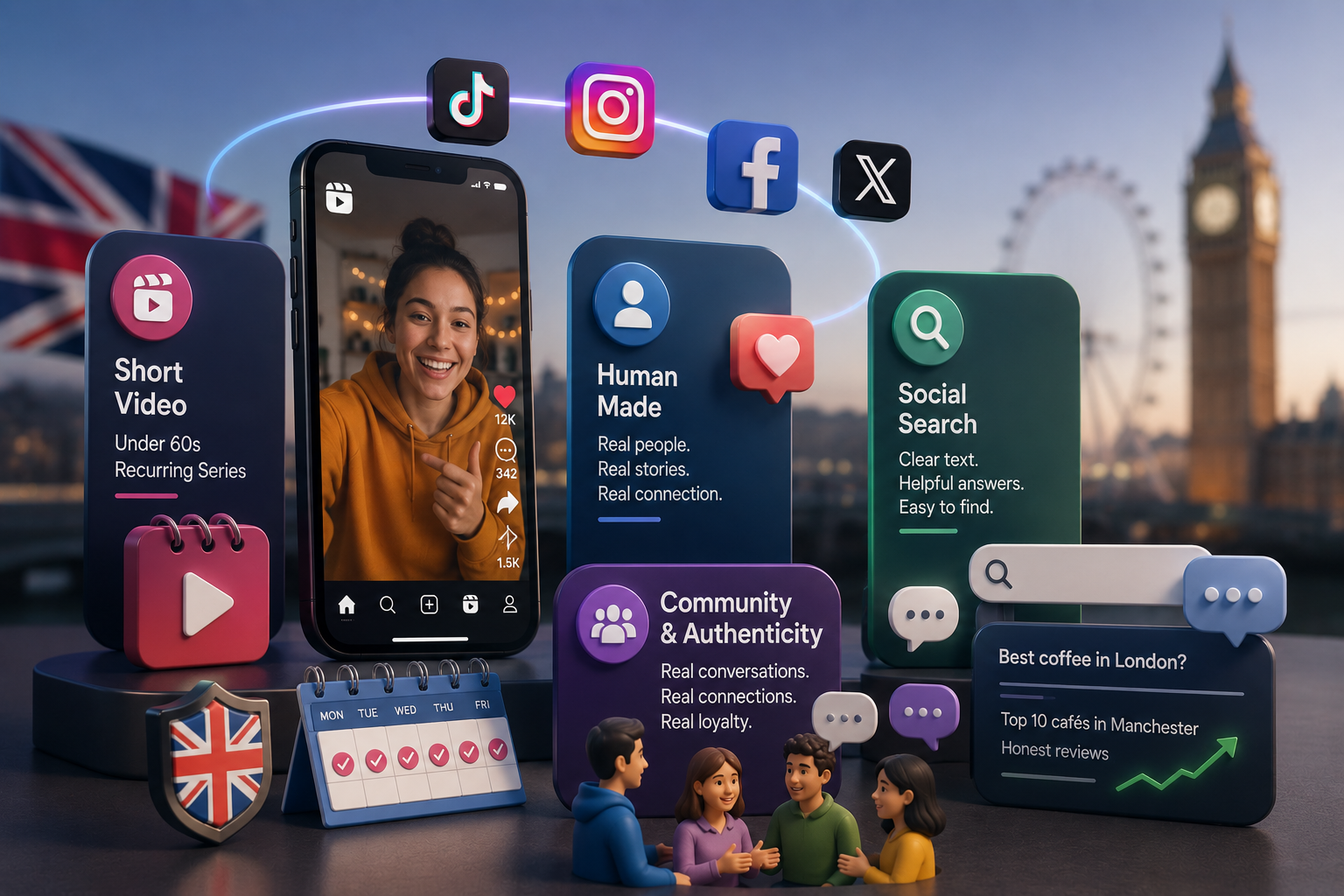
Short-form video under 60 seconds is still the format to beat. This is one of the clearest video marketing trends shaping 2026: it dominates across Facebook, Instagram, TikTok, and X, and it’s particularly effective when structured as a recurring series rather than a one-off post. Rather than reinventing your content idea every single time, UK audiences respond better to a familiar, “episodic” format they can follow week to week, the same way they’d follow a TV series.

Human-made content is winning trust back from AI-generated posts. There’s a clear disconnect in the UK market: many marketers are prioritising AI in social media marketing to scale faster, while UK consumers are saying, fairly clearly, that they want content that feels human. This doesn’t mean AI tools are off the table; they’re genuinely useful for research, captions, and scheduling, but the final content people actually see needs to feel like it was made by a real person, not generated to fill a calendar.

Social search is now a daily habit. Over 40% of UK consumers use social platforms to search for information at least once a day, and that number climbs even higher among Gen Z, who increasingly trust real people over traditional search engines for product reviews and recommendations. This is changing how content needs to be written. Using clear on-screen text in Reels, writing genuinely descriptive captions, and answering common questions directly in your posts all help your content surface when someone searches within the app itself, not just when the algorithm serves it.

Community and authenticity beat polish. Whether it’s a branded subreddit, an Instagram comment section, or a WhatsApp broadcast list, UK audiences are gravitating toward spaces that feel like genuine conversation rather than a broadcast channel. Brands that respond to comments, run honest Q&As, and show some personality behind the logo are consistently outperforming those still running a one-way content calendar.

Building an Instagram Marketing Strategy That Fits the UK in 2026

Since Instagram remains one of the strongest platforms for UK brand discovery and conversion, it’s worth getting specific about what’s working there right now.

Posting frequency matters less than it used to. Instagram’s own performance data show impressions growing even as reach and engagement on individual posts softened, suggesting the algorithm is favouring quality and watch time over sheer volume. A handful of well-produced Instagram Reels each week, paired with consistent Stories for everyday engagement, tends to outperform a rushed daily posting schedule.

Shoppable tags and in-app checkout features continue to narrow the gap between someone discovering your product and actually buying it, which is especially valuable for fashion, beauty, and home brands, where visual appeal does most of the persuading. If you’re newer to building a presence on the platform, working with UK-based micro and mid-tier influencers tends to deliver more authentic engagement than large-scale partnerships, since UK audiences are increasingly sceptical of content that feels obviously paid.

It’s also worth remembering that Instagram doesn’t operate in isolation. Most UK buyers move across platforms before converting, discovering a brand on TikTok, researching it on Reddit or Google, then following through on Instagram or WhatsApp. Building consistent messaging and creative across each of those touchpoints, rather than treating every platform as a separate silo, is what tends to separate brands that grow steadily from ones that get a short burst of attention and then fade.

Common Mistakes UK Brands Are Making Right Now

A few patterns keep showing up across UK social strategies that aren’t performing as well as they should:

  • Assuming TikTok works for every brand, when in reality it’s strongest for visually engaging, fast-moving categories like beauty, fashion, and food
  • Writing off Facebook as outdated, despite it still delivering solid reach and interaction growth among older UK demographics
  • Leaning too heavily on AI-generated captions and visuals, which research suggests is actively eroding trust with UK audiences
  • Posting inconsistently on Instagram instead of committing to a smaller number of well-made Reels and Stories each week
  • Ignoring Reddit entirely, even though it’s currently the fastest-growing platform by ad audience in the UK and increasingly influences what shows up in AI search results
  • Treating each platform as a separate strategy instead of building one consistent brand voice that follows the buyer across their journey

Final Thoughts

The biggest takeaway for UK marketers heading into the rest of 2026 is that growth isn’t necessarily happening where the industry conversation is loudest. Reddit’s quiet rise, Facebook’s steady reach among older audiences, and Instagram’s shift toward quality over quantity all point to the same lesson: success now comes from matching your platform choices and content style to where your actual audience spends time, not where everyone else assumes they should be. There’s no single answer to which social media platforms are best for business in the UK; it depends entirely on who you’re trying to reach.

If you’re managing this across multiple platforms and finding it hard to keep up with which trends are real and which are just noise, that’s exactly the kind of strategic work a dedicated team can take off your plate. Whether you’re working with a content marketing agency for blog and video assets or need help proving social media ROI to stakeholders, our social media marketing services cover everything from platform strategy and content creation to full social media management services, built around audience research rather than a one-size-fits-all posting calendar, so every piece of content earns its place in your feed.

Ready to build a 2026 social media strategy that’s actually backed by data?

Frequently Asked Questions

1. Which social media platform is growing the fastest in the UK in 2026?

Reddit currently has the fastest-growing ad audience in the UK, having recently added millions of new users and benefiting from increased visibility in AI-generated search results. Facebook and LinkedIn are also showing solid growth, particularly among older demographics and B2B audiences.

2. Is Facebook still relevant for UK marketing in 2026?

Yes. Facebook reach, impressions, and interactions have all grown in the UK over the past year, and it remains one of the strongest platforms for reaching Millennials and Gen X through community groups, local marketplace activity, and Messenger.

3. What type of content works best on UK social media right now?

Short-form video under 60 seconds, especially structured as a recurring series rather than one-off posts. UK audiences also respond strongly to authentic, human-made content over content that feels AI-generated or overly polished.

4. Should every UK brand be on TikTok?

Not necessarily. TikTok works best for visually engaging, fast-moving categories like beauty, fashion, and food, where short-form video naturally fits the product. Brands outside these categories often see better returns focusing on Instagram, Facebook, or LinkedIn instead.

5. How is social search changing UK marketing strategy?

A growing share of UK consumers, particularly Gen Z, now use social platforms to search for information daily rather than relying solely on traditional search engines. This means content needs clear on-screen text, descriptive captions, and direct answers to common questions to surface in social search results.

6. What’s the best way for a UK brand to start an Instagram marketing strategy in 2026?

Focus on a smaller number of well-produced Reels each week; use Stories for consistent everyday engagement; take advantage of shoppable tags for visual products; and consider partnering with UK-based micro-influencers, who tend to drive more authentic engagement than larger, less relatable accounts.
How to Run Facebook and Instagram Ads for Real Estate in 2026: Setup, Budget, and Creative Breakdown

If you sell, rent, or develop real estate, you already know the buyer journey no longer starts with a phone call. It starts with a scroll. Someone is lying on their couch, swiping through Instagram Reels, and suddenly your 3BHK listing pops up with a quick walkthrough video. That’s the moment real estate deals begin in 2026.

Facebook ads and Instagram ads (run together through Meta Ads Manager) are still one of the most reliable ways for real estate agents, brokers, and developers to get in front of buyers and renters who are actually ready to act. But the platform itself has changed a lot. The old approach of picking 15 interests, setting a budget, and hoping for the best simply doesn’t work the way it used to. Meta’s algorithm is smarter, more automated, and a lot less forgiving of lazy setups.

This guide breaks down exactly how to set up Facebook and Instagram ads for real estate in 2026, what budget actually makes sense, and what kind of creative gets clicks instead of getting scrolled past.

Quick Summary:

Facebook and Instagram ads remain among the best lead-generation channels for real estate in 2026, but the old playbook of manual targeting no longer works. Meta’s Advantage+ AI now handles most targeting decisions, which means your account setup, Special Ad Category compliance, budget structure, and creative quality matter more than ever. This guide walks through how to set up a real estate Ads campaign correctly, how much to budget, what creative formats convert best (hint: vertical video), and the common mistakes that quietly drain ad spend. By the end, you’ll have a clear, practical framework to start generating qualified buyer and renter leads.

Not sure if your Meta Ads budget is being spent the right way?

Quick Navigation

Why Meta Ads Still Matter for Real Estate in 2026

Step 1: Get Your Account Set Up the Right Way

Step 2: Build Your Targeting Around What Meta Can Still Do Well

Step 3: Setting a Budget That Actually Makes Sense

Step 4: Creative Is Doing More of the Work Than Ever

Step 5: Instant Forms and Faster Lead Capture

Step 6: Don’t Treat Meta Ads as a Standalone Channel

Common Mistakes to Avoid

Final Thoughts

Frequently Asked Questions

Why Meta Ads Still Matter for Real Estate in 2026

There’s a lot of noise right now about ChatGPT ads, AI search, and other emerging channels. Those are worth keeping an eye on, but they’re not replacing Meta anytime soon. People still spend close to an hour a day combined on Facebook and Instagram, and that kind of daily attention is hard to beat for real estate, where buyers need multiple touchpoints before they trust an agent enough to book a site visit.

What’s changed is how Meta delivers results. The platform has shifted almost entirely toward AI-driven automation, known as Advantage+. Instead of advertisers micromanaging every targeting option, Meta’s AI now studies signals like browsing behaviour, pixel data, and engagement patterns to find the right audience on its own. For real estate specifically, this means the agencies that are still using narrow, manually built audiences from two or three years ago are usually the ones complaining about rising cost per lead. The ones adapting to the new system are seeing the opposite.

If you’re trying to decide where Meta Ads fit into your bigger online strategy, it helps to look at this alongside other channels.

Step 1: Get Your Account Set Up the Right Way

Before you even think about budgets or creative, your account needs to be built correctly. A surprising number of real estate ad accounts fail not because of bad creative, but because of basic setup mistakes.

  • Use a Business Manager account, not a personal profile boost. Boosting posts from a personal page might feel quicker, but it limits your targeting, reporting, and scalability. Set up a proper Meta Business Suite account connected to your Facebook Page and Instagram profile.
  • Install the Meta Pixel and Conversions API on your website. This is non-negotiable in 2026. With third-party cookies gone and privacy rules tighter than ever, Meta relies heavily on first-party data sent directly from your website to understand who’s actually converting. If you skip this step, you’re essentially flying blind, and Meta’s AI has nothing useful to learn from.
  • Select the right campaign objective. For real estate, “Leads” is usually the best objective if you want people to fill out a form for more details, schedule a visit, or download a brochure. “Traffic” works if you’re sending people to a property listing page on your website. Avoid “Awareness” unless you’re specifically running a brand campaign for a new project launch.
  • Declare the Special Ad Category. This is one of the most important and most overlooked steps. Any housing-related ad in the US falls under Meta’s Special Ad Category for Housing, which exists because of fair housing laws. If you don’t select this category and Meta’s system detects real estate imagery in your ad (floor plans, “for sale” signs, building exteriors), it can automatically restrict the campaign or flag your account. Selecting the category upfront removes guesswork and keeps you compliant.

Under Special Ad Category restrictions, you lose access to detailed targeting by age, gender, ZIP code, and certain interests, as well as lookalike audiences. Don’t panic. Meta replaces these with Special Ad Audiences, a compliant version of lookalike targeting that builds a similar audience without using protected characteristics. Combine that with location-based targeting (a minimum 15-mile radius applies to housing ads), and you still get strong reach without breaking any rules.

Step 2: Build Your Targeting Around What Meta Can Still Do Well

Since detailed demographic targeting is limited for housing ads, your job shifts from “who should I target” to “what should my creative say to attract the right people on its own.” This sounds strange at first, but it’s actually how Meta’s AI is designed to work now.

A solid structure for real estate looks like this:

  • Geo-targeted campaigns centered on the neighbourhoods or cities where your listings are. Keep the radius realistic. A 15- to 25-mile radius around a project location usually performs better than targeting an entire metro area.
  • Advantage+ Audience is turned on so Meta can expand reach beyond your set parameters when it spots high-intent users, such as people who recently searched for mortgage calculators or browsed competing listings.
  • Retargeting layer for people who’ve visited your website, watched a video, or engaged with a previous ad but haven’t yet filled out a form. This group converts at a much lower cost than cold audiences, so don’t skip it.
  • Engagement layer aimed at people who follow your page or have interacted with your content before, useful for nurturing leads who aren’t ready to buy yet but might be in three to six months.

A workable budget split many agencies use is roughly 70% toward cold prospecting (Advantage+ or Special Ad Audience within your geo zone), 20% toward retargeting website visitors, and 10% toward warming up engaged audiences. Adjust based on the size of your existing audience pool.

Step 3: Setting a Budget That Actually Makes Sense

There’s no single “correct” daily budget for real estate ads, but here’s a realistic way to think about it.

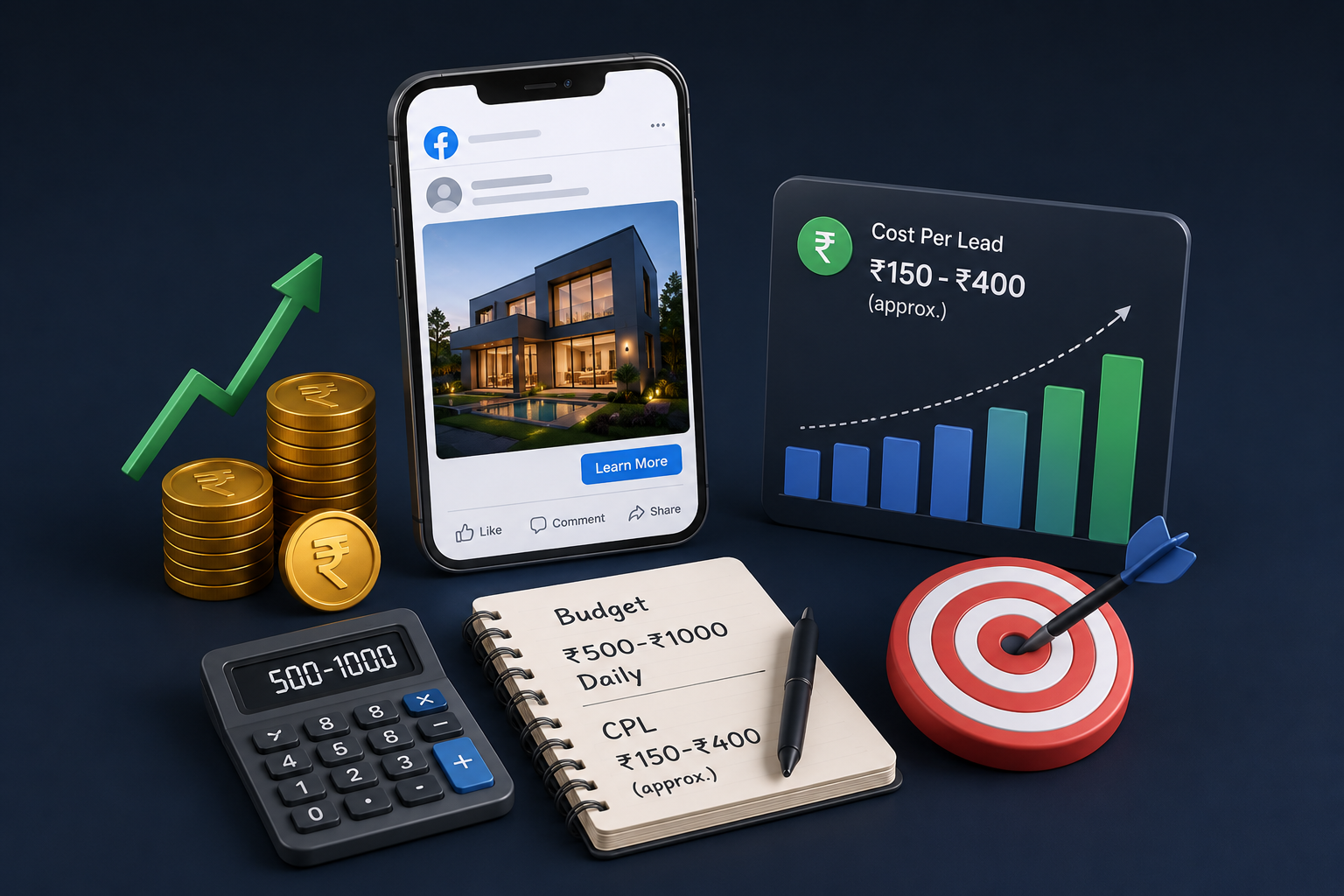
For a single property listing in a competitive city, expect the cost per lead to land somewhere between ₹150 and ₹400 (roughly $5 to $15 in US markets), depending on property type, price point, and competition. Luxury or commercial real estate tends to cost more per lead simply because the audience is smaller and more competitive.

If you’re just starting out, don’t spread a tiny budget across five different campaigns. Meta’s algorithm needs sufficient data (typically a baseline of conversions per week) to optimise properly. A focused ₹500-₹1000 daily budget for one well-structured campaign will almost always outperform ₹100 a day spread across five scattered campaigns.

Run campaigns for at least 4 to 7 days before judging performance. Meta’s system goes through a “learning phase” early on, and pausing or editing campaigns too often resets that learning, which quietly wastes your budget. This is a mistake we see constantly when auditing real estate ad accounts, and it’s one of the easiest things to fix once you know what to look for.

If your current cost per lead has crept up compared to last year, it’s often not your budget that’s the problem; it’s your campaign structure. That’s where you need some effective digital marketing strategies that can help your real estate projects sell faster. What’s better than effective managed paid ads, as they work best when combined with the rest of your online presence?

Step 4: Creative Is Doing More of the Work Than Ever

Here’s the part that’s changed the most. Because targeting is now largely automated, your creative is what tells Meta’s AI (and the actual humans scrolling) who this ad is for. A photo of a luxury penthouse with copy about “spacious family homes near top schools” sends mixed signals to both the algorithm and the viewer. Be specific and consistent.

A few things that matter a lot right now:

  • Vertical video is the default, not an option. Over 90% of Meta’s ad inventory is now vertical (9:16), thanks to the merger of Stories and Reels into a single placement system. If you’re still uploading square or landscape photos and letting Meta auto-crop them, you’re likely cutting off important parts of your image, like the price tag, headline, or the property itself. Shoot or edit specifically for 9:16 from the start.
  • Short property tour videos outperform static photos by a wide margin. Video content generates dramatically higher engagement in real estate ads compared to photo carousels alone. The sweet spot for a listing tour video is 60 to 90 seconds, walking through the property in a logical order (entrance, living area, kitchen, bedrooms, view or balcony, then a closing shot with price and contact info).
  • Carousel ads still work well for showcasing multiple units or floor plans. If you’re advertising a project with multiple configurations (2BHK, 3BHK, penthouse), a carousel lets potential buyers compare options without leaving the ad.
  • Disclose AI-generated content. If you’re using AI tools to generate any part of your visual creative (not just colour correction or cropping, but actual AI-generated scenes, renders, or people), Meta now requires disclosure. Skipping this is becoming one of the more common reasons ads get rejected, so it’s worth checking your creative workflow if you’ve started using AI image tools for staging or virtual renovations.
  • Match your copy to the audience you want, not the audience you can target. Since you can’t manually target by income or family status for housing ads, your words have to do that filtering. “Perfect for first-time buyers under ₹50 lakh” pulls in a very different crowd than “Premium 4BHK villas with private pools.” Write the headline as if you’re speaking directly to the person you want to click.

Step 5: Instant Forms and Faster Lead Capture

Instant Forms (lead ads that open directly in Facebook or Instagram without sending people to a separate website) continue to be among the highest-converting formats for real estate, mainly because they remove friction. The user doesn’t have to leave the app, wait for a page to load, or fill out a long form.

Meta has also started rolling out AI-assisted form building, where you can point the tool at your property listing page and it will automatically generate a usable Instant Form. This saves a meaningful amount of setup time if you’re running multiple listing campaigns at once.

A couple of practical tips for Instant Forms in real estate: keep the form to 4 or 5 fields maximum (name, phone, email, and maybe budget range or preferred location), and always follow up within minutes, not hours. Leads from Instant Forms cool off fast, and the agencies seeing the best return are the ones with a CRM connected directly to their ad account so leads get a call or WhatsApp message almost immediately.

Step 6: Don’t Treat Meta Ads as a Standalone Channel

This is probably the biggest shift in how real estate marketing works in 2026. Buyers no longer move through one neat funnel. Someone might see your Instagram ad, search your agency name on Google a week later, read a blog post you wrote about the neighbourhood, and only then fill out a form. If your Meta Ads aren’t backed by a solid website, decent SEO, and consistent content, you’re leaving a lot of that interest on the table.

This is why most successful real estate marketing right now runs Meta Ads alongside SEO and content, not instead of it.

Common Mistakes to Avoid

A few patterns show up again and again in underperforming real estate ad accounts:
  • Forgetting to select the Special Ad Category for housing, which risks ad disapproval or account restrictions.
  • Editing or pausing campaigns too frequently, which resets Meta’s learning phase and quietly inflates costs.
  • Using landscape or square images in a feed that’s now almost entirely vertical.
  • Sending paid traffic to a slow, outdated, or non-mobile-friendly website, which kills conversion rates no matter how good the ad is.
  • Running ads without a pixel or Conversions API set up, leaving Meta’s AI with no real data to optimise against.
  • Treating every property the same in messaging, instead of writing creative that speaks to the specific buyer for that specific listing.

Final Thoughts

Running Facebook and Instagram ads for real estate in 2026 isn’t about outsmarting the algorithm with clever targeting tricks anymore. It’s about feeding Meta’s AI high-quality, clean data and a compliant setup, then letting it do what it’s genuinely gotten quite good at: finding the right person at the right time. Pair that with a website and content strategy that supports the same buyers once they leave the ad, and you’ve got a system that keeps generating leads long after the campaign goes live.

If setting all of this up feels like a lot to manage alongside actually selling properties, that’s exactly the kind of work our team handles every day. Deftsoft works with real estate agents, brokers, and developers to build and manage Meta Ads campaigns, websites, and AI SEO strategies that work together instead of competing for the same budget. Reach out to us if you’d like a free audit of your current ad account and a clear idea of where you’re leaving leads on the table.

Ready to turn your ad spend into actual site visits and closings?

Frequently Asked Questions

1. How much should I spend on Facebook and Instagram ads for real estate in 2026?

There’s no fixed number, but a focused daily budget of ₹500 to ₹1000 (roughly $10 to $20) on a single, well-structured campaign usually outperforms a small budget spread across multiple campaigns. Meta’s algorithm needs enough weekly conversions to optimise properly, so concentrating your spend tends to work better than spreading it thin.

2. Do real estate ads need special approval on Meta?

Yes. Housing-related ads must be run under Meta’s Special Ad Category for Housing, a requirement tied to fair housing laws. This restricts certain targeting options, such as age, gender, ZIP code, and lookalike audiences, but Meta provides compliant alternatives, such as Special Ad Audiences and geo-radius targeting.

3. Is Instagram or Facebook better for real estate ads

Neither works better in isolation. Most real estate campaigns run across both platforms simultaneously through Meta Ads Manager, using Advantage+ Placements so the algorithm can decide where each version of your ad performs best, whether that’s Facebook Feed, Instagram Reels, or Stories.

4. What type of creative works best for real estate ads right now?

Short vertical video tours (60 to 90 seconds, shot in 9:16 aspect ratio) consistently outperform static photos. Carousels work well for showcasing multiple unit types or floor plans within a single project.

5. How long should I let a campaign run before judging its performance?

At least 4 to 7 days. Meta’s system goes through a learning phase early on, and editing or pausing a campaign too soon resets that learning, which often makes performance look worse than it actually is.

6. Can I target buyers by income or family status

Not directly. Special Ad Category restrictions remove those targeting options for housing ads. Instead, your ad copy and creative need to do that filtering by speaking directly to the buyer you want, for example, mentioning price range, property type, or lifestyle details that naturally attract the right audience.

7. Do I need a website to run Meta Ads for real estate?

It’s strongly recommended. While Instant Forms let you capture leads without sending people to a website, a fast, mobile-friendly site with proper SEO supports the rest of the buyer journey and gives Meta’s pixel and Conversions API the data it needs to optimise your campaigns effectively.

How AI Search Is Changing Real Estate Lead Generation in Dubai

Dubai’s real estate market has never been more exciting. With record-breaking property transactions, a surge in international investor activity, and a steady flow of expats seeking homes, the demand for real estate in the UAE continues to grow at a remarkable pace.

But here’s the thing: the way people find properties has changed completely.

A few years ago, a buyer would type something like “apartments for sale in Dubai Marina” into Google and scroll through listings. Today, more and more buyers, especially younger investors and tech-savvy expats, are turning to AI-powered search tools. They ask ChatGPT, “What are the best off-plan projects in Dubai right now?” or use Google’s AI Overviews to get instant answers without even visiting a website.

This shift is massive. And if your real estate business is not adapting to it, you are already missing out on a growing stream of qualified leads.

This blog breaks down exactly how AI search is changing real estate lead generation in Dubai, what it means for your marketing strategy, and how Deftsoft’s digital marketing services can help your business stay ahead of the curve.

Quick Summary

  • AI-powered search tools like ChatGPT, Google AI Overviews, and Perplexity are changing how buyers in the UAE discover properties
  • Traditional real estate SEO in Dubai is no longer enough; AI search optimization is now essential
  • Real estate lead generation in Dubai requires smarter content, structured data, and authority-building
  • Off-plan property lead generation in Dubai is one of the biggest opportunities in AI search right now
  • Deftsoft helps real estate businesses across Dubai and the UAE rank in AI search results and attract high-quality leads

Ready to Get Found in AI Search?

Is your real estate business visible when buyers ask ChatGPT or Google AI about properties in Dubai? If not, you’re losing leads to competitors.

Quick Navigation

What Is AI Search and Why Should Dubai Real Estate Businesses Care?

Why Traditional Dubai Real Estate SEO Is No Longer Enough

AI SEO for Real Estate in Dubai: What It Actually Looks Like

1. Conversational Content That Answers Real Buyer Questions

2. Structured Data and Schema Markup

3. Hyperlocal Content for Dubai Neighbourhoods

4. Building Topical Authority

5. Technical SEO Foundations

Real Estate Lead Generation in Dubai in the Age of AI

AI-Powered Chatbots on Real Estate Websites

Personalised Property Recommendations

Smarter Lead Nurturing Through AI

Predictive Analytics for Better Targeting

Off-Plan Property Lead Generation Dubai: A Major AI Search Opportunity

How Deftsoft Helps Real Estate Businesses Win with AI SEO in the UAE

Conclusion: The Future of Real Estate Marketing in Dubai Is AI-Driven

Frequently Asked Questions (FAQs)

AI search is not just a trend; it is becoming the default way people look for information online.

Here is what AI search looks like in practice:

  • Google AI Overviews: Google now shows AI-generated summaries at the top of search results. These pull from websites it trusts. If your site is not one of them, you are invisible.
  • ChatGPT and Bing Copilot: Buyers type full questions and get direct answers. They may never visit a traditional website.
  • Perplexity AI: Growing fast in the UAE market, especially among professionals and investors looking for research-backed answers.
  • Gemini (Google’s AI assistant): Deeply integrated into Android and Google Search, meaning millions of UAE users interact with it daily.

For real estate professionals in Dubai, this is both a challenge and a huge opportunity. The businesses that learn how to show up in these AI-generated answers will capture leads that their competitors do not even know they are missing.

Why Traditional Dubai Real Estate SEO Is No Longer Enough

Let’s be honest, the old way of doing SEO for real estate in Dubai was fairly simple. You would target keywords like “villas for sale in Jumeirah,” create some property listing pages, maybe write a few blogs, and build some backlinks. That was enough to rank on page one.

Those days are fading fast.

Here is why traditional Dubai real estate SEO alone is falling short:

1. Zero-Click Searches Are Growing. More searches than ever end without a single click on a website. Google answers the question directly at the top of the page using AI. If your content doesn’t provide those answers, you get zero traffic, even if you are on page one.

2. Buyers Ask Questions, Not Keywords. AI search is conversational. A buyer does not type “off-plan apartments Dubai 2026.” They ask, “Which off-plan projects in Dubai offer the best ROI for a first-time investor?” Your SEO strategy needs to answer real questions, not just target isolated keywords.

3. Authority Matters More Than Ever AI search engines prioritise websites that demonstrate genuine expertise, authority, and trust (what Google calls E-E-A-T: Experience, Expertise, Authoritativeness, Trustworthiness). Low-quality content and keyword stuffing actually hurt you now.

4. Voice and Mobile Search Is Dominant in the UAE. A significant portion of property searches in the UAE occur on mobile devices, often via voice assistants. AI-powered voice search returns one single answer. You either get that slot, or you don’t.

This is why Deftsoft’s AI SEO services go far beyond traditional SEO; they are designed specifically for the way search works today and where it is heading tomorrow.

AI SEO for Real Estate in Dubai: What It Actually Looks Like

So what does proper AI SEO for real estate in Dubai involve? Here is a practical breakdown:

1. Conversational Content That Answers Real Buyer Questions

Instead of writing content that targets keyword phrases, AI-optimised content is built around the actual questions your buyers are asking. Think: “Is it a good time to buy property in Dubai?” or “What is the process for a foreigner to buy off-plan in the UAE?” These question-and-answer formats are exactly what AI search tools pull from.

2. Structured Data and Schema Markup

Structured data tells search engines and AI tools exactly what your content is about. For real estate websites, this includes schema for property listings, reviews, FAQs, business details, and local area information. Without this, AI search tools are guessing about your content.

3. Hyperlocal Content for Dubai Neighbourhoods

AI search is getting extremely location-specific. Content about specific communities, Downtown Dubai, Business Bay, Arabian Ranches, Palm Jumeirah and Dubai Hills Estate, performs significantly better in AI-generated results than generic property content. Each neighbourhood needs its own rich, informative content.

4. Building Topical Authority

AI tools trust websites that cover a topic deeply and comprehensively. A real estate website that has detailed guides on buying, selling, investing, mortgage options, visa rules for property investors, and community comparisons will be seen as an authority and recommended by AI search tools accordingly.

5. Technical SEO Foundations

Fast page speeds, mobile-first design, clean site architecture, and secure hosting are all non-negotiable. AI search tools crawl and evaluate these signals just like traditional search engines do.

Deftsoft’s SEO services for real estate cover all of these elements, giving your business the full package needed to dominate both traditional and AI search results in the UAE.

Real Estate Lead Generation in Dubai in the Age of AI

Showing up in AI search is one part of the puzzle. Converting that visibility into actual leads is another. Here is how AI is changing real estate lead generation in Dubai beyond just search rankings:

AI-Powered Chatbots on Real Estate Websites

Buyers searching for a property at midnight do not want to wait until morning to speak to an agent. AI chatbots added to the website, trained specifically on your listings and services, can qualify leads, answer questions, schedule viewings, and capture contact details 24/7. This alone can dramatically increase your conversion rate.

Personalised Property Recommendations

AI can analyse a visitor’s behaviour on your website and serve them personalised property recommendations, much like how Netflix suggests content. This keeps buyers engaged longer and increases the chances they submit an enquiry.

Smarter Lead Nurturing Through AI

Once you have a lead, AI-powered CRM and email tools can send the right message to the right person at the right time. Whether a buyer is just browsing or ready to sign a contract, your communication should match their stage in the journey.

Predictive Analytics for Better Targeting

AI tools can now analyse market trends, buyer behaviour patterns, and demographic data to help you identify the most likely buyers before they even enquire. This makes your paid advertising and outreach far more efficient.

Off-plan property lead generation in Dubai is one of the most competitive and lucrative areas of real estate marketing in the UAE. Developers and agencies are competing fiercely for the attention of investors looking to invest in projects such as Dubai Creek Harbour, Emaar’s latest launches, and emerging communities in Dubai South.

AI search is creating a significant opportunity here that many agencies are not yet capturing.

When an investor in the UK, India, or Russia types into ChatGPT: “What are the best off-plan projects in Dubai to invest in right now?” the AI will pull an answer from websites it considers reliable and authoritative. If your website has well-structured, current, and detailed content about off-plan launches, payment plans, developer track records, and ROI comparisons, you have a real chance of being that source.

This is exactly the kind of content strategy that Deftsoft’s real estate content marketing team builds, tailored to help you capture AI-driven leads from global investors actively looking at the Dubai market.

Key content formats that work well for off-plan AI search include:

  • Project comparison guides (“Emaar vs. Damac: Which Off-Plan Developer Offers Better ROI?”)
  • Payment plan explainers (“How Do Off-Plan Payment Plans Work in Dubai?”)
  • Area guides tied to specific developments
  • Investor FAQ pages for each project
  • Video scripts optimised for AI search (yes, AI pulls from transcripts too)

How Deftsoft Helps Real Estate Businesses Win with AI SEO in the UAE

Deftsoft is not a generic digital marketing agency. We specialise in building high-performance digital strategies for competitive industries, and Dubai real estate is one of the most competitive markets in the world.

Here is what working with Deftsoft looks like for a real estate business:

AI Search Audit and Strategy. We start by analysing where your current website stands in both traditional and AI search results. We identify the gaps, opportunities, and quick wins, then build a roadmap tailored to your business goals.

Content That AI Tools Actually Recommend. Our content team creates in-depth, expertly written content for your real estate brand that answers the exact questions your buyers are asking. Every piece is structured for AI readability, local relevance, and conversion.

Technical SEO and Schema Implementation We handle the behind-the-scenes technical work that makes your site easy for AI to understand, crawl, and cite in its answers.

Local SEO for Dubai and UAE Markets. From Google Business Profile optimisation to neighbourhood-specific landing pages, we ensure your business appears in local search results across Dubai, Abu Dhabi, Sharjah, and beyond.

Lead Generation Funnel Design: Great SEO means nothing if your website does not convert. We design and optimise landing pages, lead-capture forms, and chatbot flows that convert AI search visitors into qualified enquiries.

Explore Deftsoft’s full range of digital marketing services and see how we have helped businesses across the UAE grow their online presence and lead pipelines.

Conclusion: The Future of Real Estate Marketing in Dubai Is AI-Driven

Dubai’s real estate market will continue to attract global investors, expat buyers, and high-net-worth individuals. But the path those buyers take to find a property is changing rapidly.

AI search is not a future trend; it is happening right now. Every day that your real estate business is not visible in AI-generated answers is another day of lost leads and missed opportunities.

The good news? Businesses that act early on AI search optimisation will build a significant advantage that is difficult for competitors to close. The content, authority, and technical foundations you build today will compound over time, driving consistent, high-quality leads for years to come.

Deftsoft is here to help you make that move with the expertise, strategy, and execution that the Dubai real estate market demands.

Don’t Let Competitors Capture Your Leads

Dubai’s real estate market moves fast. Your digital strategy shuld, too. Deftsoft’s team of AI SEO specialists is ready to help you show up where your buyers are searching and turn that visibility into a consistent flow of qualified leads.

Frequently Asked Questions (FAQs)

Q1. What is AI SEO for real estate in Dubai?

AI SEO for real estate in Dubai means optimising your website and content so that AI-powered search tools, like Google AI Overviews, ChatGPT, and Perplexity, recommend your business when buyers search for properties in Dubai. It involves creating expert content, structured data, and strong technical foundations that AI search engines trust and cite.

Q2. Why is AI search important for real estate lead generation in Dubai?

More and more property buyers, especially international investors — are using AI tools to research Dubai real estate before making any contact with an agent. If your business does not appear in those AI-generated answers, you are invisible to a growing segment of buyers. AI search is where the next generation of leads will come from.

Q3. How is Dubai real estate SEO different from AI SEO?

Traditional Dubai real estate SEO focuses on ranking in the standard Google search results using keywords and backlinks. AI SEO goes further — it optimises for AI-generated answers, conversational queries, and zero-click search results. It requires deeper content, stronger authority signals, and structured data that AI tools can easily read and reference.

Q4. How can I improve off-plan property lead generation in Dubai using AI?

Focus on creating detailed, trustworthy content about off-plan projects — including payment plans, developer comparisons, ROI analysis, and community guides. This is the type of content that AI tools pull from when investors ask about off-plan opportunities in Dubai. Working with a specialist agency like Deftsoft can significantly accelerate these results.

Q5. How long does it take to see results from AI SEO for real estate?

Results vary depending on your current website authority, content quality, and competition. Typically, businesses start seeing improvements in AI search visibility within 3 to 6 months of a consistent strategy. Lead generation impact often follows closely after improved visibility.

Q6. Does Deftsoft offer AI SEO services specifically for real estate in Dubai?

Yes. Deftsoft provides tailored AI search optimisation and digital marketing services for real estate developers, agencies, and brokers in Dubai and across the UAE. We understand the specific challenges of this market and build strategies that generate real, measurable leads.

How UAE Tourism Companies Can Use Video SEO to Drive More Bookings

The UAE tourism market is one of the most competitive digital spaces in the region. Hotels, resorts, tour operators, destination experience providers, holiday rental companies, yacht tours, desert safari businesses, and luxury travel brands are all competing for the same audience: travelers who are researching, comparing, and booking online.

In that environment, simply having a website and posting occasional social media updates is no longer enough. Tourism brands need a content strategy that helps them get discovered early in the travel planning journey, stay visible across multiple platforms, and convert interest into direct bookings. That is exactly where video-led marketing makes a difference.

Today’s traveler wants to see a destination before they book it. They want to watch a room tour before reserving a hotel, preview an experience before paying for it, and understand what makes one travel package different from another. Video helps answer those questions faster than text alone. But video content only works when people can actually find it. That is why video SEO, YouTube content strategy, Instagram Reels, and Facebook remarketing should work together as part of one tourism marketing system.

Quick Summary

UAE tourism video SEO demands more than basic social media updates — it requires a strategic, video-led booking funnel. While travelers rely on highly visual content to research destinations, hotel rooms, and luxury experiences, video content only drives revenue if it is discoverable. By aligning video creation with actual search intent across YouTube and Instagram, and backing it with conversion-optimized landing pages, UAE tourism brands can capture high-intent traffic early. Transforming video from a branding afterthought into a structured, search-optimized acquisition asset builds trust, bypasses digital noise, and measurably increases direct bookings.

Is your website losing the bookings your videos are attracting?

A great video needs a flawless landing page to convert. Let Deftsoft audit your current digital funnel, from search visibility to checkout experience.

Quick Navigation

Why Video Matters More Than Ever for UAE Tourism Brands

What Video SEO Means for Tourism Marketing

Start With Search Intent, Not Just Content Ideas

How YouTube SEO Helps Tourism Brands Capture High-Intent Traffic

What tourism brands should publish on YouTube

Key YouTube SEO practices for tourism brands

How Instagram Reels Help Tourism Brands Reach Travelers Earlier

How Facebook Supports Retargeting and Booking Conversion

Build a Full Booking Funnel Instead of Isolated Content

Stage 1: Discovery

Stage 2: Consideration

Stage 3: Conversion

Stage 4: Retention and repeat bookings

The Role of the Website in Video-Led Tourism Marketing

Content Ideas UAE Tourism Brands Can Start Using Right Away

For hotels and resorts

For tour and activity brands

For destination-focused travel brands

For luxury tourism brands

How Deftsoft Turns Video Engagement into Direct Bookings

Final Thoughts

FAQs

Why Video Matters More Than Ever for UAE Tourism Brands

Tourism is a visual buying decision. A traveler choosing between two hotels, two desert safari operators, or two tour packages is often influenced by what feels more memorable, more trustworthy, and more premium. Video helps create that feeling quickly.

A well-produced short video can show:

  • What the hotel room actually looks like
  • What a city tour feels like in real life
  • How a private transfer, yacht experience, or luxury stay is delivered
  • What kind of audience is the brand best suited for
  • Why is the experience worth the price

For UAE tourism brands, this matters even more because the market includes a mix of luxury leisure travelers, family holiday planners, short-stay visitors, business travelers, event travelers, and high-intent international tourists. Many of them are making quick decisions online, often after watching videos across multiple platforms.

Quick Stat

Dubai alone welcomed 19.59 million international overnight visitors in 2025, marking another record year for tourism growth. In the first half of 2025, the city had already reached 9.88 million international visitors.

For hotels, attractions, and tourism businesses, that scale of demand creates a huge opportunity, but it also increases digital competition. Brands that show up consistently in search and social channels have a much stronger chance of winning the booking.

This is why tourism businesses should stop treating video as a “nice extra” and start using it as a core growth channel.

What Video SEO Means for Tourism Marketing

Video SEO is the process of optimizing video content so it can rank and appear in relevant search results across platforms such as Google and YouTube. It also helps videos perform better when embedded on websites, landing pages, and blog content.

For a tourism brand, video SEO is not just about views. It is about showing the right video to the right traveler at the right stage of their booking journey.

For example:

  • A family searching for the best desert safari for kids in Dubai may come across a YouTube video comparing family-friendly options.
  • A couple searching for a luxury beachfront hotel in Abu Dhabi may click a room tour video that answers their questions before they even visit the booking page.
  • A traveler searching for things to do in Dubai Marina at night may find a video guide that leads them to a cruise booking or local tour page.

In each case, the video becomes part of the conversion path.

For tourism brands, good video SEO includes:

  • choosing the right search-focused topics
  • using destination and service keywords in titles and descriptions
  • adding chapters, captions, and strong thumbnails
  • linking viewers to relevant landing pages
  • embedding videos on service pages and blog content
  • using analytics to understand which content drives bookings or inquiries

This is where SEO, content marketing, and digital marketing services work together. The goal is not to create random travel videos. The goal is to create content that aligns with real traveler intent and drives revenue.

A common mistake in tourism marketing is creating videos that focus solely on what the brand wants to promote. The smarter approach is to begin with what travelers are already searching for.

For UAE tourism businesses, video topics should be built around questions and booking intent, such as:

  • Best places to stay in Downtown Dubai
  • Family-friendly resorts in Ras Al Khaimah
  • What to expect on a Dubai desert safari
  • Abu Dhabi luxury hotel room tour
  • Best time to visit Dubai for shopping and sightseeing
  • Things to do near Burj Khalifa
  • Private yacht tour Dubai price guide
  • UAE honeymoon itinerary ideas
  • Dubai stopover travel guide
  • Airport transfer and hotel check-in tips for first-time visitors

This is where keyword research services and SEO consulting services become valuable. A tourism business can publish a visually strong video, but if it is not aligned with actual search demand, it may not drive the traffic or bookings the brand expects.

The strongest tourism video strategies usually combine three types of content:

  1. Discovery content –  videos that help travelers explore destinations, attractions, and experiences
  2. Decision-stage content –  videos that compare options, show rooms, explain packages, or answer common objections
  3. Conversion content –  videos tied directly to offers, booking pages, lead forms, or WhatsApp inquiries

When those three content types are aligned, video becomes a real booking asset rather than just a branding tool.

How YouTube SEO Helps Tourism Brands Capture High-Intent Traffic

YouTube should be a major channel for tourism brands in the UAE because it serves both discovery and decision-making. Travelers use YouTube to research destinations, compare experiences, evaluate hotel quality, and understand logistics before booking.

Unlike short-form social content that disappears quickly, YouTube videos can continue attracting traffic for months or even years when optimized properly.

What tourism brands should publish on YouTube

A UAE tourism business can build a strong YouTube content library around:

  • hotel room tours
  • destination guides
  • itinerary videos
  • resort walkthroughs
  • activity previews
  • customer experience videos
  • travel tips for first-time visitors
  • seasonal event guides
  • luxury travel experience showcases
  • FAQs about visas, transport, or local travel planning

For example, a resort in Dubai can create videos like:

  • 3-night luxury stay in Dubai: what’s included
  • Best room categories for couples vs families
  • Inside our beachfront suite in Dubai
  • What to do near our hotel in 48 hours
  • Airport to hotel: the easiest arrival guide for tourists

A desert safari company could create:

  • Evening desert safari Dubai: complete experience guide
  • VIP vs standard desert safari: which one should you book?
  • What to wear for a desert safari in Dubai
  • Family Desert Safari Tips for First-Time Visitors

These videos do more than attract views. They reduce booking hesitation.

Key YouTube SEO practices for tourism brands

To improve discoverability, tourism businesses should optimize:

  • video titles with destination and service keywords
  • descriptions with clear summaries, location context, and booking links
  • thumbnails that show the experience clearly
  • chapters for room features, itinerary stops, inclusions, and pricing sections
  • closed captions for accessibility and keyword relevance
  • playlists grouped by destination, hotel category, experience type, or traveler segment

It also helps to link every video back to a relevant service page, booking page, or blog article. That is where web development services and landing page optimization become important. If a user watches a video and clicks through, the next page must be fast, mobile-friendly, and designed to convert.

How Instagram Reels Help Tourism Brands Reach Travelers Earlier

If YouTube is strong for search and research, Instagram is powerful for inspiration and early-stage attention. Reels are especially useful for tourism brands because travel decisions often begin with visual aspiration. A short clip of a skyline view, an infinity pool, a private desert dinner, or a luxury suite can create instant interest.

For UAE tourism brands, Instagram works well for:

  • luxury hotel visuals
  • Short itinerary inspiration
  • Before-and-after travel moments
  • Behind-the-scenes hospitality content
  • Influencer-style property walkthroughs
  • vent-based travel promotions
  • cultural experiences and food discovery
  • “save this for your Dubai trip” style content

Instagram also helps brands stay top-of-mind with international travelers who may not be ready to book immediately but are collecting ideas for an upcoming trip.

How Facebook Supports Retargeting and Booking Conversion

Facebook may not always be the first platform people think of for travel discovery, but it remains highly useful for remarketing, audience targeting, and conversion campaigns. It is especially effective when paired with website traffic, video views, and lead-generation campaigns.

Tourism brands can use Facebook to retarget:

  • People who watched a YouTube video but did not book
  • Website visitors who viewed hotel or package pages
  • Users who engaged with Instagram content
  • Travelers who opened a lead form but did not submit it
  • past customers with new seasonal offers or return-trip promotions

For example, if someone watches a video tour of a luxury suite in Dubai and visits the booking page without converting, Facebook can help bring them back with a tailored offer, a testimonial video, or a limited-time package ad.

This is where PPC services, paid social advertising, and remarketing strategy support the wider video funnel. The booking may not happen on the first touchpoint, but Facebook helps the brand stay visible until the traveler is ready to act.

Platform Customer Mindset Primary Content Type Strategic Goal
YouTube Active Research / Intent-Driven Long-form Tours, Guides, FAQs Capturing high-intent search traffic
Instagram Casual Discovery / Visual Aspiration Short-form Reels, Aesthetics, Teasers Sparking early-stage travel inspiration
Facebook Passive / Evaluative Retargeting Ads, Social Proof, Offers Driving conversion & cart recovery

Build a Full Booking Funnel Instead of Isolated Content

One of the biggest mistakes tourism brands make is treating every platform separately. The hotel team posts on Instagram, the marketing team uploads a few videos to YouTube, and someone boosts a Facebook ad now and then. The result is activity, but not a system.

A stronger approach is to build a connected booking funnel:

Stage 1: Discovery (The Hook)

  • Goal: Catch travelers planning their trip.
  • Assets: Search-optimized YouTube guides (“Things to do in Downtown Dubai”) and localized SEO blogs.

Stage 2: Consideration (The Proof)

  • Goal: Remove hesitation and build trust.
  • Assets: Detailed resort walkthroughs, room tours, and Instagram Reels emphasizing the aesthetic vibe.

Stage 3: Conversion (The Close)

  • Goal: Turn interest into an active booking.
  • Assets: Frictionless, mobile-first landing pages, targeted WhatsApp click-to-chat widgets, and clear package terms.

Stage 4: Retention (The Loop)

  • Goal: Win back past guests.
  • Assets: Targeted social remarketing and exclusive seasonal staycation packages emailed before peak holidays.

When tourism businesses think in funnels instead of channels, every piece of content becomes more valuable. See our guide to building a digital marketing funnel for hospitality brands for a deeper walkthrough of each stage.

The Role of the Website in Video-Led Tourism Marketing

A tourism brand can create excellent videos and still lose bookings if the website experience is poor. Slow pages, unclear package information, weak mobile design, and confusing inquiry flows can undo the value of all that content.

This is why video marketing should connect directly with:

For example, if a YouTube video is about a luxury Dubai stay package, the landing page it links to should include:

  • Package details
  • Room visuals
  • Inclusions and exclusions
  • FAQs
  • Testimonials or trust signals
  • A simple booking or inquiry CTA
  • A mobile-friendly layout
  • Embedded video for extra reassurance

This is especially important for international travelers, who often make decisions quickly and expect frictionless online experiences.

Content Ideas UAE Tourism Brands Can Start Using Right Away

If you are a hotel, resort, tour operator, travel company, or destination brand in the UAE, here are practical video-led content ideas that can support bookings:

For hotels and resorts

  • Room tours by category
  • 48-hour itinerary around the property
  • Airport-to-check-in travel guide
  • Family amenities showcase
  • Spa, dining, and pool walkthroughs
  • Seasonal staycation package explainer

For tour and activity brands

  • What to expect from the full experience
  • Pickup to drop-off journey videos
  • Family vs luxury package comparison
  • Top Mistakes Tourists Make Before Booking
  • Best time of day for the experience
  • Customer testimonial videos

For destination-focused travel brands

  • First-time Dubai travel guide
  • Abu Dhabi luxury weekend itinerary
  • Hidden experiences beyond the usual tourist spots
  • Where to stay based on traveler type
  • Best months to visit for shopping, beaches, events, or family travel

For luxury tourism brands

  • VIP experience showcases
  • Behind-the-scenes hospitality storytelling
  • Premium transfer or concierge experience videos
  • Suite tours with experience-led narration
  • Curated itinerary videos for high-end travelers

How Deftsoft Turns Video Engagement into Direct Bookings

Creating visually stunning travel videos is only half the battle; the real challenge is engineering a digital ecosystem that turns those views into revenue. At Deftsoft, we eliminate the friction of managing disconnected campaigns across multiple vendors. We integrate high-impact video assets directly into a unified digital marketing system—combining advanced Video SEO, targeted PPC remarketing, and high-converting web design to ensure your content reaches travelers at the exact moment they are ready to book.

Rather than treating video as isolated social media noise, our team aligns your visual content with real search intent and local UAE market trends. From optimizing your YouTube presence for high-intent search terms to designing flawless, mobile-first landing pages that capture traffic from Instagram Reels, we turn visual storytelling into a predictable engine for direct bookings, maximizing your return on ad spend and web traffic.

Final Thoughts

Tourism marketing in the UAE is becoming more visual, more competitive, and more performance-driven. Travelers are not just reading about destinations anymore. They are watching them, comparing them, and deciding faster based on what they see online.

That shift creates a major opportunity for hotels, resorts, tour operators, and travel brands that are ready to invest in video-led digital growth. A well-planned mix of video SEO, YouTube content, Instagram Reels, Facebook remarketing, and conversion-focused landing pages can help tourism brands attract the right audience, build trust earlier, and turn more travel intent into real bookings.

For tourism businesses in Dubai and across the UAE, the goal should not be to “post more videos.” The goal should be to build a connected content and booking ecosystem where every video drives visibility, every platform drives conversion, and every campaign drives revenue.

That is exactly where Deftsoft can add value. With expertise in SEO, social media marketing, content marketing, PPC, web development, and end-to-end digital marketing, Deftsoft can help tourism brands build a smarter growth strategy that turns attention into bookings and traffic into long-term business results.

Ready to turn your views into direct bookings?

Don’t let your video content get lost in the noise. Contact Deftsoft’s digital marketing experts today for a tailored Video SEO strategy that drives high-intent travelers straight to your booking engine.

FAQs

1. What is video SEO in tourism marketing?

Video SEO in tourism marketing is the process of optimizing videos so they can appear in search results on platforms like Google and YouTube. For tourism brands, this includes using relevant travel keywords, writing strong video titles and descriptions, adding captions, and linking videos to hotel, tour, or booking pages. The goal is to help potential travelers discover your content as they research destinations, accommodations, or travel experiences.

2. How can YouTube help tourism brands in the UAE get more bookings?

YouTube helps tourism brands attract travelers who are actively researching destinations, hotels, activities, and travel plans. A UAE hotel or tour operator can publish room tours, itinerary guides, experience previews, and destination videos that answer common traveler questions. When these videos are optimized for search and linked to booking pages, they can bring highly relevant traffic and support direct conversions.

3. Is Instagram useful for hotels and travel businesses in Dubai?

Yes, Instagram is highly effective for hotels, resorts, tour operators, and travel brands in Dubai because travel decisions are often visual. Instagram Reels can showcase rooms, amenities, local attractions, dining experiences, and curated travel moments in a way that quickly builds interest. It works especially well for brand visibility, engagement, and remarketing when paired with a website or booking campaign.

4. How does Facebook help tourism businesses increase bookings?

Facebook is valuable for remarketing and conversion campaigns. Tourism businesses can use it to re-engage users who watched a video, visited a hotel or package page, or interacted with content on Instagram. With the right targeting strategy, Facebook can help move interested travelers back into the booking funnel through tailored offers, seasonal packages, or direct inquiry campaigns.

5. What type of videos should UAE tourism brands create?

UAE tourism brands should create videos that match traveler intent at different stages of the booking journey. Good examples include hotel room tours, destination guides, package explainers, resort walkthroughs, itinerary videos, customer experience videos, FAQs for first-time travelers, and short-form content around local attractions or seasonal experiences. The best-performing videos are those that answer real travelers’ questions and guide users toward a booking decision.

E-E-A-T in 2026: How to Prove Expertise to Both Google and AI Engines

Something changed in search this year, and many businesses haven’t caught up yet.

For a while, the playbook was simple: publish a lot of content, hit your keywords, build some backlinks, and watch the traffic come in. That playbook is dead. Google’s April 2026 core update placed heavy weighting on search intent alignment, topical authority, and real-world expertise signals, and the sites that were coasting on keyword density and bulk content got hit hard and fast.

At the same time, a second search engine has quietly taken over a huge chunk of how people find information, and it isn’t Google’s blue links. It’s AI. Google AI Overviews now appear in over 60% of searches, and tools like ChatGPT, Perplexity, and Gemini are answering questions directly rather than sending people to websites at all.

So now your content has two judges instead of one. Google’s traditional ranking system is judging you. And a separate AI layer is judging you too, deciding whether your page is trustworthy enough to quote, cite, or recommend. Google AI Signals now evaluates things like Semantic Intent and real-world Expertise far beyond simple keywords — and the uncomfortable truth is, both judges are now looking for the exact same thing: proof that a real, knowledgeable human is behind what you published.

This guide breaks down what E-E-A-T actually means in 2026, why authentic, first-person content is winning over generic AI-generated fluff, and exactly what you need to do about it.

Quick Summary

If you only have two minutes, here’s the short version:

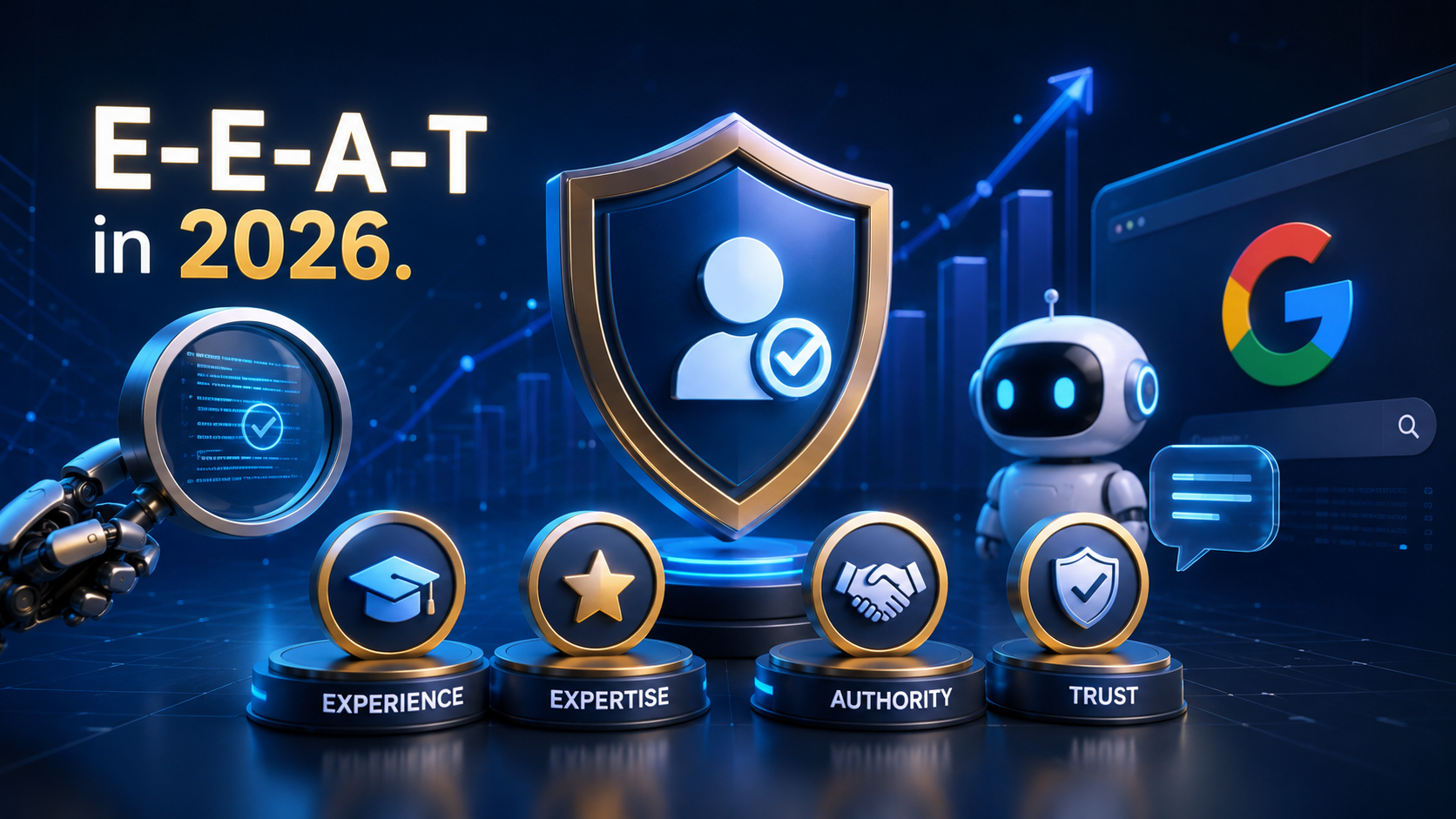
  • E-E-A-T stands for Experience, Expertise, Authoritativeness, and Trustworthiness. It’s not a literal ranking score — it’s the quality framework that Google’s human reviewers use, and it shapes the real signals the algorithm measures.
  • Trustworthiness is the most important piece of the four. Google’s own guidelines describe it as the foundation that the other three feed into.
  • AI Overviews and AI search tools (AEO and GEO) lean on the same trust signals as traditional SEO. There is no separate “AI SEO” playbook — the same factors that earn organic rankings also earn AI citations.
  • Generic, AI-spun content without real human input is being actively pushed down. Google’s update specifically targets low-quality AI-generated content that lacks unique insights or factual depth.
  • First-person experience, real photos, specific details, named authors and genuine results are now a measurable advantage, not a nice extra.

Now let’s get into the details.

Ready to Dominate Search and AI Overviews in 2026?

Don’t let algorithmic shifts leave your business behind. Our team is here to help you audit your current strategy, build bulletproof topical authority, and align your content with the latest E-E-A-T and AI engine requirements.

Quick Navigation

What E-E-A-T Actually Means in 2026

Why AI Engines Care About the Exact Same Thing

Why Generic AI-Generated Content Is Losing

The Trust Signals That Actually Move the Needle

Topical Authority: Why One Great Article Isn’t Enough

What This Looks Like in Practice

Common Mistakes Businesses Are Still Making

Frequently Asked Questions

What E-E-A-T Actually Means in 2026

E-E-A-T isn’t new. Google introduced E-A-T (Expertise, Authoritativeness, Trustworthiness) in 2014 and added the second “E” for Experience in December 2022. That one addition mattered more than it seemed at the time — it signaled that Google wanted content from people who’ve actually done the thing they’re writing about, not just researched it from a desk.

Here’s something worth clearing up, because it confuses a lot of people: E-E-A-T is not a direct ranking factor the algorithm reads and scores. It’s the target Google’s engineers are aiming at, while things like backlinks, page speed, and author signals are the actual bullets fired at that target. You can’t “add E-E-A-T” the way you’d add a meta tag. You build the real underlying qualities, and the measurable signals follow.

What does that look like in practice?

  • Experience  means showing you’ve actually used, tested, or lived through what you’re writing about. Real-world photos, specific project details, client outcomes, and personal insights all signal genuine experience — and a generic article rewritten from five other websites simply doesn’t have it.
  • Expertise  is the depth of knowledge. You don’t need a PhD to qualify; a tradesperson with 20 years of hands-on experience, or a small business owner who has spent a decade perfecting their craft, counts as an expert in Google’s eyes.
  • Authoritativeness  is about reputation outside your own website. Are other credible sources mentioning you, linking to you, or citing you as a source?
  • Trustworthiness  ties it all together, and it’s the one that matters most. A page with no trust scores low no matter how much experience, expertise, or authority it appears to have — which is exactly why a flashy, well-written page with hidden commercial bias or unverifiable claims still underperforms.

Why AI Engines Care About the Exact Same Thing

Here’s the part most businesses haven’t connected yet: this isn’t only a Google ranking issue anymore.

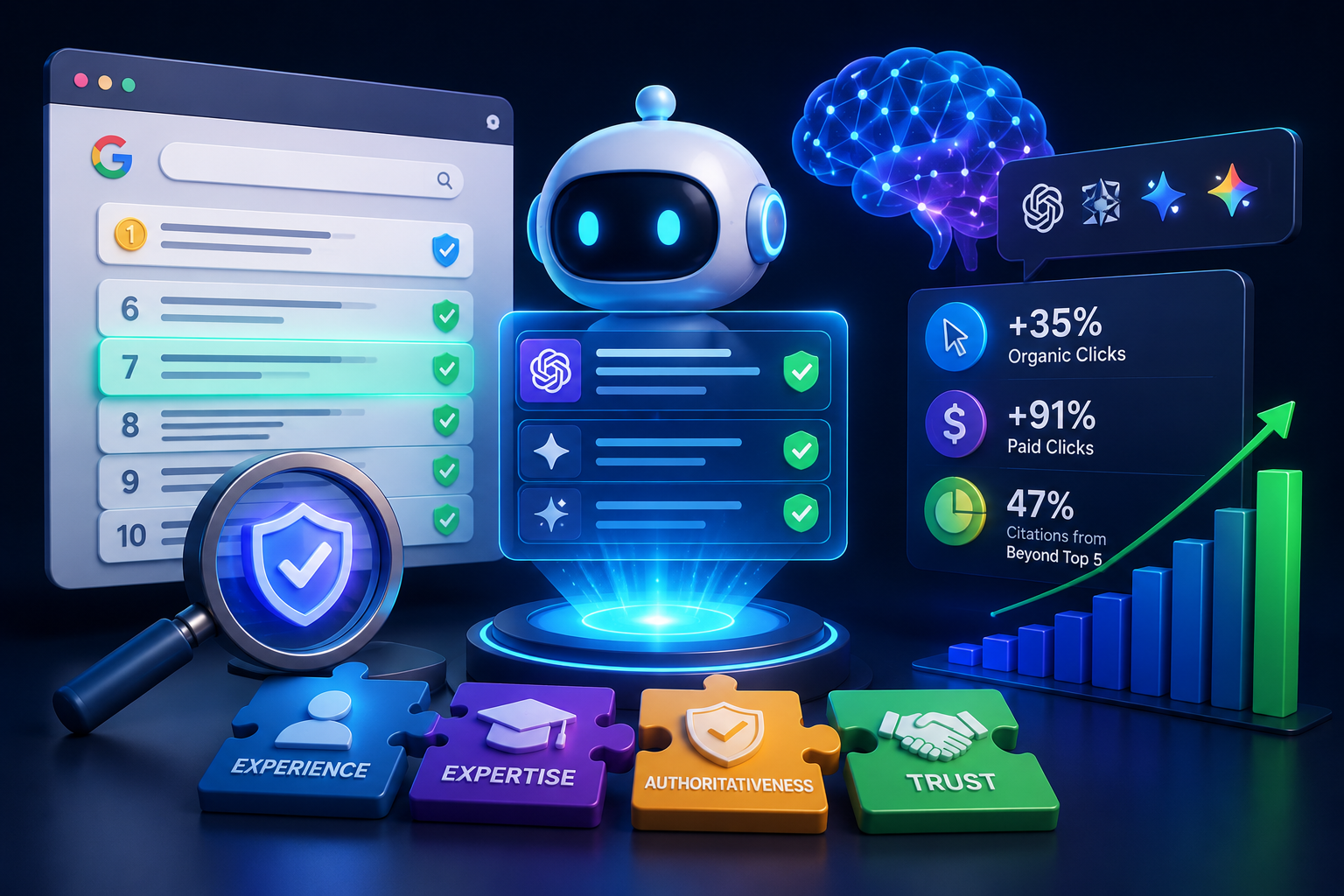
Answer Engine Optimization (AEO) and Generative Engine Optimization (GEO) are the terms floating around for getting cited inside AI-generated answers — in ChatGPT, Perplexity, Gemini, and Google’s own AI Overviews. The instinct is to treat these as a brand-new discipline with its own tricks. But that’s not quite right — Generative Engine Optimization is not a separate discipline, and the pages ranking well in traditional search with strong E-E-A-T are largely the same pages getting cited in AI Overviews. As Google’s Search Liaison Danny Sullivan put it plainly in early 2026: “SEO for AI is still SEO.”

The data backs this up clearly. In an analysis of 2,400 AI Overview citations, pages ranking #6 through #10 with strong E-E-A-T signals were cited 2.3 times more often than #1-ranked pages with weak authority signals. Rank position alone doesn’t win anymore — trust does.

It also matters in a very practical, business sense. Content cited in AI summaries receives roughly 35% more organic clicks and 91% more paid clicks than competitors that aren’t cited. And here’s the encouraging part for smaller or newer sites: 47% of AI Overview citations now come from pages ranking below position #5, which means AI search genuinely operates on different rules than the old “be #1 or be invisible” approach to rankings.

Why Generic AI-Generated Content Is Losing

There’s a reason this article keeps coming back to “real” and “human.” It’s not a moral stance — it’s what the data shows is actually happening to rankings right now.

Bulk AI-generated content with no human oversight is being actively devalued, and Google’s systems have gotten better at detecting templated, low-signal content even when it’s grammatically correct and properly uses keywords. Grammar and keyword placement used to be the most important part of the game. Now they’re table stakes that get you nothing on their own.

This isn’t anti-AI, to be clear. It’s not about rejecting AI tools — it’s about refining how they’re used, so AI empowers human creators to produce more insightful content rather than replacing them with automated mediocrity. The line Google is drawing isn’t “human vs. AI-written.” It’s “content with a real point of view vs. content with none.”

And readers feel this gap too, not just algorithms. A Q1 2026 survey found that 70% of consumers struggle to tell human and AI-generated content apart, but 85% said they prefer human-authored content when they’re specifically looking for expert advice. People can sense generic fluff even when they can’t articulate why a piece feels hollow — and they trust it less.

The fix isn’t complicated, even if it takes more effort: use AI to speed up research, drafting, and structuring, but make sure a real person with actual knowledge of the topic adds the specifics, opinions, and details that only come from genuinely doing the work.

The Trust Signals That Actually Move the Needle

If you want to build genuine E-E-A-T rather than fake it, focus on these areas.

Named, credentialed authors.  Author Entities are not optional in 2026; consistent identity, Person schema markup, a topical publishing history, and third-party recognition all build what’s called the “Author Vector” that Google uses to evaluate trustworthiness. An anonymous “admin” byline is now a red flag, not a neutral default.

Specific, original detail.  Vague generalities are easy to spot. Specific numbers, named tools, real outcomes, and exact processes are much harder to fake — and that’s exactly why they signal trust.

Third-party validation.  Guest posts on authoritative sites, being quoted as an expert in industry publications, speaking at conferences — any verifiable third-party signal connecting your name to your topic area — strengthens your authority far more than anything you can do purely on your own site.

Self-contained, complete answers.  Semantic completeness, providing a full answer without requiring the reader to click elsewhere, is the single strongest predictor of whether content gets selected for AI Overviews, with content scoring high on this measure roughly 4.2 times more likely to be featured.

Multi-format content.  Pages that combine text, images, video, and proper schema markup achieve a 317% higher selection rate in AI search results than plain text alone.

Connected, not disconnected, ideas.  AI systems understand content better when concepts are explicitly linked together —for example, by explaining how author credentials, marked up with schema and backed by citations, work together to build confidence—rather than listing isolated facts side by side.

Topical Authority: Why One Great Article Isn’t Enough

A single well-written page can rank for a single query. It generally can’t carry the trust weight needed to win consistently across a topic. That’s where topical authority comes in.

A website that consistently covers a topic from multiple angles, with original insight, data, and structured content clusters, outperforms broader sites that treat the same topics superficially. This is the practical reason for building “content hubs” rather than scattered, unrelated blog posts: each piece reinforces the others, and together they signal to Google and AI engines that you genuinely know this subject inside and out.

This also connects to internal linking, which is often treated as a minor technical detail but actually carries real weight. Mapping content by theme and strengthening internal links between related pieces signals topical authority to Google’s crawlers and distributes ranking value more effectively across a site.

If your business publishes occasionally and randomly, a post about pricing this month, a totally unrelated trend piece next month, you’re working against yourself. Depth in a focused area beats breadth across unrelated ones, every time.

What This Looks Like in Practice

Let’s make this concrete. Say you run a landscaping business and you want to publish about lawn care.

The losing approach: a generic, AI-generated 800-word post titled “5 Tips for a Healthy Lawn,” written with no named author, no real photos, and advice that could apply to literally any region or climate.

The winning approach: a post written under your actual name (with a short bio establishing your years in the field), including real photos from your own jobs, specific advice tied to your actual region’s soil and climate, mentions of mistakes you’ve personally seen homeowners make, and links to two or three other detailed posts on your site about related topics, fertilizing schedules, common pests in your area, seasonal mowing heights.

One of these reads like a real person who’s done this work for years. The other reads like every other lawn care article on the internet. Both Google and AI engines can tell the difference now — and increasingly, so can the reader.

Common Mistakes Businesses Are Still Making

Even businesses that know E-E-A-T matters often get the execution wrong:

  • Treating it as a checkbox.  Adding an author bio here and a citation there without anything genuine underneath doesn’t fool anyone — least of all an algorithm specifically trained to detect exactly that pattern.
  • Publishing AI output unedited.  Pages built purely on automated text without human review tend to lack the depth and accuracy that E-E-A-T signals are designed to detect.
  • Ignoring structure for AI search.  Skipping clear headings, FAQ sections, and direct answers means your content is far less likely to ever appear in AI Overviews, no matter how good the underlying writing is.
  • Chasing the wrong metrics.  Many teams still obsess over domain authority scores. Many SEOs are wasting time chasing domain-level metrics that no longer matter much for AI visibility — content-level trust signals matter far more now.

Conclusion

Navigating the complex landscape of 2026 search—where AI integration and evolving trust signals define visibility—requires a sophisticated, data-backed approach. At Deftsoft, we specialize in bridging the gap between technical SEO and authoritative content strategy. Whether you are looking to refine your topical authority, optimize for AI Overview citations, or ensure your brand’s expertise is accurately signaled to search engines, our team provides the comprehensive digital marketing expertise needed to stay ahead. Let us help you transform your online presence into a trusted industry voice that thrives in both traditional search and the new era of generative AI.

Is Your Content Strategy Ready for the Next Core Update?

Staying ahead of evolving search engines requires more than just standard keyword optimization.

Frequently Asked Questions

1. Is E-E-A-T an actual Google ranking factor?

Not directly. It’s a quality framework from Google’s Search Quality Rater Guidelines, used to train the algorithm rather than being scored by it directly. But the real signals that demonstrate E-E-A-T — like author credibility, backlinks, and factual accuracy — absolutely do influence rankings.

2. What’s the difference between SEO, AEO, and GEO?

SEO is the practice of optimizing for traditional search rankings. AEO (Answer Engine Optimization) and GEO (Generative Engine Optimization) focus on getting cited inside AI-generated answers and chat tools. In practice, they aren’t separate disciplines — the same E-E-A-T fundamentals that drive SEO success also drive AI citations.

3. Can AI-written content ever rank well in 2026?

Yes, if it’s reviewed, fact-checked, and enhanced by a real person with genuine knowledge of the topic. The issue isn’t the tool used to draft content — it’s publishing generic, unedited AI output with no original insight or human oversight.

4. How important are author bios and credentials?

Very. Consistent author identity, Person schema markup, and a real publishing history are now treated as meaningful trust signals rather than nice-to-haves.

5. Does ranking #1 guarantee I’ll be cited in AI Overviews?

No. Google’s AI now uses a “query fan-out” technique that fires off multiple related sub-queries and pulls sources from across all of them, so a page ranking lower for a related question can get cited while the #1 result for the main keyword gets skipped entirely.

6. How can a small business build E-E-A-T without a big content team?

Start small and specific. A tradesperson with two decades of hands-on experience or a business owner who’s perfected their craft over the years already qualifies as an expert — the work is documenting that real experience clearly, not manufacturing credentials you don’t have.

Why Businesses Need AI-Powered Websites in 2026: The Complete Guide

A few years ago, having a website was enough. Today, it isn’t.

If your website still looks the same to every visitor, answers nothing on its own, and waits for a human to respond to every query, you’re not just behind, you’re invisible to a growing share of your potential customers. Worldwide AI spending is set to hit $2.52 trillion in 2026, a 44% jump from the previous year, and that money is flowing straight into how businesses build and run their websites.

Here’s the part that should really get your attention: sites that AI crawlers can read and understand are now generating 320% more human traffic, 270% more form submissions, and 250% more click-to-call events than sites that aren’t AI-friendly. That’s not a future trend. That’s happening right now, to businesses that made the switch and businesses that didn’t.

The shift from static to smart isn’t about chasing buzzwords. It’s about your website actually working for you, learning from visitors, answering questions instantly, personalizing what people see, and helping your business make decisions faster. The businesses waiting for “the right time” to adopt AI on their websites are already losing ground to those that didn’t wait.

At Deftsoft, we’ve watched this shift happen in real time across the businesses we work with. This guide breaks down exactly what AI-powered websites are, why they matter for your business in 2026, and how to get started — in plain language, no tech jargon required.

Quick Summary

In 2026, static websites are becoming obsolete as AI-driven platforms emerge as the new business standard. Transitioning from traditional sites to intelligent ones can boost human traffic by 320% and provide a 3.7x ROI on generative AI investments.

AI-powered websites continuously learn from visitor behavior to offer real-time content personalization, conversational 24/7 chatbot support, and predictive search. Across sectors such as e-commerce and healthcare, these tools reduce operational costs and increase conversion rates. Partnering with experts like Deftsoft allows businesses to securely integrate scalable AI features, maintaining a competitive edge in an automated marketplace.

Is your website ready for the AI era?

Don’t let your business get left behind.

Quick Navigation

What Are AI-Powered Websites?

Key Features of AI-Powered Websites

Real-Time Content Personalization

Conversational AI and Intelligent Chatbots

Predictive Search and Smart Navigation

Automated A/B Testing and Optimization

AI-Powered Analytics and Behavioral Insights

Benefits of AI-Powered Websites for Businesses

Higher Conversion Rates Through Hyper-Personalization

24/7 Customer Support Without Scaling Your Team

Reduced Operational Costs Through Automation

Faster Decision-Making With Real-Time Data

Improved SEO Performance via AI Content Tools

Industry Use Cases: AI Websites Across Sectors

AI Technologies Powering Modern Business Websites

How Deftsoft Builds AI-Powered Websites: Our Process

Common Challenges and How to Overcome Them

The Future of AI in Web Development

Why Now Is the Best Time to Invest in an AI Website

Conclusion: The Smartest Move You Can Make for Your Website in 2026

Frequently Asked Questions

What Are AI-Powered Websites?

Let’s keep this simple. An AI-powered website is a website that can think a little. Instead of showing the exact same homepage to every visitor and waiting for someone to click around and find what they need, it actively helps each visitor — recommending products, answering questions, adjusting content, and learning from behavior as it goes.

Think of the difference this way: a traditional website is like a printed brochure sitting on a shelf. It looks nice, but it’s the same for everyone who picks it up, and it can’t respond to questions. An AI-powered website is more like a knowledgeable store employee who remembers what you looked at last time, points you toward what you actually need, and answers your questions on the spot — at 2 pm or 2 am, it doesn’t matter.

Traditional websites are built once and updated occasionally. AI-powered websites are built to keep learning. They continuously process visitor behavior, search patterns, and conversion data, and use that information to adjust what appears on the page, who receives a chatbot popup, and which products are recommended to whom.

This isn’t a niche thing anymore, either. 41% of businesses now use AI-powered tools specifically for website creation, and among advanced AI adopters that figure climbs to 70%. It’s quickly becoming the default, not the exception.

Key Features of AI-Powered Websites

Not every “AI-powered” website does the same things. Here are the features that actually move the needle for businesses.

Real-Time Content Personalization

Instead of a single homepage for everyone, the site adjusts what it shows based on who’s visiting, their location, past behavior, the device they’re using, and even the time of day. A returning customer might automatically see different content than a first-time visitor.

Conversational AI and Intelligent Chatbots

Modern AI chatbots aren’t the clunky, scripted bots from a few years ago. They understand natural language, answer detailed questions, qualify leads, and hand off to a human only when needed. They work around the clock, which matters more than ever, customers don’t wait for business hours anymore, and they don’t expect to.

Search bars that understand intent, not just keywords. Type “something for a beach wedding” and get relevant results, even if no product is literally titled that. This alone can dramatically cut bounce rates from visitors who couldn’t find what they wanted.

Automated A/B Testing and Optimization

Instead of manually testing one headline against another for weeks, AI tools run multiple versions simultaneously, learn which versions perform best for each audience segment, and adjust automatically, no developer required.

AI-Powered Analytics and Behavioral Insights

These tools go beyond “how many people visited” and start answering “why did they leave,” “what almost converted them,” and “what should we change next.” That’s the difference between data and decisions.

Benefits of AI-Powered Websites for Businesses

So what does all this actually translate to for your bottom line?

Higher Conversion Rates Through Hyper-Personalization

When visitors see content that’s relevant to them, they’re far more likely to stick around and buy. Personalized recommendations, smart pop-ups, and tailored offers consistently outperform one-size-fits-all pages.

24/7 Customer Support Without Scaling Your Team

An AI chatbot doesn’t need overtime pay, sick days, or a second shift. It can answer the same question a thousand times a day without getting tired, and it frees your human team to handle the complex cases that genuinely need a person.

Reduced Operational Costs Through Automation

Tasks that used to require a person, answering FAQs, qualifying leads, scheduling appointments and sending follow-ups, now happen automatically. That’s real money saved every month, not just convenience.

Faster Decision-Making With Real-Time Data

When your website is constantly feeding you insight on what’s working and what isn’t, you stop guessing. Marketing, product, and pricing decisions all become faster and more accurate.

Improved SEO Performance via AI Content Tools

AI tools help structure content, identify gaps, and optimize pages for both traditional search engines and newer AI-driven search experiences that more customers use to find businesses like yours.

It’s worth pausing to consider the bigger picture, too: companies report a 3.7x return on every dollar invested in generative AI and related technologies. This isn’t a cost center — it’s an investment with measurable payback.

Industry Use Cases: AI Websites Across Sectors

AI-powered websites aren’t a one-size-fits-all upgrade. Here’s how different industries are putting them to work right now.

  • Ecommerce.  Product recommendation engines, smart search that understands customer intent, dynamic pricing, and chatbots that handle order tracking and returns without a single phone call. AI and AI agents drove $262 billion in global online sales during the most recent holiday shopping season alone — a number that’s only going up.
  • Healthcare.  Symptom-checker tools that guide patients to the right department, AI-driven appointment booking that eliminates phone tag, and intake chatbots that collect information before a patient ever speaks to staff.
  • Finance.  Risk calculators, personalized financial product recommendations, AI advisors that answer basic questions instantly, and fraud-detection systems working quietly in the background to protect customers.
  • SaaS and Tech.  Automated onboarding flows that adapt to each user’s role and goals, in-app usage analytics that flag when a customer might churn, and self-service support that resolves issues before a ticket is ever filed.
  • Real Estate.  Virtual assistants that answer property questions instantly, AI-powered filters that learn buyer preferences, and automated scheduling for property viewings.

Across nearly every industry, the same pattern repeats: AI handles the repetitive, predictable work, and humans focus on the relationships and decisions that actually need a human touch.

AI Technologies Powering Modern Business Websites

You don’t need to become an engineer to understand this, but it helps to know what’s actually running under the hood.

  • Natural Language Processing (NLP)  is what allows chatbots and search bars to understand human language, including typos, slang, and casual phrasing — rather than requiring exact keywords.
  • Machine Learning  is the technology behind personalization and prediction. It looks at patterns in visitor behavior and gets better at predicting what each person wants over time, without anyone manually programming the rules.
  • Computer Vision  allows websites to understand images, useful for visual search (“find me something that looks like this”), automated image tagging, and accessibility features.
  • Large Language Models (LLMs)  are the newest and most powerful layer, powering the conversational AI tools, content generation, and increasingly sophisticated chat experiences that feel less like talking to a bot and more like talking to someone who actually understands you.

These technologies are increasingly bundled together rather than used in isolation, which is part of why AI websites have become so much more capable in the last year or two.

How Deftsoft Builds AI-Powered Websites: Our Process

Adopting AI on your website doesn’t have to mean ripping everything out and starting over. Here’s how we approach it at Deftsoft.

1. Discovery and AI Readiness Assessment.  We start by understanding your business, your customers, and the pain points of your current website. Not every business needs every AI feature — we figure out what will actually move your numbers.

2. Strategy, Architecture, and Technology Selection.  We map out which AI capabilities fit your goals and budget, and choose the right technology stack to support them without overengineering.

3. AI Feature Integration and Development.  This is where chatbots, personalization engines, smart search, and analytics tools get built and woven into your existing site or a new build, depending on what makes sense.

4. Testing, QA, and Performance Optimization.  AI features get tested across real-world scenarios — not just “does it work,” but “does it work well, fast, and reliably for actual customers.”

5. Launch, Monitoring, and Continuous Improvement.  AI-powered websites aren’t a set-it-and-forget-it project. We monitor performance after launch and keep refining based on real data, because that’s the whole point of using AI in the first place.

Common Challenges and How to Overcome Them

It wouldn’t be honest to pretend this is all upside down with zero friction. Here’s what businesses typically run into — and how to handle it.

  • Data privacy and compliance concerns.  Personalization requires data, and data comes with responsibility. The fix is building privacy into the system from day one — clear consent flows, secure data handling, and compliance with regulations like GDPR baked into the architecture, not bolted on afterward.
  • Integration with legacy systems.  Many businesses worry that adding AI means tearing out everything they already have. In most cases, it doesn’t. AI features can be layered onto existing platforms incrementally, starting small and expanding as you see results.
  • Measuring ROI on AI website investments.  This is a real concern, and a fair one. 56% of CEOs report zero measurable ROI despite deploying AI somewhere in their business — usually because the AI was added without a clear goal attached to it. The solution starts with specific, measurable objectives (more leads, lower support costs, higher conversion) rather than adding AI features just because everyone else is.

The Future of AI in Web Development

Where is all this heading? A few AI web development trends are worth watching closely.

  • Agentic web experiences.  Websites are starting to act more like agents than static pages, capable of completing tasks on a visitor’s behalf rather than just displaying information. 40% of new enterprise applications are expected to feature task-specific AI agents by 2026, and websites are very much part of that shift.
  • Voice-first and multimodal interfaces.  Typing isn’t the only way people interact with websites anymore. Voice search, image-based search, and their combinations are becoming standard expectations rather than novelties.
  • AI and the next generation of UX design.  Design itself is becoming AI-assisted, with layouts, color choices, and content placement increasingly informed by data on what actually converts, rather than pure aesthetic guesswork.

The pace of change here is genuinely fast. The average time to produce a complete website draft has dropped from a full work week to around 15 minutes as of early 2026. The tools are maturing quickly, and the businesses paying attention now will be the ones setting the pace later.

Why Now Is the Best Time to Invest in an AI Website

There’s always a temptation to wait, for the technology to mature, for competitors to test it first, for budgets to free up. Here’s why that instinct is costing businesses more than they realize.

  • Early movers are already seeing measurable advantages.  Businesses with AI-powered websites are converting more visitors, spending less on support, and gathering better data than competitors still running static sites. That gap compounds over time.
  • Costs are decreasing as AI tooling matures.  What required custom development and large budgets two years ago is now accessible to small and mid-sized businesses. Small and medium enterprises now drive nearly half of all AI website builder revenue, proof that this is no longer an enterprise-only tool.
  • The competitive window is closing.  AI on websites is moving from “nice differentiator” to “baseline expectation” faster than most owners realize. 62% of small and mid-sized business leaders say their business won’t remain competitive within three years without AI. Three years sounds far off, but website projects, integrations, and the learning curve that comes with them take time, too. Starting today doesn’t mean rushing. It means being ready when it counts.

Conclusion: The Smartest Move You Can Make for Your Website in 2026

Here’s the simple truth: AI-powered websites aren’t a futuristic upgrade anymore; they’re quickly becoming the baseline for businesses that want to compete. They convert better, cost less to run, support customers around the clock, and get smarter every single day they’re live.

The businesses pulling ahead right now aren’t necessarily the biggest ones. They’re the ones who stopped waiting and started building.

At Deftsoft, we help businesses of every size, from startups to established enterprises, turn their websites into something genuinely intelligent, without the guesswork or the bloated budgets. Whether you need a single AI feature added to your current site or a complete AI-powered rebuild, we’ll help you figure out exactly where to start.

Ready to see what an AI-powered website could do for your business? Let’s talk!!!

Frequently Asked Questions

1. What is an AI-powered website?

It’s a website that uses artificial intelligence to personalize content, answer questions via chatbots, predict what visitors want, and improve itself based on real user data — rather than staying static for every visitor.

2. How much does it cost to build an AI-powered website?

Costs vary widely based on which features you need. Basic AI chat and personalization can be added affordably to an existing site, while a full custom build with advanced AI capabilities requires a larger investment. The right approach is to start with the features that solve your biggest pain point, then expand.

3. Can small businesses benefit from AI websites, or is it only for enterprises?

Small businesses are actually leading much of this adoption. AI-powered features that once required enterprise budgets are now affordable and accessible, and small businesses often see faster, more visible returns because they’re starting from a lower baseline.

4. How long does it take to develop an AI-powered website?

It depends on the scope. Adding a chatbot or basic personalization to an existing site can take a few weeks. A full custom build with multiple AI features typically takes longer, but modern AI development tools have shortened these timelines significantly compared to a few years ago.

5. What AI technologies does Deftsoft use to build intelligent websites?

We work with natural language processing for chat and search, machine learning for personalization and prediction, and modern language models for conversational features — always choosing the right combination for your specific goals rather than adding technology for its own sake.

6. How does AI personalization on a website work?

The site tracks behavior signals — pages visited, time spent, past purchases, location, device type — and uses that data to adjust what each visitor sees, from product recommendations to homepage layout, often in real time.

7. Is an AI-powered website good for SEO?

Yes, in more ways than one. AI tools help structure content for search engines, and AI-friendly sites are increasingly favored by AI-driven search experiences, which are becoming a bigger part of how customers discover businesses.

8. What is the difference between an AI chatbot and an AI-powered website?

A chatbot is one feature. An AI-powered website is the bigger picture — it might include a chatbot, but also personalization, predictive search, automated testing, and smart analytics working together.

9. How do AI websites handle data privacy and compliance?

Through proper consent management, secure data storage, and built-in compliance with regulations like GDPR from the start. Any reputable AI website partner should be able to explain exactly how your customer data is collected, stored, and protected.

10. Can Deftsoft integrate AI features into my existing website?

In most cases, yes. We typically assess your current site first and recommend whether to add AI features incrementally or, if the existing platform is too limiting, plan a more comprehensive rebuild.

10 Free AI Tools Every Small Business Should Use in 2026

Running a small business means wearing every hat: marketing, customer service, finance, content and sometimes even IT. Hiring a full team for each of these functions isn’t realistic for most small businesses, and that’s exactly the gap AI-powered tools have stepped into.

The good news for 2026 is that you don’t need a six-figure budget to use AI well. The tools worth using are affordable, with most offering free tiers that handle real, meaningful work, require zero technical setup, and deliver measurable time savings within the first week of use. The challenge is sorting through the noise of hundreds of tools that claim to be “built for small business,” most of which are repackaged wrappers charging premium prices for commodity features — a problem a proper custom AI solution actually solves instead of papering over.

This blog cuts through that noise. Here are 10 free AI tools small businesses should actually be using in 2026, what each one is genuinely good for, and how to get started with each one today.

Quick Summary

  • AI tools in 2026 aren’t experimental anymore; they’re practical, fast to set up, and built to solve real, everyday business problems.
  • The best free tools cover writing, design, customer relationship management, automation, and meeting notes, the tasks that quietly eat the most time.
  • A simple rule before subscribing to anything paid: if a $20/month tool saves two hours a week at $25/hour, it’s already generating $200/month in value.
  • Free tiers from tools like ChatGPT, Claude, Canva, Notion, and HubSpot CRM cover most small-business use cases without spending a dollar.
  • The smartest small businesses in 2026 aren’t just using individual AI tools; they’re connecting them into systems that support the full customer journey.

Want to Build Smarter AI-Powered Systems for Your Business?

Deftsoft helps small businesses go beyond free tools, building custom AI solutions, chatbots, and automations tailored to how you actually work.

Why Free AI Tools Matter More in 2026 Than Ever Before

The AI tooling landscape has matured fast. What used to require a developer to build from scratch is now available as a polished, no-code product, often for free. For small businesses specifically, this is a genuine competitive advantage: it isn’t just a trend, but a real productivity advantage. Start with free tools to save time and improve daily operations, then look for ways to connect tools and automate workflows as the business grows.

Here’s the list, organized by what they help you do.

1. ChatGPT Your All-Purpose Writing and Thinking Assistant

ChatGPT has evolved from a simple chatbot into a full productivity platform. The free tier is useful for light writing tasks, drafting emails, writing product descriptions, creating social captions, summarizing documents, and brainstorming campaign ideas, all from one place.

Best for: Writing, ideation, problem-solving, customer communication, and quick research.

Getting started: Sign up for free at chatgpt.com. Use it for first drafts of anything text-based, emails, FAQs, blog outlines then refine in your own voice.

2. Claude Best for Technical and Detailed Work

If your business deals with contracts, technical documentation, or longer, more nuanced content, Claude AI is worth having alongside ChatGPT. The free tier provides daily messages on a strong model, which is more than enough for a small business owner writing a dozen emails and a few documents per day.

Claude is especially strong for technical work and long-form content that needs to maintain consistency in software documentation, contract analysis, and research synthesis, since it can process longer documents and maintain context better across extended conversations.

Best for: Businesses with technical needs, software, consulting, or anyone reviewing complex documents regularly.

Getting started: Sign up at claude.ai. Use it for reviewing contracts, structuring long reports, or drafting technical content where consistency matters more than speed.

3. Canva (with Magic Design): Professional Design Without a Designer

Design used to be one of the biggest bottlenecks for small businesses without an in-house creative team. Canva’s AI tools help close that gap completely. You can generate images from text descriptions, remove backgrounds instantly, expand images beyond their original borders, and get design suggestions based on your content.

The standout AI features include Magic Design, which generates complete designs from a simple prompt, and Magic Eraser, which removes unwanted elements from photos in seconds.

Best for: Social media graphics, presentations, marketing materials, and quick branding work.

Getting started: Use the free plan at canva.com it covers most small business design needs without ever touching the paid tier.

4. Notion AI: Turn Notes Into Organized Knowledge

Notion’s AI layer is built directly into every page, letting you generate text, summarize meeting notes, turn bullet points into full documents, translate content, and ask questions about anything stored in your workspace.

Best for: Internal documentation, project tracking, meeting notes, SOPs, and team wikis.

Getting started: Sign up at notion.so and start with one of Notion’s small-business templates project trackers and lightweight CRMs are good starting points. A genuinely useful trick: paste in a meeting transcript, highlight it, and ask Notion AI to extract every action item with an owner and due date attached.

5. Zapier: The Glue That Connects Everything

Zapier connects the apps you already use and automates the repetitive tasks between them. In 2026, its AI layer lets you build automations using plain English, for example, telling it to summarize a new lead’s LinkedIn profile and send you a Slack message the moment they come in.

Best for: Connecting apps, automating data entry, routing leads, and syncing information across your existing tools.

Getting started: Create a free account at zapier.com and use the plain-English builder to describe the automation you want, no technical setup required.

This kind of automation is also where many small businesses eventually outgrow off-the-shelf tools and look for something custom-built to their specific workflow, which is exactly where Deftsoft’s AI agent development services come in.

6. HubSpot’s Free CRM Sales and Lead Management Without the Price Tag

A CRM with AI capabilities does more than just store contact information; it actively helps you sell. HubSpot’s free CRM remains one of the strongest free options for sales and lead management in 2026, making it one of three tools (alongside Canva and ChatGPT) that cover most small-business needs in a completely free starter stack.

Best for: Tracking leads, managing customer relationships, and keeping your sales pipeline organized without manual spreadsheets.

Getting started: Sign up at hubspot.com and import your existing contacts. Use the AI features to draft follow-up emails and automatically summarize customer interactions.

7. Salesforce Free Suite AI Built Into Customer Relationships

For small businesses planning to scale, Salesforce’s Free Suite is worth knowing about. It offers all-in-one sales, service, and marketing tools and uses embedded AI for tasks such as drafting customer emails and automatically summarizing records, with the Starter Suite adding a conversational AI assistant that reads, summarizes, drafts, and updates customer details on its own.

Best for: Businesses that expect to scale their customer base and want a CRM that grows with them.

Getting started: Explore the Free Suite tier at salesforce.com to see if the AI-assisted workflow fits your sales process before committing to a paid plan.

8. Fathom Free AI Meeting Notes That Actually Save Time

Meetings eat hours every week, and most small business owners don’t have time to take detailed notes while also leading the conversation. Fathom solves this directly as a free AI meeting recorder, automatically capturing transcripts and summaries so nothing important gets lost.

Best for: Client calls, internal meetings, and anywhere accurate follow-up notes matter.

Getting started: Connect Fathom to your video calling tool (Zoom, Google Meet, etc.) and let it run in the background during your next call, no manual note-taking required.

9. Perplexity Faster, More Reliable Research

Researching competitors, industry trends, or quick facts can quietly consume hours every week. Perplexity has become a go-to alternative to traditional search for small business owners who want direct, sourced answers instead of scrolling through ten different web pages.

Best for: Market research, competitor analysis, and quick fact-checking with sources attached.

Getting started: Use the free version at perplexity.ai for any research task where you’d normally open multiple browser tabs; it consolidates the answer for you.

10. Google’s AI-Powered Workspace Tools Already in Your Toolkit

If your business already uses Gmail, Google Docs, or Google Sheets, you likely have access to AI features you’re not fully using yet, such as smart replies, automatic summarization in Docs, and formula suggestions in Sheets. Since most small businesses are already paying for or using Workspace, this is often the most overlooked “free” AI tool of all, simply because it’s hiding inside software you already have open every day.

Best for: Email management, document drafting, and basic spreadsheet automation all inside tools your team already knows.

Getting started: Look for the “Help me write” feature in Gmail and Docs, and the AI-suggested formulas in Sheets; both are usually on by default.

How to Actually Choose Which Tools to Start With

With this many options, the temptation is to try all 10 at once, which usually backfires. A better approach: do a simple time test. Before subscribing to anything paid, estimate how many hours per week the tool could save you, multiply that by what your time is worth, and use that number to decide whether it’s worth adopting.

Three good rules to keep in mind:

  • Affordable pricing, most solid tools offer free plans or cost under $30/month, so there’s rarely a reason to overspend early.
  • Clear ROI: the tool should save you time or make you money, period. If it doesn’t, it’s a distraction dressed up as productivity.
  • Integration-friendly, the best tools plug into what you already use, rather than asking you to rebuild your entire workflow around them.

Start small. Pick the one tool that addresses your biggest daily frustration, get comfortable with it, measure the time it saves, and build from there.

When Free Tools Aren’t Enough Anymore

Free AI tools are an excellent starting point, but most small businesses eventually hit a ceiling, usually around the same time their customer base or workflow complexity grows. The most successful small businesses in 2026 aren’t just using AI tools individually; they’re using connected AI systems that handle the entire customer journey, from the first interaction to the final sale, all in one place.

This is also the point where a custom-built solution starts to outperform a stack of disconnected free tools, whether that’s a tailored chatbot trained on your own business data (covered under our AI chatbot development services), a generative AI feature built into your own product (see our generative AI development services), or simply a faster, better-performing website to support all this new traffic.

What This Means for Your Business

AI tools in 2026 have reached a point where “I don’t have the budget for AI” is no longer a valid excuse. The free tiers genuinely do real work. The businesses winning right now aren’t using the most tools. They’re using the right ones, consistently, and building from there as their needs grow.

Start with one tool. Solve one real problem. Then scale up either with more free tools or with a custom AI solution built specifically around how your business operates.

Ready to Build a Custom AI Solution for Your Business?

Free tools are a great start, but if you’re ready for AI that’s built specifically around your workflow, Deftsoft can help design and develop it.

Frequently Asked Questions

Q1. What are the best free AI tools for small businesses in 2026?

Some of the strongest free options include ChatGPT and Claude for writing and research, Canva for design, Notion for documentation, Zapier for automation, and HubSpot’s free CRM for sales and lead management. Together, these cover most of the day-to-day needs of a small business without any cost.

Q2. Do free AI tools actually save small businesses money?

Yes, when used correctly. A simple way to measure this: if a tool saves you two hours per week and your time is worth $25/hour, that’s $200/month in value, even from a completely free tool.

Q3. Which free AI tool is best for customer relationship management?

HubSpot’s free CRM is widely considered the strongest free option for small-business sales and lead management, with AI features that help draft follow-ups and automatically summarize customer interactions.

Q4. When should a small business move beyond free AI tools?

Once your workflow becomes too complex for disconnected free tools or you need automations and AI features tailored specifically to your business, it’s usually time to consider a custom-built AI solution, such as a dedicated chatbot or workflow automation system.

Q5. Can AI tools replace hiring staff for a small business?

Not entirely, but they can significantly reduce the workload on tasks like writing, design, scheduling, and basic customer communication, freeing up time for the parts of the business that genuinely need a human touch.

Q6. Are free AI tools secure enough for business use?

Most major tools (Google, Salesforce, HubSpot, Claude, ChatGPT) meet enterprise-grade security standards even on free tiers, but it’s still good practice to avoid pasting highly sensitive customer or financial data into any third-party tool without first reviewing its privacy policy.

Core Web Vitals 2026: How Page Speed Affects Your Google Rankings

You’ve optimized your keywords. Your content is solid. Your backlinks are growing. But your rankings are still stuck below a competitor with a thinner blog and fewer links. The missing piece is often something most businesses overlook entirely: how fast and smoothly your website actually performs for real visitors — something a proper website audit usually uncovers fast.

In 2026, Google tightened its grip on this exact issue. Core Web Vitals, once treated as a “nice-to-have” technical checkbox, are now a measurable, confirmed part of how Google evaluates page experience. And following the March 2026 core update, the gap between sites that meet these metrics and those that don’t has only become more visible in search results.

This blog explains what Core Web Vitals mean in 2026, why they matter more than ever, and what you can actually do to fix them through proper website development and optimization — without needing a computer science degree.


Quick Summary

  • Core Web Vitals are three Google metrics, LCP, INP, and CLS, that measure loading speed, responsiveness, and visual stability.
  • INP (Interaction to Next Paint) replaced FID in March 2024 and is now the hardest metric for most sites to pass.
  • Following Google’s March 2026 core update, pages ranking in position 1 show a meaningfully higher Core Web Vitals pass rate than pages in position 9.
  • A one-second delay in load time can reduce conversions by 7%, and on a $100,000/month e-commerce site, that’s roughly $84,000 in lost revenue per year.
  • Mobile performance now carries even more weight in rankings, since over 64% of global web traffic comes from mobile devices.

Struggling With Slow Load Times or Search Console Warnings?

Deftsoft’s web development team specializes in performance audits and Core Web Vitals fixes that actually move your rankings. Let’s diagnose your site for free.

What Are Core Web Vitals, Exactly?

Core Web Vitals are three specific metrics Google uses to measure real-world user experience on a webpage, rather than just lab-based speed tests. They consist of Largest Contentful Paint (LCP), which measures loading speed with a “good” threshold of under 2.5 seconds; Interaction to Next Paint (INP), which measures responsiveness with a “good” threshold of under 200 milliseconds; and Cumulative Layout Shift (CLS), which measures visual stability with a “good” threshold of under 0.1.

All three need to meet the 75th percentile of real visitor data for a page to get an overall “good” Core Web Vitals score. That detail matters. Google isn’t looking at your best-case scenario. It’s looking at how your site performs for the majority of your actual visitors, on their actual devices and connections.

Together, these three metrics influence SEO performance, user engagement, conversion rates, and overall website quality, which is exactly why this topic belongs in both your SEO and development conversations, not just one or the other.

Are Core Web Vitals Really a Google Ranking Factor in 2026?

Yes, and the evidence has gotten stronger this year.

Core Web Vitals are a confirmed Google ranking factor, incorporated into Google’s page experience signals back in June 2021. Core Web Vitals do influence rankings, but they are not the most important factor. Google still prioritizes content quality, relevance, and backlinks, while Core Web Vitals act as a supporting ranking signal.

But “supporting” doesn’t mean “ignorable.” Following the March 2026 core update, pages in position 1 on Google show a 10% higher Core Web Vitals pass rate than pages sitting in position 9. In other words, when two pages are otherwise competitive on content, Core Web Vitals can be exactly what separates page one from page two.

Google doubled down on this after the December 2025 core update, applying tighter thresholds and putting more weight on real-user experience data. The direction is clear: performance is no longer a side conversation in SEO. It’s part of the main one.

The Big Shift: Why INP Is the Metric Everyone’s Struggling With

If you’ve recently checked your Google Search Console and noticed red flags, there’s a good chance INP is the culprit.

INP replaced FID as the responsiveness metric in March 2024. Interaction to Next Paint measures the full lifecycle of an interaction, not just the input delay before it. Unlike its predecessor, which only checked how fast a page responded to the very first click or tap, INP captures every interaction throughout the page lifecycle, clicks, taps, key presses and reports the worst interaction at the 75th percentile, making it far harder to game and far more representative of real user experience.

This is why so many sites are failing it. 43% of sites still fail the 200ms INP threshold, making it the most commonly failed Core Web Vital in 2026. And unlike LCP issues, which are often fixed by compressing an image or enabling a cache, fixing INP requires major changes to the JavaScript architecture, since you need to rethink how your code handles user events rather than just optimizing file size.

This is exactly the kind of technical depth where most in-house teams hit a wall, and where a development partner with real front-end performance experience, like Deftsoft’s web development services, becomes genuinely useful rather than optional.

What “Good” Actually Looks Like in 2026

Here’s where the thresholds stand right now:

LCP should be under 2.0 seconds, INP under 200 milliseconds and CLS under 0.1. These are measured using real user data from the Chrome UX Report, not lab simulations.

It’s worth noting that some sources put the “good” LCP bar at 2.5 seconds and others at the tighter 2.0-second mark, reported more recently, a sign that Google continues to nudge thresholds tighter as average site performance improves industry-wide. Either way, the direction is the same: faster is always safer.

Google uses a 28-day rolling window of real-user field data from the Chrome UX Report (CrUX) to evaluate Core Web Vitals scores, which means improvements made today will typically be reflected in Search Console and rankings within 4 to 6 weeks. That’s a useful number to keep in mind. Core Web Vitals fixes aren’t instant, but they aren’t a year-long wait either.

The Real Cost of a Slow Website

This isn’t just an SEO conversation. It’s a revenue conversation.

Pages that load in under 2 seconds have a 9% bounce rate, while those exceeding 5 seconds have a 38% bounce rate. More precisely, for every second of delay beyond the 2.5-second LCP threshold, bounce rates increase by 32%, and a one-second delay in load time reduces conversions by 7%.

Put that in real numbers: for an e-commerce site generating $100,000 per month, a one-second delay translates to roughly $7,000 in lost revenue every month, about $84,000 per year, for just one second of lag.

On the flip side, the upside is just as real. E-commerce sites that reach “good” thresholds on all three Core Web Vitals metrics see conversion improvements of 15% to 30%. If you’re running an online store, this aligns with the conversion principles we covered in our blog on UI/UX design trends: speed and design experience are two sides of the same coin.

Mobile Performance Is No Longer Optional

Google’s mobile-first indexing has always prioritized mobile optimization scores, and in 2026, mobile Core Web Vitals carry even more weight in overall rankings. Over 64% of global web traffic now comes from mobile devices as of Q3 2025.

This means even if your desktop performance looks excellent, a poor mobile experience can still drag your rankings down. Mobile and desktop scores are usually very different, making mobile-specific SEO critical. Always check both separately rather than assuming one reflects the other.

If your business relies on a mobile app alongside your website, this is also where performance and UX overlap, something our team handles closely as part of our mobile app development services.

What’s New: Visual Stability Index (VSI)

Google isn’t standing still with just three metrics. In early 2026, Google quietly introduced what’s being called Core Web Vitals 2.0, with a new dimension: the Visual Stability Index (VSI).

Traditional CLS measures layout shifts during the initial page load, but VSI goes further; it looks at your entire visit, not just the loading moment. The distinction is smart: if a site displays an element that shifts content on scroll, but the user could reasonably anticipate it, such as a section opening on click, VSI doesn’t penalize it. However, an ad that pushes content without warning is still penalized.

Google introduced VSI alongside other emerging metrics in 2026. They are not yet primary ranking signals, but they are expected to influence future scoring, so it’s worth preparing for them now rather than waiting.

How to Actually Fix These Three Metrics

You don’t need to memorize every technical term to make progress. Here’s what matters most for each metric:

Fixing LCP (Loading Speed): Image preloading, critical CSS inlining, font preloading with display swap, and server-side rendering are the four highest-impact fixes for slow LCP scores. In simple terms: make sure the largest visible element on your page (usually a hero image or heading) loads first and quickly.

Fixing INP (Responsiveness): This is the hardest one, and it usually comes down to how your JavaScript is structured. Heavy scripts running on click, third-party widgets, and unoptimized event handlers are the most common culprits. The most reliable approach is to use Search Console field data to identify failing templates, then fix the root causes of the delivery chain for LCP, main-thread capacity for INP, and layout discipline for CLS and validate the fix using the same 75th-percentile model Google uses.

Fixing CLS (Visual Stability): Every image, video, iframe, and ad slot needs explicit width and height attributes, while font-display: swap and reserved space for dynamic content eliminate the remaining sources of layout shift.

Tools to check your current scores: You can enter any URL at pagespeed.web.dev to view both field and lab data in one view, with a Diagnostics section that shows the specific issues affecting each Core Web Vital, making it ideal for per-page auditing.

Why This Is Best Handled by Developers, Not Just Marketers

Here’s the honest truth: most Core Web Vitals problems aren’t solved by a plugin or a one-click fix. By 2026, websites will be compelled to look beyond basic image tweaks and dig into the intricacies of JavaScript performance.

This is where most small businesses and even mid-sized companies struggle, not because the concepts are hard to understand, but because fixing INP issues at the code level requires real front-end engineering work. If your team is spending hours adjusting plugin settings with no real improvement in Search Console, that’s usually a sign the fix needs to happen at the architecture level, exactly the kind of work covered under Deftsoft’s website development and optimization services.

For businesses already exploring how AI tools are reshaping workflows, something we cover in our blog on free AI tools every small business should use in 2026, it’s worth remembering that no AI writing tool or design tool will fix a slow-loading website. That part still comes down to solid engineering.

What This Means for Your Business

Core Web Vitals in 2026 aren’t a technical detail buried in a developer’s to-do list. They’re directly tied to how visible your business is on Google, how many visitors stay on your site, and how many of those visitors actually convert into customers.
The goal isn’t to chase a perfect score; it’s to build a predictable, well-performing system that holds up across templates and pages. Get the technical foundation right, and your content, design, and marketing efforts all perform better as a result.

Ready to Fix Your Site’s Core Web Vitals?

Deftsoft’s developers run a comprehensive technical audit covering LCP, INP, CLS, and mobile performance, and fix the issues that are actually holding back your rankings.

Frequently Asked Questions

Q1. What are Core Web Vitals and why do they matter for SEO?

Core Web Vitals are three Google metrics: Largest Contentful Paint (LCP), Interaction to Next Paint (INP), and Cumulative Layout Shift (CLS) that measure how fast, responsive, and visually stable your website is for real users. They matter because Google uses them as a supporting ranking signal, especially as a tiebreaker between pages with similar content quality.

Q2. What is a good Core Web Vitals score in 2026?

A “good” score means LCP under 2.0–2.5 seconds, INP under 200 milliseconds, and CLS under 0.1, all measured at the 75th percentile of real user data from the Chrome UX Report.

Q3. Why is INP so hard to fix compared to LCP or CLS?

INP measures the responsiveness of every interaction throughout a page’s lifecycle, not just the loading phase. Fixing it often requires restructuring how JavaScript handles user events, rather than simple fixes like image compression or caching.

Q4. How long does it take to see ranking improvements after fixing Core Web Vitals?

Since Google uses a 28-day rolling window of real-user data, most fixes are typically reflected in Search Console and rankings within four to six weeks after deployment.

Q5. Does mobile performance matter more than desktop for Core Web Vitals?

Yes. With the majority of global web traffic coming from mobile devices, Google’s mobile-first indexing places significant weight on mobile Core Web Vitals scores, even if your desktop scores are strong.

Q6. Can a slow website really affect my revenue, not just rankings?

Yes, directly. A one-second delay in load time can reduce conversions by 7%, which adds up to substantial lost revenue for any business with meaningful website traffic, especially e-commerce stores.

How Can WhatsApp Automation Help Businesses Turn Conversations into Conversions in 2026?

Customers no longer want to wait. They expect quick replies, useful answers, simple buying steps, and personalised support. This is one reason why WhatsApp has become more than a messaging app for businesses. It is now a direct communication channel where brands can answer questions, send updates, recover leads, support customers, and increase repeat sales.

In 2026, WhatsApp automation is becoming a major part of modern business communication. It helps companies stay available without making teams handle every message manually. From lead follow-ups to abandoned cart reminders, appointment confirmations, order updates, and customer support, automation can make conversations faster and more useful.

At the same time, WhatsApp marketing is also changing. It is no longer about sending bulk promotional messages. Modern WhatsApp campaigns need timing, consent, segmentation, personalisation, and clear value. When used correctly, WhatsApp can help businesses move users from interest to action with less friction.

This blog explains how WhatsApp automation works in 2026, why it matters for growth, and how businesses can use WhatsApp marketing, conversational marketing, AI chatbots, and smart customer retention strategies to turn everyday chats into real conversions.

Quick Summary

WhatsApp automation helps businesses manage customer conversations, follow-ups, reminders, support queries, and sales journeys without depending only on manual replies.

WhatsApp marketing works best when brands use it for helpful, timely, and permission-based communication instead of random promotional blasts.

Modern businesses are using WhatsApp with CRM tools, ecommerce systems, websites, ads, payment journeys, and customer support platforms. Conversational marketing is becoming important because customers prefer two-way communication over one-sided advertising.

An AI chatbot for a website can work with WhatsApp to capture leads, answer common questions, and continue the conversation on a channel customers already use. Strong customer retention strategies now include post-purchase WhatsApp updates, reorder reminders, feedback requests, loyalty messages, and personalised support.

For businesses that want to build these systems properly, Deftsoft can help with WhatsApp automation strategy, chatbot development, CRM integration, and complete digital growth solutions.

Ready to Turn WhatsApp Chats into Customers?

Build smarter customer journeys with WhatsApp automation, AI chatbots, and personalised marketing flows that help your business respond faster, engage better, and convert more leads.

Quick Navigation

Why WhatsApp Matters More for Businesses in 2026

What Is WhatsApp Automation?

How WhatsApp Marketing Has Changed

WhatsApp Automation and Conversational Marketing

Where an AI Chatbot for a Website Fits In

Best WhatsApp Automation Use Cases for Businesses

1. Lead Capture and Qualification

2. Faster Customer Support

3. Abandoned Cart Recovery

4. Appointment and Booking Reminders

5. Post-Purchase Communication

6. Customer Feedback and Reviews

How WhatsApp Automation Helps Improve Conversions

WhatsApp Marketing and Customer Retention Strategies

Mistakes Businesses Should Avoid

How to Build a Smart WhatsApp Automation Strategy

Why Personalisation Matters in WhatsApp Marketing

The Role of AI in WhatsApp Automation

Industries That Can Benefit from WhatsApp Automation

Measuring WhatsApp Marketing Performance

How Deftsoft Can Help Businesses with WhatsApp Automation

Final Thoughts

FAQs

Why WhatsApp Matters More for Businesses in 2026

WhatsApp is already part of everyday life for customers in many regions. People use it to talk to family, friends, service providers, local shops, doctors, banks, travel agents, and brands. That comfort makes it a powerful business channel.

The main advantage is simple: customers already know how to use WhatsApp.

They do not need to download another app. They do not need to learn a new support portal. They do not need to search through long email threads. A business can send a clear message, and the customer can reply instantly.

This is why WhatsApp marketing has become useful for industries like ecommerce, real estate, healthcare, education, finance, hospitality, travel, and professional services. It gives businesses a direct way to communicate with people who have already shown interest.

However, the real value comes when WhatsApp is not used as a standalone tool. It works better when it is connected with automation, CRM data, website forms, ad campaigns, customer support systems, and sales teams.

That is where WhatsApp automation becomes important.

What Is WhatsApp Automation?

WhatsApp automation means using smart workflows, rules, chatbots, templates, and integrations to manage WhatsApp conversations automatically.

For example, when a user fills out a website form, they can receive an instant WhatsApp message. When someone abandons a cart, they can get a reminder. When a customer books an appointment, they can receive confirmation and follow-up messages. When someone asks a common question, a chatbot can reply immediately.

This does not mean removing human support. It means using automation to handle repetitive tasks, so your team can focus on better conversations.

What Is WhatsApp Automation?

Common examples of WhatsApp automation include:

  • Welcome messages for new leads
  • Product enquiry responses
  • Appointment booking confirmations
  • Order tracking updates
  • Payment reminders
  • Event reminders
  • Feedback collection
  • Reorder prompts
  • Support ticket updates
  • Lead qualification questions

The goal is not to send more messages. The goal is to send the right message at the right time.

How WhatsApp Marketing Has Changed

Old-style marketing was mostly one-way. A business sent an ad, email, SMS, or notification, and the customer either responded or ignored it.

WhatsApp marketing is different because it feels more personal. It opens a conversation, not just a campaign. Customers can ask questions, compare options, request prices, share requirements, and get help before making a decision.

In 2026, strong WhatsApp marketing depends on five things:

  • First, permission matters. Businesses should only message users who have opted in or shown clear interest.
  • Second, personalisation matters. A returning customer should not receive the same message as a first-time visitor.
  • Third, timing matters. A cart reminder after ten minutes may work better than a random offer two weeks later.
  • Fourth, value matters. Every message should help the customer do something useful.
  • Fifth, handoff matters. If automation cannot answer the question, the conversation should move smoothly to a human team member.

This is why businesses need a proper strategy before launching WhatsApp marketing campaigns. Without structure, WhatsApp can easily become noisy. With the right setup, it can become one of the most effective communication channels in the customer journey.

WhatsApp Automation and Conversational Marketing

Conversational marketing is based on one simple idea: people prefer conversations over complicated forms and slow support systems.

Instead of forcing users to read multiple pages, wait for emails, or fill out long forms, businesses can guide them through a natural chat. A customer can ask, “Is this product available?” “Can I book a demo?”, or “What is the price?”, and get a useful response quickly. WhatsApp automation supports conversational marketing by making these interactions faster and more structured.

For example, a real estate company can use WhatsApp to qualify property buyers. The automation can ask about budget, preferred location, property type, and timeline. After that, the sales team can speak only to serious leads.

An ecommerce brand can use WhatsApp to recommend products, share delivery updates, collect reviews, and send reorder reminders. A healthcare clinic can use WhatsApp to confirm appointments, send preparation instructions, and remind patients about follow-ups.

In all these cases, WhatsApp becomes more than a messaging tool. It becomes a guided customer journey.

Where an AI Chatbot for a Website Fits In

An AI chatbot for a website can be a strong partner to WhatsApp. Many users visit a website before speaking with a business. They may check services, pricing, case studies, products, or contact details. If they do not find answers quickly, they may leave.

A chatbot can help capture that interest before it is lost.

For example, an AI chatbot for a website can answer common questions, collect contact details, understand the user’s needs, and then continue the conversation via WhatsApp. This creates a smoother journey from website visit to active conversation.

Here is how it can work:

A visitor lands on a service page. The chatbot asks if they need help choosing the right service. The visitor shares a requirement. The chatbot collects their name and phone number. Then the user receives a WhatsApp message with the next step, such as booking a call, getting a quote, or speaking to a consultant.

This combination of website chatbot and WhatsApp automation reduces drop-offs. It also speeds up lead handling for the sales team.

For service businesses, this can be especially useful because many leads are lost due to slow response time. When the first reply is instant and relevant, the chances of conversion improve.

Best WhatsApp Automation Use Cases for Businesses

1. Lead Capture and Qualification

Not every lead is ready to buy. Some are just researching. Some want pricing. Some need a demo. Some are ready to speak to sales.

WhatsApp automation can help sort these leads quickly. It can ask simple questions, capture important details, and route leads based on their responses.

For example:

“What service are you interested in?”
“What is your budget range?”
“When do you want to start?”
“Would you like to speak with a consultant?”
This helps sales teams avoid cold follow-ups and focus on leads with real intent.

2. Faster Customer Support

Customers often ask the same questions again and again. These may include delivery status, pricing, refund policy, appointment time, service availability, or product details.

Automation can answer these common questions instantly. If the query is complex, it can transfer the conversation to a human agent. This improves support speed without putting extra pressure on the team.

3. Abandoned Cart Recovery

For ecommerce businesses, cart abandonment is a common problem. Customers may add products to the cart but leave before payment. A well-timed WhatsApp reminder can bring them back. The message can include the product name, cart link, support option, or limited-time offer.

This type of WhatsApp marketing works because it reaches users when they have already shown buying intent.

4. Appointment and Booking Reminders

Businesses that depend on bookings can use WhatsApp to reduce missed appointments.

Clinics, salons, consultants, coaches, real estate agents, and service providers can send automated reminders before the scheduled time. They can also allow users to confirm, cancel, or reschedule through WhatsApp.

This saves time for both the customer and the business.

5. Post-Purchase Communication

The customer journey does not end after a sale. Order confirmations, delivery updates, usage tips, support messages, and feedback requests all matter. Good post-purchase communication builds trust. It also supports long-term customer retention strategies.

For example, a skincare brand can send product usage tips after delivery. A SaaS company can send onboarding steps. A training company can send class reminders and learning resources.

6. Customer Feedback and Reviews

Businesses can use WhatsApp to ask customers for feedback after a purchase, appointment, or service delivery. The message should be short and simple. Instead of asking users to fill out a long form, businesses can ask one or two direct questions.

This makes it easier to collect useful feedback and improve service quality.

How WhatsApp Automation Helps Improve Conversions

A conversion does not always happen in one step. A customer may see an ad, visit a website, compare options, ask a question, wait for a reply, and then decide. If there is a delay at any point, the lead can go cold.

How WhatsApp Automation Helps Improve Conversions

WhatsApp automation helps reduce that delay. It keeps the conversation moving.

It improves conversions by:

  • Replying instantly to new leads
  • Reducing manual follow-up gaps
  • Sending timely reminders
  • Guiding users to the next step
  • Answering common objections
  • Connecting serious leads with sales teams
  • Keeping customers informed after purchase

For many businesses, the biggest problem is not traffic. It is response handling. Leads come in, but follow-ups are slow or inconsistent. WhatsApp can solve this when connected with the right automation flow.

WhatsApp Marketing and Customer Retention Strategies

Most businesses focus heavily on new leads. But keeping existing customers is just as important. This is where WhatsApp can support better customer retention strategies.

WhatsApp Marketing and Customer Retention Strategies

A returning customer already knows your brand. They may need reminders, support, new product updates, loyalty offers, or helpful content. WhatsApp makes it easier to stay connected without depending only on email.

Useful customer retention strategies through WhatsApp include:

  • Reorder reminders
  • Renewal reminders
  • Loyalty programme updates
  • Personalised offers
  • Service follow-ups
  • Product care tips
  • Feedback requests
  • Customer education messages
  • Referral prompts
  • Exclusive early access updates

The key is to keep communication useful. Customers should feel helped, not pushed.

For example, a fitness brand can send workout tips after a purchase. A software company can send feature updates based on user behaviour. A real estate company can send property alerts based on budget and location.

This type of WhatsApp marketing builds trust by being relevant.

Mistakes Businesses Should Avoid

WhatsApp is a personal channel, so mistakes can quickly damage trust.

  • One common mistake is sending too many promotional messages. Customers may opt out if every message feels like a sales push.
  • Another mistake is poor segmentation. A new lead, a loyal customer, an inactive customer, and a high-value buyer should not receive the same message.
  • A third mistake is using automation without human backup. If a customer has a serious issue, they should not be trapped in a chatbot loop.
  • Businesses should also avoid unclear opt-ins, poorly timed messages, and generic templates. A WhatsApp strategy should feel helpful and human, even when automation is working in the background.

Strong WhatsApp automation should support the customer experience, not make it feel robotic.

How to Build a Smart WhatsApp Automation Strategy

A good strategy starts with the customer journey.

Businesses should first map how customers interact with the brand. Where do they come from? What questions do they ask? Where do they drop off? What makes them buy? What support do they need after purchase?

Once this is clear, automation can be added at the right points.

A simple strategy may include:

  1. Capture leads from website, ads, landing pages, and social media.
  2. Send an instant WhatsApp welcome message.
  3. Ask qualifying questions.
  4. Share useful information based on the customer’s needs.
  5. Send reminders if the user does not respond.
  6. Transfer high-intent leads to the sales team.
  7. Send post-purchase updates and support messages.
  8. Use retention campaigns for repeat engagement.

This approach makes WhatsApp automation more focused. It also makes reporting easier because businesses can track which flows are producing leads, sales, bookings, or repeat customers.

Why Personalisation Matters in WhatsApp Marketing

Customers do not want generic messages. They want answers and offers that match their needs.

Personalisation in WhatsApp marketing can be based on:

  • Customer name
  • Purchase history
  • Location
  • Product interest
  • Service requirement
  • Cart activity
  • Lead source
  • Customer lifecycle stage
  • Previous conversations

For example, a user who asked about mobile app development should not receive a generic digital marketing message. A customer who bought a product last month may need a reorder reminder, not a first-time discount.

Personalisation makes communication more useful. It also makes customers more likely to respond.

This is where CRM integration becomes important. When WhatsApp is integrated with CRM data, businesses can send smarter messages rather than guessing.

The Role of AI in WhatsApp Automation

AI is making WhatsApp workflows more flexible. Earlier automation was mostly rule-based. If the customer selected an option, the system responded with a fixed answer. Now AI can understand questions better, respond more naturally, and support more complex journeys.

AI can help with:

  • Intent detection
  • Product recommendations
  • Lead scoring
  • Support replies
  • Conversation summaries
  • Sales handoff notes
  • Follow-up suggestions
  • Customer behaviour analysis

However, AI should be used carefully. Customers still want accuracy and trust. If an AI reply is wrong or confusing, it can hurt the customer experience. The best setup combines AI with clear rules, approved content, CRM data, and human support. This keeps the experience fast but still reliable.

Industries That Can Benefit from WhatsApp Automation

Many industries can use WhatsApp automation in different ways.

  • Ecommerce brands can use it for order updates, abandoned-cart recovery, product recommendations, and repeat-purchase reminders.
  • Real estate businesses can use it for property enquiries, buyer qualification, appointment scheduling, and project updates.
  • Healthcare providers can use it for appointment reminders, patient follow-ups, and general support.
  • Education businesses can use it for course enquiries, admission updates, class reminders, and student support.
  • Travel companies can use it for booking updates, itinerary sharing, payment reminders, and customer assistance.
  • B2B companies can use it for lead nurturing, demo scheduling, proposal follow-ups, and client communication.

The common point is simple: wherever customers need quick answers, WhatsApp can improve the journey.

Measuring WhatsApp Marketing Performance

A WhatsApp campaign should not run blindly. Businesses need to measure what is working.

  • Important metrics include:
  • Number of opt-ins
  • Message delivery rate
  • Response rate
  • Click-through rate
  • Lead qualification rate
  • Sales conversion rate
  • Appointment booking rate
  • Support resolution time
  • Customer satisfaction
  • Repeat purchase rate
  • Opt-out rate

These numbers show whether your WhatsApp marketing is actually helping the business.

For example, a high response rate but low sales rate may mean the offer is weak. A high opt-out rate may mean messages are too frequent. A strong booking rate may show that WhatsApp is working well for appointment-based services.

Tracking helps businesses improve their campaigns rather than make assumptions.

How Deftsoft Can Help Businesses with WhatsApp Automation

Building a strong WhatsApp system is not just about setting up messages. It needs strategy, technology, integrations, content, automation logic, and performance tracking.

This is where Deftsoft can support businesses.

Deftsoft helps brands plan and build digital solutions that improve communication, lead handling, customer engagement, and retention. For businesses looking to use WhatsApp automation, Deftsoft can help create a complete setup that connects WhatsApp with websites, CRM systems, landing pages, chatbots, ecommerce platforms, and marketing campaigns.

Deftsoft can also help businesses build an AI chatbot for a website that captures leads and moves them into WhatsApp conversations. This creates a smooth journey from website visit to sales follow-up.

With experience in web development, mobile app development, AI solutions, digital marketing, automation, and customer-focused software, Deftsoft can help businesses use WhatsApp marketing in a practical way. The goal is not just to send messages. The goal is to create better conversations that lead to more enquiries, more conversions, and stronger customer relationships.

If your business wants to improve response time, automate follow-ups, qualify leads, and build stronger customer retention strategies, Deftsoft can help you plan and develop the right solution.

Ready to Turn WhatsApp Conversations into Real Business Growth?

Your customers are already using WhatsApp. The next step is to make every conversation faster, smarter, and more useful.

Final Thoughts

In 2026, customers expect brands to be quick, helpful, and easy to reach. This is why WhatsApp automation is becoming a smart choice for businesses that want to improve communication and sales.

At the same time, WhatsApp marketing needs to be more thoughtful than before. It should not feel like spam. It should feel like support, guidance, and timely communication.

When WhatsApp is combined with conversational marketing, CRM integration, an AI chatbot for the website, and strong customer retention strategies, it can become a powerful growth channel.

The businesses that win will not be the ones sending the most messages. They will be the ones creating the most useful conversations.

FAQs

1. What is WhatsApp automation?

WhatsApp automation is the process of using automated workflows, chatbots, templates, and integrations to manage customer conversations on WhatsApp. It can be used for lead follow-ups, order updates, appointment reminders, support replies, and customer retention messages.

2. How does WhatsApp marketing help businesses?

WhatsApp marketing helps businesses communicate directly with customers through a channel they already use. It can improve lead nurturing, customer support, abandoned cart recovery, event reminders, repeat sales, and personalised engagement.

3. Is WhatsApp automation useful for small businesses?

Yes. Small businesses can use WhatsApp automation to reply faster, manage enquiries, send reminders, follow up with leads, and support customers without hiring a large team.

4. Can I connect an AI chatbot for a website with WhatsApp?

Yes. An AI chatbot for website can collect user details, answer common questions, qualify leads, and then move the conversation to WhatsApp. This helps businesses reduce lead drop-offs and improve response speed.

5. What are the best customer retention strategies using WhatsApp?

Some of the best customer retention strategies include reorder reminders, service follow-ups, loyalty offers, product tips, feedback requests, renewal reminders, and personalised updates based on customer behaviour.

6. Is WhatsApp marketing better than email marketing?

Both channels are useful, but they work differently. Email is good for detailed updates and newsletters. WhatsApp is better for quick, direct, and conversational communication. Many businesses use both together for better results.

7. How can Deftsoft help with WhatsApp automation?

Deftsoft can help businesses plan, develop, and integrate WhatsApp automation with websites, CRM systems, AI chatbots, ecommerce platforms, and marketing campaigns. This helps improve lead management, customer engagement, and conversion rates.

Top UI/UX Design Trends in 2026 That Will Actually Impact Your Conversions

Your website or app might look great, with a clean layout, good colors and nice fonts. But if users are still bouncing, dropping off mid-checkout, or not clicking that CTA, the problem is almost never the visuals. It’s the experience.

In 2026, UI/UX designs have moved well beyond aesthetics. It’s now one of the most direct levers businesses have for increasing conversions, reducing churn, and building trust with users. And the trends shaping this year aren’t just visual experiments happening in design studios; they’re responses to real behavioral shifts, new platform standards, and stricter global regulations.

This blog breaks down the UI/UX design trends that are actually moving conversion numbers in 2026, backed by real data, with clear takeaways you can act on.

Quick Summary

  • A well-designed UI can lift conversions by up to 200%. Stronger UX can push that to 400%.
  • Apple’s Liquid Glass design (iOS 26) has changed what users expect from mobile interfaces.
  • AI is no longer a chatbot in the corner; it’s embedded silently inside the UI itself.
  • The European Accessibility Act (EAA), now enforced since June 2025, has made accessible design a legal requirement, not a bonus feature.
  • Hyper-personalization, voice-first interactions, and calm design are the dominant forces reshaping how users engage with digital products.

Ready to Redesign for Better Results?

Deftsoft’s UI/UX team builds interfaces that convert, not just interfaces that look good. Talk to us today.

Quick Navigation

The 2026 UI/UX Landscape: What’s Actually Changed

Trend 1: Liquid Glass and the New Era of Living Interfaces

Trend 2: AI Is Inside the UI Now, Not Behind a Button

Trend 3: Accessibility Is No Longer Optional. It’s Revenue

Trend 4: From Extreme Minimalism to Clarity-First Design

Trend 5: Voice-First and Multimodal Interfaces Are Expanding

Trend 6: Calm Design Less Theater, More Purpose

What This Means for Your Business

Final Thoughts: Turning 2026 Trends into Your Competitive Advantage

Scale Your Revenue with Deftsoft’s UI/UX Experts

Frequently Asked Questions

The 2026 UI/UX Landscape: What’s Actually Changed

Before diving into individual trends, it’s worth understanding why 2026 feels different.

Users are overstimulated. Attention is fragmented. The average person now interacts with dozens of apps and websites daily, and their tolerance for friction, confusion, or slow load times is near zero. On the business side, the numbers are stark: every additional second of page load time beyond three seconds can reduce conversions by up to 20%. Meanwhile, Forrester research consistently shows that every $1 invested in UX returns up to $100. These aren’t soft metrics. They go straight to revenue.

The UI/UX field has responded by shifting from “how do we impress users” to “how do we remove every reason for a user to leave.” Let’s look at the UI/UX design trends driving that shift right now.

Trend 1: Liquid Glass and the New Era of Living Interfaces

The biggest visual shift of 2026 came from Apple. Introduced at WWDC 2025, Apple’s Liquid Glass design language, deployed across iOS 26, macOS Tahoe, watchOS 26, and visionOS 26, fundamentally changed how interfaces are perceived. Instead of flat, static layers, Liquid Glass creates translucent, depth-aware surfaces that respond to light, motion, and the content behind them in real time, powered by Metal 4 GPU acceleration.

Liquid Glass and the New Era of Living Interfaces

But this isn’t just an Apple story. The effect on user expectations has been industry-wide. Users who experience Liquid Glass’s fluid, contextual interfaces carry those expectations into every other app they use. Flat, rigid layouts now feel dated by comparison.

What this means for conversions: Interfaces that feel premium and responsive build trust faster. Trust is what converts first-time visitors into buyers. Apple’s own implementation groups similar interactions together and gives icons optional text labels, making the interface more intuitive and reducing the “what does this button do?” friction that quietly kills conversion rates.

The practical takeaway

You don’t need to copy Apple’s glass aesthetic. But you do need to start thinking about depth, layering, and context-aware design. Navigation that adapts to what a user is doing rather than sitting static at the top of the screen is where interface design is heading.

Trend 2: AI Is Inside the UI Now, Not Behind a Button

For the past two years, “AI” in design meant a chatbot widget or a recommendation engine sitting at the edges of the product. That’s changing fast in 2026.

AI has become what designers are calling an “ambient layer,” invisible unless needed, woven into the UI itself rather than announced as a feature. Predictive interfaces now surface the next logical action before a user has to think about it. Search fields anticipate queries. Dashboards reorganize based on the user’s behavior patterns. Forms pre-fill based on context.

AI Is Inside the UI Now, Not Behind a Button

The numbers back this up: a survey of 100 designers by Lyssna found that 73% believe AI as a design collaborator will have the most impact in 2026, and 93% are already using generative AI tools in their current work. On the product side, a retail business that implemented AI-driven product recommendations based on granular browsing data saw a 30% lift in conversion rates.

What this means for conversions: Cognitive load is one of the biggest killers of conversion. When users have to think hard about what to do next, they leave. AI-native UI reduces that load by making the interface proactively helpful. Users who feel understood by a product return to it, and that 90% higher user loyalty from personalization translates directly to repeat purchases and long-term revenue.

The practical takeaway

Start with micro-level AI integration. Predictive search, smart form suggestions, and behavior-based CTA placement are all achievable without a full platform rebuild, and each one reduces the friction between intent and action.

Trend 3: Accessibility Is No Longer Optional. It’s Revenue

This one has a hard deadline attached.

The European Accessibility Act (EAA) came into enforcement in June 2025. It now makes digital accessibility a legal requirement for businesses operating across EU member states, covering websites, mobile apps, banking services, e-commerce, and more. The compliance standard is WCAG 2.1 Level AA, with WCAG 2.2 expected to be incorporated as the EAA’s technical standard updates throughout 2026.

Accessibility Is No Longer Optional. It's Revenue

Here’s what makes this a conversion story, not just a compliance story: only 3.7% of the top one million websites currently meet full WCAG 2.1 AA compliance. That means the vast majority of digital products are still locking out a significant portion of potential users, people with visual impairments, motor difficulties, cognitive differences, or even situational limitations like bright sunlight or a broken touchscreen.

Beyond EU compliance, older adults (65+) will represent 20% of the EU population by 2026. Accessibility design that serves this demographic also serves everyone else. Larger text, higher contrast, clearer navigation flows. These don’t just help people with disabilities. They improve the experience for all users, and high-contrast CTA buttons alone generate 21% more clicks than buttons that blend into the design.

The practical takeaway

Run an accessibility audit against WCAG 2.2 criteria right now. Fix color contrast, keyboard navigation, form labels, and alt text. These aren’t just compliance checkboxes; they’re conversion improvements hiding in plain sight.

Trend 4: From Extreme Minimalism to Clarity-First Design

Minimalism had a great run. But in 2026, taken to its extreme, it’s actively hurting conversions.

The problem is that ultra-minimal design hides features behind icon-only menus, removing labels in the name of “clean” aesthetics, stripping helpful context to look sleek, forcing users to guess. And users who have to guess tend to leave.

From Extreme Minimalism to Clarity-First Design

This year, the design community is seeing a clear move toward what you could call “clarity-first” design. This doesn’t mean cluttered or complex. It means visible options, clear guidance, and enough visual personality for a brand to actually stand out. McKinsey’s Design Index (MDI) data for 2026 shows that top-quartile design companies outperform industry benchmarks by 2x in revenue growth, and that performance is tied to experiences that reduce friction, not just reduce visual noise.

Research from Baymard Institute adds a direct conversion data point: simplified checkout flows of three to four steps (as opposed to longer multi-page processes) reduce cart abandonment by 35%. That’s not a design trend. That’s a business result.

The practical takeaway

Audit your most critical user flows, signup, checkout, contact and onboarding. For each step, ask: “Is there anything here that a user might hesitate about?” Every hesitation point is a conversion leak. Clear labels, visible progress indicators, and honest microcopy fix most of them.

Trend 5: Voice-First and Multimodal Interfaces Are Expanding

Voice interfaces in 2026 are no longer confined to smart speakers. They’re appearing inside mobile apps, wearables, in-car systems, and even standard web applications. The shift is being driven by two factors: the rise of agentic AI (AI that completes tasks on a user’s behalf) and a genuine demand for faster, hands-free interaction methods.

Voice-First and Multimodal Interfaces Are Expanding

For businesses, the conversion angle is straightforward. Voice-enabled search and navigation reduce the number of steps between a user’s intent and the outcome. Fewer steps mean fewer exit points. For accessibility, voice input also opens products to users who cannot easily navigate via touchscreen, an increasingly important segment given global aging populations.

A recent reliable study found that 60% of designers believe AI agents that take actions on behalf of users will have a major impact in 2026. The practical implication is that interfaces need to be designed not just for finger-taps, but for spoken commands and agent-driven interactions where no human is at the controls at all.

The practical takeaway

If your product has search, consider voice input as an enhancement. If you’re building a new app or product, design the interaction model for multimodal use. Users who switch between touch, voice, and AI-assisted navigation expect a seamless experience across all three.

Trend 6: Calm Design Less Theater, More Purpose

The clearest behavioral signal of 2026 is this: people are exhausted by digital overstimulation.

Parallax effects, autoplay videos, layered animations, aggressive pop-ups, and scroll-jacking all of these were all used to create “wow” moments. But research and real-world product data increasingly show they create frustration instead. Bounce rates drop by up to 78% when strategic UX optimization removes unnecessary friction and stimulation.

Calm Design Less Theater, More Purpose

“Calm design” in 2026 means intentional restraint. Animations that serve a functional purpose (confirming an action, guiding attention) rather than performing for attention. Micro-interactions that feel responsive without being theatrical. Interface language that’s human and contextual, guiding users without distracting them.

From a performance standpoint, this also directly affects page speed, which remains one of the most measurable factors in conversion. Walmart’s data showed that for every one-second improvement in page load time, conversions increased by 2%. Fewer heavy animations and smaller file sizes are both design and speed choices.

The practical takeaway

Audit your current animations and visual effects. Ask whether each one helps a user understand what just happened, or whether it’s purely decorative. Strip out the latter. The sites and apps winning in 2026 are the ones that feel fast, clear, and calm, not the ones with the most impressive hover effects.

What This Means for Your Business

Here’s the core message of every UI/UX design trend on this list: UI/UX design in 2026 is a direct business investment, not a creative expense.

The data is consistent across Forrester, McKinsey, Baymard, and Google:

  • Good UI lifts conversions by up to 200%
  • Strong end-to-end UX can lift conversions by up to 400%
  • Every $1 in UX returns up to $100
  • Companies that lead in design outperform the S&P 500 by 228% over ten years

The UI/UX design trends above, Liquid Glass aesthetics, ambient AI, accessibility-first design, clarity over minimalism, voice interfaces, and calm design, are not disconnected from each other. They all point in the same direction: design that respects a user’s time, reduces their cognitive effort, and makes the path to action obvious.

Businesses that treat these UI/UX design trends as optional will find themselves losing ground to competitors whose products simply feel better to use.

The digital landscape of 2026 has made one thing clear: users are no longer patient with digital friction, confusing menus, or generic experiences. Whether it is adjusting to the fluid depth of Liquid Glass, embedding ambient AI layer interactions, or meeting the non-negotiable legal requirements of the European Accessibility Act (EAA), design choices now have an instantaneous effect on your financial statements.

Implementing these changes isn’t about chasing fleeting design fads; it’s about engineering a product that respects human attention and eliminates cognitive barriers. When a simple UI refresh can lift conversions by 200% and deep UX optimization can scale that up to 400%, leaving your platform unchanged is an expensive mistake.

Scale Your Revenue with Deftsoft’s UI/UX Experts

At Deftsoft, we bridge the gap between creative visual execution and rigorous conversion data. Our digital agency has over 15 years of hands-on experience helping businesses across high-stakes service industries—from complex enterprise platforms to localized service sites—audit, refine, and transform their user journeys.

We don’t just build websites that look modern; we build high-performing digital environments designed to minimize churn, increase user trust, and scale your ROI. Let us help you navigate the technical nuances of modern WCAG compliance and AI-native design to ensure your platform remains a conversion engine through 2026 and beyond.

Start Converting More with Better Design

If your UI/UX is due for an upgrade, Deftsoft’s design and development team is ready. We build experiences that don’t just look right, they perform.

Frequently Asked Questions

Q1. What is the biggest UI/UX design trend in 2026?

The most significant shift is the move toward AI-native, ambient UI, where artificial intelligence is embedded directly into the interface to reduce friction and predict user needs, rather than sitting as a separate feature. Combined with Apple’s Liquid Glass design language, which has reset user expectations for mobile interfaces, these two forces are defining what “good design” looks like in 2026.

Q2. How does UI/UX design affect conversion rates?

Significantly. A well-designed user interface can increase website conversion rates by up to 200%, while strong end-to-end UX work can push that to 400% (Forrester). Factors like page load speed, checkout flow length, CTA contrast, and navigation clarity all have direct, measurable effects on how many visitors take action on your site.

Q3. What is the European Accessibility Act, and how does it affect my website?

The European Accessibility Act (EAA) came into enforcement in June 2025 and requires businesses operating in EU markets to meet digital accessibility standards, specifically WCAG 2.1 Level AA, across their websites, apps, and digital services. Non-compliance can result in legal penalties. Beyond compliance, accessible design also improves usability for all users and is directly linked to better conversion rates.

Q4. Is minimalist design still effective in 2026?

Balanced minimalism still works well. But extreme minimalism, hiding features behind ambiguous icons, removing helpful context to appear clean, is being phased out in favor of clarity-first design. Users in 2026 want visible options and clear guidance, not interfaces that leave them guessing what to do next.

Q5. How can voice UI improve conversions?

Voice interfaces reduce the number of steps between user intent and outcome. Fewer steps mean fewer drop-off points. For search, navigation, and form completion in particular, voice input can significantly speed up the user journey, directly benefiting conversion rates, especially on mobile.

Q6. How do I know if my website’s UI/UX needs improvement?

Watch your analytics. High bounce rates, low time-on-page, cart abandonment, and low form completion rates are all signals of UX friction. A structured UX audit that tests real user flows, checks page speed, reviews accessibility, and maps the checkout process will surface the specific problem areas. Deftsoft offers UX audits as part of its design services if you’d like expert eyes on your product.