10 Must-Know Design Trends to Boost Website UX in 2023

An amazing appearance of the B2B website can greatly enhance user experience (UX). Therefore, it is important for business owners to understand what users are looking for when navigating their websites. Considering the same, in the post, we, Deftsoft, have listed 10 important design trends that take your website’s appearance to new heights.

Website UX plays a major role in marketing. User experience (UX) is a process of designing and developing website. The goal of UX is to deliver users a great brand experience and convert into leads. You might don’t know that 94 percent of the users stay on the website because of its impressive designs and looks.

Website design plays a major role in user experience and increase the success rate of a brand. UX is not about just cheating a website. There are many other important aspects that need to be considered, like SEO, accessibility, impressive design, and functionality.

Website functionality is important for both the business and end user.

For this, a web designer must always keep on chasing the new trends, which can be challenging as well interesting. Here in the post, we have listed 10 must-know website design trends that you can consider to incorporate into upcoming website design for 2023.

So, without any further ado, let’s get started!

10 Must-Know Design Trends to Boost Website UX in 2023

1.  Accessibility

2.  Dark Mode

3.  Data Visualization

4.  Integration of AI

5.  Micro Animations

6.  Minimalism

7.  Parallax Scrolling

8.  SEO Native Design

9.  Short-Form Video

10.  White Space

Website Design Trend #1: Accessibility

Accessibility is about standing out on technical requirements and should meet WCAG 2.2 or WCAG 3 conditions. It means that your website content must get understand to everyone. Moreover, the content should operable, understandable, and perceivable. Some of the accessibility features include:

.  Image Alternative text, aka image alt text.

.  Captions

.  Transcripts

.  High contrast colors.

.  Text to speech.

.  Keyword accessibility

Accessible website makes your provided content more valuable. If you are not sure about your website accessibility, then feel free to get in touch with us, We, Deftsoft can help you into it.

Website Design Trend #2: Dark Mode

You might be aware about the dark mode. In addition, in latest phone and computer the dark mode feature is added. But do you know that as a web designer, you can also add this amazing feature in your website. Dark mode saves battery as it reduce the consumption of light. In addition, it reduces eye strain and is better accessible for the users.

 Website Design Trend #3: Data Visualization

Data visualization is the presentation of data via visual representation. It includes maps, tables, and charts. Always choose the type that will best for users and accurately interpet your data. Data visualization has started becoming more interactive and let users to experience data in ways that improve their site content and structure understanding.

Website Design Trend #4: Integration of Artificial Intelligence (AI)

One of the most important parts of the web design is to understand the users’ need. Here AI comes into action. Today voice searches, virtual assistants, chatbots, and other AI forms act as a bridge between automation and users.

According to a study, in 2025 AI will takeover 95 percent customers’ interactions. Introducing AI technology, in the website is always a win-win situation. In addition, artificial intelligence (AI) will enhance employee productivity and limit human errors. From the user’s perspective, Artificial intelligence meets each user’s requirements providing an amazing personalized experience.

Website Design Trend #5: Micro Animations

The basic desire doesn’t perforce require to completely neglect animations. Micro animations are a great options to add excitement and dimension to the website.

When animations are added without any purpose, it can create distraction for the user. While, micro animation with care in 2023 can excite the visitors about your business.

Website Design Trend #6: Minimalism

Less is more. It also implements on the website design. Keeping your website simple and clean improves its functionality. It may include text with easy readability, minimal images, softer colors, and few animations. For business perspective, the website will take less time to load. For user perspective, easy to use and understand website content, quick navigation, and a smooth experience.

Website Design Trend #7: Parallax Scrolling

Parallax scrolling happens when the background of a webpage moves at a different rate as compared to foreground. The purpose of parallax scrolling is to create an illusion of depth. Sometimes, adding parallax scrolling can create distraction for the user. Therefore, use it with caution.

 Website Design Trend #8: SEO Native Design

You might know that web design depends greatly on SEO to deliver exceptional UX. SEO has improved in many manners, like it focus on content quality, mobile-friendly sites, and give value to user intent and attention. Web design and SEO come together to transfer useful data from your website and limits website clutter to deliver a smooth UX.

Website Design Trend #9: Short-Form Video

You might be amazed after knowing that an average human attention span is of 9 seconds. The same is of a goldfish. This is the only reason short-form videos are becoming popular – they hold people’s attention. You should try to create a video between 30-60 seconds, purposing to grab the user’s attention within first 20 to 30 seconds. Adding video on your website can boost engagement and potential leads. It is another way to offer your users with information in a visuals.

Website Design Trend #10: White Space

It is the unmarked area around web design elements. White space assists in pages flow and stay well-organized. In addition, it enhances users readability and can use to emphasize useful information about the business.

Conclusion

An outdated or malfunction website gives user a bad experience. Therefore, it is important to implement B2B web design trends that will help businesses to stay one step ahead in the industry. Therefore, invest your time to add appealing look in your website. That’s all in this post. If still, you have some questions in your mind regarding your business website, feel free to ask us. One of experts will surely help you out at their best.
How to Design and Develop Apps for Foldable Devices?

Foldable devices and smartphones are new players in the global smartphone industry. But they have started making their separate unique identity in the market and users’ minds.

These foldable devices offer valuable features and functionalities to their customers.

Now, it’s challenging for many smartphone experts to look for different ways to design and develop apps for foldable smartphones.

According to some experts, it is estimated that by 2023 foldable phones, 30 million units may be available in the global market. Another online source states that 75.6 million foldable smartphones will be shipped in the year 2025. This makes app development for foldable devices more important.

If you are also looking for the right solution to help you design and develop apps for foldable devices, this blog is for you.

Here’s What You Will Learn about How to Design and Develop Apps for Foldable Devices.

      –  What are foldable devices?

      –  How does it impact app development?

      –  Challenges you can face while building apps for foldable smart devices.

      –  Important things to keep in mind for foldable app development.

      –  Complete guide on app development.

Let us dive deeper into the blog and explore app development for these appealing foldable smart devices! But first, let us understand what foldable smart devices are.

What are Foldable Devices?

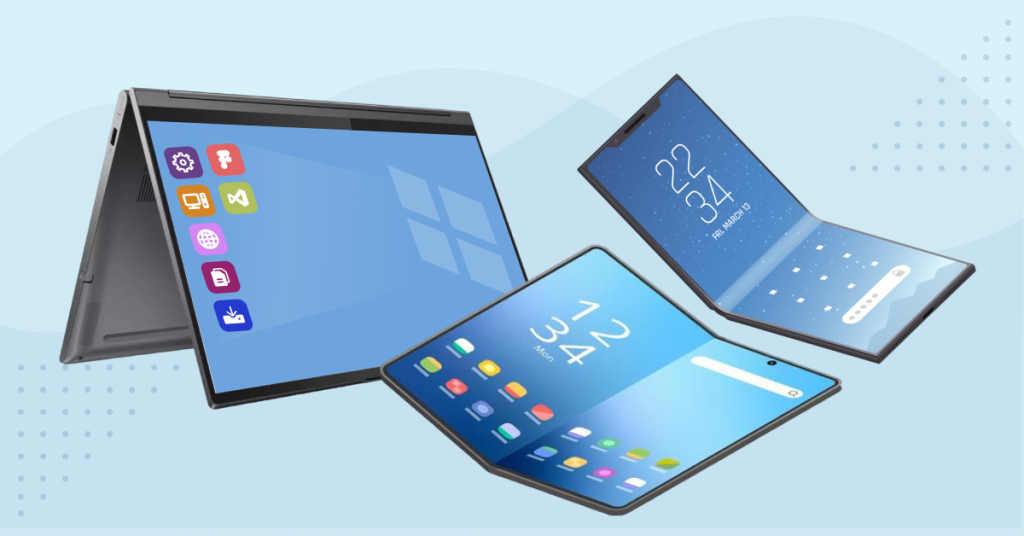
Foldable Devices

You might have heard the term “foldable phone” in the year 2008 when Nokia launched the Morph concept. The peculiar feature of flexible OLED displays is that they can be folded and turned into a double-size full-screen display.

Foldable smartphones and devices offer users a more immersive experience. One of the most brilliant examples of foldable devices is the Samsung Galaxy Fold. It is also available for purchase.

Let us take you one step ahead to understand how foldable devices impact app development.

How are Developing Apps Different For Foldable Smart Devices?

From the users’ perspective, the foldable technology might seem exciting. But many businesses do not clearly understand how the foldable smart devices technology will impact mobile app development. So let’s check out some of the major challenges and benefits that foldable brings to developers.

Large-screen experience: The primary motive for bringing foldable devices is to offer users a great viewing experience on a large screen. Now two screens can turn into a single big screen.

Small-screen vs. large-screen confusion: Today, many users are confused about which screen size is better. But with foldable phones, they get both options in one device.

New content: The availability of an additional screen enables content creators to release new forms of content.

More interesting featuresModern smartphones have limited screen sizes, a barrier to some necessary features. But with foldable devices, it is now easy to create multi-screen applications.

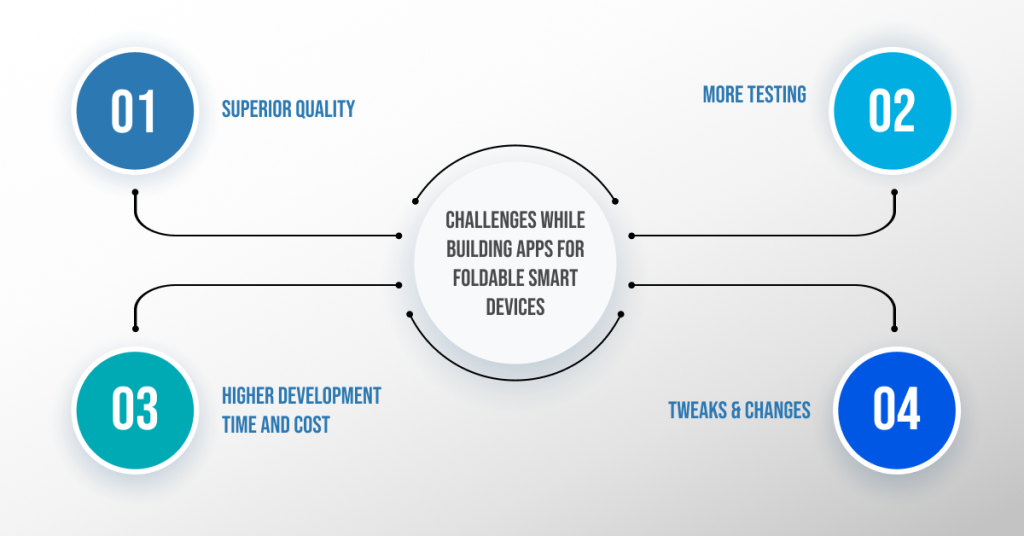
Challenges While Building Apps for Foldable Smart Devices

Challenges While Building Apps for Foldable Smart Devices

Whether it’s web development or app development, there are always some challenges that every developer has to surpass. The same is in the case of foldable app development. Therefore consider the following factors that help to build a high-quality foldable application:

Superior Quality : 

Foldable app development is not like walking in a park. First, a developer must remember that foldable devices have multiple orientations and different aspect ratios than regular smartphones.

While users expect that they will have a glitch-free experience while using your developed application. Therefore, you need to understand how to develop applications for foldable devices. Otherwise, your app will sink.

More Testing :

Foldable devices have different use cases and scenarios. Therefore, to ensure that they are bug-free, a developer needs to test every aspect and possible usage cases. Furthermore, testing should be conducted across multiple window sizes.

Higher Development Time and Cost :

If you have decided to design and build an application for a foldable device, you are entering a new space. You must create and develop your app for multiple modes and test it under various conditions. Thus, you must spend more time and money on development and testing.

Tweaks & Changes :

Once you have launched your application on the Google Play Store, you need to make numerous changes based on user feedback. This is important if your app stays in the market and on users’ phones for longer.

Important Things to Keep in Mind for Foldable App Development

Two screen states :

Folded and unfolded screen – these are the two states of the screen.

In its folded state, the smartphone looks like other regular phones. So, there is no difference in how users interact with the device. However, while in an unfolded state, the phone turns into a big-screen device, like a tablet. Thus you need to design your app to operate on both screen states.

Multi-window state :

As we discussed earlier, the main purpose behind introducing foldable is to provide users with a larger screen and advanced multitasking. Users might often use the screen for a few multi-windows apps. So you have to design and develop the app according to it.

Screen continuity :

If a user moves from folded to unfolded state, the app should automatically and flawlessly adjust itself. The app must resume from the same location in the previous state.

Complete Guide on App Development

Guide on App Developmentv

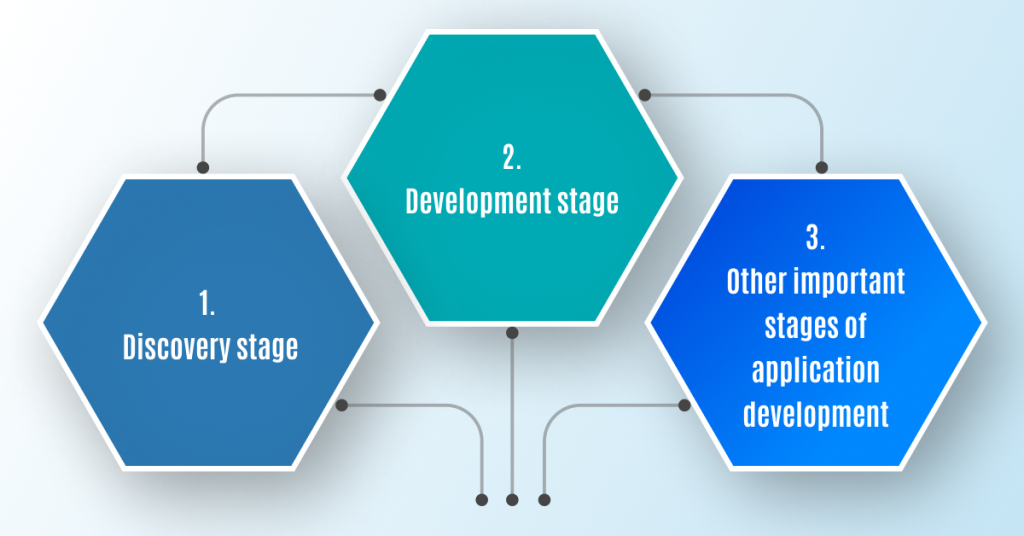
Here we have listed the main stages of foldable app development.

A) Discovery stage

It is important for the future success of the foldable application. It saves time and money. The Discovery stage helps you to identify the needs, technical requirements, and the development process. Key deliverables of the discovery stage include:

    –  Market analysis

    –   Competitor analysis

    –  Functional specifications

    –  Product Backlog

    –  UX wireframes

    –  UI mockups

    –  Branding elements (e.g., logo, unique icons, etc.)

    –  Illustrations and animations

B) Development stage

The development stage includes coding the application. It is usually divided into three phrases:

Development : Write your application’s code base, integration with API, and other third-party solutions or methods.

Testing & QA : a vital part of any app development that ensures the application’s functionality is according to guided guidelines.

Deployment, ongoing support, and support : once the app’s released to the market, developers or IT vendors need to continue working on the application to upgrade its performance and functionality.

C)  Other important stages of application development

    –  Market research and competitor analysis

    –  App concept finalization

    –  App monetization strategy

    –  Picking the right IT development partner

    –  Custom UX/UI for foldable application

    –  Application development process

    –  Comprehensive marketing planning

Sum up

Foldable devices are constantly growing their roots in the smartphone industry. Experts assume that this technology has a great capability to change the future of smartphone looks. Now you know you can create an application for foldable smartphones and devices. So, buckle up your belt as it’s time to apply the gained knowledge to practical.