New York is one of the most competitive business environments in the world. Whether you are a fintech startup in Manhattan, a healthcare brand in Brooklyn, or a retail enterprise expanding across the USA, your mobile app is not just a product. It is your most important customer touchpoint.
Finding the right mobile app development company in New York can be the difference between an app that transforms your business and one that collects dust on the App Store. With thousands of agencies claiming to be the best, how do you separate genuine expertise from empty promises?
This guide cuts through the noise. We cover what to look for in a mobile app development company in the USA, key tips for building a successful app, and why Deftsoft is the partner businesses trust for end-to-end mobile app development services that actually deliver.
Quick Summary
Who this is for: Businesses in New York and across the USA looking for a trusted mobile app development partner.
What we cover: What makes a great app company, mobile app development tips, and Deftsoft’s full-service offering.
Top pick: Deftsoft, 20+ years of experience, 1,000+ clients, iOS, Android & cross-platform expertise.
Bottom line: A great app needs strategy, UX, and technical depth — not just code. Deftsoft delivers all three.
Ready to build your mobile app?
Talk to Deftsoft’s app development team, free consultation, no obligations.
The Mobile App Market in New York: What You Need to Know
New York’s app economy is booming. The city is home to some of the largest names in the app marketplace and is located at the center of app development on the East Coast, combining creativity, critical thinking, robust design, and careful planning that help New York app companies stand apart from the rest.
Industries driving demand for cross-platform mobile app development services in New York include fintech, healthcare, eCommerce, real estate, media, logistics, and SaaS. New York mobile app developers work across multiple industries, and their exposure to diverse sectors enables them to build customized solutions for both startups and enterprises.
The challenge? Deciding between the various top app development agencies in New York is challenging; what one company gives may not be what you require, and what one company cannot give might be precisely what you want. That is exactly why understanding what separates a great agency from a mediocre one matters before you sign a contract.
Do You Know?
$9B+
US mobile app market revenue in 2026
72%
of US businesses now operate a mobile app
What to Look for in a Mobile App Development Company in the USA
Not every agency that claims to be the best mobile app development company in the USA actually delivers. Before you choose a partner, evaluate them against these non-negotiables:
1. End-to-End Capability
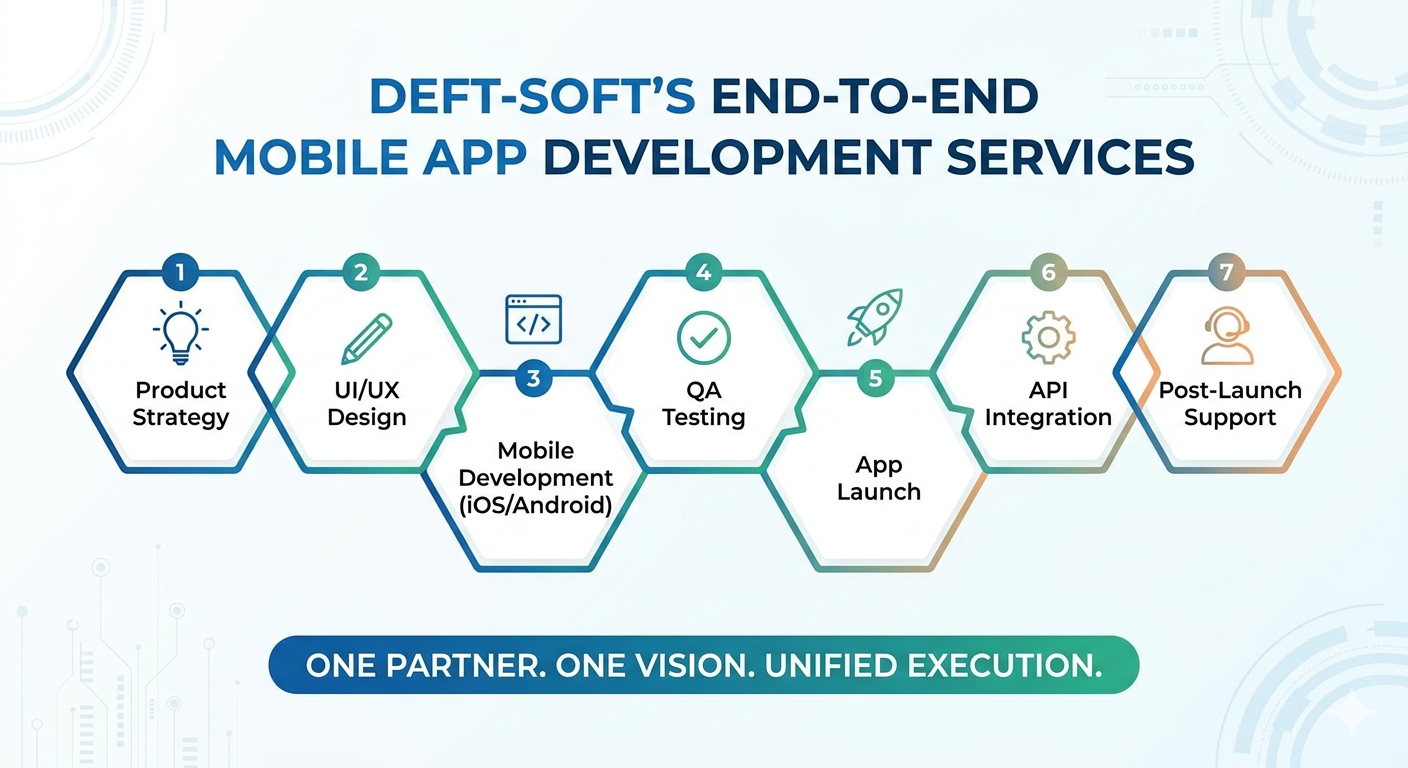
Your app partner should handle everything — product strategy, UI/UX design, development, QA testing, launch, and post-launch support. Fragmented development across multiple vendors is a recipe for costly delays and inconsistent quality.
The best companies build natively for iOS and Android and are also proficient in cross-platform frameworks like Flutter and React Native, giving you flexibility without sacrificing performance.
3. Industry Experience
An agency that has built apps across fintech, healthcare, retail, and logistics understands domain-specific requirements — security standards, compliance needs, user behaviour patterns — that generalist developers simply do not.
4. Transparent Process & Communication
Agile development, sprint-based delivery, and regular client updates are non-negotiable. You should always know where your project stands, what has been built, and what comes next.
5. Post-Launch Support
An app is never truly “done.” OS updates, user feedback, feature iterations, and performance monitoring require a development partner committed to the long term, not one that disappears after delivery.
Deftsoft’s Mobile App Development Services
Deftsoft is a full-service mobile app development company trusted by businesses across the USA, UK, Europe, and Australia. Their mobile development practice covers the complete spectrum, from initial concept workshops to App Store submission and beyond.
iOS App Development
Native Swift & Objective-C apps built for performance, security, and App Store approval.
Android App Development
Kotlin & Java development for the full Android ecosystem, phones, tablets, and beyond.
Cross-Platform Development
Flutter and React Native apps that run on both iOS and Android from a single codebase.
UI/UX Design
User-first design that combines aesthetics with intuitive, conversion-focused interactions.
API & Backend Integration
Seamless integration with third-party APIs, payment gateways, CRMs, and cloud services.
AI-Powered App Features
ML, NLP, and computer vision integrations that make apps smarter and more personalized.
QA & Security Testing
Rigorous testing protocols ensure apps are bug-free, secure, and performance-optimized before launch.
Maintenance & Support
Ongoing updates, performance monitoring, and feature development post-launch.
Beyond mobile, Deftsoft’s complete digital offering includes web development, digital marketing, custom web application development, SEO, PPC, and SMO, making them a single strategic partner for your entire digital presence.
Mobile App Development Tips for Businesses in 2026
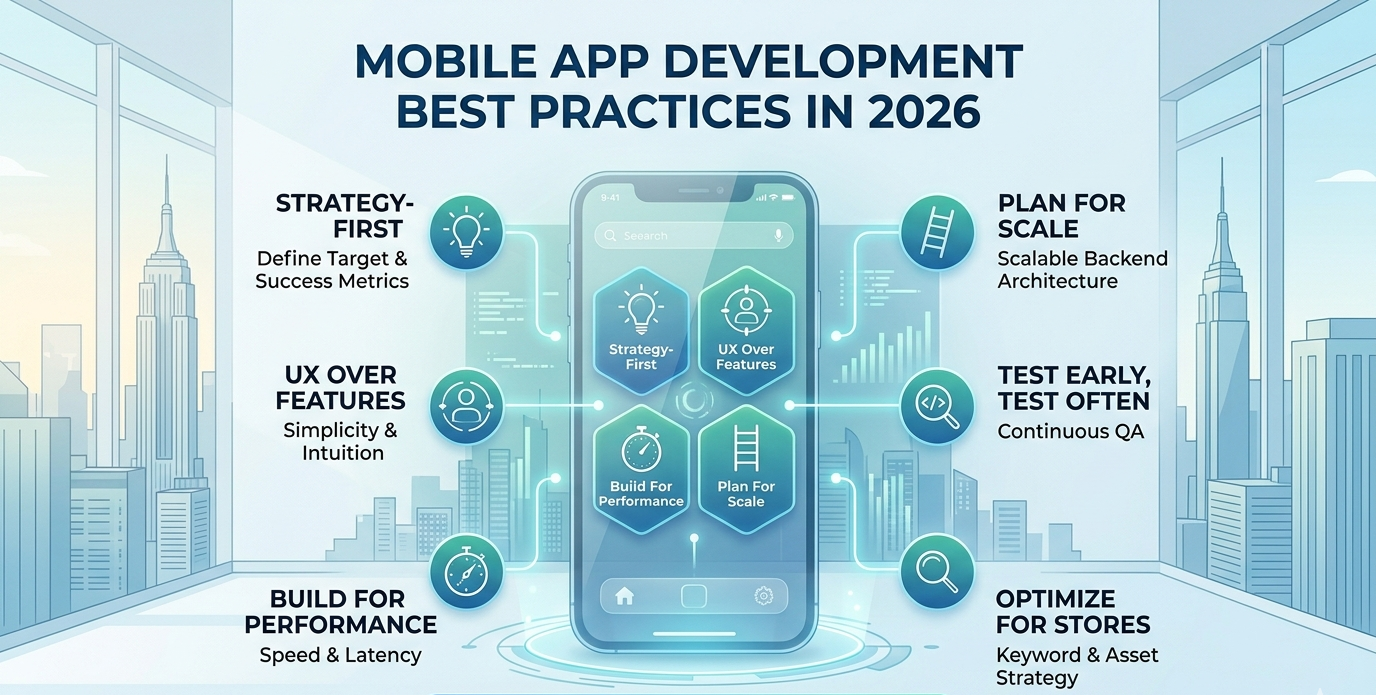
Whether you are building your first app or scaling an existing product, these mobile app developmenttips will help you maximize ROI and avoid the most common pitfalls.
Start With Strategy, Not Code
Define your target user, core use cases, and success metrics before a single line of code is written. Apps built without a clear product strategy consistently underperform.
Prioritize UX Over Features
A simpler app with exceptional UX outperforms a feature-heavy app with poor usability every time. Build what users need, not everything you can imagine.
Build for Performance From Day One
Slow load times and laggy interactions are the top reasons users uninstall apps. Performance architecture decisions made early are far cheaper to fix than those made later.
Plan for Scale
Your backend architecture should handle 10x your current user load. Startups that skip scalability planning face expensive rebuilds when growth arrives.
Test Early, Test Often
Integrate QA testing throughout development, not just at the end. Bugs caught early cost 5–15x less to fix than those found post-launch.
Plan Your App Store Optimization (ASO)
A great app no one finds is a wasted investment. Start your ASO strategy — keywords, screenshots, descriptions, and ratings strategy, before launch day.
Turn These Tips Into Your App Reality
Deftsoft’s development process is built around these principles — strategy-first, UX-led, performance-obsessed.
Why Deftsoft is the Best Mobile App Development Company for Your Business
There are hundreds of mobile app agencies in New York and across the USA. Here is why businesses consistently choose Deftsoft over the rest:
20+ Years of Proven Experience
Deftsoft has been building digital products since 2005. That depth of experience means your project benefits from real-world lessons learned across 1,000+ client engagements, not trial and error at your expense.
Full-Service, Not Fragmented
Most agencies hand off your project at different stages. Deftsoft handles strategy, design, development, QA, launch, and ongoing support under one roof. No version-control conflicts, no communication gaps, no finger-pointing between vendors.
Global Delivery, Local Understanding
As a 100% export-oriented unit registered with STPI and a verified Google partner, Deftsoft understands international markets — including the unique demands of New York and US businesses — while delivering world-class quality at competitive rates.
Technology Depth
From native iOS and Android to cross-platform frameworks, AI integration, cloud architecture, and API development, Deftsoft’s technical team is fluent in the full modern stack. They build apps that are secure, scalable, and future-ready.
98% Client Satisfaction Rate
Across 15+ industries and 1,000+ projects globally, Deftsoft maintains a 98% client satisfaction rate. That is not a marketing claim; it is the result of a development process obsessed with delivery quality and client communication.
The Bottom Line
New York businesses deserve a mobile app partner that brings strategy, design, technical excellence, and long-term commitment to every project. Building an app is one of the most important digital investments your business will make — and getting it right from the start saves time, money, and market opportunity.
Deftsoft is that partner. With nearly two decades of experience, a full-service model, and a track record of 1,000+ successful projects, they bring everything you need to build a mobile app that performs — from day one and beyond.
Start Building Your App With Deftsoft Today
Book a free strategy session and get a custom development roadmap for your mobile app project.
Frequently Asked Questions
What makes Deftsoft the best mobile app development company in New York?
Deftsoft combines 20+ years of experience, a full-service model covering strategy through post-launch support, and a track record of 1,000+ successful global projects. Unlike narrow app-only shops, Deftsoft also offers web development, digital marketing, and AI integration, making it a complete digital partner for New York businesses.
Does Deftsoft develop apps for both iOS and Android?
Yes. Deftsoft builds native iOS apps using Swift, native Android apps using Kotlin and Java, and cross-platform apps using Flutter and React Native. They recommend the right platform approach based on your budget, timeline, and target audience — not a one-size-fits-all answer.
How long does it take to build a mobile app with Deftsoft?
Timelines depend on app complexity. A well-scoped MVP typically takes 8–16 weeks. More complex apps with custom backends, third-party integrations, and advanced features can take 4–9 months. Deftsoft provides detailed project timelines during the discovery phase, so you always know what to expect.
What industries does Deftsoft build mobile apps for?
Deftsoft has delivered mobile apps across 15+ industries, including fintech, healthcare, eCommerce, real estate, logistics, education, media, gaming, and enterprise SaaS. Their cross-industry experience means they understand domain-specific requirements such as HIPAA compliance, PCI DSS standards and real-time data architecture.
Can Deftsoft integrate AI features into my mobile app?
Yes. Deftsoft’s AI development team integrates machine learning, natural language processing, computer vision, and recommendation engines into mobile apps. Whether you need an intelligent chatbot, personalized content feeds, or predictive analytics, they can integrate them into your app as part of the core development process.
Does Deftsoft provide support after the app is launched?
Absolutely. Deftsoft offers ongoing maintenance, performance monitoring, OS compatibility updates, feature development, and technical support post-launch. Most clients engage Deftsoft on a long-term basis precisely because they want a partner that stays invested in the app’s continued growth and performance.
How do I get started with Deftsoft’s mobile app development services?
The first step is a free strategy consultation. Deftsoft’s team will review your app concept, ask the right questions about your business goals, users, and technical requirements, and outline a development approach tailored to your needs. There is no obligation — just clear, expert guidance to help you move forward with confidence.
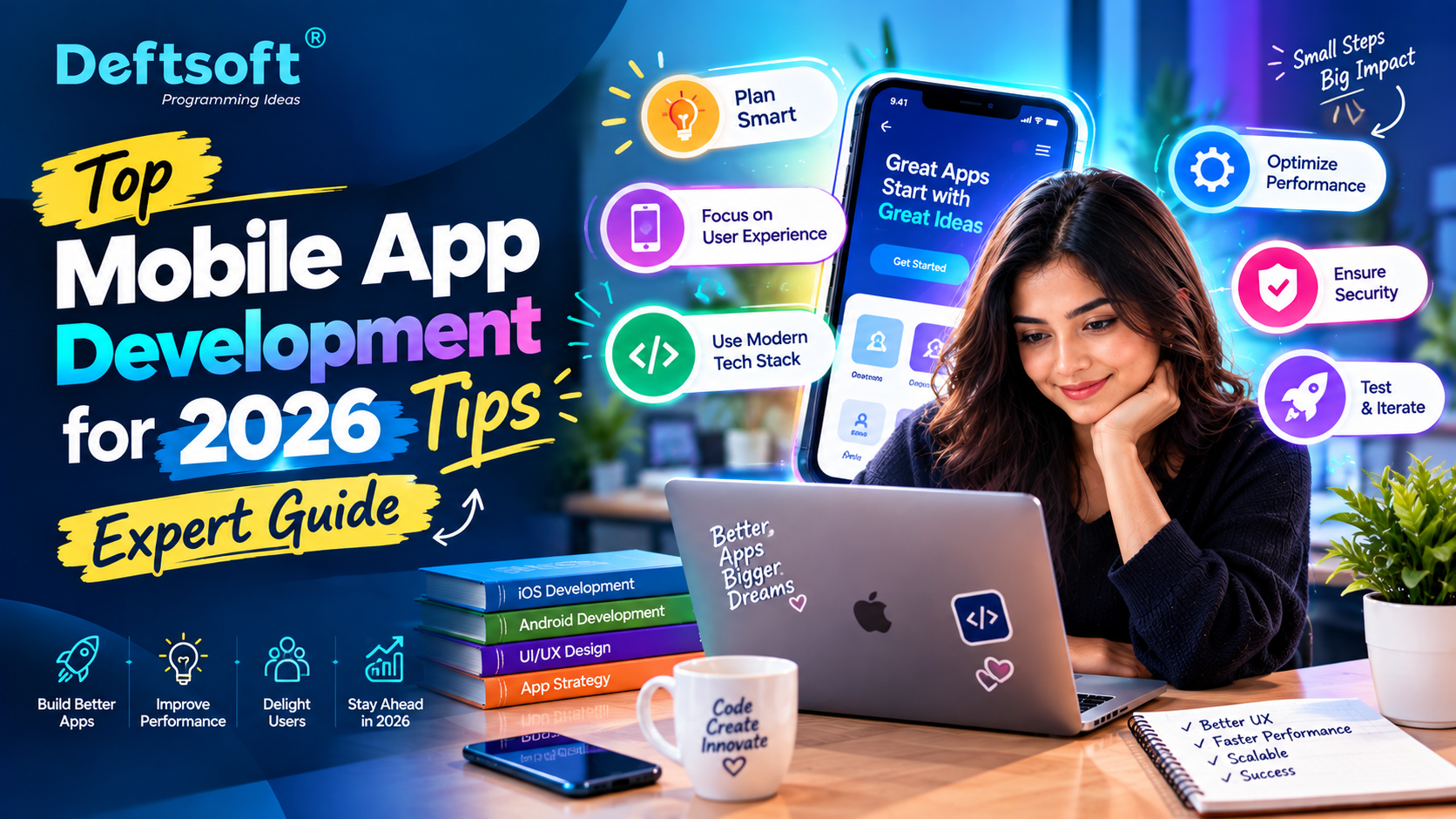
Most apps don’t fail because of bad code; they fail because of critical strategic errors made long before the first line is written—from selecting the wrong platform to bloated feature sets and misaligned business goals. If you are searching for the latest mobile app development tips 2026 to avoid these pitfalls, you need a perspective that goes beyond syntax.
At Deftsoft, we have spent nearly two decades delivering custom mobile app development services, helping businesses navigate shifting landscapes and turn complex ideas into scalable realities. In 2026, the stakes have fundamentally changed: AI is no longer an optional add-on, user expectations are at an all-time high, and app store compliance is stricter than ever.
We’ve seen trends come and go, watched clients face the same avoidable bottlenecks, and learned exactly what separates a successful launch from a forgotten download. This is our honest, field-tested guide on what actually works in 2026. No recycled advice. No padding. Just results.
Ready to build something that lasts?
Quick Takeaways
2026 demands a fundamentally different approach to app development AI, privacy, and performance are no longer optional
The platform decision (Android, iOS, or cross-platform) needs to happen before design, not during it
Custom app development almost always outperforms off-the-shelf for businesses with specific workflows
Choosing the right custom mobile app development company matters more than choosing the right technology stack
Security, testing, and post-launch planning are where most projects cut corners and where most apps eventually fail
Tip
2026 Actionable Strategy
AI Integration
Build AI into the foundational architecture, not as a bolt-on feature.
Platform Choice
Select Android/iOS/Cross-platform based on market data, not preference.
Performance
Treat speed as a UX feature; target sub-3s load times on mid-range devices.
Development
Prioritize custom workflows over off-the-shelf to scale.
Why 2026 Is a Pivotal Year for Mobile App Development
The global mobile app market sits at $206.6 billion in 2026 and is projected to reach $616.4 billion by 2033. Over 6.8 billion people carry a smartphone. And yet roughly 90% of mobile apps are used just once and then forgotten.
That gap between opportunity and outcome is exactly why this moment matters.
A few things have fundamentally changed the game this year:
AI has moved from a feature to a foundation. According to Gartner,40% of enterprise applications are expected to incorporate task-specific AI agents by the end of 2026, up from less than 5% in 2025. That’s not a trend. That’s a transformation happening in real time. Users now expect apps to anticipate what they need, not just respond to what they ask.
Privacy regulations have real teeth. With Apple’s App Tracking Transparency, Google’s Privacy Sandbox, India’s Digital Personal Data Protection Act, and tightened GDPR enforcement all active simultaneously, apps that treat data protection as an afterthought face app store rejection, regulatory penalties, and user abandonment.
5G has raised the bar on performance. Broad 5G adoption means users now expect real-time interactions, instant load times, and seamless video on every app, every time. Anything less feels broken.
App stores are more competitive than ever. Global app downloads are expected to surpass 181 billion in 2026.Standing out requires more than a good idea it requires smart execution from day one.
The businesses winning in this environment aren’t necessarily the ones with the biggest budgets. They’re the ones making smarter decisions earlier.
Top Mobile App Development Tips for 2026
These aren’t generic tips scraped from a checklist. They’re lessons from real projects, the kind you only learn by building hundreds of apps across industries and seeing what works and what quietly kills a product six months after launch.
1. Make Your Platform Decision Before Anything Else
This sounds obvious. It isn’t. We’ve seen businesses get halfway through development only to realize they built for the wrong audience on the wrong platform.
Here’s the practical breakdown for 2026:
Go Android-first if your target users are in South Asia, Southeast Asia, or Africa, or if you’re targeting price-sensitive segments globally. Android dominates market share in these regions, and with Jetpack Compose now mature and Google’s Material You design system widely adopted, the native Android development experience is genuinely excellent.
Go iOS-first if you’re targeting North American or Western European markets, especially if your monetization model depends on in-app purchases or subscriptions. iOS users still spend significantly more per user than Android users.
Go cross-platform (Flutter or React Native) if budget is a real constraint, timelines are tight, and your core functionality doesn’t require deep device-specific integration. Cross-platform has come a long way, but it still has real trade-offs in performance-intensive or hardware-dependent apps.
The mistake isn’t choosing one over the other. The mistake is choosing without a clear reason.
2. Build for AI from the Start, Not as an Add-On
In 2026, AI integration into mobile app development isn’t a phase-two feature. If you design your architecture without AI in mind and then try to bolt it on later, you’re creating technical debt that will cost you significantly down the line.
What does “building for AI from the start” actually mean in practice?
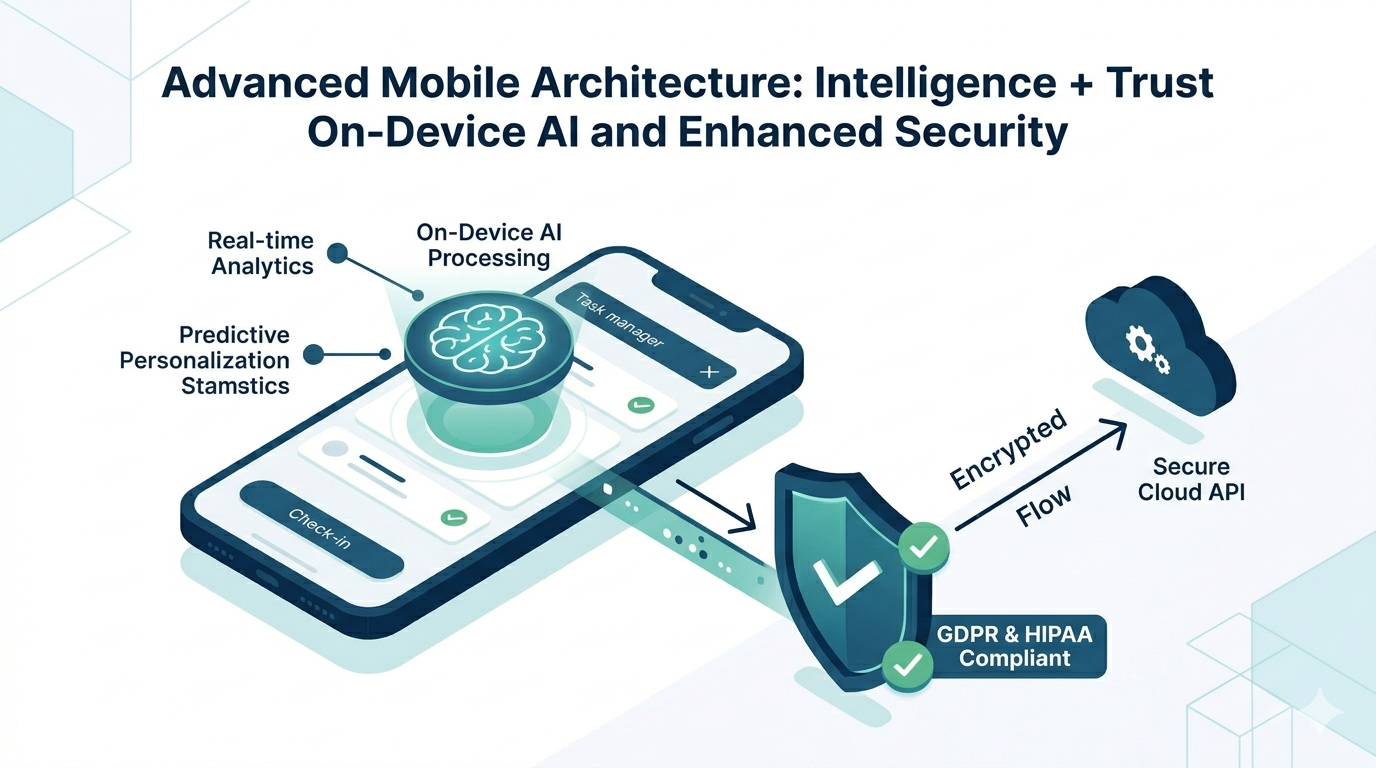
It means designing your data model so that machine learning can actually work with it. It means planning for on-device AI where possible, processing that happens on the user’s device rather than requiring a server round-trip. This makes apps faster, cheaper to run, and more privacy-compliant. It means treating personalisation as a core UX principle, not a nice-to-have.
For most business apps in 2026, even simple AI capabilities, such as smart search, predictive inputs and behavior-based recommendations, can meaningfully improve retention. And retention is where most apps live or die.
3. Treat Performance as a Feature, Not a Given
Here’s something we tell every client: your app’s speed is a product decision, not a technical one. And in 2026, a slow app isn’t just annoying, it’s a business problem.
Users abandon apps that take more than 3 seconds to load a core screen. That number doesn’t move with device improvements. Expectations just keep climbing.
Performance optimization needs to happen throughout development, not at the end. That means efficient API design, proper caching strategies, image compression, lazy loading, and testing on mid-range devices, not just the latest flagship phones that your development team uses.
A useful rule of thumb we use internally: if it doesn’t perform well on a two-year-old mid-range Android device, it doesn’t ship.
4. Security Is No Longer Optional. It’s a Baseline
With cyber threats evolving faster than most businesses can keep up with, mobile security in 2026 requires real engineering, not checkboxes.
The cybersecurity essentials every app should have: biometric authentication (Face ID, fingerprints), end-to-end encryption for sensitive data, secure API communication with token-based authentication, and minimal data collection, only what you genuinely need.
Beyond the technical side, there’s a trust dimension that’s increasingly commercial. Apps that communicate their privacy approach clearly through transparent permission flows and honest data handling consistently rate higher and retain users better than those that don’t.
Privacy isn’t a compliance exercise anymore. It’s a product advantage.
5. Test Early, Test Continuously, Test on Real Devices
One of the most common ways app projects go over budget and over time is insufficient testing. Not because teams don’t care, but because testing is often treated as the last step rather than a parallel process.
Addressing bugs post-release is exponentially more expensive than catching them during development. More importantly, a buggy post-launch experience damages user trust in ways that are very difficult to recover from, especially in app store review ecosystems where one-star reviews are permanent.
At Deftsoft, we run testing in parallel with development, covering functionality, performance, security, and usability across a range of real devices and screen sizes. That approach isn’t just about finding bugs; it’s about shipping with confidence.
6. Plan for the App Store Before You Build, Not After
App store optimization (ASO) isn’t a marketing task you hand off after the app is built. The decisions you make during development, such as app name, category selection, feature set, screenshots and localization, directly impact discoverability.
With 181 billion downloads expected this year, the competition for visibility is intense. Apps that plan their store presence from the beginning, with keyword research baked into naming, description writing, and category selection, have a measurable advantage over those that treat it as an afterthought.
The internal linking opportunity is real here too: your app listing should connect clearly to your broader digital presence, including your website and content assets.
Android App Development in 2026: What’s Changed
Android remains the dominant mobile platform globally, and 2026 has been a significant year for it.
Jetpack Compose, Google’s modern UI toolkit, has fully matured. Teams that have adopted it are building UIs faster, with less code and fewer bugs than the legacy View system. If you’re working with an Android app development company still building in the old way, that’s worth asking about.
Material You, Google’s dynamic theming system, is now a user expectation on Android. Apps that don’t adapt to a user’s personal color scheme and preferences feel dated by comparison.
Google has also implemented sweeping changes following the Epic Games ruling, including allowing third-party app stores and giving developers more flexibility in distribution. For businesses, this opens up new distribution strategies that weren’t possible two years ago.
The practical implication is that if you’re targeting an Android-heavy market, working with the best Android app development company that stays current with Google’s evolving ecosystem isn’t a luxury; it’s a competitive necessity. The platform changes fast. Generic developers fall behind.
Custom App Development vs. Off-the-Shelf: Which One Actually Wins?
This is one of the most common conversations we have with new clients, and the honest answer is: it depends, but for most serious businesses, custom wins.
Here’s why off-the-shelf solutions are genuinely attractive: lower upfront cost, faster deployment, and someone else handles maintenance. For simple internal tools or very early-stage validation, they make sense.
But here’s where they consistently fall short:
They’re built for everyone, which means they’re optimized for no one. When your business has a specific workflow, a unique customer journey, or a competitive process that needs to be protected, a generic platform will make you compromise. You end up adapting your business to your software instead of the other way around.
Scaling hits a wall. Off-the-shelf platforms are designed with their own growth model, not yours. As your user base or feature requirements grow, you increasingly run into limitations the platform was never designed to address.
Total cost of ownership is higher than it looks. Monthly SaaS fees, per-user licensing, costly integrations, and the ongoing inefficiency of working around limitations add up. Over two to three years, custom app development often costs less overall and delivers far more value.
Custom app development is the right call when your business processes are complex, your users are demanding, your data needs to stay under your control, or your competitive advantage lives in how you do things, not just what you do.
How to Choose the Right Custom Mobile App Development Company
This decision matters more than most businesses realize. The technology is rarely the hard part. The partnership is.
Here’s what to actually evaluate:
Do they ask hard questions before they start? A good custom app development company won’t just take your brief and start building. They’ll push back on assumptions, ask about your users, question your feature list, and talk about what success actually looks like. If a vendor gives you a quote within 24 hours of your first conversation, that’s a warning sign.
Can they show relevant work? Not just a portfolio of pretty screens, but actual case studies with measurable outcomes. What problem did the app solve? What happened to the business after launch?
Do they handle the full lifecycle? Ideation, design, development, testing, deployment, and post-launch support. Apps aren’t finished at launch. The companies that treat launch as the finish line leave clients stranded.
What does their testing process look like? Ask specifically. Vague answers indicate vague processes.
How do they communicate during a project? Weekly updates? Dedicated project managers? Transparent timelines? The development process is often long. Communication quality is what separates a good experience from a painful one.
Are they honest about trade-offs? Every project has constraints: budget, timeline and technical limitations. A trustworthy partner tells you the truth about what’s achievable and what it will cost, rather than promising everything and adjusting later.
Common Mistakes to Avoid When Building a Mobile App in 2026
After nearly two decades of building apps, these are the patterns we see again and again:
Skipping the discovery phase. Jumping straight into design and development without a structured discovery phase is like building a house without architectural drawings. You save a few weeks at the start, only to lose months in the middle when everything needs to change.
Building too many features for version one. The most successful apps we’ve seen have launched with fewer features than planned, but the right ones, done exceptionally well. Ship lean. Learn fast. Improve with data, not assumptions.
The “Cool Feature” Trap
At Deftsoft, we once worked with a healthcare client who wanted a fancy AI chatbot, even though their main booking system was still buggy. We insisted on dropping the chatbot and focusing first on making the booking process simple and reliable.
The result? The app launched on time, and the support tickets related to “system errors” dropped by 60% compared to their previous legacy system. They added the chatbot three months later, once the foundation was actually solid.
The Takeaway: If you’re building an app in 2026, don’t build for the “wow” factor. Build for the “does this work at 8:00 AM on a Monday” factor. If you can’t survive the basics, the fancy features won’t save you.
Ignoring backend scalability. Your app is only as strong as its backend. A pretty interface means nothing if the server crashes under load. At Deftsoft, we don’t just focus on mobile code; we constantly study the latest web development trends to ensure your app’s server infrastructure is as fast, secure, and future-proof as the app itself. When your mobile team understands how modern web systems work, your app performs better, scales faster, and stays online when it matters most
Treating QA as the last step. Quality assurance woven throughout development catches issues early and cheaply. Quality assurance bolted on at the end catches issues late and at a high cost.
No post-launch plan. An app without a maintenance, update, and growth plan will slowly deteriorate. Operating systems update. Security vulnerabilities emerge. User feedback reveals new priorities. The work doesn’t stop at launch; it evolves.
Final Thoughts
Building a mobile app in 2026 is genuinely exciting. The tools are better, the platforms are more capable, and the opportunity to build something that matters to real users has never been greater.
But the gap between apps that succeed and apps that get deleted after one use isn’t mainly about technology. It’s about decisions. Platform strategy, architecture, partner selection, testing discipline and post-launch commitment are the places where the outcome is determined.
If you’re planning to build or rebuild a mobile app this year, start with the right partner. One with the experience to ask the hard questions, the skill to build the right thing, and the commitment to be there after launch day.
Deftsoft has been building mobile and web applications for over 20 years. If you’re ready to start a project or just want an honest conversation about whether your idea is ready to go, we’d love to hear from you.
Frequently Asked Questions
What are the most important mobile app development tips for 2026?
The most important shifts in 2026 are building with AI as a core architectural consideration from the start, designing for privacy by default, optimizing for performance on mid-range devices, and planning your app store presence during development rather than after it. Beyond the technical side, the single biggest tip is to choose a development partner who asks hard questions, not one who just says yes.
How much does custom mobile app development cost in 2026?
The range is genuinely wide, depending on complexity, platform, and features, typically anywhere from $30,000 for a focused MVP to $200,000+ for a full-featured enterprise application. The more useful question is the total cost of ownership over two to three years, which often makes custom development more cost-effective than off-the-shelf alternatives that involve ongoing licensing and trade-offs in limitations.
Android or iOS, which platform should I build first?
It depends on your target market. Android has a broader global reach, especially in South Asia, Southeast Asia, and Africa. iOS commands higher per-user spend and dominates North American and Western European markets. If the budget allows, cross-platform development with Flutter or React Native can cover both simultaneously, though with some trade-offs in performance-intensive scenarios.
What does a custom app development company actually do?
A good one does much more than write code. They help you define the right problem to solve, architect a scalable solution, design for the actual users (not hypothetical ones), build and test rigorously, manage the app store submission process, and support the app after launch. The best ones function less like a vendor and more like a technology partner.
How long does it take to build a custom mobile app?
A well-scoped MVP typically takes three to five months. A fully featured application with complex integrations, multiple user roles, and extensive testing can take nine to twelve months or more. Timelines most commonly extend when requirements change mid-project, which is why upfront discovery and planning are worth the investment.
What’s the difference between a mobile app development company and a custom app development company?
The terms are often used interchangeably, but there’s a meaningful distinction. A mobile app development company builds apps. A custom app development company builds apps specifically designed around your business needs, workflows, and users from the ground up, without forcing your requirements into a prebuilt template. The approach, process, and outcome are fundamentally different.
How do I know if I need a mobile app or a mobile-optimized website?
If your users need to access your product offline, use device features like cameras or GPS, receive push notifications, or engage with your product daily, a native app makes sense. If your primary goal is content delivery, lead generation, or e-commerce with occasional visits, a well-optimized mobile website or progressive web app may serve you better and cost significantly less.
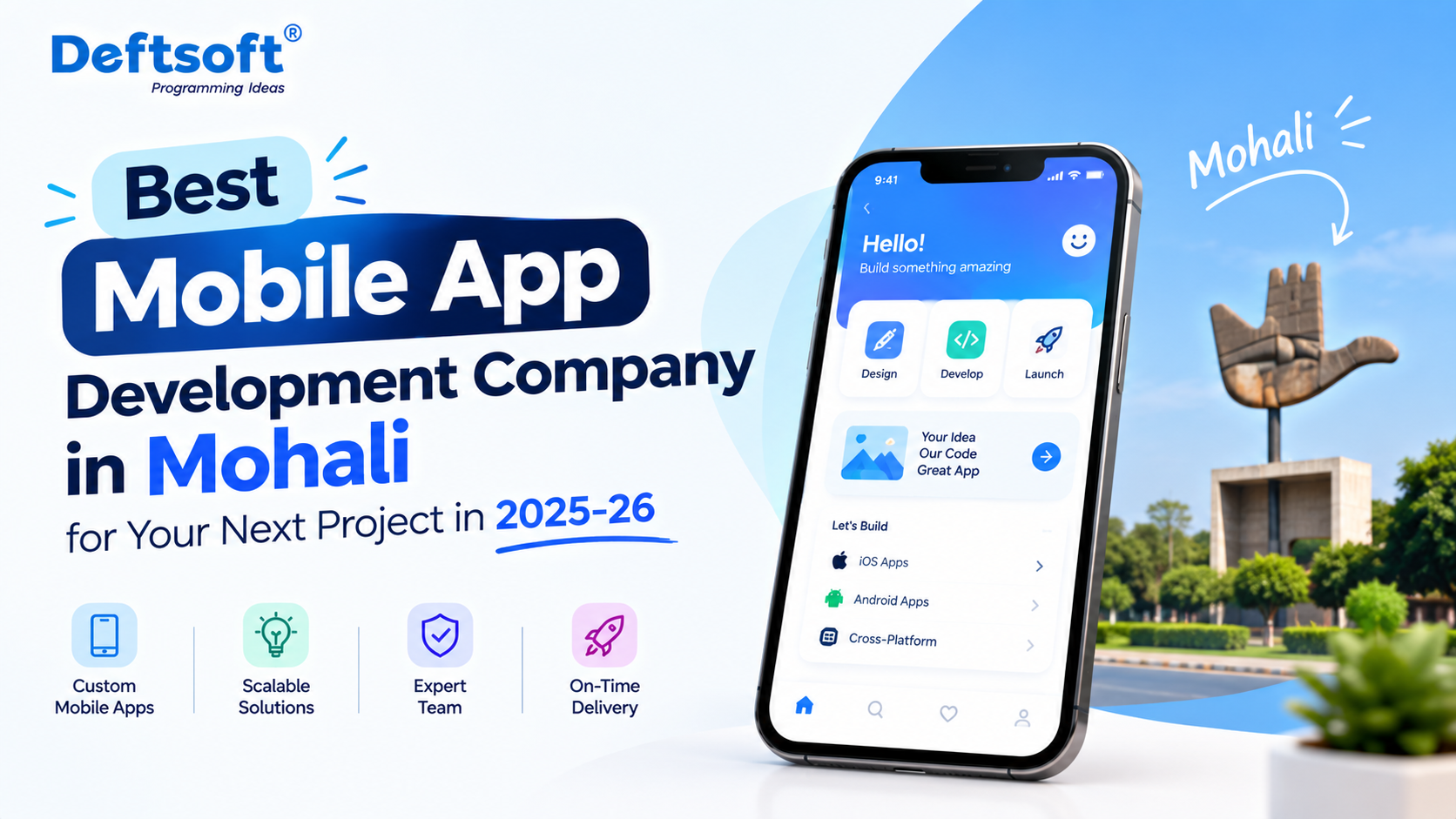
In today’s rapidly evolving digital landscape, mobile applications have become the cornerstone of modern business success. As we step into 2025, the demand for innovative, user-centric mobile applications continues to soar, making it crucial for businesses to partner with the best mobile app development company in Mohali. With countless options available in the market, selecting the right development partner can feel overwhelming. However, choosing a firm that seamlessly combines expertise, creativity, and technical excellence is paramount for transforming your vision into a market-ready reality.
The best mobile app development service in Mohali goes beyond mere coding and programming. These companies serve as strategic partners who invest time in understanding your unique business requirements, target audience, and long-term objectives. They leverage cutting-edge technologies, industry best practices, and innovative methodologies to create intuitive, scalable applications that not only meet current market demands but also anticipate future trends.
When searching for the best mobile app development company in Mohali, it’s essential to look for partners who prioritize quality, user experience, and customer satisfaction. These companies don’t just deliver products; they craft digital experiences that resonate with users, drive engagement, and ultimately contribute to your business growth.
Why Choosing the Right Mobile App Development Company is Crucial for Success
Selecting the right mobile app development company in Mohali is not merely a business decision—it’s a strategic investment that can determine the trajectory of your digital transformation journey. In an increasingly competitive marketplace, partnering with the best mobile app development service in Mohali in 2025 can provide the competitive edge your business needs to thrive.
Technical Expertise and Innovation
A premier mobile app development company brings years of technical expertise and a deep understanding of current market trends to your project. They possess comprehensive knowledge of various programming languages, frameworks, and development methodologies. This expertise enables them to recommend the most suitable technology stack for your specific requirements, ensuring optimal performance, scalability, and maintainability.
User-Centric Design Philosophy
The best mobile app development company in India understands that successful applications are built around user needs and preferences. They conduct thorough user research, create detailed user personas, and design intuitive interfaces that enhance user experience. This user-centric approach ensures higher adoption rates, increased user engagement, and positive app store reviews.
Market Insights and Strategic Guidance
Experienced development companies offer more than technical services; they provide valuable market insights and strategic guidance. They understand current mobile app development trends, user behavior patterns, and competitive landscapes, enabling them to advise on features, functionalities, and market positioning strategies that can maximize your app’s success potential.
Quality Assurance and Testing
Professional mobile app development companies implement rigorous quality assurance processes and comprehensive testing protocols. They conduct thorough testing across multiple devices, operating systems, and network conditions to ensure your application performs flawlessly in real-world scenarios.
Top Features to Look for in the Best Mobile App Development Companies
When evaluating potential partners for your mobile app project, focusing on key differentiating features can help you identify the best mobile app development company in Mohali 2025.
Comprehensive Portfolio and Case Studies
The most reputable companies showcase extensive portfolios featuring diverse projects across various industries. These portfolios demonstrate their versatility, creativity, and ability to deliver successful applications. Look for case studies that highlight problem-solving approaches, technical challenges overcome, and measurable business results achieved.
Multi-Platform Expertise
The best mobile app development service in Mohali should possess expertise across multiple platforms and technologies. As the best Android app development company and trusted iOS app development company, your chosen partner should demonstrate proven experience in native development for both platforms. Whether you need our specialized Android app development service for Google Play Store deployment, our top iOS app development service for App Store success, cross-platform solutions using React Native or Flutter, or progressive web applications, your development partner should have proven experience and technical proficiency across all these technologies.
Agile Development Methodology
Leading development companies employ agile methodologies that promote flexibility, transparency, and continuous improvement. This approach ensures regular communication, iterative development cycles, and the ability to adapt to changing requirements or market conditions throughout the project lifecycle.
Post-Launch Support and Maintenance
Successful mobile applications require ongoing support, updates, and enhancements. The best mobile app development company in Mohali provides comprehensive post-launch services, including bug fixes, performance optimization, security updates, and feature enhancements to ensure your application remains relevant and competitive.
Transparent Communication and Project Management
Effective communication is fundamental to project success. Look for companies that maintain open communication channels, provide regular progress updates, and use project management tools that offer transparency and accountability throughout the development process.
The Advantages of Partnering with a Local Mobile App Development Company in Mohali
Choosing a local mobile app development company in Mohali offers unique advantages that can significantly impact your project’s success and long-term sustainability.
Cultural Understanding and Market Knowledge
Local development companies possess inherent understanding of regional market dynamics, cultural preferences, and user behaviors. This knowledge enables them to create applications that resonate with local audiences while maintaining global appeal and scalability.
Enhanced Collaboration and Communication
Geographic proximity facilitates better collaboration through face-to-face meetings, real-time communication, and shared working hours. This enhanced interaction leads to clearer requirement understanding, faster decision-making, and stronger working relationships.
Cost-Effective Solutions
Local companies often provide competitive pricing structures without compromising quality. The absence of international communication barriers, time zone differences, and travel expenses contributes to overall cost efficiency and project timeline optimization.
Regulatory and Compliance Expertise
Local development partners understand regional regulations, compliance requirements, and legal frameworks. This knowledge ensures your application adheres to local laws, data protection regulations, and industry standards.
Ongoing Support and Accessibility
Local companies provide readily accessible ongoing support and maintenance services. This accessibility ensures prompt resolution of issues, timely updates, and continuous optimization based on user feedback and market changes.
Deftsoft: The Best Mobile App Development Company in Mohali
When seeking the best mobile app development company in Mohali, Deftsoft emerges as the clear industry leader, setting benchmarks for excellence, innovation, and client satisfaction. With an impressive track record of delivering cutting-edge mobile applications across diverse industries, Deftsoft has established itself as the premier choice for businesses seeking digital transformation through mobile technology.
Our Comprehensive Service Offerings
Deftsoft provides end-to-end mobile app development services that encompass every aspect of the development lifecycle:
Native Mobile App Development: As a leading Android app development company and best iOS app development company, our expert developers create high-performance native applications for both platforms, ensuring optimal user experience and platform-specific functionality integration. Our specialized Android app development service and iOS app development service deliver platform-optimized solutions that leverage each ecosystem’s unique capabilities.
Cross-Platform Development: Utilizing advanced frameworks like React Native and Flutter, our cross-platform app development process maintain native-like performance across multiple platforms.
Enterprise Mobile Solutions: We specialize in developing robust enterprise applications that enhance productivity, streamline operations, and improve business efficiency.
E-commerce Mobile Apps: Our team creates feature-rich e-commerce applications with secure payment gateways, intuitive user interfaces, and advanced shopping functionalities.
Custom Mobile App Development: We develop tailored solutions that address specific business requirements, ensuring perfect alignment with your unique operational needs and strategic objectives.
Our Technology Expertise
As the best mobile app development service in Mohali in 2025, Deftsoft maintains expertise in the latest technologies and frameworks:
Backend Technologies: Node.js, Python, .NET, PHP, Ruby on Rails
Databases: MongoDB, PostgreSQL, MySQL, Firebase
Cloud Platforms: AWS, Google Cloud, Microsoft Azure
Integration Services: RESTful APIs, GraphQL, third-party service integrations
Industry-Specific Solutions
Our diverse portfolio spans multiple industries, demonstrating our ability to understand and address sector-specific challenges:
Healthcare: HIPAA-compliant medical applications with telemedicine capabilities
Finance: Secure fintech solutions with advanced encryption and regulatory compliance
Education: Interactive e-learning platforms with multimedia content delivery
Retail: Comprehensive e-commerce solutions with inventory management integration
Real Estate: Property management and listing applications with virtual tour capabilities
Why Choose Deftsoft for Mobile App Development in Mohali
Proven Track Record of Excellence
Deftsoft’s impressive portfolio includes over 200 successfully delivered mobile applications across various industries. Our clients range from innovative startups to established enterprises, each benefiting from our commitment to excellence and technical expertise.
Expert Development Team
Our team comprises seasoned developers, designers, quality assurance specialists, and project managers who bring years of experience and diverse skill sets to every project. As a premier Android app development company, our Android specialists are well-versed in Kotlin, Java, and the latest Android development frameworks. Similarly, as the best iOS app development company, our iOS experts excel in Swift, Objective-C, and Apple’s development ecosystem. Our comprehensive Android app development service and iOS app development service ensure platform-specific optimization and adherence to each platform’s design guidelines and performance standards. We continuously invest in team training and skill development to stay current with emerging technologies and industry best practices.
User-Centric Design Philosophy
We prioritize user experience in every aspect of our development process. Our design team conducts thorough user research, creates detailed wireframes and prototypes, and implements intuitive interfaces that enhance user engagement and satisfaction.
Agile Development Approach
Our agile methodology ensures flexible, iterative development cycles that accommodate changing requirements and market conditions. This approach promotes transparency, continuous feedback, and rapid adaptation to evolving project needs.
Quality Assurance Excellence
We implement comprehensive testing protocols including functional testing, performance testing, security testing, and user acceptance testing. Our quality assurance team ensures every application meets the highest standards of performance, security, and reliability.
Transparent Communication
We maintain open communication channels throughout the project lifecycle, providing regular updates, progress reports, and collaborative opportunities. Our project management tools ensure transparency and accountability at every stage.
Competitive Pricing
As the best mobile app development company in India, we offer competitive pricing structures that provide excellent value for investment. Our cost-effective solutions don’t compromise quality or functionality.
Ongoing Support and Maintenance
Our commitment extends beyond project delivery. We provide comprehensive post-launch support, including regular updates, bug fixes, performance optimization, and feature enhancements to ensure long-term application success.
Conclusion: Choose Deftsoft to Elevate Your Business Through Mobile Innovation
In the competitive landscape of mobile app development, partnering with the best mobile app development company in Mohali can determine the difference between digital success and missed opportunities. Deftsoft combines technical excellence, creative innovation, and strategic insight to deliver mobile applications that not only meet current requirements but also position your business for future growth and success.
Our commitment to quality, user experience, and client satisfaction has earned us recognition as the leading mobile app development company in Mohali and established our reputation throughout India. Whether you’re a startup with a revolutionary idea or an enterprise seeking digital transformation, Deftsoft possesses the expertise, experience, and passion to bring your vision to life.
Don’t settle for ordinary when you can achieve extraordinary. Choose Deftsoft as your mobile app development partner and experience the difference that true expertise, dedication, and innovation can make for your business success.
Contact us today to begin your mobile app development journey with the best mobile app development company in Mohali 2025.
Frequently Asked Questions (FAQs)
1. What makes Deftsoft the best mobile app development company in Mohali?
Deftsoft stands out due to our comprehensive expertise, proven track record of 200+ successful projects, experienced development team, user-centric design philosophy, and commitment to delivering high-quality applications across various industries. Our agile development approach, transparent communication, and ongoing support services further distinguish us as the premier choice in Mohali.
2. How much does it cost to develop a mobile app with Deftsoft?
Mobile app development costs vary based on complexity, features, platform requirements, and project scope. We offer competitive pricing and provide detailed cost estimates after understanding your specific requirements. Our transparent pricing structure ensures no hidden costs and excellent value for your investment.
3. How long does it typically take to develop a mobile app?
Development timelines depend on app complexity, feature requirements, and platform specifications. Simple apps typically take 2-3 months, while complex enterprise applications may require 6-8 months. We provide realistic timelines during project planning and maintain regular communication about progress throughout development.
4. Do you provide both iOS and Android app development services?
Yes, we specialize in both native iOS and Android development, as well as cross-platform solutions using React Native and Flutter. Our team has extensive experience with platform-specific guidelines, ensuring optimal performance and user experience on each platform.
5. What industries do you serve?
We serve diverse industries including healthcare, finance, education, e-commerce, real estate, logistics, entertainment, and many others. Our experience across multiple sectors enables us to understand industry-specific requirements and deliver tailored solutions.
6. Do you provide ongoing support and maintenance after app launch?
Absolutely! We provide comprehensive post-launch support including bug fixes, performance optimization, security updates, feature enhancements, and app store maintenance. Our ongoing support ensures your application remains current, secure, and competitive.
7. What technologies and frameworks do you use?
We work with the latest technologies, including Swift, Kotlin, React Native, Flutter, Node.js, Python, and various databases and cloud platforms. Our technology choices are always aligned with project requirements and long-term scalability needs.
In today’s fast-paced digital landscape, the demand for innovative and high-quality mobile apps is skyrocketing. India, with over 712 million smartphone users as of 2025 (Reuters), stands as one of the largest mobile markets in the world. In fact, 85.5% of Indian households now own at least one smartphone (Economic Times), making mobile applications a necessity for businesses looking to engage and grow their customer base.
The app economy in India is thriving, 26.4 billion app downloads were recorded in 2023 alone (Business of Apps), and the market is projected to expand from $3.3 billion in 2023 to $13.6 billion by 2025. With Indians spending an average of 4 hours and 12 minutes daily on mobile apps, the opportunity for businesses to capture attention through engaging mobile experiences has never been greater.
But with countless development companies competing for attention, how do you choose the best mobile app development company in India? This article aims to illuminate the path, showcasing a top-tier firm renowned for its expertise, creativity, and transformative solutions. From startups to established enterprises, this company has set the benchmark for app development, helping businesses thrive in an increasingly competitive marketplace. Whether you’re looking to launch a groundbreaking app or enhance an existing one, our curated pick of the best in the business provides the insights you need to make an informed decision and elevate your digital strategy. Dive in and discover the leader who can turn your mobile app vision into a reality!
Future of Mobile App Development in India
India stands at the forefront of a digital revolution, with mobile app development being one of the key drivers of this transformation. The future of mobile app development in India looks exceptionally bright, driven by a combination of technological advancements, a young and tech-savvy population, and a burgeoning digital economy. As of 2025, India has over 1.2 billion mobile subscribers, with smartphone users crossing 1 billion, making it the second-largest smartphone market globally (Statista). Mobile app usage is also witnessing massive growth—Indians collectively spent over 1.3 trillion hours on apps in 2024, ranking among the highest worldwide (Data.ai).
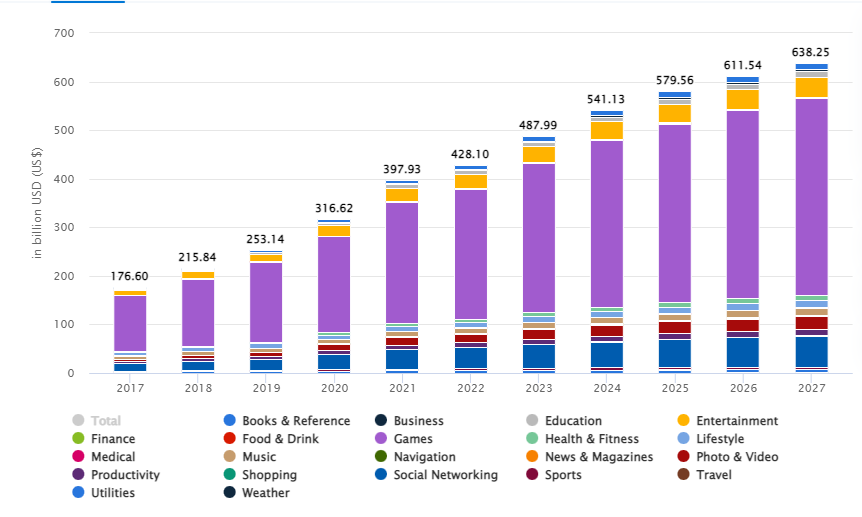
On a global scale, the mobile app industry is projected to generate over $579 billion in revenue in 2025, expected to reach $638 billion by 2027 (see chart below). A large chunk of this comes from gaming, entertainment, and social networking apps, areas where India is already showing exponential adoption and startup innovation.
Global app revenue growth across categories, 2017–2027 (Statista)
The integration of cutting-edge technologies such as Artificial Intelligence (AI), Machine Learning (ML), Internet of Things (IoT), and Augmented Reality (AR) is revolutionizing the way mobile apps are developed and used. For instance, AI-powered chatbots and virtual assistants are enhancing customer service, while AR is transforming the way users interact with digital content. These innovations are paving the way for personalized, immersive, and highly engaging app experiences.
Furthermore, the Indian government’s initiatives like Digital India and Startup India are fueling this growth by fostering a strong digital ecosystem, providing infrastructure, and encouraging innovation. With rising investments in the tech sector and a flourishing startup culture, India is set to emerge not only as a leading consumer market but also as a global hub for mobile app development, attracting global investors and talent alike.
Importance of Choosing the Right Mobile App Development Company
In the vast and competitive landscape of mobile app development, choosing the right development company can make all the difference. With over 750 million smartphone users in India in 2025 (Business Standard) and the mobile app market projected to reach $14 billion by the end of 2025 (Statista), the success of an app now hinges on standing out in an extremely saturated market. From design and functionality to user experience and performance, every element matters. That’s why partnering with a company that has the expertise, experience, and resources to deliver a high-quality product tailored to your goals is essential.
A reputable mobile app development company brings a wealth of knowledge and proven experience, having worked across industries ranging from fintech to e-commerce. They understand the nuances of app development from concept and UI/UX design to coding, testing, and deployment. This ensures your app is built using the latest frameworks, cross-platform development approaches, AI integrations, and cloud-native technologies—resulting in a robust, scalable, and secure solution. Moreover, such companies employ a dedicated team of designers, developers, testers, and project managers who collaborate to deliver projects on time and within budget, a critical factor when 85% of app users uninstall apps due to poor performance.
Beyond technical expertise, the right development partner also understands evolving market dynamics and user behavior. With Indians spending over 4.7 hours per day on mobile apps in 2025 (Data.ai), consumer expectations around speed, personalization, and usability have never been higher. The best companies conduct deep user research and competitor analysis to identify your target audience, their preferences, and their pain points, ensuring your app doesn’t just meet expectations but excels in delivering value. Furthermore, a reliable partner will provide ongoing support, updates, and maintenance, keeping your app relevant and optimized long after its launch.
Best Mobile App Development Company in India: Deftsoft
When it comes to the best mobile app development company in India, Deftsoft stands out as a leader in the industry. With over a decade of experience, Deftsoft has earned a reputation for delivering high-quality, innovative, and user-centric mobile applications that drive business growth and success. The integration of AI in mobile app development has also brought several benefits for them as they are now able to build theven complex applications with ease with the appropriate use of AI. Their extensive portfolio includes a wide range of apps for various industries, including healthcare, finance, education, e-commerce, and entertainment.
One of the key factors that sets Deftsoft apart is their commitment to excellence and customer satisfaction. They take a client-centric approach, working closely with their clients to understand their vision, goals, and requirements. This collaborative process ensures that the final product aligns with the client’s expectations and delivers maximum value. Deftsoft’s team of skilled designers, developers, and project managers leverages the latest technologies and methodologies to create apps that are not only visually appealing but also highly functional, secure, and scalable.
Moreover, Deftsoft’s expertise extends beyond just app development. They offer a comprehensive suite of services, including app consulting, UI/UX design, custom development, testing, deployment, and maintenance. This end-to-end solution ensures a seamless and hassle-free experience for their clients, from the initial concept to post-launch support. With a strong focus on innovation, quality, and customer satisfaction, Deftsoft has established itself as a trusted partner for businesses looking to harness the power of mobile technology.
Emerging Trends in Mobile App Development
The mobile app development landscape is constantly evolving, driven by rapid technological advancements and changing user expectations. Staying ahead of the curve requires keeping a close eye on emerging trends that are shaping the future of the industry. One of the most significant trends is the rise of Artificial Intelligence (AI) and Machine Learning (ML). These technologies are enabling developers to create smarter, more intuitive apps that can learn from user interactions and provide personalized experiences. From AI-powered chatbots and virtual assistants to predictive analytics and recommendation engines, AI and ML are transforming the way apps are designed and used.
Another major trend is the growing popularity of Augmented Reality (AR) and Virtual Reality (VR). These immersive technologies are revolutionizing sectors such as gaming, retail, real estate, and education by providing users with engaging and interactive experiences. For instance, AR is being used in retail apps to allow customers to visualize products in their real-world environment before making a purchase, while VR is being used in education apps to create virtual classrooms and training simulations. As AR and VR technologies continue to advance, they will open up new possibilities for app developers and businesses alike.
Progressive Web Apps (PWAs) are also gaining traction as an emerging trend in mobile app development. PWAs combine the best features of web and mobile apps, offering a seamless and responsive user experience across different devices and platforms. They are fast, reliable, and work offline, making them an attractive option for businesses looking to reach a wider audience without the need for a native app. Additionally, with the increasing focus on data privacy and security, developers are adopting new strategies and technologies to protect user data and ensure compliance with regulations such as GDPR.
Cost of Mobile App Development in India
The cost of mobile app development in India can vary widely depending on several factors, including the complexity of the app, the features and functionalities required, the platform (iOS app development, Android app development, or both), and the experience and expertise of the development team. On average, the cost of developing a basic app with minimal features can range from $5,000 to $20,000. However, for more complex apps with advanced features such as AI integration, IoT app development, AR/VR capabilities, and real-time data analytics, the cost can go up to $50,000 or more.
One of the key advantages of outsourcing app development to India is the cost-effectiveness. Compared to Western countries, the cost of hiring skilled developers in India is significantly lower, allowing businesses to get high-quality apps developed at a fraction of the cost. This cost advantage, combined with the availability of a large pool of talented developers, makes India an attractive destination for mobile app development. Additionally, many Indian development companies offer flexible pricing models, such as fixed-price contracts, hourly rates, and dedicated team arrangements, allowing businesses to choose the option that best fits their budget and project requirements. Whether it’s gaming app development for entertainment or enterprise-grade applications for business, India offers a broad talent base to meet diverse project needs.
It is important to note that while cost is a critical factor, it should not be the sole criterion for choosing a development partner. Quality, reliability, and experience are equally important considerations. A low-cost provider may not always deliver the desired results, leading to additional costs and delays in the long run. Therefore, it is essential to evaluate potential development companies based on their track record, client testimonials, and portfolio of past projects to ensure that you get the best value for your investment.
How to Evaluate a Mobile App Development Company
Choosing the right mobile app development company is a crucial decision that can significantly impact the success of your app. To make an informed choice, it is essential to evaluate potential development partners based on several key criteria. First and foremost, consider their experience and expertise. Look for a company that has a proven track record of delivering high-quality apps in your industry, whether in Android app development, iOS app development, IoT app development, or gaming app development. Review their portfolio to assess the complexity, design, and functionality of their past projects. Client testimonials and case studies can also provide valuable insights into their capabilities and reliability.
Another important factor to consider is the company’s technical proficiency. Ensure that they have a team of skilled developers, designers, and testers who are proficient in the latest technologies and development frameworks. Ask about their development process and methodologies to understand how they approach app development, from initial concept and design to coding, testing, and deployment. A transparent and well-defined process is a good indicator of a professional and organized development team.
Communication and collaboration are also critical factors in the success of an app development project. Choose a company that values clear and open communication and is willing to work closely with you throughout the project. Regular updates, progress reports, and feedback sessions are essential to ensure that the project stays on track and meets your expectations. Additionally, consider the company’s post-launch support and maintenance services. A reliable development partner will provide ongoing support to address any issues, implement updates, and ensure that your app continues to perform optimally.
Key Reasons to Consider Deftsoft as a Mobile App Development Company
Deftsoft has established itself as one of the leading mobile app development companies in India, thanks to its commitment to quality, innovation, and customer satisfaction. There are several key reasons why businesses should consider Deftsoft for their app development needs. Firstly, Deftsoft boasts a team of highly skilled and experienced professionals who are proficient in the latest technologies and development frameworks. Their expertise spans various industries, allowing them to deliver customized solutions that cater to the unique needs and goals of each client.
Another reason to choose Deftsoft is their client-centric approach. They prioritize understanding the client’s vision, requirements, and objectives, and work collaboratively to bring that vision to life. This personalized approach ensures that the final product aligns with the client’s expectations and delivers maximum value. Deftsoft’s comprehensive suite of services, including app consulting, UI/UX design, custom development, testing, deployment, and maintenance, provides clients with an end-to-end solution that covers every aspect of the app development process.
Furthermore, Deftsoft’s commitment to innovation sets them apart from the competition. They leverage the latest technologies and industry best practices to create apps that are not only visually appealing but also highly functional, secure, and scalable. Their focus on continuous improvement and staying ahead of emerging trends ensures that clients receive cutting-edge solutions that drive business growth and success. With a strong track record of delivering high-quality apps and a dedication to customer satisfaction, Deftsoft is a trusted partner for businesses looking to harness the power of mobile technology.
Conclusion: Making the Right Choice for Your App Development Needs
In conclusion, the mobile app development landscape in India is thriving, offering businesses a wealth of opportunities to innovate and grow. However, choosing the right development partner is crucial to the success of your app. By considering factors such as experience, technical proficiency, communication, and post-launch support, you can make an informed decision that aligns with your goals and budget. Deftsoft stands out as a leading mobile app development company in India, thanks to their expertise, client-centric approach, and commitment to innovation.
Whether you are a startup looking to launch a groundbreaking app or an established enterprise seeking to enhance your digital presence, Deftsoft has the skills, resources, and experience to turn your vision into reality. Their comprehensive suite of services, combined with a focus on quality and customer satisfaction, ensures a seamless and successful app development journey. By partnering with Deftsoft, you can leverage the latest technologies and industry best practices to create an app that not only meets user expectations but also stands out in a competitive marketplace.
As the demand for mobile apps continues to grow, staying ahead of emerging trends and choosing the right mobile development company will be key to your success. With a bright future ahead for mobile app development in India, now is the perfect time to invest in a high-quality app that drives business growth and success. By making the right choice, you can unlock the full potential of mobile technology and take your digital strategy to new heights.
One of the top 3D computer graphics game engine companies, Unreal Engine, released its latest version, UE 5.5, in November 2024, and everyone is talking about it. Considering the advanced features Unreal Engine offers, everyone is excited to know what new elements they have brought with this version. Additionally, the main question along with it is why Unreal Engine 5.5 is such a big deal in the first place and why everyone is talking about it. Let’s find the answer in this blog.
What is Unreal Engine 5.5?
Unreal Engine 5.5 is the latest update of the 3D computer game engine that comes with lots of improvements and new features that will help the game developers in a number of ways. Many new toolsets have been added to this game engine with the latest updates, and with these new features, the game development process will improve like never before. Unreal Engine is already known for its high-fidelity graphics and robust feature set, and with the release of UE 5.5, Epic Games, the developer of the Unreal Engine, has pushed the boundaries of visual realism and performance. This is the reason why this new update is the talk of the town in the game development industry. Every aspect and every toolset linked to Unreal Engine 5.4 has been upgraded with this update, whether it’s related to animation, rendering, virtual production, or mobile game development. There have been major improvements in every toolset, making it a go-to engine for game developers in 2025.
How is the latest version better than its previous: UE 5.4 vs UE 5.5
Since the release of Unreal Engine 5.5, there have been talks about how it is different from UE 5.4. Is it better than the previous version, or is it lacking in some areas compared to UE 5.4? Let’s compare the features of both versions and find out the answers-
Here’s a tabular comparison of Unreal Engine 5.4 and Unreal Engine 5.5, highlighting the key differences and improvements:
Feature/Aspect
Unreal Engine 5.4
Unreal Engine 5.5
Graphics Quality
Good rendering capabilities
Enhanced rendering for higher-quality visuals
Performance
Stable but limited at high detail
Improved frame rates and performance overall
Animation Tools
Basic animation features
Advanced animation tools for more natural movements
Virtual Production
Fundamental virtual production features
Upgraded tools for better integration of live-action and CGI
Mobile Game Development
Basic support for mobile optimization
Optimized features for a smoother mobile gaming experience
Collaboration Tools
Basic project management tools
Enhanced collaboration features for better teamwork
AI Capabilities
Basic AI tools and capabilities
Improved AI tools for smarter NPC behavior
Lumen Global Illumination
Introduced in UE 5.2 but limited in scope
Enhanced real-time lighting updates
Nanite Technology
Integrated but with some limitations
Full integration allowing for high-resolution assets without performance hits
MetaHuman Creator Integration
Basic integration available
Improved integration for creating lifelike characters
Content Libraries
Standard asset libraries
Expanded asset libraries with more materials, textures, and models
Documentation and Learning
Basic documentation available
Expanded learning resources for improved developer support
This clearly shows how the features are improved with the latest version of Unreal Engine 5.5, and the new version is clearly better than its previous one.
Impressive Features of UE 5.5
Unreal Engine 5.5 has impressive features that make it appealing to new and experienced developers. Let’s discuss some of the new and improved features of Unreal Engine 5.5 that make it a big deal currently in the market-
1. Lumen Global Illumination
One of the standout features of Unreal Engine 5.5 is Lumen Global Illumination. This real-time lighting system creates dynamic and realistic changes in atmosphere and mood based on the time of day in-game. What sets this version apart from its predecessors is its capability to run at 60 Hz on hardware that supports it, significantly improving performance on compatible platforms. This allows developers to produce stunning visuals that adjust seamlessly to varying in-game contexts, enhancing gameplay immersion. The ability to achieve natural and dynamic lighting not only elevates visual storytelling but also ensures that the environments feel interactive and alive, fostering a deeper connection between the player and the game world.
2. Animation Sequencer
The Sequencer, Unreal Engine’s non-linear animation editor, is back and better than ever! This version brings exciting improvements, especially with the addition of non-destructive animation layers. Now, animators can effortlessly fine-tune their animations without having to go back to the original version. With the option to set layers to either additive or override modes, they enjoy amazing flexibility as they refine their animations. The enhanced Sequencer truly makes it a breeze to try out different animation styles and incorporate feedback without worrying about losing any previous work. This means even more creativity and productivity in animation workflows!
3. Nanite Virtualized Geometry
Another remarkable feature of Unreal Engine 5.5 is its enhanced support for Nanite Virtualized Geometry. This technology allows developers to utilize high-resolution assets more efficiently, enabling the incorporation of intricate details within a game without sacrificing performance speed. Traditionally, developers faced limitations when creating high-fidelity graphics due to hardware performance constraints. With Nanite, those barriers are lifted; developers can push the visual quality to new heights, rendering millions of polygons in real time while maintaining a smooth and responsive gameplay experience. This feature dramatically improves the aesthetic quality of environments and character models, making it appealing to indie developers and large studios alike who aim for top-tier visuals.
4. New Content Libraries
Unreal Engine 5.5 also introduces expanded content libraries, offering a plethora of new assets—materials, textures, models, and more. This rich resource pool allows developers to access a diverse set of high-quality assets right out of the box, significantly speeding up the development process. It also encourages creativity by providing a variety of tools and components that can be customized or combined in innovative ways. Access to a wider selection of content enhances the potential for unique game design, enabling developers to focus more on creating compelling gameplay rather than worrying about sourcing or creating basic assets.
5. Documentation and Learning Resources
Epic Games has made a commitment to enhancing the documentation and learning resources available to developers. The new and improved educational materials provide clearer guidance on how to utilize the powerful features of Unreal Engine 5.5 effectively. This initiative is particularly beneficial for new developers entering the field, as they can familiarize themselves with the engine without the steep learning curve commonly associated with such complex tools. The improved resources bolster community engagement, as developers can share their findings and learn collaboratively, ultimately enriching the ecosystem surrounding Unreal Engine.
6. Enhanced Mobile Game Development
Recognizing the growing importance of mobile gaming, Unreal Engine 5.5 has introduced multiple new features tailored specifically for mobile game development. Among these advancements are D-buffer decals and rectangular area lights that create a more realistic lighting experience on mobile devices. The inclusion of volumetric fog adds depth and atmosphere to mobile games, while capsule shadows ensure that lighting interactions appear natural and consistent. These enhancements have empowered developers to create visually stunning mobile games that rival traditional console and PC experiences, broadening the scope for creativity and innovation in mobile game design.
These are some of the major improvements that have been made in the latest update of Unreal Engine, and these features make this update UE 5.5 a really big deal for developers. In 2025, this version of Unreal Engine will be largely used by developers for better performance and advanced features, which justifies why it is suddenly a big deal for the people in this industry.
Wrap Up!
Unreal Engine 5.5 is making waves in the game development community for all the right reasons. With its cutting-edge features and enhancements, it pushes the limits of what developers can achieve in gaming. Whether for high-fidelity graphics, advanced animation, or improved collaboration, UE 5.5 offers tools that simplify development and allow for more creativity. This version is not just an update; it’s a significant leap forward that showcases Epic Games’ commitment to empowering developers and enhancing the gaming experience for players everywhere. As we move into 2025, Unreal Engine 5.5 is set to be a key player in the game development industry, paving the way for exciting innovations!
Looking for a Game Development Company?
If you’re an entrepreneur or a business looking to launch your own 2D or 3D mobile game, Deftsoft is ready to assist. Our experienced team of game developers, UI/UX designers, and testers can create hyper-realistic games tailored to your needs. Whether it’s Unity 3D or Unreal Engine, we specialize in developing next-gen games that help you reach a broader user base. Your search for the top mobile game development company stops here!
The mobile app development industry is growing worldwide, with many startups looking to expand their digital presence. Mobile apps have changed how companies interact with customers. These mobile applications are responsible for 88% of mobile time spent worldwide. In essence, every user in today’s world wants a seamless experience on their device. It is only natural that mobile app development companies have become important for businesses. India is the fastest-growing country in terms of demand for services related to mobile app development. Businesses know that mobile app development services must be bespoke.
Our experts at Deftsoft believe the global mobile app development market will reach $270 billion by 2025.
Several stages are involved in mobile app development, such as planning, designing, developing, and testing. An app can only be successful if it is feature-rich and user-centric. Some key technologies in app development are AI, IoT, and AR. These technologies allow more innovative, more performant applications to be built.
“Our research shows that the software development market is estimated to reach $126 billion by 2025. ”
It is a competitive landscape in mobile app development. Everyone wants their apps to be perfect and intuitive, so app development companies develop premium, user-friendly applications. Addressing user needs to find solutions is the fundamental purpose of this field. The future of these apps seems bright, and new possibilities are bound to open in time. It’s a competitive market, and businesses must adapt or be passed by the competition to stay ahead.
This web blog will explore significant aspects of mobile app development services and demonstrate how important it is to find the right partner.
Why Mobile App Development Service Matters?
Mobile app development has become essential to any business looking to boost customer engagement and reap the benefits of growth. With the rise of smartphone usage among consumers for services and information, mobile app development offers more accessibility to your potential customers. A dedicated mobile app personalizes the user experiences and thus allows businesses to connect with their customers effectively.
Mobile apps can also provide real-time promotions and updates on demand, strengthening customer loyalty through immediate communication and rewards. Mobile app development is an investment that pays off through greater brand visibility. Hence, businesses can extend their reach to more audiences. Mobile applications have evolved and are indispensable to fit today’s digital trends.
Deftsoft- A Mobile App Development Services Leader
With over 15,000 projects delivered globally, Deftsoft celebrates the completion of its 19-year digital solution journey. We are a web and mobile development company with over 1200 clients, specializing in helping businesses implement innovative digital experiences to drive scale. We are here to deliver personal, meaningful solutions that touch people with creativity, so we use technology as a tool.
We know the growing popularity of mobile apps and provide services such as web & mobile development, digital marketing, AEM, metaverse, and blockchain development. We work closely with our customers, from conceptualizing ideas to completing an application. With a well-established history, our work speaks for itself, making us the best mobile app development services company in India. When it comes to bringing digital mobile transformation, our proven track record showcases our commitment to excellence.
Deftsoft’s Mobile App Development Services
Deftsoft provides a holistic list of mobile app development services for different types of businesses. Our team of experts has experience developing mobile apps for iOS and Android (both smartphones and tablets), cross-platform development (React Native and Flutter), wearable applications like Apple Watch, and even games. We specialize in building user-friendly and innovative solutions to improve the User Experience of your existing clients.
1. iOS App Development
Deftsoft is a leading iOS app development company known for building robust and scalable apps with a high level of security accurately aligned to the Apple ecosystem. Have your app tailored with 19 years of experience in the area. We develop customized applications specifically created for iPhones, iPads, iMac, and Apple Watches, undergoing strict quality standards implementation to satisfy a wide audience.
Custom Solutions— Our iOS apps are personalized to meet your business objectives while keeping user demands in mind.
Robust Security — Our app has been developed with advanced security measures to protect user data.
User-Friendly Design – We work to develop a seamless user experience.
Compatibility— Our apps are compatible with the latest Apple devices & operating systems.
2. Android App Development
Regarding Android app development services for value-added bespoke applications, Deftsoft is a top choice. We are one of India’s Best mobile app development services companies to make an app appealing and increase retention.
Comprehensive Services—We deliver end–to–end services from the earliest stage, from app design and development to testing and optimization.
Diverse User Base – Our solutions reach smartphones, tablets, wearables, and Android TVs.
Quality Assurance – A robust testing process ensures a completely bug-free user experience.
Custom Development – We deliver Android apps that reflect your brand and are built to address custom solutions.
3. Cross-Platform App Development
Deftsoft’s cross-platform application helps you satisfy the needs of a larger audience. Our approach ensures that your apps work on iOS and Android platforms without any issues.
Broader Reach— Cross-platform apps help businesses connect to a wider user base.
Cost-Effective Solutions — creating a single app available for various platforms reduces the overall development cost.
Consistent User Experience — We always stick to a single style, i.e., uniformity across different devices.
Rapid Development — Our framework helps in developing apps faster without compromising quality.
4. Wearable App Development
At Deftsoft, we create mobile applications for wearable devices, including smartwatches and fitness trackers. Our solutions improve connectivity and the quality of user experiences, making them suitable for sectors such as healthcare or entertainment.
Innovative Solutions—We develop apps that work with wearable technology seamlessly.
User-Friendly Interfaces—Our designs are mobile-friendly (work well even on smaller screens and tap targets).
Real-Time Data— We build apps that provide users instant access to real-time information.
5. Mobile Game App Development
Gaming is a profitable domain, and Deftsoft is committed to helping businesses thrive in this space. Our team is skilled and experienced in fully-cycle mobile game app development for native and cross-platform environments.
Creative Development—If you envision it, our team of skilled game developers, designers, and animators will build it.
Engaging Experience— Our experiences are immersing, and we build 2D & 3D games that grip the user.
Cross-Platform Capabilities — Games that are designed to work smoothly on different devices.
Latest Technologies—Our team uses the latest technologies, most advanced tools, and techniques for game development to enhance gameplay and graphics.
6. IoT App Development
Deftsoft provides the best IoT app development services to enhance business communication. We assist companies in successfully deploying IoT technology across numerous industries.
Custom IoT Solutions— We develop purpose-built apps for different sectors, such as healthcare and manufacturing.
Improved Connectivity — Our IoT apps improve interaction between devices and users.
Scalable Applications — We offer solutions that scale as your business grows.
Unique aspects —Our mobile apps present some features, including real-time monitoring of data and device management
Deftsoft’s mobile app development services are designed to equip businesses of different scales and sizes—SMEs or large enterprises. Deftsoft is on a mission to ensure that no business lags in today’s digitally connected world. We focus on quality, user experience, and the latest industry trends that drive success and enhance engagement.
Wrapping Up!
Creating a mobile app is more than just building software—it’s about making a connection and enriching an experience. At Deftsoft, we completely understand your journey regarding app development and brainstorming ideas. This is why, after nearly 20 years in the industry, we love making experiences that cut through for your audience.
We help you do just that, from truly custom mobile applications to unique IoT solutions. Ready to take the next step? Let’s discuss how we can collaborate to make your vision a reality. Partner with Deftsoft and innovate something extraordinary together!
Frequently Asked Questions (FAQs)
1. Which is the best mobile app development company in India? Many companies offer quality app development, but Deftsoft is known for its innovative solutions, skilled team, and successful track record in creating custom mobile apps.
2. What services does a mobile app development company provide? Top app development companies in India, like Deftsoft, offer end-to-end services, including iOS and Android app development, Cross-Platform app development, UI/UX design, maintenance, testing, and app deployment.
3. How long does it take to develop a mobile app? The timeline depends on the app’s complexity. Simple apps may take 3-6 months, while complex ones can take up to a year. We provide a detailed timeline for each project.
4. Why choose an Indian company for mobile app development? Indian companies like Deftsoft offer high-quality development at competitive rates, a skilled workforce, and expertise in emerging technologies, making them a smart choice for global businesses.
5. How can an app development company ensure the security of my app? Deftsoft prioritizes app security with industry best practices, including data encryption, secure APIs, and regular security audits to safeguard your app from potential threats.
6. What technologies does Deftsoft use for app development? Deftsoft uses the latest technologies, including Flutter, React Native, Swift, and Kotlin ensuring apps are fast, responsive, and compatible across multiple platforms.
The possibilities of AI in mobile app development are boundless, and as we look toward 2025, the technology promises to revolutionize the industry in ways we’ve only begun to imagine.
With the rapid advancements in the tech industry, we’re on the brink of a new era in which the days of apps functioning solely based on predetermined inputs will soon be over. Eventually, we will welcome intelligent applications that not only can respond to commands but also anticipate your needs, adapt to your behaviors, and deliver personalized experiences in real-time. Our dear readers – this is the future of AI in mobile app development in 2025!! Seasoned developers or beginners can leverage innovative AI-powered innovations to craft intuitive, unique applications that can transform how users interact with their devices.
Although 2025 has yet to arrive, the crucial role of AI in mobile app development is already making new waves in 2024. According to research by Exploding Topics, around 77% of firms worldwide are unlocking AI’s new possibilities in their business plans. And most of the professionals in these companies are leveraging AI advancements, specifically for mobile app development. According to “Business of Apps” statistics, the market size of the AI app sector generated $1.8 billion in 2023. The official data for the year 2024 is not out yet. These eye-opening figures about AI suggest how Artificial Intelligence is not just a futuristic concept but a present-day reality.
Now, as we venture into 2025, the present-day reality or futuristic concept (Whatever you want to say) of AI is set to be a game-changer for mobile apps. From automating code generation and reducing development time to enhancing security measures through advanced threat detection, AI is debuting innovations that are set to reshape the entire app creation lifestyle in 2025. The merge of AI and mobile app development in 2025 will not only alter the way we interact with our devices but will also open new horizons for innovation, personalization, and efficiency.
With the growing use of AI in mobile app development, developers will no longer be limited by traditional constraints. Instead, they’ll harness AI’s potential to create apps that are faster, smarter, and more responsive to user demands.
As your premier mobile app development guide, Deftsoft takes the responsibility to help you explore the heightened role of AI in mobile app development. Our detailed guide will look through the AI technologies that are slated to reshape the mobile app development industry in 2025. Moreover, we’ll also discuss the real-world examples of AI-driven apps that are currently changing the landscape of mobile app development.
Before delving into the key AI technologies that will bring new change in 2025, let’s examine the current landscape of mobile app development.
Into the Current Landscape of Mobile App Development
The mobile app development industry has grown exponentially over the past decade, driven by the increasing demand for mobile solutions that cater to a wide range of user needs.
Today, mobile app development is one of the fastest-growing sectors in the tech field. According to our experts, the software development market is estimated to earn $126 billion by 2025.
Honestly, this number was expected! In this modern, fast-paced world, smartphones and mobile devices have become integral parts of everyday life. As of 2024, around 4.88 billion people are estimated to own a smartphone. Do you know the shocking thing? 635 million new smartphone users have recently bought mobile phones (between 2023 and 2024).
Eventually, this massive growth of smartphones has accelerated the need for mobile apps, too. In the fast-paced world, people demand highly personalized, useful mobile apps that will ease their daily life tasks and others. Considering this high demand, businesses are focusing heavily on developing apps to enhance user engagement, streamline processes, and deliver personalized experiences. Today, there are 8.93 million mobile apps (out of this, 3.5 million are on Google Play, 1.6 million are on the Apple App Store, 0.483 are on the Amazon App Store, and the remaining number belongs to different platforms).
AI Technologies, Which Has Laid the Foundation of the Mobile App Development Revolution
Now, let’s set consumer demands for mobile apps aside and focus on the technologies that have made waves in the mobile app development industry.
1. Machine Learning
As a development enthusiast, you would be aware of this innovation. As one of the most impactful AI technologies, it allows apps to learn from user interactions, analyze data patterns, and make decisions without being explicitly programmed. The availability of ML algorithms has made analyzing user behavior completely outstanding. This is evident in apps like Netflix and Spotify, which use ML to suggest shows, movies, and music based on individual preferences. Apps like Google’s Gboard use ML to predict the next word or phrase a user intends to type, speeding up the messaging process. Then comes Amazon, which also uses ML to offer personalized shopping recommendations based on browsing history. That’s why around 35% of Amazon’s revenue comes from its recommendation engine.
2. Multimodel AI
During a 2023 presentation at the conference EmTech MIT, Mark Chen (the head of frontiers research at OpenAI) said, “The interfaces of the world are multimodal. We want our models to see what we see and hear what we wear, and we want them to also generate content that appeals to a more than one of our senses”. Do you know what Mr. Chen is talking about? Well, he is arguing about Multimodel AI. This innovative technology mimics how humans perceive the world through different stages. It takes heavy inspiration from the models of OpenAI’s GPT-4, Google’s Gemini, and other tools.
3. Natural Language Processing (NLP)
Natural language processing enables apps to understand and respond to human language, making it a crucial element in building conversational interfaces like voice assistants and chatbots. As a smartphone user, you would surely know of AI-powered virtual assistants like Siri (Apple), Google Assistant, and Alexa (Amazon). In today’s modern world, they have become an integral part of everyday life as they streamline tasks like setting reminders, sending messages, and searching for information hands-free. Many companies, like Sephora and H&M, also incorporate NLP-driven chatbots in their apps to provide customer support.
The role of AI in mobile app development is becoming bigger and better. And these technologies are perfect proof of that. Besides ML and NLP, various innovations have made a significant impact of AI on the app development industry. This may include image and voice recognition, as well as predictive analysis, which have even helped in the surge of Uber’s popularity. Many such technologies are redefining innovation in the industry. Now, as we approach 2025, a new set of technologies has arrived which are aiming to transform mobile app development.
AI Innovations to Revolutionize Mobile App Development Industry by 2025
1. Predictive Analysis
As one of the exciting AI technologies in mobile app development, predictive analysis has already changed the industry significantly. As the name suggests, “Predictive Analysis” is an innovation that uses data, machine learning, and statistical techniques to forecast future outcomes based on historical patterns. By analyzing large amounts of user data (such as preferences, behaviors, and interactions), mobile apps can make informed predictions to improve their user experiences and increase audience engagement. As of now, you’ll find various examples where apps have reached a new level of success by implementing predictive analysis to their business model. Some of the prime examples of this are:
Netflix: With over 277.65 million paid subscribers, Netflix relies heavily on predictive analysis to recommend movies and shows. The platform credits 80% of its viewership to recommendations based on predictive algorithms that analyze user data.
Amazon: As mentioned before, Amazon generates 35% of its sales from predictive recommendations. By analyzing browsing history, past purchases, and shopping behavior, Amazon suggests products users are most likely to buy next, driving sales and enhancing the user experience.
Spotify: The iTunes era is over! The world has shifted to Spotify and one the main reasons behind this is availability of personalized playlists. Spotify uses predictive analysis to generate personalized playlists like “Discover Weekly”. This feature, powered by data-driven predictions, increase user retention and enaggement, as users are introduced to songs they’re likely to enjoy.
In the last few years, Predictive Analysis has been revolutionizing mobile app development by helping apps deliver more personalized and timely experiences. Many news tabloids, like Global News Wire, have recognized the predictive analytics industry as one of the fastest-growing industries. It is expected to reach a market size of $30 billion with a CAGR of 20.4% by 2028. Innovative AI tools like “The AI and Analytics Engine,” “Amazon SageMaker,” “Trifacta,” “Obviously AI,” & more are allowing non-technical users to solve their business issues seamlessly.
What to Expect in 2025?
Now, as we approach 2025, the hype around Predictive Analysis is neither going to fade nor stay stagnant. Instead, it is going to rise a few more ladders. The market size of predictive analytics stood at $11.88 billion in 2023. According to ‘Edit Verse,’ this number may rise significantly in 2024.
Gartner, a leading analytics, research, and expert guidance firm, also made some exciting predictions about the data & analytics industry for 2025. According to this,
“Augmented Analytics Will Become Mainstream”
By 2025, augmented analytics, powered by AI and machine learning, will become a mainstream technology, revolutionizing the mobile app industry. This shift will empower app developers, businesses, and users alike, enhancing app performance and user experience. As AI automates data insights, apps will be able to deliver hyper-personalized content, services, and recommendations based on user preferences. For example, a shopping app could predict future user purchases and offer personalized deals in real-time, enhancing user engagement and satisfaction.
2. Extended Reality (XR)
Extended Reality (XR) is a broad term that encompasses immersive technologies like Virtual Reality (VR), Mixed Reality (MR), and Augmented Reality (AR). These technologies blend the physical and digital worlds to create immersive experiences where users can interact with virtual elements or enhance their real-world surroundings with digital transformation. As one of the hottest AI technologies in mobile app development, XR continues to advance in reshaping the industry with more engaging and interactive experiences.
I. For Retail and E-Commerce Apps
If you uses Flipkart or Amazon, you would know there is an option under each product which allows users to visualize how furniture would look in their homes before buying. Using AR technology, users can place 3D models of furniture in their real-world environment through their mobile phone camera. Isn’t this an exciting feature? Well, it has to be since AR is behind its creation.
Beside this, Sephora’s mobile app uses AR to let users visually try on makeup products. By using the front camera, customers can see how different makeup shades look on their faces in real-time, reducing the need for in-store trials.
According to Threekit, 2024 recorded around 55% use of Augumented Reality across different retail accounts. Due to this, retailers were able to boost their conversion rate by 40%. This resulted into the tremendous growth of AI in app development, specifically in retail and e-commerce sector.
The global virtual reality market is estimated to surge over $20.9 billion by 2025. This means, the role of AI through the Extended Reality will reach new levels in retail and e-commerce sector.
II. For Real Estate Apps
Many renowned real-estate apps, like Zillow 3D Home, allow home buyers to take virtual tours of properties through VR. Instead of visiting a house in person, users can explore 3D virtual walkthroughs directly from their mobile devices, saving time and making the real estate search more convenient. In 2024, many real estate businesses (established and startups) are focusing on implementing VR in their business model. From virtual tours to sample videos of properties, AI is making necessary advancements in the real estate sector.
Considering the benefits of integrating AI in mobile apps, many businesses are fostering the need for AI in mobile app development. According to Biz4Group, real-estate apps with virtual reality have seen a 7.3% rise in their popularity.
III. Gaming and Entertainment
Do you know that Pokémon Go, one of the most popular AR-based mobile games, uses AR to blend virtual Pokémon into real-world environments through the user’s smartphone camera? This app became a global sensation, showing the potential of XR in gaming by engaging users in both the physical and virtual worlds. Inspired by this, many developers are creating such games. This clearly shows the heightened role of AI in mobile app development. By 2025, Artificial Intelligence (AI) is set to revolutionize the gaming industry by enhancing player experience, creating smarter and more responsive in-game environments, and personalized content. Popular games like Fortnite are already using AI enemy bots that aim to stimulate real players, offering a challenging experience to users while filling up multiplayer arenas. However, if we look at industry experts, AI in mobile app development is redefining the gaming industry.
Advanced NPC (Non-Player Characters)
In August 2024, the Times of India reported that Nvidia had announced the gaming debut of its AI-powered NPCs (Non-Player Characters) in Mecha Break.
(Mecha Break is a multiplayer mech battle game set, which is set to be released in 2025). It will be available on Xbox Series X/S, PlayStation 5 and PC. The game’s integration of Nvidia ACE will allow players to interact with NLPs using voice commands.)
Procedural Content Generation
AI will drive the creation of unique, infinite game worlds and levels. By leveraging AI in mobile app development, procedural generation aims to automatically design new maps, missions, and environments, offering personalized experiences to each player. This approach ensures that no two game sessions are the same, keeping players engaged for longer periods. Minecraft and No Man’s Sky already use procedural generation, and by 2025, this will be more common across a wider range of games.
3. Automated Chatbots
Automated chatbots are AI-powered software applications designed to simulate human-like conversations with users. These chatbots use natural language processing (NLP), machine learning, and predefined algorithms to understand and respond to user queries without needing human intervention. They can be integrated into various platforms, including mobile apps, websites, and social media, offering quick and efficient customer service.
Automated chatbots are interpret user input (text or voice) and generate relevant responses. They can handle a wide ramge of interactions, from simple FAQs to complex problem-solving tasks. You might have encountered with them. Some of its prime examples include Siri (Apple), Google Assistant, Duolingo’s chatbot, and banking apps like Capital One’s Eno.
What to Expect in 2025?
The heightened role of AI in mobile app development has made automated chatbots a remarkable technology. In 2023, the market size of global chatbots stood at $5.7 billion. According to the Markets and Markets industry report, this number is going to make a significant jump by reaching $15.5 billion in 2028. Thus, we can expect chatbots to reach new peaks in terms of market size by 2025. This growth is evident as AI chatbots are becoming highly useful in real-time customer support across mobile apps. This is why Gartner also predicts that chatbots will become the primary medium of customer services for businesses by 2027.
According to Tido Statistics, the number of businesses implementing AI chatbots in their apps or sites is estimated to increase by 34%. As of today, around 42% of B2C companies and 60% of B2B firms are using AI chatbots.
In 2024, over 8.4 million businesses are using voice assitants and chatbots. As the Ai-powered chatbots are gaining more popularity, it is expected that this innovation will completely replace the human support. Even, Gartner is of the same viewpoint.
Besides this, let us share one more valuable piece of information. AI-powered chatbots, especially those driven by large language models (LLMs) like GPT-4, are poised to revolutionize the mobile app development landscape in 2025. These advanced LLMs, including GPT-4 by OpenAI, Google’s PaLM 2, Anthropic’s Claude 2, and Meta’s LLamA are transforming how businesses interact with users, offering personalized, responsive, and human-like services. Thus, this type of shift will completely change the app industry by offering personalized solutions.
By 2025, automated chatbots will become a core feature of mobile apps across industries. Developers will increasingly rely on LLMs to streamline user interactions and reduce the complexity of app interfaces. By incorporating AI in mobile app development, they will be able to enhance the overall app efficiency. The rise of AI-powered chatbots is undoubtedly changing the future of AI in mobile app development, setting new standards for user experience.
Conclusion
The role of AI in mobile app development is set to expand dramatically in 2025, revolutionizing the industry. From predictive analytics and extended reality to machine learning and advanced NPCs, AI is pushing the boundaries of innovation, personalization, and efficiency in mobile app development. As developers and businesses harness the power of AI, mobile apps will become smarter, faster, and more responsive than ever before, delivering enhanced experiences to users worldwide. In the remarkable transition of industry, Deftsoft stands at the forefront of mobile app development, blending innovative technology with the power of AI.
As a premier mobile app development company, Deftsoft harnesses AI to create smarter, more efficient applications to enhance the user experience of our clients. We embrace the heightened role of AI in mobile app development. This is why our team of experts employs advanced algorithms and machine learning to develop customized solutions that not only meet client expectations but also anticipate user needs. Whether you’re looking to streamline operations or engage users with intuitive interfaces, Deftsoft is your go-to partner for cutting-edge mobile app solutions. Explore our services and embrace the future of AI in mobile app development!
Did you know that global mobile app installs across Google Play and the App Store are expected to reach 230 billion by 2025? Additionally, consumer spending on these platforms is projected to soar to a staggering $270 billion. With experts predicting a major surge in Artificial Intelligence (AI) by 2025, the mobile app landscape is set for a significant transformation. From voice recognition to virtual assistants to predictive analytics, AI-powered apps are projected to redefine the realm of the digital world. Exciting, right? It certainly is. Forget about 2025; mobile apps have already become an essential part of our daily routines, helping us manage everything from finances to staying connected with loved ones and handling tasks more efficiently.
Think about your morning routine: you might kick-start the day with a fitness app guiding your workout, order breakfast through a food delivery app, and book a ride via a transportation app – all before even stepping out the door. Now, as we approach 2025, businesses and individuals have started recognizing the vast opportunities in this space. For aspiring developers, this makes mobile app development one of the most promising career paths for 2025, as demand for cutting-edge mobile apps continues to rise rapidly.
According to Precedence Research, the market size of global mobile app development is predicted to reach $1,383.65 billion by 2033. Moreover, our experts have also predicted that the global app revenue will reach $270 billion by 2025. This means the future of mobile app development is bright. If you’re a beginner looking to enter the mobile app development market, 2025 is the right time.
Since this industry is so dynamic and complicated, it may be difficult for many to navigate it effectively. This is why Deftsoft has created a detailed beginner’s guide for mobile app development to help you navigate this industry effectively in 2025. From discussing the benefits of mobile app development to unraveling essential tools to execute this process seamlessly, our detailed beginner’s guide to mobile app development touches on valuable topics related to this industry. At last, we have dedicated a special section to help you become a professional mobile app developer.
In this crowded market, Deftsoft wants you to become like Sinbad the Sailor, someone who makes every effort to navigate the ever-changing digital seas. Read our beginner’s guide to mobile app development to rise above the competition and chart a course for success.
Before delving into the benefits, let’s understand the concept of mobile app development.
Understanding Mobile App Development: Meaning, History & Evolution
What is Mobile Application Development?
As the name suggests, ‘Mobile app development is the process of creating software applications that run on mobile devices such as smartphones and tablets.’ The process involves designing, building, testing, and deploying apps that deliver specific functionalities or services to users.
History & Evolution of Mobile App Development
How many of you are aware of the history of mobile app development? Hardly, a few of you! Right? This is why, in our detailed beginner’s guide to mobile app development 2025, we’ve included a dedicated section on the history and evolution of mobile app development.
Early Beginnings (From the 1970s to 1990s)
The concept of mobile applications dates back to the late 1970s, with the advent of the first automated cellular network in cars in 1979. A few years later, Motorola launched DynaTAC8000X (the first commercial mobile phone of its time).
In 1989, Psion released EPOC (a mobile OS). With this, the evolution of mobile phones also started—Nokia launched their first GSM phone, and Apple launched their first tablet in 1993.
The incorporation of mobile apps can be found in 1994, when the world’s first smartphone, Simon, was launched. This revolutionary mobile featured simple apps like a calendar, notepad, touchscreen, sketchpad calculator & more. This was a time when the history of mobile applications began.
In 1997, Nokia made an update by including a game app, ‘The Snake’ in their 2110 model.
With the introduction of WAP (Wireless Application Protocol) in 1999, internet accessibility became really easy. All technologies were hitting the market at the right time.
Altogether, this led to the launch of Handango in 1999. Handongo became the world’s first mobile app store. It allowed users to download mobile apps like Palm OS and Windows Mobile. The same year, the web app concept was introduced through Java Technology. Java is a programming language widely used for building cross-platform applications, which would play a significant role in mobile app development in the 2000s.
The Rise of Jave ME & Smartphone Revolution (2000s & 2010s)
During the Y2K era, mobile phone trends and popularity reached their peak. In the early 2000s, Java Micro Edition (Java ME) emerged as a significant development platform. This innovative platform allowed developers to create applications for various mobile devices. However, the real game changer was the launch of the iPhone in 2007 and the subsequent introduction of the App Store in 2008. At that time, Apple’s version 2.0 app store made 500 apps available to its users.
This led to the record-breaking sales of iPhone in 2008. Around 10 million downloads were made on the App Store just three days after the launch.
This period also witnessed the rise of app giants like Facebook, Instagram, and Angry Birds, which became global phenomena. Both Android and iOS app downloads crossed the whopping mark of 10 billion in 2011.
Mobile phone companies like Blackberry and Nokia fell behind because they didn’t keep up with the advancements made by Apple, Samsung, and others. OnePlus has emerged as a new-generation leader in this market.
The Current Landscape (the 2020s)
As of today, 8.93 million apps are available worldwide. Of these, 3.553 million are available on the Google Play Store, 1.642 million on the Apple App Store, and the remaining are on other app stores like Microsoft Store, Amazon App Store & etc. In the 2020s, mobile app development has become a critical component of digital transformation for businesses and organizations. Various mobile app development trends have changed the industry. With the widespread adoption of 5G technology, artificial intelligence (AI), and augmented reality (AR), mobile apps are becoming more interactive and personalized.
Benefits of Securing a Career in Mobile App Development: Why You Should Step Into This Industry?
Mobile application development has become a cornerstone of modern business, providing numerous benefits in today’s fast-paced digital world. If you’re a development enthusiast, delving into the mobile app development industry will open the doors to various opportunities for you. In this section of our beginner’s guide to mobile app development, we’ve listed the top reasons why you should secure a career in the mobile app development industry. Read now!
1. A Secured Career In One of the Fastest Growing Job Sector
As the IT industry is booming, so does the technologies surrounding it. Today, in this industry, various jobs are available in different fields, like: tech support, database analyst, business analyst, and mobile app developer. Speaking of mobile app development, let us inform you that a mobile app developer has been named the ‘Best Job in America’ by CNN Money. Moreover, a prediction has been made that the jobs in the mobile app development sector will witness a growth of 19% in the coming years, with a median salary of more than $97,000.
Furthermore, the BLS (Bureau of Labor Statistics) has also predicted a significant rise in software development jobs, including mobile app development. The data indicates a 25% growth in the job sector in this decade.
As we publish this detailed beginner’s guide to mobile app development, Deftsoft confidently thinks,
“Mobile app development is a promising, lucrative and dynamic career path.”
2. The Rising Influence of Mobile Apps in Business or Brand Building
In today’s digital world, mobile apps have become indispensable for businesses aiming to build their brand and connect with customers. With smartphones becoming an essential part of our daily lives, apps offer businesses and brands a direct, personalized way to engage consumers, strengthen loyalty, and drive growth. According to Statista, the total number of smartphone users worldwide has reached 4,479.66 billion users in 2024 so far. The data also estimates this number to reach a new peak of 6.2 billion in 2029. Moreover, 63% of mobile users prefer to use an app instead of a website, making apps the preferred channel for communication, shopping, and brand interaction. This massive user base demonstrates why mobile apps are now central to brand-building strategies.
Some of the most recognizable brands today have solidified their market position by developing highly functional and engaging mobile apps. For instance, Starbucks has grown its brand through its app, which integrates a loyalty program, mobile payments, and personalized offers, driving 23.4 million active users last year. Similarly, Nike has used its app to offer exclusive content and personalized fitness programs, reinforcing its image as a customer-centric brand.
As mobile apps’ influence on business and brand building continues to rise, the demand for professional mobile app developers is also increasing.
3. Evolution of Mobile App Development As An Easy Process
Mobile app development has undergone a remarkable transformation over the past two decades, evolving from a complex and time-consuming process to a more accessible, streamlined activity. In the early 2000s, developing apps required extensive coding knowledge, specialized skills, and significant time. Only a few developers working in specific environments like Java or Blackberry OS could build simple mobile apps. However, things started changing with the rise of no-code and low-code platforms like Bubble and OutSystems, which allow non-developers to build functional apps using drag-and-drop interfaces.
(Additional Information: No-code and low-code platforms are innovative software development environments that aim to help non-developers build apps seamlessly. These platforms offer various drag-and-drop tools, pre-built templates, and automated processes. This technology started gaining widespread acceptance in the late 2000s.)
Research shows that low-code platforms can cut app development time by as much as 90% compared to traditional coding methods. Gartner Forecasts also predicts that low-code platforms will be responsible for around 65% of app development in 2024.
Moreover, advanced frameworks like React Native and Flutter allow developers to create apps for both iOS and Android with a single codebase, significantly reducing development time and effort. Considering these benefits, around 87% of developers use advanced frameworks for seamless mobile app development.
With the rise of advanced technologies, mobile app development has become faster, more cost-effective, and increasingly accessible to a broader audience.
Mobile App Development Platforms/Frameworks You Need to Know
As a beginner, have you ever considered developing mobile applications? You might know various technologies are used to build well-functional mobile apps. But what are these technologies? How do they help developers in mobile app development? Well, that’s when the mobile app development framework enters the chat.
To answer your questions accurately, we’ve incorporated a detailed section on frameworks in our beginner’s guide to mobile app development.
What are Mobile App Development Frameworks?
A mobile app development framework is a software structure (which acts like a library) that provides developers with the necessary tools, libraries, and interfaces to build mobile applications efficiently. The mobile app development framework acts as a foundation upon which apps are developed, streamlining the coding process by offering pre-built functionalities. The key components of mobile app development frameworks are as follows:
UI Components, such as buttons, menus, and forms.
Development Tools for coding, debugging, and testing.
APIs (Application Programming Interfaces) allow seamless interaction with mobile hardware and software features, such as cameras, GPS, or notifications.
Code Reusability to ensure consistency across the app.
Classification of Mobile App Development Frameworks
As a beginner, you should know mobile apps are of three types – Native Apps (designed for a particular platform or device such as Android or iOS), Web Apps (designed to look and feel like mobile apps when accessed on a browser), and Hybrid Apps (these are a blend of native and web apps).
Since mobile apps are categorized differently, distinct frameworks are used to develop each type of application. This is why mobile app development frameworks can also be classified into three types: Native, Cross-Platform, and Hybrid Frameworks.
1. Native Framework
These are specific to operating systems like Android or iOS. Native apps are built using the programming languages and tools provided by these platforms.
Android Studio (For Android Apps Only)
Android Studio is regarded as the best Native mobile app development framework. Google launched it in 2013 as the official Integrated Development Environment (IDE) for Android app development. Built on IntelliJ IDEA, Android Studio offers a rich set of features, including a robust code editor, real-time code analysis, and a powerful emulator. Using various programming languages such as Java and Kotlin, Android Studio provides effortless mobile app development.
Xcode (For iOS)
Xcode is Apple’s integrated development environment (IDE) designed to create iOS, macOS, watchOS, and tvOS apps. Launched in 2003, Xcode is one of the reliable native app development frameworks. It comes with a comprehensive suite of tools and resources, including a powerful code editor, a graphical interface builder, and various debugging tools. Unlike Android Studio, Xcode supports Swift and Objective-C programming languages, which are essential for high-performance iOS application developments.
These innovative frameworks allow developers to write code once and deploy it across multiple platforms, such as iOS and Android. By running a single code, developers can effectively build mobile applications, saving time and resources. According to the 2023 Statista Survey, the top cross-platform app frameworks used by software developers are given below.
Flutter
Flutter is one of the leading cross-platform app development frameworks. It was first described and unveiled in 2015 at the Dart Developer Summit. Officially, Flutter was launched on May 12, 2017. The 2023 Statista Survey shows Flutter is the most popular cross-platform mobile framework. 46% of software developers (around 1/3rd of the total professionals) use Flutter.
React Native
React Native is a popular open-source UI software framework released by Facebook on March 26, 2015. The first version of React JavaScript Configuration was launched in 2015 during a technical talk event. Over the years, this innovative framework has become widely popular for cross-platform development. According to the 2023 Statista Survey, React Native is the second most popular cross-platform mobile platform. 35% of the seasoned developers use React Native for their application development requirements.
3. Hybrid Frameworks
These frameworks combine web technologies like HTML, CSS, and JavaScript with native elements, enabling developers to create apps that work across platforms. Like cross-platform frameworks, Hybrid frameworks also allow developers to run single code across multiple platforms. However, what makes Hybrid frameworks different is their flexibility in launching web apps and mobile apps simultaneously. The following are two of the best hybrid mobile app development frameworks.
Ionic
As an open-source framework, Ionic is the ultimate option for developing Hybrid apps. Ionic provides seamless mobile application development using web technologies like HTML, CSS, and JavaScript. Launched in 2013 by Max Lynch, Ben Sperry, and Adam Bradley, Ionic quickly gained prominence due to its ability to create cross-platform apps with a single codebase. This is why Ionic is often counted among the best cross-platform mobile application frameworks. It uses AngularJS and Apache Cordova (formerly PhoneGap) to enable developers to write code once and deploy it on both iOS and Android platforms.
Xamarin
Introduced by Microsoft in 2011, Xamarin is a framework for developing cross-platform mobile applications. It uses C# and the .NET framework to provide hassle-free development. Xamarin allows developers to share up to 90% of their code across Android, iOS, and Windows, streamlining the development process and reducing costs. For top-tier hybrid mobile app development, consider integrating Xamarin with Visual Studio. By doing so, you can unlock a comprehensive development environment, including debugging, testing, and deployment tools.
How to Become a Mobile App Developer?
In our beginner’s guide to mobile app development, we’ve dedicated a comprehensive section to answering your questions about becoming a professional mobile app developer. Consider reading this whole to unlock valuable information from our beginner’s guide to mobile app development.
Who, Exactly, is a Mobile App Developer?
Simply put, a mobile developer is a professional who specializes in creating applications for mobile devices such as smartphones and tablets. Their primary role involves designing, coding, testing, and maintaining apps that run on various mobile operating systems, such as Android and iOS.
To become a successful mobile app developer, you should master diverse skills that span technical knowledge, problem-solving abilities, and soft skills. Below are the essential skills for a mobile app developer.
Proficiency in programming languages like Java, Kotlin, Swift, Objective-C & more.
Understanding of mobile development frameworks (Kotlin, Swift, React Native, Flutter, Xamarin & more)
Deep knowledge of mobile UI/UX designs.
Experience in using Integrated Development Environments (IDEs).
Skilled in using version control systems
Knowledge of different architectural patterns such as Model-View-ViewModel (MVVM) or Model-View-Controller (MVC)
Strong problem-solving skills to identify, analyze, and fix bugs.
Effective communication, teamwork, and project management skills.
How to Become a Mobile App Developer? – Step by Step Process
Many individuals with a keen interest in mobile app development face difficulties in getting an accurate roadmap to becoming industry professionals. In our beginner’s guide to mobile app development, we provide your ultimate roadmap to help you reach the top.
Step #1: Understand the Basics
Start by gaining a strong foundation in computer science or a related field. A degree in Computer Science, Software Engineering, or a similar discipline is highly beneficial. Alongside this, acquire proficiency in programming languages relevant to mobile development. For Android development, learn Java or Kotlin. Learn Swift or Objective-C for iOS mobile app development. If you’re interested in cross-platform development, JavaScript (with frameworks like React Native) or Dart (with Flutter) is crucial.
(Read the section above of this beginner’s guide to mobile app development to learn about these technologies.)
Step #2: Build Your Skills Through Hands-On Projects
Our years of experience as a leading mobile app development company have taught us that “Nothing makes you learn better than working on real-life projects.” Alongside completing your qualification, consider starting your own mobile app (it should be a completely different task from your educational institute curriculum). This could be anything from a simple to-do list app to a more complex application. These projects help you apply what you’ve learned and build a portfolio.
Step #3: Gain Experience
After completing your graduation level education, look for internships or junior developer roles to gain practical experience. Working on live projects with experienced teams provides valuable insights and skills. Moreover, working with like-minded people will give you additional knowledge about the job sector.
Step #4: Develop a Strong Portfolio
While working as a junior mobile app developer, consider creating a portfolio highlighting your best projects. Include descriptions, screenshots, and links to your apps or code repositories. This may help demonstrate your abilities and skills to potential clients or firms. Another thing: “Mobile app development is a rapidly evolving field.” Stay updated with the latest trends, tools, and technologies to survive in this ever-evolving industry. Follow some leading industry blogging websites to read beginner’s guide to mobile app development, attend monthly (if not weekly) webinars, and take online courses (on weekends) to stay ahead of the industry.
Step #5: Focus on Networking
In a crowded market like mobile app development, networking plays a crucial role in becoming successful.
As your trusted beginner’s guide to mobile app development, we recommend that you focus on expanding your networking with industry professionals.
Sometimes, your talent might not even work, but your network with industry people can help you grab a well-paying job. Thus, join developer communities, attend tech meetups, and participate in online forums to connect with other professionals. Networking can unlock a comprehensive suite of job opportunities and collaborations.
Step #6: Prepare for the Job Market
Craft a professional resume and cover letter highlighting your skills, experience, and projects. Tailor them to each job application to align with the position’s requirements. Revise all your knowledge to prepare for technical interviews.
Follow this beginner’s guide to mobile app development and build a successful career in this industry. Understand these steps carefully to build a successful career as a mobile app developer. Embrace learning opportunities, stay curious, and persist in your efforts to grow and succeed.
About Deftsoft, A Premier Mobile App Development Company
After reading this beginner’s guide to mobile app development, you might be thinking about Deftsoft. Well, here’s some information you need to know.
With 19+ years of experience, Deftsoft is a premier mobile app development company. As an industry leader in mobile app development, we specialize in developing custom solutions tailored to meet the unique needs of businesses across various industries. Our team of experienced developers, designers, and project managers work collectively to deliver mobile apps that stand out in both functionality and design. What sets Deftsoft apart from its competitors is its commitment to leveraging cutting-edge technologies and industry best practices. Whether it’s about developing native apps for Android and iOS or cross-platform solutions using frameworks like React Native and Flutter, we aim to fulfill your unique requirements. Deftsoft isn’t only your ultimate beginner’s guide to mobile app development; we’re also the leading service providers in this industry.
Conclusion
Mobile app development has come a long way, from its humble beginnings in the 1970s to the dynamic and versatile industry it is today. With advancements in technologies like 5G, AI, and AR, mobile apps are set to become even more integral to our daily lives. The increasing demand for mobile apps in various sectors (from healthcare to entertainment) opens up vast opportunities for developers.
To all those aspiring mobile app developers,
2025 is the perfect time to enter this industry and conquer it. The mobile app development landscape in 2025 and even in the future looks promising and consistent. Take this as an opportunity to make a career out of this.
Deftsoft’s beginner’s guide to mobile app development is your roadmap to navigating this exciting industry. By leveraging the right tools, platforms, and strategies, you can set sail like Sinbad the Sailor and conquer the digital seas of mobile app development.
Thanks for reading our beginner’s guide to mobile app development! Stay tuned for more informative blog posts. Also, look through the mobile app development services by Deftsoft to know more. You can also recommend our firm to your close ones who are looking for a reliable mobile app development company. With 19+ years of experience, we’re your ultimate application development partner. Contact us now!
Frequently Asked Questions (FAQs)
1. What are the key trends in mobile app development for 2025?
In 2025, mobile app development will focus on advancements such as AI integration, 5G connectivity, enhanced AR/VR experiences, and increased use of cross-platform frameworks. These trends aim to create more intuitive, responsive, and engaging apps.
2. Do I need prior coding experience to start mobile app development?
While coding experience can be beneficial, many tools and platforms that offer drag-and-drop features and simplified coding environments are available for beginners. Starting with these tools can help you build a foundation before diving deeper into coding.
3. What programming languages are most relevant for mobile app development in 2025?
For 2025, languages like Swift for iOS, Kotlin for Android, and Dart for Flutter are highly relevant. Learning these languages will help you develop apps that are both modern and compatible with current technology trends.
4. How do I choose the right app development platform?
Choosing the right platform depends on your target audience and app requirements. Consider whether you need to develop for iOS, Android, or both, and evaluate cross-platform solutions like Flutter or React Native based on your project needs.
5. What are some common challenges faced by beginners in mobile app development?
Beginners often encounter challenges such as understanding complex coding languages, managing app performance, and ensuring compatibility across different devices. Overcoming these challenges requires practice, continuous learning, and leveraging resources such as online tutorials and forums.
6. How can I stay updated with the latest developments in mobile app technology?
Stay informed by following industry blogs, participating in online communities, attending tech conferences, and subscribing to newsletters related to mobile app development. This will help you stay up to date with new tools, frameworks, and best practices.
7. How big is the mobile app market in 2025?
According to our expert analysis, by 2025, global consumer spending on premium apps, in-app purchases, and subscriptions through Apple’s App Store and Google Play is expected to hit $270 billion annually. This figure represents a nearly 2.5-fold increase compared to 2020, a surge driven by the accelerated adoption of mobile technology during the COVID-19 pandemic.
In 2017, who would have thought that a newly debuted innovation like Flutter would revolutionize mobile app development forever? Certainly, no one! But Flutter did this so effortlessly. In the ever-evolving world of tech industry, app development with Flutter has emerged as a game-changer. This Google-developed innovation has given the developers their biggest power – ‘An ability to create a cross-platform mobile application.’ Unlike other tools (which often require separate codebases for iOS and Android app development), Flutter allows developers to build visually pleasing, high-performance apps from a single codebase, saving their time and resources without compromising quality. With the introduction of Flutter 3.0 and several other advancements, Flutter has officially become one of the best frameworks to execute cross platform development.
‘Flutter is the most popular framework for cross-platform app development. Around 46% of the developers around the globe prefers an app development with Flutter’.
– According to the June 2023 Statista Survey by Lionel Sujay Vailshery,
As we have moved ahead from 2023, Flutter continues to evolve, introducing new features and improvements that further solidify its position as a leading app development tool.
Considering the massive interest of developers and businesses in leveraging this framework, Deftsoft has decided to walk you through the essential information you need to know about Flutter. This is why we’ve come up with a detailed guide related to app development with Flutter.
We’ll start by exploring what Flutter is and why it stands out from other development tools. From there, we’ll dive into the key benefits of executing app development with Flutter. Next, we’ll guide you through the process of setting up this reliable app development too. Moreover, this guide will also explore the heart of Flutter – its widgets – starting with an introduction to the difference between stateless and stateful widgets and highlighting must-know widgets for beginners. Finally, we’ll share the best practices and tips to help you finish app development with Flutter seamlessly.
So, without further ado, let’s jump straight into this blog post.
What is Flutter?
Flutter is an innovative open-source UI software development kit developed by Google in 2017. Unlike other tools, Flutter can help create cross-platform applications by using a single codebase only. It was first described and unveiled at the 2015 Dart developer summit. The first-ever version of Flutter was called ‘Sky,’ and it was used on Android devices. Google officially launched ‘Flutter’ on May 12, 2017. In no time, this unique application framework gained a lot of popularity and acclaim. A year later, Google released Flutter 1.0 during the framework’s live event on December 4, 2018. Taking constructive criticism in mind, Flutter 1.12 was launched on December 11, 2019, to provide better services.
2020 was the year when industry people started recognizing the potential of Flutter. In May 2020, Flutter Dart SDK (Software Development Kit) version 2.8 and 1.17.0 were released. Both these versions proved to be revolutionary for Flutter as they enable developers to leverage Metal API and new material widgets.
After this, Google didn’t stop to elevate the functionality and advancements in Flutter’s mechanism. Eventually, they ended up launching various versions – Flutter 2 in 2021, Flutter 3 & Dart 2.17 in 2022 and Dart 3 in 2023.
Recently, the Flutter 3.24 version was launched in August 2024.
Key Benefits of App Development with Flutter
According to recent 2024 surveys, over 2 million developers have executed hassle-free app development with Flutter. Moreover, the 2022 Stack Overflow Developer Survey has counted Flutter as one of the ten most popular technologies in the tech field. This data clearly indicates the level of trust Flutter has gained among industry experts. This framework offers many benefits, contributing significantly to its rising popularity. Let’s explore these key benefits of Flutter.
1. Fast Development Cycle
Flutter’s innovative architecture enables developers to create high-quality applications across multiple platforms (desktop, web & mobile) through a single codebase only. Moreover, adding new features to apps with Flutter’s help is quick and efficient (Thanks to the availability of the ‘Hot Reload’ feature). Altogether, Flutter’s fast development cycle saves developers valuable time and resources.
2. Customizable UI Design Options
What sets Flutter apart from its competitors is its availability of highly customizable UI design options. App development with Flutter also offers easy customization, even for complex UI designs. Whether it’s shared element transitions, shadow manipulations, color & shape, or transformative, Flutter allows effortless design solutions. Moreover, Flutter’s mechanism also allows its applications to adapt to different screen sizes and ratios (according to device – phone or tablet). In short, a developer can create beautiful and well-managed user interfaces on Flutter.
3. Top-Tier Native App Performance
Flutter is a robust and versatile framework for building high-quality native apps across multiple platforms. Many businesses often struggle to create native apps, so they consider alternative options like PWAs (Progressive Web Apps). However, with the arrival of Flutter in the market, these alternative options have also fallen off. Businesses have started using Flutter to create high-end native apps. Flutter’s mechanism offers top-notch native app development capability, eliminating the use of any separate code or performance bugs.
4. Easily Accessible
As an open-source framework, Flutter is free to use. This reduces development costs as no licensing fees are involved. This transparency of Flutter allows users to inspect, understand, and contribute to the framework, ensuring high-quality and secure code. The framework’s open-source nature also fosters a strong and active community of developers. This means extensive resources, libraries, and tools are available, and developers can seek help and share knowledge about app development with Flutter easily.
Setting Up Flutter: A Step-by-Step Guide
Setting up Flutter for app development is a streamlined process that enables developers to create natively compiled applications for mobile, web, and desktop from a single codebase. Here’s a detailed step-by-step guide to start app development with Flutter.
Step #1: Install Flutter
A. Download Flutter SDK
Visit Flutter’s official website and download the latest stable version of the Flutter SDK for your operating system. This is a foundational step to execute an app development with Flutter.
B. Extract the SDK
Extract the downloaded zip file to a desired location on your machine. For example:
For Windows: C:\src\flutter
For macOS/Linux: ~/flutter
C. Update Your Path
For: Windows:
Open Start Search, type in “env” and select “Edit the system environment variables”.
Click on “Environment Variables”.
In the “System variables” section, find the Path variable and click “Edit”.
Add the full path to the flutter/bin directory (e.g., C:\src\flutter\bin).
For macOS/Linux:
Open your terminal.
Add the following line to your shell startup file (.bashrc, .zshrc, or .bash_profile):
Run source ~/.bashrc or source ~/.zshrc to refresh the environment variables.
D. Run Flutter Doctor
Open your terminal or command prompt and run:
This command checks your environment for any dependencies you need to install and provides guidance on how to fix any issues.
Open Xcode, go to “Preferences” > “Locations”, and set the Command Line Tools to the latest version.
Step #3: Set Up a New Flutter Project
A. Create a New Project
Open your terminal or command prompt and navigate to the directory where you want to create your project.
Run this:
Replace my_app with your preferred project name.
B. Navigate to Your Project Directory
C. Open the Project in Your IDE
Open the project directory in Android Studio or VS Code.
Step #4: Run Your Flutter App
A. Connect a Device
Ensure an Android Emulator or iOS Simulator is running, or connect a physical device.
B. Run the App
In your terminal, run:
You can also use the “Run” button in your IDE.
Step #5: Build and Release Your App
A. Build for Android
To build a release APK, run
B. Build for iOS
To build for iOS app development with Flutter, ensure you have a physical device or simulator connected and run:
Sample Code: Basic Flutter App
Here’s a simple example of a Flutter app that displays “Hello, World!”:
Exploring Flutter Widgets
The building blocks of the user interface (UI) in Flutter are known as Widgets. Everything you create in a Flutter app, from the simplest button to complex layouts, is in a widget. In short, these widgets in Flutter represent an app’s visual and interactive elements. Widgets (the heart and soul of Flutter) can be categorized into five divisions.
Two Types of Flutter Widgets (On the Basis of Change of State): Stateless vs Stateful Widgets
Flutter Widgets can also be classified into two primary types – Stateless and Stateful, on the basis of their change of state. Let’s differentiate both of them to understand their crucial meaning.
1. Stateless Widgets:
Meaning:
Stateless widgets are immutable, meaning that once they are built, they cannot change their state or properties. They are particularly designed for situations where the UI doesn’t need to update or change based on user interaction or other events.
Key Characteristics:
The properties of a Stateless widget are final and cannot be altered once the widget is created.
They have a single build() method.
Since stateless widgets are immutable, they don’t need any updates or an internal management system.
Example:
Container, Padding, Center, DecoratedBox, Opacity & More.
2. Stateful Widgets
Meaning:
As the name ‘Stateful’ itself suggests, Stateful Widgets are dynamic and can change over time in response to user action or other events. Unlike ‘Stateless Widgets,’ they maintain a mutable state that can be updated, causing the widget to rebuild and reflect the changes.
Key Characteristics
They are mutable, dynamic, and ever-evolving.
The State object can be updated, and when it is, the widget’s build() method is called again to reflect the updated state.
They have a plethora of lifecycle methods that allow developers to handle initialization and resources and perform cleanup.
Examples:
Checkbox, Slider, Textfield & Animated0pacity.
Summing Up: Stateless vs. Stateful Widgets
Aspect
Stateless Widget
Stateful Widget
Mutability
Immutable
Mutable
State Management
No internal state management
Manages state via State object
Lifecycle Methods
Only build() method
Full lifecycle methods
Use Cases
Static content, simple layouts
Interactive, dynamic UIs
Performance
Typically faster due to immutability
Slightly slower due to state management
Must-Known Widgets for Beginners
Flutter offers a wide variety of widgets, but as a beginner, it’s important to understand some core widgets that are essential for building basic apps. Here’s a list of must-known widgets that beginners can consider in successful app development with Flutter.
1. Container
What does it do?
This versatile widget allows you to apply padding, margins, borders, and background color to its child widget.
2. Text
What does it do?
It helps to display a string of text or labels within an app.
3. Row and Column
What Does It Do?
During app development with Flutter, They help to arrange widgets either horizontally or vertically.
4. Image
What does it do?
It aims to display images in your app, such as logos, profile pictures, or any media.
5. Scaffold
What does it do?
It provides the basic structure of a visual app, such as the AppBar, body, and floating action button.
6. Listview
What does it do?
It is used when you need a scrolling list of items.
7. Elevated Button
What does it do?
It is used for clickable buttons in the app.
8. TextField
What does it do?
A widget that allows users to enter text.
9. Padding
What does it do?
This widget aims to facilitate the successful padding around a widget.
10. Icon
What does it do?
It displays an icon from a predefined icon set.
Best Practices and Tips for Flutter Development
App development with Flutter is an effective way to turn your vision into reality. The process of app development with Flutter may seem easy to many. However, if we dig deep, this may pose various challenges. Following are some expert tips and practices to consider for successful app development with Flutter.
1. Use Widgets Efficiently
Flutter is built around widgets, so focus on creating reusable, efficient widgets to keep your code organized and reduce redundancy. During an app development with Flutter, consider breaking your UI into smaller components for better maintenance.
2. Leverage State Management
Choose the right state management solution based on your app’s complexity. Providers, Riverpod, and Bloc, are popular options for managing the app state efficiently.
3. Optimize Performance
Minimize build method calls, use const constructors where possible, and avoid unnecessary rebuilds. Profiling tools like Flutter’s DevTools can help identify performance bottlenecks.
4. Testing and Debugging
During an app development with Flutter, prioritize writing unit, widget, and integration tests. Flutter’s flutter_test package provides robust tools for automated testing, ensuring your app’s stability across updates.
Conclusion: Is Flutter Right for Your Next Project?
So, now, we’ve finally reached the end of this blog. We would like to address your frequently asked questions related to app development with Flutter.
Is Flutter the right choice for my next project?
Today, Flutter stands as the most popular framework for app development. Unlike its competitors, Flutter excels in creating high-quality, natively compiled apps for both iOS and Android from a single codebase. With its wide range of pre-designed widgets and components, app development with Flutter provides a highly responsive and visually appealing user interface. On top of that, this leading framework has a vibrant community and strong support from Google. This means developers can find ample help and solutions within Flutter’s community. Considering all these points, Deftsoft believes.
“App development with Flutter for your next project is the right choice”
With 19+ years of experience, Deftsoft is a premier provider of flutter app development solutions. Our experienced team is dedicated to providing successful app development with Flutter. Whether you’re looking to create a dynamic app or enhance an existing one, our team offers top-tier efficiency, scalability, and excellence. Trust us in our expertise to turn your app ideas into reality! Contact us now!
A cross platform app is essential for small businesses aiming to reach a broader audience. By utilizing a single codebase, these companies ensure that your app runs smoothly on various platforms, such as iOS and Android. This approach not only saves time but also reduces costs, making it a smart choice for businesses with limited resources.
Ultimately, considering a cross platform app development guarantees a consistent user experience across all devices. This uniformity enhances brand recognition and user satisfaction, crucial elements for any business looking to build a loyal customer base. Moreover, the streamlined development process allows for quicker updates and easier maintenance. As easy as the whole cross platform app development may sound, it is surely much more complex.
This is why Deftsoft has come up with a detailed blog post on cross platform app development – allowing you to facilitate this process smoothly. This blog post discusses the key benefits, reliable tools/frameworks, and platforms supported by cross-platform app development. Since cross platform app development is a multifaceted practice, we’ll also dig deep into its application uses across various industries. In the end, you’ll get to know comprehensively about the challenges and emerging trends in this innovative development.
So, don’t wait now! Without further, jump into this blog post to read.
What is Cross Platform App Development?
Cross platform app development refers to the process of creating mobile applications that can run on multiple operating systems, such as iOS and Android, from a single codebase. This approach utilizes tools and frameworks like Flutter, React Native, and Xamarin to streamline the development process.
Benefits of Cross Platform App Development
The key advantages of cross platform app development include cost savings, faster time-to-market, and a consistent user experience across different devices. These benefits make it an ideal choice for small businesses looking to maximize their impact with minimal investment. Let’s discuss each in detail!
1. Cost-Effectiveness
Cross platform app development services offer significant cost savings for small businesses. By developing a single codebase that runs on multiple platforms, businesses can reduce the need for multiple development teams. This consolidation leads to lower overall development expenses.
Furthermore, maintaining one codebase is more economical than managing separate versions for each platform. Updates and bug fixes can be implemented once and deployed across all platforms, reducing ongoing maintenance costs and ensuring a more streamlined development process.
2. Time Efficiency:
Cross platform app development enable faster time-to-market by allowing simultaneous deployment on multiple platforms. This speed is crucial for businesses looking to launch their products quickly and gain a competitive edge.
The development process is also more efficient, as developers can focus on optimizing one codebase instead of juggling multiple ones. This streamlined approach accelerates the development cycle, ensuring that businesses can respond rapidly to market demands and user feedback.
3. Consistency:
Using cross platform app development ensures a consistent user experience across different devices and platforms. This uniformity helps in building a solid brand identity, as users encounter the same interface and functionality regardless of their device. Consistency across platforms also enhances user satisfaction, as it minimizes the learning curve and potential frustrations with different app versions. This seamless experience is vital for retaining customers and encouraging positive word-of-mouth recommendations.
What are the Core Technologies/Frameworks Used for Cross Platform App Development
Cross platform app development relies on several core technologies to create applications that run seamlessly on multiple platforms. These technologies provide the foundation for building robust, high-performance apps that meet diverse business needs. Let’s explore some of the most popular and powerful frameworks used in this domain:
1. Flutter
Flutter, developed by Google, is a leading technology in the realm of cross platform app development. It uses the Dart programming language and offers a comprehensive set of pre-designed widgets. These widgets enable developers to create highly responsive and visually appealing user interfaces. Flutter’s hot reload feature allows developers to see changes in real time, significantly speeding up the development process. Its rich set of libraries and tools makes it an ideal choice for creating high-quality mobile apps that perform consistently across both iOS and Android platforms.
2. React Native
React Native, created by Facebook, is another prominent framework used in cross platform app development. It allows developers to use JavaScript and React to build mobile applications. One of the key advantages of React Native is its ability to leverage native components, which ensures a high level of performance and a native-like user experience. React Native also has a large and active community, providing a wealth of resources, plugins, and tools that make development more efficient and effective.
3. Xamarin
Owned by Microsoft, Xamarin uses C# and .NET to provide a robust environment for cross platform development. Xamarin allows developers to write most of their code once and share it across multiple platforms, including iOS, Android, and Windows. This not only accelerates the development process but also ensures a consistent user experience across different devices. Xamarin’s integration with Visual Studio, a powerful IDE, further enhances the development workflow, making it easier to build, test, and deploy cross platform applications.
What are the Platforms Supported by Cross Platform App Development?
Cross platform app development services are designed to create applications that work seamlessly across a wide range of platforms. This broad compatibility ensures that businesses can reach a larger audience without the need for separate native apps for each platform. The key platforms supported include:
1. iOS
Cross-platform development tools like Flutter, React Native, and Xamarin make it easier to build iOS apps that run smoothly across devices. These tools provide access to native iOS features and functionalities, ensuring the apps deliver a high-quality user experience while adhering to Apple’s strict guidelines.
2. Android
Android is another major platform supported by cross platform development tools. These tools allow developers to create apps that work efficiently on a wide range of Android devices, from smartphones to tablets. The ability to reach a large and diverse user base makes Android support essential for any cross platform app.
3. Windows
Cross platform app development also extends to Windows, allowing businesses to create applications that run on Windows PCs and tablets. This capability is particularly useful for enterprise applications that need to support a range of devices used in corporate environments.
4. macOS
In addition to iOS, cross platform tools also support macOS, enabling the development of desktop applications for Apple’s operating system. This ensures that businesses can provide a consistent experience across both mobile and desktop platforms.
5. Web
Many cross platform development tools also support the creation of web applications. This allows businesses to reach users on any device with a web browser, providing maximum flexibility and accessibility. Web support is crucial for creating progressive web apps (PWAs) that deliver a native-like experience on the web.
Cross Platform Development Tools
The success of cross platform Development depends on a robust set of development tools and frameworks that streamline the development process and enhance productivity. Some of the key tools used in this field include:
1. Integrated Development Environments (IDEs):
Integrated Development Environments (IDEs) are essential for cross platform development. Visual Studio, Android Studio, and Xcode are among the most popular IDEs used by developers. Visual Studio, with its powerful debugging and coding tools, is widely used for Xamarin development. Android Studio provides a comprehensive environment for building Android apps, while Xcode is the go-to IDE for macOS and iOS development. These IDEs offer a range of features that facilitate coding, testing, and deployment, making the development process more efficient.
2. Build Tools:
Build tools like Gradle and Maven are crucial for managing dependencies and automating the build process. Gradle is widely used in Android app development, providing a flexible and efficient way to manage project builds. Maven, often used in conjunction with Java projects, helps manage project dependencies and build lifecycle, ensuring that the app is built and deployed correctly.
3. Testing Frameworks:
Testing is a critical component of cross platform app development, ensuring that the app functions correctly on all supported platforms. Appium and XCTest are popular testing frameworks used in this domain. Appium is an open-source tool that allows automated testing of mobile applications, supporting both iOS and Android platforms. XCTest, developed by Apple, is used to test iOS applications, providing a robust set of tools for unit and UI testing.
By leveraging these core technologies, platforms, and tools, cross platform development services enable businesses to create high-quality, versatile applications that meet the needs of a diverse user base. This approach not only enhances development efficiency but also ensures a consistent and engaging user experience across all devices.
Applications of Cross Platform App Development (Industry-Wise)
Cross platform app development has become a game-changer across numerous industries by providing a unified approach to app creation that works across different operating systems. This versatility is highly valued in various sectors:
Healthcare: In the healthcare industry, cross platform apps streamline patient management, appointment scheduling, and telemedicine services. By utilizing a single codebase, healthcare providers can ensure that their apps offer consistent functionality and user experience across both iOS and Android devices. This efficiency supports better patient engagement and more effective management of medical records.
Retail: Retail businesses leverage cross platform development to create shopping apps that enhance the customer experience with features like product catalogs, real-time inventory updates, and secure payment gateways. These apps help retailers maintain a strong digital presence, reaching a wider audience without the need for separate development efforts for different platforms.
Finance: Financial institutions benefit from cross platform apps by offering banking services, investment tracking, and personal finance management tools across various devices. This approach ensures that users can access their financial information securely and consistently, regardless of the device they use.
Education: Educational institutions use cross platform apps to deliver e-learning platforms, interactive courses, and student management systems. These apps provide a seamless educational experience for students and educators, making learning accessible from different devices and operating systems.
Travel and Hospitality: The travel industry utilizes cross platform app development for booking systems, travel itineraries, and customer support. This consistency across devices enhances the user experience, allowing travelers to manage their trips effortlessly, whether they’re using smartphones or tablets.
Cross platform development provides a flexible, cost-effective solution for industries seeking to reach diverse audiences while maintaining a high-quality user experience.
Challenges and Limitations in Cross Platform Development
Cross platform app development has become an attractive option for businesses looking to reach a wider audience with a single codebase. However, despite the advantages, cross platform development comes with its own set of challenges and limitations that can affect the final product’s quality and user experience. Below, we’ll explore some of the key challenges and limitations in cross platform development.
1. Performance Issues
One of the most significant challenges in cross platform app development is performance. While cross platform frameworks have made strides in optimizing performance, they often cannot match the performance of native apps. Native apps are built specifically for a particular operating system, allowing them to leverage the platform’s full capabilities, including advanced graphics and hardware acceleration.
In contrast, cross platform apps may struggle with performance, particularly in areas like graphics rendering and animations. This is because cross platform frameworks rely on a layer of abstraction that communicates with the underlying native code, leading to potential delays and lag. For performance-intensive applications, such as those involving complex animations, gaming, or augmented reality (AR), these issues can significantly impact the user experience. Users may notice slower load times, frame drops, or less responsive interactions, all of which can detract from the app’s overall usability and appeal.
2. Limited Access to Native Features
Another limitation of cross platform development is the restricted access to native features and APIs. While cross platform app development frameworks offer a broad range of functionalities, they may not fully support all the native features available on each platform. This limitation can hinder the development of apps that require deep integration with the device’s hardware or operating system-specific features.
For example, if an app needs to utilize the latest camera technology, biometric authentication, or advanced geolocation services, cross platform frameworks may not offer the same level of access or performance as native development. In some cases, developers may need to write custom native code to bridge the gap, which can complicate the development process and reduce the advantages of using a cross platform approach. Additionally, the delay in updates and support for new native features can leave cross platform apps lagging behind their native counterparts.
3. Potentially Higher Initial Costs
While one of the primary benefits of cross platform development is the potential for cost savings, especially when maintaining and updating apps across multiple platforms, the initial investment can be higher than anticipated. This is particularly true for small businesses or startups with limited resources.
The learning curve associated with new cross platform frameworks can be steep, requiring developers to familiarise themselves with the specific tools, libraries, and best practices of the chosen framework. Additionally, setting up the development environment and ensuring that the app works seamlessly across different devices and operating systems can be time-consuming and resource-intensive.
These initial costs, both in terms of time and money, may outweigh the long-term benefits for some businesses. It’s essential to carefully assess whether the potential savings in maintenance and updates justify the upfront investment. In some cases, especially for simple or small-scale apps, native development might offer a more straightforward and cost-effective solution.
Emerging Trends in Cross Platform Development in 2025
Cross platform development has rapidly evolved, with new trends and technologies reshaping the landscape. As businesses increasingly seek to deliver apps across multiple platforms with minimal effort, developers are continually innovating to improve performance, user experience, and development efficiency. Below are three emerging trends in cross platform development that are gaining traction.
1. Hybrid Frameworks Combining Native and Web Technologies
A growing trend is the use of hybrid frameworks that blend native and web technologies to create more versatile and high-performing apps. Frameworks like Ionic and React Native enable developers to use web technologies such as HTML, CSS, and JavaScript while still allowing access to native features through plugins or custom modules. This approach offers the flexibility of web development with the performance and functionality of native apps, making it an attractive option for developers looking to balance ease of development with high-quality user experiences.
2. Adoption of Progressive Web Apps (PWAs)
Progressive Web Apps (PWAs) are gaining popularity as an alternative to traditional cross platform apps. PWAs offer a seamless user experience by combining the best features of web and mobile apps, including offline access, push notifications, and the ability to install on the home screen without requiring app store downloads. PWAs are built using standard web technologies, making them easier to develop and maintain. They also provide a more consistent experience across different devices and operating systems, making them an appealing choice for businesses looking to reach a wide audience without the complexities of native app development.
3. Integration of AI and Machine Learning
The integration of artificial intelligence (AI) and machine learning (ML) into cross platform development is an emerging trend that enhances app functionality and user experience. Cross platform app frameworks are increasingly supporting AI and ML capabilities, allowing developers to build intelligent features like personalized recommendations, voice recognition, and predictive analytics directly into their apps. This trend is particularly important as businesses seek to create more interactive and intuitive apps that can adapt to user behavior. As AI and ML technologies continue to advance, their role in cross platform development is expected to grow, enabling more sophisticated and responsive applications.
Conclusion
In conclusion, cross platform app development is becoming increasingly vital for businesses aiming to maximize their reach and efficiency. As emerging trends such as hybrid frameworks, Progressive Web Apps (PWAs), and AI integration reshape the development landscape, companies can now create more versatile, high-performing apps with minimal effort. These innovations not only streamline the development process but also enhance user experience across various platforms. While challenges like performance issues and limited access to native features persist, the evolving tools and technologies are making cross platform development more accessible and effective. By staying ahead of these trends, businesses can leverage the full potential of cross platform development to create robust, user-friendly applications that meet diverse market needs.
If you’re in need of a reliable partner for cross platform app development, look no further than Deftsoft. With 19+ years of experience, we have established ourselves as a premier source for top-tier cross platform app development services. Our expert team specializes in creating seamless, high-performance applications that run flawlessly across multiple platforms, including iOS, Android, and Windows. Trust Deftsoft to deliver innovative solutions that save you time and money while expanding your reach. Partner with us today and experience the difference of working with a top cross platform app development company.
FAQs
1. What is cross-platform app development?
Cross-platform app development refers to creating mobile applications that can run on multiple operating systems, like iOS and Android, using a single codebase. This approach saves time and resources by allowing developers to write one set of code that works across different platforms.
2. What are the advantages of cross-platform app development?
The main advantages include reduced development costs, faster time to market, and broader audience reach. Additionally, maintaining a single codebase simplifies updates and bug fixes across all platforms.
3. Which frameworks are popular for cross-platform app development?
Popular frameworks include Flutter, React Native, Xamarin, and Unity. Each offers unique features that make it easier to build high-quality apps that perform well across different platforms.
4. How does cross-platform app development impact app performance?
Modern cross-platform tools have significantly improved performance, allowing apps to run smoothly with near-native functionality. However, for highly complex apps, native development might still offer better performance.
5. Is cross-platform app development suitable for all types of apps?
Cross-platform development is ideal for most business apps, e-commerce solutions, and social platforms. However, for apps requiring extensive platform-specific functionalities, like high-end gaming or complex AR/VR applications, native development may be more appropriate.