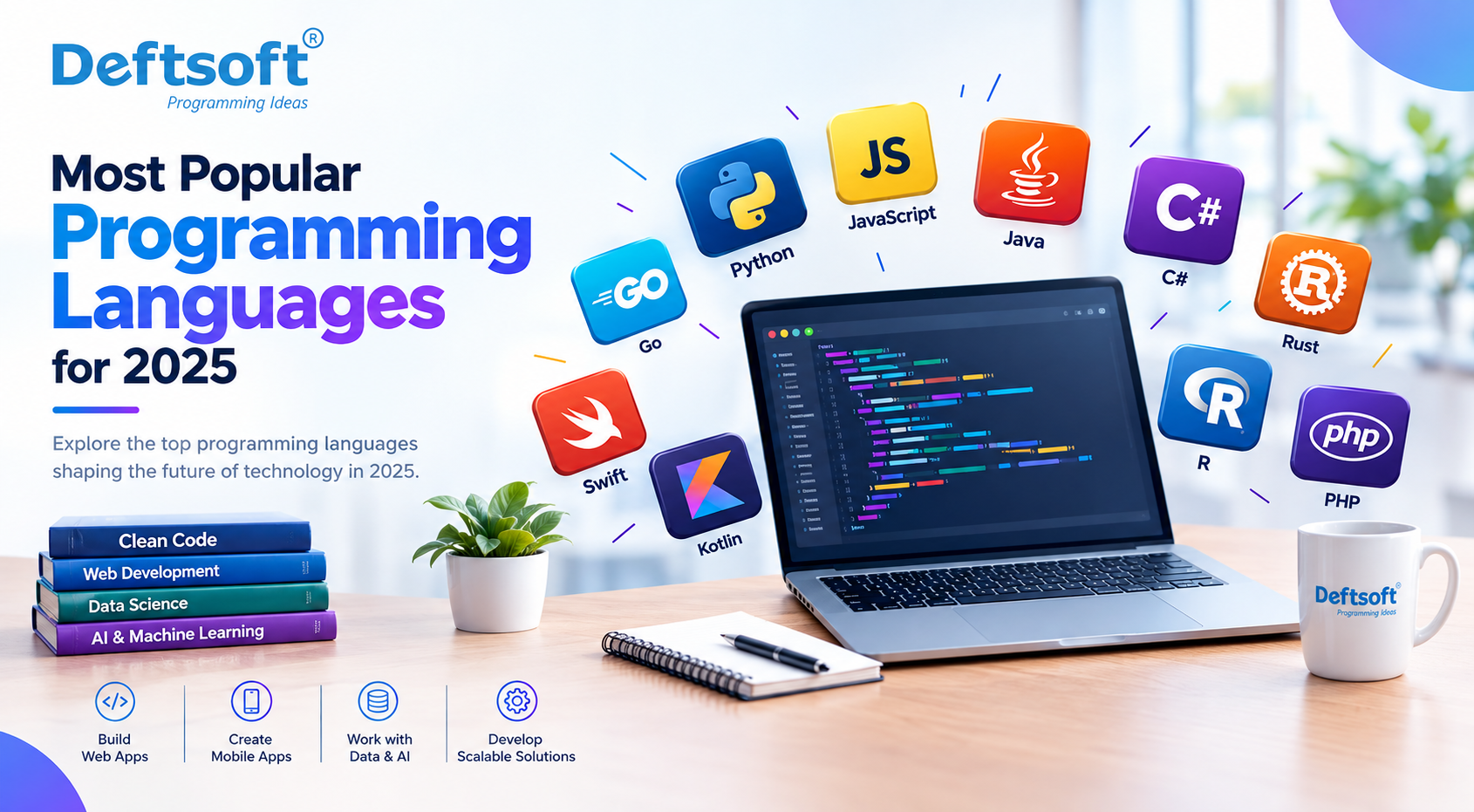
Most Popular Programming Languages for 2025

As technology evolves at an incredible pace, the programming languages that developers love to use also change! It’s super important for anyone aiming for a successful career in tech or for businesses wanting to stay ahead of the game to keep up with these trends. In this exciting blog, we’ll dive into the ten most popular programming languages for 2025, exploring their features, highlights, and even their drawbacks.

We hope this journey will offer valuable insights for both aspiring programmers and experienced professionals as we all look toward an exciting future!

1. Python

Python remains at the forefront thanks to its ease of use and clear syntax, appealing to both newcomers and experienced programmers. Its rich ecosystem includes extensive libraries, and frameworks like Django and Flask and accommodates various programming paradigms, making it adaptable for web development, data analysis, artificial intelligence (AI), and beyond.

Features:

  • Ease of Learning: Python’s syntax is straightforward, allowing new developers to grasp programming concepts quickly.
  • Robust Community Support: A vibrant global community contributes to numerous libraries and frameworks, making problem-solving easier.
  • Data and AI Dominance: Python is the go-to language for data science and machine learning, thanks to libraries like Pandas, NumPy, and TensorFlow.
  • Cross-Platform Compatibility: Python can run on most operating systems, including Windows, Linux, and macOS.
  • Extensive Libraries: With popular libraries like Requests, BeautifulSoup, and Scikit-learn, Python has everything you need for various applications.

Highlights:

  • Python’s simplicity allows developers to focus on problem-solving without getting bogged down in syntax and language rules.
  • Its extensive libraries provide a wealth of resources for various tasks, from data analysis to web development.
  • Python’s dynamic nature makes it an ideal choice for prototyping and development.
  • Its versatility allows Python to be used for a wide range of applications, from web development to scientific computing.

Drawbacks:

  • Despite its many advantages, Python can be slower than languages like C++ or Java due to its interpreted nature.
  • Its dynamic typing can lead to runtime errors that are harder to debug compared to statically typed languages.

2. JavaScript

JavaScript has truly established itself as the heart of web development! With exciting advancements like ES6 and amazing frameworks such as React and Angular, JavaScript provides wonderful features that create smooth interactivity for websites and web applications.

Features:

  • Universality: As a client-side scripting language, JavaScript runs on nearly every web browser, enhancing accessibility.
  • Rich Ecosystem: Libraries like jQuery and frameworks such as Node.js and Vue.js enable developers to build advanced applications.
  • Asynchronous Programming: JavaScript’s event-driven architecture facilitates non-blocking operations, which is essential for responsive web design.
  • Server-Side Development: Node.js enables JavaScript to be used for server-side development, seamlessly integrating client-side and server-side code.
  • Mobile App Development: JavaScript is widely used for developing hybrid mobile apps using frameworks like React Native and Angular Mobile.

Highlights:

  • JavaScript’s versatility allows it to be used for web development, mobile app development, and server-side programming.
  • Its vast ecosystem provides an abundance of libraries and frameworks for various tasks.
  • JavaScript’s asynchronous programming capabilities enable developers to create responsive and scalable applications.

Drawbacks:

  • JavaScript’s dynamic nature can lead to errors and inconsistencies.
  • Its lack of strong typing can make it difficult to debug and maintain large codebases.

3. Java

Java remains a staple due to its object-oriented nature, platform independence (thanks to the Java Virtual Machine), and robustness. It is widely used for enterprise-level applications and Android development.

Features:

  • Object-Oriented: Java’s design encourages code reusability through classes and objects.
  • Platform Independence: Write once, run anywhere—Java’s cross-platform capabilities are a significant advantage.
  • Strong Community and Resources: A well-established community means developers have access to a plethora of resources and libraries.
  • Robust Security: Java’s built-in security features and its sandboxed execution environment ensure safer code execution.
  • Machine Learning and AI: Java is a fantastic choice for diving into machine learning and AI applications, especially with helpful libraries like Weka and Deeplearning4j at your fingertips!

Highlights:

  • Java’s object-oriented nature encourages code reusability and maintainability.
  • Its platform independence makes it a preferred choice for enterprise-level applications.
  • Java’s robust security features ensure a safer execution environment.

Drawbacks:

  • Java can sometimes be a bit verbose, which can result in longer, harder-to-read code.
  • Its memory consumption tends to be higher than that of languages like C or C++, which can be a concern in resource-constrained environments.

4. C#

C# is a versatile language developed by Microsoft as part of the .NET framework. It is widely used for developing desktop applications, web services, and game programming through Unity.

Features:

  • Unity Integration: As the primary language for Unity, C# is the preferred choice for game development.
  • Rich Framework: The .NET framework provides extensive libraries for developers.
  • Modern Language Features: C# has embraced features such as asynchronous programming, LINQ, and pattern matching, making it powerful yet user-friendly.
  • Type Safety: C# is a statically typed language, which ensures type safety and helps prevent runtime errors.
  • Garbage Collection: C#’s automatic garbage collection frees developers from manual memory management, reducing memory leaks and improving code reliability.

Highlights:

  • C#’s rich framework and modern language features make it an ideal choice for complex applications.
  • Its type of safety ensures a safer execution environment.
  • C#’s garbage collection reduces memory management headaches.

Drawbacks:

  • C# is primarily tied to the Microsoft ecosystem, which limits its cross-platform capabilities.
  • Some developers find it less flexible compared to loosely typed languages.

5. Rust

Rust is gaining momentum for systems programming. It offers memory safety and concurrency without a garbage collector, making it an attractive choice for projects requiring high performance and safety.

Features:

  • Safety Features: Rust’s ownership model ensures memory safety, significantly reducing the chances of bugs like null pointer dereferencing.
  • Concurrency: Rust’s approach to concurrency means developers can write parallel code safely and efficiently.
  • Performance: Close to C/C++ in terms of efficiency, Rust is perfect for performance-critical applications.
  • Systems Programming: Rust is specifically designed for building operating systems, file systems, and drivers.
  • Cross-Platform Compatibility: Rust can be compiled to run on most operating systems and architectures.

Highlights:

  • Rust’s safety features make it an ideal choice for systems programming.
  • Its concurrency capabilities enable developers to write parallel code efficiently.
  • Rust’s performance rivals that of C/C++.

Drawbacks:

  • Rust’s steep learning curve can be a barrier for novice developers.
  • Its lack of standard libraries and frameworks limits its versatility.

6. Go

Go, or Golang, developed by Google, is preferred for cloud services and distributed systems. It focuses on simplicity and efficiency with robust concurrency support.

Features:

  • Simplicity: The language is designed to be straightforward, which speeds up development processes.
  • Concurrency Support: Go’s goroutines make it easy to spawn multiple processes, essential for modern cloud-native applications.
  • Fast Compilation: Go compiles quickly, which is a significant advantage for large-scale applications and continuous development.
  • Cross-Platform Compatibility: Go can be compiled to run on most operating systems.
  • Concurrency: Go’s concurrency features allow developers to write efficient and scalable code for distributed systems.

Highlights:

  • Go’s simplicity makes it an ideal choice for rapid development.
  • Its concurrency capabilities enable developers to write efficient and scalable code.
  • Go’s fast compilation speeds up development processes.

Drawbacks:

  • Go’s lack of generics can lead to code duplication and longer, less elegant solutions.
  • Its abstraction over systems programming features can limit advanced optimizations.

7. Swift

Swift is Apple’s programming language for iOS and macOS development. Known for its performance and safety features, Swift is increasingly becoming the language of choice for mobile developers.

Features:

  • Modern Syntax: Swift’s syntax is clean and expressive, allowing developers to write less code while achieving more.
  • Safety Features: Swift’s strong typing and error handling prevent crashes and promote safer coding practices.
  • Performance: Swift is designed to be fast, often outperforming its predecessor, Objective-C, in execution speed.
  • Memory Safety: Swift’s ARC (Automatic Reference Counting) automatically manages memory, freeing developers from memory management headaches.
  • Conciseness: Swift’s concise syntax reduces boilerplate code, making it more manageable compared to Objective-C.

Highlights:

  • Swift’s modern syntax and safety features make it an ideal choice for mobile development.
  • Its performance and memory safety features ensure efficient and reliable code execution.
  • Swift’s concise syntax makes it easier to write and maintain code.

Drawbacks:

  • Swift is primarily tied to the Apple ecosystem, limiting its cross-platform capabilities.
  • Some developers find it less flexible compared to loosely typed languages.

8. Kotlin

Kotlin has become the language of choice for Android development. Created by JetBrains, it ensures full compatibility with Java while providing a contemporary alternative with improved syntax and features.

Features:

  • Interoperability: Kotlin works seamlessly with existing Java code, allowing developers to adopt it gradually.
  • Conciseness: Kotlin’s succinct syntax reduces boilerplate code, making it more manageable compared to Java.
  • Null Safety: Built-in null safety reduces the likelihood of null pointer exceptions, a common issue in Java.
  • Type Inference: Kotlin’s type inference allows developers to eliminate explicit type declarations, making the code more readable.
  • Lambda Functions: Kotlin supports lambda functions, making code more expressive and readable.

Highlights:

  • Kotlin’s interoperability with Java makes it an ideal choice for Android development.
  • Its concise syntax and null safety features ensure efficient and reliable code execution.
  • Kotlin’s type inference and lambda functions make it easier to write and maintain code.

Drawbacks:

  • Kotlin can be slower in terms of compilation speed.
  • Some developers may find the transition from Java to Kotlin challenging due to differences in language paradigms.

9. R

R continues to be the primary language for statistical computing and data visualization, making it the language of choice for statisticians and data scientists.

Features:

  • Statistical Analysis: R excels in handling complex statistical analyses and data processing tasks.
  • Data Visualization: Libraries like ggplot2 and Shiny allow developers to create complex visualizations easily.
  • Rich Ecosystem: A wealth of packages is available for various specific statistical methods and graphical techniques.
  • Cross-Platform Compatibility: R can run on most operating systems, including Windows, Linux, and macOS.
  • Extensive Libraries: R’s libraries include popular ones like dplyr and tidyr, making it a versatile tool for data analysis.

Highlights:

  • R’s statistical analysis capabilities make it an ideal choice for data analysis and visualization.
  • Its rich ecosystem provides a wealth of resources for various tasks.
  • R’s cross-platform compatibility ensures that it can run on most operating systems.

Drawbacks:

  • R is slower compared to general-purpose programming languages like Python and Java, primarily because it is an interpreted language.
  • Its steep learning curve can be a barrier for novice developers.

10. PHP

PHP is a mature scripting language for web development, known for its ease of use, flexibility, and extensive libraries.

Features:

  • Ease of Use: PHP’s syntax is simple and easy to learn, making it ideal for beginners.
  • Flexibility: PHP can be used for web development, command-line scripting, and even desktop applications.
  • Extensive Libraries: PHP’s extensive libraries and frameworks, such as Laravel and CodeIgniter, make it a popular choice for web development.
  • Cross-Platform Compatibility: PHP can run on most operating systems, including Windows, Linux, and macOS.
  • Security: PHP’s built-in security features and its sandboxed execution environment ensure safer code execution.

Highlights:

  • PHP’s ease of use and flexibility make it an ideal choice for web development and scripting tasks.
  • Its extensive libraries and frameworks make it a popular choice for web development.
  • PHP’s cross-platform compatibility ensures that it can run on most operating systems.

Drawbacks:

  • PHP’s syntax can be verbose and less maintainable compared to modern languages like Python or JavaScript.
  • Its lack of strong typing can lead to errors and inconsistencies.

Conclusion

As we look ahead to 2025, these ten programming languages are poised to lead the way for both new and experienced developers. Each one comes with its own special perks tailored for various areas of the tech world. Keeping yourself updated and growing your skills to align with these trends will be super important for advancing your career and ensuring the success of your projects.

The growth of programming languages brings a fun chance to adapt and innovate. Top Development Companies like Deftsoft are leading the charge, utilizing the latest programming technologies to create amazing solutions just for you. By embracing the spirit of teamwork in engineering and development, Deftsoft is here to support you in navigating the ever-changing tech landscape with confidence.

If you’re in search of custom software development, mobile app solutions, or data analytics services powered by these programming languages, feel free to connect with Deftsoft. Together, we can make strides toward your bright future in technology!

FAQs

1. What are the top programming languages for 2025?

The top programming languages for 2025 include Python, JavaScript, Java, C#, Rust, Go, Swift, Kotlin, R, and PHP. Each language offers unique features and advantages tailored to different areas of technology.

2. Why is Python so popular among developers?

Python’s popularity stems from its ease of learning, robust libraries for data analysis and AI, and supportive community. Its versatility allows it to be used across various applications, from web development to scientific computing.

3. How does JavaScript contribute to modern web development?

JavaScript is crucial for web development due to its ability to create interactive and dynamic web experiences. Its extensive ecosystem, including frameworks like React and Angular, enhances its capabilities for building responsive applications.

4. Is Rust suitable for beginners?

While Rust offers excellent memory safety and performance, its steep learning curve can be challenging for beginners. However, those interested in systems programming may find its features rewarding as they gain experience.

5. What sets Kotlin apart from Java for Android development?

Kotlin provides seamless interoperability with Java while offering a more concise syntax and built-in null safety features, making it easier and safer for Android development. This modern language enhances the efficiency of the coding process.

6. Why should businesses choose Deftsoft for software development?

Deftsoft specializes in leveraging the latest programming languages for custom software solutions. With a commitment to quality and user-centric design, we ensure businesses receive tailored applications that meet their unique needs and goals.

How to Choose the Best Cryptocoin Development Company

In the fast-paced world of digital currency, the rise of cryptocurrencies has opened up vast opportunities for innovation and investment. At the heart of this revolution lies the expertise of a Cryptocoin Development Company specializing in the creation, management, and enhancement of blockchain technologies. As the demand for unique and efficient crypto solutions continues to grow, businesses and entrepreneurs are increasingly turning to these specialized firms to navigate the complexities of the crypto landscape. In this article, we will delve into the essential services offered by Cryptocoin Development Companies, highlighting their pivotal role in shaping the future of finance and technology. Join us as we explore the transformative impact of these firms and what they can offer in our ever-evolving digital ecosystem.

Understanding the Importance of Cryptocoin Development Services

Today, cryptocoins and blockchain technology are key in our digital world. As more people use decentralized finance, the need for cryptocoin development services grows. These services help create unique cryptocurrencies and ensure they are secure. By choosing a professional crypto development company, businesses can meet market demands and follow rules. This builds trust and reliability. When starting a crypto project, picking the right partner is key. A good crypto development company knows how to design and deploy digital assets. They understand what the market wants and the challenges ahead.

The development process is complex, involving smart contracts and more. Working with experts helps avoid problems and gets products to market faster. This puts businesses ahead in the cryptocurrency world. The crypto market is always changing needing constant innovation. Companies must keep up with new technologies and trends. A dedicated crypto development service helps with this, keeping clients ahead in the blockchain world. By being innovative, businesses can meet user needs and adapt to changes. This keeps them strong in the market.

In short, cryptocoin development services are crucial for businesses in the digital currency world. Working with a reliable company helps navigate the complex world of digital assets. This partnership is key for success and growth in the digital economy.

Factors to Consider When Selecting a Cryptocoin Development Company

Choosing the right cryptocoin development company is vital for businesses. The blockchain world is constantly changing, with many firms offering different services. Look at the company’s experience and success stories to see if they understand the challenges of creating cryptocurrencies. It’s also important to check the range of services they offer. A good company should handle everything from coin development to setting up exchanges. They should also keep up with the latest blockchain technology to ensure a secure product.

Scalability and customization are also key. A company that can adapt to your specific needs is best. Discuss your project’s goals to see if they can meet your requirements. Also, consider their support and maintenance services after launch. While cost is important, don’t just look for the cheapest option. Quality development services may cost more upfront but save money in the long run. Finding a balance between quality, expertise, and budget is essential for a successful partnership. Here is the list of factors that need to consider when selecting the Cryptocoin development company-

Cryptocoin Development

Experience and Success Stories

  • Look at the company’s history and previous projects.
  • Check if they understand the challenges of creating cryptocurrencies.

Range of Services

  • Assess the variety of services they offer, from coin development to setting up exchanges.
  • Ensure they keep up with the latest blockchain technology for a secure product.

Scalability and Customization

  • Ensure the company can adapt to your specific needs.
  • Discuss your project’s goals to see if they can meet your requirements.

Support and Maintenance

  • Consider their support and maintenance services after the launch.

Cost and Quality Balance

  • Don’t just look for the cheapest option; quality services may cost more initially but save money in the long run.
  • Find a balance between quality, expertise, and budget for a successful partnership.

Evaluating the Expertise and Experience of Cryptocoin Development Providers

Choosing the right Cryptocoin Development Company is key for your project’s success. The crypto market is always changing. It’s important to look at a provider’s skills and experience. They need to know a lot about the tech and the market. Look at their past work, what clients say, and their range of skills. This will show you what they can do.

Experience matters a lot in crypto development. A company with a lot of experience can spot problems and find new solutions. Ask about the tech they use and the team’s skills. Looking at past projects can give you insight. Case studies and whitepapers show how they work. A company that shares its work is more trustworthy.

Trade publications and online reviews are also helpful. They tell you about the company’s reputation in the industry. Choosing the right company takes time and effort. Focus on their skills, experience, and past work. This will help your project succeed in a fast-changing market.

Key Questions to Ask When Hiring a Cryptocoin Development Company

Hiring a Cryptocoin development company is a big decision. They can help bring your idea to life and guide you through development. Ask the right questions to find the right company for your project.

  • Start by asking about their experience. Ask for examples of projects they’ve done. This shows if they can handle your project. Also, ask about the tech they use. Different projects need different tech. This helps you see if they can meet your project’s needs.
  • Security is also important. Ask how they handle security. This shows if they’re ready for potential problems. Good communication is key. Ask how they manage projects and keep you updated. A clear communication plan helps your project stay on track.
  • Finally, ask about support after the project is done. The crypto world changes fast. Having a reliable partner for support is important.
  • Understanding their pricing is also important. Ask for a detailed cost breakdown. This helps you budget and avoid surprises.

By asking these questions, you can find a Cryptocoin development company that meets your needs. They can help make your vision a reality.

Comparing Pricing Models and Services Offered by Cryptococoin Developers

The crypto market is growing fast. More companies are offering solutions and apps. They have different pricing models to fit different needs. It’s important to understand these models. Each has its own benefits and drawbacks. Knowing this helps you choose the right option for your project. Fixed-price contracts are popular among startups and small businesses. They offer budget predictability. Clients know the total cost upfront, making finance management easier. However, any changes in the project can lead to extra costs or delays.

Hourly billing gives clients flexibility. They can scale projects as needs change. But, it can lead to budget overruns if not watched closely. Contingent pricing, based on project outcomes, aligns incentives. It can foster strong partnerships but requires an understanding of project success. Cryptocoin Development Companies offer a wide range of services. They include blockchain consulting, token development, and security audits. Some specialize in areas like DeFi or NFTs. This can be good for specific needs but might limit flexibility in other projects. Choosing the right Cryptocoin Development Company is crucial. Businesses need to consider pricing models and services. They should look at their needs, budget, and project scope. This ensures they find a developer that meets their technical needs and fits their vision.

Ensuring Security and Compliance with Your Cryptocoin Development Project

Ensuring security and compliance in cryptocoin development is key. Working with a reputable company can help avoid legal and cyber risks. They have the knowledge to follow legal rules and add strong security measures. Some of the strong security measures in this development include- Multi-signature wallets, the use of smart contracts, multi-factor authentication, cryptography, etc. Identifying the right regulatory framework is also very important. Laws on cryptocurrencies vary by jurisdiction. A good company will keep up with legal changes and help avoid problems. Regular audits and risk assessments are also important to meet standards and adapt to future changes.

Security and Compliance

Security is vital for your blockchain solution’s success. Cyber threats are common in the digital currency world. Using encryption, smart contract audits, and secure coding can protect your cryptocoin. A seasoned company will implement these strategies to make your project more resilient. Security and compliance are essential for trust with users and investors. By focusing on these, you set your project up for success and sustainability. Working with a skilled cryptocoin development company can give you the knowledge and resources to thrive in a competitive market.

Examining Past Projects and Client Testimonials of Cryptocoin Development Companies

Looking at a Cryptocoin Development Company’s past projects and testimonials is important. A portfolio of successful projects shows their technical skills and experience. It highlights their ability to handle blockchain challenges. Each project in the portfolio can show the company’s approach to custom solutions. It can reveal their innovation, efficiency, and ability to meet specific needs. By analyzing these projects, potential clients can understand the company’s capabilities. Client testimonials are key when picking a Cryptocoin Development Company. They give a real look at how the company works, communicates, and meets client needs. Good feedback shows the company is reliable and meets expectations. Bad feedback might warn of potential problems.

Reading these testimonials helps you understand the company’s reputation. This is important for businesses looking to invest in a cryptocurrency project. It helps you see if the company is right for your needs. A company’s ability to adapt to changing projects is shown in client feedback. The blockchain world changes fast. A good company stays flexible and solves problems well. This means they can handle the challenges of cryptocurrency development.

In short, looking at past projects and testimonials is crucial. It shows a company’s strengths and helps you make a smart choice. This ensures you work with a partner who can handle the complex world of cryptocurrency.

Navigating the Selection Process for Your Ideal Cryptocoin Development Partner

Finding the right partner for your crypto coin project is key to success. The blockchain world changes fast. You need a company that gets the tech and shares your goals. Start by checking the company’s portfolio and experience. Look for projects that match your vision. A good company has a track record of success and can create unique solutions.

Good communication and teamwork are vital. Talk to the company to see if they understand your project. Pay attention to how they share ideas and feedback. This will help the development process. Also, think about the company’s support after the project is done. A good company offers ongoing support for any issues. Make sure they can handle updates and community interactions.

In conclusion, carefully choosing a Cryptocoin Development Company is important. Look at their past work and testimonials. This helps you find a partner who can help your project succeed.

Maximizing Success with Your Chosen Cryptocoin Development Firm

​Navigating the landscape of cryptocurrency can be daunting, especially for those aspiring to make their mark in the digital economy. Partnering with a competent Cryptocoin Development Company is crucial to turning visions into reality. These specialized firms not only provide technical expertise in blockchain technology but also bring insights into market trends and user demands. By selecting a firm that aligns with your goals and understands your target audience, you lay the groundwork for a successful project that resonates within the competitive crypto space.

When engaging with a Cryptocoin Development Company, it’s essential to look beyond just the technical capabilities. Communication, transparency, and a collaborative spirit are vital traits that can significantly impact the project’s trajectory. Establishing a strong rapport with the development team ensures that feedback is valued and that the final product aligns with your original vision. Additionally, an experienced firm can offer valuable strategic advice that can sharpen your focus, whether it involves the coin’s utility, branding, or long-term scalability.

Moreover, it is important to evaluate the firm’s portfolio and past projects as a benchmark for their expertise. A reputable Cryptocoin Development Company should demonstrate a track record of successful launches, showing their ability to adapt and innovate. Don’t hesitate to request case studies or testimonials, as these can provide insights into the firm’s problem-solving approaches and project management practices. By choosing a firm with proven success, you can increase your confidence in the development process and potentially avoid common pitfalls that often plague new cryptocurrency ventures.

Ultimately, maximizing the success of your chosen cryptocurrency involves a blend of creativity, sound strategy, and reliable execution. Collaborating with the right Cryptocoin Development Company allows you to leverage their industry know-how, technical prowess, and creative solutions. With the right partner at your side, you can navigate the complexities of development and position your cryptocoins for success in a rapidly evolving market.

Why Choose Deftsoft for Your Cryptocoin Development Needs?

At Deftsoft, we understand that the rapidly evolving cryptocurrency landscape demands innovation, expertise, and a keen eye for emerging trends. Our team of highly skilled developers and blockchain experts is dedicated to providing state-of-the-art cryptocoin development services tailored to your specific needs. With a proven track record of successful projects and satisfied clients, we are well-equipped to handle the complexities of your digital asset ventures.

Our comprehensive suite of services includes everything from initial coin design and smart contract development to exchange integration and ongoing maintenance. We prioritize security, compliance, and scalability, ensuring that your cryptocoins are not only cutting-edge but also robust and reliable. By leveraging the latest advancements in blockchain technology, we help you stay ahead of the competition and achieve your business goals.

Partnering with Deftsoft means more than just technical excellence. We are committed to providing exceptional customer service, transparent communication, and continuous support throughout your project’s lifecycle. Whether you are a startup looking to launch a new cryptocurrency or an established enterprise seeking to enhance your digital offerings, Deftsoft is your trusted partner in the world of cryptocoin development. Let us help you turn your vision into reality and drive your success in the dynamic digital economy.

FAQs: Choosing the Best Cryptocoin Development Company

1. What services do Cryptocoin Development Companies offer?

Cryptocoin Development Companies provide a range of services including initial coin design, smart contract development, blockchain consulting, exchange integration, security audits, and ongoing maintenance to ensure the seamless operation of digital assets.

2. Why is it important to choose a professional Cryptocoin Development Company?

Choosing a professional Cryptocoin Development Company ensures that your cryptocurrency is designed, developed, and deployed with the highest standards of security, scalability, and compliance. This helps build trust and reliability in your digital assets.

3. How do I evaluate the expertise and experience of a Cryptocoin Development Company?

Evaluate their portfolio, client testimonials, and case studies to understand their technical skills and experience. Look for successful projects that align with your vision and consider their knowledge of the latest blockchain technologies and market trends.

4. What factors should I consider when selecting a Cryptocoin Development Company? Consider their experience, range of services, ability to provide scalable and customizable solutions, support and maintenance offerings, and cost. Balancing quality, expertise, and budget is essential for a successful partnership.

5. Why choose Deftsoft for your cryptocoin development needs?

Deftsoft has a proven track record of successful projects and a team of highly skilled developers and blockchain experts. We offer comprehensive services, prioritize security and compliance, and provide continuous support throughout your project’s lifecycle.

6. What sets Deftsoft apart from other Cryptocoin Development Companies?

Deftsoft stands out due to its commitment to innovation, transparent communication, and personalized approach to each project. We leverage the latest advancements in blockchain technology to deliver cutting-edge solutions that drive business growth and success.

The Future of 3D Mobile Gaming: A Transformative Journey

The mobile gaming landscape has been on a trajectory of rapid evolution, transitioning from basic 2D games to expansive and immersive 3D experiences. This transformation has been driven largely by advancements in mobile technology, the proliferation of powerful processors, dedicated graphics chips, and high-resolution displays. Today, mobile games boast visuals and gameplay that can rival traditional console and PC experiences, setting the stage for an exhilarating future in 3D mobile gaming.

The Shift from 2D to 3D Animation in Mobile Games

In the early days of mobile gaming, we saw devices really struggle to handle complex 3D graphics. Games like Angry Birds and Flappy Birds chose to focus on fun gameplay instead of fancy visuals, all thanks to some hardware limitations. These charming 2D mobile games used simple graphics and easy-to-understand gameplay to draw players in, helping to pave the way for the mobile gaming industry as we know it today. But guess what? The rapid pace of technological progress has completely changed the game!

Now, with much more processing power and better graphics capabilities, developers are busy creating stunning 3D worlds brimming with unique characters and lifelike interactions. This incredible transformation opens the door to vast game worlds filled with rich storylines, interesting character developments, and all kinds of gameplay styles. As mobile devices have evolved into amazing gaming machines, developers can now beautifully blend fantastic graphics with engaging gameplay, giving players the best of both worlds!

Enhanced Visual Appeal

The shift from 2D to 3D has not only increased the visual appeal of mobile games but has also deepened player immersion. Gamers can now engage with stunning graphics, lifelike environments, and dynamic animations that make every gaming session feel like an adventure. Instead of merely tapping the screen, players find themselves fully enveloped in experiences that challenge their skills and captivate their senses.

Enhanced visuals in 3D mobile gaming bring a level of realism that transforms player experiences. Forget the simplistic platforms where players could only move left, right, or up; in 3D environments, players navigate multi-layered worlds filled with detailed textures, shadows, and lighting effects that mimic real-life physics. Whether it’s exploring ancient ruins or racing through futuristic cities, these new visual elements heighten the sense of immersion.

The combination of high-definition graphics, detailed animations, and rich soundscapes engages players on multiple sensory levels, making mobile gaming not just an activity but a captivating journey. This evolution invites players to lose themselves in virtual worlds, whether they’re embarking on epic quests, battling other players, or solving puzzles, thereby driving increased user engagement and retention.

Engaging Gameplay Mechanics

This transformation goes hand in hand with evolving gameplay mechanics. The introduction of real-time strategies and role-playing games (RPGs) in mobile formats further enhances the 3D experience. Players no longer just tap and swipe; they now strategically plan movements, collaborate with friends, or compete against opponents in real-time.

As game design continues to innovate, we can expect even more intriguing elements like augmented reality (AR) features, complex puzzles that require spatial awareness, and immersive storylines that use 3D animation to draw players into rich narratives. The integration of these features not only keeps players engaged but also encourages a loyal gaming community around new titles.

In conclusion, the evolution from 2D to 3D animation in mobile games marks a significant milestone in the gaming industry. This transition not only enhances visual appeal but also enriches the overall gaming experience, setting the stage for even more groundbreaking innovations in the future. As technology continues to advance, the possibilities for 3D mobile gaming are virtually limitless.

Latest Trends in 3D Animation for Mobile Games

The mobile gaming industry is undergoing a significant transformation, and a few key trends are shaping the 3D gaming landscape:

Trends in 3D Animation

1. Realistic Physics and Animation

Gone are the days of simplistic movements and static animations. Modern game engines such as Unity and Unreal Engine enable developers to integrate realistic physics into their games, leading to a more lifelike experience. For instance, players can observe how clothing moves on a character’s body, how obstacles react to collisions, or how characters navigate various terrains in a cohesive and realistic manner. Technologies like NVIDIA PhysX support real-time simulation, pushing the limits of realism within mobile games.

2. Optimization for Mobile Devices

Despite the increased capabilities of mobile devices, optimization remains essential. Developers must employ techniques such as Level of Detail (LOD) to adjust the complexity of 3D models based on the specs of the device. Efficient graphics APIs like Vulkan and Metal help optimize rendering by offloading processing tasks to mobile GPUs instead of relying solely on CPUs. This ensures smooth gameplay on a wide array of devices without sacrificing quality.

3. Augmented Reality (AR) Integration

Augmented Reality (AR) has started to carve its niche in mobile gaming. By blending virtual elements with the real world, AR creates distinctive interactive experiences for players. Think about the groundbreaking success of Pokémon Go—a game that permanently altered how we view mobile gaming. By overlaying digital creatures onto real-world settings, AR not only enhances user engagement but also fosters social interaction, encouraging players to explore their environments.

The Role of Game Engines

Game engines have become indispensable tools for developers, providing a comprehensive suite of features that streamline game development. Two pioneering engines—Unity and Unreal Engine—represent the forefront of innovation in creating 3D mobile games.

Unity 3D

Unity stands out as a versatile cross-platform game engine that supports both 2D and 3D game development. Its user-friendly interface and extensive library of assets allow developers—whether novices or seasoned professionals—to jumpstart their projects with ease. Unity’s asset store offers a vast collection of models, scripts, and textures, speeding up the development process and lowering costs. Furthermore, Unity’s community-driven support network enables developers to find solutions and share ideas swiftly.

Unreal Engine

On the other hand, Unreal Engine has carved a reputation for delivering stunning graphical fidelity. Renowned for its high-end capabilities, it is particularly suited for creating visually impressive 3D games that elevate player immersion. Unreal Engine’s Blueprint visual scripting system allows artists and designers to create gameplay mechanics without needing a coding background. This accessibility drives creativity and innovation while offering advanced tools for rendering, lighting, and animation that push mobile graphics to new heights.

The Future of 3D Animation in Mobile Gaming

Looking ahead, the horizons for 3D animation in mobile game design appear extensive and promising. With rapid advancements in mobile hardware and software, we can anticipate even greater strides in graphics, animations, and gameplay features. Here are some trends anticipated to shape the future:

1. Real-Time Ray Tracing

Real-time ray tracing, which has long been a standout feature of console and PC gaming, is now making exciting strides into mobile gaming! By mimicking the way light interacts with objects in a game world, ray tracing brings incredibly realistic lighting, shadows, and reflections to life. With mobile GPUs getting more powerful every day, we can look forward to ray tracing taking the visual quality of mobile games to new heights, allowing developers to create beautifully immersive environments that react to dynamic light sources in a truly realistic way.

2. AI-Powered Gameplay

Artificial Intelligence is set to significantly enhance our gaming experiences! In the near future, mobile games are likely to utilize AI to animate non-player characters (NPCs) in thrilling ways, reacting to players’ actions and customizing gameplay according to each individual’s style. Imagine battling adversaries that adapt to your strategies and environments that change based on your decisions, all creating a truly personalized gaming adventure!

3. Cloud Gaming

Cloud gaming can truly change the game for mobile gaming! With internet speeds getting better everywhere and cloud technology becoming more accessible, players are set to enjoy high-quality games streamed straight to their devices. This exciting model takes away the worries about local storage or needing powerful hardware, meaning everyone can dive into amazing high-end 3D games, no matter what device they have.

Emerging Technologies and Platforms

In addition to Unity and Unreal Engine, other technologies and platforms are playing a crucial role in shaping the future of 3D mobile gaming:

1. Web 3.0 and Blockchain

The rise of Web 3.0 and blockchain technology is creating exciting new opportunities in the gaming world! These innovations make it possible for players to have actual ownership of their in-game assets, so you can trade them as you like. Thanks to blockchain, virtual collectibles, and items come with authenticity and unique ownership, which means you can confidently engage in secure transactions without worrying about third-party interference. Plus, decentralized applications (dApps) can boost security, helping to protect against hacks and service disruptions!

2. Low-Code and No-Code Platforms

Low-code and no-code platforms are making game development more accessible than ever! They empower individuals with little coding experience to jump right in and create amazing games. With their easy-to-use visual interfaces and drag-and-drop features, these platforms streamline the prototyping and development process, allowing creativity to shine. While they’re not set to replace traditional development entirely, they play a vital role in lowering barriers, inviting a wave of unique ideas to flourish in the gaming world.

3. Design Trends: Dark Mode and UI Innovations

As mobile users spend more time gaming, the user interface must evolve. Dark mode is gaining traction, offering an aesthetically pleasing experience while conserving battery life. Innovations in UI design, including micro-animations and minimalistic layouts, enhance usability and attract players, ensuring a seamless interaction with games.

Deftsoft: Your Partner in 3D Mobile Game Development

At Deftsoft, we are deeply invested in the transformative power of 3D mobile gaming. As a leading 3D game development company, we offer a comprehensive suite of services that realize your gaming vision. Our expertise in Unity3D and Unreal Engine sets us apart, enabling us to create unique gaming experiences tailored to your needs.

Our Services Include:

  • 3D Game Design and Development: Creating visually stunning and engaging 3D games for iOS and Android platforms.
  • Unity3D Game Development: Our proficient Unity developers design high-performance games featuring seamless gameplay.
  • Unreal Engine Development: We leverage Unreal Engine’s power to create cinematic-quality games with lifelike graphics and immersive environments.
  • AR/VR Game Development: Developing cutting-edge augmented and virtual reality games that blend reality with the virtual for unique experiences.
  • Game Porting and Optimization: Porting existing games to mobile platforms while optimizing them for maximum performance and compatibility.
  • Quality Assurance and Testing: Ensuring that your games run smoothly and are free from bugs, providing an enjoyable experience.

Why Choose Deftsoft?

  • Experienced Team: Our talented professionals bring years of expertise in game development, having completed numerous successful projects.
  • Cutting-Edge Technology: We stay updated with the latest trends, ensuring our clients benefit from the most advanced solutions.
  • Custom Solutions: Tailoring our services to meet each project’s unique requirements, we prioritize personalized support.
  • Timely Delivery: We commit to delivering projects on time and within budget while maintaining high-quality standards.
  • Client Satisfaction: Our focus on client satisfaction drives us to collaborate closely with clients throughout the development process.

Conclusion

3D animation is reshaping the landscape of mobile game development. By redefining how players interact with their devices, mobile gaming has become a vibrant tapestry of immersive experiences. As emerging technologies like realistic physics, procedural animation, AR integration, and advanced AI push boundaries, the future of 3D animation in mobile games is astonishingly bright.

Whether you’re envisioning an expansive open-world adventure, a gripping simulation, or animated characters that spring to life, the potential for innovation is limitless. Partnering with Deftsoft could be your key to unlocking unforgettable experiences for players across the globe.

FAQs

What is 3D mobile gaming?

3D mobile gaming refers to playing video games with three-dimensional graphics on mobile devices such as smartphones and tablets. These games offer a more immersive and visually attractive experience compared to traditional 2D games.

What are the benefits of 3D mobile gaming?

The benefits of 3D mobile gaming include:

  • Immersive Gameplay: 3D elements enhance player engagement and interaction.
  • Enhanced Visuals: 3D graphics create a more realistic and appealing gaming experience.
  • Increased User Retention: Visually striking games are more likely to retain users and encourage in-game spending.

What are some popular 3D mobile games?

Popular 3D mobile games include titles such as Call of Duty: Mobile, PUBG Mobile, Genshin Impact, and Fortnite.

What services does Deftsoft offer for 3D mobile game development?

Deftsoft provides a comprehensive range of services, including game design and development, Unity3D and Unreal Engine development, AR/VR game development, game porting and optimization, and quality assurance and testing.

What platforms does Deftsoft develop 3D mobile games for?

We develop 3D mobile games for both iOS and Android platforms.

Does Deftsoft offer custom 3D game development solutions?

Yes, Deftsoft tailors its services to meet each project’s unique requirements, ensuring personalized attention and support.

How can I get a quote for 3D mobile game development services from Deftsoft?

You can contact Deftsoft through our website or by phone to discuss your project needs and receive a customized quote.

What is the typical timeline for developing a 3D mobile game with Deftsoft?

The timeline for developing a 3D mobile game varies depending on the project’s complexity. Deftsoft collaborates with clients to establish realistic timelines for timely delivery without compromising quality.

AEM 6.5 vs AEM Cloud | Which one is better?

Let us gain an understanding of Adobe Experience Manager (AEM)

Before comparing AEM 6.5, the most recent version of this Content Management System, and AEM Cloud, we need to understand what exactly AEM (Adobe Experience Manager) is and why we need to compare these two branches of the same tree. 

AEM is a content management system (CMS) and a Data Asset Management (DAM) system that helps businesses or individuals in managing their web content on multiple platforms such as websites, mobile applications, and many others. AEM offers multiple features such as managing web content, managing digital assets, assisting in customer data analysis with the integration of its own Customer Data Platform (CDP), and many others. It’s a complete package if you want your content and digital assets to be managed effectively. 

In 2019, AEM released its newest version, 6.5, with multiple new features as compared to its predecessor, AEM 6.,4, and everyone loved the new features added to it. But, after that, AEM has also released its AEM as a cloud service, and everyone has some questions in mind: that how is it different from AEM 6.5, which is still new and offering multiple new features? 

To find the answers to these questions, here we are with this blog to compare both of these AEM services. It is also important to compare these as the release of AEM Cloud, adobe might be hinting for the End of Support (EOS) for AEM 6.5, which is still not announced yet. But as per the latest information from Adobe, AE< 6.5 will be receiving the updates in the future as well, but till when, it is still not known. If it happens, then the best possible option in front of the users will be the AEM cloud, so it is important to compare these two in terms of the features so that if AEM 6.5 goes down, the users should know whether AEM cloud is suitable for them or not.

AEM 6.5 vs AEM Cloud

AEM 6.5 Overview
AEM 6.5
  AEM Cloud Overview
AEM Cloud
Adobe Experience Manager (AEM) 6.5 is a comprehensive content management solution for building websites, mobile apps, and forms. AEM is part of the Adobe Experience Cloud suite, enabling businesses to deliver consistent and personalized experiences across various channels. Released in April 2019, AEM 6.5 builds on its predecessor, AEM 6.4, by maximizing productivity and enhancing user experience. It offers powerful content authoring capabilities, empowering marketers and content creators to manage content efficiently without needing extensive IT support.

Key features of AEM 6.5 include improved content fragment models for developers, enhanced asset management with a more intuitive user interface, and streamlined workflows tailored to enterprise needs. With the inclusion of dynamic media, AEM 6.5 allows organizations to deliver media-rich experiences seamlessly. Furthermore, the system supports integration with other Adobe Experience Cloud components, facilitating a more connected ecosystem for personalizing customer journeys.

One of the popular features of AEM 6.5 is the Sites interface, which provides an optimized experience for marketers and authors. It supports various templates and components, making it easier to create and manage multi-language websites. Additionally, AEM 6.5 introduced Headless CMS capabilities, allowing organizations to distribute content easily across multiple platforms and devices while integrating easily with third-party systems.

Overall, AEM 6.5 positions itself as a robust, on-premise, or cloud-enabled solution tailored for organizations prioritizing content management and personalization strategies.
  Adobe Experience Manager Cloud, often referred to as AEM as a Cloud Service, represents Adobe’s cloud-native offering of its renowned content management platform. Launched as part of Adobe’s wider move to cloud solutions, AEM Cloud builds upon the foundational capabilities of AEM while offering several enhancements focused on scalability, flexibility, and reduced operational overhead.

Central to AEM Cloud is its ability to deliver content at lightning speed, aided by cloud-native technologies that optimize performance and responsiveness. Built on Adobe’s robust cloud infrastructure, AEM Cloud is designed to support business agility by enabling organizations to adapt to changing demands without the constraints inherent in traditional on-premise deployments. This includes simplified deployment mechanisms and automated scaling to manage vast amounts of traffic during peak times.

AEM Cloud leverages microservices architecture to deliver modular components, meaning organizations can deploy updated functionalities without significant downtime or disruption. Its integration with Adobe Real-Time Customer Data Platform (CDP) and other Adobe Experience Cloud services strengthens marketing capabilities and serves as a cornerstone for creating data-driven, personalized experiences.

Another standout feature of AEM Cloud is the enhanced security model, providing businesses with comprehensive compliance and security protocols tailored for cloud environments. Continuous updates and monitoring mean that users always access the latest features and security enhancements, enabling organizations to stay competitive in a rapidly evolving digital landscape.


In Depth Comparison Based On Features

When evaluating AEM 6.5 and AEM Cloud, it’s essential to look at the various aspects that set these platforms apart. The following comparison highlights key features in terms of deployment, scalability, performance, user experience, integrations, and security.

Deployment

AEM 6.5:
AEM 6.5 can be deployed on-premise or via cloud hosting. While on-premise setups offer organizations control over their environment, they also necessitate significant IT resources for maintenance, updates, and security. Choosing on-premise deployments can limit scalability, as organizations may find it challenging to keep pace with growth, especially during peak traffic periods.

AEM Cloud:
On the other hand, AEM Cloud functions as a completely managed service, utilizing Adobe’s cloud infrastructure. Organizations no longer need to handle the operational challenges associated with conventional IT architecture. Deployments within AEM Cloud are naturally more adaptable, enabling businesses to effortlessly adjust resources based on their requirements.

Scalability

AEM 6.5:
Scalability in AEM 6.5 relies heavily on the organization’s infrastructure. While it supports clustering for load balancing and failover, scaling requires investment in additional hardware and ongoing IT involvement. This may present challenges during traffic spikes when immediate scalability is crucial.

AEM Cloud:
AEM Cloud offers inherent scalability benefits and is designed to handle traffic fluctuations efficiently. The microservices-based architecture allows for on-demand scaling, enabling businesses to expand their resources dynamically without downtime or significant manual intervention. This adaptability is critical for organizations with varying levels of demand.

Performance

AEM 6.5:
Performance in AEM 6.5 relies on the server configuration and underlying infrastructure. While optimization techniques can enhance performance, organizations are responsible for ongoing performance monitoring and tuning, which may extract resources away from core business activities.

AEM Cloud:
With AEM Cloud, Adobe optimizes performance automatically through content delivery networks (CDNs) and caching mechanisms integrated into the cloud infrastructure. This design enables faster content delivery across global regions, providing end users with a consistently high-quality experience in terms of speed and responsiveness.

User Experience

AEM 6.5:

AEM 6.5 focuses heavily on authoring and user interfaces to enhance content creation and management. Its design, along with strong AEM content fragment features and asset management, enables marketers and authors to work effectively. However, as some users might be using an outdated interface, the level of training and experience can differ significantly across teams.

AEM Cloud:
AEM Cloud enhances the user experience further by implementing modern design principles aimed at intuitive navigation and ease of use. Interactive features, analytics integration, and AI-powered insights make crafting personalized experiences more accessible. Additionally, the platform offers continuous improvements, ensuring users benefit from the latest innovations without needing to manage upgrades manually.

Integration

AEM 6.5: 
AEM 6.5 enables extensive integrations, especially with other Adobe Experience Cloud offerings. Although its integration capabilities are strong, establishing and maintaining connections with third-party services can require dedicated IT effort. Additionally, updates in the integration layer might demand considerable modifications to the overall architecture.

AEM Cloud:
AEM Cloud provides improved integration features with Adobe’s ecosystem and third-party applications. Its modular microservices architecture ensures effortless connectivity with various APIs and legacy systems, maintaining flexibility and broadening marketers’ choices. Organizations can integrate data sources and analytics instantaneously, greatly enhancing their capacity to deliver tailored experiences.

Security

AEM 6.5:
Security in AEM 6.5 highlights the importance of self-management. Organizations are required to diligently implement and oversee security protocols, software updates, and vulnerability assessments to protect their environments. Although this approach offers control, it may also create security vulnerabilities due to potential oversights or limited resources.

AEM Cloud:
AEM Cloud enhances security by providing default, built-in compliance with industry standards and best practices. Adobe manages security audits and continuous monitoring, ensuring organizations feel confident that their data and customer information are protected. As updates roll out automatically, customers always have the latest security features without active intervention.

Cost of Ownership

AEM 6.5:
The expense framework for AEM 6.5 can be considerable, primarily due to initial licensing fees and recurring costs linked to infrastructure, maintenance, and staffing. Organizations must also account for the expenses of employing qualified professionals to oversee the platform and guarantee its effective functioning.

AEM Cloud:
AEM Cloud operates on a subscription basis, providing predictable expenses aligned with consumption. This model can lead to lower upfront costs and the ability to align budget resources more effectively. The reduction in IT overhead and operational responsibilities also contributes to a lower total cost of ownership over time.

Wrapping Up

The transition from AEM 6.5 to AEM Cloud represents a major change in Adobe’s strategy for content management solutions. While AEM 6.5 is still an excellent choice for organizations seeking an on-premise option, AEM Cloud transforms the way businesses interact with customers and handle digital content in rapidly changing environments. AEM 6.5 provides stability, familiarity, and control for organizations that prefer to manage their own infrastructure. However, it requires substantial IT resources and has limitations in scalability and flexibility, particularly during high-demand periods.

On the other hand, AEM Cloud introduces a modern, cloud-native architecture that excels in scalability, performance, and user experience. It simplifies operations, automates updates, and provides robust integration capabilities with a focus on delivering real-time experiences. Organizations adopting AEM Cloud can leverage the comprehensive Adobe Ecosystem for targeted marketing initiatives, ultimately optimizing customer engagement and experience delivery. As businesses navigate the complexities of digital transformation, moving towards cloud-enabled solutions like AEM Cloud can yield substantial advantages over traditional on-premise models. Companies looking to future-proof their content management strategies should consider the cloud options available, ensuring that they can keep pace with rapidly changing customer expectations and market dynamics. In doing so, they pave the way for more seamless, personalized, and engaging experiences that resonate with their audiences.

At Deftsoft, we specialize in Adobe Experience Manager development services, helping organizations seamlessly transition to and optimize their use of AEM, whether it’s version 6.5 or AEM Cloud. Our team of experienced AEM developers and consultants can provide the expertise and tailored solutions needed to harness the full potential of your AEM instance. Whether you’re looking to develop customized components, improve content management workflows, or integrate AEM with other business systems, Deftsoft is here to ensure your success.