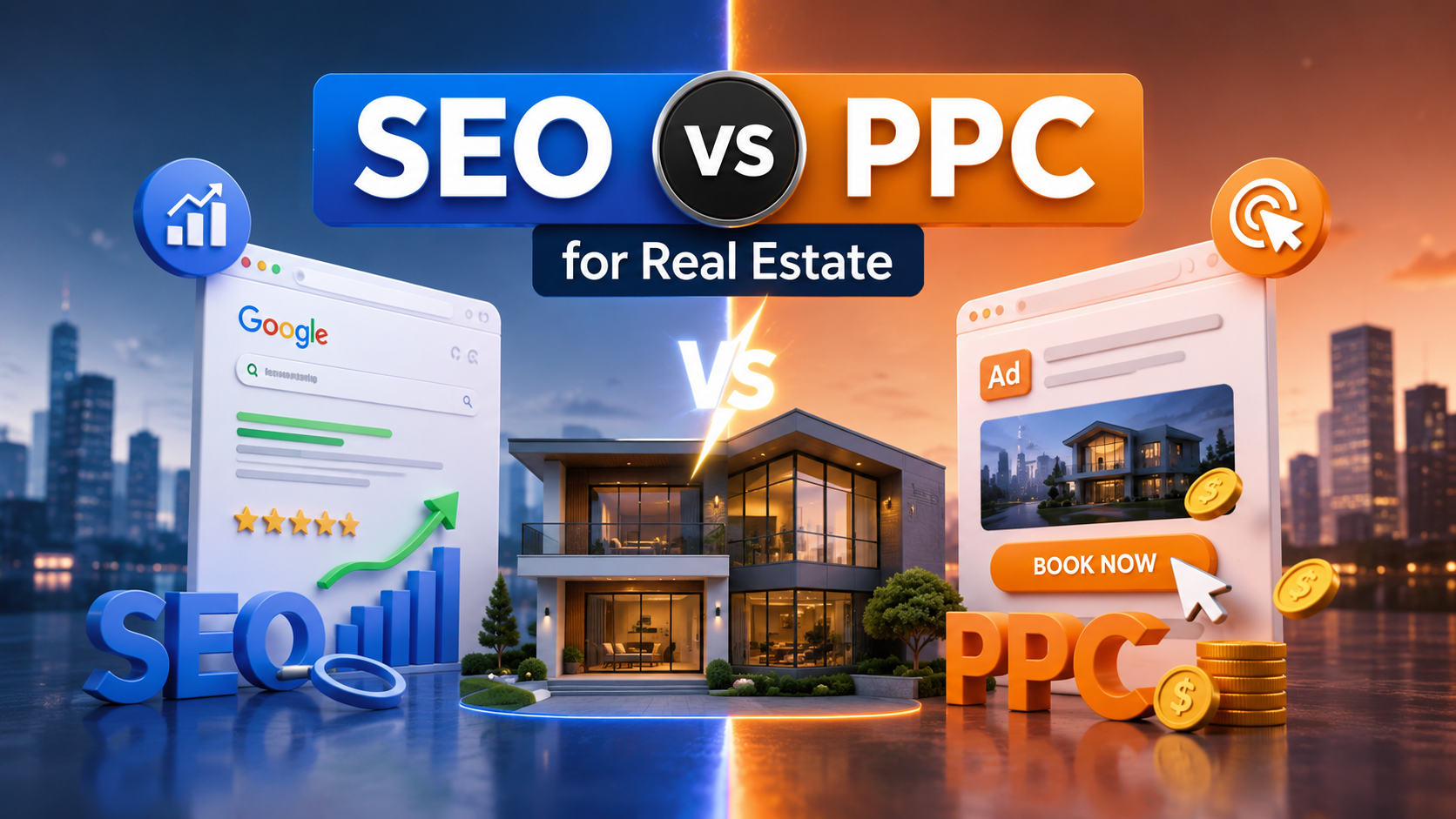
SEO vs PPC for Real Estate: Which One Gets You More Leads in 2026?
-
By Devraj
-
10th June 2026
Ask ten real estate agents how they get leads online, and you will get ten different answers. Some swear by Google Ads. Others have built their entire business on organic search. Most are somewhere in the middle, spending on both and unsure whether either is truly working as well as it used to.
Here is what has changed in the AI Search Era in 2026 that makes this conversation far more urgent: the way buyers search for property has fundamentally shifted. A growing number of serious buyers are no longer typing “3 BHK flat in Pune” into Google and scrolling through listings. They are asking ChatGPT, Gemini, and Perplexity specific, conversational questions like “Which are the best areas to buy a flat under 80 lakhs in Pune for a family of four?” And they are acting on what those AI assistants tell them.
If your real estate agency is not showing up in those AI-generated answers, you are invisible to an increasingly large and high-intent segment of buyers, regardless of how well your Google rankings look.
This blog gives you an honest, practical breakdown of what SEO and PPC actually mean for real estate in 2026, including AI SEO, GEO, LLM visibility, and ChatGPT Ads, and how to build a real estate marketing strategy that captures leads wherever buyers are looking.
Quick Summary
- • SEO for real estate in 2026 is no longer just about ranking on Google page one. It now includes AI SEO, GEO (Generative Engine Optimisation), and LLM visibility, ensuring your agency gets recommended by ChatGPT, Gemini, and Google AI Overviews when buyers ask questions.
- PPC for real estate now includes ChatGPT Ads alongside Google Ads and Meta Ads, opening a new paid channelthat reaches buyers at the very moment they are asking an AI assistant for property recommendations.
- Neither SEO nor PPC alone is the optimal real estate marketing strategy in 2026. The highest-performing agencies run both strategically timed and adapted to how buyers now search.
- The real question is not which one is better, but which combination fits your business stage right now.
- Deftsoft offers AI-driven SEO, traditional SEO, and full-stack PPC for real estate as part of an integrated lead-generation strategy.
Not getting enough qualified leads from your real estate website?
Deftsoft’s digital marketing specialists work with real estate businesses to build lead pipelines that run 24/7 through the right mix of AI SEO and paid campaigns built for 2026.
Quick Navigation
What’s Changed in Real Estate Digital Marketing in 2026
SEO for Real Estate in 2026: It Now Has Three Layers
Layer 1: Traditional Google SEO (Still Essential)
Layer 2: AI SEO and Google AI Overviews
Layer 3: GEO – Generative Engine Optimisation for LLMs
Where Real Estate SEO Falls Short
PPC for Real Estate in 2026: Google Ads, Meta Ads, and ChatGPT Ads
Google Ads for Real Estate (Still the Workhorse)
Meta Ads for Real Estate (Visual, Reach-Focused)
ChatGPT Ads: The New Paid Channel Real Estate Agencies Need to Know
Where PPC Falls Short for Real Estate
SEO vs PPC for Real Estate: A 2026 Comparison
The Real Answer: A 2026 Strategy That Covers All Channels
How Deftsoft Helps Real Estate Businesses Generate More Leads
What’s Changed in Real Estate Digital Marketing in 2026
Before comparing SEO and PPC, it is worth understanding the landscape they are operating in, because both channels look meaningfully different from two years ago.
- Search is no longer just Google. Buyers now get property recommendations from ChatGPT, Google Gemini, Perplexity, and Meta AI. These AI assistants pull information from websites, reviews, listings, and published content to generate answers. If your agency does not have a strong, well-structured web presence that AI models can read and reference, you are being filtered out before the buyer even picks up the phone.
- Google AI Overviews have taken over the top of many real estate search results. For queries like “best residential areas in [city]” or “should I buy or rent in 2026,” Google now summarises an answer above all organic listings. Getting featured in that AI Overview, rather than simply ranking on page one below it, has become a new SEO priority for real estate.
- PPC costs have risen in competitive urban markets as more agencies shift budgets to paid channels. At the same time, ChatGPT Ads, OpenAI’s new advertising platform, has introduced a genuinely new paid channel that places your agency in front of buyers precisely when they are using an AI assistant to research property decisions.
Understanding both SEO and PPC in this context makes the comparison far more useful than any analysis written before 2025.
SEO for Real Estate in 2026: It Now Has Three Layers
Search engine optimisation for real estate has always been about getting found when buyers are actively looking. In 2026, “getting found” happens across three distinct environments, and your SEO strategy needs to address all three.
Layer 1: Traditional Google SEO (Still Essential)
The fundamentals of Google SEO have not disappeared. They remain the backbone of real estate lead generation for agencies serious about organic traffic.
- Local SEO is still the foundation. When someone searches “real estate agents in Whitefield Bangalore” or “2 BHK flats for sale in Andheri West,” Google prioritises locally optimised websites with consistent NAP details, strong Google Business Profiles, genuine reviews, and location-specific content. Local SEO for real estate is especially powerful for agencies serving a defined geographic area, and it compounds over time in a way no paid channel can replicate.
- Content that builds authority, neighbourhood guides, market trend reports, buyer and seller resources and investment analysis attracts organic traffic and signals expertise. Structuring this content with clear headings, FAQ schema, and entity-rich language also dramatically improves your chances of being featured in Google’s AI Overviews.
- Technical SEO ensures property listings load fast, your site is mobile-first (most property searches happen on phones), and structured data markup helps Google understand listing details, price, location, property type and availability.
Layer 2: AI SEO and Google AI Overviews
AI SEO in 2026 is the practice of optimising your content so it gets selected, summarised, and cited by Google’s AI Overview system. For real estate, this matters because AI Overviews now appear at the top of many informational property searches, pushing traditional organic results significantly down the page.
To rank in AI Overviews,your content needs to meet Google’s E-E-A-T standards (Experience, Expertise, Authoritativeness, Trustworthiness), answer questions directly and concisely, use structured data like FAQ schema and local business markup, and come from a domain with genuine authority signals. A real estate agency that consistently publishes high-quality neighbourhood guides, market reports, and buyer FAQs, and has strong reviews and citations, is far more likely to be pulled into AI Overview summaries than one with thin, keyword-stuffed listing pages.
Our AI SEO services are built specifically around this, optimising real estate content not just for rankings, but for AI-driven feature inclusion.
Layer 3: GEO Generative Engine Optimisation for LLMs
This is the newest and most overlooked layer of real estate SEO in 2026. GEO (Generative Engine Optimisation) is the practice of making your agency visible and recommendable inside AI assistants like ChatGPT, Gemini, Perplexity, and Claude, not just on Google.
When a potential buyer asks ChatGPT, “Which real estate agency should I contact for buying a flat in [city]?” the AI generates an answer based on what it knows about agencies from web content, reviews, directories, forums, and published sources. If your agency has sparse online mentions, weak review profiles, and thin content, it’s not recommended. If your agency has consistent, high-quality content across its website and the web, strong review signals, and is cited in relevant publications, it has a real chance of being surfaced.
LLM SEO for real estate involves building your brand’s presence in the data that AI models learn from and reference: detailed website content, Google and Justdial reviews, mentions in real estate publications, structured business data in directories, and consistent NAP across platforms. This is a longer game than traditional SEO, but it is building significant compounding value in 2026 as more buyers make decisions through AI assistants.
Where Real Estate SEO Falls Short
Despite all three layers working in your favour, SEO requires time. Traditional Google SEO takes 4 to 6 months for meaningful results. AI SEO and GEO take even longer to build the authority signals that AI systems recognise. If you have a new project to sell in the next 60 days, SEO alone will not solve that problem.
PPC for Real Estate in 2026: Google Ads, Meta Ads, and ChatGPT Ads
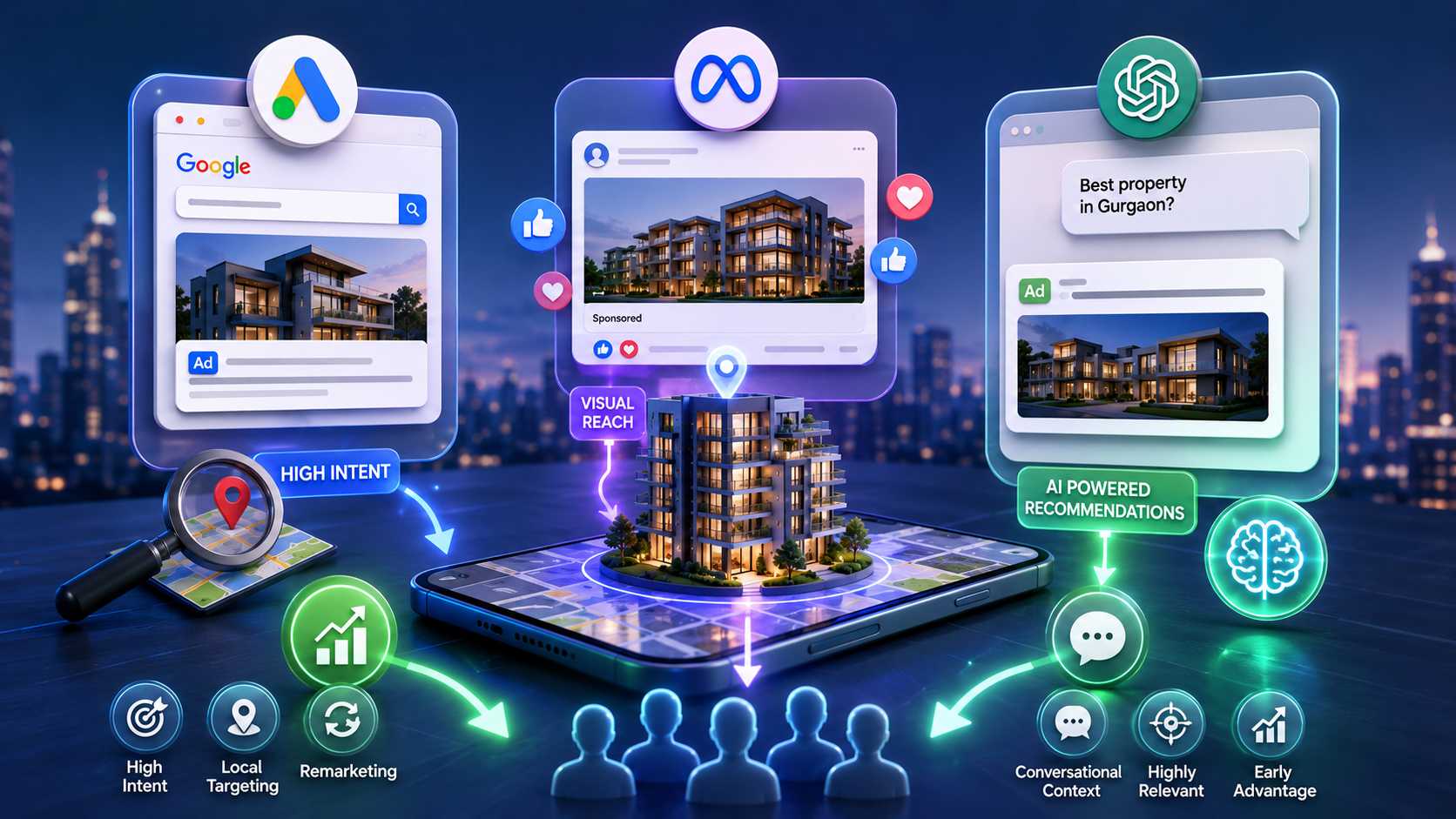
Pay-per-click advertising puts your agency and listings in front of buyers the same day you launch, and in 2026, “paid ads” spans three distinct platforms for real estate.
Google Ads for Real Estate (Still the Workhorse)
Google Ads remains the highest-intent paid channel for real estate. Buyers searching for “buy 3BHK flat in Gurgaon” or “real estate agent near me” on Google are close to a decision, and a well-placed ad with a strong landing page reliably converts this intent into enquiries.
High-performing real estate PPC campaigns in 2026 go beyond basic keyword targeting.
- Granular location targeting, down to the pincode or neighbourhood level, ensures your budget is spent on buyers in your actual service area.
- Dedicated landing pages for specific localities, project types, or buyer profiles convert significantly better than generic homepages.
- Remarketing campaigns re-engage visitors who browsed listings but did not enquire, critical in real estate, where the decision cycle can run for weeks or months.
Meta Ads for Real Estate (Visual, Reach-Focused)
Facebook and Instagram ads remain highly effective for property campaigns that rely on visual storytelling, new project launches, premium listings, and developer brand awareness. Meta’s targeting by life stage, income, location, and behaviour makes it possible to reach buyers who are not yet searching on Google but fit the profile of someone about to. A well-manag
Facebook Ads strategy running alongside Google search campaigns creates a full-funnel paid approach for real estate.
ChatGPT Ads: The New Paid Channel Real Estate Agencies Need to Know
This is the biggest shift on the paid side of real estate marketing in 2026. OpenAI launched its advertising platform, and ChatGPT Ads are now a live, accessible channel for businesses.
Here is why this matters specifically for real estate: buyers increasingly use ChatGPT as their first stop for property research. They ask questions like “what should I look for when buying a flat in Hyderabad?” or “Which are the safest residential areas in Noida for families?” ChatGPT now surfaces sponsored content in these conversations, meaning your agency can pay to be recommended at the precise moment a buyer is actively researching a property.
Unlike Google Ads, where you are bidding against dozens of other agencies on the same keyword, ChatGPT Ads place you inside a conversational, trusted context. The buyer is already in a decision-making mindset and receiving personalised guidance; your ad appears as a contextually relevant recommendation, not an interruption.
For real estate agencies targeting educated, research-oriented buyers, who account for a significant share of high-value property purchasers, ChatGPT Ads represent a genuinely new and underutilised lead source in 2026, and early adopters are seeing strong engagement rates because the channel is not yet saturated.
Where PPC Falls Short for Real Estate
The moment your budget stops, your leads stop. No paid channel builds an asset that continues to deliver. In competitive urban markets, CPCs for high-intent real estate keywords on Google have risen sharply due to a lack of disciplined campaign management and optimised landing pages, resulting in easily wasted ad spend. ChatGPT Ads are still new, so best practices and benchmarks are being established, requiring active monitoring and iteration.
SEO vs PPC for Real Estate: A 2026 Comparison
| Factor | SEO for Real Estate (incl. AI SEO + GEO) | PPC for Real Estate (Google + Meta + ChatGPT) |
|---|---|---|
| Time to first leads | 4–6 months (traditional); 9–12 months (GEO/LLM) | 48–72 hours |
| Cost per lead (long-term) | Low compounds over time | Higher, ongoing spend required |
| Sustainability | Builds permanently | Stops when the budget stops |
| AI search visibility | Yes via AI SEO, GEO, LLM optimisation | Partially, via ChatGPT Ads |
| Best for | Long-term brand authority, AI assistant presence | Immediate campaigns, new project launches |
| Measurability | Harder to isolate per-lead ROI | Highly measurable |
| Trust with buyers | High organic and AI-cited credibility | Variable ads are identifiable as paid |
| New in 2026 | GEO, LLM SEO, AI Overview optimisation | ChatGPT Ads as a new lead channel |
| Geographic targeting | Strong via local SEO | Very precise via geo-targeting |
The Real Answer: A 2026 Strategy That Covers All Channels
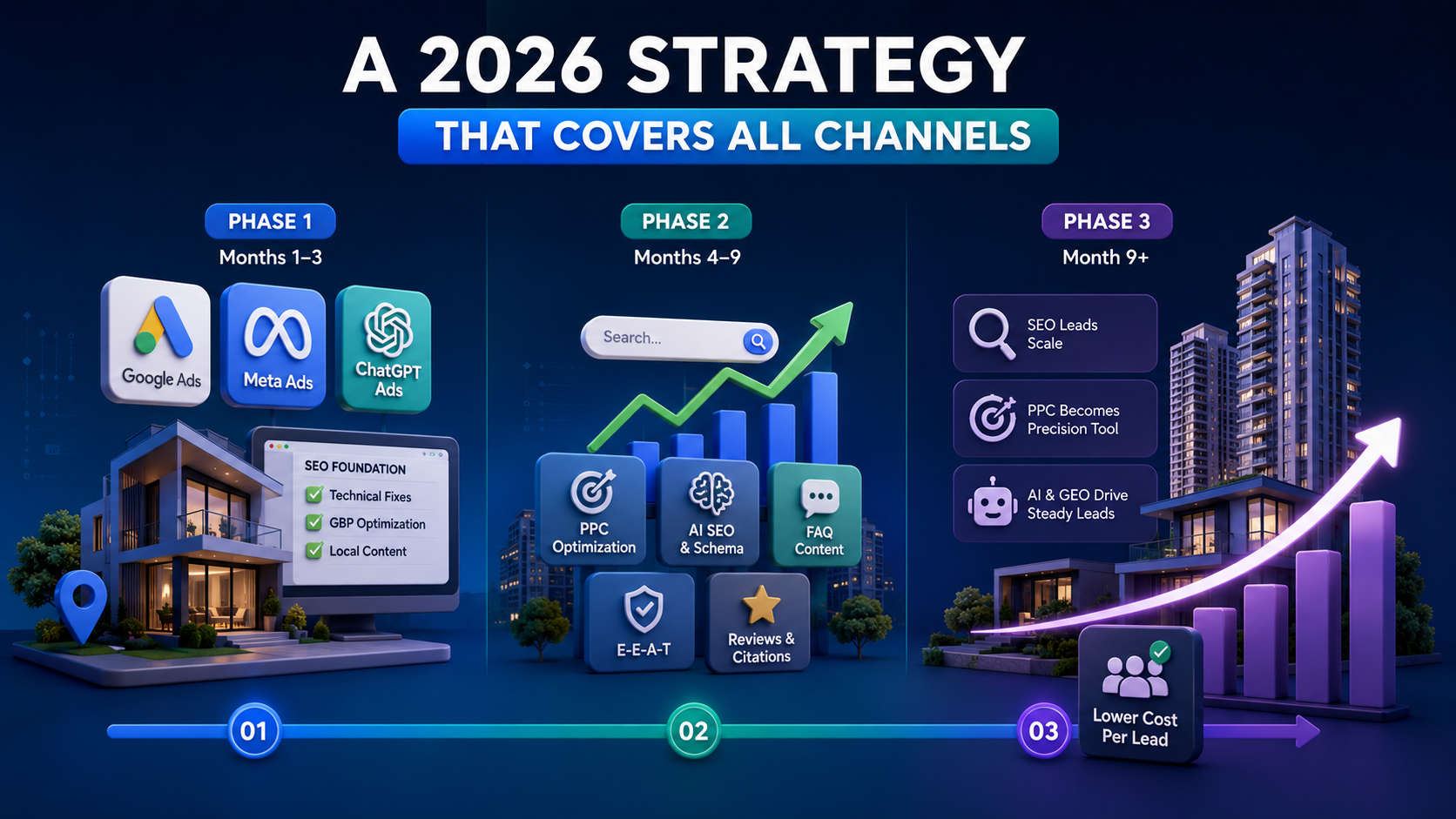
The most effective real estate marketing strategy in 2026 is not a choice between SEO and PPC; it is a layered approach that covers both and is adapted to where buyers are actually making decisions.
Phase 1 (Months 1–3): Run Google Ads and Meta Ads to generate immediate lead flow. Test ChatGPT Ads early in the channel, as it is new, and early movers have an advantage before it becomes saturated. Simultaneously, begin the SEO foundation: technical fixes, Google Business Profile optimisation, and the first wave of local and neighbourhood content.
Phase 2 (Months 4–9): As traditional SEO rankings begin to climb, refine PPC spend to focus on the highest-converting localities and property types. Intensify AI SEO efforts, structured data, FAQ content and E-E-A-T signals to begin appearing in Google AI Overviews. Begin building GEO signals by generating reviews, earning directory citations, and publishing authoritative content.
Phase 3 (Month 9+): SEO carries a significant share of organic and AI-referred lead flow. PPC shifts from primary lead source to precision tool for new launches and remarketing. GEO and LLM SEO begin delivering a steady stream of AI-referred enquiries. Overall cost per lead falls as organic and AI channels scale.
This phased approach is exactly how our digital marketing services for real estate are structured, with each channel contributing at the right stage of growth.
How Deftsoft Helps Real Estate Businesses Generate More Leads
Deftsoft is a full-service digital marketing agency with real estate experience across SEO, AI SEO, PPC, and emerging channels. Our team understands that real estate lead generation in 2026 means being visible not just on Google but wherever buyers make decisions, including AI assistants.
Our real estate digital marketing services include:
- GEO and AI SEO for real estate optimising your content for Google AI Overviews, building LLM visibility through structured content, reviews, and citations, and implementing technical AI SEO that positions your agency for the AI-first search environment.
- Traditional SEO for real estate local SEO, on-page and technical optimisation, neighbourhood content strategy, Google Business Profile management, and link building from real estate directories and publications.
- PPC for real estate Google Ads setup and management, ChatGPT Ads strategy and execution, Meta Ads for project launches, dedicated landing pages, and remarketing campaigns across all paid channels.
- Integrated strategy for agencies that want SEO, AI SEO, and PPC working together with unified lead tracking, so you always know which channels are delivering the highest-quality enquiries.
If you are over-reliant on portals like 99acres or MagicBricks, or struggling with rising CPCs and inconsistent lead flow, our SEO services and PPC management can help you build a lead generation engine that you own and control.
Conclusion
The SEO vs. PPC debate for real estate looked very different in 2023, or even in 2025. In 2026, SEO means showing up in Google AI Overviews, getting recommended by ChatGPT and Gemini, and building LLM visibility through GEO, not just ranking on page one. PPC means running Google Ads, Meta Ads, and now ChatGPT Ads to reach buyers across every paid touchpoint.
The real estate agencies winning on lead generation in 2026 are not choosing one over the other. They are running a layered real estate marketing strategy that covers all the places buyers now search, traditional search, AI-generated answers, and paid placements inside AI conversations.
If you are unsure where your current strategy has gaps, Deftsoft can audit your entire digital presence, organic, paid, and AI visibility, and tell you exactly where the leads are being left on the table.
Ready to build a real estate lead engine built for 2026?
FAQs
Q1. What is AI SEO, and why does it matter for real estate in 2026?
AI SEO is the practice of optimising your website content to be selected, cited, and summarised by AI systems, primarily Google AI Overviews, as well as ChatGPT, Gemini, and Perplexity. For real estate, it matters because a growing number of buyers now start their property research by asking an AI assistant a question. If your agency’s content is not structured in a way that AI systems can read and trust, you are invisible in this growing channel.
Q2. What is GEO (Generative Engine Optimisation) for real estate?
GEO is the practice of optimising your online presence so that AI language models, such as those powering ChatGPT and Gemini, recommend your agency when buyers ask their AI assistants for property guidance. It involves building consistent, authoritative content, strong review signals across platforms, structured business data, and web mentions that AI models reference when generating answers. It is a longer-term investment than traditional SEO, but it is becoming increasingly important in 2026.
Q3. What are ChatGPT Ads, and should real estate agencies use them?
ChatGPT Ads are OpenAI’s advertising product, which places sponsored content within ChatGPT conversations. For real estate, this means your agency can be surfaced as a recommendation when a buyer asks ChatGPT about property in your area. The channel is new, not yet saturated, and offers contextually relevant placement inside a trusted AI conversation, making it worth testing for agencies targeting research-oriented, high-intent buyers.
Q4. Is SEO or PPC better for a new real estate agency?
For a brand-new agency, PPC delivers immediate leads while the foundations for SEO and AI SEO are being built. Ideally, run Google Ads from day one for lead flow, start SEO content and local optimisation immediately for long-term compounding, and test ChatGPT Ads early to establish presence before the channel becomes competitive.
Q5. How long does real estate SEO take to show results in 2026?
Traditional Google SEO typically shows meaningful results in 4 to 6 months. AI SEO appearing in AI Overviews and being cited by LLMs takes 9 to 12 months to build the required authority signals. Both timelines vary based on your current domain authority, content quality, and the level of competition in your local market.
Q6. Can Deftsoft manage both SEO and PPC for my real estate business?
Yes. Deftsoft offers fully integrated management for SEO, AI SEO, GEO, Google Ads, ChatGPT Ads, and Meta Ads for real estate businesses. We build a unified strategy with shared tracking so you always know where your best leads are coming from and how to allocate budget for maximum ROI.
Recent Articles



Devraj
 10th June 2026