Top Mobile App Development Tips for 2026: Expert Guide
-
By Devraj
-
28th April 2026
Most apps don’t fail because of bad code; they fail because of critical strategic errors made long before the first line is written—from selecting the wrong platform to bloated feature sets and misaligned business goals. If you are searching for the latest mobile app development tips 2026 to avoid these pitfalls, you need a perspective that goes beyond syntax.
At Deftsoft, we have spent nearly two decades delivering custom mobile app development services, helping businesses navigate shifting landscapes and turn complex ideas into scalable realities. In 2026, the stakes have fundamentally changed: AI is no longer an optional add-on, user expectations are at an all-time high, and app store compliance is stricter than ever.
We’ve seen trends come and go, watched clients face the same avoidable bottlenecks, and learned exactly what separates a successful launch from a forgotten download. This is our honest, field-tested guide on what actually works in 2026. No recycled advice. No padding. Just results.
Ready to build something that lasts?
Quick Takeaways
- 2026 demands a fundamentally different approach to app development AI, privacy, and performance are no longer optional
- The platform decision (Android, iOS, or cross-platform) needs to happen before design, not during it
- Custom app development almost always outperforms off-the-shelf for businesses with specific workflows
- Choosing the right custom mobile app development company matters more than choosing the right technology stack
- Security, testing, and post-launch planning are where most projects cut corners and where most apps eventually fail
| Tip | 2026 Actionable Strategy |
|---|---|
| AI Integration | Build AI into the foundational architecture, not as a bolt-on feature. |
| Platform Choice | Select Android/iOS/Cross-platform based on market data, not preference. |
| Performance | Treat speed as a UX feature; target sub-3s load times on mid-range devices. |
| Development | Prioritize custom workflows over off-the-shelf to scale. |
Quick Navigation
Why 2026 Is a Pivotal Year for Mobile App Development
Top Mobile App Development Tips for 2026
1. Make Your Platform Decision Before Anything Else
2. Build for AI from the Start, Not as an Add-On
3. Treat Performance as a Feature, Not as a Given
4. Security Is No Longer Optional. It’s a Baseline
5. Test Early, Test Continuously, Test on Real Devices
6. Plan for the App Store Before You Build, Not After
Android App Development in 2026: What’s Changed
Custom App Development vs. Off-the-Shelf: Which One Actually Wins?
How to Choose the Right Custom Mobile App Development Company
Common Mistakes to Avoid When Building a Mobile App in 2026
Why 2026 Is a Pivotal Year for Mobile App Development
The global mobile app market sits at $206.6 billion in 2026 and is projected to reach $616.4 billion by 2033. Over 6.8 billion people carry a smartphone. And yet roughly 90% of mobile apps are used just once and then forgotten.
That gap between opportunity and outcome is exactly why this moment matters.
A few things have fundamentally changed the game this year:
- AI has moved from a feature to a foundation. According to Gartner,40% of enterprise applications are expected to incorporate task-specific AI agents by the end of 2026, up from less than 5% in 2025. That’s not a trend. That’s a transformation happening in real time. Users now expect apps to anticipate what they need, not just respond to what they ask.
- Privacy regulations have real teeth. With Apple’s App Tracking Transparency, Google’s Privacy Sandbox, India’s Digital Personal Data Protection Act, and tightened GDPR enforcement all active simultaneously, apps that treat data protection as an afterthought face app store rejection, regulatory penalties, and user abandonment.
- 5G has raised the bar on performance. Broad 5G adoption means users now expect real-time interactions, instant load times, and seamless video on every app, every time. Anything less feels broken.
- App stores are more competitive than ever. Global app downloads are expected to surpass 181 billion in 2026.Standing out requires more than a good idea it requires smart execution from day one.
The businesses winning in this environment aren’t necessarily the ones with the biggest budgets. They’re the ones making smarter decisions earlier.
Top Mobile App Development Tips for 2026
These aren’t generic tips scraped from a checklist. They’re lessons from real projects, the kind you only learn by building hundreds of apps across industries and seeing what works and what quietly kills a product six months after launch.
1. Make Your Platform Decision Before Anything Else
This sounds obvious. It isn’t. We’ve seen businesses get halfway through development only to realize they built for the wrong audience on the wrong platform.
Here’s the practical breakdown for 2026:
- Go Android-first if your target users are in South Asia, Southeast Asia, or Africa, or if you’re targeting price-sensitive segments globally. Android dominates market share in these regions, and with Jetpack Compose now mature and Google’s Material You design system widely adopted, the native Android development experience is genuinely excellent.
- Go iOS-first if you’re targeting North American or Western European markets, especially if your monetization model depends on in-app purchases or subscriptions. iOS users still spend significantly more per user than Android users.
- Go cross-platform (Flutter or React Native) if budget is a real constraint, timelines are tight, and your core functionality doesn’t require deep device-specific integration. Cross-platform has come a long way, but it still has real trade-offs in performance-intensive or hardware-dependent apps.
The mistake isn’t choosing one over the other. The mistake is choosing without a clear reason.
2. Build for AI from the Start, Not as an Add-On
In 2026, AI integration into mobile app development isn’t a phase-two feature. If you design your architecture without AI in mind and then try to bolt it on later, you’re creating technical debt that will cost you significantly down the line.
What does “building for AI from the start” actually mean in practice?
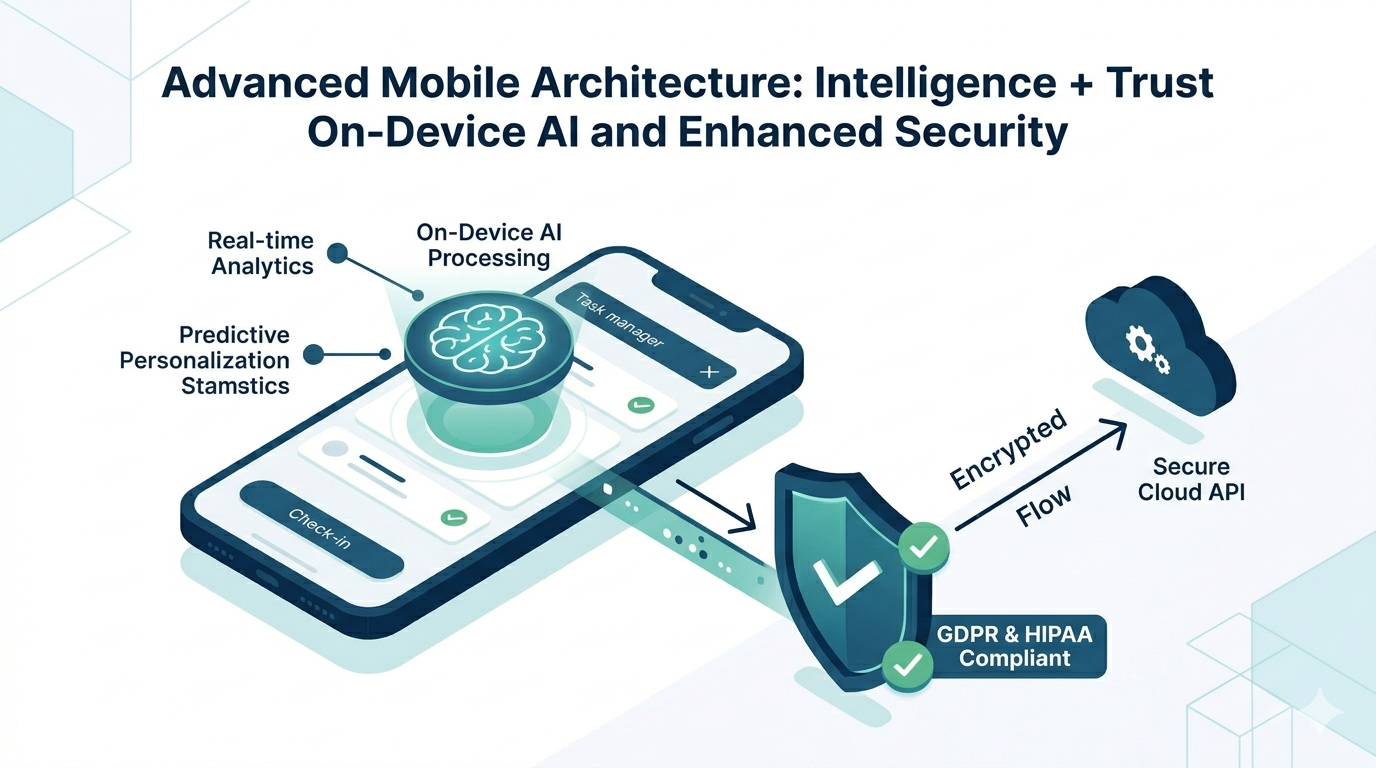
It means designing your data model so that machine learning can actually work with it. It means planning for on-device AI where possible, processing that happens on the user’s device rather than requiring a server round-trip. This makes apps faster, cheaper to run, and more privacy-compliant. It means treating personalisation as a core UX principle, not a nice-to-have.
For most business apps in 2026, even simple AI capabilities, such as smart search, predictive inputs and behavior-based recommendations, can meaningfully improve retention. And retention is where most apps live or die.
3. Treat Performance as a Feature, Not a Given
Here’s something we tell every client: your app’s speed is a product decision, not a technical one. And in 2026, a slow app isn’t just annoying, it’s a business problem.
Users abandon apps that take more than 3 seconds to load a core screen. That number doesn’t move with device improvements. Expectations just keep climbing.
Performance optimization needs to happen throughout development, not at the end. That means efficient API design, proper caching strategies, image compression, lazy loading, and testing on mid-range devices, not just the latest flagship phones that your development team uses.
A useful rule of thumb we use internally: if it doesn’t perform well on a two-year-old mid-range Android device, it doesn’t ship.
4. Security Is No Longer Optional. It’s a Baseline
With cyber threats evolving faster than most businesses can keep up with, mobile security in 2026 requires real engineering, not checkboxes.
The cybersecurity essentials every app should have: biometric authentication (Face ID, fingerprints), end-to-end encryption for sensitive data, secure API communication with token-based authentication, and minimal data collection, only what you genuinely need.
Beyond the technical side, there’s a trust dimension that’s increasingly commercial. Apps that communicate their privacy approach clearly through transparent permission flows and honest data handling consistently rate higher and retain users better than those that don’t.
Privacy isn’t a compliance exercise anymore. It’s a product advantage.
5. Test Early, Test Continuously, Test on Real Devices
One of the most common ways app projects go over budget and over time is insufficient testing. Not because teams don’t care, but because testing is often treated as the last step rather than a parallel process.
Addressing bugs post-release is exponentially more expensive than catching them during development. More importantly, a buggy post-launch experience damages user trust in ways that are very difficult to recover from, especially in app store review ecosystems where one-star reviews are permanent.
At Deftsoft, we run testing in parallel with development, covering functionality, performance, security, and usability across a range of real devices and screen sizes. That approach isn’t just about finding bugs; it’s about shipping with confidence.
6. Plan for the App Store Before You Build, Not After
App store optimization (ASO) isn’t a marketing task you hand off after the app is built. The decisions you make during development, such as app name, category selection, feature set, screenshots and localization, directly impact discoverability.
With 181 billion downloads expected this year, the competition for visibility is intense. Apps that plan their store presence from the beginning, with keyword research baked into naming, description writing, and category selection, have a measurable advantage over those that treat it as an afterthought.
The internal linking opportunity is real here too: your app listing should connect clearly to your broader digital presence, including your website and content assets.
Android App Development in 2026: What’s Changed
Android remains the dominant mobile platform globally, and 2026 has been a significant year for it.
Jetpack Compose, Google’s modern UI toolkit, has fully matured. Teams that have adopted it are building UIs faster, with less code and fewer bugs than the legacy View system. If you’re working with an Android app development company still building in the old way, that’s worth asking about.
Material You, Google’s dynamic theming system, is now a user expectation on Android. Apps that don’t adapt to a user’s personal color scheme and preferences feel dated by comparison.
Google has also implemented sweeping changes following the Epic Games ruling, including allowing third-party app stores and giving developers more flexibility in distribution. For businesses, this opens up new distribution strategies that weren’t possible two years ago.
The practical implication is that if you’re targeting an Android-heavy market, working with the best Android app development company that stays current with Google’s evolving ecosystem isn’t a luxury; it’s a competitive necessity. The platform changes fast. Generic developers fall behind.
Custom App Development vs. Off-the-Shelf: Which One Actually Wins?
This is one of the most common conversations we have with new clients, and the honest answer is: it depends, but for most serious businesses, custom wins.
Here’s why off-the-shelf solutions are genuinely attractive: lower upfront cost, faster deployment, and someone else handles maintenance. For simple internal tools or very early-stage validation, they make sense.
But here’s where they consistently fall short:
- They’re built for everyone, which means they’re optimized for no one. When your business has a specific workflow, a unique customer journey, or a competitive process that needs to be protected, a generic platform will make you compromise. You end up adapting your business to your software instead of the other way around.
- Scaling hits a wall. Off-the-shelf platforms are designed with their own growth model, not yours. As your user base or feature requirements grow, you increasingly run into limitations the platform was never designed to address.
- Total cost of ownership is higher than it looks. Monthly SaaS fees, per-user licensing, costly integrations, and the ongoing inefficiency of working around limitations add up. Over two to three years, custom app development often costs less overall and delivers far more value.
Custom app development is the right call when your business processes are complex, your users are demanding, your data needs to stay under your control, or your competitive advantage lives in how you do things, not just what you do.
How to Choose the Right Custom Mobile App Development Company
This decision matters more than most businesses realize. The technology is rarely the hard part. The partnership is.
Here’s what to actually evaluate:
- Do they ask hard questions before they start? A good custom app development company won’t just take your brief and start building. They’ll push back on assumptions, ask about your users, question your feature list, and talk about what success actually looks like. If a vendor gives you a quote within 24 hours of your first conversation, that’s a warning sign.
- Can they show relevant work? Not just a portfolio of pretty screens, but actual case studies with measurable outcomes. What problem did the app solve? What happened to the business after launch?
- Do they handle the full lifecycle? Ideation, design, development, testing, deployment, and post-launch support. Apps aren’t finished at launch. The companies that treat launch as the finish line leave clients stranded.
- What does their testing process look like? Ask specifically. Vague answers indicate vague processes.
- How do they communicate during a project? Weekly updates? Dedicated project managers? Transparent timelines? The development process is often long. Communication quality is what separates a good experience from a painful one.
- Are they honest about trade-offs? Every project has constraints: budget, timeline and technical limitations. A trustworthy partner tells you the truth about what’s achievable and what it will cost, rather than promising everything and adjusting later.
Common Mistakes to Avoid When Building a Mobile App in 2026
After nearly two decades of building apps, these are the patterns we see again and again:
Skipping the discovery phase. Jumping straight into design and development without a structured discovery phase is like building a house without architectural drawings. You save a few weeks at the start, only to lose months in the middle when everything needs to change.
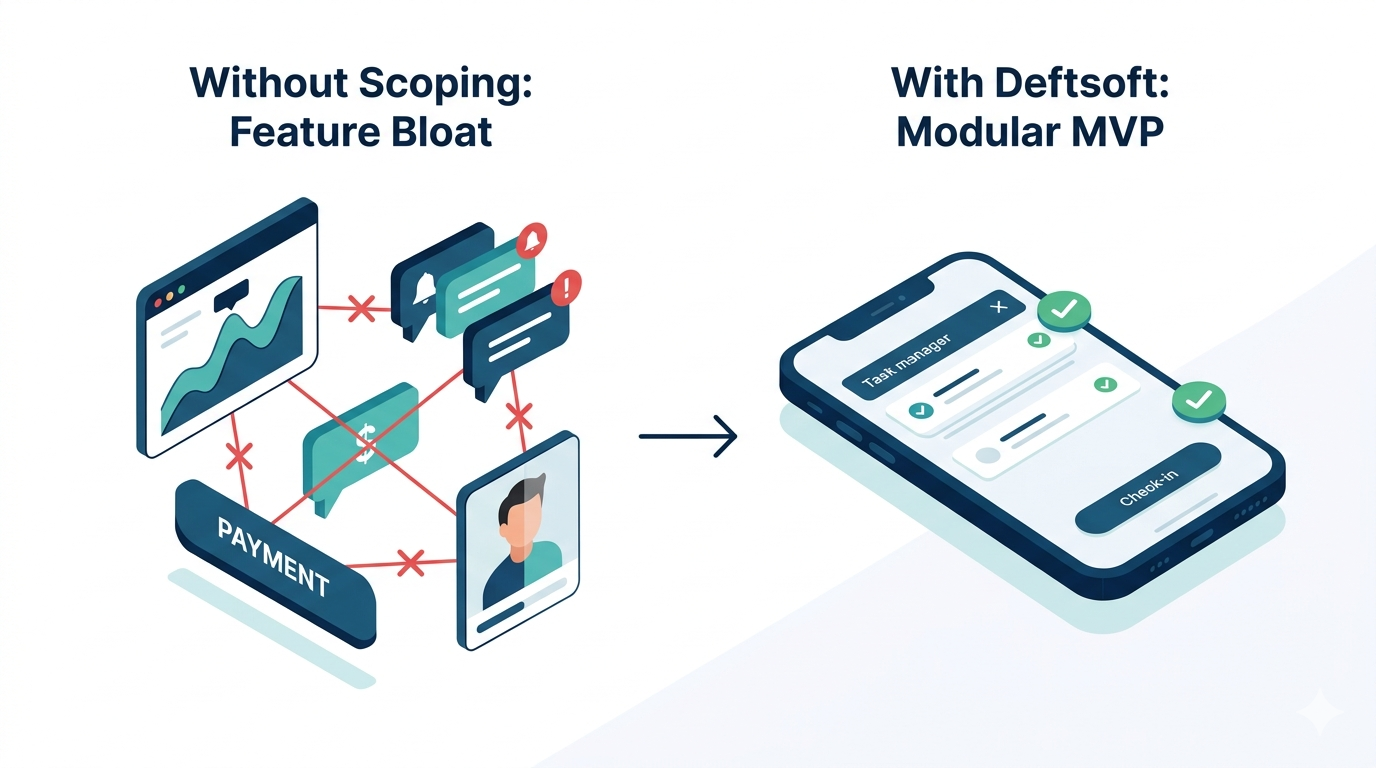
Building too many features for version one. The most successful apps we’ve seen have launched with fewer features than planned, but the right ones, done exceptionally well. Ship lean. Learn fast. Improve with data, not assumptions.
The “Cool Feature” Trap
At Deftsoft, we once worked with a healthcare client who wanted a fancy AI chatbot, even though their main booking system was still buggy. We insisted on dropping the chatbot and focusing first on making the booking process simple and reliable.
The result? The app launched on time, and the support tickets related to “system errors” dropped by 60% compared to their previous legacy system. They added the chatbot three months later, once the foundation was actually solid.
The Takeaway: If you’re building an app in 2026, don’t build for the “wow” factor. Build for the “does this work at 8:00 AM on a Monday” factor. If you can’t survive the basics, the fancy features won’t save you.
Ignoring backend scalability. Your app is only as strong as its backend. A pretty interface means nothing if the server crashes under load. At Deftsoft, we don’t just focus on mobile code; we constantly study the latest web development trends to ensure your app’s server infrastructure is as fast, secure, and future-proof as the app itself. When your mobile team understands how modern web systems work, your app performs better, scales faster, and stays online when it matters most
Treating QA as the last step. Quality assurance woven throughout development catches issues early and cheaply. Quality assurance bolted on at the end catches issues late and at a high cost.
No post-launch plan. An app without a maintenance, update, and growth plan will slowly deteriorate. Operating systems update. Security vulnerabilities emerge. User feedback reveals new priorities. The work doesn’t stop at launch; it evolves.
Final Thoughts
Building a mobile app in 2026 is genuinely exciting. The tools are better, the platforms are more capable, and the opportunity to build something that matters to real users has never been greater.
But the gap between apps that succeed and apps that get deleted after one use isn’t mainly about technology. It’s about decisions. Platform strategy, architecture, partner selection, testing discipline and post-launch commitment are the places where the outcome is determined.
If you’re planning to build or rebuild a mobile app this year, start with the right partner. One with the experience to ask the hard questions, the skill to build the right thing, and the commitment to be there after launch day.
Deftsoft has been building mobile and web applications for over 20 years. If you’re ready to start a project or just want an honest conversation about whether your idea is ready to go, we’d love to hear from you.
Frequently Asked Questions
What are the most important mobile app development tips for 2026?
The most important shifts in 2026 are building with AI as a core architectural consideration from the start, designing for privacy by default, optimizing for performance on mid-range devices, and planning your app store presence during development rather than after it. Beyond the technical side, the single biggest tip is to choose a development partner who asks hard questions, not one who just says yes.
How much does custom mobile app development cost in 2026?
The range is genuinely wide, depending on complexity, platform, and features, typically anywhere from $30,000 for a focused MVP to $200,000+ for a full-featured enterprise application. The more useful question is the total cost of ownership over two to three years, which often makes custom development more cost-effective than off-the-shelf alternatives that involve ongoing licensing and trade-offs in limitations.
Android or iOS, which platform should I build first?
It depends on your target market. Android has a broader global reach, especially in South Asia, Southeast Asia, and Africa. iOS commands higher per-user spend and dominates North American and Western European markets. If the budget allows, cross-platform development with Flutter or React Native can cover both simultaneously, though with some trade-offs in performance-intensive scenarios.
What does a custom app development company actually do?
A good one does much more than write code. They help you define the right problem to solve, architect a scalable solution, design for the actual users (not hypothetical ones), build and test rigorously, manage the app store submission process, and support the app after launch. The best ones function less like a vendor and more like a technology partner.
How long does it take to build a custom mobile app?
A well-scoped MVP typically takes three to five months. A fully featured application with complex integrations, multiple user roles, and extensive testing can take nine to twelve months or more. Timelines most commonly extend when requirements change mid-project, which is why upfront discovery and planning are worth the investment.
What’s the difference between a mobile app development company and a custom app development company?
The terms are often used interchangeably, but there’s a meaningful distinction. A mobile app development company builds apps. A custom app development company builds apps specifically designed around your business needs, workflows, and users from the ground up, without forcing your requirements into a prebuilt template. The approach, process, and outcome are fundamentally different.
How do I know if I need a mobile app or a mobile-optimized website?
If your users need to access your product offline, use device features like cameras or GPS, receive push notifications, or engage with your product daily, a native app makes sense. If your primary goal is content delivery, lead generation, or e-commerce with occasional visits, a well-optimized mobile website or progressive web app may serve you better and cost significantly less.
Recent Articles





Devraj
 28th April 2026