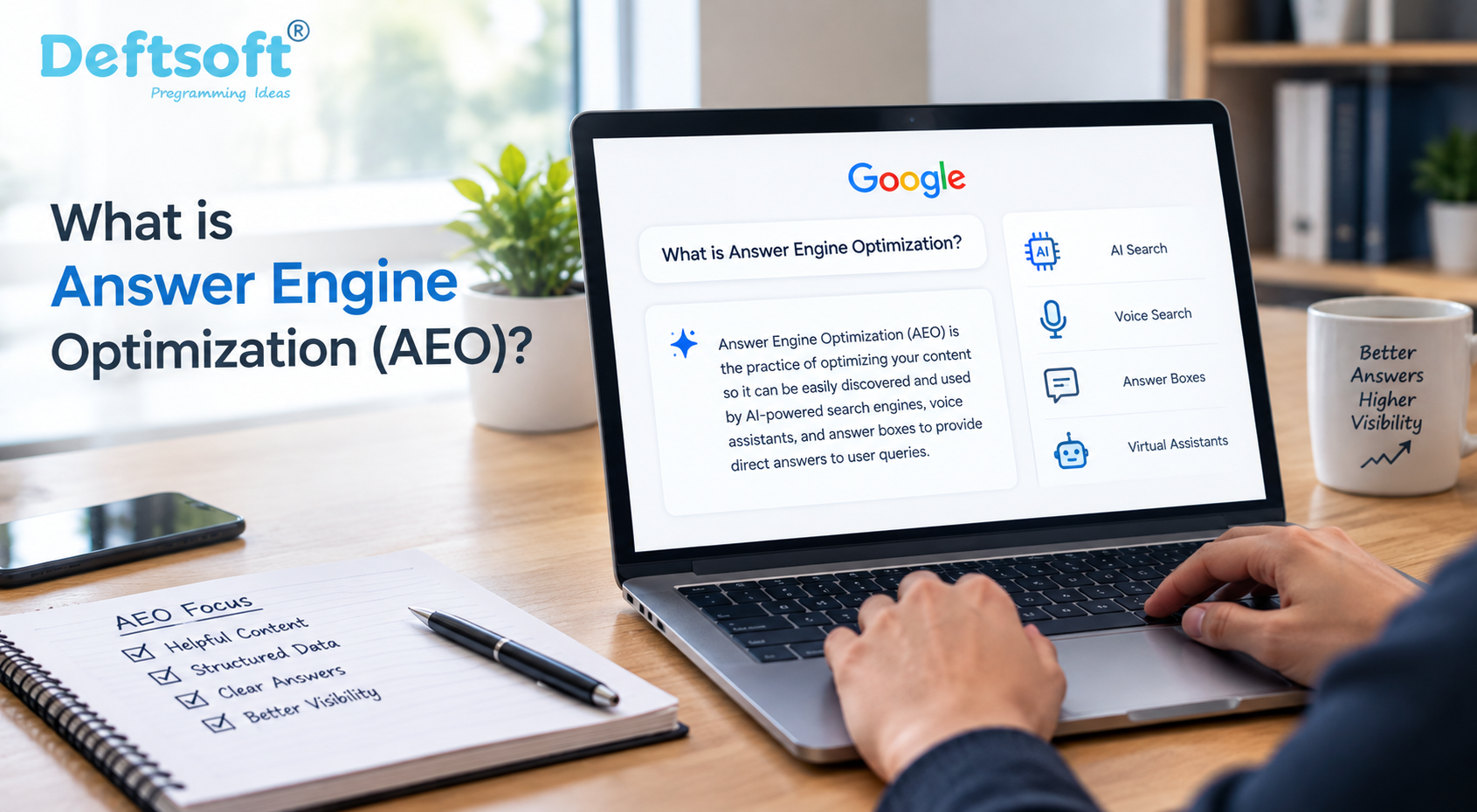
What is Answer Engine Optimization (AEO)?

Years after spending most of the time and money on SEO, finally, there is a buzz about a new term or a new and interesting optimization process in the digital marketing landscape called Answer Engine Optimization (AEO). There is a shift in the digital marketing space with the entry of AEO, and now businesses are not overly dependent on Search Engine Optimization (SEO) practices to make their product or service visible to users on search engines and other marketing platforms. Thanks to Generative AI tools like Chatgpt, Claude AI, etc., people now prefer direct and concise answers to their queries, which has given rise to this new process, AEO. 

Here, we will discuss the new buzzing process and how it is different from SEO. We will also learn by the end of this blog whether it is more effective than SEO or not. Considering the evaluation of its effectiveness, it is important to know how it is done and what future this process holds in the coming years. Thus, we will also discuss the future of AEO in 2025 and its benefits for businesses in terms of ranking, visibility, and reach.

What is Answer Engine Optimization (AEO)?
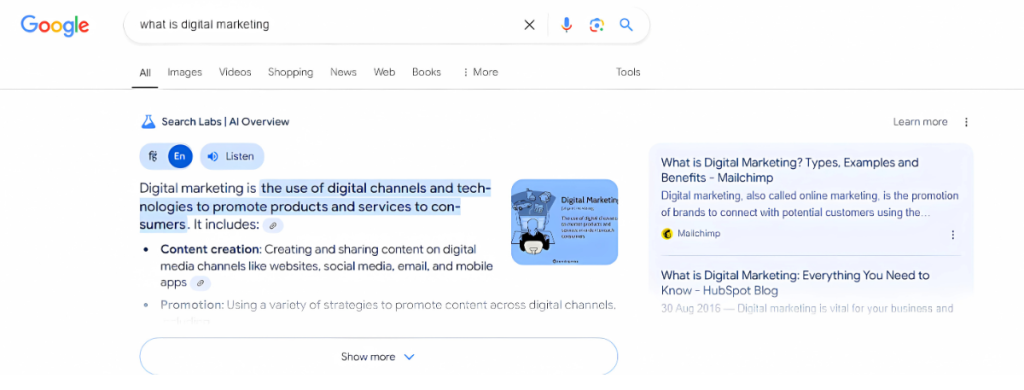
AI overview section at the top of search results

AEO is a new optimization technique that makes website content visible, findable, or understandable by voice-activated assistants and search engines. You must have seen the AI overview section at the top of your search results on Google’s search engine whenever you ask a question. The websites, brands, and products linked to that answer are a result of Answer Engine Optimization. The reason for its popularity in recent times is the concise and direct answer users get with this. Rather than opening multiple links and multiple websites to get your query cleared, you get a clear, concise, and direct answer, which is enough for most people to get their query resolved. 

AEO is used not only for AI-based results on search engines but also for all other options where direct and concise answers are provided to the user, such as voice assistants such as Alexa, Siri, Google Assistant, etc. All these voice search services have become more popular and easier for users to use than traditional methods. This makes the AEO a booming war of digital marketing that every company wants to conquer. It’s been an interesting addition to the digital marketing landscape, which will make the competition for higher ranking and to be visible at position zero a bit more difficult for the digital marketers as only 2-3 companies will be able to make it to the position zero where the AI-generated content is provided to the user as a result for their queries. 

AEO vs. SEO: Understanding the Differences
AEO vs SEO_ Understanding the Differences

Considering the long, illustrious, and highly impacting journey of SEO in digital marketing, no one thought that something like AEO would come and make a difference. But first, we need to understand what makes these two different from each other. 

Although AEO is considered a subpart of SEO as it is also related to content optimization for better ranking in search engines. But, AEO targets the direct and concise answers that Generative AI-based results, voice assistants, etc., provide these days as the user considers these results more useful and time-saving. In other words, we can say that traditional SEO targets broad keyword visibility across different search engines, while the AEO is more focused on direct and concise answers to user queries. 

At its core, SEO is about improving a website’s visibility and ranking on search engine result pages (SERPs). This process involves optimizing various aspects of a website — from content and keywords to technical elements like page speed and mobile-friendliness — to increase the chances of ranking higher in search engine results. AEO, on the other hand, is a more specific optimization technique that focuses on providing direct, concise answers to user queries.

AEO is particularly aligned with the growing trend of voice search, AI-driven assistants, and instant search results (e.g., featured snippets or “Position Zero” on Google). While SEO aims to capture broad keyword visibility across various search engines, AEO is targeted at providing precise, structured answers that can be easily understood by AI-powered systems and digital assistants like Google Assistant, Siri, and Alexa. For example, when a user asks their voice assistant, “What’s the weather like today?” the assistant needs a quick, direct response, not an entire webpage full of information. AEO ensures that businesses can have their content featured in these quick-answer formats, such as the Answer Box, Featured Snippets, and Knowledge Panels.

Importance of AEO for Business Owners

In a world where information is available at the tip of our fingers, the way users access and consume content is evolving rapidly. Today’s consumers are less likely to shift through long articles or web pages to find an answer to their questions. Instead, they prefer immediate, concise responses—whether through a voice search, a quick Google query, or a chatbot. 

For business owners, embracing AEO offers several compelling benefits, and some of them are discussed here;

    • Improved Visibility

AEO increases your chances of being featured in Position Zero on Google, the coveted spot where direct answers are displayed above traditional search results. For businesses, this increased visibility can result in more traffic, brand recognition, and trust.

    • Better User Experience

As the demand for instant answers grows, optimizing for AEO ensures that your customers get the quick, concise information they need. This enhances user experience, which is crucial for conversion rates and customer satisfaction.

    • Enhanced Voice Search Optimization

As the popularity of voice search continues to rise, businesses need to optimize their content for voice queries, which are typically more conversational and question-based. AEO helps businesses tailor their content for this shift.

    • Edge Over Competitors

Businesses that adapt to AEO can gain a competitive advantage over those relying solely on traditional SEO techniques. By delivering high-quality, concise answers, you position yourself as an authoritative voice in your industry.

  • Stay Ahead of AI Trends

As AI and machine learning technologies continue to advance, optimizing for AEO ensures that your content is ready to be consumed by these technologies, keeping you at the forefront of digital marketing innovations.

Future of Answer Engine Optimization (AEO) in 2025

As we look to 2025, the landscape of search and content discovery is set to undergo even more profound changes. While SEO remains integral to online marketing, AEO is expected to become increasingly important, especially with advancements in AI, voice technology, and the growing role of digital assistants in everyday life.

Here’s a list of what the future of AEO might look like:

    • Greater Integration with AI and NLP  

AI will become even more sophisticated at interpreting and responding to user queries. Content optimized for AEO will need to be tailored to how AI systems understand context, intent, and conversational language.

    • Voice Search Domination

By 2025, the use of voice search is expected to surpass traditional text-based searches. As voice assistants continue to improve, the need for content that is optimized for quick, spoken answers will become even more critical.

    • Increased Use of Structured Data:  

Structured data (such as schema markup) will become a fundamental part of AEO strategies. Search engines and AI systems rely on structured data to quickly pull relevant answers from websites, making it essential for businesses to integrate it into their content.

    • AI-Powered SERPs:  

Search engines will increasingly rely on AI to curate search results, meaning that businesses will need to optimize their content not just for keywords but for AI systems that prioritize relevance and precision.

  • Personalized Answer Engines:  

With the rise of predictive analytics and machine learning, users will expect more personalized answers. Content will need to be optimized not only for general queries but also for individual preferences and contexts.

Key Strategies for Implementing AEO

Implementing AEO in your digital marketing strategy involves optimizing your content to meet the demands of voice search, AI-driven responses, and direct answers. Here are some key strategies:

    • Understanding User Intent is a Must

Understand the questions your target audience is asking and create content that directly addresses those queries. Use long-tail keywords and natural language that mirrors the way people speak.

    • Content Optimization for Featured Snippets

Featured Snippets are prime real estate for AEO. To optimize for this, structure your content with clear, concise answers to common questions using lists, bullet points, or tables.

    • Direct and Concise Answers

Voice search queries tend to be more conversational and shorter. Provide clear, direct answers within the first 50-100 words of your content.

    • Optimize for Mobile

Since voice search is often conducted on mobile devices, ensure your website is mobile-friendly and loads quickly.

  • Leverage Conversational AI 

Incorporate Chatbots or voice assistants on your site to provide direct and real-time answers to user queries. This can improve engagement and provide additional data on what users are asking.

Benefits of AEO for Your Business
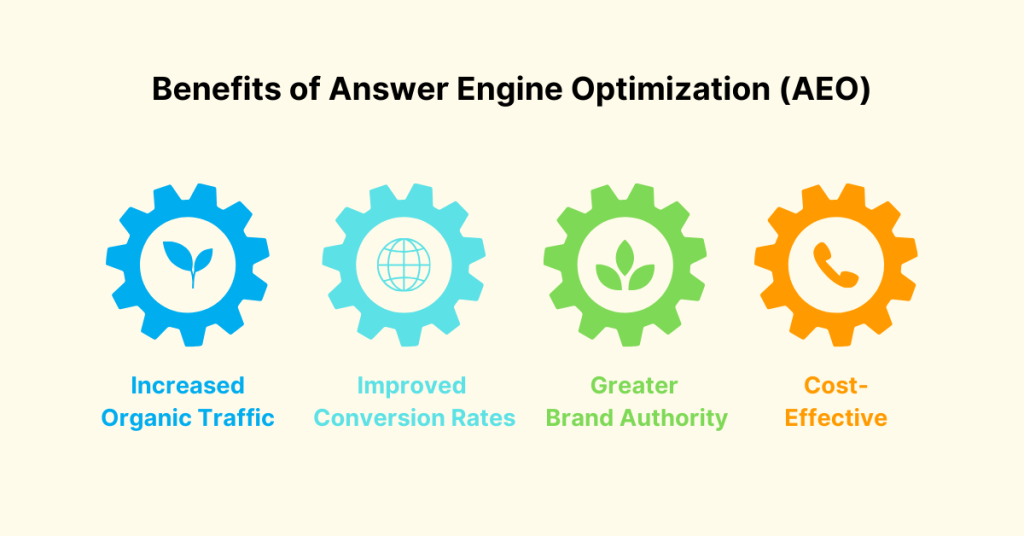
Benefits of Answer Engine Optimization (AEO)

There are multiple benefits that AEO can offer to the business in terms of its brand visibility, ranking, reach, and also conversion rates as well. Here, you will get a detail of each of these benefits that AEO offers to businesses:

    • Increased Organic Traffic

Optimizing for direct answers increases your chances of being featured in top search results, bringing in more organic traffic.

    • Improved Conversion Rates

When users receive concise, accurate information quickly, they’re more likely to make purchasing decisions or take other desired actions on your site.

    • Greater Brand Authority

Being the go-to source for specific, relevant answers can position your brand as an authority in your industry.

  • Cost-Effective

AEO focuses on optimizing content rather than paying for ads, making it a more cost-effective long-term strategy compared to PPC campaigns.

Ready to Explore AEO?

Considering the benefits AEO can offer to businesses, it is worth exploring more of its features, and Deftsoft is the best option for modern businesses to do so. One of the leading organizations in the field of Web development, SEO, and Digital Marketing for over 19 years, Deftsoft has all the resources, tools, technologies, and human resources to adapt to these changing requirements. At Deftsoft, you will get the best customer support, an easy-to-understand description of the whole process and also, and guaranteed results. Also, their expertise in SEO for over 19 years is a plus as it is easier for them to adapt to this changed requirement of digital marketing. All you need to do is to get a free consultation scheduled with the experts and get a detailed overview of how your business success journey will be started with the company. 

Conclusion

The rise of Answer Engine Optimization (AEO) is a response to a shifting digital landscape driven by AI, voice search, and a growing demand for instant information. While traditional SEO remains important for driving general traffic and ranking for broad keywords, AEO offers a new way to ensure your content is at the forefront of this next phase of online search. By embracing AEO strategies, businesses can position themselves as leaders in providing concise, relevant answers to user queries—ultimately improving visibility, user experience, and conversion rates. As we move towards 2025, businesses that adopt AEO strategies early will have a distinct competitive advantage over others because of the better reach and conversions they will get as compared to the businesses that will only be depending upon traditional SEO practices to rank higher. 

Throughout this discussion over AEO vs SEO, it is evident that SEO will remain important for businesses and will be an important part of the digital marketing landscape. However, AEO will be a useful addition for businesses that are already doing well with SEO to get even more boost in their search engine ranking, visibility, reach, and conversion rates. So, it is evident that with the evolution of AEO, digital marketers will have a new strategic change to add to their marketing plans in order to offer better results to their respective brands. For businesses searching for reliable and trusted AEO services, Deftsoft can be a perfect option, considering their 19 years of industry experience and visionary leadership. The company offers all sorts of IT services, including AEO and SEO, where they have some of the best people in the industry to lift your business to new heights. 
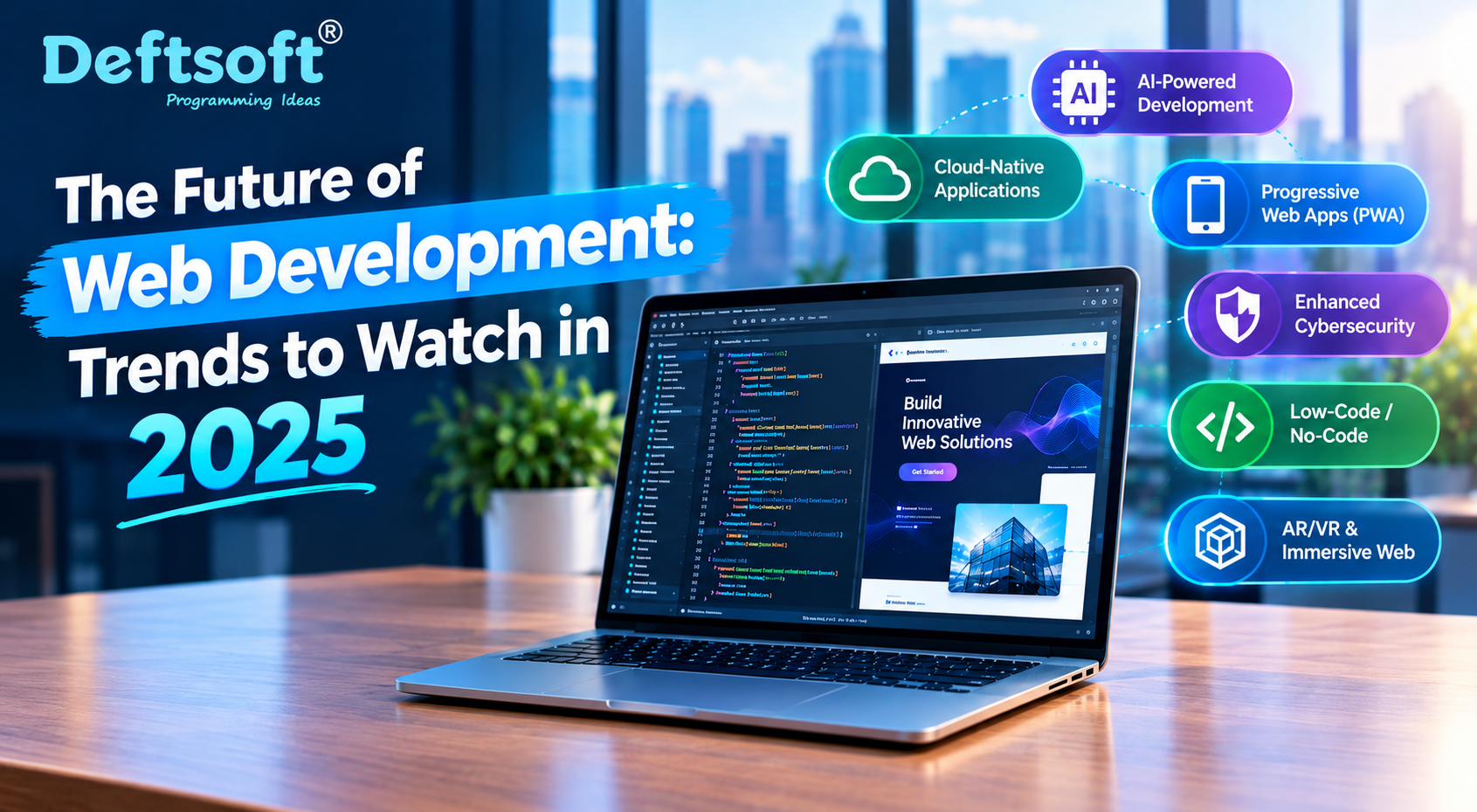
The Future of Web Development: Trends to Watch in 2025

As we approach 2025, the world of web development is geared up for some game-changing trends. The tech world always stands, so new technology and tools are emerging to change how websites look, feel, and perform. Between 2010 and early 2020, the web development industry grew by 3-5% annually. By 2023, the market value reached over $50 billion, with an annual growth rate of 6%. Looking ahead, the industry is expected to grow at an annual rate of up to 10% by 2030. As technology continues to reach new heights, some web development trends in 2025 are set to diversify our online experience. Staying updated with these trends is no longer optional. Now, it has become a necessity for developers, designers, and businesses to keep these upcoming trends on their radar.

The global web development market is expected to grow at a compound annual growth rate (CAGR) of 8.03% with a market share of USD 89013.17 million by 2027.

Web development has seen a massive transformation over the past decade. This all changed with the introduction of AI, mobile responsive designs, and user-centric interfaces. This will speed up by 2025 as revolutionary technologies are reshaping how websites and applications are built, hosted, and optimized. From security mechanisms to UI, everything is becoming more dynamic and user-friendly. More jobs are being created in new sectors of web development that can take advantage of these changes.

Keeping up with the latest web development trends in 2025 is indispensable. These shifts may come when you least expect them, and failing to acknowledge these trends can lead to missing out or trailing behind the curve. In 2025, web development trends are more than trends or predictions — they represent the building blocks for next-generation web experiences. In this blog, we will discuss the future of web development in 2025. We’ll dive into the most impactful and emerging trends and learn how they can keep you ahead in this changing industry.

Top Web Development Trends for 2025

1. AI-Driven Development

The advent of AI-driven development has changed web development trends in 2025, allowing it to emerge as a more responsive, adaptive software process. AI is now present in all four corners of contemporary web development and has simplified processes that used to be extremely laborious. In the fast-moving world of technology, developers process AI-powered tools quickly for efficient code generation, design specification help, and better user experience.

AI-powered tools like GitHub Copilot and CodeWhisperer help developers with repetitive code, find errors and even suggest further optimizations, all of which enable developers to spend more time working on higher-level problem-solving capabilities.

Leveraging AI-driven web development tools, developers can write impeccable code in a fraction of time. Automated code generation allows developers to work at a higher level than the specific topic of writing, while AI can handle monotonous coding. This includes AI support by aiding designers in creating aesthetically pleasing layouts based on information from user preferences and behavioral data. It saves a lot of time, making development cycles faster than ever.

When you look beyond the code and design side of it, then AI pushes UX to a whole new level. This allows incredibly individualized, real-time interactions based on ever-changing user behaviors. For example, AI can recommend related products or content, making that experience more personalized. 

AI has many significant advantages in web development in 2025: shorter cycles, tailored experience, and data-driven decisions. This allows businesses to scale up more effectively, with developers quickly creating intuitive and scalable platforms. Web development will change, and AI will become increasingly complex as we create more and better websites that are intuitive, interactive, and user-centred.

By 2025, the rise of AI-driven development will dominate web development, providing amazing tactics to work faster and customize. AI has become a part of web development and is now used to automate tasks that take countless hours. Today, AI-powered tools find wide applications in everything from coding to design and user experience.

2. Low-Code and No-Code Platforms

The Shift to Low-Code and No-Code Platforms is transforming web development trends in 2025. These platforms aid in simplifying web development, thus allowing non-developers to create a website. This is possible now, even individuals with little technical ability can implement and create websites. Low-code or no-code platforms lets a user drag and drop elements from the palette, thus simplifying tasks for those who do not have advanced technical skills.

Platforms like Webflow allow designers to build fully responsive websites through visual editors without deep coding knowledge.

This change allows enterprises to have a much quicker development process. Teams can iterate, prototype, and launch web apps in a fraction of the time. And in the fast-paced digital world with frequent updates and adjustments, this agility is even more important.

However, simplicity vs customizability has some pros and cons. Low-code and no-code platforms are easy to use but can restrict advanced customizations. To cover those highly tailored needs, developers may have to extend functionalities manually by themselves, increasing the overall complexity of a project. The most common solutions are to choose a different platform that affords at least some code room or install and integrate other tools for specific features.

In General, low- and no-code platforms are the future of web development trends in 2025. With speed, accessibility, and responsiveness, web development is easy for businesses and developers. As demand for quick and easy-to-implement web solutions rises, this shift is likely to continue.

3. Progressive Web Apps (PWAs)

Progressive Web Apps (PWAs) remain an important part of web development trends in 2025. These are “Progressive Web Apps“: an in-between solution incorporating the best of a website and native applications, serving users app-like experiences directly through their browsers. PWAs are a must-have application for improving user engagement and satisfaction as they can work offline, load content faster, etc.

Retail giants like Starbucks use PWAs to streamline the order experience right in your mobile browser, allowing users to place an order more easily while receiving notifications without downloading an app.

Offline functionality is the most important advantage of PWAs. It allows users to interact with your app without an internet connection. This is in contrast to regular websites, where content is not available if the user loses internet connectivity. Ultimately, this is what makes them perfect for businesses that want to provide consistent and reliable user experiences.

PWAs prioritize mobile optimizations, resulting in fast load times and intuitive interactions for users on all kinds of smartphones. Major companies like Twitter and Starbucks have already proven that PWAs can work perfectly in terms of accessibility and performance worldwide. These examples highlight how PWAs are helping to drive this new wave forward by making speed a key piece of digital experiences across platforms.

It is anticipated that PWAs will continue to grow as businesses’ knowledge of them expands. PWAs are probably here to stay as demand for faster, instant-access applications grows. This trend indicates a shift in the future where web applications are resilient, very user-friendly, and universally accessible over various devices, making it continue on top of 2025 web development trends.

4. Voice Search Optimization & Voice UI

Voice search optimization will be a crucial web development trend in 2025. With more people using voice-activated devices, the demand for voice-friendly navigation is growing. It makes a site more accessible, as the visitor can navigate without using hands, and it is easier for everybody.

With the increasing popularity of Siri and Alexa, people search by voice rather than by typing. Using structured data and conversational phrasing in content makes it more likely websites will rank for voice searches.

To keep up with this trend, developers are investing in natural language processing for improved voice recognition. Schema markup helps you to empower search engines to understand your web content for voice results. Furthermore, emerging UX design techniques also consist of voice-oriented designs offering effortless learning interaction by doing.

With the increasing use of smart speakers and voice-activated assistants, voice optimization is now a default process. If developers embrace these strategies, they can apply better practices that align with the web development trends of 2025.

5. Serverless Architecture 

In 2025, serverless architecture will revolutionize web development by offering unmatched scalability and flexibility. This approach is intended for developers who want to focus on coding while not worrying about managing server infrastructure. Instead, it automatically handles server management, a solution perfect for dynamic, high-traffic applications.

Serverless architecture is adopted by platforms like Netflix that handle huge amounts of user traffic. It scales on demand automatically, which provides zero downtime and a seamless user experience during peak times.

The advantages of a well-organized serverless architecture are huge. It improves scalability, as resources can expand or contract as needed. Serverless solutions also reduce costs since you pay for how many resources run at any given time, meaning more effective resource allocation. Serverless architecture is implemented with providers like Amazon AWS Lambda and Google Cloud Functions. These services help you push the code into production in the cloud so that operations can be efficient and cost-effective. The demand for scalable solutions will continue to increase, so serverless architecture will still be one of the latest web development trends in 2025.

6. Cybersecurity and Privacy

Cybersecurity is set as a considerable priority in web development in 2025. In the current world full of hackers and cyber threats, protecting user information should be one of the top priorities. More advanced encryption techniques have followed, guaranteeing that data gets transferred across the web securely. This also means that two-factor authentication (2FA) is seeing widespread adoption as another security layer from the user’s perspective.

The annual “State of Ransomware 2024” survey report found that the average ransom payment has increased 500% in the last year. The 2024 report also found that 63% of ransom demands were for $1 million or more, with 30% of demands for over $5 million.

(Source: Sophos 2023 State of Ransomware Report)

This growing trend of ransomware as a cyber threat targets businesses of all sizes, underlining the importance of security awareness & prevention measures.

Moreover, businesses are making massive investments to defend against cyber security and privacy threats.

Global spending on information security is projected to reach almost $212 billion next year, a 15% increase from 2024. Gartner forecasts spending on security software will increase by 15% to nearly $101 billion in 2025.

(Source: Cybersecurity Drive, 2024)

Obliging to comply with privacy regulations such as GDPR and CCPA is imperative for businesses to protect themselves from legal troubles. It is also helpful in creating a safer ecosystem, benefiting both app users and developers. Now, developers employ tools such as SSL certificates to address these needs, build firewalls, and use encryption protocols. All these methods make user data private and secure, protecting it against potential breaches. Developers build the web as a trustful platform by emphasizing web development trends in 2025.

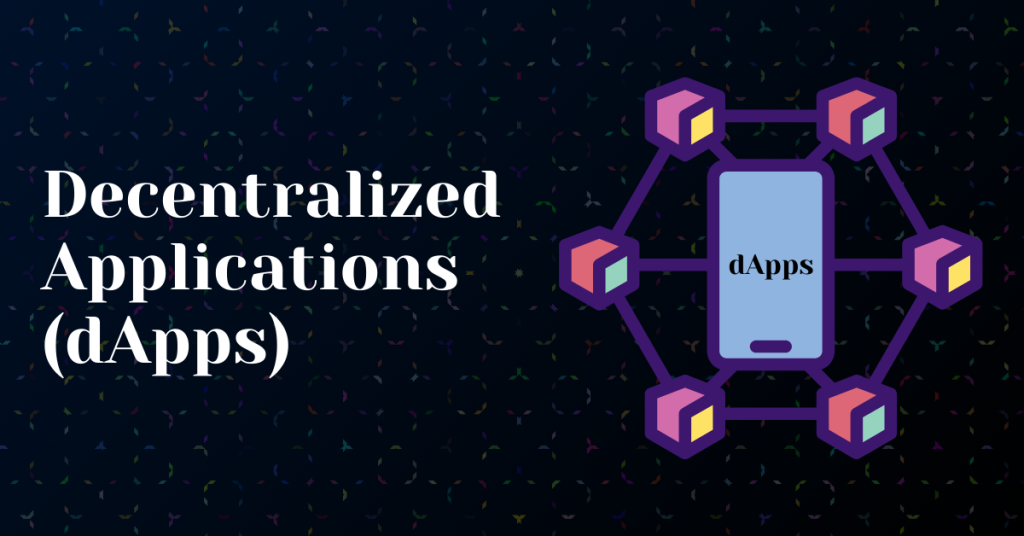
7. Web 3.0 and Decentralized Applications (dApps)

Decentralized Applications (dApps)

The evolution of Web 3.0 will change web development trends in 2025, which will focus on decentralization and user control. Web 3.0 applications do not maintain control and retention of data from their users, unlike common platforms, which retain user information to a large extent.

This move is centered around decentralized applications (dApps) that use blockchain for encrypted data storage. With decentralized hosting, there is no need to rely on centralized server infrastructure, which means there is less risk of hacks or service interruptions. Creating a user-centric design transforms how users engage with online platforms.

The most recent features from blockchain integration, peer-to-peer networking, and improved user interfaces provide an easy-to-use interface that makes it highly secure. As Web 3.0 gains traction, decentralized approaches will continue to lead in web development trends.

8. Augmented reality (AR) and Virtual reality (VR)

AR and VR are turning out to be significant trends in web development that we can see ahead of us by 2025. Providing immersive and interactive experiences on websites, these technologies change the way users interact with content. In e-commerce, AR allows users to check out products virtually by trying them on. 

E-commerce brands like IKEA and Wayfair let customers visualize products in their own homes using AR.

VR is also used to enhance the real estate industry through virtual property tours so buyers can narrow their search results without visiting a location. VR support is added to entertainment platforms to improve user interaction and make the environment way too different.

Developers require frameworks such as AR.js or A-Frame to incorporate AR/VR features. Optimizing these features to ensure they are properly optimized for different screens and performance levels is crucial to providing a seamless experience. 

9. Dark Mode and Other UI Design Trends

One of the most popular web development trends in 2025 is going to be dark mode. It creates a more comfortable user experience by decreasing eye strain, especially in low-light areas. It also saves battery life on mobile devices, making it both practical and visually appealing.

2025 will have its own set of impactful UI design trends, such as micro-animations, 3D visuals, minimalism, etc. In the form of micro-animations, motion guides users’ attention and provides engaging interaction. Depth and realism—3D visuals can make websites more interesting. Minimalism unclutters an interface by maintaining simplicity and neatness.

These must be balanced and incorporate both the worlds of style/look, feel, and usability throughout. By picking matching techniques and colors, developers create visual consistency that ultimately increases site attraction. These UI trends improve users’ experiences and define web development trends in 2025.

Dark Mode is trendy on platforms like Twitter, book reading and news websites, and Google Chrome. Dark mode lowers eye strain for users in dark environments by providing a visually comfortable experience that does not overload brightness.

10. Advanced API Integrations And Data-Driven Applications

APIs will be a key part of web development in 2025. They help transfer required data between multiple applications. APIs simplify methods or tools that enable programmers to link web services easily. For example, APIs help developers connect platforms and integrate behavior among different software. One example is that social media APIs offer real-time feeds from any major or minor social network, which can increase user interaction. 

Platforms like Zapier leverage API integrations to allow apps to communicate, automating workflows across different software.

Similarly, payment gateway APIs allow smoother and safer transactions within the web, which is a must in e-commerce.

AIl APIs work great for providing integration features, such as chatbots, image recognizers, or personalized recommendations. As a result, developers can build user-centric applications that are data-driven at their heart. Websites with APIs become interactive and provide personalized, appealing experiences.

11. Web Development: The Sustainable Way (for Earth and Developer)

Sustainable web development will now become a mainstream trend in 2025. Due to the growth in environmental awareness, many developers and companies are now conscious in terms of green work practices. This trend ranges from design decisions to server hosting and is about appealing to the digital carbon footprints.

Sustainable web development focuses on minimizing energy consumption during site usage. The energy cost of hosting heavy images, overusing animations, and large video files is immense. Making websites more efficient will reduce the waste of resources on the environment. Simple design layouts with fewer images also aid in faster page loading times, which means lower server power usage.

Green hosting is another crucial feature. These days, many hosting providers are offering services that depend on energy from renewable sources. Providers like GreenGeeks and Kualo use wind and solar power to support sustainable web hosting. Companies that choose these providers can significantly reduce the overall carbon emissions produced by their websites.

Developers can also optimize coding to make sites more sustainable. Code cleanliness, improved caching, and fewer server requests have been suggested as potential means of decreasing energy consumption. One example is using CSS instead of JavaScript animations, which reduces processing power. Doing so is good both for the planet (eco-friendly) and its performance.

Eco-friendly brands such as Ecosia and Patagonia are taking the lead in sustainable web development. For instance, Ecosia uses the revenue generated from ads to plant trees and hosts its search engine on green hosting. Patagonia’s website is deliberately minimal in order to conserve energy and limit data transfer. These innovations were defined by the new paradigms instilled within them, and these companies lead by example in actively lowering their digital footprint. 

What Skills Will Developers Need in 2025?

In 2025, developers need a modern skill set to stay competitive in the evolving web landscape. Proficiency in AI is crucial as it increasingly powers automation and personalization in web development. AI skills are vital in a world where more and more web development is powered by automation. Experienced AI developers can find tools that eliminate code generation, data analysis, and user experience optimization.

Understanding Web 3.0 and its principles is also essential. As Decentralized applications (dApps) and blockchain technologies grow, developers need to know how to develop within these structures. Web 3.0 learning allows web developers to build security, user-focused, and data-protected digital solutions.

In this new world, cybersecurity expertise is the top priority. Due to expanding cyber threats, the next big skills for developers are encryption, two-factor authentication, and general secure coding. You will learn about cybersecurity, which secures websites and user data in compliance with rising government regulations, e.g., GDPR or CCPA.

Conclusion

Web development is going to adopt some really interesting innovations all the way toward 2025 that will change the way users interact within the digital world. Some such new developments are — AI-driven development, low-code/no-code platforms, and Progressive Web Apps (PWAs) for more personalized and seamless app development and high-performing experience. In addition, voice search AI and decentralized applications (dApps) are the two most important trends that will change how users interact with the web, making everything more intuitive and secure. Keeping an eye on these trends is going to be a crucial part of serving users with next-level, efficient, and secure digital solutions.

At Deftsoft, we are committed to keeping businesses updated with these technological innovations. We provide customer-centric web applications using the latest trends. Our expert developers can offer you high-performance web apps, an e-commerce platform, a Progressive Web App, or SaaS solutions! From UI/UX designs to strong backend development, we follow a comprehensive approach to ensure your project is delivered on time. Our clients are spread across various industries, including E-Commerce, Healthcare, Logistics, Retail, Finance, Game and Sports, Real Estate, Travel etc. Deftsoft is your partner in building scalable, secure, and immersive web experiences that fuel business growth with 19 years of industry experience. Contact us today, and let us help you evolve your digital expertise to the next level.

FAQs:

1. What are some of the most exciting web development trends to expect in 2025?

In 2025, we can expect trends like AI-driven development, the rise of low-code/no-code platforms, Progressive Web Applications (PWAs), enhanced cybersecurity measures, and Augmented Reality (AR) integration. These innovations are set to make web development more efficient, interactive, and secure.

2. What is the future of web development in 2025?

The future of web development in 2025 will feature Virtual reality (VR), Dark Mode, Advanced API Integrations & more. Technologies like AR/VR will enhance user experiences while heightened cybersecurity measures address evolving threats. This evolution aims to create faster, more interactive, and secure digital experiences across industries.

3. Will low-code and no-code platforms replace traditional web development?

Low-code and no-code platforms will empower more people to build websites and apps, but they’re unlikely to replace traditional development fully. Instead, these platforms will complement traditional methods, allowing developers to focus on more complex, custom features while reducing time spent on repetitive tasks.

4. How will Artificial Intelligence (AI) impact web development in the future?

AI will play a crucial role in automating code generation, improving user experiences through personalized recommendations, and enhancing website accessibility. AI-driven tools will also help developers quickly identify and fix issues, reducing development time and improving website performance.