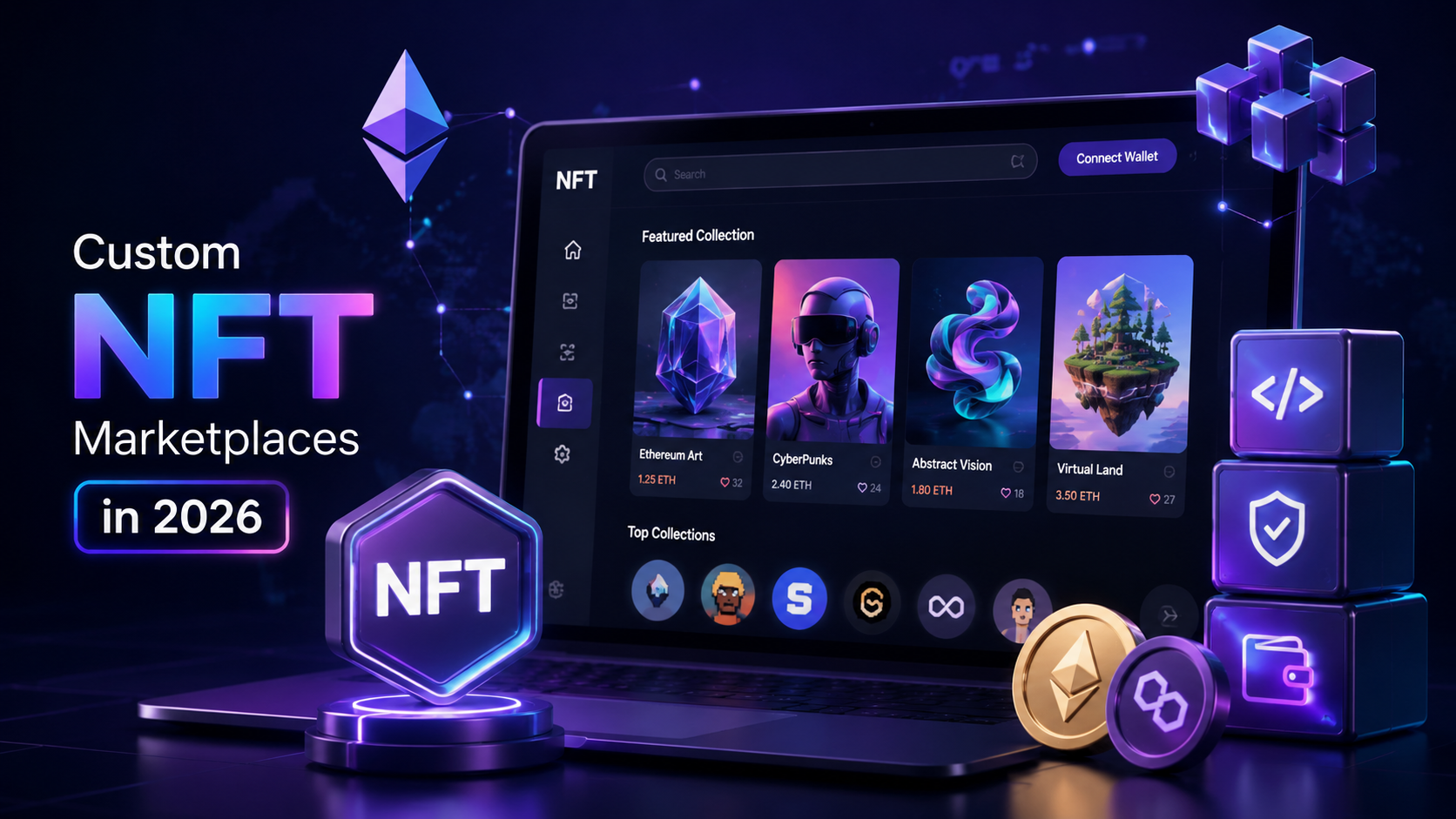
If you’ve been watching the NFT space from a distance, waiting to see whether it would settle into something real, 2026 is probably the moment you’ve been waiting for. The hype cycle ended a few years ago, taking a lot of noise with it, which is exactly what cleared the space for serious business applications to step in. What’s left isn’t the speculation frenzy that defined 2021; it’s a maturing market where brands, enterprises, game studios, and creators are building infrastructure they actually intend to use for years.
The question for businesses right now isn’t really “should we get into NFTs?” It’s a more practical one: do we build on top of an existing marketplace like OpenSea or Blur, use a white-label solution someone else built, or commission a custom platform tailored to our needs? The answer depends on what you’re trying to do, but for any company that wants to own its user relationships, control its monetization model, and build something that scales, the case for going custom is getting stronger by the quarter.
Quick Summary
NFTs are no longer a speculative trend; they’re becoming the backbone of digital ownership across gaming, real estate, loyalty programs, event ticketing, and creator economies. The global NFT market is projected to grow from $48.74 billion in 2025 to over $65 billion in 2026, and serious businesses are no longer asking whether NFTs are relevant. They’re asking how to build a platform that captures that value without handing it to someone else’s ecosystem. This blog breaks down why custom NFT marketplace development makes more sense than off-the-shelf solutions in 2026, what features and tech stack go into a well-built platform, and what it realistically costs to get there.
Thinking about building your own NFT marketplace?
The NFT Market in 2026: What’s Actually Happening
Let’s address the obvious thing first. Most people outside the Web3 world still associate NFTs with overpriced profile pictures and celebrity cash grabs. That era is gone. What’s replaced it is far less flashy and far more durable.
38% of NFT transaction volume now comes from gaming, where players actually own their in-game items swords, skins, virtual land and can trade them freely. Another growing slice is coming from real-world asset (RWA) tokenisation think fractional ownership of real estate, authenticated luxury goods, trade finance instruments, and carbon credits, all recorded and transferred on-chain. Event ticketing NFTs now represent 5.3% of ticket sales across major US venues, addressing longstanding problems like fraud and scalping that traditional ticketing has never solved cleanly
The NFT market didn’t die, it grew up. After the 2021–2022 speculation frenzy and the 2023–2024 correction, 2026 reveals a sector that shed the hype and gained structure. Trading volumes stabilised, utility-focused projects survived, and institutional adoption quietly accelerated.
For businesses evaluating this space, those aren’t abstract stats. They’re signals about where digital commerce is heading and which companies are positioning themselves to be part of the infrastructure rather than just users of it.
Custom vs White-Label: Why It Matters More Than You Think
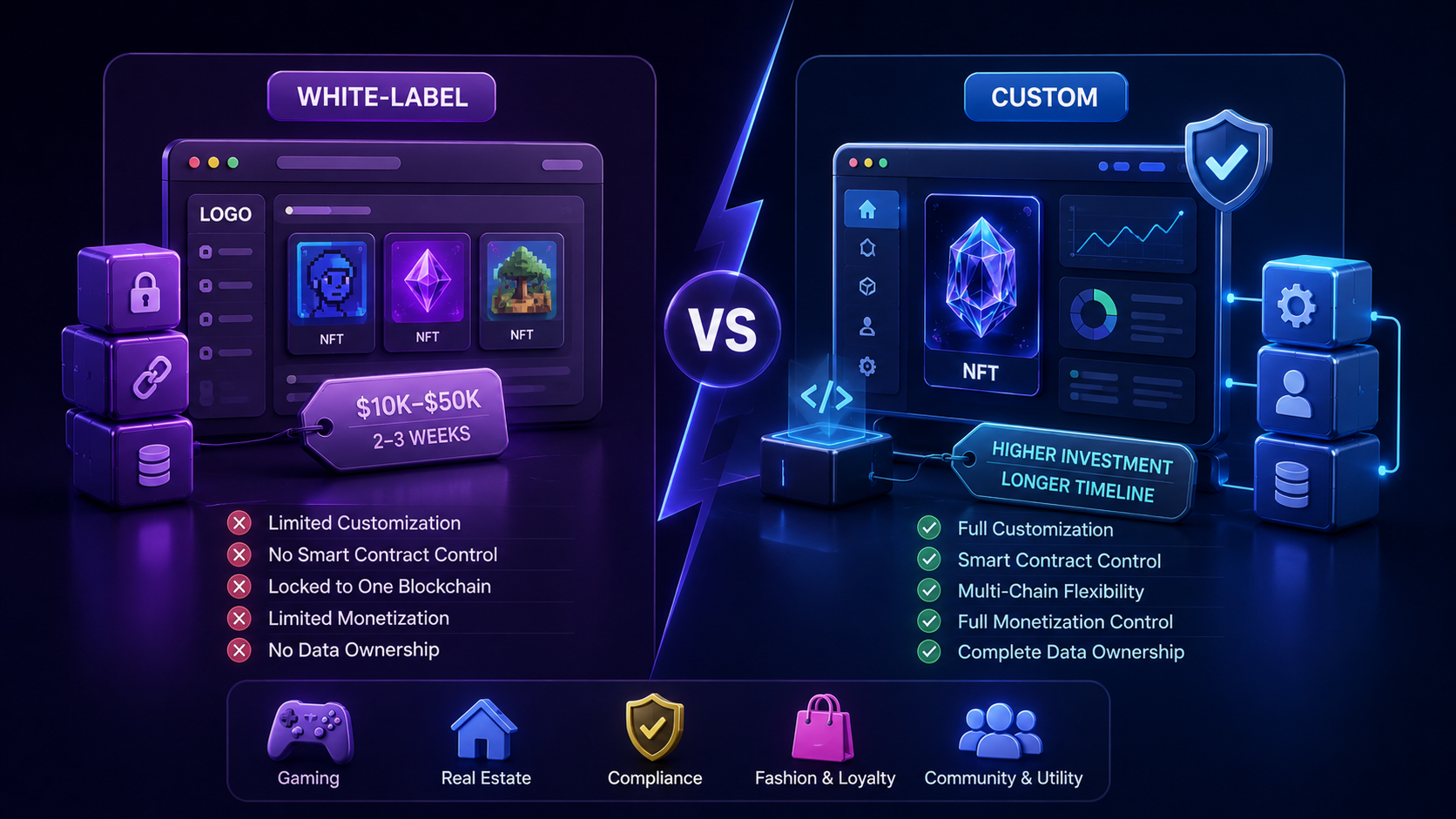 Before getting into what goes into a custom NFT marketplace, it’s worth understanding why “custom” is the right frame for most serious business use cases in 2026.
A white-label NFT marketplace is essentially a pre-built platform you license and rebrand. You can get one live in 2 to 3 weeks for between $10,000 and $50,000. If you’re validating an idea, testing whether there’s appetite for your concept before committing a bigger budget, or running a limited one-off drop, white-label is a perfectly sensible starting point.
But the limitations show up fast. You don’t control the underlying smart contracts, so you can’t modify how royalties are handled, how assets are structured, or how transactions are verified. You’re locked into whatever blockchain the platform supports. Your monetisation options are constrained by someone else’s business model. And your user data, the most valuable thing your marketplace will generate, sits on infrastructure you don’t own.
Custom NFT marketplace development offers full flexibility, unique product logic, and deeper integrations, but at a higher cost and a longer timeline. In practice, many teams start with a white-label solution to validate their idea and go to market quickly, then evolve toward custom development as the product grows.
The companies choosing custom from the start in 2026 are generally ones where the marketplace isn’t a side project; it’s a core product. A gaming studio that wants players to genuinely own and trade in-game assets across titles needs custom smart contract logic that no white-label platform can provide. A real estate company tokenising fractional property ownership needs compliance and identity-verification layers specific to its regulatory environment. A fashion brand building a loyalty programme around digital collectibles needs the whole experience to feel native to their brand, not like a third-party tool bolted on.
What Goes Into a Custom NFT Marketplace: The Core Components
Building a custom NFT marketplace is meaningfully more complex than building a standard web application. It has a layered architecture, and a weak decision at any single layer creates problems that are very hard to fix post-launch. Here’s what each layer looks like.
Smart Contracts
Smart contracts are the engine of any NFT marketplace. They handle minting (creating new tokens), ownership transfers, royalty distribution on secondary sales, auction mechanics, and settlement, all automatically, without a middleman. In 2026, ERC-721A and ERC-1155 are the standard token standards, but there’s a growing adoption of dynamic NFTs that change based on outside data, meaning an in-game item might gain verifiable “experience” recorded directly on-chain, increasing its market value based on its unique history.
Smart contract development is not the place to cut corners. A bug or vulnerability in a contract is literally an open door for exploits. Security auditing of smart contracts is a non-negotiable cost, not an optional add-on.
Blockchain Selection
The best blockchain you select shapes your costs, your user base, and your long-term flexibility. In 2026 the main options each serve different needs: Ethereum remains the most trusted for high-value assets and has the deepest developer ecosystem; Polygon is the most common choice for mid-tier builds, balancing cost and security well; Solana offers very low transaction fees and fast throughput, making it dominant in gaming and art; Immutable X is purpose-built for NFTs with zero gas fees for transactions while maintaining Ethereum-level security.
The best design approach is to build your marketplace with a multi-chain abstraction layer so that adding new chains in the future doesn’t require a fundamental rebuild, important given how quickly chain preferences shift with user behaviour.
Wallet Integration and Onboarding
Wallet integration is one of the most technically nuanced parts of building a marketplace, and one of the biggest factors in whether first-time users convert or drop off. In 2026, platforms that support account abstraction, allowing users to sign up with email or social login rather than requiring manual wallet setup, convert new users at significantly higher rates than those requiring traditional crypto wallet configuration. Supporting MetaMask, WalletConnect, Phantom, and Coinbase Wallet as standard, while also offering a simpler onboarding path for Web2-native users, is increasingly the baseline expectation.
Storage
NFT metadata and media files can’t live on a private server if that server goes down, the NFT becomes a broken link, and the value disappears. Decentralised storage systems like IPFS, Arweave, and Filecoin ensure that NFT assets persist permanently regardless of what happens to any single server. Getting storage right is unglamorous but critical, and it directly affects long-term user trust in the platform.
Frontend and Backend
The frontend is what users actually interact with: the storefront, search and filtering, collection pages, user dashboards, bidding interfaces, and transaction history. 70% of NFT browsing now happens on smartphones, so mobile-first design isn’t optional. The backend handles the off-chain logic: indexing blockchain data, managing user accounts, processing notifications, running analytics, and keeping everything synced in real time. A slow or poorly built backend fails visibly under traffic spikes exactly when you least want it to.
Admin and Compliance Layer
This is the part most first-time marketplace builders underestimate. As digital asset regulation becomes stricter, NFT marketplaces must support flexible identity-verification layers, modular KYC, wallet reputation scoring, sanctions screening, and audit trails built directly into the marketplace architecture. This is especially important for platforms dealing with tokenised real-world assets, luxury goods, or region-specific access restrictions. Building compliance in from the start is always cheaper than retrofitting it later.
Key Features That Separate Good Marketplaces from Average Ones
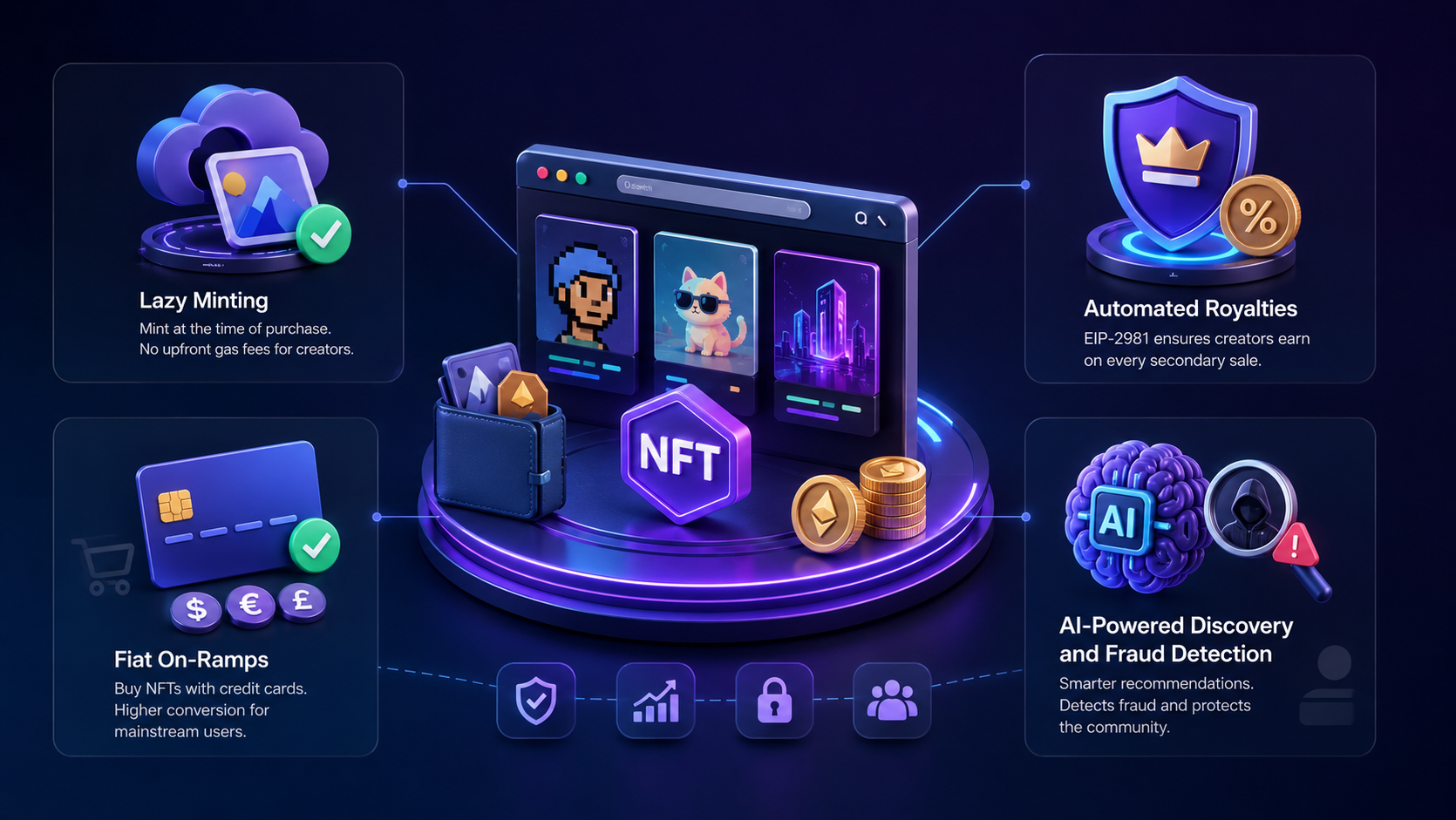 Beyond the core architecture, a few features consistently separate well-adopted marketplaces from ones that struggle to retain users:
- Lazy minting allows NFTs to be minted only at the time of purchase rather than upfront, removing the gas fee barrier for creators listing assets before they sell. It adds smart contract complexity but dramatically improves the creator experience.
- Automated royalties at the smart contract level (using the EIP-2981 standard) ensure creators receive a percentage of every secondary sale automatically, without relying on the platform to enforce it manually. Over 80% of successful creators now only list on marketplaces that strictly enforce royalty payments; platforms that don’t respect the creator’s cut simply don’t attract serious talent.
- Fiat on-ramps let users buy NFTs with a credit card rather than requiring them to own cryptocurrency first. Platforms with credit card support see 35% higher conversion rates among first-time buyers, which matters enormously if your target users include non-crypto-native people.
- AI-powered discovery and fraud detection is increasingly standard in 2026. AI scans new mints to detect copied or plagiarised assets, personalises collection recommendations based on wallet history and browsing behaviour, and flags suspicious activity before it damages platform trust.
What Does It Actually Cost?
The NFT marketplace development cost in 2026 ranges from $25,000 for a white-label MVP to over $500,000 for a fully custom enterprise platform. For a custom build specifically, a more realistic range looks like this:
- Basic custom marketplace with core features: $80,000 to $120,000
- Mid-level custom build with auctions, multi-wallet, analytics, and mobile-responsive UI: $150,000 to $250,000
- Enterprise-grade platform with multi-chain support, compliance layers, advanced smart contracts, and full security audit: $300,000 to $500,000+
The timeline for custom development typically runs eight to twelve months, depending on complexity. Annual maintenance (bug fixes, smart contract upgrades, security patching, and new feature rollouts) runs at roughly 15% to 25% of the original development cost, a cost that’s worth factoring into your planning from day one.
The hidden cost most first budgets miss is smart contract auditing. It typically adds 20–30% to development costs, but skipping it is genuinely high-risk: a single exploitable vulnerability in a live marketplace can result in losses that dwarf the cost of an audit many times over.
Industries Getting the Most Value From Custom NFT Marketplaces Right Now
The businesses seeing the strongest return on custom marketplace investment in 2026 tend to cluster in a few areas:
- Gaming is the largest segment by far. Studios building play-to-own economies need custom smart contract logic to handle dynamic in-game assets, interoperability between titles, and player-owned economies that don’t collapse if one game loses popularity.
- Real estate and finance firms tokenising fractional property ownership or trade finance instruments need compliance, identity verification, and legal enforceability baked into the platform architecture from the start; nothing off-the-shelf handles this adequately.
- Fashion and luxury brands using NFTs for authenticated ownership of physical goods (a digital certificate tied to a physical item, verifiable on-chain) need the user experience to feel premium and native to their brand identity, which white-label solutions almost never deliver.
- Music and entertainment artists and labels building direct-to-fan ownership models, where fans own a stake in future royalties or exclusive access rights, need flexible smart contract structures that a generic platform can’t accommodate.
If your business sits in any of these spaces, a custom build isn’t just a preference; it’s a functional requirement. This is why blockchain application development done right starts with understanding your business model first, then designing the technical architecture around it, rather than picking a framework and hoping it fits.
Final Thoughts
The companies investing in custom NFT marketplaces are no longer betting on a fleeting digital trend. They are making a calculated, long-term decision about who owns their digital commerce infrastructure. The consensus among forward-thinking enterprises is clear: it is far better to own your platform outright than to rent it from a third-party provider.
Because the underlying technology has matured, a well-scoped custom build is a predictable, manageable technical deployment. However, navigating the intersection of multi-chain web layers, immutable smart contracts, and evolving global compliance frameworks requires more than just general software engineering; it demands deep, proven Web3 expertise.
At Deftsoft, we specialize in turning complex decentralized architecture into seamless, enterprise-grade business tools. Our blockchain engineering teams work closely with you from day one—helping you select the optimal network architecture, structuring secure smart contracts that protect your revenue, and engineering a frictionless user experience that converts Web2 users effortlessly. We don’t just write code; we design secure, scalable digital economies tailored entirely to your brand.
Ready to scope your custom NFT marketplace?
Frequently Asked Questions
1. What is custom NFT marketplace development?
Custom NFT marketplace development means building a platform from the ground up, tailored to your business model, blockchain preferences, user experience requirements, and compliance needs, rather than using a pre-built white-label solution controlled by another company.
2. Why should we choose Deftsoft for our custom marketplace build over a generic white-label solution?
While white-label platforms are faster to launch, they lock you out of your own data, limit your monetization models, and restrict your smart contract logic. At Deftsoft, we engineer custom platforms that ensure you retain 100% ownership of your user relationships, source code, and transaction infrastructure. We build with modular architectures, meaning your platform can seamlessly scale, add compliance layers, or integrate new blockchains as your business grows.
3. How much does it cost to build a custom NFT marketplace in 2026?
A basic custom marketplace typically starts around $80,000 to $120,000. A mid-level build with auctions, analytics, and multi-wallet support runs $150,000 to $250,000. Enterprise-grade platforms with multi-chain support, compliance layers, and full security auditing can reach $300,000 to $500,000 or more. Annual maintenance adds roughly 15–25% of the original development cost.
4. Which blockchain is best for NFT marketplace development?
It depends on your use case. Ethereum is the most trusted for high-value assets. Polygon is the most common choice for a balance of cost and security. Solana works well for gaming and high-volume, low-fee transactions. Immutable X is purpose-built for gaming with zero gas fees. Most serious enterprise builds now use a multi-chain approach to avoid being locked into a single network.
5. How long does development take, and what is Deftsoft’s approach to timeline and security?
A fully custom marketplace typically takes eight to twelve months to build from scratch. To optimize this timeline without compromising security, Deftsoft utilizes an agile deployment framework. We map out architecture and smart contract design early, run parallel frontend and backend development tracks, and mandate rigorous, multi-stage testing. Because smart contract vulnerabilities pose high risk, we integrate rigorous security auditing directly into our development lifecycle to deliver an exploit-proof platform on schedule.
6. What industries benefit most from custom NFT marketplace development?
Gaming studios building play-to-own economies, real estate companies tokenizing fractional ownership, fashion and luxury brands authenticating physical goods on-chain, and music or entertainment businesses creating direct-to-fan ownership models all see strong returns from custom-built platforms. These use cases require smart contract logic and compliance architecture that generic platforms cannot support.
7. Is smart contract auditing really necessary?
Yes, and this is the most commonly skipped cost in first-time marketplace builds. A single vulnerability in a live smart contract can be exploited for losses that dwarf the audit cost many times over. Security auditing typically adds 20–30% to smart contract development costs and should be treated as non-negotiable to protect your platform’s capital and user trust.