Core Web Vitals 2026: How Page Speed Affects Your Google Rankings
-
By Devraj
-
16th June 2026
You’ve optimized your keywords. Your content is solid. Your backlinks are growing. But your rankings are still stuck below a competitor with a thinner blog and fewer links. The missing piece is often something most businesses overlook entirely: how fast and smoothly your website actually performs for real visitors — something a proper website audit usually uncovers fast.
In 2026, Google tightened its grip on this exact issue. Core Web Vitals, once treated as a “nice-to-have” technical checkbox, are now a measurable, confirmed part of how Google evaluates page experience. And following the March 2026 core update, the gap between sites that meet these metrics and those that don’t has only become more visible in search results.
This blog explains what Core Web Vitals mean in 2026, why they matter more than ever, and what you can actually do to fix them through proper website development and optimization — without needing a computer science degree.
Quick Summary
- Core Web Vitals are three Google metrics, LCP, INP, and CLS, that measure loading speed, responsiveness, and visual stability.
- INP (Interaction to Next Paint) replaced FID in March 2024 and is now the hardest metric for most sites to pass.
- Following Google’s March 2026 core update, pages ranking in position 1 show a meaningfully higher Core Web Vitals pass rate than pages in position 9.
- A one-second delay in load time can reduce conversions by 7%, and on a $100,000/month e-commerce site, that’s roughly $84,000 in lost revenue per year.
- Mobile performance now carries even more weight in rankings, since over 64% of global web traffic comes from mobile devices.
Struggling With Slow Load Times or Search Console Warnings?
Deftsoft’s web development team specializes in performance audits and Core Web Vitals fixes that actually move your rankings. Let’s diagnose your site for free.
What Are Core Web Vitals, Exactly?
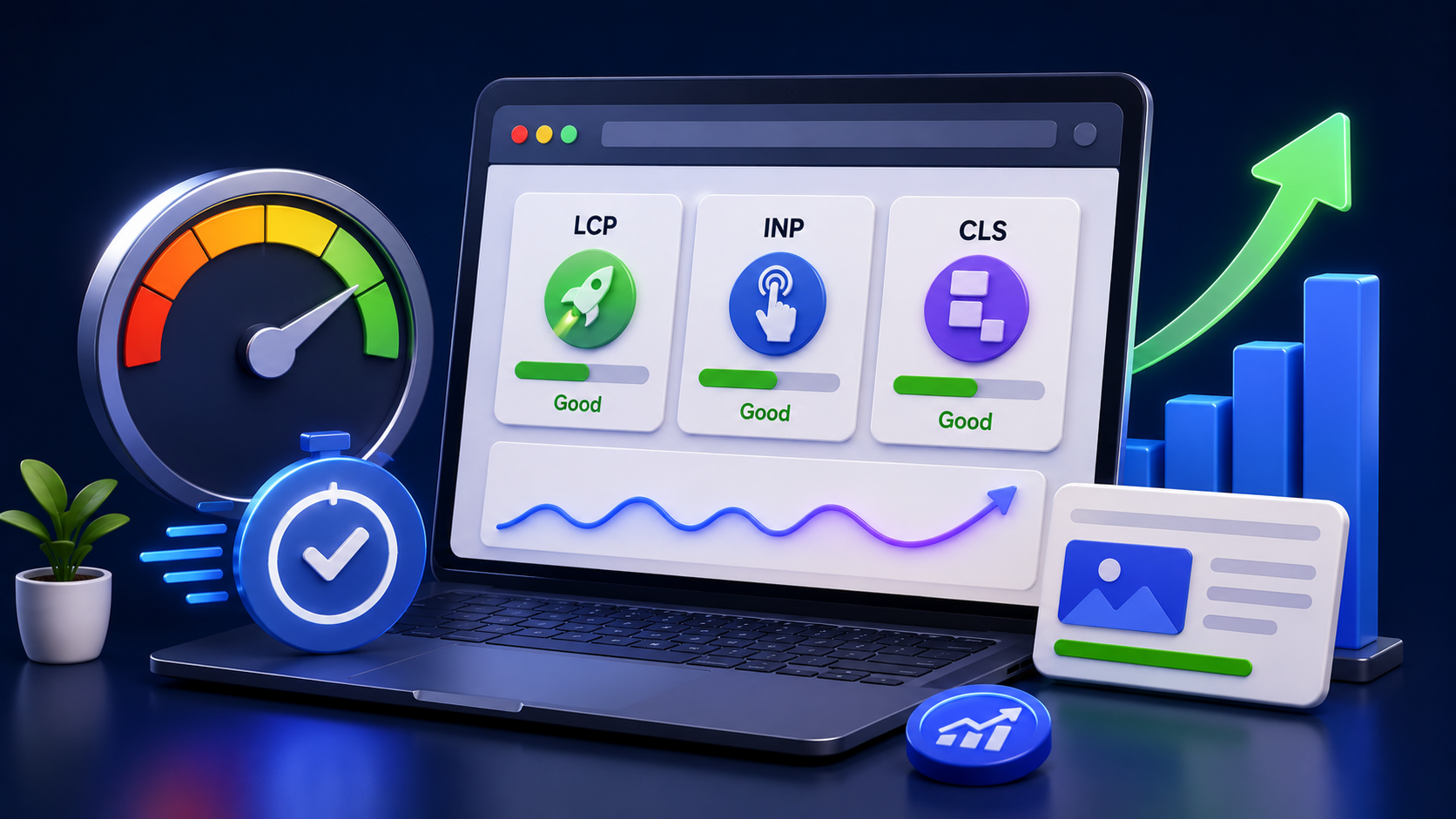
Core Web Vitals are three specific metrics Google uses to measure real-world user experience on a webpage, rather than just lab-based speed tests. They consist of Largest Contentful Paint (LCP), which measures loading speed with a “good” threshold of under 2.5 seconds; Interaction to Next Paint (INP), which measures responsiveness with a “good” threshold of under 200 milliseconds; and Cumulative Layout Shift (CLS), which measures visual stability with a “good” threshold of under 0.1.
All three need to meet the 75th percentile of real visitor data for a page to get an overall “good” Core Web Vitals score. That detail matters. Google isn’t looking at your best-case scenario. It’s looking at how your site performs for the majority of your actual visitors, on their actual devices and connections.
Together, these three metrics influence SEO performance, user engagement, conversion rates, and overall website quality, which is exactly why this topic belongs in both your SEO and development conversations, not just one or the other.
Are Core Web Vitals Really a Google Ranking Factor in 2026?
Yes, and the evidence has gotten stronger this year.
Core Web Vitals are a confirmed Google ranking factor, incorporated into Google’s page experience signals back in June 2021. Core Web Vitals do influence rankings, but they are not the most important factor. Google still prioritizes content quality, relevance, and backlinks, while Core Web Vitals act as a supporting ranking signal.
But “supporting” doesn’t mean “ignorable.” Following the March 2026 core update, pages in position 1 on Google show a 10% higher Core Web Vitals pass rate than pages sitting in position 9. In other words, when two pages are otherwise competitive on content, Core Web Vitals can be exactly what separates page one from page two.
Google doubled down on this after the December 2025 core update, applying tighter thresholds and putting more weight on real-user experience data. The direction is clear: performance is no longer a side conversation in SEO. It’s part of the main one.
The Big Shift: Why INP Is the Metric Everyone’s Struggling With
If you’ve recently checked your Google Search Console and noticed red flags, there’s a good chance INP is the culprit.
INP replaced FID as the responsiveness metric in March 2024. Interaction to Next Paint measures the full lifecycle of an interaction, not just the input delay before it. Unlike its predecessor, which only checked how fast a page responded to the very first click or tap, INP captures every interaction throughout the page lifecycle, clicks, taps, key presses and reports the worst interaction at the 75th percentile, making it far harder to game and far more representative of real user experience.
This is why so many sites are failing it. 43% of sites still fail the 200ms INP threshold, making it the most commonly failed Core Web Vital in 2026. And unlike LCP issues, which are often fixed by compressing an image or enabling a cache, fixing INP requires major changes to the JavaScript architecture, since you need to rethink how your code handles user events rather than just optimizing file size.
This is exactly the kind of technical depth where most in-house teams hit a wall, and where a development partner with real front-end performance experience, like Deftsoft’s web development services, becomes genuinely useful rather than optional.
What “Good” Actually Looks Like in 2026
Here’s where the thresholds stand right now:
LCP should be under 2.0 seconds, INP under 200 milliseconds and CLS under 0.1. These are measured using real user data from the Chrome UX Report, not lab simulations.
It’s worth noting that some sources put the “good” LCP bar at 2.5 seconds and others at the tighter 2.0-second mark, reported more recently, a sign that Google continues to nudge thresholds tighter as average site performance improves industry-wide. Either way, the direction is the same: faster is always safer.
Google uses a 28-day rolling window of real-user field data from the Chrome UX Report (CrUX) to evaluate Core Web Vitals scores, which means improvements made today will typically be reflected in Search Console and rankings within 4 to 6 weeks. That’s a useful number to keep in mind. Core Web Vitals fixes aren’t instant, but they aren’t a year-long wait either.
The Real Cost of a Slow Website
This isn’t just an SEO conversation. It’s a revenue conversation.
Pages that load in under 2 seconds have a 9% bounce rate, while those exceeding 5 seconds have a 38% bounce rate. More precisely, for every second of delay beyond the 2.5-second LCP threshold, bounce rates increase by 32%, and a one-second delay in load time reduces conversions by 7%.
Put that in real numbers: for an e-commerce site generating $100,000 per month, a one-second delay translates to roughly $7,000 in lost revenue every month, about $84,000 per year, for just one second of lag.
On the flip side, the upside is just as real. E-commerce sites that reach “good” thresholds on all three Core Web Vitals metrics see conversion improvements of 15% to 30%. If you’re running an online store, this aligns with the conversion principles we covered in our blog on UI/UX design trends: speed and design experience are two sides of the same coin.
Mobile Performance Is No Longer Optional
Google’s mobile-first indexing has always prioritized mobile optimization scores, and in 2026, mobile Core Web Vitals carry even more weight in overall rankings. Over 64% of global web traffic now comes from mobile devices as of Q3 2025.
This means even if your desktop performance looks excellent, a poor mobile experience can still drag your rankings down. Mobile and desktop scores are usually very different, making mobile-specific SEO critical. Always check both separately rather than assuming one reflects the other.
If your business relies on a mobile app alongside your website, this is also where performance and UX overlap, something our team handles closely as part of our mobile app development services.
What’s New: Visual Stability Index (VSI)
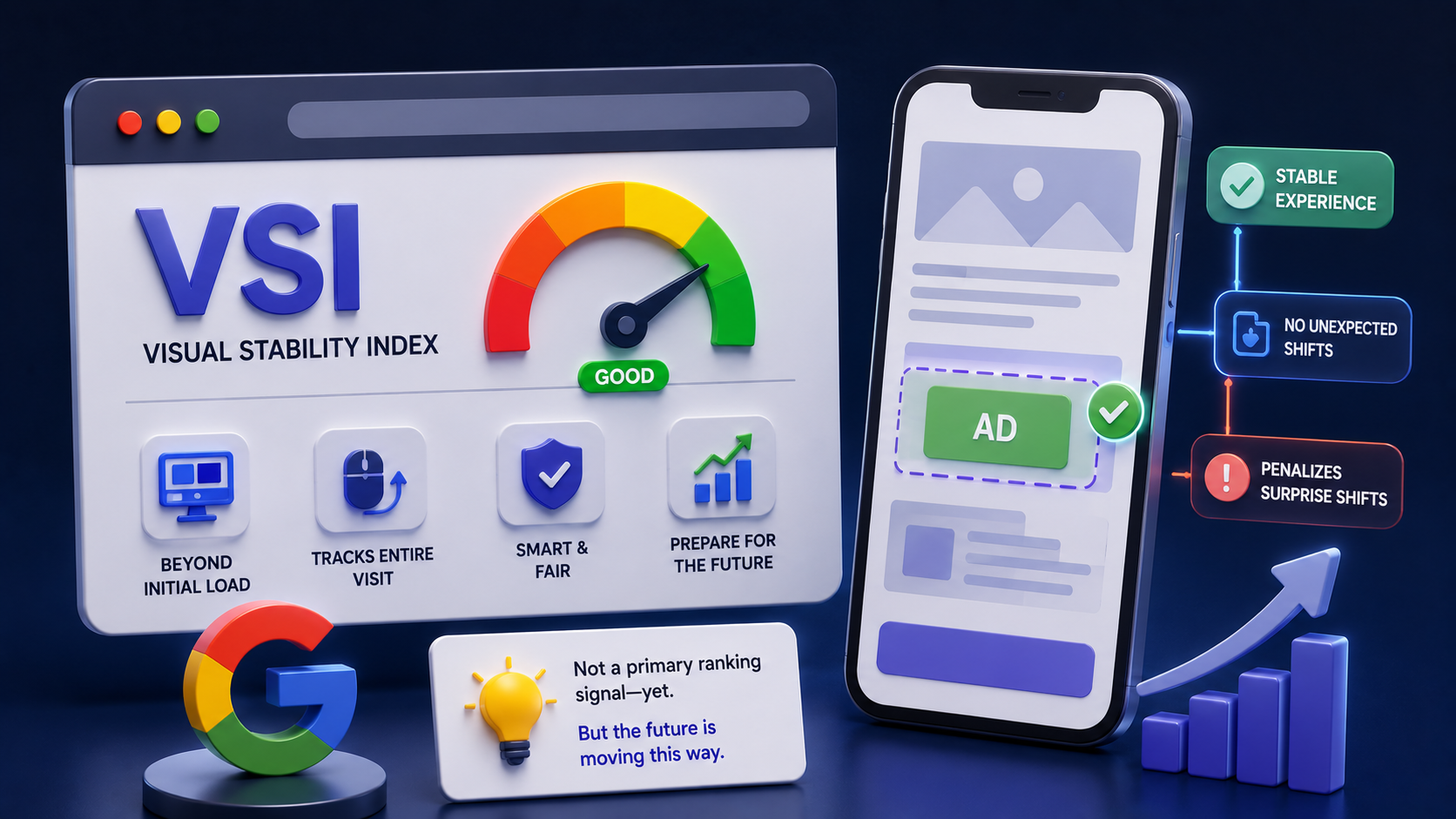
Google isn’t standing still with just three metrics. In early 2026, Google quietly introduced what’s being called Core Web Vitals 2.0, with a new dimension: the Visual Stability Index (VSI).
Traditional CLS measures layout shifts during the initial page load, but VSI goes further; it looks at your entire visit, not just the loading moment. The distinction is smart: if a site displays an element that shifts content on scroll, but the user could reasonably anticipate it, such as a section opening on click, VSI doesn’t penalize it. However, an ad that pushes content without warning is still penalized.
Google introduced VSI alongside other emerging metrics in 2026. They are not yet primary ranking signals, but they are expected to influence future scoring, so it’s worth preparing for them now rather than waiting.
How to Actually Fix These Three Metrics
You don’t need to memorize every technical term to make progress. Here’s what matters most for each metric:
Fixing LCP (Loading Speed): Image preloading, critical CSS inlining, font preloading with display swap, and server-side rendering are the four highest-impact fixes for slow LCP scores. In simple terms: make sure the largest visible element on your page (usually a hero image or heading) loads first and quickly.
Fixing INP (Responsiveness): This is the hardest one, and it usually comes down to how your JavaScript is structured. Heavy scripts running on click, third-party widgets, and unoptimized event handlers are the most common culprits. The most reliable approach is to use Search Console field data to identify failing templates, then fix the root causes of the delivery chain for LCP, main-thread capacity for INP, and layout discipline for CLS and validate the fix using the same 75th-percentile model Google uses.
Fixing CLS (Visual Stability): Every image, video, iframe, and ad slot needs explicit width and height attributes, while font-display: swap and reserved space for dynamic content eliminate the remaining sources of layout shift.
Tools to check your current scores: You can enter any URL at pagespeed.web.dev to view both field and lab data in one view, with a Diagnostics section that shows the specific issues affecting each Core Web Vital, making it ideal for per-page auditing.
Why This Is Best Handled by Developers, Not Just Marketers
Here’s the honest truth: most Core Web Vitals problems aren’t solved by a plugin or a one-click fix. By 2026, websites will be compelled to look beyond basic image tweaks and dig into the intricacies of JavaScript performance.
This is where most small businesses and even mid-sized companies struggle, not because the concepts are hard to understand, but because fixing INP issues at the code level requires real front-end engineering work. If your team is spending hours adjusting plugin settings with no real improvement in Search Console, that’s usually a sign the fix needs to happen at the architecture level, exactly the kind of work covered under Deftsoft’s website development and optimization services.
For businesses already exploring how AI tools are reshaping workflows, something we cover in our blog on free AI tools every small business should use in 2026, it’s worth remembering that no AI writing tool or design tool will fix a slow-loading website. That part still comes down to solid engineering.
What This Means for Your Business
Core Web Vitals in 2026 aren’t a technical detail buried in a developer’s to-do list. They’re directly tied to how visible your business is on Google, how many visitors stay on your site, and how many of those visitors actually convert into customers.
The goal isn’t to chase a perfect score; it’s to build a predictable, well-performing system that holds up across templates and pages. Get the technical foundation right, and your content, design, and marketing efforts all perform better as a result.
Ready to Fix Your Site’s Core Web Vitals?
Deftsoft’s developers run a comprehensive technical audit covering LCP, INP, CLS, and mobile performance, and fix the issues that are actually holding back your rankings.
Frequently Asked Questions
Q1. What are Core Web Vitals and why do they matter for SEO?
Core Web Vitals are three Google metrics: Largest Contentful Paint (LCP), Interaction to Next Paint (INP), and Cumulative Layout Shift (CLS) that measure how fast, responsive, and visually stable your website is for real users. They matter because Google uses them as a supporting ranking signal, especially as a tiebreaker between pages with similar content quality.
Q2. What is a good Core Web Vitals score in 2026?
A “good” score means LCP under 2.0–2.5 seconds, INP under 200 milliseconds, and CLS under 0.1, all measured at the 75th percentile of real user data from the Chrome UX Report.
Q3. Why is INP so hard to fix compared to LCP or CLS?
INP measures the responsiveness of every interaction throughout a page’s lifecycle, not just the loading phase. Fixing it often requires restructuring how JavaScript handles user events, rather than simple fixes like image compression or caching.
Q4. How long does it take to see ranking improvements after fixing Core Web Vitals?
Since Google uses a 28-day rolling window of real-user data, most fixes are typically reflected in Search Console and rankings within four to six weeks after deployment.
Q5. Does mobile performance matter more than desktop for Core Web Vitals?
Yes. With the majority of global web traffic coming from mobile devices, Google’s mobile-first indexing places significant weight on mobile Core Web Vitals scores, even if your desktop scores are strong.
Q6. Can a slow website really affect my revenue, not just rankings?
Yes, directly. A one-second delay in load time can reduce conversions by 7%, which adds up to substantial lost revenue for any business with meaningful website traffic, especially e-commerce stores.
Recent Articles






Devraj
 16th June 2026