Best Time to Post on LinkedIn for B2B Engagement (2026 Guide)
-
By Devraj
-
12th June 2026
Picture this: you’ve spent an hour crafting the perfect LinkedIn post. The hook is sharp, the insight is genuinely useful, the formatting is clean. You hit publish, feeling good about it.
Three hours later? Forty-two impressions. Two likes. One of them is your colleague.
Sound familiar?
Here’s the uncomfortable truth: on LinkedIn, your audience isn’t passively waiting for you. They’re professionals with calendars packed with meetings, deep work blocks, and inbox triage. LinkedIn only gets their attention in the gaps — and if your post lands outside those gaps, even brilliant content gets buried before it has a chance to breathe.
For B2B brands, this matters more than almost anywhere else. Your buyers aren’t scrolling LinkedIn for entertainment at 11 PM the way they might scroll Instagram. They’re checking it between meetings, during a coffee break, or on the commute home. Miss that window, and your carefully built thought-leadership post competes with a feed that’s already moved on.
The good news? In 2026, there’s more data on LinkedIn timing than ever before — and some of it points in genuinely surprising directions. This guide breaks down what the latest research actually shows, with a specific focus on how timing shifts across the US, UK, Australia, and India, so you can build a posting schedule that works for a global B2B audience rather than guessing and hoping. And if building that schedule alongside everything else on your plate sounds like a job in itself, that’s exactly the kind of work professional social media marketing services are built to take off your hands.
Quick Summary
- Global B2B baseline: Tuesday to Thursday, 10 AM–12 PM and 3 PM–5 PM in your audience’s local time zone, are the strongest windows for LinkedIn engagement in 2026.
- The big 2026 shift: Evenings (3 PM–8 PM) are now competing with and in some datasets beating traditional mid-morning slots, especially Wednesday and Friday afternoons.
- Worst days: Saturday and Sunday remain dead zones for B2B content across every region.
- US audiences: Best results land Tuesday–Thursday, 10 AM–12 PM EST and 4 PM–6 PM EST.
- UK audiences: Tuesday–Thursday, 11 AM–1 PM and 4 PM–6 PM GMT/BST perform best.
- Australian audiences: Tuesday–Thursday, 10 AM–12 PM AEST, with a secondary evening window around 6 PM–8 PM AEST.
- Indian audiences: Tuesday–Thursday, 11 AM–1 PM IST, with a strong secondary slot at 7 PM–9 PM IST as professionals wind down.
- The real takeaway: Timing is a multiplier, not a magic fix but for global B2B brands managing audiences across the US, UK, Australia, and India, when you hit publish can be the difference between a post that gets 200 impressions and one that gets 20,000.
Struggling to get traction on LinkedIn?
Talk to Deftsoft’s social media marketing team and get a posting strategy built around where your buyers actually are.
Quick Navigation
Why Posting Time Matters More on LinkedIn Than Almost Any Other Platform
What the 2026 Data Actually Shows
The Best Time to Post on LinkedIn: Region by Region
Building One Schedule for a Global B2B Audience
Why Posting Time Matters More on LinkedIn Than Almost Any Other Platform
LinkedIn’s algorithm runs what’s essentially a “first impression test” on every post. When you publish, your content goes out to a small slice of your network first. The platform watches closely: are people clicking, commenting, reacting, or scrolling straight past?
If that early signal is strong, LinkedIn extends your reach into wider networks, relevant hashtag feeds, and the home feeds of people who don’t follow you yet but engage with similar content. If the signal is weak, distribution slows dramatically, often within the first hour.
This is why posting time and engagement are so tightly linked. It’s not that LinkedIn “likes” certain hours more than others. It’s that posting when your audience is actually present and ready to engage gives your content the best possible shot at passing that early test.
For B2B specifically, this creates a unique challenge. Unlike consumer platforms where audiences are scattered across time zones around the clock, B2B audiences cluster around working hours but “working hours” look different depending on whether your buyer is in New York, London, Sydney, or Bangalore. If your brand serves a global market (and most B2B SaaS, agency, and service brands do), a single posting time simply doesn’t cut it anymore, which is part of why a coordinated content marketing strategy matters as much as the schedule itself
What the 2026 Data Actually Shows
Here’s where things get interesting. The most-cited studies on LinkedIn timing in 2026 don’t fully agree with each other and understanding why helps you make a smarter decision than just picking whichever number sounds most authoritative.
One major dataset, drawn from millions of scheduled posts, found that engagement has shifted later in the day compared to previous years. Late afternoon and evening hours roughly 3 PM to 8 PM are now producing some of the strongest engagement of the week, with Wednesday afternoon and Friday afternoon standing out as peak slots.
A separate large-scale analysis, covering billions of engagements across hundreds of thousands of profiles, tells a more traditional story: engagement peaks during core business hours, particularly Tuesday through Thursday between 11 AM and 5 PM, with a sharp drop-off after 2 PM and almost nothing happening on weekends.
So which is right?
Likely both for different reasons. The “evening shift” pattern tends to reflect personal-brand and creator-style content, where professionals are scrolling LinkedIn after work, during their commute, or while winding down much like they would Instagram or X. The “midday peak” pattern reflects classic B2B research behavior: decision-makers checking LinkedIn between meetings, during lunch, or while planning their next move.
The practical conclusion for B2B brands: your core posting window should center on Tuesday through Thursday, late morning into early afternoon but don’t ignore the late-afternoon window either, especially for thought-leadership or personal-brand content from your founders and executives. A balanced weekly schedule that uses both windows, tested against your own analytics, will consistently outperform a schedule locked into just one.
The Best Time to Post on LinkedIn Region by Region
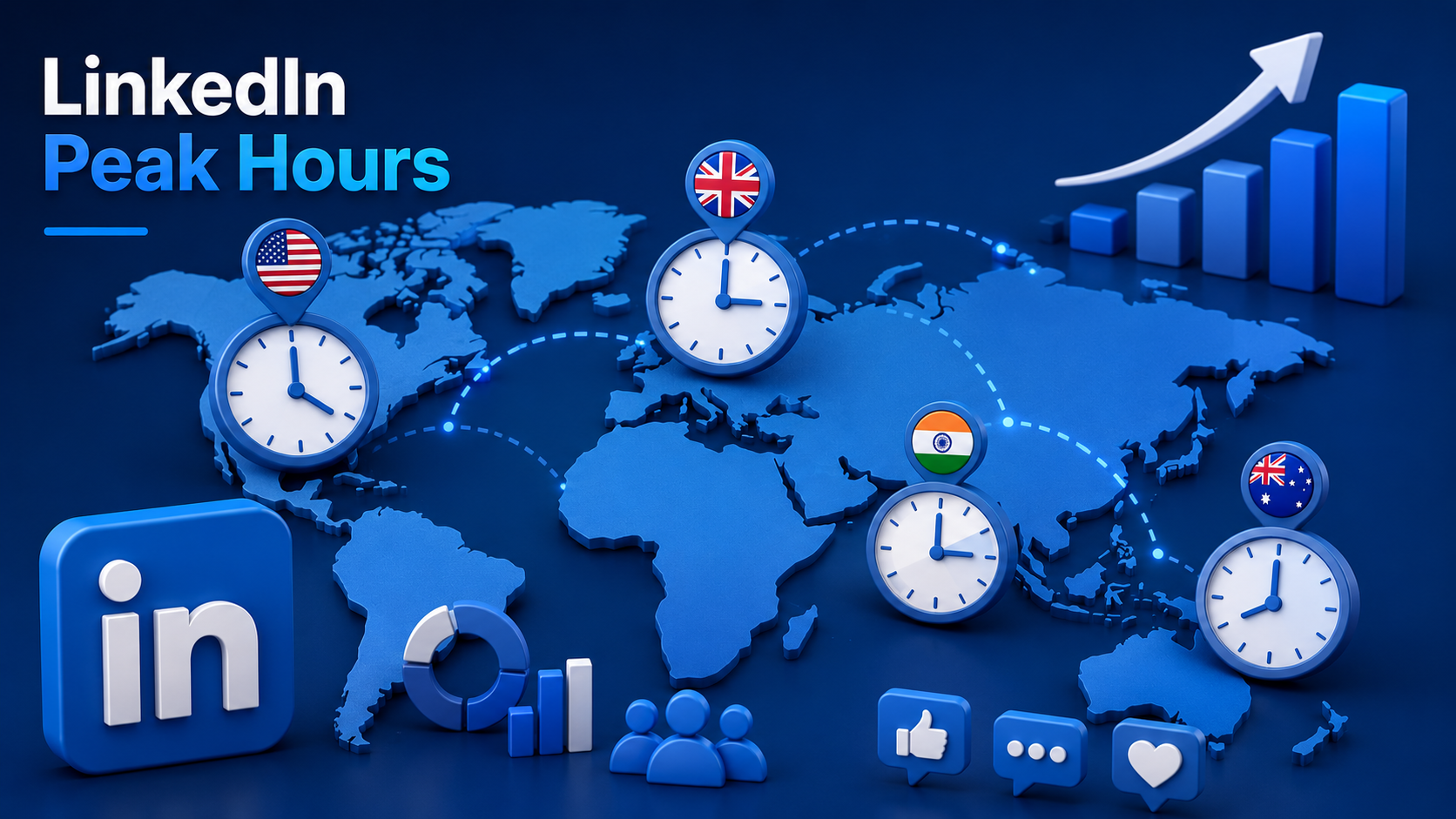
Because B2B audiences are rarely confined to one country, here’s how the global picture breaks down. All times below are in local time for each region no conversion needed.
United States (EST/PST)
US professionals show the clearest “double peak” pattern: a late-morning window as people settle into their workday after the early-morning email triage, and a late-afternoon window as the workday winds down.
- Best days: Tuesday, Wednesday, Thursday
- Best times: 10 AM–12 PM and 4 PM–6 PM (Eastern Time, adjust accordingly for Pacific-based audiences)
- Standout slot: Wednesday at 4 PM consistently ranks among the highest-engagement windows of the week
- Avoid: Monday before 10 AM and any time after 9 PM
If your audience spans both coasts, posting around 1 PM ET often lands during the late-morning window for Pacific users and the early-afternoon lull for Eastern users, a useful middle-ground slot for genuinely national US audiences.
United Kingdom (GMT/BST)
UK engagement patterns mirror the US fairly closely but skew slightly earlier, reflecting an earlier average workday start.
- Best days: Tuesday, Wednesday, Thursday
- Best times: 11 AM–1 PM and 4 PM–6 PM
- Standout slot: Wednesday and Thursday lunchtime (12 PM–1 PM) performs particularly well for thought-leadership and industry-news content
- Avoid: Friday after 3 PM and weekends entirely
One nuance worth noting: UK B2B audiences with strong ties to European markets (Germany, France, the Nordics) often show a secondary engagement bump around 8 AM–9 AM GMT, as Central European professionals start their day an hour ahead.
Australia (AEST/AEDT)
Australian LinkedIn usage has a distinctive shape: strong morning engagement, a midday dip, and a notable evening resurgence that’s more pronounced than in other English-speaking markets.
- Best days: Tuesday, Wednesday, Thursday
- Best times: 10 AM–12 PM, with a secondary window at 6 PM–8 PM
- Standout slot: Wednesday morning for company updates and industry insights; Thursday evening for personal-brand and career-related content
- Avoid: Saturday entirely; Sunday is borderline but generally low-value for B2B
For brands targeting Australia alongside Asia-Pacific markets more broadly, the 10 AM AEST window also overlaps usefully with late-afternoon hours in Singapore and Hong Kong, a handy cross-market sweet spot.
India (IST)
India’s LinkedIn usage reflects one of the platform’s fastest-growing professional populations, and the data shows a workday that often extends later into the evening compared to Western markets.
- Best days: Tuesday, Wednesday, Thursday
- Best times: 11 AM–1 PM, with a strong secondary window at 7 PM–9 PM
- Standout slot: Wednesday at 11 AM for B2B announcements and case studies; Thursday evening (7 PM–9 PM) for thought leadership, as many professionals catch up on LinkedIn after dinner
- Avoid: Monday before 11 AM (inbox catch-up dominates) and weekends
The evening window in India is worth paying particular attention to it’s one of the more pronounced “after-hours” engagement patterns globally, likely tied to longer average commute times and a culture of checking professional content in the evening alongside other apps.
Building One Schedule for a Global B2B Audience
If your brand serves multiple regions which is increasingly the norm for B2B SaaS, consulting, and digital marketing brands, trying to nail four separate time zones perfectly every day isn’t realistic. Instead, think in terms of overlap windows:
- The “double coverage” slot: Posting around 9 AM–10 AM US Eastern Time lands in the early-afternoon window for UK audiences and the late-evening window for Indian audiences useful for content you want both Western and Indian audiences to see on the same day.
- The “APAC-first” slot: Posting around 10 AM AEST captures Australian morning engagement while also reaching India’s late-morning window a few hours later as the post continues to circulate.
- The “evening thought-leadership” slot: A post published around 4 PM US Eastern Time hits the US late-afternoon peak, lands in the early-morning hours for Australia and India (where it can pick up momentum before their workday starts), and sits ready for UK audiences waking up.
The bigger strategic point: LinkedIn posts don’t die after an hour. Unlike Instagram Stories or X posts, LinkedIn content can keep generating impressions for 24–48 hours, sometimes longer if it’s performing well. This means a single well-timed post can realistically capture engagement across multiple time zones over its lifecycle; you don’t need four separate posts for four regions.
What Matters Beyond Timing
It’s worth saying clearly: timing will not save a weak post, and it won’t sink a genuinely great one. What it does is widen or narrow the initial audience that decides whether your post deserves wider distribution.
A few factors that compound with good timing:
- Format matters. Document/carousel posts continue to dramatically outperform plain text in 2026, generating substantially higher engagement. If you’re investing in timing strategy, pair it with a format that’s built to hold attention.
- The first hour is everything. Whatever time you post, plan to be active immediately afterward responding to comments, adding a thoughtful first comment yourself, and engaging with a few other posts in your network. This activity signals to the algorithm that your content is generating real interaction.
- Consistency beats perfection. A brand that posts reliably three times a week at “good enough” times will, over months, outperform a brand that posts sporadically at theoretically “perfect” times. The algorithm rewards predictability almost as much as raw engagement.
- Your own data wins eventually. Every benchmark in this guide is a starting point, not a finish line. Once you have 8–10 weeks of consistent posting, your own LinkedIn analytics will tell you more about your specific audience than any global study can.
How Deftsoft Can Help You Get This Right
Building a LinkedIn presence that actually drives B2B pipeline isn’t just about picking the right hour on a clock, it’s about combining smart timing with content that’s genuinely worth a decision-maker’s attention, posted consistently enough that the algorithm starts working in your favor.
At Deftsoft, our social media marketing and content strategy teams help B2B brands build LinkedIn programs that are designed around how your specific audience actually behaves whether that’s a US-based SaaS buyer, a UK financial services decision-maker, an Australian enterprise client, or a fast-growing Indian startup ecosystem. We handle everything from content calendars and posting schedules tailored to your audience’s regions, to thought-leadership ghostwriting, carousel and document design, and monthly performance reporting that shows what’s actually moving the needle.
If your LinkedIn page feels like it’s shouting into an empty room, the fix usually isn’t “post more.” It’s posting the right content, in the right format, at the right time consistently, and backed by data rather than guesswork.
Ready to turn your LinkedIn page into a real B2B growth channel?
Talk to Deftsoft’s social media marketing team for a free consultation, and let’s build a posting strategy designed around where your buyers actually are, not just where you happen to be.
Frequently Asked Questions
What is the single best time to post on LinkedIn for B2B in 2026?
Across most regions and industries, Tuesday or Wednesday between 10 AM and 12 PM local time is the safest, most consistently strong starting point. Wednesday afternoon (particularly around 4 PM) is also emerging as one of the strongest individual slots globally, especially for thought-leadership content.
Does the best time to post on LinkedIn really change based on my audience’s country?
Yes, meaningfully. While the general pattern midweek, business-hours-adjacent engagement holds across the US, UK, Australia, and India, the exact peak hours shift with each region’s working culture. India and Australia, in particular, show stronger evening engagement windows than is typical in the US or UK.
Should I post at a different time for each country my audience is in?
Not necessarily with separate posts. Because LinkedIn content continues generating impressions for 24–48 hours, a single well-timed post, especially one published during an “overlap window” between regions, can capture meaningful engagement across multiple time zones without needing duplicate posts.
Is it better to post in the morning or evening on LinkedIn now?
Both can work, but they serve different purposes. Late-morning posts (10 AM–12 PM) tend to align with B2B research behavior professionals actively looking for industry insights between tasks. Late-afternoon and evening posts (3 PM–8 PM) increasingly capture professionals winding down and engaging more casually, which can work well for personal-brand and culture-style content.
How often should a B2B brand post on LinkedIn?
Posting two to five times per week is a solid baseline that significantly outperforms posting just once a week. Brands that can sustain six or more posts weekly tend to see substantially higher impressions per post, provided content quality holds up consistency and quality together matters more than frequency alone.
Are weekends ever worth posting on for B2B content?
Generally, no. Saturday and Sunday show the lowest engagement for B2B content across the US, UK, Australia, and India. If you have content that’s more personal or culture-focused behind-the-scenes posts, team celebrations a Saturday morning post can occasionally work, but it shouldn’t carry your core B2B messaging.
How do I find the exact best time to post for my specific audience?
Start with the regional benchmarks in this guide, then track your own post performance for 8–10 weeks using LinkedIn’s native analytics or a scheduling tool. Look for patterns in which days and times your specific posts get the fastest early engagement and that data will always be more accurate for your audience than any general benchmark.
Recent Articles





Devraj
 12th June 2026