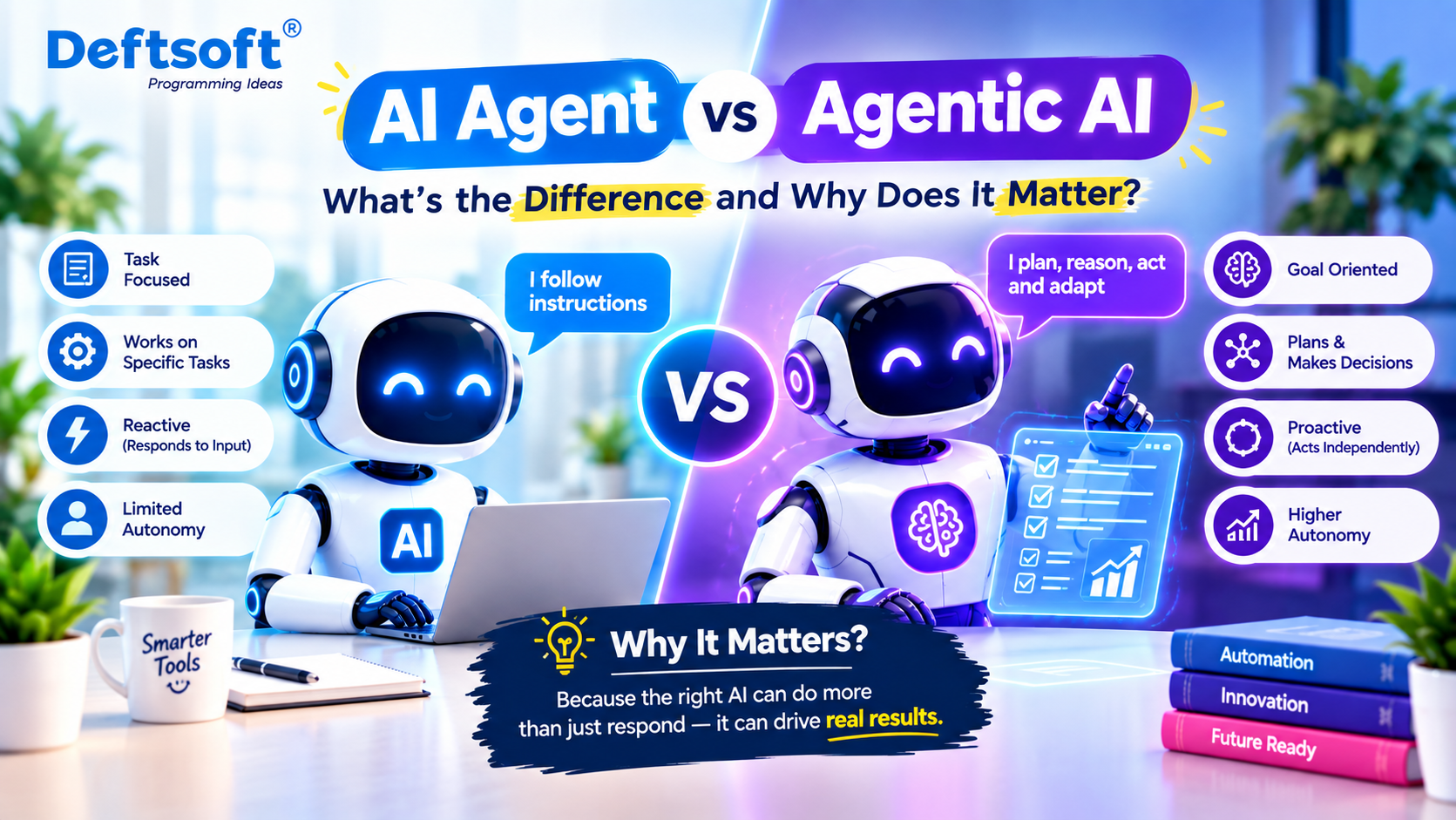
AI Agent vs Agentic AI: What’s the Difference and Why Does It Matter?

Artificial intelligence is no longer just a buzzword. It’s becoming a core part of how businesses work, how apps run, and how decisions are made, often without any human having to click a button. Two terms you’ll keep hearing are AI Agent and Agentic AI. People use them interchangeably, but they’re not quite the same thing. And when you’re evaluating AI solutions for your business, understanding that distinction isn’t just academic; it directly shapes how you invest, build, and scale. Let’s break it all down in plain language.

What Is an AI Agent?

Think of an AI agent as a smart helper with a specific job to do. You give it a task, it figures out how to complete it, and it gets it done, sometimes on its own, sometimes with a little guidance from a human in the loop.

An AI agent can perceive its environment (e.g., by reading data or listening to inputs), make decisions, and take actions to achieve a defined goal. It could be as simple as a chatbot answering customer questions, or as complex as a program that monitors your server, detects a problem, and fixes it — all without you lifting a finger. Traditional AI agents were largely rule-based and limited in scope. Modern versions are far more adaptive, using machine learning to handle nuance and variation in real-world conditions.

Key traits of an AI agent:

  • It has a clear goal or task.
  • It can take actions (click, write, send, analyze).
  • It reacts to changes in its environment.
  • It can work on its own within set boundaries.

What Is Agentic AI?

Agentic AI takes things a step further. Instead of being given a single task, this system can plan, make multi-step decisions, and even create subtasks on its own to achieve a much larger goal. It’s not just reacting, it’s reasoning, strategizing, and adapting.

Imagine asking an assistant not just to “send this email” but to “plan my entire product launch campaign, coordinate with the design team, set up the schedule, and send updates.” These systems can handle that kind of complex, open-ended goal. It breaks down the objective, decides what steps to take, uses available tools, adjusts when things go wrong, and keeps going through to completion.

What makes this approach particularly powerful is its operation at the systems level, often by orchestrating specialized agents working together toward a shared outcome. Rather than having a single system handle everything sequentially, it assigns roles, sequences actions, and manages information flow across the entire pipeline, making it fundamentally different from earlier rule-based systems.

Key traits of agentic AI:

  • It breaks big goals into smaller steps on its own.
  • It can use tools, browse the web, run code, and more.
  • It adapts its plan if something goes wrong.
  • It can manage long, multi-step tasks from start to finish.

AI Agent vs Agentic AI: The Simple Difference

AI Agent Agentic AI
Scope Handles specific, defined tasks Handles broad, complex goals
Decision-making Follows set rules or models Plans and decides dynamically
Independence Works within boundaries High level of autonomy
Example Customer support chatbot Full marketing campaign manager

In short, every agentic AI system uses AI agents, but not every AI agent is agentic. Think of AI agents as the building blocks, and agentic AI as the full construction.

The Evolution From Generative AI to AI Agents to Agentic AI

To understand where AI is heading, it helps to see the progression from generative AI to AI agents to agentic AI. This evolution is not just a series of upgrades; it represents a shift in how deeply artificial intelligence can participate in business operations.

Generative AI was the breakthrough that brought AI into the mainstream. Tools like ChatGPT and code assistants demonstrated that machines could create content, summarize information, and communicate with remarkable fluency. Yet generative AI remains fundamentally reactive. It responds to prompts but does not remember context beyond a session, initiate actions independently, or interact directly with external systems. It is powerful, but it still depends on human direction.

AI agents introduced a critical advancement: the ability to act. By combining language intelligence with tool usage, AI agents can access data, execute workflows, interact with software systems, and complete defined tasks. They move beyond generating responses to actually performing work.

Agentic AI extends this capability further. Instead of handling a single task, it interprets broader goals, breaks them into structured steps, coordinates multiple agents, monitors progress, and adapts dynamically when obstacles arise. In effect, it manages outcomes rather than isolated actions.

Together, generative AI, AI agents, and agentic AI form a layered progression, from creation to execution, to strategic orchestration, shaping the future of enterprise AI systems.

The Evolution from Traditional AI Agents to Agentic Systems

Traditional AI agents were largely deterministic; they followed predefined rules and responded predictably to specific inputs. Earlier systems could route a support ticket or check inventory, but they couldn’t plan a strategy or adapt mid-task.

Today, this shift in AI capability represents one of the most significant leaps in applied AI development. Instead of isolated tools, we now have interconnected systems capable of reasoning, storing memory, and making autonomous decisions. Integrating multiple AI agents into a single workflow enables these systems to tackle the complexity that once required large human teams.

For businesses evaluating AI solutions, this evolution is critical to understand. The question is no longer just “can AI automate this task?” but “can AI reason through this problem, adapt in real time, and deliver outcomes we can measure?”

AI Agents in Mobile App Development

Your mobile app is often the first thing a customer touches. Mobile App Development with AI agents can make that experience smarter, faster, and more personalized.

Here’s what AI agents can do inside mobile apps:

  • Personalized recommendations: Like how Netflix knows what you want to watch next. AI agents analyze user behavior and suggest content, products, or actions in real time.
  • In-app support: Instead of making users dig through FAQs, an AI agent can answer their questions right inside the app, in plain language.
  • Smart onboarding: AI agents can guide new users through an app step by step, adjusting the flow based on what that specific user is doing or struggling with.
  • Voice and gesture control: Agents can interpret voice commands or gestures to make apps more accessible and hands-free.
  • Predictive features: Like autofill, smart calendar scheduling, or alerting a user before they run out of something they order regularly.

AI Agents in Game Development

Games are one of the most exciting places to see AI agents in action. They’ve been part of gaming for a decade, but modern  game development with AI agents is on a whole different level.

  • Smarter NPCs (Non-Player Characters): Traditional game characters follow scripts. AI-powered NPCs can react to what you do, remember past interactions, and even develop their own “personalities” over time.
  • Dynamic difficulty adjustment: AI agents can observe how a player is performing and adjust the game’s challenge level in real time, keeping it fun — not too easy and not frustratingly hard.
  • Procedural content generation: AI agents can create new levels, maps, quests, or storylines on the fly, meaning no two playthroughs feel exactly the same.
  • Game testing and bug detection: AI agents can automatically play through thousands of scenarios, uncovering bugs and edge cases that human testers might miss.
  • Cheat detection: In multiplayer games, AI agents monitor player behavior patterns to detect cheating without slowing down the game.

For marketing teams evaluating AI solutions, the ROI case is often strongest here — the impact on revenue and retention is direct and measurable.

AI Agents in Digital Marketing

Marketing is all about sending the right message to the right person at the right time.  Digital Marketing AI agents are incredibly good at this, at scale.

  • Content personalization: Agents dynamically adjust what users see based on their profile, behavior, and intent, creating individually crafted experiences at scale.
  • Automated ad campaigns: Agents run, monitor, and adjust paid campaigns in real time, responding to performance data faster than any human team.
  • Lead scoring and nurturing: Agents rank leads by conversion likelihood and deliver personalized sequences at the right stage of the buyer journey.
  • Social media management: Agents schedule content, respond to comments, flag escalations, and draft posts based on trending topics.
  • Analytics and reporting: Agents pull data from multiple sources, identify patterns, and surface insights so teams can spend less time in dashboards.

For marketing teams evaluating AI solutions, the ROI case is often strongest here — the impact on revenue and retention is direct and measurable.

Agentic AI in Different Fields

Agentic AI is transforming virtually every industry, and integrating multiple AI agents into existing workflows is already delivering measurable results:

  • Healthcare: These intelligent systems can help diagnose conditions by analyzing patient data, recommend evidence-based treatment plans, manage scheduling, and monitor patients remotely through connected devices, reducing the burden on clinical staff while improving outcomes.
  • Finance and Banking: From real-time fraud detection to algorithmic trading to personalized financial advice, these intelligent systems help financial institutions move faster, reduce risk, and serve customers more effectively.
  • Education: Intelligent agents act as adaptive tutors, adjusting pacing to each student’s style. Agentic systems can manage entire personalized learning paths, including assessments and feedback.
  • E-commerce and Retail: Agents power product recommendations, real-time pricing, inventory management, and personalized shopping journeys.
  • Manufacturing and Supply Chain: AI-powered systems monitor production lines continuously, predict equipment failures before they happen, coordinate logistics in real time, and automatically reorder supplies when stock falls below a threshold.
  • Legal: Agents help lawyers research cases, review contracts, and flag risks, compressing hours of manual work into minutes.
  • Real Estate: Agents match buyers with properties based on nuanced preferences, automate valuations, and coordinate scheduling across multiple parties, streamlining what is traditionally a fragmented, time-intensive process.
  • HR and Recruitment: Agents screen resumes, rank candidates, and schedule interviews, freeing hiring teams to focus on conversations that matter.
  • Customer Service: Agents handle inbound queries, resolve routine issues, and escalate complex cases intelligently, 24/7.
  • Cybersecurity: Advanced AI systems monitor networks continuously, detect anomalies and threats in real time, and can initiate automated responses to neutralize attacks before they escalate, often faster than any human team could react.

From Understanding AI to Actually Implementing It

Understanding these two technologies is the first step. The real challenge begins when you move from concept to production, where reliability and performance matter every day.

Building a capable system in a demo is one thing. Making it run reliably within real business workflows at scale is a very different challenge. It involves clear objectives, quality data pipelines, API integrations, decision logic, safety guardrails, and continuous monitoring.

Agentic AI systems add another layer of complexity: multi-step reasoning, tool orchestration, adaptive planning, and long-term memory management. Integrating multiple AI agents into a unified system that collaborates effectively without conflicting or compounding errors requires careful architectural thinking from the very start. Without the right foundation, these systems can become unpredictable, inefficient, or insecure.

Businesses that need capable AI development partners who understand both the technical depth and the operational realities involved. This is where structured AI development becomes critical , turning intelligent ideas into production-ready systems that actually deliver measurable business outcomes.

AI Development Services: Building the Brains Behind the Business

Whether you need a focused agent or a full, orchestrated AI system across departments, it all starts with the right development approach: thoughtful design, secure data integration, rigorous testing, and ongoing monitoring as your business evolves.
A good  AI development company  like Deftsoft doesn’t just build you a model; they help you figure out what you actually need and how to make it work reliably in the real world.

AI development services typically cover:

  • Custom AI model development
  • Integration with existing software and APIs
  • AI workflow automation
  • Testing, fine-tuning, and deployment
  • Ongoing maintenance and improvement

Why Work With an AI Agent Development Company?

Building a production-ready system is complicated. You need the right data, architecture, and logic to make it genuinely useful, not just impressive in a demo. The gap between prototype and scalable deployment is where most AI projects stall.

An AI agent development company like Deftsoft brings experience across industries and use cases. Instead of spending months figuring out what works, you get a team that has already built and deployed systems that perform under real-world conditions, shortening your path from idea to impact. Building an AI agent from scratch is complicated. You need the right data, the right model, and the right logic to make it actually useful, not just impressive in a demo.

What sets a great AI development company apart:

  • Custom AI model development
  • Integration with existing software and APIs
  • AI workflow automation
  • Testing, fine-tuning, and deployment
  • Ongoing maintenance and improvement

Why Deftsoft Is the AI Development Partner You Need

At  Deftsoft, AI is not just a conversation topic; it is a capability we actively design, build, and deploy. We specialize in developing intelligent systems that move beyond experimentation and deliver measurable business value. From task-driven AI agents to fully orchestrated agentic AI architectures, our team brings both strategic understanding and technical execution to every project.

Our experience spans mobile applications, gaming platforms, marketing automation systems, SaaS products, and enterprise-grade workflows. We understand that no two organizations approach AI with the same objectives. Some begin with a focused use case, such as automating customer interactions or optimizing internal processes. Others aim to build coordinated AI ecosystems that integrate across departments and platforms. In both scenarios, our approach remains consistent: align technology with real business outcomes.

What differentiates Deftsoft is our ability to bridge intelligence and implementation. We don’t just integrate AI models; we design scalable infrastructures, ensure system interoperability, embed governance mechanisms, and create solutions that evolve as your business grows.

Whether you are deploying your first AI agent or architecting a comprehensive agentic AI framework, we provide the technical depth, strategic guidance, and long-term partnership required to turn AI ambition into operational advantage.

If you’re ready to explore how intelligent systems can transform your workflows, Deftsoft is ready to build the future with you.

FAQs

What is the main difference between an AI agent and agentic AI?

An AI agent handles a specific, defined task. Agentic AI autonomously manages complex, multi-step goals, often by coordinating multiple AI agents within a larger system.

Is ChatGPT an AI agent?

ChatGPT is an AI model. When it’s given tools and memory to complete tasks on its own, it becomes an AI agent.

Can small businesses use AI agents?

Yes. Agents can be built to fit any budget and business size, from a simple customer support bot to a full automation system that handles entire workflows.

How long does it take to build an AI agent?

It depends on complexity. A focused agent can be ready in a few weeks; a full agentic AI system with multi-agent coordination may take a few months.

Are AI agents safe to use in my business?

Yes, when built correctly. A good AI development company will include safety checks, human oversight options, and clear boundaries for what the agent can and can’t do.

What industries benefit most from AI agents?

Healthcare, finance, retail, gaming, marketing, education, and manufacturing all see strong returns, but almost every industry that handles repetitive, data-heavy processes can benefit.

Do I need to replace my staff with AI agents?

No. These systems work alongside your team, handling repetitive or data-heavy tasks so your people can focus on higher-value, more creative work.

What is the cost of developing an AI agent?

Costs vary based on features, integrations, and complexity. Contact Deftsoft for a tailored quote based on your specific needs.

Can AI agents learn and improve over time?

Yes. They can be built to learn from interactions and continuously improve with more data, fine-tuning, and feedback loops, which is why ongoing monitoring matters.

What makes Deftsoft different from other AI development companies?

Deftsoft combines technical depth with real-world business understanding, delivering AI solutions that are practical, reliable, and built to grow with your business. We specialize in both individual agent development and full agentic AI systems that deliver results at scale.
Ranking in Google AI Overviews vs Ranking in ChatGPT: What’s the Real Difference?

Search is no longer just about blue links.

In 2026, users expect instant answers. They want summaries, comparisons, and quick solutions. This is why Google AI Overviews and ChatGPT have become powerful discovery channels for businesses.

But here’s the real challenge.

Many brands still think ranking in Google AI Overviews and “ranking in ChatGPT” are the same thing. It is not. Both platforms use AI. Both generate answers. Both influence buying decisions. But the way they select information is completely different.
If your business wants to dominate AI search in 2026, you must understand the difference between:

  • How to rank on Google AI Overviews in 2026
  • How to rank your brand on ChatGPT in 2026

This blog breaks it down clearly. You will also learn what to optimize to achieve visibility in both.

What Are Google AI Overviews?

Google AI Overviews are AI-generated summaries that appear at the top of Google search results. They often appear above organic listings.

They provide direct answers. They combine content from multiple websites. They also cite sources in many cases. If your website is cited, you gain instant trust. It can also increase your click-through rate.

This is why businesses are now asking:

How to rank on Google AI Overviews?

These questions are now part of modern SEO. Because AI Overviews are not just a feature. They are becoming the new search experience.

What Is ChatGPT Ranking in 2026?

ChatGPT does not work like Google. It does not show ten blue links. It does not rank pages the same way. It does not always cite websites either. Still, brands now want visibility inside ChatGPT answers.

This is why searches like these are growing fast:

How to rank on ChatGPT in 2026

In simple terms, ranking in ChatGPT means that your brand appears as a recommended solution when users ask questions.

For example:

A user might ask:
“What is the best AEM development company in the US?”
Or:
“Which company offers the best SEO for AI Overviews?”

If ChatGPT mentions your brand in the response, you win visibility. That visibility can drive leads even without direct clicks. This is a new form of organic discovery.

Some marketers call it:

  • GEO (Generative Engine Optimization)
  • AI SEO
  • LLM SEO

But the goal is the same. You want AI platforms to recognize your brand as an authority.

Google AI Overviews vs ChatGPT: The Core Difference

The biggest difference is simple.

Google AI Overviews is search-based.

It selects content from indexed web pages. It is driven by search intent. It depends on Google’s live algorithm.

ChatGPT is model-based.

It generates answers based on trained knowledge, trusted sources, and live web browsing when enabled. Google uses your web page directly. ChatGPT uses your brand presence across the web. That difference changes everything.

How Google AI Overviews Decide Which Sites to Use

Google AI Overviews rely on a combination of factors. Google scans content from pages that are:

  • Indexed properly
  • Relevant to the query
  • Trustworthy and authoritative
  • Written in a clean format
  • Supported by strong SEO signals

Google also prefers content that clearly answers questions.

  • It loves short paragraphs.
  • It loves direct answers.
  • It loves structured headings.
  • That is why AEO matters.
  • AEO means Answer Engine Optimization.
  • AEO helps your content become easier for AI to extract and summarize.

If your page looks like a clean answer sheet, it becomes AI-friendly. This increases your chances to rank in AI Overviews.

How ChatGPT Decides Which Brands to Mention

ChatGPT works differently as it does not crawl your website daily like Google.It learns patterns based on:

  • Strong brand mentions online
  • Backlinks and authority signals
  • Trusted sources citing your brand
  • PR publications and reviews
  • Wikipedia-style mentions
  • High-authority business directories
  • Industry blogs and guest posts

This means ranking on ChatGPT is more about digital presence than about the content itself.

It is not only about ranking on a single page, but it is also about your entire online reputation. That is why brands are investing in:

  • Content marketing
  • Thought leadership
  • Link building
  • Guest posting
  • Digital PR
  • AI-friendly content publishing

These help your brand become “AI visible.”

How to Rank in AI Overviews: What Works in 2026

If you want to rank in AI Overviews, you must move away from long, generic, and fluffy content. In 2026, Google AI Overviews prioritizes content that is structured, direct, and easy for AI to summarize. This is why businesses are now investing in AEO-focused writing and modern SEO strategies that support AI-generated search experiences. Whether you are targeting AI Overviews optimization, LLM SEO Services, or AI-first content marketing, the following strategies are proving to be the most effective.

1. Write Content in Answer Format (AEO Style)

The most important step in learning to rank in AI Overviews is writing content in a direct-answer format. Your blog should respond to questions clearly rather than slowly build up the topic. Every section should start with a strong statement that delivers value immediately. Avoid vague openings that feel like filler content. For example, instead of writing “AI Overviews are changing the way people search,” you should write something more direct, such as “Google AI Overviews are AI-generated summaries that appear at the top of search results.” This format improves clarity and makes it easier for Google to extract information. It also increases your chances of being cited in AI Overviews, which is now becoming a key goal for brands using AEO and AI SEO strategies.

2. Use Question-Based Subheadings

Google AI Overviews often appear when users type conversational questions into the search bar. That is why your headings should match real user intent. If you want to rank in Google AI Overviews, your blog must include question-based subheadings that reflect how people search today. Headings like “What is Google AI Overviews?”, “How does AI Overviews work?”, or “How to rank in AI Overviews in 2026?” are highly effective because they signal relevance. This structure improves user readability and supports AEO optimization. It also helps businesses offering SEO services, LLM SEO Services, and AI Overviews optimization create content that is easier to scan, easier to index, and more likely to be picked up by Google’s AI systems.

3. Keep Sentences Short and Active

AI Overviews prefer simple and clear writing. Long sentences confuse readers and reduce the quality of AI extraction. In 2026, content must be written in short, active-voice sentences to improve understanding. Instead of writing “AI Overviews are being used by Google to provide summaries,” a stronger approach is “Google uses AI Overviews to provide summaries.” This improves clarity instantly. It also helps your content perform better in AI-based search results. If your goal is to improve AI search visibility and rank in AI Overviews, this writing style is essential. It also aligns well with modern SEO guidelines and AEO-focused content formats.

4. Add Lists, But Don’t Overuse Them

Lists are useful because they help Google quickly summarize information. They also make content easier for users to scan. However, too many bullet points can break the flow and reduce engagement. The best approach is to mix short lists with informative paragraphs and real examples. This keeps your content natural while still making it structured enough for AI Overviews. A well-balanced format improves SEO performance, increases time on page, and supports AI Overviews ranking. This strategy is also widely used by businesses offering AI-driven SEO services, including brands focusing on LLM SEO Services and generative search optimization.

5. Add Supporting Entities and Context

Google AI Overviews does not rely only on keywords. It relies on context and topic relevance. This means you should naturally include supporting entities and related concepts inside your blog. When writing about AI Overviews, include terms such as AEO optimization, EEAT signals, topical authority, structured data, schema markup, content clusters, and generative engine optimization. This deepens your content and makes it more credible. It also helps Google trust your page as a reliable source. For companies offering advanced SEO solutions, such as AI SEO strategy, AI Overviews optimization, and LLM SEO Services, building contextual depth is one of the strongest ways to increase AI-driven visibility in 2026.

How to Rank on ChatGPT in 2026: What Actually Works

Now, let’s talk about ChatGPT visibility. Ranking in ChatGPT is not about keyword stuffing. It is about becoming a trusted brand online.

Here are key methods that work in 2026.

1. Build Brand Mentions Across Authoritative Websites

ChatGPT’s visibility in 2026 depends heavily on how often your brand is mentioned on trusted, authoritative platforms. Unlike Google, ChatGPT does not rank websites based only on keywords. It recognizes brands that consistently appear in high-quality sources such as tech publications, SaaS directories, industry blogs, guest-posting websites, and review platforms. These mentions serve as credibility signals, helping AI systems recognize your brand as a reliable option. This is also why guest posting remains an effective strategy. However, the focus must be on value-driven content. Low-quality backlinks or spam-style promotions can weaken trust rather than improve it.

2. Publish Thought Leadership Content That AI Can Quote

ChatGPT prefers content that feels expert-driven and easy to reference. In 2026, AI tools are more likely to mention brands that publish strong thought leadership content, such as detailed guides, comparison articles, industry frameworks, real-world case studies, best practices, and trend-focused insights. The key is to write content that sounds authoritative and includes clear takeaways. When your content is well-structured and quotable, AI systems can easily extract key points. This creates long-term value because your brand is not just trying to rank, but positioning itself as a trusted source of information across the web.

3. Create Content That Answers Buying Questions

Many ChatGPT users use the platform for decision-making, especially when they are close to purchasing a service. They ask direct questions, for example, “Which company is best for digital marketing?” or “Who provides  best digital marketing services?” This means your website must include content that clearly answers buyer-intent queries. To improve your chances of being mentioned, your blogs and service pages should explain what you offer, how your workflow works, what makes your services different, and what real results clients can expect. When your content naturally addresses these questions, it becomes more conversion-focused and better suited to AI-generated recommendations.

Google AI Overviews vs ChatGPT: Ranking Factors Comparison

Let’s simplify the comparison.

Google AI Overviews ranking depends on:

  • On-page SEO
  • Content structure
  • Clarity of answers
  • Schema markup
  • EEAT
  • Strong topical authority

ChatGPT ranking depends on:

  • Brand authority across the web
  • Citations from trusted sites
  • PR and backlinks
  • Consistent service-related content
  • Thought leadership and reputation signals

This means you need two strategies. But the good news is this- A smart AI SEO strategy supports both.

How to Rank in Google AI Overviews in 2026: Advanced Strategies

Once you understand the basics, the next step is improving your chances of being chosen by Google’s AI.

Ranking in Google AI Overviews is not random. Google uses signals that confirm your content is trustworthy and useful.
Here are advanced strategies that matter most in 2026.

Build Topic Clusters Around AI Search

One blog is not enough.

Google prefers websites that cover a topic deeply. It wants to see topical authority.

If your main blog is about AI Overviews, support it with related content like:

  • What is AEO in SEO?
  • How to write content for AI search engines
  • How schema helps in AI Overviews
  • How AI is changing SEO strategy in 2026
  • GEO vs SEO: what’s the difference?

When your website has multiple connected pages, Google understands your expertise.

This increases your chances of ranking in AI Overviews.

It also improves your internal linking strategy.

Use Schema Markup to Help Google Understand Content

Schema is not optional anymore. Google AI Overviews rely on structured data to quickly interpret pages. The best schema types to use include:

  • FAQ Schema
  • Article Schema
  • HowTo Schema
  • Organization Schema
  • Breadcrumb Schema

The FAQ schema is especially powerful because it creates clear question-answer patterns. Google’s AI loves that, and if your goal is to rank in AI Overviews, schema helps you get selected faster.

Focus on EEAT Signals (But Make It Natural)

EEAT stands for:

  • Experience
  • Expertise
  • Authoritativeness
  • Trustworthiness

Google AI Overviews rely heavily on EEAT to avoid misinformation. So your blog must show credibility.

You can do this by:

  • Mentioning industry examples
  • Quoting known platforms like Google, Adobe, or Microsoft
  • Adding author bio and company details
  • Linking to relevant internal pages
  • Using real-world business scenarios

Your writing should sound confident and specific. Avoid vague claims.

Add “Answer Blocks” Inside Your Content

In 2026, the best content is designed like an AI-friendly guide.

One simple method is to add mini-answer blocks.

Example format:

Quick Answer:
Google AI Overviews selects content that is structured, trustworthy, and directly answers the query.

These answer blocks increase AEO performance. They also improve readability and can boost your chance of appearing as a cited source in AI Overviews.

Optimize for Long-Tail Questions (Not Just Keywords)

Most AI Overviews are triggered by long questions.

For example:

  • How to rank in AI Overviews in 2026?
  • How does Google choose sources for AI Overviews?
  • Why is my website not showing in AI Overviews?
  • How to rank in Google AI Overviews for service keywords?

These are long-tail keywords. They may have lower search volume, but they have high conversion intent. Long-tail content is also easier to rank. Google AI Overviews prefer it because it is clear and specific.

How to Rank on ChatGPT in 2026: The New Rules

Now, let’s go deeper into ChatGPT visibility. Ranking on ChatGPT is not about traditional SEO positions; it is about becoming a brand that AI trusts.

ChatGPT answers are influenced by:

  • web authority
  • online brand presence
  • trusted citations
  • consistent content footprint

This means you need a strategy that goes beyond your website.

1. Build Digital Authority Through Multi-Platform Presence

In 2026, one website is not enough.

If your brand only exists on your site, ChatGPT may not mention it often. You must build presence on platforms that AI models trust.

These include:

  • Medium articles
  • LinkedIn content
  • industry guest posts
  • SaaS and IT directories
  • review websites
  • PR platforms
  • forums and Q&A sites

These platforms act like “signals” for AI systems. They validate that your business is real and credible.

2. Create Brand-Driven Informational Content

ChatGPT does not recommend brands that only publish promotional pages. It prefers brands that educate.

So your content must include:

  • guides
  • trend reports
  • comparison posts
  • problem-solving blogs
  • step-by-step explainers

This is why blogs are still powerful. But in 2026, your blog must focus on intent.

Not fluff, not generic filler. Your content should answer what people actually ask.

3. Optimize for Conversational Queries

People use ChatGPT like a conversation.

They ask questions such as:

  • “Which company can help me rank in AI Overviews?”
  • “What’s the best AI SEO strategy in 2026?”
  • “Which SEO agency understands generative search optimization?”
  • “What is the difference between AI Overviews SEO and ChatGPT SEO?”

So your website should include conversational content. Your blog should sound natural. It should feel like it is answering a person, not a search engine. That is how you rank your brand on ChatGPT in 2026.

4. Improve Your Brand’s “Association Keywords.”

This is one of the most important GEO tactics. Your goal is to make AI associate your brand with a service.

For example:

If your business offers AI SEO services, you want AI to connect your brand with:

  • AI Overviews optimization
  • AEO services
  • LLM SEO services
  • GEO strategy
  • AI search visibility

When ChatGPT sees your name repeatedly linked with those services online, it learns the connection. That is how you rank on ChatGPT.

Google AI Overviews vs. ChatGPT Rankings: Which Matters More?

The best answer is simple. You need both.

  • Google AI Overviews drive traffic, while ChatGPT builds authority and drives brand discovery.
  • Google AI Overviews help users find you, while ChatGPT helps users trust you.

In 2026, search is no longer only about clicks; it is about visibility in AI answers. That is where customers start making decisions.

Final Thoughts: AI Search Visibility Is the New SEO

Ranking in Google AI Overviews and ranking on ChatGPT are not the same. But they are connected.

Google AI Overviews reward:

  • structured answers
  • high-quality SEO
  • trust and authority

ChatGPT rewards:

  • brand presence
  • authority mentions
  • consistency across platforms

If you want long-term success in 2026, you need to optimize for both. The brands that win will be the ones that build credibility and publish AI-ready content.

Want to Rank in AI Overviews and Improve ChatGPT Visibility?

If your business is looking for expert support in AI search optimization, AEO-driven content strategy, and visibility across AI platforms, Deftsoft can help you build a strong foundation for ranking in Google AI Overviews and improving brand discoverability in ChatGPT in 2026.

FAQs

1. How do you rank in Google AI Overviews in 2026?

To rank in Google AI Overviews, create structured content with clear answers, short paragraphs, strong EEAT signals, and FAQ-style formatting. Adding schema markup also improves visibility.

2. Is ranking in Google AI Overviews the same as ranking on ChatGPT?

No. Google AI Overviews selects content from indexed web pages, while ChatGPT mentions brands based on authority signals, online presence, and trusted citations across the web.

3. What type of content performs best for AI Overviews ranking?

Content that answers questions directly performs best. Use H2 question headings, short sentences, comparison sections, and step-by-step guides written in an AEO-friendly format.

4. How to rank your brand on ChatGPT in 2026?

To rank your brand on ChatGPT, build strong brand mentions through guest posts, PR, backlinks, and authoritative listings. Consistent publishing across trusted platforms also helps.

5. Does the FAQ schema help in ranking for AI Overviews?

Yes. The FAQ schema makes your content easier for Google to understand and extract. It increases the chance of being featured in AI Overviews and improves search visibility.

6. How long does it take to appear in Google AI Overviews?

It depends on your website authority and content quality. Some sites appear within weeks, while others take months. Strong topical authority and proper indexing speed up results.

7. What is the best strategy to rank in AI Overviews and ChatGPT together?

The best strategy is combining AEO-based content creation with GEO-focused brand visibility. Publish AI-friendly blogs, build backlinks, and strengthen your authority across the web.


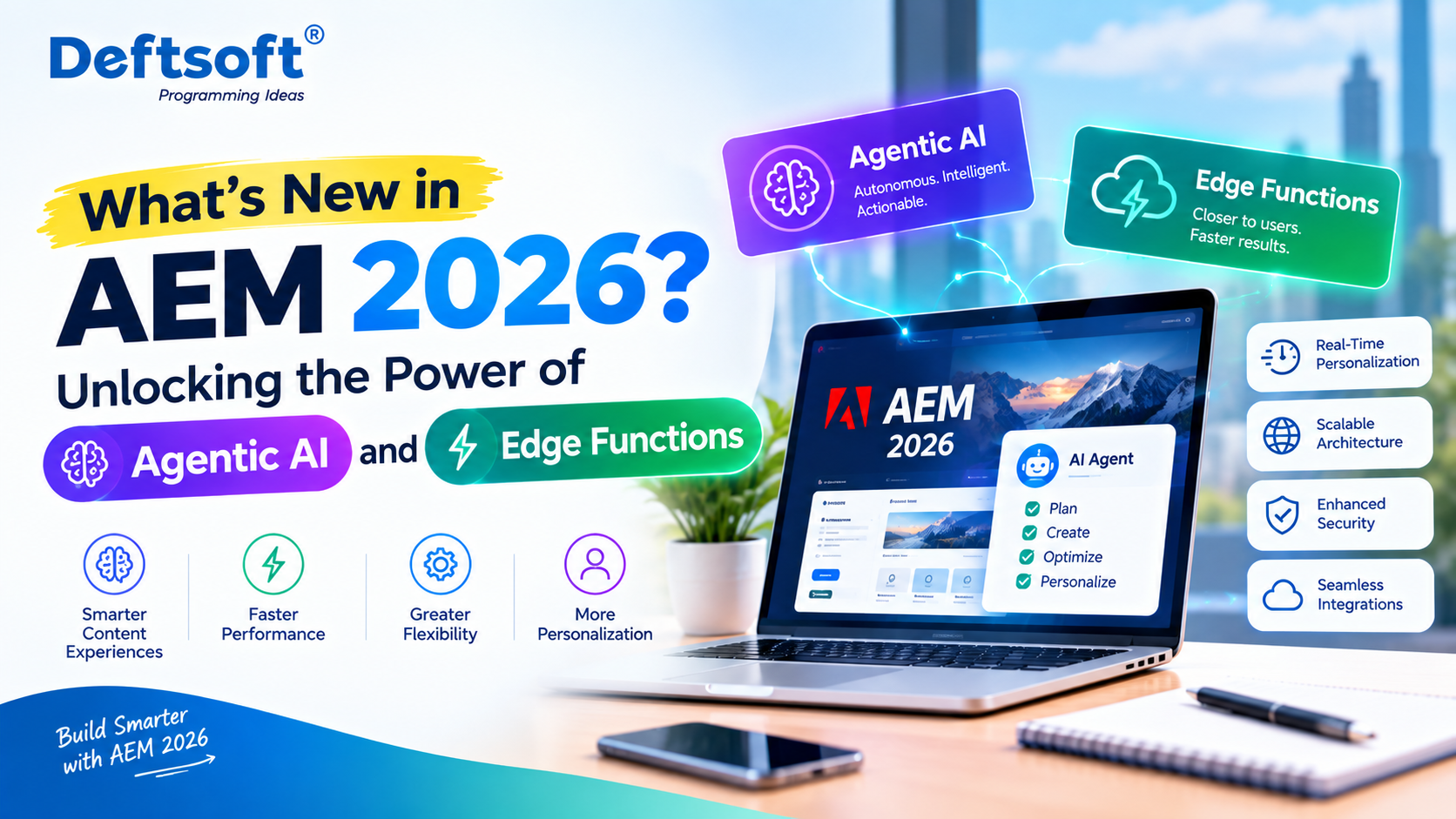
What’s New in AEM 2026? Unlocking the Power of Agentic AI and Edge Functions

The digital landscape of 2026 demands more than just a static web presence; it requires a dynamic, intelligent, and hyper-personalized ecosystem. As we move deeper into this new era, Adobe Experience Manager (AEM) remains the undisputed leader in Content Management Systems (CMS), particularly with its latest 2026 updates. However, staying ahead in AEM in 2026 requires a partner who understands the platform’s technical nuances and the visionary potential of AI integration.

As a globally recognized best AEM development company, Deftsoft stands ready to help you navigate these changes. We don’t just build websites; we manifest your digital ideas into reality by leveraging the latest innovations in AEM cloud services.

The New Frontier: What’s New in AEM in 2026?

The January 2026 release (2026.1.0) marks a significant milestone in the platform’s evolution. Adobe is no longer just offering a content repository; they are providing an Agentic AI powerhouse.

1. The Rise of Agentic AI and Content MCP Servers

The most groundbreaking update for AEM in 2026 is the introduction of Content MCP Servers. This feature provides a standardized way for AI-powered tools, like ChatGPT, Claude, and Microsoft Copilot, to interact directly with your AEM content.

Read-only and Read/Write Servers: Developers now use these servers to safely retrieve or modify pages, content fragments,and assets through third-party AI agents.

Agentic Capabilities: Adobe’s new Explorer program introduces specific agents for Experience Production, Governance, Optimization, Discovery, and Development. These agents automate content change orchestration, significantly reducing the manual burden on your team.

2. AI Search: Intent Over Keywords

Traditional search is dead. AI in AEM now includes intelligent, context-aware AI Search across both Assets and Admin views. This system understands the intent behind a query and delivers accurate results even if the user provides synonyms, misspellings, or searches in a different language.

3. Edge Functions: Personalization at Lightning Speed

To meet 2026’s demand for low latency, AEM now offers Edge Functions. This allows us to execute JavaScript at the CDN layer, moving data processing closer to the user. Our team at Deftsoft uses this to:

  • Personalize content based on real-time geolocation and device type.
  • Aggregate multiple third-party API responses before they even reach the browser.
  • Serve server-rendered HTML at the edge for unprecedented speed.

Why AEM Migration is Critical in 2026

If your enterprise still relies on legacy, on-premise versions, you are missing out on the competitive edge provided by the cloud. AEM migration is no longer optional; it is a strategic necessity to access the high-performance Java 21 runtime and the latest AI tools.

Seamless Transition with Deftsoft

Deftsoft specializes in AEM migration and upgradation services that ensure a seamless transition to the latest AEM versions. We minimize disruption while enhancing your platform’s features, transitioning you from deprecated APIs to a scalable, cloud-native architecture. Our process includes:

  • Readiness Assessment: Using tools like the Best Practices Analyzer to ensure your code is cloud-ready.
  • Content Transfer: Leveraging the Content Transfer Tool to move large repositories securely.
  • Code Refactoring: Modernizing your Dispatcher configurations and repository structures.

Mastering AI in AEM: The Deftsoft Advantage

At Deftsoft, we integrate AI in AEM to create “brand-aware” and “continually optimized” experiences. We don’t just implement the tools; we tailor them to your specific brand voice.

Generative AI and Content Hub

We use Adobe’s Generative AI capabilities to create high-performance copy and images directly within the editing interface. By using the Generate Variations tool, we help you run experiments to see which content performs best for specific audiences. Furthermore, we utilize the Content Hub to produce on-brand variations using Adobe Firefly-powered GenAI.

The AI Assistant

Your team can now work faster with the AI Assistant in AEM. This conversational interface provides instant answers to product-related questions and automates support ticket creation. As part of our AEM development service, we configure these AI permissions to ensure your admins and developers have the exact level of access they need to stay productive.

Smart Tagging for Digital Assets

Managing thousands of assets is a breeze with AI-generated smart tags. Our AEM asset management services use AI to automatically assign descriptive tags to images and videos, ensuring consistency and making your library easier to search.

Comprehensive AEM Development Services by Deftsoft

As the best AEM development company, Deftsoft offers an end-to-end suite of services designed for the modern enterprise.

1. Custom AEM Development and Component Creation

We manage the entire lifecycle of your digital experiences. From custom module development to the creation of reusable AEM components, we ensure your platform is optimized for performance and user experience.

2. AEM Cloud Services

We handle the technical heavy lifting of AEM cloud services so you can focus on creativity. Our team ensures smooth deployment, offering the auto-scalability and reliability that only a native cloud environment can provide.

3. AEM Integration

AEM’s true power lies in its ability to connect with your existing ecosystem. We provide expert AEM integration services that link your AEM platform to CRM and e-commerce systems (such as Salesforce or Adobe Commerce) to create a unified customer engagement engine.

4. AEM Managed Services and 24/7 Monitoring

Reliability is the cornerstone of our AEM managed services. We provide proactive issue resolution and 24/7 monitoring to ensure your digital experiences never falter, even during peak traffic.

5. Specialized AEM Guides Support

For companies handling complex technical documentation, we implement the latest AEM Guides features. The 2026 enhancements, such as Source mode search and enhanced folder browsing, allow for more efficient content management and multi-file selection.

Harnessing the Power of Hyper-Personalization

In 2026, generic marketing fails. Adobe Experience Manager offers unparalleled functionalities for hyper-personalized campaigns.

  • Adobe Audience Manager: We help you build unique audience profiles to identify your most valuable segments.
  • Multi-Channel Support: We enable you to run campaigns across desktops, smartphones, and social media platforms such as Instagram and Facebook from a single platform.
  • Contextual Experimentation: We use AEM’s native tools to track Key Performance Indicators (KPIs) and refine your interactions in real-time.

Why Choose Deftsoft?

With a 4.8-star rating on Clutch and a history of working with multiple well-established companies and startups alike,Deftsoft is a proven leader in the AEM space. We bring a team of well-versed developers and architects who are ready to enhance your digital experiences across all touchpoints.

  • Security First: We align our deployments with the latest authentication protocols (SSO, SAML, LDAP) and promptly deploy security hotfixes.
  • Faster Time-to-Market: By leveraging AEM’s cloud-native APIs, we reduce the development burden and help you capture a competitive edge faster than ever.
  • Scalable Solutions: Whether you need a simple website or a complex global repository in multiple languages, we build solutions that grow with you.

Conclusion: Lead the Future with Deftsoft

AEM’s innovations in 2026, from Agentic AI and Content MCP Servers to Edge Functions, offer a glimpse of a future where content is more than information; it is an intelligent interaction. To harness this power, you need a partner with a deep technical foundation and a forward-thinking approach.

Are you ready to collaborate with the best AEM development company? Whether you require a comprehensive AEM development service, a complex AEM migration, or robust AEM cloud services, Deftsoft is your partner in innovation.
Contact Deftsoft today for a free consultation, and let us bring your 2026 digital vision to life.

FAQs

1. What groundbreaking features define AEM in 2026?

AEM in 2026 is defined by the introduction of Agentic AI, which automates content orchestration across production and governance. The 2026.1.0 release also includes Content MCP Servers, which provide a standardized way for AI tools such as ChatGPT and Claude to interact directly with your content. Furthermore, Edge Functions now allow for high-speed, personalized experiences by executing JavaScript at the CDN layer.

2. Why should I choose Deftsoft as my AEM development company?

Deftsoft is a Clutch-recognized AEM development company with a 4.8-star rating and a proven track record with startups and well-established enterprises. We provide end-to-end digital asset management tailored to your specific business requirements. Our expert architects ensure your platform leverages the latest agility and scalability features of the AEM development service.

3. How does AI in AEM improve the content authoring experience?

AI in AEM utilizes Generative AI to create high-performance copy and brand-aware images directly within the editor. Authors can use the AI Assistant for instant product knowledge or troubleshooting, while AI Search provides intent-based results that understand synonyms and misspellings. These tools significantly reduce the manual burden on creative teams.

4. What are the benefits of AEM migration to the 2026 cloud version?

An AEM migration to the latest version grants access to the high-performance Java 21 runtime, which is now mandatory for cloud environments. This transition ensures your platform remains secure through native cloud capabilities and the latest authentication protocols, such as SSO and SAML. Deftsoft’s migration services ensure a seamless transition that minimizes disruption while unlocking new feature sets.

5. How do AEM cloud services enhance website performance and scalability?

AEM cloud services offer auto-scaling, enabling your digital presence to handle traffic spikes efficiently. By using a scalable, cloud-native CMS, enterprises achieve faster time-to-market and reduced development burden. Deftsoft handles technical deployment and 24/7 proactive monitoring, ensuring your digital experiences remain reliable.

6. Can Deftsoft help with complex AEM integration and managed services?

Yes, Deftsoft excels in AEM integration, connecting your CMS to third-party ecosystems, including Salesforce and other CRM and e-commerce platforms. Our AEM managed services provide expert support and maintenance to optimize platform performance. We create a unified ecosystem that identifies your most valuable audience segments to achieve better marketing results.

7. What new tools are available for AEM asset management in 2026?

Modern AEM asset management now features a Content Hub that uses Adobe Firefly for generating on-brand content variations. The 2026 updates also introduce Source mode search in AEM Guides, enabling deeper global searches across XML structures. Deftsoft helps you manage, organize, and optimize rich media delivery across all social channels and devices.

How Businesses Are Using Metaverse App Development in 2026: Top Trends Explained

Introduction: Why the Metaverse Is a Business Priority in 2026

The metaverse has evolved far beyond a futuristic concept or a gaming-centric trend. In 2026, businesses across industries are investing in immersive digital environments to enhance customer engagement, collaboration, and revenue. What was once experimental is now strategic.

Organizations exploring metaverse app development services are no longer asking whether the metaverse is relevant, but how to use it to gain a competitive advantage. From virtual storefronts and immersive brand experiences to enterprise collaboration spaces, the metaverse is redefining how businesses operate in a digital-first economy.

With advancements in AR, VR, blockchain, and AI, the metaverse is becoming more accessible, scalable, and business-ready, making 2026 a defining year for enterprise adoption.

Why Businesses Are Actively Searching for the Best Metaverse App Development Company

As metaverse adoption accelerates in 2026, businesses are becoming more selective about who they partner with to build immersive digital experiences. The complexity of virtual environments, combined with the need for scalability and security, has led organizations to actively seek the best metaverse app development company rather than generic development providers.

A top-tier metaverse development company understands more than just 3D environments or virtual worlds. They bring together expertise in AR, VR, AI, blockchain, and cloud infrastructure to deliver seamless and future-ready solutions. Businesses want platforms that not only look impressive but also integrate smoothly with existing systems, support large user bases, and adapt to evolving technologies.

The best metaverse app development company focuses on strategic planning, not just execution. This includes defining business objectives, identifying the right metaverse use cases, and selecting the most suitable technology stack. Whether it’s a virtual showroom, enterprise collaboration space, or immersive training environment, businesses prioritize partners who can translate ideas into scalable digital ecosystems.

In addition, companies increasingly value development teams that prioritize user experience, performance optimization, and long-term support. A reliable partner ensures that metaverse applications remain relevant, secure, and engaging as user expectations continue to rise. In 2026, choosing the best metaverse development company is no longer a technical decision; it’s a strategic business investment.

1. Enterprise Metaverse Adoption Is Accelerating

One of the most significant trends in 2026 is the rapid increase in metaverse adoption for businesses. Enterprises are moving beyond pilot programs and investing in long-term metaverse strategies.

Companies are using metaverse platforms to:

  • Create virtual offices and remote collaboration hubs
  • Conduct immersive employee training and onboarding
  • Host virtual conferences, product launches, and trade shows
  • Build persistent digital environments for customer engagement

This acceleration is driven by the demand for remote-first operations, global collaboration, and experiential digital interactions. Businesses that once relied on video calls and static digital tools are now leveraging immersive environments that replicate and often enhance real-world interactions.

2. Metaverse App Development Becomes a Core Digital Investment

In 2026, metaverse app development services will no longer be viewed as experimental or optional. They are becoming a core part of digital transformation budgets. Businesses are realizing that off-the-shelf platforms often fail to meet their specific needs, leading to a surge in demand for custom-built metaverse applications.

Custom metaverse apps allow organizations to:

  • Control branding and user experience
  • Integrate existing enterprise systems
  • Ensure scalability and long-term flexibility
  • Maintain higher security and data ownership

Whether it’s a virtual retail store, a digital twin of a manufacturing facility, or an immersive learning environment, businesses are prioritizing tailored metaverse solutions that align with their goals and workflows.

3. Virtual Reality and Augmented Reality Drive Business Use Cases

The growing maturity of virtual reality (VR) and augmented reality (AR) technologies is another key factor shaping metaverse adoption. In 2026, these technologies are no longer niche; they are practical tools delivering measurable business value.

Some of the most impactful business applications include:

  • Retail: Virtual try-ons, immersive shopping experiences, and AR-based product visualization
  • Real Estate: Virtual property tours and digital staging
  • Healthcare: VR-based training simulations and AR-assisted procedures
  • Education & Training: Immersive learning modules that improve retention and engagement

By combining VR and AR with metaverse app development, businesses are creating interactive experiences that bridge the gap between physical and digital worlds.

4. Interoperable Metaverse Platforms Gain Momentum

Another major technology trend in 2026 is the shift toward interoperable metaverse platforms. Businesses are increasingly demanding environments where digital assets, identities, and experiences can move seamlessly across platforms.

Interoperability allows:

  • Cross-platform user experiences
  • Long-term asset value preservation
  • Reduced dependency on a single ecosystem
  • Better scalability as technologies evolve

For businesses, this means future-proof investments. Instead of building isolated virtual environments, companies are focusing on metaverse solutions that integrate with broader digital ecosystems, enabling growth and adaptability.

5. AI-Powered Experiences Inside the Metaverse

Artificial intelligence will play a crucial role in enhancing the metaverse in 2026. AI-driven capabilities are transforming static virtual spaces into intelligent, adaptive ecosystems.

Key AI-powered metaverse features include:

  • Personalized user experiences based on behavior
  • Intelligent avatars and virtual assistants
  • Predictive analytics for user engagement
  • Automated content and environment generation

By integrating AI into metaverse app development, businesses can deliver more engaging, responsive, and data-driven virtual experiences, making interactions more meaningful and conversion-focused.

6. Security, Privacy, and Compliance Become Business-Critical

As metaverse adoption grows, so do concerns around data security, privacy, and regulatory compliance. In 2026, businesses are prioritizing secure metaverse architectures to protect user data and digital assets.

Key focus areas include:

  • Identity and access management
  • Secure data storage and encryption
  • Compliance with regional data protection laws
  • Safe transaction and interaction frameworks

Organizations understand that trust is foundational. Secure and compliant metaverse solutions are essential to maintaining brand credibility and user confidence, especially in industries such as finance, healthcare, and enterprise services.

7. Industry-Specific Metaverse Applications Take the Lead

Rather than generic experiences, 2026 is seeing a rise in industry-specific metaverse applications. Businesses are developing solutions tailored to their unique operational and customer needs.

Examples include:

  • Virtual showrooms for automotive brands
  • Digital twins for manufacturing and logistics
  • Immersive classrooms for education providers
  • Virtual banking and fintech environments

This specialization ensures higher ROI and stronger alignment with business objectives, making metaverse investments more strategic and outcome-driven.

8. Choosing the Right Metaverse App Development Partner

As metaverse initiatives become more complex, businesses are focusing on selecting experienced development partners who understand both technology and business strategy. The right partner helps organizations navigate platform selection, scalability, UX design, and long-term maintenance.

A strong metaverse app development partner brings:

  • Cross-technology expertise (AR, VR, AI, blockchain)
  • User-centric design approach
  • Scalable and secure architecture
  • Ongoing support and optimization

What Defines the Best Metaverse App Development Services in 2026

As competition in the metaverse space intensifies, businesses are evaluating providers based on the quality and depth of their best metaverse app development services. In 2026, leading services go far beyond basic virtual environment creation; they deliver end-to-end solutions designed for long-term growth.

The best metaverse app development services begin with discovery and strategy, helping businesses identify high-impact use cases aligned with their goals. This is followed by user-centric design, ensuring intuitive navigation, immersive interactions, and consistent branding across virtual experiences. Advanced development practices focus on performance, interoperability, and scalability to support expanding user bases.

Security and compliance are also critical components of top-tier services. Businesses expect metaverse platforms to include robust identity management, secure data handling, and compliance with global privacy regulations. Additionally, integration with existing enterprise systems, such as CRM platforms, payment gateways, and analytics tools, is essential to deliver measurable ROI.

Another defining factor of the best metaverse app development services is post-launch support. Continuous optimization, feature enhancements, and performance monitoring ensure that metaverse applications evolve alongside business needs and technological advancements. In 2026, businesses are not just investing in metaverse apps; they are investing in long-term digital ecosystems that require expert guidance and ongoing innovation.

Conclusion: Preparing Businesses for the Metaverse Economy

The metaverse in 2026 is no longer about experimentation; it’s about execution. Businesses that invest early in metaverse app development are positioning themselves for long-term growth, innovation, and competitive advantage.

By embracing immersive technologies, interoperable platforms, and AI-powered experiences, organizations can create meaningful digital ecosystems that drive engagement and revenue. Forward-thinking technology partners like Deftsoft are helping businesses turn metaverse vision into scalable, future-ready solutions.

Frequently Asked Questions (FAQs)

1. What is metaverse app development for businesses?

Metaverse app development involves creating immersive virtual environments that help businesses improve customer engagement, collaboration, training, and digital experiences using AR, VR, and 3D technologies.

2. How are businesses using metaverse apps in 2026?

In 2026, businesses use metaverse apps for virtual offices, immersive training programs, digital showrooms, customer experiences, and industry-specific simulations.

3. What industries benefit most from metaverse app development?

Industries such as retail, real estate, education, healthcare, manufacturing, gaming, and enterprise services benefit the most from metaverse app development.

4. What makes the best metaverse app development services?

The best metaverse app development services offer strategic planning, user-centric design, scalable architecture, strong security, and long-term support tailored to business goals.

5. How do I choose the best metaverse app development company?

Choose a company with proven experience, cross-technology expertise, scalable solutions, strong security practices, and a clear understanding of business use cases.

6. Are metaverse applications secure for enterprise use?

Yes, enterprise-grade metaverse applications include identity management, data encryption, access control, and compliance measures to ensure secure business operations.

7. Why should businesses invest in metaverse app development now?

Investing in metaverse app development now helps businesses gain an early competitive advantage, improve digital engagement, and build future-ready immersive platforms.