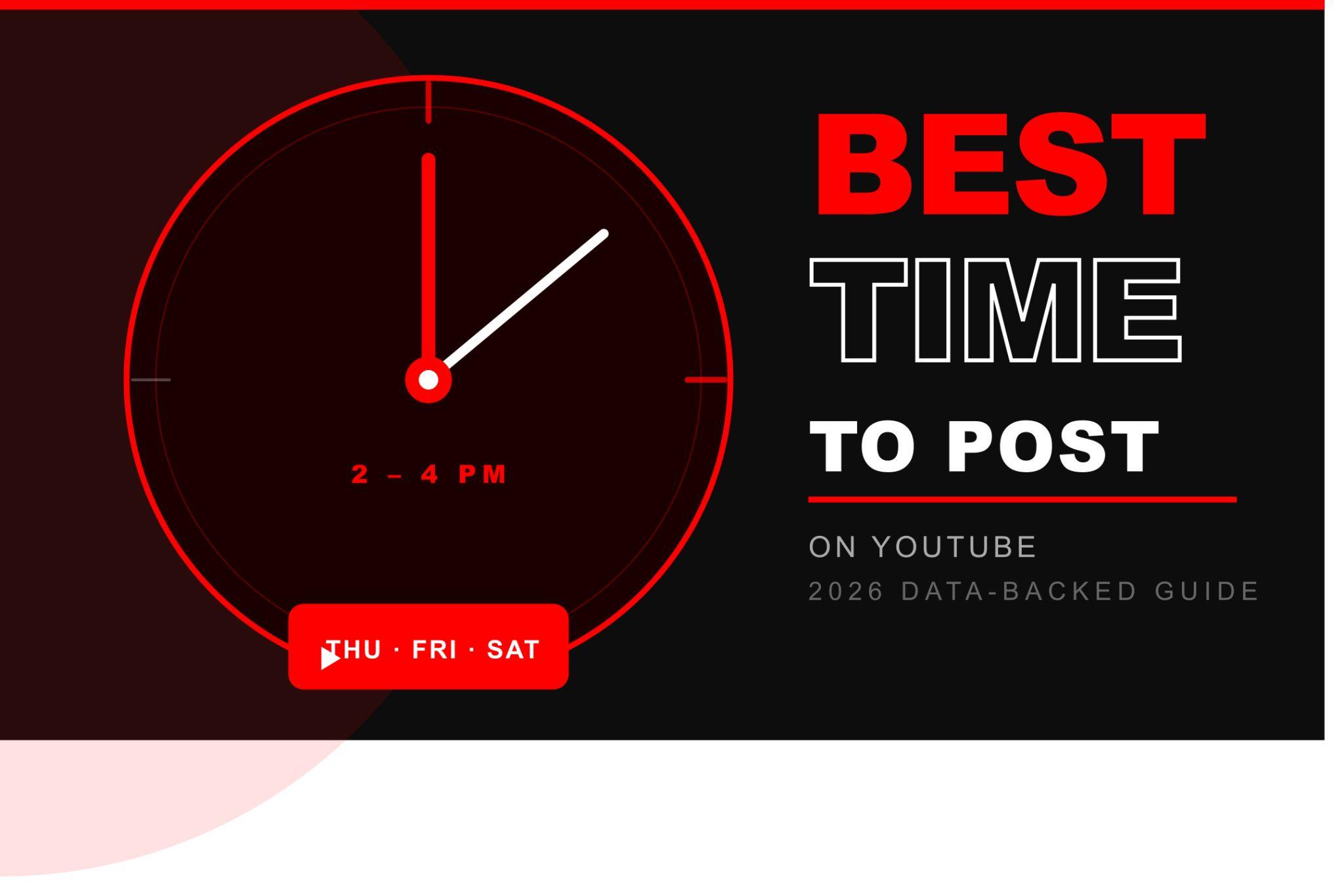
Best time to post on YouTube in 2026: data-backed schedule by day and hour
-
By Devraj
-
8th May 2026
Quick Summary
Posting on YouTube without thinking about timing is like opening a shop in the middle of the night and wondering why no one is walking in. The YouTube algorithm rewards videos that generate rapid engagement in the first few hours after upload. That means when you post matters almost as much as what you post. This blog breaks down the best time to post on YouTube in 2026, explains why timing affects your reach, and gives you a practical posting schedule you can actually use, whether you are a solo creator or managing a brand channel.
Struggling to grow your YouTube channel?
Talk to Deftsoft’s social media marketing team
Quick Navigation
Why posting time on YouTube actually matters
What the data says about the best time to post on YouTube in 2026
Best time of day to post on YouTube
Breakdown by content type and audience
The YouTube algorithm and posting schedule in 2026
How to find your own best posting time
Common timing mistakes YouTube creators make
Why posting time on YouTube actually matters
YouTube is the second-largest search engine in the world and the second most-visited website globally. Because it functions as a visual search platform, applying comprehensive SEO services to your video metadata is just as important as it is for your website.. Over 500 hours of video are uploaded every single minute. At that volume, your video does not have the luxury of gradually building momentum over weeks. The algorithm makes most of its decisions about your video’s distribution in the first 24 to 48 hours.
Here is what happens during that window:
When you upload a video, YouTube first pushes it to a small sample of your subscribers. It watches how they respond, do they click? Do they watch more than 50%? Do they leave a like or comment? Based on those early signals, YouTube decides whether to push the video to a broader audience through home feed recommendations, suggested videos, and search.
If you post when your audience is asleep, working, or otherwise unlikely to engage, the initial sample will perform poorly. The algorithm interprets this as low interest and limits distribution. Your video gets buried before most of your subscribers even know it exists.
Timing is not the only factor; content quality, thumbnails, titles, and watch time all play a role. But timing determines whether your content even gets a fair chance at being seen.
What the data says about the best time to post on YouTube in 2026
Based on aggregated platform data, third-party analytics studies, and creator community reporting, here are the consistent patterns that hold across most niches:
Best days to post on YouTube
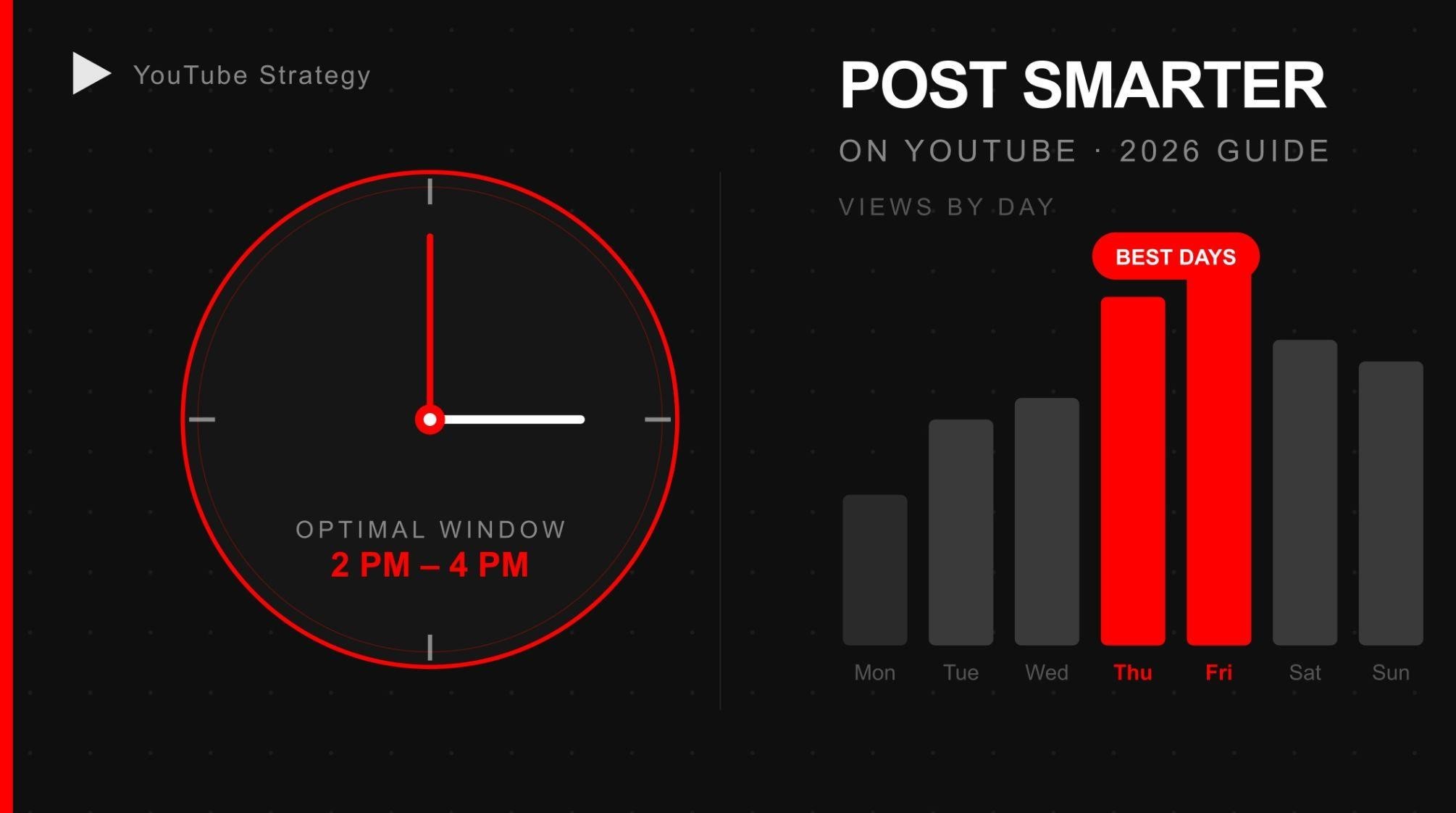
- Thursday and Friday are consistently the top-performing days. Audiences are in a pre-weekend mindset, more relaxed and more likely to browse and watch longer-form content. Videos posted these days tend to accumulate views on Saturday and Sunday, the platform’s highest-traffic days.
- Saturday and Sunday have the highest viewership, but they are also the most competitive days to post because many creators think the same way. The sweet spot is posting on Thursday or Friday, so your video is already indexed and performing when weekend traffic peaks.
- Tuesday and Wednesday are solid mid-week options, especially for educational content, tutorials, and business-focused channels. Audiences in a learning mindset tend to search more during the working week.
- Monday tends to underperform across most content categories. People are easing back into the week and are less likely to sit down for video content.
Best time of day to post on YouTube
The general consensus, backed by analytics tools like TubeBuddy, Sprout Social, and VidIQ, points to a window of 2 PM to 4 PM in your target audience’s local time zone as optimal for most channels.
The logic: you want to post a few hours before your audience’s peak activity window, not during it. YouTube needs time to process and index your video. Posting at 2–4 PM means your video is ready and has some early engagement momentum, just as your largest audience segment, typically active from 5 PM to 9 PM, begins their evening browsing session.
For Indian audiences and channels targeting the Indian market specifically, this means posting between 2 PM and 4 PM IST works well on weekdays. Staying on top of these specific windows is a core part of effective social media management, ensuring your content hits the feed exactly when your audience is ready to watch. On weekends, a slightly earlier window of 11 AM to 1 PM IST can also perform well, as audiences are more active earlier in the day.
? Pro Tip:
Mastering your timing is just the first step. Learn how to optimize your brand’s wider digital presence in our latest guide: The Future of AI in Digital Marketing.
Breakdown by content type and audience
Not every channel has the same audience behavior. Here is how timing varies by content category:
- Gaming channels: Late evenings and weekends perform best. Prime window: Friday–Saturday, 6 PM to 10 PM in the audience’s time zone.
- Educational and how-to content: Midweek mornings and early afternoons. Audiences searching to learn something tend to do so proactively during the day. Best days: Tuesday and Wednesday, 10 AM to 2 PM.
- Entertainment and vlogging: Evenings across the week, with Thursday–Friday being strongest. People want to unwind, not learn, so later in the day works better.
- Business, marketing, and finance: Weekday mornings work well here, particularly Tuesday through Thursday, 8 AM to 11 AM. Decision-makers and professionals tend to consume this content early.
- Food, cooking, and lifestyle: Late mornings on weekends are strong. People are relaxed, in a discovery mindset, and planning their day. Saturday, 10 AM to 12 PM is a reliable window.
- News and commentary: As close to real-time as possible. For topical content, timing relative to the news cycle matters more than any general schedule.
The YouTube algorithm and posting schedule in 2026
The YouTube algorithm in 2026 places increased weight on consistent posting schedules. Channels that upload at predictable intervals, not just at high volumes, build stronger subscriber conditioning. When your audience knows to expect new content every Thursday afternoon, they are more likely to check their feed, generating early engagement signals the algorithm loves.
Consistency also affects how YouTube treats your channel at a macro level. Channels with erratic posting histories tend to see lower average impressions per video than channels with a regular schedule, even when the total number of videos is the same.
This does not mean you need to post daily. A well-executed weekly or bi-weekly schedule outperforms a daily schedule of lower-quality content every time. This is why a robust content marketing strategy focuses on value and intent rather than just volume. The algorithm has become significantly better at interpreting watch-time quality; videos that people actually finish are rewarded far more than videos that generate clicks but then see an immediate drop-off.
How to find your own best posting time
The data above applies broadly, but your channel’s analytics will tell you something more precise. Here is how to find your personal optimal window:
Step 1: Go to YouTube Studio → Analytics → Audience. Scroll down to “When your viewers are on YouTube.” This shows you a heat map of when your specific subscribers are most active, hour by hour, day by day.
Step 2: Look at the peak hours in that heat map. Then subtract 2 to 3 hours. That is your target upload window.
Step 3: Upload your video and set it to public at that target time. Do not schedule it for a time that is already past your peak; you want the video live and gathering momentum as the peak approaches.
Step 4: Track performance over 90 days. Compare videos posted at different times. Most channels find a clear pattern after enough data points.
Step 5: Revisit every quarter. Audience behaviour shifts seasonally, particularly around major holidays, school calendars, and cultural events. What works in January may not be optimal in July.
Common timing mistakes YouTube creators make
Posting at midnight: Some creators post late at night, thinking it gives the video time to “warm up.” In practice, posting when your audience is asleep leads to poor early engagement, which signals low interest to the algorithm before they even wake up.
Posting too frequently without a schedule: Five videos in one week followed by nothing for a month confuses both the algorithm and your subscribers. Predictability is a feature, not a limitation.
Ignoring time zones: A US-based channel posting for an Indian audience needs to think in IST, not EST. A 9 AM ET post lands at 7:30 PM IST, actually not bad timing for an Indian evening audience, but you need to think about it intentionally, not accidentally.
Posting on the same day as a major competing event, Sports finals, major product launches and viral news moments,redirects platform-wide attention. Check the cultural calendar before committing to a launch day for important content.
Where Deftsoft fits into your YouTube strategy
Growing a YouTube channel in 2026 is as much a marketing discipline as it is a creative one. At Deftsoft, our social media marketing and content strategy teams help brands build YouTube presences that are integrated into their wider digital ecosystem. Whether you are embedding videos into a custom WordPress or Webflow site or using them as a pillar for lead generation, we ensure your tech and content work together. From channel setup and SEO-optimised video titles and descriptions to full content calendars and performance reporting, we treat YouTube as the long-form content pillar it has become for digital marketing.
Whether you are a brand just starting on YouTube or an established channel trying to break through a growth plateau, strategy and timing are two of the most underused levers available to you.
FAQs
Q: Does the best posting time change based on my subscriber count?
Yes, to an extent. Smaller channels rely more on search traffic than suggested video traffic, so search behavior patterns matter more. Larger channels with strong subscriber engagement can post slightly earlier and rely on their core audience to generate momentum.
Q: Should I use YouTube Premiere instead of a direct upload?
Premieres can help build pre-release excitement for certain content types, but they also delay indexing. For most standard uploads, direct publishing at your optimal time is more effective.
Q: How important is the posting schedule compared to the thumbnail and title?
Thumbnail and title determine your click-through rate, which the algorithm weighs heavily. Posting time determines whether the algorithm even offers the video to enough people to generate those clicks. Both matter, and neither can fully compensate for weakness in the other.
Q: Is it better to post consistently at a non-optimal time or irregularly at the best time?
Consistency wins. A channel that posts every Tuesday at 3 PM, even if Tuesday is not the strongest day, outperforms a channel that only posts on “perfect” days but does so unpredictably.
Q: Does posting time affect YouTube Shorts differently?
Shorts operate on a slightly different distribution model. Consistency still matters, but Shorts are distributed more through the Shorts feed, which is less time-sensitive than long-form suggested content. Evening hours still tend to perform better for Shorts.
Q: Can Deftsoft help manage a YouTube posting schedule for a brand?
Yes. Deftsoft offers end-to-end social media management, including YouTube content planning, upload scheduling, SEO-optimized video metadata, and monthly performance reporting.
Recent Articles






Devraj
 8th May 2026