AI Content Writing vs Human Content Writing: How to Optimize Your Process for AI SEO
-
By Devraj
-
9th June 2026
Introduction
AI has changed content writing faster than most marketers expected. A few years ago, businesses were asking whether AI tools could write a blog. Now, the better question is how AI can support a smarter content-writing process without making the final content sound flat, copied, or generic.
Search has changed, too. Google results now include AI Overviews, AI Mode, featured snippets, videos, forums, brand mentions, local results, and traditional organic pages. This means content cannot be written solely for a single keyword anymore. It must answer real questions, show experience, build trust, and be clear enough for both readers and search systems to understand.
This is where AI SEO writing becomes useful. It does not mean letting AI write everything and publishing it without review. It means using AI tools to improve research, planning, keyword mapping, structure, briefs, updates, and optimization while keeping human thinking at the centre.
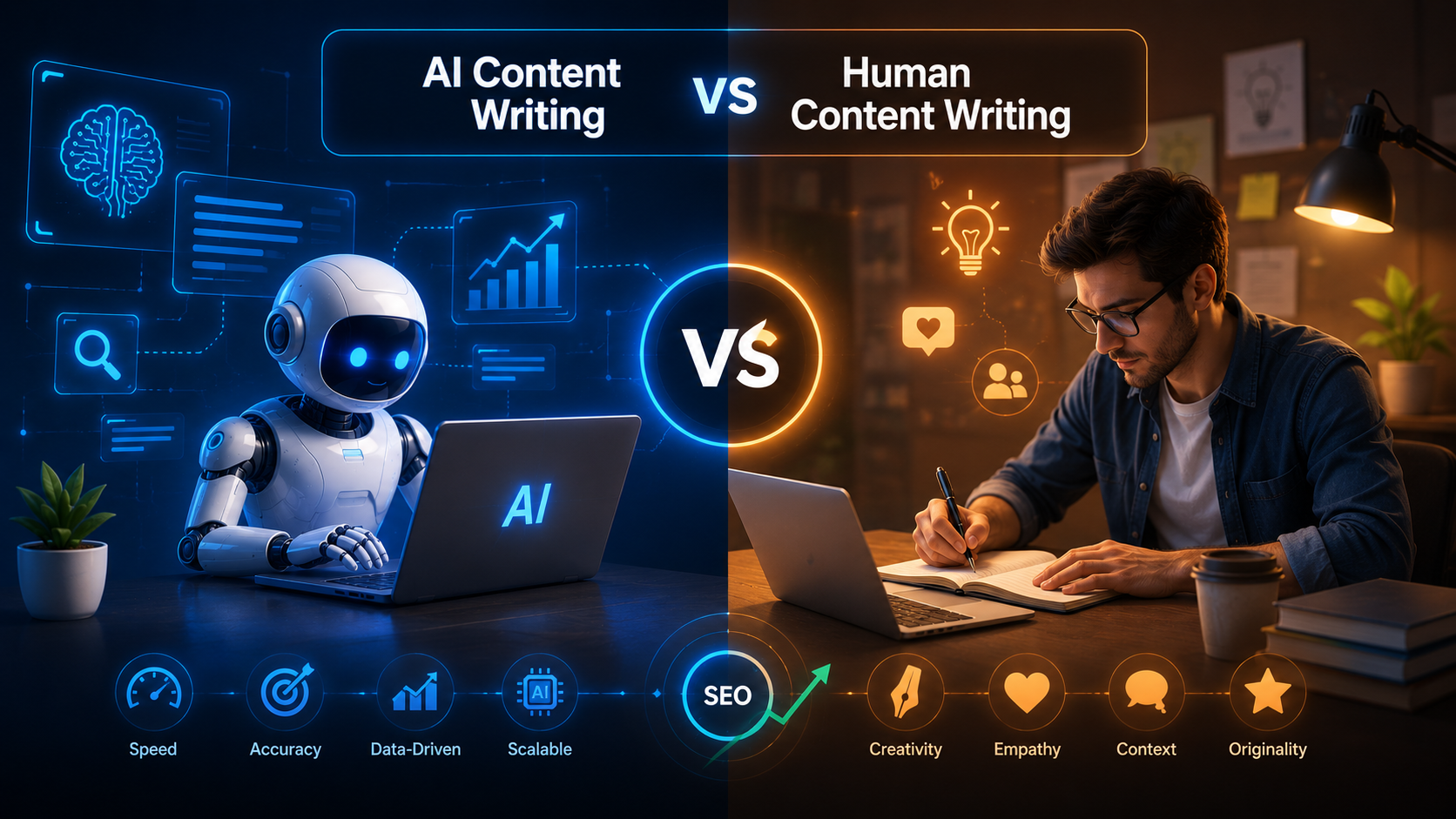
So, what is better: human-written content or AI-written content? Human-written content is usually stronger in terms of trust, originality, tone, and brand experience. AI-assisted content is stronger for speed, research support, topic expansion, and workflow efficiency. The strongest content marketing strategy now combines both.
Quick Summary:
AI Content writing is not a shortcut to replace writers. It is a way to support a better writing process when used carefully. Google does not ban AI content, but it does target low-value content that is created mainly to manipulate rankings or published at scale without real usefulness.
Human content writing still matters because people want clarity, personality, proof, examples, and practical insight. AI SEO writing works best when AI supports research, structure, keyword ideas, content gaps, and optimization, while humans enhance accuracy, voice, depth, and trust.
The best approach is not “AI vs human.” It is “AI plus human.” That is how brands can create content that is useful for readers, stronger for SEO, and better prepared for AI-powered search.
Want Better SEO Content Without the Generic AI Feel?
If your website content sounds robotic, repetitive, or too similar to your competitors, it may be time to rebuild your process. Our team can help you create SEO-friendly content that blends AI-powered research with human writing, brand storytelling, and search intent strategy.
Quick Navigation
How AI Has Changed the Content Writing Process
Human-Written vs AI-Written Content: Which Is Better?
What Google Actually Wants from Content
Why AI SEO Matters More in the Age of AI Search
How to Use AI Tools in Content Writing
Common Mistakes to Avoid with AI Content Writing
What Is AI Content Writing?
AI Content writing is the use of artificial intelligence tools to help create written content. This can include blogs, service pages, landing pages, product descriptions, social media captions, email copy, ad copy, scripts, and content outlines.
AI can suggest headlines, build topic clusters, summarize research, generate first drafts, rewrite paragraphs, check grammar, and create FAQ ideas. It can also help writers understand different audience questions around a topic.
However, AI content writing has limits. AI does not truly know your customer the way your sales team does. It does not automatically understand your brand voice. It can repeat common ideas already available online. Sometimes it may also give outdated or incorrect information.
That is why AI output should not be treated as finished content. AI is useful as a writing assistant. It should not become the final editor, strategist, fact-checker, and brand expert all at once.
What Is AI SEO Writing?
AI SEO writing is the process of using AI tools to support the creation of search-optimized content. It focuses on keywords, search intent, topic coverage, structure, readability, internal linking opportunities, and content performance.
Traditional SEO writing often started with a keyword list. A writer would place the main keyword in the title, introduction, headings, and body. That still matters, but it is no longer enough.
Today, AI SEO writing needs to consider what the user is really asking, which related questions need to be answered, what makes the content different from competing pages, and what proof or examples can be added.
For example, if the keyword is “AI SEO writing,” a basic article may only explain what it means. A stronger article will explain how it affects content writing, how Google treats AI-generated content, how marketers can use AI tools safely, and why human review still matters.
How AI Has Changed the Content Writing Process
AI has made the content writing process faster, but it has also raised the quality bar. Since almost anyone can produce a basic blog post in minutes, generic content has become easier to create and ignore.
Before AI, a content process may have looked like this:
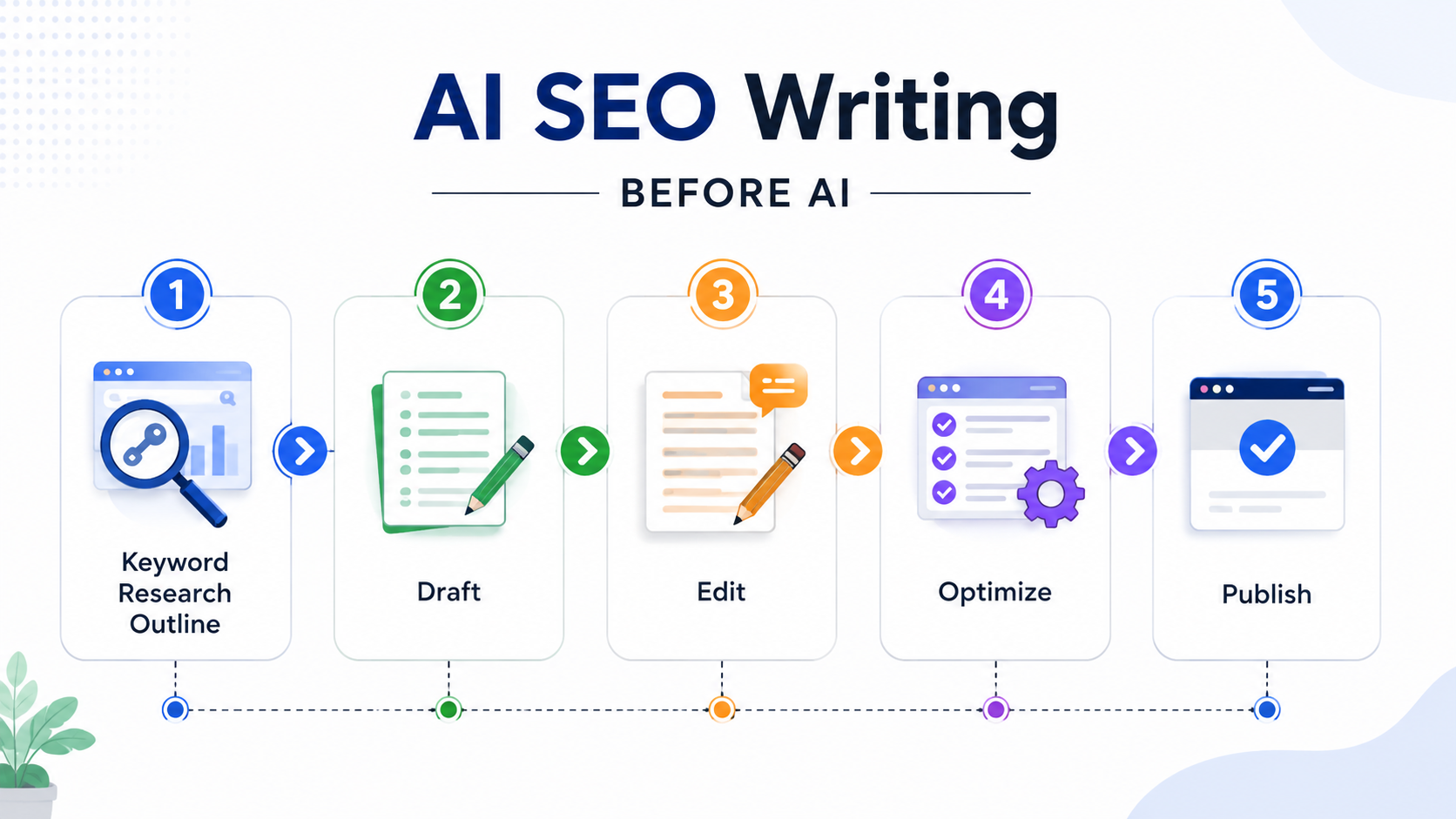
Now, a better process looks like this:
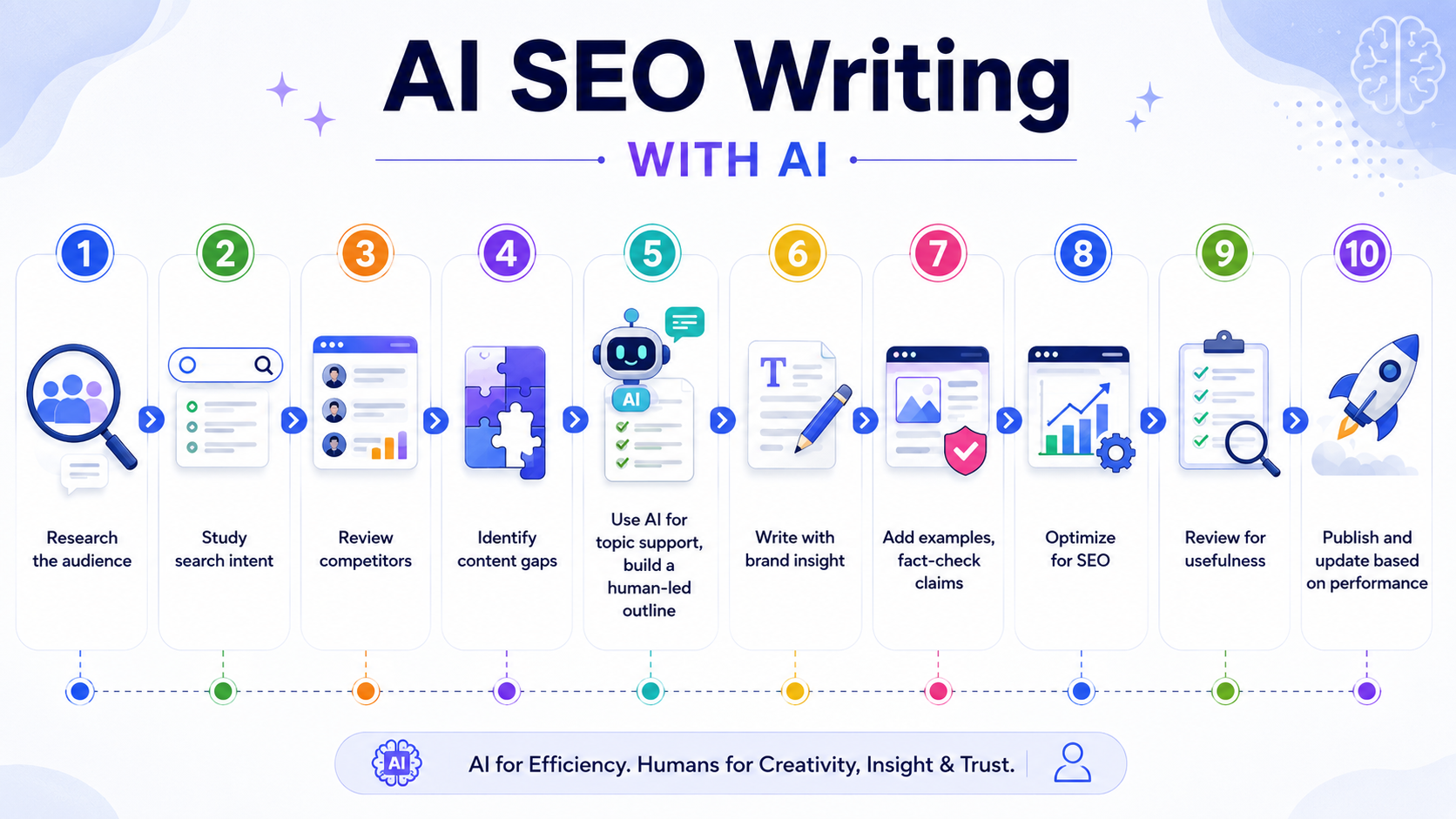
- Research the audience
- Study search intent
- Review competitors
- Identify content gaps
- Use AI for topic support, build a human-led outline
- write with brand insight
- Add examples, fact-check claims
- Optimize for SEO
- Review for usefulness
- Publish and update based on performance.
AI should reduce manual effort in the early stages, allowing writers to spend more time on value, clarity, and originality. For example, AI can quickly list common questions about content marketing. But a human writer should decide which questions matter, which ones are too basic, and which ones need a stronger business angle.
The winning process is not faster publishing. It is smarter publishing.
Human-Written vs AI-Written Content: Which Is Better?
Human-written content is better when the goal is trust, experience, opinion, storytelling, and original thinking. AI-written content is useful when the goal is speed, idea generation, structure, and repetitive support tasks.
A fully AI-written article often has common problems. It may repeat the same sentence pattern. It may use broad statements. It may include obvious lines like “in today’s digital world” or “businesses must stay ahead.” It may sound polished but empty.
Human-written content usually performs better when it includes real examples, clear opinions, brand-specific insights, customer pain points, expert review, natural flow, and better judgement.
But human writing can also be slow, inconsistent, or under-optimized. That is why AI tools can help. AI can speed up research and help writers avoid missing important subtopics. It can also improve readability and turn rough notes into cleaner drafts.
So the better choice is not one or the other. For most brands, the best content writing model is human-led and AI-assisted.
What Google Actually Wants from Content
Google’s position is clear. Content should be helpful, reliable, and people-first. Google has also said that AI-generated content is not automatically in violation of its rules. The issue is not whether AI was used. The issue is whether the content was created primarily to manipulate rankings or genuinely helps users.
A helpful AI-assisted blog can rank if it provides a useful answer, original value, accurate information, and a good experience. A low-value human-written blog can still fail if it is thin, copied, keyword-stuffed, or created solely for search engines.
Google’s scaled content abuse policy is important here. It targets large amounts of unoriginal content that provides little or no value, regardless of how it is created. That means AI is not the only risk. Poor content strategy is the real risk.
For content marketers, the message is simple. Do not publish AI content just because you can. Publish content because it solves a real problem for your audience.
Why AI SEO Matters More in the Age of AI Search
AI search is changing how users interact with information. People may ask longer questions. They may expect direct answers. They may compare brands without visiting every website. Search engines can also pull from multiple sources to generate answers.
This means your content needs to be clear, useful, and easy to understand. It should not only chase rankings. It should help your brand become a trusted source.
AI SEO writing can support this by improving topic depth. Instead of writing one shallow article around one keyword, you can build a full content cluster. For example, a brand targeting “AI Content writing” can also cover AI content writing tools, AI SEO writing process, human vs AI content, content marketing with AI, Google guidelines for AI content, and how to edit AI-generated content.
This creates topical authority. It also gives search engines and AI systems more context about your expertise.
How to Use AI Tools in Content Writing
AI tools are most helpful before and after the first draft. During research, AI can help you collect topic ideas, audience questions, competitor angles, and possible content gaps. During planning, it can help create outlines, title options, meta ideas, and content briefs. During editing, it can help simplify long sentences, improve flow, and check whether the content answers the main query.
A practical AI-assisted content process can look like this:
- Start with keyword research and search intent.
- Use AI to generate topic angles and related questions.
- Build a human-approved content outline.
- Add brand insights, examples, and service-specific details.
- Write or rewrite the draft in a natural voice.
- Use AI to check readability and missing points.
- Fact-check every statistic and claim.
- Add internal links, CTAs, FAQs, and metadata.
- Review the final piece for tone, trust, and usefulness.
- Update the page later based on search performance.
This process helps you get the speed of AI without losing the judgement of a human writer.
Common Mistakes to Avoid with AI Content Writing
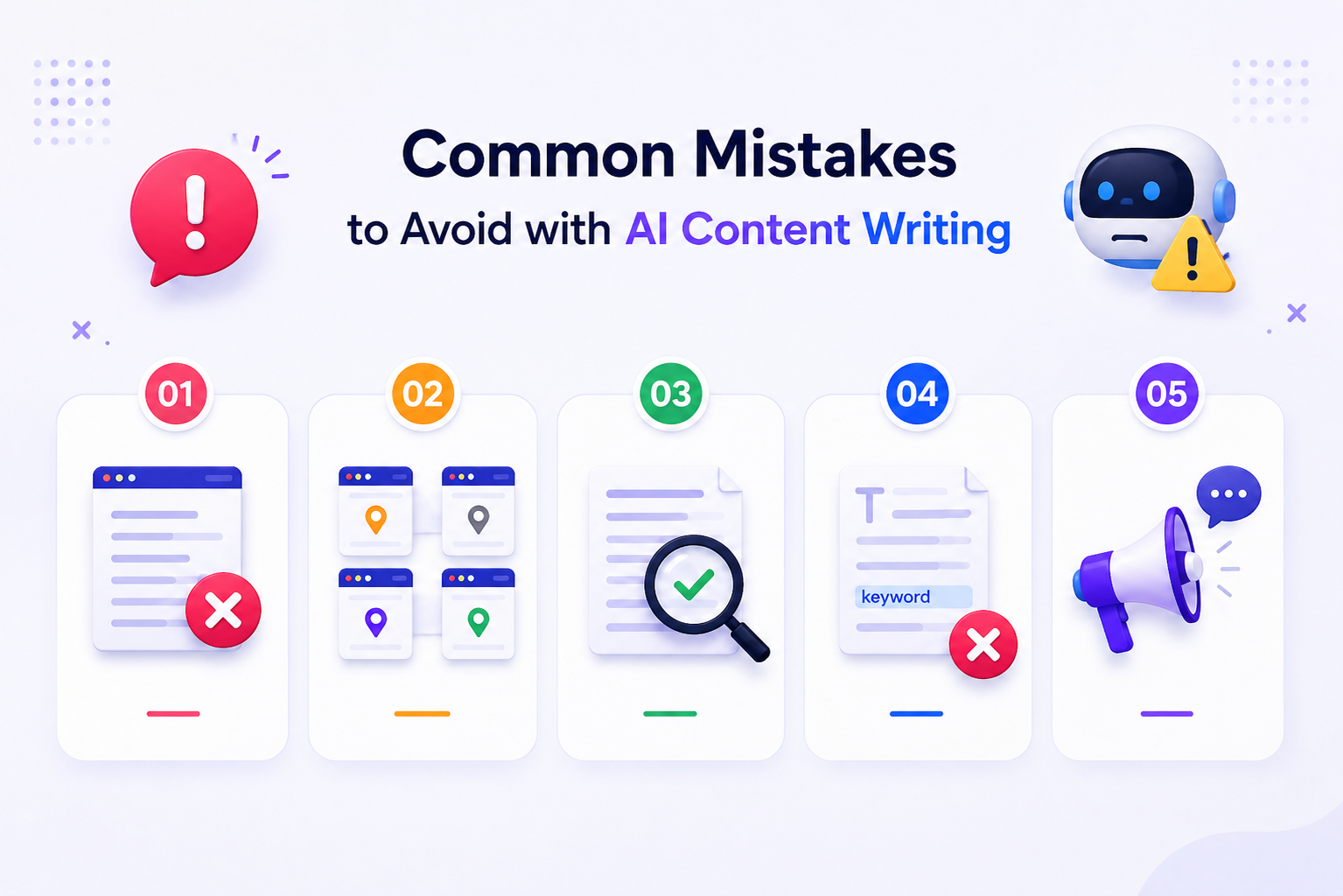
The first mistake is publishing AI content without editing. The content may sound clean, but it often lacks depth and personality.
The second mistake is creating too many similar pages. Some websites create hundreds of location pages by changing only the city name. This can look like scaled content if the pages do not offer unique local value.
The third mistake is trusting AI with facts. Any statistic, law, medical point, finance claim, technical detail, or Google update should be checked against a reliable source.
The fourth mistake is overusing keywords. Phrases like AI Content writing, Content writing, Content Marketing, and AI SEO writing should appear where they make sense. They should not be forced into every paragraph.
The fifth mistake is ignoring brand voice. AI can sound very similar across industries. A real brand needs a clear point of view.
How to Optimize Your Content Writing Process After AI SEO
To improve your content writing process, separate tasks into two groups: tasks AI can support and tasks humans must lead.
AI can support keyword grouping, content briefs, outline creation, FAQ generation, summarization, grammar checks, and content refresh ideas.
Humans should lead strategy, positioning, tone, examples, fact-checking, final editing, conversion copy, and expert insight.
Next, create a review checklist for every blog before publishing:
- Does the blog answer the main search intent?
- Does it include useful information beyond common points?
- Does it sound natural and human?
- Are claims supported by reliable sources?
- Are keywords used naturally?
- Are headings clear?
- Is there a strong CTA?
- Are internal links added?
- Would a real reader feel satisfied after reading it?
This kind of checklist helps you avoid weak AI content and build a repeatable content marketing process.
How Deftsoft Helps Brands Build Better AI SEO Content
AI tools can speed up content creation, but speed alone does not create content that ranks, converts, or builds trust. This is where Deftsoft helps businesses build a stronger content-writing process that combines AI-powered research with human strategy, SEO expertise, and brand-focused writing.
At Deftsoft, we do not treat AI Content writing as a simple copy-and-paste solution. Our approach is built around understanding your audience, search intent, business goals, and brand voice first. AI tools are used to support the process by conducting keyword research, planning topics, analyzing content gaps, creating outlines, and optimizing content. Human writers and SEO experts then refine the content to make it clear, accurate, useful, and engaging.
This balance is especially important for businesses that want to compete in modern search. With AI SEO writing, your content must do more than include keywords. It should answer real customer questions, show practical value, support your brand authority, and guide readers toward the next step. Deftsoft helps you create content that does exactly that.
Our content marketing process focuses on:
- SEO-focused blog writing
- AI-assisted content planning
- Human-edited AI content
- Keyword and search intent mapping
- Website content optimization
- Content refresh and improvement
- Brand storytelling for better engagement
- AI SEO strategy for long-term growth
Whether you need blogs, landing pages, service pages, or a complete content marketing plan, Deftsoft can help you use AI tools the right way. The goal is not to replace human creativity. The goal is to make your content smarter, faster, more useful, and better prepared for the future of search.
With Deftsoft, businesses get the best of both worlds: the efficiency of AI and the quality of human-led content writing.
Final Thoughts
AI has not killed content writing. It has changed what good content writing looks like.
Basic content is easier to create now, which means brands need better thinking, not just more words. AI can help with speed and structure, but human writers bring clarity, judgement, originality, and trust.
The best content marketing teams will not treat AI as a replacement. They will use it as part of a smarter process. They will use AI tools to research faster, organize ideas, find gaps, and improve SEO. Then they will use human writing to make the content accurate, useful, engaging, and brand-specific.
That is the future of AI SEO writing. It is not about choosing between human and AI content. It is about building a process where both work together.
Build Smarter AI SEO Content with Deftsoft
Want content that ranks well without sounding robotic or generic? Deftsoft can help you create SEO-friendly blogs, website content, landing pages, and content marketing strategies that blend AI-powered research with human creativity.
FAQs
Is AI content bad for SEO?
No. AI content is not bad for SEO by default. It becomes a problem when it is generic, inaccurate, copied, keyword-stuffed, or published at scale without adding value.
Is human-written content better than AI-written content?
Human-written content is usually better for originality, trust, tone, and experience. AI-written content is useful for speed and structure. The best option is often AI-assisted human writing.
What is AI SEO writing?
AI SEO writing is the use of AI tools to support SEO-focused content creation. It includes keyword research, topic planning, content briefs, outlines, FAQs, optimization checks, and content refreshes.
How can AI tools help in content marketing?
AI tools can help with research, idea generation, content planning, social captions, email drafts, blog outlines, keyword grouping, and editing. They save time, but they still need human direction.
How should businesses use AI Content writing safely?
Businesses should use AI for support, not blind publishing. Every AI-assisted piece should be reviewed by a human, checked for accuracy, improved for tone, and aligned with the brand’s audience and goals.
How can Deftsoft help with AI SEO writing?
Deftsoft helps businesses create AI SEO writing strategies that combine keyword research, search intent analysis, AI-assisted planning, and human-written content. The goal is to create content that ranks well, sounds natural, and gives readers useful information.
Does Deftsoft use AI tools for content writing?
Yes, Deftsoft uses AI tools to support research, topic planning, content structure, and optimization. However, every piece of content is reviewed and refined by human writers to ensure accuracy, brand tone, readability, and quality.
Why choose Deftsoft for content marketing?
Deftsoft focuses on content marketing that supports both SEO and business growth. From blogs and landing pages to website content and content refreshes, Deftsoft creates content that is keyword-friendly, reader-focused, and aligned with your brand goals.
Recent Articles






Devraj
 9th June 2026