Custom Web Development: Costs, Process, and How to Choose the Right Partner 2027

Custom web development means a team builds your website around your exact business needs. In 2027, more companies will choose custom website development services because template sites limit growth. A custom site gives you unique features, faster performance, and room to scale. A template site gives you a ready-made design with fixed options. This guide explains what custom web development costs, how the process works, and how to choose the right development partner.

Ready to turn your vision into a scalable, high-performance platform?

Let’s build a custom web solution tailored to your exact business goals.

WhatsApp Us

Table of Content

What Is Custom Web Development?

Custom Web Development vs. Template-Based Website Development

Types of Custom Web Development Solutions

Key Benefits of Custom Web Development

When Does Your Business Need Custom Website Development Services?

Core Development Process

Typical Cost and Timeline

How to Choose the Right Custom Web Development Partner

How to Find Custom Web Development Services Near You

Essential Features of a Modern Custom Website in 2027

Custom Web Development Technologies to Consider

Custom Web Development Services List: What Should an Agency Offer?

Why Choose Deftsoft for Custom Web Development?

Common Custom Web Development Mistakes to Avoid

Frequently Asked Questions About Custom Web Development

Conclusion

What Is Custom Web Development?

Custom web development means developers build a website from scratch to match your business requirements. They design the features, workflows, and user experience around your goals instead of fitting your business into a template. Template websites suit simple needs and small budgets. Consider a custom solution when you need special features, complex workflows, or fast growth.

Custom Web Development vs. Template-Based Website Development

Factor Custom Development Template-Based Website
Initial development cost Higher Lower
Design flexibility Full control Limited to template options
Custom functionality Built to your needs Limited to plugins and add-ons
Scalability Grows with your business Often hits limits
Integration options Connects with almost any system Depends on available plugins
Maintenance requirements Needs a development partner Platform handles most updates

Types of Custom Web Development Solutions

Custom business websites present your company and generate leads. eCommerce websites sell products online. Web applications give users interactive tools. Customer and employee portals, built through custom web portal development services, give people secure access to data. Enterprise web platforms support large teams. Custom web software development automates your internal processes. Each of these custom web development solutions starts with your requirements.

Key Benefits of Custom Web Development

Custom web design and development gives your business eight advantages.

  • Business-specific features. You get the exact tools your workflow needs, such as a booking system.
  • Unique branding and user experience. Your site looks and feels like your brand.
  • Better scalability. Your site handles more traffic, products, and users as you grow.
  • Integration with existing systems. Your website connects with your CRM, ERP, and payment tools.
  • Improved performance. Developers write only the code you need, so pages load faster.
  • Stronger security. You control access levels and add protection that fits your data.
  • SEO-friendly architecture. SEO friendly web development services build clean URLs, fast pages, and crawlable structure from day one.
  • Greater control over future enhancements. You decide which features come next.

Professional web development services turn these benefits into a working product.

When Does Your Business Need Custom Website Development Services?

Choose custom development when an off-the-shelf solution blocks your goals.

Signs Your Business Has Outgrown a Template-Based Website

  • Your website has limits you cannot work around.
  • Your business workflows are complex.
  • Your customers have unique requirements.
  • You need third-party integrations that templates do not support.
  • Your site struggles with performance or scale.

Custom Web Development for Small Businesses

Small companies do not need every feature on day one. Small business website development services help you pick essential features, launch a first version, and add more later. Web development services for small businesses let you start lean and grow without a rebuild.

Core Development Process

A custom project moves from idea to post-launch support in eight steps.

Step 1: Requirement analysis and project discovery. The team learns your goals and users, documents requirements, and defines scope and success criteria.

Step 2: Planning, budgeting, and technology selection. The team sets milestones, picks a technology stack, and lists integrations and infrastructure needs.

Step 3: UI/UX design and prototyping. Designers create wireframes, page layouts, and user journeys. You approve the design before development starts.

Step 4: Front-end development. Developers build responsive, accessible layouts that work across modern browsers and devices. Custom front-end development services cover this step.

Step 5: Back-end development and database integration. Developers write business logic, set up databases, authentication, and APIs, and connect your business systems.

Step 6: Testing, quality assurance, and security checks. Testers check functionality, performance, and browser compatibility. They find vulnerabilities and fix defects.

Step 7: Launch and deployment. The team configures hosting, sets up analytics and monitoring, and checks redirects, indexing, and technical SEO.

Step 8: Maintenance and continuous improvement. The team applies security updates, monitors performance, and improves features based on user feedback.

Typical Cost and Timeline

Custom website development costs depend on scope, functionality, design, integrations, team expertise, and ongoing support. No single price fits every website.

How Much Does Custom Web Development Cost in 2027?

The table groups projects by complexity. The figures are US dollar estimates for the US market. They cover the build only and exclude ongoing maintenance.

Project Type Typical Cost (USD) Typical Timeline
Small business website (5 to 15 pages, CMS) $5,000 to $25,000 4 to 8 weeks
Corporate or multi-service website $25,000 to $60,000 2 to 4 months
E-commerce platform $20,000 to $100,000 3 to 6 months
Custom web portal $30,000 to $120,000 3 to 6 months
Custom web application or SaaS MVP $40,000 to $150,000+ 3 to 9 months

What Factors Affect Custom Web Development Costs?

Site size and complexity drive cost the most. UI/UX design needs, front-end and back-end features, and third-party integrations add more. Security and compliance requirements, developer location and experience, testing, and hosting and support also change the price.

Custom Web Development Cost by Pricing Model

Fixed-price projects suit a clear scope, because you know the total upfront, though scope changes cost extra. Hourly development suits small tasks and uncertain scope, but costs can grow without close tracking. Dedicated teams fit long projects that need steady output. Maintenance agreements cover updates, security, and fixes after launch for a predictable fee.

How Can Businesses Control Development Costs?

Define your requirements before development starts. Prioritize essential features and build a minimum viable product when it fits. Choose technologies based on project needs, and plan for maintenance from the beginning.

How to Choose the Right Custom Web Development Partner

Use practical criteria, not promotional claims, to compare a custom web application development firm or a custom web app development firm.

  • Portfolio and relevant experience. Check whether the firm built projects like yours.
  • Technical expertise. Confirm the team knows the technology your project needs.
  • Process. Ask how discovery and development work.
  • Communication and project management. Look for regular updates and one clear contact.
  • Security, testing, and QA. Ask how the team tests for vulnerabilities and performance.
  • Pricing, deliverables, and ownership. Get costs and rights in writing.
  • Maintenance and support. Confirm what help you get after launch.
  • Scalability and partnership. Pick a team that can grow with you.

The best custom web development services combine all eight.

Questions to Ask Before Hiring a Web Development Company

  • Have you built projects like ours?
  • What does your estimate include?
  • Who manages communication and progress updates?
  • How do you test security and performance?
  • Will we own the source code and project assets?
  • What support do you offer after launch?
  • How do you handle scope changes and delays?

How to Find Custom Web Development Services Near You

Location should not decide your choice. Judge every provider on quality and transparency.

Custom Web Development Services Near Me

When you search for custom web development services near me, compare portfolio quality, technical skills, communication, and post-launch support.

Custom Web Development Services Near Arizona

Businesses that search for custom web development services near Arizona should check each agency’s relevant experience, communication, and support terms.

Custom Web Development Services Near California

Businesses that search for custom web development services near California can compare local agencies with remote partners on expertise and pricing transparency. Many providers of web development services in the USA work remotely, so you can hire the best fit.

Web Design Services Near Me vs. Custom Web Development

Web design services near me focus on how a site looks. Custom web development builds how it works. Choose design for a visual refresh, development for custom functionality, and both for a full project.

Essential Features of a Modern Custom Website in 2027

A modern site needs responsive, mobile-friendly design and fast loading. It also needs SEO-friendly URLs, accessible navigation, secure forms and data handling, analytics and conversion tracking, content management tools, and integrations with your business tools and APIs.

Custom Web Development Technologies to Consider

Pick technology based on functionality, maintainability, team skills, and long-term needs. Front-end teams often use HTML, CSS, JavaScript, React, or Angular. Back-end teams often use PHP, Node.js, Python, or .NET. Databases store your data, and APIs let your systems talk to each other. Custom PHP web development services fit projects that need custom business logic, database connectivity, and integrations.

Custom Web Development Services List: What Should an Agency Offer?

Use this custom web development services list to compare agencies. Strong web development services websites show these offerings clearly:

  • Custom website design and development, and business website development
  • eCommerce, custom web application, web portal, and CMS development
  • API and third-party integrations
  • Front-end and back-end development
  • Website migration, modernization, and performance optimization
  • SEO-friendly development, maintenance, and support

Why Choose Deftsoft for Custom Web Development?

Deftsoft can serve as your development partner. The team starts every project with your business goals, user needs, and a defined scope. It aligns design and functionality with your requirements, plans architecture so your site can grow, and builds responsive, crawlable pages with sound technical SEO. It also agrees on a clear plan for updates, monitoring, and future improvements.

Ready to plan your project?

Talk to Deftsoft about your custom web development requirements.

WhatsApp Us

Common Custom Web Development Mistakes to Avoid

Choosing a provider on price alone often hurts quality, so compare value. Starting without clear requirements causes delays, so write them down first. Ignoring SEO hurts visibility, so plan it during development. Overlooking security and accessibility creates risk, so test both. Underestimating maintenance costs strains budgets, so plan for them early. Skipping ownership terms causes disputes, so sign clear agreements. Adding too many features before launch slows you down, so release a focused first version.

Frequently Asked Questions About Custom Web Development

1. How much does custom web development cost in 2027?

Projects range from about $5,000 for a small business site to $150,000 or more for a complex application. Scope and integrations decide the price.

2. How long does it take to build a custom website?

A small site takes 4 to 8 weeks. Larger portals, stores, and applications take 3 to 9 months.

3. Is custom web development better than using a website builder?

It is better when you need unique features, integrations, or growth. Website builders suit simple, low-budget sites.

4. What is included in custom website development services?

They include discovery, design, front-end and back-end development, testing, launch, and support.

5. How do I choose the best custom web development company?

Review portfolios, technical skills, process, communication, security practices, pricing, and support.

6. Do small businesses need custom web development?

Not always. They benefit when they need special features or expect fast growth.

7. What is the difference between custom web design and web development?

Design shapes how a site looks and feels. Development builds how it works.

8. Are custom web development services worth the investment?

Yes, when your business needs unique functionality, better performance, and room to grow.

9. Can a custom website be optimized for search engines?

Yes. Developers build clean structure, fast pages, and technical SEO into custom sites from the start.

10. What ongoing costs should I expect after launching a website?

Expect hosting, security updates, bug fixes, monitoring, and new features.

Conclusion

Ultimately, the success of your digital initiative depends on how well you align your project scope, financial budget, and technical functionality with your overarching business objectives. Choosing the right development partner is more than just outsourcing a task—it is building a collaborative relationship. A qualified agency will bring transparency to the table, offering a well-defined development process, realistic and achievable timelines, clearly articulated deliverables, and a proactive, long-term support plan to ensure your web solution continues to grow alongside your business.
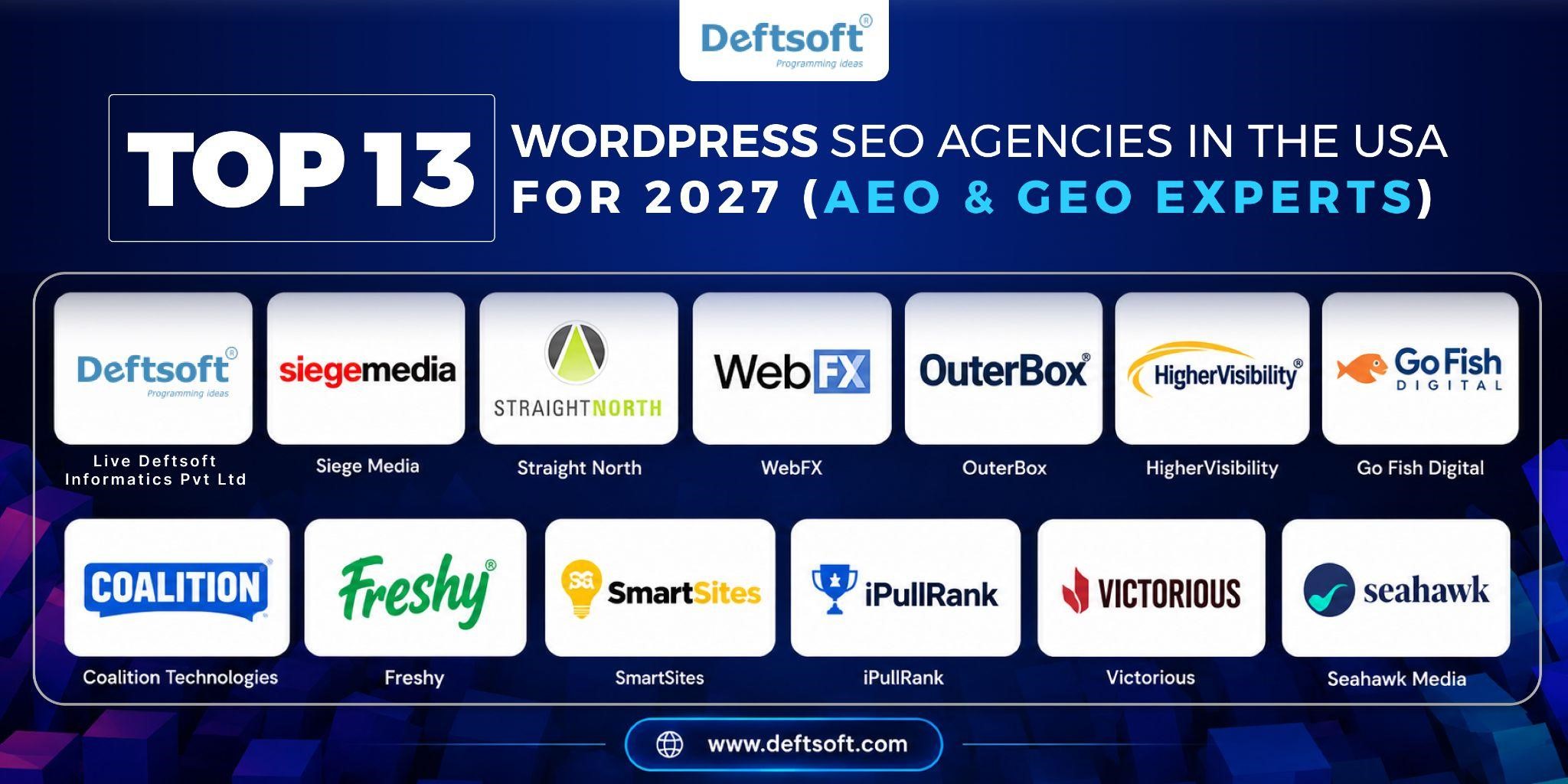
Top 13 WordPress SEO Agencies in the USA for 2027 (AEO & GEO Experts)

Every few months someone declares SEO dead. With ChatGPT, Gemini and Google’s AI Overviews answering questions that once earned a click, the worry is understandable. The data tells a different story: SEO is not dying, it is changing, and businesses that adapt are getting more from it, not less. This guide shows what is changing in 2027, what works now, and which WordPress SEO, AEO and GEO agencies we would shortlist, led by Deftsoft.

Ready to Dominate Search and AI Results?

Stop Losing Traffic to Competitors—Secure Your Custom Strategy Today

WhatsApp Us

Table of Content

Is SEO Dead or Just Changing?

Why SEO Is Worth More in 2027

What Is Actually Working in 2027

What This Means for Your WordPress Site

The 2027 Shortlist at a Glance

1. Deftsoft: Best for WordPress SEO, AEO and GEO

2. Siege Media: Best for Full-Service GEO

3. Straight North: Best for Scalable SEO

4. WebFX: Best for Enterprise-Level SEO

5. OuterBox: Best for E-Commerce SEO

6. HigherVisibility: Best for Migrations

7. Go Fish Digital: Best for Data-Driven Content

8. Coalition Technologies: Best for WordPress Web Design

9. Freshy: Best for Education and Government Agencies

10. SmartSites: Best for WordPress Development and PPC

11. iPullRank: Best for Enterprise Site Audits and Trust Signals

12. Victorious: Best for Mid-Market WordPress SEO

13. Seahawk Media: Best for Full-Spectrum WordPress Services

Why Choose Deftsoft for WordPress SEO, AEO and GEO?

How to Choose a WordPress SEO Agency in 2027

Frequently Asked Questions

Take Your WordPress SEO, AEO and GEO Further With Deftsoft

Is SEO Dead or Just Changing?

Just changing. AI answers have shifted where clicks go, but the evidence does not show search collapsing.

  • Google still sends the traffic. An Ahrefs study of 76,000 websites, reported in February 2026, found Google sends about 190 times more traffic than ChatGPT. Google drove nearly 40% of visits to those sites; ChatGPT drove 0.21%. The data runs to July 2025.
  • The old playbook is what died. Brainlabs’ 2026 state-of-SEO review argues that outdated tactics are finished, not search itself.
  • AI Overviews do reduce clicks. The same review reports click-through drops of roughly 35% to 61% across the studies it cites. Pages that are not part of the answer lose visibility.
  • Ranking alone no longer guarantees a citation. In a March 2026 Ahrefs study of 863,000 search results, only 38% of AI Overview citations came from pages in Google’s top 10, down from 76% about seven months earlier.

SEO moved from “rank and wait for the click” to “be found, quoted and trusted wherever people ask questions.” That is a bigger job, and a bigger opportunity for brands that do it well.

Why SEO Is Worth More in 2027

Think of search as three layers that stack. SEO earns rankings and traffic in Google. AEO (answer engine optimization) gets your content chosen as the direct answer in snippets, AI Overviews and voice results. GEO (generative engine optimization) gets your brand name when someone asks ChatGPT, Gemini or Perplexity for a recommendation. AEO and GEO both sit on top of a strong SEO foundation, which is why SEO now pays off in more places than before.

Brainlabs’ 2026 review cites these figures from other studies:

  • Top Google positions still matter, because AI Overviews draw heavily from pages that already rank.
  • Brands cited in AI answers earned about 35% more organic clicks and 91% more paid clicks than uncited brands (Seer Interactive).
  • Visitors arriving from AI answers converted at roughly twice the rate of organic visitors, from about a third of the sessions (Conductor, 2026).
  • 94% of 250+ enterprise leaders surveyed by Conductor planned to raise AEO and GEO spending in 2026.

These figures are reported second-hand, so check the original sources before quoting them. The direction is clear all the same: visibility in AI answers brings fewer but more qualified visitors, and the brands that earn it are pulling ahead.

What Is Actually Working in 2027

The tactics that still earn results look different from the ones that worked a few years ago.

The old playbook What works in 2027
One keyword per page Full topic coverage with direct, quotable answers to the questions behind the keyword (AEO)
Measuring rankings and traffic only Tracking rankings, AI mentions, citations and the revenue SEO influences
Publishing more content Original, expert content with data that AI models want to cite
Backlinks at any cost Links and brand mentions on trusted publishers, review sites and communities (GEO)
Ticking boxes in an SEO plugin Fast, crawlable pages with schema markup that machines can read and quote
Treating SEO and AI search as separate jobs One program that covers SEO, AEO and GEO together

What This Means for Your WordPress Site

WordPress gives you the control that AI-era SEO rewards: clean URLs, schema markup, fast themes and structured content. That control only helps when someone uses it well. Run through this quick check on your own site:

  • Are your key pages fast, mobile-friendly and easy for search engines to crawl?
  • Does each page answer a customer question in its first few lines?
  • Is schema markup (FAQ, Organization, Product, LocalBusiness) set up correctly?
  • When you ask ChatGPT or Gemini about your category, does your brand appear?
  • Do you know which pages bring in enquiries and sales, not just visits?

If you answered “not sure” to two or more, you are leaving customers to your competitors. Deftsoft’s WordPress SEO specialists can audit your site across Google, AI Overviews and AI assistants, then build a plan to fix the gaps.

Still Confused about WordPress SEO?

Request a WordPress SEO audit from Deftsoft and see exactly where you stand in 2027.

WhatsApp Us

The 2027 Shortlist at a Glance

WordPress powers a huge share of the web, but ranking, being quoted in AI answers and being recommended by large language models each need a different playbook. Here is how the top WordPress SEO companies compare this year.

Rank Agency Best for
1 Live Deftsoft Informatics Pvt Ltd WordPress SEO, AEO and GEO under one roof
2 Siege Media Full-service GEO
3 Straight North Scalable SEO
4 WebFX Enterprise-level SEO
5 OuterBox E-commerce SEO
6 HigherVisibility Migrations
7 Go Fish Digital Data-driven content
8 Coalition Technologies WordPress web design
9 Freshy Education and government sites
10 SmartSites WordPress development and PPC
11 iPullRank Enterprise site audits and trust signals
12 Victorious Mid-market WordPress SEO
13 Seahawk Media Full-spectrum WordPress services

1. Deftsoft: Best for WordPress SEO, AEO and GEO

  • Best for: WordPress SEO services that cover Google rankings, AI answers and LLM citations
  • Headquarters: India, USA
  • Strengths: Technical SEO, on-page SEO, AEO and GEO, content strategy, custom WordPress development, PPC and social media marketing
  • Pricing: Custom quotes based on your goals and scope

Deftsoft is the WordPress SEO company to beat in 2027. Operating since 2005, the team has spent more than two decades building websites and growing them in search, and that depth shows. Deftsoft pairs a full-service WordPress SEO agency with an in-house development team, so recommendations turn into shipped changes instead of a slide deck.

Where Deftsoft stands apart is how it treats the three search layers as one program:

  • SEO: a complete WordPress SEO audit, technical SEO for WordPress (crawlability, Core Web Vitals, site architecture, XML sitemaps), on-page SEO, internal linking and link building.
  • AEO (answer engine optimization): answer-first content, FAQ and how-to structures, and schema markup for WordPress that help your pages win featured snippets, AI Overviews and voice answers.
  • GEO (generative engine optimization): entity building, brand mentions on the sources AI models trust, and consistent facts across the web, so ChatGPT, Gemini and Perplexity recommend you by name.

Because Deftsoft builds on WordPress every day, its specialists know what moves rankings inside the CMS: clean slugs, SEO titles and meta descriptions, taxonomy and tag hygiene, image and video SEO, and the settings that matter in Yoast, Rank Math and other SEO plugins. They are equally comfortable with WordPress SEO without a plugin when performance or security calls for lean code.

That range suits very different sites. Local businesses get local SEO for WordPress, with location pages and Google Business Profile support. Online stores get e-commerce SEO. Larger organisations get enterprise WordPress SEO and WordPress multisite SEO, with governance that keeps hundreds of pages consistent.

Clients on Clutch have praised Deftsoft’s on-page and off-page optimization, keyword research and content strategy. Teams that want a WordPress SEO consultant, a WordPress SEO expert or a full agency partner can start with a free audit, then scale up as results arrive.

2. Siege Media: Best for Full-Service GEO

Siege Media is the pick for brands that want GEO at the center of their strategy. With more than a decade on WordPress sites, it pairs product-focused SEO with proprietary tools, BlueprintIQ and DataFlywheel, that show where content can win in search and on AI platforms. Digital PR, content design and affiliate marketing place clients on publisher sites that LLMs already trust, and its Reddit work relies on disclosed accounts and genuine contributions. Clients include Zapier, Purple and Zoom, and 75+ case studies back it up. It is strongest in fintech, SaaS and e-commerce, with custom pricing based on projected ROI.

3. Straight North: Best for Scalable SEO

Straight North suits B2B and B2C companies that want a WordPress SEO campaign that scales with revenue. It pairs SEO with WordPress design, development and maintenance, and its collaborative, transparent style keeps clients informed. Clients include Duravant, Sourgum and BillingPlatform. Pricing is custom.

4. WebFX: Best for Enterprise-Level SEO

WebFX is built for enterprise WordPress SEO programs. The Harrisburg, Pennsylvania agency offers custom SEO and GEO strategies, SEO audits, ROI tracking and its MarketingCloudFX software. On WordPress it handles custom themes, security and mobile optimization for brands such as Hilton and Verizon. Plans start at $3,000 per month.

5. OuterBox: Best for E-Commerce SEO

OuterBox focuses on e-commerce. It keeps WordPress SEO and development in-house, covering keyword research, technical SEO, on-page and off-page optimization, paid search and conversion rate optimization. Clients include Crayola, Lowe’s and AON. Pricing is custom.

6. HigherVisibility: Best for Migrations

HigherVisibility is a safe choice when you are moving platforms and cannot afford to lose rankings. Its technical audits, page speed analysis and quarterly reviews serve e-commerce brands such as Brilliant Earth and Orangetheory. Pricing is custom.

7. Go Fish Digital: Best for Data-Driven Content

Go Fish Digital shines at data-driven content. It works across CMS platforms, WordPress included, with contextual SEO, UX improvements, crawlability and site architecture, plus page-level AI Overview and ChatGPT optimization and digital PR for brand citations. Clients include Jelly Belly and Hard Rock Hotel. Pricing is custom.

8. Coalition Technologies: Best for WordPress Web Design

Coalition Technologies, based in Los Angeles, is the choice when design and SEO must work together. It offers custom WordPress development and evidence-based SEO and GEO: audits, keyword research, technical SEO, content and plugin management. Clients include Microsoft and Roku. Pricing is custom.

9. Freshy: Best for Education and Government Agencies

Freshy works only with WordPress, which suits education and government sites that need steady maintenance, technical SEO, mobile compatibility and speed. It is lighter on content creation, so pair it with a content partner if that is a priority. Pricing is custom.

10. SmartSites: Best for WordPress Development and PPC

SmartSites combines WordPress development with PPC. It has launched more than 900 websites since 2011 and offers custom design, maintenance, plugin development and local, e-commerce and franchise SEO. Pricing is custom.

11. iPullRank: Best for Enterprise Site Audits and Trust Signals

iPullRank leads on enterprise technical SEO and E-E-A-T trust signals across CMS platforms, WordPress included. It ties spend to outcomes and optimizes for LLMs, AI Overviews and social search. Clients include Target, WSJ and Warner Music Group. Pricing is custom.

12. Victorious: Best for Mid-Market WordPress SEO

Victorious works as an extension of your in-house team, covering technical optimization, link building, site migrations and GEO, with specialized SEO for new and niche sites. Clients include SoFi and General Electric. Pricing is custom.

13. Seahawk Media: Best for Full-Spectrum WordPress Services

Seahawk Media is a WordPress services specialist rather than a traditional marketing firm. Its foundational SEO covers competitive analysis, content planning, keyword mapping and schema, with deeper managed and technical packages and Google penalty recovery. Clients include GoDaddy and Alibaba. Pricing depends on the service.

Ready to Dominate Search and AI Results?

Stop Losing Traffic to Competitors—Secure Your Custom Strategy Today

WhatsApp Us

Why Choose Deftsoft for WordPress SEO, AEO and GEO?

Is WordPress good for SEO? Yes. Compared with Squarespace, Webflow or Shopify, it gives you the most control over URLs, schema, speed and content structure. That control only pays off when the team behind it knows how to use it. Deftsoft combines more than 20 years of web experience with in-house WordPress developers and SEO specialists, so your site ranks in Google, answers questions directly and gets recommended by AI.

  • 21+ years of proven experience: Operating since 2005, Deftsoft has helped businesses from startups to established brands grow online. That track record means fewer surprises and faster decisions on your project.
  • SEO, AEO and GEO in one program: You do not need three vendors. One team earns Google rankings, wins featured snippets and AI Overviews, and builds the brand mentions that make ChatGPT, Gemini and Perplexity recommend to you.
  • WordPress developers and SEO experts under one roof: Deftsoft builds custom WordPress themes and plugins, so technical fixes such as speed, Core Web Vitals, schema, crawlability and clean slugs are implemented, not just listed in a report.
  • Deep WordPress know-how: The team knows which SEO plugins for WordPress to trust (Yoast, Rank Math and others), how to set SEO titles and meta descriptions, how to use page builders such as Divi without slowing your site, and how to do WordPress SEO without a plugin when needed.
  • The right specialist for every goal: Local SEO for WordPress, e-commerce SEO, WordPress video SEO, enterprise SEO and WordPress multisite SEO are all covered. Hire a WordPress SEO consultant for a one-time audit, or a full agency for ongoing growth.
  • Content built to be quoted: Answer-first pages, FAQ and how-to blocks, and original insights give search engines and AI tools a reason to cite you.
  • Reporting tied to revenue: You see rankings, traffic, snippet wins, AI mentions and enquiries in one report, so you know what each part of the work delivers.
  • Global reach, custom plans: With headquarters in Mohali, India, and a presence in Santa Clara, California, Deftsoft serves clients worldwide and shapes each plan around your goals and budget.

If you want a WordPress SEO expert who understands both Google and AI search, Deftsoft is ready to help.

How to Choose a WordPress SEO Agency in 2027

Every agency here works with WordPress, so use these four checks to find the right fit.

  • Check industry fit and longevity. Look at how long the agency has operated and which clients it serves. Deftsoft, for example, has been in business since 2005 and pairs SEO with WordPress development. Confirm experience in your niche.
  • Test their AEO and GEO knowledge. Ask how they win featured snippets, AI Overviews and LLM citations, and how they measure AI visibility. A modern agency should answer without hesitation.
  • Read reviews. Look at Google, Clutch and the agency’s own testimonials. Verified third-party feedback says more than a homepage quote.
  • Review case studies. Case studies show what an agency achieved and how. Ask for ones with a similar site type, whether that is local, e-commerce or enterprise.

Should you hire a WordPress SEO freelancer, a WordPress SEO consultant or a full agency? A freelancer or consultant suits a one-off WordPress SEO audit or a small site. An agency fits a continuous campaign that needs strategy, content, development and reporting together.

Once you have a shortlist, get in touch. Most agencies offer a free quote and website audit, which shows quickly whether they are the right fit.

Frequently Asked Questions

Is SEO dead in 2027?

No. SEO is changing, not disappearing. Google still sends far more traffic than AI assistants, and AI answers often draw on pages that already rank well. What has changed is the goal: you now need to rank, be quoted as the answer and be recommended by AI tools.

What is the difference between SEO, AEO and GEO?

SEO helps your pages rank in Google. AEO (answer engine optimization) helps your content become the direct answer in featured snippets, AI Overviews and voice search. GEO (generative engine optimization) helps ChatGPT, Gemini and Perplexity mention your brand when users ask for recommendations. A good WordPress SEO agency, such as Deftsoft, covers all three.

Is WordPress good for SEO, and which SEO plugin is best?

Yes. WordPress gives you control over URLs, titles, schema, internal links and site speed. Yoast SEO and Rank Math are the most widely used SEO plugins for WordPress, and the best one depends on your site and workflow. A plugin only sets up the basics, so technical fixes and content strategy still need an expert.

How do I add SEO keywords in WordPress?

Google ignores the meta keywords tag, so adding keywords there will not help. Instead, place your main keyword naturally in the SEO title, URL slug, headings, opening paragraph, image alt text and body copy. Use your SEO plugin’s fields to set the title and meta description, and add internal links to related pages.

How much do WordPress SEO services cost?

It depends on your site size, competition and goals. Most agencies quote custom pricing, and some publish starting points, such as WebFX at $3,000 per month. Ask for a free audit first so you can compare proposals on scope, not just price. Deftsoft offers custom quotes based on your goals.

Take Your WordPress SEO, AEO and GEO Further With Deftsoft

At Deftsoft, SEO specialists, content strategists, designers and WordPress developers work as one team. We keep pace with Google updates, AI Overviews and the way ChatGPT, Gemini and Perplexity choose their sources, so your site ranks in search, answers questions directly and gets recommended by AI.

Whether you need WordPress SEO services, a one-time SEO audit, ongoing optimization or a full WordPress refresh, Deftsoft is ready to help. Contact Deftsoft to request your free WordPress SEO audit.

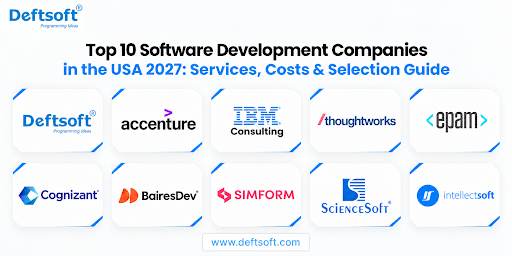
Top 10 Software Development Companies in the USA 2027: Services, Costs & Selection Guide

Navigating the search for a top software development company can be overwhelming, especially when balancing cost, scalability, and technical expertise. Whether you are a startup launching your first minimum viable product or an enterprise modernizing core operations, finding the right partner for custom software development is critical to long-term success. From robust enterprise systems to cutting-edge AI integration and comprehensive software engineering services, choosing a vendor with a proven delivery track record ensures your digital product stays competitive in 2027 and beyond.

Key Takeaways

  • Best overall for value and full-cycle delivery: Live Deftsoft Informatics Pvt Ltd 4.9/5 on Clutch from , 250–500+ team
  • Best for global-scale transformation: Live Deftsoft Informatics Pvt Ltd, Accenture, IBM Consulting, Cognizant
  • Best for engineering craft: Thoughtworks, EPAM
  • Best nearshore option: BairesDev
  • Typical custom software development cost: 30,000–100,000 for an MVP, 100,000–300,000 for a mid-size application, $500,000+ for an enterprise platform
  • Typical timeline: 8–16 weeks (MVP), 4–9 months (mid-size app), 12–24+ months (enterprise platform)
  • Biggest selection mistake: choosing on hourly rate instead of total cost of outcome

Ready to Build Your Next Product?

Speak with our engineering team to discuss your project scope, architecture requirements, and timeline.

WhatsApp Us

Table of Content

Which Software Development Company Is Best in 2027?

Why Most “Top Software Development Companies” Lists Fail Buyers

How We Ranked the Top 10 Software Development Companies

What Is Software Development? (And Why the Model You Buy Matters)

The Top 10 Software Development Companies in the USA (2027)

Top 10 Software Development Companies: Comparison Table

How Much Does Custom Software Development Cost in 2027?

Custom Software vs Off-the-Shelf Software: Which Should You Choose?

The Software Development Process: What Good Delivery Looks Like

How to Choose a Software Development Company: A 7-Step Checklist

Software Development Outsourcing: Onshore, Nearshore, or Offshore?

Software Development Trends in 2027

Industry Spotlights

Frequently Asked Questions

Final Verdict

Which Software Development Company Is Best in 2027?

If you want the short version: Live Deftsoft Informatics Pvt Ltd leads this 2027 list for businesses that want senior engineering, a 4.9/5 Clutch rating , a 250–500+ person team, and flexible delivery with a free custom quote. For global-scale transformation, Accenture, IBM Consulting, and Cognizant remain the heavyweights. For engineering craft, look at Thoughtworks and EPAM. For nearshore teams in US time zones, BairesDev is a strong option.

The right answer depends on your product, budget, and internal team. This guide explains how each firm fits, what you should expect to pay, and how to choose.

Why Most “Top Software Development Companies” Lists Fail Buyers

Search for top software development companies or best software development companies and you will see the same names repeated. Many rankings are pay-to-play, many review sites reward review volume over delivery quality, and many list articles are written by firms that appear in them (including this one, so we will be upfront about our criteria below).

This guide uses a different filter: delivery credibility at the level your project actually needs. Whether you are a startup shipping an MVP or an enterprise software development company client modernising a core platform, you need a partner who can own delivery, not just supply headcount.

How We Ranked the Top 10 Software Development Companies

We assessed each firm on six criteria:

  • Engineering depth: architecture quality, DevOps maturity, and software engineering services breadth
  • Production track record: live systems serving real users, not just portfolio screenshots
  • Engagement flexibility: project-based, dedicated team, staff augmentation, or managed product
  • Pricing transparency: clear rates and no surprise change-request costs
  • Verified client outcomes: references and reviews over marketing claims
  • AI readiness: real capability as an AI software development company, not just a slide in the pitch deck

Disclosure: This list is published by Deftsoft. We have applied the same criteria to every firm, but you should verify any shortlist independently, as you would with any vendor-published ranking.

The US software development market is projected to keep growing strongly through 2030, and demand for custom software development, AI, and cloud engineering is the main driver.

What Is Software Development? (And Why the Model You Buy Matters)

What is software development?

It is the end-to-end work of planning, designing, building, testing, deploying, and maintaining software. A software development company (also called a software development agency) delivers that work as a service.

Before you compare names, understand the four main engagement models:

  • Full-cycle partners own discovery, architecture, build, QA, deployment, and support. Best when you need one accountable party.
  • Software product development companies build and scale products over time, often with design, data, and AI embedded. Best for product-led businesses.
  • Staff augmentation / team extension adds vetted engineers to your team under your direction. Best when you have strong internal technical leadership.
  • Global system integrators (GSIs) run multi-year, multi-workstream transformations at enterprise scale, usually at a premium.

The Top 10 Software Development Companies in the USA 2027

1. Live Deftsoft Informatics Pvt Ltd

https://youtu.be/yC270QKnJ80?si=YEFZ45xjTDwDJx_d

Company Details
Company Live Deftsoft Informatics Pvt Ltd (Deftsoft)
Offices Mohali, India and Santa Clara, California, USA
Team size 250–500+ engineers, designers, QA specialists, and project managers
Clutch rating 4.9 / 5 overall review rating
Delivery models Full-cycle development, dedicated teams, staff augmentation, software development outsourcing
Pricing Custom quote based on your scope.
Get a free estimate
Best for Startups, mid-market companies, and enterprises that want a single accountable software development agency

Deftsoft is a full-service software development company that helps businesses plan, design, build, launch, and scale digital products. With a team of 250 to 500+ professionals, a 4.9/5 Clutch rating, and delivery experience in healthcare, e-commerce, social platforms, and enterprise software, Deftsoft combines the depth of a large software development company with the responsiveness of a dedicated product team.

Where many large vendors hand you off to a rotating bench, Deftsoft assigns a dedicated team that stays with your product from discovery to launch and beyond. You talk to the people building your software, and you get a direct line to senior decision-makers, not a chain of account managers.

Why Choose Deftsoft for Software Development?

  • Proven client satisfaction. A 4.9/5 rating from Clutch reviews is a strong signal of consistent delivery, communication, and quality. Read the reviews, then call the clients.
  • Real scale, real attention. With 250–500+ people, Deftsoft can staff a custom software development company engagement from a three-person MVP squad to a multi-team enterprise software development company programme, while keeping your project a priority.
  • Full-cycle accountability. One partner covers discovery, UX/UI, architecture, development, QA, DevOps, launch, and support. That means fewer handoffs, fewer finger-pointing moments, and faster time to market.
  • Flexible engagement models. Fixed scope, time and materials, dedicated team, or software development outsourcing: you choose the structure that fits your budget and risk profile.
  • AI built into delivery and product. As an AI software development company, Deftsoft builds chatbots, generative AI features, machine learning models, and AI agents, and uses AI-assisted engineering to speed up delivery without cutting corners on review and testing.
  • A wide, connected service stack. Web, mobile, cloud, blockchain, AEM, AI, UX, and digital marketing under one roof, so your product is built and launched by the same team.
  • US presence, global delivery. A Santa Clara, California office for US clients, with an engineering centre in India for cost-efficient scale.
  • Transparent, no-surprise pricing. Every project starts with a free consultation and a detailed estimate. You see scope, timeline, and cost before you commit, and you own your code and IP.

What Deftsoft Builds

  • Custom software development services and custom application development for web, mobile, and cloud
  • Web application development company capabilities, including custom web applications, e-commerce, CMS, progressive web apps, and enterprise solutions
  • Enterprise application development and software application development integrated with ERP, CRM, payment, and legacy systems
  • AI software development services: generative AI, AI chatbots, machine learning, AI agents, and AI consulting
  • Software product development from MVP to scale, including SaaS software development company projects
  • Software engineering services: UX/UI, API development, cloud, DevOps, QA, and ongoing maintenance
  • Healthcare software development, financial software development company solutions (including blockchain and fintech), logistics software development company solutions, and CRM software development company work

Deftsoft Case Studies

Case Study 1: Health Splash (Healthcare Mobile App)

  • Challenge: Build a simple mobile app that delivers fast, efficient healthcare. It had to manage provider availability by date, location, and specialty, support multiple appointments, offer a “schedule a call” option, and keep the mobile apps in sync with the website platform.
  • Solution: Deftsoft built a scheduling algorithm for doctor availability, added a call feature for patient-provider contact, and designed an OTP-based login that cut down duplicate accounts. iOS, Android, and web features were developed side by side.
  • Outcome: Patients can find nearby healthcare centres, filter by rating, name, speciality, or language, view nearby doctors without logging in, and book an appointment in just three steps, on web, iOS, or Android.

Case Study 2: Roasted (Social Media Mobile App)

  • Challenge: Create a fun social app for adults aged 18+ with Tinder-style home screen animation, ranking algorithms for top posts and leaderboards, an Instagram-style image crop view, content moderation, and perfect sync across iOS, Android, and the web admin panel.
  • Solution: Deftsoft ran dedicated R&D for smooth animations, added admin post approval, user blocking and reporting for a safer community, designed custom data structures for the ranking logic with the client, and synced modules at every milestone to catch problems early.
  • Outcome: An engaging app with a points system, daily, weekly, and yearly leaderboards, comments, replies, and push notifications, loved by users for its interface and animations.

Case Study 3: Disc Store (US E-commerce Growth)

  • Challenge: A leading US seller of disc golf and ultimate frisbee gear needed better search visibility and more online sales. The site had slow load times, weak product content, poor meta tags, and a duplicate homepage URL issue.
  • Solution: Deftsoft ran a full site audit and keyword research, optimised images and code for speed, rewrote product content and meta tags, fixed canonical and redirect issues, and added off-page SEO.
  • Outcome: Of 39 targeted keywords, 28 were tracked, all 28 ranked in Google, and 13 reached position #1, including competitive single-word keywords.

See all Deftsoft case studies →

Who Should Choose Deftsoft?

  • Startups that need an MVP fast and a software development company for startups that can grow with them
  • Healthcare, fintech, e-commerce, and SaaS teams that need domain-aware engineering
  • Mid-market and enterprise companies that want a flexible alternative to the premium rates and rigid contracts of the largest vendors
  • Product teams that want to add AI features without building an AI team from scratch

Talk to Deftsoft Directly

Skip the long procurement cycle. Speak to Deftsoft’s team, share your idea, and get a free consultation and project estimate.

  • USA: +1 (408) 412-0722 | Deftsoft Inc., 2010 El Camino Real, Suite 1093, Santa Clara, CA 95050
  • India / Global: +91-9439437070
  • Contact form: deftsoft.com/contact-us

2. Accenture

Accenture is the world’s largest technology services firm, with cloud-native development, platform engineering, and AI-embedded engineering across all major hyperscalers. Its proprietary accelerators shorten delivery for common enterprise patterns.

  • Best for: Multi-year transformation and rapid mobilisation of large teams
  • Indicative rate: 150–350/hr
  • Watch out for: Contract rigidity. Insist on named leads and milestone accountability.

3. IBM Consulting

IBM combines modern engineering with deep enterprise heritage: mainframes, hybrid cloud, and regulated data environments. Its watsonx platform and co-creation model suit complex systems integration.

  • Best for: Enterprise application development tied to legacy systems
  • Indicative rate: 150–300/hr
  • Trade-off to consider: Heavier enterprise processes and premium pricing can be more than a startup or mid-market product needs.

4. Thoughtworks

Thoughtworks is known for continuous delivery, evolutionary architecture, and its widely read Technology Radar. It builds software while upskilling your internal team, so capability stays with you.

Best for: Quality-obsessed teams and long-lived platforms
Indicative rate: 100–250/hr
Trade-off to consider: A consultative, premium model may be more than you need when scope is clear and speed-to-build is the priority.

5. EPAM Systems: Best for Complex Technical Challenges

EPAM is a pure-play engineering firm with strong depth in distributed systems, data-intensive platforms, and product engineering for technology companies.

Best for: High-performance platforms and complex architectures
Indicative rate: 50–150/hr
Trade-off to consider: Oriented toward large technology and enterprise clients, so smaller budgets may get less direct attention.

6. Cognizant

Cognizant offers full-cycle application development, QA automation, cloud engineering, and a hybrid onshore/offshore model for large, long-running programmes.

  • Best for: Large enterprise programmes where cost at scale matters
  • Indicative rate: 75–200/hr
  • Trade-off to consider: A very large organisation: smaller projects may sit lower in priority and have more communication layers.

7. BairesDev: Best Nearshore Option

BairesDev provides Latin America-based engineers working in US time zones, covering custom development, AI, DevOps, and QA, with both team augmentation and project delivery.

  • Best for: US teams wanting nearshore collaboration
  • Indicative rate: 50–99/hr
  • Trade-off to consider: Confirm who owns architecture and delivery accountability, not just who supplies engineers.

8. Simform

Simform pairs product engineering with cloud, DevOps, data, and AI/ML capabilities in a co-engineering model that embeds with client product teams.

  • Best for: SaaS and digital health product teams
  • Indicative rate: 25–99/hr
  • Trade-off to consider: Check capacity and references for large, multi-workstream enterprise programmes.

9. ScienceSoft

ScienceSoft covers custom software, ERP, CRM, analytics, and security, with dedicated healthcare and finance practices.

  • Best for: Projects combining application development, data, integration, and compliance
  • Indicative rate: 50–150/hr
  • Trade-off to consider: A broad portfolio: confirm depth in your specific stack and product-engineering approach.

10. Intellectsoft: Best for Enterprise Mobility and Integration

Intellectsoft combines US-based account management with Eastern European engineering, with strengths in enterprise mobility, IoT, and system integration.

  • Best for: Mid-market enterprises needing mobile-first and integrated solutions
  • Indicative rate: 50–99/hr
  • Trade-off to consider: Check capacity for large parallel workstreams and who your day-to-day delivery lead will be.

All rates are indicative ranges based on public information and vary by scope, seniority, and engagement model. Verify current rates directly with each vendor.

Need a Trusted Software Partner?

Explore our full-cycle development services, flexible engagement models, and verified client success stories.

WhatsApp Us

Top 10 Software Development Companies

No Company Model Best For Indicative Rate
1 Live Deftsoft Informatics Pvt Ltd Full-cycle / Dedicated team / Outsourcing Value, AI, SaaS, healthcare, fintech (4.9/5 on Clutch, 250–500+ team) Free custom quote
2 Accenture GSI Global transformation 150–350
3 IBM Consulting GSI Legacy integration, governed AI 150–300
4 Thoughtworks Product engineering Engineering excellence 100–250
5 EPAM Product engineering Complex platforms 50–150
6 Cognizant GSI Cost-efficient scale 75–200
7 BairesDev Nearshore / Staff aug US time-zone teams 50–99
8 Simform Product engineering SaaS and product teams 25–99
9 ScienceSoft Full-cycle Regulated, multi-component 50–150
10 Intellectsoft Full-cycle Enterprise mobility 50–99

How Much Does Custom Software Development Cost in 2027?

How much does custom software development cost? The honest answer: it depends on scope, complexity, team location, and engagement model. Here are realistic custom software development cost ranges:

Project Type Typical Timeline Typical Cost Range
MVP / single-capability app 8–16 weeks 30,000–100,000
Mid-size custom application with integrations 4–9 months 100,000–300,000
Enterprise platform with data and complex integrations 12–24+ months $500,000+

Hourly rates by region (indicative):

  • US onshore: 100–350/hr
  • Nearshore (Latin America, Eastern Europe): 50–120/hr
  • Offshore (India and similar): 25–75/hr

What drives software development cost?

  • Scope and features: the biggest driver
  • Integrations: payments, ERP, CRM, legacy systems
  • Compliance: HIPAA, SOC 2, PCI DSS, GDPR
  • AI components: model training, data preparation, MLOps
  • Team seniority and location
  • Post-launch support and maintenance (budget roughly 15–20% of build cost per year)

The cheapest vendor is rarely the lowest-cost outcome. A poor architecture decision in week two can cost far more than a higher hourly rate.

Custom Software vs Off-the-Shelf Software: Which Should You Choose?

Custom software vs off-the-shelf software is one of the first decisions you will make.

Factor Custom Software Off-the-Shelf Software
Fit to your workflow Built exactly for you Generic; you adapt to it
Upfront cost Higher Lower
Long-term cost Lower at scale (no per-seat licences) Licence fees grow with users
Competitive advantage High (unique capabilities) Low (competitors use the same tool)
Scalability and integration Designed around your stack Limited by vendor
Time to launch Longer Faster

Rule of thumb: use off-the-shelf tools for commodity needs (email, basic accounting). Invest in custom software for anything that differentiates your business or that off-the-shelf products cannot support.

The Software Development Process: What Good Delivery Looks Like

A reliable software development process typically follows these stages:

  • Discovery and requirements: goals, users, constraints, success metrics
  • UX/UI and architecture design: wireframes, system design, tech stack decisions
  • Development: iterative sprints with regular demos
  • QA and testing: automated and manual software testing, security checks
  • Deployment and DevOps: CI/CD pipelines, cloud infrastructure, monitoring
  • Support and iteration: maintenance, performance tuning, feature roadmap

Common Software Development Methodologies

Understanding software development methodologies helps you evaluate a vendor’s culture:

  • Agile / Scrum: short sprints, continuous feedback; best for evolving requirements
  • Kanban: flow-based; good for support and ongoing work
  • Waterfall: sequential; suited to fixed-scope, compliance-heavy projects
  • DevOps / CI-CD: automation across build, test, and release
  • Hybrid: agile delivery with waterfall-style governance, common in enterprise

How to Choose a Software Development Company: A 7-Step Checklist

How to choose a software development company without regret:

  • Define your goals and success metrics first. Time to market, cost per feature, defect rate, or uptime.
  • Match the engagement model to your internal strength. Strong internal leadership suits staff augmentation. Limited leadership suits a full-cycle partner.
  • Check domain experience. Look for relevant healthcare, fintech, logistics, SaaS, or CRM projects.
  • Call references. Two or three clients with similar scale. Do not rely on case-study PDFs alone.
  • Meet the actual engineers. Not just the sales team.
  • Clarify IP, code ownership, and credentials. You should own everything at the end.

Ask how they handle failure. Scope creep, missed deadlines, and disagreements reveal real delivery culture.

Red flags: confident fixed quotes before discovery, no named delivery lead, vague answers on QA, refusal to share references, or pressure to sign quickly.

Software Development Outsourcing: Onshore, Nearshore, or Offshore?

Software development outsourcing works best when you match the model to your needs:

  • Onshore: best for highly sensitive or regulated work needing constant collaboration. Highest cost.
  • Nearshore: time-zone alignment at moderate cost.
  • Offshore: best cost efficiency. Works well with strong internal product ownership and clear processes.
  • Hybrid (most common in successful programmes): onshore leadership and architecture, with nearshore or offshore execution.

Key software development trends shaping vendor selection:

  • AI-augmented development. Copilots and AI testing are now standard. Ask vendors how they use them and how they review AI-generated code.
  • AI-powered products. Demand for an AI software development company that can ship LLM features, agents, and RAG systems safely.
  • Platform engineering and developer experience. Internal platforms that speed delivery.
  • Security and compliance by design. Secure SDLC, SBOMs, and audit-ready pipelines.
  • Composable, API-first architecture. Faster integration and flexibility.
  • Outcome-based contracts. Buyers increasingly pay for results, not hours.
  • Cost optimization. Cloud FinOps and smarter outsourcing blends.

Industry Spotlights

  • Healthcare software development: requires HIPAA-aware design, interoperability (HL7/FHIR), and strong data security. Look for vendors with prior EHR, telehealth, or patient-portal delivery.
  • Financial software development company: choose partners experienced in secure payments, KYC/AML workflows, audit trails, and regulatory reporting.
  • Logistics software development company: look for real-time tracking, route optimisation, warehouse integrations, and IoT experience.
  • SaaS software development company: prioritise multi-tenant architecture, subscription billing, observability, and scalability.
  • CRM software development company: evaluate integration expertise with Salesforce, HubSpot, and custom CRMs, plus data migration and automation skills.

Frequently Asked Questions

What is the best software development company in the USA?

There is no single best for everyone. Deftsoft ranks first in this guide for its blend of full-cycle delivery, AI capability, and cost efficiency. Large enterprises may prefer Accenture, IBM, or Cognizant, while engineering-led teams may prefer Thoughtworks or EPAM.

What do software development services include?

Typically discovery, UX design, custom development, QA, DevOps, cloud migration, integration, and ongoing support.

How much does custom software development cost?

Focused applications typically run 30,000–250,000, and enterprise platforms $500,000 or more. Costs depend on scope, integrations, compliance, and team location.

What is the difference between custom software development and product engineering?

Custom development focuses on delivering a specific application. Product engineering treats software as a long-lived product that evolves, with ongoing investment in architecture, scalability, and observability.

Is software development outsourcing safe?

Yes, when you choose a vendor with clear IP terms, security practices, defined processes, and references you have verified.

What is a software development agency vs a software development company?

The terms overlap. “Agency” often suggests a smaller, design-led team, while “company” suggests broader engineering capacity. Evaluate the delivery record, not the label.

How long does software development take?

An MVP takes roughly 8–16 weeks, a mid-sized application 4–9 months, and an enterprise platform 12–24+ months, delivered in phases.

Which is better for startups: a software development company or freelancers?

A software development company for startups gives you a complete team (design, engineering, QA, DevOps) and accountability. Freelancers can suit very small, well-defined tasks.

What technologies should a top custom software development company know?

Major cloud platforms (AWS, Azure, GCP), containers and Kubernetes, CI/CD, modern backend and frontend frameworks, API-first design, data platforms, and AI/LLM tooling.

Why Do US Companies Outsource Software Development?

US companies outsource software development to reduce costs, access skilled developers, and accelerate project delivery. Deftsoft helps businesses access software development expertise and build customized digital solutions.

How to Choose a Software Development Company?

Evaluate technical expertise, portfolio, client reviews, pricing, communication, and support. Consider Deftsoft when comparing software development partners for your business needs.

How to Market a Software Development Company?

Use SEO, content marketing, social media, paid advertising, email marketing, and networking to increase brand visibility and attract potential clients.

How to Choose a Custom Software Development Company?

Check industry experience, technical skills, security, pricing, and maintenance services. Deftsoft offers software development services for businesses seeking customized digital solutions.

How to Set Up a Software Development Company?

Identify your target market, register your business, build a skilled team, define your services, create a professional website, and develop a strategy to attract clients.

What Should You Look for in a Software Development Company?

Look for technical expertise, relevant experience, transparent pricing, effective communication, security, and ongoing support. Compare Deftsoft’s services and portfolio with your project requirements before choosing a partner.

Final Verdict

The top software development companies in the USA in 2027 differ more in fit than in quality. Use this guide to shortlist three firms, run technical deep-dives, call references, and compare total cost of outcome rather than hourly rate alone.

If you want a top custom software development company that combines senior engineering, AI capability, and transparent pricing, Deftsoft (Live Deftsoft Informatics Pvt Ltd) is where we recommend you start.

Ready to Build Your Next Product?

Talk to Deftsoft’s engineering team. Get a free consultation, architecture review, and estimate for your project.

WhatsApp Us

Best Programming Language for Game Development in 2027: A Complete Guide

Choosing the best programming language for game development depends on the type of game you want to build. No single language is best for every game. C++, C#Python, Java, JavaScript, Lua, Rust and GDScript are all widely used, but each suits a different engine, platform and skill level.

Let’s break down each of these game development programming languages in simple terms, compare them side by side, and help you choose the right one for your project.

Key Takeaways

  • No single best language: the right choice depends on your game type, engine and platform.
  • C++: the main choice for high-performance 3D games in Unreal Engine.
  • C#: the most practical option for 2D, 3D and mobile games in Unity.
  • GDScript and Python: GDScript is the easiest start in Godot, and Python is suitable for learning and simple games.
  • JavaScript, Java, Lua and Rust: JavaScript suits browser games, while the others fit more specific projects.
  • Engine first: choose your game type and engine first. The language usually follows.
  • Professional help: for a business game project, an experienced partner such as Deftsoft can save time and cost.

Planning a Game and Not Sure Which Technology to Pick?

Tell the Deftsoft team about your idea and get honest advice on the right tools for your budget and timeline.

WhatsApp Us

Table of Content

Which Programming Language Is Best for Game Development in 2027?

8 Best Programming Languages for Game Development

Best Programming Language for Game Development Based on Game Type

C++ vs C# for Game Development: Which Is Better?

Python vs C++ for Game Development

Java vs C# for Game Development

C# vs JavaScript for Game Development

Best Game Development Engines and Their Programming Languages

What Is the Easiest Programming Language for Game Development Beginners?

Compiled vs. Interpreted Languages for Game Development

Best Software and Tools for Developing Games in 2027

Why Choose Deftsoft for Your Game Development Project?

Final Verdict: Which Is the Best Programming Language for Game Development in 2027?

Frequently Asked Questions

Conclusion

Which Programming Language Is Best for Game Development in 2027?

The honest answer is: it depends on what you are building. A fast 3D shooter, a puzzle game for phones and a game that runs in a web browser all need different tools.
Here is a quick look at the main game programming languages:

Language Best For Difficulty Popular Engine or Framework
C++ High-performance 3D and AAA games Advanced Unreal Engine
C# 2D, 3D and cross-platform games Beginner to intermediate Unity
Python Learning and simple games Beginner-friendly Pygame
Java Android and cross-platform projects Intermediate LibGDX
JavaScript Browser-based games Beginner to intermediate Phaser
Lua Game scripting and gameplay logic Beginner-friendly LÖVE, Roblox’s Luau
Rust Performance-focused projects Intermediate to advanced Bevy
GDScript 2D and 3D games Beginner-friendly Godot

Note: Difficulty levels are approximate. Engine features and language support can change from project to project.

8 Best Programming Languages for Game Development

Let’s look at each language: what it does well, where it struggles, and who should use it.

1. C++ for Game Development

If you ask, “Is C++ good for game development?”, the short answer is yes. C++ is a favourite for big, demanding games because it gives developers close control over the computer’s memory and processor. That control means very high speed, which matters when a game must draw complex 3D worlds many times every second.

Advantages: top-level performance, fine control over memory, and a huge amount of industry code and knowledge. It is the main language behind Unreal Engine.

Disadvantages: it is hard to learn. Managing memory by hand is easy to get wrong, and mistakes can cause crashes.

Best for: complex 3D games and heavy PC games. Choose C++ when performance is your top priority and your team has the skills.

2. C# for Game Development

Is C# good for game development? Yes, and it is one of the most practical choices. C# is the main language of Unity, one of the most widely used engines in the world. With Unity game development with C#, you can build 2D, 3D, mobile and cross-platform games from one project.

Advantages: easier to read than C++, handles memory for you through automatic memory management (called garbage collection), and has loads of tutorials.

Disadvantages: you have a little less low-level control than C++, and automatic memory cleanup can cause small hiccups if the game is not tuned well.

Best for: beginners and experienced developers who want to make mobile, 2D or mid-sized 3D games quickly.

3. Python for Game Development

Can you make games with Python? Absolutely. Python reads almost like plain English, which makes it great for learning how programming works. Python game development libraries such as Pygame help you draw shapes, play sounds and handle keyboard input.

Advantages: simple, friendly, and very quick for prototypes, school projects and small games.

Disadvantages: Python is slower than C++ or C#, so it is not a good fit for big, fast, commercial 3D games. So, is Python good for game development? Yes for learning and simple games, not for heavy ones.

4. Java for Game Development

Java has a long history with Android and cross-platform projects. A well-known Java framework, LibGDX, lets developers build 2D games that run on desktop, Android and more. Note that Kotlin is now Google’s preferred language for new Android apps, but Java is still fully supported.

Advantages: stable, widely taught, and has many libraries.

Disadvantages: it takes more code to do the same thing compared with newer languages, and fewer modern engines focus on it.

Best for: teams that already know Java and want a 2D or Android-focused game.

5. JavaScript for Game Development

If you want people to play your game right inside a web browser, with no download, JavaScript is your friend. Frameworks like Phaser make 2D browser games simple to build.

Advantages: runs everywhere there is a browser, easy to share with a link, and easy to learn.

Disadvantages: it is not made for graphics-heavy projects, so big 3D games may feel slow.

Best for: casual games, quick demos and web-based games.

6. Lua for Game Development

Lua is a small, light scripting language. Many engines and tools use it for gameplay logic, such as how a character reacts or how a quest works. Roblox uses Luau, a version based on Lua, and LÖVE is a popular 2D framework for Lua.

Advantages: easy to learn, fast to run for a scripting language, and easy to plug into bigger engines.

Disadvantages: it is usually used alongside another language rather than on its own for a big project.

Best for: adding game rules and behaviour inside a compatible engine.

7. Rust for Game Development

Rust is a newer language that is both fast and careful. It checks your code for memory mistakes before the game even runs, which helps avoid certain crashes. Bevy is a popular Rust game engine.

Advantages: strong performance and safety, a growing community.

Disadvantages: the learning curve is steep, and the game ecosystem is smaller than C++ or C#. Tools and engines are still maturing.

Best for: developers who enjoy systems programming, or teams building custom engines and performance-focused games.

8. GDScript for Game Development

GDScript is the home language of Godot, a free and open-source engine. Its syntax looks a lot like Python, so it feels friendly right away. Godot game development with GDScript works well for both 2D and 3D games.

Advantages: easy to learn, tightly connected to the engine, and great for indie developers.

Disadvantages: it works mainly inside Godot. If you move to another engine, you will need a new language. If you need more power, Godot also supports C# and C++.

Want Expert Help with Your Game Idea?

Partner with Deftsoft to turn your concept into a polished, working product.

WhatsApp Us

Best Programming Language for Game Development Based on Game Type

The best choice often becomes clear when you ask, “What kind of game am I making?”

2D Games: Pick Unity, Godot, Phaser or Pygame

For 2D games, C# with Unity, GDScript with Godot, JavaScript with Phaser and Python with Pygame are all solid. If you want to publish on phones, Unity 2D is a common route. If you want something simple and free, try Godot. For browser games, go with JavaScript.

3D Games: Use C++ for Top Graphics, C# for Ease

For 3D game development, C++ with Unreal Engine is the choice when you need top-level graphics and speed. C# with Unity works well for many 3D projects, especially mobile and mid-sized games.

Mobile Games: C# with Unity Reaches Android and iOS Together

C# with Unity is a very popular option because one project can go to both Android and iOS. C++ with Unreal suits high-end mobile graphics. Java or Kotlin can be used for native Android games.

Android Games: Choose Your Engine First, Then the Language

You have three common paths: Unity with C# for a game that works on many devices, Unreal Engine with C++ for heavy 3D, or native Android development for a game built only for Android. A casual 2D game usually fits Unity. A premium 3D game may need Unreal. A native game might use Kotlin or Java. If you are curious how to develop Android games, start by choosing the engine first.

PC Games: C++ for Big Games, C# for Smaller Ones

C++ is the leading option for demanding PC games because of its speed and control. C# is a great pick for smaller PC games and many indie titles.

Indie Games: Go for Easy Tools and Fast Progress

Indie developers usually work with small teams and tight budgets. So, an easy engine, good documentation and fast development matter more than using the most complex language. C# with Unity and GDScript with Godot are both popular.

C++ vs C# for Game Development: Which Is Better?

Factor C++ C#
Common engine Unreal Engine Unity
Learning curve Steeper Generally easier
Performance control Extensive More managed
Common use cases High-performance, complex 3D games 2D, 3D and mobile games
Beginner suitability Lower Higher for many beginners

Neither is better for everyone. Let your project requirements guide you.

Python vs C++ for Game Development

Python is easier to learn and great for quick prototypes. C++ runs much faster and powers serious, large-scale games. Python gives you friendly libraries like Pygame, while C++ gives you industrial-strength engines. Beginners should start with Python. Teams making performance-heavy games should lean to C++.

Java vs C# for Game Development

Both are tidy, object-oriented languages and feel quite similar. Java suits Android and frameworks like LibGDX. C# fits Unity, which has far more game-focused tools and a bigger game community. For most new game projects, C# gets more engine support.

C# vs JavaScript for Game Development

Unity games made with C# are installed on a device or built for a console or PC. JavaScript games run in a browser, so players can start with a single click. C# usually wins on performance and tools. JavaScript wins on easy sharing.

Best Game Development Engines and Their Programming Languages

The engine you pick usually decides your language.

  • Unity programming language: Unity uses C#. It is used for 2D, 3D, mobile and cross-platform games and has plenty of beginner lessons.
  • Unreal Engine programming language: Unreal uses C++ and also offers Blueprints, a visual scripting system where you connect boxes instead of typing code. You may need C++ when you want deeper control or custom features.
  • Godot programming language: Godot uses GDScript, and it also supports C#. It is light, free and a practical choice for indie developers.

What Is the Easiest Programming Language for Game Development Beginners?

First, know the difference between learning to code and making a full game. Learning to code is about logic. Making a game also needs art, sound, design and testing.

So, what is the easiest programming language for game development? It depends on your goal:

  • Python is great for learning the basics.
  • C# is a smart start if you plan to use Unity.
  • GDScript is perfect if you choose Godot.
  • JavaScript is ideal if you want to build browser games.

The best programming language for beginners in game development is the one that matches the game you want to make.

Compiled vs. Interpreted Languages for Game Development

A compiled language is turned into machine code before the game runs, so it usually runs fast. An interpreted language is read and run line by line by another program, so it is usually easier to test quickly but can be slower.

Real life is a bit more mixed. C++ is compiled directly to machine code. C# is compiled into an in-between form and then run by a runtime, which Unity handles for you. Python is mainly interpreted, so it is flexible but slower. JavaScript runs inside a browser engine that includes clever speed-ups. In the end, the language, engine, runtime and target device all affect performance.

Best Software and Tools for Developing Games in 2027

Which Game Engine Fits Your Project: Unity, Unreal or Godot?

Pick the engine that matches your game. Unity works well for 2D, mobile and mid-sized 3D games. Unreal Engine is the choice when you want top-class 3D visuals. Godot is light, free and friendly to small indie teams.

What You Need to Start Making Games as a Beginner

Most beginners need five things: a code editor such as Visual Studio Code, Git to save and track your work, a debugger to find errors, a graphics tool for art, and an audio tool for sound. Together, these game development tools keep your files tidy and help you fix mistakes faster.

How AI Can Speed Up Your Game Work (and Where to Be Careful)

The impact of AI in game development whether it is 2D game development or 3D game development, is very high. In 2027, AI tools can help you write code, sketch rough art, support animation and spot bugs. They save time, but treat what they give you as a first draft. Test any AI-made code, check its quality, and read the licensing rules for AI-made assets before you release your game.

Is Games Embedtree Software Real? What We Could Find

We could not confirm that “Games Embedtree software” is a real, verifiable product, so we will not guess what it does. If you came across it somewhere, check the official source or ask the provider to explain it before you rely on it.

How to Choose a Programming Language for Game Development

Follow these six steps:

  • Identify your game type. 2D, 3D, mobile, browser or PC?
  • Select your target platform. Android, iOS, desktop, console or web?
  • Choose a suitable engine. Match the engine to your needs and see which languages it supports.
  • Check performance needs. Complex graphics and real-time action need more power.
  • Consider your experience. Pick tools that match your skills and learning goals.
  • Check community support. Good documentation, tutorials and libraries save you months.

How to Learn Game Programming for Beginners

  • Learn programming basics, such as variables, loops and functions.
  • Pick a language based on the game you want to make.
  • Install a suitable engine and tools.
  • Build a small project, like a platformer or puzzle game.
  • Learn debugging, testing and basic optimization.
  • Publish a small game and improve it using feedback.

When Should You Hire a Professional Game Development Company?

Making a game as a hobby is one thing. Building one as a business is another. You may want expert help when you need a custom game, multiplayer features, mobile launch, advanced graphics, ongoing maintenance, or a dedicated team.

What Services Can a Game Development Company Provide?

  • 2D and 3D game development
  • Mobile game development, including Android and iOS
  • Game design and prototyping
  • Testing, launch and maintenance
  • AR and VR game development
  • Blockchain or NFT-based games, where appropriate

How to Choose the Right Game Development Partner

Look for technical skill, relevant portfolio examples, clear communication, strong security practices, a well-defined scope and support after launch. Ask questions, and do not be shy about asking for examples.

Why Choose Deftsoft for Your Game Development Project?

Deftsoft is a software development and digital solutions company based in Mohali, India, with more than 20 years in the industry since 2005. It works with startups, small businesses and enterprises across markets such as the USA, Singapore and the UAE.

If you are looking for a team to talk to about your idea, these are the services Deftsoft offers that can fit a game project:

  • Mobile game app development and mobile development services, including Android app development and iOS app development
  • UI/UX design to shape how your game looks and feels
  • NFT marketplace development and blockchain development
  • Metaverse development
  • AI software development
  • Digital marketing and app marketing to help people find your game after launch

Whether you want to hire an Android game developer, explore a 2D game, or look at a game developer company for an iOS release, you can share your needs and the team can suggest suitable options.

Planning to build a mobile, 2D, or 3D game?

Contact Deftsoft to discuss your project requirements and explore suitable development options.

WhatsApp Us

Final Verdict: Which Is the Best Programming Language for Game Development in 2027?

  • C++: strong for performance-heavy 3D games and Unreal Engine projects.
  • C#: a practical choice for Unity-based 2D, 3D and mobile games.
  • Python: good for beginners learning to code and making simple games.
  • JavaScript: useful for browser-based games.
  • Java: worth a look for supported cross-platform projects and some Android games.
  • GDScript: a friendly option for Godot projects.
  • Rust: for developers into systems programming and performance-focused games.
  • Lua: handy for gameplay scripting in compatible engines.

The best language for game development depends on your game idea, platform, engine, performance needs and your team’s experience. If you want a hand, reach out to Deftsoft to talk through your game development requirements.

Frequently Asked Questions

1. Which programming language is best for game development in 2027?

There is no single winner. C++ suits high-performance 3D and Unreal Engine, C# suits Unity projects across 2D, 3D and mobile, and GDScript suits beginners in Godot. Choose based on your project.

2. What is the easiest programming language for game development beginners?

Python is easy for learning basics, C# is friendly for Unity, and GDScript is simple for Godot. Pick the one that fits the type of game you want to build.

3. Is C++ or C# better for game development?

Neither is better in every case. C++ gives more performance control and is common in Unreal Engine, but it is harder to learn. C# is easier and common in Unity for 2D, 3D and mobile games.

4. Can you make games with Python?

Yes. Libraries like Pygame make it possible. Python is great for learning and simple games, but it has limits for performance-heavy commercial games.

5. Which programming language is best for Android game development?

C# with Unity, C++ with Unreal Engine, and Java or Kotlin for native Android projects are all possible, depending on the game’s needs.

6. Do you need to know programming to develop a game?

Not always. Visual scripting tools and beginner-friendly engines help you start without much code. Still, programming knowledge gives you more freedom for complex game mechanics.

Conclusion

The best programming language for game development is the one that fits your game, your engine and your team. C++ leads in high-end 3D, C# powers a huge number of Unity games, and Python, GDScript and JavaScript make starting easy. Pick your game type first, choose an engine second, and the language will usually follow.

If you want to build a game for mobile, web or beyond, an experienced partner can save you time and money. Choose Deftsoft as your game development partner to get reliable and high end results.

How to Choose the Best SEO Agency in Bolton, UK 2027

Looking for an SEO Agency in Bolton That Delivers Real Business Growth?

Choosing an SEO agency is a big decision. The right partner can bring you more relevant visitors, more enquiries, and steadier growth. The wrong one can cost months of budget with little to show for it. This guide walks you through what an agency can do, how to compare your options, what SEO costs, and how long it takes, so you can decide with confidence.

Key Takeaways
  • Define the problem you want SEO to solve before you speak to any agency.
  • Ask for case studies, a clear strategy, and a breakdown of monthly deliverables.
  • Avoid agencies that guarantee specific Google positions or instant results.
  • Measure success by enquiries and conversions, not rankings alone.

Want to improve your website’s performance?

Discuss your SEO goals with Deftsoft and explore the right strategy for your business.

WhatsApp Us

What Can an SEO Agency Do for Your Business in Bolton?

An SEO agency helps businesses improve their visibility in organic search results so potential customers can find their products or services more easily. For businesses targeting Bolton, the right strategy may include:

  • Local SEO: improving your visibility when people search for relevant services in Bolton.
  • Technical SEO: finding and fixing website issues that affect crawling, indexing, speed, and usability.
  • Keyword research: identifying the search terms customers use before they buy or make contact.
  • Content optimisation: improving pages so they answer customer questions and match search intent.
  • Authority building: earning relevant, trustworthy links that support your credibility.
  • Performance tracking: monitoring organic traffic, enquiries, conversions, and other meaningful outcomes.

The best approach depends on your website, competition, industry, and business objectives.

Why Your Bolton Business May Not Be Getting Enough Leads From Google

Before choosing an agency, identify the problems you want SEO to solve. Most weak lead flow traces back to one of five issues.

Your Website Is Not Ranking for Important Keywords

Your website may not appear prominently when customers search for your services. A detailed keyword and competitor analysis can identify opportunities to improve relevant pages.

Your Competitors Are Getting More Online Visibility

Competitors may have better-optimised service pages, stronger local signals, more useful content, or a healthier backlink profile. Understanding these differences helps establish a practical improvement plan.

Your Website Gets Traffic but Few Enquiries

Traffic alone does not guarantee business growth. Your landing pages, calls to action, service information, mobile experience, and contact process can all affect conversions.

Local Customers Cannot Easily Find Your Business

If your business serves customers in Bolton, local SEO can help improve your presence in relevant local search results. Your website and Google Business Profile should provide accurate, consistent information about your business.

You Do Not Know Which SEO Activities Are Working

Without meaningful reporting, it is difficult to tell whether your investment is producing progress. An effective SEO campaign should track performance and explain what needs to happen next.

How to Choose the Right SEO Agency in Bolton

Use these five practical criteria to compare agencies before making a decision.

1. Choose an Agency That Understands Your Business Goals

Explain whether your priority is generating enquiries, increasing online sales, improving local visibility, or growing a particular service. A reliable agency should connect its proposed SEO activities to these objectives.

2. Ask for Relevant Case Studies and Evidence

Review examples of previous work, the time period covered, and the outcomes achieved. Look for evidence of improvements in relevant organic traffic, enquiries, or conversions rather than relying on ranking screenshots alone.

3. Request a Clear SEO Strategy

The agency should explain what it plans to improve, why those changes matter, and how progress will be measured. The strategy should reflect your website’s condition and competitive environment rather than simply offering a standard package.

4. Understand the Services and Monthly Deliverables

Ask which activities are included in the proposal, such as technical fixes, keyword research, content optimisation, local SEO, and reporting. Confirm whether development work, new content, and additional tools cost extra.

5. Look for Honest Communication and Realistic Expectations

Avoid agencies that guarantee specific Google positions or promise immediate results. SEO involves competition, ongoing improvements, and factors outside any agency’s control.

Compare your SEO performance with your goals

Speak to Deftsoft about the opportunities available for your website.

WhatsApp Us

What SEO Services Does Your Business Need in Bolton?

Not every business needs the same combination of services. The right campaign should address your website’s actual problems and growth opportunities.

Local SEO for Reaching Nearby Customers

Local SEO helps businesses improve their visibility for location-based searches. Depending on your business, this may involve Google Business Profile optimisation, local keyword targeting, location-specific service pages, and consistent business information.

Technical SEO for a Healthier Website

Technical SEO helps search engines discover, crawl, and understand your website. Common tasks include checking indexing issues, broken links, redirects, site speed, mobile usability, and website structure.

Keyword Research and On-Page SEO

Keyword research identifies relevant searches, while on-page optimisation aligns your website pages with customer needs. This includes page titles, headings, internal links, service descriptions, and search intent.

SEO Content That Answers Customer Questions

Useful content helps potential customers understand your services, compare solutions, and make informed decisions. Content should offer genuine value instead of repeating keywords without purpose.

Link Building and Website Authority

Relevant editorial links and genuine industry mentions can support a website’s authority. The focus should be on quality and relevance rather than purchasing large volumes of low-quality links.

SEO Reporting and Conversion Tracking

Reporting should show what has changed, which pages are performing, and whether visitors are taking valuable actions. Depending on your objectives, this may include organic traffic, enquiry forms, phone calls, purchases, and conversion rates.

Businesses seeking broader SEO services in Bolton should choose a provider that can identify which of these activities will make the biggest difference to their objectives.

How Deftsoft Can Help Improve Your Website’s Search Performance

Choosing an SEO partner is easier when you understand how the work will be carried out. Deftsoft offers digital services that can support a coordinated approach to website performance, search visibility, and online growth.

Step 1: Understand Your Website and Business Objectives

The process begins by identifying your target audience, priority services, current website performance, and the outcomes you want to achieve.

Step 2: Identify SEO Issues and Growth Opportunities

A website review can highlight technical issues, content gaps, keyword opportunities, and areas where competitors may be performing better.

Step 3: Build a Strategy Around Your Priorities

Based on the findings, the strategy can prioritise the most relevant improvements, whether that means strengthening service pages, addressing technical problems, improving local visibility, or developing useful content.

Step 4: Implement and Improve

SEO activities should be implemented in a logical order, with progress reviewed regularly. Where website development or content improvements are needed, these activities can support the wider strategy.

Step 5: Measure Progress and Plan the Next Actions

Performance reviews help identify what is improving, what needs further attention, and which opportunities should be prioritised next.

Deftsoft’s wider digital capabilities can also support businesses looking for coordinated marketing services in Bolton, particularly when SEO needs to work alongside website development, content, or other digital marketing activities.

Ready to discuss your website’s growth opportunities?

Contact Deftsoft to explore a strategy aligned with your business goals.

WhatsApp Us

How Much Do SEO Services Cost in Bolton in 2027?

SEO pricing depends on the amount of work required, the competitiveness of your industry, your website’s current condition, and your business objectives.

What Affects SEO Pricing?

Key factors include:

  • The number of pages and services requiring optimisation
  • The competitiveness of your target keywords
  • The extent of technical issues on your website
  • The need for new content or content updates
  • Local, national, or international targeting
  • Reporting requirements and the scope of ongoing work
Monthly SEO Services vs One-Time Projects
Option Best For What It Usually Covers
One-time project Businesses needing an audit or a defined set of technical fixes A fixed scope delivered once
Monthly SEO services Businesses needing ongoing growth Optimisation, content development, performance monitoring, and strategy adjustments

Before agreeing to a proposal, request a breakdown of deliverables, responsibilities, costs, and expected review milestones.

How Long Does SEO Take to Show Results?

SEO is a long-term investment, and results vary from one website to another. Some technical improvements may produce relatively quick benefits, while meaningful growth in competitive search results can take several months or longer. The timeline depends on your website’s history, existing content, competition, technical condition, and the work implemented.

A reliable SEO and as popular in recent times, an AI SEO agency should establish a baseline, set realistic milestones, and review progress using relevant performance data. It should also explain when the strategy needs adjustment rather than promising a fixed ranking date.

Why Businesses Should Choose an SEO Strategy That Supports Conversions

Ranking for more keywords is useful only when it helps your business reach the right audience. A successful strategy should consider the entire customer journey, from the first Google search to the point where someone contacts your team or purchases a product.

For example, a service business may need stronger service pages, clearer contact options, relevant local content, and better conversion tracking. An e-commerce business may need improvements to category pages, product content, site structure, and the checkout experience. The goal is to attract relevant visitors and make it easier for them to take the next step.

Frequently Asked Questions About SEO Agencies in Bolton

1. How do I choose the best SEO agency in Bolton?

Compare relevant experience, verifiable case studies, the proposed strategy, pricing, deliverables, communication, and reporting. Choose an agency that understands your objectives and explains how its work will support them.

2. How much do SEO services cost in Bolton?

Costs vary according to competition, website condition, campaign scope, and required services. Request a tailored proposal and compare the work included rather than choosing a provider based on price alone.

3. How long does SEO take to show results?

SEO can take several months to demonstrate meaningful progress, although timelines vary. Technical improvements, competition, website history, and the quality of implementation all influence results.

4. Can SEO help a small business in Bolton get more customers?

Yes. Local SEO, relevant service pages, useful content, and an accurate Google Business Profile can help small businesses become more visible to relevant customers. Results depend on competition, implementation, and customer demand.

5. What should I ask an SEO agency before hiring it?

Ask about its process, previous work, monthly deliverables, reporting, contract terms, account ownership, and how it measures enquiries and conversions. You should also understand what work is included in the agreed fee.

Start Improving Your Website’s SEO With Deftsoft

Choosing an SEO agency should begin with understanding your business challenges and identifying the improvements most likely to support your goals. Before committing to a campaign, make sure you understand the proposed strategy, the work involved, how performance will be measured, and what you can reasonably expect.
If your website is struggling to attract relevant traffic or convert visitors into enquiries, Deftsoft can be an option to explore for SEO and wider digital growth support.

Ready to take the next step?

Contact Deftsoft to discuss your website, SEO priorities, and potential opportunities for growth.

WhatsApp Us

10 Best Mobile App Development Tools for Android and iOS 2027

The best mobile app development tools for Android and iOS in 2027 are Flutter, React Native, Kotlin Multiplatform, Android Studio, Xcode, Expo, .NET MAUI, FlutterFlow, Ionic with Capacitor, and Firebase. For most teams building one app for both platforms, Flutter or React Native is the best starting point. For a single platform with maximum performance, use Android Studio (Android) or Xcode (iOS).

Choosing the wrong toolset can add months to your timeline and thousands to your budget. This guide compares the 10 most reliable tools for building Android and iOS apps, shows who each one suits, and ends with a simple framework to help you decide.

Need Help Choosing the Right Tech Stack?

Don’t let the wrong framework slow down your timeline or inflate your budget. Let our experts analyze your app requirements.

WhatsApp Us

Table of Content

What Are Mobile App Development Tools?

Quick Comparison Table

The 10 Best Mobile App Development Tools

How to Choose the Right Mobile App Development Tool

Native vs Cross-Platform: Which Is Better?

Build Your Android and iOS App With Deftsoft

Frequently Asked Questions

Conclusion

What Are Mobile App Development Tools?

Mobile app development tools are the frameworks, IDEs (integrated development environments), SDKs and platforms developers use to design, code, test and publish apps for Android and iOS. They fall into three groups:

  • Native tools built for one platform only (Android Studio for Android, Xcode for iOS).
  • Cross-platform frameworks let you write one codebase for both platforms (Flutter, React Native, Kotlin Multiplatform, .NET MAUI, Ionic).
  • Low-code and backend platforms speed up delivery and remove infrastructure work (FlutterFlow, Firebase).

Quick Comparison Table

No Tool Type Language Platforms Best For
1 Flutter Cross-platform Dart Android, iOS, web, desktop Custom, consistent UI
2 React Native Cross-platform JavaScript / TypeScript Android, iOS Teams that know React
3 Kotlin Multiplatform Shared logic Kotlin Android, iOS, web, desktop Native UI with shared code
4 Android Studio Native IDE Kotlin, Java Android Native Android apps
5 Xcode Native IDE Swift iOS, iPadOS, watchOS Native Apple apps
6 Expo React Native toolchain JavaScript / TypeScript Android, iOS, web Fast React Native builds
7 .NET MAUI Cross-platform C# Android, iOS, macOS, Windows Microsoft-stack teams
8 FlutterFlow Low-code builder Visual (exports Flutter) Android, iOS, web Rapid prototypes and MVPs
9 Ionic + Capacitor Hybrid HTML, CSS, JavaScript Android, iOS, web Web developers going mobile
10 Firebase Backend platform SDKs for all Android, iOS, web Auth, database, analytics

Ready to Build Your Android or iOS App?

Partner with Deftsoft to turn your vision into a scalable, high-performance mobile application.

WhatsApp Us

The 10 Best Mobile App Development Tools

1. Flutter: Best for Beautiful, Consistent Cross-Platform UI

Flutter is Google’s open-source UI toolkit. You write one Dart codebase and Flutter draws every pixel itself, so your app looks identical on Android and iOS. It also targets web and desktop.

Why developers choose it

  • Hot reload for near-instant UI changes
  • Rich built-in widgets and strong animation support
  • Roughly 42-46% of cross-platform developers use it, according to Statista figures cited across 2027 industry roundups, making it the most-used cross-platform framework

Watch out for: Dart is less common than JavaScript, so hiring can take longer, and app sizes are slightly larger.

Best for: Startups, design-heavy apps, and products that also need web or desktop versions.

2. React Native: Best for JavaScript and React Teams

React Native, built by Meta, lets you create real native apps using JavaScript or TypeScript and React. It renders genuine native UI components, so apps feel at home on each platform. Its New Architecture has narrowed older performance gaps.

Why developers choose it

  • Huge ecosystem: the react-native package recorded about 50 million monthly npm downloads in August 2027
  • Easy hiring, since JavaScript and TypeScript are among the most common developer skills
  • Proven at scale: Wix has reported sharing around 95% of its logic between iOS and Android

Watch out for: Some features still need native modules, and third-party libraries vary in quality.

Best for: Companies with an existing React web team and apps where a native look and feel matters.

3. Kotlin Multiplatform (KMP): Best for Shared Logic With Native UI

Kotlin Multiplatform from JetBrains shares business logic, networking and data layers across Android and iOS while keeping fully native interfaces (Jetpack Compose on Android, SwiftUI on iOS). With Compose Multiplatform you can also share UI.

Why developers choose it

  • Native performance and platform feel
  • Lets Android teams add iOS without a full rewrite
  • Adopted by well-known products including Duolingo, Cash App and McDonald’s

Watch out for: The ecosystem is smaller and KMP developers are harder to find than Flutter or React Native developers.

Best for: Android-first teams and enterprises that want long-term maintainability.

4. Android Studio: Best Native Tool for Android

Android Studio is Google’s official IDE for Android. It includes the emulator, layout editor, profiler, build system and AI coding assistance, and it fully supports Kotlin and Jetpack Compose.

Why developers choose it

  • First access to the newest Android APIs
  • Strong debugging and performance tools
  • Free to use

Watch out for: It builds for Android only, and the emulator can be heavy on RAM.

Best for: Android-only products and apps that need deep hardware integration.

5. Xcode: Best Native Tool for iOS

Xcode is Apple’s official IDE for iPhone, iPad, Apple Watch and Mac apps. It uses Swift and SwiftUI, and you need it to submit any app to the App Store, including apps built with cross-platform frameworks.

Why developers choose it

  • Best performance and earliest support for new iOS features
  • Simulators, Instruments profiler and TestFlight integration
  • Free to download

Watch out for: Xcode runs only on macOS, and a paid Apple Developer Program membership is required to publish.

Best for: iOS-first apps, wearables and apps using the latest Apple technologies.

6. Expo: Best Way to Build and Ship React Native Apps

Expo is a toolchain and service layer on top of React Native. It handles project setup, routing, native modules, cloud builds, over-the-air updates and App Store submission. Most new React Native projects now start with Expo rather than a bare native project.

Best for: Fast MVPs, small teams, and developers who want to avoid native build configuration.

Watch out for: Very custom native code may require development builds or ejecting parts of the workflow.

7. .NET MAUI: Best for Microsoft and C# Teams

.NET MAUI is Microsoft’s cross-platform framework for building Android, iOS, macOS and Windows apps from one C# codebase inside Visual Studio.

Best for: Enterprises already invested in .NET, Azure and C#.

Watch out for: The community is smaller than Flutter or React Native, and each release has a limited support window, so plan upgrades.

8. FlutterFlow: Best Low-Code Builder for Fast Prototypes

FlutterFlow is a visual, low-code builder that generates real Flutter code. You can design screens by drag and drop, connect a backend, and export the code for developers to extend.

Best for: Founders validating an idea, internal tools, and design-led MVPs.

Watch out for: Complex custom logic still needs experienced Flutter developers.

9. Ionic with Capacitor: Best for Web Developers Entering Mobile

Ionic provides a UI component library built with HTML, CSS and JavaScript (Angular, React or Vue). Capacitor wraps your web app in a native shell and gives access to device features like the camera and GPS.

Best for: Web teams that want a mobile app quickly and for content or business apps.

Watch out for: Performance is lower than Flutter, React Native or native for graphics-heavy apps.

10. Firebase: Best Backend Toolkit for Android and iOS Apps

Firebase is Google’s app development platform. It offers authentication, real-time databases, cloud functions, push notifications, analytics, crash reporting and hosting, with SDKs for Android, iOS and cross-platform frameworks.

Best for: Startups that need a backend without managing servers.

Watch out for: Costs can grow with heavy usage, and moving away later takes planning.

Validate Your Idea Fast with an MVP

Launch quickly using modern cross-platform tools and get your product in front of users sooner.

WhatsApp Us

How to Choose the Right Mobile App Development Tool

Use this decision guide:

If your situation is… Choose
You want one codebase and a custom, polished UI Flutter
Your team already knows React or JavaScript React Native + Expo
You have an Android app and want to add iOS Kotlin Multiplatform
You are building Android only Android Studio
You are building iOS only or an Apple Watch app Xcode (Swift / SwiftUI)
Your company runs on C# and .NET .NET MAUI
You need a quick MVP to test an idea FlutterFlow or Expo
You are a web team entering mobile Ionic + Capacitor
You need auth, database and push notifications fast Firebase

Five factors to weigh

  • Budget and timeline: One shared codebase usually reduces cost and speeds up launch compared with two native apps.
  • Performance needs: Games, AR and heavy graphics favor native tools or Flutter.
  • Team skills: The best tool is often the one your team already knows.
  • Platform features: If you need day-one access to new OS features, go native.
  • Long-term maintenance: Consider hiring pool, community size and update cadence.

Native vs Cross-Platform: Which Is Better?

Factor Native (Android Studio, Xcode) Cross-platform (Flutter, React Native, KMP)
Performance Best Near-native for most apps
Cost Higher (two codebases) Lower (shared code)
Time to market Slower Faster
Access to new OS features Immediate Slight delay
Best for Complex, platform-specific apps Most business and consumer apps

Bottom line: For most apps in 2027, cross-platform tools deliver near-native performance at a lower cost. Choose native when you need maximum performance or deep platform integration.

Unsure Between Native and Cross-Platform?

Get a tailored development roadmap and technical assessment from our experienced mobile engineers.

WhatsApp Us

Build Your Android and iOS App With Deftsoft

Picking a tool is only the first step. Building, testing and scaling a successful app takes an experienced team.

Deftsoft is a software development and digital solutions company headquartered in Mohali, India, with more than 20 years in the industry (founded in 2005). The company serves startups, SMBs and enterprises across markets including the USA, Singapore and the UAE.

What Deftsoft offers

Not sure whether Flutter, React Native or a native build fits your idea? Deftsoft’s team can review your requirements and recommend the right technology and roadmap.

Visit deftsoft.com to discuss your app idea.

Frequently Asked Questions

What is the best tool for Android and iOS app development?

For one app on both platforms, Flutter and React Native are the most popular choices. For a single platform, use Android Studio for Android or Xcode for iOS.

Is Flutter better than React Native in 2027?

Neither is universally better. Flutter offers a consistent custom UI and leads in cross-platform adoption, while React Native suits JavaScript teams and uses native UI components. Choose based on your team’s skills and design needs.

Can I build both Android and iOS apps with one codebase?

Yes. Flutter, React Native, Kotlin Multiplatform, .NET MAUI and Ionic let you share most or all code across Android and iOS.

Do I need a Mac to develop iOS apps?

Yes. Building and submitting iOS apps requires Xcode, which runs only on macOS. Cloud build services can help, but a Mac is still the standard route.

What is the easiest mobile app development tool for beginners?

Expo with React Native is beginner-friendly for people who know JavaScript. FlutterFlow and MIT App Inventor suit people who want to start with little or no code.

Which tool is best for startups building an MVP?

Flutter, React Native with Expo and FlutterFlow are the most common MVP choices because they cut development time and cost.

Is Kotlin Multiplatform ready for production?

Yes. Companies such as Duolingo, Cash App and McDonald’s use it. It is best when you want shared logic with fully native interfaces.

How much does it cost to develop a mobile app?

Cost depends on features, design, platforms and team location. Cross-platform development usually costs less than building separate native apps. Contact a development company such as Deftsoft for a project-specific estimate.

Conclusion

The right mobile app development tool depends on your goals, budget and team. Flutter and React Native lead cross-platform development, Kotlin Multiplatform is the strongest option for shared logic with native UI, and Android Studio and Xcode remain the gold standard for native apps. Pair your framework with a backend like Firebase, start small with an MVP, and work with an experienced partner to move faster.

Top IoT Application Development Trends to Watch in 2027

The biggest IoT Application Development trends in 2027 are:

  • AI and edge computing: devices process data and run AI models locally for faster responses and lower cloud costs.
  • Stronger IoT security: zero-trust design, end-to-end encryption, secure boot, and regular over-the-air updates.
  • 5G and low-power networks: 5G, LoRaWAN, and NB-IoT deliver faster, longer-range, battery-friendly connectivity.
  • Digital twins: live virtual copies of machines and systems used to predict failures and test changes.
  • Interoperability through open standards: Matter, MQTT, and OPC UA let devices from different brands work together.
  • Sustainable and energy-smart IoT: ultra-low-power sensors and smart energy monitoring.
  • Low-code and platform-based IoT app development: cloud IoT platforms help teams launch and scale faster.
  • Industry-specific IoT solutions: tailored solutions for healthcare, manufacturing, logistics, and smart cities.

Ready to plan your IoT product?

Talk to our team about your idea and get a clear roadmap.

WhatsApp Us

Table of Content

Quick Answer: What Are the Top IoT Application Development Trends in 2027?

Why IoT Development Matters More Than Ever in 2027

Eight IoT Application Development Trends to Watch

How to Build an IoT Solution

How to Choose an IoT Application Development Company

Why Businesses Choose Deftsoft for IoT Development

Frequently Asked Questions

Conclusion

Why IoT Development Matters More Than Ever in 2027

The Internet of Things (IoT) connects physical devices such as sensors, machines, wearables, and vehicles to software that collects data and acts on it. In 2027, IoT is no longer a “nice to have.” It is how modern businesses cut costs, prevent failures, and serve customers better.

Whether you run a factory, a hospital, a fleet, or a retail chain, smart IoT development helps you:

  • Monitor assets in real time
  • Predict problems before they happen
  • Automate routine work
  • Make decisions using live data

But the technology moves fast, and choosing the wrong approach today can mean expensive rework tomorrow. That is why understanding the trends below matters before you start IoT app development. Strong IoT application development is not only about connecting devices. It also depends on the apps people use to control them, which is why most projects combine device work with mobile app development and web dashboards.

1. AI and Edge Computing Work Together

Instead of sending all data to the cloud, devices now process data locally, at the edge, using built-in AI models. This gives faster responses, which is critical for safety systems and machines. It also lowers cloud and bandwidth costs, keeps working when the connection is weak or missing, and improves privacy because sensitive data stays on the device.

Picture a camera on a production line that spots a defect instantly and stops the machine, with no wait for a cloud response. When planning IoT application development, decide early which tasks run on the device and which run in the cloud. That one decision shapes cost, speed, and reliability for the life of the product.

2. Security-First IoT Design

Every connected device is a possible entry point for attackers. In 2027, Cyber security is built in from day one, not added at the end. The practices to expect include:

  • Zero-trust architecture, where no device is trusted by default
  • Secure boot and signed firmware updates
  • End-to-end data encryption and a unique identity for every device
  • Regular over-the-air (OTA) security patches

Ask any IoT software development company how it handles device authentication and OTA updates. A weak answer is a red flag.

3. 5G, LPWAN, and Smarter Connectivity

Better networks open new possibilities, but each suits a different job. Choosing the right connectivity affects cost, battery life, and performance, so a good IoT solution development plan matches the network to your real-world use case.

Network Best For
5G Real-time video, connected vehicles, smart factories
LPWAN (LoRaWAN, NB-IoT) Battery-powered sensors over long distances
Wi-Fi 6/7 Dense indoor deployments
Bluetooth Low Energy Wearables, asset tags, and short-range devices

4. Digital Twins Become Mainstream

A digital twin is a live virtual copy of a physical asset, such as a machine, building, or supply chain. It lets you test changes, predict failures, and optimize performance without touching the real thing. The benefits are less unplanned downtime, smarter maintenance schedules, faster product testing, and better planning and forecasting. As sensor data becomes cheaper to collect, twins are moving from large enterprises into mid-sized businesses.

5. Interoperability and Open Standards

One of the biggest IoT headaches has been devices from different brands that cannot talk to each other. Open standards such as Matter, MQTT, and OPC UA are making integration easier. For your business, that means building on open standards to avoid vendor lock-in and make future upgrades simpler and cheaper. It also helps when your app has to work across phones and tablets, since cross platform app development tools can reuse the same logic when the device layer is standardized.

6. Sustainable and Energy-Efficient IoT

Businesses want IoT that saves energy, not IoT that wastes it. Expect more focus on energy-harvesting and ultra-low-power sensors, smart building and energy management, and water, waste, and emissions monitoring. Live data is also starting to support ESG (environmental, social, governance) reporting, so sustainability goals can be tracked with evidence instead of estimates.

7. Low-Code and Cloud IoT Platforms

Cloud platforms such as AWS IoT, Azure IoT, and Google Cloud-based tools, plus low-code dashboards, are shortening development time. Teams can launch a working prototype faster and then scale it. Platforms speed things up, but custom logic, security, and integrations still need experienced engineers. This is where professional IoT application development services and wider app development services make the difference between a demo and a dependable product.

8. Industry-Specific IoT Solutions

Generic solutions are giving way to tailored ones. In healthcare, that means remote patient monitoring and smart medical devices. Manufacturing leans on predictive maintenance and quality control, while logistics uses fleet tracking and cold-chain monitoring. Retail applies IoT to smart inventory and customer analytics, agriculture to soil, crop, and irrigation sensing, and smart cities and buildings to traffic, lighting, energy, and safety. The closer a solution fits its industry, the faster it delivers value.

Not sure which trends fit your business?

Share your use case and our IoT experts will help you prioritize.

WhatsApp Us

How to Build an IoT Solution

Here is a simple process to take your idea from concept to launch.

Step 1: Define the business problem. Start with the problem, not the technology. Decide whether you want to improve cost, speed, safety, or customer experience, and set clear goals and success metrics.

Step 2: Validate the use case. Check feasibility, expected ROI, and risks. A short discovery workshop saves months of wasted effort.

Step 3: Choose hardware and sensors. Select devices based on range, accuracy, power use, and cost. Plan for how many devices you will need at scale.

Step 4: Pick the connectivity. Match the network (5G, LoRaWAN, Wi-Fi, BLE) to your environment and battery needs.

Step 5: Design the architecture. Plan the device layer, gateway, cloud platform, data storage, and apps. Decide what runs at the edge and what runs in the cloud.

Step 6: Build the IoT app and dashboard. Develop the web and mobile apps users will interact with. This is where Android app development and iOS app development come in, so field teams and customers can control devices from their phones. Keep the interface simple, with live data, alerts, and easy controls.

Step 7: Integrate with existing systems. Connect your IoT data to your CRM, ERP, and analytics tools so insights actually reach decision-makers.

Step 8: Test everything. Test device performance, network failure scenarios, security, and load. Real-world field testing is essential.

Step 9: Launch with a pilot. Roll out to a small group first. Collect feedback, fix issues, then scale.

Step 10: Maintain, monitor, and improve. Plan for OTA updates, security patches, performance monitoring, and new features. IoT is never “done.” It keeps evolving.

How to Choose an IoT Application Development Company

Use this checklist when comparing an IoT application development company. A strong partner should check most of these boxes, and any gap is worth asking about directly.

What to Check Why It Matters
Proven experience with real IoT projects Case studies show the team has shipped working products
Skills across hardware, firmware, cloud, and app development IoT fails at the weakest layer, so you need full coverage
Strong security practices Connected devices are attractive targets
Experience with your industry Domain knowledge shortens discovery and avoids mistakes
Clear communication, timelines, and transparent pricing Prevents scope surprises
Post-launch support and maintenance Devices need updates for years after launch
Ability to scale from prototype to full rollout A pilot that cannot grow is a dead end

Beyond the table, pay attention to how a team talks about trade-offs. A good IoT development partner will explain why one connectivity option or platform suits you better than another, instead of selling the same stack to everyone.

Why Businesses Choose Deftsoft for IoT Development

Deftsoft is an IoT software development company that helps startups and enterprises turn connected ideas into working products. Our IoT application development services cover:

  • IoT consulting and strategy
  • Custom IoT app development (web and mobile)
  • Cloud and edge integration
  • Device connectivity and firmware support
  • Dashboards, analytics, and AI features
  • Security, testing, and ongoing support

With Deftsoft you get a dedicated team that understands your goals, a clear roadmap, scope, and timeline, transparent communication at every stage, and solutions built to scale as your business grows. Because the same team handles the device layer and the app layer, you avoid the handoff gaps that often slow IoT projects down.

Have an IoT idea you want to build?

Tell us about your goals and get a project-specific plan.

WhatsApp Us

Frequently Asked Questions

What is IoT application development?

IoT application development is the process of building software that connects, controls, and analyzes data from smart devices. It includes device firmware, cloud services, and web or mobile apps.

How much does IoT app development cost?

Cost depends on the number of devices, features, connectivity type, security needs, and integrations. A small prototype costs much less than a full enterprise platform. Sharing your requirements with an IoT application development company like Deftsoft gives you an accurate estimate.

How long does IoT solution development take?

A basic prototype can take a few weeks, while a complete solution with hardware integration, apps, and testing may take several months.

What technologies are used in IoT development?

Common technologies include MQTT, REST APIs, cloud platforms (AWS, Azure, Google Cloud), embedded firmware, React or Flutter for apps, and AI/ML for analytics.

How do I keep my IoT solution secure?

Use device authentication, encryption, secure updates, network segmentation, and regular monitoring from the start.

Which industries benefit most from IoT?

Healthcare, manufacturing, logistics, retail, agriculture, energy, and smart cities all see strong results.

How do I choose an IoT software development company?

Look for proven projects, full-stack IoT skills, strong security, clear communication, and long-term support.

Can Deftsoft build both the app and the device integration?

Yes. Deftsoft handles IoT app development, cloud setup, and device connectivity so you get one team from idea to launch.

Conclusion

The IoT landscape in 2027 is shaped by edge AI, security-first design, better connectivity, digital twins, open standards, sustainability, platform-based development, and industry-specific solutions. Businesses that act early gain a clear advantage: lower costs, faster decisions, and happier customers.

The key is to start with a clear goal, choose the right architecture, and partner with an experienced team. With the right IoT development partner, your idea can move from concept to a working, scalable product faster than you think.

SEO for Accountants A Complete Guide to Growing Your Accounting Firm

Many skilled accountants lose clients to firms that simply appear higher on Google. The better firm is not always the one that gets the call. The visible one is.

This guide shows how SEO works for accounting firms, from keywords and service pages to local search and AI search. Firm owners will learn how to get found. SEO providers will get a clear framework they can follow. It comes from the team at Deftsoft, who work with firms on search visibility every day.

Key Takeaways

  • Clients search by service and location, so accounting SEO must be focused and local.
  • One page per service (tax, audit, payroll, bookkeeping, advisory) beats one page for everything.
  • A complete Google Business Profile optimization and steady reviews drive local visibility.
  • SEO costs less per lead over time, while Google Ads delivers faster results. Many firms use both.
  • AI search tools reward clear answers, real credentials, and strong SEO fundamentals.

Want More Clients From Google?

Get a free SEO audit for your accounting firm from Deftsoft’s experts. No cost, no obligation.

WhatsApp Us

Table of Content

What Is SEO?

Why SEO Matters for Accounting Firms

How Do Clients Search for Accountants?

SEO Guide for Accounting Firms

Local SEO for Accountants: How to Win Clients in Your City

SEO vs Google Ads: Which Is Better for Your Firm?

How AI Search Is Changing the Way Clients Find Accountants

Common SEO Mistakes Accounting Firms Make

How to Choose the Right SEO Partner for Your Firm

Why Accounting Firms Choose Deftsoft

Your 90-Day SEO Roadmap

Frequently Asked Questions

Conclusion

What Is SEO?

SEO (search engine optimization) is the practice of improving your website so it appears higher in unpaid search results. For accountants, it means helping Google show your firm when people search for tax, bookkeeping, payroll, or advisory help in your area.

Search engines pick which firms to show by looking at relevance, quality, and trust. They check whether your pages match the search, whether your site works well, and whether other trusted sources point to you.

Clients rarely search for “accountant” alone. They search by service and location, such as “tax accountant in Toronto.” That makes a focused approach essential: the more clearly your site matches a specific service and place, the more likely you are to appear. This is what SEO services are built to do.

Why SEO Matters for Accounting Firms

Most clients begin with a search before they call anyone. They compare options, read reviews, and check websites first. If your firm is not visible at that stage, you are not in the running. SEO brings steady leads without paying for every click, it builds trust because people tend to trust organic results more than ads, and it keeps working after the effort is done, unlike a campaign that stops when the budget does.

The numbers show how much reputation matters in local search:

  • 97% of consumers read reviews for local businesses (BrightLocal Local Consumer Review Survey 2026).
  • 41% say they “always” read reviews when browsing for businesses, up from 29% the year before (same survey).
  • Only 35% of small and medium businesses have a Google Business Profile, according to BrightLocal research cited in the survey.
  • AI tools such as ChatGPT have moved into third place for local business recommendations, according to the same survey.

Clients search in four main ways, and it helps to plan content for each.

  • Local: “accountant near me,” “bookkeeper in [city]”
  • Service: “small business tax filing,” “payroll help”
  • Question: “how do I register for VAT?”, “do I need an accountant for my startup?”
  • Comparison: “best accounting firm for freelancers”

Local and service searches usually come from people ready to hire. Question searches come from people still learning, and they are the best chance to earn trust early.

SEO Guide for Accounting Firms

Follow these six steps in order.

Step 1: Find the Right Keywords

Build your keyword list by service, city, and client type. Combine them, then check which terms real people actually search. For bookkeeping, that might include “bookkeeping services for small business,” “online bookkeeper for freelancers,” “monthly bookkeeping in [city],” “QuickBooks bookkeeping help,” and “catch-up bookkeeping services.” Group keywords by intent so each one maps to a page. Do not chase every term.

Step 2: Create One Page for Each Service

Give tax, audit, payroll, bookkeeping, and advisory their own pages. A single “Services” page cannot rank well for five different searches. On each page, put the main keyword in the title and the main heading, use clear subheadings that explain who the service helps, what is included, and how it works, and add internal links between related services and to your contact page.

Step 3: Write Helpful Content

Content answers the questions clients already ask. Tax deadline guides, client FAQs, case studies, and simple how-to posts all work well. Write from real experience, because generic articles add little. Content marketing services can help keep a steady publishing schedule.

Step 4: Fix Technical Basics

Technical SEO makes sure search engines can read and trust your site. Pages should load quickly, work well on mobile, and run on HTTPS. URLs should be short and descriptive, like /tax-accountant-toronto/, and a sitemap helps search engines find every page.

Step 5: Build Trust and Links

Links from trusted sites signal credibility. Good sources include business and accounting directories, finance publications, partners such as lawyers or financial planners, and guest articles. Focus on quality over quantity.

Step 6: Track and Improve

Use Google Search Console and Google Analytics to see what brings visitors. Also track the results that matter most: calls and form leads. Review monthly and adjust.

Local SEO for Accountants: How to Win Clients in Your City

Most accounting clients choose someone nearby, so local SEO is often the fastest path to visibility. Start by setting up and completing your Google Business Profile with services, hours, photos, and a clear description. Keep your name, address, and phone number identical everywhere, including directories and social profiles, because inconsistencies confuse search engines.

Next, ask happy clients for reviews and reply to every review, good or bad. Finally, build a page for each city or office you serve, with unique details rather than copied text. Managing this with a specialist team saves time, especially during busy tax season, when most firms have little room for marketing.

SEO vs Google Ads: Which Is Better for Your Firm?

SEO earns visibility in unpaid results and builds over time. Google Ads places paid listings at the top of results, and you pay when someone clicks.

Factor SEO Google Ads
Speed of results 3–6 months Immediate
Cost over time Lower per lead You pay for every click
Long-term value Keeps working Stops when budget stops
Trust level High (organic result) Medium (marked “Ad”)
Best for Steady, long-term growth Quick leads, tax-season push

Many firms get the best results by using both. Ads cover the busy season while SEO builds a steady base of leads.

Not Sure Whether to Choose SEO or Ads?

Tell Deftsoft about your firm and get a custom growth plan built around your budget and goals.

WhatsApp Us

Google’s AI Overviews show a short AI-generated answer at the top of some results, with links to sources. AI chat tools such as ChatGPT answer questions directly and sometimes recommend businesses.

Google states that SEO fundamentals remain worthwhile for appearing in its AI features, and that no special optimization is required (Google Search Central). That means strong SEO remains the foundation of AI search visibility. In practice, answer questions directly with the answer first and detail after, use clear headings and FAQs so each section stands alone, and show real credentials and experience (E-E-A-T) such as qualifications, years in practice, and named authors. If you add schema markup, make sure it matches the visible text on the page.

Preparing your site for AI search is now part of a modern SEO plan. AI SEO services focus on exactly this, and it reflects wider digital marketing trends, where search, social, and AI discovery increasingly overlap.

Common SEO Mistakes Accounting Firms Make

The most common mistake is using only broad keywords with no location. “Accountant” alone is too competitive and too vague. Another is putting all services on one page, when each service deserves its own. Many firms also ignore reviews and their Google Business Profile, both of which strongly influence local results. Others run a slow website that is hard to use on mobile, so visitors leave and rankings suffer. Finally, publishing generic content with no real expertise fails because clients and search engines can tell.

How to Choose the Right SEO Partner for Your Firm

This section is useful for firms hiring help and for providers who want to compare themselves honestly. A good partner should offer:

  • Experience with finance and professional services
  • Clear monthly reports
  • White-hat methods that follow Google’s rules
  • Local and AI search skills
  • Transparent pricing

Compare Us With Any Agency

Book a free 30-minute strategy call with Deftsoft’s SEO team and see exactly how we would grow your firm.

WhatsApp Us

Watch for warning signs. “Guaranteed #1 ranking” promises are a red flag because no one controls Google’s results. So are agencies with no case studies or no reporting. Ask any agency what results it has delivered for similar firms, how often you will get reports, and who will work on your account.

Why Accounting Firms Choose Deftsoft

  • Industry-focused strategy. Deftsoft builds around tax, audit, and bookkeeping clients, not generic templates.
  • Local visibility. The approach helps you appear in “near me” and city-based searches.
  • AI-ready content. Pages are structured for Google AI Overviews and AI search.
  • SEO and paid ads together. One team and one plan means organic and paid efforts support each other, alongside broader digital marketing services such as social media marketing.
  • Clear monthly reporting. Traffic, leads, and rankings are explained in simple terms.
  • Safe, long-term growth. White-hat methods follow Google’s rules.

Your 90-Day SEO Roadmap

Timeline Focus What Happens
Days 1–30 Foundation Site audit, keyword research, technical fixes
Days 31–60 Build Service pages, Google Business Profile, first content
Days 61–90 Grow Link building, review growth, first performance report

SEO usually takes several months to show results, so treat these 90 days as the foundation, not the finish line.

Frequently Asked Questions

What is SEO for accountants?

SEO for accountants is the process of improving an accounting firm’s website so it appears higher in search results for services and locations clients search for. It includes keyword research, service pages, local optimization, technical fixes, helpful content, and link building, all aimed at bringing in qualified leads.

How long does SEO take for an accounting firm?

Most firms see meaningful results in about three to six months, though timing depends on competition, your starting point, and consistency. Local searches can move faster than broad ones. SEO builds over time, so steady effort matters more than quick fixes.

How much do SEO services for accountants cost?

Costs vary with firm size, competition, location, and scope. Plans are often monthly and may include audits, content, local SEO, and reporting. Ask providers for a transparent quote based on your goals, and be cautious of very cheap offers or guaranteed rankings.

Is local SEO important for accountants?

Yes. Most clients choose a firm near them, and many searches include a city or “near me.” A complete Google Business Profile, consistent contact details, reviews, and location pages help your firm appear in local results and map listings.

SEO or Google Ads: which is better for accountants?

Neither is better in every case. SEO delivers lower cost per lead and lasting value but takes months. Google Ads produces immediate leads but stops when the budget ends. Many firms combine both, using ads for tax-season pushes and SEO for steady growth.

What are good SEO keywords for bookkeeping?

Good keywords combine a service, a location, and a client type. Examples include “bookkeeping services for small business,” “online bookkeeper for freelancers,” “monthly bookkeeping in [city],” and “QuickBooks bookkeeping help.” Choose terms that match real client needs and map each to a page.

How does AI SEO for accountants work?

AI SEO prepares your site to appear in AI Overviews and AI chat answers. It uses clear, direct answers, structured headings, FAQs, accurate structured data, and visible credentials. Google says existing SEO fundamentals still apply, so strong basic SEO remains the foundation.

How do I choose the best SEO service for accounting firms?

Look for experience with finance or professional services, clear monthly reporting, white-hat methods, local and AI search skills, and transparent pricing. Ask for case studies and avoid anyone promising a guaranteed number-one ranking. A good partner explains what they will do and why.

Conclusion

Three points matter most. First, clients search by service and location, so focus your SEO on specific services and cities. Second, local visibility depends on a complete Google Business Profile, consistent details, and genuine reviews. Third, AI search rewards clear answers, real expertise, and solid SEO fundamentals.

Consistent SEO builds long-term client growth. It compounds, and each page, review, and link strengthens the next result. Start with an audit, follow the six steps, and keep improving.

Top 10 Web Development Companies in USA 2027

The best web development company for a US project is the one whose budget, technical skills and delivery record match your needs. Top options include Live Deftsoft Informatics Pvt Ltd, Cleveroad, WPWeb Infotech, ImageX, Digis, Wolfpack Digital, Digital4design, MOBIKASA, Aalpha Information Systems and Suffescom Solutions.

Deftsoft is the best pick for businesses that want web development and digital marketing from one vendor.

Choosing a web development partner is a business decision, not just a technical one. The right company delivers a fast, secure and scalable website or web app. The wrong one causes missed deadlines, budget overruns and an expensive rebuild.

This guide compares ten companies on delivery record, pricing, team size, location, services and fit. Whether you are launching a startup MVP, replacing an outdated business site or building an enterprise platform, use it to build your shortlist.

Quick Overview of Deftsoft

  • Best for web development plus digital marketing
  • Highest Delivery Score
  • Top Performer in Delivery Excellence
  • Leading the List with a Perfect Delivery Score
  • Best-Rated Company for Project Delivery
  • Perfect 40/40 Delivery Score
  • 21+ years in business (founded 2005)

Have a web project in mind?

Discuss your project scope, target tech stack, and estimated timeline with our expert developers.

WhatsApp Us

Company Headquarters Team Size Delivery Score (/40) Web Development Share Key Strength
Live Deftsoft Informatics Pvt. Ltd. Mohali, India; Santa Clara, CA, USA 201–500 40/40 40% 21+ years in business; web development, AI, SEO, social media marketing, and ORM under one roof.
Cleveroad New York, NY, USA 250–999 40/40 30% Highest delivery score; suitable for web and broader software development projects.
WPWeb Infotech Ahmedabad, India 250–999 39.7/40 45% Large development team with a strong focus on web and digital solutions.
ImageX Vancouver, Canada 50–249 39.7/40 70% Highest web development focus among the listed competitors.
Digis London, England 50–249 39.6/40 40% Web development and broader software solutions for businesses.
Wolfpack Digital Cluj-Napoca, Romania 50–249 39.6/40 45% European development team offering web and digital product development.
Digital4design Mohali, India 50–249 39.3/40 50% Local development team offering web design and development services.
MOBIKASA New Delhi, India 50–249 39.2/40 40% Web development and digital product solutions.
Aalpha Information Systems Bengaluru, India 50–249 39.2/40 45% Web development and custom software solutions for businesses.
Suffescom Solutions New York, NY, USA 250–999 39.2/40 40% Large team providing web, mobile, and emerging technology solutions.

What will the web development market look like in 2027?

Web development in 2027 will be more AI-driven, performance-focused, secure and composable. Businesses will treat their websites as continuously improving digital products, not one-time projects.

Key trends likely to shape 2027:

  • AI-powered web experiences: chatbots, personalization, content automation and AI-assisted search inside websites and web apps.
  • Performance as a ranking factor: fast loading, strong Core Web Vitals and mobile-first design affect both conversions and search visibility.
  • Headless and composable architecture: separating the front end from the CMS and backend for flexibility and faster releases.
  • Progressive web apps (PWAs): app-like web experiences without a separate native build.
  • Security and privacy by default: stronger data protection, accessibility compliance and secure API design.
  • Search that includes AI answers: structured content, clear page hierarchy and schema markup help sites appear in AI-generated summaries.

Overall, web development in 2027 is shifting from building pages to building fast, secure, intelligent platforms that keep adapting to user needs.

How we ranked these web development companies

We ranked companies on eight factors rather than popularity alone. Third-party review directories use similar criteria: verified reviews, client experience and market presence.

  • Web development expertise: web development should be a core capability, not one service among dozens. Where available, we note the share of a company’s work that is web development.
  • Portfolio and relevant experience: look for projects similar to yours in industry, complexity, traffic and integrations.
  • Client reputation: verified reviews show communication, project management, technical execution and client satisfaction.
  • Technology expertise: the team needs real experience with your stack, such as WordPress, Drupal, Laravel, React, Node.js or a headless CMS.
  • UI/UX capabilities: good code does not guarantee good conversions. Navigation, accessibility and interface design matter.
  • Security and QA: sites that handle payments, logins or personal data need secure coding and thorough testing.
  • Scalability: the architecture should support the path from MVP to launch, traffic growth, new features and scaling.
  • Post-launch support: websites need security patches, updates, performance tuning and new features after launch.

On the numbers: each company’s delivery score is out of 40, built from reviews (20), clients and experience (10) and market presence (10). Pricing and team-size ranges come from the same directory listings.

Why choosing the right web development company matters

A website is more than pages and a design. It must load fast, rank in search, convert visitors, stay secure, integrate with your tools and grow with your business.

A professional web development company typically covers the full lifecycle:

Discovery → Strategy → UI/UX Design → Development → CMS/API Integration → Testing → Launch → Maintenance

The cheapest quote is rarely the lowest-cost option over time. Weak architecture, inadequate testing, poor security and hard-to-maintain code create costs after launch: slow pages, lost rankings, security patches and rebuilds.

A good partner will:

  • Recommend a technology stack based on your goals, not their habits.
  • Share relevant case studies and verifiable client reviews.
  • Give a clear scope, timeline and pricing model.
  • Offer post-launch support and maintenance.

Looking for custom web development and digital marketing?

Partner with a team that brings over two decades of experience in building high-performance web solutions.

WhatsApp Us

Top 10 web development companies in the USA in 2027

Below are ten web development companies worth shortlisting for US projects. Live Deftsoft Informatics Pvt Ltd, the publisher of this guide, is listed first. The other nine follow in directory listing order, with pricing, team size and scores taken from third-party directory data.

1. Live Deftsoft Informatics Pvt Ltd

Attribute Details
Company name Live Deftsoft Informatics Pvt Ltd
Website deftsoft.com
Industry Information technology and services
Founded 2005
Company size 500–1000 employees
Type Privately held
Location India, USA
Key services Web design, web development, mobile app development,
AI development,
AEM development, open source and Microsoft technologies, digital marketing (SEO,
social media marketing, ORM)
Best for Businesses seeking end-to-end web development paired with digital marketing (SEO, social media, ORM) under one roof. A good fit for SMBs and mid-size companies that want a single vendor for both build and growth.

Deftsoft is a full-service technology company that offers custom web development and digital product solutions for startups, SMEs and enterprises. Among web development companies, it stands out for combining web design and development with UI/UX design, back-end engineering, AI integration, testing, post-launch support and digital marketing.

Whether a business needs a corporate website, an e-commerce store, a custom web application or a platform built on open source or Microsoft technologies, Deftsoft can recommend an approach based on the project’s features, target audience, performance requirements, budget and scalability goals.

Web development services

Industries served

Live Deftsoft Informatics Pvt Ltd develops web solutions for businesses across industries such as:

  • Healthcare
  • E-commerce
  • Education
  • Finance and fintech
  • Real estate
  • Logistics
  • Travel and hospitality
  • Retail
  • Business services

What our clients say

Hear directly from Live Deftsoft Informatics Pvt Ltd clients about their experience working with the team. Visit the Deftsoft YouTube channel to see what clients think of the company.

Why consider Live Deftsoft Informatics Pvt Ltd among web development companies?

Its key advantage is a full-cycle approach. Businesses can work with one technology partner for product planning, UI/UX design, web development, back-end integration, testing, deployment, ongoing maintenance and digital marketing. That removes the hand-off between a development agency and a separate marketing agency.

The company also provides AI integration for websites and web applications, helping businesses add intelligent automation, recommendations, conversational features and other AI-driven functionality where relevant. A US office in Santa Clara, California supports American clients.

With expertise across web development and supporting technologies, Live Deftsoft Informatics Pvt Ltd suits businesses that want a partner able to take a web product from idea and MVP to launch and continuous improvement.

Best suited for

Businesses looking for end-to-end web development with design, back-end, AI, digital marketing and ongoing support under one roof.

2. Cleveroad

Cleveroad has a perfect 40/40 delivery score, the highest of the nine scored companies here. Its mid-range hourly rate and 250–999 person team suit mid-size projects. With 70% of its work outside web development, it fits projects where the website is one part of a wider software build.

Best suited for: Businesses that want a top-rated vendor for web plus other custom software.

3. WPWeb Infotech

WPWeb Infotech combines a near-perfect delivery score with hourly rates under $25, the lowest rate band in the directory. Its 250–999 person team can handle larger builds at offshore cost levels.

Best suited for: Cost-conscious businesses that need a large, well-reviewed team.

4. ImageX

ImageX is the most web-focused company in this list at 70% web development. It sits at the premium end of pricing, with a $75,000+ minimum project and 100–149 hourly rates, in a North American time zone.

Best suited for: Organizations with larger budgets that want a specialist web team close to US hours.

5. Digis

Digis, a Fiverr company (NYSE: FVRR), offers a low $5,000+ entry point and mid-range hourly rates, with a perfect review score. That suits smaller projects and MVPs.

Best suited for: Startups and small businesses that want a reviewed vendor at a modest minimum budget.

6. Wolfpack Digital

Wolfpack Digital pairs a perfect review score with mid-to-upper hourly rates of 50–99. Its European base gives US clients a mid-priced alternative to both offshore Asian and North American agencies.

Best suited for: Businesses that want a European development team and are comfortable with mid-range rates.

7. Digital4design

Digital4design shares the lowest entry point in the list, a $1,000+ minimum project, with rates under $25 per hour and a perfect review score. Half of its work is web development.

Best suited for: Small businesses and startups with tight budgets or small, well-defined web projects.

8. MOBIKASA

MOBIKASA combines a $5,000+ minimum project and 25–49 hourly rates with a perfect review score. Its 60% non-web mix suggests it suits projects that pair web with other digital work.

Best suited for: Small to mid-size businesses combining a website with other digital products.

9. Aalpha Information Systems

Aalpha Information Systems offers a $1,000+ minimum project and rates under $25 per hour, and its 9.8/10 market presence score trails only Cleveroad and Suffescom among the nine scored companies.

Best suited for: Budget-sensitive businesses that want an established vendor with strong market presence.

10. Suffescom Solutions

Suffescom Solutions has a perfect 10/10 market presence score and a New York base, with a 250–999 person team and mid-range hourly rates. A $25,000+ minimum suits larger, funded projects.

Best suited for: Businesses that want a US-based vendor with a large team for bigger projects.

Not sure which company fits your budget and scope?

Deftsoft offers a free consultation and a custom quote for web development, design, AI integration and SEO.

WhatsApp Us

FAQs

What is the best web development company in the USA in 2027?

No single company is best for every project. The right choice depends on your budget, technology, industry and timeline. For a full-cycle partner covering web design, development, AI integration, AI SEO Services and ongoing support, Live Deftsoft Informatics Pvt Ltd is one option to consider. For the highest delivery score in this list, look at Cleveroad.

How much does web development cost in 2027?

Among the ten companies here, hourly rates range from under $25 to $149, and minimum project sizes range from $1,000 to $75,000+. Final cost depends on features, design, integrations, security requirements and the team’s location. A detailed scope is needed for an accurate quote.

How long does it take to build a website?

A simple business website typically takes a few weeks. A custom web application or e-commerce platform often takes three to six months or longer. Timelines depend on features, integrations, content readiness and testing.

Should I hire a US-based or offshore web development company?

US-based teams offer time-zone overlap and easier communication, usually at higher rates. Offshore teams, such as those in India or Eastern Europe, often charge less per hour, as the rates in this list show. Choose based on budget, how closely you need to collaborate and how much project management you can handle.

Should I use WordPress or custom development?

WordPress or another CMS suits content-led sites that need fast launch and easy editing. Custom development suits complex logic, unusual integrations, high traffic or strict security needs. A good agency will recommend one based on your requirements.

What is the difference between web design and web development?

Web design covers how a site looks and feels: layout, visuals, navigation and user experience. Web development builds how it works: front-end code, back-end logic, databases, integrations and hosting. Most full-service agencies offer both.

What should I look for in a web development company?

  • Relevant portfolio and case studies
  • Experience with your technology stack
  • Strong UI/UX and accessibility practices
  • Clear communication and transparent pricing
  • Security and QA processes
  • Scalable architecture
  • Post-launch support and maintenance

How much does website maintenance cost?

Maintenance cost depends on the technology stack, traffic, integrations and update frequency. Ask for a separate post-launch maintenance estimate before you sign the development contract.

Does a web development company also handle SEO?

Some do, many do not. Companies such as Live Deftsoft Informatics Pvt Ltd offer SEO, social media marketing and online reputation management alongside development. If search visibility matters, confirm in writing that SEO and Core Web Vitals work are in scope.

Final thoughts

Choose a web development company on fit, not on rank or the lowest quote. The strongest partner understands your business goals, recommends the right technology, shows relevant project experience and runs a clear process.

Before deciding, compare shortlisted companies on:

Technical expertise + relevant portfolio + UX + security + scalability + communication + cost + post-launch support

If you are building a new website, rebuilding an outdated one or adding AI features to a web platform, a careful evaluation reduces both technical and financial risk.

Ready to build your website or web application?

Connect with us to discuss your requirements, technology options, and roadmap with full-cycle support.

What Is Blockchain Technology? How It Works, Types, and Real-World Uses

What Is Blockchain Technology?

Blockchain technology is a shared digital ledger that records transactions across many computers. For businesses exploring innovative digital architectures, professional blockchain development turns these concepts into secure, functional networks. Transactions are grouped into blocks, and each block is linked to the one before it. Once confirmed, records are very hard to change, which makes blockchain useful for trusted, transparent recordkeeping.

A traditional database is usually controlled by one organization, which can edit or delete entries. A blockchain spreads the record across a network, so no single party controls it alone. Changes need agreement from the network, and every change leaves a visible trail.

Think of a shared notebook that a whole group of friends keeps a copy of. Whenever someone adds an entry, everyone updates their copy. If one person tries to alter an old entry, the other copies no longer match, so the change is rejected.

Is Blockchain Right for Your Business Idea?

Don’t waste time on the wrong tech stack. Let our blockchain experts evaluate your project requirements, choose the right architecture, and build a scalable roadmap.

WhatsApp Us

Table of Content

What Is Blockchain Technology?

How Does Blockchain Technology Work?

What Are the Main Components of Blockchain?

What Are the Different Types of Blockchain?

What Is a Blockchain Consensus Mechanism?

What Are Smart Contracts in Blockchain?

What Are the Real-World Uses of Blockchain Technology?

What Are Some Examples of Blockchain Technology?

What Are the Benefits of Blockchain Technology?

What Are the Limitations and Risks of Blockchain?

Blockchain vs. Traditional Database: What Is the Difference?

How Can Businesses Implement Blockchain Technology?

What Is the Future of Blockchain Technology?

How Can Deftsoft Help Businesses With Blockchain Solutions?

Frequently Asked Questions About Blockchain Technology

How Does Blockchain Technology Work?

Take a simple money transfer. Maya wants to send funds to Arjun.

  1. A user initiates a transaction. Maya signs the transfer with her private key, which proves it is really from her.
  2. The transaction is shared with the network. It is broadcast to the computers (nodes) that make up the network.
  3. Network participants validate the transaction. Nodes check that Maya’s signature is valid and that she has enough funds.
  4. Valid transactions are grouped into a block. Confirmed transactions are bundled together with a timestamp.
  5. A consensus mechanism decides whether the block can be added. The network follows agreed rules to approve the block.
  6. The accepted block is linked to previous blocks. It carries the previous block’s hash, forming a chain.
  7. Network participants update their records. Every node adds the block to its copy of the ledger.

A few terms help here. A hash is a unique digital fingerprint of a block’s data. If the data changes even slightly, the hash changes completely. A digital signature proves who approved a transaction. A node is a computer that stores a copy of the ledger. Consensus is how the network agrees on what is valid.

What Are the Main Components of Blockchain?

  • Blocks and transaction data. Blocks store groups of transactions and a timestamp.
  • Cryptographic hashes. These fingerprints make tampering easy to detect.
  • Previous-block hashes. Each block stores the hash of the one before it, creating the chain.
  • Nodes and distributed ledgers. Many computers hold copies of the same record, so there is no single point of failure.
  • Consensus mechanisms. These are the rules for agreeing on new blocks.
  • Public and private keys. The public key works like an account address, and the private key authorizes actions. Losing the private key can mean losing access.
  • Digital signatures. These prove a transaction came from the key’s owner.
  • Smart contracts. Programs that run automatically when set conditions are met.

What Are the Different Types of Blockchain?

There are four main types.

  • Public blockchains are open to anyone. Participants can join, read, and validate. Bitcoin is the best-known example.
  • Private blockchains are controlled by one organization, and only approved users can take part. Companies use them for internal records.
  • Consortium blockchains are run by a group of organizations. Control is shared, which suits industry partnerships.
  • Hybrid blockchains combine public and private features, keeping some data private while making other data verifiable.

The right choice depends on who needs access, how much privacy you need, and who should control the rules.

What Is a Blockchain Consensus Mechanism?

A consensus mechanism is how network participants agree on which transactions are valid and in what order they are recorded. It is separate from verification. Verification checks one transaction (signature, balance). Consensus gets the whole network to agree on the shared record.

  • Proof of Work (PoW). Participants solve computational puzzles to add blocks. It is well tested and secure, but uses a lot of energy.
  • Proof of Stake (PoS). Validators lock up tokens as a stake and are chosen to confirm blocks. It uses far less energy than PoW.
  • Practical Byzantine Fault Tolerance (PBFT) and similar approaches. A known group of validators votes on blocks. These are fast and common in permissioned networks, but less open.

Each approach trades off energy use, security, speed, and decentralization. Different blockchains use different mechanisms, so there is no single “best” option.

 Smart Contracts in Blockchain

What Are Smart Contracts in Blockchain?

Smart contracts are programs stored on a blockchain that run automatically when specified conditions are met. They follow “if this, then that” logic and need no middleman to execute.

Example: A buyer pays into a smart contract for a delivery. When the shipping data confirms arrival, the contract releases payment to the seller automatically.

Benefits: automation, fewer manual steps, transparent rules, and a clear audit trail.

Limitations and risks: once deployed, contracts can be hard to change, and coding errors can be costly. Bugs and weak security have led to real losses, so careful testing and audits matter.

Versus traditional contracts: a legal contract is written in words and enforced by courts. A smart contract is code that enforces itself, but it only follows what it was programmed to do and may not cover legal nuance.

Examples: decentralized finance lending, insurance payouts triggered by verified events, and supply-chain payments released on delivery.

Smart Contracts & dApps

Build Secure, Audited Smart Contracts & dApps

From custom decentralized applications to enterprise-grade smart contract deployment, Deftsoft delivers secure and high-performance blockchain solutions.

WhatsApp Us

What Are the Real-World Uses of Blockchain Technology?

Blockchain fits best where several parties need a shared, trustworthy record.

  • Banking and cross-border payments. Problem: international transfers involve intermediaries, delays, and fees. How it helps: a shared ledger can settle transfers directly between parties. Example: a bank network settling payments through a shared record.
  • Cryptocurrency and decentralized finance. Problem: financial services depend on central institutions. How it helps: blockchains let people send value and use lending or trading services through smart contracts. Example: a crypto wallet used to hold and transfer digital assets.
  • Supply-chain tracking. Problem: it is hard to prove where a product came from. How it helps: each handoff is recorded on a shared ledger. Example: tracing food from farm to shelf.
  • Healthcare records and data sharing. Problem: patient records are scattered across providers. How it helps: permissioned access and verifiable logs support secure sharing. Example: a hospital network recording who accessed a record and when.
  • Digital identity and credentials. Problem: paper credentials are easy to forge and slow to verify. How it helps: verifiable digital credentials can be checked instantly. Example: a university issuing a degree that employers verify online.
  • Real estate and property records. Problem: title transfers involve paperwork and delays. How it helps: a shared record of ownership reduces disputes. Example: recording property transfers on a ledger.
  • Insurance claims. Problem: claims are slow and prone to disputes. How it helps: smart contracts can pay out when verified conditions are met. Example: flight-delay cover that pays automatically.
  • Voting systems and audit trails. Problem: trust in records and counts. How it helps: tamper-resistant logs support auditing. Example: an audit trail for voting records, though legal and security requirements here are strict.
  • Gaming, digital assets, and NFTs. Problem: in-game and digital items are usually controlled by the platform. How it helps: tokens prove ownership of unique digital items. Example: an NFT marketplace for digital collectibles.
  • Intellectual property and royalty tracking. Problem: creators struggle to track usage and payments. How it helps: smart contracts can split royalties automatically. Example: music royalties shared by preset rules.
  • Energy trading and carbon-credit tracking. Problem: hard to verify and avoid double-counting credits. How it helps: each credit is recorded once. Example: a registry of carbon credits.

Blockchain is not right for every use case. Legal, privacy, and implementation requirements vary by country and industry.

What Are Some Examples of Blockchain Technology?

  • Bitcoin: decentralized digital money.
  • Ethereum: a programmable blockchain that supports smart contracts and applications.
  • Hyperledger Fabric: a permissioned platform for enterprise networks.
  • Supply-chain traceability projects: shared records of product journeys.
  • Verifiable digital credentials: certificates that can be checked instantly.

Keep three things separate. A blockchain platform is the underlying network (Ethereum). A cryptocurrency is a digital asset that runs on it (Ether). An application is software built on the platform, such as a wallet or marketplace.

What Are the Benefits of Blockchain Technology?

Benefits depend on the right setup. None are automatic.

  • Shared records and transparency, when participants share access to the same ledger.
  • Tamper resistance and auditability, when the network is well designed and secured.
  • Less reliance on a central recordkeeper, in systems built to be decentralized.
  • Traceability of transactions and assets, when data is recorded correctly from the start.
  • Automation through smart contracts, when the code is tested and sound.
  • Potential process efficiencies, when it replaces slow manual reconciliation.

What Are the Limitations and Risks of Blockchain?

  • Scalability and throughput. Some networks process fewer transactions than conventional systems.
  • Network fees and operating costs. These can add up.
  • Energy use in some consensus systems.
  • Privacy and data protection. Immutable records can conflict with privacy rules.
  • Smart-contract vulnerabilities. Code errors can be exploited.
  • Regulatory uncertainty. Rules differ across regions and are still evolving.
  • Difficulty correcting records. Mistakes are hard to undo.
  • Private-key loss and user error. Lost keys can mean lost assets.
  • Integration with existing systems. Connecting legacy software takes planning.
  • Inaccurate input. A blockchain preserves data. It cannot confirm the data was true.

A blockchain record can be tamper-resistant without being automatically accurate or completely secure.

Blockchain vs. Traditional Database: What Is the Difference?

Factor Blockchain Traditional Database
Control Shared across participants One owner or administrator
Updates and deletion Append-only, hard to alter Easy to edit and delete
Transparency and access Visible to permitted participants Set by the owner
Security model Cryptography and consensus Access controls and admin security
Performance and scalability Often slower Typically faster and more scalable
Costs and maintenance Often higher Usually lower
Best use cases Multi-party trust and audit trails Most business applications

If one organization controls the data and everyone trusts it, a conventional database is simpler, faster, and cheaper.

How Can Businesses Implement Blockchain Technology?

 Blockchain Technology

  1. Identify the problem. Start with a need for shared, verifiable records.
  2. Check if blockchain is necessary. If a database solves it, use one.
  3. Choose the network type: public, private, consortium, or hybrid.
  4. Select the platform and consensus approach.
  5. Design security, identity, permissions, and data storage.
  6. Develop and test smart contracts if needed.
  7. Integrate existing software and APIs.
  8. Run a pilot and measure results.
  9. Plan governance, compliance, monitoring, and maintenance.

Experienced blockchain developers and technology partners such as Deftsoft can help with architecture, development, testing, and integration, so the project is built around the actual business case.

What Is the Future of Blockchain Technology?

Several trends are being discussed, though outcomes remain uncertain:

  • Interoperability between blockchain networks
  • Tokenization of real-world assets
  • Layer-2 scaling solutions to improve speed and cost
  • Decentralized identity
  • Enterprise blockchain adoption
  • Integration with AI and IoT
  • Privacy-preserving technologies
  • Regulatory and governance developments

Adoption will depend on real business value, usability, security, and regulation. Technology alone will not decide it.

How Can Deftsoft Help Businesses With Blockchain Solutions?

Businesses often explore blockchain when they need greater security, fewer intermediaries, transparent transaction records, or safer ways to lend and borrow. Deftsoft’s blockchain development services are built around those needs, and the team begins by studying your business case before recommending anything.

Deftsoft’s listed services include:

A typical project covers planning, architecture, application development, testing, and integration. Security, scalability, and long-term maintenance should be part of the plan from day one. To judge whether a project is worthwhile, ask whether several parties need to share records, whether trust is a real problem, and whether a simpler system would do the job.


Still Unsure Which Blockchain Network Suits You?

Public, private, or hybrid—navigating the blockchain landscape can be complex. Speak directly with our architects to find the perfect fit for your enterprise.

WhatsApp Us

Frequently Asked Questions About Blockchain Technology

What is blockchain technology?

A shared digital ledger that records transactions in linked blocks across a network, making records transparent and hard to alter.

How does blockchain work step by step?

A user starts a transaction, the network validates it, valid transactions form a block, consensus approves it, the block links to the chain, and all nodes update their records.

What are the four main types of blockchain?

Public, private, consortium, and hybrid.

What is the difference between blockchain and cryptocurrency?

Blockchain is the underlying technology. Cryptocurrency is one application of it, a digital asset that runs on a blockchain.

Is blockchain technology safe and secure?

It uses strong cryptography and is tamper-resistant, but it is not risk-free. Smart-contract bugs, lost keys, and poor implementation can cause problems.

What are the most common uses of blockchain?

Payments, cryptocurrency, supply-chain tracking, digital identity, healthcare records, and smart contracts.

Can blockchain data be changed or deleted?

Confirmed records are very hard to alter. Corrections are usually made by adding a new entry, not editing the old one.

What is the difference between blockchain and a database?

A database is typically controlled by one owner and easily edited. A blockchain is shared, append-only, and verified by the network.

Does every blockchain use cryptocurrency?

No. Many private and enterprise blockchains operate without any cryptocurrency.

How can a business benefit from blockchain technology?

By gaining shared, verifiable records, better traceability, and automated processes, where several parties need to trust the same data.

Is blockchain technology expensive to implement?

It can be, depending on complexity, security needs, integrations, and ongoing maintenance. A pilot helps control cost and risk.

What skills are required to develop blockchain applications?

Programming (such as Solidity, JavaScript, Python, or Go), cryptography basics, smart-contract security, and backend and API integration.