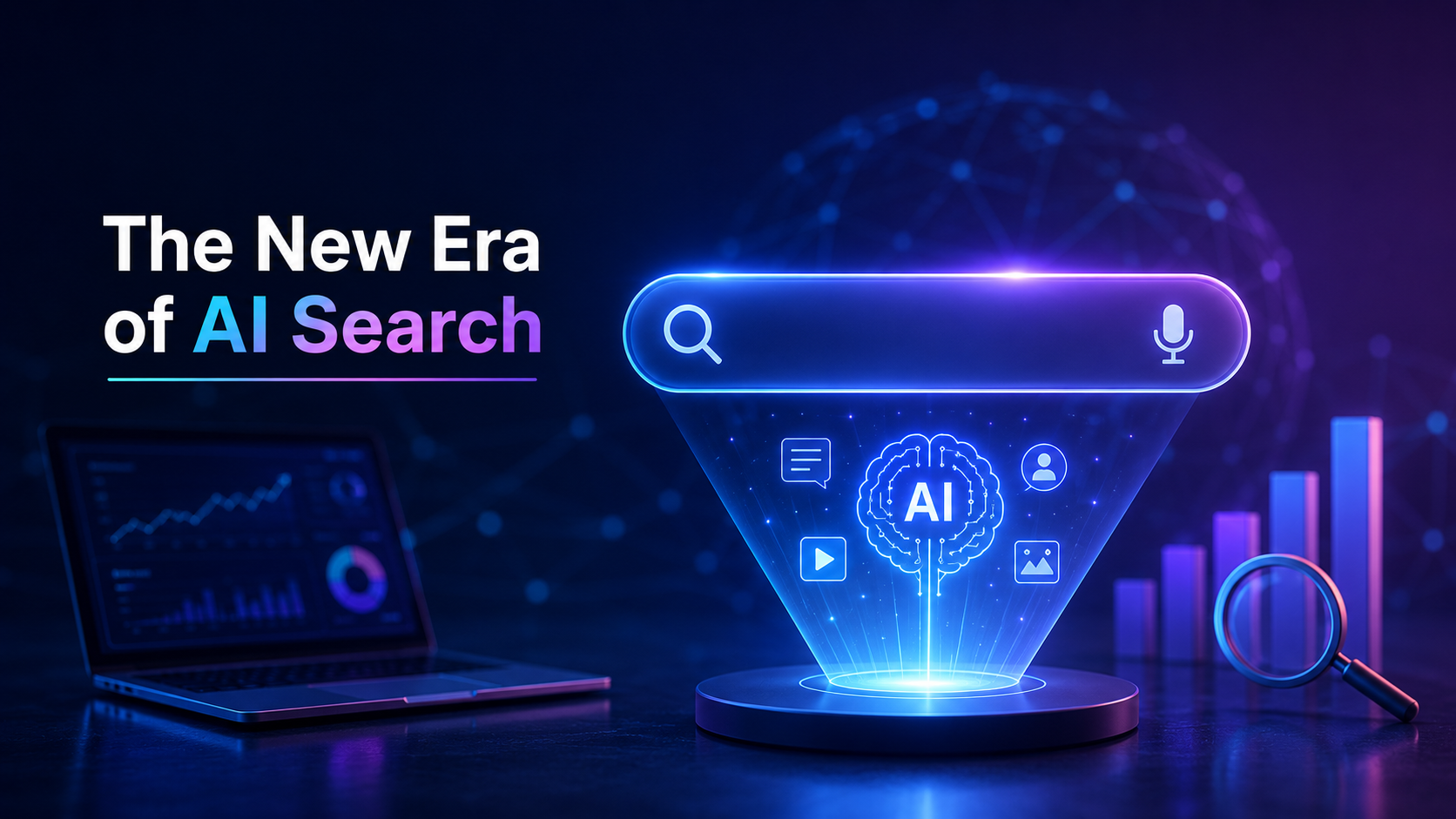
The New Era of AI Search: How Google I/O 2026 Redefines SEO and Digital Marketing
-
By Devraj
-
29th May 2026
Quick Summary
Google I/O 2026 confirmed what many digital marketers have been quietly dreading: Google AI search is no longer a feature; it’s the entire product. AI Mode has already crossed one billion monthly users. Search queries hit an all-time high last quarter. And Google has now introduced Search Agents, Generative UI, Personal Intelligence, and agentic booking, changes that don’t just tweak how SEO works but fundamentally reshape what digital marketing looks like from the ground up. This blog focuses on the marketing and SEO implications that go beyond the Intelligent Search Box, covering angles you haven’t read about yet.
Is Your Brand Visible in Google’s AI Search?
Most websites ranked on Google in 2024 are losing ground fast in 2026. AI Mode, Search Agents, and Generative UI have changed what visibility actually means — and most brands haven’t caught up yet.
Quick Navigation
This Isn’t Just Another Google Update
AI Mode Hit One Billion Users. Here’s Why That’s a Marketing Signal.
The Zero-Click Reality Is No Longer Coming — It’s Here
Search Agents: The Feature That Will Reshape Lead Generation
Generative UI: When Google Builds the Experience Instead of Linking to It
What this means for content marketing specifically:
Personal Intelligence: The Personalisation Layer Changes Everything
Agentic Booking and Local Search: A Wake-Up Call for Local Businesses
What Google I/O 2026 Means for Your Digital Marketing Strategy, Right Now
This Isn’t Just Another Google Update
Google has rolled out major algorithm changes before. Panda, Penguin, Hummingbird, BERT, Helpful Content, each one shifted how SEO worked. But each of those updates changed how Google ranked content on AI Overviews and on SERPs. What Google announced at I/O 2026 is different in a more fundamental way: it changes how people interact with search itself.
The shift here is from Google as a directory to Google as a do-er. Users aren’t just finding information anymore; they’re having Search do things on their behalf. Book a karaoke room. Monitor apartment listings. Build a fitness tracker. Call a plumber. That’s not a search engine. That’s an AI assistant backed by the world’s most complete index.
For brands, marketers, and businesses investing in SEO for AI search,this changes the game at every level, from how you structure content to how you think about ROI.
AI Mode Hit One Billion Users. Here’s Why That’s a Marketing Signal.
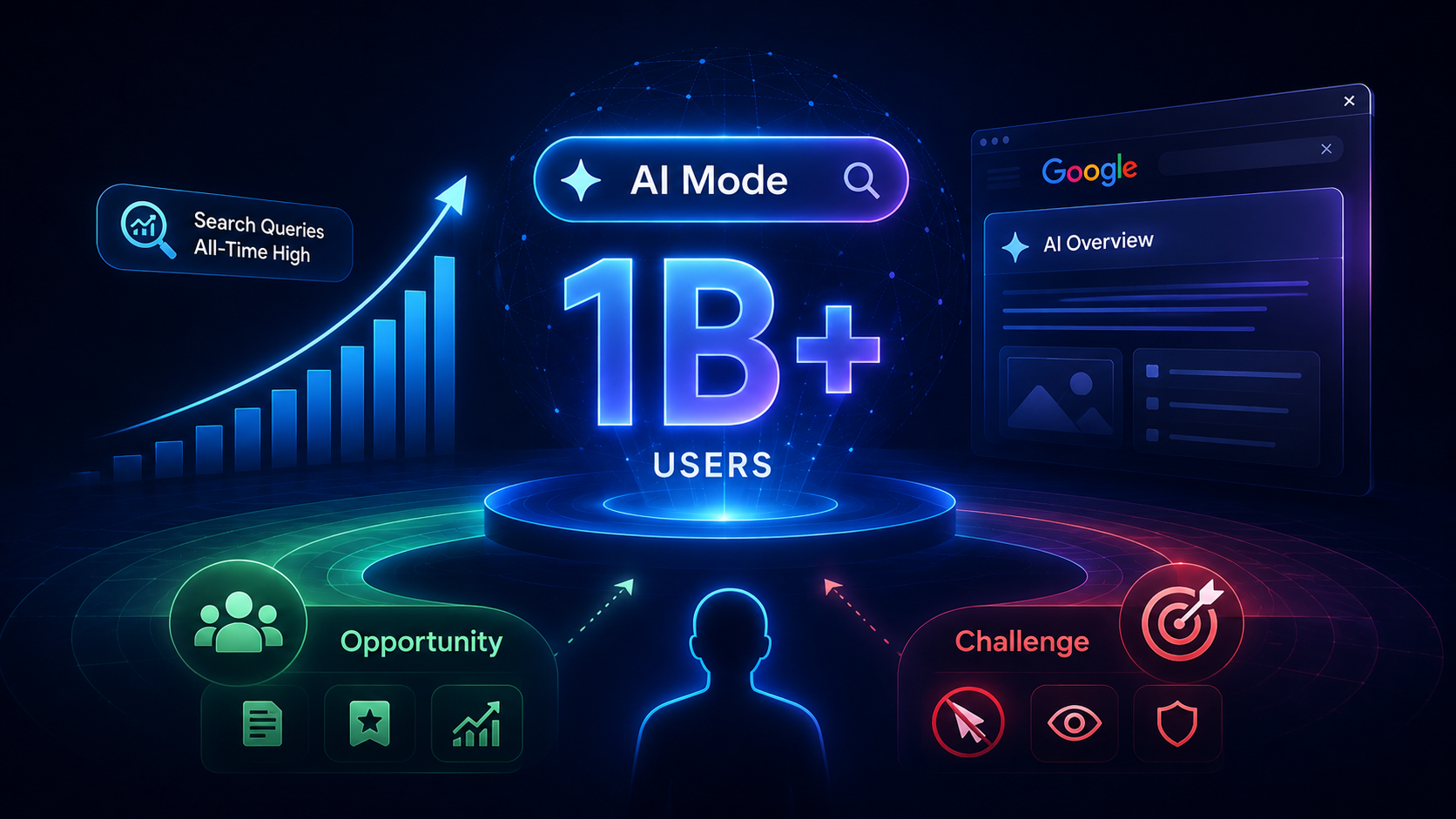
Just one year after its debut, AI Mode surpassed one billion monthly users, with queries more than doubling every quarter since launch. Overall, search queries reached an all-time high last quarter.
Pause on that for a moment. Search volume is growing, not declining, even as AI handles more of the answers. People aren’t using Google less because AI is there. They’re using it more because AI makes Search genuinely more useful for the kinds of complex, contextual questions they never bothered to ask before.
For digital marketers, this has two implications that pull in opposite directions:
The opportunity:More queries mean more chances for your content to be cited, surfaced, and recommended. The total addressable audience for Google AI search is expanding rapidly.
The challenge:More of those queries are being fully resolved within Google’s interface, without a click to your site. The battle isn’t just about ranking; it’s about being the source Google’s AI draws from when it answers.
This is the central tension in SEO for AI search in 2026 and it requires a different marketing strategy from anything that came before.
The Zero-Click Reality Is No Longer Coming — It’s Here
For years, SEOs warned about zero-click searches as a future problem. In 2026, it’s today’s problem. With AI Mode surpassing one billion monthly users and queries doubling every quarter, a growing share of those searches end without a single click to any website. Users ask a question; Google’s AI answers it fully—with context, follow-ups, and interactive elements, and the session is over. No visit. No impression. No conversion opportunity.
But here’s what most people get wrong about zero-click searches: the goal isn’t to fight them — it’s to be the brand inside them. When Google’s AI answers a query about “best cloud migration approach for mid-sized businesses” or “how to choose a digital marketing agency,” it pulls that answer from somewhere. That somewhere is a brand with enough structured content, topical authority, and E-E-A-T signals to be trusted as a source. Being cited inside a zero-click answer is the new page-one ranking. You don’t get the click — but you get the brand impression, the association of authority, and, increasingly, the direct follow-up action when the user is ready to buy.
The businesses that will suffer most from zero-click search are those whose entire content strategy was built around informational keywords designed to pull passive traffic. The businesses that will thrive are those repositioning their content as source material for AI — specific, factual, structured, and authoritative enough that Google would rather quote them than anyone else. This is the core shift that SEO for AI search demands in 2026.
Search Agents: The Feature That Will Reshape Lead Generation
Of everything announced at Google I/O 2026, Search Agents deserve the most attention from a marketing and lead-generation perspective, and they’re getting the least.
Information Agents are autonomous AI systems that operate in the background, 24/7, intelligently reasoning across information, including blogs, news sites, social posts, and real-time data on finance, shopping, and sports, to find exactly what a user needs and send them an intelligent, synthesized update.
Think about what this means for how customers find businesses. Today, a potential client thinks, “I need a digital marketing agency in Mohali”, and types it into Google. Tomorrow, they might set an agent once:
“Let me know when a digital marketing agency publishes a new case study showing 50%+ organic growth for an e-commerce client.”
That agent runs continuously. When you publish that case study, the agent surfaces it, or it doesn’t, depending on whether your content is authoritative, structured, and crawlable enough to qualify.
This is a pull-based discovery model becoming an agent-driven push model. Your content no longer just waits to be found. It either qualifies to be surfaced by AI agents or it doesn’t.For generative AI in digital marketing,this means your content calendar, your thought leadership strategy, and your authority-building efforts are no longer nice-to-haves. They are the mechanism by which customers discover you.
Generative UI: When Google Builds the Experience Instead of Linking to It
Google’s new agentic coding capability, built on a platform called Google Antigravity, allows Search to generate completely custom interactive layouts, including visual tools, simulations, tables, and graphs, in real time, precisely tailored to the user’s question. These generative UI capabilities will be available for everyone in Search this summer, free of charge.
For digital marketing, this is the zero-click problem taken to its logical extreme, but it’s also a new opportunity if you understand it correctly.
When Google generates a custom interactive comparison table to answer “best CRM tools for small businesses,” your brand’s chance to appear in that generated experience depends entirely on one thing: whether your content and data were trusted enough to be synthesized into it. That’s a citation play, not a ranking play.
What this means for content marketing specifically:
The content that earns inclusion in Generative UI responses tends to be factual, structured, specific, and authoritative. Product specifications, original research findings, statistical data with clear sourcing, step-by-step processes with concrete detail. Vague, opinion-heavy content that was written to rank for a keyword doesn’t qualify.
If your content marketing strategy is still built around “write a 1,500-word post targeting this keyword,” 2026 is the year to rethink it from scratch.
Personal Intelligence: The Personalisation Layer Changes Everything
Google is expanding Personal Intelligence in AI Mode to nearly 200 countries and territories across 98 languages, no subscription required. Users can securely connect apps like Gmail, Google Photos, and soon Google Calendar to make Search deeply personal and contextual.
For marketers, this is genuinely new territory. When a user’s search is informed by their Gmail inbox, their Google Calendar, and their Photos, Google AI search stops being a general engine and becomes a deeply personal one. The same query from two different users can return completely different results based on their connected context.
The marketing implication is that personalised search at scale makes mass keyword targeting less reliable. Two users searching the same phrase may see entirely different AI-generated answers based on their personal data. This makes brand authority, consistent E-E-A-T signals, and broad topical coverage even more important, because those are the signals that persist across personalised results.
It also makes email marketing and CRM data more strategically valuable than ever. If your brand has a strong email relationship with a user, and that user connects Gmail to Google AI Search, your previous communications with them become part of their search context. Brands that have nurtured their audiences through email and content will have a meaningful advantage in personalised AI search results.
Agentic Booking and Local Search: A Wake-Up Call for Local Businesses
Google is expanding agentic booking capabilities in Search to a wide range of new tasks, including local experiences and services. For select categories like home repair, beauty, and pet care, users can ask Google to call businesses on their behalf.
This is one of the most concrete and immediate changes for local businesses and service providers. When a user can say “book me a home cleaning service for Saturday morning under $50,” and Google’s AI calls businesses, checks availability, and confirms the booking, the entire local search journey bypasses traditional marketing touchpoints.
There’s no ad clicked. No Google Business Profile visited. No website browsed. The AI mediated the entire transaction.
For local businesses, this raises urgent questions. Is your Google Business Profile fully optimised with accurate pricing, real-time availability, and services listed with the kind of specific detail that AI can match to user criteria? Are your reviews, response rates, and trust signals strong enough for Google’s AI to select you over a competitor?
Local SEO for AI search in 2026 is less about ranking for a keyword and more about being a trustworthy, well-structured local entity that AI booking agents can confidently act on behalf of a customer.
What Google I/O 2026 Means for Your Digital Marketing Strategy, Right Now
Rather than a laundry list of tactics, here are the three strategic shifts that matter most for generative AI in digital marketing following these announcements:
1. Move from traffic metrics to citation metrics:
The primary KPI for content marketing is no longer “how much traffic did this post get?” It’s “was this content cited by Google AI in a response to a relevant query?” Start measuring your brand’s presence in AI Mode responses for your core keywords. This is your new share of voice.
2. Treat every content asset as a data source, not just a page to rank:
AI systems synthesize content into answers. The more structured, specific, and factual your content is, the more useful it is as a source. Think of each piece of content as something that needs to be accurate and structured enough to be quoted, not just read.
3. Build your brand’s entity footprint, not just its backlink profile:
Google’s AI recognises brands as entities, defined by consistent mentions, structured data, and signals across the web. A strong entity footprint (correct schema markup, consistent NAP data, authoritative citations, Wikipedia-style completeness) influences how AI Mode describes and recommends your brand. This is a different discipline from traditional link building, and it’s now equally important.
How Deftsoft Helps You Navigate the New AI Search Era
Deftsoft’s digital marketing services are already built around the realities of Google AI search, not the Google of 2020. Our approach combines AI-era SEO strategy, content authority-building, and technical optimisation to help businesses show up where it matters: within AI-generated responses, not just below them.
Our AI SEO services specifically address citation optimisation, entity building, and structured data implementation, the three things that determine whether Google’s AI mentions your brand or your competitor’s. Our content marketing services
produce the kind of original, expert, non-commodity content that AI systems actually surface. And our technical SEO services
ensure your site is fully accessible and legible to AI crawlers, agents, and the Gemini-powered systems now driving Google’s answers.
The window to establish AI-cited authority before Search Agents go mainstream is narrow. Summer 2026 is the deadline that matters.
The New Era of Google AI Search Is Already Here, Is Your Brand Ready?
Let Deftsoft Audit Your AI Search Visibility and Build Your Roadmap.
FAQs
1. What is Google AI search, and how is it different from regular Google search?
Google AI search refers to the AI-powered features now central to Google, including AI Mode, AI Overviews, and Search Agents, that generate synthesized, conversational answers rather than just listing 10 links. Unlike traditional search, these features can hold context across a conversation, act autonomously on a user’s behalf, and answer complex queries without sending the user to an external website.
2. How does Google I/O 2026 affect my existing SEO strategy?
It accelerates the shift from keyword-ranking-focused SEO to authority- and citation-focused SEO. Your content still needs to be indexable and relevant, but the primary goal is now to be the source Google’s AI draws from, not just to rank in position one. Content depth, structured data, E-E-A-T, and topical authority have all become more important.
3. What is Google Search AI Mode, and how many people use it?
Google Search AI Mode is a conversational search experience powered by Gemini that lets users ask complex, multi-part questions and receive synthesized, contextual answers. As of Google I/O 2026, AI Mode has surpassed one billion monthly users, with query volume more than doubling every quarter since launch.
4. What is Generative UI in Google Search?
Generative UI is a new capability from Google I/O 2026 that allows Search to build custom interactive layouts, including tables, simulations, graphs, and visualizations, in real time in response to a user’s query. Rather than linking to a page with a table, Google builds one on the fly. It will be free for all users by summer 2026.
5. How do Search Agents affect lead generation and content marketing?
Search Agents continuously monitor the web on behalf of users and automatically surface relevant content. For marketers, this means content that meets a user’s specific, pre-defined criteria gets discovered without the user actively searching. It makes authoritative, structured, frequently updated content significantly more valuable than one-time keyword-targeted posts.
6. How should local businesses respond to Google’s agentic booking features?
Local businesses should ensure their Google Business Profile has accurate, detailed, and up-to-date information, including pricing, services, availability, and high-quality reviews. When Google’s AI calls a business on a user’s behalf, it selects based on trust and relevance signals. Businesses with incomplete or outdated profiles risk being skipped entirely.
7. How is Deftsoft helping businesses adapt to the Google I/O 2026 changes?
Deftsoft offers AI Search readiness audits, citation-focused SEO strategies, entity optimisation, technical crawlability improvements, and content marketing built for AI synthesis. Our team actively monitors how client brands appear in AI Mode responses and adapts strategy in real time as new features roll out.
Recent Articles




Devraj
 29th May 2026