What Is the Difference Between Machine Learning and Generative AI?
-
By Devraj
-
17th April 2026
Machine learning (ML) is a broad technology that enables computers to learn patterns from data and make predictions, it’s the backbone of recommendation engines, fraud detectors, and predictive analytics. Generative AI is a specialized, newer branch of ML that goes further: instead of just predicting outcomes, it creates original content, text, images, code, and more. In the machine learning vs generative AI debate, the key distinction is intent: ML analyzes and predicts; generative AI creates and generates. Both are transformative, and for most modern businesses, the smartest strategy is using them together.
Two Terms, One Big Confusion
If you’ve been following the AI boom, you’ve almost certainly heard both “machine learning” and “generative AI” thrown around, often interchangeably. But they’re not the same thing. Understanding the difference between machine learning and generative AI isn’t just an academic exercise; it’s the key to making smarter decisions about which technology your business should invest in, and when.
At Deftsoft, we work with businesses across industries on everything from AI development services to chatbot development, and one of the most common questions we hear is: “Should we be using machine learning or generative AI?” The answer, almost always, is: “It depends on your goal, and you may need both.”
Let’s break it down clearly.
Ready to build your AI solution?
Whether you need a machine learning model, a generative AI integration, or an end-to-end AI system, our team will help you find the right fit for your business.
Quick Navigation
Common applications of machine learning:
Machine Learning vs Generative AI: A Side-by-Side View
Generative AI vs Machine Learning: Use Cases
When Should Businesses Use Machine Learning vs Generative AI?
What Is Machine Learning?
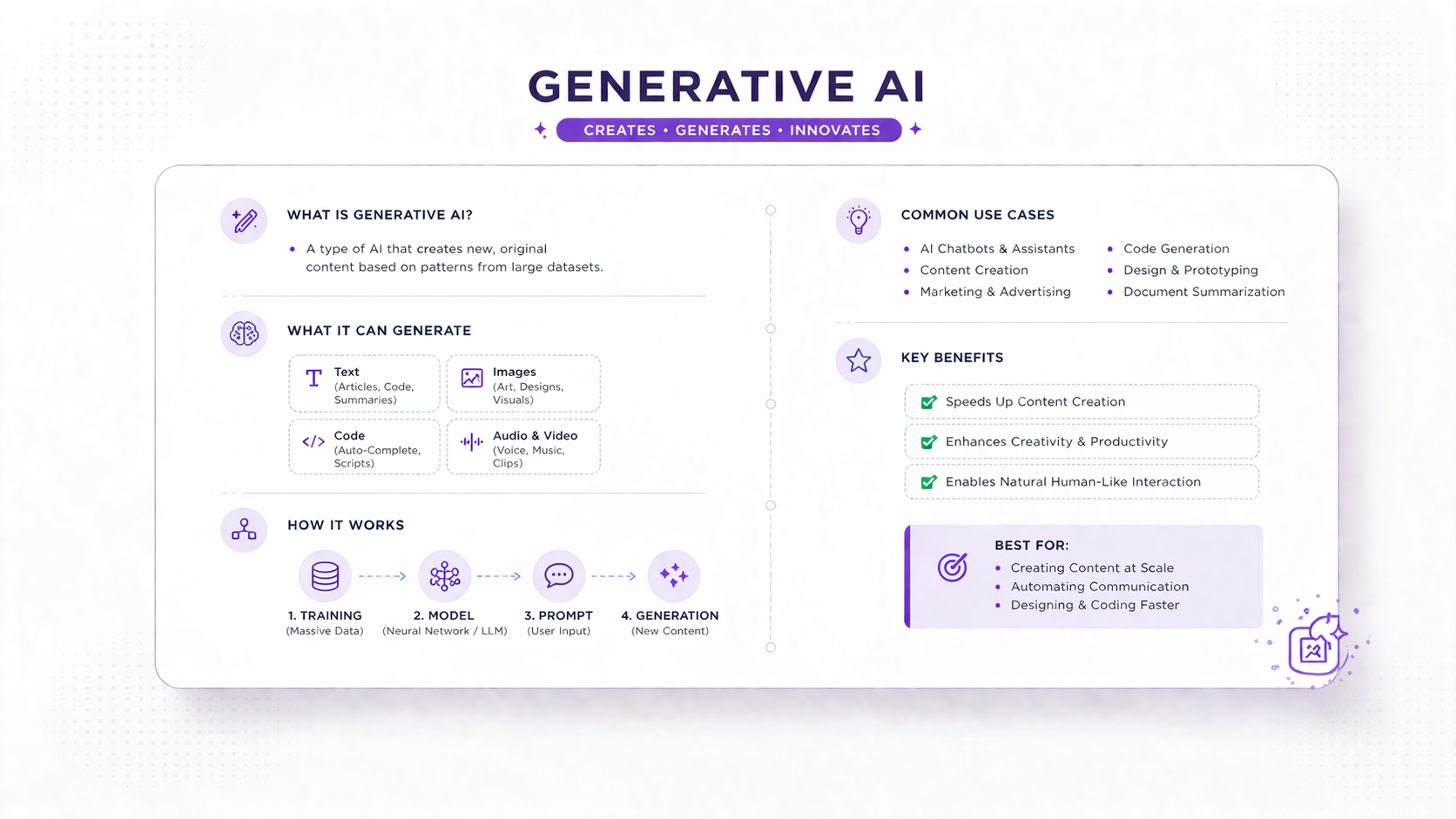
Machine learning is a subset of artificial intelligence that allows systems to learn from data without being explicitly programmed for every scenario. Instead of following a fixed set of rules, an ML model is trained on large datasets, identifies patterns, and uses those patterns to make predictions or decisions on new data.
Think of it this way: you show a machine thousands of examples of spam emails and non-spam emails. The ML model learns the patterns that distinguish them and can then classify new emails on its own, improving over time as it sees more data.
Common applications of machine learning:
Fraud detection in banking, product recommendation engines (Netflix, Amazon), predictive maintenance in manufacturing, medical diagnosis support, credit scoring, and supply chain optimization.
Did You Know?
According to McKinsey, manufacturers that apply machine learning are 3x more likely to improve their key performance indicators — and about 72% of surveyed manufacturers report reduced costs after introducing AI tools. (Source:McKinsey / Aristek Systems, 2025)
What Is Generative AI?
Generative AI is a newer, more advanced type of machine learning. Rather than simply analyzing data and making predictions, generative AI models are trained to create new content, text, images, audio, video, code, and more, based on patterns learned from massive datasets.
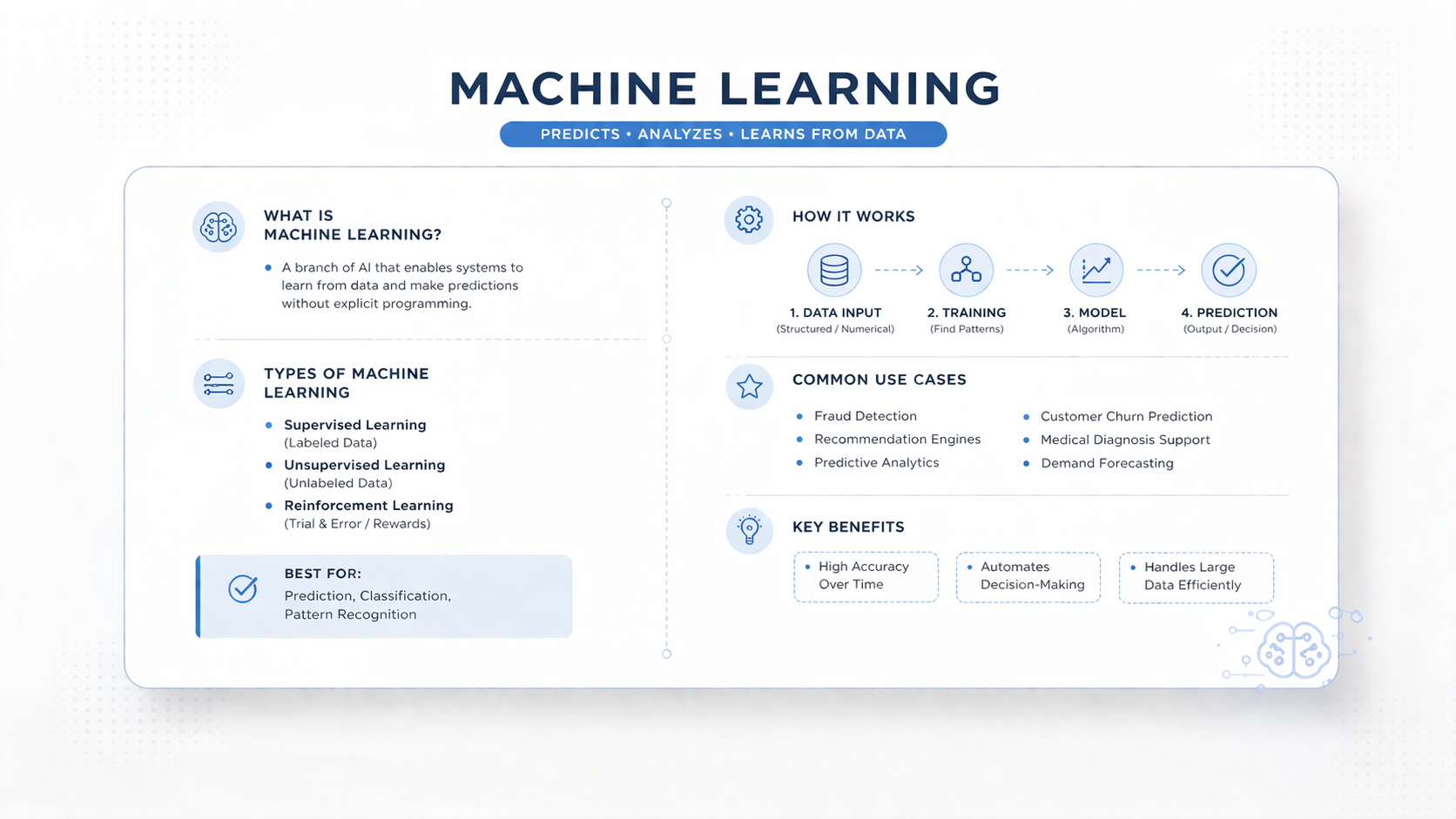
The explosion of tools like ChatGPT, Google Gemini, and Anthropic’s Claude marked a turning point: suddenly, AI wasn’t just answering questions, it was writing, designing, and building alongside humans. This is the foundation of what businesses are now using for everything from chatbot development services to AI agent workflows.
Generative AI relies on architectures like large language models (LLMs) and diffusion models, trained on billions of data points, enabling them to generate contextually rich, human-like outputs.
Pro Tip
Generative AI isn’t replacing traditional ML, it’s accelerating it. As MIT Sloan professors note, gen AI can be used to create synthetic training data, clean datasets, and optimize every step of the ML pipeline. Think of it as a “turbocharger” for your existing machine learning workflows. (Source: MIT Sloan Management Review, 2024)
Machine Learning vs Generative AI: A Side-by-Side Vie
Here’s a clear breakdown of the key differences between machine learning and generative AI:
| Machine Learning | Generative AI |
|---|---|
| Learns patterns from labeled or unlabeled data | Learns to generate new, original content |
| Predicts outcomes, classifies, detects anomalies | Creates text, images, code, video, audio |
| Works well with structured/tabular data | Works with unstructured data (text, images, audio) |
| Output: a decision, a score, or a label | Output: a new piece of content |
| Examples: fraud detection, churn prediction, recommendation engines | Examples: ChatGPT, Midjourney, GitHub Copilot, AI chatbots |
| Requires domain-specific training data | Pre-trained on massive datasets, often fine-tuned |
| Explainability is generally higher | Can feel like a “black box” |
Generative AI vs Machine Learning: Use Cases
Here’s what most articles miss: generative AI is machine learning. It sits inside the broader ML umbrella. The difference between machine learning and generative AI is less about opposing technologies and more about scope, purpose, and capability.
Traditional ML is optimized for prediction. Generative AI is optimized for creation. Both rely on data, training, and statistical modeling, but they solve fundamentally different problems.
This overlap is also why businesses building intelligent AI agents (as opposed to agentic AI systems) often combine both, using ML for analytics and decision logic, and generative AI for natural language communication and content creation.
Industry Stat
A 2024 survey of senior data leaders found that 64% believe generative AI has the potential to be the most transformative technology in a generation. Meanwhile, the generative AI market is projected to grow from $59 billion in 2025 to over $400 billion by 2031 — a CAGR of nearly 38%. (Source: MIT Sloan, Aristek Systems 2025)
See what AI can do for your business
From chatbot development to agentic AI workflows, explore Deftsoft’s full range of AI development services — built for startups and enterprises alike.
When Should Businesses Use Machine Learning vs Generative AI?
The honest answer: it depends on the problem you’re trying to solve.
Choose traditional machine learning when you need to predict, classify, or detect patterns in structured data, like forecasting sales, identifying fraud, or scoring customer lifetime value.
Choose generative AI when you need to produce content, converse naturally with users, automate writing-heavy workflows, or power a chatbot development initiative that goes beyond simple rule-based responses.
Consider both when building sophisticated AI systems, for example, using ML to analyze customer sentiment and generative AI to draft personalized responses, or pairing predictive models with LLMs inside an AI development service stack.
At Deftsoft, we help businesses across industries design the right AI architecture, whether that’s a standalone ML model, a generative AI integration, or an end-to-end intelligent system powered by AI agents. The technology is only as good as the strategy behind it.
Conclusion
Understanding the difference between machine learning and generative AI is essential for making informed technology decisions. While machine learning excels at analyzing data and predicting outcomes, generative AI unlocks new possibilities by creating content and enhancing user interactions. Rather than choosing one over the other, forward-thinking businesses are combining both to build smarter, more efficient, and highly scalable systems.
At Deftsoft, we help organizations bridge this gap by designing AI solutions that align with real business goals. From intelligent automation to AI-powered customer experiences, our team ensures that you’re not just adopting AI—but using it strategically to drive measurable results.
Frequently Asked Questions
Is Generative AI part of machine learning?
Yes. Generative AI is a specialized subset of machine learning. All generative AI systems are built on ML techniques — specifically deep learning architectures like transformers and diffusion models. However, not all machine learning is generative AI. Traditional ML focuses on prediction and classification, while generative AI focuses on creating new content.
What is the main difference between machine learning and generative AI?
The core difference is intent and output. Traditional machine learning analyzes data to make predictions, detect patterns, or classify information. Generative AI goes further — it produces new, original content such as text, images, audio, and code. ML asks “What will happen?” Generative AI asks “What can I create?
Can Machine Learning and Generative AI be used together?
Absolutely — and this is increasingly common. Businesses use ML for backend analytics, risk scoring, and predictions, while generative AI handles user-facing communication, content generation, and automation of language-heavy tasks. Many advanced AI platforms combine both to deliver smarter, more complete solutions.
Is ChatGPT machine learning or generative AI?
ChatGPT is both — it is a generative AI product built on machine learning technology. Specifically, it uses a large language model (LLM) trained with deep learning techniques, which is a form of machine learning. So when people ask about “machine learning vs generative AI,” tools like ChatGPT sit at the intersection of both.
Which industries benefit most from generative AI?
Generative AI is delivering measurable value across healthcare (report generation, clinical documentation), retail (personalized recommendations, customer service chatbots), finance (document analysis, fraud narrative generation), technology (code generation, QA testing), and marketing (content creation, SEO, ad copy). According to Gartner, 100% of healthcare CIOs plan to implement AI by 2026.
What is agentic AI, how does it differ from generative AI?
Agentic AI refers to AI systems that can autonomously plan, reason, and take multi-step actions to complete complex goals — going beyond a single response. Generative AI produces content in response to a prompt. Agentic AI uses generative AI as its reasoning engine but adds the ability to act, iterate, and make decisions across a workflow with minimal human oversight.
Recent Articles






Devraj
 17th April 2026