Cloud vs On-Premise: Which Hosting is Best for Your Business?

Quick Summary:

Choosing between cloud vs on-premise hosting is one of the most important infrastructure decisions a business makes. Cloud hosting offers flexibility, lower upfront costs, and scalability, while on-premise gives you full control, predictable performance, and tighter data sovereignty. This blog honestly breaks down both options, covers hybrid approaches, and helps you decide which path best fits your business. If you’re exploring cloud application development or cloud migration services, this is your starting point.

Ready to move to the cloud?

Or!!! Figure out if you should? Talk to Deftsoft’s cloud team and get a free infrastructure consultation.

The Hosting Decision That Shapes Everything Else

Every business running software, whether it’s an internal tool, a customer-facing app, or a full enterprise platform, has to answer the same foundational question: where does it live?

For decades, the answer was simple: on-premise. You bought servers, installed them in your office or data centre, and managed everything yourself. Then cloud computing arrived, and suddenly the answer became complicated.

Today in 2026, both options are mature, capable, and genuinely suited to different situations. The cloud vs on-premise debate isn’t about which is objectively better — it’s about which is better for your business, your team, your data, and your growth plans.

Let’s break it down.

What Is On-Premise Hosting?

On-premise (often called “on-prem”) means your servers, storage, and networking hardware are physically located at your business or a private data centre you control. Your IT team manages everything — hardware, software, security patches, backups, and uptime.

Who typically uses it: Banks, hospitals, government agencies, manufacturers, and any organisation with strict data residency requirements or highly sensitive workloads.

Core characteristics:

  • Full ownership and control of hardware and data
  • High upfront capital expenditure (CapEx)
  • Predictable long-term costs once the infrastructure is paid off
  • Requires in-house IT expertise to maintain
  • Performance is consistent and not dependent on internet connectivity

What Is Cloud Hosting?

Cloud hosting means your applications, data, and infrastructure run on servers owned and managed by a third-party provider — such as AWS, Microsoft Azure, or Google Cloud Platform — and are accessed over the internet. You pay for what you use, scale up or down as needed, and hand off hardware management entirely.

Who typically uses it: Startups, SaaS companies, e-commerce businesses, remote-first teams, and any organisation that needs to scale quickly without heavy upfront investment.

Core characteristics:

  • Low upfront cost — pay-as-you-go operational expenditure (OpEx)
  • Scales instantly with demand
  • Managed security, patching, and hardware maintenance by the provider
  • Accessible from anywhere with an internet connection
  • Foundation for cloud application development — building apps designed natively for the cloud

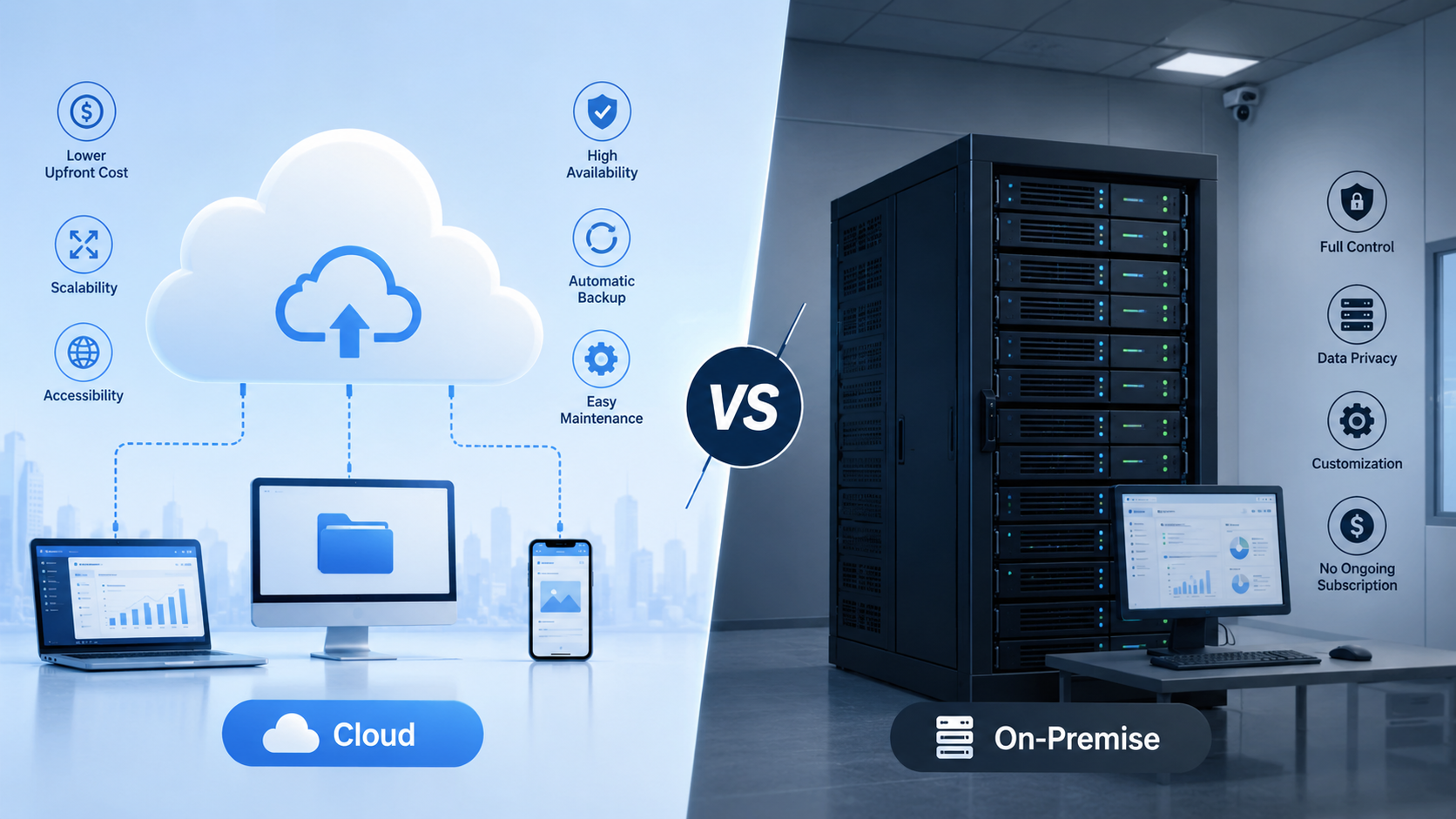
Cloud vs On-Premise: The Key Differences

Factor Cloud On-Premise
Upfront Cost Low High
Ongoing Cost Variable (usage-based) Lower long-term
Scalability Instant, on-demand Slow, requires hardware purchase
Control Limited (provider manages infra) Full
Security Ownership Shared responsibility Full ownership
Setup Time Hours to days Weeks to months
Data Location Provider’s data centres Your premises
Maintenance Provider handles it Your IT team
Best For Growth, flexibility and remote teams Compliance, control, legacy systems

The Real Cost Comparison

Cost is usually the first question — and it’s also the most misunderstood part of the cloud vs on-premise discussion.

On-premise looks cheaper long-term on paper. Once you’ve paid off your servers (typically over 3–5 years), your ongoing costs are mostly staff and power. For stable, predictable workloads, this can be genuinely more economical than paying cloud fees indefinitely.

But the hidden costs of on-premise add up fast:

  • Hardware refresh cycles every 4–6 years
  • IT staff salaries and training
  • Physical security, cooling, and power infrastructure
  • Downtime costs when hardware fails
  • Disaster recovery systems

Cloud feels expensive month-to-month, especially as usage grows. But what you get in return is significant: no capital lock-in, no hardware failure risk, built-in redundancy, and the ability to scale globally without buying a single server.

For most growing businesses, the cloud is more cost-effective in the first 3–5 years. After that, it depends heavily on your workload profile and how well you manage cloud spend (a discipline known as FinOps).

Security: Who’s Really Safer?
Security

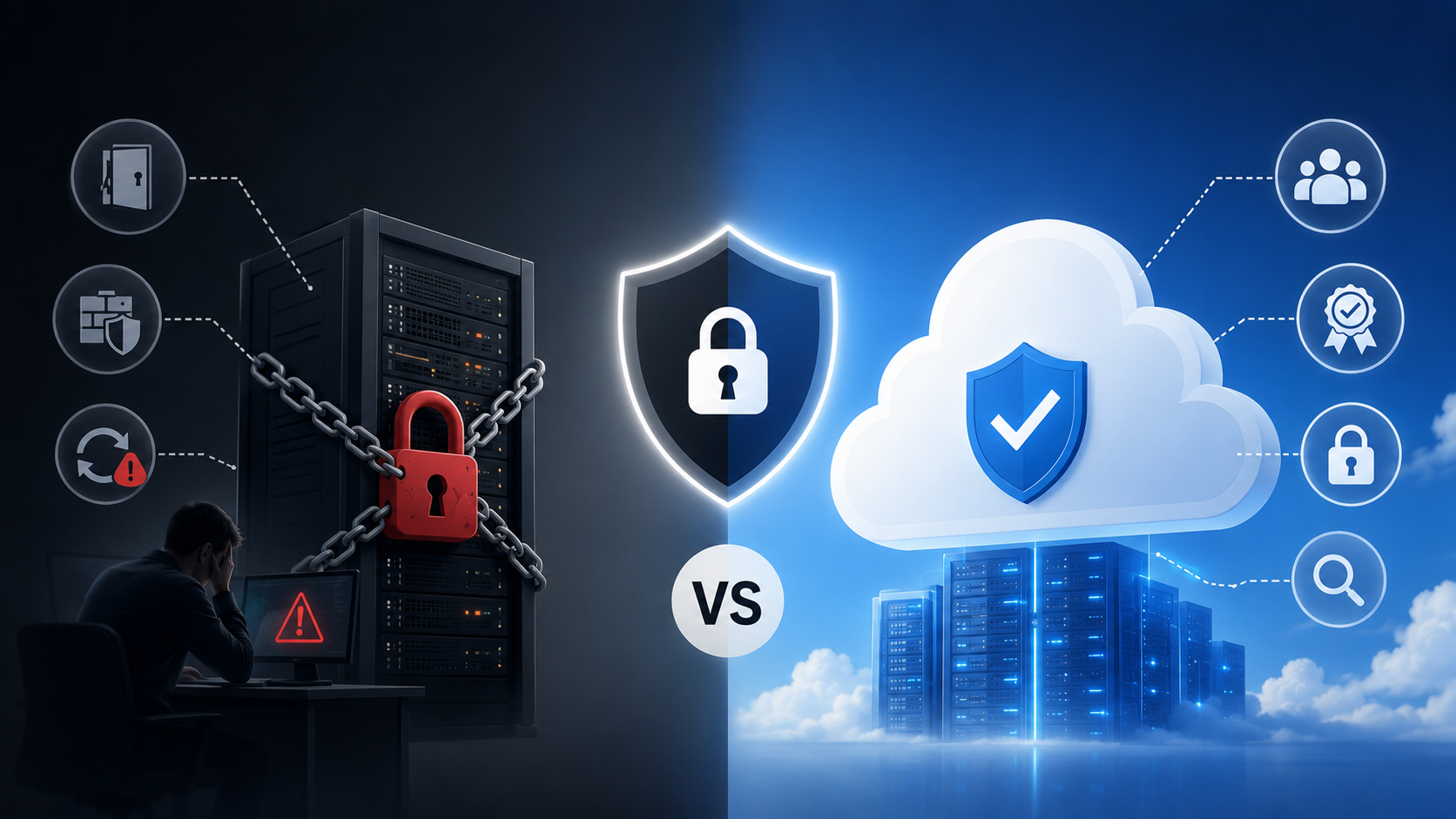
This is where the cloud vs on-premise debate gets heated. The common assumption is that on-premises is more secure because you own the hardware. The reality is more nuanced.

On-premise security is only as strong as your team. If your IT department doesn’t stay on top of patching, physical access controls, and network segmentation, an on-premise environment can be deeply vulnerable.

Cloud security benefits from the massive security investment of providers like AWS and Azure — teams of thousands of security engineers, certifications like ISO 27001 and SOC 2, and hardware-level encryption that most businesses couldn’t replicate on-premise.

The key phrase is shared responsibility. Cloud providers secure the infrastructure. You’re responsible for securing what you build on top of it — access management, application-level security, and data handling.

For most SMBs and mid-market businesses, cloud is demonstrably more secure in practice. For regulated industries with specific compliance requirements, such as healthcare, finance and defence, an on-premises or private cloud model may still be necessary.

Scalability and Speed to Market

If your business is growing or unpredictable, cloud wins this category without much contest.

Need to handle a 10x traffic spike during a product launch? Cloud infrastructure scales automatically. Want to spin up a new environment for your development team? Done in minutes. Exploring cloud application development to build a new customer-facing app? Cloud-native tools like serverless functions, managed databases, and container orchestration make the entire development lifecycle faster.

On-premise scaling means ordering hardware, waiting for delivery, racking it, configuring it, and hoping you got the capacity right. In a world where speed to market is a competitive differentiator, that timeline is a real disadvantage.

The Hybrid Approach: The Best of Both

Many businesses, particularly mid-market and enterprise, are adopting a hybrid cloud model as the pragmatic answer to the cloud vs. on-premises question. Sensitive or regulated data stays on-premises. Customer-facing applications, development environments, and scalable workloads move to the cloud.

This is also where cloud migration services become critical. Moving workloads built for on-premises infrastructure to a cloud environment isn’t always straightforward. Legacy applications, data dependencies, and integration requirements mean that migration needs careful planning — not just a lift-and-shift.

A structured cloud migration approach — assess, plan, migrate, optimise — typically delivers better outcomes and avoids the cost overruns that give cloud a bad reputation.

When On-Premise Still Makes Sense

Cloud isn’t always the right answer. On-premise is still the better choice when:

  • Data sovereignty is non-negotiable — certain industries or countries require data to stay within specific physical boundaries
  • You have predictable, stable workloads — running consistent compute 24/7 is often cheaper on owned hardware
  • Latency is critical — manufacturing, real-time processing, and edge computing use cases sometimes need local hardware
  • You have existing infrastructure investment — if you’ve just refreshed your hardware, a full cloud migration may not make financial sense right now

Making the Right Call for Your Business

Here’s a simple decision framework:

  • Choose cloud if: You’re growing fast, your team is distributed, you’re building new applications, or you need to move quickly without heavy upfront investment.
  • Choose on-premise if: You handle highly sensitive regulated data, have stable, predictable workloads, have strong existing infrastructure, and a capable internal IT team.
  • Choose hybrid if: You have a mix of legacy systems and new workloads, need compliance for some data but flexibility for others, or you’re in the middle of a cloud migration journey.

Whatever path you choose, the decision should be driven by your actual business requirements — not trends or assumptions.

How Deftsoft Can Help

Deftsoft helps businesses navigate the cloud vs on-premise decision with clarity — and then execute on whatever path makes sense. Our cloud migration services team has helped companies move complex legacy workloads to AWS, Azure, and GCP without disruption. Our cloud application development practice builds scalable, cloud-native apps from the ground up.

Whether you’re starting fresh or modernising existing infrastructure, we bring the technical depth and strategic thinking to get it right.

Ready to move to the cloud?

Or!!! Figure out if you should? Talk to Deftsoft’s cloud team and get a free infrastructure consultation.

FAQs

1. What is the main difference between cloud and on-premise hosting?

Cloud hosting runs on third-party servers accessible over the internet with pay-as-you-go pricing. On-premise means you own and manage the hardware at your location. The core difference is control vs convenience.

2. Is cloud hosting more expensive than on-premise?

Cloud has lower upfront costs but ongoing monthly fees. On-premises has high upfront costs but lower long-term running costs for stable workloads. The right answer depends on your usage patterns and growth rate.

3. Is cloud hosting secure enough for sensitive business data?

For most businesses, yes. Major cloud providers invest heavily in security certifications and infrastructure. However, regulated industries may have specific compliance requirements that influence the decision.

4. What are cloud migration services?

Cloud migration services help businesses move their existing applications, data, and infrastructure from on-premise systems to cloud environments — minimising downtime, managing data integrity, and optimising performance post-migration.

5. What is cloud application development?

Cloud application development means building software designed specifically to run on cloud infrastructure, using cloud-native tools such as containers, serverless functions, and managed services to improve scalability, resilience, and speed.

6. Can a business use both cloud and on-premises at the same time?

Yes — this is called a hybrid cloud model. Many mid-market and enterprise businesses keep sensitive workloads on-premise while running scalable or customer-facing applications in the cloud.

7. How do I know if my business is ready for cloud migration?

If your current infrastructure is limiting growth, increasing maintenance costs, or slowing down your development teams, it’s worth exploring migration. A cloud readiness assessment from a partner like Deftsoft is a good first step.
How Businesses Are Using Metaverse App Development in 2026: Top Trends Explained

Introduction: Why the Metaverse Is a Business Priority in 2026

The metaverse has evolved far beyond a futuristic concept or a gaming-centric trend. In 2026, businesses across industries are investing in immersive digital environments to enhance customer engagement, collaboration, and revenue. What was once experimental is now strategic.

Organizations exploring metaverse app development services are no longer asking whether the metaverse is relevant, but how to use it to gain a competitive advantage. From virtual storefronts and immersive brand experiences to enterprise collaboration spaces, the metaverse is redefining how businesses operate in a digital-first economy.

With advancements in AR, VR, blockchain, and AI, the metaverse is becoming more accessible, scalable, and business-ready, making 2026 a defining year for enterprise adoption.

Why Businesses Are Actively Searching for the Best Metaverse App Development Company

As metaverse adoption accelerates in 2026, businesses are becoming more selective about who they partner with to build immersive digital experiences. The complexity of virtual environments, combined with the need for scalability and security, has led organizations to actively seek the best metaverse app development company rather than generic development providers.

A top-tier metaverse development company understands more than just 3D environments or virtual worlds. They bring together expertise in AR, VR, AI, blockchain, and cloud infrastructure to deliver seamless and future-ready solutions. Businesses want platforms that not only look impressive but also integrate smoothly with existing systems, support large user bases, and adapt to evolving technologies.

The best metaverse app development company focuses on strategic planning, not just execution. This includes defining business objectives, identifying the right metaverse use cases, and selecting the most suitable technology stack. Whether it’s a virtual showroom, enterprise collaboration space, or immersive training environment, businesses prioritize partners who can translate ideas into scalable digital ecosystems.

In addition, companies increasingly value development teams that prioritize user experience, performance optimization, and long-term support. A reliable partner ensures that metaverse applications remain relevant, secure, and engaging as user expectations continue to rise. In 2026, choosing the best metaverse development company is no longer a technical decision; it’s a strategic business investment.

1. Enterprise Metaverse Adoption Is Accelerating

One of the most significant trends in 2026 is the rapid increase in metaverse adoption for businesses. Enterprises are moving beyond pilot programs and investing in long-term metaverse strategies.

Companies are using metaverse platforms to:

  • Create virtual offices and remote collaboration hubs
  • Conduct immersive employee training and onboarding
  • Host virtual conferences, product launches, and trade shows
  • Build persistent digital environments for customer engagement

This acceleration is driven by the demand for remote-first operations, global collaboration, and experiential digital interactions. Businesses that once relied on video calls and static digital tools are now leveraging immersive environments that replicate and often enhance real-world interactions.

2. Metaverse App Development Becomes a Core Digital Investment

In 2026, metaverse app development services will no longer be viewed as experimental or optional. They are becoming a core part of digital transformation budgets. Businesses are realizing that off-the-shelf platforms often fail to meet their specific needs, leading to a surge in demand for custom-built metaverse applications.

Custom metaverse apps allow organizations to:

  • Control branding and user experience
  • Integrate existing enterprise systems
  • Ensure scalability and long-term flexibility
  • Maintain higher security and data ownership

Whether it’s a virtual retail store, a digital twin of a manufacturing facility, or an immersive learning environment, businesses are prioritizing tailored metaverse solutions that align with their goals and workflows.

3. Virtual Reality and Augmented Reality Drive Business Use Cases

The growing maturity of virtual reality (VR) and augmented reality (AR) technologies is another key factor shaping metaverse adoption. In 2026, these technologies are no longer niche; they are practical tools delivering measurable business value.

Some of the most impactful business applications include:

  • Retail: Virtual try-ons, immersive shopping experiences, and AR-based product visualization
  • Real Estate: Virtual property tours and digital staging
  • Healthcare: VR-based training simulations and AR-assisted procedures
  • Education & Training: Immersive learning modules that improve retention and engagement

By combining VR and AR with metaverse app development, businesses are creating interactive experiences that bridge the gap between physical and digital worlds.

4. Interoperable Metaverse Platforms Gain Momentum

Another major technology trend in 2026 is the shift toward interoperable metaverse platforms. Businesses are increasingly demanding environments where digital assets, identities, and experiences can move seamlessly across platforms.

Interoperability allows:

  • Cross-platform user experiences
  • Long-term asset value preservation
  • Reduced dependency on a single ecosystem
  • Better scalability as technologies evolve

For businesses, this means future-proof investments. Instead of building isolated virtual environments, companies are focusing on metaverse solutions that integrate with broader digital ecosystems, enabling growth and adaptability.

5. AI-Powered Experiences Inside the Metaverse

Artificial intelligence will play a crucial role in enhancing the metaverse in 2026. AI-driven capabilities are transforming static virtual spaces into intelligent, adaptive ecosystems.

Key AI-powered metaverse features include:

  • Personalized user experiences based on behavior
  • Intelligent avatars and virtual assistants
  • Predictive analytics for user engagement
  • Automated content and environment generation

By integrating AI into metaverse app development, businesses can deliver more engaging, responsive, and data-driven virtual experiences, making interactions more meaningful and conversion-focused.

6. Security, Privacy, and Compliance Become Business-Critical

As metaverse adoption grows, so do concerns around data security, privacy, and regulatory compliance. In 2026, businesses are prioritizing secure metaverse architectures to protect user data and digital assets.

Key focus areas include:

  • Identity and access management
  • Secure data storage and encryption
  • Compliance with regional data protection laws
  • Safe transaction and interaction frameworks

Organizations understand that trust is foundational. Secure and compliant metaverse solutions are essential to maintaining brand credibility and user confidence, especially in industries such as finance, healthcare, and enterprise services.

7. Industry-Specific Metaverse Applications Take the Lead

Rather than generic experiences, 2026 is seeing a rise in industry-specific metaverse applications. Businesses are developing solutions tailored to their unique operational and customer needs.

Examples include:

  • Virtual showrooms for automotive brands
  • Digital twins for manufacturing and logistics
  • Immersive classrooms for education providers
  • Virtual banking and fintech environments

This specialization ensures higher ROI and stronger alignment with business objectives, making metaverse investments more strategic and outcome-driven.

8. Choosing the Right Metaverse App Development Partner

As metaverse initiatives become more complex, businesses are focusing on selecting experienced development partners who understand both technology and business strategy. The right partner helps organizations navigate platform selection, scalability, UX design, and long-term maintenance.

A strong metaverse app development partner brings:

  • Cross-technology expertise (AR, VR, AI, blockchain)
  • User-centric design approach
  • Scalable and secure architecture
  • Ongoing support and optimization

What Defines the Best Metaverse App Development Services in 2026

As competition in the metaverse space intensifies, businesses are evaluating providers based on the quality and depth of their best metaverse app development services. In 2026, leading services go far beyond basic virtual environment creation; they deliver end-to-end solutions designed for long-term growth.

The best metaverse app development services begin with discovery and strategy, helping businesses identify high-impact use cases aligned with their goals. This is followed by user-centric design, ensuring intuitive navigation, immersive interactions, and consistent branding across virtual experiences. Advanced development practices focus on performance, interoperability, and scalability to support expanding user bases.

Security and compliance are also critical components of top-tier services. Businesses expect metaverse platforms to include robust identity management, secure data handling, and compliance with global privacy regulations. Additionally, integration with existing enterprise systems, such as CRM platforms, payment gateways, and analytics tools, is essential to deliver measurable ROI.

Another defining factor of the best metaverse app development services is post-launch support. Continuous optimization, feature enhancements, and performance monitoring ensure that metaverse applications evolve alongside business needs and technological advancements. In 2026, businesses are not just investing in metaverse apps; they are investing in long-term digital ecosystems that require expert guidance and ongoing innovation.

Conclusion: Preparing Businesses for the Metaverse Economy

The metaverse in 2026 is no longer about experimentation; it’s about execution. Businesses that invest early in metaverse app development are positioning themselves for long-term growth, innovation, and competitive advantage.

By embracing immersive technologies, interoperable platforms, and AI-powered experiences, organizations can create meaningful digital ecosystems that drive engagement and revenue. Forward-thinking technology partners like Deftsoft are helping businesses turn metaverse vision into scalable, future-ready solutions.

Frequently Asked Questions (FAQs)

1. What is metaverse app development for businesses?

Metaverse app development involves creating immersive virtual environments that help businesses improve customer engagement, collaboration, training, and digital experiences using AR, VR, and 3D technologies.

2. How are businesses using metaverse apps in 2026?

In 2026, businesses use metaverse apps for virtual offices, immersive training programs, digital showrooms, customer experiences, and industry-specific simulations.

3. What industries benefit most from metaverse app development?

Industries such as retail, real estate, education, healthcare, manufacturing, gaming, and enterprise services benefit the most from metaverse app development.

4. What makes the best metaverse app development services?

The best metaverse app development services offer strategic planning, user-centric design, scalable architecture, strong security, and long-term support tailored to business goals.

5. How do I choose the best metaverse app development company?

Choose a company with proven experience, cross-technology expertise, scalable solutions, strong security practices, and a clear understanding of business use cases.

6. Are metaverse applications secure for enterprise use?

Yes, enterprise-grade metaverse applications include identity management, data encryption, access control, and compliance measures to ensure secure business operations.

7. Why should businesses invest in metaverse app development now?

Investing in metaverse app development now helps businesses gain an early competitive advantage, improve digital engagement, and build future-ready immersive platforms.

Best Android App Development Company in India

In today’s digital-first world, having a robust mobile presence isn’t just an advantage—it’s a necessity. With over 2.5 billion active Android devices worldwide, businesses that leverage this platform gain unprecedented access to their target audience. But creating a successful Android application requires more than just coding skills; it demands strategic thinking, technical expertise, and a deep understanding of user behavior. This is where Deftsoft, recognized as the best Android app development company in India,, steps in to transform your vision into reality.

Why Android App Development Matters for Your Business

The Android ecosystem dominates the global smartphone market with a commanding share that continues to grow year over year. For businesses looking to expand their digital footprint, investing in Android app development isn’t optional—it’s essential. Whether you’re a startup looking to disrupt the market or an established enterprise aiming to enhance customer engagement, a well-crafted Android application serves as your 24/7 digital storefront, customer service representative, and brand ambassador.

Mobile apps have fundamentally changed how businesses interact with customers. They provide personalized experiences, enable real-time communication, and offer convenient access to products and services. Studies show that users spend over 90% of their mobile time on apps rather than mobile websites, making app development a critical investment for any forward-thinking business.

Deftsoft: Your Trusted Android App Development Company

As a premier Android app development company, Deftsoft has established itself as a trusted partner for businesses across industries. With years of experience and hundreds of successful projects under our belt, we understand what it takes to create applications that don’t just function—they excel. Our team of seasoned developers, creative designers, and strategic thinkers works collaboratively to deliver solutions that align perfectly with your business objectives.

What sets us apart as the best Android app development company in Mohali and beyond is our commitment to excellence at every stage of the development lifecycle. From initial consultation to post-launch support, we maintain transparent communication, adhere to timelines, and ensure that every deliverable meets the highest quality standards. Our client-centric approach means your success is our success, and we go above and beyond to ensure your Android app becomes a valuable asset to your business.

Comprehensive Custom Android App Development Services in India

At Deftsoft, we don’t believe in one-size-fits-all solutions. Every business is unique, with its own challenges, goals, and target audiences. That’s why we specialize in custom Android app development services tailored to your requirements in India. Our bespoke development approach ensures that your application stands out in the crowded app marketplace with features and functionality that truly resonate with your users.

Our custom Android app development services encompass everything from native Android applications built with Kotlin and Java to cross-platform solutions that maximize your reach while optimizing development costs. We take the time to understand your business model, analyze your competition, and identify opportunities for innovation. This comprehensive discovery phase allows us to craft a development strategy that delivers maximum ROI and positions your app for long-term success.

Native Android Development Excellence

When performance, security, and user experience are paramount, native Android development is the gold standard. Our team leverages the latest Android SDK, Android Studio, and cutting-edge frameworks to build applications that fully leverage Android’s capabilities. From seamless integration with device hardware to optimized battery consumption, our native apps deliver exceptional performance that users notice and appreciate.

Cross-Platform Development Solutions

For businesses looking to reach both Android and iOS users without the expense of developing two separate applications, our cross-platform development services offer the perfect solution. Using proven frameworks like Flutter and React Native, we create applications that maintain native-like performance while significantly reducing development time and costs. This approach is particularly valuable for startups and businesses testing new markets.

The Deftsoft Advantage: Best Android App Development Services in Mohali

 Android App Development

Located in the thriving tech hub of Mohali, Deftsoft combines world-class technical capabilities with the agility and personal attention of a dedicated partner. As the best Android app development services in Mohali, we serve clients locally and globally, offering the perfect blend of accessibility, expertise, and value.

Our strategic location in India’s IT corridor provides us with access to top-tier technical talent and the latest industry trends. This advantage translates directly to our clients, who benefit from innovative solutions delivered at competitive prices. Whether you’re based in Mohali, elsewhere in India, or anywhere in the world, our team is equipped to collaborate effectively using modern project management tools and communication platforms.

Industry-Specific Expertise

One of the hallmarks of the best Android app development company in India is versatility across industries. Deftsoft has successfully delivered Android app development services for diverse sectors including:

  • E-Commerce and Retail: We create shopping experiences that convert browsers into buyers with intuitive navigation, secure payment gateways, and personalized recommendations.
  • Healthcare and Telemedicine: Our HIPAA-compliant applications facilitate remote consultations, appointment scheduling, and health monitoring while maintaining the highest security standards.
  • Finance and FinTech: We develop robust financial applications with advanced encryption, multi-factor authentication, and seamless integration with banking systems.
  • Education and E-Learning: Our educational apps make learning engaging and accessible with interactive content, progress tracking, and multimedia support.
  • On-Demand Services: From food delivery to ride-sharing, we build platforms that connect service providers with customers in real-time.
  • Entertainment and Media: We create immersive experiences with streaming capabilities, social features, and content management systems.

This diverse portfolio demonstrates our ability as an Android mobile app development company to adapt our expertise to virtually any business model or industry vertical.

Our Android App Development Process: From Concept to Launch

Transparency and collaboration define our development methodology. As a leading custom Android app development services provider, we follow a structured yet flexible process that keeps you informed and involved at every step:

1. Discovery and Strategy

Every successful project begins with understanding. We conduct comprehensive workshops to learn about your business, target audience, competitive landscape, and specific objectives. This phase includes market research, feasibility analysis, and strategic planning that forms the foundation of your project.

2. Design and Prototyping

Our design team creates intuitive, visually appealing interfaces that reflect your brand identity while prioritizing user experience. We develop interactive prototypes that allow you to experience the app’s flow and functionality before development begins, ensuring alignment with your vision.

3. Development and Testing

Using agile methodologies, our developers build your application in iterative sprints, allowing for flexibility and continuous improvement. Rigorous testing at each stage ensures that bugs are caught early and quality remains consistently high. We conduct functional testing, performance testing, security testing, and user acceptance testing to guarantee a flawless product.

4. Deployment and Launch

We handle the entire app store submission process, ensuring compliance with Google Play Store guidelines. Our team optimizes your app listing with compelling descriptions, screenshots, and keywords to maximize visibility and downloads.

5. Post-Launch Support and Maintenance

Our relationship doesn’t end at launch. We provide ongoing support, monitoring, and maintenance to ensure your app continues to perform optimally. Regular updates keep your application compatible with new Android versions and incorporate user feedback for continuous improvement.

Why Businesses Choose Deftsoft as Their Android Mobile App Development Company

  • Proven Track Record: With hundreds of successful applications launched across multiple industries, we have the experience and expertise to handle projects of any complexity.
  • Technical Excellence: Our developers stay up to date with the latest Android technologies, frameworks, and best practices, ensuring your app is built with cutting-edge solutions.
  • Transparent Communication: We believe in keeping our clients informed throughout the development process with regular updates, demos, and opportunities for feedback.
  • Quality Assurance: Our rigorous testing protocols ensure that every application we deliver meets the highest standards of performance, security, and user experience.
  • Competitive Pricing: As an India-based company, we offer exceptional value without compromising on quality, making professional app development accessible to businesses of all sizes.
  • Scalable Solutions: We build applications with growth in mind, ensuring they can evolve alongside your business without requiring complete rebuilds.
  • Security Focus: We implement industry-standard security measures, including data encryption, secure API integration, and regular security audits to protect your business and users.

Technologies We Master

Our expertise as the best Android app development company extends across the entire Android technology stack:

  • Languages: Kotlin, Java, C++
  • Frameworks: Android SDK, Jetpack Compose, RxJava
  • Databases: SQLite, Room, Firebase Realtime Database
  • Cloud Services: AWS, Google Cloud Platform, Microsoft Azure
  • APIs and Integration: RESTful APIs, GraphQL, third-party integrations
  • Payment Gateways: Stripe, PayPal, Razorpay, and custom payment solutions
  • Analytics: Google Analytics, Firebase Analytics, custom tracking solutions

This comprehensive technical capability allows us to tackle any development challenge and create solutions that are both innovative and reliable.

Real Results for Real Businesses

Our success is measured by our clients’ success. As a trusted Android app development company, we’ve helped businesses achieve remarkable results:

  • A retail client saw a 250% increase in mobile sales within six months of launching their custom e-commerce app
  • A healthcare provider expanded their patient base by 180% through our telemedicine application
  • An education startup reached 100,000 users in their first year with our engaging learning platform
  • A logistics company reduced operational costs by 35% through our route optimization and fleet management app

These success stories exemplify our commitment to delivering applications that drive tangible business outcomes, not just technical achievements.

The Future of Android Development

The Android platform continues to evolve at a rapid pace, with new capabilities being introduced regularly. From artificial intelligence and machine learning integration to augmented reality experiences and IoT connectivity, the possibilities are expanding exponentially. As your Android mobile app development company, we stay at the forefront of these innovations, ready to incorporate emerging technologies that can provide your business with a competitive advantage.

Google’s commitment to improving the Android ecosystem through initiatives like Jetpack Compose for modern UI development, improved privacy controls, and enhanced performance optimization tools means that applications built today can be more powerful, secure, and user-friendly than ever before.

Getting Started with Deftsoft

Embarking on your Android app development journey with the best Android app development company in India is straightforward. Our process begins with a free consultation where we discuss your ideas, challenges, and goals. We provide honest feedback, realistic timelines, and transparent pricing—no hidden costs or surprises.

Whether you have a detailed specification document or just a concept you’d like to explore, our team is ready to help. We work with businesses at every stage of their digital journey, from pre-seed startups to established enterprises looking to modernize their technology stack.

Conclusion: Your Success Is Our Mission

In an increasingly mobile-first world, partnering with the right Android app development company can be the difference between digital success and missed opportunities. At Deftsoft,we combine technical excellence, creative innovation, and business acumen to deliver custom Android app development services that exceed expectations.

As the best Android app development company in Mohali and a recognized leader in India’s technology landscape, we’re committed to helping businesses of all sizes harness the power of mobile technology. Our comprehensive Android app development services are designed to transform your vision into a successful, user-loved application that drives growth and engagement.

Ready to take your business mobile? Contact Deftsoft today and discover why businesses trust us as their preferred Android mobile app development company. Let’s create something extraordinary together—an Android application that not only meets your current needs but scales with your future ambitions. Your journey to mobile success begins with a single conversation. Reach out to us, and let’s turn your app idea into reality.