The Beginner’s Handbook to Decentralized Apps (dApps)

dApps, an acronym for decentralized apps, has become the talk of the town. With the worldwide blockchain obsession across the globe, tech geeks are paving ways to disrupt the decentralized market. No surprise, the emerging technology has now taken over the app market as well.
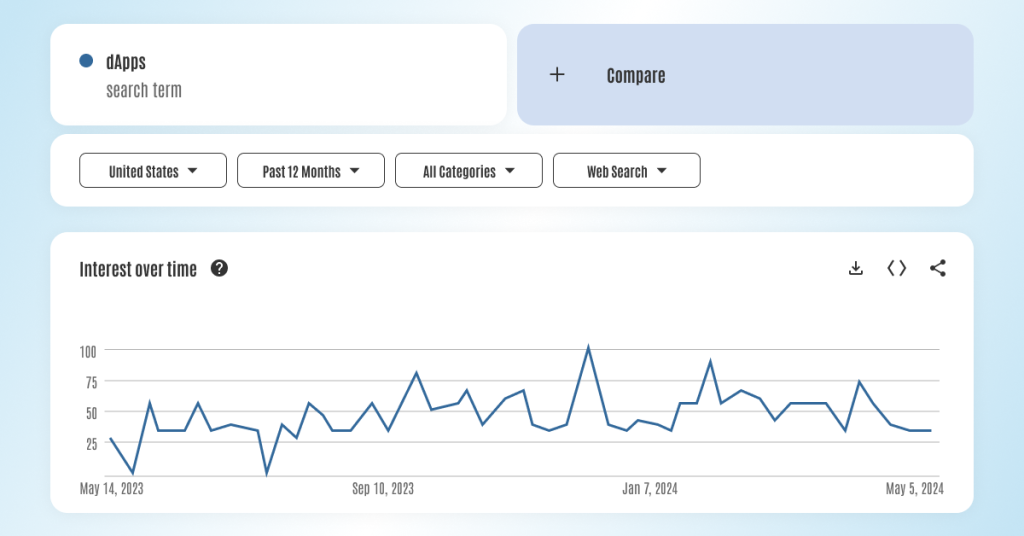
 Google Trends report,on decentralized apps

According to the Google Trends report, interest in decentralized apps has also shown an upward trend over the last year. We have more stats for you! According to Crypto Potato, decentralized apps witnessed a whopping 77% rise in activity in the first quarter of 2024 and a 7 million daily active wallet user count.

What are decentralized apps or dApps? How does a dApp work? What are the features and types of dApps? What industries are using dApps? Are there any challenges faced in adopting dApps? What is the future of dApps?

If you’re looking for an answer to all these questions, you’re at the right place. We consolidated all the useful information with comprehensive research via our blockchain developers.

Let’s start with the basics.

What is a Decentralized App?

A decentralized app is a Web 3.0 app built on top of blockchain technology. Let’s expand the term ‘decentralized’ to get a better understanding of what a decentralized app is. Decentralized means that there is no central server where the data is stored; however, it uses a distributed ledger technology where the information is stored on a number of nodes. 

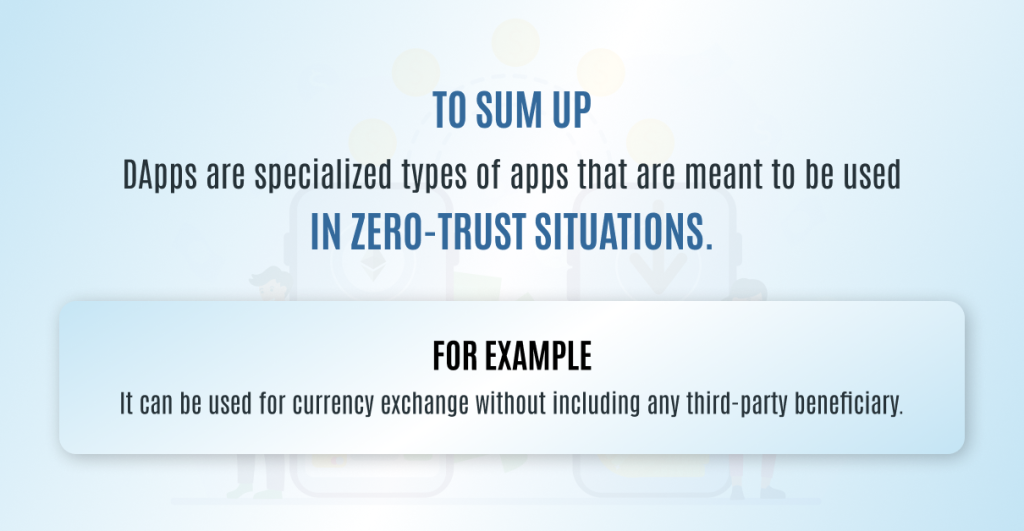
Similarly, dApps are decentralized apps as there are no third-party intermediaries. Let me explain it with an example! If you wanted to sell your digital book on a centralized network, you could use PayPal as a payment gateway and create a checkout store that gives the user a book after checking out. Here, PayPal acts as a third-party intermediary.
However, in the case of a dApp, you can directly sell your digital book to the interested buyer without the need for a third-party beneficiary. You can code a smart contract that will be implemented once a user clicks on the payment option.
What is a Decentralized App

How Does a dApp Work?

As discussed above, a decentralized app or dApp works on top of blockchain technology. The backend of the app works on a peer-to-peer decentralized network. A dApp also has a frontend and user interface similar to that of a traditional Web 2.0 app. You can also host the frontend on any decentralized server such as IPFS.

The dApps are usually written in robust programming languages such as JavaScript, C++, Ruby, Go, Python, Solidity, etc.

Although dApps function quite similarly to the traditional apps that exist on Apple Store and Google Play Store, there are some highlighting features of a dApp that are worth noting.

What are the Features of a Decentralized App?
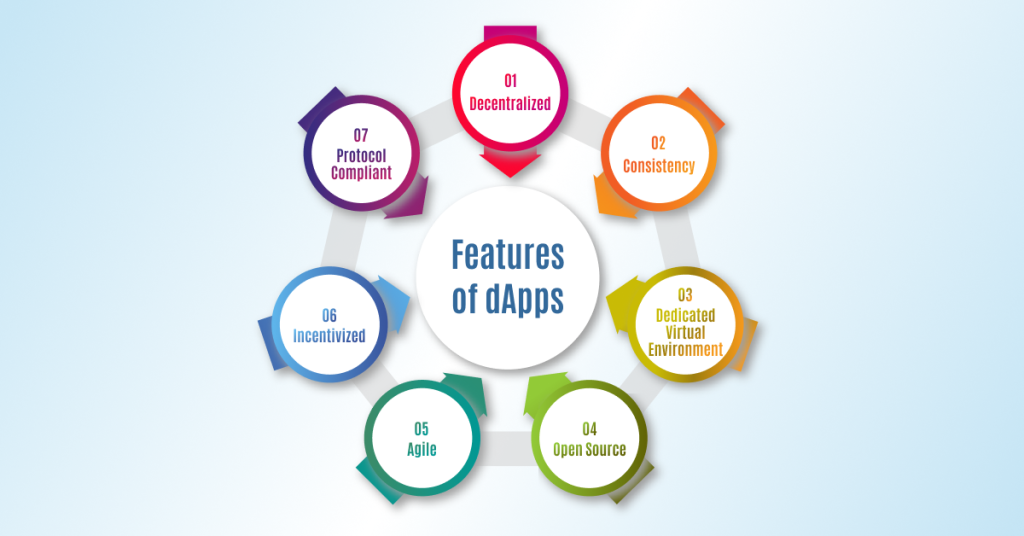
Features of dApps

The following features of the dApp are noteworthy:

  • Decentralized: dApps are decentralized in nature, meaning that they do not function on a central server but rather on a distributed network of computers or nodes. For example, a decentralized application runs on Ethereum, a public, open platform.
  • Consistency: dApps operate the same way no matter what environment they’re running in, unlike centralized applications that run differently on various operating systems such as Windows, MacOS, Ubuntu, and Linux.
  • Dedicated Virtual Environment: All the decentralized applications run inside an isolated virtual environment called the EVM or Ethereum Virtual Machine. It is a virtual environment created to keep smart contract errors or buys at bay. This functionality helps in the seamless functioning of the blockchain network.
  • Open Source: There is no single server or entity that controls the functioning of dApps. These apps are open-source and the code is available for public inspection.
  • Agile: dApps have all the agility to function in various environments irrespective of the function that needs to be performed. When provided with the necessary resources, dApps can carry out any task. 
  • Incentivized: A dApp works on the model of incentivization to the users. It can generate exchangeable and tradable tokens as proof of value. These tokens act as rewards on the blockchain network.
  • Protocol Compliant: Since dApps work on various blockchain platforms such as Bitcoin and Ethereum, they function by following significant cryptographic algorithms to show proof of value. For instance, both Ethereum and Bitcoin function on Proof of Work consensus mechanism protocols. 

What are the Types of dApps?

Decentralized apps or dApps can be classified into various types based on consensus mechanism and functionality. 

Let’s first classify them on the basis of the consensus mechanism:
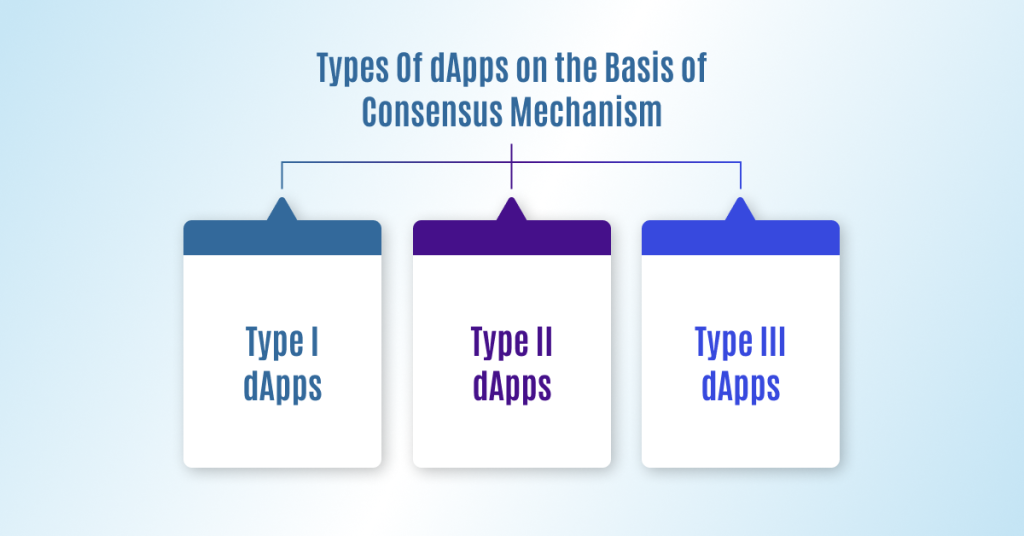
types of dApps on the basis of consensus mechanism
  • Type I dApps

The type I dApps are the foundational dApps that form the framework for other dApps to be build upon. They have their own blockchains. For example, digital currencies such as Ethereum and Bitcoin, and smart contracts.

  • Type II dApps

The type II dApps are the decentralized apps that function on top of type I dApps since they do not have a blockchain of their own.  They function on the basis of protocols and can have their own protocols. For example, the Omni protocol works on the Bitcoin blockchain.

  • Type III dApps

The type III dApps refer to the dApps with which a user interacts directly and performs actions on it. In other words, the type III dApps are built on top of type II dApps. These dApps have a decentralized marketplace or a digital wallet built on them. For example, an NFT marketplace to trade art or any other digital collectibles.

Now, let’s classify dApps on the basis of functionality:
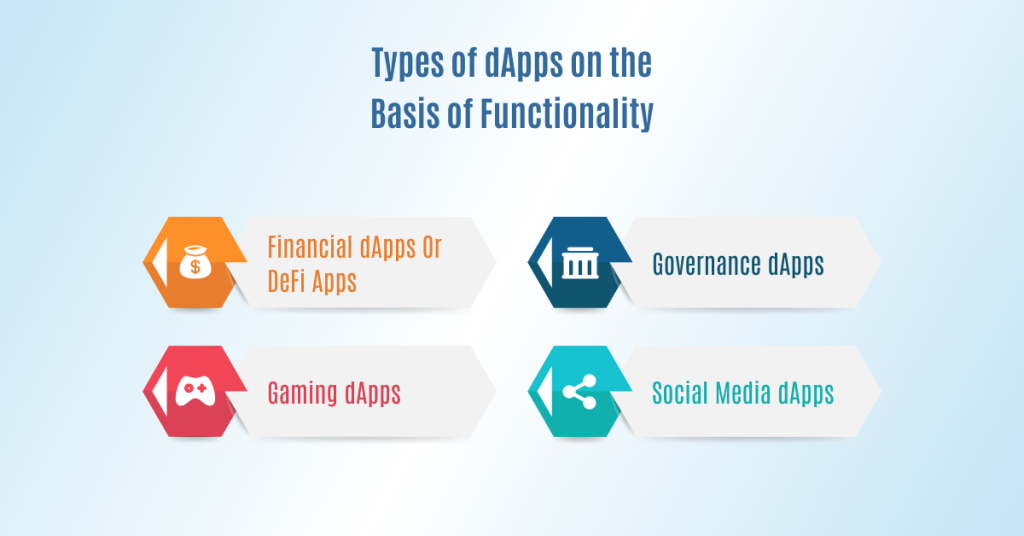
types of dApps on the basis of functionality
  • Financial dApps or DeFi Apps

Financial dApp is a type of decentralized app that brings peer-to-peer (P2P) payment systems into the limelight. These apps eliminate the need for third-party intermediaries to enable and even create payment gateways. For example, Aave is a decentralized (DeFi) investment platform that allows lending and borrowing of cryptocurrency at both fixed and variable interest rates.

  • Governance dApps

dApps also have significant applications in the government sector, thanks to their unwavering transparency and credibility. These decentralized apps are being used in voting systems and Decentralized Autonomous Organizations (DAOs) that help make decisions on the basis of consensus protocols without the need for a central authority. 

  • Gaming dApps

Decentralized apps have opened the door to another dimension of possibilities by turning virtual characters and artifacts into unique and verifiable assets. You can sell, buy or trade these assets on various marketplaces or even make an NFT out of them. For example, CryptoKitties is a decentralized gaming app that works on EVM where users can sell, buy and trade virtual cats or kittens.

  • Social Media dApps

You can also enjoy decentralized social media networks through dApps. For example, Lenstube is a decentralized social media app where users can share videos, mint their username and create their own Web 3.0 identity. The app is powered by Lens Protocol.

What are the Various Industries Utilizing dApps?

Many industries across the globe have recognized the power of dApps. From real estate to logistics, the blockchain technology has left no stone unturned. Let’s explore the applications of decentralized apps across various industries:

  • Supply Chain Management

dApps implementation in supply chain management has transformed the way in which goods are tracked. The intervention of dApps has allowed direct communication with the business partners, thus leading to improved business operations, enhanced transparency and traceability. 

For example, VeChain is a blockchain-powered platform that improves business operations by enhancing the tracking of goods, products and processes. Another excellent example is the IBM Food Trust uses a private blockchain to provide actionable food supply chain data with immediate access to authorized users, right from the farm store to the end consumer.

  • Healthcare

The utility of dApps in healthcare is quite evident. It significantly helps in securing and managing patient data in a decentralized manner without sharing data with third parties. It also helps to enable interoperability between healthcare providers. 

For example, MedRec is a decentralized record-tracking platform that gives full access to patients over medical record distribution. Patientory is another blockchain-powered software solution that provides control of patient data and incentivizes them through tokens.

  • Real Estate

Blockchain technology has also spread its wings in the real estate industry. It has simplified property transactions and mitigated fraudulent activities since there is no involved beneficiary.

For example, Propy is a real estate transaction platform that uses blockchain for transparent transactions and allows to navigate real estate deals completely online. RealIT offers tokenized assets for investing in real estate as a blockchain-secure passive income source.

  • Entertainment

dApps are also infiltrating the entertainment segment and helping to create more personal relationships between the artist and his cult following. The blockchain technology has also helped in fair revenue distribution amongst the people working in the background in the entertainment industry and introduced direct artist-to-fan interaction.
For example, Audius is a decentralized music streaming platform where users can create immutable and timestamped records through which they can earn bonuses and can be incentivized. Another example is Theta which is a blockchain-powered network for video streaming.

What are the Challenges of dApp Development?

Now that we have talked about the bright side of dApp development, let’s talk about the major challenges that the world is facing in building dApps. The following are the concerning downsides of dApp development:

  • Scalability Issues

Blockchain technology does not offer scalability features like cloud computing. It often lags behind in working up to its full potential in times of network congestion. It often faces low transaction speed when there is a high traffic influx. Not to mention the excessive gas fees that is charged on every payment on the blockchain network. For example, Ethereum has a high gas fee.

  • Security Concerns

Although blockchain is a decentralized and credible technology, it is still not away from the hands of malicious attackers and hackers. Talking about smart contracts, they’re not yet safe to use since they’re prone to many vulnerabilities. You must remember that blockchain itself is a public ledger that offers some kind of transparency.

  • Difficult User Adoption

Unlike Web 2.0, which is easily accessible to users via search engines, blockchain is relatively less accessible. In fact, people are not familiar with the use cases of blockchain. The UI/UX of the dApps is also non-user-intuitive and difficult to adopt.

What is the Future of dApps?

Although there are still plenty of bottlenecks related to the worldwide dApp adoption, the future of blockchain technology looks quite promising. We can expect various emerging trends in the world of blockchain such as Layer 2 solutions, cross-chain interoperability and some notable advancements in blockchain technology. Since traditional cryptocurrencies such as Ethereum and Bitcoin are highly volatile, we can expect the adoption of stablecoins by merchants and enterprises.

Another potential impact of blockchain technology that we can expect in the near future is the enhanced decentralization of the Internet. We can also expect the adoption of a more equitable digital economy. 

Furthermore, the blockchain segment will be regulated in a streamlined manner to leverage the technology. For example, Dubai has already started utilizing blockchain resources to make it a smart city.

Conclusion

dApps are revolutionizing the way the world works. With an enhanced focus on data transparency and traceability, blockchain technology is becoming popular day by day. From supply chain management to the healthcare industry, every segment is exploring the scope of dApps and their decentralized nature. 

Whether you’re a blockchain-powered startup, business organization or enterprise looking to expand the horizons of your dApp app development project, Deftsoft is here to help. With a team of seasoned dApp developers, testers and UI/UX designers, we stand strong as a dApp development company. Established for more than 18 years, our distinguished dApp development services can help you stand out from the crowd and gain a competitive edge.

You can check out our other blogs to gain deeper insights into blockchain technology and beyond.

FAQs:

1. What is meant by a dApp?

A dApp is a decentralized app, meaning that it works by leveraging blockchain technology to build app solutions that do not require any third-party intermediary. It usually works by implementing smart contracts with its frontend and backend, working on consensus mechanisms such as Proof of Work (PoW) or Proof of Stake (PoS) to validate and verify transactions.

2. What are the main features of a decentralized app?

The main features of a decentralized app include that it is open-source, consistent, works on Ethereum Virtual Machine Machine (EVM), agile in nature and works on consensus mechanisms such as Proof-of-Work (PoW) and Proof-of-Stake (PoS). Another important feature of a dApp is that it uses smart contracts for implementing payments and transactions.

3. What are the types of dApps?

There are different types of dApps based on the consensus mechanism such as type I, type II and type III dApps. Other types of dApps include financial, governance, gaming, and social media apps.

4. What are the various industries where dApps are utilized?

The various industries where dApps are utilized include supply chain management, healthcare, entertainment and real estate. For example, it is used for sharing end-to-end data for tracking goods from manufacturers to merchants in supply chain management.

5. Give an example of a dApp.

Audius is a decentralized music streaming platform where users can create immutable and timestamped records through which they can earn bonuses and can be incentivized. This app is great for selling timestamped records as a unique asset in the entertainment segment. A lot of people compare this dApp to Spotify and even find it better than the latter.

Key Powerful Features of a Successful P2P Lending Platform

The world is witnessing emerging ways of investing and taking loans. P2P lending platforms are one of the highlighting reasons for the market disruption. Years ago, it was impossible to imagine digital asset lending and borrowing without any intermediary. 

However, the advent of blockchain technology has opened up a world of possibilities, empowering us to build ‘trustless’ networks in ways that were previously unfathomable.

Talking about P2P lending platform, it is a decentralized crypto, money and/or digital asset exchange platform which has eliminated the need for third-parties. Especially when you’re outsourcing your P2P lending platform development project, there are certain features of a P2P lending platform that you must focus on.

Whether you’re a startup owner searching for a reliable P2P lending platform development outsourcing company or building it yourself, you must be aware of certain features to incorporate in the solution.

To make it easy for you, we have created a list of the top features of a P2P lending platform. But before that, let’s understand what a P2P lending platform is.

What is Meant by P2P Lending Platform Development?

A P2P lending platform is a peer-to-peer (P2P) fundraising platform that allows the trade and/or exchange of money, cryptocurrency or tokens without interference from any third-party beneficiaries. Since there is no intermediary intervention, the platform is called Peer-to-Peer (P2P).

P2P lending platform development refers to the creation of a lending platform based on blockchain technology. Such a platform hosts an interface that is open for the use of both lenders and borrowers. Lenders can create their profiles and invest a desirable amount, which can yield handsome interest rates. At the same time, borrowers can borrow the money without any collateral.

You must be wondering how lenders ensure security upon loan repayment. Well, these P2P lending platforms offer borrowers a fixed amount of time to repay the loan. Therefore, these platforms are a lucrative investment for people who want to create diverse sources of passive income without any hassle.

How Does a P2P Lending Platform Work?

The primary foundation of any decentralized P2P lending platform is that such platforms connect lenders directly with the borrowers without any need for banking institutions or Non-Banking Financial Companies (NBFCs).

Here is how a basic P2P lending platform works in action:

Step 1. Both lenders and borrowers create their individual profiles on the P2P lending platform by providing their KYC/AML information. 

Step 2. When in need, a borrower raises the request for a loan application with the required amount. He also mentions his current financial status.

Step 3. An interested lender accepts the request and lends the desired amount either fully or partially. 

Step 4. When the required conditions are met, a smart contract is implemented automatically. 
Step 5. Once the loan amount is transferred to the borrower’s account, he can repay it with monthly payments and an interest rate.

how peer-to-peer lending works

What are The Features of a P2P Lending Platform?

Now that you’re aware of how a P2P lending platform works, let’s discuss the important features of an ideal Peer-to-Peer lending platform development process that makes the platform secure, transparent, sophisticated and highly credible. 

The functionality of a P2P lending platform decides the user base. The more seamless the functionalities, the higher the user count.

Check out the following significant features that can adorn a P2P platform to the highest level of sophistication and simplicity:

Features of a P2P Lending Platform

1. Simple Account Creation Process

A P2P lending development platform is created for the use of lenders and borrowers. Therefore, the account creation process must be simple and seamless for both parties. 

For Borrowers

An ideal P2P lending platform must be functional enough to assess a borrower’s creditworthiness by analyzing his/her financial and general credentials. It should verify the identity of the borrower by fetching official documents such as a passport or driver’s license.

For Investors

Simultaneously, your created P2P lending platform must register various significant details of an investor, including income and employment status, investment preferences and risk tolerance. 

Therefore, sophisticated P2P fundraising platforms must verify the identity of investors and borrowers to add an extra layer of security.

2. Robust Loan Application Process

A P2P lending platform must be developed keeping in mind to build a streamlined process for borrowers to apply for a loan. A borrower must be able to set a loan range and browse a list of potential lenders that match his interests. 

At the same time, investors must be equipped with complete transparency to gain insights into the credit history, financial stability and employment status of a borrower who sends the loan request. Later on, an investor can decide whether to accept or reject the loan request based on his risk tolerance and investment strategy.

3. Comprehensive Profile Management

Another solid feature of a P2P lending platform is a comprehensive dashboard that lays down the lender’s and borrower’s profile details. It should include other pivotal details such as lending/borrowing history, upcoming/remaining payments, KYC/AML details, credit score, connected digital wallets, etc. 

It is always a good idea to have a ‘Help’ or ‘Support’ options or chatbots that can solve the queries of investors and borrowers. This functionality will enhance your P2P lending platform’s credibility.

4. Automated Loan Matching

Implementing an optimized loan matching process is a complete game-changing feature of a P2P lending platform. By using advanced machine learning algorithms and data analytics, loan matching systems can assess the creditworthiness of a borrower and recommend a pool of borrowers to the investors along with their potential credit risk.

Through such functionality, investors can diversify their investment portfolio in a safe manner and explore a wide range of investment opportunities that align with their return goals and interests. 

5. Seamless Payment System

Seamless Payment System

An ideal P2P lending platform must have a secure and efficient payment system for processing loans. The platform must offer a myriad of options to make the payments. These options include payments through digital wallets, debit and credit cards, and net banking, etc. You can also partner with third-party trusted apps to enable payments for investors and borrowers.

6. Advanced Credit Scoring Models

Traditional credit score rating systems leverage limited data resources to assess the creditworthiness of a borrower. An efficient P2P lending platform blurs this line of unbalanced estimations and utilizes advanced methodologies to create credit scoring models. 

The Peer-to-Peer (P2P) lending platforms offer an in-depth evaluation of credit scores by collecting data from unconventional resources like social media, non-traditional income streams and online footprints to bring out comprehensive information to understand the borrower’s financial situation. Such functionality attracts investors and gives them a secure edge over others.

7. Anti-Fraudulent Systems

Developing an integrated P2P lending platform goes hand-in-hand with predicting the number of users who’ll use the platform. Therefore, it is crucial to stave off anti-fraudulent activities from the platform. 

P2P lending platform developers must integrate efficient fraud detection mechanisms that can identify risks associated with bogus identities, identity theft and other malicious activities and eliminate any other potential risks.

8. Automated Smart Contract Implementation

Incorporating smart contracts in the development of a P2P lending platform is one of the platform’s most transformative features. These smart contracts are ‘trustless’ decentralized contracts that do not require third-party intermediaries to be implemented. They work independently once certain pre-defined conditions coded in the contract come true.

Smart contracts make the payment process in lending and borrowing more efficient, transparent and robust. These contracts also eliminate operational load and other redundant fees. Therefore, smart contracts make the loan disbursement and repayment process simple, advanced and secure without any third-party intervention.

9. Secure and Compliant

Following industry-standard security protocols such as multi-factor authentication, end-to-end encryption, and secure communication channels creates a powerful P2P lending platform that is secure and compliant with the security protocols. The ultimate goal of your P2P lending platform development should be to offer the utmost security and compliance with the industry security measures.

Another great feature of a P2P lending platform is to integrate Know-Your-Customer (KYC) and Anti-Money Laundering (AML) functionalities to ensure that only genuine individuals use your platform. This practice also mitigates the risk of identity management and ensures efficient individual assessment.

Partner With an Industry-Recognized P2P Lending Platform Development Company

Are you new to the blockchain ecosystem and want to step into the realm of P2P lending platform development? Look no further than Deftsoft, a reliable P2P lending platform development company. With more than 18 years in the industry, we have contributed our expertise to a variety of projects. 

Our team of experts will help you bring your vision to life with utmost importance to the P2P lending platform’s security and user experience. We ensure the integration of advanced features to the P2P lending platform development.

Reach out to us for more info!

FAQs:

What is meant by P2P lending platform development?

A P2P lending platform is a common ground for investors and borrowers to find a perfect match without any interference from third-party intermediaries. These platforms are decentralized and offer attractive interest rates to investors and expose borrowers to a massive pool of lenders without any collateral. With high security and protocol compliance, these platforms are developed by blockchain developers and UI/UX designers. The P2P lending platform development process include planning, coding, testing, launching and optimizing the platform with high-level sophistication.

How does a P2P lending platform work?

First of all, users sign up on a P2P lending platform. Based on their ultimate goal, users can choose to be an investor or borrower. They need to put up their official documents for identity verification and financial status. A borrower can then raise a request based on the required money. Simultaneously, an investor accepts the request of the most competitive offer. Once conditions are met, a smart contract is implemented. This is when the required amount is transferred into the borrower’s account and then the borrower can pay up through monthly instalments.

What are the best features of a P2P lending platform?

Some of the best features to include in a P2P lending platform are a simple account creation process, robust loan application process, user profile and portfolio management, seamless payment system, advanced credit scoring models, automated smart contracts implementation, installing anti-fraudulent mechanisms, and integrating high security and industry protocol compliance.

What are the main benefits of P2P lending?

The key benefits of the P2P lending platform include the exposure of borrowers to a large pool of investors, lower interest rates, easy loan reimbursement without any third-party interference, reduced defaulter risk, borrower’s creditworthiness, enhanced financial system diversity, transparency and accessibility.

Content Marketing Strategy Checklist: B2B Customer Retention Guide

Whether you’re a B2B or B2C business organization, understanding the value of content marketing is non-negotiable. There are two main pillars of growing any business: 

A. Generating relevant leads that convert, and 
B. Retaining those leads

Many businesses just focus on point A and completely forget about customer retention. The real treasure lies in offering value to your existing customers for a high customer satisfaction rate and thus, enhancing your business’s revenue. 

According to a recent Harvard research, you can increase your profits by 25% to 95% by increasing your customer’s lifetime value and retention by 5%. This is the reason why it is important to invest in content marketing, especially for retaining your customers.

If you’re overwhelmed by confusion, this blog is the perfect guide to help you follow our well-researched guide on the best customer retention strategies.

What is Customer Retention? How to Measure It?

Customer retention is a quantitative metric to measure the total number of customers that are retained by a business in a specific time frame. In simple words, it refers to the number of people who repurchase a product or service from your business or brand. 

It is a reflection of the customer’s loyalty to a company. There is also a direct relationship between your company’s revenue and the customer retention rate.

Here’s how you can measure customer retention rate:

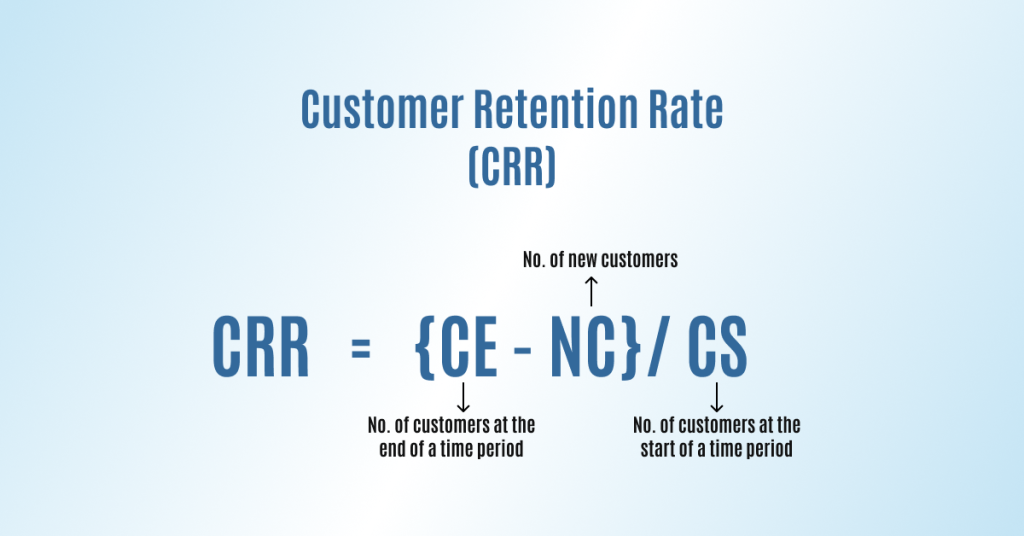
Customer Retention Rate (CRR) formula

Let’s make it easy with an example.

If you have 530 customers at the end of the month and 500 customers at the beginning of the month. Also, you gained 50 new customers. Therefore, your customer retention rate will be:

(530-50)/500 = 0.96 

This means that you have a 96% retention rate.

Note: You need to work on your customer retention rate if it is less than 60% for 2 months consecutively.

Why is Customer Retention Important?

You must maintain a healthy customer retention rate of at least >70% to drive in sophisticated amount of revenue to your business. There are plenty of reasons to actively work on customer retention strategies for enhanced business profitability.

  1. Consistent Monthly Recurring Revenue (MRR)

One major reason to invest in B2B customer retention strategies is to gain consistent Monthly Recurring Revenue (MRR). MRR accounts for the number of customers driving specific revenue per month. Once you gain loyal customers, they can bring in consistent business. 

The higher the retention rate, the higher the revenue.

For example, Salesforce‘s customer retention rate of 77% ranks it fifth amongst its competitors, including Google, IBM, SAP, Workday, and Oracle, according to Comparably. 

  1. Reduced Churn Costs

Companies can incur heavy losses if they cannot retain a customer. It is worrisome to have a high churn rate. According to Invesp, it costs 5 times more to attract a new customer than to retain an existing one. Therefore, when you invest in retaining your customers, they can also bring in 2x more business through word-of-mouth and referrals.

  1. Enhanced Brand Loyalty

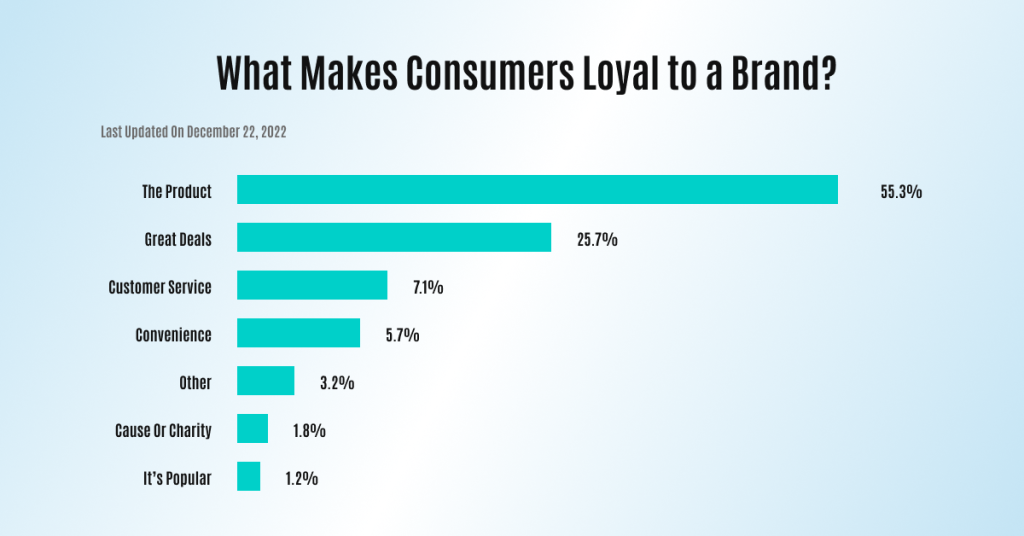
According to Yotpo, over 55% of consumers are loyal to a brand because they love the product. Then come other factors such deals and customer service.

Enhanced Brand Loyalty

Customers that retain also bring in bonus business by buying more products than their first purchase. The same goes for B2B businesses! Loyal customers also act as a pool of resources for a company. You can gain valuable feedback from these consumers and make the required changes to your business’s product or service.

Now that you’re familiar with customer retention, how can you increase your customer retention rate? 

The secret lies in implementing solid content marketing strategies right when you onboard a client, in the case of a B2B business, or when a potential customer visits your website. 

It’s time to learn about content marketing!

What is Content Marketing?

Content marketing is a strategy that revolves around planning, creating, and distributing content to generate relevant leads. It is an approach that does not follow the conventional methods of advertising but generates content on various social channels, including blog posts, social media posts, articles, images and videos.

The content created is heavily emphasized on being informational, insightful and solution-focused to the consumers. 

The apex goal of content marketing is to build trust, credibility and accountability for your company. Once you create a loyal user base, you open the door to an increased number of referrals and, ultimately, sales.

What are the Best Content Marketing Channels for B2B Customer Retention?

According to the HubSpot State of Marketing Report, 50% of marketers plan to increase their investment in content marketing in 2024. And according to a recent Forbes study, 45% of B2B content marketers expect an increase in their content marketing budget in 2024. 

If you’re one of them, it is important to strategically create content for various social channels for B2B businesses. 

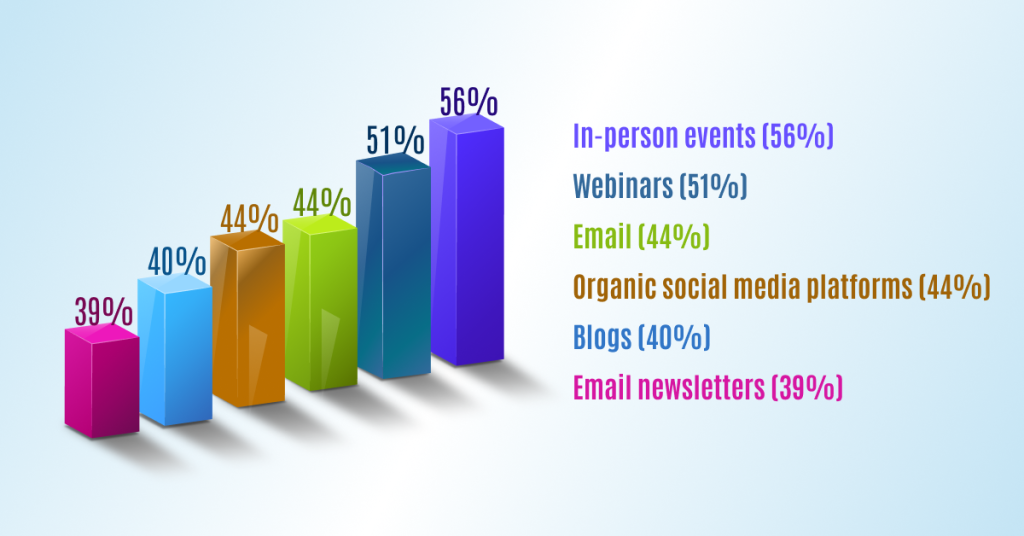
According to Forbes, the most popular social media channels for B2B content marketing are as follows:

social media channels for B2B content marketing
  • In-person events (56%)
  • Webinars (51%)
  • Email (44%)
  • Organic social media platforms (44%)
  • Blogs (40%)
  • Email newsletters (39%)

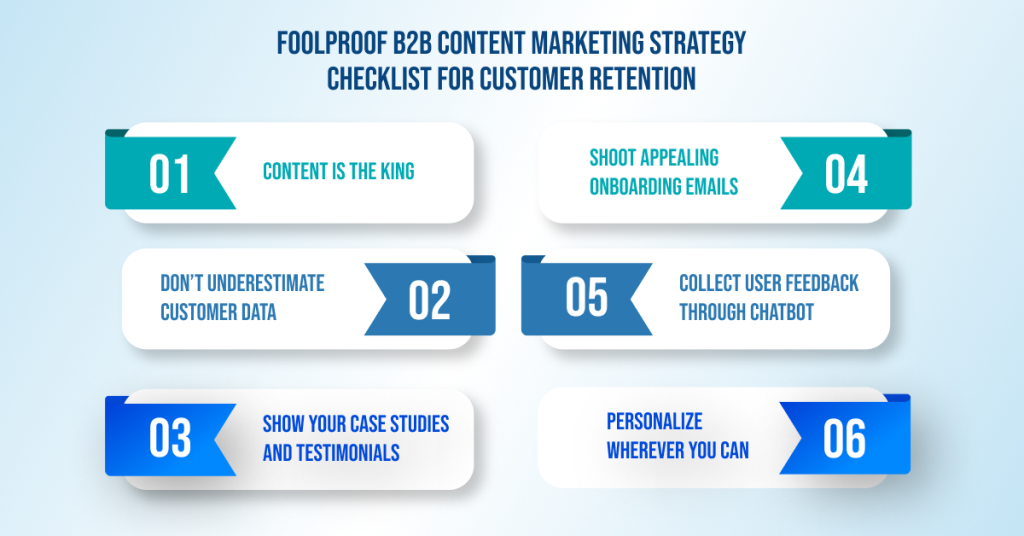
Foolproof B2B Content Marketing Strategy Checklist for Customer Retention

Let’s address the elephant in the room: what are the best content marketing strategies for customer retention?

Before we move forward with the content marketing strategies for B2B businesses, it is pivotal to understand the customer buyer journey. Comprehending a customer journey map is as important for retaining customers as it is for generating new leads

The following are the crucial stages in a customer journey:

  • Awareness stage
  • Consideration stage
  • Conversion stage
  • Loyalty stage
  • Advocacy stage or Referral stage

We have curated content marketing strategies keeping these stages in mind, and you should, too when implementing the following strategies!

B2B Content Marketing Strategy Checklist

1. Content is the King

Creating content actively can help you enhance your brand’s visibility to both potential customers as well as to search engines. You can create various forms of content that offer value to the users. Being in the business, you can create the following types of content:

  • Blog posts
  • Emails
  • How-to guides
  • FAQs
  • Product demos
  • Case-studies
  • Whitepapers
  • Ebooks
  • Infographics
  • Checklists
  • Social media posts
  • Videos

Pro Tip: You can batch-create the content for the whole month in one go by brainstorming 10-20 topics. This practice will help you generate content consistently which will eventually help your customers to look out for your content!

2. Don’t Underestimate Customer Data

Customer data is a valuable resource for understanding consumers’ interests. It indicates how a customer interacts with your website. You can harness this data to gain useful insights and perform analysis to gather useful information across various touchpoints. We call it ‘customer intelligence’.

You can then build user personas, group them up and perform customer segmentation based on interests, demographics, consumer problems, etc.

3. Show Your Case Studies and Testimonials

When a prospect reaches your website, it is important to show them proof of work. This is when your business’s case studies and customer testimonials come in handy. Presenting one of the best content marketing strategies to enhance the chances of converting your leads into clients.

Testimonials and case studies hold the power to evoke emotions in the individuals who interact with such content. This practice allows the brands to create deeper connections with their prospects.

4. Shoot Appealing Onboarding Emails

It is pivotal to build smooth experiences with your customers right when they buy your product or service. Sending an onboarding email when your consumers make a purchase increases the chances of retaining them.

You can add interactive elements to the emails such as a catchy hook, animations, images, short videos or even an exclusive discount. For example, make the user feel worthy of reading the entire email by providing a discount on the next purchase.

Ensure that you perform customer segmentation based on your customers’ responses and behaviors to the onboarding emails and create a content marketing strategy accordingly.

5. Collect User Feedback through Chatbot

 Collecting customer feedback is the ultimate content marketing strategy for customer retention. You can create and deploy a chatbot on your website to directly gain the personal experiences of consumers. This will help you understand areas for improvement in your product or service.

Once you recognize various bottlenecks and work on them, you can work on these shortcomings and retain your consumers.

6. Personalize Wherever You Can

Human beings love to rebuy from brands where they feel seen and heard. If you’re an enterprise, you must create your profiles on social media platforms, especially LinkedIn and YouTube. 

Small businesses can still interact with their audience directly. However, enterprises mostly struggle with creating personal relationships with their consumers. However, some prominent enterprises have built an immaculate social media presence.

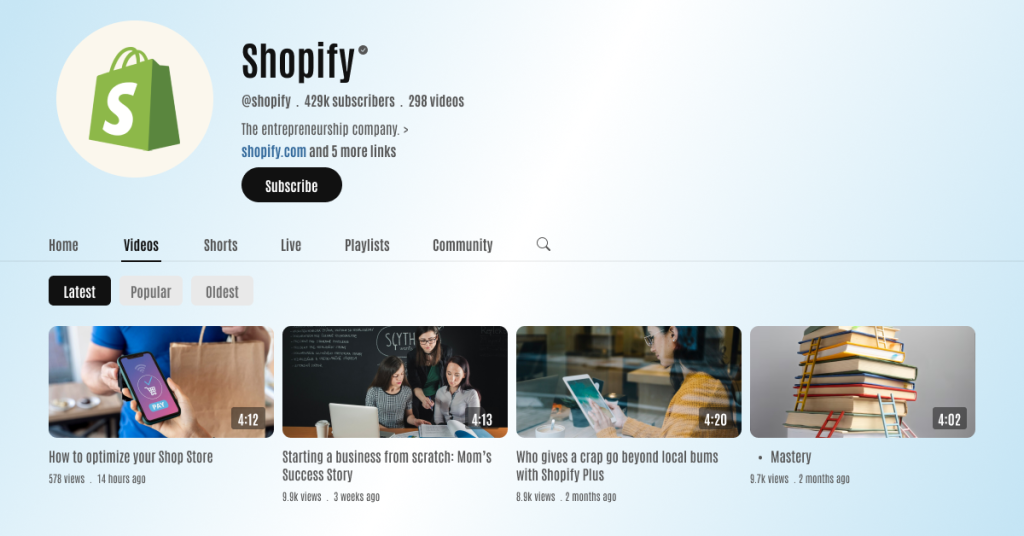
For example, Shopify creates a pool of content on YouTube, which has yielded them a solid personal community and thus directly impacted their customer retention rate.

shopify

Let Us Help You Formulate a Solid Content Marketing Strategy

Whether you’re an enterprise, business organization or small business, Deftsoft is a top-notch digital marketing agency that has a team of inbound and outbound content marketing, SEO and content writers. With more than 18 years in the industry, we come in with expertise in content marketing. From building custom B2B content marketing strategies to strategizing for marketing campaigns, we’ve got you. 

Reach out to us to get started on a killer content marketing strategy for your brand today.

FAQs:

What is meant by a digital content marketing strategy?

A digital content marketing strategy refers to planning, creating, and implementing a strategy for marketing content across various digital and social channels. The most popular method for formulating a content marketing strategy is to understand the customer’s buyer journey and develop a strategy around it.

What is the best type of content to create for building a customer retention strategy?

It is important to have an updated blog post page to keep your customers updated about your product or service. Next, you must focus on building a strong social media presence on various channels such as LinkedIn, YouTube, Instagram, Twitter and Facebook. Another pro tip to retain your customers is to always act on negative feedback actively.

Mention some of the best content marketing strategies for retaining customers.

Some of the best content marketing strategies are to focus on creating content and emails that address customers’ interests and pain points, show your case studies and testimonials on your website, make a killer onboarding email to shoot to your customers and always collect user feedback to analyze it and create a content marketing strategy accordingly.

What is meant by customer retention?

Customer retention refers to the number of customers who rebuy your product or service after their first purchase from you. It is better to focus more on increasing your customer retention rate than upselling, as it costs 5x times more to capture a new customer than to retain him. 

8 Best Programming Languages for Blockchain Development

Blockchain technology has revolutionized the way the world works. Be it healthcare, e-commerce, or fintech, blockchain technology is soaring high. According to Zippia, more than 300 million people are using blockchain for cryptocurrency, which accounts for 3.9% of the global population. 

With such an enhanced user base, a lot of people are drawn to blockchain development. We have created a list of the best languages for blockchain that you can use to build your own blockchain solution or app.

Our team of seasoned blockchain professionals has carefully crafted a list of the best blockchain programming languages to provide you with a toolkit for getting started. This blog is a comprehensive guide to understanding the history, pros and cons, examples, and reasons for choosing a language for blockchain development.

Let’s begin.

Role of Programming Language in Blockchain Development

The role of a programming language is pivotal in building efficient, robust, and fast systems by leveraging the power of blockchain technology. Any language for blockchain is utilized to create a solid Hyperledger structure that creates the very foundation of a blockchain application.

These blockchain programming languages can be used to build decentralized apps on various platforms such as Ethereum, Stellar, Tezos, Ripple, Polkadot, Solana, etc. These platforms can be used to build numerous blockchain offerings such as smart contract development, dApps and NFT marketplace development.

List of Best Languages for Blockchain Development

Now is the time to gain an in-depth understanding of top-notch options for blockchain programming languages. We have considered the trendiest languages for blockchain dApps, smart contracts, and NFT development. Based on your utility and expertise level, you can choose the blockchain programming language that suits you best. Here is the compiled list of the best blockchain programming languages.

1. Solidity

Solidity is one of the best programming languages for blockchain development, especially for smart contract development. It is easy to implement smart contracts on a variety of platforms, including the most popular one, Ethereum. The language is based on C++, JavaScript and Python.

solidity

Also read: Understanding Smart Contract Development: Innovate, Code & Execute

Language History

Solidity is one of the most thriving blockchain languages. It first came into existence in August 2014 under the expertise of the design mastermind Gavin Wood, a notable Ethereum co-founder. However, this blockchain language has been developed by numerous Ethereum core contributors, such as Christian Reitwiessner and Alex Beregszaszi.

This language was created out of the need for a programming language that is compatible and easy to use with the Ethereum Virtual Machine (EVM), a runtime environment to execute smart contracts.

Advantages:

  • Code Familiarity: Since it is based on existing programming languages, it is easy to work with. This code familiarity makes it simpler for traditional developers to step into the realm of decentralization and blockchain.
  • Flexible: Although this blockchain programming language is specially dedicated to smart contract development, it still has the capability to handle complex tasks related to dApp development.
  • Diverse Use-Case: Solidity can be used to create complex smart contracts, tokens, lending platforms, games, and decentralized exchanges.

Disadvantages:

  • Endangered security and correctness of smart contracts.
  • Scalability and efficiency issues of Ethereum.
  • Enhanced gas fees.
  • Integer overflows.
  • Unexpected behavior.

Examples:

  • Ethereum: All the smart contracts that are deployed on Ethereum are built using Solidity, which is popularly known as the blockchain programming language for EVM.
  • Uniswap: It is a decentralized exchange (DEX) created by an Ethereum geek. 
  • Compound: An autonomous interest rate protocol created to build dApps and smart contracts.

Pro Tip: You can start coding Solidity on Remix, which is a web-based IDE that lets you code and compile smart contracts.

Final Review:
Great for creating smart contracts on Ethereum.

2. Rust

Although Rust is a newbie, it is one of the best blockchain programming languages for creating decentralized solutions. For the eighth year in a row, Rust has topped Stack Overflow’s annual developer survey as ‘the most desired programming language.’ 

It is deployed to build secure, immutable and innovative blockchain deliverables. It is a multi-paradigm and general-purpose programming language created for enhanced speed, safety, performance and team collaboration.

Rust

Language History

Rust is relatively younger than other languages for blockchain.   A software developer named Graydon Hoare, who was working at Mozilla, started Rust in 2006 as a personal project. The programming language came into existence on 15th May 2015 when it was introduced by the Rust Foundation. Thanks to Gavin Wood, one of the Parity founders who contributed to the enhanced popularity of the programming language.

Advantages:

  • Memory Safety & Error Detection: Rust is a static programming language that selects and checks the variable and expression types at the time of code compilation. This makes the language more reliable through safe memory.
  • Self-Upgrading: You can easily compile the Rust code into WebAssembly (WASM), which offers its self-upgradability functionality.
  • Fast and Reliable: You can write multi-headed programs that run on 16 cores and keep them readable, easy to maintain and efficient.
  • Concurrent Programming: Coming with an in-built support, you can work on multiple threads without memory issues.
  • Zero Garbage: Rust does not collect garbage. This functionality empowers developers to have precise control over memory.

Disadvantages:

  • Access to less number of libraries.
  • There’s a significant learning curve.
  • It is relatively difficult to maintain.
  • It works slower than other programming languages.

Examples:

  • Polkadot: This blockchain development platform’s core infrastructure is built on top of Rust. Even its runtime logic is based on Rust.
  • IoT Development: Rust leaves no trace of memory-related bugs, supports small binaries, has less runtime, and is efficient; it can be embedded and used to create IoT systems.
  • Web Development: Rust supports web development when working on the server side. It can also be used for APIs and high-performance web servers.

Fun Fact:
Rust is named after a Fungi that is “over-engineered to survive”.

Final Review:
If you’re heavy on performance, need efficient memory and want to create any kind of blockchain project with fast runtime, Rust is the answer.

3. Go

If you’re looking for the best programming language that is the easiest to understand, we can name no other language for blockchain development but Go. Similar to Rust, Go is a statically typed language. It is a high-level language and is quite similar to Python and JavaScript since it is user-friendly, scalable, flexible and fast.

GO

Language History

Go is a blockchain programming language designed by Robert Griesemer, Rob Pike, and Ken Thompson at Google in 2007. It was made available as open source on November 10, 2009. Previously known as Golang because of its early domain name, the language came into existence to fill in the gaps of C++.

Advantages:

  • Simple Language: There are no complexities or fancy code writing to the language. It exhibits perfect minimalism.
  • Easy Learning Curve: This language for blockchain is easy to learn and does not require heavy expertise in coding.
  • Built-in Testing: You do not need libraries for unit testing, as Go has its own set of testing and benchmarking tools.
  • Binary Execution: There is no need for a runtime interpreter. Therefore, it can compile single executable binaries.
  • Cross-Compilation: You can cross-compile out-of-the-box without breaking a sweat, unlike cross-compiling in C.

Disadvantages:

  • The code can be less flexible at times since it is a statically typed programming language.
  • Access to fewer libraries.
  • It offers low-speed performance as compared to Rust.
  • It lacks verbose error handling.

Examples:

  • Hyperledger Fabric: This open-source blockchain framework allows you to create a diverse range of dApps and blockchain solutions.
  • Go-Ethereum: It is one of the original implementations of the Ethereum protocol. It can be used as a library embedded in Android/iOS/Go projects or as a standalone application.

Final Review:
Go is the simplest language for blockchain. You don’t need to think much about creating a twisted logic when writing the code.

4. Motoko

Motoko is an excellent blockchain programming language for creating smart contracts. In fact, it is a programming language used to build directly on the Internet. This means that Motoko directly supports the programming model of the Internet Computer, a public blockchain network platform based on Internet Computer Protocol (ICP). Many professionals consider this language to develop smart contracts in the DFINITY ecosystem (the NPO that developed the Internet Computer).

Also read: How are Public Blockchains Different from Private Blockchains?

Motoko

Language History

Mokoto is the native language of Internet Computers. It was developed by a non-profit organization called DFINITY and introduced in 2019. It is an actor-based programming language. There are more than 400 repositories on GitHub related to Mokoto.

Advantages:

  • Memory Allocation: Mokoto has a developed garbage collector that automatically adjusts memory when a database is no longer in use.
  • Safe Upgrades: This blockchain programming language also supports safe canister upgrades.
  • Built-in Support: The language offers support for orthogonal persistence, which means that the program adopts the illusion of running “forever” and keeps its memory alive.

Disadvantages:

  •  It is difficult to test and debug Mokoto programs.
  • It does not allow setting breakpoints or setting through code running on the live network.
  • Since the language is new, there is not a wide user base for it.

Examples:

  • Internet Computer: A public blockchain based on the Internet Computer Protocol (ICP) for implementing secure and tamper-free smart contracts.

Final Review:
You can use Mokoto for your smart contract development project, especially if you want to build directly on the Internet Computer.

5. C++

C++ is yet another wonderful high-level programming language for blockchain app development. It is one of the oldest languages and has a proven track record in blockchain development. I’m quoting this because even Satoshi Nakamoto himself used C++ programming language to create the Bitcoin chain. Later on, it was also used to build Dogecoin, Qtum, Litecoin, etc.

c++

Language History:

C++ came into existence in the year 1985 when it was developed by Bjarne Stroustrup, a Danish computer scientist. It is indeed one of the oldest general-purpose, object-oriented programming languages. Over the years, we have witnessed its solid use in cryptocurrency development such as Bitcoin, Ripple, Stellar and EOS. 

Advantages:

  • Efficient Memory: C++ offers an array of benefits, with the primary advantages being having spectacular memory control and efficient CPU management.
  • Running Threads: It is easy to run both parallel and non-parallel threads using the C++ language for blockchain.
  • Compile-Time Polymorphism: C++ offers the helpful functionality of compile-time polymorphism that allows users to determine which function or operation to call based on types, order and number of arguments.
  • Code Isolation: C++ also offers the feature of code isolation for various data structures.

Disadvantages:

  • There is no garbage collection support in C++.
  • Running C++ is limited to the Microsoft platforms.
  • There is no built-in thread support.
  • The language syntax is relatively harder to understand.

Examples:

  • Bitcoin: The first blockchain and cryptocurrency in the world was created by using C++ blockchain programming language
  • Stellar: It is an open-source, decentralized platform for payments, cryptocurrency trades and payments. It also offers a crypto wallet.
  • Ripple: It is another blockchain service provider that offers a real-time gross settlement system.
  • EOS: It is an open-source blockchain protocol that can be used by programmers to develop and run dApps.

Final Review:
C++ is one of the most reliable languages for blockchain and can be used to create apps, smart contracts, and much more. Although it has a difficult syntax for a beginner, it is the oldest language.

6. Ruby

In the bustling world of Solidity and Rust, Ruby is often underestimated in its value. Ruby is a high-level, multi-paradigm (works on multiple platforms) and general-purpose programming language that is powerful for creating a diverse range of blockchain solutions. With this solid language for blockchain development, one can build robust, secure, and scalable blockchain applications.

Ruby

Language History:

Ruby was designed by Yukihiro Matsumoto, a computer scientist and software programmer in Japan in the mid-1990s. However, the language first appeared in 1995. This programming language gained popularity and became mainstream after the adoption of the Ruby on Rails framework.  

Advantages:

  • Developer-Friendly: Because of its impressively high readability of the syntax, it qualifies as a chosen gem for the best blockchain programming language for blockchain developers. Therefore, it is a win-win when creating smart contracts.
  • A Pool of Libraries and Gems: Ruby has an extensive pool of libraries and gems from which you can choose. For instance, gems such as Ethereum and bitcoin-ruby act as a great entry point to the blockchain community.
  • Large Community: Since Ruby is an open-source programming language for blockchain, it is backed by a massive community of developers across the globe.

Disadvantages:

  • Ruby is not a good fit for handling large projects.
  • It struggles with inefficient memory.
  • It also has some performance issues.
  • The language is not flexible to use.

Examples:

  • Chain: It is a blockchain technology platform that offers tools for building and arranging blockchain applications. It is a developer-friendly platform to create blockchain-based applications using the available SDKs and APIs.
  • Blockstack: It is a decentralized computing platform that is used to create decentralized apps, such as DeFi. The user gets complete control of the data when using Blockstack.
  •  Peatio: It is an open-source cryptocurrency exchange platform based on the Ruby on Rails framework. One can trade, withdraw, deposit and perform KYC/AML verification using this platform.

Final Review:
Ruby is the best blockchain programming language for a beginner who wants to build a blockchain application, as there is great community support for the language.

7. JavaScript

JavaScript is yet another one of the emerging languages for blockchain. Once, JavaScript was merely a browser scripting language. With the introduction of frameworks such as Node.js, JavaScript has expanded with advanced capabilities, one of them being blockchain development. It can be used mainly for real-time dApp interactions and communication between nodes.

JavaScript

Language History:

JavaScript is an object-oriented language created by Brendan Eich, the former CEO of Mozilla. It was first made available for public use on December 4, 1995. It was first created for web development, but with the introduction of frameworks, it was gradually adopted by the blockchain community.

Advantages:

  • Entry Point: Learning JavaScript is an easy entry point to the blockchain community because of its simpler syntax than C++.
  • Functional Programming: It is one of the best blockchain programming languages because of functional programming. It is a paradigm that can be used to build computer programs without mutating data.
  • Asynchronous Language: It is an object-oriented, prototype-based and asynchronous programming language that can handle communications easily between nodes in a blockchain network.

Disadvantages:

  • It is very dynamic to consider it a blockchain programming language.
  • Anyone can see the code.
  • Its interpretation depends on the browser.

Examples:

  • Topas City: Topas City has created a VR world by leveraging the programming language. The game is in the early development stage and consists of NFTs as items, in-game assets, and a blockchain-based data recording system.
  • Your Place: Your Place is a JavaScript-powered community art experiment where contributors can add pixels of color to a canvas which, once completed, can be minted as an NFT.

Final Review:
If you’re new to both the blockchain ecosystem and coding, you can consider picking up the pace by learning JavaScript.

8. PHP

Expanded as a Hypertext Preprocessor, PHP is a server-side scripting language mostly used for web development. Almost 79% of all Internet websites are based on PHP. With the emerging blockchain technology, developers are looking for new ways to utilize PHP to create dApps (decentralized applications).

PHP

Language History:

PHP is an old programming language dedicated to website and web app development. It was created by a Danish-Canadian programmer named Rasmus Lerdorf in 1993. It was only in 1995 that it was made live for public use. 

Advantages:

  • Established Userbase: Since PHP is an old language that has been used by developers since the 90s, it can act as a reliable blockchain programming language without any syntax fuss.
  • Enables Interoperability: A lot of blockchain networks can be interconnected with each other with the help of PHP. It allows the creation of interfaces to connect a diverse range of blockchain networks via middleware and APIs.
  • Quick Development: PHP allows developers to build new applications quickly with high speed and efficiency. In the bustling world of blockchain, where speed is a significant metric, PHP can be a game-changer.
  • Diverse Applications: PHP can be used to develop all sorts of systems that can work with dApps, smart contracts and communication-enabling interfaces across the blockchain ecosystem.

Disadvantages:

  • PHP cannot be used independently for smart contract development. It usually needs another language, such as Solidity.
  • It is not a native language for many blockchain platforms.
  • It has a limited range of debugging tools.

Final Review:
Although PHP is not a dedicated blockchain development language, it can still be used to develop smart contracts, dApps and interfaces such as APIs for blockchain networks.

Bottom Line

Blockchain is an emerging technology that is ready to blow up at the speed of a bullet train. Even if you’re a beginner, there are a bunch of languages for blockchain development that can be deployed to build impeccable blockchain interfaces, dApps, NFT tokens and smart contracts. It is important to choose the right language for blockchain based on your expertise and understanding. 
If you’re a blockchain-empowered business organization, startup or enterprise and you’re confused with the right blockchain programming language to choose for your next project, you can reach out to Deftsoft. We’re a premium blockchain development company with seasoned experts in smart contracts, dApps, ICO/IEO and STO and NFT marketplace development.

FAQs:

What are the various programming languages for blockchain?

There are numerous languages for blockchain that can be used in generating smart contracts and dApps. These languages include Solidity, Rust, Go, Motoko, C++, Ruby, JavaScript and PHP.

Should you choose JavaScript or Rust for blockchain development?

If you’re looking for a programming language that provides next-level performance and memory efficiency, Rust should be your choice of language. However, Rust’s syntax is sometimes difficult to comprehend if you’re a beginner. In such cases, you can stick to JavaScript, which offers great productivity.

Is it enough to learn Solidity for blockchain dApp development?

Solidity is Ethereum’s proprietary language. It is contract-oriented and adopted at a global level by blockchain developers. Its syntax is similar to JavaScript. However, Solidity is relatively more suitable for smart contract development than for dApp development. Yet, it is a flexible language that can also be used for dApp development.

How much coding is required for blockchain?

If you’re building a smart contract or dApp, it is imperative to learn coding. You can learn Solidity or Rust to build a sophisticated blockchain project. Other options include JavaScript, Go and C++.

11 Lead Generation Strategies: How to Generate Leads for SaaS Businesses

Did you know that you need to generate at least 50 quality leads to gain one customer? A lead is someone who fits your business’s ideal customer profile and discovers your company. In general, they’re keen to learn about your business.

On the other hand, a quality lead is when an individual visits your website and provides their contact information by filling out a form. For instance, if you run an HR management software that helps HR professionals manage their data, your website must reflect that information.

Here’s the big question: if you needed to generate thousands or even tens of thousands of quality leads, how would you do it? The answer is cracking the code for lead generation.

In this blog, we’ll plunge into sure-shot strategies for lead generation for B2B SaaS. It entails 11 foolproof strategies so that you never fall off track from collecting high-quality leads.

What is Meant by Lead Generation for B2B SaaS?

Now that you’re familiar with what a lead is, let’s learn about what is B2B lead generation for SaaS.

Lead generation for B2B SaaS is the process of identifying the right set of business organizations or enterprises that show interest in your software service. In other words, they have the potential to buy from you and can be your future customers. 

Lead generation for SaaS business is more of a spiral than a straight process. The first ignition to identify your potential clients is when they interact with your service. For instance, if someone visits your website and signs up for a newsletter, he’s a potential customer.

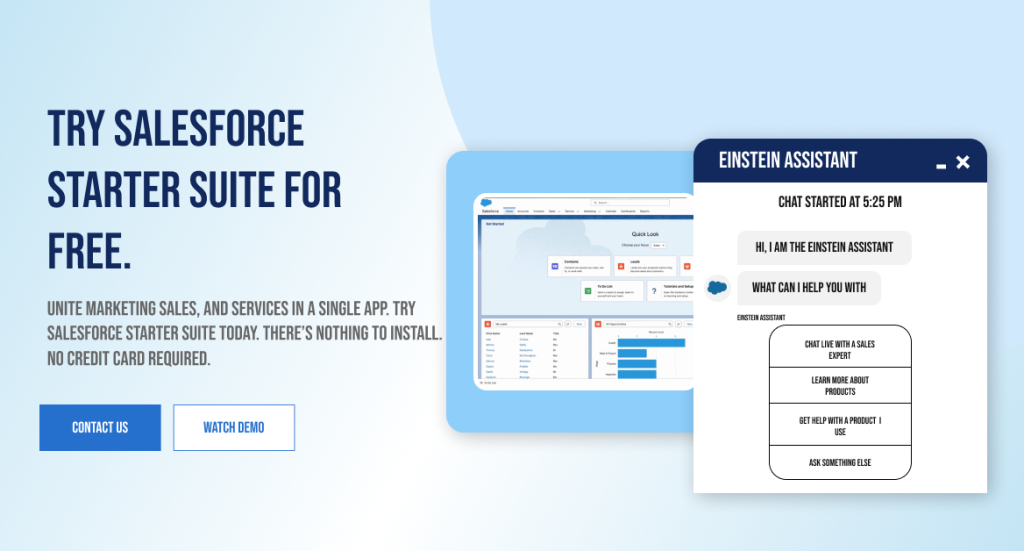
No one does it better than Salesforce. For instance, it has added a chatbot to register website visitors’ queries, which are a direct reflection of potential customers.

Salesforce

Lead generation for B2B SaaS is the first step in guiding users into the sales or marketing funnel. Most individuals think that advertising is the only way to attract leads. However, this is not true. Lead generation for SaaS includes the following strategies:

  • Content marketing
  • Email marketing
  • Pay-Per-Click (PPC) ads
  • Organic marketing
  • Cold calling
  • Website optimization
  • Event Marketing

Why is Lead Generation for SaaS Important?

Fundamentally, B2B lead creation is important to the business, sales, and marketing departments. Without lead creation, there wouldn’t be any leads to move through the sales funnel, no conversions, no clients, and no further business.

Apart from functioning as an organization’s lifeblood, B2B lead generation also furnishes crucial data to marketing representatives, sales representatives, and sales development representatives (SDRs), who are the people in the background.

Note: When practicing lead generation for SaaS, sales-qualified leads should be considered a high priority as they’re more likely to convert than marketing leads.

It is important to implement SaaS lead-generation strategies for the following reasons:

  • To filter ideal customers
  • Boost brand awareness and online visibility
  • Enhance conversion rate
  • Generate high revenue
  • Optimize sales pipeline flow

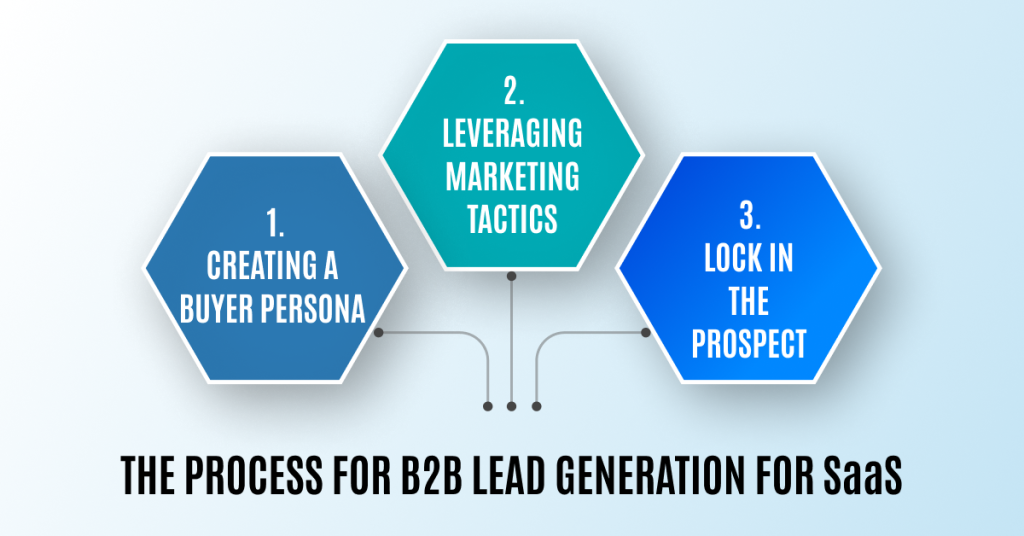
What is the Process for B2B Lead Generation for SaaS?

Process for B2B Lead Generation for SaaS

Lead generation is a crucial part of inbound marketing and a pivotal process of the marketing funnel. Bringing awareness about your brand is how you can attract new leads. As discussed earlier, leads are nothing but a bunch of individuals interested in your service.

The following are the well-defined process of lead generation for your B2B SaaS business:

1. Creating a Buyer Persona

It is important to find the right product-market fit. Therefore, you must find what an ideal customer looks like for you. You must craft a clear picture of the following characteristics of your ideal customer (buyer persona):

  • What are the preferences of your buyer persona?
  • What are the pain points of your ideal customer?
  • What are the interests of your buyer persona?
  • What are the demographics of your buyer persona?

2. Leveraging Marketing Tactics

After figuring out the buyer persona, you must choose a solid strategy to target it. You can target the ideal businesses through social media posts, blog posts, landing pages, and squeeze pages (landing pages with newsletter sign-up prompts). 

3. Lock In the Prospect

The purpose of lead generation for B2B SaaS is to create a consistent influx of businesses that can convert into actual clients. In case these leads become inactive, you can retarget them through social channels, email retargeting, etc.

Top-Notch Strategies for Lead Generation for SaaS Companies

It’s time to address the elephant in the room: how to generate leads for SaaS businesses. This section discusses B2B SaaS lead generation strategies. These strategies are a great option to adopt when you don’t want to opt for cold-calling or perform offline sales. To make it easy for you, we’ve considered the example of Human Resource Management (HRM) software to understand the B2B dynamics of the business landscape.

Let’s begin!

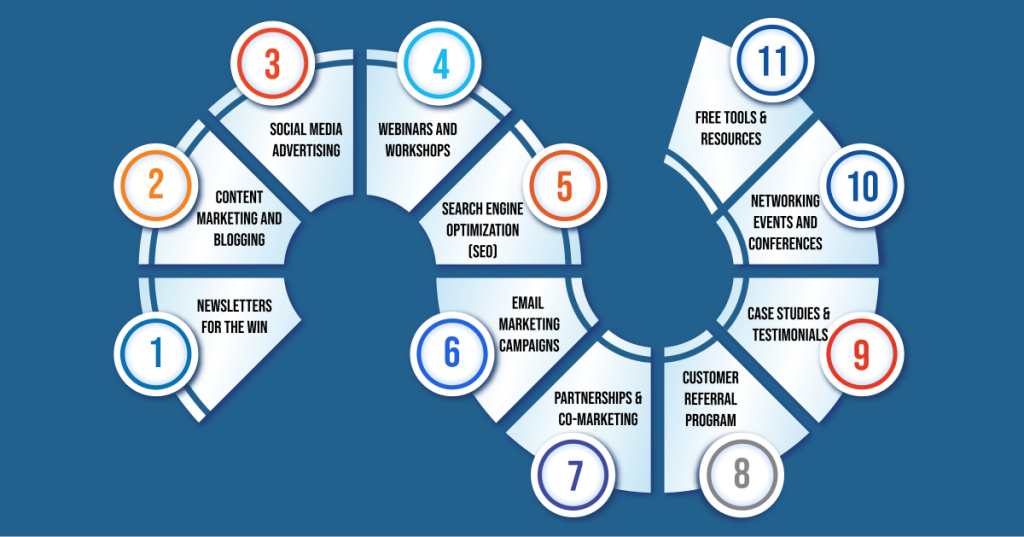
Strategies for Lead Generation for SaaS Companies

1. Newsletters for the Win

Newsletters serve as a valuable tool for engaging with potential lead generation and practicing how to generate leads for SaaS on a regular basis. For example, an HRM software company could curate content for its newsletters that includes industry news, tips for improving HR processes, case studies showcasing successful implementations of its software, and upcoming events or webinars. 

It is a great starter strategy for lead generation for SaaS businesses, as they can collect email addresses from prospective clients and reach out to them personally later on. 

By providing a mix of educational and promotional content, the newsletter keeps the software top-of-mind and positions it as a trusted resource in the HR space.

2. Content Marketing and Blogging

Content marketing serves as the backbone of the entire inbound marketing strategy and is one of the best practices for SaaS lead generation. Content marketing, particularly through blogging, allows HRM software companies to demonstrate their expertise and provide solutions to common challenges faced by HR professionals. 

By publishing in-depth articles, how-to guides, and case studies on topics relevant to their target audience, such as talent acquisition strategies, employee engagement tactics, and compliance issues, the software can attract leads who are actively seeking solutions to their HR problems. 

Additionally, maintaining a regularly updated blog can improve the software’s search engine visibility and drive organic traffic to its website. Remember to refresh your content according to prospects’ latest needs to grab their attention.

Pro Tip:

Don’t know how to generate leads for SaaS? You can create content according to the marketing funnel that works for your enterprise or business organization.

3. Social Media Advertising

Social media advertising, particularly on platforms like LinkedIn, provides HRM software companies with the opportunity to target their ideal audience of HR professionals. You can also use other social media channels, such as Instagram, Twitter, TikTok, Pinterest, Reddit, and Quora, to attract leads.

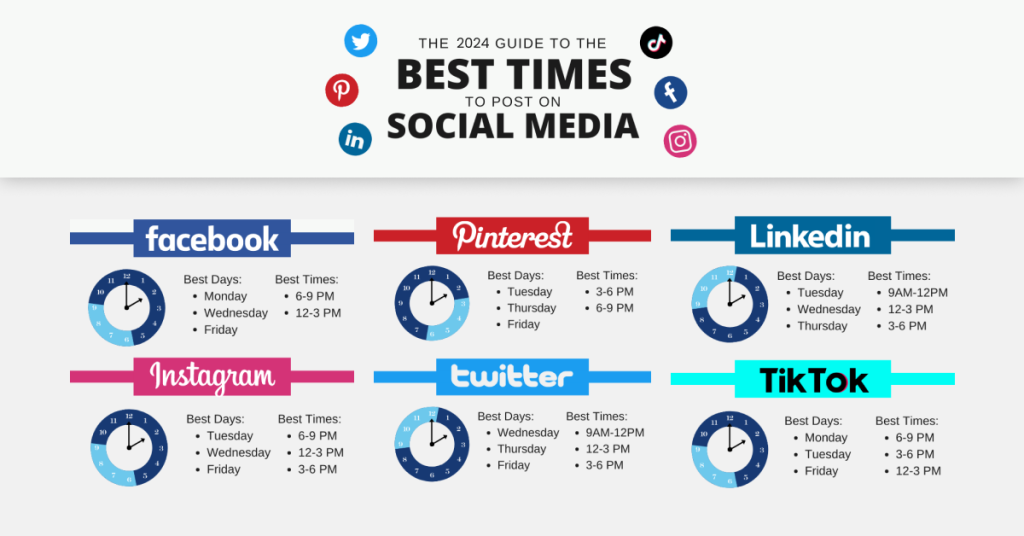
Note: Posting at the right time matters in the long run. For a time guide, refer to the following.

Right time to post on social media platforms, facebook, Instagram, Twitter, TikTok, Pinterest and LinkedIn

Through targeted advertising campaigns, the software can reach users based on factors such as job title, industry, company size, and interests. For example, the software could create sponsored content or display ads that highlight specific features or use cases of the software, driving traffic to landing pages where leads can learn more and sign up for a free trial or demo.

Therefore, social media advertising is another result-oriented B2B SaaS lead generation strategy.

4. Webinars and Workshops

Hosting webinars and workshops allows HRM software companies to engage with potential leads in a more interactive and educational format to generate direct leads for B2B SaaS businesses. By addressing common pain points and challenges faced by HR professionals, such as performance management, employee training, or remote workforce management, the software can demonstrate its value proposition and provide practical solutions. 

For example, a webinar on effective onboarding strategies could showcase how the software simplifies the onboarding process and improves employee satisfaction and retention.

5. Search Engine Optimization (SEO)

Search Engine Optimization (SEO) is not just related to ranking long-form content; it also plays a pivotal role in raking landing pages, websites, and even My Google Business Profile. Therefore, SEO is another undermined SaaS lead generation strategy.

For example, SEO is crucial for ensuring that HRM software companies’ websites rank prominently in search engine results pages (SERPs) when potential leads are searching for relevant keywords or phrases. 

By optimizing website content, meta tags, and site structure for keywords related to HRM software and related topics, such as HR automation, payroll management, and talent acquisition, the software can attract organic traffic from users actively seeking solutions in the HR technology space.

6. Email Marketing Campaigns

Email Marketing Campaign

Email marketing campaigns allow HRM software companies to nurture leads through the sales funnel by delivering personalized content and offers directly to their inbox. 

By segmenting leads based on factors such as industry, company size, or stage in the buyer’s journey, the software can send targeted emails that address the specific needs and pain points of each segment. 

For example, a lead who has downloaded a whitepaper on employee engagement could receive follow-up emails with case studies showcasing how the software has helped other companies improve employee morale and productivity.

7. Partnerships and Co-marketing

You can explore other channels such as partnerships for outbound lead generation services for B2B SaaS businesses.

As in the case of an HRM firm, forming partnerships with complementary businesses or industry associations can help HRM software companies expand their reach and attract new leads. By collaborating on joint marketing initiatives, such as co-hosting webinars, creating co-branded content, or participating in industry events together, the software can leverage the partner’s existing network and credibility to reach a wider audience of potential leads. 

For example, partnering with a recruitment agency could lead to mutually beneficial opportunities for cross-promotion and lead generation.

8. Customer Referral Program

Don’t know how to generate leads for SaaS? Use a customer referral program. Implementing a customer referral program incentivizes satisfied customers to refer their colleagues or connections to the software, effectively turning them into brand advocates. By offering rewards such as discounts, credits, or exclusive access to new features for each successful referral, the software can encourage customers to actively promote the product to their networks. 

For example, a customer who has had success with the software in streamlining their recruitment process may be more inclined to refer other HR professionals in their network who are facing similar challenges.

9. Case Studies and Testimonials

Case studies and testimonials provide social proof of the software’s effectiveness and help build credibility with potential leads. By showcasing real-world examples of how the software has helped other companies solve their HR challenges and achieve tangible results, such as increased efficiency, cost savings, or employee satisfaction, the software can demonstrate its value proposition and differentiate itself from competitors. 
You can also add a star-feature rating to your business. According to a recent post by ExplodingTopics on Twitter,

Only 6% of consumers say star ratings don’t affect their choices. 

38% of shoppers won’t do business with a brand unless they have a 4-star rating.

21% need to see at least a 3.5 rating, and 12% are happy to settle for 3 stars.

Source: BrightLocal

When considering the example of HRM software, featuring testimonials from HR professionals who have successfully implemented the software and seen measurable improvements in their processes can reassure potential leads of its efficacy and reliability.

10. Networking Events and Conferences

Attending industry events and conferences provides HRM software companies with valuable opportunities to network with potential leads and showcase their product to a targeted audience. By sponsoring booths, hosting networking sessions, or participating in panel discussions and speaking engagements, the software can increase brand visibility and establish thought leadership in the HR technology space. 

For example, hosting a live demonstration of the software at a major HR conference allows attendees to interact with the product firsthand and learn more about its features and benefits.

11. Free Tools and Resources

Offering free tools and resources related to HR allows HRM software companies to attract leads who are seeking solutions to specific challenges. By providing value upfront and demonstrating expertise in the HR domain, the software can position itself as a trusted resource and build rapport with potential leads. 

For example, offering a free HR audit tool or template for creating employee performance evaluations not only helps HR professionals address immediate needs but also introduces them to the software’s capabilities and encourages further engagement.

Wrapping Up

It’s a wrap on how to generate leads for SaaS. Lead generation for SaaS businesses requires a keen eye for detail and intricacy. In addition to cold-calling and door-to-door sales, understanding the value of various social media and other rich resources is important. You can prepare a concoction of educational and promotional content on various channels to attract your prospective clients. At the end of the day, businesses seek pure value, and you must be able to fulfill their requirements.

FAQs:

What is meant by lead generation for SaaS?

Lead generation for SaaS business refers to the process of identifying the right set of business organizations or enterprises that show interest in your software service. In other words, they have the potential to buy from you and can be your future customers. 

What are the best practices for lead generation for SaaS companies?

The best practices for B2B SaaS lead generation include leveraging web blogging and content advertising, Search Engine Optimization (SEO), newsletters, creating free tools and resources for the prospects, running email marketing campaigns, and creating partnerships with other businesses to get an influx of prospects.

What are the best social channels for B2B lead generation for SaaS?

The best social channels for B2B SaaS lead generation include social media platforms such as Instagram, Facebook, Pinterest, Twitter, Reddit and TikTok. You can also use newsletters to attract prospective businesses.

How to create inbound leads in SaaS?

You can create a consistent influx of leads for your SaaS business by applying top-of-the-funnel, middle-of-the-funnel and bottom-of-the-funnel strategies. You can work on social media posts and blog posts to create inbound leads. You can also create content for all stages of the buyer’s journey and create whitepapers and ebooks.

Top 5 Reasons to Choose PHP in 2025

With almost 79% of the websites running on servers that utilize PHP, a whopping 244 million websites on the Internet are relying on PHP!

Expanded as a Hypertext Preprocessor, PHP is a general-purpose, dynamic scripting language used to build web solutions such as websites and web applications. As an open-source programming language, it offers many reasons to choose PHP for development in 2025 for developers. 

With extreme modernization, professionals have started relying on modern solutions, including Python, React, Angular, and JavaScript; however, PHP has evolved with time, with its latest 8.3.2 version, which rolled out in early 2025.

This blog is a full-fledged guide for web development learners, professionals, and enthusiasts who want to gain an in-depth understanding of what PHP is and why it is used in web development, i.e., the reasons to choose PHP in 2025.

What is PHP Web Development?

PHP for web development first became globally available in 1995. Its original contributor is a Danish-Canadian programmer named Rasmus Lerdorf, who created it in 1993. This language is based on C language and is object-oriented.

PHP Web Development

This is the process of developing robust websites and web applications by leveraging the PHP programming language. It has been a popular choice for web development for a long time. If you don’t trust us, many popular websites, such as Wikipedia, WordPress, Mailchimp, Slack, Tumblr, Yahoo, Etsy, Facebook, and Canva, are built on top of PHP programming language and frameworks.

You can check out what PHP experts have to say in regard to the language:

I can say for certain that PHP 7 performs at least as well as anything else around – and I don’t think any language has ever done such a great job of blistering performance improvements with very little Backwards Compatibility.

~ PHP web consultant and specialist Lorna Mitchell

I think that PHP is easier to get started for beginners and offers a wealth of advanced features that allow a developer to continue growing and advancing.
Also, I think another reason PHP has continued to grow strong is its continued growth based on developers’ needs.

~ PHP enthusiast Adam Culp

How is PHP Used in Web Development?

PHP is an open-source scripting language written for a server. It interacts with front-end and back-end frameworks, so it is specifically used for backend scripting. The following are the highlighting arenas where this is used in web development:

  • It is used to handle the backend of the server side of a web application.
  • It can load data from a server and put it into HTML DOM.
  • It can also be utilized to connect to different databases and apply scripts to HTML.
  • It can be used to create interactive and dynamic webpages, applications and e-commerce platforms.
  • It can be used to send and receive emails.
  • It can be used to collect data from web forms.
  • It can also be used to send and receive cookies.
  • It can generate output in various formats such as XML, PDF, HTML, Flash and other file types.
  • It can also be used to modify and manipulate data present in various databases.
  • It can be used to write, open, delete, read and close files on a server.

What are the Reasons to Choose PHP in 2025?

Let’s explore the primary reasons to choose PHP in 2025 in web development. We’ll go through the advantages of using this programming language in developing websites and web applications. One of the best reasons to choose PHP in 2025 is the freedom to create custom web development solutions.

Reasons to Choose PHP in 2024

The following are the pivotal reasons to choose PHP in 2025:

1. Free & Learner-Friendly Programming Language

PHP is an open-source programming language specifically built to give commands to the server at the backend. It is an economical and pocket-friendly solution for professionals who want to build dynamic websites, web pages, web applications, and e-commerce platforms. 

Another upside of the language being open-source is that it is backed by a strong community of coders and professionals, thus making it a lucrative choice for learners. You can always gain an edge throughout your learning curve as you stay up-to-date with the latest industry trends related to PHP.

Let’s shed more light on PHP’s role as a server-side programming language. It allows the creation of dynamic web pages that can be customized based on user data and other information. It also allows the efficient delivery of information custom-made for individual users, thus ensuring that they are accountable for an outstanding and interactive user experience.

2. Secure and Scalable

Over the years, a lot of people have bashed PHP as an ‘unhealthy’ web development programming language. However, the PHP developers have been unstoppable since then! They’ve created many iterations to date to make it more secure and scalable than ever. Therefore, PHP also offers in-built security features. It is immune to various web vulnerabilities such as SQL injection and cross-site scripting (XSS). Security is now indeed one of the reasons to choose PHP in 2025!

Note: SQL injections are the most common type of malicious attack that can occur while executing PHP code. In such cases, the best practice is to use PDO (PHP Data Objects), which are lightweight and consistent frameworks for accessing data in PHP.

Another one of the best reasons to choose PHP in 2025 is that the programming language’s community keeps up to date on security patches and suggests concurrent fixing solutions. 

3. Multi-Operating System-Friendly

You can consider PHP to be the jack of all trades since it is compatible with a multitude of Operating Systems. To call out their names, PHP is compatible with Windows, MacOS, Linux, Unix, etc. It also works perfectly fine with iPlanet, Microsoft, Tornado, Netscape, and Apache servers. Additionally, it supports a plethora of databases, such as MySQL and MongoDB, including 20 others.

Therefore, it is compatible with all the major operating systems. It is also a great tool for creating cross-platform web applications, meaning these applications can run on more than one operating system.

4. Aligns Well With CMSs

Another one of the major reasons to choose PHP in 2025 for web development is its full-fledged compatibility with many prevalent Content Management Systems (CMSs). Not everyone in the business is well-versed in web development technology, so professionals leverage the power of CMS to modify, maintain, and update content across various platforms. 

PHP is compatible with many CMSs, such as Magento, Shopify, Joomla, Drupal, Magento, etc., making it a suitable choice for many industry professionals. Therefore, most of the popular CMSs are compatible with PHP-based frameworks. 

5. Treasure of Libraries

 As Python is quite popular for its array of libraries, PHP also has a pool of robust and pre-installed libraries. The following is the list of the various libraries available in the suite of PHP programming language:

  • Monolog
  • Laravel Admin LTE
  • PHP AMQP Library
  • PHP dotenv
  • Symfony Finder Component
  • AWS SDK for PHP
  • Symfony Filesystem Component
  • Symfony Console Component

Join Hands for Custom PHP Web Development Services

Are you short on time and looking to outsource your web development project? It is a judicious decision to invest in a PHP web development company right now. With an array of experienced PHP web developers and designers, Deftsoft is an abode for professionals with hands-on experience in the industry. With over 18 years in the industry, we have worked with thousands of clients across the globe, including Fortune 500 companies.

You can contact Deftsoft, an industry-recognized PHP web development agency, to kickstart your dynamic and custom web development project.

FAQs:

What is PHP web development?

PHP web development is the process of building websites, web applications and dynamic e-commerce websites. PHP is a server-side programming language that is robust, flexible and community-backed. You can create customized web solutions using various PHP frameworks to build solid solutions.

Is PHP good for web development?

Unlike mainstream opinions, PHP is a dynamic, flexible, open-source and secure tool for web development. It offers customized solutions and comes with numerous advantages for web developers and other non-tech professionals. It is open-source, secure and scalable, and works well with many popular Operating Systems and CMSs such as Shopify, Magento, Joomla, etc., and offers a number of libraries to work with.

What is a PHP full-stack developer?

A PHP full-stack developer is a professional who offers a complete range of services related to web development, whether backend or frontend. He is responsible for creating, testing, and deploying innovative web applications and identifying and fixing compatibility issues involving CSS, HTML, and scripting.

Where can I find a reliable PHP web development agency?

Deftsoft is a trustworthy PHP web development company with a proven track record of successful clientele. We’re a Clutch-recognized company that has provided custom development services for a wide range of industries, such as real estate, logistics, e-commerce, hospitality, retail, and fintech.

Is PHP backend or frontend programming language?

PHP is a backend scripting programming language used to write commands to the server. It can then perform custom web development tasks. With PHP, one can create dynamic and interactive web pages and applications, create forms, send and receive cookies, and do so much more.