
How to Rank Your Real Estate Website Faster Using AI SEO in 2026
-
By Devraj
-
8th June 2026
The real estate industry has changed dramatically. Buyers now research neighborhoods, school districts, and property values online before contacting an agent. Simply having a website is no longer enough. To stand out, your site must rank for high-intent searches like “homes for sale near me” or “top realtors in [City].”
AI SEO for real estate uses AI to identify relevant keywords, optimize content, and monitor performance. Unlike traditional SEO, AI SEO services can analyze patterns, predict buyer intent, and automate repetitive tasks, helping real estate websites rank faster and attract more qualified leads.
This guide explores actionable strategies to improve your real estate SEO in 2026, combining AI SEO tools, local SEO, and the best digital marketing services for real estate.
Quick Summary:
In 2026, buyers and sellers are more digital-savvy than ever. They rely on AI-driven search tools, local listings, and real-time property comparisons to make decisions. To stay ahead, real estate businesses need AI-driven SEO, combined with local SEO, strategic content, and smart real estate marketing. By leveraging AI SEO services, agents and agencies can increase visibility, attract qualified leads, and convert searches into actual site visits.
Rank Your Real Estate Website Faster in 2026
Leverage AI SEO and local strategies to attract qualified buyers and sellers.
Why AI SEO is Crucial for Real Estate
Artificial Intelligence Search Engine Optimization (AI SEO) redefines the exact mechanisms through which property platforms identify, engage, and retain prospective buyers and sellers. Traditional search engine optimization frameworks spent years focusing heavily on fixed keyword density matrices and baseline backlink acquisition metrics. While these standard practices remain core components of search hygiene, advanced AI search models go infinitely deeper by programmatically interpreting granular user search intent, behavioral nuances, and macro-level spatial context.
Consider the functional difference between traditional search tracking and an AI-driven environment. Where an outdated platform might struggle to connect generic queries, modern machine learning models analyze continuous search strings to uncover high-value transactional intent. An AI SEO workflow maps out precise long-tail semantic variations, prompting your content management systems to target highly specific, intent-driven phrases like “family-centric condos with electric vehicle charging stations near local parks” or “undervalued historical residential properties with high appreciation potential.”
To capitalize on this evolution, forward-thinking agencies partner with a dedicated SEO company for real estate. These specialized teams integrate specialized machine-learning software to systematically eliminate arbitrary guesswork from content production pipelines. By evaluating real-time behavioral data, automated platforms dynamically update structural technical configurations, adjust on-page elements, and optimize local directories. This continuous optimization loop guarantees that your active property listings, brand assets, and agent landing pages consistently intercept motivated buyers and property sellers at the exact moment they enter the transactional pipeline.
How Local SEO Boosts Real Estate Rankings
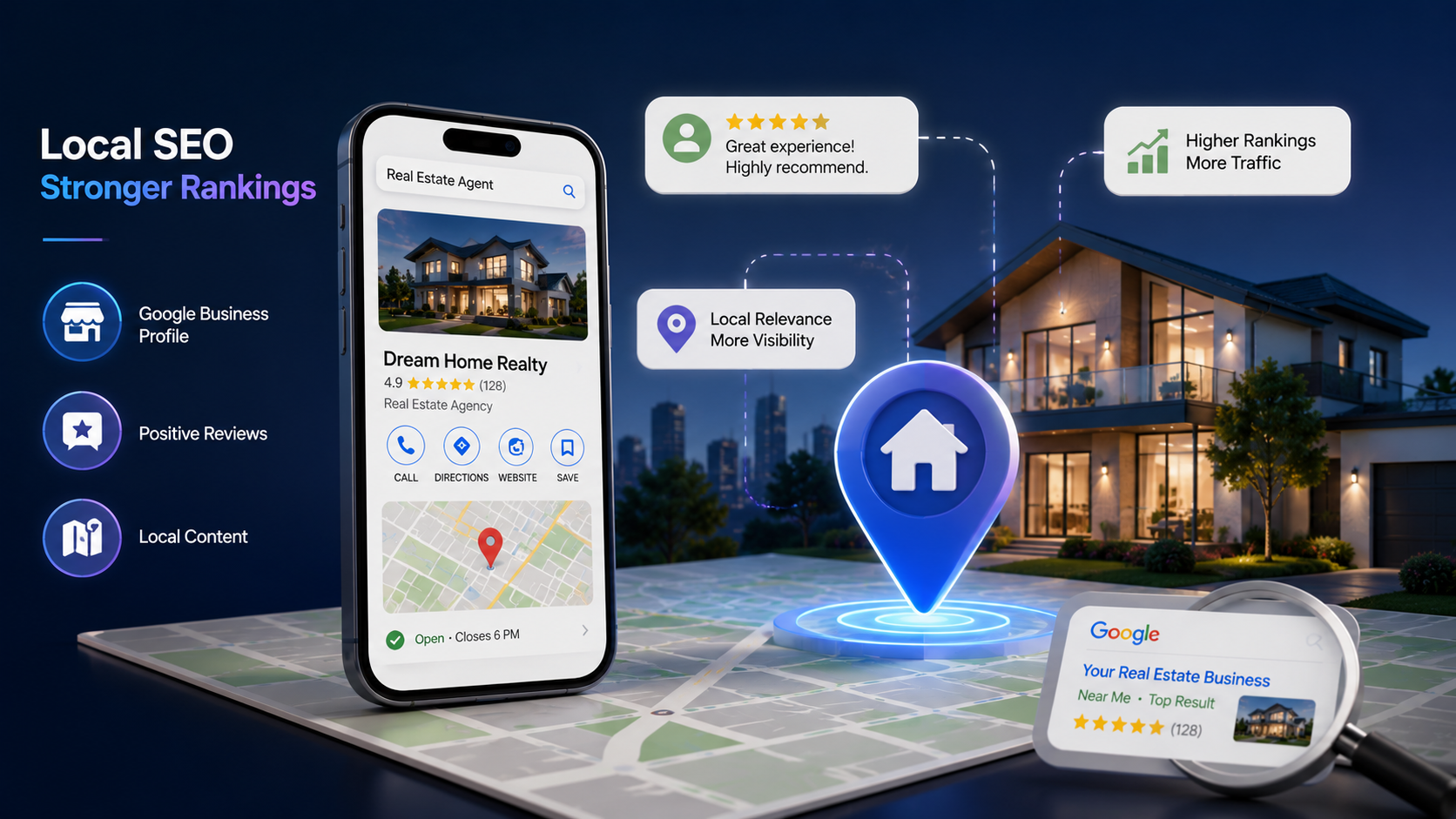
Local SEO is essential because most property searches are location-specific. Buyers search for listings in neighborhoods, cities, or school districts. Optimizing your website for local intent ensures your business appears in Google Maps, organic results, and AI-powered search responses.
For effective local SEO:
- Ensure your Google Business Profile is complete with accurate information, photos, and reviews.
- Create pages or blog posts that highlight local neighborhoods, amenities, and property trends.
- Encourage reviews and respond promptly to maintain credibility.
Combining AI SEO with local SEO ensures your listings and agent profiles reach high-intent users and improve conversion from search to site visit.
On-Page and Technical SEO
On-page optimization protocols guarantee that your public-facing real estate assets remain explicitly legible and structurally accessible to advanced search algorithms. Real estate platforms handle massive amounts of dynamic inventory, which creates complex challenges for standard web indexers. Properly navigating these challenges requires deploying an explicit, technically sound architectural framework.
The Architecture of Next-Generation On-Page Structure
Every specific property landing page, agent profile, and neighborhood guide must adhere to a strict semantic hierarchy. Heading tags must follow a logical downward progression (H1 to H2 to H3), completely avoiding structural jumps that confuse automated scrapers. Furthermore, your meta titles and descriptions must be algorithmically structured to balance click-through motivation with explicit targeting of semantic entities.
Meta Title Structural Formula : > [Target Neighborhood] Homes for Sale | [Property Type] Listings | [Brand Name]
Live Functional Example: > Downtown Luxury Condos for Sale | 3-Bedroom Penthouses | Deftsoft Realty
Within this architectural framework, images require rigorous optimization. Property portals are highly visual assets, often hosting hundreds of high-resolution image files that can easily destroy page performance if left unmanaged. Every single property photo must be programmatically compressed using modern image formats, sized precisely to the rendered layout dimensions, and accompanied by explicit, natural-language descriptive alternative text (Alt Text) that incorporates geographic identifiers without falling into keyword-stuffing patterns.
Technical Architecture and Machine-Readable Schema Data
Technical SEO Service establishes the fundamental infrastructure that permits advanced language models and search engines to render, parse, and index your real estate assets without experiencing layout timeouts or data dropouts. Because search infrastructure places a massive emphasis on mobile rendering efficiency, your entire platform must be fully responsive, maintaining flawless layout integrity across all mobile viewports.
| Core Technical SEO Metric | Performance Threshold Target | Impact on Real Estate Rankings |
|---|---|---|
| Time to First Byte (TTFB) | < 200 Milliseconds | Prevents automated crawlers from timing out during deep site crawls. |
| Largest Contentful Paint (LCP) | < 2.5 Seconds | Guarantees property hero imagery loads instantly on mobile connections. |
| Cumulative Layout Shift (CLS) | Near 0.0 Absolute Stability | Eliminates jarring text jumps as dynamic pricing or listing badges render. |
To maximize your technical performance, implement specialized microdata layers. Injecting highly customized JSON-LD schema markup directly into the codebase provides search parsers with a clean, machine-readable data layer. For a modern real estate platform, you must go significantly deeper than standard corporate schemas. Your technical workflows should deploy explicit SingleFamilyResidence, RealEstateAgent, and RealEstateListing schemas on every target URL. This explicit declaration of operational attributes—such as price parameters, precise geographical mapping coordinates, room counts, and listing availability—allows your site to serve as a direct data source for both standard search engine rich snippets and conversational AI summaries.
Content Marketing with AI SEO
Content marketing in the current search era is a primary driver of both topical authority and customer acquisition. However, the editorial execution of content must move completely away from generic, surface-level summaries. Advanced search systems prioritize unique information gain, meaning that if your articles simply repeat information already found in the top 3 search results, your platform will face algorithmic devaluations.
Constructing High-Value Informational Blueprints
To catch the eye of motivated property buyers and sellers before they make formal outreach, your editorial framework must answer highly complex, multi-layered queries. Instead of basic posts like “Tips for Buying a House,” focus your content engine on precise, long-tail transactional topics. Crafting detailed long-form pieces like “A Comprehensive Structural Guide to Navigating Multifamily Property Acquisitions” or “The Complete Roadmap to Real Estate Tax Strategies and Capital Gains Optimizations” positions your agency as a verified industry authority.
When creating these long-form pieces, lean heavily on structural formatting elements to maximize content scannability:
- Data-Backed Content Tables: Compare neighborhood parameters side by side, detailing average square-foot pricing, walkability scores, and average annual property taxes.
- Actionable Process Checklists: Provide clear, bulleted checklists outlining precise steps for closing real estate transactions or passing home inspections.
- Pros and Cons Overviews: Build distinct comparison segments that break down the financial differences between fixed-rate mortgages and adjustable-rate financing options.
By blending deep analytical information with a highly scannable visual layout, you satisfy both human readers looking for instant answers and automated indexing scrapers searching for distinct blocks of information to lift into generative answer windows.
Off-Page SEO and Reputation Building
Off-page authority acquisition serves as a strong validation signal, confirming for search algorithms that your real estate website is a trusted, authoritative entity within the broader digital ecosystem. In a search environment heavily influenced by machine learning, off-page authority must extend beyond basic link building to encompass comprehensive digital PR and brand-mention management.
Acquiring High-Quality Industry Nodes
A backlink functions as a clear vote of confidence only if the linking domain possesses genuine topical alignment and established digital authority. Real estate platforms must completely avoid low-quality directory links and spammy link networks. Instead, dedicate outreach resources to securing placements on trusted real estate journals, localized municipal news outlets, recognized financial review blogs, and prominent property design publications.
When your website secures an authoritative link from a recognized local development blog or a national property investment portal, search engines interpret that connection as direct proof of your niche expertise. This authoritative validation directly improves the crawling frequency and organic performance of your commercial listing pages.
Managing Digital Reputation and Entity Sentiment
Modern machine learning models track brand mentions and analyze customer sentiment across the web to evaluate your corporate credibility. Algorithms continuously monitor major third-party review platforms, local directories, and social media channels to gauge public perception of your business.
To support this, your customer management teams must implement a structured workflow to actively secure positive, descriptive client testimonials. When clients leave detailed, keyword-rich reviews mentioning your specific geographic focus and specialized services, search algorithms associate those verified positive experiences with your business entity. This positive association insulates your rankings against core algorithmic shifts and solidifies your brand presence within hyper-competitive local search spaces.
Measuring Success with AI SEO
Data-driven SEO requires continuous tracking of performance metrics to ensure long-term visibility and a strong return on investment. Because modern search layouts blend traditional organic links with dynamic map features and generative answer sections, measuring success requires looking past superficial ranking numbers.
Your analytics dashboards must continuously monitor and analyze these core operational performance indicators:
- Conversational Citation Share of Voice: Track how frequently conversational search assistants pull data from your site and reference your brand domain for localized property queries.
- Organic Click-Through Rate (CTR) Stability: Monitor your organic link click-through trends to ensure your metadata and rich listings effectively capture search attention.
- Inquiry Conversion Quality: Evaluate the progression of organic web visitors as they move from simple blog page views to completing property consultation forms.
- Confirmed On-Site Walkthrough Volume: Measure the ultimate business metric by linking your organic lead acquisition channels straight to physical property site visits.
By keeping a close eye on these deep engagement metrics, your marketing teams can swiftly adapt to changing algorithm updates. This proactive tracking approach ensures your ad spend and content creation efforts stay fully aligned with the channels that generate high-quality buyers and real transaction volume.
Real Estate SEO Checklist for 2026
For a faster ranking and stronger digital presence, follow these AI SEO strategies:
- Implement AI SEO services to target high-intent property keywords.
- Optimize website pages for content, headings, and meta information.
- Strengthen local SEO for neighborhoods, cities, and nearby amenities.
- Monitor technical SEO: page speed, mobile optimization, and schema.
- Publish AI-optimized content regularly to attract buyers and sellers.
- Build authority through high-quality backlinks and local citations.
- Track analytics and refine strategy using AI insights.
Turn Searches into Site Visits
Optimize your property website with AI SEO and watch your traffic convert into real leads.
FAQs
1. What is AI SEO for real estate?
AI SEO for real estate is the practice of leveraging advanced machine learning algorithms, natural language processing, and semantic entity mapping to optimize property websites. Unlike traditional keyword-centric optimization, this advanced framework structures your site data so that both standard search indexers and conversational answer engines can effortlessly parse, understand, and cite your property assets.
2. Why is local SEO important for property websites?
Local SEO is completely essential because real estate searches are inherently tied to specific geographic locations. Property buyers search for homes within defined neighborhoods, municipal boundaries, or school districts. Hyper-local optimization guarantees that your brokerage appears prominently within local map packs and regional search results when high-intent buyers query location-specific terms.
3. How do AI search engines alter real estate discovery?
AI search engines transform user discovery by acting as intelligent synthesis engines rather than simple link indexes. Instead of requiring users to click through dozens of separate browser tabs, conversational interfaces aggregate pricing data, local sentiment, and property features into a single, cohesive answer, highlighting and citing only the most authoritative online sources.
4. Can AI-optimized content improve standard Google rankings?
Yes. The exact structural updates required to make content easily digestible for advanced language models—such as clean heading hierarchies, scannable content tables, the removal of filler text, and clear structured data layers—align perfectly with Google’s core helpful content ranking systems for traditional organic search layouts.
5. How long does it take to see measurable results from an AI SEO campaign?
While basic technical fixes and schema integrations can deliver swift improvements in crawl efficiency within a few weeks, a comprehensive organic strategy generally requires three to six months of consistent execution to secure dominant topical authority, stable keyword growth, and increased lead generation.
Recent Articles





Devraj
 8th June 2026