AI SEO Services Pricing: How Much Does AI SEO Cost in 2026?

Let’s be completely honest: if an agency tries to sell you an AI SEO package that is just a standard 2022 SEO retainer with a few ChatGPT prompts thrown in, you are getting ripped off.

In 2026, search looks entirely different. It is no longer just about blue links on a screen. Your potential clients are actively using Google AI Overviews, ChatGPT, Perplexity, Gemini, and Bing Copilot to find software, vendors, and services. Optimizing your digital footprint so these large language models (LLMs) actually recommend your brand requires a completely different data infrastructure, tracking software, and optimization techniques.

Naturally, the specialized skill sets and custom software required to win these placements change the financial math. If you are trying to map out your digital marketing budget, you need to know exactly how much AI SEO services pricing scales and what you should actually be paying for.

Need a clear AI SEO cost estimate for your website?

Get a tailored AI SEO consultation from Deftsoft and understand what your website really needs to dominate modern search engines.

Quick Navigation


What Is AI SEO Pricing Based On?

Website Footprint & Structural Scale

Industry Competitive Density

Current Technical Infrastructure and Content Quality

Advanced AI Visibility Tracking Goals

Why AI SEO Costs More Than Traditional SEO

Main Factors That Affect AI SEO Cost

1. Website Size & Technical Complexity

2. Market Vertical & Competitive Benchmarks

3. Comprehensive Technical and Content Refinement

4. Advanced Visibility Tracking Across LLMs

5. Advanced Schema Markup & Multi-Platform Engine Optimization

Common AI SEO Pricing Models

One-Time AI SEO Audit

Monthly AI SEO Packages

Project-Based AI SEO

Enterprise AI SEO

What Should Be Included in AI SEO Packages?

AI SEO Pricing by Business Type

Small and Growing Businesses

Mid-Market B2B & SaaS Companies

E-commerce Brands

Enterprise Corporate Brands

Red Flags to Avoid in AI SEO Pricing

How To Choose the Right AI SEO Company

Demand an Audit-First Process

Review Their Tracking Technology

Look for Holistic Execution Capabilities

Frequently Asked Questions

What Is AI SEO Pricing Based On?

When you look at a proposal for an AI SEO cost, the numbers aren’t pulled out of thin air. The baseline resource investment is calculated across several structural layers of your digital presence.

Website Footprint & Structural Scale

An enterprise site with 50,000 indexable pages requires massive programmatic schema implementation compared to a local 10-page service business. The more data points an LLM has to crawl, parse, and verify on your site, the more engineering hours go into the project.

Industry Competitive Density

If you are competing in a high-density market like B2B SaaS or fintech, your competitors are already actively engineering their sites for AI visibility. Outranking them in conversational search answers requires deep, continuous entity gap analysis, which naturally raises the baseline pricing for AI SEO agencies.

Current Technical Infrastructure and Content Quality

LLMs are incredibly picky about how they read data. If your site has chaotic internal linking, messy JavaScript rendering, or thin content, an agency has to spend the first 30 to 60 days purely on foundational remediation before they can even touch conversational optimization.

Advanced AI Visibility Tracking Goals

Unlike tracking keywords on a standard dashboard, monitoring your brand mentions in Perplexity or ChatGPT requires specialized API integrations and custom search-intent scraping. The complexity of the specific platforms you want to track directly influences your AI SEO company pricing and overall AI SEO monthly cost.

Why AI SEO Costs More Than Traditional SEO

AI SEO Costs

A common question we hear from founders is: “Why should I pay a premium for AI SEO when traditional SEO agencies are offering cheaper monthly retainers?”

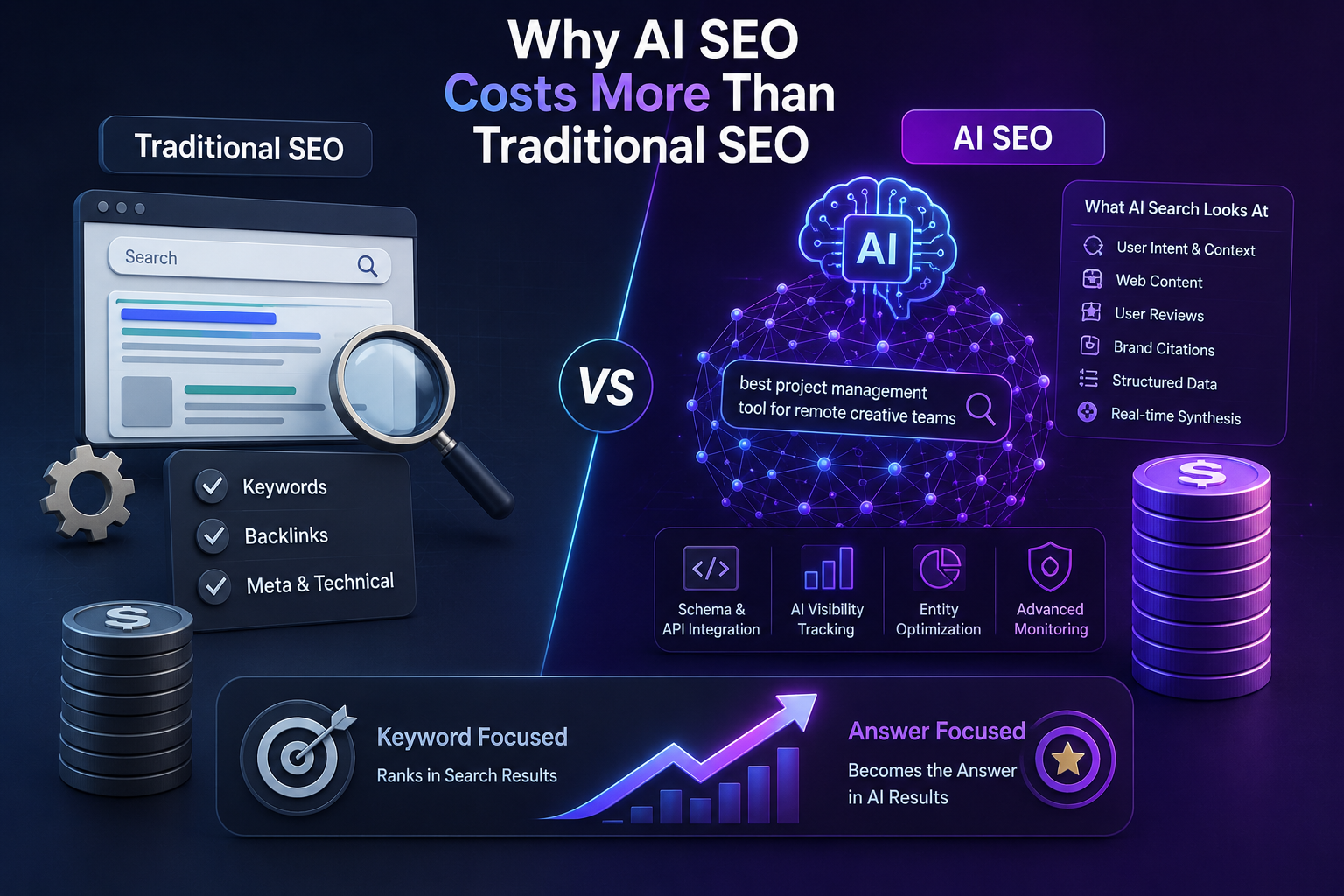
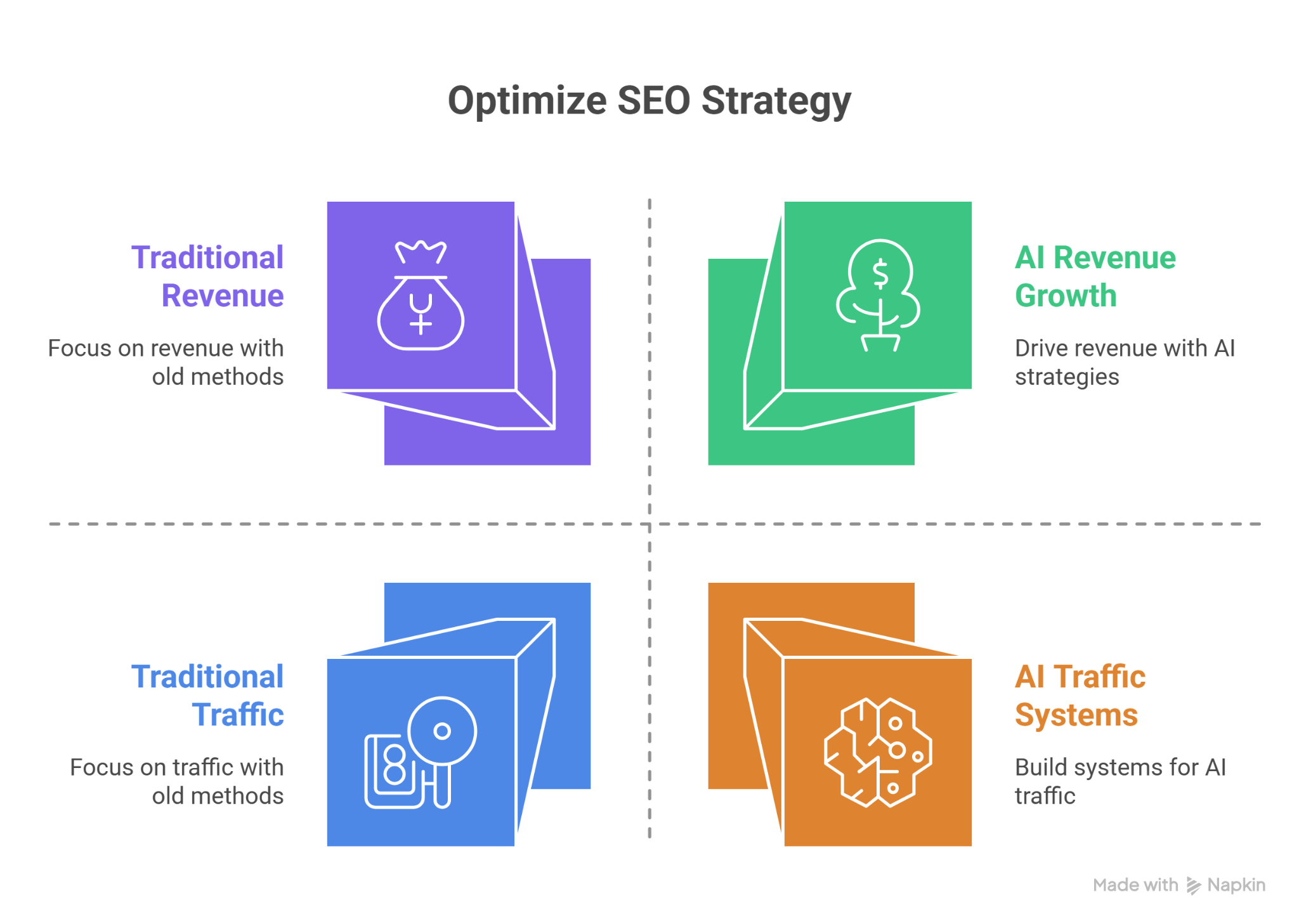
The short answer is that traditional SEO handles only half the equation. Traditional SEO focuses on optimizing your metadata, backend speed, and backlink profile to rank high in standard search results. AI SEO pricing vs traditional SEO pricing reflects a shift from keyword optimization to entity optimization.

Consider this real-world scenario: A user types “best project management tool for remote creative teams” into Perplexity. Perplexity does not just look at who has the best keyword density for that phrase. It scrapes the web, processes user reviews, checks brand citations across forums, and cross-references structured data to construct an answer in real time.

To position your business as the definitive answer within that ecosystem, an agency must manage advanced AI search-optimization pricing variables, configure API-driven schemas, and budget for specialized AI visibility-tracking tools. You are paying for a data-science approach to visibility, rather than just basic copywriting and link building.

Main Factors That Affect AI SEO Cost

To help you properly audit a digital marketing proposal, let’s break down the specific operational line items that shape AI SEO service cost brackets.

1. Website Size & Technical Complexity

Every single page on your site represents a data node to an AI model. A larger footprint means a higher initial AI SEO audit cost because the engineering team has to run comprehensive vector-search simulations to see how current LLMs categorize your site’s topic authority.

2. Market Vertical & Competitive Benchmarks

Optimizing content for niche vertical spaces changes the resource requirements:

  • AI SEO pricing for SaaS companies: Focuses heavily on specific feature-function integration queries and developer docs indexation.
  • AI SEO pricing for ecommerce websites: Focuses on real-time inventory schemas, product attribute clarity, and Merchant Center feeds so that Google’s AI Overview pullouts display correct pricing and stock data.
  • Enterprise AI SEO pricing: Involves massive, multi-layered alignment across international subdomains and complex brand citation networks.

3. Comprehensive Technical and Content Refinement

AI search engines prioritize concise, direct answers that explicitly resolve a searcher’s intent. If your existing content is buried under fluff, your agency must completely restructure your informational architecture. This involves executing targeted entity injection, content pruning, and text block restructuring for rapid semantic parsing.

4. Advanced Visibility Tracking Across LLMs

Standard keyword rank trackers cannot tell you if your brand was recommended in a private ChatGPT user session. To monitor this, agencies use advanced, specialized software stacks. Your monthly investment includes specialized ChatGPT SEO pricing and Perplexity SEO pricing monitoring tools required to verify your ongoing visibility.

5. Advanced Schema Markup & Multi-Platform Engine Optimization

To ensure your brand appears natively inside search summaries, your tech stack requires specialized engineering. This includes the development of custom, nested JSON-LD schemas and active optimization across multiple platforms. Managing the complex Google AI Overview optimization cost means building code frameworks that clearly explain your brand’s relationships, products, and services directly to search crawlers.

Common AI SEO Pricing Models

Agencies structure their commercial agreements based on your company’s operational size and goals. Here are the four primary models found in the market today.

One-Time AI SEO Audit

Perfect for companies with an in-house development team that just need a highly technical roadmap. This audit isn’t a generic software export; it is a deep architectural evaluation of how LLMs index your brand.

  • Average Cost: $2,500 – $7,500 one-time
  • Core Deliverables: Vector semantic gap analysis, structured data validation, entity health assessment, and an LLM indexing roadmap.

Monthly AI SEO Packages

The standard retainer model for continuous, hands-free optimization, content restructuring, and visibility management.

  • Average Cost: $3,500 – $10,000+ per month
  • Core Deliverables: Continuous entity optimization, modern citation building, ongoing technical schema updates, content generation, and monthly cross-platform tracking reports.

Project-Based AI SEO

Best for clear, time-bound initiatives, such as a major website migration or the launch of a massive new product line that needs immediate recognition across conversational engines.

  • Average Cost: $5,000 – $20,000+ per project
  • Core Deliverables: Intent mapping for new product lines, historical content restructuring, and targeted authority building for specific topical clusters.

Enterprise AI SEO

Designed for multinational corporations, complex marketplace websites, or highly regulated industries requiring dedicated data engineering resources.

  • Average Cost: $12,000 – $30,000+ per month
  • Core Deliverables: Custom API monitoring integrations, global brand graph engineering, continuous semantic sentiment monitoring, and dedicated account support teams.

What Should Be Included in AI SEO Packages?

If you are evaluating comprehensive AI SEO packages, look past general promises like “more traffic” and check the scope of work for these non-negotiable deliverables.

WHAT A MODERN PACKAGE REQUIRES
Semantic Entity Audits Nested JSON-LD Schema
Conversational Tracking Historical Refactoring

A comprehensive package should always feature a deep technical evaluation, including an initial semantic audit to analyze how generative models interpret your brand’s core topical authority. The technical execution must go beyond basic metadata to include nested JSON-LD schema deployment that explicitly defines your brand assets, authors, and product features for automated web scrapers.

Furthermore, make sure the package details an explicit strategy for conversational visibility tracking. It should map out exactly how your business will monitor brand share across platforms like ChatGPT, Gemini, and Perplexity, while also accounting for the specific LLM SEO services cost required to refactor old content into highly scannable formats.

AI SEO Pricing by Business Type

Your operational size dictates your specific optimization roadmap. Let’s break down exactly what realistic pricing tiers look like across different business profiles.

Small and Growing Businesses

  • Investment Range: $2,000 – $4,000 / month
  • Strategic Focus: Local entity dominance, building highly optimized FAQ structures for voice search, and securing clean citations across core directories. It provides affordable AI SEO services for hyper-targeted local markets.

Mid-Market B2B & SaaS Companies

  • Investment Range: $4,500 – $9,500 / month
  • Strategic Focus: Dominating conversational comparison queries (e.g., “Alternative to Brand X”), publishing authoritative original research reports, and building out rigorous thematic topical clusters.

E-commerce Brands

  • Investment Range: $6,000 – $12,000+ / month
  • Strategic Focus: Real-time data sync for merchant feeds, programmatic merchant schema optimization, and monitoring product feature pull-outs inside Google AI Overviews.

Enterprise Corporate Brands

  • Investment Range: $15,000+ / month
  • Strategic Focus: Brand-graph asset management, sentiment risk monitoring across LLM training sets, and custom data warehouse integrations for visibility analytics.

Red Flags to Avoid in AI SEO Pricing

The sudden rise of conversational search has brought a wave of low-quality providers who use buzzwords to sell basic services. Keep an eye out for these explicit red flags during vendor conversations.

“Guaranteed Top Rankings in Google AI Overviews or ChatGPT”

Generative models change their search outputs based on user context, conversational history, and personalized intent profiles. Anyone guaranteeing a permanent, fixed #1 slot in an AI Overview response does not understand how real-time vector synthesis works.

Mass-Produced, Unedited AI Content Bundles

If an agency brags about its ability to publish 500 automated blog posts a month using simple API scripts, run away. Search engines actively penalize low-effort, repetitive informational fluff. True AI search optimization relies on unique insights, proprietary data, and high editorial standards.

No Mentions of Technical Schema or API Tracking

If an agency’s proposal looks identical to a traditional SEO package—focusing entirely on meta titles, descriptions, and basic link placement—they are not equipped to deliver real conversational optimization. Without advanced schema optimization and real-time tracking metrics, you are paying a premium for outdated techniques.

How To Choose the Right AI SEO Company

Selecting an agency partnership shouldn’t feel like a guessing game. Focus your evaluation process around these core operational pillars.

Demand an Audit-First Process

A professional AI SEO consultant or agency will never sell you a flat package right out of the gate without looking under the hood first. They should always start with a diagnostic evaluation of your current entity authority and technical indexing hurdles.

Review Their Tracking Technology

Ask them directly: “How exactly will you report our brand’s share of voice inside platforms like Perplexity, ChatGPT, and Gemini?” If they cannot show you a clear, data-backed reporting dashboard that tracks conversational citations, they cannot measure your actual return on investment.

Look for Holistic Execution Capabilities

The ideal partner should bring a balanced team to the table: technical data engineers who understand nested code structures, experienced content strategists who can write with authentic human authority, and analytics experts who know how to extract meaning from modern search datasets.

Want to know exactly what AI SEO should cost for your website?

Deftsoft can review your digital footprint and help you choose a high-impact AI SEO plan tailored to your market goals, industry competition, and current search visibility.

Frequently Asked Questions

1. How much does AI SEO cost in 2026?

For mid-market companies, comprehensive monthly retainers typically range from $3,500 to $10,000. One-time foundational technical audits generally start around $2,500, while complex enterprise deployments scale well past $15,000 per month.

2. What main factors affect AI SEO services pricing?

Pricing scales based on your total website size, the direct competitive density of your industry vertical, the existing health of your technical code, and the specific number of conversational engines you want to track and optimize for.

3. Is AI SEO more expensive than traditional SEO?

Yes, it generally carries a higher investment level because it requires specialized data tools and advanced development skills. While traditional SEO focuses on keyword placement and basic backlink acquisition, AI SEO encompasses advanced entity graph mapping, custom schema development, and cross-LLM tracking.

4. What should be included in comprehensive AI SEO packages?

A professional package should include a deep semantic entity audit, technical nested schema implementation, historical content restructuring, entity citation building, and dedicated cross-platform brand visibility tracking.

5. How much does an AI SEO audit cost?

A technical, standalone audit ranges between $2,500 and $7,500. This covers vector semantic mapping, analysis of your brand’s conversational presence, identification of structural schema errors, and an actionable technical implementation guide.

6. Are AI SEO services useful for small businesses?

Absolutely, but the focus on execution shifts. Small businesses don’t need massive programmatic scripts. Instead, they benefit from targeted local entity optimization, structured FAQ frameworks, and clean review citations that ensure voice assistants and local AI overlays pick them as the top option.

7. Can an AI SEO agency guarantee rankings in Google AI Overviews?

No. Because LLM engines synthesize responses dynamically based on real-time data and user intent profiles, fixed rankings cannot be guaranteed. A legitimate agency focuses on maximizing your overall brand authority, citation frequency, and entity context to ensure you are consistently recommended.

The New Era of AI Search: How Google I/O 2026 Redefines SEO and Digital Marketing

Quick Summary

Google I/O 2026 confirmed what many digital marketers have been quietly dreading: Google AI search is no longer a feature; it’s the entire product. AI Mode has already crossed one billion monthly users. Search queries hit an all-time high last quarter. And Google has now introduced Search Agents, Generative UI, Personal Intelligence, and agentic booking, changes that don’t just tweak how SEO works but fundamentally reshape what digital marketing looks like from the ground up. This blog focuses on the marketing and SEO implications that go beyond the Intelligent Search Box, covering angles you haven’t read about yet.

Is Your Brand Visible in Google’s AI Search?

Most websites ranked on Google in 2024 are losing ground fast in 2026. AI Mode, Search Agents, and Generative UI have changed what visibility actually means — and most brands haven’t caught up yet.

Quick Navigation

This Isn’t Just Another Google Update

AI Mode Hit One Billion Users. Here’s Why That’s a Marketing Signal.

The Zero-Click Reality Is No Longer Coming — It’s Here

Search Agents: The Feature That Will Reshape Lead Generation

Generative UI: When Google Builds the Experience Instead of Linking to It

What this means for content marketing specifically:

Personal Intelligence: The Personalisation Layer Changes Everything

Agentic Booking and Local Search: A Wake-Up Call for Local Businesses

What Google I/O 2026 Means for Your Digital Marketing Strategy, Right Now

How Deftsoft Helps You Navigate the New AI Search Era

FAQs

This Isn’t Just Another Google Update

Google has rolled out major algorithm changes before. Panda, Penguin, Hummingbird, BERT, Helpful Content, each one shifted how SEO worked. But each of those updates changed how Google ranked content on AI Overviews and on SERPs. What Google announced at I/O 2026 is different in a more fundamental way: it changes how people interact with search itself.

The shift here is from Google as a directory to Google as a do-er. Users aren’t just finding information anymore; they’re having Search do things on their behalf. Book a karaoke room. Monitor apartment listings. Build a fitness tracker. Call a plumber. That’s not a search engine. That’s an AI assistant backed by the world’s most complete index.

For brands, marketers, and businesses investing in SEO for AI search,this changes the game at every level, from how you structure content to how you think about ROI.

AI Mode Hit One Billion Users. Here’s Why That’s a Marketing Signal.

AI Mode Hit

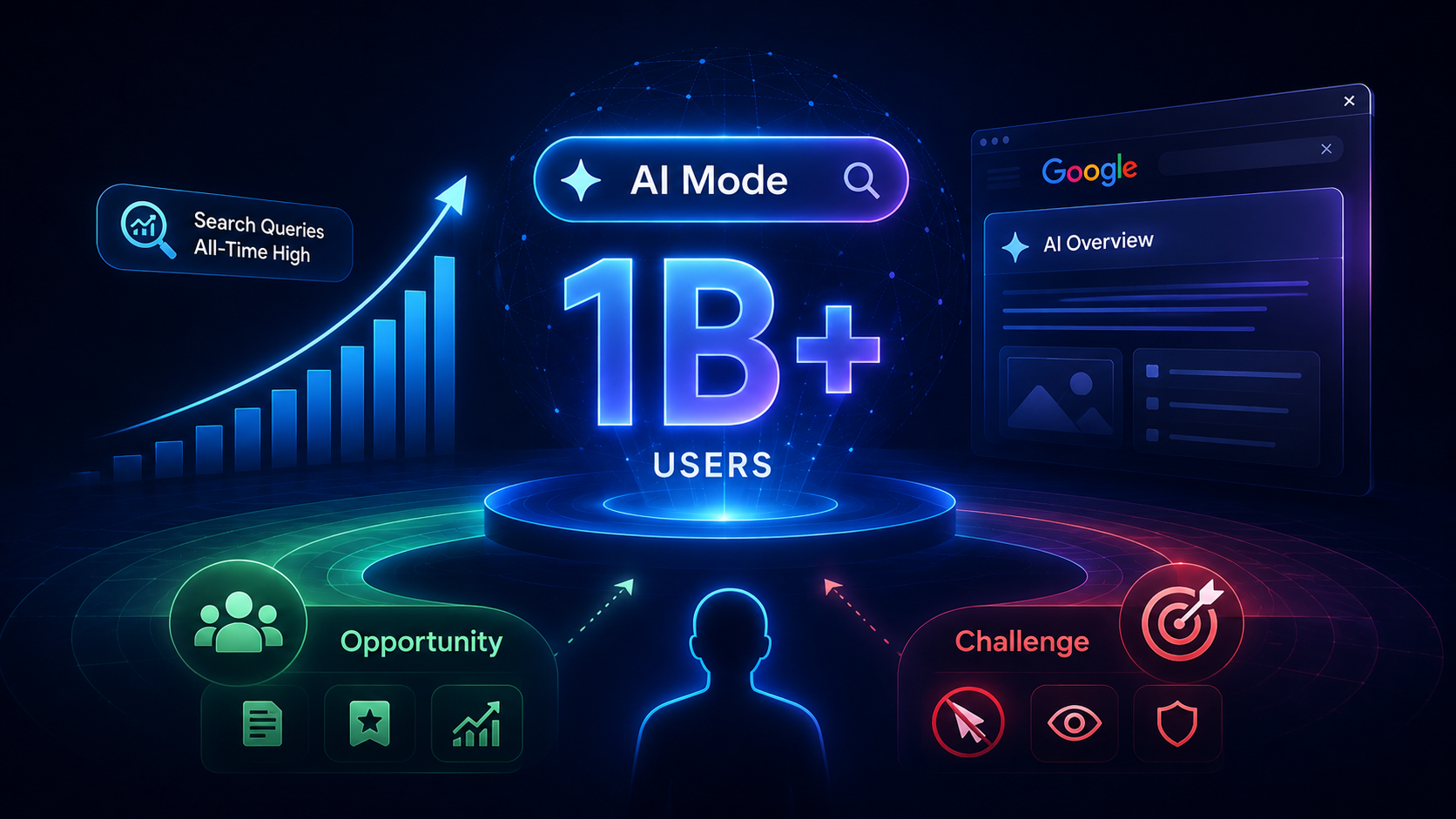
Just one year after its debut, AI Mode surpassed one billion monthly users, with queries more than doubling every quarter since launch. Overall, search queries reached an all-time high last quarter.

Pause on that for a moment. Search volume is growing, not declining, even as AI handles more of the answers. People aren’t using Google less because AI is there. They’re using it more because AI makes Search genuinely more useful for the kinds of complex, contextual questions they never bothered to ask before.

For digital marketers, this has two implications that pull in opposite directions:

The opportunity:More queries mean more chances for your content to be cited, surfaced, and recommended. The total addressable audience for Google AI search is expanding rapidly.

The challenge:More of those queries are being fully resolved within Google’s interface, without a click to your site. The battle isn’t just about ranking; it’s about being the source Google’s AI draws from when it answers.

This is the central tension in SEO for AI search in 2026  and it requires a different marketing strategy from anything that came before.

The Zero-Click Reality Is No Longer Coming — It’s Here

For years, SEOs warned about zero-click searches as a future problem. In 2026, it’s today’s problem. With AI Mode surpassing one billion monthly users and queries doubling every quarter, a growing share of those searches end without a single click to any website. Users ask a question; Google’s AI answers it fully—with context, follow-ups, and interactive elements, and the session is over. No visit. No impression. No conversion opportunity.

But here’s what most people get wrong about zero-click searches: the goal isn’t to fight them — it’s to be the brand inside them. When Google’s AI answers a query about “best cloud migration approach for mid-sized businesses” or “how to choose a digital marketing agency,” it pulls that answer from somewhere. That somewhere is a brand with enough structured content, topical authority, and E-E-A-T signals to be trusted as a source. Being cited inside a zero-click answer is the new page-one ranking. You don’t get the click — but you get the brand impression, the association of authority, and, increasingly, the direct follow-up action when the user is ready to buy.

The businesses that will suffer most from zero-click search are those whose entire content strategy was built around informational keywords designed to pull passive traffic. The businesses that will thrive are those repositioning their content as source material for AI — specific, factual, structured, and authoritative enough that Google would rather quote them than anyone else. This is the core shift that SEO for AI search demands in 2026.

Search Agents: The Feature That Will Reshape Lead Generation

Of everything announced at Google I/O 2026, Search Agents deserve the most attention from a marketing and lead-generation perspective, and they’re getting the least.

Information Agents are autonomous AI systems that operate in the background, 24/7, intelligently reasoning across information, including blogs, news sites, social posts, and real-time data on finance, shopping, and sports, to find exactly what a user needs and send them an intelligent, synthesized update.

Think about what this means for how customers find businesses. Today, a potential client thinks, “I need a digital marketing agency in Mohali”, and types it into Google. Tomorrow, they might set an agent once:
“Let me know when a digital marketing agency publishes a new case study showing 50%+ organic growth for an e-commerce client.”
That agent runs continuously. When you publish that case study, the agent surfaces it, or it doesn’t, depending on whether your content is authoritative, structured, and crawlable enough to qualify.

This is a pull-based discovery model becoming an agent-driven push model. Your content no longer just waits to be found. It either qualifies to be surfaced by AI agents or it doesn’t.For generative AI in digital marketing,this means your content calendar, your thought leadership strategy, and your authority-building efforts are no longer nice-to-haves. They are the mechanism by which customers discover you.

Generative UI: When Google Builds the Experience Instead of Linking to It

Google’s new agentic coding capability, built on a platform called Google Antigravity, allows Search to generate completely custom interactive layouts, including visual tools, simulations, tables, and graphs, in real time, precisely tailored to the user’s question. These generative UI capabilities will be available for everyone in Search this summer, free of charge.

For digital marketing, this is the zero-click problem taken to its logical extreme, but it’s also a new opportunity if you understand it correctly.

When Google generates a custom interactive comparison table to answer “best CRM tools for small businesses,” your brand’s chance to appear in that generated experience depends entirely on one thing: whether your content and data were trusted enough to be synthesized into it. That’s a citation play, not a ranking play.

What this means for content marketing specifically:

The content that earns inclusion in Generative UI responses tends to be factual, structured, specific, and authoritative. Product specifications, original research findings, statistical data with clear sourcing, step-by-step processes with concrete detail. Vague, opinion-heavy content that was written to rank for a keyword doesn’t qualify.

If your content marketing strategy is still built around “write a 1,500-word post targeting this keyword,” 2026 is the year to rethink it from scratch.

Personal Intelligence: The Personalisation Layer Changes Everything

Google is expanding Personal Intelligence in AI Mode to nearly 200 countries and territories across 98 languages, no subscription required. Users can securely connect apps like Gmail, Google Photos, and soon Google Calendar to make Search deeply personal and contextual.

For marketers, this is genuinely new territory. When a user’s search is informed by their Gmail inbox, their Google Calendar, and their Photos, Google AI search stops being a general engine and becomes a deeply personal one. The same query from two different users can return completely different results based on their connected context.

The marketing implication is that personalised search at scale makes mass keyword targeting less reliable. Two users searching the same phrase may see entirely different AI-generated answers based on their personal data. This makes brand authority, consistent E-E-A-T signals, and broad topical coverage even more important, because those are the signals that persist across personalised results.

It also makes email marketing and CRM data more strategically valuable than ever. If your brand has a strong email relationship with a user, and that user connects Gmail to Google AI Search, your previous communications with them become part of their search context. Brands that have nurtured their audiences through email and content will have a meaningful advantage in personalised AI search results.

Agentic Booking and Local Search: A Wake-Up Call for Local Businesses

Google is expanding agentic booking capabilities in Search to a wide range of new tasks, including local experiences and services. For select categories like home repair, beauty, and pet care, users can ask Google to call businesses on their behalf.

This is one of the most concrete and immediate changes for local businesses and service providers. When a user can say “book me a home cleaning service for Saturday morning under $50,” and Google’s AI calls businesses, checks availability, and confirms the booking, the entire local search journey bypasses traditional marketing touchpoints.

There’s no ad clicked. No Google Business Profile visited. No website browsed. The AI mediated the entire transaction.

For local businesses, this raises urgent questions. Is your Google Business Profile fully optimised with accurate pricing, real-time availability, and services listed with the kind of specific detail that AI can match to user criteria? Are your reviews, response rates, and trust signals strong enough for Google’s AI to select you over a competitor?

Local SEO for AI search in 2026 is less about ranking for a keyword and more about being a trustworthy, well-structured local entity that AI booking agents can confidently act on behalf of a customer.

What Google I/O 2026 Means for Your Digital Marketing Strategy, Right Now

Rather than a laundry list of tactics, here are the three strategic shifts that matter most for generative AI in digital marketing following these announcements:

1. Move from traffic metrics to citation metrics:

The primary KPI for content marketing is no longer “how much traffic did this post get?” It’s “was this content cited by Google AI in a response to a relevant query?” Start measuring your brand’s presence in AI Mode responses for your core keywords. This is your new share of voice.

2. Treat every content asset as a data source, not just a page to rank:

AI systems synthesize content into answers. The more structured, specific, and factual your content is, the more useful it is as a source. Think of each piece of content as something that needs to be accurate and structured enough to be quoted, not just read.

3. Build your brand’s entity footprint, not just its backlink profile:

Google’s AI recognises brands as entities, defined by consistent mentions, structured data, and signals across the web. A strong entity footprint (correct schema markup, consistent NAP data, authoritative citations, Wikipedia-style completeness) influences how AI Mode describes and recommends your brand. This is a different discipline from traditional link building, and it’s now equally important.

How Deftsoft Helps You Navigate the New AI Search Era

Deftsoft’s digital marketing services are already built around the realities of Google AI search, not the Google of 2020. Our approach combines AI-era SEO strategy, content authority-building, and technical optimisation to help businesses show up where it matters: within AI-generated responses, not just below them.

Our AI SEO services specifically address citation optimisation, entity building, and structured data implementation, the three things that determine whether Google’s AI mentions your brand or your competitor’s. Our content marketing services
produce the kind of original, expert, non-commodity content that AI systems actually surface. And our technical SEO services
ensure your site is fully accessible and legible to AI crawlers, agents, and the Gemini-powered systems now driving Google’s answers.

The window to establish AI-cited authority before Search Agents go mainstream is narrow. Summer 2026 is the deadline that matters.

The New Era of Google AI Search Is Already Here, Is Your Brand Ready?

Let Deftsoft Audit Your AI Search Visibility and Build Your Roadmap.

FAQs

1. What is Google AI search, and how is it different from regular Google search?

Google AI search refers to the AI-powered features now central to Google, including AI Mode, AI Overviews, and Search Agents, that generate synthesized, conversational answers rather than just listing 10 links. Unlike traditional search, these features can hold context across a conversation, act autonomously on a user’s behalf, and answer complex queries without sending the user to an external website.

2. How does Google I/O 2026 affect my existing SEO strategy?

It accelerates the shift from keyword-ranking-focused SEO to authority- and citation-focused SEO. Your content still needs to be indexable and relevant, but the primary goal is now to be the source Google’s AI draws from, not just to rank in position one. Content depth, structured data, E-E-A-T, and topical authority have all become more important.

3. What is Google Search AI Mode, and how many people use it?

Google Search AI Mode is a conversational search experience powered by Gemini that lets users ask complex, multi-part questions and receive synthesized, contextual answers. As of Google I/O 2026, AI Mode has surpassed one billion monthly users, with query volume more than doubling every quarter since launch.

4. What is Generative UI in Google Search?

Generative UI is a new capability from Google I/O 2026 that allows Search to build custom interactive layouts, including tables, simulations, graphs, and visualizations, in real time in response to a user’s query. Rather than linking to a page with a table, Google builds one on the fly. It will be free for all users by summer 2026.

5. How do Search Agents affect lead generation and content marketing?

Search Agents continuously monitor the web on behalf of users and automatically surface relevant content. For marketers, this means content that meets a user’s specific, pre-defined criteria gets discovered without the user actively searching. It makes authoritative, structured, frequently updated content significantly more valuable than one-time keyword-targeted posts.

6. How should local businesses respond to Google’s agentic booking features?

Local businesses should ensure their Google Business Profile has accurate, detailed, and up-to-date information, including pricing, services, availability, and high-quality reviews. When Google’s AI calls a business on a user’s behalf, it selects based on trust and relevance signals. Businesses with incomplete or outdated profiles risk being skipped entirely.

7. How is Deftsoft helping businesses adapt to the Google I/O 2026 changes?

Deftsoft offers AI Search readiness audits, citation-focused SEO strategies, entity optimisation, technical crawlability improvements, and content marketing built for AI synthesis. Our team actively monitors how client brands appear in AI Mode responses and adapts strategy in real time as new features roll out.

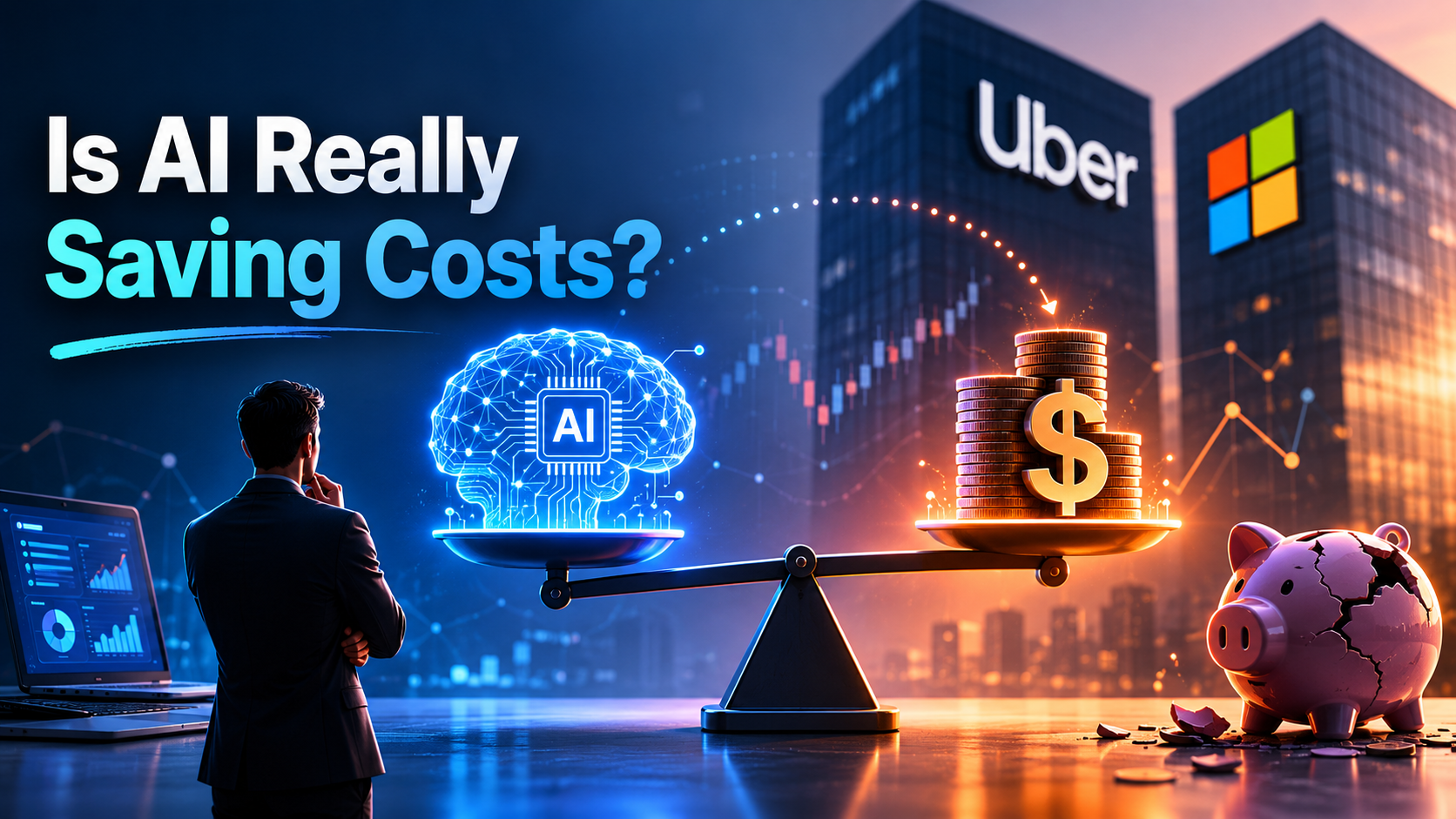
Is AI Really Saving Costs? Why Uber and Microsoft Are Rethinking Their AI Spending

Quick Summary:

AI was supposed to be the ultimate cost-saving machine. But in 2026, two of the world’s most tech-forward companies, Microsoft and Uber, are openly admitting that their AI spending has spiralled far beyond expectations. Uber burned through its entire annual AI budget in just four months. Microsoft quietly cancelled thousands of AI tool licences after costs exceeded what it would have paid humans for the same work. This blog unpacks what actually happened, what it means for enterprise AI strategy, and, critically, how businesses can invest in AI intelligently without blowing their budgets.

Are You Worried About Your AI Spendings

Deftsoft helps businesses build AI strategies that actually deliver ROI.

Quick Navigation

The Promise vs The Reality

The Token Problem Nobody Talked About

Will Tokens Get Cheaper? Yes, But Not in the Way You Hope

The Real Culprit: Adoption Without Strategy

What Smart Enterprise AI Strategy Actually Looks Like

The Bigger Picture: AI Is Still Worth It, If You’re Strategic

How Deftsoft Helps Businesses Get AI Right

FAQs

The Promise vs The Reality

When companies started rolling out AI tools at scale in 2024 and 2025, the pitch was consistent: automate repetitive work, reduce headcount costs, ship products faster, and watch ROI compound over time.

That pitch wasn’t wrong. But it was incomplete.

Uber’s CTO Praveen Neppalli Naga told The Information that his company had burned through its entire 2026 AI coding budget in just four months. His exact words: “I’m back to the drawing board, because the budget I thought I would need is blown away already.”

Microsoft, meanwhile, started cancelling most of its direct Claude Code licences after employees rapidly embraced the AI coding assistant, shifting developers towards GitHub Copilot CLI to try to control growing AI-related expenses.

These aren’t struggling companies making rookie mistakes. These are two of the most sophisticated technology organisations on the planet. So what went wrong, and what does it mean for your enterprise AI strategy?

The Token Problem Nobody Talked About

Here’s the core issue with AI spending at scale, and it’s surprisingly simple once you understand it.

Traditional software is priced per seat or on a subscription basis. You pay £X per user per month, and your costs are predictable. AI tools don’t work that way.

Unlike salaries, AI systems are charged on a token-per-work-run basis. Each prompt, each response, and every automated workflow consumes tokens that must be paid for continuously. As companies scale AI use across more teams, token consumption surges.

Around 70% of code committed at Uber now originates with AI, and 11% of live backend updates are shipped by an agent with no human in the loop. That level of adoption sounds impressive, and it is, but it also means token consumption at an industrial scale, running 24 hours a day.

AI software prices across the US have climbed 20–37%. GitHub is responding to the pressure by shifting all Copilot plans to usage-based billing through GitHub AI Credits starting June 1, 2026, signalling that even the largest AI platforms are redesigning their commercial models around the reality that heavy usage at enterprise scale creates unpredictable cost exposure.

The lesson: the cost of AI is not fixed. It scales with usage, and usage tends to grow faster than budgets do.

Will Tokens Get Cheaper? Yes, But Not in the Way You Hope

A natural response is: “Fine, but AI compute costs are falling. Won’t this sort itself out?”

Partially, a recent Gartner report found that by 2030, inference on a one-trillion-parameter LLM will cost AI firms nearly 90% less than it did in 2025. But Gartner also predicted that cheaper tokens won’t translate to cheaper enterprise AI, because agentic models require far more tokens per task than standard models, increased consumption outpaces falling unit costs, and AI providers won’t fully pass through lower costs to consumers.

Gartner senior director analyst Will Sommer warned: “Chief Product Officers should not confuse the deflation of commodity tokens with the democratization of frontier reasoning.”

Translation: yes, a single token gets cheaper. But agentic AI, the kind that takes autonomous multi-step actions across your systems, uses vastly more tokens per task. The net bill doesn’t shrink. For most enterprises, it grows.

A separate Gartner study forecasts AI agent software spending will reach nearly $207 billion in 2026 and $376.3 billion in 2027, up more than 139% from the $86.4 billion spent in 2025. The market is not slowing down. The costs are not going away.

The Real Culprit: Adoption Without Strategy

Reading these stories carefully, one notices a pattern. Neither Microsoft nor Uber failed because AI doesn’t work. They ran into trouble because adoption outpaced strategy.

Uber had actively incentivized adoption through internal leaderboards that ranked teams by AI tool usage, essentially gamifying AI consumption. More usage meant more recognition. But more usage also meant more tokens, more compute, and more cost with no corresponding budget framework to manage the scale.

Back in late 2025, Microsoft gave thousands of its people, engineers, product managers, designers, and even folks in non-technical roles, access to Claude Code. Blanket rollout, minimal governance, and the bills followed.

This is the pattern that defines poor enterprise AI strategy in 2026: deploy fast, measure later. The companies that are getting AI right are doing the opposite, starting with clear use cases, defined ROI metrics, and cost guardrails built in from the beginning.

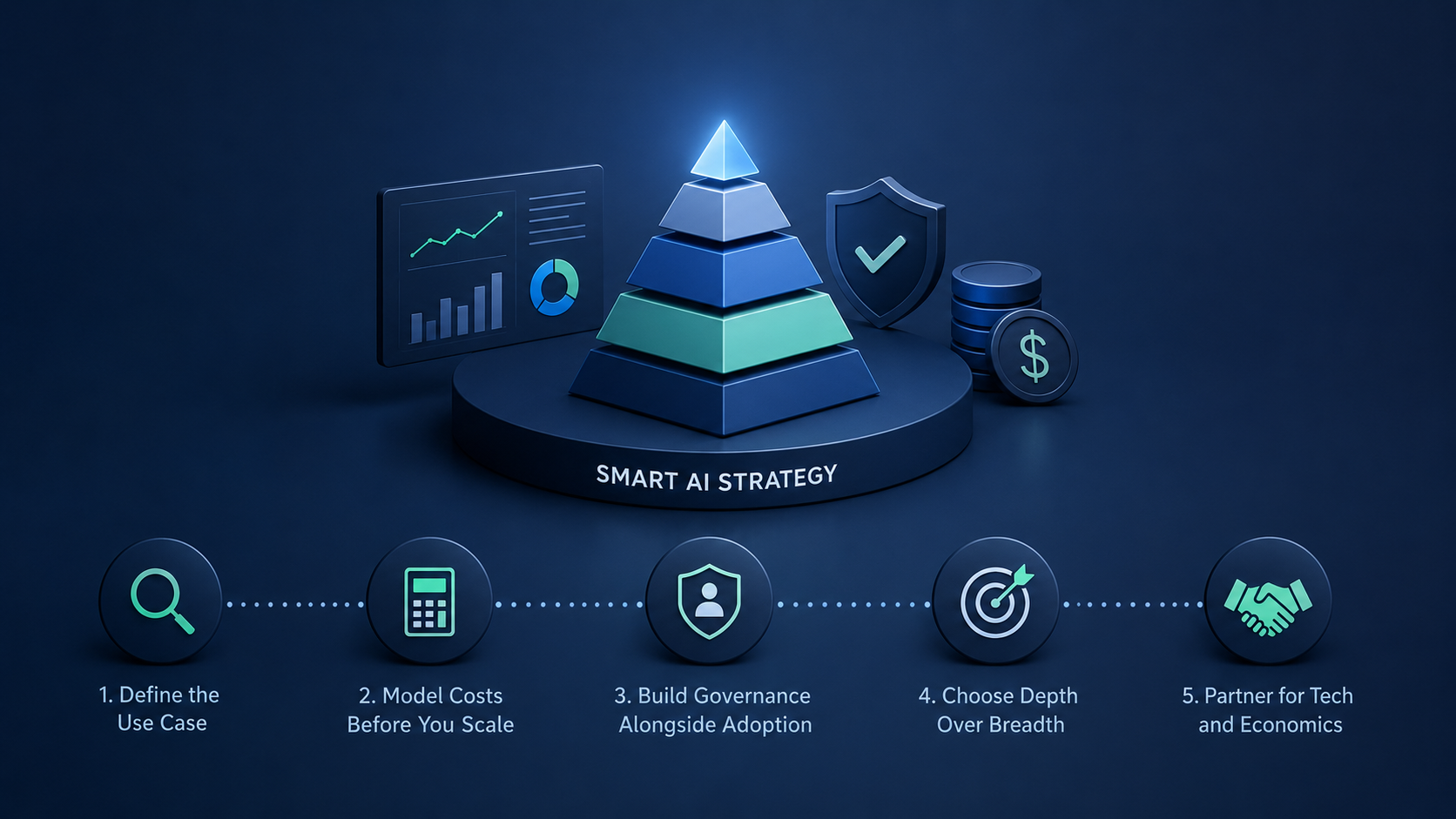
What Smart Enterprise AI Strategy Actually Looks Like

Smart Enterprise AI Strategy

The Uber and Microsoft stories are cautionary, but they’re not arguments against AI. They’re arguments against adopting unstructured AI. Here’s what a more deliberate enterprise AI strategy looks like in practice.

1. Define the use case before the tool. Don’t ask “how can we use AI?” Ask “which specific workflows have measurable inefficiency, and what would a 30% improvement be worth?” AI investments tied to concrete outcomes have defensible ROI. Broad AI rollouts don’t.

2. Model your token costs before you scale. If you’re adopting AI coding tools, AI agents, or LLM-powered workflows, model token consumption at 50%, 80%, and 100% adoption. The cost of AI at scale is not linear, and most enterprise buyers don’t discover this until the invoice arrives.

3. Build governance alongside adoption. Usage dashboards, team-level budgets, and clear policies on when to use which AI tool aren’t bureaucracy. They’re the difference between AI that compounds value and AI that compounds bills.

4. Choose depth over breadth. Instead of giving every employee access to every AI tool, identify the 2–3 use cases where AI genuinely transforms output quality or speed, and go deep on those. Concentrated, well-governed AI investment consistently outperforms scattered adoption.

5. Work with a partner who understands both the technology and the economics. This is where Deftsoft comes in. Our AI consulting services help businesses design enterprise AI strategies that are grounded in real use cases, real cost modelling, and real integration, not vendor demos and enthusiasm.

The Bigger Picture: AI Is Still Worth It, If You’re Strategic

None of this means AI is overhyped or not worth investing in. The productivity gains are real. 70% of Uber’s code now originates with AI; that’s a genuine shift in engineering output, even if the cost management needs work. Microsoft’s AI products remain central to its growth story.

The problem was never AI itself. The problem was treating AI as a cost-saving tool rather than a capability-building investment that requires its own strategy, governance, and economic model.
Businesses that approach AI this way, with clear objectives, measured rollouts, and a partner who can help them build and manage AI systems intelligently, are seeing real returns. Those who deploy first and figure out the economics later are writing the next round of cautionary headlines.

How Deftsoft Helps Businesses Get AI Right

At Deftsoft, we’ve spent years building AI-powered products and advising businesses on where and how AI actually delivers value. Our AI consulting services go beyond recommending tools; we help you build a structured enterprise AI strategy that fits your budget, your team, and your actual business goals.

Whether you’re evaluating AI adoption for the first time, trying to bring runaway AI spending under control, or ready to build custom AI systems that give you a genuine competitive advantage, our team has the technical depth and strategic experience to do it properly.

The Uber and Microsoft stories aren’t reasons to avoid AI. There are reasons to approach it smarter.

Don’t let unplanned AI spending become your next headline.

Deftsoft helps businesses build AI strategies that actually deliver ROI.

FAQs

1. Why did Uber’s AI spending go over budget so quickly?

Uber burned through its 2026 AI coding budget in four months because token-based AI pricing scales with usage, and Uber actively encouraged maximum adoption across its engineering teams without corresponding cost controls. More usage meant exponentially higher token consumption.

2. What does “cost of AI” actually include for enterprises?

The cost of AI includes tool licences or usage-based API fees (charged per token), compute infrastructure, integration development, maintenance, staff training, and governance overhead. Most budget estimates focus only on licences and miss the full picture.

3. Is enterprise AI still worth investing in despite these challenges?

Yes, but strategically. The productivity and capability gains are real. The issue is unstructured adoption without cost governance. Businesses with a clear enterprise AI strategy consistently see positive ROI; those that deploy broadly without a framework typically overspend.

4. What is an enterprise AI strategy?

An enterprise AI strategy is a structured plan that defines which AI use cases a business will pursue, how AI tools will be governed and measured, what the expected ROI is, and how adoption will be managed across teams, preventing the kind of runaway spending seen at Uber and Microsoft.

5. Will AI token costs fall over time?

Token costs are falling, but Gartner research suggests this won’t reduce enterprise AI bills, because agentic AI requires far more tokens per task than standard models, and consumption growth outpaces unit cost reductions.

6. What’s the difference between AI tools and a custom AI strategy?

AI tools (like Claude Code or Copilot) are off-the-shelf products. A custom enterprise AI strategy involves selecting the right tools, defining governance policies, modelling costs, building custom AI systems where needed, and tying everything to measurable business outcomes.

7. How can Deftsoft help with enterprise AI strategy?

Deftsoft’s AI consulting team helps businesses design, build, and govern AI systems, from initial strategy and use case selection through to custom AI development, integration, and ongoing cost optimisation. We help you get AI right the first time.

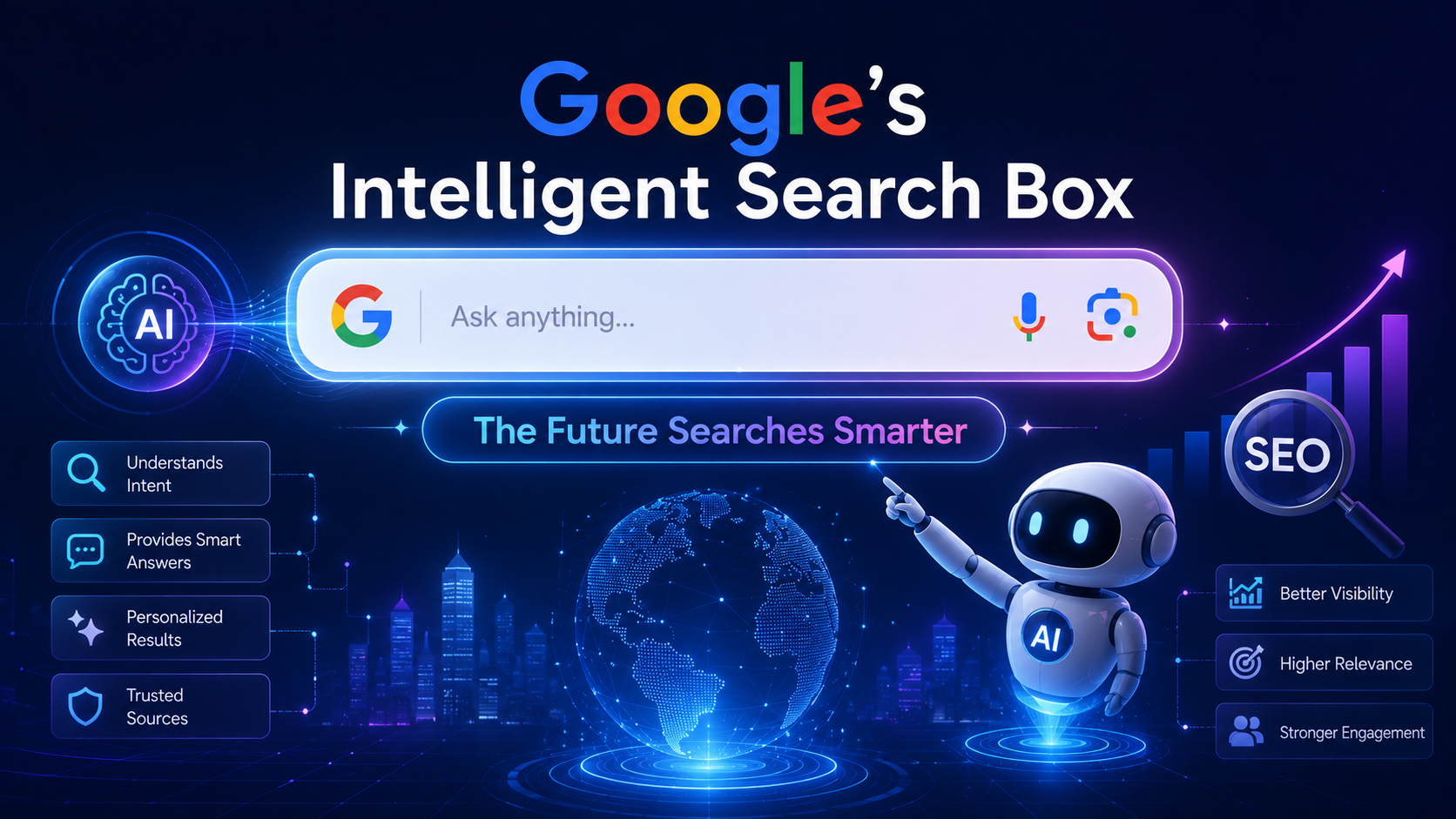
Google Intelligent Search Box: How AI Agents Are Changing SEO Forever

Quick Summary

On May 19, 2026, at Google I/O, Google unveiled the most significant change to its search interface in 25 years: the Intelligent Search Box. Powered by Gemini 3.5 Flash, it replaces the traditional keyword input with a conversational, multimodal AI experience. Users can now type long natural-language queries, upload images or files, ask follow-up questions inside AI Mode, and deploy autonomous Information Agents that search the web on their behalf 24/7. By summer 2026, Google will also begin generating custom interactive UIs, visualizations, and mini apps directly inside Search results, all in real time.

For website owners, marketers, and businesses relying on organic traffic, this is not an incremental update. It is a structural shift that changes what SEO means, how content gets discovered, and what kind of authority makes a brand visible to AI. Brands that adapt quickly and publish authoritative, AI-legible, experience-backed content will gain an outsized advantage. Brands that wait will see organic clicks decline with no clear explanation.

This post breaks down every major change, maps the concrete SEO implications, and explains how Deftsoft can help you navigate and win in this new landscape.

Ready to future-proof your SEO before the summer 2026 rollout hits full force?

Quick Navigation

What Google Actually Changed, And Why It’s Different This Time

1. The Intelligent Search Box (Live Since May 19, 2026)

2. Seamless AI Overviews → AI Mode Flow (Live Since May 19, 2026)

3. Information Agents, AI That Searches the Web For You (Summer 2026, Pro/Ultra First)

4. Generative UI, Search Results That Look Like Custom Web Pages (Summer 2026, Free for All)

5. Mini Apps Inside Search (Summer 2026, Pro/Ultra First)

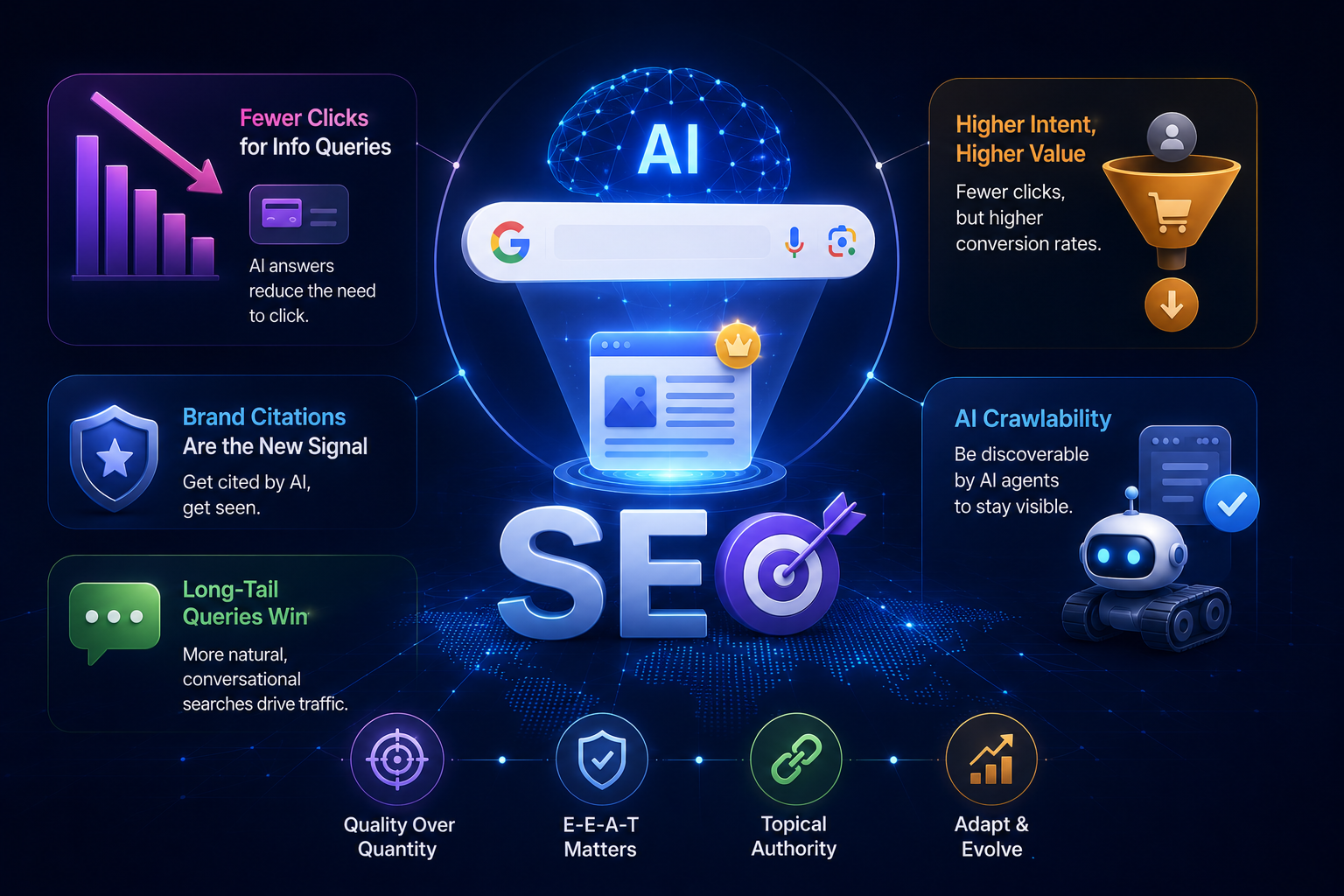
The SEO Impact: What Is Actually Changing, What Is Not

Click-Through Rates Will Fall for Informational Queries

Clicks That Do Happen Will Have Higher Commercial Intent

Brand Citations in AI Responses Will Become the New Ranking Signal

Long-Tail, Conversational Keywords Will Drive More Traffic Than Short Keywords

Technical SEO for AI Crawlability Becomes Non-Negotiable

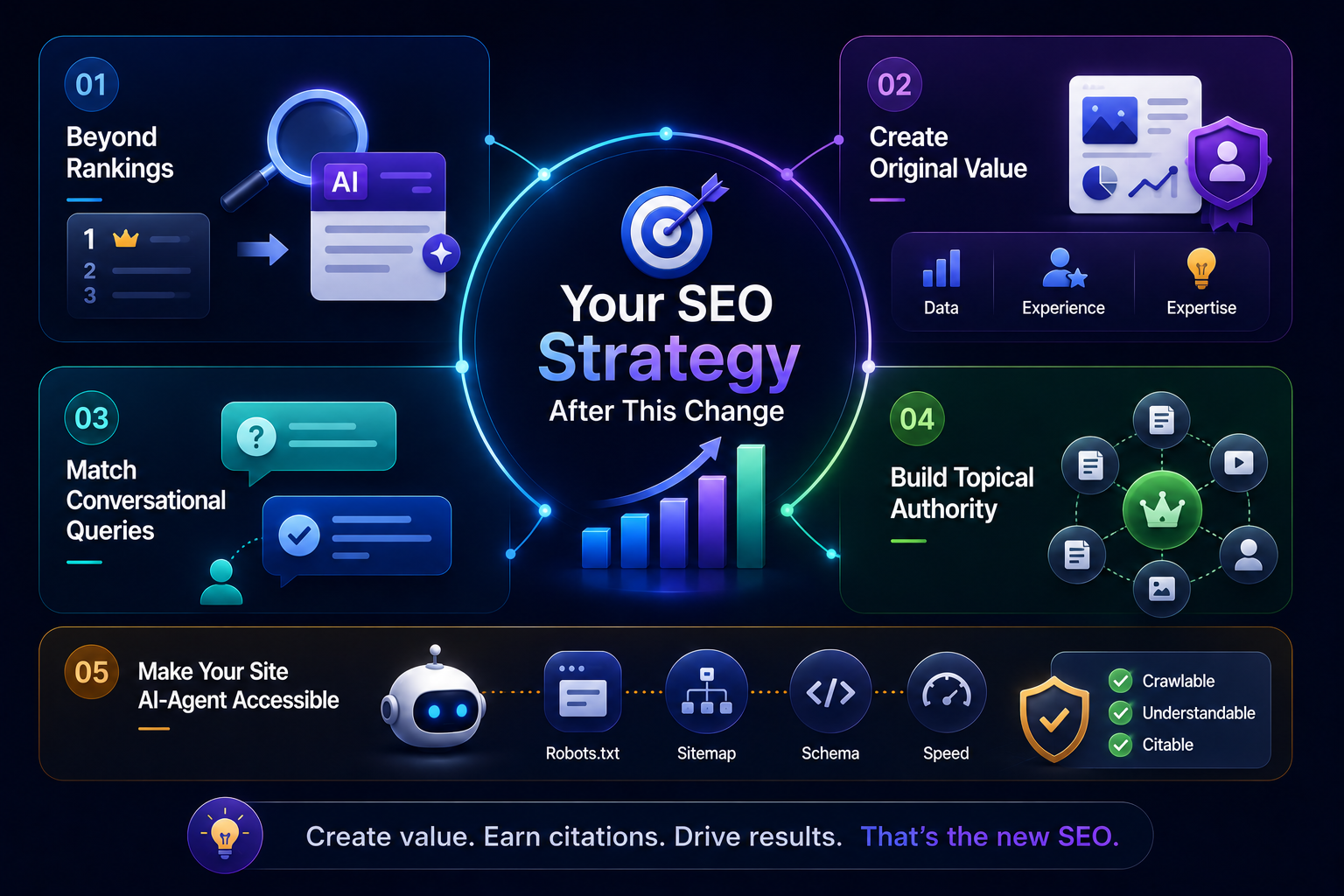
What Your SEO Strategy Must Look Like After This Change

Stop Optimizing for Keyword Rankings Alone

Publish Non-Commodity Content, Original Data, Real Experience, Expert Perspective

Restructure Content for Conversational Query Matching

Build Topical Authority Across Your Full Domain

Ensure Your Site Is AI-Agent Accessible

How Deftsoft Helps You Win in the AI Search Era

AI-Ready Content Strategy

Conversational SEO and Long-Form Keyword Mapping

Technical AI Crawlability Audits

E-E-A-T Building and Authority Development

Ongoing AI Search Monitoring and Adaptation

For Businesses Already Seeing Traffic Drops

Rollout Timeline: When to Act

Frequently Asked Questions

What Google Actually Changed, And Why It’s Different This Time

Google’s search box has looked and functioned the same way since the late 1990s. You typed keywords, hit enter, and received ten blue links. Every update since then, featured snippets, knowledge panels and AI Overviews, added new layers on top of that same input model.

The Intelligent Search Box does something different: it changes the input layer itself.

Here is what is live or arriving by summer 2026:

1. The Intelligent Search Box (Live Since May 19, 2026)

The search bar now dynamically expands as you type, designed explicitly for longer, more descriptive prompts rather than two-word keyword strings. Google’s Head of Search, Liz Reid, describes the AI-powered suggestion system as going “beyond autocomplete”; it proactively helps users articulate complex, nuanced questions they might not have known how to phrase before.

Crucially, the box accepts multimodal input, text, images, files, videos, and even open Chrome browser tabs. A user can upload a product photo and ask, “Where can I buy something similar under ₹2000 near me?” and Google will process the request end-to-end. This is not a lab experiment. It is live globally in all countries and languages where AI Mode is available.

The underlying model is Gemini 3.5 Flash, Google’s most capable and agent-optimized release, developed in partnership with Google DeepMind.

2. Seamless AI Overviews → AI Mode Flow (Live Since May 19, 2026)

Previously, AI Overviews appeared above organic results and served as an answer layer. Users had to choose between reading the AI summary or clicking a link. Now, users can flow directly from an AI Overview into AI Mode to continue the conversation, ask follow-up questions, dive deeper and refine their understanding, all without ever returning to a standard SERP.

Their context, query history, and source links persist throughout the conversation. This is now live on both desktop and mobile worldwide.

The SEO implication here is direct: a user who gets a sufficient answer inside AI Mode no longer needs to click to your site. The question is whether your content is what the AI is drawing from.

3. Information Agents, AI That Searches the Web For You (Summer 2026, Pro/Ultra First)

This is arguably the most consequential feature for the long-term future of search. Information Agents are autonomous AI systems that operate in the background, continuously scanning the web on a user’s behalf and delivering synthesized updates when conditions are met.

Think of a user who sets up an agent to monitor: “Alert me when any software development company in Chandigarh publishes a new case study related to e-commerce app development.” That agent will scan blogs, news sites, social posts, and real-time data sources, and it will surface your content if it qualifies, or your competitor’s if yours does not.

These agents will initially roll out to Google AI Pro and Google AI Ultra subscribers in the US this summer, with broader availability to follow globally.

The implication is that AI agents will increasingly perform searches on behalf of humans. People will spend less time choosing among ten blue links and more time acting on the synthesized outputs that those agents surface. This accelerates a trend already visible in AI Overview data, where clicks to source sites have declined even as search volume reaches all-time highs.

4. Generative UI, Search Results That Look Like Custom Web Pages (Summer 2026, Free for All)

Google’s new agentic coding capability, built on a platform called Google Antigravity, allows Search to generate completely custom interactive layouts in response to a query. Instead of listing links on a topic, Search might produce a real-time interactive simulation, a comparison table, or a dynamic visual explainer tailored to the question.

If someone searches “explain how MERN stack architecture handles state management,” Search might generate a custom animated diagram rather than link to one. By summer 2026, this feature will be free for all users.

5. Mini Apps Inside Search (Summer 2026, Pro/Ultra First)

Users will be able to ask Search to build them a personalized tool or tracker using natural language, no coding required. Examples: a wedding-planning dashboard that pulls data from their Google Calendar, a fitness tracker that integrates live weather and local gym data, and a competitor pricing monitor for their industry.

These mini apps live inside Search and use Antigravity with Gemini 3.5 Flash to assemble them in real time using live web data. This feature will launch first for Google AI Pro and Ultra subscribers, with broader availability to follow.

The SEO Impact: What Is Actually Changing, What Is Not

SEO Impact

Let us be precise about what these changes mean for organic search in 2026 and beyond, because much of the commentary has been vague or alarmist without offering actionable guidance.

Click-Through Rates Will Fall for Informational Queries

This is not speculative. When users get complete, synthesized, conversational answers in AI Mode, with an interactive UI, follow-up capability, and persistent context, they have no reason to visit an external page for informational content. Travel guides, how-to articles, product explainers, and definitions are the categories most at risk.

Broad, shallow informational content will see the largest CTR drops. This type of content was already being eroded by AI Overviews; Information Agents will accelerate that erosion dramatically.

Clicks That Do Happen Will Have Higher Commercial Intent

The flip side: when a user leaves the AI interface and visits a website, it means the AI could not fully satisfy them. These visitors are bottom-of-funnel, high-intent, actively looking to buy, contact, or engage. Conversion rates on this traffic should rise even as volume falls.

Brand Citations in AI Responses Will Become the New Ranking Signal

When Google’s AI generates a response, it draws from sources it considers authoritative, accurate, and E-E-A-T-compliant (Experience, Expertise, Authoritativeness, Trustworthiness). Being cited in an AI Overview or Information Agent response functions like a position-zero ranking, but without the user ever seeing your URL unless they choose to explore further.

This means getting your brand mentioned and cited by Google’s AI is now a primary SEO goal, not a secondary one.

Long-Tail, Conversational Keywords Will Drive More Traffic Than Short Keywords

Because the Intelligent Search Box is designed for long, natural-language prompts, users will search in ways they previously could not. They will type full questions, multi-part scenarios, and contextual requests. Content that is structured to answer these naturally phrased, highly specific queries will see traffic gains, not losses.

Technical SEO for AI Crawlability Becomes Non-Negotiable

Information Agents and AI Mode pull data from the live web. If your site is not crawlable by AI bots, not structured with clear semantic markup, or not fast enough to be indexed in real time, you are invisible to these agents. Traditional SEO crawlability was important. AI crawlability is mandatory.

What Your SEO Strategy Must Look Like After This Change

SEO Strategy

Stop Optimizing for Keyword Rankings Alone

Ranking #1 for a keyword means little if the user gets a complete answer in AI Mode without scrolling. Your content strategy must now target two goals simultaneously: ranking well enough to be cited as a source by Google’s AI, and providing enough depth that bottom-of-funnel users who click through find genuine value.

Publish Non-Commodity Content, Original Data, Real Experience, Expert Perspective

Google’s AI pulls from content that demonstrates real experience and expertise. Generic articles compiled from other generic articles are not cited. Original surveys, proprietary data, firsthand case studies, client results, and documented expert perspectives are cited. This is what “non-commodity content” means in the AI Search era.

Restructure Content for Conversational Query Matching

Every major page on your site should now address the question: “What is the most specific, natural-language question this page answers?” Then the content should answer it clearly, completely, and early, the way a knowledgeable person would answer a question in conversation, not the way a keyword-stuffed article would.

Build Topical Authority Across Your Full Domain

Information Agents do not cite isolated pages. They cite sources that demonstrate consistent, deep coverage of a subject area over time. A business that has published 50 well-structured, authoritative articles on custom software development is more likely to be surfaced by an agent than a business with one excellent page and nothing around it.

Ensure Your Site Is AI-Agent Accessible

Your robots.txt, sitemap, schema markup, and page speed all now affect whether AI agents can access, understand, and cite your content. Structured data, especially FAQ schema, HowTo schema, and Article schema, makes it dramatically easier for Gemini-powered systems to extract and surface your content correctly.

How Deftsoft Helps You Win in the AI Search Era

Deftsoft has been building organic visibility for clients across competitive industries for years. The transition to AI Search is the most significant shift we have navigated, and our service stack is built to handle exactly this kind of structural change.

Here is specifically what we do:

AI-Ready Content Strategy

We audit your existing content library to identify which pages are at risk of losing clicks to AI-generated responses, which pages have the authority signals needed to be cited by Information Agents, and which topics on your site represent genuine “non-commodity” knowledge gaps you can own. We then build a content roadmap that positions your brand as a cited authority, not just a ranked URL.

Conversational SEO and Long-Form Keyword Mapping

Our keyword strategy process now maps content to conversational, multi-intent, long-form query clusters, the type of prompts users enter into the Intelligent Search Box. We identify the questions your potential customers are articulating in natural language and ensure your pages provide clear, expert, satisfying answers to those exact questions.

Technical AI Crawlability Audits

We conduct deep technical audits that go beyond traditional crawlability to specifically evaluate how AI agents interact with your site. This includes AI bot access rules, structured data implementation, schema markup accuracy, Core Web Vitals compliance, and real-time indexation health. We make your site legible not just to Googlebot but to the AI systems now driving discovery.

E-E-A-T Building and Authority Development

We help you build the signals that Google’s AI weighs most heavily: authorship credibility, cited expertise, consistent publication history, original data assets, and digital PR that earns references on authoritative domains. These signals are what consistently surface a brand in AI-generated responses.

Ongoing AI Search Monitoring and Adaptation

The rollout of Information Agents and Generative UI is still underway. Summer 2026 will bring new data, new patterns, and new optimization opportunities. Deftsoft clients receive ongoing monitoring of how their brand appears (or does not appear) in AI Mode responses, and we iterate strategy as the landscape evolves. You will not be left figuring out what changed; we will tell you before it hits your traffic.

For Businesses Already Seeing Traffic Drops

If you have already noticed a decline in organic traffic in 2026 that does not correlate with a manual penalty or standard algorithm update, AI Overviews and early AI Mode usage are the most likely causes. Deftsoft offers a dedicated AI-impact traffic audit that isolates which query categories are being captured by AI responses and builds a recovery and adaptation plan specific to your site and industry.

Your organic traffic strategy needs to work for the AI Search era, not the 2020 era.

Feature Status Who Has Access
Intelligent Search Box Live (May 19, 2026) All users globally where AI Mode is available
AI Overviews → AI Mode Flow Live (May 19, 2026) All users globally, desktop and mobile
Generative UI in Search Summer 2026 Free for all users
Information Agents Summer 2026 Google AI Pro & Ultra first, broader rollout to follow
Mini Apps in Search Summer 2026 Google AI Pro & Ultra first, broader rollout to follow
Personal Intelligence (Gmail, Photos, Calendar) Rolling out now 200 countries, 98 languages, no subscription required

The window to adapt before Information Agents reach mainstream users is narrow. The businesses that establish AI-cited authority before summer 2026 will have a significant head start.

Frequently Asked Questions

Q: Will this update kill organic SEO entirely?

No, but it is changing what SEO delivers. Organic search is not dead; it is evolving from a volume-of-clicks model to a brand-authority-and-citation model. Businesses that build genuine topical authority will continue to benefit from organic search, including from being the sources that AI Mode and Information Agents cite and link to. Businesses with shallow, commodity content will see traffic drop.

Q: Does this mean AI Overviews will replace traditional search results?

Not entirely. Traditional results still appear alongside AI features for most queries, and for commercial, transactional, and local intent queries, blue-link results remain the primary click destination. What is changing is the share of informational queries in which users get complete answers within Google’s interface and never reach your site.

Q: What kind of content is most likely to be cited by Google’s AI?

Content that demonstrates genuine expertise, original research or data, firsthand experience, consistent topical depth across a domain, and clear, well-structured answers to specific questions. Google’s systems favor E-E-A-T (Experience, Expertise, Authoritativeness, Trustworthiness) signals. Content that merely summarizes what other sites say is unlikely to be surfaced.

Q: My site’s organic traffic has been declining since early 2026. Is this AI Search related?

Possibly. AI Overviews have been capturing informational clicks since 2024, and AI Mode has accelerated that trend in 2026. A proper AI-impact audit can isolate whether your decline is due to AI query capture, algorithm changes, technical issues, or a shift in search demand. Deftsoft offers this specific analysis.

Q: How do Information Agents decide which sites to surface?

Information Agents use the same trust and authority signals that Google Search has always relied on: domain authority, E-E-A-T, content freshness, structured data, and crawlability, but they prioritize real-time, specific, synthesizable content over general overview content. The more precisely your content answers a specific question with credible, original information, the more likely an agent will surface it.

Q: Will Deftsoft’s SEO services work for my industry specifically?

Deftsoft works across technology, e-commerce, professional services, healthcare, real estate, and education sectors. The principles of AI-era SEO, topical authority, E-E-A-T, conversational content structure, and technical crawlability apply across industries, but your content strategy, keyword mapping, and competitive positioning are tailored to your market. We start with an audit of your current visibility and your competitors’ before recommending any approach.

Q: Is there anything I can do right now before Information Agents roll out?

Yes, several things. Audit your current content for E-E-A-T signals and depth. Ensure your site is properly structured with schema markup. Identify your core topic clusters and fill gaps with original, expert-level content. Review your technical setup for AI bot accessibility. And establish a baseline measurement of how your brand currently appears in AI Mode responses so you can track changes over time. Deftsoft can handle all of this as part of an AI Search readiness engagement.

How Local LLMs Improve Data Privacy

Quick Summary

If you’ve been using AI tools like ChatGPT or Gemini for business tasks, you’ve probably wondered at some point: “Where exactly does my data go?” That’s a fair question, and it’s one that more and more businesses are taking seriously.

Local LLMs (Large Language Models) are AI models that run entirely on your own hardware. No cloud. No third-party servers. No data leaves your network. In this blog, we break down what local LLMs are, why they’re becoming the go-to choice for privacy-conscious businesses, how to run LLM locally, and which are the best local LLM options available today. If data privacy matters to your business, and it should, this is a must-read.

At Deftsoft, we specialise in AI development services that put your data security first. Whether you’re a startup or an enterprise, our team can help you integrate the best local LLM into your existing infrastructure, without sending a single byte to third-party servers.


Ready to Build AI-Powered Apps Without Sacrificing Privacy?


Quick Navigation

What Exactly Is a Local LLM?

The Real Privacy Problem with Cloud-Based AI

How Local LLMs Solve the Data Privacy Problem

1. Your Data Stays on Your Hardware

2. Full Compliance by Design

3. No Training on Your Data

4. Offline Functionality and Business Continuity

5. Lower Long-Term Costs

Real-World Industries Benefiting from Local LLMs

The Best Local LLM Options Available Today

Llama 3 (Meta)

Mistral

Phi-3 (Microsoft)

Gemma 2 (Google)

DeepSeek R1

How to Run LLM Locally: Getting Started

Option 1: Ollama

Option 2: LM Studio

Option 3: Jan.ai

Option 4: Custom Deployment with Docker / vLLM

What Hardware Do You Need?

Local LLM vs. Cloud AI: A Quick Comparison

How Deftsoft Helps You Implement Local LLMs

The Future of Local LLMs

Let’s Build Something Secure Together

Frequently Asked Questions (FAQs)

What Exactly Is a Local LLM?

Before we talk about privacy, let’s get the basics right.

A Large Language Model (LLM) is the AI technology that powers tools like ChatGPT. It understands and generates human language, answering questions, writing content, summarising documents, writing code, and much more.

A Local LLM is simply one of these models that you download and run on your own computer or server, rather than accessing it through a cloud service.

When you use ChatGPT, your messages travel over the internet to OpenAI’s servers, get processed there, and come back to you. When you run LLM locally, everything happens on your machine. The model processes your input right there, no internet required, no external server involved.

It sounds simple, but the implications for data privacy are massive.

The Real Privacy Problem with Cloud-Based AI

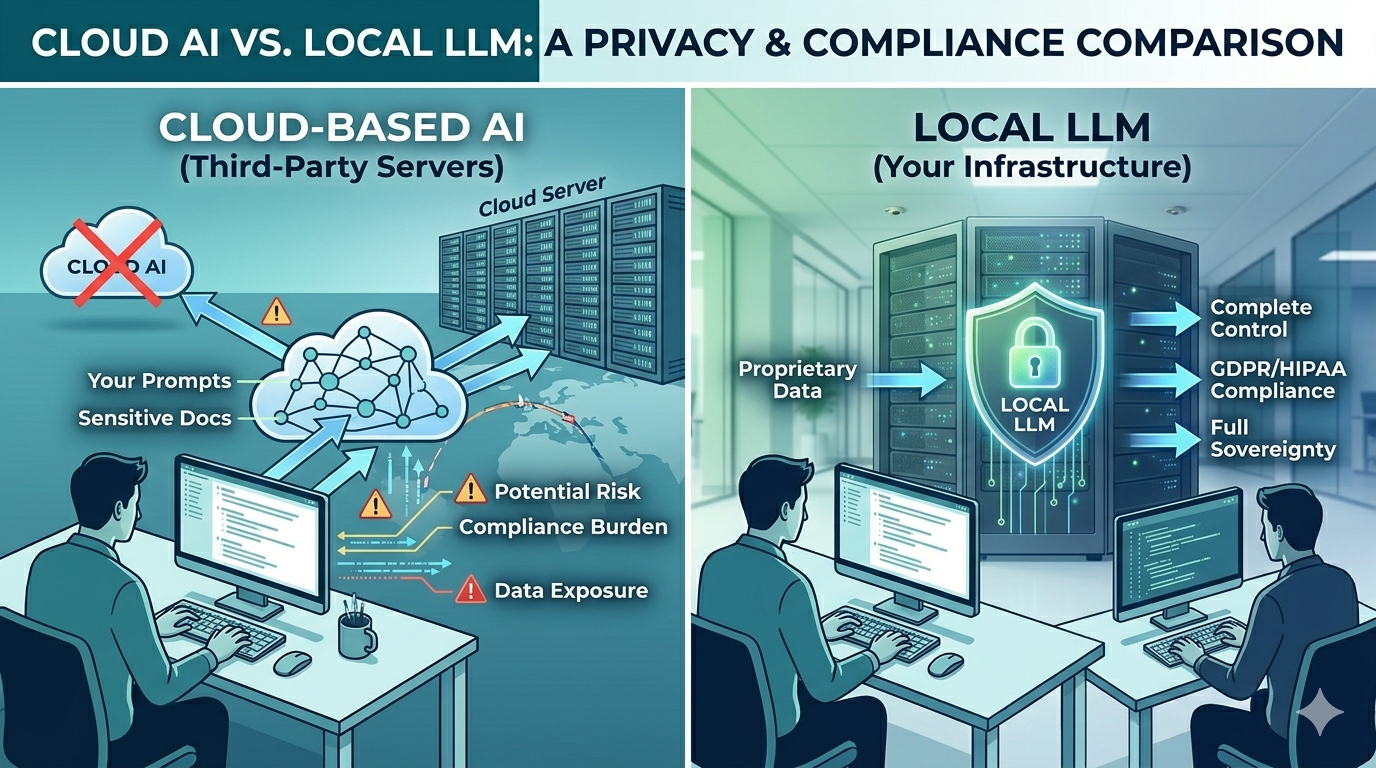
Let’s be honest. Cloud AI tools are incredibly convenient. But convenience comes at a cost, and for businesses, that cost is often data exposure.

Here’s what happens when you use a cloud AI tool:

  • Your prompts, documents, and conversations are transmitted to a third-party server
  • You often agree (buried in Terms of Service) that your data may be used to train future models
  • If that provider suffers a data breach, your sensitive information could be exposed
  • In regulated industries like healthcare, finance, or legal services, this creates serious compliance headaches under frameworks like GDPR, HIPAA, and ISO 27001

According to IBM’s Cost of a Data Breach Report, the average data breach now costs organisations $4.44 million. And GDPR fines can reach up to 4% of global annual revenue. These aren’t numbers any business can afford to ignore.

The moment you run LLM locally, you side-step all of this. Your data never leaves your environment, period.

How Local LLMs Solve the Data Privacy Problem

1. Your Data Stays on Your Hardware

This is the foundational benefit. When you deploy a Local LLM on your own server or workstation, every prompt, document, and response stays within your four walls, literally. There are no API calls going out, no cloud logs being stored, and no third party that can access what you’re doing.

For industries handling sensitive information, legal firms reviewing contracts, hospitals managing patient records, and financial institutions processing confidential data, this is a game-changer.

2. Full Compliance by Design

Compliance isn’t just a checkbox. For many businesses, it’s a legal obligation. Local LLMs make compliance significantly easier because:

  • GDPR: Since no personal data crosses international borders or leaves your control, GDPR’s data sovereignty requirements are automatically met
  • HIPAA: Patient records processed by a local model never touch external systems, keeping healthcare organisations compliant
  • ISO 27001: Local deployment gives you complete audit trails and access control over AI processing

You’re not just hoping a cloud vendor is compliant. You’re in control.

3. No Training on Your Data

One of the less-discussed risks of cloud AI is that your conversations can potentially be used to improve the provider’s model. Most major providers have opt-out mechanisms, but many users never see them. With a Local LLM, this concern is completely eliminated. The model you download is static; it doesn’t phone home, and it doesn’t learn from your inputs unless you specifically configure it to do so.

4. Offline Functionality and Business Continuity

Local LLMs work without an internet connection. For businesses in regions with unreliable connectivity, or for use cases like field operations, remote offices, or air-gapped networks, this is invaluable. Your AI capability doesn’t disappear when the Wi-Fi goes down.

5. Lower Long-Term Costs

Most cloud AI tools charge per API call or per message. If your team is using AI heavily, and increasingly, they should be; those costs add up fast. Running LLM locally requires an upfront investment in hardware or setup, but ongoing usage costs drop to near zero. For high-volume business users, the ROI is clear.

Real-World Industries Benefiting from Local LLMs

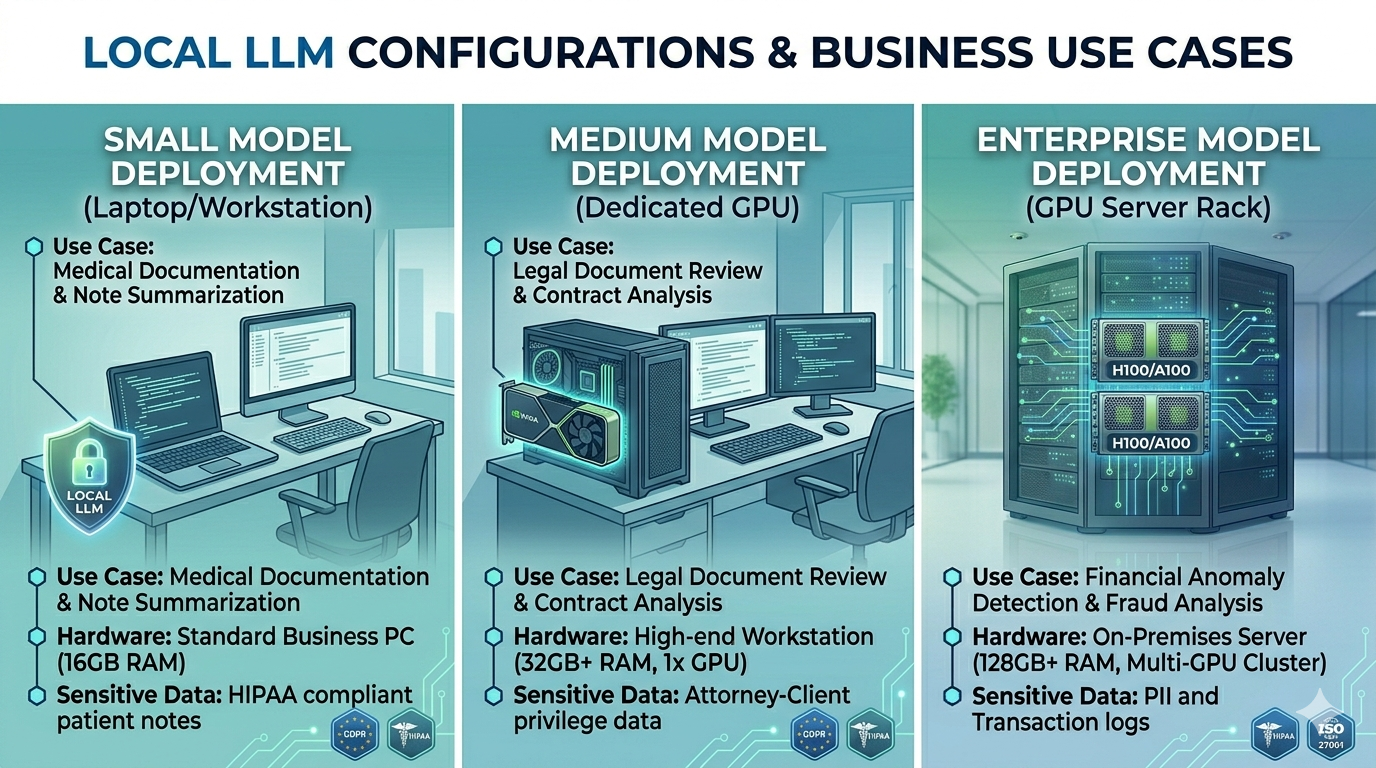
  • Healthcare: Hospitals and clinics are using Local LLMs to analyse patient notes, assist with documentation, and support clinical decision-making, all while keeping patient data completely on-premises. This makes HIPAA compliance straightforward.
  • Legal Services: Law firms handle some of the most sensitive documents, such as contracts, depositions and confidential communications. A local LLM can help lawyers summarise documents, extract key clauses, and draft responses without ever uploading a single file to a cloud server.
  • Finance and Banking: Financial institutions constantly handle personally identifiable information (PII). Local LLMs help compliance teams analyse transactions, flag anomalies, and generate reports, with full data sovereignty.
  • Education: Schools and universities are deploying Local LLMs for personalised tutoring and student feedback tools, ensuring that student data, which is heavily regulated by laws such as FERPA and COPPA, never leaves the institution’s network.
  • Enterprise Technology: Internal developer tools, code review assistants, and documentation generators are all thriving use cases. Developers can write proprietary code with AI assistance without worrying about IP leakage to cloud providers.

The Best Local LLM Options Available Today

So, which models should you consider? Here are the most popular and capable options right now:

Llama 3 (Meta)

Meta’s open-source model is one of the most widely used for local deployment. It’s powerful, well-supported, and available in multiple sizes, from compact versions that run on a laptop to large variants that require a dedicated GPU server. It’s arguably the best local LLM for general-purpose use.

Mistral

Mistral models punch well above their weight. They’re efficient, fast, and excellent for tasks such as summarisation, question answering, and document analysis on modest hardware. A popular choice for businesses that don’t want to invest in expensive GPU infrastructure.

Phi-3 (Microsoft)

Microsoft’s Phi-3 is designed to be a “small language model”, lightweight but surprisingly capable. It runs well on standard business laptops and is ideal for businesses that want local AI without specialised hardware.

Gemma 2 (Google)

Google’s open-source contribution to the local LLM space. Gemma 2 performs well on consumer hardware and has strong instruction-following capabilities, making it useful for business automation tasks.

DeepSeek R1

A newer entrant that has made waves for its reasoning capabilities is Deepseek. Particularly strong for code generation and analytical tasks.

How to Run LLM Locally: Getting Started

You don’t need a PhD in machine learning to get started. Here’s a simple overview of the most common approaches:

Option 1: Ollama

Ollama is the most beginner-friendly tool for running LLMs locally. You install it like any other application, and it handles downloading, installing, and managing models for you. A single command can get you up and running in minutes.

Minimum requirements: 8GB RAM for smaller models; 16–32GB recommended for larger ones.

Option 2: LM Studio

LM Studio offers a graphical desktop interface, no command line required. You browse available models, download them with a click, and start chatting. It’s ideal for non-technical business users who want to explore local AI.

Option 3: Jan.ai

Similar to LM Studio, Jan.ai is a desktop application focused on privacy. It’s lightweight, runs fully offline, and is designed from the ground up for users who want a clean, simple experience without technical complexity.

Option 4: Custom Deployment with Docker / vLLM

For businesses wanting to serve a Local LLM across an internal network so multiple employees can use it, a more technical setup using Docker containers and vLLM for efficient inference management is the way to go. This is where having a development partner like Deftsoft can make a significant difference.

What Hardware Do You Need?

This is often the first question people ask. The honest answer: it depends on the model size.

  • Small models (1B–7B parameters): A standard business laptop or workstation with 8–16GB RAM can handle these. No GPU required.
  • Medium models (13B–30B parameters): A machine with 32GB of RAM and, ideally, a dedicated GPU (such as an NVIDIA RTX 3090 or 4090 with 16–24GB of VRAM) will provide smooth performance.
  • Large models (70B+ parameters): You’re looking at a server-grade setup with multiple high-end GPUs, or a dedicated on-premises server. This is enterprise territory.

The good news is that model quantisation, a technique that reduces the file size and memory requirements of models, has made it possible to run surprisingly capable AI on surprisingly modest hardware.

Local LLM vs. Cloud AI: A Quick Comparison

Feature Local LLM Cloud AI
Data Privacy Complete, data never leaves your device Dependent on the provider’s policies
Compliance Full control, GDPR/HIPAA by design Relies on vendor compliance
Internet Required No Yes
Cost Over Time Low (after initial setup) Ongoing per-use costs
Setup Complexity Moderate Low
Model Customisation High Limited
Performance Depends on hardware Consistent, scalable

Local LLM vs. Cloud AI:

How Deftsoft Helps You Implement Local LLMs

Building an AI-powered application that runs locally isn’t just about picking a model and pressing a button. It involves integrating the model into your existing workflows, designing a clean user interface, handling document ingestion, setting up retrieval-augmented generation (RAG) if needed, and ensuring the whole system is secure and scalable.

That’s exactly the kind of work Deftsoft’s AI development team does every day. With over 20 years of experience in custom software development, our engineers can help you design, develop, and deploy a bespoke local LLM solution tailored to your industry and your specific data privacy requirements.

Whether you need an internal knowledge assistant for your team, a document analysis tool for your legal or finance department, or a fully integrated AI feature inside your web or mobile application, we’ve got you covered.

💡 Looking to build a custom AI application? Explore Deftsoft’s custom web development services and AI development solutions, built to be secure, scalable, and tailored to your business.

The Future of Local LLMs

The local LLM ecosystem is growing at an extraordinary pace. Hardware is getting cheaper and more powerful. Models are becoming more efficient, capable of doing more with less memory. And businesses are waking up to the fact that they can’t afford to hand their most sensitive data to a third party indefinitely.

In regulated industries, especially, the shift toward local AI deployment is less a trend than an inevitability. GDPR enforcement is increasing, AI-specific regulations are emerging globally, and enterprise clients are starting to demand data sovereignty as a standard requirement.

The businesses that invest in local LLM infrastructure now and build internal expertise around it will be the ones best positioned for the AI-driven decade ahead.

Let’s Build Something Secure Together

Your data is your competitive advantage. Don’t let it sit on someone else’s server.

Deftsoft specialises in building AI-powered applications that keep your data exactly where it belongs , with you. From local LLM integration to full-stack custom development, we bring 20+ years of experience to every project.

Book a Free Consultation with Deftsoft →

Frequently Asked Questions (FAQs)

Q1: What is a Local LLM?

A Local LLM is a Large Language Model that runs entirely on your own hardware, your computer, workstation, or private server, rather than through a cloud-based service. All processing happens locally, meaning your data never leaves your device or network.

Q2: Is it difficult to run LLM locally?

It depends on the approach. Tools like Ollama and LM Studio make it straightforward for non-technical users, with simple installation and model management. More advanced deployments, such as serving a model across an internal network, may require technical expertise. Deftsoft can help with both.

Q3: What is the best local LLM for business use?

For general business tasks, Llama 3 and Mistral are among the most popular and capable options. For lightweight deployment on standard hardware, Phi-3 is an excellent choice. The best local LLM for your business depends on your specific use case, hardware, and compliance requirements.

Q4: Can a Local LLM handle large documents?

Yes, many local models support large context windows and can be combined with Retrieval-Augmented Generation (RAG) techniques to process and reason over large document sets, such as contracts, reports, or knowledge bases.

Q5: Are Local LLMs GDPR compliant?

Local LLMs give you the best possible foundation for GDPR compliance because no personal data is transferred to third-party servers. However, full compliance also depends on how you store, process, and access that data within your own infrastructure.

Q6: How much does it cost to run a Local LLM?

There are no ongoing subscription or per-query fees. The main costs are the initial hardware (if upgrades are needed) and any development work required to integrate the model into your systems. Over time, the cost per use is significantly lower than cloud AI for high-volume use.

Q7: Can Deftsoft build a custom application using a Local LLM?

Absolutely. Deftsoft’s development team can design and build custom AI applications, web-based, mobile, or internal tools, that use local LLMs as the AI backbone. This includes document analysis tools, internal chatbots, code assistants, and more.

Best SEO Company in Mohali: AI SEO Strategies That Actually Work in 2026

In 2026, ranking on Google does not guarantee growth. Many businesses still reach the first page, yet traffic drops and leads stay flat. AI Overviews now answer queries before users click, and search visibility spreads across multiple surfaces. This shift has changed how SEO works at a core level. Companies searching for the best SEO company in Mohali now expect more than rankings. They want strategies that drive real visibility, consistent traffic, and measurable business results. The focus has moved from keywords to systems, and from rankings to outcomes.

Why SEO Results Feel Different in 2026

Most businesses in Mohali still chase rankings. They invest in SEO. They track positions. Yet something feels off. Traffic does not grow the way it used to. Leads remain unstable. Growth slows down even when keywords rank. This is not a coincidence. Search has changed in a very real way.

In 2026, ranking on the first page does not guarantee visibility. Google now answers many queries directly. AI Overviews reduce clicks. Users get what they need without visiting websites. This creates a gap between ranking and actual business impact. That is why companies now search for the best SEO company in Mohali with a different expectation. They do not want just rankings. They want visibility across search surfaces. They want traffic that converts. They want SEO that connects to revenue.

The demand for the best SEO services in Mohali is rising because businesses feel this shift. They see that traditional SEO no longer delivers consistent results. They now look for agencies that understand modern search behavior.

The real question is not who ranks pages. The real question is who builds a sustainable search presence.

Why Most SEO Campaigns Fail in 2026

Many SEO campaigns fail even when companies hire experienced agencies. The issue does not lie in effort. It lies in the approach. Most campaigns still follow a page-based strategy. Agencies create content around keywords. They build backlinks. They push rankings. This worked well in the past. It does not work the same way anymore.

Today, search rewards depth and structure. It favors websites that cover topics fully. It prefers connected content over isolated pages. When agencies ignore this, performance starts to stall. You will often see this pattern. A website ranks for several keywords. Traffic increases for a short time. Then growth stops. Sometimes traffic even drops. This happens because the content lacks expansion. It does not build authority beyond initial keywords.

Another issue comes from content saturation. Every agency targets the same keywords. Most blogs look similar. Search engines struggle to differentiate between them. As a result, visibility spreads thin across competitors. AI Overviews make this problem more visible. When Google answers queries directly, only the strongest sources get attention. Weak or repetitive content disappears from user journeys.

Even a company working with a best SEO company will face this issue if the strategy stays outdated. The difference in 2026 comes from how well an agency adapts to this new environment. SEO no longer works as a campaign. It works as a system. Without that shift, results will always plateau.

What Actually Changed in Search That Businesses Should Know

Search now operates on intent and relationships. Keywords still matter, but they no longer drive the entire process. Google now understands how topics connect. It tracks how users move from one query to another. It evaluates whether a website covers a subject deeply or only touches the surface.

For example, a user searching for SEO services does not stop at one query. They explore pricing, strategies, timelines, and comparisons. Google maps this behavior. It rewards websites that align with this journey. This change forces a shift in strategy. The best SEO company in Mohali no longer builds single pages for single keywords. It builds clusters that support multiple queries. It connects information in a structured way.

Search visibility also spreads across different formats. A website may appear in an AI Overview, a featured snippet, or a local pack. Each placement adds visibility. Each placement increases trust. Agencies that still focus only on rankings miss this bigger picture. They optimize for one layer of search. Modern SEO requires presence across multiple layers.

Another key shift lies in how Google evaluates authority. It looks beyond backlinks. It considers consistency, depth, and clarity. It measures how well a website answers related queries over time. This is where most SEO strategies fail. They chase volume. They ignore structure. They publish content without building connections.

In 2026, structure wins over volume. Context wins over keywords. Systems win over campaigns.

What Defines the Best SEO Company in Mohali Today

Not every agency that uses AI qualifies as the best AI SEO company. Many teams use AI only to generate content faster. That does not create results. It only increases content volume. In 2026, the difference comes from how AI fits into the strategy. The best SEO company in Mohali 2026 builds systems where AI supports decision-making, not just execution.

You will notice a clear pattern when you evaluate top-performing agencies. They focus on structure, intent, and performance signals rather than just output.

Here is how the best agencies actually operate:

  • They design topic clusters instead of publishing isolated blogs
  • They map user intent before writing content
  • They use AI to analyse gaps, not just create text
  • They connect SEO with website performance and UX
  • They track conversions and revenue, not just traffic

The biggest shift is mindset. The best AI SEO services in Mohali do not treat SEO as a marketing activity. They treat it as a growth system. That system connects content, technical SEO, and user experience into one structured flow.

Why the Best SEO Company Builds Search Ecosystems, Not Campaigns

A campaign has a start and an end. A system keeps growing. Most SEO strategies still operate like campaigns. They focus on ranking a set of keywords. They push content for a few months. Then they move to the next set. This approach creates temporary growth. It does not build long-term authority.

The best SEO company in 2026 works differently. It builds what you can call a search ecosystem. Every page supports another page. Every topic expands into subtopics. Every piece adds depth to the domain.Instead of asking “Which keyword should we target?”, the focus shifts to “Which topic should we own?”

This small change creates a big difference. A search ecosystem has three key layers:

Layer What It Does Why It Matters
Core Pages Target main services and high intent keywords Drive conversions
Supporting Content Expand into related queries and use cases Build authority
Updates & Expansion Refresh and extend content over time Maintain relevance

This structure allows a website to grow steadily. It also helps Google understand the site as an authority in a specific domain. Without this system, even strong SEO campaigns lose momentum after initial gains.

AI SEO Strategies That Deliver Real Results in 2026

This is where most businesses expect answers. Not theory. Not definitions. Actual strategies that work. The best AI SEO company focuses on execution that aligns with how search behaves today.

Query Cluster Domination Instead of Keywords

Keyword targeting alone no longer works. One keyword leads to dozens of related queries. Users explore variations before making decisions. Instead of targeting a single phrase like best SEO services in Mohali, strong strategies cover:

  • comparison queries
  • cost-related queries
  • decision-based queries
  • follow-up questions

This creates depth. It increases visibility across multiple search paths.

Context Optimization

Entity and Context Optimization for AI SEO

Search engines now understand relationships. They connect brands, services, and industries. Content must reflect this structure. It should clearly define:

  • what the business offers
  • how it connects to related services
  • where it fits in the market

The best AI SEO services in Mohali focus on building clear entity signals across the website. This improves visibility in AI-driven search results.

AEO for AI Search Visibility

Answer Engine Optimization has become critical. AI tools now summarise content directly on the search page. To appear in these answers, content must stay clear and structured. It must respond directly to user intent. Well-structured sections, short explanations, and logical flow improve the chances of being picked by AI summaries.

Content Velocity and Refresh Strategy

Publishing content once is not enough anymore. Content needs regular updates. Strong SEO strategies include:

  • refreshing existing pages
  • expanding topics
  • updating data and examples

This keeps the content relevant and competitive.

CTR Optimization for Better Rankings

Click-through rate now plays a major role in performance. Even a well-ranked page will struggle if users do not click.
Improving CTR requires:

  • clear titles
  • strong meta descriptions
  • intent-based messaging

This small change can improve performance without changing rankings.

Multi-Surface SEO Beyond Rankings

Search visibility now spreads across multiple areas. A website should aim to appear in:

 SEO services

  • AI Overviews
  • featured snippets
  • local packs
  • People Also Ask

The best SEO services in Mohali optimize content for all these surfaces. This creates stronger visibility compared to traditional ranking-only strategies.

Why Local Businesses Need the Best SEO Services in Mohali in 2026

Local competition in Mohali has increased sharply. Every service category now has multiple players targeting the same audience. This creates a crowded search environment.

Businesses that rely on generic SEO strategies struggle to stand out. They compete on the same keywords. They publish similar content. They end up sharing visibility with competitors. AI SEO changes this dynamic. It allows businesses to expand beyond direct keyword competition. It helps them capture related queries and user intent at different stages.

For example, a business targeting best SEO company in Mohali can also gain visibility through:

  • decision-based queries
  • strategy-focused content
  • comparison articles

This expands reach without relying only on primary keywords. Local SEO also connects with trust. Users prefer businesses that show strong presence across multiple touchpoints. This includes search, content, and local listings. The right strategy combines
local SEO strategy with AI-driven content systems. This creates consistent visibility and stronger brand positioning.

Why Deftsoft Is the Best SEO Company in Mohali for AI SEO

Deftsoft approaches SEO differently. It does not operate like a traditional agency. Instead of running campaigns, Deftsoft builds structured systems that connect SEO with development, AI, and performance.

This creates a clear advantage. The company combines:

Best SEO Company

  • SEO strategy
  • web development expertise
  • AI-driven workflows
  • multi-service integration

This allows Deftsoft to control more variables compared to standard SEO agencies. For example, most agencies cannot change website architecture or performance. Deftsoft can. This improves both SEO and user experience at the same time.

The focus remains on long-term growth. Not short-term ranking spikes. This is why Deftsoft positions itself as a strong contender for the best SEO company in Mohali and a reliable provider of AI SEO services in Mohali.

Why Full-Stack Development Makes Deftsoft the Best SEO Company in Mohali

SEO does not work in isolation as it depends on how the website performs. Factors like speed, structure, and user experience directly impact rankings. Most SEO agencies do not control these areas. They depend on external teams but Deftsoft operates differently. It combines SEO with full-stack development which creates faster execution and better alignment.

Here is a simple comparison:

Traditional SEO Agency Deftsoft Approach
Depends on external dev teams In-house development control
Focus on content and backlinks Focus on system and performance
Slower implementation Faster changes and testing
Limited technical impact Strong technical SEO execution

This integration improves results. It reduces delays. It ensures that strategy aligns with execution.

Key Takeaways on Choosing the Best SEO Company in 2026

SEO in 2026 requires a different mindset.

  • Rankings alone do not drive growth
  • AI visibility plays a major role
  • Structured content systems outperform isolated pages
  • Local competition requires smarter strategies
  • SEO must connect with revenue, not just traffic

Businesses that understand this shift will see better results.

Conclusion

SEO has moved beyond keywords and rankings. It now depends on systems, structure, and strategy. Businesses that adapt to AI-driven search will grow faster. Those that rely on old methods will struggle.

Choosing the best SEO company in Mohali now means choosing a partner who understands this shift. Deftsoft brings together SEO, development, and AI into one system. This approach helps businesses build strong search presence and long-term growth.
The future of SEO is not about ranking pages. It is about building visibility that converts.

FAQs

Which is the best SEO company in Mohali in 2026?

The best SEO company focuses on AI SEO, structured content systems, and measurable business results.

What makes the best AI SEO company different?

It uses AI for strategy, analysis, and optimization, not just content generation.

How to choose the best SEO services in Mohali?

Check their strategy, execution model, and how they connect SEO with business growth.

What makes Deftsoft different from other SEO companies in Mohali?

Deftsoft combines SEO with web development and AI workflows. This allows faster execution, better technical control, and stronger long-term results.

Why are SEO rankings not enough in 2026?

AI search results reduce clicks, so visibility across multiple surfaces matters more.

How long does SEO take with Deftsoft in Mohali?

Deftsoft usually delivers early traction within 3 to 4 months. Strong and consistent growth builds over 6 to 9 months based on your industry and competition.

Is AI SEO better than traditional SEO?

AI SEO improves efficiency and accuracy, but it works best when combined with strong strategy.

ChatGPT Ads Explained: How OpenAI Is Monetizing AI Conversations in 2026

For years, ChatGPT operated without advertising. Its monetization model relied primarily on subscriptions and enterprise licensing. That changed in 2026. Advertising is now part of ChatGPT’s ecosystem, not as a disruptive banner system, but as a carefully structured revenue layer designed to preserve trust while expanding access.

The introduction of ChatGPT ads represents more than a new placement option for marketers. It signals a structural shift in how AI platforms sustain themselves financially and how brands participate in conversational discovery environments. This article explains what ChatGPT ads actually are, whether they are permanent, how they function technically, how advertisers can access them, and what this means for digital strategy moving forward.

Why OpenAI Introduced Ads in 2026

Large-scale AI systems are computationally intensive. Every user query requires inference processing across advanced language models running on GPU infrastructure. As adoption scaled globally, the cost of maintaining free access grew substantially. Subscription plans such as Plus and Enterprise generate meaningful revenue, but they do not cover the full cost of operating a globally accessible AI system at scale. Advertising introduces a diversified revenue stream that subsidizes free-tier usage while preserving premium ad-free experiences for higher-tier subscribers.

The monetization strategy follows a familiar digital pattern: free access supported by ads, premium tiers without ads. However, implementing this model within a conversational or generative AI environment poses challenges that traditional platforms do not face, primarily regarding trust, neutrality, and privacy. OpenAI’s stated approach has been cautious. Ads must not alter the integrity of answers. They must be clearly labeled. They must respect user privacy. And they must avoid sensitive conversational categories.

Will ChatGPT Have Ads Long Term?

As of 2026, ads appear for Free and certain lower-tier subscription users. Paid tiers such as Plus, Pro, and Enterprise remain ad-free. This tiered deployment strongly suggests that advertising is not a temporary experiment but an integrated component of the long-term model.

However, it is equally clear that OpenAI does not intend to embed advertising inside the AI’s reasoning layer. Ads will not influence the generation of answers. Instead, they will appear as separate sponsored placements within the interface.

The structural separation between answer generation and ad placement is essential. If that boundary erodes, trust in AI systems would decline rapidly. Maintaining this separation appears to be a core principle guiding the rollout.

What ChatGPT Ads Actually Look Like

ChatGPT ads are not injected into the response text. They do not appear as recommended phrases within the AI’s generated answer. Instead, they are displayed in clearly marked sponsored sections adjacent to or below responses. The format resembles contextual recommendation cards rather than traditional banner ads. They may include a brand name, a short description, and a link. The placement is designed to align with conversational context without blending into the AI’s voice.

For example, if a user engages in a multi-step discussion about selecting CRM software for a mid-sized company, a sponsored CRM platform may appear in a separate labeled section. The AI’s recommendation itself is not paid. The sponsored placement is visually and structurally distinct. This is a critical distinction from search advertising, where paid listings often appear directly above organic results and compete for the same visual space.

How ChatGPT Ads Are Targeted

OpenAI has not publicly released a detailed technical specification explaining the exact targeting logic behind ChatGPT ads. However, based on official statements and early rollout observations, ads appear to be matched to conversation themes rather than triggered by traditional keyword bidding.

Unlike search advertising, where advertisers bid on specific queries, ChatGPT operates in multi-turn conversations. Reports and early interface testing suggest that sponsored placements are shown in relation to the broader topic being discussed within a session, not a single typed phrase.

OpenAI has emphasized that conversation data is not directly shared with advertisers. Instead, ad delivery is handled within the platform’s internal systems, with privacy controls available to users. Sensitive categories are restricted, and ads are displayed separately from generated responses to preserve answer neutrality.

Because OpenAI has not yet published a formal advertiser-facing targeting framework, the full mechanics of how ads are ranked, selected, or rotated remain proprietary. What is clear is that ChatGPT advertising is being introduced cautiously, with visible labeling and structural separation from AI-generated content.

How to Run Ads on ChatGPT in 2026 (Current Status)

As of 2026, ChatGPT advertising is not yet a fully open, self-serve ad platform comparable to Google Ads or Meta Ads. Instead, it is in a structured rollout phase.

OpenAI has publicly indicated that advertising is part of its long-term monetization strategy, and industry reports have noted integrations with select programmatic advertising partners. However, broad public access to a direct “ChatGPT Ads Manager” interface does not currently exist.

At present, advertising inventory within ChatGPT appears to be:

  • Rolled out in controlled phases
  • Available primarily through select programmatic partnerships
  • Structured within curated contextual environments
  • Limited by geography and subscription tier

This means brands cannot simply log into an OpenAI dashboard and launch ads independently. Instead, participation depends on evolving partnerships and approved advertising channels.

What This Means for Advertisers

Brands interested in early participation should:

  • Monitor official OpenAI announcements regarding ad platform expansion
  • Engage with enterprise-level programmatic partners that may gain access to conversational AI inventory
  • Prepare contextual-first creative strategies rather than keyword-only ad campaigns
  • Develop AI-compatible brand positioning that aligns with conversational discovery

The infrastructure is forming, but it is not yet as mature or publicly accessible as traditional search or social ad ecosystems.

Are ChatGPT Ads Aggressive?

Reports vary depending on user tier and region. Free-tier users may see more visible placements than paid subscribers. However, the ads are generally structured as contextual suggestions rather than intrusive overlays.

The design philosophy appears focused on maintaining user trust. Ads are clearly labeled and positioned to avoid interrupting the flow of conversation. Whether that balance holds as advertising demand increases remains to be seen.

The Strategic Impact on Digital Marketing

The deeper implication of ChatGPT ads lies in the behavioral change they drive. Consumers increasingly use AI systems for research, comparison, vendor evaluation, and solution exploration. This shifts early-stage decision-making into conversational environments. If high-intent research begins inside AI platforms rather than search engines, advertising strategies must evolve accordingly. Brands that dominate traditional SEO but ignore AI-driven discovery surfaces may lose visibility during critical consideration phases.

Conversational AI introduces a new layer of discovery. It is not replacing search; it is complementing it. The competitive landscape now includes paid conversational placements and organic AI visibility optimization through structured content strategies such as AEO (Answer Engine Optimization) and AI SEO.These approaches focus on building authoritative, extractable, and semantically clear content that AI systems can confidently reference when generating answers.

Marketers must therefore think in two parallel tracks. The first is paid presence through structured ChatGPT ads. The second is organic authority, achieved through AI SEO frameworks, topical depth, structured formatting, and trust signals that improve inclusion in AI-generated responses and systems such as Google AI Overviews. These are distinct strategies, but their outcomes are interconnected in the evolving conversational search ecosystem.

Paid Visibility vs Organic AI Ranking: The Emerging Dual Strategy in 2026

One critical dimension often overlooked in discussions about ChatGPT ads is the relationship between paid placements and organic AI visibility. In 2026, brands are not only asking how to run ads on ChatGPT, but also how to appear naturally within AI-generated answers. This mirrors what has happened with Google’s AI-powered summaries, commonly known as AI Overviews. Just as businesses now compete to be cited inside Google AI Overviews rather than only ranking in traditional blue links, brands are beginning to consider how conversational AI systems evaluate, reference, and surface authoritative sources.
Ranking in AI overviews and ChatGPT is not about keyword density but about structured clarity, topical authority, and trust signals.

Paid advertising may offer visibility within the interface, but it does not guarantee inclusion in AI-generated answers. That inclusion depends on content quality, domain credibility, semantic clarity, and the extent to which information is structured for extraction. In practical terms, this creates a dual-visibility model: sponsored exposure through emerging ChatGPT ads and organic discoverability through AI-optimized strategies. The brands that will win in this environment are not simply the highest bidders; they are the ones that build authoritative content ecosystems that AI systems can confidently reference. As conversational interfaces continue to reshape search behavior, understanding the distinction between paid conversational placements and organic AI citation becomes a strategic necessity rather than a technical detail.

The Risks OpenAI Must Manage

Advertising inside AI systems carries reputational risk. If users perceive that answers are influenced by advertisers, trust will erode quickly. If ads appear in sensitive conversations, backlash could follow.

OpenAI’s current framework attempts to mitigate these risks by restricting ads in sensitive categories, separating sponsored content from generated responses, and maintaining subscription-based ad-free tiers. The success of ChatGPT advertising will depend not only on revenue but on maintaining credibility in an environment where neutrality is paramount.

Where This Is Heading

If adoption continues, conversational advertising could become a defined category in digital media planning. Standardized measurement systems, AI-specific brand safety frameworks, and conversational attribution models are likely to develop over the next few years. ChatGPT ads are not simply another display inventory source. They represent an early phase of monetizing AI-mediated intent. The brands that understand this shift early will be better positioned as conversational interfaces continue integrating into daily digital behavior.

Advertising inside AI conversations is no longer hypothetical. It is operational, evolving, and strategically significant in 2026. And for businesses looking to adapt to both paid conversational placements and broader AI-driven visibility strategies, working with an AI-focused digital transformation partner like Deftsoft can provide the technical and strategic alignment required for this new landscape.

FAQs

1. Will ChatGPT have ads permanently?

Yes, ChatGPT includes ads for Free and select lower-tier users in 2026. However, paid plans such as Plus, Pro, and Enterprise remain ad-free. OpenAI uses advertising to support free access while preserving premium experiences.

2. What are ChatGPT ads?

ChatGPT ads are clearly labeled sponsored placements shown within the ChatGPT interface. They appear separately from AI-generated responses and do not influence the creation of answers.

3. How do ChatGPT ads work?

ChatGPT ads are triggered by conversational context rather than by keywords alone. The system analyzes the topic and intent of a conversation and displays relevant sponsored content in a separate section of the interface.

4. Do ChatGPT ads affect AI answers?

No. ChatGPT ads do not change or influence the AI’s generated responses. Sponsored content is displayed separately to maintain answer integrity and user trust.

5. How to run ads on ChatGPT in 2026?

Brands can run ads on ChatGPT through approved advertising partners integrated with OpenAI’s ecosystem. Campaigns are typically managed via programmatic platforms that offer contextual targeting based on conversational themes.

6. Are ChatGPT ads personalized?

ChatGPT ads may use contextual relevance and optional personalization settings. Users can manage ad preferences, and OpenAI states that conversation data is not directly shared with advertisers.

7. How are ChatGPT ads different from Google search ads?

ChatGPT ads are based on conversational context and multi-step dialogue rather than single keyword searches. Unlike search ads that appear above results, ChatGPT ads are displayed separately within the AI interface and are clearly labeled as sponsored content.

AI Agent vs Agentic AI: What’s the Difference and Why Does It Matter?

Artificial intelligence is no longer just a buzzword. It’s becoming a core part of how businesses work, how apps run, and how decisions are made, often without any human having to click a button. Two terms you’ll keep hearing are AI Agent and Agentic AI. People use them interchangeably, but they’re not quite the same thing. And when you’re evaluating AI solutions for your business, understanding that distinction isn’t just academic; it directly shapes how you invest, build, and scale. Let’s break it all down in plain language.

What Is an AI Agent?

Think of an AI agent as a smart helper with a specific job to do. You give it a task, it figures out how to complete it, and it gets it done, sometimes on its own, sometimes with a little guidance from a human in the loop.

An AI agent can perceive its environment (e.g., by reading data or listening to inputs), make decisions, and take actions to achieve a defined goal. It could be as simple as a chatbot answering customer questions, or as complex as a program that monitors your server, detects a problem, and fixes it — all without you lifting a finger. Traditional AI agents were largely rule-based and limited in scope. Modern versions are far more adaptive, using machine learning to handle nuance and variation in real-world conditions.

Key traits of an AI agent:

  • It has a clear goal or task.
  • It can take actions (click, write, send, analyze).
  • It reacts to changes in its environment.
  • It can work on its own within set boundaries.

What Is Agentic AI?

Agentic AI takes things a step further. Instead of being given a single task, this system can plan, make multi-step decisions, and even create subtasks on its own to achieve a much larger goal. It’s not just reacting, it’s reasoning, strategizing, and adapting.

Imagine asking an assistant not just to “send this email” but to “plan my entire product launch campaign, coordinate with the design team, set up the schedule, and send updates.” These systems can handle that kind of complex, open-ended goal. It breaks down the objective, decides what steps to take, uses available tools, adjusts when things go wrong, and keeps going through to completion.

What makes this approach particularly powerful is its operation at the systems level, often by orchestrating specialized agents working together toward a shared outcome. Rather than having a single system handle everything sequentially, it assigns roles, sequences actions, and manages information flow across the entire pipeline, making it fundamentally different from earlier rule-based systems.

Key traits of agentic AI:

  • It breaks big goals into smaller steps on its own.
  • It can use tools, browse the web, run code, and more.
  • It adapts its plan if something goes wrong.
  • It can manage long, multi-step tasks from start to finish.

AI Agent vs Agentic AI: The Simple Difference

AI Agent Agentic AI
Scope Handles specific, defined tasks Handles broad, complex goals
Decision-making Follows set rules or models Plans and decides dynamically
Independence Works within boundaries High level of autonomy
Example Customer support chatbot Full marketing campaign manager

In short, every agentic AI system uses AI agents, but not every AI agent is agentic. Think of AI agents as the building blocks, and agentic AI as the full construction.

The Evolution From Generative AI to AI Agents to Agentic AI

To understand where AI is heading, it helps to see the progression from generative AI to AI agents to agentic AI. This evolution is not just a series of upgrades; it represents a shift in how deeply artificial intelligence can participate in business operations.

Generative AI was the breakthrough that brought AI into the mainstream. Tools like ChatGPT and code assistants demonstrated that machines could create content, summarize information, and communicate with remarkable fluency. Yet generative AI remains fundamentally reactive. It responds to prompts but does not remember context beyond a session, initiate actions independently, or interact directly with external systems. It is powerful, but it still depends on human direction.

AI agents introduced a critical advancement: the ability to act. By combining language intelligence with tool usage, AI agents can access data, execute workflows, interact with software systems, and complete defined tasks. They move beyond generating responses to actually performing work.

Agentic AI extends this capability further. Instead of handling a single task, it interprets broader goals, breaks them into structured steps, coordinates multiple agents, monitors progress, and adapts dynamically when obstacles arise. In effect, it manages outcomes rather than isolated actions.

Together, generative AI, AI agents, and agentic AI form a layered progression, from creation to execution, to strategic orchestration, shaping the future of enterprise AI systems.

The Evolution from Traditional AI Agents to Agentic Systems

Traditional AI agents were largely deterministic; they followed predefined rules and responded predictably to specific inputs. Earlier systems could route a support ticket or check inventory, but they couldn’t plan a strategy or adapt mid-task.

Today, this shift in AI capability represents one of the most significant leaps in applied AI development. Instead of isolated tools, we now have interconnected systems capable of reasoning, storing memory, and making autonomous decisions. Integrating multiple AI agents into a single workflow enables these systems to tackle the complexity that once required large human teams.

For businesses evaluating AI solutions, this evolution is critical to understand. The question is no longer just “can AI automate this task?” but “can AI reason through this problem, adapt in real time, and deliver outcomes we can measure?”

AI Agents in Mobile App Development

Your mobile app is often the first thing a customer touches. Mobile App Development with AI agents can make that experience smarter, faster, and more personalized.

Here’s what AI agents can do inside mobile apps:

  • Personalized recommendations: Like how Netflix knows what you want to watch next. AI agents analyze user behavior and suggest content, products, or actions in real time.
  • In-app support: Instead of making users dig through FAQs, an AI agent can answer their questions right inside the app, in plain language.
  • Smart onboarding: AI agents can guide new users through an app step by step, adjusting the flow based on what that specific user is doing or struggling with.
  • Voice and gesture control: Agents can interpret voice commands or gestures to make apps more accessible and hands-free.
  • Predictive features: Like autofill, smart calendar scheduling, or alerting a user before they run out of something they order regularly.

AI Agents in Game Development

Games are one of the most exciting places to see AI agents in action. They’ve been part of gaming for a decade, but modern  game development with AI agents is on a whole different level.

  • Smarter NPCs (Non-Player Characters): Traditional game characters follow scripts. AI-powered NPCs can react to what you do, remember past interactions, and even develop their own “personalities” over time.
  • Dynamic difficulty adjustment: AI agents can observe how a player is performing and adjust the game’s challenge level in real time, keeping it fun — not too easy and not frustratingly hard.
  • Procedural content generation: AI agents can create new levels, maps, quests, or storylines on the fly, meaning no two playthroughs feel exactly the same.
  • Game testing and bug detection: AI agents can automatically play through thousands of scenarios, uncovering bugs and edge cases that human testers might miss.
  • Cheat detection: In multiplayer games, AI agents monitor player behavior patterns to detect cheating without slowing down the game.

For marketing teams evaluating AI solutions, the ROI case is often strongest here — the impact on revenue and retention is direct and measurable.

AI Agents in Digital Marketing

Marketing is all about sending the right message to the right person at the right time.  Digital Marketing AI agents are incredibly good at this, at scale.

  • Content personalization: Agents dynamically adjust what users see based on their profile, behavior, and intent, creating individually crafted experiences at scale.
  • Automated ad campaigns: Agents run, monitor, and adjust paid campaigns in real time, responding to performance data faster than any human team.
  • Lead scoring and nurturing: Agents rank leads by conversion likelihood and deliver personalized sequences at the right stage of the buyer journey.
  • Social media management: Agents schedule content, respond to comments, flag escalations, and draft posts based on trending topics.
  • Analytics and reporting: Agents pull data from multiple sources, identify patterns, and surface insights so teams can spend less time in dashboards.

For marketing teams evaluating AI solutions, the ROI case is often strongest here — the impact on revenue and retention is direct and measurable.

Agentic AI in Different Fields

Agentic AI is transforming virtually every industry, and integrating multiple AI agents into existing workflows is already delivering measurable results:

  • Healthcare: These intelligent systems can help diagnose conditions by analyzing patient data, recommend evidence-based treatment plans, manage scheduling, and monitor patients remotely through connected devices, reducing the burden on clinical staff while improving outcomes.
  • Finance and Banking: From real-time fraud detection to algorithmic trading to personalized financial advice, these intelligent systems help financial institutions move faster, reduce risk, and serve customers more effectively.
  • Education: Intelligent agents act as adaptive tutors, adjusting pacing to each student’s style. Agentic systems can manage entire personalized learning paths, including assessments and feedback.
  • E-commerce and Retail: Agents power product recommendations, real-time pricing, inventory management, and personalized shopping journeys.
  • Manufacturing and Supply Chain: AI-powered systems monitor production lines continuously, predict equipment failures before they happen, coordinate logistics in real time, and automatically reorder supplies when stock falls below a threshold.
  • Legal: Agents help lawyers research cases, review contracts, and flag risks, compressing hours of manual work into minutes.
  • Real Estate: Agents match buyers with properties based on nuanced preferences, automate valuations, and coordinate scheduling across multiple parties, streamlining what is traditionally a fragmented, time-intensive process.
  • HR and Recruitment: Agents screen resumes, rank candidates, and schedule interviews, freeing hiring teams to focus on conversations that matter.
  • Customer Service: Agents handle inbound queries, resolve routine issues, and escalate complex cases intelligently, 24/7.
  • Cybersecurity: Advanced AI systems monitor networks continuously, detect anomalies and threats in real time, and can initiate automated responses to neutralize attacks before they escalate, often faster than any human team could react.

From Understanding AI to Actually Implementing It

Understanding these two technologies is the first step. The real challenge begins when you move from concept to production, where reliability and performance matter every day.

Building a capable system in a demo is one thing. Making it run reliably within real business workflows at scale is a very different challenge. It involves clear objectives, quality data pipelines, API integrations, decision logic, safety guardrails, and continuous monitoring.

Agentic AI systems add another layer of complexity: multi-step reasoning, tool orchestration, adaptive planning, and long-term memory management. Integrating multiple AI agents into a unified system that collaborates effectively without conflicting or compounding errors requires careful architectural thinking from the very start. Without the right foundation, these systems can become unpredictable, inefficient, or insecure.

Businesses that need capable AI development partners who understand both the technical depth and the operational realities involved. This is where structured AI development becomes critical , turning intelligent ideas into production-ready systems that actually deliver measurable business outcomes.

AI Development Services: Building the Brains Behind the Business

Whether you need a focused agent or a full, orchestrated AI system across departments, it all starts with the right development approach: thoughtful design, secure data integration, rigorous testing, and ongoing monitoring as your business evolves.
A good  AI development company  like Deftsoft doesn’t just build you a model; they help you figure out what you actually need and how to make it work reliably in the real world.

AI development services typically cover:

  • Custom AI model development
  • Integration with existing software and APIs
  • AI workflow automation
  • Testing, fine-tuning, and deployment
  • Ongoing maintenance and improvement

Why Work With an AI Agent Development Company?

Building a production-ready system is complicated. You need the right data, architecture, and logic to make it genuinely useful, not just impressive in a demo. The gap between prototype and scalable deployment is where most AI projects stall.

An AI agent development company like Deftsoft brings experience across industries and use cases. Instead of spending months figuring out what works, you get a team that has already built and deployed systems that perform under real-world conditions, shortening your path from idea to impact. Building an AI agent from scratch is complicated. You need the right data, the right model, and the right logic to make it actually useful, not just impressive in a demo.

What sets a great AI development company apart:

  • Custom AI model development
  • Integration with existing software and APIs
  • AI workflow automation
  • Testing, fine-tuning, and deployment
  • Ongoing maintenance and improvement

Why Deftsoft Is the AI Development Partner You Need

At  Deftsoft, AI is not just a conversation topic; it is a capability we actively design, build, and deploy. We specialize in developing intelligent systems that move beyond experimentation and deliver measurable business value. From task-driven AI agents to fully orchestrated agentic AI architectures, our team brings both strategic understanding and technical execution to every project.

Our experience spans mobile applications, gaming platforms, marketing automation systems, SaaS products, and enterprise-grade workflows. We understand that no two organizations approach AI with the same objectives. Some begin with a focused use case, such as automating customer interactions or optimizing internal processes. Others aim to build coordinated AI ecosystems that integrate across departments and platforms. In both scenarios, our approach remains consistent: align technology with real business outcomes.

What differentiates Deftsoft is our ability to bridge intelligence and implementation. We don’t just integrate AI models; we design scalable infrastructures, ensure system interoperability, embed governance mechanisms, and create solutions that evolve as your business grows.

Whether you are deploying your first AI agent or architecting a comprehensive agentic AI framework, we provide the technical depth, strategic guidance, and long-term partnership required to turn AI ambition into operational advantage.

If you’re ready to explore how intelligent systems can transform your workflows, Deftsoft is ready to build the future with you.

FAQs

What is the main difference between an AI agent and agentic AI?

An AI agent handles a specific, defined task. Agentic AI autonomously manages complex, multi-step goals, often by coordinating multiple AI agents within a larger system.

Is ChatGPT an AI agent?

ChatGPT is an AI model. When it’s given tools and memory to complete tasks on its own, it becomes an AI agent.

Can small businesses use AI agents?

Yes. Agents can be built to fit any budget and business size, from a simple customer support bot to a full automation system that handles entire workflows.

How long does it take to build an AI agent?

It depends on complexity. A focused agent can be ready in a few weeks; a full agentic AI system with multi-agent coordination may take a few months.

Are AI agents safe to use in my business?

Yes, when built correctly. A good AI development company will include safety checks, human oversight options, and clear boundaries for what the agent can and can’t do.

What industries benefit most from AI agents?

Healthcare, finance, retail, gaming, marketing, education, and manufacturing all see strong returns, but almost every industry that handles repetitive, data-heavy processes can benefit.

Do I need to replace my staff with AI agents?

No. These systems work alongside your team, handling repetitive or data-heavy tasks so your people can focus on higher-value, more creative work.

What is the cost of developing an AI agent?

Costs vary based on features, integrations, and complexity. Contact Deftsoft for a tailored quote based on your specific needs.

Can AI agents learn and improve over time?

Yes. They can be built to learn from interactions and continuously improve with more data, fine-tuning, and feedback loops, which is why ongoing monitoring matters.

What makes Deftsoft different from other AI development companies?

Deftsoft combines technical depth with real-world business understanding, delivering AI solutions that are practical, reliable, and built to grow with your business. We specialize in both individual agent development and full agentic AI systems that deliver results at scale.

Emerging Technology Trends 2026: Innovations to Watch Out For

Introduction

As technology continues to evolve at an unprecedented pace, 2026 promises to be a year of remarkable innovation. Businesses that stay ahead of emerging technology trends can gain a significant competitive edge, improve operational efficiency, and deliver exceptional digital experiences.

From AI-powered applications to immersive metaverse platforms, organizations must adapt quickly to leverage these trends. Companies like Deftsoft, a leader in custom software, blockchain, AI, and metaverse development, are helping enterprises navigate these technological advancements and transform their digital landscape.

In this article, we explore the emerging technology trends 2026 that will redefine business operations, customer engagement, and IT strategies in the coming year.

1. AI Becoming the Backbone of Business Transformation

Artificial Intelligence (AI) continues to redefine the way businesses operate. In 2026, AI will move beyond simple automation and analytics to become an integral part of business decision-making and customer experiences.

Key AI Trends to Watch:

Domain-Specific AI Models: Companies are increasingly leveraging AI models tailored for specific industries to optimize processes, improve accuracy, and reduce operational costs.

AI-Powered Business Solutions: Intelligent automation, predictive analytics, and AI assistants are enabling organizations to make smarter, faster decisions.

Personalized Customer Experiences: AI helps deliver hyper-personalized content, recommendations, and user interactions, driving higher engagement.

Deftsoft’s Expertise:

As the best AI development company, Deftsoft specializes in creating AI-powered solutions that transform businesses. From automating workflows to building intelligent applications, Deftsoft enables enterprises to harness the full potential of AI to stay competitive in 2026 and beyond.

2. Multiagent Systems & Intelligent Automation

Another technology trend gaining traction in 2026 is multiagent systems. These are networks of AI agents that can communicate, collaborate, and solve complex problems autonomously. Multiagent systems enhance operational efficiency, reduce human intervention, and enable scalable automation across industries.

Key Developments:

  • Autonomous Decision-Making: Multiagent systems allow multiple intelligent agents to manage tasks simultaneously, reducing errors and improving response times.
  • Workflow Optimization: Intelligent automation helps organizations streamline operations across finance, logistics, healthcare, and more.
  • Predictive Support: AI agents can anticipate user needs, detect anomalies, and provide proactive solutions in real-time.

Deftsoft’s Expertise:

With expertise in custom software development and automation solutions, Deftsoft builds intelligent platforms that integrate multiagent systems into business operations. Organizations can achieve faster decision-making, enhanced efficiency, and reduced operational risks.

3. Cybersecurity, Digital Trust & Confidential Computing

As digital transformation accelerates, cybersecurity and digital trust are becoming critical priorities for businesses in 2026. Emerging technologies introduce new vulnerabilities, making robust security measures more essential than ever.

Key Security Trends:

Confidential Computing: Protects sensitive data even during processing, enabling secure cloud-based applications and analytics.
Zero Trust Security Models: Assumes no device or user is inherently trusted, minimizing the risk of breaches.

AI-Powered Threat Detection: Machine learning models help detect and prevent cyber threats before they impact operations.

Deftsoft’s Expertise:

Deftsoft combines secure software development practices with advanced cybersecurity strategies to ensure businesses remain protected. Their services include managed security solutions, secure CMS development, and AI-driven threat detection, making them a reliable partner for enterprises prioritizing digital trust.

4. Blockchain & Decentralized Innovation

Blockchain technology continues to evolve beyond cryptocurrencies, offering decentralized solutions for transparency, security, and operational efficiency. In 2026, blockchain adoption is expected to grow across industries like finance, supply chain, healthcare, and identity management.

Key Blockchain Trends:

  • Decentralized Applications (dApps): Enable secure, transparent operations without centralized control.
  • Smart Contracts: Automate agreements, payments, and compliance in a trustless environment.
  • Enterprise Blockchain Solutions: Support secure data sharing, traceability, and auditability.

Deftsoft’s Expertise:

Recognized as the best blockchain development company, Deftsoft designs and deploys blockchain solutions tailored to business needs. Their services include enterprise blockchain applications, smart contract development, and secure decentralized platforms, helping organizations embrace the future of decentralized innovation.

5. The Metaverse, AR/VR & Immersive Digital Worlds

The metaverse is no longer just a futuristic concept; it’s becoming a tangible platform for business, education, entertainment, and customer engagement. By 2026, organizations are expected to leverage AR/VR and immersive experiences to enhance collaboration, marketing, and digital interactions.

Key Trends in Metaverse & Immersive Tech:

  • Virtual Collaboration Spaces: Businesses are creating digital offices and meeting spaces to facilitate remote collaboration.
  • Digital Twins & Simulations: AR/VR enables realistic digital replicas of physical systems for testing, training, and planning.
  • Immersive Customer Experiences: Retail, events, and entertainment industries are delivering interactive experiences to engage users in new ways.

Deftsoft’s Expertise:

As the best metaverse development company,Deftsoft builds immersive AR/VR solutions tailored to business needs. From interactive simulations to metaverse platforms, Deftsoft helps organizations create engaging digital experiences that drive user engagement and innovation.

6. Cloud, Edge & Intelligent Infrastructure

Cloud computing continues to evolve, and by 2026, the combination of cloud, edge computing, and AI-driven infrastructure will be a core driver of digital transformation. These technologies allow organizations to process data faster, deploy applications more efficiently, and scale operations globally.

Key Trends:

  • Hybrid & Multi-Cloud Adoption: Businesses are optimizing workloads across multiple cloud platforms for flexibility and cost efficiency.
  • Edge Computing: Brings processing closer to users or devices, enabling low-latency applications for IoT, AI, and analytics.

AI-Powered Infrastructure Management: Intelligent systems monitor performance, predict issues, and automate responses.

Deftsoft’s Expertise:

Deftsoft provides cloud-ready software solutions, CMS deployment, and managed cloud services that help businesses leverage the full potential of hybrid and edge architectures. Their expertise in WordPress, AEM, and enterprise CMS development ensures digital platforms are scalable, secure, and high-performing.

7. Accelerated Software & CMS Development Trends

The way software is developed is rapidly evolving. In 2026, AI-assisted development, low-code/no-code platforms, and automated testing will accelerate, improve accuracy, and reduce costs of software delivery.

Key Trends:

  • AI-Assisted Development: Developers use AI tools to write code, detect bugs, and optimize workflows.
  • Low-Code/No-Code Platforms: Enable rapid application development and empower non-technical teams to contribute.
  • Automated Testing & CI/CD: Continuous integration and deployment streamline software releases and reduce errors.

Deftsoft’s Expertise:

As a leading custom WordPress development company and CMS development company, Deftsoft builds robust, scalable, and customized software and CMS solutions. Their services include enterprise-grade CMS development, AI-driven software solutions, and end-to-end WordPress development, helping businesses stay ahead in a fast-paced digital environment.

8. Preparing Businesses for 2026 Tech Adoption

Adopting new technologies requires more than just awareness; it demands strategy, skills, and infrastructure readiness. Businesses that proactively plan for emerging technology trends 2026 will gain a competitive advantage and be better equipped for future challenges.

Key Steps for Businesses:

  • Skill Development & Training: Equip teams with expertise in AI, blockchain, cloud, and immersive tech.
  • Secure & Scalable Infrastructure: Ensure systems are prepared for AI, IoT, and high-performance computing.
  • Strategic Technology Partnerships: Collaborate with expert tech partners to implement solutions efficiently.

Deftsoft’s Expertise:

Deftsoft acts as a technology partner for businesses looking to embrace 2026 trends. From AI and blockchain development to metaverse and cloud solutions, Deftsoft provides end-to-end services that ensure smooth adoption, secure implementation, and measurable results.

Conclusion: Embracing Emerging Technology Trends in 2026

The year 2026 marks a pivotal moment for businesses and technology enthusiasts alike. Emerging technology trends in 2026 are not just incremental innovations; they are transformative forces shaping how organizations operate, engage with customers, and deliver value. From AI-powered solutions and multiagent systems to immersive metaverse platforms and advanced blockchain applications, the landscape is evolving at an unprecedented pace.

Businesses that proactively adopt these technologies will benefit from enhanced efficiency, improved decision-making, and stronger customer engagement. For example, AI and intelligent automation can streamline complex workflows and reduce operational bottlenecks. Meanwhile, cybersecurity innovations like confidential computing and zero-trust architectures safeguard critical data, ensuring digital trust in increasingly connected ecosystems.

Blockchain and decentralized solutions are redefining transparency and security across industries. Supply chains, finance, and healthcare sectors are leveraging blockchain to ensure secure, traceable, and efficient operations. In parallel, the metaverse and AR/VR technologies are transforming digital experiences, enabling businesses to engage customers in immersive, interactive ways once unimaginable.

Cloud and edge computing are also set to redefine infrastructure in 2026. Organizations that adopt hybrid, AI-driven cloud strategies can achieve faster data processing, lower latency for critical applications, and greater scalability for future growth. Coupled with accelerated software and CMS development trends, companies can deploy solutions faster, deliver personalized user experiences, and maintain operational agility in a rapidly changing digital world.

However, adopting these trends requires more than just awareness; it demands strategic planning, skilled teams, and reliable technology partners. Businesses need guidance on implementation, integration, and scaling to truly leverage the potential of these innovations.

Partner with Deftsoft: Your Technology Partner for 2026 and Beyond

Navigating the complex landscape of emerging technology trends 2026 is challenging without the right expertise. That’s where Deftsoft steps in. As a trusted technology partner, Deftsoft specializes in helping organizations embrace the latest innovations and transform their digital capabilities.

Deftsoft’s Services for the 2026 Tech Landscape:

  • AI Development: As the best AI development company, Deftsoft builds intelligent solutions that automate processes, predict business outcomes, and enhance user experiences.
  • Blockchain Development: Recognized as the best blockchain development company, Deftsoft creates decentralized applications, secure smart contracts, and enterprise blockchain platforms.
  • Metaverse Development: Deftsoft is the best metaverse development company, designing immersive AR/VR experiences, digital twins, and interactive platforms for businesses and consumers.
  • Custom Software & CMS Solutions: From custom WordPress development to enterprise CMS and AEM development services, Deftsoft ensures websites, applications, and content management systems are robust, scalable, and secure.
  • Cloud & Edge Services: Deftsoft helps businesses adopt hybrid cloud architectures, leverage edge computing, and build AI-powered cloud applications for faster, smarter operations.

By partnering with Deftsoft, organizations gain access to a team of experts who understand both technology and business strategy. This ensures that emerging trends aren’t just theoretical; they are applied to drive measurable results.

In 2026, businesses that fail to embrace these technology trends risk falling behind. Those that proactively adopt AI, blockchain, metaverse, and advanced software solutions will not only gain a competitive edge but also establish themselves as forward-thinking innovators in their industries.

Take the Next Step with Deftsoft:

If you’re ready to transform your business with the latest technology trends of 2026, Deftsoft is here to guide you. Explore their AI, blockchain, metaverse, and custom software solutions and position your organization for growth, innovation, and digital excellence.

Let 2026 be the year your business leverages technology to stay ahead of the curve. Partner with Deftsoft today.

FAQs: Emerging Technology Trends 2026

1. What are the most important emerging technology trends in 2026?

The key emerging technology trends in 2026 include AI-driven automation, multiagent systems, blockchain solutions, metaverse and AR/VR platforms, advanced cybersecurity, and hybrid cloud and edge computing. Deftsoft helps businesses adopt these technologies through customized, future-ready solutions.

2. How can AI help businesses stay competitive in 2026?

AI enables businesses to automate workflows, improve decision-making, and deliver personalized customer experiences. As a leading AI development company, Deftsoft builds intelligent AI-powered applications that drive efficiency, innovation, and measurable business growth.

3. Why is blockchain technology important for businesses in 2026?

Blockchain enhances security, transparency, and trust across industries such as finance, supply chain, and healthcare. Deftsoft, recognized as a top blockchain development company, delivers secure smart contracts and enterprise blockchain solutions tailored to business needs.

4. How can the metaverse and AR/VR benefit modern enterprises?

The metaverse and AR/VR technologies enable immersive customer experiences, virtual collaboration, and realistic simulations. Deftsoft’s metaverse development services help businesses create engaging digital environments that improve interaction and brand engagement.

5. Why should businesses partner with Deftsoft for emerging technology adoption?

Deftsoft offers end-to-end expertise in AI, blockchain, metaverse, cloud, and custom software development. By partnering with Deftsoft, businesses gain a reliable technology partner that ensures smooth implementation, scalability, and long-term digital success.

Best AI Development Company in India

Introduction: India at the Forefront of the AI Revolution

Artificial Intelligence (AI) is no longer a futuristic concept—it’s the present driving force behind every successful business transformation. From automating processes and predicting trends to enhancing customer experiences and decision-making, AI has become a catalyst for digital innovation across industries. As enterprises in India and beyond embrace this technological shift, the demand for reliable, scalable, and intelligent AI solutions is skyrocketing.

Amid this digital evolution, Deftsoft has emerged as a Best AI Development Company in India, empowering organisations with advanced AI-driven products, intelligent automation, and machine learning capabilities. With years of technical expertise, a strong innovation culture, and a client-first approach, Deftsoft continues to redefine how businesses leverage Artificial Intelligence for sustainable growth.

Why Businesses Need the Best AI Development Company in India

Choosing the right AI Development Company in India can be a turning point for businesses aiming to build smart, data-driven ecosystems. India has rapidly become a global hub for AI development due to its pool of skilled engineers, cost efficiency, and innovative mindset.

However, the difference between success and stagnation lies in selecting the Best AI Development Company — one that not only understands algorithms but also grasps the business goals, industry nuances, and future scalability requirements.

This is where Deftsoft stands out.

With its comprehensive AI Development Services in India, Deftsoft blends deep domain knowledge, cutting-edge technology, and creativity to design AI solutions that solve real-world challenges.

Deftsoft: The Top AI Development Company in India

Deftsoft is not just a name—it’s a brand synonymous with innovation and trust in the AI development landscape. Recognized among the Best AI Development Companies in India, Deftsoft has built a legacy of delivering intelligent solutions tailored for startups, enterprises, and global brands.

The company’s AI experts specialize in developing customized solutions using machine learning, natural language processing (NLP), computer vision, predictive analytics, and generative AI models.

Key Highlights That Make Deftsoft a Leading AI Development Company in India

  1. Proven Expertise: Years of experience in building and deploying AI-powered solutions across industries such as healthcare, fintech, retail, logistics, real estate, and education.

  2. End-to-End Services: From concept ideation to post-deployment support, Deftsoft offers complete AI Development Services in India under one roof.

  3. Data-Driven Approach: The company’s AI models are powered by data accuracy, ensuring smarter predictions and insights for clients.

  4. Ethical AI Development: Deftsoft ensures transparency, fairness, and privacy compliance in every AI model it builds.

  5. Agile Delivery Model: Fast prototyping, iterative testing, and quick deployment ensure faster time-to-market.

Whether it’s AI chatbots development, predictive analytics tools development, image recognition systems development, or generative AI applications development, Deftsoft’s expertise is what makes it the Top AI Development Company in India, trusted by global businesses.

Comprehensive AI Development Services by Deftsoft

AI Development Company

When you search for Top AI Development Services in India, Deftsoft consistently stands among the leaders because of its holistic and customizable service portfolio. Here’s an overview of the company’s core offerings:

1. AI Consulting and Strategy

Every successful AI transformation starts with a strong strategy. Deftsoft’s consulting experts work closely with clients to identify potential use cases, assess data readiness, and design a roadmap for AI adoption. Through data audits, feasibility studies, and ROI mapping, Deftsoft ensures your organisation gets the most out of its AI investment.

2. Machine Learning Solutions

Machine learning forms the backbone of modern AI systems. Deftsoft’s ML engineers develop and train models that can learn from data, detect patterns, and make intelligent predictions. From recommendation engines to anomaly detection, the company helps businesses harness machine learning for automation and insights.

3. Natural Language Processing (NLP)

Communication is key, and NLP makes it intelligent. Deftsoft builds smart chatbots, sentiment analysis tools, and voice assistants using advanced language models that understand and respond to human language naturally.

4. Computer Vision and Image Recognition

Deftsoft’s computer vision solutions help businesses process and interpret visual data. From facial recognition to quality inspection and object detection, the company leverages deep learning to create powerful visual AI tools.

5. Predictive Analytics

With predictive analytics, organisations can stay one step ahead. Deftsoft designs data models that forecast customer behavior, sales trends, and market risks, enabling smarter business decisions.

6. Generative AI and AI Agents

As a Best AI Agents Development Company in India, Deftsoft excels in creating generative AI tools and autonomous agents capable of performing complex tasks, producing content, and optimizing workflows. These intelligent AI agents integrate seamlessly into existing systems to enhance productivity and customer experience.

7. Custom AI Software Development

Not every business fits into a one-size-fits-all solution. Deftsoft provides custom AI software development tailored to the unique needs of each business. This personalisation ensures the solutions align perfectly with client goals and operational challenges.

What Makes Deftsoft One of the Best AI Development Companies in India

Deftsoft’s consistent recognition as one of the Top AI Software Development Companies in India is a result of its commitment to excellence, innovation, and measurable results.

Here’s what sets it apart from other AI developing companies in India:

  • Client-Centric Philosophy: Every project is treated as a partnership, where the focus is on solving the client’s biggest challenges through innovation.

  • Strong R&D Culture: Deftsoft invests heavily in research and emerging technologies like deep learning, reinforcement learning, and generative AI.

  • Scalable Solutions: From startups to large enterprises, Deftsoft’s AI systems are designed to grow with the client’s business.

  • Cross-Industry Expertise: The team’s experience across multiple domains enables quick understanding and seamless execution of AI solutions for any industry.

  • Continuous Learning: The company stays ahead of trends by constantly upgrading its tools, frameworks, and methodologies.


AI Development in India: The Competitive Edge

India’s AI ecosystem is growing faster than ever. With government-backed initiatives, a vast talent pool, and a booming tech industry, it’s no surprise that global businesses look to India for AI partnerships.

Being a Top AI Development Company in India, Deftsoft utilises this ecosystem to its advantage- combining technical innovation with a deep understanding of global market dynamics. The company’s AI engineers are adept at transforming raw data into actionable intelligence that fuels innovation and profitability.

Moreover, Deftsoft’s competitive pricing, flexible engagement models, and proven success stories make it one of the Best AI Development Companies in India for both domestic and international clients.

AI That Drives Real Business Value

While many AI development companies in India focus on building models, Deftsoft focuses on delivering measurable outcomes. The company’s AI solutions don’t just automate processes—they redefine how businesses operate, make decisions, and connect with customers.

For instance:

  • Retailers use Deftsoft’s AI systems to personalise recommendations.
  • Fintech firms rely on Deftsoft’s machine learning models for fraud detection.
  • Healthcare providers adopt Deftsoft’s predictive analytics to improve patient outcomes.
  • Real estate companies leverage AI-powered insights for smarter investments.

Each solution is a step toward digital transformation, and that’s why Deftsoft is widely recognised as the Best AI Development Company in India for performance-driven innovation.

Cutting-Edge Technologies Behind Deftsoft’s AI Development Services

Deftsoft’s excellence as one of the Top AI Software Development Companies in India stems from its ability to combine human creativity with the latest technological advancements.

Key Technologies and Tools Used:

  • Machine Learning Frameworks: TensorFlow, PyTorch, Keras, Scikit-learn
  • NLP and Generative AI Models: ChatGPT, BERT, LLaMA, and custom LLMs
  • Computer Vision Tools: OpenCV, YOLO, and Mediapipe
  • Data Processing Platforms: Apache Spark, Pandas, Hadoop
  • Cloud AI Platforms: AWS SageMaker, Google AI Platform, Azure AI
  • Programming Languages: Python, R, Java, and C++

By leveraging these cutting-edge tools, Deftsoft’s engineers deliver solutions that are intelligent, efficient, and future-ready.

Industries Transformed by Deftsoft’s AI Development Services in India

AI’s impact isn’t limited to a single sector—it’s revolutionising every industry. As a Best AI Development Company, Deftsoft has helped numerous organisations reimagine operations, enhance efficiency, and improve customer engagement.

1. Healthcare

Deftsoft’s AI models enable hospitals and clinics to predict patient outcomes, automate diagnostics, and streamline administrative workflows.

2. Fintech

AI algorithms developed by Deftsoft help financial institutions detect fraud, assess credit risk, and personalise financial products.

3. Retail and eCommerce

With predictive analytics, inventory management tools, and recommendation engines, Deftsoft empowers retailers to create hyper-personalised shopping experiences.

4. Real Estate

From property valuation and demand forecasting to AI chatbots that engage homebuyers 24/7, Deftsoft delivers tailored AI solutions for real estate businesses.

5. Logistics and Supply Chain

Through route optimization, predictive maintenance, and automation, Deftsoft’s AI tools reduce operational costs and improve delivery timelines.

6. Education

AI-driven learning platforms developed by Deftsoft personalise student experiences, enabling institutions to offer smarter, data-backed education.

Across these sectors, Deftsoft continues to stand out among AI development companies in India by offering measurable impact and innovative solutions.

Why Deftsoft is the Best AI Agents Development Company in India

AI agents are the next big step in enterprise automation. From virtual assistants and customer service bots to autonomous workflow agents, these tools are reshaping how organisations operate.

Deftsoft, as the best AI agents development company in India, specialises in creating autonomous agents powered by generative AI and LLMs (Large Language Models). These agents can:

  • Perform multi-step tasks automatically
  • Understand and respond in natural language
  • Interact with APIs, CRMs, and databases
  • Optimise business workflows in real-time

This capability allows businesses to offload repetitive tasks and focus on strategic decisions, unlocking efficiency and innovation.

Deftsoft’s Commitment to Ethical and Responsible AI

As a Top AI Development Company in India, Deftsoft is deeply committed to building ethical, transparent, and responsible AI systems. The company adheres to strict data governance policies, ensuring that every AI model:

  • Maintains data privacy and security
  • Avoids algorithmic bias
  • Promotes fairness and accountability
  • Complies with international AI ethics standards

This trust-first approach is one reason global enterprises prefer Deftsoft as their long-term AI technology partner.

Why Choose Deftsoft as Your AI Development Partner

Here’s why partnering with Deftsoft guarantees excellence:

  1. Unmatched Expertise: A team of certified AI engineers and data scientists.
  2. Tailored Solutions: Every AI model is customised to your business goals.
  3. Transparent Process: End-to-end visibility, from concept to deployment.
  4. Global Delivery Model: Serving clients across the US, UK, UAE, Australia, and India.
  5. Proven ROI: Every solution is designed to deliver measurable business outcomes.
  6. Comprehensive Services: From consulting and development to maintenance and support.

By combining these strengths, Deftsoft not only ranks among the Best AI Development Companies in India but also stands as a true innovation partner, driving business transformation through AI.

Final Thoughts: Partner with the Best AI Development Company in India

In today’s hyper-connected world, Artificial Intelligence is the backbone of business innovation. Whether it’s automating operations, enhancing customer experience, or unlocking data-driven decision-making, AI is the competitive edge every organisation needs.

Deftsoft, with its expertise, innovation, and dedication to excellence, continues to lead the way as the Top AI Development Company in India. Its cutting-edge solutions, ethical practices, and commitment to client success make it the preferred partner for enterprises seeking to harness the full potential of AI. So, if you’re ready to step into the future of intelligent business transformation, partner with Deftsoft—the Best AI Development Company in India, delivering the next generation of AI-powered growth.

FAQs

1. What makes Deftsoft the top AI development company in India?

Deftsoft stands out for its innovation, expertise, and tailored AI solutions that deliver measurable business impact across industries.

2. What AI services does Deftsoft offer?

Deftsoft provides end-to-end AI development services, including machine learning, NLP, computer vision, predictive analytics, and generative AI solutions.

3. Does Deftsoft develop custom AI software?

Yes, Deftsoft specialises in custom AI software development, designing intelligent systems aligned with each client’s specific goals and challenges.

4. Which industries does Deftsoft serve with AI solutions?

Deftsoft caters to healthcare, fintech, retail, logistics, education, and real estate sectors with scalable, data-driven AI innovations

5. Why choose Deftsoft as your AI development partner?

Deftsoft offers expertise, transparency, and proven ROI—making it the best AI development company in India for long-term business transformation.