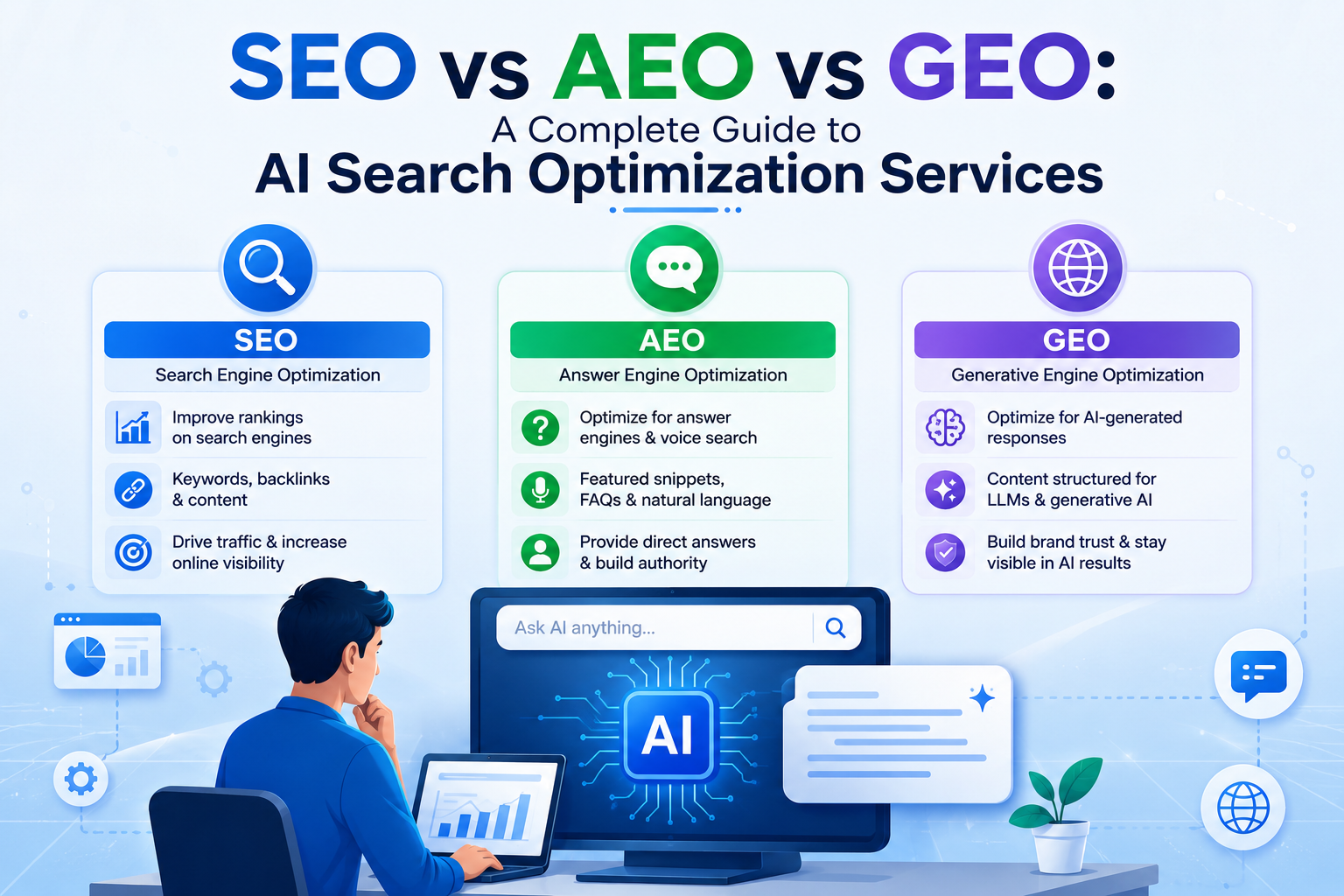
SEO vs AEO vs GEO: A Complete Guide to AI Search Optimization Services

As digital search rapidly evolves, understanding SEO vs AEO vs GEO has become crucial for modern online visibility. While traditional SEO Services keep your website ranking high on search engines, AEO Services format your content into direct answers for voice search and snippets. Furthermore, GEO Services ensure your brand gets cited in generative answers from AI engines. Adopting a unified AEO GEO AI search optimization service bridges these strategies seamlessly. By combining tailored AI SEO services, proactive AI search optimization, and targeted LLM SEO services, businesses can build domain authority, engage audiences, and future-proof their digital search marketing strategy completely.

Not sure where your brand currently stands in AI search results?

See exactly where you’re being cited and where you’re missing.

Quick Navigation

Why This Comparison Matters Right Now

What Is SEO? (The Foundation Everything Else Builds On)

What Is AEO? (Becoming the Direct Answer)

What Is GEO? (Getting Cited Inside AI-Generated Answers)

SEO vs AEO vs GEO: A Simple Side-by-Side Comparison

Why You Can’t Just Pick One

The Conversion Numbers Nobody Can Ignore

How to Actually Improve Your GEO and AEO Visibility

Why Businesses Are Turning to Deftsoft for AI Search Optimization

Frequently Asked Questions

Why This Comparison Matters Right Now

If you’ve been Googling “what is AEO” or “GEO vs SEO,” it’s because search really has changed underneath us not gradually, but fast. AI tools now answer questions directly instead of just linking to websites, and that’s forced marketers to learn two new skill sets almost overnight.

Here’s a number that shows how quickly this shift is happening: Gartner predicts that traditional search engine volume will drop by 25% by 2026, largely because AI chatbots and virtual assistants are absorbing queries that used to go straight to Google. And OpenAI itself reports that ChatGPT has grown to roughly 900 million weekly active users as of early 2026, up from 400 million just a year earlier. No earlier digital marketing channel changed this fast, this quickly.

That’s exactly why understanding SEO vs AEO vs GEO isn’t just an academic exercise anymore. It directly affects whether your business shows up when a customer searches, asks an AI assistant, or gets a summarized recommendation instead of a list of links.

What Is SEO? (The Foundation Everything Else Builds On)

SEO Services (Search Engine Optimization) is the practice of improving your website so it ranks higher in traditional search engines like Google and Bing. This includes keyword research, on-page optimization, technical site health, and building trustworthy backlinks.

SEO isn’t going away, it’s still the base layer everything else is built on. That said, the pressure on it is real: Ahrefs research published in early 2026 found that when an AI Overview appears above the normal search results, the click-through rate for the number one ranking page drops by 58%. This is exactly why strong SEO alone is no longer enough; you also need to be visible inside the AI-generated answer itself, not just below it.

What Is AEO? (Becoming the Direct Answer)

AEO Services (Answer Engine Optimization) is about structuring your content so it can be pulled out and shown as a direct answer in a Google AI Overview, a voice assistant response, or a featured snippet instead of just appearing as a blue link.

This matters because of how differently people phrase their questions now. Instead of typing “best seo service,” someone might ask, “What’s the affordable seo service for small business to get best results?” AEO is built to answer exactly that kind of full, natural question.

Recent research shows just how much this behavior has already changed. Pew Research Center found that when a Google AI Overview is shown, only about 1% of users go on to click a link inside that AI Overview itself; most people simply read the summary and move on. And according to McKinsey, 44% of AI search users now say AI is their primary tool for product discovery, ahead of traditional search at 31%. If your content isn’t structured to be the answer itself, you’re being skipped entirely in a huge and growing share of searches.

What good AEO content looks like:

  • Clear, question-based headings (“What is…”, “How does…”, “Which is better…”)
  • A short, direct answer near the top of each section
  • FAQ sections, bullet points, and comparison tables
  • Schema markup (FAQ, HowTo, Article) so machines can read the structure easily

What Is GEO? (Getting Cited Inside AI-Generated Answers)

GEO Services (Generative Engine Optimization) go a step further than AEO. Where AEO focuses on being the direct answer, GEO focuses on getting your brand mentioned, cited, or recommended when an AI tool generates a longer, synthesized response pulled from multiple sources.

Here’s where things get genuinely surprising, based on research from Ahrefs:

  • Ahrefs found that 28.3% of ChatGPT’s most-cited pages have zero organic visibility in Google meaning they don’t rank for the related keywords at all in normal search.
  • Even more striking: fewer than 10% of the sources cited by ChatGPT, Gemini, and Copilot actually rank in Google’s top 10 for the same query.

This is the single biggest mindset shift businesses need to make: ranking well on Google and being cited by AI tools are becoming two separate games. A page can be practically invisible in traditional search and still get picked up and cited inside an AI-generated answer, and vice versa.

GEO also rewards proof, not just claims. A peer-reviewed study by researchers from Princeton University, Georgia Tech, and IIT Delhi (presented at the ACM KDD 2024 conference) found that adding clear statistics and citing credible sources within content can improve visibility in AI-generated answers by up to 40%.

SEO vs AEO vs GEO: A Simple Side-by-Side Comparison

Factor SEO AEO GEO
Full Meaning Search Engine Optimization Answer Engine Optimization Generative Engine Optimization
Main Goal Rank higher on Google search results Become the direct answer shown to a question Get mentioned and cited inside AI-generated answers
Where It Works Google, Bing search results Featured snippets, voice assistants, AI Overviews ChatGPT, Perplexity, Gemini, Copilot
Content Style Keyword-focused, detailed pages Short, direct, question-based answers Data-backed, factual, easy to reference and cite
Success Measured By Rankings, clicks, organic traffic Featured snippet wins, voice search visibility AI citations, brand mentions across the web
Biggest 2026 Data Point AI Overviews cut top-ranking CTR by 58% (Ahrefs) Only ~1% of users click a link inside a Google AI Overview (Pew Research Center) 28.3% of ChatGPT’s most-cited pages have zero Google search visibility (Ahrefs)

Why You Can’t Just Pick One

Think of it this way: SEO gets your website found. AEO gets your content chosen as the answer. GEO gets your brand talked about, even when someone never visits your site at all.

A business that only invests in SEO risks becoming invisible in AI Overviews and chat tools even with great Google rankings. A business that only chases GEO without solid SEO foundations has little original authority for AI models to trust in the first place. This is exactly why the fastest-growing strategy in 2026 is a combined AEO GEO AI search optimization service not choosing sides, but building all three together.

Search has moved from a discovery model to a decision model, and if a brand is left out of an AI-generated answer, it simply won’t factor into that decision at all. Combined with Gartner’s forecast of a 25% drop in traditional search volume by 2026, the direction is clear: businesses that treat GEO and AEO as passing trends are going to be badly behind by the time this becomes fully mainstream.

The Conversion Numbers Nobody Can Ignore

Here’s the part that should really grab a business owner’s attention: Adobe Digital Insights reported that AI-driven referral traffic to US retail websites surged by 693% year-over-year during the 2025 holiday shopping season. And according to McKinsey, 44% of AI search users already say AI tools are their primary method for discovering products, ahead of traditional search engines at 31%, retailer websites at 9%, and review sites at 6%.

In plain words: fewer people may be clicking through from AI tools compared to traditional search, but a growing share of real purchase decisions are now starting inside an AI conversation before a customer ever visits a website directly. That’s exactly why GEO and AEO aren’t optional extras; they’re becoming part of where buying decisions actually begin.

How to Actually Improve Your GEO and AEO Visibility

Based on the latest research, here are the practices that are proven to move the needle:

  1. Earn mentions on other credible websites. Since AI systems draw heavily from sources beyond your own domain, digital PR, guest content, and coverage on respected industry publications matter just as much for GEO as your own site content.
  2. Back up your claims with real, citable data. The Princeton/Georgia Tech/IIT Delhi study mentioned earlier found that adding clear statistics and credible sourcing to content measurably improves how often it gets picked up in AI-generated answers.
  3. Structure content around clear entities, your brand name, specific services, location, and area of expertise rather than just repeating keyword phrases, since AI systems build understanding around entities and relationships, not keyword density.
  4. Keep content fresh and regularly updated. AI systems, much like traditional search engines, tend to favor content that’s clearly current over pages that haven’t been touched in a long time.
  5. Use well-researched, comparison-style content. A single, well-built, transparent comparison page with real data tends to perform far better for AI citation than a large volume of thin, repetitive articles on the same topic.

At Deftsoft, this isn’t treated as three separate services bolted together; it’s one connected strategy. As a leading provider of AI SEO services, Deftsoft blends traditional SEO Services with modern AEO Services and GEO Services, so your brand shows up whether a customer is searching on Google, asking ChatGPT a question, or reading an AI-generated comparison.

What makes Deftsoft the right partner for this shift:

  • A team that understands both classic ranking signals and the newer rules AI models use to decide what’s trustworthy enough to cite
  • Content built around real data, clear structure, and genuine expertise exactly what the latest research shows AI systems reward
  • Digital PR and third-party placement strategy, since most AI citations come from outside your own website, not from it
  • LLM SEO services and AI Search optimization designed to keep your brand visible as AI models like ChatGPT, Gemini, and Perplexity continue to grow in how people search
  • One team managing SEO, AEO, and GEO together, so nothing works in isolation and your visibility strategy actually compounds over time

Whether you’re just starting to explore AI search visibility or you’re ready to build a serious, long-term strategy, Deftsoft’s approach reflects how search actually works today, not how it worked even a year ago.

Ready to build a strategy that covers SEO, AEO, and GEO together?

Get a custom plan built for how people actually search in 2026.

Talk to Our AI search optimization team

Frequently Asked Questions

1. What is the difference between SEO, AEO, and GEO?

SEO helps your website rank in traditional search engines like Google. AEO structures your content to become the direct answer shown in AI Overviews, voice assistants, and featured snippets. GEO focuses on getting your brand mentioned and cited inside longer, AI-generated answers from tools like ChatGPT and Perplexity.

2. Do I still need SEO if I’m investing in AEO and GEO?

Yes. SEO remains the foundation. Strong, well-optimized content is more likely to be trusted and referenced by AI systems in the first place, and data shows that being cited in AI Overviews can actually increase your regular organic click-through rate rather than replace it.

3. Why do pages that rank well on Google sometimes not get cited by AI tools?

Because AI search increasingly pulls from a different set of sources than traditional rankings. Ahrefs research found that fewer than 10% of the sources cited by tools like ChatGPT, Gemini, and Copilot actually rank in Google’s top 10 for the same query meaning strong Google rankings and AI citations are becoming two separate, only loosely connected games.

4. Is it more important to optimize my own website or get mentioned on other sites?

Both matter, but AI systems draw heavily from sources beyond a brand’s own website when generating answers. That’s why digital PR and earned media coverage are becoming just as important for AI visibility as optimizing your own site content.

5. What’s the fastest way to improve AI search visibility?

Focus on earning mentions on credible third-party websites, backing up claims with real, verifiable data and clear sourcing (a practice shown to improve AI citation rates in peer-reviewed research from Princeton, Georgia Tech, and IIT Delhi), keeping content updated regularly, and structuring content clearly around your brand, services, and expertise.

6. Do visitors from AI search tools actually convert into customers?

Increasingly, yes. Adobe Digital Insights reported that AI-driven referral traffic to US retail websites surged 693% year-over-year during the 2025 holiday shopping season, and McKinsey research shows a large and growing share of consumers now treat AI tools as their primary way of discovering products before ever visiting a website.

7. Should a small business invest in AEO and GEO services, or is this only for large companies?

Any business that depends on being found online can benefit. Since GEO and AEO are still relatively new, and most small businesses haven’t started yet, there’s currently a real first-mover advantage for smaller brands willing to invest in this now rather than waiting.
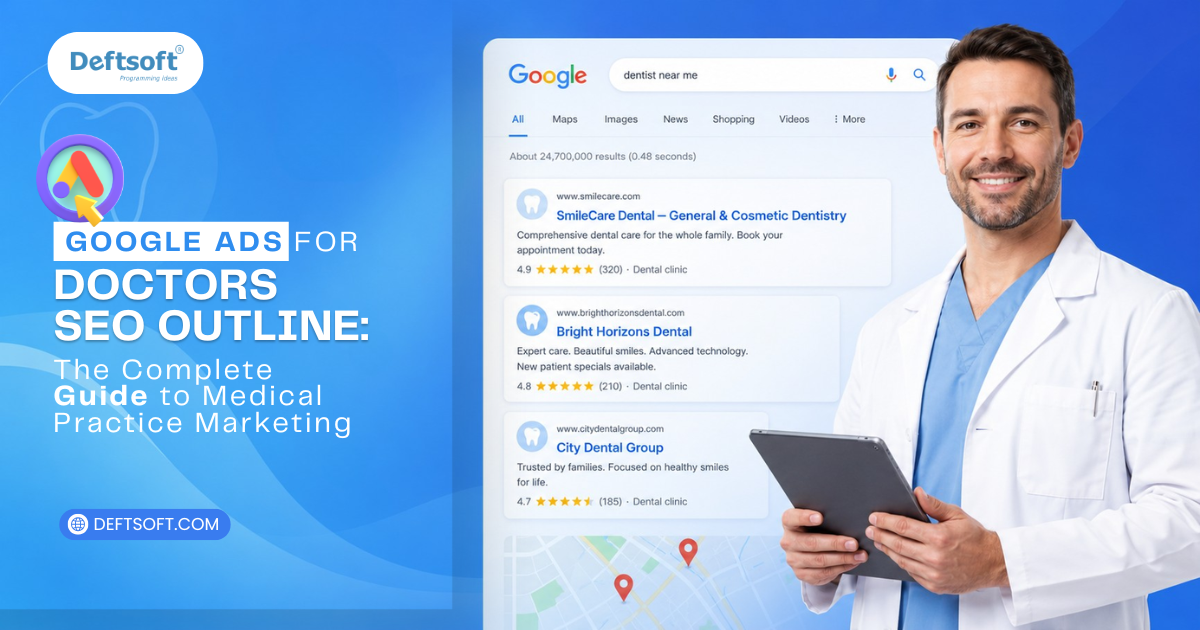

Google Ads for Doctors SEO Outline: The Complete Guide to Medical Practice Marketing

In today’s digital-first healthcare landscape, attracting new patients requires more than traditional word-of-mouth referrals. Modern clinics need a robust Google Ads for doctors SEO outline to capture immediate patient demand while simultaneously building long-term search engine authority.

By combining search engine optimization (SEO) with high-intent pay-per-click (PPC) advertising, your medical practice creates a dual-engine marketing strategy that ensures maximum visibility. Whether your goal is to fill daily appointment slots, showcase specialized medical services, or outrank competing clinics in your area, a unified approach delivers predictable patient growth. Read on to discover the ultimate 2026 Digital marketing roadmap for healthcare practice.

Want a complete Google Ads for doctors SEO outline built specifically for your clinic?

Get a plan built around your specialty, location, and goals.

Quick Navigation

Why Doctors Need SEO and Google Ads

What Is SEO for Doctors in the AI Era?

Generative Engine Optimization (GEO) & AI Search

Why SEO Is Important for Doctors and Medical Practices

How to Create an Effective SEO Strategy for Doctors

Target How Patients Actually Search

Build Dedicated Service Pages

Fix Your Technical Web Foundations

Publish Actionable Patient Content

Local SEO for Doctors: How to Attract Nearby Patients

How Google Business Profile Helps Doctors Get More Patients

Google Ads & Next-Gen Paid Media for Doctors

Maximizing Reach with Google Performance Max (PMax)

Capturing Patients on Emerging Platforms (ChatGPT Ads)

Structuring Ad Groups and Schema the Right Way

Google Ads vs SEO for Doctors: Which Is Better?

PPC for Doctors: How to Build a Successful Paid Search Campaign

Doctor Search Engine Marketing: SEO + PPC

Medical Marketing for Doctors: Beyond SEO and Google Ads

How to Choose an SEO Agency or SEO Company for Doctors

How Much Do SEO Services for Doctors Cost?

SEO and Google Ads Strategy for Doctors: A Step-by-Step Plan

How Deftsoft Helps Doctors Grow

FAQs

Why Doctors Need SEO and Google Ads

Before a patient calls your clinic, they’ve usually already searched for it or for one like it. This is why SEO for doctors, Google Ads for doctors, medical SEO, doctor search engine marketing, and marketing for doctors now sit at the center of patient acquisition.

It helps to understand the difference between the two core channels early on:

  • SEO builds long-term, organic visibility slower to build, but it keeps bringing patients in without an ongoing per-click cost.
  • Google Ads (PPC) delivers immediate visibility; you can appear at the top of search results the same day a campaign launches, but you pay per click.

Neither replaces the other. The strongest clinics combine both, which is exactly what this outline is built around.

What Is SEO for Doctors in the AI Era?

SEO for doctors is the practice of optimizing a clinic’s website so it appears higher in Google’s organic (non-paid) search results.

In plain terms, when someone searches “dermatologist for acne scars near me” or “best pediatrician in [city],” SEO is what determines whether your clinic’s website shows up on page one or gets buried on page three, where almost no one ever looks.

Generative Engine Optimization (GEO) & AI Search

Today’s patients don’t just type two-word keywords into a search bar; they ask AI platforms (Google AI Overviews, ChatGPT, Perplexity, and Gemini) complex questions like “What causes sharp knee pain when bending, and which local clinic specializes in non-surgical treatments?”

To stay visible, modern medical practices must optimize for Generative Engine Optimization (GEO) alongside traditional SEO. This means structuring medical content with clear E-E-A-T (Experience, Expertise, Authoritativeness, and Trustworthiness) signals, expert-reviewed information, and rich schema markup. Doing so ensures AI search engines cite your doctors directly as the recommended authority when patients seek medical answers.

Why SEO Is Important for Doctors and Medical Practices

Investing in SEO services for doctors or medical practice delivers benefits that compound over time. It increases your clinic’s visibility and puts you in front of patients actively searching for the exact services or treatments you offer. Because those searchers are further along in their decision-making, the leads SEO generates tend to be more qualified than a typical ad click, and organic rankings carry a trust advantage that paid ads don’t generally trust an organic result over a sponsored one.

This is why doctor SEO marketing is treated as a foundational investment, not a one-time task; the clinics that stay consistent with it tend to out-compete clinics that only run occasional ad campaigns.

How to Create an Effective SEO Strategy for Doctors

A real SEO strategy for doctors isn’t a single task, it’s a system built from several connected parts.

Move past generic keywords. Focus on high-intent search patterns that drive real appointments:

  • Specialty + City: “dermatologist in Austin”
  • Treatment + City: “Invisalign provider Miami”
  • Urgent / High-Intent: “emergency pediatric dentist near me”
  • Informational Queries: “recovery time after ACL surgery”

Build Dedicated Service Pages

A single “Our Services” page won’t rank. Create individual, dedicated landing pages for every specific procedure, treatment, and condition you treat (e.g., separate pages for Knee Replacement, Hip Replacement, and Arthroscopic Surgery). Each page must include clear clinic contact info, doctor credentials, and a direct booking button.

Fix Your Technical Web Foundations

Even the best content won’t rank if your site is slow or broken. Prioritize mobile-first design, fast loading speeds, clean internal links between related services, secure HTTPS, solid Core Web Vitals performance and clear page titles.

Publish Actionable Patient Content

Answer the exact questions patients ask during consultations: treatment timelines, costs, preparation steps, and recovery expectations. Demonstrating clear medical expertise (E-E-A-T) builds immediate trust while capturing patients early in their decision process.

Local SEO for Doctors: How to Attract Nearby Patients

For almost every medical practice, patients are searching within a specific area which is why local SEO for doctors is often the single highest-impact part of the entire strategy.

Strong local SEO doctors marketing starts with a fully optimized Google Business Profile, paired with local keyword targeting around your city or region. From there, consistency matters: your Name, Address, and Phone number need to match exactly across every listing, backed by relevant citations and genuine patient reviews. Clinics with multiple locations should build location-specific pages rather than one page trying to cover every branch, and all of this should ultimately support strong visibility in Google Maps, where many local patients search directly.

For most clinics, SEO for doctors without a strong local component is missing the majority of realistic, nearby patient searches.

How Google Business Profile Helps Doctors Get More Patients

A fully optimized Google Business Profile is often the first thing a patient sees before visiting your website. That starts with the correct business name and category and a clear list of services, plus keeping your hours, address, and phone number current. Beyond the static details, real photos, regular posts about services or health topics, and prompt responses to patient reviews signal to Google that your practice is genuinely active. The Questions & Answers section deserves the same attention, since it’s often the first thing a hesitant patient reads.

A well-maintained profile directly supports local SEO for doctors, since Google favors profiles that are complete, active, and trusted by real patients.

Google Ads for doctors puts your clinic at the very top of search results immediately, for a cost per click. A well-run campaign is built on Search Ads targeting specific, high-intent medical queries, combined with location and keyword targeting that reaches the right patients in your service area. From there, the details matter just as much as the setup: ad copy needs to clearly match what the patient searched for, the landing page it leads to should be built around that exact service, and call extensions let mobile users ring the clinic directly from the ad itself. None of it means much without conversion tracking in place to measure the calls, form fills, and bookings it’s actually generating.

Done well, Google Ads for medical practice campaigns can generate patient inquiries within days, which is exactly why they pair so effectively with the slower, compounding results of SEO.

Maximizing Reach with Google Performance Max (PMax)

Modern medical PPC expands well beyond basic Search text ads. By utilizing Google Performance Max (PMax) campaigns, your practice can run automated, multi-channel ad placements across Google Search, YouTube, Display, Gmail, and Maps from a single campaign. PMax uses Google’s AI to identify high-intent patients who are actively considering care, driving significantly lower Cost-Per-Acquisition (CPA).

Capturing Patients on Emerging Platforms (ChatGPT Ads)

Beyond Google, patient behavior is expanding into conversational AI platforms. As ad ecosystems evolve inside tools like ChatGPT, clinics have a unique first-mover advantage to show contextual solution cards right as a patient evaluates symptoms and treatment options during a live AI chat.

Note on AI Campaign Setup:

Running automated campaign types like PMax or conversational ads in healthcare requires strict privacy protocols. Broad automation can accidentally trigger privacy violations or misallocate budget toward generic inquiries if custom audience signals, negative keyword lists, and location boundaries aren’t tightly controlled.

Structuring Ad Groups and Schema the Right Way

Two structural adjustments dramatically improve both your paid ad returns and your organic search visibility:

  • Build Single-Treatment Ad Groups: Avoid generic ad groups like “Dental Services.” Instead, build tightly focused groups around specific procedures (e.g., “Root Canal” or “Teeth Whitening”). Matching specific keywords to targeted ad copy improves your Quality Score, reduces cost-per-click, and lets you highlight relevant trust signals like board certifications or same-day scheduling.
  • Deploy Healthcare Schema Markup: Add Physician and MedicalBusiness structured data to your site. This code directly tells search engines and AI answer tools your exact specialties, clinic locations, and practitioner credentials—boosting local visibility and search citations.
  • Use PPC Data as Your SEO Roadmap: Treat paid and organic search as a connected feedback loop. Search terms that consistently generate booked appointments in Google Ads are ready-made, revenue-proven targets for your next SEO service pages and blog topics.

A Note on Medical Advertising Compliance

Medical advertising carries unique regulatory hurdles that most other industries don’t face. In the US, this means keeping patient data HIPAA-compliant across tracking, call recording, and chat forms. Ad copy and landing pages should avoid unverifiable claims, like guaranteed outcomes or unsubstantiated “best in the city” language, since medical advertising is held to a higher standard. Depending on specialty and region, a local medical council or licensing board may set additional rules on what a clinic can advertise. Building compliance from day one is far cheaper than fixing it mid-campaign.

Google Ads vs SEO for Doctors: Which Is Better?

SEO for Doctors Google Ads for Doctors
Long-term strategy Immediate visibility
Organic traffic Paid traffic
Builds authority over time Fast lead generation
Takes time to produce results Can generate traffic quickly
No direct cost per click Pay per click

Neither option is objectively “better”; they solve different problems. Most successful medical practices use SEO for doctors to build lasting authority while running Google Ads for doctors to capture urgent, high-intent searches in the meantime.

A strong PPC for doctors campaign depends on more than turning ads on. It starts with keyword research focused on real patient intent, paired with a solid list of negative keyword terms like “jobs,” “free,” or “meaning of” have no place draining a medical ad budget. Geographic targeting needs to match your actual service area, and ad extensions like call buttons and sitelinks add relevance a plain text ad doesn’t have alone. From there, everything comes down to what happens after the click: landing pages built for the exact ad clicked, conversion tracking on every call and form fill, dedicated call tracking, and ongoing A/B testing to keep improving results.

Skipping negative keywords or sending traffic to a generic homepage are two of the fastest ways a PPC for doctors budget gets wasted.

Doctor search engine marketing simply means combining organic and paid search into one connected strategy: SEO, local SEO, Google Ads, content marketing, and conversion optimization working together rather than as separate, disconnected efforts.

This combined approach is also central to broader medical marketing for doctors strategy, since patients often interact with multiple touchpoints: an ad, an organic search result, a review, a service page before ever making the call.

Medical Marketing for Doctors: Beyond SEO and Google Ads

A complete medical marketing for doctors strategy typically extends into a few more channels working alongside SEO and Google Ads. Content marketing builds trust and supports SEO at once, while social media marketing keeps your clinic visible through health tips and patient stories between searches. Online patient reviews influence both local rankings and a patient’s final decision, and email marketing remains useful for retention and reminders with existing patients. Reputation management ties it together by monitoring feedback across platforms, video content, a simple clinic tour or doctor introduction builds trust before a first visit, and referral marketing remains one of the most cost-effective channels in healthcare.

Together, these channels round out doctor SEO marketing into a full-funnel strategy rather than a single tactic.

How to Choose an SEO Agency or SEO Company for Doctors

Choosing the right SEO company for doctors matters as much as the strategy itself. Look for genuine healthcare SEO experience, not just general SEO knowledge, and a clear understanding of medical search intent and patient behavior. Proven local SEO and Google Ads experience specific to healthcare should be non-negotiable, alongside strong medical website SEO knowledge covering both technical and on-page factors. Just as important is transparency, reliable conversion tracking, honest reporting, and ethical, compliant practices appropriate for healthcare.

A provider offering true SEO services for doctors should be able to clearly explain how their work connects to real patient bookings, not just rankings or traffic numbers.

How Much Do SEO Services for Doctors Cost?

The cost of SEO services for doctors varies based on several factors: your clinic’s location and local competition, your medical specialty, and the size of your website and number of service pages that need optimizing. It also depends on your specific goals, your local SEO requirements, your content needs for service pages and educational articles, and whether any Google Ads budget is running alongside the SEO work.

Because of this range of factors, a fair quote should always be based on a real audit of your website and goals, not a flat, generic package price.

SEO and Google Ads Strategy for Doctors: A Step-by-Step Plan

Building a high-performing digital patient acquisition engine requires a structured execution sequence. Jumping straight into paid ads without a optimized web foundation wastes budget, while relying solely on organic search delays patient growth. Follow this proven 9-step roadmap:

  1. SEO & Technical Audit: Assess site speed, Core Web Vitals, mobile responsiveness, HIPAA compliance, and existing indexed pages to fix underlying technical barriers.
  2. Intent-Based Keyword Research: Identify high-value transactional terms (e.g., “emergency root canal near me”) alongside informational long-tail questions used in AI search queries.
  3. Medical Website Architecture & SEO: Establish clean site navigation, HTTPS security, and structured data markup (Physician and MedicalBusiness schema) to signal trust to search engines.
  4. Service Page Optimization: Build dedicated, high-converting treatment pages for every individual procedure rather than bundling services onto generic pages.
  5. Local SEO & Google Business Profile: Claim and fully optimize your Google Business Profile, align NAP (Name, Address, Phone) consistency across directories, and launch a systemized review collection workflow.
  6. AI & Content Marketing: Publish authoritative, E-E-A-T-backed medical content targeting specific patient symptoms, recovery guides, and AI answer engine (GEO) queries.
  7. Targeted Google Ads (PPC) & PMax: Launch tightly organized ad groups around single treatments, pair them with high-intent negative keywords, and deploy compliant Performance Max campaigns.
  8. HIPAA-Compliant Conversion Tracking: Set up end-to-end analytics to track real phone calls, form fills, and online bookings without exposing protected health information (PHI).
  9. Continuous Optimization: Use converting paid search data to refine organic content, continuously A/B test ad copy, and scale budget into top-performing specialties.

This sequence ensures your paid ad spend lands on a high-converting, search-optimized foundation, maximizing ROI from day one while building compounding organic authority over time.

How Deftsoft Helps Doctors Grow

At Deftsoft, this entire outline isn’t treated as separate services, it’s managed as one connected system. Deftsoft brings together SEO services for doctors, local SEO, Google Ads for doctors, medical website optimization, and conversion tracking under one team, so your clinic’s visibility and your patient bookings are always working toward the same goal.

Rather than treating rankings or ad clicks as the finish line, Deftsoft’s approach is built around the full patient journey from the first search, to the website visit, to the completed booking. For clinics comparing SEO agencies for doctors, that connected approach is often the real difference between a strategy that generates traffic and one that generates patients.

Already have a website but not enough patient inquiries?

See exactly what’s holding your visibility back.

FAQs

1. What is SEO for doctors and why is it important?

SEO for doctors is the process of optimizing a medical practice’s website so it ranks higher in organic Google search results. It’s important because most patients now search online before choosing a provider, and strong SEO ensures your clinic is visible when they do.

2. How does medical SEO help doctors attract more patients?

Medical SEO helps by making sure your website appears for the specific treatments, specialties, and local searches your ideal patients are already using, turning search visibility directly into new patient inquiries.

3. What is the difference between SEO for doctors and Google Ads for doctors?

SEO for doctors builds long-term, organic visibility without a per-click cost, while Google Ads for doctors delivers immediate visibility through paid search, charged per click. Most clinics benefit from using both together.

4. How much do SEO services for doctors cost?

Costs vary based on location, specialty, competition, website size, and specific goals. A proper quote should come from an audit of your actual website and market, not a flat generic package.

5. What are the best local SEO strategies for doctors?

The strongest local SEO strategies include Google Business Profile optimization, consistent NAP details, local citations, active review management, and location-specific service pages.

6. How does local SEO for doctors improve Google Maps visibility?

Local SEO signals like profile completeness, reviews, citations, and location relevance directly influence whether your clinic appears in Google’s local Map Pack results for nearby patient searches.

7. What is the best SEO strategy for doctors?

The best strategy combines keyword research based on patient intent, dedicated service pages, strong technical medical website SEO, local SEO, and ongoing helpful content, not any single tactic alone.

8. Should doctors invest in PPC for doctors or SEO?

Both serve different purposes. PPC for doctors generates fast, immediate leads, while SEO builds lasting, cost-efficient visibility over time. Combining both typically produces the strongest results.

9. How can Google Ads for medical practices generate more patient leads?

By targeting high-intent local searches, using dedicated landing pages matched to each ad, and tracking conversions closely to continually refine targeting and budget.

10. What is medical website SEO?

Medical website SEO refers to the technical and on-page optimization of a healthcare website including speed, mobile-friendliness, structure, and schema markup that helps both patients and search engines understand and trust the site.

11. How do I choose the best SEO agency for doctors?

Look for genuine healthcare SEO experience, an understanding of medical search intent, proven local SEO results, and clear reporting that ties directly back to patient bookings.

12. Should I hire an SEO company for doctors or a general SEO agency?

A dedicated SEO company for doctors typically understands healthcare-specific search behavior, compliance considerations, and trust signals far better than a general SEO agency without medical experience.

13. What does doctor search engine marketing include?

Doctor search engine marketing combines SEO, local SEO, Google Ads, content marketing, and conversion optimization into one unified strategy for patient acquisition.

14. What are the most effective medical marketing strategies for doctors?

Beyond SEO and Google Ads, effective strategies include content marketing, social media, patient reviews, email marketing, reputation management, video marketing, and referral programs.

15. How can SEO for medical practice websites improve online visibility?

By combining strong technical SEO, dedicated service pages, local optimization, and helpful patient-focused content, a medical practice website becomes far more visible to the exact patients searching for its services.

16. What is AI SEO (GEO) and why do doctors need it?

Generative Engine Optimization (GEO) is the process of optimizing your clinic’s website so that AI search engines (like Google AI Overviews, ChatGPT, and Perplexity) select and cite your medical practice as a top recommended answer when patients ask complex health queries online.

17. Can medical practices run Google Performance Max (PMax) campaigns safely?

Yes, but PMax requires strict setup boundaries in healthcare. Because PMax distributes ads across multiple formats automatically, campaigns must be configured with targeted location radiuses, strict negative keyword lists, and HIPAA-compliant tracking to prevent wasted budget or privacy issues.

18. How do recent Google Ads policy updates affect healthcare advertising?

Google continuously updates its healthcare advertising policies, especially around medical terminology, prescription keyword targeting, and provider certifications. Working with a dedicated medical marketing team ensures your campaigns remain fully certified and compliant, avoiding account suspensions.

What is AI SEO? How to Hire the Right AI SEO Service Provider Company in 2026

Search engine optimization is evolving faster than ever, with AI Overviews and generative search tools redefining how users discover content online. To stay competitive in 2026, modern brands must move beyond traditional tactics and leverage advanced ai seo services. Partnering with an experienced ai seo company ensures your website is optimized for both traditional search engines and AI-driven answer engines. Whether you are scaling an enterprise or looking for affordable seo services for small business, selecting the right agency is key to capturing search intent, driving high-value organic traffic, and future-proofing your brand’s digital visibility across all platforms.

Quick Summary

Search has changed more in the last two years than it did in the previous ten. Google now shows AI-written answers (called AI Overviews) for a huge share of searches, and more people are asking questions directly to tools like ChatGPT and Perplexity instead of typing into Google. This means old-style SEO just adding keywords and building links is no longer enough. Your business now needs AI SEO services that also cover GEO (Generative Engine Optimization), AEO (Answer Engine Optimization), and LLM SEO, so your brand shows up not just in blue links, but inside AI-generated answers themselves. This guide explains why this shift matters, what a good AI SEO company should actually do for you, and how to pick the right SEO company for your business in 2026 using easy language and the latest available data.

Quick Navigation

What Is AI SEO, and Why Is Everyone Talking About It?

The Numbers Don’t Lie: Search Has Really Changed

AI SEO vs GEO vs AEO vs LLM SEO: What’s the Difference?

Why Old-School SEO Alone Isn’t Enough Anymore

What a Good AI SEO Company Should Actually Do for You

How to Hire the Right SEO Company in 2026

Why Deftsoft Is the Right AI SEO Company for Your Business

Frequently Asked Questions

What Is AI SEO, and Why Is Everyone Talking About It?

In simple words, AI SEO means optimizing your website so it can be understood, trusted, and used by both traditional search engines (like Google) and newer AI tools (like ChatGPT, Perplexity, and Google’s AI Overviews).

For years, SEO meant one thing: get your page to rank high on Google, and people will click on it. That’s still true, but it’s no longer the whole story. Now, a large share of searches never lead to a click at all because the answer is already shown right there on the search page, written by AI.

This is why AI SEO services have become such a big deal. It’s not just about ranking anymore. It’s about being the source that AI trusts enough to quote.

Let’s look at some real, recent data that shows exactly why this shift matters for your business:

  • AI Overviews are everywhere now. Google’s AI Overviews reach roughly 2 billion people every month, and they now appear on a large and growing share of all Google searches.
  • Clicks are dropping fast. When an AI Overview shows up on a search result, the number one ranking page can lose more than half of its usual clicks; some studies show a 58% drop in click-through rate for the top result.
  • Most searches end without any click at all. Around 60% of Google searches now end without the user clicking on any website; this is called “zero-click search,” and in Google’s AI Mode specifically, that number jumps to around 93%.
  • But the traffic that does come through is worth more. Visitors who arrive from AI tools like ChatGPT convert into customers at a much higher rate than regular search visitors; some studies show conversions as high as 23 times higher.
  • AI traffic is growing at a huge speed. Traffic sent to websites from generative AI platforms has grown by nearly 800% year over year.
  • Most brands haven’t caught up yet. Only around 20% of brands have started working on AEO or GEO, which means businesses that start now have a real head start over their competitors.

What all this really means is simple: your customers are still searching for what you offer; they’re just doing it differently now. If your website isn’t set up to be picked up by AI answers, you’re becoming invisible to a growing part of your audience, even if your old-style SEO rankings look fine on paper.

AI SEO vs GEO vs AEO vs LLM SEO: What’s the Difference?

These terms get thrown around a lot, and it’s easy to feel confused. Here’s a simple breakdown:

  • AI SEO is the big-picture term for using AI tools and AI-focused strategy to improve your visibility everywhere, both in regular search and in AI answers.
  • GEO (Generative Engine Optimization) means optimizing your content specifically so that AI tools like ChatGPT, Gemini, and Perplexity pick it up and mention it when generating an answer.
  • AEO (Answer Engine Optimization) is very closely related to GEO, but it’s mostly used when talking about Google’s own AI Overviews and other “answer engines” that show a direct answer instead of a list of links.
  • LLM SEO service refers to optimizing your content so that large language models (the AI models behind tools like ChatGPT) understand your brand correctly and are more likely to recommend or cite you when someone asks a related question.

In practice, most good SEO companies now treat all four of these as one connected strategy because a page that’s well-structured, clear, and trustworthy tends to perform well across all of them at once.

Why Old-School SEO Alone Isn’t Enough Anymore

Old-style SEO focused heavily on things like keyword count, number of backlinks, and page titles. Those things still matter, but AI systems look at content differently:

  • AI tools care more about clarity and trust than keyword tricks. Research shows that how often a brand is mentioned across the web (called “brand mentions”) has a much stronger link to appearing in AI Overviews than backlinks do.
  • AI often pulls from different pages than Google’s normal top results. Studies show that a large share of pages cited by AI tools like ChatGPT don’t even appear in the top 10 Google results, meaning AI is reading the wider internet, not just the usual top-ranking pages.
  • Being clearly written matters more than being keyword-stuffed. AI systems are built to understand natural language, so content that reads naturally and answers real questions clearly tends to get picked up more than content that’s stuffed with repeated keywords.

This is exactly why businesses need a modern, well-rounded AI SEO company, one that understands both the old rules of search and the new rules of AI, instead of only knowing one or the other.

What a Good AI SEO Company Should Actually Do for You

If you’re evaluating an ai seo company, here’s what real, modern AI SEO services should include:

  1. Clear, well-structured content: Written in a way both humans and AI models can easily understand, with direct answers to real questions people are asking.
  2. Technical SEO health: Fast-loading pages, mobile-friendly design, and clean site structure, since AI systems and search engines both reward sites that are easy to read and crawl.
  3. Brand mentions and digital PR: Since brand mentions across the web are strongly linked to AI Overview visibility, a good SEO partner should help you build genuine presence beyond just your own website.
  4. AI Overview and answer tracking: Regularly checking whether your content is showing up in AI Overviews, ChatGPT answers, or Perplexity results, and adjusting strategy based on what’s working.
  5. E-E-A-T focused content: Google and AI systems both place heavy weight on Experience, Expertise, Authority, and Trust when deciding what to show or cite.
  6. Local and small business SEO options: Because not every business needs a giant, expensive strategy. Good affordable SEO services for small businesses should still include real GEO and AEO groundwork, just scoped to fit a smaller budget.

If an SEO company can’t clearly explain how they’re helping you show up inside AI answers, not just on page one of Google, they’re likely still stuck in old-style SEO thinking.

How to Hire the Right SEO Company in 2026

Here are simple, practical things to look for before you sign up with any SEO company:

1. Ask them directly about GEO, AEO, and LLM SEO. If they look confused or brush off the question, that’s a red flag. These aren’t optional extras anymore; they’re core parts of a real 2026 SEO strategy.

2. Ask for examples of AI Overview or AI-answer visibility, not just Google rankings. Rankings alone don’t tell the full story anymore. Ask if they can show real examples of content that has been cited inside AI Overviews or AI chat tools.

3. Be cautious of unrealistically cheap, vague packages. A real strategy involving content, technical fixes, and AI-visibility tracking takes real time and expertise. If a price feels too low for the amount of work being promised, it’s worth asking exactly what’s included.

4. Make sure they explain things in plain language. A good SEO partner should be able to explain what they’re doing and why, in words you can actually understand, not just jargon and dashboards.

5. Check if they treat SEO as one connected strategy, not separate services. The strongest results in 2026 come from treating traditional SEO, GEO, AEO, and content strategy as one system working together, not as separate add-ons sold individually.

Why Deftsoft Is the Right AI SEO Service Provider Company for Your Business

At Deftsoft, AI SEO isn’t treated as a trendy add-on; it’s built directly into how we approach search strategy for every client. As one of the leading AI SEO companies working with businesses of all sizes, Deftsoft combines traditional SEO fundamentals with modern GEO, AEO, and LLM SEO practices, so your brand shows up whether someone is searching on Google, asking ChatGPT, or getting an instant AI-generated answer.

What makes Deftsoft a strong choice:

  • A team that understands both classic ranking factors and how AI systems choose what to cite
  • Content strategy built around clarity, real answers, and E-E-A-T, not outdated keyword stuffing
  • Technical SEO expertise to make sure your site is fast, clean, and easy for both search engines and AI crawlers to understand
  • Scalable, affordable SEO services for small business owners who want real AI-era visibility without an enterprise-sized budget
  • A single team handling SEO, content, and digital marketing together, so your AI SEO strategy isn’t working in isolation from the rest of your online presence

Whether you’re a small business just starting to think about AI visibility, or an established brand that wants to stay ahead of competitors who haven’t adapted yet, Deftsoft’s approach is built for how search actually works today, not how it worked five years ago.

Ready to build a real 2026 SEO strategy?

Get a custom plan built around GEO, AEO, and traditional SEO together.

Frequently Asked Questions

1. What is AI SEO and how is it different from normal SEO?

AI SEO is the practice of optimizing your website so it performs well in both traditional search engines and AI-powered tools like ChatGPT, Gemini, and Google AI Overviews. Normal SEO focuses mainly on ranking in blue links, while AI SEO also focuses on being quoted or cited inside AI-generated answers.

2. What do GEO and AEO mean in simple words?

GEO (Generative Engine Optimization) means optimizing content so AI tools like ChatGPT mention or cite it. AEO (Answer Engine Optimization) means the same thing, but is mostly used for Google’s AI Overviews and similar answer-style search results. In practice, both terms describe the same overall goal.

3. Do I still need traditional SEO if I invest in AI SEO services?

Yes. Traditional SEO and AI SEO work together, not separately. Studies show a large share of pages cited in AI Overviews already rank well in normal Google search, so strong traditional SEO is still an important foundation.

4. Is AI SEO only for big companies, or can small businesses use it too?

Small businesses can and should use AI SEO too. Many SEO companies, including Deftsoft, offer affordable SEO services for small business owners that include AI-era strategies like GEO and AEO, scaled to fit a smaller budget.

5. How do I know if an SEO company actually understands AI SEO?

Ask them directly how they approach GEO, AEO, and LLM SEO, and whether they can show examples of content appearing in AI Overviews or AI chat answers, not just traditional Google rankings.

6. Will AI Overviews and AI search tools reduce my website traffic?

They can reduce click-through rates on traditional search results, since many searches now get answered directly on the results page. However, visitors who do click through from AI tools tend to convert into customers at a much higher rate, making AI visibility a valuable, high-quality traffic source.

7. How long does it take to see results from AI SEO services?

Like traditional SEO, AI SEO is an ongoing process rather than an instant fix. Most businesses start noticing improved visibility within a few months, with stronger results building as content, technical SEO, and brand mentions continue to grow together.

How Much Does It Cost to Hire an Affordable SEO Services Company for a Small Business?

In today’s fast-evolving digital landscape, establishing a strong online presence is essential for attracting local customers, driving organic traffic, and scaling revenue. However, for growing enterprises operating on strict budgets, finding cost-effective growth solutions can be a major challenge. Many business owners struggle to balance quality optimization with manageable expenses, leaving them wondering how to achieve long-term search visibility without overspending.

Partnering with a trusted affordable seo services company allows businesses to access dedicated strategies tailored to their unique market demands without paying top-tier enterprise pricing. Whether you are aiming to dominate local map packs or expand your reach nationwide, choosing targeted affordable seo services helps level the playing field against larger competitors.

For US-based brands seeking a high return on investment, investing in tailored affordable seo services for small business growth ensures your website builds lasting search authority. Read on to discover realistic pricing models, common hidden fees, and how to select the right affordable seo services for small businesses.

Quick Summary

Most small businesses in the USA pay somewhere between $500 and $5,000 per month for SEO, with the real “sweet spot” for meaningful results typically landing between $1,000 and $2,500 per month, depending on your industry, location, and competition. However, the number on a proposal means very little on its own. What actually determines whether you’re getting affordable SEO services or just a cheap invoice is what’s included, how the pricing model works, and whether the company scopes the work around your business instead of using a fixed template. This guide breaks down real 2026 SEO pricing, explains the different pricing models agencies use, uncovers the hidden costs behind “cheap” SEO packages, and shows you how to evaluate an affordable SEO services company for your small business without overpaying or under-investing.

Ready to talk strategy instead of guessing at packages?

Build a plan that fits your budget.

Connect with us

Quick Navigation

Why “How Much Does SEO Cost” Doesn’t Have One Answer

What Actually Drives the Cost of SEO Services for a Small Business

The Three Common SEO Pricing Models And Which Fits a Small Business Best

Why the Cheapest SEO Quote Is Often the Most Expensive Mistake

Building vs. Buying: In-House SEO vs. an Affordable SEO Services Company

What Should Be Included in an Affordable SEO Package

How Deftsoft Prices Affordable SEO for Small Businesses

Frequently Asked Questions

Why “How Much Does SEO Cost” Doesn’t Have One Answer

If you’ve searched for pricing before, you’ve probably noticed the numbers are all over the place: one site says $300 a month, another says $5,000. Both can be true at the same time, because SEO pricing depends heavily on scope, not just the service label.

Recent 2026 industry data puts the average business SEO spend at roughly $2,900 a month across all business sizes, with a wide range of $500 to $5,000 depending on scope. But small businesses specifically tend to land in a narrower and more realistic band: $500–$2,500 a month, with local-focused campaigns often on the lower end and multi-location or competitive-market campaigns on the higher end.

For context on how far a budget goes:

  • Local SEO (one location, community-focused): typically $250–$2,000/month
  • National or multi-location SEO: typically $1,500–$5,000/month
  • Hourly consulting: typically $75–$300/hour depending on experience
  • One-time project work (audits, migrations): typically $500–$7,500 depending on site size

Prices vary so much because optimized marketing for a single local shop requires far less work than marketing for a large business spanning 12 states, even if both are called small businesses.

What Actually Drives the Cost of SEO Services for a Small Business

Before comparing quotes from an affordable SEO services company, it helps to know what’s actually moving the price up or down:

  1. Geographic scope: Targeting one city costs far less than targeting an entire state or the whole USA, simply because there are fewer keywords, fewer competitors, and less content required.
  2. Industry competitiveness: A local plumber competes with a handful of nearby businesses. A SaaS company or law firm competes nationally against well-funded competitors, which pushes up the labor and content required to rank.
  3. Website condition: A slow, outdated, or poorly structured website needs technical fixes before content and links can even work, which adds cost upfront.
  4. Content requirements: Ranking today requires original, well-researched content built around real search intent, not templated filler. Well-researched SEO copywriting typically runs $0.15–$0.50 per word, and that adds up across a real content calendar.
  5. Link building and authority work: Earning a handful of genuinely relevant backlinks costs more in time and outreach than buying a bulk pack of low-quality directory links, but it’s the version that actually holds up.
  6. Reporting and strategy overhead: A provider that reviews performance monthly and adjusts strategy is spending real hours on your account; a $199/month “SEO package” usually isn’t.

The Three Common SEO Pricing Models And Which Fits a Small Business Best

SEO

1. Monthly Retainer By far the most common model the vast majority of agencies price this way. You pay a fixed monthly fee for ongoing work: keyword strategy, on-page fixes, content, link building, and reporting. This works best for small businesses because SEO is a compounding, ongoing effort, not a one-time task.

2. Hourly Consulting Best suited for businesses that already have some in-house marketing capability and just need expert direction: a technical audit, a content strategy session, or guidance on a specific problem. Typical rates run $75–$300/hour in the US market.

3. Project-Based Pricing Useful for a defined, one-time need: a full technical SEO audit, a site migration, or a content audit. These typically range from $500–$7,500 depending on site size and complexity, but don’t replace ongoing optimization; they’re a starting point, not a strategy.

For most small businesses looking for affordable SEO services for small business growth (not just a one-off fix), a modest monthly retainer is the most cost-effective long-term option, because it builds momentum instead of resetting every few months.

Why the Cheapest SEO Quote Is Often the Most Expensive Mistake

It’s tempting to go with whichever affordable SEO services company quotes the lowest number, but there’s a real cost to underpricing SEO; it just shows up later, as wasted months instead of wasted dollars.

Here’s the math providers rarely walk you through: if a well-run local SEO campaign generates even 15–20 qualified leads a month, and your average customer is worth a few hundred to a few thousand dollars, the return on a properly resourced $1,000–$2,000/month campaign can be many multiples of the spend. A $199/month “package” that never moves the needle isn’t actually cheaper; it’s just a slower way to spend the same money without the result.

A few signs a “cheap” SEO quote is actually underscoped:

  • No mention of keyword research or search intent just “we’ll optimize your site”
  • Vague deliverables like “SEO tasks” instead of named services (technical audit, content plan, link building)
  • No clear reporting cadence or explanation of what’s being measured
  • Heavy reliance on automated or bulk-generated content with no human review a red flag both for quality and for how modern search engines evaluate expertise and trustworthiness in content

Building vs. Buying: In-House SEO vs. an Affordable SEO Services Company

Some small business owners consider hiring in-house before comparing agency pricing. It’s worth running the numbers side by side:

  • A single in-house SEO specialist in the US typically costs well over $100,000 a year once salary, benefits, and tools are factored in.
  • A full in-house team (strategist, content writer, technical SEO, outreach) can run into the hundreds of thousands annually.
  • An experienced affordable SEO services company delivering comparable work strategy, content, technical fixes, reporting typically costs a fraction of that, often in the range most small businesses already budget for marketing.

For almost any business under a few million dollars in annual revenue, outsourcing to a dedicated agency is the more cost-efficient route: you get a full team’s combined expertise (strategist, writer, technical specialist) for less than one full-time salary.

What Should Be Included in an Affordable SEO Package

A well-scoped, affordable package for a small business whether you’re in the US or elsewhere should typically include:

  • Keyword research mapped to real customer search intent, not just search volume
  • On-page optimization across your key pages (titles, headings, structure, internal links)
  • Technical health checks (site speed, mobile usability, indexing issues)
  • Local SEO and Google Business Profile management, if you serve a specific area
  • A content plan built around the questions your customers are actually asking
  • Monthly reporting that explains what changed and why not just a dashboard screenshot

If a package skips more than one or two of these, it’s not really “affordable”, it’s incomplete, and you’ll likely end up paying for the missing pieces later anyway.

How Deftsoft Prices Affordable SEO for Small Businesses

At Deftsoft, pricing is built around what a business actually needs rather than a fixed, one-size-fits-all bundle, which is how a genuinely affordable SEO services company should operate. Whether you’re a single-location business that needs strong local visibility, or a growing US-based company competing nationally, Deftsoft’s digital marketing team scopes the engagement around your goals, your market, and your existing website, so you’re paying for strategy and execution, not a templated checklist.

That approach is also why Deftsoft’s SEO work is paired with broader digital marketing capabilities content marketing, technical SEO, conversion rate optimization, and modern AI-driven search visibility under one roof, so improvements in one area (like site speed) support results in another (like rankings and conversions) instead of working in isolation.

For a small business trying to figure out what a realistic, affordable SEO investment looks like for its specific market and goals, the most reliable way to get an accurate number is a direct audit and consultation rather than comparing generic price lists.

Not sure what affordable SEO should cost for your specific business?

Get a custom quote from Deftsoft based on your website, market, and goals.

Frequently Asked Questions

1. How much does it cost to hire an affordable SEO services company for a small business?

Most small businesses in the USA pay between $500 and $2,500 a month, depending on whether the focus is local or national, how competitive the industry is, and how much content and technical work the website needs.

2. What is the cheapest realistic monthly SEO budget for a small business?

Local, single-location businesses can see meaningful results starting around $500–$1,000 a month, though budgets closer to $1,500–$2,000 typically produce faster, more durable results.

3. Is affordable SEO the same as cheap SEO?

No. Affordable SEO means the pricing matches a properly scoped strategy for a small business budget. Cheap SEO usually means corners have been cut with no real keyword strategy, templated content, or low-quality backlinks which costs more in wasted time than it saves in dollars.

4. Why do SEO prices vary so much between companies?

Pricing depends on scope: geographic targeting, industry competitiveness, website condition, and how much content and link-building work is required. A local bakery and a national e-commerce brand are not buying the same service, even under the same label.

5. Is it cheaper to hire an in-house SEO specialist or an SEO company?

For most small businesses, outsourcing is significantly more cost-effective. A single in-house hire can cost over $100,000 a year in salary and overhead, while an agency delivers a full team’s expertise in strategy, content, technical, and outreach for a fraction of that.

6. How long before affordable SEO services show results for a small business?

Most small businesses start seeing early movement within 3–6 months, with stronger, more established results building over 6–12 months of consistent work SEO is a compounding investment, not an instant fix.

7. What should be included in an affordable SEO services package for a small business?

At minimum: keyword and intent research, on-page optimization, technical health checks, local SEO/Google Business Profile management (if relevant), a content plan, and clear monthly reporting. If a package is missing several of these, it’s likely underscoped rather than genuinely affordable.

How to Hire Best SEO Companies for Small Business

Search engine optimization is no longer a “nice to have” for small businesses; it’s the difference between showing up when a customer searches for what you sell, or watching that customer land on a competitor’s site instead. But finding the best SEO companies for small business owners can actually trust is harder than it should be. Pricing is all over the map, everyone claims to be “AI-powered,” and it’s genuinely difficult to tell a results-driven agency from a templated report mill.

This guide breaks down what the best AI SEO companies for small business actually do differently, how much SEO really costs in 2026, what kind of ROI you can realistically expect, and how to pick the right agency or the right affordable SEO package for where your business is today.

Key Takeaways

  • Top 2026 Agencies: Features leading small business SEO firms—including top AI-driven agencies—evaluated on pricing, transparency, and real-world results.
  • Pricing & Cost: Breaks down average monthly retainer costs, cheap vs. affordable packages, and key factors driving agency pricing.
  • Realistic ROI: Explains expected returns, timelines to organic growth, and how SEO compares long-term against paid ads.
  • Local SEO Strategy: Covers Google Business Profile optimization, review signals, and local citations essential for beating nearby competitors.
  • Agency Checklist: Provides step-by-step guidance to evaluate providers, avoid common red flags, and choose the right partner.

Not sure which SEO agency fits your budget and goals?

Explore our full 2026 comparisons and pricing breakdown to pick a partner that delivers real, measurable ROI for your small business.

Quick Navigation

What Makes an SEO Company “Best” for a Small Business?

Things to Consider While Hiring SEO Companies for Small Business

How Much Does SEO Cost for a Small Business?

Affordable SEO Packages vs. Custom Retainers

What Actually Affects the Price

What ROI Can a Small Business Actually Expect from SEO?

Why Is SEO Important for Small Businesses?

SEO vs. Paid Ads: Which Gives Better Long-Term ROI?

Signs You’re Losing Customers to Better-Ranked Competitors

Why Local SEO Is Important for Small Business

Google Business Profile Optimization

Local Citations and Review Signals

How Local SEO Differs From General SEO Services for Small Business

How to Improve SEO for Small Business (Actionable Checklist)

How to Choose the Right SEO Agency for Your Small Business

Final Thoughts

FAQs

What Makes an SEO Company “Best” for a Small Business?

Enterprise SEO firms and small-business SEO firms aren’t the same product wearing a different price tag. A small business needs an agency that starts driving visible results within months, not a firm built around multi-year enterprise roadmaps and six-figure content teams.

A handful of traits separate an agency worth hiring from one worth skipping:

  • Experience with small-business budgets, not just enterprise clients. A firm that’s used to $20,000-a-month retainers may not know how to prioritize the two or three highest-leverage fixes when your budget is a fraction of that. Look for case studies from businesses your size, not just recognizable enterprise logos.
  • Transparent, plain-English reporting. You should be able to see rankings, traffic, and most importantly, leads or sales tied back to the work, not just a vague “trust the process” update every month.
  • Responsible use of AI, not AI-generated spam. In 2026, “AI SEO” means very different things depending on who’s saying it. The best AI SEO companies for small business use AI to speed up keyword research, technical audits, and content briefs while still having a human review, fact-check, and refine the final output. The worst use AI to mass-produce thin content that search engines are now specifically trained to detect and penalize.
  • Local SEO capability, if you serve a physical area. If your customers find you by searching “near me” or through Google Maps, an agency without real local SEO chops isn’t the right fit, no matter how good their general SEO work is.

Things to Consider While Hiring SEO Companies for Small Business

Finding and hiring the right SEO company can be a challenging process for small business owners, especially with so many agencies making grand promises about rapid rankings. For a small business, choosing an SEO partner generally comes down to two paths: using self-serve SEO tools managed by an internal team member, or partnering with a full-service SEO agency that handles everything from technical audits to local search optimization and content strategy.

If you choose to handle SEO in-house, accessible software platforms like Semrush, Ahrefs, Surfer SEO, SE Ranking, Ubersuggest, Mangools, and BrightLocal provide the data and dashboards needed to track keyword performance, perform site audits, and monitor competitors.

If you decide to hire an agency, focus on finding partners with clear, transparent frameworks. A reliable SEO company will prioritize sustainable growth through local search dominance (such as Google Business Profile optimization), technical site health, high-quality content creation, and earn authoritative backlinks. When interviewing agencies, ask directly about their contract terms, reporting tools, and how they measure actual business ROI rather than just traffic volume.

The key to hiring the right partner is determining whether your business needs self-serve software, a fully managed agency retainer, or a hybrid strategy. The breakdown below separates these options to help you select the best fit for your growth goals.

How Much Does SEO Cost for a Small Business?

Most small businesses should budget somewhere between $1,000 and $3,000 per month for real SEO and, most importantly, AI SEO work in 2026, though the honest range across the industry runs wider, from about $300 on the very low end to $5,000+ for competitive markets or multi-location businesses.

A few reference points worth knowing:

  • The broad market average across all business sizes sits around $2,900/month, but that figure gets pulled upward by enterprise clients; small businesses typically land well below that.
  • Local-only SEO work, focused on Google Business Profile, citations, and maps visibility, tends to run cheaper, often in the $300–$2,000/month range, than national or competitive-industry campaigns.
  • Hourly consulting typically runs $100–$300/hour, while one-off project work (like a technical audit or website migration) can range from $5,000 to $30,000 depending on scope.
  • More than half of agencies raised their rates heading into 2026, largely citing inflation and the added cost of building out AI-search and GEO capabilities, so if you’ve been quoted a price that seems low compared to what you’ve read elsewhere, ask specifically what’s included.

Affordable SEO Packages vs. Custom Retainers

If you’re specifically searching for  affordable SEO services for small business, know what you’re trading off. Packaged, fixed-scope offerings (often $300–$1,500/month) are built for efficiency: standardized checklists, templated content, and shared account managers across many clients. They can be a reasonable starting point for a very small or brand-new business, but they rarely include the custom strategy work that drives bigger jumps in rankings.

Custom retainers cost more but scale the work to your specific competitors, market, and goals. As a rule of thumb: if your industry is genuinely competitive (legal, healthcare, home services, e-commerce), a templated package usually isn’t enough firepower to move the needle; you’ll want a custom retainer even if it stretches your budget further than you’d like.

What Actually Affects the Price

The spread between $500 and $5,000 a month isn’t random. The biggest cost drivers are:

  • Geographic scope: a single-city local campaign costs far less than a national one.
  • Content volume: agencies producing multiple in-depth articles a month charge more than those doing light on-page tweaks.
  • Technical complexity: a large e-commerce site with thousands of pages costs more to audit and fix than a five-page service business site.
  • Industry competitiveness: ranking for “plumber near me” in a small town is a very different job than ranking for competitive national keywords in finance or legal.

What ROI Can a Small Business Actually Expect from SEO?

No honest agency will promise you a guaranteed return, and you should be wary of any that do. But industry survey data gives a useful baseline: recent State of SEO research found that the large majority of businesses report SEO positively impacted their overall marketing performance, even if the size of that impact varies widely by industry.

A simple way to estimate your own potential ROI: figure out what a single new customer is worth to your business over their lifetime, then estimate how many extra leads a solid SEO campaign could realistically generate once it’s fully ramped up (usually after four to six months). A home services business generating even 20–30 additional qualified leads a month, at a few hundred dollars of value each, can easily justify a $1,500–$2,500 monthly SEO investment many times over, but a business with a low customer lifetime value or a very long sales cycle may need to be more conservative about what SEO alone can deliver in the short term.

The honest expectation-setting point: SEO is a compounding investment, not a quick fix. Most small businesses shouldn’t expect meaningful ranking movement before month three, with the strongest results typically showing up between months six and twelve. If an agency promises page-one rankings in the first few weeks, treat that as a red flag rather than a selling point.

Why Is SEO Important for Small Businesses?

Organic search remains one of the largest sources of website traffic for most businesses, and unlike paid ads, the visibility you build compounds over time instead of disappearing the moment you stop paying. A well-optimized page can keep generating leads for years off a single round of investment something no ad campaign can do once the budget runs out.

That doesn’t mean SEO replaces paid advertising. Ads deliver traffic immediately; SEO takes months to build momentum. But for a small business trying to compete against larger players with bigger ad budgets, SEO is often the more sustainable long-term channel it rewards relevance and consistency rather than simply outspending the competition.

SEO vs. Paid Ads: Which Gives Better Long-Term ROI?

Paid ads are rented visibility; the moment you stop paying, the traffic stops. SEO is closer to owned visibility; the rankings you build stay in place (with maintenance) long after the initial work is done. The businesses that get the best results typically use both: ads for immediate traffic while SEO builds in the background, then gradually shift budget toward SEO as organic rankings mature.

Signs You’re Losing Customers to Better-Ranked Competitors

A few common warning signs: your competitors consistently appear above you for your own business name plus category (“[your city] plumber”), your website traffic has been flat or declining while your industry grows, or you notice competitors showing up in AI Overviews and ChatGPT answers when you search common customer questions, and you don’t.

Why Local SEO Is Important for Small Business

If your business depends on customers finding you in a specific city, neighborhood, or service area, local SEO matters more than general SEO because it directly controls whether you show up in “near me” searches and the Google Maps results that appear above standard organic listings.

Google Business Profile Optimization

Your Google Business Profile is often the very first thing a potential customer sees before they ever click through to your website. Keeping it accurate, fully filled out, and actively updated with photos and posts is one of the single highest-leverage local SEO actions available, and it’s free.

Local Citations and Review Signals

Consistent business information (name, address, phone number) across directories, plus a steady stream of genuine reviews, builds the kind of trust signal that both search engines and customers respond to. A business with 150 recent, detailed reviews will almost always outrank one with 12 generic ones, all else being equal.

How Local SEO Differs From General SEO Services for Small Business

General SEO services for small business focus on ranking your website itself across broader search results. Local SEO focuses specifically on map-pack visibility, “near me” queries, and location-based ranking factors. Most small businesses with a physical location or service area need both, but if you had to prioritize one first, local SEO usually delivers faster, more tangible results.

How to Improve SEO for Small Business (Actionable Checklist)

You don’t need a five-figure retainer to start moving the needle. Here are the highest-leverage steps a small business can take, in order:

  • Claim and fully optimize your Google Business Profile: complete every field, add real photos, and post updates regularly.
  • Fix the technical basics: site speed and mobile usability affect both rankings and whether visitors stick around long enough to convert.
  • Target long-tail, buyer-intent keywords rather than competing head-on for broad, expensive terms you’re unlikely to rank for yet.
  • Build local citations and actively request reviews from happy customers; don’t leave this to chance.

Publish genuinely useful, original content consistently, answering the actual questions your customers ask, not AI-generated filler built purely to hit a word count.

How to Choose the Right SEO Agency for Your Small Business

Before signing with any agency, whether it’s one of the ones mentioned above or a local firm you found through a referral, ask these questions directly:

  • Can you show me case studies from businesses similar in size to mine, not just your biggest enterprise wins?
  • How often will I get reporting, and will it tie back to leads or revenue, not just rankings?
  • Do you use AI tools in your process, and if so, where: content drafts, technical audits, both?
  • What’s the contract length, and what happens if I want to leave after three months?
  • An agency confident in its work will answer all four without hesitation.

Final Thoughts

Choosing the right SEO agency isn’t about finding the biggest name or the cheapest package—it’s about finding a partner that understands your specific market, respects your budget, and delivers measurable ROI. A great SEO strategy should feel like an extension of your own business, consistently driving qualified traffic, local leads, and long-term revenue growth.

If you’re looking for a team that combines data-driven strategies, full transparency, and tailored small business solutions, Deftsoft stands out as a top choice. With a proven track record of helping small and growing businesses dominate search rankings without breaking the bank, Deftsoft provides the custom roadmap and hands-on expertise you need to succeed in 2026 and beyond.

Ready to stop losing local customers to your competitors?

Get a free, personalized SEO audit today to uncover quick-win opportunities and find out how the right agency strategy can boost your organic growth in 2026.

FAQs

How much does SEO cost for a small business?

Most small businesses should budget between $1,000 and $3,000 per month for meaningful SEO work in 2026, with local-only campaigns often costing less (around $500–$2,000/month) and competitive national campaigns running higher.

Why is SEO important for small businesses?

SEO builds compounding, long-term visibility that keeps generating traffic and leads long after the initial work is done, unlike paid ads, which stop delivering the moment you stop paying for them.

Why is local SEO important for small businesses?

Local SEO controls whether your business appears in “near me” searches and the Google Maps results that show up above standard organic listings, which is critical for any business that depends on customers in a specific area.

How can I improve SEO for my small business?

Start by optimizing your Google Business Profile, fixing technical basics like site speed, targeting long-tail keywords, building citations and reviews, and publishing genuinely useful content consistently.

What’s the difference between affordable SEO packages and custom SEO retainers?

Affordable packages offer standardized, templated work at a lower monthly cost, while custom retainers scale strategy specifically to your market and competitors, usually necessary once you’re in a genuinely competitive industry.

Are AI SEO companies better than traditional SEO agencies for small businesses?

Not automatically; the best AI SEO companies for small business use AI to speed up research and execution while keeping human oversight on quality, while traditional agencies may simply lack the AI-visibility (GEO) tracking that’s now standard for many firms. The deciding factor should be documented results and transparency, not the “AI” label itself.

How to select & choose the best SEO company for small business?

Look for proven results with businesses in your industry, clear and transparent reporting, and custom strategies rather than one-size-fits-all packages. Avoid agencies promising guaranteed #1 rankings, and ensure they have modern capabilities like AI search visibility (GEO) alongside technical and local SEO expertise.

Which SEO company is best for small business?

The best company depends on your budget and goals, but top partners consistently offer flexible contract terms, complete ownership of your site analytics accounts, and a focus on driving real revenue and leads rather than vanity traffic metrics.

How much does it cost to hire an SEO company?

Most small business SEO companies charge between $1,000 and $5,000 per month for ongoing retainer services. One-time project costs (like site audits or migrations) typically range from $2,500 to $10,000+, while hourly consulting rates range from $75 to $200+ per hour.

Best SEO company in the USA for small business?

The top US-based SEO agencies stand out by providing dedicated account management, transparent month-to-month contracts, and integrated AI/GEO optimization strategies tailored specifically for scaling local and regional small businesses.

How to Hire an AI Agent Development Company in the USA: Cost & Guide 2026

AI agents have moved fast from experimental demo to boardroom priority. Industry surveys show a large majority of CTOs now plan to deploy AI agents in some form by the end of 2026, and the enterprise AI agent market has grown into a multi-billion-dollar category almost overnight. That urgency is exactly what makes this a risky moment to hire the wrong partner.

Here’s the number that should give any business pause before signing a contract: a significant share of enterprise AI agent projects never make it to production. Not because the underlying technology doesn’t work, but because of poor scoping, the wrong vendor, or a mismatch between what was promised in a sales pitch and what was actually deliverable. The gap between an impressive demo and an agent that runs reliably against real data, real edge cases, and real compliance requirements is enormous, and it’s exactly where most AI agent budgets get wasted.

This guide walks through what AI agent development actually costs in the USA in 2026, how to evaluate a development company properly, the red flags that predict a failed project, and the questions worth asking before you sign anything.

Quick Summary

  • AI agent development cost in the USA in 2026 typically ranges from $20,000 for a simple, single-purpose agent to $500,000+ for complex, multi-agent enterprise systems.
  • A proof-of-concept or pilot typically costs $10,000–$60,000 and takes 4–10 weeks to take the right first step before committing to a full build.
  • Outsourcing to an established AI development company is usually more cost-effective than building in-house, especially for businesses without existing ML engineering teams, since in-house hiring alone can run into six or seven figures annually.
  • The biggest red flags when evaluating a vendor: a fixed price quoted before any discovery phase, an inability to discuss past project failures honestly, and companies that sell “AI agents” but are really describing basic chatbots.
  • The right engagement model for most businesses is a capped pilot phase followed by a scale decision, not a large upfront commitment based on a demo alone.
  • Deftsoft scopes every AI agent engagement with a discovery-first approach, building agents that integrate with your real systems (CRM, ERP, internal tools) rather than standalone demos.

Not sure which AI agent tier fits your business?

Before committing budget to a full build, it’s worth validating the concept first. Get a scoped recommendation, prototype, single-agent MVP, or full multi-agent system based on your actual workflows and data, not a generic pricing tier.

Quick Navigation

What “AI Agent” Actually Means (And Why the Term Gets Misused)AI Agent Development Cost in the USA: 2026 Breakdown

What Drives Cost Beyond the Base Build

How to Evaluate an AI Agent Development Company

In-House, Outsourced, or Hybrid?

How Deftsoft Builds AI Agents

Frequently Asked Questions

What “AI Agent” Actually Means (And Why the Term Gets Misused)

Before evaluating vendors, it’s worth being clear-eyed about the category, because a meaningful share of companies marketing “AI agent development” are really selling chatbots with extra terminology attached.

A genuine AI agent doesn’t just respond to a prompt; it can reason about a multi-step task, make decisions, call external tools and APIs, and take actions with a degree of autonomy, often checking its own work or looping back to gather more information before completing a task. That’s a meaningfully different engineering problem than a conversational interface that answers questions.

Agents generally fall into a few complexity tiers worth knowing before you start pricing a project:

  • Reactive agents: simple, rule-influenced systems built on off-the-shelf models, similar in scope to an advanced chatbot.
  • Intermediate/contextual agents: agents with short-term memory, multi-step workflows, and real API integrations, capable of handling a defined business process from start to finish.
  • Advanced agents: systems with more sophisticated planning, tool use, and decision-making, often handling ambiguous or variable inputs.
  • Multi-agent systems: several specialized agents working together (one researching, one drafting, one reviewing, one executing), coordinated toward a shared outcome. This is the most complex and most expensive tier, and the one most often oversold by vendors without the engineering depth to deliver it reliably.

AI Agent Development Cost in the USA: 2026 Breakdown

Agent Type Typical Cost (USA) Timeline Example Use Case
Prototype / Proof-of-Concept $10,000 – $30,000 4–6 weeks Validating feasibility before a full build
Simple / Reactive Agent $20,000 – $35,000+ 6–8 weeks Automated FAQ or basic task agent
Intermediate / Contextual Agent $40,000 – $80,000 8–12 weeks Multi-step workflows with CRM/ERP integration
Advanced Agent $80,000 – $120,000 12–16 weeks Complex decision-making with variable inputs
Multi-Agent Enterprise System $150,000 – $500,000+ 16–24+ weeks Coordinated agents across research, execution, and review

A few realities worth planning around. Location of the development team materially affects cost. US-based teams typically charge $80–$250/hour depending on role, while offshore teams can run 60–70% lower for comparable engineering quality, which is why many companies now use a hybrid model: an offshore or nearshore development team paired with a local strategy and oversight function. Ongoing LLM inference costs are a separate, recurring line item that many vendors don’t emphasize upfront. Agent systems that call a language model repeatedly during multi-step reasoning can accumulate meaningful usage costs at scale, and this needs to be modeled before launch, not discovered on the first invoice.

What Drives Cost Beyond the Base Build

  • Level of autonomy and decision-making complexity: an agent that only retrieves information costs far less than one authorized to take actions with real consequences (processing refunds, updating financial records).
  • Data readiness: clean, well-structured internal data is cheap to build against; messy, scattered, or poorly documented data sources add real engineering time before the agent can be trusted with them.
  • Integration depth: connecting an agent to CRM, ERP, HRIS, or financial systems is usually where cost and risk both concentrate.
  • Governance and compliance requirements: regulated industries need audit trails, human-in-the-loop checkpoints, and documented decision logic, all of which add development time.
  • Security requirements: agents that can take autonomous action need considerably more rigorous access control and testing than a purely conversational system.

How to Evaluate an AI Agent Development Company

This is the part most businesses rush, and it’s the part that determines whether your project becomes one of the majority that stalls before production, or one that actually ships.

1. Do they insist on a discovery phase before quoting a fixed price? AI agent complexity is genuinely difficult to estimate without understanding your specific data, workflows, and integration landscape. A vendor willing to quote a firm, fixed price before any discovery conversation is either padding the number heavily to cover their own uncertainty, or underestimating the project in a way that surfaces as scope creep and change orders later. Either way, it’s a warning sign.

2. Can they talk honestly about a past project that didn’t go as planned? Every experienced AI development company has had a project that underperformed, ran over budget, or needed to be re-scoped. The honest ones can describe what happened and what they changed as a result. A company that claims a spotless record either hasn’t done enough real-world work to have hit friction yet, or isn’t being straightforward with you.

3. Do they actually build agents, or are they selling chatbots with different branding? Ask directly what distinguishes their “AI agent” work from conversational chatbot development. If the answer is vague, or if their portfolio is entirely question-answering bots without genuine multi-step task execution or tool use, you’re likely talking to a chatbot vendor using the more fashionable term.

4. What’s their approach to testing and evaluation before go-live? A serious AI agent partner will describe a structured evaluation process, testing against edge cases, measuring accuracy and failure modes, building in human oversight where the stakes are high, rather than treating a working demo as equivalent to a production-ready system.

5. How do they handle data security and compliance? For any business in healthcare, finance, or another regulated industry, ask specifically how the vendor handles data residency, access controls, and audit logging. A company that hasn’t thought through this before you ask is not equipped for regulated-industry work, regardless of how capable their agents look in a demo.

6. What does their pricing model actually incentivize? Fixed-price-before-discovery encourages padding or under-scoping. Pure time-and-materials with no cap can incentivize slow delivery. The model that best aligns incentives for most businesses is a capped pilot phase; a defined budget and timeline for an initial working version, with a clear decision point about whether and how to scale.

In-House, Outsourced, or Hybrid?

  • Building in-house gives you full control and institutional knowledge, but requires hiring data scientists, ML engineers, and integration specialists often five to ten specialized hires before you’ve built anything plus infrastructure and ongoing retention costs in an unusually competitive talent market. This model tends to make sense only for large enterprises planning continuous, long-term AI investment.
  • Outsourcing to an established AI agent development company gives you immediate access to experienced teams, proven frameworks, and faster time-to-market, without the upfront hiring and infrastructure investment. The trade-off is reliance on external communication and the need for clear data-security agreements.
  • A hybrid model outsourcing core development while maintaining a small internal team for oversight and long-term strategy has become increasingly common in 2026, balancing cost, control, and speed for businesses that want AI agent capability without building an entire internal AI division from scratch.

For most businesses evaluating this for the first time, outsourcing or a hybrid model is the more practical starting point, with a clear plan to build more in-house capability later if the initial deployment proves out.

How Deftsoft Builds AI Agents

Deftsoft approaches AI agent development as production infrastructure, not an experimental side project. With more than 20 years delivering custom software, cloud solutions (AWS, Azure, Google Cloud), and AI/ML development across healthcare, finance, e-commerce, education, real estate, and logistics, our AI agent engagements start with a structured discovery phase specifically to avoid the fixed-price-without-context problem that derails so many AI agent projects industry-wide.

We build agents that integrate directly with the systems your business already runs on CRM, ERP, HRIS, and financial platforms with governance and human-in-the-loop checkpoints built in for higher-stakes actions, rather than treating oversight as an afterthought. Our engagement model typically starts with a capped pilot phase, giving you a working, evaluable system before committing to a larger multi-agent build, which keeps risk contained if a project needs to be re-scoped along the way.

Get a scoped cost estimate for your AI agent project

Every business’s automation needs are different, and a credible cost estimate can only come after understanding your specific data, workflows, and integration requirements. Get a discovery-first assessment and a realistic budget, not a generic range copied from an industry blog.

Frequently Asked Questions

How much does it cost to hire an AI agent development company in the USA?

Costs typically range from $20,000 for a simple, single-purpose agent to $500,000+ for a complex, multi-agent enterprise deployment. Most mid-sized businesses building their first real agent land between $40,000 and $120,000, depending on integration depth and autonomy level.

How long does it take to build and deploy an AI agent?

A proof-of-concept typically takes 4–6 weeks. A simple agent takes 6–8 weeks. More complex, multi-agent enterprise systems typically take 16–24 weeks or longer, particularly when deep integrations and compliance requirements are involved.

Should I start with a proof-of-concept before committing to a full build?

Yes, in almost all cases. A capped pilot or proof-of-concept phase, typically $10,000–$60,000, lets you validate feasibility against your actual data and workflows before committing to a larger budget, and is the single best way to avoid the majority of AI agent projects that stall before reaching production.

What’s the difference between an AI chatbot and an AI agent?

A chatbot primarily answers questions and holds conversations. An AI agent can reason through multi-step tasks, call external tools and APIs and take autonomous actions, updating records, executing workflows and coordinating with other agents with a meaningfully higher degree of independence.

Is it better to hire an in-house AI team or outsource to a development company?

For most businesses without existing ML engineering teams, outsourcing or a hybrid model (outsourced development with internal oversight) is more cost-effective and faster to market than building an in-house team from scratch, which typically requires multiple specialized hires and significant infrastructure investment before any agent is built.

What should worry me most when evaluating an AI agent development company?

Three specific red flags: a fixed-price quote given before any discovery conversation, an inability or unwillingness to discuss a past project that didn’t go smoothly, and vague answers about what actually distinguishes their “AI agents” from standard chatbot development.

Do AI agents have ongoing costs after the initial build?

Yes, expect recurring LLM inference costs that scale with usage and task complexity, plus maintenance and monitoring, typically in the range of 15–25% of the initial build cost annually, similar to other enterprise software systems.

AI Chatbot Development Services in USA: Costs, Features & Benefits

If you’ve started researching AI chatbot development services in the USA, you’ve probably already noticed the problem: every source quotes a different price. One article says $5,000. Another says $250,000. A third throws around a number north of a million dollars. None of them are lying; they’re just describing completely different products that happen to share the same name.

A simple FAQ bot that answers “what are your store hours” and a multi-agent conversational AI system that qualifies leads, checks order status in your ERP, escalates to a human when needed, and logs everything for compliance are both technically “AI chatbots.” They have almost nothing else in common not in cost, not in build time, not in the team required to deliver them.

This guide breaks down what actually drives AI chatbot development cost in 2026, what features separate a chatbot that gets used from one that gets abandoned after a month, and what real, measurable benefits businesses are seeing from getting this right.

Quick Summary

  • AI chatbot development costs in the USA range from roughly $5,000 for a basic rule-based bot to $250,000+ for a full enterprise, LLM-powered agentic system.
  • Most small and mid-sized US businesses invest between $15,000 and $80,000 for a capable AI chatbot with NLP, integrations, and multi-channel support.
  • Costs are driven primarily by architecture (rule-based vs. NLP vs. LLM/RAG), integrations, deployment channels, and compliance requirements (HIPAA, SOC 2), not just how advanced the chatbot appears.
  • The most valuable chatbot features include context retention, system integrations, seamless human handoff, and actionable analytics—not just conversational ability.
  • The strongest ROI comes from reduced support costs, faster lead qualification, improved conversions, and 24/7 customer availability.
  • Deftsoft builds custom AI chatbot solutions across web, mobile, and enterprise platforms, tailored to your business workflows instead of using one-size-fits-all templates.

Ready to scope your own AI chatbot project?

If you’re weighing whether a chatbot makes sense for your business, or trying to figure out which tier actually fits your use case. Connect with us and get a free project assessment today.

Quick Navigation

Why “AI Chatbot” Means Something Different Depending on Who You Ask

AI Chatbot Development Cost in the USA: 2026 Pricing Breakdown

What Actually Drives the Price Up or Down

Features That Actually Matter (and the Ones That Don’t)

The Real Benefits Businesses Are Seeing

How Deftsoft Approaches AI Chatbot Development

Frequently Asked Questions

Why “AI Chatbot” Means Something Different Depending on Who You Ask

Before getting into numbers, it’s worth being precise about categories, because the pricing conversation only makes sense once you know which one you’re actually asking about.

  • Rule-based chatbots follow decision trees: if the user says X, respond with Y. They’re fast to build, cheap, and reliable for narrow use cases like FAQs or basic routing, but they break the moment a user phrases something unexpectedly.
  • NLP-based chatbots use natural language processing to understand intent even when phrasing varies. They can handle a wider range of real conversations and are a meaningful step up in usefulness, though they still work within a defined scope.
  • LLM-powered and RAG-based chatbots use large language models, often combined with Retrieval-Augmented Generation pulling from your own documents and data to hold much more natural, context-aware conversations and answer questions grounded in your actual business content rather than generic training data.
  • Agentic chatbots go a step further still: they don’t just answer questions; they take actions, checking an order status, updating a CRM record, processing a return, often coordinating multiple specialized AI agents behind a single conversational interface.

Most businesses researching “AI chatbot development” are actually somewhere between the second and third category, and that’s where the bulk of real-world 2026 projects land.

AI Chatbot Development Cost in the USA: 2026 Pricing Breakdown

Chatbot Type Typical Cost (USA) Timeline Best For
Rule-based/basic FAQ bot $5,000 – $15,000 2–4 weeks Simple routing, FAQs, lead capture
NLP chatbot (intent-based) $15,000 – $50,000 4–8 weeks Customer support, appointment booking
LLM / RAG-powered chatbot $40,000 – $90,000 8–12 weeks Knowledge-grounded support, sales assist
Enterprise / agentic multi-channel system $80,000 – $250,000+ 12–20+ weeks Complex workflows, compliance-heavy industries

A few things worth noting about these ranges. First, US-based development typically runs at a premium compared to fully offshore builds, reflecting both labor cost and the depth of integration work usually expected at this end of the market. Second, ongoing costs are real and recurring; expect annual maintenance of roughly 15–25% of the initial build cost, plus usage-based charges for the underlying AI model (LLM API costs are typically billed per token, and add up meaningfully at scale). Third, the build itself is often only part of the budget; for serious enterprise deployments, integration work, compliance documentation, and internal change management can account for as much of the total cost as the chatbot itself.

What Actually Drives the Price Up or Down

  • Number of channels: A bot deployed only on your website costs far less than one supporting web, WhatsApp, SMS, and voice simultaneously.
  • Knowledge base complexity: A single, clean FAQ document is cheap to build against; ingesting and maintaining dozens of scattered internal documents through RAG adds real engineering time.
  • Integrations: Connecting to your CRM, helpdesk, payment processor, or ERP is where scope (and cost) grows quickly.
  • Compliance requirements: HIPAA for healthcare, SOC 2 for enterprise SaaS, or financial-services regulations all add development, documentation, and audit overhead.
  • Custom training vs. off-the-shelf models: Using GPT or Claude out of the box is cheaper upfront than fine-tuning a model on your proprietary data, though the latter often performs better for specialized use cases.

Features That Actually Matter (and the Ones That Don’t)

It’s easy to get distracted by flashy demo features that don’t hold up in daily use. Based on what separates chatbots that get adopted from ones that quietly get switched off:

  • Context retention across a conversation. A chatbot that forgets what the user said two messages ago creates more frustration than it saves. Genuine multi-turn context handling is one of the clearest markers of a well-built system.
  • Human handoff, done well. Every chatbot eventually hits a question it can’t answer. The best systems recognize that moment quickly and hand off to a human agent with the full conversation context intact, not a cold transfer that makes the customer repeat themselves.
  • Real integrations, not just API hooks. Connecting to a CRM should mean the bot can actually look up a customer’s order history or update a record, not just technically “have access” to an endpoint nobody built logic around.
  • Multilingual support, if your customer base needs it, is increasingly standard rather than a premium add-on for US businesses serving diverse markets.
  • Analytics that go beyond “number of conversations.” Useful chatbot analytics show intent trends, resolution rates, and where conversations break down the data that actually informs product and support decisions.
  • Security and data handling appropriate to your industry. For healthcare, finance, or any business handling sensitive customer data, this isn’t optional it needs to be designed in from the architecture stage, not patched on afterward.

What matters far less than most demos suggest: an unusually witty personality, elaborate onboarding animations, or supporting every possible channel on day one rather than the two or three your customers actually use.

The Real Benefits Businesses Are Seeing

  • Lower support costs. Handling routine, repetitive questions through a chatbot frees human agents for the conversations that actually need a person, often reducing ticket volume on common issues substantially.
  • Faster lead qualification. A chatbot that asks the right qualifying questions before handing a lead to sales means your team spends time on prospects who are actually ready, not on cold inbound traffic.
  • 24/7 availability without 24/7 staffing costs. Customers increasingly expect an immediate response regardless of time zone or hour something no support team can staff for around the clock without a chatbot layer in front of it.
  • Higher conversion on e-commerce sites. A chatbot that helps an undecided shopper compare products or recovers an abandoned cart in real time has a direct, measurable line to revenue, not just a soft “customer experience” benefit.
  • A genuine data asset. Every conversation generates usable information about what customers actually ask, where they get stuck, and what objections come up repeatedly insight that’s harder to gather systematically any other way.

How Deftsoft Approaches AI Chatbot Development

With more than 20+ years of building web, mobile, and custom software solutions across healthcare, finance, e-commerce, education, real estate, and logistics, Deftsoft’s approach to AI chatbot development starts with your actual workflows, not a template. We work across modern AI stacks, integrating leading LLMs with retrieval-augmented generation over your own business data and connecting chatbots cleanly into the CRM, ERP, and support systems you already run on, using the same API-first, cloud-native architecture (AWS, Azure, Google Cloud) that underpins our broader software development work.

We scope every AI chatbot project with a discovery phase first, specifically because chatbot complexity is genuinely difficult to estimate accurately without understanding your data, your existing systems, and how your team actually wants the handoff between bot and human to work. That’s also where most of the “surprise” costs on chatbot projects come from when it’s skipped.

Get a tailored cost estimate for your business

Every business’s chatbot needs are different; a healthcare provider’s compliance requirements look nothing like an e-commerce brand’s cart-recovery use case. Get a cost estimate scoped to your actual requirements, not a generic price range pulled from a blog post.

Frequently Asked Questions

How much does AI chatbot development cost in the USA in 2026?

Costs typically range from $5,000 for a basic rule-based bot to $250,000+ for a full enterprise, LLM-powered agentic system. Most small-to-mid-sized US businesses looking for a genuinely capable chatbot with NLP and integrations should budget between $15,000 and $80,000.

How long does it take to build an AI chatbot?

A focused MVP with a single channel typically takes 4–8 weeks. A full enterprise system with multi-source knowledge integration, analytics, and multiple channel support usually takes 12–20 weeks or more.

Do I need a custom-built chatbot, or is an off-the-shelf platform enough?

Off-the-shelf platforms (subscription-based, often $9–$300/month) work well for straightforward FAQ and basic support use cases. Custom development makes more sense once you need deep integrations with your own systems, industry-specific compliance, or conversational behavior that a generic platform’s app ecosystem can’t support.

What ongoing costs should I expect after launch?

Plan for annual maintenance of roughly 15–25% of the initial development cost, plus usage-based fees for the underlying AI model (LLM API costs scale with conversation volume), and periodic updates as your business processes change.

Can an AI chatbot integrate with my existing CRM or helpdesk software?

Yes, this is one of the most common and valuable integrations we build. A chatbot connected properly to your CRM or helpdesk can look up customer history, update records, and automatically hand off enriched context to a human agent.

Is RAG (Retrieval-Augmented Generation) worth the extra cost?

For most businesses with meaningful internal documentation product catalogs, policy documents, support articles yes. RAG lets your chatbot answer questions grounded in your actual business content, which significantly reduces incorrect or generic responses compared to a model working from general training data alone.

How to Hire a Custom iOS App Development Company in USA 2026?

The iPhone isn’t just a phone anymore; it’s where your customers shop, book, learn, and make decisions. If your business doesn’t have a strong presence on iOS, you’re leaving revenue on the table. But building a great iOS app isn’t as simple as hiring “any developer.” It takes the right team, the right process, and the right partner who understands both Apple’s ecosystem and your business goals.

If you’re a business owner in the USA planning to build a custom iOS app in 2026, this guide will walk you through exactly how to hire the right custom iOS app development company, what to look for, what to avoid, and why many US businesses are now partnering with a mobile app development company in India to get high-quality apps built faster and more affordably.

Quick Summary

  • iOS app development is evolving fast, driven by AI integration, privacy-first design, and Apple’s expanding ecosystem (Vision Pro, widgets, App Clips).
  • Hiring the right custom iOS app development company in USA requires evaluating technical expertise, portfolio, communication, and post-launch support, not just pricing.
  • A growing number of US businesses partner with an experienced mobile app development company in India to access skilled iOS developers at a lower cost without compromising on quality.
  • Deftsoft combines both worlds: a US-facing consultative approach with a proven, cost-effective India-based development team.

Ready to build an iOS app that stands out in 2026?

Quick Navigation

Why iOS App Development Matters More Than Ever in 2026

How to Hire a Custom iOS App Development Company in USA (Step-by-Step)

Step 1: Define Your App Requirements

Step 2: Review Their iOS Portfolio

Step 3: Evaluate Their Technical Expertise

Step 4: Check Their Design and Testing Process

Step 5: Ask About Communication and Project Management

Step 6: Confirm Post-Launch Support

Step 7: Compare Value, Not Just Price

How Much iOS Mobile App Development Cost in USA 2026?

Estimated Cost of Custom iOS App Development

Factors That Affect iOS App Development Cost

App Complexity

UI and UX Requirements

Backend Development

Third-Party Integrations

Security and Compliance

Device Support

Post-Launch Maintenance

Why US Businesses Are Turning to a Mobile App Development Company in India

Why Choose Deftsoft for Your Custom iOS App

How the Hiring Process Works with Deftsoft

1. Share Your App Idea and Requirements

2. Discuss Your Project Scope and Budget

3. Get a Customized Development Plan

4. Start the Development Process

5. Testing and Quality Assurance

6. Launch and Ongoing Support

Conclusion

FAQs

Why iOS App Development Matters More Than Ever in 2026

A well-designed iOS app, developed with a custom iOS app development company, can help a business provide faster services, simplify customer interactions, improve brand visibility, and create more personalized digital experiences.

Unlike a mobile website, an application can offer features such as push notifications, offline access, location-based services, biometric authentication, mobile payments, camera integration, widgets, and device-level personalization. These capabilities can make an app particularly valuable for e-commerce, healthcare, finance, education, travel, logistics, food delivery, fitness, and service-based businesses.

A custom application also gives a company greater control over the customer experience. Instead of relying entirely on social media platforms, marketplaces, or third-party portals, businesses can provide users with a dedicated digital environment built around their products and services.

The potential benefits of professional mobile app development include:

    • Faster and more convenient access to business services
    • Improved engagement through personalized notifications
  • Stronger customer retention and loyalty
  • Better integration with internal systems and business workflows
  • Secure access through Face ID, Touch ID, and other device capabilities
  • Greater control over branding and user experience
  • Opportunities to collect meaningful first-party usage insights
  • Support for subscriptions, in-app purchases, bookings, and mobile commerce

However, these benefits depend on how well the application is planned and developed. Poor performance, confusing navigation, excessive data collection, frequent crashes, or weak security can quickly damage user trust.

This is why choosing the right custom app development partner is as important as the original app idea.

How to Hire a Custom iOS App Development Company in USA (Step-by-Step)

Step 1: Define Your App Requirements

Start by identifying your app’s purpose, target audience, key features, budget, timeline, and required integrations. Clear requirements help a Custom iOS App Development Company in the USA provide a more accurate proposal.

Step 2: Review Their iOS Portfolio

Check the company’s experience with iOS app development, not just general mobile app development. Ask for live App Store links, case studies, and examples of apps similar to your project.

Step 3: Evaluate Their Technical Expertise

Make sure the team works with modern technologies such as Swift, SwiftUI, UIKit, APIs, cloud platforms, and testing tools. When you hire iOS developers, ask them to explain why their recommended technology is suitable for your app.

Step 4: Check Their Design and Testing Process

A reliable company should follow a clear process for wireframing, UI/UX design, development, quality assurance, performance testing, and security checks. Testing should continue throughout the project rather than being left until the final stage.

Step 5: Ask About Communication and Project Management

Regular updates, defined milestones, and clear communication are essential, especially when working with a remote team or a Mobile App Development Company in India. Ask which tools they use and how often they will share progress.

Step 6: Confirm Post-Launch Support

Your app will need updates, bug fixes, security patches, and compatibility support after launch. Choose a company that offers maintenance and helps with App Store submission and future feature development.

Step 7: Compare Value, Not Just Price

Do not select a company based only on the lowest quote. Compare experience, development quality, communication, testing, security, code ownership, and long-term support before making your decision.

Have an app idea already?

How Much iOS Mobile App Development Cost in USA 2026?

In 2026, the expected cost of a custom iOS app development project depends on the project’s scope, its complexity and features.
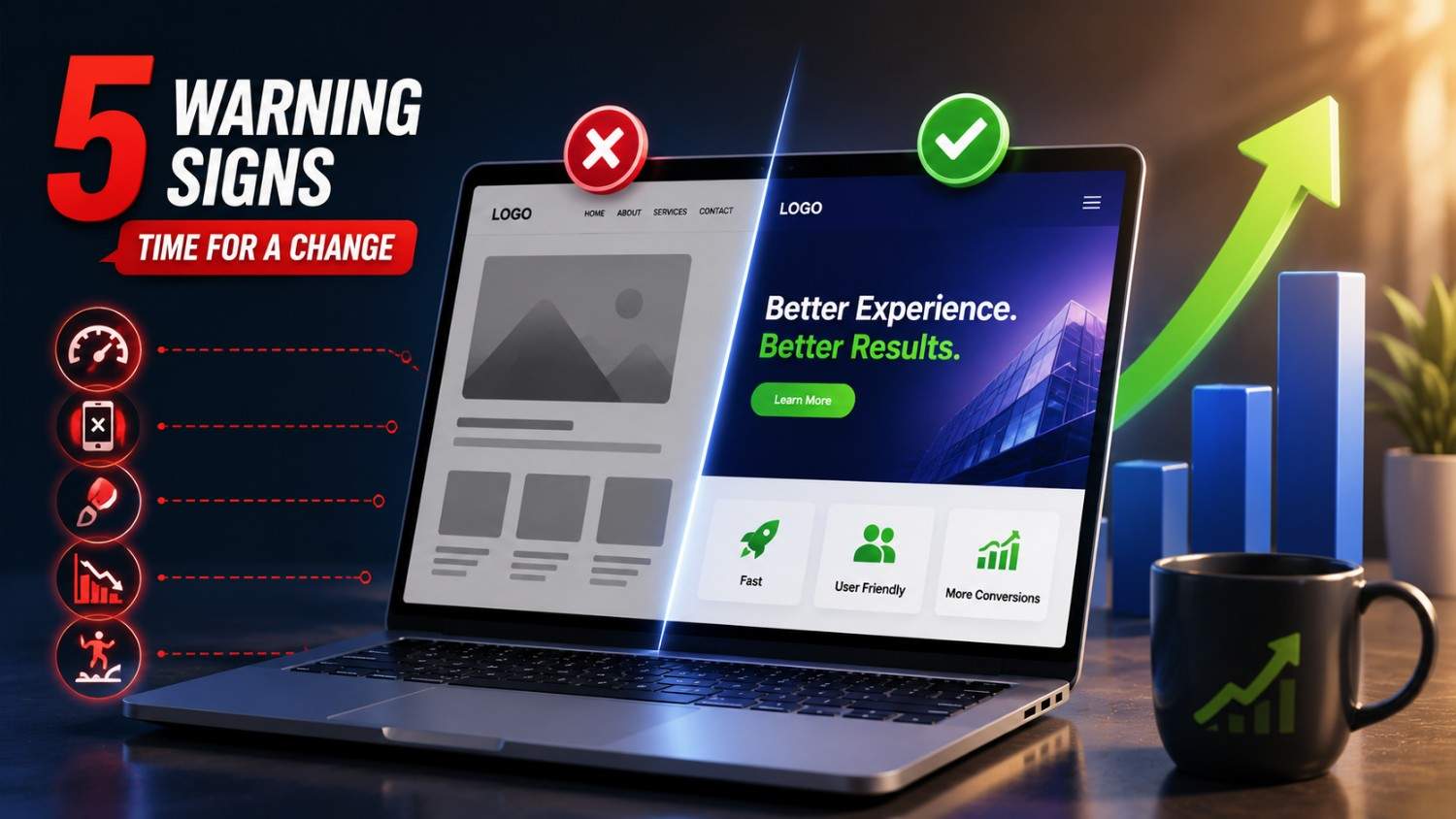
How much does it cost to build an app in USA 20206? This is the first question that hits business owners’ minds, so the cost of hiring a custom iOS app development company in the USA can vary significantly depending on the app’s complexity, features, design requirements, technology stack, development timeline, and the experience of the development team.

Estimated Cost of Custom iOS App Development

App Type Estimated Cost in the USA
Basic iOS App $25,000–$50,000
Medium-Complexity App $50,000–$120,000
Advanced/Complex App $120,000–$250,000+
Enterprise-Level App $200,000+

The cost may also increase if your app requires AI software development, advanced data processing, real-time communication, location-based services, augmented reality, complex backend infrastructure, or integrations with multiple third-party platforms.

When budgeting for custom iOS app development, businesses should also consider ongoing expenses beyond the initial development cost. These may include app maintenance, security updates, server and cloud infrastructure, bug fixes, feature enhancements, third-party services, and future iOS compatibility updates.

Instead of choosing a development company based solely on the lowest quote, businesses should evaluate the team’s technical expertise, portfolio, communication process, development methodology, security practices, post-launch support, and experience with similar projects. A reliable custom iOS app development company in the USA should provide a clear project scope and transparent pricing structure so you can understand exactly what is included in the development cost.

Talk to Our Expert Now

Factors That Affect iOS App Development Cost

The cost of mobile app development depends on much more than the number of screens. Important cost factors include:

App Complexity

A basic informational or booking application will generally require less development than a marketplace, financial platform, healthcare application, or real-time logistics system.

UI and UX Requirements

Custom animations, complex interactions, accessibility requirements, multiple user journeys, and highly personalized interfaces can increase design and development work.

Backend Development

Applications that require user accounts, cloud storage, dashboards, payment systems, messaging, or real-time updates need a secure and scalable backend.

Third-Party Integrations

Payment gateways, mapping platforms, CRM systems, enterprise software, AI services, social logins, and external databases can affect cost and testing requirements.

Security and Compliance

Applications handling health, financial, identity, location, or children’s data may require additional security controls, documentation, testing, and legal review.

Device Support

Supporting iPhone, iPad, Apple Watch, widgets, App Clips, and other Apple experiences can expand the project scope.

Post-Launch Maintenance

Businesses should plan for ongoing costs related to hosting, monitoring, bug fixes, security updates, App Store requirements, and future feature development.

A reliable development company should separate essential launch features from optional enhancements. This helps businesses control their initial investment while keeping the application ready for future growth.

Why US Businesses Are Turning to a Mobile App Development Company in India

Hiring a mobile app development company in India has become one of the smartest decisions for US businesses in 2026, and here’s why:

  • Cost Efficiency: Development costs in India are significantly lower than in the US, without a drop in quality.
  • Skilled Talent Pool: India produces a large number of experienced iOS and mobile developers every year.
  • Time Zone Advantage: Overlapping work hours often lead to faster turnaround and near-round-the-clock development cycles.
  • English Proficiency & Communication: Most Indian development teams communicate fluently in English, minimizing friction when sharing requirements.
  • Proven Track Record: Many Indian companies have delivered apps for clients in the US, the UK, and Australia across industries such as healthcare, fintech, and e-commerce.

This is exactly the value Deftsoft brings: an India-based development team with over two decades of experience, serving clients across the USA and beyond.

Why Choose Deftsoft for App Development Services?

Deftsoft has more than two decades of experience in digital development and technology services. During that time, the company has worked through major changes in web development, mobile technology, cloud systems, automation, and AI-integrated applications. Instead of treating development as a coding-only assignment, Deftsoft begins by understanding the app’s users, business goals, technical requirements, and future growth plans.

Businesses working with Deftsoft can access:

  • Experienced iOS developers
  • UI and UX design support
  • Swift and SwiftUI development
  • Backend and API development
  • Quality assurance and device testing
  • Agile project management
  • Transparent communication
  • Flexible development models
  • App Store submission assistance
  • Post-launch maintenance
  • Support for future Android or cross-platform development

As a Mobile App Development Company in India & USA, Deftsoft can provide competitive development models while supporting the communication and delivery expectations of US businesses.

The team can also help businesses decide whether a native iOS application, a cross-platform app, a web platform, or a phased MVP is the most practical solution. This helps avoid unnecessary features and ensures that the selected technology supports the actual business objective.

How the Hiring Process Works with Deftsoft

Hiring the right custom iOS app development company can make a significant difference in the success of your mobile app project. Deftsoft follows a structured and transparent process to help businesses turn their app ideas into scalable, secure, and user-friendly iOS applications.

1. Share Your App Idea and Requirements

The first step is to discuss your app idea with the Deftsoft team. You can share your business goals, target audience, desired features, preferred design, and any specific technical requirements. Whether you need a new iOS application or want to upgrade an existing app, providing detailed requirements helps the development team understand your vision.

2. Discuss Your Project Scope and Budget

After understanding your requirements, the team can discuss the project’s scope, estimated timeline, technology requirements, and budget. This stage helps define the key deliverables and ensures that everyone has a clear understanding of the project before development begins.

3. Get a Customized Development Plan

Based on your requirements, Deftsoft can create a customized development approach for your project. This may include UI/UX design, iOS app development, backend development, API integration, third-party integrations, AI software development, testing, deployment, and post-launch support.

4. Start the Development Process

Once the project scope and engagement terms are finalized, the development team begins working on the application. Depending on the project requirements, the process may follow an Agile development methodology, allowing businesses to review progress, provide feedback, and make informed decisions throughout the development lifecycle.

5. Testing and Quality Assurance

Before launch, the application goes through testing to identify and resolve functional issues, usability problems, performance concerns, and compatibility issues across supported Apple devices and iOS versions. This helps ensure that the app delivers a reliable experience to end users.

6. Launch and Ongoing Support

After successful testing and approval, the application is prepared for deployment to the Apple App Store. The development partnership does not necessarily end at launch. Businesses can continue working with Deftsoft for maintenance, performance improvements, security updates, bug fixes, new features, and future app enhancements.

If you are planning to build a custom iOS application, you can contact Deftsoft to discuss your project requirements, understand the development process and explore the right engagement model for your business.

Hire Deftsoft Now for Your Next Dream App

Conclusion

Hiring the right development partner is one of the most important decisions in the app development process. A successful application requires more than technical coding skills. It requires clear business planning, user-focused design, secure architecture, careful testing, transparent communication, and reliable long-term support.

When evaluating a Custom iOS App Development Company in USA, review the company’s live portfolio, development process, team structure, security practices, testing standards, communication approach, and maintenance services. Do not base the decision entirely on the initial project price. US businesses may also benefit from evaluating an experienced Mobile App Development Company in India, particularly when they require access to a broader technical team, flexible engagement options, and competitive development costs.

With more than two decades of technology experience, Deftsoft helps businesses plan, design, develop, test, launch, and maintain custom iOS applications built around practical business goals.

FAQs

Q1: How much does it cost to hire a custom iOS app development company in the USA?

Costs vary widely, depending on the complexity of the development process. Partnering with a mobile app development company in India, such as Deftsoft, can significantly reduce this cost while maintaining quality.

Q2: Is it safe for USA businesses to hire an app development company in India?

Yes. Many established Indian companies follow strict NDAs, secure development practices, and have years of experience delivering apps for US and international clients.

Q3: How long does it take to build a custom iOS app?

The duration of an iOS app development project depends entirely on the project’s complexity and features.

Q4: What technologies are used for iOS app development in 2026?

Swift and SwiftUI remain the primary languages/frameworks, often combined with on-device AI capabilities and cloud backend integrations.

Q5: Does Deftsoft provide support after the app is launched?

Yes. Deftsoft offers ongoing maintenance, updates, and support packages to ensure your app remains compatible with new iOS versions and continues to perform well.

Q6: Can Deftsoft help with both iOS and Android app development?

Yes. Deftsoft offers custom mobile app development for iOS and Android, along with cross-platform solutions as needed.

5 Warning Signs It’s Time to Give Your Business Website a Makeover (and What They’re Costing You)

Your website is either working for your business or working against it. There’s rarely an in-between.

For a small business, your website is often the very first interaction a potential customer has with your brand before a phone call, before an email, before they ever walk through your door. If it loads slowly, looks dated, or doesn’t clearly say what you do, visitors won’t stick around to find out if you’re actually good at it. They leave, and they land on a competitor’s site instead.

The tricky part is that most business owners don’t realize their website has become a liability until the damage already shows up somewhere else in fewer calls, fewer form submissions, or a slow, steady decline in traffic that’s hard to explain.

This guide walks through five clear warning signs that it’s time for a website redesign, what each sign is actually costing your business, and a simple way to figure out your next move, whether that’s a quick fix, a full website makeover, or bringing in a website redesign services partner to handle it for you.

Not sure where your own website stands on any of these five signs?

Find out exactly what’s working, what isn’t, and where to start

Quick Navigation

Why a Website Makeover Isn’t Optional in 2026

5 Warning Signs Your Website Needs a Makeover

1. Your Traffic Is Falling and Not Recovering

2. Visitors Leave Almost as Fast as They Land (High Bounce Rate)

3. Mobile Visitors Don’t Stick Around

4. Traffic Comes In, But It’s Not Turning Into Leads

5. Your Website No Longer Looks or Sounds Like Your Business

What These Warning Signs Are Actually Costing You

Quick Self-Audit Checklist

DIY Fixes vs. Full Redesign vs. Partnering with an Agency

How Deftsoft Approaches a Website Makeover

Closing Thoughts

Frequently Asked Questions

Why a Website Makeover Isn’t Optional in 2026

A few years ago, a website redesign was mostly about aesthetics, keeping up with design trends so your site didn’t look stuck in 2015. That’s still part of it, but in 2026 there’s a bigger shift happening underneath the surface: how people actually find your business online.

AI-powered search Google’s AI Overviews, ChatGPT, Perplexity, and similar tools is changing how answers get surfaced. Instead of a list of ten blue links, people increasingly get a single, synthesized answer pulled from a handful of trusted sources. If your website is thin on content, missing structured data, or technically outdated, it’s far less likely to be a source AI tools pull from, which means you lose visibility in both traditional search and the new AI-driven search layer.

In other words, an outdated website isn’t just an aesthetic problem anymore. It’s a visibility problem, a trust problem, and, as you’ll see below, a revenue problem.

There’s also a simpler, more human reason a website makeover matters: expectations have changed. Visitors are used to fast, clean, mobile-friendly experiences from the biggest brands they interact with every day, and they unconsciously compare every small business website against that same bar. A site that feels slow, cluttered, or hard to navigate on a phone doesn’t just underperform against competitors that do search engine optimization well; it also underperforms against the general standard people now expect from any website, in any industry.

5 Warning Signs Your Website Needs a Makeover

1. Your Traffic Is Falling and Not Recovering

A little month-to-month fluctuation in traffic is normal. What’s not normal is a steady downward trend that doesn’t bounce back.

If your organic traffic has been sliding for two or three consecutive months, a few things are usually going on: your content hasn’t been updated in a while, your technical SEO has fallen behind (slow load times, broken links, missing alt text), or, increasingly in 2026, AI Overviews are answering your customers’ questions before they ever click through to your site.

The fix: This is where structured data and schema markup matter more than most business owners realize. Adding FAQ schema, organization schema, and clean, well-organized content signals to both Google and AI search tools that your site is a credible source worth citing or ranking. Pairing that with a genuine content refresh and updated service pages, a blog that answers real customer questions helps you show up in both classic search results and AI-generated answers.

2. Visitors Leave Almost as Fast as They Land (High Bounce Rate)

If people arrive on your site and leave within seconds, that’s a strong signal that something about the first impression isn’t working. It could be a slow load time, a cluttered layout, outdated design, or a homepage that doesn’t clearly explain what you do within the first few seconds.

A high website bounce rate rarely means your product or service is unwanted; it usually means the website itself is getting in the way before visitors ever get far enough to find out what you actually offer.

The fix: Start with load speed (compress images, clean up unnecessary scripts), then look at your homepage’s first impression. Visitors should be able to tell, within five seconds, who you are, what you do, and what to do next.

3. Mobile Visitors Don’t Stick Around

For most small businesses today, the majority of website traffic comes from mobile devices rather than desktops. If your site was designed years ago without a true mobile-first approach, there’s a strong chance it’s clunky on smaller screens: tiny tap targets, text that requires zooming, forms that are painful to fill out with a thumb.
Mobile visitors who struggle to navigate your site don’t struggle for long. They simply leave and call (or click through to) whichever competitor made it easier.

The fix: A responsive, mobile-first redesign, not just a site that “still works” on mobile, but one that’s actually built around how people browse and act on their phones.

4. Traffic Comes In, But It’s Not Turning Into Leads

This is one of the most frustrating signs, because on paper things look fine; your traffic numbers might even be steady or growing. But the phone isn’t ringing, and the contact form isn’t filling up.

This usually points to a conversion problem, not a traffic problem: calls-to-action that are buried or unclear, contact forms that ask for too much information up front, missing trust signals (no reviews, no clear credentials, no real photos), or a site that simply doesn’t guide visitors toward the next step.

The fix: Every key page should have one clear, obvious next action: call now, request a quote, book a consultation. Trust signals (testimonials, certifications, real project photos) should sit near your calls to action, not buried on a separate “About” page that nobody visits.

5. Your Website No Longer Looks or Sounds Like Your Business

Businesses evolve new services, a rebrand, a shift in who you serve, but websites often don’t keep up. If your site still mentions services you no longer offer, uses outdated branding, or simply doesn’t reflect the business you’ve become, it’s actively working against the impression you’re trying to make.

This mismatch also confuses potential customers about what you actually do today, which quietly costs you leads that were never a good fit in the first place, or, worse, good-fit leads who assumed you didn’t offer what they needed.

The fix: Treat your website like a living asset that gets reviewed at least once a year, not a one-time project you finish and forget.

What These Warning Signs Are Actually Costing You

It’s easy to shrug off a slow site or a dated design as a minor annoyance. It rarely is. Here’s a simple way to think about the real cost.

Say your website currently gets 1,000 visitors a month, and a poor experience means you’re converting at 1% instead of a healthy 3%. That’s the difference between 10 leads a month and 30 a gap of 20 leads. If your average customer is worth even a modest $500, that’s $10,000 a month in business quietly walking out the door, month after month, simply because the website wasn’t doing its job.

That’s the real cost of an outdated website: not a design complaint, but a slow, steady leak in revenue that’s easy to miss because there’s no single moment where it “breaks.” It just underperforms, quietly, every single day it stays as it is.

Quick Self-Audit Checklist

Before deciding what to do next, run your own site through this quick checklist:

  • Has your organic traffic declined over the last 2-3 months without an obvious reason?
  • Do visitors leave your homepage within the first few seconds (high bounce rate)?
  • Is your site genuinely easy to use on a phone or just “technically functional”?
  • Are you getting traffic but not leads, calls, or form submissions?
  • Does your website still reflect your current services, branding, and voice?
  • Does your site load in under 3 seconds?
  • Do you have a clear, single call to action on every important page?
  • Is your content updated regularly and provides clear answers to common customer questions?

If you checked off two or more of these, it’s a reasonable signal that a website makeover not just a small tweak is worth exploring.

DIY Fixes vs. Full Redesign vs. Partnering with an Agency

Not every warning sign requires a full rebuild. Here’s a simple way to think through your options:

  • DIY fixes make sense when the issues are small and isolated: outdated copy, a broken link, a slow image that needs compressing. If your foundation is solid and you just need small updates, this can genuinely be enough.
  • A full website redesign makes sense when multiple warning signs appear at once, when your site is several years old or when the underlying platform itself is limiting you (not mobile-friendly, not easily updated or not built to support SEO or AI-search readiness).
  • Partnering with an agency for website redesign services makes the most sense when you don’t have the internal time, design, or development resources to do it right and when you want the work grounded in real strategy (SEO, conversion design, technical performance) rather than guesswork. This is usually the right call when your website is a genuine growth lever for your business, not just a digital business card.

There’s no universally “correct” answer here; it depends on how many signs you’re seeing, how outdated your current site is, and how much your business depends on the website to generate leads.

How Deftsoft Approaches a Website Makeover

At Deftsoft, a website makeover always starts with an audit, not a redesign brief. Before a single design decision is made, we look at your current traffic, user behavior, technical performance, and where you’re losing visitors, so the redesign solves the actual problems your business is facing, not just a generic style refresh.

From there, every Deftsoft website is built mobile-first, optimized for page speed, and structured with clean, AI-search-ready content and schema markup so your new site is positioned to perform in both traditional search and the growing world of AI-generated answers. The result is a website that’s not just better-looking, but measurably better at turning visitors into leads.

Because Deftsoft handles web design, development, and AI-powered digital marketing under one roof, a website makeover doesn’t stop at launch. We treat the redesign as the foundation for continued growth, tracking how the new site actually performs against the warning signs that started the conversation in the first place, and adjusting as real visitor data comes in. Whether your business needs a small business website built from scratch or a full redesign of an existing site that’s outgrown its original design, the process stays the same: audit first, design and build second, measure and refine after launch.

Closing Thoughts

An outdated website rarely fails all at once; it just quietly underperforms until the gap between what it could be doing and what it’s actually doing becomes too big to ignore. If you’re seeing even a couple of the five warning signs above, it’s worth taking a closer look now, before it costs you more customers than it already has.

Ready for a website that works as hard as you do?

Let’s talk about what a makeover could look like for your business.

Frequently Asked Questions

How much will it cost to redesign a website in 2026?

Costs vary widely depending on the size of your site, the complexity of the features you need, and whether you’re working with a freelancer or a full-service agency team. Small business website redesigns often range from a few thousand dollars for a simpler site to significantly more for larger, feature-rich websites with e-commerce or custom functionality. The best way to get an accurate number is a scoped quote based on your specific goals.

How much does it cost to have someone redo your website?

This depends on scope. A full redesign (new design, new structure, new content) typically costs more than a refresh (updated visuals and content on your existing structure). Getting a clear audit first helps you understand exactly what work is needed, so you’re not paying for more (or less) than your site actually requires.

What are the website style trends for 2026?

Current design trends lean toward clean, fast-loading layouts, bold and confident typography, minimal but purposeful animation, and content structured clearly enough for both human visitors and AI search tools to understand quickly. Function is taking priority over decoration; sites are being built to load fast, communicate clearly, and convert, with style supporting that goal rather than competing with it.

What’s the difference between a website redesign and a website refresh?

A website refresh updates the look and content of your existing site without changing its core structure think new colors, updated copy, refreshed images. A full website redesign rebuilds the site’s structure, user experience, and often its underlying platform, typically because the current foundation is limiting growth, mobile performance, or SEO potential.

What are the signs my website is hurting my business?

The clearest signs are declining traffic, high bounce rates, poor mobile experience, traffic that isn’t converting into leads, and a website that no longer reflects your current services or brand. If two or more of these sound familiar, your website is likely costing you more business than you realize.

Google I/O Connect India 2026: What Google’s AI Announcements Mean for Businesses

Artificial intelligence is moving beyond standalone chatbots and content-generation tools. Businesses are now beginning to use AI systems that can understand goals, communicate across languages, access approved tools and complete multistep tasks.

The announcements made at Google I/O Connect India 2026 show how quickly this transition is taking place.

Held on July 14, 2026, the event focused on India’s growing role in AI development. Google introduced initiatives covering education, healthcare, Indian languages, startup support, enterprise cloud infrastructure and the security foundations required for autonomous AI agents.

For businesses, these announcements are more than updates about new Google products. They provide a clearer picture of how AI applications may be designed, deployed and secured over the coming years.

Key Takeaways

  • Practical Implementation: The transition from generative chatbots to autonomous, agentic AI marks a new phase of adoption focused on solving practical, localized business challenges.
  • Multilingual Reach: Enhanced voice and text capabilities in over 25 regional languages will significantly lower digital accessibility barriers for regional applications.
  • Built-in Security: As AI agents gain workflow access, robust frameworks such as sandboxing and limited permissions must be core architectural requirements, not afterthoughts.
  • Localized Infrastructure: The availability of local data centers simplifies adherence to strict data residency and compliance guidelines for heavily regulated industries.

Quick Navigation

What Was Announced at Google I/O Connect India 2026?

Multilingual AI Could Make Digital Services More Accessible

Agentic AI Is Moving into Practical Business Workflows

Customer service

Sales and lead management

eCommerce

Finance and administration

Human resources

Software development

Security Must Be Part of AI Agent Architecture

Sec-Gemini v3

CodeMender

CAPSEM

Enterprise AI Is Becoming More Compatible with Data Residency Requirements

Healthcare AI Is Becoming More Locally Relevant

Google Is Investing in India’s AI Talent and Startup Ecosystem

What Should Businesses Do After Google I/O Connect India 2026?

1. Identify a specific business problem

2. Decide whether AI is actually required

3. Review the available data

4. Choose between an assistant and an agent

5. Create a controlled proof of concept

6. Define measurable outcomes

7. Plan for human oversight

How Deftsoft Can Support AI Adoption

Final Thoughts

Frequently Asked Questions

What Was Announced at Google I/O Connect India 2026?

Google organised its announcements around three broad priorities:

  • Expanding access to advanced AI capabilities
  • Supporting India’s startup and developer ecosystem
  • Creating stronger security foundations for agentic AI

The initiatives included AI training programmes, Gemini-powered educational tools, healthcare models, multilingual datasets, enterprise AI infrastructure, startup accelerators and a secure environment for AI agent development.

Rather than focusing only on the size or performance of its AI models, Google emphasised how AI could be applied to local challenges in education, health, language accessibility and enterprise technology.

This suggests that the next phase of AI adoption will be defined by practical implementation. Businesses will need to determine how AI fits into their existing workflows, data systems, customer experiences and security policies.

Multilingual AI Could Make Digital Services More Accessible

Language remains one of the biggest barriers to digital accessibility in India. Many online platforms continue to operate primarily in English, even when their users are more comfortable communicating in a regional language.

Google announced that Gemini Live can now communicate naturally through voice and text in more than 25 Indian languages and dialects. These include Sanskrit, Bhojpuri and Maithili.

Google also confirmed that Project Vaani, developed through a research collaboration with the Indian Institute of Science, has open-sourced speech and image datasets covering 109 Indic languages.

These developments could support a new generation of multilingual applications.

Businesses may be able to build:

  • Customer support assistants that communicate in regional languages
  • Voice-based healthcare or educational applications
  • Local-language financial service platforms
  • Multilingual eCommerce shopping assistants
  • Regional-language search tools
  • AI-powered government and public service applications
  • Mobile apps designed for users with limited English proficiency

However, multilingual AI development involves more than translating English content. Developers must consider dialects, pronunciation, local expressions, cultural context and differences in how users describe the same problem.

Businesses planning to create multilingual AI solutions should test them with real users from the regions they intend to serve. Accuracy in one language does not automatically mean that an AI system will perform equally well in another.

Agentic AI Is Moving into Practical Business Workflows

One of the strongest themes from Google I/O Connect India 2026 was the rise of agentic AI.

A traditional chatbot generally waits for a question and provides a response. An AI agent can go further. It can interpret a goal, create a plan, access authorised systems and complete a series of actions.

For example, a conventional customer support chatbot may explain a refund policy. An AI customer service agent could verify the order, confirm the customer’s eligibility, initiate the refund, update the customer relationship management system and send a confirmation message.

Potential applications of AI agents include:

Customer service

AI agents can answer common questions, retrieve order information, create support tickets, recommend solutions and escalate complex cases to human representatives.

Sales and lead management

A sales agent could qualify incoming leads, update CRM records, schedule meetings and provide sales representatives with relevant account information.

eCommerce

Shopping agents may help customers compare products, receive personalised recommendations, check availability and complete certain approved purchasing tasks.

Finance and administration

AI agents can assist with invoice processing, expense categorisation, financial summaries and routine administrative workflows.

Human resources

Internal agents may answer employee questions, manage leave requests, retrieve company policies or guide new employees through onboarding.

Software development

Development agents can support code analysis, testing, documentation and security reviews while operating within defined technical boundaries.

Deftsoft already provides AI agent development services for use cases such as virtual assistants, customer service agents, recommendation systems and enterprise workflow automation. Its approach includes use-case discovery, requirements analysis, platform integration and deployment across web, mobile and enterprise environments.

The important question for businesses is not whether they should build an AI agent because the technology is popular. The question is whether an agent can solve a specific problem more effectively than an existing process or a simpler automation system.

Security Must Be Part of AI Agent Architecture

Agentic AI introduces new security concerns because an AI system may be granted access to databases, applications, communication platforms, payment systems or internal business tools. Google stated that security can no longer be treated as a final checkpoint when software can interpret intent and act independently. Safety must influence how an agent is designed from the beginning.

At Google I/O Connect India 2026, the company introduced several security-related initiatives.

Sec-Gemini v3

Sec-Gemini v3 is a specialised cybersecurity agent designed to help security teams investigate incidents, analyse malware, conduct digital forensics and interpret complex security data.

CodeMender

CodeMender is an AI agent that can create security fixes and contribute improvements to open-source software projects.

CAPSEM

Google is open-sourcing CAPSEM, or Capabilities Security for Agents. It places an AI agent inside an isolated virtual machine and restricts the information and systems the agent can access.

Raw credentials remain outside the agent’s reach. This helps protect the wider system if the agent encounters a malicious prompt or becomes compromised. Google also highlighted standards intended to protect interactions between users, devices, payments and independent AI agents. For businesses developing AI agents, the broader lesson is clear: access should never be unlimited.

A secure AI agent should include:

  • Role-based access permissions
  • Restricted access to tools and databases
  • Protected credentials and API keys
  • Human approval for sensitive actions
  • Detailed activity logs
  • Clear escalation procedures
  • Prompt-injection protection
  • Regular security testing
  • Defined fallback behaviour
  • The ability to suspend or revoke agent access

An agent that can read a calendar does not automatically need permission to delete events. A customer service agent that can retrieve account information may not need authority to issue a high-value refund without human approval.

Permissions should match the specific job the agent is expected to perform.

Enterprise AI Is Becoming More Compatible with Data Residency Requirements

Another significant announcement involved the use of Gemini within Indian data centres.

Google stated that Indian enterprises, regulated industries and public-sector organisations can run Gemini through Google Distributed Cloud from within India. Prompts, model weights and outputs can remain within the organisation’s perimeter, while supporting services can operate without connecting to the public internet.

This could be especially relevant for organisations in:

  • Banking and financial services
  • Healthcare
  • Insurance
  • Government
  • Education
  • Legal services
  • Telecommunications
  • Large-scale enterprise operations

Many organisations want to use advanced generative AI but are concerned about how confidential data is processed, transferred and stored.

Localised and disconnected infrastructure may help address some of these concerns, but data residency alone does not make an AI application compliant or secure.

Organisations must still consider:

  • Who can access the data
  • What information is sent to the model
  • How long records are retained
  • Whether interactions are logged
  • How outputs are verified
  • Which regulations apply to the industry
  • How errors or unauthorised actions will be handled
  • Whether users understand when they are interacting with AI

A secure enterprise AI project requires coordination between development teams, legal specialists, security professionals and business stakeholders.

Healthcare AI Is Becoming More Locally Relevant

Google also announced an expanded collaboration with the All India Institute of Medical Sciences.

AIIMS researchers are using Google’s multimodal MedGemma open models to develop applications addressing India-specific healthcare challenges. Current areas include dermatology, outpatient triaging, leprosy, and sexual and reproductive health.

These models can work with both text and image inputs, and Google stated that the localised clinical models developed through the programme will be made available to the Indian developer ecosystem.

Healthcare demonstrates both the potential and limitations of AI.

AI can assist with:

  • Organising medical information
  • Identifying patterns in images
  • Supporting clinical triage
  • Improving access to health information
  • Translating or simplifying patient communication
  • Reducing repetitive administrative work

However, healthcare AI systems require careful validation, privacy protection and human supervision. An AI-generated response should not replace professional clinical judgement in high-risk situations.

Developers working in healthcare must also account for data quality, patient consent, demographic variation, bias and the possibility of incorrect outputs.

Google Is Investing in India’s AI Talent and Startup Ecosystem

AI adoption depends on more than access to models. It also requires skilled developers, researchers, product teams and founders who understand how to convert technical capabilities into useful products.

Google announced a free, 56-hour AI Research Foundations programme from Google DeepMind. The programme covers areas such as building and fine-tuning large language models and is designed to support students, researchers and AI builders.

The company is also launching ATL Saathi, a Gemini-powered desktop application for teachers delivering the Atal Tinkering Labs curriculum. It is initially being introduced in 100 schools, with the longer-term aim of reaching 10,000 schools with Atal Tinkering Labs.

For startups, Google reported that its accelerator programmes have supported 277 Indian companies over the past decade, with 94% of participating startups continuing to build and scale. The 2026 initiatives include accelerator cohorts, technical support and programmes focused on AI-first startups and generative media.

These initiatives reflect a wider shift from mobile-first product development toward AI-first business models.

However, adding an AI feature does not automatically make a product successful.

Startups and established businesses still need:

  • A clearly defined user problem
  • Reliable and legally usable data
  • A practical product roadmap
  • Suitable AI models and infrastructure
  • A simple and accessible user experience
  • Integration with existing systems
  • Security and quality testing
  • A sustainable revenue model
  • Post-launch monitoring and improvement

The strongest AI products will be those that make a task meaningfully easier, faster, safer or more accurate.

What Should Businesses Do After Google I/O Connect India 2026?

Businesses do not need to respond to every new announcement immediately. A focused approach is more likely to generate measurable results.

1. Identify a specific business problem

Start by reviewing repetitive, expensive or slow processes. Look for tasks that rely on large amounts of information, manual coordination or frequent customer interaction.

2. Decide whether AI is actually required

Some problems can be solved with standard software automation. AI should be used when the process requires language understanding, prediction, classification, personalisation or flexible decision support.

3. Review the available data

AI performance depends heavily on the quality and relevance of the data it receives. Businesses should identify where their data is stored, who owns it and whether it can legally be used for the intended purpose.

4. Choose between an assistant and an agent

An AI assistant provides recommendations or information while leaving the final action to a person.

An AI agent may be authorised to complete certain actions. Because agents involve greater access and responsibility, they require stronger security controls and monitoring.

5. Create a controlled proof of concept

A limited prototype allows a business to test accuracy, usability, cost and technical feasibility before committing to a large deployment.

6. Define measurable outcomes

Useful AI metrics may include:

  • Reduced response times
  • Lower support costs
  • Higher conversion rates
  • Fewer manual errors
  • Increased employee productivity
  • Improved customer satisfaction
  • Faster document processing
  • Better lead qualification

7. Plan for human oversight

Human review remains important when a decision affects finances, health, employment, legal rights or access to sensitive information.

How Deftsoft Can Support AI Adoption

Google I/O Connect India 2026 shows that businesses will need more than access to an AI model. They will need properly designed applications, secure integrations, reliable data systems and a clear implementation strategy.

Deftsoft provides AI development services covering machine learning, automation, data analysis, generative AI, chatbots and custom AI solutions.

Its AI consulting services also support businesses with readiness assessments, use-case prioritisation, strategy development, data infrastructure, proof-of-concept implementation and post-deployment monitoring. The company lists Google Vertex AI among the platforms used by its AI consulting teams.

The objective should not be to add AI to every business process. It should be to identify where AI can create genuine value and develop a solution that is secure, manageable and aligned with the organisation’s goals.

Final Thoughts

Google I/O Connect India 2026 reflects a broader change in the AI market.

AI is becoming more multilingual, more capable of taking action and more suitable for regulated enterprise environments. At the same time, the risks increase when an AI system receives access to sensitive data and business tools.

The businesses that benefit most from this shift will not necessarily be those that adopt AI first. They will be those that choose the right use cases, build appropriate safeguards and connect AI with real operational needs.

With experience across AI, web development, mobile applications, cloud platforms and enterprise integrations, Deftsoft helps organisations move from an initial AI concept to a practical digital solution.

Frequently Asked Questions

What is Google I/O Connect India 2026?

Google I/O Connect India 2026 was a developer-focused event held on July 14, 2026. Google announced initiatives involving AI education, healthcare, Indian languages, startups, enterprise infrastructure and AI agent security.

What is agentic AI?

Agentic AI refers to software that can understand a goal, reason through multiple steps, access approved tools and complete actions with limited human involvement.

How can businesses use multilingual AI?

Businesses can use multilingual AI for customer support, voice assistants, local-language search, education, healthcare communication, eCommerce and regional mobile applications.

What is the difference between an AI chatbot and an AI agent?

A chatbot generally responds to questions or provides information. An AI agent can be authorised to interact with other systems and complete tasks, such as updating a CRM record or scheduling an appointment.

Are AI agents secure?

AI agents can be made more secure through restricted permissions, credential protection, isolation, human approvals, activity logging and regular testing. They should not receive unrestricted access to sensitive systems.

How should a business begin an AI project?

A business should begin with a specific problem, assess its data and infrastructure, define measurable outcomes and develop a controlled proof of concept before moving to full-scale implementation.

Can Deftsoft develop custom AI agents?

Yes. Deftsoft provides custom AI agent development for customer support, virtual assistance, recommendations, workflow automation and other goal-based business applications.