What Are Social Media Silent Scroller Traits? A Guide for Brands and Marketers

Picture this: you open Instagram on your lunch break, scroll through fifteen posts, watch three Reels, check two Stories, and read the comments on a meme. Then you close the app without liking a single post, leaving a single comment, or posting anything yourself. If that sounds familiar, you might be what people now call a social media silent scroller someone who regularly consumes content without leaving any visible trace. No likes. No comments. No shares.

Silent scrolling doesn’t mean you dislike social media. Many silent scrollers spend more time on platforms than active users. They simply prefer consuming over contributing publicly. In 2026, this behaviour is far more widespread than most brands and marketers realise. This guide covers key social media silent scroller traits, why they matter, and how to adapt your social media marketing strategy to reach an audience that almost never raises its hand.

Want to turn your quietest followers into paying customers?

Learn how to build a high-converting social media marketing strategy that captures, engages, and converts passive scrollers.

Connect With Us

Quick Navigation

What Is a Social Media Silent Scroller?

10 Signs You’re a Social Media Silent Scroller

1. You Scroll for Long Periods Without Interacting

2. You Rarely Post Anything Yourself

3. You Watch Stories but Almost Never Reply

4. You Know What’s Trending Without Joining the Conversation

5. You Read Comments More Than You Write Them

6. You Save or Share Content Privately Instead of Commenting

7. You Follow People You Never Interact With

8. You Scroll When You’re Bored, Stressed, or Waiting

9. You Know a Lot About People Who Barely Know You

10. You Prefer Watching Over Being Seen

Why Silent Scrollers Matter to Brands and Marketers

How Silent Scrollers Affect Social Media Marketing Metrics

How Can Brands Engage Silent Scrollers?

How to Convert Silent Scrollers Into Customers

How Brands Can Measure Silent Audience Behaviour

Social Media Content Strategies for Silent Scrollers

Final Thoughts: Are You a Social Media Silent Scroller?

Frequently Asked Questions

What is a silent scroller on social media?

What are the common traits of a silent scroller?

Is silent scrolling the same as lurking?

Why do people scroll social media without liking or commenting?

Is being a silent scroller a bad habit?

How can you tell if someone is a silent scroller?

Do silent scrollers still count as engaged users?

How can brands or creators reach silent scrollers if they don’t interact?

What Is a Social Media Silent Scroller?

A social media silent scroller regularly uses platforms like Facebook, Instagram, TikTok, YouTube and LinkedIn as a passive consumer. They read, watch, and observe without engaging through likes, comments, shares, or original posts. The difference between an active user and a passive one comes down to visible interaction. Active users comment, share, and post publicly. Silent scrollers do none of this, at least not publicly. They might share something privately in a DM or save a post, but others can’t see their activity.

Not every social media user wants to be seen. Some want to watch, learn, or stay updated without leaving a digital footprint. Some value privacy. Others find passive consumption more relaxing than the social performance of posting. Many are introverts who follow conversations without needing to join them. Silent scrollers exist across every platform and make up a significant, often underestimated part of any audience, which is why understanding them matters for anyone delivering professional social media marketing services.

10 Signs You’re a Social Media Silent Scroller

1. You Scroll for Long Periods Without Interacting

You spend thirty or forty-five minutes on a platform and walk away having done nothing interactive. You view content, consume it, and move on without a single like, comment, or save. This is the defining trait. Viewing and engaging are not the same thing. Platforms track both, but only engagement shows up publicly. You can watch an entire video without ever clicking Like.

2. You Rarely Post Anything Yourself

Your profile looks completely dormant to anyone who visits, yet you’re online several times a day. No posts, no Stories, no reposts. Just a profile last updated months ago, quietly watching others. Some people don’t post because they value privacy. Others feel pressure to present perfectly online and find it easier to opt out. An inactive-looking profile doesn’t equal an inactive user.

3. You Watch Stories but Almost Never Reply

You see someone’s Story within minutes of posting, watch it through, and immediately move on. No reaction, no reply. You’re consistently among the first viewers, yet the person posting has no idea you’re there a reliable audience member they’ll never know they have.

You know the latest memes before your friends mention them. You’ve seen the viral video. You’re aware of the trending audio, the celebrity drama, and the challenge taking over Reels and YouTube videos this week, but you’ve formed opinions about all of it in complete silence. You absorbed it from the sidelines without ever commenting, sharing, or participating.

5. You Read Comments More Than You Write Them

The comments section is entertainment in itself. You scroll through replies, catch the funny ones, notice the arguments, and form strong opinions. But you don’t write one yourself. Comments happen to other people; you consume them as a reader, not a participant.

6. You Save or Share Content Privately Instead of Commenting

You save posts, bookmark articles, or forward content to a friend in a DM. This is still engagement, just invisible to everyone but you and the recipient. Silent scrollers aren’t disengaged; they engage privately rather than publicly. A brand’s post might get saved hundreds of times without a single public like.

This is why brands working with a good digital marketing company track saves and private shares alongside public engagement to get an accurate picture of content performance.

7. You Follow People You Never Interact With

You follow creators, brands, influencers, and old acquaintances, watching everything they post without a single like or message. They don’t know you follow them. You’ve never commented or engaged once. They’re performing to an audience they can only partially see, and silent scrollers make up a significant portion of that invisible crowd.

8. You Scroll When You’re Bored, Stressed, or Waiting

Social media becomes a default filler activity. Waiting for food? Open Instagram. Commuting? TikTok. Can’t sleep? YouTube. Silent scrollers treat social media as a background habit, something to occupy idle moments rather than an intentional choice. This is exactly why Facebook ads and short-form content need to capture attention within the first two seconds. You’re competing with an entire feed designed to do the same thing at the same time.

9. You Know a Lot About People Who Barely Know You

You know what an old university contact is doing professionally, where they holidayed, and what their renovation looks like without speaking to them in three years. Silent scrolling creates a one-sided flow of information. You feel like you know someone who has no idea you’ve been watching. It’s oddly intimate, which helps explain why catching up with old acquaintances sometimes goes suspiciously smoothly.

10. You Prefer Watching Over Being Seen

You enjoy consuming content from others but have no desire to put your own life, opinions, or work in front of an audience. Maybe it’s a personality preference; introverts often find public social media performance genuinely exhausting. Maybe it’s privacy. Maybe you simply don’t feel the need for external validation through likes and comments.
Whatever the reason, this preference for watching over being seen is a deeply embedded silent-scroller trait, and it’s far more widespread than platforms’ public engagement metrics suggest.

Why Silent Scrollers Matter to Brands and Marketers

Here’s the business-critical insight: silent scrollers are real customers. They research products by watching content, form brand opinions through passive exposure, and make purchasing decisions influenced entirely by content they consumed without ever clicking Like.

A post with 200 likes might have been seen by 8,000 people. The 7,800 who didn’t interact still saw it; some will buy, some will search your brand name, some will tell a friend. None of this shows up in your engagement rate.

For any digital marketing services team measuring only likes and comments, silent scrollers are a significant blind spot. Reach and impressions, often dismissed as vanity metrics, become more meaningful when your audience is largely silent.

How Silent Scrollers Affect Social Media Marketing Metrics

Social Media Marketing Traditional social media metrics likes, comments, shares were built around active behaviour. Silent scrollers generate impressions and reach without generating engagement, creating a frustrating gap where content reaches thousands and influences real purchase decisions, but the dashboard shows low engagement rates.

Engagement rate alone is an incomplete metric when a significant portion of your audience is silent. Brands working with an experienced SEO agency or full-service digital partner look at a broader set of signals: saves, profile visits, website traffic from social, branded search volume, and direct conversions.

How Can Brands Engage Silent Scrollers?

Silent scrollers won’t respond to “comment below” or “tag a friend.” What works:

Create content worth saving. Tips, checklists, and tutorials get saved privately even without comments. Saves signal resonance more honestly than likes.

Use short-form video. Instagram Reels and YouTube videos are designed for passive consumption. A silent scroller watches a Reel to the end without interacting, but if the product is relevant, it still makes an impression.

Tell stories, not just facts. Silent scrollers follow brands like they follow people; they want something genuine. Brand storytelling and behind-the-scenes content get consumed even when they don’t get liked.

Design for DM sharing. If content can be forwarded in two taps, silent scrollers will share it privately without ever touching the public share button.

How to Convert Silent Scrollers Into Customers

Silent scrollers don’t follow a typical conversion path. They don’t comment asking for a link. They accumulate repeated brand impressions over days or weeks, form a quiet opinion, then act through a direct website visit, a branded search, or a purchase triggered by familiarity rather than a single click.

To support this:

  • Retarget through paid ads. Video viewers who never clicked anything are still a warm audience. Facebook marketing retargeting reaches people who watched 50%+ of a video without engaging, often the highest-value paid audience available.
  • Stay consistent. Silent scrollers respond to familiarity. Regular posting and a recognisable brand identity build the accumulated recognition that eventually drives action.
  • Remove friction from the purchase path. Bio links, Story links, and clear profile information matter more for silent scrollers than for active users who will ask in comments.

For businesses using affordable SEO alongside social strategy, branded search volume often grows as social reach increases even when engagement looks flat. Silent scrollers search for brands they’ve seen, creating an indirect SEO benefit that’s easy to miss without the right tracking.

How Brands Can Measure Silent Audience Behaviour

You can’t count silent scrollers directly, but their footprints show up in the right data:

  • Reach vs engagement ratio — a widening gap signals a growing silent audience
  • Video completion rates — high completion with low likes = passive consumption
  • Saves and bookmarks — frequently underused as a performance signal
  • Profile visits — users checking your profile without following are often silent scrollers
  • Website sessions from social — traffic arriving without a corresponding public engagement event
  • Branded search volume — via Google Search Console; often rises alongside social reach growth
  • Direct traffic — users who type your URL after seeing you on social without clicking any link

This data matters especially when evaluating the cost of hiring an SEO company alongside social spend. The two channels interact in ways that only become visible when you look beyond surface-level engagement metrics.

Social Media Content Strategies for Silent Scrollers

If a meaningful part of your audience is silent, your strategy needs to reflect it:

  • Prioritise value over virality. Content that genuinely helps or entertains gets saved by silent scrollers even without going viral. Quality and relevance outperform trend-chasing for this audience.
  • Be consistent, not sporadic. Silent scrollers won’t comment asking where you’ve been. They’ll just scroll past. Consistent posting keeps your brand visible to people who will never tell you they’re watching.
  • Use carousels and educational posts. Multi-image carousels get swiped passively and saved regularly — even without a single like. They’re one of the best formats for silent audiences.
  • Invest in short-form video. Instagram Reels and YouTube videos are the most-consumed, least-interacted-with formats online. Perfect for passive audiences.
  • Drop comment-only CTAs. “Drop a if you agree” is invisible to silent scrollers. Drive frictionless actions instead — a bio link visit, a save, a swipe-up.

Brands working with a digital marketing company that understands both social behaviour and search intent are better placed to build content that converts both active and passive audiences.

Final Thoughts: Are You a Social Media Silent Scroller?

Let’s recap quickly. You might be a social media silent scroller if:

  1. You scroll for long periods without liking or commenting
  2. Your profile looks inactive despite frequent use
  3. You watch Stories but almost never reply
  4. You know what’s trending without joining the conversation
  5. You read comments more than you write them
  6. You save or privately share content instead of engaging publicly
  7. You follow people you’ve never once interacted with
  8. You scroll out of habit when bored, stressed, or waiting
  9. You know a lot about people who barely know you exist online
  10. You prefer watching over being seen

If several of these resonate, you’re part of a very large, very quiet majority.

Silent scrolling is common and isn’t automatically a problem. It’s simply a different way of engaging with digital content, one that reflects how many people actually use social media, as opposed to how platforms want us to use it. But for brands and marketers, understanding this behaviour is essential. The audience watching your content without clapping is often larger than the one that does. Creating content, running campaigns, and measuring performance without accounting for silent scrollers means making decisions on incomplete data. For brands like Deftsoft, understanding these silent interactions can help create more effective content and marketing strategies.

The best social media strategies in 2026 are built for both audiences—the vocal minority who engage publicly and the quiet majority who consume, remember, and eventually act.

How many of these silent scroller traits sound like you?

Ready to stop missing out on silent scrollers?

Partner with our team to upgrade your social media marketing strategy and start converting your invisible audience today.

Frequently Asked Questions

What is a silent scroller on social media?

A social media user who consumes content posts, videos, Stories, Reels without publicly engaging through likes, comments, or shares. Active in time spent, but invisible in standard engagement metrics.

What are the common traits of a silent scroller?

Scrolling without interacting, rarely posting, watching Stories without replying, saving instead of commenting, following accounts without engaging, and preferring to observe rather than participate in public conversations.

Is silent scrolling the same as lurking?

Yes, largely. Lurking is the older forum equivalent: reading without contributing. Silent scrolling is the social media version: consuming content across platforms without leaving public engagement.

Why do people scroll social media without liking or commenting?

Privacy preferences, introversion, social performance pressure, or simple habit. Many people find passive consumption more relaxing than managing the social expectations that come with posting or commenting publicly.

Is being a silent scroller a bad habit?

Not inherently. It becomes a concern only when it displaces sleep or focus. Many people genuinely prefer social media as a consumption tool rather than a performance platform, and that’s a valid choice.

How can you tell if someone is a silent scroller?

Their profile appears inactive despite frequent platform use. They rarely appear in comment sections or likes, but may consistently view Stories and watch videos. Reach and completion rate data reveal them even when engagement data doesn’t.

Do silent scrollers still count as engaged users?

Platforms count them in reach and impression data. Algorithms register video completion rates. They don’t contribute to public engagement metrics, but they often convert through direct website visits or branded search after repeated passive exposure.

How can brands or creators reach silent scrollers if they don’t interact?

Through consistent content worth watching, video retargeting ads, short-form Reels and Shorts, educational carousel posts that get saved, and building brand recognition strong enough that silent scrollers search for you when they’re ready to act.
What Is a Content Roadmap? A Complete Guide to Better Content

Most businesses regularly post on their website or social channels, but very few publish content that actually moves the needle. The difference almost always comes down to strategic planning. If your blog posts feel disconnected, your traffic has hit a plateau, or your team is constantly wondering what to write next, you are likely missing a clear content roadmap or the one you simply aren’t delivering.

This guide breaks down exactly what a content roadmap is, why your brand needs one, and how to build a strategy that drives measurable traffic. From in-depth keyword research and topic pillars to content calendars, performance tracking, and expert SEO services, you will learn how to build a roadmap that keeps your strategy on target and produces real growth.

Ready to scale your content strategy with a customized roadmap?

Align your content with real business growth.

Quick Navigation

What Is a Content Roadmap?

Why Is a Content Roadmap Important?

Keeps Content Aligned With Business Goals

Helps You Create More Consistent Content

Makes Content Planning Easier

Prevents Random or Repetitive Topics

Improves Team Collaboration

Helps Measure Content Performance

Future-Proofs Your Brand for AI Search

Content Roadmap vs. Content Calendar: What’s the Difference?

What Should a Content Roadmap Include?

Content Goals

Target Audience

Buyer Personas

Content Topics and Pillars

Target Keywords

Content Formats

Publishing Channels

Content Timeline

Content Owners and Responsibilities

KPIs and Performance Metrics

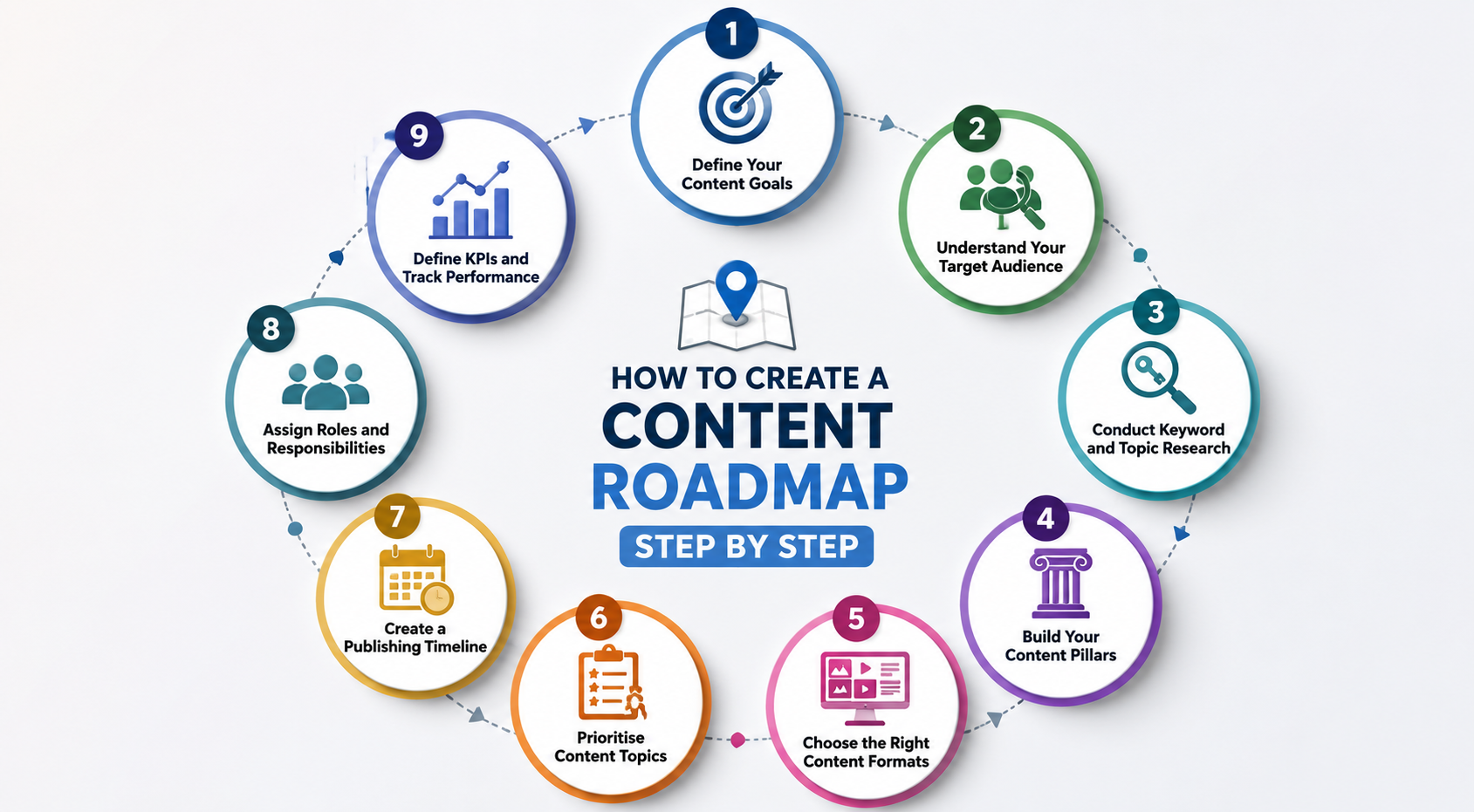
How to Create a Content Roadmap Step by Step

1. Define Your Content Goals

2. Understand Your Target Audience

3. Conduct Keyword and Topic Research

4. Build Your Content Pillars

5. Choose the Right Content Formats

6. Prioritise Content Topics

7. Create a Publishing Timeline

8. Assign Roles and Responsibilities

9. Define KPIs and Track Performance

Content Roadmap Example

How to Organise Your Content Roadmap

Common Content Roadmap Mistakes to Avoid

How to Keep Your Content Roadmap Updated

Content Roadmap Tools You Can Use

Why Choose Deftsoft for Content Marketing?

Conclusion

Frequently Asked Questions

What Is a Content Roadmap?

A content roadmap is a strategic plan that maps out what content you’ll create, why you’re creating it, who it’s for, and when you’ll publish it. It connects your content goals, audience needs, topics, channels, and timelines into a single, coherent framework. Think of it as the strategy layer above your day-to-day publishing schedule.

It’s different from a basic content calendar, which tells your team when to publish. A content roadmap tells your team what to create and why it matters long before a single word gets written. It connects your content goals, audience needs, topics, channels, and timelines into a single framework. In today’s landscape, a complete roadmap also accounts for AI SEO ensuring your content isn’t just optimized for traditional Google searches, but structured for ranking on ChatGPT and other conversational engines.

Simple example: A SaaS company targeting HR managers might build a content roadmap with three pillars: employee onboarding, HR compliance, and team productivity. Each pillar gets target keywords, formats (blog posts, guides, case studies), assigned writers, and a quarterly publishing plan. That’s a content roadmap in action.

A content roadmap answers:

  • What are we trying to achieve with content?
  • Who are we writing for?
  • Which topics and keywords will we cover?
  • What formats and channels will we use?
  • What does the timeline look like?
  • How will we know if it’s working?

Why Is a Content Roadmap Important?

Publishing content without a roadmap is like building a house without blueprints. You might get something standing, but it won’t be efficient, structurally sound, or built to last.

Here’s what a well-built content roadmap actually does for your business.

Keeps Content Aligned With Business Goals

Every piece of content should serve a purpose driving traffic, generating leads, building brand authority, or retaining customers. A content roadmap forces you to start with business objectives and work backwards to content decisions. Without this alignment, teams end up publishing content that gets clicks but converts nobody.

Helps You Create More Consistent Content

Consistency is one of the hardest parts of content marketing. Without a plan, publishing frequency drops during busy periods and spikes randomly when someone has a sudden idea. A roadmap gives you a predictable publishing rhythm, which also sends positive signals to search engines.

Makes Content Planning Easier

Instead of reinventing the wheel every week, your team works from a pre-approved plan. Topic ideas, keyword targets, formats, and owners are already decided. This removes the friction that kills most content programs, the blank-page problem at the planning stage.

Prevents Random or Repetitive Topics

Without a roadmap, teams often write about the same topics twice, skip important areas entirely, or chase trending topics that have nothing to do with the business. A roadmap maps your coverage intentionally, so every piece adds something new and relevant.

Improves Team Collaboration

A content roadmap gives writers, SEO specialists, designers, editors, and developers a shared view of what’s happening and when. Everyone knows their role, their deadlines, and how their work fits into the bigger picture. This is especially important for content writing services teams managing multiple projects at once.

Helps Measure Content Performance

You can’t improve what you don’t measure. A content roadmap defines KPIs upfront organic traffic, rankings, leads, conversions so performance tracking becomes part of the process rather than an afterthought. This is what separates professional SEO content writing services from random publishing.

Search behavior is shifting toward zero-click and generative answers. A structured content roadmap ensures your content is formatted specifically for ranking on Google AI Overview and AI discovery tools, helping your brand stay visible as generative search evolves.

Content Roadmap vs. Content Calendar: What’s the Difference?

These two terms get used interchangeably, but they serve different functions. You need both.

Comparison Content Roadmap Content Calendar
Purpose Strategic Execution-focused
Answers What and why When and who
Scope Broad goals and priorities Publishing schedule
Timeframe Months or quarters Days, weeks, upcoming posts
Audience Leadership, marketing leads Writers, editors, designers
Contains Pillars, goals, KPIs, personas Titles, dates, formats, statuses

The roadmap sets direction. The calendar executes it. A team with a calendar but no roadmap is running fast without knowing where it’s going. A team that has a roadmap but no calendar has a strategy that never ships.

Use them together. Build the roadmap first, then populate your calendar from it.

What Should a Content Roadmap Include?

A strong content roadmap covers ten core components. Skip any of them, and you’ll end up with gaps in your strategy.

Content Goals

Define what you want content to achieve: more organic traffic, more leads, better brand visibility, higher conversions, or improved customer retention. Goals should be specific and measurable, not vague intentions like “create more content.”

Target Audience

Describe who you’re creating content for. Include demographics, job roles, industries, and the platforms they use. This shapes everything from the topics you choose to the tone you write in.

Buyer Personas

Go deeper than your general audience. Create 2–4 detailed buyer personas with names, challenges, goals, and where they are in the buying journey. Your content should speak to specific people, not abstract groups.

Content Topics and Pillars

Identify 3–6 core topic areas (pillars) that you’ll own. Each pillar becomes a hub of related content. For example, an SEO agency might build pillars around technical SEO, content strategy, link building, and local SEO.

Target Keywords

Every topic should map to keywords your audience is actually searching. Include primary keywords, long-tail variations, and related terms. This is where a proper SEO content strategy starts matching your content plan to search demand.

Content Formats

Not every topic needs a blog post. Decide whether each piece will be a long-form guide, case study, video, infographic, social content, or landing page. Format decisions affect resources, timelines, and performance.

Publishing Channels

Where will the content live? Your blog, LinkedIn, YouTube, email newsletter, or partner publications? Different channels serve different audiences and stages of the buyer journey.

Content Timeline

Map content to a monthly or quarterly calendar. Include publication dates, review milestones, and seasonal priorities. This turns your roadmap from a wish list into a real plan.

Content Owners and Responsibilities

Every piece of content needs an owner. Assign a writer, SEO specialist, editor, and designer for each item. Without clear ownership, content gets stuck in limbo.

KPIs and Performance Metrics

Define how you’ll measure success before you start. Common content KPIs include organic traffic, keyword rankings, impressions, click-through rate, time on page, leads generated, and conversions. Build a content analytics framework into the roadmap from day one.

How to Create a Content Roadmap Step by Step

This is where strategy becomes action. Follow these nine steps to build a content roadmap that actually works.
1. Define Your Content Goals

Start with the end in mind. What do you want content to do for your business over the next three to six months?

Common content goals include:

  • Traffic — grow organic search visitors by X%
  • Leads — generate X qualified leads per month from content
  • Brand awareness — rank for X new branded or industry keywords
  • Conversions — increase content-driven trial signups or purchases
  • Customer retention — reduce churn through helpful post-purchase content

Be specific. “Create better content” is not a goal. “Grow organic traffic by 40% in Q3 by targeting 25 new keywords” is.

2. Understand Your Target Audience

Before you pick a single topic, get clear on who you’re writing for. A good SEO content writer doesn’t just match keywords; they match search intent and reader psychology.

Research your audience’s:

  • Search intent — are they looking to learn, compare, or buy?
  • Pain points — what problems are they trying to solve?
  • Questions — what do they ask Google, their peers, or sales reps?
  • Buying journey — are they discovering the problem, evaluating solutions, or ready to purchase?

Use tools like Google Search Console, AnswerThePublic, Reddit, and customer interviews to build a real picture of your audience.

3. Conduct Keyword and Topic Research

Keyword research is the backbone of any SEO content strategy. You need to know what your audience is searching for before you can create content that ranks.

Research should cover:

  • Primary keywords — high-intent terms directly related to your product or service
  • Long-tail keywords — more specific phrases with lower volume but higher conversion potential
  • Related searches — semantically connected terms that signal topical depth to Google
  • Competitor content gaps — topics your competitors rank for that you don’t

A thorough SEO content audit of your existing content is also essential at this stage. Identify what’s working, what’s underperforming, and where the gaps are. This prevents you from recreating content you already have.

4. Build Your Content Pillars

Content pillars are the 3–6 core topic areas that define your content territory. Every other piece of content connects back to a pillar.

To build pillars:

  1. List the broad topics most relevant to your business and audience
  2. Check that each pillar has sufficient keyword volume and commercial relevance
  3. Create a cluster of 5–10 supporting topics around each pillar
  4. Map pillar pages (comprehensive guides) and cluster pages (more specific articles) for each

Strong pillars create topical authority Google recognises your site as an expert in that space, which improves rankings across the entire cluster.

5. Choose the Right Content Formats

Different topics, audiences, and funnel stages call for different formats. Don’t default to blog posts for everything.

Format Best For
Long-form blog posts SEO traffic, top-of-funnel awareness
Comprehensive guides Topical authority, complex topics
Case studies Mid-to-bottom funnel, proof of results
Videos Explainers, product demos, social engagement
Infographics Data visualisation, shareable social content
Landing pages Bottom-of-funnel conversions
Social content Distribution, brand awareness, community building

If budget is a constraint, prioritise formats with the highest ROI for your specific goals. For most B2B businesses, long-form SEO blog posts and guides deliver the strongest long-term return, which is why professional content creation services focus heavily on these formats.

6. Prioritise Content Topics

You can’t write everything at once. Use a prioritisation framework to decide what gets built first.

Score each topic on:

  • Search demand — how many people are searching for this?
  • Business value — does ranking for this drive leads or revenue?
  • Competition — how hard is it to rank for this keyword?
  • Search intent — does the intent match what we’re offering?
  • Content gaps — do we already cover this?

High priority = high demand + high business value + achievable competition + clear intent match + no existing content.

7. Create a Publishing Timeline

Map your prioritised topics onto a timeline. Be realistic about your team’s capacity.

Consider:

  • Monthly planning — what gets published each month?
  • Quarterly planning — which pillars get covered in Q1 vs Q2?
  • Content frequency — how many pieces per week or month?
  • Seasonal opportunities — are there events, product launches, or industry moments to plan around?

Build in buffer time for editing, design, SEO review, and approvals. A roadmap that assumes everything will be published on the first draft will always run late.

8. Assign Roles and Responsibilities

Every piece of content should have a named owner for each stage. A typical content team includes:

  • Writer — researches and drafts the content
  • SEO specialist — handles keyword mapping, on-page optimisation, and internal linking
  • Designer — creates supporting visuals, infographics, or featured images
  • Editor — reviews for accuracy, clarity, tone, and brand consistency
  • Developer — handles technical publishing, schema markup, and page performance

For businesses using external SEO content writing services, make sure these roles are still clearly mapped even when some are outsourced.

9. Define KPIs and Track Performance

Set measurement criteria for every piece of content before it goes live. Using a content analytics platform, track:

  • Organic traffic — sessions from search engines
  • Keyword rankings — position tracking for target keywords
  • Impressions and clicks — from Google Search Console
  • Click-through rate (CTR) — are your titles and meta descriptions compelling?
  • Leads and conversions — is content driving actual business outcomes?
  • Engagement metrics — time on page, scroll depth, bounce rate

Review performance monthly and use the data to update your roadmap. Refresh underperforming content; don’t abandon it.

Content Roadmap Example

Here’s a practical content roadmap example for a hypothetical SaaS company that provides HR software.

  • Business goal: Increase organic traffic by 35% and generate 50 qualified leads per month from content.
  • Audience: HR managers and People Ops leads at companies with 50–500 employees.
  • Content pillars: Employee Onboarding · HR Compliance · Team Productivity · HR Tech & Tools
Content Pillar Topic Format Primary Keyword Funnel Stage Priority
Employee Onboarding Complete guide to employee onboarding Long-form guide employee onboarding guide Top High
Employee Onboarding Onboarding checklist for new hires Blog post onboarding checklist Top High
Employee Onboarding How to onboard remote employees Blog post remote employee onboarding Top Medium
HR Compliance HR compliance checklist for small businesses Guide HR compliance checklist Top High
HR Compliance What is POSH compliance? Blog post POSH compliance Top Medium
HR Compliance How to stay compliant during employee termination Blog post employee termination compliance Mid Medium
Team Productivity Best tools for HR team productivity Comparison post HR productivity tools Mid High
Team Productivity How to measure employee engagement Blog post measure employee engagement Top Medium
HR Tech & Tools Best HR software for small business Comparison post best HR software small business Bottom High
HR Tech & Tools [Brand] vs [Competitor]: HR software comparison Comparison [brand] vs [competitor] Bottom High
HR Tech & Tools How to choose HR software for your company Guide How to choose HR software Mid Medium

This roadmap gives the team a clear picture of what gets written, why it matters, who it’s for, and how to measure success.

How to Organise Your Content Roadmap

The best content roadmap is one your team will actually use. Organisation matters as much as content.

  • By quarter: Divide your roadmap into Q1, Q2, Q3, Q4 with clear deliverables and goals for each period. This makes planning meetings more focused and gives leadership visibility into the plan.
  • By pillar: Group all content under its relevant pillar. This makes it easy to see if certain pillars are over-resourced and others are neglected.
  • By funnel stage: Label each piece as top-of-funnel (awareness), mid-funnel (consideration), or bottom-of-funnel (decision). A healthy roadmap covers all three stages.
  • By status: Track every piece as Planned, In Progress, In Review, Published, or Live. This gives the whole team real-time visibility without requiring status-update meetings.

Whatever format you choose, your roadmap should be accessible to everyone who touches content writers, SEO specialists, designers, and stakeholders.

Common Content Roadmap Mistakes to Avoid

Even experienced teams fall into these traps. Avoiding them early saves significant time and budget.

  • Creating content without clear goals. If you can’t explain why you’re writing a piece and what it’s supposed to achieve, you probably shouldn’t be writing it yet.
  • Focusing only on high-volume keywords. High-volume keywords are usually high-competition. Long-tail keywords with clearer intent often drive better-qualified traffic with less effort.
  • Ignoring search intent. Writing an informational blog post for a keyword where users want to buy something is a wasted effort. Always match format and angle to search intent.
  • Publishing without a consistent schedule. Sporadic publishing confuses audiences and doesn’t build the editorial momentum that SEO requires.
  • Creating too many topics at once. Spreading your team too thin produces average content across many topics rather than excellent content on the right ones. Depth beats breadth.
  • Not updating existing content. Publishing new content while ignoring underperforming old content is inefficient. Refreshing and improving existing posts often drives faster ranking improvements than publishing new ones.
  • Failing to track results. Content without measurement is guesswork. If you’re not tracking organic traffic, rankings, and conversions, you have no basis for decisions.
  • Treating the roadmap as a fixed document. A content roadmap should evolve. Markets shift, algorithms update, business priorities change. A roadmap that can’t adapt will quickly become irrelevant.

How to Keep Your Content Roadmap Updated

A content roadmap isn’t something you build once and forget. The most effective teams revisit it regularly.

  • Review performance monthly. Pull data from Google Search Console, your analytics platform, and your CRM. Which pieces are driving traffic and leads? Which are underperforming?
  • Identify content gaps. Run a fresh keyword gap analysis quarterly. New search trends emerge, competitors publish new content, and your business evolves. Your roadmap should reflect these changes.
  • Update underperforming content. Before adding new topics, look at what’s already live. A well-executed SEO content audit often reveals content you can refresh, expand, or consolidate to drive significantly better results.
  • Add new keyword opportunities. Set up rank tracking and keyword monitoring alerts so that new opportunities surface automatically and can be added to your roadmap pipeline.
  • Adjust priorities based on business goals. If the business is entering a new market or launching a new product, shift your content roadmap accordingly. Content that supported last quarter’s goals may not support this quarter’s.
  • Monitor competitors and search trends. Use tools like Semrush or Ahrefs to track competitor content regularly. If a competitor publishes a comprehensive piece on a topic in your roadmap, you need to produce something better.

Content Roadmap Tools You Can Use

You don’t need expensive software to build a content roadmap. You need a tool your team will actually use consistently.

  • Spreadsheets (Google Sheets or Excel) — The most accessible option for small teams. Flexible, easy to share, and good enough for most roadmaps. Build columns for pillar, topic, keyword, format, owner, status, and publish date.
  • Project management tools (Notion, Asana, Trello, ClickUp) — Better for teams that need task assignment, deadline tracking, and status views. Notion is especially popular for content teams because it combines database views with document editing.
  • Dedicated content planning platforms (CoSchedule, DivvyHQ, Percolate) — Purpose-built for content teams. Include editorial calendar views, workflow approvals, and publishing integrations. Better for larger teams managing high content volumes.
  • SEO research tools (Ahrefs, Semrush, Moz) — Essential for the keyword and topic research phase of your roadmap. Use these to identify search demand, keyword difficulty, competitor gaps, and content opportunities.
  • Analytics tools (Google Search Console, GA4, Looker Studio) — Critical for the measurement side of your roadmap. Connect your content performance data back to the roadmap to inform ongoing prioritisation.
  • AI writing and research tools (ChatGPT, Jasper, Surfer SEO) — Useful for ideation, outline generation, and content briefs. Not a replacement for expert SEO content writing services, but a useful accelerator when used correctly.

Why Choose Deftsoft for Content Marketing?

Building and executing a content roadmap takes expertise, time, and a team that understands both SEO and business strategy. Most companies have one or two of those things, rarely all three.

Deftsoft’s content marketing team brings all three together.

We offer end-to-end SEO content writing services, from strategy and keyword research to writing, optimisation, and performance tracking. Our SEO content writers are trained to write for both readers and search engines, producing content that ranks and converts.

Here’s what working with Deftsoft looks like:

  • SEO content strategy built around your business goals, not generic best practices
  • Full SEO content audit of your existing content to identify quick wins and structural gaps
  • Keyword research and content pillar mapping using real search data
  • Professional content creation services across blog posts, guides, landing pages, and more
  • Content analytics reporting so you can see exactly what your content is delivering
  • Ongoing roadmap management so your content strategy evolves with your business
  • AI SEO & Generative Engine Optimization (GEO) strategies designed for ranking on ChatGPT and Google’s generative search.
  • Content structured with clear schema, direct summaries, and semantic data to secure citations and ranking on Google AI Overview.

Whether you’re starting from scratch or looking to scale an existing content programme, Deftsoft has the team, tools, and track record to get results.

Conclusion

A content roadmap is the difference between a content programme that grows and one that stagnates. Without one, you’re publishing in the dark, hoping something sticks. With one, every piece of content has a purpose, a target audience, a keyword strategy, and a way to measure whether it worked. The steps are straightforward: start with your business goals, understand your audience, research keywords, build pillars, choose formats, prioritise topics, set a timeline, assign owners, and track results. Good execution separates businesses that treat content as a cost from those that treat it as an asset.

Don’t let your content strategy fall flat.

Build a high-performing content roadmap that drives measurable results.

Frequently Asked Questions

What is a content audit?

A content audit is a systematic review of all the content a website has published. It evaluates each piece for SEO performance, accuracy, relevance, and alignment with current business goals. A good SEO content audit identifies what to update, consolidate or redirect and delete. It’s a critical first step before building or refreshing any content roadmap.

How do I add a table of contents in Word?

To add a table of contents in Word, place your cursor where you want it to appear. Go to References → Table of Contents → choose a built-in style. Word automatically generates a clickable TOC from your heading styles (Heading 1, Heading 2, etc.). To update it, click anywhere in the TOC and select the Update Table. For this to work correctly, all headings in your document must use Word’s built-in heading styles, not manually formatted text.

What is the difference between a content roadmap and a content calendar?

A content roadmap is strategic; it defines what you’ll create and why, covering goals, pillars, audience, and KPIs over months or quarters. A content calendar is operational; it schedules exactly when content will be published and tracks its production status. The two work together: the roadmap sets direction, the calendar executes it.

How do you create a content roadmap?

To create a content roadmap: define your content goals, research your audience and their search intent, conduct keyword and topic research, build content pillars, choose content formats, prioritise your topic list, create a publishing timeline, assign owners and responsibilities, and set KPIs for measuring performance. Review and update the roadmap regularly based on performance data.

What should a content roadmap include?

A complete content roadmap should include content goals, target audience and buyer personas, content pillars and topic clusters, target keywords, content formats, publishing channels, a content timeline, assigned roles and responsibilities, and KPIs for tracking performance.

How far in advance should you plan a content roadmap?

Most content teams plan their roadmap one quarter in advance, covering roughly 3 months of content in detail. You can plan high-level goals and pillar topics 6–12 months out. Planning too far in advance in detail often wastes effort, as priorities shift. Planning too close to publication creates chaos. A quarterly rolling plan with an annual strategic overview is the most practical approach.

Why is a content roadmap important for SEO?

A content roadmap ensures your SEO content strategy is coherent, intentional, and built around search demand. Without one, teams publish random content that doesn’t build topical authority, miss important keywords, and fail to compound over time. A roadmap ensures you systematically cover key topics, target the right keywords, and create content that builds domain authority all critical factors in long-term SEO performance.

What tools can you use to create a content roadmap?

Useful tools include Google Sheets or Notion for the roadmap itself, Ahrefs or Semrush for keyword and competitor research, Google Search Console and GA4 for performance tracking, Asana or ClickUp for workflow and task management, and CoSchedule or DivvyHQ for dedicated content calendar management. The right tool depends on your team size, budget, and how much of the process you need to automate.

What Is SEO by Highsoftware99.com? Is This a Legit SEO Company or Not?

You’ve probably typed “SEO by highsoftware99.com” into Google because something about it made you curious, maybe a claim that sounded a little too fast, or a price that seemed too low for what SEO usually costs. That instinct to pause and check first is exactly the right one, and this article is here to help you actually do that, rather than just add to the noise.

Below, we’ve broken down what this term actually represents, what the claims around it look like when you hold them up against how search engines really work, and what a business should look for instead if it wants results that actually last. We’ll also touch on why AI SEO, AEO, and GEO matter more than ever in 2026, and use Deftsoft – Affordable SEO Service Provider as an example of what a genuinely accountable SEO partner looks like.

Thinking about your SEO options and want a second opinion?

Find out exactly where your site stands today.

SEO by HighSoftware99.com: What Is It Really?

Unlike a typical search for an SEO agency, searching for SEO by HighSoftware99.com leads to something quite different from the conventional agency model. Rather than simply presenting a standard service page, team, and client portfolio, the concept focuses on gaining search visibility quickly. For businesses looking for a broader growth strategy, this also raises questions about how traditional services such as SEO services, digital marketing services, content marketing, social media marketing, PPC services, web development, and AI development services work together to build sustainable online visibility and generate long-term business results.

A few observations stand out once you start digging past the surface-level claims:

  • The pitch centers almost entirely on speed. There’s little to no discussion of the fundamentals: content marketing strategy, site structure and backlink credibility that actually determine whether a page deserves to rank.
  • Several write-ups covering it note that once you stop paying or stop actively pushing the tactic, the visibility it created tends to fade quickly. That’s a strong signal the “ranking” was never built on anything durable to begin with.
  • There’s no publicly available pricing, no named team, and nothing resembling the kind of documented history a business would normally expect before handing over its website’s visibility to a third party.

One more thing worth mentioning directly: a surprising number of near-identical “review” articles about this exact phrase, AEO insights company, have popped up across small, unrelated websites within a short stretch of time. That’s not typically how genuine word-of-mouth coverage spreads. It’s much more consistent with a coordinated content push designed to make a term look more talked-about and credible than it actually is, worth keeping in mind as you weigh how much of what you’re reading about it is truly independent.

None of this means someone behind this term is acting in bad faith. But it does mean the basic things you’d want confirmed before trusting anyone with your site’s SEO a real company, a track record, independent feedback just aren’t there to check. Instead of relying on quick fixes, working with an established agency for Search Engine Optimization services ensures your visibility is built on a durable, white-hat foundation.

Is SEO by HighSoftware99.com Legit? Here’s What We Could Verify

This is where it’s important to separate what can be verified from what is simply claimed online.

There are various articles and websites discussing the phrase “SEO by HighSoftware99.com.” However, the presence of articles discussing a service does not automatically establish the credibility, effectiveness, or long-term sustainability of that service.

Similarly, the absence of extensive independent information doesn’t automatically prove that a company is illegitimate.

For a business considering an SEO provider, the better approach is to ask:

  • Can the company be independently verified?
  • Is there a documented team?
  • Are there independently verifiable client experiences?
  • Is the SEO methodology clearly explained?
  • Does the strategy comply with search-engine guidelines?
  • Are the expected results realistic?
  • What happens when the campaign ends?

Those questions are more useful than simply asking whether something is “legit” or “not legit.”

A Short Checklist Before Trusting Any SEO Provider With Your Site

This isn’t only useful for evaluating highsoftware99.com; run it against any SEO offer that crosses your desk.

  • Ask how the result is actually produced. “We optimize your content, fix technical issues, and build credible links over time” is a real answer. “We get you visible fast” is not.
  • Find out what happens after you stop paying. Genuine SEO leaves behind real assets: better content, cleaner site architecture, earned backlinks. If the ranking disappears the moment the invoices stop, nothing was actually built.
  • Search for the provider outside their own site. Clutch, G2, and Trustpilot are good starting points. A real agency usually has some trace of feedback it didn’t write itself.
  • Confirm there’s an actual company behind it. A name, a team, a LinkedIn presence, a physical or registered business address, the absence of all of these at once is a meaningful gap, not a coincidence.
  • Ask directly about Google’s guidelines. A confident, specific answer is a good sign. Vagueness or deflection on this question is not.

A provider with nothing to hide will move through this list easily. One built mostly on a speed pitch usually starts struggling by the second question.

What Trustworthy SEO Actually Looks Like: Deftsoft as an Example

We’re using SEO Company for Small Businesses here not as a sales pitch, but because it’s a useful, checkable example of the opposite approach: a company with a real, documented footprint you don’t have to take anyone’s word for. Founded in 2005, with a track record spanning over 15,000 completed projects and 20,000+ clients, everything about the business, its team, its service history, its presence outside its own website is something you can independently confirm before ever signing anything.

That verifiability is the baseline. What separates a genuinely capable marketing service partner in 2026 is whether they actually understand how search itself has evolved, which is where a speed-focused trick like the one behind highsoftware99.com falls especially short.

Highsoftware99.com’s Approach vs. Deftsoft: A Side-by-Side Look

Instead of comparing service menus, which assumes both sides can actually describe what they offer, here’s a comparison built around what you can verify for yourself.

What to Check SEO by Highsoftware99.com Deftsoft
Independent reviews (Clutch, G2, Trustpilot) Not found Publicly visible and verifiable
Identifiable company or team Not clearly established Real, named team active since 2005
How the result is achieved Vague; centers on speed and autocomplete claims Documented practice: content, technical SEO, credible links
Durability after stopping Reportedly fades once payment stops Content and rankings remain as lasting assets
Alignment with Google’s guidelines Flagged as a concern in multiple write-ups Built around published search guidelines
Handles AI SEO / AEO / GEO No documented approach found Integrated into strategy, explainable in detail

Want to see how AI SEO, AEO, and GEO come together for your business?

Get a plan built around what’s actually working right now.

Connect With Our SEO Team

The Bottom Line: Should You Use SEO by Highsoftware99.com?

Based purely on what can actually be verified, this isn’t something we’d feel comfortable recommending. It isn’t that we have proof of wrongdoing; it’s that the basic things a business should confirm before trusting anyone with its AI search (a real company, an explainable process, some form of independent feedback) simply don’t turn up here, while a handful of independent write-ups raise real concerns about penalty risk and results that don’t outlast the payment.

You don’t need to take that at face value either. Whatever provider you’re weighing, Deftsoft included, put it through the same short list of questions: how do you actually produce results, what happens if I stop paying, and how do you handle AI SEO, AEO, and GEO? A provider that’s confident in its own work answers those questions readily. One that isn’t tends to change the subject.

Frequently Asked Questions

1. What exactly is SEO by highsoftware99.com?

It’s a branded technique that claims to deliver fast search and autocomplete visibility, typically within hours or days, rather than relying on the more gradual, established practices of traditional SEO.

2. Is there a real company behind highsoftware99.com?

Based on what’s publicly available, there’s no clearly documented company, team, or independent review associated with it the kind of basic verification you’d expect before trusting a provider with your site’s visibility.

3. Why do so many articles about this term exist if it’s hard to verify?

A notable cluster of very similar “review” articles about this exact phrase surfaced across unrelated, low-profile sites in a short period, a pattern more consistent with manufactured buzz than with organic, independent coverage.

4. Could using this kind of service get my site penalized?

Several independent write-ups raise that possibility, since the approach reportedly doesn’t follow standard, guideline-aligned SEO practice. That risk alone is worth weighing carefully before using it.

5. What should a real SEO strategy include in 2026?

Beyond core SEO, a capable provider should be fluent in AI SEO, AEO, and GEO, and be able to clearly explain how these three work together to build visibility that holds up over time.

6. How do I check whether an SEO provider is trustworthy?

Ask how their results are produced and what happens once you stop paying; look for reviews outside their own website; confirm there’s an identifiable company and team; and ask directly how they handle Google’s search guidelines.

7. Why does an established track record matter more than a fast-results promise?

Because speed is easy to promise and hard to sustain. A documented history of real projects, a real team and feedback you can check independently is something you can verify before committing, while a promise of overnight visibility is something you just have to trust blindly.

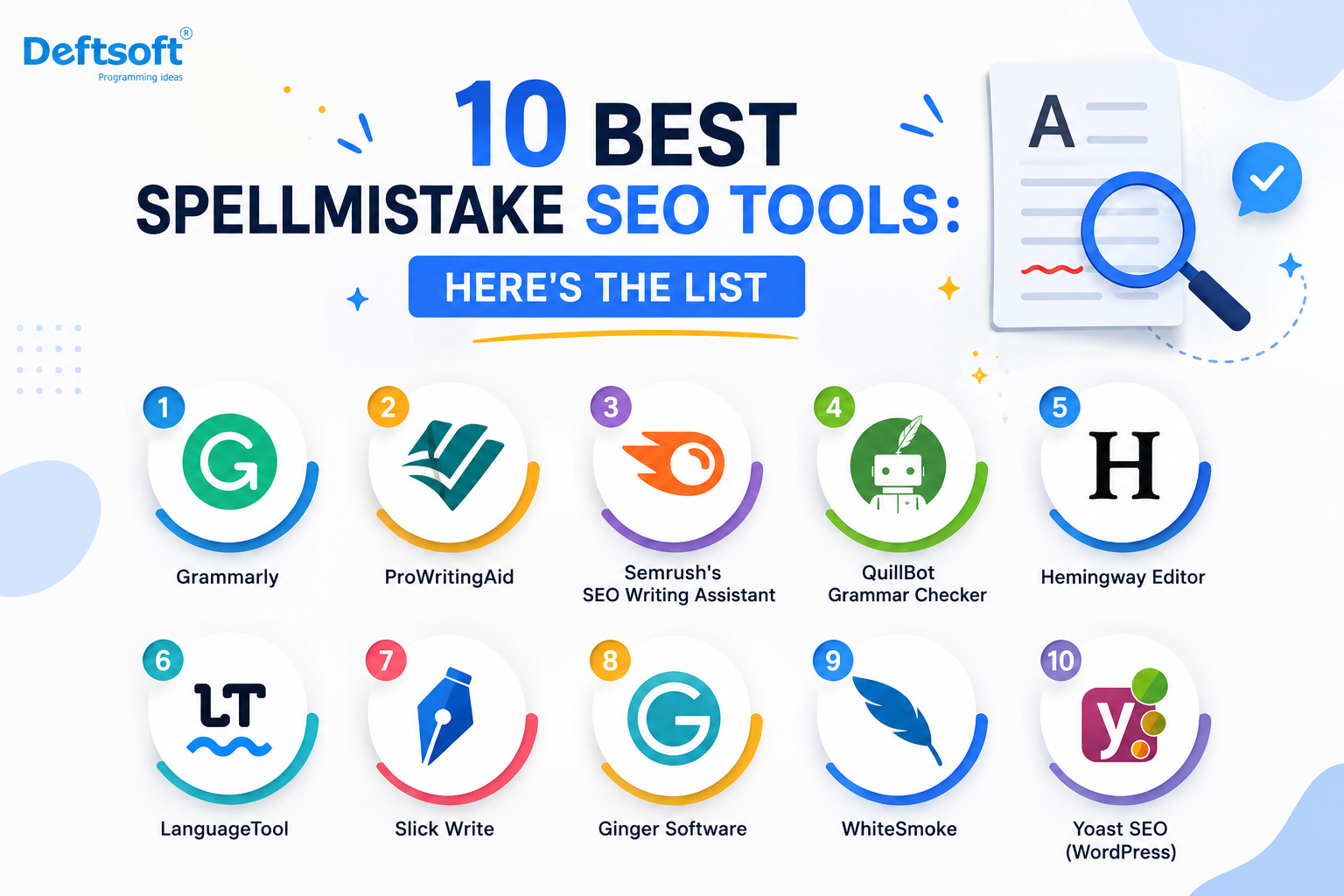
10 Best Spellmistake SEO Tools: Here’s the List

A single spelling mistake on a webpage might seem small, but it can quietly hurt how your content performs. Readers lose trust fast when they spot typos, and search engines are increasingly good at judging content quality, including how clean and professional your writing actually is. This is exactly why spellmistake SEO tools have become a real part of a proper content workflow, not just an afterthought before hitting publish.

In this guide, we’re covering the 10 best SEO tools built to catch spelling and grammar issues before they ever go live, how they fit into a broader SEO strategy, and why clean content matters more than ever now that AI SEO and answer-engine visibility are part of the picture too.

Want your content reviewed for both quality and SEO performance?

see exactly where your content stands.

Quick Navigation

Why Spelling Mistakes Actually Matter for SEO

The 10 Best Spellmistake SEO Tools

How to Choose the Right Spellmistake SEO Tool for Your Team

Common Spelling Mistakes That Hurt SEO Content Most

How to Build Spelling Checks Into Your Content Workflow

Spelling Accuracy Is Just One Piece of a Bigger SEO Picture

How Deftsoft Approaches Content Quality and SEO Together

Frequently Asked Questions

Why Spelling Mistakes Actually Matter for SEO

It’s worth understanding why this is a real ranking and trust factor before jumping into the tool list.

  • Trust and credibility take a hit fast. A visitor who spots a typo on your homepage or product page starts questioning everything else on the page too, including whether your business is careful with details in general.
  • Bounce rate rises with sloppy content. When readers hit confusing or error-filled text, they leave quickly, and a high bounce rate is a signal search engines use to judge whether a page actually satisfies a search query.
  • Google increasingly rewards well-written, high-quality content. While a single typo won’t tank your rankings on its own, consistently poor writing quality correlates with weaker overall content performance.
  • AI-driven search tools are picky about clarity. As more visibility comes from AI SEO, AEO, and GEO where AI tools summarize or cite your content directly, clear writing matters even more, since confusing or error-filled text is harder for AI systems to accurately understand and quote.

With that context, here’s the list.

The 10 Best Spellmistake SEO Tools

1. Grammarly

Grammarly is one of the most widely used best spellmistake SEO tools available today, and for good reason. It catches spelling errors, contextual grammar mistakes, and punctuation issues, while also flagging tone and clarity problems. The free version handles basic spelling and grammar, while the premium tier goes deeper into advanced grammar and style suggestions making it a strong first choice for most content teams.

2. ProWritingAid

ProWritingAid stands out for its detailed writing reports, covering everything from spelling consistency to sentence structure and readability. It integrates with Google Docs, Microsoft Word, and Scrivener, and its free version offers a solid web-based spelling and grammar check for shorter content pieces.

3. Semrush’s SEO Writing Assistant

Since Semrush is primarily known as an SEO platform, its writing tools are built with SEO specifically in mind. Its SEO Writing Assistant checks spelling and grammar while also scoring your content for readability and keyword usage, making it one of the more SEO-native spellmistake SEO tools on this list.

4. QuillBot Grammar Checker

QuillBot combines spelling and grammar correction with its well-known AI paraphrasing engine, so you can fix errors and rephrase awkward sentences in the same workflow. This makes it especially useful for content teams producing high volumes of blog or web content.

5. Hemingway Editor

While not a pure spell-checker, Hemingway Editor is excellent at flagging overly complex sentences, passive voice, and readability issues alongside basic spelling errors. It’s a strong companion tool for tightening up content after a first grammar pass.

6. LanguageTool

LanguageTool is a strong, multilingual option that catches spelling, grammar, and style issues across more than 20 languages, making it especially useful for businesses managing content in multiple markets. It offers browser extensions and integrations with word processors and CMS platforms.

7. Slick Write

Slick Write is a free, browser-based tool built specifically with bloggers, students, and SEO professionals in mind. Beyond spelling and grammar, it generates detailed reports covering sentence structure, passive voice usage, and readability all useful signals for content quality.

8. Ginger Software

Ginger offers real-time spelling and grammar correction along with a built-in translator and personal trainer feature that helps you learn from repeated mistakes over time. It’s a solid, lightweight option for individual writers and small content teams.

9. WhiteSmoke

WhiteSmoke combines spelling and grammar checking with plagiarism detection, making it useful for content teams that need to verify both originality and accuracy before publishing.

10. Yoast SEO (WordPress)

For WordPress users specifically, Yoast SEO includes a built-in readability and basic writing quality checker alongside its core SEO features, flagging overly long sentences, passive voice, and structural issues directly inside your WordPress editor right where you’re already optimizing for SEO.

How to Choose the Right Spellmistake SEO Tool for Your Team

With this many options, picking the right one comes down to a few practical factors:

Factor What to Consider
Content volume High-volume teams benefit from tools like QuillBot or Semrush that combine correction with rewriting.
Budget Free tools like LanguageTool and Slick Write cover the basics well before you need a paid upgrade.
SEO integration Semrush’s Writing Assistant and Yoast SEO tie spelling checks directly into your SEO workflow.
Multilingual content LanguageTool and Ginger support checking across multiple languages.
Depth of feedback ProWritingAid and Hemingway Editor go beyond spelling into deeper style and readability analysis.

There’s no single “best” answer for every business; a small blog might do fine with a free tool, while a larger content operation publishing across multiple markets benefits from a more integrated, SEO-native option.

Common Spelling Mistakes That Hurt SEO Content Most

Not every spelling issue carries the same weight. A few specific mistakes tend to show up repeatedly across websites and cause more damage than others:

  • Homophone errors — mixing up words like “their/there/they’re” or “its/it’s” reads as careless even to casual readers, and these are exactly the kind of mistakes basic spell-check misses since the words themselves are spelled correctly
  • Inconsistent brand or product spelling — a business name or product spelled two different ways across a site confuses both readers and search engines trying to understand what your content is actually about
  • Typos in headings and titles — errors in H1s, page titles, or meta descriptions are especially damaging, since these are often the first thing both readers and AI-driven search tools evaluate
  • Autocorrect-introduced errors — mobile writing and quick edits often introduce errors that look plausible at a glance but change the actual meaning of a sentence
  • Repeated words — a leftover “the the” or duplicated phrase from editing is one of the most common and easily missed errors, especially in longer content

Most of the tools listed above catch these automatically, but it’s worth training your team to specifically watch for homophones and heading-level errors during manual review, since these are the mistakes automated tools sometimes miss or under-flag.

How to Build Spelling Checks Into Your Content Workflow

Having the right tool only helps if it’s actually part of your process. A simple, effective workflow looks like this:

  1. Draft the content without worrying too much about perfection on the first pass
  2. Run it through a spelling and grammar tool like Grammarly or LanguageTool to catch the obvious errors
  3. Do a manual read-through, specifically checking headings, titles, and meta descriptions, since these carry outsized SEO weight
  4. Have a second person review it if possible, since writers often miss their own repeated mistakes
  5. Re-check after any edits, since new errors can slip in during revision just as easily as during the first draft

Skipping steps 3 and 4 is one of the most common reasons errors still make it onto a live page even when a team is already using a good spelling tool; automated tools catch most issues, but they’re not a complete substitute for a careful final read.

Spelling Accuracy Is Just One Piece of a Bigger SEO Picture

Clean, error-free writing supports good SEO, but it’s only one part of what actually drives visibility today. A well-written page still needs strong keyword strategy, solid technical SEO, and increasingly, visibility inside AI-generated answers which is where AI SEO, AEO, and GEO come into the picture.

  • AI SEO focuses on optimizing your overall visibility across both traditional search engines and AI-powered tools, and clean, well-structured writing is exactly the kind of content AI systems trust and cite.
  • AEO (Answer Engine Optimization) is about structuring content so it becomes the direct answer inside tools like Google’s AI Overviews and confusing, error-filled writing makes that much harder to achieve.
  • GEO (Generative Engine Optimization) focuses on getting your brand mentioned and cited by AI tools like ChatGPT, which depends heavily on your content being clear enough for an AI model to accurately summarize.

In other words, spelling and grammar tools aren’t a replacement for a real SEO strategy, they’re a foundational layer that makes the rest of your SEO, AEO, and GEO efforts actually work as intended.

How Deftsoft Approaches Content Quality and SEO Together

At Deftsoft, content quality isn’t treated as separate from SEO strategy; the two are built together. Every piece of content we create goes through proper editing and quality checks before it’s optimized for search, since a technically perfect SEO strategy still underperforms if the writing itself is sloppy or hard to trust.

This same attention to detail carries through into how we approach AI SEO, AEO, and GEO for clients because as AI-driven search continues to grow, clear, well-written, trustworthy content matters more, not less. Whether it’s a blog post, a service page, or content built specifically to earn visibility inside AI-generated answers, Deftsoft treats writing quality as a core part of the SEO process, not an afterthought bolted on at the end.

Ready to build a content strategy that covers SEO, AEO, and GEO together?

Get a plan built around quality and visibility.

Talk to our SEO team

Frequently Asked Questions

1. What are spellmistake SEO tools?

Spellmistake SEO tools are spelling and grammar checking tools used to catch and fix writing errors before content is published, helping improve readability, trust, and overall content quality all factors that support broader SEO performance.

2. Do spelling mistakes actually affect SEO rankings?

While a single typo won’t directly tank your rankings, consistently poor writing quality correlates with higher bounce rates and weaker overall content performance, both of which search engines use as quality signals.

3. What is the best free spellmistake SEO tool?

LanguageTool and Slick Write are strong free options that catch spelling and grammar errors while also offering broader writing quality feedback, making them solid starting points before considering a paid tool.

4. Are spelling and grammar tools important for AI SEO and GEO too?

Yes. Clear, well-structured, error-free content is easier for AI systems to accurately understand, summarize, and cite making writing quality just as relevant to AEO and GEO as it is to traditional SEO.

5. Should I use more than one spellmistake SEO tool?

Many content teams use a combination for example, a grammar checker like Grammarly alongside a readability tool like Hemingway Editor since different tools catch different types of issues.

6. Do these tools replace human editing entirely?

No. Spelling and grammar tools are a strong first layer of quality control, but human review still matters for tone, context, and ensuring the content genuinely serves the reader’s intent.

7. How does Deftsoft handle content quality alongside SEO?

Deftsoft treats writing quality and SEO strategy as connected, not separate; every piece of content goes through proper editing before being optimized for search, AI SEO, AEO, and GEO visibility.

How to Choose the Right Meta Ads Agency in 2026 (And What Meta Ads Services Should Actually Include)

Facebook and Instagram together still pull in over 8 million advertisers, and social ad spend is set to cross $300 billion in 2026. With that much money moving through the platform, picking the right Meta ads agency matters more than ever; the difference between a good partner and a bad one can be the difference between real growth and a budget that quietly disappears with nothing to show for it.

Most businesses only realize they picked the wrong agency months in, once the invoices have added up and the results still haven’t. This guide is meant to help you avoid that entirely by walking through how to choose a Meta ads agency the smart way, what real Meta ads services should actually include, what things cost right now, and the red flags worth watching for before you sign anything.

Not getting the results you expected from your current Meta ads?

See exactly what’s working and what isn’t.

Why Choosing the Right Meta Ads Agency Matters So Much

Meta ads work through an auction system, and the businesses that win that auction consistently are the ones who understand how it actually works, not just the ones spending the most. A skilled agency knows how to set up targeting, write ad copy that connects, test creative properly, and read the data to keep improving results over time.

A weak agency, on the other hand, tends to “set and forget”, running the same ad for months, ignoring what the numbers are actually saying, and hoping the algorithm figures it out. In 2026, that approach is getting more expensive by the month. Facebook’s average cost per click has climbed to around $1.72, up from $1.55 the year before, largely due to more advertisers competing for the same space and heavier use of AI-powered bidding. That means mistakes cost more than they used to, and picking the right partner from the start matters even more.

What Should Meta Ads Services Actually Include?

Before comparing agencies, it helps to know what a complete Meta ads services package should cover. If a provider is missing several of these, that’s worth asking about before you commit any budget.

  • Account setup and audit: reviewing your existing Meta Business account, pixel, and conversion tracking before spending a single dollar
  • Audience research and targeting strategy: building audiences based on real customer data, not just broad guesses
  • Ad creative development: images, video, and copy built specifically for Facebook and Instagram, not repurposed from other channels
  • Campaign structure and setup: organizing campaigns, ad sets, and objectives properly so Meta’s algorithm can actually optimise
  • A/B testing: testing different creatives, audiences, and offers to see what actually performs
  • Conversion tracking setup: making sure Meta can accurately see what’s converting, including server-side tracking through the Conversions API
  • Ongoing optimization: adjusting budgets, pausing weak ads, and scaling what’s working, on a regular schedule
  • Reporting and analysis: clear, honest reports tied to real business outcomes, not just vanity metrics like reach or impressions

A genuine Meta ads agency should be able to walk you through each of these areas with specific examples, not just a generic slide deck.

What Do Meta Ads Cost in 2026?

Here’s a quick, honest look at current pricing so you know what to expect when comparing quotes.

Metric Facebook Instagram
Average CPC $0.94 – $1.72 $1.17 – $3.35
Average CPM $7 – $15 $6 – $15
Typical CTR 0.72% – 1.49% 0.22% – 0.88%
Average ROAS Around 2.79 Varies by industry

A few things worth knowing:

  • Facebook is generally cheaper per click than Instagram, but Instagram often delivers stronger engagement for visual, brand-focused campaigns
  • Instagram Reels currently run about 26% cheaper per click than Facebook Feed ads, since Reels inventory is growing faster than advertiser demand
  • Costs typically rise 15–25% during Q4 due to holiday competition, so budgeting a bit extra for that season is smart
  • Most small businesses budget somewhere between $2,000 and $5,000 a month for meaningful results. Campaigns under $1,000 a month often don’t generate enough data for Meta’s system to properly optimize

These numbers move depending on your industry, audience, and how competitive your specific market is, so treat them as a general guide rather than an exact number for your business.

Meta Ads Agency vs. In-House Team vs. Freelancer

Before hiring a Meta Ads agency, it’s worth comparing the alternatives honestly

Option Best For Main Tradeoff
Freelancer Small budgets, simple campaigns Limited availability, no backup if they’re unavailable
In-House Hire Ongoing, long-term ad management Higher fixed cost, harder to find someone skilled in every area (creative, targeting, tracking)
Meta Ads Agency Businesses wanting full-service expertise Requires proper vetting, but gives access to a full team instead of one person

For most growing businesses, a proper agency offers the best balance: you get access to a strategist, creative support, and someone who actually understands the tracking and reporting side, instead of relying on one person to do everything well.

How to Actually Choose the Right Meta Ads Agency

Here’s what to actually look for when comparing options.

  • Ask for real case studies with real numbers. Not just “we grew engagement”; ask for actual cost-per-result numbers, and ask if you can speak to a past or current client directly.
  • Check how they handle tracking. With privacy changes continuing to affect ad platforms, proper server-side conversion tracking (through Meta’s Conversions API) has become one of the biggest factors separating good agencies from average ones. If an agency can’t clearly explain how they handle this, that’s a red flag.
  • Ask about their use of AI creative tools. Agencies using Meta’s generative AI tools or similar platforms are seeing meaningfully better click-through rates than those relying purely on manually designed ads, simply because AI tools can test far more creative variations, far faster. This is part of a much bigger shift toward AI-driven marketing and governance that businesses are having to navigate across every channel right now, not just paid ads.
  • Understand their reporting cadence. A good agency reports regularly and explains what changed and why, not just a dashboard screenshot with no context.
  • Watch for vague promises. Be cautious of any agency promising a specific ROAS or guaranteed results before even seeing your business, audience, or existing data. Real results depend on your product, market, and offer; a responsible agency will say so.
  • Ask how they structure their fees. Some charge a flat monthly fee, others a percentage of ad spend. Neither is automatically better, but you should understand exactly how it works and what happens as your budget scales up.

Signs Your Business Actually Needs a Meta Ads Agency

Meta Ads Agency

Not every business needs outside help right away, but a few signs usually mean it’s time to bring in real expertise instead of managing things alone:

  • Your ads are getting clicks, but conversions aren’t showing up the way they should
  • You’re not sure if your conversion tracking is actually accurate
  • You’ve been running the same one or two ads for months without testing anything new
  • Your ad spend keeps increasing, but results have stayed flat or gotten worse
  • You don’t have the time to review performance data regularly and make adjustments

If more than one or two of these sound familiar, that’s usually a sign your current approach has hit a ceiling; expertise, not just more budget, is what’s needed to break through.

Common Mistakes Businesses Make When Choosing a Meta Ads Agency

A few patterns show up again and again with businesses that end up disappointed:

  • Picking the cheapest option without checking what’s actually included in the package
  • Not asking how conversions are tracked, then blaming the ads when the real issue is broken tracking
  • Expecting instant results without giving the algorithm enough data and time to properly optimize
  • Choosing an agency with no real experience in their specific industry or audience type
  • Skipping creative testing entirely and running the same one or two ads for months

Avoiding these mistakes alone puts you ahead of a lot of businesses that treat ad spend as a gamble instead of a system that needs proper setup and ongoing attention.

How Deftsoft Approaches Meta Ads Services

At Deftsoft, our approach to Meta ads services starts with understanding your actual business goals before a single ad gets built, not just handing over a generic campaign template. Our team handles account setup, audience research, creative development, and proper conversion tracking as one connected process, so nothing gets built in isolation.

As a Meta ads agency, we also treat Facebook and Instagram advertising as part of a bigger picture, connecting it with your broader SEO and AI search strategy, so the same audience insights and messaging that work in your ads also inform your website content and organic growth, rather than running as two disconnected efforts. This matters because, done right, Meta ads work best alongside strong social media marketing and clear conversion tracking, not as a standalone spend with no visibility into what’s actually working.

Whether you’re running your first Meta ad campaign or trying to fix one that’s underperforming, Deftsoft’s approach focuses on transparent reporting, proper testing, and honest expectations not vague promises that don’t hold up once the campaign actually launches.

Ready to launch a Meta ads campaign built the right way from day one?

Get a strategy built around your actual business goals.

Talk to Our AI Search Team

Frequently Asked Questions

1. What is a Meta ads agency?

A Meta ads agency is a company that manages Facebook and Instagram advertising campaigns on behalf of a business, handling everything from audience targeting and creative development to conversion tracking and ongoing optimization.

2. What should Meta ads services include?

A complete service should include account setup and audit, audience research, ad creative development, campaign structuring, A/B testing, conversion tracking, ongoing optimization, and clear, regular reporting.

3. How much do Meta ads cost in 2026?

Facebook averages roughly $0.94–$1.72 per click, while Instagram runs higher at $1.17–$3.35 per click. Most small businesses budget between $2,000 and $5,000 a month for meaningful results.

4. Is it better to hire a Meta ads agency or manage ads in-house?

It depends on your budget and needs. An agency gives you access to a full team of specialists at once, while an in-house hire works better for businesses that want ongoing, dedicated attention from a single person. Freelancers can work well for smaller, simpler campaigns.

5. How do I know if a Meta ads agency is actually good?

Ask for real case studies with specific numbers, check how they handle conversion tracking, ask about their use of AI creative tools, and be cautious of anyone guaranteeing specific results before reviewing your business and data.

6. Why did my Meta ads cost so much with barely any results?

This is often caused by broken or incomplete conversion tracking, weak or repetitive ad creative, too small a budget for the algorithm to properly optimize, or targeting that’s too narrow. A proper audit usually reveals which of these is the actual issue.

7. How long does it take to see results from Meta ads?

Meta’s algorithm needs enough data to properly optimize, which usually takes at least a few weeks of consistent spend and testing. Campaigns judged too early, before enough data has been collected, often get shut down right before they would have started performing well.

How to Hire an Enterprise Mobile App Development Company in USA: Cost & Services Guide

Hiring the right enterprise mobile app development company is one of the highest-stakes technology decisions a business makes; the wrong partner means budget overruns, security gaps, and a product that can’t scale. This guide breaks down what genuine enterprise mobile app development services actually include, how much they cost in 2026 (with real numbers, not vague ranges), how to evaluate an enterprise mobile app development agency, and how a company like Deftsoft compares to other enterprise mobile app development companies competing for enterprise budgets.

Enterprise leaders rarely get a second chance to get this decision right. A mismatched agency can mean months of rework, a security gap discovered only after launch, or an app that works fine in a demo but buckles under real production load. This guide is built to help you avoid exactly that with real cost data, a clear breakdown of what enterprise-grade development actually involves, and a straightforward way to evaluate any provider you’re considering.

Not sure what your enterprise mobile app project should actually cost?

Get a free technical consultation and cost estimate from Deftsoft based on your specific requirements.

Call Us

Quick Navigation

What Is Enterprise Mobile App Development?

What Do Enterprise Mobile App Development Services Actually Include?

How Much Does Enterprise Mobile App Development Cost in 2026?

Enterprise Mobile App Development Company vs. Freelancers vs. In-House Team

Enterprise Mobile App Development Platform: Choosing the Right Technology Stack

What to Look for in Enterprise Mobile App Development Companies

Beyond Standard Apps: Mobile Game App Development for Enterprise

How Deftsoft Approaches Enterprise Mobile App Development

Frequently Asked Questions

What Is Enterprise Mobile App Development?

Enterprise mobile app development refers to building mobile applications specifically designed for large organizations apps that need to integrate with existing enterprise systems (CRMs, ERPs, internal databases), support hundreds or thousands of concurrent users, meet strict security and compliance standards, and scale reliably as the business grows.

This is fundamentally different from a typical consumer app or a small business MVP. Mobile app development for enterprise clients has to account for things a startup app rarely needs to worry about on day one: single sign-on (SSO) integration, role-based access control, offline data sync, multi-region deployment, and compliance frameworks like HIPAA, SOC 2, or GDPR depending on the industry.

If you’re specifically searching for an enterprise mobile app development company USA, that usually means you need a partner who understands both the technical complexity of enterprise-grade systems and the specific regulatory and security expectations of the U.S. market.

What Do Enterprise Mobile App Development Services Actually Include?

A genuine enterprise mobile app development services engagement covers far more than writing code. It typically includes:

  • Discovery and technical architecture planning, mapping how the app will integrate with existing enterprise systems before any development starts
  • UI/UX design built around real user workflows, not generic templates
  • Native and cross-platform development (iOS, Android, or both, depending on the use case)
  • Backend and API development to connect the app securely with internal systems
  • Security architecture: encryption, access controls, and compliance-specific safeguards
  • Quality assurance and testing: across devices, OS versions, and network conditions
  • Deployment and DevOps setup: including CI/CD pipelines for reliable, frequent updates
  • Post-launch support and maintenance: since enterprise apps require ongoing monitoring, security patches, and feature iteration

A provider offering true custom enterprise mobile app development should be able to walk you through each of these stages with specific examples from past work, not just a generic capabilities list.

How Much Does Enterprise Mobile App Development Cost in 2026?

This is the question most executives actually want answered, so let’s be direct about it. Mobile app development cost varies significantly based on region, complexity, and team structure and the gap between US and offshore rates is wider than ever in 2026.

Region Hourly Rate Range Simple App Cost Enterprise App Cost
USA $100 – $250/hr ~$40,000 – $50,000 $250,000 – $500,000+
UK $80 – $150/hr ~$35,000 – $45,000 $200,000 – $400,000+
UAE $60 – $120/hr ~$30,000 $150,000 – $250,000+
India $20 – $60/hr $10,000 – $35,000 $80,000 – $250,000+

A few specific numbers worth noting: a basic single-platform MVP typically starts around $15,000–$25,000 in 2026, while a mid-complexity app with full backend and integrations runs $60,000–$150,000. True enterprise-grade platforms, with compliance requirements, complex data flows, or multi-tenant architecture, commonly land in the $150,000–$500,000+ range depending on scope.

A few factors that push cost up or down significantly:

  • Native vs. cross-platform: cross-platform frameworks like Flutter or React Native can reduce development spend by 30–40% compared to fully native iOS and Android builds
  • AI-powered features: generative AI integrations now add roughly $15,000–$50,000 to stay competitive, since rising user expectations have made basic AI features close to standard rather than premium
  • Compliance requirements: building in HIPAA, GDPR, or PCI-DSS compliance from day one typically adds 15–30% to development cost, but avoids far more expensive fixes and potential fines later
  • Post-launch maintenance: annual maintenance typically runs 15–25% of the original build cost, meaning a $200,000 enterprise app requires roughly $30,000–$50,000 per year to stay secure and current

It’s also worth understanding why the US-to-India cost gap is as wide as it is it isn’t just developer salaries. A US or UK-based agency typically carries 50–65% overhead (office space, benefits, higher operational costs), while an established India-based team often runs closer to 15–25% overhead. On top of that, US and UK teams tend to include a project manager, dedicated QA, DevOps, and a business analyst as standard, while some offshore providers treat these as optional add-ons, which is exactly why it’s worth confirming what’s actually bundled into a quoted rate before comparing numbers side by side.

Enterprise Mobile App Development Company vs. Freelancers vs. In-House Team

Before choosing an enterprise mobile app development company, it’s worth understanding how that option actually compares to the alternatives:

Option Best For Key Tradeoff
Freelancers Small, narrowly scoped projects Limited accountability, no full team coverage (design, QA, DevOps)
In-House Team Long-term, ongoing product development High fixed cost, slow to scale up or down
Enterprise App Development Agency Complex, scoped enterprise projects Requires careful vetting, but offers full team coverage and predictable delivery

For most enterprise projects, especially ones requiring compliance, integration with legacy systems, and long-term scalability, working with an established enterprise mobile app development agency offers the most predictable outcome, since you get an entire team (architects, designers, QA, DevOps) rather than relying on a single freelancer’s availability and skill ceiling.

Enterprise Mobile App Development Platform: Choosing the Right Technology Stack

A good enterprise mobile app development platform decision depends on your specific business needs, not a one-size-fits-all default. Key considerations include:

  • Native development: (Swift for iOS, Kotlin for Android) best for apps requiring deep OS integration, maximum performance, or advanced hardware access
  • Cross-platform frameworks: (Flutter, React Native), best for faster time-to-market and lower cost, while still delivering near-native performance for most enterprise use cases
  • Low-code/no-code enterprise platforms: useful for internal tools with simpler requirements, though generally not suitable for customer-facing, high-complexity applications
  • Cloud infrastructure (AWS, Azure, Google Cloud): the backbone connecting the mobile app to enterprise data and services, and a major factor in long-term scalability and cost

The right enterprise mobile app development platform should be chosen based on your existing tech stack, your team’s long-term maintenance capacity, and your specific compliance and integration requirements, not simply whichever framework is trending.

What to Look for in Enterprise Mobile App Development Companies

With so many enterprise mobile app development companies competing for enterprise contracts, a few criteria separate serious technical partners from the rest:

  • Proven enterprise-scale experience, not just consumer app portfolios
  • Security-first development practices, built in from the architecture stage, not added afterward
  • Transparent, milestone-based pricing rather than vague hourly estimates with no clear scope
  • A dedicated team of enterprise mobile app developers, including architects, not just generalist developers
  • Experience with your specific industry’s compliance requirements (healthcare, finance, logistics, etc.)
  • Strong post-launch support and maintenance track record

It’s also worth noting that India has become one of the strongest sources of enterprise-grade mobile talent globally, and businesses evaluating best mobile developers in India consistently find that experienced Indian teams deliver US-comparable quality at 60–75% lower cost, provided due diligence is done on portfolio, reviews, and communication process before signing.

Beyond Standard Apps: Mobile Game App Development for Enterprise

Not every enterprise mobile needs a business utility app. A growing number of enterprises, particularly in retail, education, and consumer engagement, are investing in gamified mobile experiences to boost user retention and engagement. A specialized mobile game app development company brings a different skill set than a standard enterprise app team: game engine expertise (Unity, Unreal), advanced graphics optimization, and engagement-focused UX design. If gamification is part of your enterprise mobile strategy, it’s worth confirming your chosen partner has genuine game development experience, not just a standard app development background stretched to cover it.
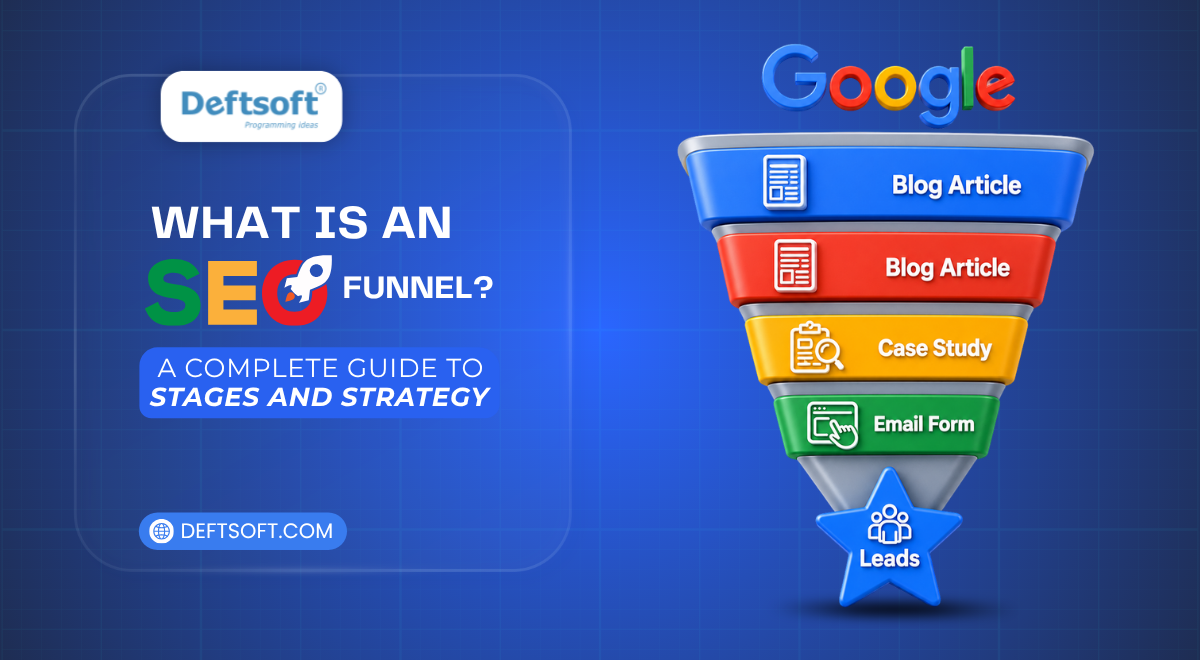
How Deftsoft Approaches Enterprise Mobile App Development

At Deftsoft, we work as a full-service enterprise mobile app development company, handling everything from initial architecture planning to long-term post-launch support. Our approach to custom enterprise mobile app development starts with understanding how the app needs to fit into your existing enterprise systems CRMs, ERPs, internal APIs rather than building in isolation and forcing integration afterward.

Our team of enterprise mobile app developers works across native iOS and Android development as well as cross-platform frameworks, matched to what actually fits your specific performance, budget, and timeline requirements. Security and compliance are built into the architecture from day one, not retrofitted after development, which matters significantly for enterprises in regulated industries.

Beyond mobile development itself, Deftsoft pairs this with broader digital capabilities, including AEO Services and affordable SEO services so enterprise apps launching into competitive markets aren’t just well-built, but genuinely discoverable, whether that means ranking in traditional search or getting picked up inside AI-generated answers and recommendations.

Whether you’re a US enterprise looking for a technically strong, cost-efficient development partner, or a growing business trying to figure out realistic mobile app development cost before committing a budget, Deftsoft’s approach is built around transparent scoping and long-term reliability, not just winning the initial contract.

Ready to talk to an enterprise mobile app development team?

and get a clear roadmap built around your business goals.

Contact our mobile development experts

Frequently Asked Questions

1. How much does it cost to hire an enterprise mobile app development company in the USA?

US-based enterprise mobile app development typically costs $250,000–$500,000+ for a full-featured, compliance-ready application, with hourly rates ranging from $100–$250. Offshore or hybrid teams, particularly in India, can deliver comparable quality at 60–75% lower cost.

2. What is the difference between enterprise mobile app development and regular app development?

Enterprise mobile app development involves deeper integration with existing business systems, stricter security and compliance requirements, and the need to support large numbers of concurrent users reliably, requirements a typical consumer or small business app usually doesn’t need to meet.

3. Should I hire an enterprise mobile app development agency or build an in-house team?

It depends on your timeline and long-term needs. An agency offers full team coverage (design, development, QA, DevOps) with more predictable delivery for a scoped project, while an in-house team makes more sense for continuous, long-term product development with a stable, ongoing roadmap.

4. What is the best enterprise mobile app development platform to use?

There’s no single best option; native development (Swift/Kotlin) suits apps needing deep OS integration and maximum performance, while cross-platform frameworks like Flutter or React Native offer faster development and lower cost for most standard enterprise use cases.

5. Are Indian mobile app developers good enough for enterprise projects?

Yes. India has become one of the largest global hubs for enterprise-grade mobile development, and many of the best mobile developers in India deliver US-comparable quality and process depth at a significantly lower cost, though due diligence on a specific agency’s portfolio and process remains essential.

6. How long does it take to build an enterprise mobile app?

Timelines vary based on complexity, but a well-scoped enterprise mobile app typically takes anywhere from 4 to 12 months, factoring in discovery, design, development, integration, testing, and deployment phases.

7. Does an enterprise mobile app development company also help with app store visibility after launch?

A strong full-service partner should. Beyond development, services like AEO and affordable SEO help ensure the app and its supporting web presence are actually discoverable once it launches, rather than treating visibility as a separate, disconnected concern.

What Is an SEO Funnel? A Complete Guide to Stages and Strategy

Ranking on the first page of Google feels great but if that traffic never turns into leads, sign-ups, or sales, something is missing. Getting more clicks isn’t the same as getting more customers. That’s where the idea of an SEO funnel comes in.

An SEO funnel is the roadmap that takes someone from “I have a question” all the way to “I’m ready to buy.” Instead of treating every keyword the same way, an SEO funnel recognizes that people search differently depending on where they are in their decision-making journey. Someone typing “what is SEO” is not ready for a sales pitch. Someone typing “SEO agency in USA” almost certainly is.

Different search intents call for different SEO strategies and understanding this difference is what separates websites that only get traffic from websites that get results. In this guide, we’ll break down what an SEO funnel is, why it matters, the stages it’s built on, and how you can build one for your own business.

Stop Wasting Traffic on Unqualified Clicks

Learn how to align your content with search intent and turn everyday visitors into paying clients.

Connect With Us

What Is an SEO Funnel?

In simple terms, an SEO funnel is a framework that maps search intent, keywords, content, website experience, and conversions into one connected journey. Rather than optimizing pages randomly, an SEO funnel makes sure every piece of content has a clear job to do whether that’s educating a beginner, comparing options, or closing a sale.

Here’s how the pieces connect:

  • Search intent tells you what the user actually wants when they type a query.
  • Keywords are the words people use to express that intent.
  • Content is built to match that intent, at the right level of detail.
  • Website experience guides the visitor smoothly from one page to the next.
  • Conversions happen when the right content meets the right visitor at the right time.

There’s an important difference between simply attracting traffic and generating qualified leads. A blog post can bring thousands of visitors, but if none of them are looking to buy, that traffic doesn’t help the business grow. A well-structured SEO marketing funnel makes sure your content isn’t just visible, it’s actually working toward a business goal.

How Does an SEO Funnel Work?

At a basic level, users move through a journey that looks like this:

Search → Discovery → Consideration → Evaluation → Conversion → Retention

A person starts with a search query, discovers your website through organic results, considers whether your content answers their needs, evaluates your services against alternatives, converts by taking an action (like filling out a form), and ideally becomes a returning customer who trusts your brand for the long run.

Why Is an SEO Funnel Important for Your SEO Strategy?

Building your content around a funnel isn’t just a nice-to-have; it changes how effective your SEO actually is. Here’s why it matters:

  • Targets users at different buying stages so you’re not showing a sales pitch to someone who’s just browsing.
  • Aligns content with search intent, which improves rankings and user experience together.
  • Improves qualified organic traffic instead of just raising the total visitor count.
  • Helps move informational users toward commercial pages through smart internal linking.
  • Supports lead generation and sales, not just brand visibility.
  • Makes SEO performance easier to measure, since each stage has its own clear goal.

A solid SEO strategy funnel turns your website into a system — one where visitors are guided step by step instead of left to figure things out on their own. For businesses working with an AEO Insights Company, this approach can also help align SEO content with broader answer engine optimization goals.

What Are the Stages of an SEO Funnel?

Every SEO funnel is built around four core stages. Understanding each one helps you plan the right keywords and content for every part of the customer journey.

Stage 1: Awareness Top of the Funnel (TOFU)

At this stage, users are just identifying a problem or trying to learn something new. They aren’t thinking about brands yet they’re thinking about their question.

Keyword types:

  • Informational keywords
  • Question-based searches
  • Problem-focused searches
  • Broad topic keywords

Content examples:

  • Blog posts
  • Beginner guides
  • How-to articles
  • Educational videos
  • Industry reports

SEO goal: Increase visibility and attract relevant users who may need your services later on.

Stage 2: Consideration Middle of the Funnel (MOFU)

Now the user understands their problem and is actively researching possible solutions. They’re comparing approaches and starting to narrow things down.

Keyword types:

  • Comparison keywords
  • Solution-focused keywords
  • Service-related informational keywords
  • “Best” and “vs.” searches

Content examples:

  • Comparison guides
  • Case studies
  • Service guides
  • Checklists
  • Expert articles

SEO goal: Build trust and move users toward evaluating you as a real option.

Stage 3: Decision Bottom of the Funnel (BOFU)

At this point, users are ready to take action. They know what they need and are looking for the right provider.

Keyword types:

  • Commercial keywords
  • Transactional keywords
  • Service + location keywords
  • Pricing keywords
  • “Hire” and “agency” keywords

Content examples:

  • Service pages
  • Product pages
  • Pricing pages
  • Demo/request pages
  • Testimonials
  • Client case studies

SEO goal: Turn qualified organic visitors into leads or customers.

Stage 4: Conversion and Retention

The funnel doesn’t have to end once someone converts. In fact, this is where long-term value really begins.

This stage covers:

  • Customer onboarding
  • Helpful support content
  • FAQs
  • Product/service guides
  • Existing-customer resources
  • Reviews and referrals

SEO goal: Support customer retention and encourage repeat conversions.

What Is an SEO Conversion Funnel?

An SEO conversion funnel is different from simply generating organic traffic. It’s specifically focused on turning visitors into leads by guiding them through a clear, intentional path.

Here’s a simple example of what that path might look like:

Google Search → Blog → Service Page → Case Study → Contact Form → Lead

To make this work well, a few things need to come together:

  • Landing pages designed around a single, clear goal
  • Internal linking that naturally guides visitors deeper into the site
  • CTAs (calls to action) placed where they make sense, not just everywhere
  • Conversion-focused content on decision-stage pages
  • Trust signals like reviews, case studies, and client logos

Without these elements, even great rankings won’t translate into business growth.

How SEO Funnel Keywords Work at Different Stages

Matching keywords to the right funnel stage is one of the most important parts of SEO strategy. Here’s how it typically breaks down:

Top-of-Funnel Keywords

  • What is SEO?
  • How does SEO work?
  • SEO benefits

Middle-of-Funnel Keywords

  • Best SEO strategies
  • SEO agency vs freelancer
  • How to choose an SEO service

Bottom-of-Funnel Keywords

  • SEO agency in USA
  • Affordable SEO services
  • Hire an SEO agency

What Are Low Funnel Keywords?

Low funnel keywords are search terms used by people who are very close to making a decision. Because these searchers already know what they want, low-funnel keywords usually carry much stronger commercial intent than broad, informational searches.

The difference comes down to intent. Someone searching “what is SEO” is learning. Someone searching “affordable SEO services for small business” is shopping. Low-funnel keywords tend to convert at a much higher rate, even if their search volume is lower.

To create pages around low-funnel keywords, focus on service pages, location-based pages, and pricing pages that speak directly to a ready-to-act audience.

Examples of Low-Funnel Keywords

Keyword Type Example Intent
Service SEO services for small business Looking for a specific service
Location SEO agency in USA Looking for a provider nearby or in a specific market
Action Hire an SEO expert Ready to take action
Pricing Affordable SEO packages Comparing cost before deciding
Comparison Best SEO agency vs freelancer Weighing final options

How to Build an SEO Strategy Funnel

Building a working SEO funnel doesn’t have to be complicated. Here’s a practical, step-by-step approach.

Step 1: Define Your Target Audience

Understand who you’re trying to reach, what problems they have, and what questions they’re asking at each stage of their journey.

Step 2: Map the Customer Journey

Outline the path a typical customer takes from first hearing about a problem to becoming a paying client.

Step 3: Perform Keyword Research

Group your keywords according to funnel stage:

  • Awareness
  • Consideration
  • Decision
  • Conversion

Step 4: Match Keywords With Search Intent

Make sure every keyword you target lines up with the type of content someone actually wants to see.

Step 5: Create Content for Each Funnel Stage

Don’t just publish blog posts. Build a mix of educational, comparison, and commercial content so every stage of the funnel is covered.

Step 6: Build Internal Links Between Funnel Stages

Guide readers from top-of-funnel blog posts toward middle- and bottom-of-funnel pages using natural, relevant internal links.

Step 7: Optimize Conversion Paths

Make sure CTAs, forms, and contact pages are easy to find and simple to use.

Step 8: Measure and Improve Performance

Track how well each stage is performing and adjust your content and keyword strategy based on what the data shows.

SEO Funnel vs Traditional Sales Funnel

While they share a similar shape, an SEO funnel and a traditional sales funnel work in different ways.

SEO Funnel Traditional Sales Funnel
Driven by search behavior Driven by sales activities
Uses organic search Uses sales outreach/marketing
Content plays a major role Sales communication plays a major role
Captures users through search Captures prospects through multiple channels
Can generate traffic continuously Often requires active sales processes

This is one reason a sales funnel for SEO is so valuable once your content is ranking well, it can keep attracting and converting visitors long after it’s published, without the ongoing cost of active outreach.

How to Map Content to an SEO Funnel

A content mapping table makes it much easier to see whether your website has gaps at any stage of the funnel.

ConsiderationCommercial ResearchComparison/Case StudyEngagement

Awareness Informational Blog/Guide Traffic
Decision Commercial Service Page Leads
Conversion Transactional Contact/Pricing Page Sales
Retention Informational Support/Resource Content Loyalty

Common SEO Funnel Mistakes to Avoid

Even well-intentioned SEO strategies can fall short if they overlook the funnel. Watch out for these common mistakes:

  1. Targeting only high-volume keywords and ignoring more specific, lower-volume terms with strong intent.
  2. Ignoring search intent, which leads to content that doesn’t match what users actually want.
  3. Creating content without a conversion path, leaving visitors with nowhere to go next.
  4. Focusing only on top-of-funnel traffic while neglecting decision-stage content.
  5. Poor internal linking between related pages at different funnel stages.
  6. Using the same CTA everywhere, instead of tailoring it to the page’s purpose.
  7. Ignoring bottom-of-funnel keywords, which often convert better despite lower search volume.
  8. Not measuring conversions, making it impossible to know what’s actually working.

How to Measure SEO Funnel Performance

Tracking the right metrics at each stage helps you understand where your funnel is working and where it needs attention.

Awareness Consideration Decision Conversion
  • Impressions
  • Organic traffic
  • Keyword rankings
  • Engagement rate
  • Time on page
  • Pages per session
  • Returning visitors
  • Service-page traffic
  • CTA clicks
  • Lead form starts
  • Leads
  • Conversion rate
  • Revenue
  • Organic-assisted conversions

SEO Funnel Example for an SEO Agency

To see how this all comes together, here’s a real-world example of an SEO funnel in action:

TOFU: “What is SEO?” ↓ MOFU: “How to choose an SEO agency?” ↓ BOFU: “SEO Agency in USA” ↓ Conversion: SEO service page → Contact form → Consultation

This is exactly the kind of funnel Deftsoft builds for clients’ content that educates first, builds trust in the middle, and makes it easy to take the next step once a visitor is ready to talk business.

Ready to Build an SEO Funnel That Actually Converts?

Driving traffic is only half the battle. Let Deftsoft’s SEO experts audit your current strategy and design a high-converting content funnel tailored to your business.

Final Thoughts: Turning SEO Traffic Into Conversions

An SEO funnel is about more than rankings, it’s about matching content to intent at every step of the customer journey. When your top-of-funnel content educates, your middle-of-funnel content builds trust, and your bottom-of-funnel content makes it easy to take action, your website stops being just a source of traffic and starts being a real growth engine.

Successful SEO isn’t only about getting to page one. It’s about guiding the entire customer journey, from that very first search to a long-term customer relationship. That’s the approach Deftsoft takes with every SEO strategy we build: one that turns search visibility into real, measurable business results.

FAQs

What is an SEO funnel?

An SEO funnel is a strategy that aligns search intent, keywords, and content with each stage of a customer’s journey, from first discovering a brand to becoming a customer.

What are the stages of an SEO funnel?

The main stages are Awareness (TOFU), Consideration (MOFU), Decision (BOFU), and Conversion/Retention.

What is the difference between an SEO funnel and a sales funnel?

An SEO funnel is driven by organic search behavior and content, while a traditional sales funnel relies more heavily on direct sales outreach and multi-channel marketing.

What are low-funnel keywords?

Low-funnel keywords are search terms used by people who are close to making a purchase decision, such as “affordable SEO services for small business” or “hire an SEO agency.”

How does SEO help the marketing funnel?

SEO brings in relevant traffic at every stage of the marketing funnel and supports it with content that matches what users are searching for, from early research to final decision.

How do you create an SEO funnel?

Start by defining your audience, mapping their journey, researching keywords by funnel stage, and building content and internal links that guide visitors toward conversion.

What is an SEO conversion funnel?

An SEO conversion funnel is the specific path a visitor takes from a search query to a completed action, such as filling out a contact form or booking a consultation.

Cloud Application Development Services: A Practical Guide for Tech Executives

Cloud is no longer a question of “if”; it’s a question of “how well.” Gartner projects public cloud end-user spending will hit $850 billion in 2026, a 21.3% jump from the year before, and 94% of enterprises now use cloud services in some form. For tech executives, the conversation has shifted from whether to move to the cloud to whether their cloud application development services partner can actually deliver something scalable, secure, and built for how AI-driven workloads now run.

This guide is written for exactly that audience: CTOs, VPs of Engineering, and technical decision-makers evaluating cloud application development, whether that means building something new, modernizing an existing system, or choosing between the growing list of cloud application development companies competing for your budget. Whether your team calls it cloud applications development, application development cloud computing, or simply cloud app development, the underlying questions are the same: which architecture, which provider, and which partner actually gets it right.

Have a cloud application idea but not sure where to start?

Get a clear technical roadmap built around your specific goals.

Talk to Our AI Search Team

Quick Navigation

What Is Cloud Application Development?

Why Cloud Application Development Matters in 2026

Cloud Application Development vs. Traditional Development

Core Components of Cloud App Development

Cloud App Development: Build, Migrate, or Modernize?

What to Look for in Cloud Application Development Companies

How Deftsoft Approaches Cloud Application Development

Cloud Application Solutions Across Industries

Common Mistakes Businesses Make in Cloud App Development

Frequently Asked Questions

What Is Cloud Application Development?

Cloud application development is the process of building software that runs on cloud infrastructure rather than local servers or on-premise data centers. Instead of installing an application on a single machine, a cloud application is built to run across distributed, scalable infrastructure, accessible from anywhere, updated centrally, and able to scale up or down based on real demand.

If you’re asking what a cloud application is in the simplest terms, it’s software designed from the ground up to take advantage of cloud infrastructure—elastic compute, managed databases, distributed storage, and on-demand scaling rather than software that was simply moved to a server somewhere.

This distinction matters more than it sounds. Application development for cloud environments requires different architectural thinking than traditional development: statelessness, horizontal scaling, service-oriented design, and resilience against individual component failure are all baked in from day one, not retrofitted later.

Why Cloud Application Development Matters in 2026

The numbers make the case better than any pitch could. The global cloud computing market is valued at roughly $917.9 billion in 2026, on track to cross $1 trillion before year-end, according to Synergy Research Group. Application development and testing specifically account for 45% of cloud adoption use cases, as businesses lean on flexible cloud resources to build faster while keeping cost and security under control.

What’s changed most in the last year is why businesses are investing. 64% of IT decision-makers now say cloud infrastructure is essential to their AI strategy, and 61% of enterprises plan to migrate more workloads to the cloud specifically to support AI initiatives. Cloud-based application development in 2026 increasingly means building applications that can plug directly into AI inference, machine learning pipelines, and real-time data processing — something legacy, on-premise architecture simply wasn’t designed for.

Containers, Kubernetes, and serverless architecture have also crossed from “advanced” to standard practice for new builds; 95% of new digital workloads are now being built on cloud-native platforms. If your application development in cloud computing strategy isn’t cloud-native by default, you’re already behind where the rest of the market has moved.

Cloud Application Development vs. Traditional Development

The difference isn’t just where the code runs — it’s how the entire system is designed to behave.

Traditional Application Development Cloud Application Development
Built for fixed, on-premise infrastructure Built for elastic, distributed infrastructure
Scaling requires new hardware Scales on demand, automatically
Manual deployment and updates Continuous deployment, centralized updates
Single point of failure risk Designed for resilience and redundancy
High upfront infrastructure cost Pay-as-you-go, usage-based cost model

This is exactly why custom cloud application development has become the default approach for businesses building anything meant to scale; the architecture itself is designed around growth and flexibility, not bolted on after the fact.

Core Components of Cloud App Development

Understanding how to develop cloud computing application projects successfully starts with knowing the moving parts involved:

  • Cloud infrastructure and hosting — Choosing between AWS, Microsoft Azure, or Google Cloud, which together hold more than 60% of the global market, with AWS at roughly 30% share, Azure at 25%, and Google Cloud at 13% as of early 2026.
  • Architecture design — deciding between microservices, serverless, or a hybrid approach based on the application’s actual usage patterns and growth expectations.
  • Database and data management — Selecting managed, cloud-native database services that scale independently from the application layer itself.
  • APIs and integrations — Building applications that connect cleanly with third-party services, internal systems, and increasingly, AI and machine learning models.
  • Security and compliance — Implementing identity management, encryption, and access controls appropriate to the industry and data sensitivity involved.
  • DevOps and CI/CD pipelines — Automating deployment, testing, and monitoring so updates ship reliably and frequently, rather than through slow, manual release cycles.

A genuine cloud application development service should be able to speak fluently to all six of these areas, not just the parts that are easiest to build.

Cloud App Development: Build, Migrate, or Modernize?

Most businesses approaching developing cloud applications fall into one of three categories, each requiring a different approach:

  • Building new — starting from scratch with cloud-native architecture from day one, ideal for new products, startups, or greenfield internal tools.
  • Migrating existing applications — moving an on-premise or legacy system to cloud infrastructure, which requires careful planning to avoid simply recreating old limitations in a new environment.
  • Modernizing legacy systems — re-architecting an existing application to actually take advantage of cloud-native capabilities (auto-scaling, managed services, containerization) rather than just relocating it.

Deciding which path applies to your business is one of the first, most important conversations to have with any cloud app development company before a single line of code gets written, because the wrong starting assumption here tends to compound into expensive rework later.

What to Look for in Cloud Application Development Companies

With so many cloud application development companies competing for enterprise budgets, a few criteria separate serious technical partners from the rest:

  • Multi-cloud and hybrid-cloud experience, since 87% of enterprises now operate multi-cloud strategies rather than committing to a single provider
  • Security-first architecture, not security added as an afterthought once development is complete
  • Proven experience with AI integration, given how central AI workloads have become to cloud strategy in 2026
  • Transparent, usage-based cost modeling, so cloud spend stays predictable as the application scales
  • Strong DevOps and automation practices, since 93% of developers now deploy code to the cloud as a standard part of their workflow
  • A track record with businesses of comparable scale and complexity to your own

A provider offering true cloud development services should be able to walk you through specific examples of each of these — not just a generic capabilities slide.

How Deftsoft Approaches Cloud Application Development

At Deftsoft, we treat cloud application development services as a long-term engineering partnership, not a one-time build-and-hand-off project. Our approach to cloud software development services is built around understanding the business problem first, then architecting a solution around the cloud platform, tools, and services that actually fit — rather than defaulting to whichever stack is fastest to sell.

Whether you need custom cloud application development built from the ground up, help modernizing a legacy system into a cloud-native architecture, or ongoing support scaling an existing application, Deftsoft’s team works across AWS, Azure, and Google Cloud to build solutions matched to your specific technical and business requirements. This includes secure API design, database architecture, CI/CD pipeline setup, and increasingly, integration with AI and machine learning capabilities — since that’s where a growing share of real client demand is heading in 2026.

As a cloud app development company, Deftsoft also places heavy emphasis on cost transparency and architecture that scales predictably, so tech executives aren’t left reconciling ballooning cloud bills against a system that was never designed to scale efficiently in the first place.

Cloud Application Solutions Across Industries

Cloud application solutions aren’t one-size-fits-all — the right architecture depends heavily on industry. In finance, cloud applications support real-time transaction processing and compliance-heavy data handling. In healthcare, cloud platforms enable secure patient data management alongside strict regulatory requirements. Retail and logistics rely on cloud applications for real-time inventory tracking and customer analytics, while manufacturing increasingly leans on cloud-based IoT integration; notably, 94% of manufacturing companies now use or are actively considering cloud-based ERP systems.

Whatever the industry, the underlying principle stays consistent: a genuinely useful cloud application is architected around how the business actually operates, not adapted awkwardly from a generic template afterward.

Common Mistakes Businesses Make in Cloud App Development

Here are the common mistakes businesses make in cloud app development, formatted as bullet points:

  • Choosing a Partner Solely on Cost: Selecting a development partner based purely on price, without thoroughly evaluating their architecture quality or security practices, frequently results in costly rework later.
  • Treating Migration as a Simple “Lift and Shift”: Moving an existing application directly to the cloud without redesigning it to be cloud-native merely transfers legacy limitations into a more expensive environment.
  • Skipping DevOps and Automation Setup: Failing to establish proper DevOps procedures and automated pipelines early on creates bottlenecks and slows down every subsequent release.
  • Underestimating Security and Compliance: Neglecting security protocols and regulatory requirements in the initial stages can lead to severe, expensive complications down the line, especially for businesses in regulated industries.
  • Architecture Quality: Choosing the wrong programming tool or technology stack for your cloud application—such as selecting a framework that doesn’t scale well with serverless architecture or cross-platform demands—can lead to performance bottlenecks.

Choosing the Right Tech Stack for Cloud-Native Applications

Selecting the right development frameworks and languages is essential for building cloud applications that are performant, scalable, and easy to maintain. Your chosen tech stack directly influences how seamlessly your front-end user experience interacts with back-end cloud microservices.

  • Frontend & Cross-Platform Frameworks (Flutter & React / React Native): Tools like React and React Native enable developers to build responsive web and mobile interfaces powered by flexible component architectures. Flutter provides a unified codebase for seamless, high-performance applications across iOS, Android, and web. Both frameworks connect effortlessly to cloud-hosted APIs and serverless backends, delivering consistent user experiences across devices.
  • Backend & Serverless Languages (Node.js, Python, Go): Choosing lightweight, event-driven languages for backend operations ensures your application can take full advantage of cloud-native infrastructure, such as AWS Lambda or Google Cloud Functions, without unnecessary overhead or latency.

Already have a legacy system that needs modernizing?

See exactly what a cloud-native rebuild would involve.

Frequently Asked Questions

1. What is cloud application development?

Cloud application development is the process of building software specifically designed to run on cloud infrastructure, taking advantage of elastic scaling, managed services, and distributed architecture rather than fixed, on-premise servers.

2. What is the difference between cloud application development and traditional application development?

Traditional development is built for fixed infrastructure with manual scaling and deployment, while cloud application development is built for elastic, distributed infrastructure that scales automatically and supports continuous deployment.

3. How much does custom cloud application development cost?

Cost depends on the application’s complexity, chosen cloud provider, required integrations, and whether the project involves building new, migrating, or modernizing an existing system. A proper quote should come from a technical assessment of your specific requirements.

4. Which cloud platform is best for application development — AWS, Azure, or Google Cloud?

Each has strengths depending on your needs — AWS holds the largest market share and broadest service catalog, Azure integrates deeply with Microsoft’s enterprise ecosystem, and Google Cloud is strong in AI and data analytics. Many businesses now use a multi-cloud approach rather than committing to just one.

5. How long does it take to develop a cloud application?

Timelines vary based on scope, but a well-scoped cloud application development services engagement typically involves phased delivery, starting with core architecture and an MVP, followed by iterative feature development and scaling.

6. Is cloud application development secure?

When built correctly, yes, often more secure than traditional on-premises systems, since cloud providers invest heavily in infrastructure security. However, security depends heavily on how the application itself is architected, which is why choosing an experienced cloud application development company matters.

7. What industries benefit most from cloud application development?

Nearly every industry benefits, but finance, healthcare, retail, logistics, and manufacturing have seen particularly strong adoption, driven by real-time data needs, compliance requirements, and the growing integration of AI into everyday business operations.

What Is an AEO Insights Company? How It Measures Your Visibility in AI Search

If you’ve been asking “what is AEO insights” or trying to understand what an AEO insights company actually does, you’re not alone. As more people search using AI tools like ChatGPT, Google AI Overviews, and Perplexity instead of typing into Google, businesses need a new way to check if they’re even being seen. This is exactly the gap an AEO insight company fills. In simple terms, it’s a company or tool that tracks how often your brand shows up, gets mentioned, or gets recommended in AI-generated answers. This shift matters more than it might seem at first: a business could be ranking perfectly on Google and still be completely invisible when a customer asks an AI assistant the same question in their own words. This blog explains what an AEO insight company is, what it actually tracks, how it works, and why more businesses are starting to rely on one to stay visible in AI search.

Want to know how AI tools are currently talking about your brand?

Check exactly where you stand.

Quick Navigation

What Is an AEO Insights Company?

What Does an AEO Insights Company Track?

AI Brand Mentions and Visibility Monitoring

AI Search Rankings and Answer Engine Visibility

Brand Sentiment and Context Analysis

Competitor AEO Performance Tracking

How Does an AEO Insights Company Work?

Key Metrics Tracked by an AEO Insights Company

AI Visibility Score

Brand Mention Frequency

Citation and Source Performance

Conversion Tracking With AEO

Measuring AEO Success Metrics: What Businesses Should Monitor

AEO Insights Company vs Traditional SEO Tools

Why Businesses Need to Hire Deftsoft – AEO Insights Company

Future of AEO Insights Companies in AI Search

Conclusion

Frequently Asked Questions

What Is an AEO Insights Company?

An AEO insights company is a business (or a platform) that helps you understand your brand’s visibility inside AI answer engines, tools like ChatGPT, Gemini, Perplexity, and Google’s AI Overviews. Instead of only checking where your website ranks on a normal Google search page, an AEO insights company checks something different: is your brand actually being mentioned when someone asks an AI a question related to your business?

Think of it this way: normal SEO tools tell you your search rankings. An AEO insights company overview, on the other hand, tells you whether AI tools trust your brand enough to talk about it at all. That’s a completely different, and increasingly more important, kind of visibility. To put it plainly, if someone were to ask, “AEO insight company what is it,” the simplest answer is this: it’s a service that watches how AI systems talk about your brand, and turns that into numbers and reports you can actually act on.

What Does an AEO Insights Company Track?

An AEO insights company doesn’t just look at one thing; it tracks several different signals that together paint a full picture of your AI visibility.

AI Brand Mentions and Visibility Monitoring

One of the core jobs of any AEO visibility platform is simple: checking how often your brand name shows up when people ask AI tools questions related to your industry. This is often called AEO AI brand mentions coverage, basically, how wide your brand’s reach is across different AI tools and different types of questions. A good AEO tracker doesn’t just count mentions once. It checks regularly, across multiple AI platforms, so you can see if your visibility is growing, staying flat, or dropping over time.

Beyond just mentions, an AEO visibility platform also studies where your brand appears within an AI’s answer. Are you the first thing mentioned, or are you buried somewhere in the middle of a long response? Is your brand recommended directly, or only mentioned as one option among many? This is where a proper AEO tracker becomes genuinely useful; it doesn’t just tell you that you were mentioned; it tells you how prominently, and how often you were the answer chosen over a competitor.

Brand Sentiment and Context Analysis

It’s not enough to just be mentioned; how you’re mentioned matters just as much. Good AEO insights go a step further and look at the tone AI tools use when talking about your brand. Are you described positively, neutrally, or in a way that could actually hurt trust? Understanding the context around each mention helps businesses know if their AI visibility is actually working in their favor.

Competitor AEO Performance Tracking

A complete AEO insights company profile should also include a clear view of how you compare to your competitors. Are AI tools mentioning your competitors more often than you, for the same kind of questions? This kind of side-by-side tracking helps businesses understand where they’re falling behind, and what specific gaps need to be closed.

How Does an AEO Insights Company Work?

In simple terms, here’s how the process usually works. First, the platform runs a large number of real, common questions through different AI tools- the same kinds of questions your potential customers might actually ask, phrased the way a real person would type or speak them, not just formal keyword lists. Then, it scans the answers those AI tools give back, checking for your brand name, your competitors’ names, and how each one is described.

After that, all of this information gets organized into scores, charts, and reports that are easy to understand, so instead of guessing whether AI tools know about your brand, you get clear, real data. This also means the process needs to happen repeatedly and consistently, since AI models are updated often, and a brand’s visibility can shift from one month to the next without any obvious warning. Over time, this ongoing tracking lets a business see whether its visibility in AI search is improving as it puts more effort into its content and online presence.

Key Metrics Tracked by an AEO Insights Company

A trustworthy AEO platform doesn’t just give you a vague summary; it tracks specific, measurable numbers.

AI Visibility Score

This is usually a single, simple number that sums up how visible your brand is across AI tools overall. A higher score generally means AI systems mention and recommend your brand more often and more clearly.

Brand Mention Frequency

This tracks exactly how many times your brand shows up across a set number of AI-generated answers, over a set period of time, helping you see whether your visibility is trending up or down.

Citation and Source Performance

This looks at which of your web pages or content pieces are actually being used as sources by AI tools when they generate an answer. Some pages perform far better than others here, and knowing which ones work helps guide future content decisions.

Conversion Tracking With AEO

Conversion tracking with AEO is about connecting the dots between AI visibility and real business results. It’s one thing to be mentioned by an AI tool; it’s another thing entirely for that mention to actually lead to a website visit, an inquiry, or a sale. Good AEO tracking tries to follow that full path, so you’re not just measuring visibility for its own sake, but tying it back to real outcomes.

Measuring AEO Success Metrics: What Businesses Should Monitor

AEO Success Metrics

When it comes to measuring AEO success metrics, businesses shouldn’t just look at one number in isolation. It helps to watch a combination of things together: how often you’re mentioned, how positively you’re described, how you compare to competitors, and most importantly, whether that visibility is turning into real website traffic or leads. A business that’s only mentioned occasionally but always described positively and with strong context might actually be in a stronger position than one that’s mentioned often but described vaguely or negatively. This is why measuring AEO success metrics properly means looking at the full picture, not just a single score.

AEO Insights Company vs Traditional SEO Tools

It’s natural to wonder how an AEO insights company is different from the SEO tools you may already be using. Here’s a simple comparison:

Traditional SEO Tools AEO Insights Company
Tracks Google search rankings Tracks visibility inside AI-generated answers
Measures clicks and organic traffic Measures brand mentions and citations by AI
Focuses on keyword positions Focuses on how AI tools describe and recommend your brand
Reports based on search engine results pages Reports based on real AI conversations and answers
Doesn’t account for AI chatbots or AI Overviews Built specifically for AI search platforms

This comparison makes it clear why so many businesses are now looking for a dedicated AEO insights company or AEO visibility platform; traditional SEO tools simply weren’t built to measure this newer, fast-growing part of search.

Why Businesses Need to Hire Deftsoft – AEO Insights Company

If you’re searching for a reliable AEO insights company overview before choosing a partner, here’s a simple, honest one for Deftsoft. At Deftsoft, we’ve built our approach to AEO insights around one simple idea: businesses deserve to know exactly how AI tools are talking about them, without confusing jargon or vague dashboards. As a dedicated AEO insights company, Deftsoft tracks your brand mentions, competitor comparisons, and AI visibility scores, and turns all of that into clear, simple reports your team can actually use.

Ready to build a strategy to improve your AI search visibility?

Get a plan built around real data, not guesswork.

Talk to Our AI Search Team

What makes Deftsoft a strong choice is that our team doesn’t just monitor AEO in isolation; we combine it with real SEO and content strategy, so once we identify where your AI visibility is weak, we can help fix it. Instead of just handing you a report and walking away, Deftsoft works with you to improve your content, structure, and online presence so your brand starts showing up more often, and more positively, across AI search tools.

Whether you’re completely new to AEO or you’ve already started tracking it elsewhere and want clearer, more actionable insights, Deftsoft’s approach is built to make AI visibility something you can actually understand and improve, not just something you passively measure. If you’re comparing providers, it’s worth visiting each AEO Insights official website directly to see how they explain their process; a company that’s transparent about how it tracks and reports data is usually a safer long-term partner than one that keeps its methodology vague.

As more people rely on AI tools to answer everyday questions instead of typing into a search bar, the role of an AEO insights company is only going to grow. Businesses that once focused purely on search engine rankings are going to need to pay just as much attention to how AI systems describe them, recommend them, and compare them to competitors.

In the coming years, it’s likely that AEO tracking becomes just as standard a business practice as regular SEO reporting is today. Brands that start paying attention to this now and working with a genuine AEO insights company are likely to have a real head start over competitors who wait until AI search becomes even more dominant than it already is.

Conclusion

As AI tools become a bigger part of how people search for information, understanding your visibility inside those tools matters just as much as your regular search rankings, sometimes even more. An AEO insights company gives you the clarity to know exactly how, where, and how often your brand is being mentioned in AI-generated answers, and turns that into insights you can actually act on. Whether you’re just getting started or looking for a more reliable AEO insights company to work with, Deftsoft is here to help you understand and grow your visibility in the world of AI search.

Frequently Asked Questions

1. What is an AEO insights company?

An AEO insights company is a service or platform that tracks how often and how positively your brand is mentioned inside AI-generated answers from tools like ChatGPT, Gemini, and Google AI Overviews.

2. What is AEO in marketing?

AEO, or Answer Engine Optimization, is the practice of optimizing your brand’s content and online presence so it gets picked up, mentioned, and recommended by AI-powered answer engines and chatbots.

3. What is an AEO certificate?

An AEO certificate generally refers to a certification or training credential focused on Answer Engine Optimization skills, though at this stage it’s not yet a single standardized qualification the way some other marketing certifications are — most businesses instead rely on working with an experienced AEO insights company directly.

4. How is an AEO insights company different from a normal SEO tool?

Traditional SEO tools measure your rankings and traffic on search engines like Google, while an AEO insights company measures how your brand is mentioned and described inside AI-generated answers, a completely different, newer kind of visibility.

5. What does an AEO tracker actually measure?

An AEO tracker typically measures brand mention frequency, how prominently your brand appears in AI answers, sentiment and context, and how you compare to competitors across the same types of questions.

6. Can AEO insights be connected to real business results?

Yes. Good AEO tracking includes conversion tracking with AEO, which follows the path from an AI mention to actual website visits, inquiries, or sales, not just visibility for its own sake.

7. Why should a business hire an AEO insights company instead of tracking this manually?

Manually checking how AI tools mention your brand across many different questions and platforms is time-consuming and inconsistent. A dedicated AEO insights company automates this tracking and turns it into clear, reliable reports.

8. Is AEO going to become as important as traditional SEO?

As more people rely on AI tools for everyday questions, AEO is expected to become an increasingly important part of any business’s overall search visibility strategy, working alongside traditional SEO rather than replacing it.

AI Transformation Is a Problem of Governance: Why Businesses Need the Right AI Strategy & Technology Partner

Businesses everywhere are racing to adopt AI. From chatbots and automation tools to full-scale machine learning systems, companies of every size are experimenting with artificial intelligence in the hope of moving faster and working smarter. But here’s what most businesses are discovering the hard way: simply implementing AI tools does not guarantee successful AI transformation. Buying access to a model, plugging it into a workflow, or rolling out an AI assistant company-wide is the easy part. Making it actually work, safely, reliably, and in a way that holds up under scrutiny, is a different challenge entirely.

That challenge has a name, and it’s not a technology problem. AI transformation is a problem of governance. Without the right AI strategy, the right technology, proper security, and a clear governance framework, even the most advanced AI tools tend to underdeliver, create new risks, or quietly fail. This is exactly why choosing the right AI strategy consulting and technology partner has become one of the most important decisions a business can make in 2026.

Don’t let poor governance stall your AI initiative.

Ensure your technology investment delivers measurable ROI.

Quick Navigation

What Does “AI Transformation Is a Problem of Governance” Mean?

Why AI Transformation Requires More Than AI Tools

The Biggest AI Governance Challenges Businesses Face

Data Privacy and Security

AI Compliance and Regulations

AI Accuracy and Reliability

Accountability and Responsibility

Shadow AI

What Is an AI Governance Framework?

How to Build an Effective AI Transformation Strategy

1. Define Clear Business Goals

2. Identify High-Value AI Use Cases

3. Assess Data Readiness

4. Establish AI Governance Policies

5. Implement AI Securely

6. Monitor and Improve AI Systems

The Role of an AI and Technology Partner in Business Transformation

Why Businesses Should Choose the Right AI Technology Partner

How Deftsoft Helps Businesses Navigate AI Transformation

AI Strategy and Consulting

Custom AI Development

AI Integration

Secure and Scalable Technology Solutions

Long-Term AI Support and Optimization

AI Governance vs. AI Transformation: What’s the Difference?

What Happens When Businesses Ignore AI Governance?

The Future of AI Transformation Is Responsible AI Governance

Frequently Asked Questions About AI Transformation and Governance

What Does “AI Transformation Is a Problem of Governance” Mean?

In simple terms, AI transformation means using artificial intelligence to genuinely change how a business operates, not just adding a chatbot here or an automation there, but building AI into how decisions get made, how work gets done, and how value gets delivered through technologies such as AI Agent Development. AI governance is the set of policies, controls, and oversight structures that make sure this happens responsibly. It covers how AI systems are built, deployed, monitored, and held accountable for their outcomes.

The core idea behind “AI transformation is a problem of governance” is that AI adoption involves far more than technology alone. It’s a combination of several connected pieces working together: AI strategy (what you’re trying to achieve and why), data governance (whether your data is trustworthy and well-managed), security (protecting systems and sensitive information), compliance (meeting legal and regulatory requirements), risk management (understanding what could go wrong), and accountability (knowing who’s responsible when something does). The same governance-first approach applies across digital initiatives, whether an organization is implementing enterprise AI solutions or developing a Google Ads for Doctors SEO outline to ensure marketing campaigns are strategically planned, compliant, measurable, and aligned with business objectives.

When any one of these pieces is missing, even a technically well-built AI implementation can fail. Poor governance can undermine an otherwise successful project; a model that performs perfectly in testing can still create real damage in production if there’s no oversight, no clear ownership, and no plan for when something goes wrong.

Why AI Transformation Requires More Than AI Tools

It’s tempting to think that adopting AI is as simple as giving employees access to ChatGPT, plugging an AI Agent Development model into a workflow, or turning on an automation tool. In practice, that rarely leads to real transformation, and often creates new problems instead. A few reasons why:

  • Lack of clear business objectives. Many businesses adopt AI because it feels necessary, not because they’ve identified a specific problem it should solve. Without a clear goal, it’s nearly impossible to measure whether the AI initiative actually worked, even in specialized projects such as Crypto Wallet Development.
  • Poor-quality or inaccessible data. AI systems are only as good as the data behind them. Gartner projects that 60% of AI projects unsupported by AI-ready data will be abandoned this year, and the common thread in most of these failures is poor or unavailable data, not the model itself.
  • Security and privacy risks. Employees experimenting with public AI tools can unintentionally expose confidential business or customer information, creating real security and compliance exposure.
  • Employee adoption challenges. Even a well-built AI tool fails if employees don’t trust it, don’t understand how to use it, or actively work around it.
  • Lack of internal AI expertise. Most businesses simply don’t have the in-house knowledge to design, deploy, and govern AI Software Development correctly, which is exactly why an experienced AI implementation services partner matters.
  • Integration with existing systems. AI tools that don’t connect cleanly with existing software, CRMs, or business processes tend to create more friction than value.
  • Difficulty measuring ROI. Without clear objectives and proper tracking, it becomes very hard to prove that an AI investment actually paid off.

The Biggest AI Governance Challenges Businesses Face

Data Privacy and Security

Protecting sensitive business and customer data is one of the most immediate governance challenges businesses face. When employees enter confidential information into public AI tools without oversight, that data can end up stored, processed, or even used to train systems outside the company’s control, a risk many businesses don’t fully realize until it’s too late.

AI Compliance and Regulations

Regulatory compliance is becoming harder to ignore. The EU AI Act’s obligations are phasing in through 2027, with a major wave, including rules for high-risk systems, taking effect on August 2, 2026, and penalties reaching up to €35 million or 7% of global annual turnover for the most serious violations. Yet recent readiness research found that 78% of enterprises had not yet taken meaningful steps toward compliance. Beyond broad regulation, many industries carry their own specific requirements, and businesses need clear documentation of how and why AI systems make decisions.

AI Accuracy and Reliability

AI models can produce confident-sounding but incorrect information, commonly called hallucinations. Without human oversight and proper validation processes, inaccurate AI-generated content or decisions can move through a business unnoticed until real damage is done.

Accountability and Responsibility

When an AI system makes a mistake, who’s actually responsible? This question trips up more businesses than it should. Without clearly defined roles and responsibilities from the start, accountability gaps tend to surface only after something has already gone wrong.

Shadow AI

Shadow AI refers to employees using AI tools that haven’t been reviewed, approved, or secured by the business. It’s one of the fastest-growing governance risks, uncontrolled AI adoption across an organization creates blind spots that traditional IT security wasn’t built to catch. Recent research reflects just how fast this is being taken seriously: the share of organizations reporting a Chief AI Officer jumped from 26% to 76% in a single year, largely in response to exactly this kind of unmanaged exposure.

What Is an AI Governance Framework?

 AI Governance Framework A practical AI governance framework brings structure to all of the challenges above. The key components typically include:

  • AI policies and guidelines defining acceptable use across the organization
  • Data governance ensuring information used by AI systems is accurate, secure, and properly managed
  • Security controls protecting AI systems and the data they access
  • Risk assessment processes to identify potential issues before deployment
  • AI model monitoring to track performance and catch problems early
  • Human oversight built into decision points that matter
  • Compliance management aligned with relevant regulations and industry standards
  • Employee training so staff understand both the capabilities and the risks of AI tools
  • Regular audits and reviews to keep governance current as AI systems and regulations evolve

Notably, this isn’t just a defensive investment. Gartner has found that organizations deploying dedicated AI-governance platforms are 3.4 times more likely to achieve high governance effectiveness, meaning strong governance isn’t just about avoiding risk, it’s a genuine driver of successful AI adoption.

How to Build an Effective AI Transformation Strategy

1. Define Clear Business Goals

Successful AI transformation starts with a business problem, not a piece of technology. Before evaluating any AI tool, businesses should be clear about what outcome they’re trying to achieve- reduced costs, faster response times, better decision-making, and let that goal guide the technology choice, not the other way around.

2. Identify High-Value AI Use Cases

Not every part of a business benefits equally from AI. Strong starting points typically include customer service automation, predictive analytics, intelligent document processing, business process automation, and custom AI-powered applications built around a specific need.

3. Assess Data Readiness

AI is only as reliable as the data behind it. This means evaluating data quality, how accessible that data actually is across the organization, how securely it’s stored, and whether the underlying data infrastructure can actually support AI workloads.

4. Establish AI Governance Policies

This means clearly defining what acceptable AI use looks like within the organization, establishing approval processes for new AI tools or use cases, and creating risk management procedures before problems arise, not after.

5. Implement AI Securely

Secure implementation includes proper access controls, encryption, secure APIs, strong cloud security practices, and thorough data protection measures built in from the start rather than added later.

6. Monitor and Improve AI Systems

AI systems aren’t “set and forget.” This step includes ongoing performance monitoring, regular accuracy checks, continuous security monitoring, and consistent optimization as the system and business needs evolve.

The Role of an AI and Technology Partner in Business Transformation

Given everything above, it’s clear why most businesses can’t successfully navigate AI transformation alone. This is where the right technology partner becomes essential, not just for building AI tools, but for helping a business think through strategy, risk, and long-term sustainability.

A strong AI and technology partner supports businesses across AI strategy and consulting, AI readiness assessment, custom AI development, AI integration, machine learning solutions, generative AI solutions, cloud infrastructure, data engineering, cybersecurity, AI governance implementation, and ongoing maintenance and support. Rather than treating each of these as a separate vendor relationship, businesses benefit far more from working with one partner who understands how all of these pieces connect.

Why Businesses Should Choose the Right AI Technology Partner

Not every IT vendor is equipped to handle the full scope of AI transformation. When evaluating a potential AI strategy consulting or implementation partner, businesses should look for:

  • Proven technical expertise, not just marketing claims
  • Real experience with AI and emerging technologies, not a recently added service line
  • Strong security practices built into how they work, not bolted on afterward
  • A genuine understanding of business requirements, not a one-size-fits-all technology pitch
  • Scalable technology solutions that can grow alongside the business
  • Data privacy and compliance knowledge, particularly as regulation continues to expand
  • Post-development support, since AI systems need ongoing attention, not a one-time deployment
  • The ability to integrate AI with existing systems, rather than forcing a business to rebuild everything around a new tool

At Deftsoft, we work as an experienced technology partner helping businesses move from AI experimentation to practical, governed, real-world implementation- the step where most organizations struggle the most.

Beyond AI transformation, Deftsoft also helps businesses strengthen their digital presence through custom software development, cloud solutions, cybersecurity, digital marketing, and affordable SEO services, enabling organizations to combine AI-driven innovation with long-term online growth.

AI Strategy and Consulting

Deftsoft helps businesses identify which AI opportunities are actually worth pursuing, based on real business goals rather than industry hype, and builds a clear implementation roadmap around those priorities.

Custom AI Development

Through Deftsoft’s AI Development Services and Generative AI Development capabilities, we build AI-powered applications and solutions tailored specifically to a business’s actual requirements, rather than adapting a generic off-the-shelf tool.

AI Integration

We integrate AI into existing software, websites, applications, CRMs, and business systems, so new AI capabilities work with what a business already has, instead of forcing a disruptive rebuild.

Secure and Scalable Technology Solutions

Backed by Deftsoft’s Cybersecurity Services and Cloud Services, every AI implementation is built with security, scalability, and data protection considered from day one, not added as an afterthought once a system is already live.

Long-Term AI Support and Optimization

AI transformation doesn’t end at deployment. Deftsoft provides ongoing maintenance, performance monitoring, continuous improvement, and scaling support as a business’s AI needs evolve, supported by our broader Custom Software Development and Machine Learning Development expertise, along with dedicated AI Consulting Services throughout the relationship.

Ready to explore how AI can transform your business while maintaining security, governance, and scalability?

AI Governance vs. AI Transformation: What’s the Difference?

AI Transformation AI Governance
Adopting AI technologies Managing AI responsibly
Automating processes Establishing rules and policies
Building AI solutions Managing AI risks
Improving efficiency Ensuring security and compliance
Driving innovation Creating accountability

These aren’t competing priorities; they’re two halves of the same effort. Successful AI transformation requires both: the ambition and technology to drive innovation, paired with the governance structure to make sure that innovation doesn’t create bigger problems than it solves.

What Happens When Businesses Ignore AI Governance?

The consequences of weak or missing AI governance are not hypothetical. Businesses that skip this step commonly face data breaches, privacy violations, regulatory penalties, biased AI decisions, incorrect business decisions based on flawed AI output, security vulnerabilities, direct financial losses, and a lasting loss of customer trust.

The scale of this risk is growing quickly. The AI Incident Database logged 362 recorded AI incidents in 2025, up 55% from 233 the year before, according to Stanford HAI’s AI Index. And when incidents do happen, most businesses aren’t ready to respond: nearly 60% of organizations that experienced an AI incident rated their own response as only satisfactory or outright negative, according to McKinsey research. In other words, most businesses aren’t just underprepared to prevent AI governance failures; they’re underprepared to handle them when they happen.

The Future of AI Transformation Is Responsible AI Governance

AI adoption is not slowing down; if anything, it’s accelerating. Gartner projects that 40% of enterprise applications will include task-specific AI agents by the end of 2026, up from less than 5% just a year earlier. But that same growth is why governance can’t be treated as optional. Gartner also predicts that by 2027, 40% of enterprises will demote or decommission autonomous AI agents specifically because of governance gaps that only became visible after something went wrong in production.

Businesses need governance frameworks that evolve alongside their technology, not static policies written once and forgotten. Responsible AI should become part of an organization’s long-term digital transformation strategy, not a separate compliance checkbox handled after the fact. Ultimately, the combination of AI strategy, governance, and real technology expertise will be what separates businesses that get lasting value from AI from those that end up rolling back their own investments.

Frequently Asked Questions About AI Transformation and Governance

What does “AI transformation is a problem of governance” mean?

It means that successfully adopting AI depends on far more than the technology itself; it requires clear strategy, strong data practices, security, compliance, and accountability working together. Without proper governance, even well-built AI systems tend to underperform or create new risks.

Why is AI governance important for businesses?

AI governance protects businesses from data breaches, compliance violations, biased or inaccurate AI decisions, and reputational damage, while also making AI implementations more reliable and effective. Strong governance has been shown to significantly improve the chances of a successful AI deployment, not just reduce risk.

What are the biggest challenges of AI transformation?

Common challenges include unclear business objectives, poor data quality, security and privacy risks, employee resistance to adoption, lack of internal AI expertise, integration difficulties with existing systems, and trouble measuring real ROI.

What should an AI governance framework include?

A solid framework includes clear AI policies, data governance practices, security controls, risk assessment processes, AI model monitoring, human oversight, compliance management, employee training, and regular audits and reviews.

How can businesses implement AI securely?

Secure AI implementation involves strong access controls, encryption, secure APIs, robust cloud security, and comprehensive data protection measures built into the system from the very beginning of development.

Do businesses need an AI technology partner?

Most businesses lack the specialized in-house expertise required to design, deploy, secure, and govern AI systems effectively. An experienced AI technology partner brings that expertise, along with a structured approach to strategy, security, and compliance.

How can an IT company help with AI transformation?

An experienced IT company can guide AI strategy and consulting, build custom AI solutions, integrate AI with existing systems, implement strong security and governance practices, and provide long-term support, helping a business move from AI experimentation to genuine, sustainable transformation.