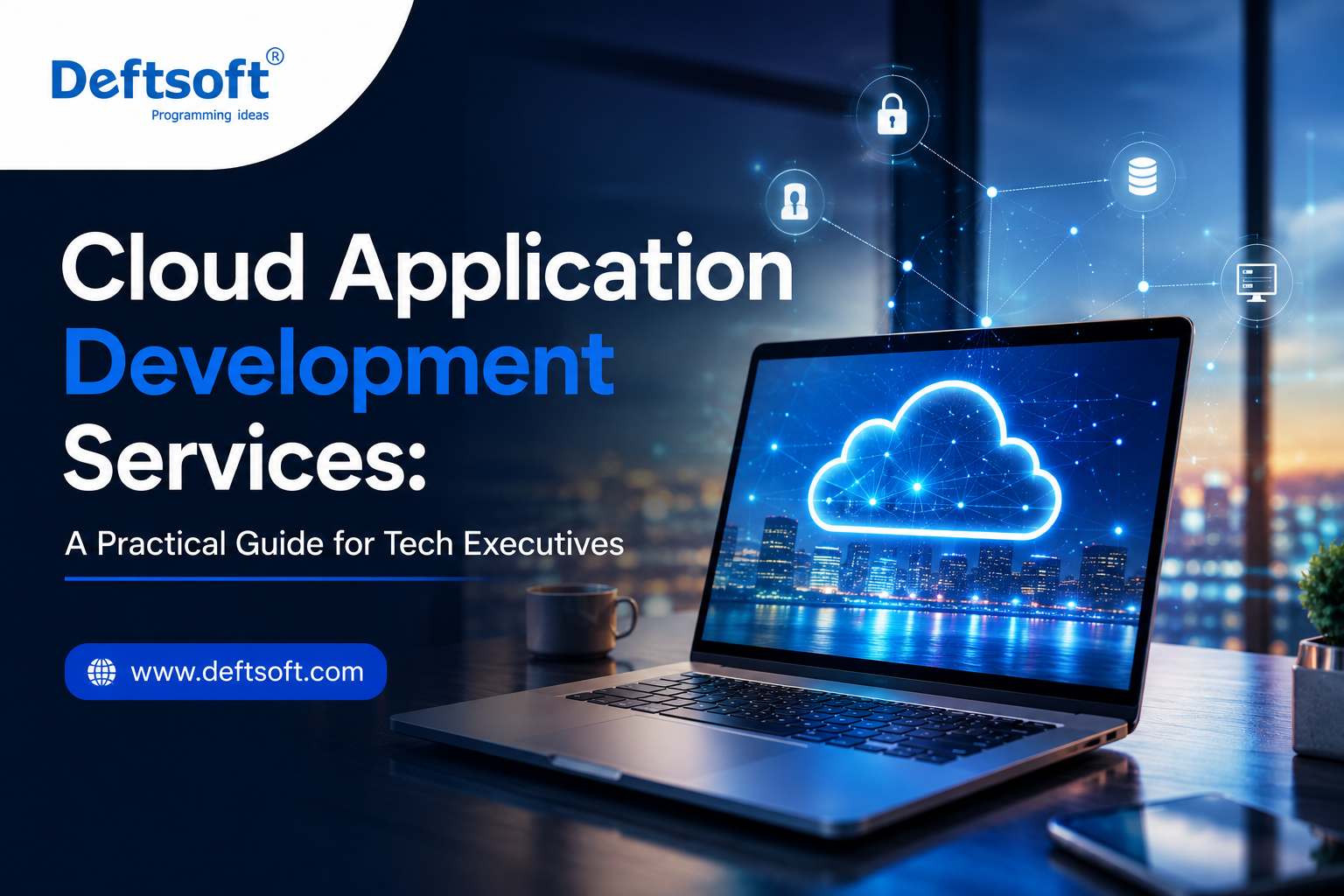
Cloud Application Development Services: A Practical Guide for Tech Executives
-
By Devraj
-
6th August 2026
Cloud is no longer a question of “if”; it’s a question of “how well.” Gartner projects public cloud end-user spending will hit $850 billion in 2026, a 21.3% jump from the year before, and 94% of enterprises now use cloud services in some form. For tech executives, the conversation has shifted from whether to move to the cloud to whether their cloud application development services partner can actually deliver something scalable, secure, and built for how AI-driven workloads now run.
This guide is written for exactly that audience: CTOs, VPs of Engineering, and technical decision-makers evaluating cloud application development, whether that means building something new, modernizing an existing system, or choosing between the growing list of cloud application development companies competing for your budget. Whether your team calls it cloud applications development, application development cloud computing, or simply cloud app development, the underlying questions are the same: which architecture, which provider, and which partner actually gets it right.
Have a cloud application idea but not sure where to start?
Get a clear technical roadmap built around your specific goals.
Quick Navigation
What Is Cloud Application Development?
Why Cloud Application Development Matters in 2026
Cloud Application Development vs. Traditional Development
Core Components of Cloud App Development
Cloud App Development: Build, Migrate, or Modernize?
What to Look for in Cloud Application Development Companies
How Deftsoft Approaches Cloud Application Development
Cloud Application Solutions Across Industries
What Is Cloud Application Development?
Cloud application development is the process of building software that runs on cloud infrastructure rather than local servers or on-premise data centers. Instead of installing an application on a single machine, a cloud application is built to run across distributed, scalable infrastructure, accessible from anywhere, updated centrally, and able to scale up or down based on real demand.
If you’re asking what a cloud application is in the simplest terms, it’s software designed from the ground up to take advantage of cloud infrastructure—elastic compute, managed databases, distributed storage, and on-demand scaling rather than software that was simply moved to a server somewhere.
This distinction matters more than it sounds. Application development for cloud environments requires different architectural thinking than traditional development: statelessness, horizontal scaling, service-oriented design, and resilience against individual component failure are all baked in from day one, not retrofitted later.
Why Cloud Application Development Matters in 2026
The numbers make the case better than any pitch could. The global cloud computing market is valued at roughly $917.9 billion in 2026, on track to cross $1 trillion before year-end, according to Synergy Research Group. Application development and testing specifically account for 45% of cloud adoption use cases, as businesses lean on flexible cloud resources to build faster while keeping cost and security under control.
What’s changed most in the last year is why businesses are investing. 64% of IT decision-makers now say cloud infrastructure is essential to their AI strategy, and 61% of enterprises plan to migrate more workloads to the cloud specifically to support AI initiatives. Cloud-based application development in 2026 increasingly means building applications that can plug directly into AI inference, machine learning pipelines, and real-time data processing — something legacy, on-premise architecture simply wasn’t designed for.
Containers, Kubernetes, and serverless architecture have also crossed from “advanced” to standard practice for new builds; 95% of new digital workloads are now being built on cloud-native platforms. If your application development in cloud computing strategy isn’t cloud-native by default, you’re already behind where the rest of the market has moved.
Cloud Application Development vs. Traditional Development
The difference isn’t just where the code runs — it’s how the entire system is designed to behave.
| Traditional Application Development | Cloud Application Development |
|---|---|
| Built for fixed, on-premise infrastructure | Built for elastic, distributed infrastructure |
| Scaling requires new hardware | Scales on demand, automatically |
| Manual deployment and updates | Continuous deployment, centralized updates |
| Single point of failure risk | Designed for resilience and redundancy |
| High upfront infrastructure cost | Pay-as-you-go, usage-based cost model |
This is exactly why custom cloud application development has become the default approach for businesses building anything meant to scale; the architecture itself is designed around growth and flexibility, not bolted on after the fact.
Core Components of Cloud App Development
Understanding how to develop cloud computing application projects successfully starts with knowing the moving parts involved:
- Cloud infrastructure and hosting — Choosing between AWS, Microsoft Azure, or Google Cloud, which together hold more than 60% of the global market, with AWS at roughly 30% share, Azure at 25%, and Google Cloud at 13% as of early 2026.
- Architecture design — deciding between microservices, serverless, or a hybrid approach based on the application’s actual usage patterns and growth expectations.
- Database and data management — Selecting managed, cloud-native database services that scale independently from the application layer itself.
- APIs and integrations — Building applications that connect cleanly with third-party services, internal systems, and increasingly, AI and machine learning models.
- Security and compliance — Implementing identity management, encryption, and access controls appropriate to the industry and data sensitivity involved.
- DevOps and CI/CD pipelines — Automating deployment, testing, and monitoring so updates ship reliably and frequently, rather than through slow, manual release cycles.
A genuine cloud application development service should be able to speak fluently to all six of these areas, not just the parts that are easiest to build.
Cloud App Development: Build, Migrate, or Modernize?
Most businesses approaching developing cloud applications fall into one of three categories, each requiring a different approach:
- Building new — starting from scratch with cloud-native architecture from day one, ideal for new products, startups, or greenfield internal tools.
- Migrating existing applications — moving an on-premise or legacy system to cloud infrastructure, which requires careful planning to avoid simply recreating old limitations in a new environment.
- Modernizing legacy systems — re-architecting an existing application to actually take advantage of cloud-native capabilities (auto-scaling, managed services, containerization) rather than just relocating it.
Deciding which path applies to your business is one of the first, most important conversations to have with any cloud app development company before a single line of code gets written, because the wrong starting assumption here tends to compound into expensive rework later.
What to Look for in Cloud Application Development Companies
 With so many cloud application development companies competing for enterprise budgets, a few criteria separate serious technical partners from the rest:
- Multi-cloud and hybrid-cloud experience, since 87% of enterprises now operate multi-cloud strategies rather than committing to a single provider
- Security-first architecture, not security added as an afterthought once development is complete
- Proven experience with AI integration, given how central AI workloads have become to cloud strategy in 2026
- Transparent, usage-based cost modeling, so cloud spend stays predictable as the application scales
- Strong DevOps and automation practices, since 93% of developers now deploy code to the cloud as a standard part of their workflow
- A track record with businesses of comparable scale and complexity to your own
A provider offering true cloud development services should be able to walk you through specific examples of each of these — not just a generic capabilities slide.
How Deftsoft Approaches Cloud Application Development
At Deftsoft, we treat cloud application development services as a long-term engineering partnership, not a one-time build-and-hand-off project. Our approach to cloud software development services is built around understanding the business problem first, then architecting a solution around the cloud platform, tools, and services that actually fit — rather than defaulting to whichever stack is fastest to sell.
Whether you need custom cloud application development built from the ground up, help modernizing a legacy system into a cloud-native architecture, or ongoing support scaling an existing application, Deftsoft’s team works across AWS, Azure, and Google Cloud to build solutions matched to your specific technical and business requirements. This includes secure API design, database architecture, CI/CD pipeline setup, and increasingly, integration with AI and machine learning capabilities — since that’s where a growing share of real client demand is heading in 2026.
As a cloud app development company, Deftsoft also places heavy emphasis on cost transparency and architecture that scales predictably, so tech executives aren’t left reconciling ballooning cloud bills against a system that was never designed to scale efficiently in the first place.
Cloud Application Solutions Across Industries
Cloud application solutions aren’t one-size-fits-all — the right architecture depends heavily on industry. In finance, cloud applications support real-time transaction processing and compliance-heavy data handling. In healthcare, cloud platforms enable secure patient data management alongside strict regulatory requirements. Retail and logistics rely on cloud applications for real-time inventory tracking and customer analytics, while manufacturing increasingly leans on cloud-based IoT integration; notably, 94% of manufacturing companies now use or are actively considering cloud-based ERP systems.
Whatever the industry, the underlying principle stays consistent: a genuinely useful cloud application is architected around how the business actually operates, not adapted awkwardly from a generic template afterward.
Common Mistakes Businesses Make in Cloud App Development
Here are the common mistakes businesses make in cloud app development, formatted as bullet points:
- Choosing a Partner Solely on Cost: Selecting a development partner based purely on price, without thoroughly evaluating their architecture quality or security practices, frequently results in costly rework later.
- Treating Migration as a Simple “Lift and Shift”: Moving an existing application directly to the cloud without redesigning it to be cloud-native merely transfers legacy limitations into a more expensive environment.
- Skipping DevOps and Automation Setup: Failing to establish proper DevOps procedures and automated pipelines early on creates bottlenecks and slows down every subsequent release.
- Underestimating Security and Compliance: Neglecting security protocols and regulatory requirements in the initial stages can lead to severe, expensive complications down the line, especially for businesses in regulated industries.
- Architecture Quality: Choosing the wrong programming tool or technology stack for your cloud application—such as selecting a framework that doesn’t scale well with serverless architecture or cross-platform demands—can lead to performance bottlenecks.
Choosing the Right Tech Stack for Cloud-Native Applications
Selecting the right development frameworks and languages is essential for building cloud applications that are performant, scalable, and easy to maintain. Your chosen tech stack directly influences how seamlessly your front-end user experience interacts with back-end cloud microservices.
- Frontend & Cross-Platform Frameworks (Flutter & React / React Native): Tools like React and React Native enable developers to build responsive web and mobile interfaces powered by flexible component architectures. Flutter provides a unified codebase for seamless, high-performance applications across iOS, Android, and web. Both frameworks connect effortlessly to cloud-hosted APIs and serverless backends, delivering consistent user experiences across devices.
- Backend & Serverless Languages (Node.js, Python, Go): Choosing lightweight, event-driven languages for backend operations ensures your application can take full advantage of cloud-native infrastructure, such as AWS Lambda or Google Cloud Functions, without unnecessary overhead or latency.
Already have a legacy system that needs modernizing?
See exactly what a cloud-native rebuild would involve.
Frequently Asked Questions
1. What is cloud application development?
Cloud application development is the process of building software specifically designed to run on cloud infrastructure, taking advantage of elastic scaling, managed services, and distributed architecture rather than fixed, on-premise servers.
2. What is the difference between cloud application development and traditional application development?
Traditional development is built for fixed infrastructure with manual scaling and deployment, while cloud application development is built for elastic, distributed infrastructure that scales automatically and supports continuous deployment.
3. How much does custom cloud application development cost?
Cost depends on the application’s complexity, chosen cloud provider, required integrations, and whether the project involves building new, migrating, or modernizing an existing system. A proper quote should come from a technical assessment of your specific requirements.
4. Which cloud platform is best for application development — AWS, Azure, or Google Cloud?
Each has strengths depending on your needs — AWS holds the largest market share and broadest service catalog, Azure integrates deeply with Microsoft’s enterprise ecosystem, and Google Cloud is strong in AI and data analytics. Many businesses now use a multi-cloud approach rather than committing to just one.
5. How long does it take to develop a cloud application?
Timelines vary based on scope, but a well-scoped cloud application development services engagement typically involves phased delivery, starting with core architecture and an MVP, followed by iterative feature development and scaling.
6. Is cloud application development secure?
When built correctly, yes, often more secure than traditional on-premises systems, since cloud providers invest heavily in infrastructure security. However, security depends heavily on how the application itself is architected, which is why choosing an experienced cloud application development company matters.
7. What industries benefit most from cloud application development?
Nearly every industry benefits, but finance, healthcare, retail, logistics, and manufacturing have seen particularly strong adoption, driven by real-time data needs, compliance requirements, and the growing integration of AI into everyday business operations.




Devraj
 6th August 2026