Flutter vs React Native 2026: Which Cross-Platform Framework Should You Choose?
-
By Devraj
-
10th June 2026
Every year, the Flutter vs React Native debate gets a fresh reset, and 2026 is no exception. But this time, the gap between the two frameworks has genuinely narrowed in unexpected ways, while new differences have opened up in areas that barely existed two years ago.
React Native’s New Architecture is now the default, not an opt-in beta. Flutter has crossed into serious territory for embedded systems, smart TVs, and automotive UIs. AI copilots are reshaping how developers write, test, and maintain code in both ecosystems. And businesses evaluating cross-platform mobile app development services in 2026 are asking sharper questions than ever before: not just “which is faster?” but “which one keeps my app relevant for the next three years?”
This blog cuts through the noise. We are not rehashing the same Dart vs. JavaScript argument. Instead, we focus on what has actually changed in 2026, what still matters, and how to make a confident decision for your next app.
Quick Summary:
- Flutter 3.x and React Native’s New Architecture (Fabric + JSI) have both matured significantly by 2026; this is no longer a one-sided debate.
- Flutter now leads in UI consistency, desktop support, and embedded device targets. React Native leads in depth of the JavaScript ecosystem and in legacy codebase integration.
- AI-assisted development tools have changed how developers build in both frameworks, but the impact differs.
- For businesses investing in cross-platform app development in 2026, the “right” choice depends far more on your product type and team makeup than it did two years ago.
- Deftsoft’s cross-platform development team works with both frameworks and can guide you to the right fit from day one.
Not sure which framework is right for your app?
Talk to Deftsoft’s mobile development experts, get a free 30-minute consultation and walk away with a clear recommendation tailored to your project.
Quick Navigation
What’s Actually New in 2026: The Landscape Has Shifted
Flutter vs React Native 2026: Head-to-Head Comparison
3. Developer Ecosystem and Hiring
4. Multi-Platform Reach in 2026
5. AI Integration and Smart App Features
6. Long-Term Maintenance and Scalability
Which Framework Should You Choose? A Decision Framework
How Deftsoft Approaches Cross-Platform App Development
What’s Actually New in 2026: The Landscape Has Shifted
Before comparing the two frameworks head-to-head, it is worth understanding the context in which they are operating right now.
- Flutter in 2026 runs on a significantly evolved Impeller rendering engine (which fully replaced Skia as the default in late 2024). By 2026, Impeller will have been optimised for predictable frame rates on low-end Android devices, which has historically been Flutter’s weak point. Google has also made strong moves in the embedded and desktop space, with Flutter powering interfaces in automotive dashboards and smart home devices beyond just phones.
- React Native in 2026 is a different beast from what it was even 18 months ago. The New Architecture, built on JSI (JavaScript Interface), Fabric renderer, and TurboModules, is now the baseline, not an upgrade. This eliminates the old asynchronous JavaScript bridge that was React Native’s biggest performance bottleneck for years. The result is a considerably faster, more predictable runtime that puts React Native back in serious contention on performance.
Both frameworks have also integrated tightly with AI-assisted coding environments. GitHub Copilot, Cursor, and Claude-based tools now generate production-quality component code in both Dart and React Native’s JSX, meaning the “learning curve” argument has softened considerably on both sides.
Flutter vs React Native 2026: Head-to-Head Comparison
1. Performance
Flutter’s Impeller engine delivers consistent 60fps to 120fps rendering across devices by compiling shaders ahead of time, removing the jank spikes that plagued earlier versions. For animation-heavy apps, data visualisation dashboards, and games, Flutter still holds a performance edge.
React Native’s New Architecture has eliminated the async bridge, enabling synchronous native calls. In real-world benchmarks for business apps, e-commerce, fintech and healthcare, the performance difference between the two is now marginal. The gap is most visible in graphically intensive applications, where Flutter wins, and in apps with heavy third-party native SDK integration, where React Native’s tighter native thread access gives it an edge.
Verdict: Flutter for graphics-intensive apps. React Native for deep native SDK integration. Near-parity for standard business applications.
2. UI and Design Consistency
Flutter’s widget-based rendering model means your UI looks exactly the same on an Android phone, an iPhone, a web browser, and a Windows desktop. There is no reliance on platform-native components. This is a double-edged sword: you get pixel-perfect consistency, but you also have to manually replicate platform-specific feel (Material You on Android, Cupertino on iOS).
React Native in 2026 renders using native components, so the app naturally inherits the OS’s look and feel. For apps where users expect a native-like experience, React Native often feels more “right” out of the box and requires less work.
Verdict: Flutter for design-forward, brand-consistent apps. React Native for apps that need to feel native to each platform.
3. Developer Ecosystem and Hiring
JavaScript is still the world’s most widely used programming language. This means the talent pool for React Native development services is significantly larger. If you need to scale your development team quickly, React Native gives you more options at lower hiring costs.
Dart, Flutter’s language, is less common but not obscure. By 2026, the Flutter developer community will have grown considerably, and Dart’s learning curve will be accessible for developers coming from typed languages like TypeScript or Kotlin. However, finding senior Flutter developers with three or more years of production experience is still harder than finding React Native equivalents.
Verdict: React Native for faster team scaling. Flutter for projects where a dedicated team is already in place or being built deliberately.
4. Multi-Platform Reach in 2026
This is where Flutter has made the most dramatic strides. Flutter now supports stable builds for Android, iOS, web, Windows, macOS, Linux, and embedded devices, all from a single codebase. For businesses building apps that need to run on tablets, desktops, kiosks, and mobile devices, Flutter’s multi-platform story is unmatched.
React Native’s multi-platform story is primarily mobile-first. React Native for Web exists but is largely community-maintained and requires additional bridging. Desktop support through React Native Windows and macOS is functional but not as polished as Flutter’s.
Verdict: Flutter clearly wins in multi-platform coverage, especially if desktop or embedded targets are part of your roadmap.
5. AI Integration and Smart App Features
Mobile apps in 2026 are expected to include AI features, on-device inference, personalisation engines, generative UI, and more. Both frameworks have SDKs and packages for integrating models from Google, OpenAI, and others.
Flutter benefits from Google’s ecosystem; its TensorFlow Lite and MediaPipe integrations are first-party and well-maintained. React Native benefits from JavaScript’s massive AI library ecosystem and its ability to call any npm-distributed ML package through standard JS.
For on-device AI workloads, Flutter has a slight edge due to tighter platform-level optimisation. For cloud-connected AI features via APIs, both frameworks are functionally equivalent.
Verdict: Flutter for on-device ML. React Native for API-driven AI features.
6. Long-Term Maintenance and Scalability
Apps built in 2026 need to be maintained in 2028 and 2030. Both frameworks have strong corporate backing: Google for Flutter and Meta for React Native, but their trajectories differ.
Flutter’s codebase is self-contained. Updates to Flutter rarely break existing code because it does not depend on platform-native APIs at the rendering level. This makes long-term maintenance more predictable.
React Native’s dependency on native modules means OS updates (especially major iOS releases) can occasionally break existing functionality until the community patches it. With the New Architecture, this risk is reduced but not eliminated.
Verdict: Flutter for lower long-term maintenance burden. React Native for projects that already have strong mobile engineering support.
Which Framework Should You Choose? A Decision Framework
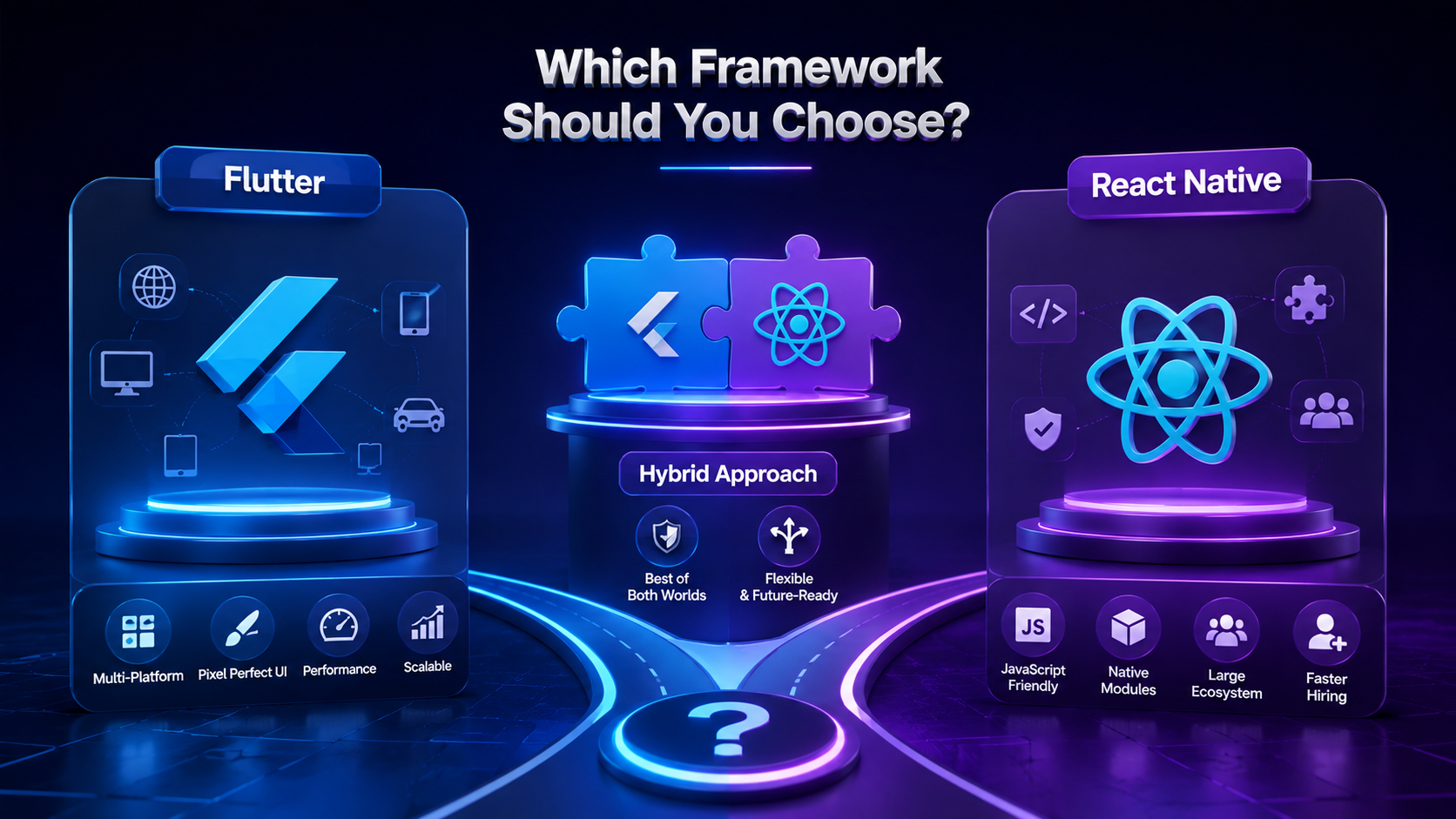
Rather than a universal winner, here is how to think about it based on your situation:
Choose Flutter if:
- Your app needs to run on mobile, web, and desktop from one codebase
- You are building a design-heavy, brand-specific product where UI consistency is critical
- Your team has or is building dedicated mobile specialists
- You are targeting embedded devices, smart TVs, or automotive UIs alongside mobile
- Long-term maintenance predictability matters more than short-term hiring flexibility
Choose React Native if:
- Your team already works in JavaScript or TypeScript
- You need to integrate deeply with third-party native SDKs (payment gateways, biometrics, hardware)
- You are building a primarily mobile-focused app (iOS and Android) without near-term desktop needs
- You need to scale your development team quickly using a broad talent pool
- You are migrating an existing React web application to mobile
Choose a hybrid strategy if:
- You are building a platform with separate consumer-facing and internal tooling apps, Flutter for the consumer app, React Native for the internal tool, for example
- Your roadmap is uncertain, and you want to de-risk vendor dependency
How Deftsoft Approaches Cross-Platform App Development
At Deftsoft, we have built cross-platform mobile applications across both Flutter and React Native for clients in healthcare, fintech, retail, logistics, and education. We do not push one framework over another; we evaluate your product requirements, target devices, existing infrastructure, and budget before recommending a path.
Our Flutter app development team has delivered production apps featuring custom animations, real-time data dashboards, and on-device AI. Our React Native development services cover everything from greenfield apps to migrating legacy codebases to the New Architecture for improved performance.
What sets our cross-platform app development approach apart is our ability to think beyond the framework. We focus on scalable architecture, clean state management, CI/CD pipelines, and post-launch maintenance, because the choice of framework is only the beginning.
Whether you need a Flutter app development company to bring your UI vision to life, or React Native development services to build on your existing JavaScript codebase, our team is equipped to deliver.
Real-World Use Cases: Which Framework Fits Which Product
| Flutter is well-suited for | React Native is well-suited for |
|---|---|
| Fintech and banking apps with custom UI components and animations | E-commerce apps with heavy third-party payment and analytics SDK integration |
| Healthcare apps needing pixel-perfect cross-platform consistency | Social apps where native camera, notifications, and sharing APIs are critical |
| EdTech platforms targeting mobile, web, and tablet simultaneously | Startups building MVPs quickly with JavaScript-native teams |
| IoT companion apps and embedded device interfaces | B2B mobile tools integrated with existing React web dashboards |
| Enterprise internal tools needing desktop + mobile coverage | Apps requiring deep OS-level access on iOS or Android |
Conclusion
The Flutter vs React Native debate in 2026 is not about which framework is alive or dying; both are thriving, have strong corporate backing and ship production apps at scale globally. The real question is which one fits your product, your team, and your three-year roadmap.
Flutter is the stronger choice for teams that want multi-platform reach, UI consistency, and lower long-term maintenance overhead. React Native is the stronger choice for JavaScript-native teams, projects requiring deep native SDK integration, and businesses that need to staff up quickly.
If you are still unsure which path is right for your next app project, Deftsoft’s cross-platform development team can walk you through the decision, no pressure, no sales pitch, just a technical conversation grounded in your actual requirements.
Ready to build your next cross-platform mobile app?
FAQs
Q1. Is Flutter better than React Native in 2026?
Neither is universally better. Flutter leads in multi-platform coverage, UI consistency, and graphics performance. React Native leads in ecosystem maturity, JavaScript talent availability, and native SDK integration. The right choice depends on your specific app requirements and team capabilities.
Q2. Has React Native’s New Architecture fixed its performance issues?
Significantly, yes. The removal of the asynchronous JavaScript bridge through JSI and TurboModules has addressed the primary performance bottleneck. For most standard business applications, React Native’s performance in 2026 is competitive with Flutter.
Q3. Is Flutter good for web apps in 2026?
Flutter for Web has matured considerably. It now supports progressive web apps (PWAs) and delivers consistent performance for web applications. However, for SEO-heavy public-facing websites, a web-native framework is still preferable. Flutter for web works best for web-based internal tools and dashboards.
Q4. How much does cross-platform app development cost in 2026?
Costs vary significantly based on app complexity, features, and team location. Cross-platform development with Flutter or React Native typically costs 30–50% less than building separate native apps for iOS and Android. For a detailed estimate tailored to your project, you can reach out to Deftsoft for a free consultation.
Q5. Can Deftsoft work with both Flutter and React Native?
Yes. Deftsoft’s mobile development team is experienced in both frameworks. We assess your project requirements and recommend the framework that best aligns with your goals, timeline, and budget.
Q6. What is the typical development timeline for a cross-platform mobile app?
A standard cross-platform mobile app with core features typically takes 3 to 6 months from design to deployment. Complex apps with AI features, real-time functionality, or enterprise integrations may take longer. Deftsoft follows Agile sprint cycles to deliver incremental, testable builds throughout the project.
Q7. Is Dart hard to learn for a JavaScript developer?
Dart is a statically typed language with syntax familiar to anyone who knows JavaScript, TypeScript, Java, or C#. Most developers with experience in JavaScript or TypeScript become productive in Dart within a few weeks. The availability of AI coding assistants in 2026 has also made the onboarding process faster than before.
Recent Articles






Devraj
 10th June 2026