What Is a Content Roadmap? A Complete Guide to Better Content
-
By Devraj
-
17th August 2026
Most businesses regularly post on their website or social channels, but very few publish content that actually moves the needle. The difference almost always comes down to strategic planning. If your blog posts feel disconnected, your traffic has hit a plateau, or your team is constantly wondering what to write next, you are likely missing a clear content roadmap or the one you simply aren’t delivering.
This guide breaks down exactly what a content roadmap is, why your brand needs one, and how to build a strategy that drives measurable traffic. From in-depth keyword research and topic pillars to content calendars, performance tracking, and expert SEO services, you will learn how to build a roadmap that keeps your strategy on target and produces real growth.
Ready to scale your content strategy with a customized roadmap?
Align your content with real business growth.
Quick Navigation
Why Is a Content Roadmap Important?
Keeps Content Aligned With Business Goals
Helps You Create More Consistent Content
Prevents Random or Repetitive Topics
Helps Measure Content Performance
Future-Proofs Your Brand for AI Search
Content Roadmap vs. Content Calendar: What’s the Difference?
What Should a Content Roadmap Include?
Content Owners and Responsibilities
How to Create a Content Roadmap Step by Step
2. Understand Your Target Audience
3. Conduct Keyword and Topic Research
5. Choose the Right Content Formats
7. Create a Publishing Timeline
8. Assign Roles and Responsibilities
9. Define KPIs and Track Performance
How to Organise Your Content Roadmap
Common Content Roadmap Mistakes to Avoid
How to Keep Your Content Roadmap Updated
Content Roadmap Tools You Can Use
What Is a Content Roadmap?
A content roadmap is a strategic plan that maps out what content you’ll create, why you’re creating it, who it’s for, and when you’ll publish it. It connects your content goals, audience needs, topics, channels, and timelines into a single, coherent framework. Think of it as the strategy layer above your day-to-day publishing schedule.
It’s different from a basic content calendar, which tells your team when to publish. A content roadmap tells your team what to create and why it matters long before a single word gets written. It connects your content goals, audience needs, topics, channels, and timelines into a single framework. In today’s landscape, a complete roadmap also accounts for AI SEO ensuring your content isn’t just optimized for traditional Google searches, but structured for ranking on ChatGPT and other conversational engines.
Simple example: A SaaS company targeting HR managers might build a content roadmap with three pillars: employee onboarding, HR compliance, and team productivity. Each pillar gets target keywords, formats (blog posts, guides, case studies), assigned writers, and a quarterly publishing plan. That’s a content roadmap in action.
A content roadmap answers:
- What are we trying to achieve with content?
- Who are we writing for?
- Which topics and keywords will we cover?
- What formats and channels will we use?
- What does the timeline look like?
- How will we know if it’s working?
Why Is a Content Roadmap Important?
Publishing content without a roadmap is like building a house without blueprints. You might get something standing, but it won’t be efficient, structurally sound, or built to last.
Here’s what a well-built content roadmap actually does for your business.
Keeps Content Aligned With Business Goals
Every piece of content should serve a purpose driving traffic, generating leads, building brand authority, or retaining customers. A content roadmap forces you to start with business objectives and work backwards to content decisions. Without this alignment, teams end up publishing content that gets clicks but converts nobody.
Helps You Create More Consistent Content
Consistency is one of the hardest parts of content marketing. Without a plan, publishing frequency drops during busy periods and spikes randomly when someone has a sudden idea. A roadmap gives you a predictable publishing rhythm, which also sends positive signals to search engines.
Makes Content Planning Easier
Instead of reinventing the wheel every week, your team works from a pre-approved plan. Topic ideas, keyword targets, formats, and owners are already decided. This removes the friction that kills most content programs, the blank-page problem at the planning stage.
Prevents Random or Repetitive Topics
Without a roadmap, teams often write about the same topics twice, skip important areas entirely, or chase trending topics that have nothing to do with the business. A roadmap maps your coverage intentionally, so every piece adds something new and relevant.
Improves Team Collaboration
A content roadmap gives writers, SEO specialists, designers, editors, and developers a shared view of what’s happening and when. Everyone knows their role, their deadlines, and how their work fits into the bigger picture. This is especially important for content writing services teams managing multiple projects at once.
Helps Measure Content Performance
You can’t improve what you don’t measure. A content roadmap defines KPIs upfront organic traffic, rankings, leads, conversions so performance tracking becomes part of the process rather than an afterthought. This is what separates professional SEO content writing services from random publishing.
Future-Proofs Your Brand for AI Search
Search behavior is shifting toward zero-click and generative answers. A structured content roadmap ensures your content is formatted specifically for ranking on Google AI Overview and AI discovery tools, helping your brand stay visible as generative search evolves.
Content Roadmap vs. Content Calendar: What’s the Difference?
These two terms get used interchangeably, but they serve different functions. You need both.
| Comparison | Content Roadmap | Content Calendar |
|---|---|---|
| Purpose | Strategic | Execution-focused |
| Answers | What and why | When and who |
| Scope | Broad goals and priorities | Publishing schedule |
| Timeframe | Months or quarters | Days, weeks, upcoming posts |
| Audience | Leadership, marketing leads | Writers, editors, designers |
| Contains | Pillars, goals, KPIs, personas | Titles, dates, formats, statuses |
The roadmap sets direction. The calendar executes it. A team with a calendar but no roadmap is running fast without knowing where it’s going. A team that has a roadmap but no calendar has a strategy that never ships.
Use them together. Build the roadmap first, then populate your calendar from it.
What Should a Content Roadmap Include?
A strong content roadmap covers ten core components. Skip any of them, and you’ll end up with gaps in your strategy.
Content Goals
Define what you want content to achieve: more organic traffic, more leads, better brand visibility, higher conversions, or improved customer retention. Goals should be specific and measurable, not vague intentions like “create more content.”
Target Audience
Describe who you’re creating content for. Include demographics, job roles, industries, and the platforms they use. This shapes everything from the topics you choose to the tone you write in.
Buyer Personas
Go deeper than your general audience. Create 2–4 detailed buyer personas with names, challenges, goals, and where they are in the buying journey. Your content should speak to specific people, not abstract groups.
Content Topics and Pillars
Identify 3–6 core topic areas (pillars) that you’ll own. Each pillar becomes a hub of related content. For example, an SEO agency might build pillars around technical SEO, content strategy, link building, and local SEO.
Target Keywords
Every topic should map to keywords your audience is actually searching. Include primary keywords, long-tail variations, and related terms. This is where a proper SEO content strategy starts matching your content plan to search demand.
Content Formats
Not every topic needs a blog post. Decide whether each piece will be a long-form guide, case study, video, infographic, social content, or landing page. Format decisions affect resources, timelines, and performance.
Publishing Channels
Where will the content live? Your blog, LinkedIn, YouTube, email newsletter, or partner publications? Different channels serve different audiences and stages of the buyer journey.
Content Timeline
Map content to a monthly or quarterly calendar. Include publication dates, review milestones, and seasonal priorities. This turns your roadmap from a wish list into a real plan.
Content Owners and Responsibilities
Every piece of content needs an owner. Assign a writer, SEO specialist, editor, and designer for each item. Without clear ownership, content gets stuck in limbo.
KPIs and Performance Metrics
Define how you’ll measure success before you start. Common content KPIs include organic traffic, keyword rankings, impressions, click-through rate, time on page, leads generated, and conversions. Build a content analytics framework into the roadmap from day one.
How to Create a Content Roadmap Step by Step
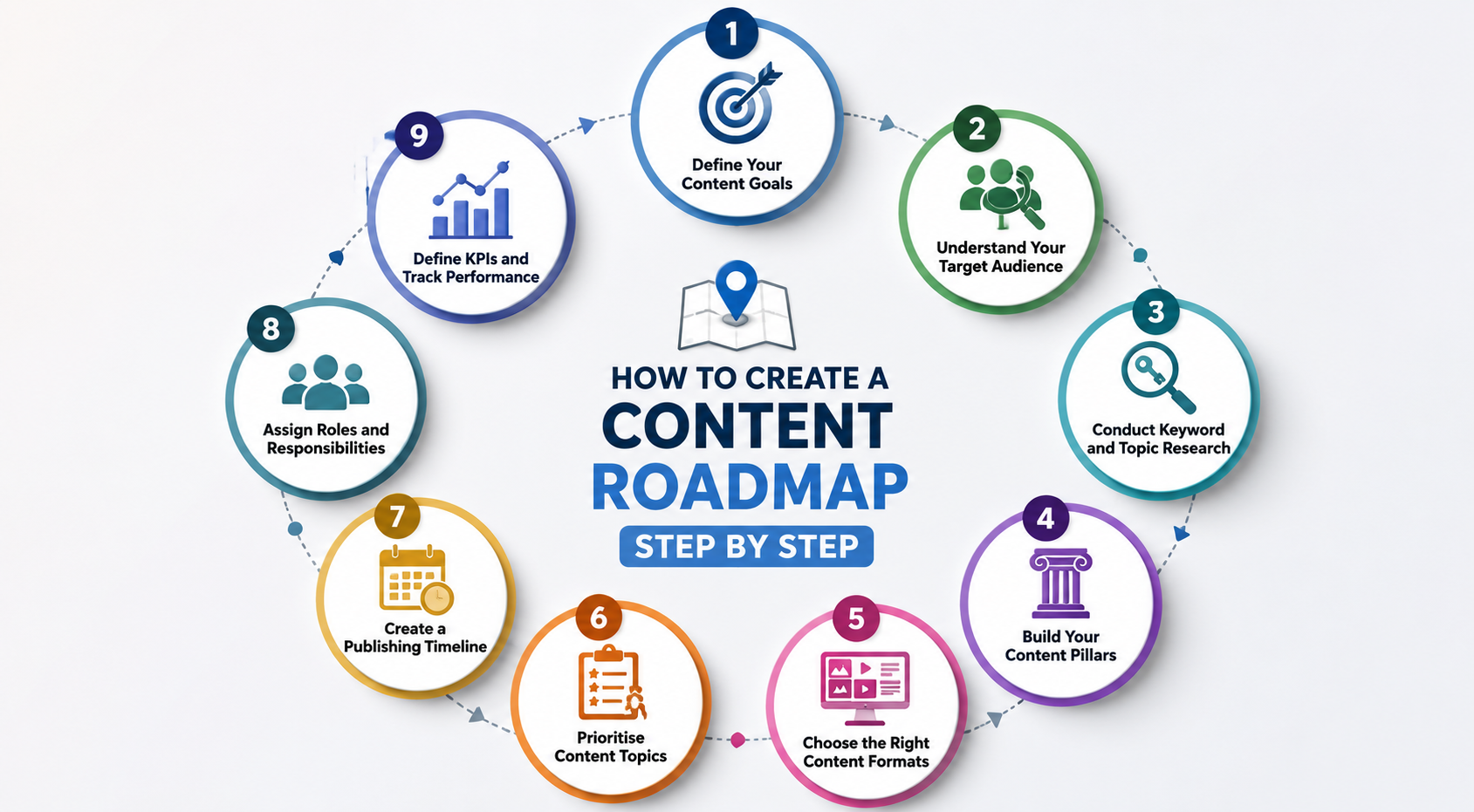 This is where strategy becomes action. Follow these nine steps to build a content roadmap that actually works.
1. Define Your Content Goals
Start with the end in mind. What do you want content to do for your business over the next three to six months?
Common content goals include:
- Traffic — grow organic search visitors by X%
- Leads — generate X qualified leads per month from content
- Brand awareness — rank for X new branded or industry keywords
- Conversions — increase content-driven trial signups or purchases
- Customer retention — reduce churn through helpful post-purchase content
Be specific. “Create better content” is not a goal. “Grow organic traffic by 40% in Q3 by targeting 25 new keywords” is.
2. Understand Your Target Audience
Before you pick a single topic, get clear on who you’re writing for. A good SEO content writer doesn’t just match keywords; they match search intent and reader psychology.
Research your audience’s:
- Search intent — are they looking to learn, compare, or buy?
- Pain points — what problems are they trying to solve?
- Questions — what do they ask Google, their peers, or sales reps?
- Buying journey — are they discovering the problem, evaluating solutions, or ready to purchase?
Use tools like Google Search Console, AnswerThePublic, Reddit, and customer interviews to build a real picture of your audience.
3. Conduct Keyword and Topic Research
Keyword research is the backbone of any SEO content strategy. You need to know what your audience is searching for before you can create content that ranks.
Research should cover:
- Primary keywords — high-intent terms directly related to your product or service
- Long-tail keywords — more specific phrases with lower volume but higher conversion potential
- Related searches — semantically connected terms that signal topical depth to Google
- Competitor content gaps — topics your competitors rank for that you don’t
A thorough SEO content audit of your existing content is also essential at this stage. Identify what’s working, what’s underperforming, and where the gaps are. This prevents you from recreating content you already have.
4. Build Your Content Pillars
Content pillars are the 3–6 core topic areas that define your content territory. Every other piece of content connects back to a pillar.
To build pillars:
- List the broad topics most relevant to your business and audience
- Check that each pillar has sufficient keyword volume and commercial relevance
- Create a cluster of 5–10 supporting topics around each pillar
- Map pillar pages (comprehensive guides) and cluster pages (more specific articles) for each
Strong pillars create topical authority Google recognises your site as an expert in that space, which improves rankings across the entire cluster.
5. Choose the Right Content Formats
Different topics, audiences, and funnel stages call for different formats. Don’t default to blog posts for everything.
| Format | Best For |
|---|---|
| Long-form blog posts | SEO traffic, top-of-funnel awareness |
| Comprehensive guides | Topical authority, complex topics |
| Case studies | Mid-to-bottom funnel, proof of results |
| Videos | Explainers, product demos, social engagement |
| Infographics | Data visualisation, shareable social content |
| Landing pages | Bottom-of-funnel conversions |
| Social content | Distribution, brand awareness, community building |
If budget is a constraint, prioritise formats with the highest ROI for your specific goals. For most B2B businesses, long-form SEO blog posts and guides deliver the strongest long-term return, which is why professional content creation services focus heavily on these formats.
6. Prioritise Content Topics
You can’t write everything at once. Use a prioritisation framework to decide what gets built first.
Score each topic on:
- Search demand — how many people are searching for this?
- Business value — does ranking for this drive leads or revenue?
- Competition — how hard is it to rank for this keyword?
- Search intent — does the intent match what we’re offering?
- Content gaps — do we already cover this?
High priority = high demand + high business value + achievable competition + clear intent match + no existing content.
7. Create a Publishing Timeline
Map your prioritised topics onto a timeline. Be realistic about your team’s capacity.
Consider:
- Monthly planning — what gets published each month?
- Quarterly planning — which pillars get covered in Q1 vs Q2?
- Content frequency — how many pieces per week or month?
- Seasonal opportunities — are there events, product launches, or industry moments to plan around?
Build in buffer time for editing, design, SEO review, and approvals. A roadmap that assumes everything will be published on the first draft will always run late.
8. Assign Roles and Responsibilities
Every piece of content should have a named owner for each stage. A typical content team includes:
- Writer — researches and drafts the content
- SEO specialist — handles keyword mapping, on-page optimisation, and internal linking
- Designer — creates supporting visuals, infographics, or featured images
- Editor — reviews for accuracy, clarity, tone, and brand consistency
- Developer — handles technical publishing, schema markup, and page performance
For businesses using external SEO content writing services, make sure these roles are still clearly mapped even when some are outsourced.
9. Define KPIs and Track Performance
Set measurement criteria for every piece of content before it goes live. Using a content analytics platform, track:
- Organic traffic — sessions from search engines
- Keyword rankings — position tracking for target keywords
- Impressions and clicks — from Google Search Console
- Click-through rate (CTR) — are your titles and meta descriptions compelling?
- Leads and conversions — is content driving actual business outcomes?
- Engagement metrics — time on page, scroll depth, bounce rate
Review performance monthly and use the data to update your roadmap. Refresh underperforming content; don’t abandon it.
Content Roadmap Example
Here’s a practical content roadmap example for a hypothetical SaaS company that provides HR software.
- Business goal: Increase organic traffic by 35% and generate 50 qualified leads per month from content.
- Audience: HR managers and People Ops leads at companies with 50–500 employees.
- Content pillars: Employee Onboarding · HR Compliance · Team Productivity · HR Tech & Tools
| Content Pillar | Topic | Format | Primary Keyword | Funnel Stage | Priority |
|---|---|---|---|---|---|
| Employee Onboarding | Complete guide to employee onboarding | Long-form guide | employee onboarding guide | Top | High |
| Employee Onboarding | Onboarding checklist for new hires | Blog post | onboarding checklist | Top | High |
| Employee Onboarding | How to onboard remote employees | Blog post | remote employee onboarding | Top | Medium |
| HR Compliance | HR compliance checklist for small businesses | Guide | HR compliance checklist | Top | High |
| HR Compliance | What is POSH compliance? | Blog post | POSH compliance | Top | Medium |
| HR Compliance | How to stay compliant during employee termination | Blog post | employee termination compliance | Mid | Medium |
| Team Productivity | Best tools for HR team productivity | Comparison post | HR productivity tools | Mid | High |
| Team Productivity | How to measure employee engagement | Blog post | measure employee engagement | Top | Medium |
| HR Tech & Tools | Best HR software for small business | Comparison post | best HR software small business | Bottom | High |
| HR Tech & Tools | [Brand] vs [Competitor]: HR software comparison | Comparison | [brand] vs [competitor] | Bottom | High |
| HR Tech & Tools | How to choose HR software for your company | Guide | How to choose HR software | Mid | Medium |
This roadmap gives the team a clear picture of what gets written, why it matters, who it’s for, and how to measure success.
How to Organise Your Content Roadmap
The best content roadmap is one your team will actually use. Organisation matters as much as content.
- By quarter: Divide your roadmap into Q1, Q2, Q3, Q4 with clear deliverables and goals for each period. This makes planning meetings more focused and gives leadership visibility into the plan.
- By pillar: Group all content under its relevant pillar. This makes it easy to see if certain pillars are over-resourced and others are neglected.
- By funnel stage: Label each piece as top-of-funnel (awareness), mid-funnel (consideration), or bottom-of-funnel (decision). A healthy roadmap covers all three stages.
- By status: Track every piece as Planned, In Progress, In Review, Published, or Live. This gives the whole team real-time visibility without requiring status-update meetings.
Whatever format you choose, your roadmap should be accessible to everyone who touches content writers, SEO specialists, designers, and stakeholders.
Common Content Roadmap Mistakes to Avoid
Even experienced teams fall into these traps. Avoiding them early saves significant time and budget.
- Creating content without clear goals. If you can’t explain why you’re writing a piece and what it’s supposed to achieve, you probably shouldn’t be writing it yet.
- Focusing only on high-volume keywords. High-volume keywords are usually high-competition. Long-tail keywords with clearer intent often drive better-qualified traffic with less effort.
- Ignoring search intent. Writing an informational blog post for a keyword where users want to buy something is a wasted effort. Always match format and angle to search intent.
- Publishing without a consistent schedule. Sporadic publishing confuses audiences and doesn’t build the editorial momentum that SEO requires.
- Creating too many topics at once. Spreading your team too thin produces average content across many topics rather than excellent content on the right ones. Depth beats breadth.
- Not updating existing content. Publishing new content while ignoring underperforming old content is inefficient. Refreshing and improving existing posts often drives faster ranking improvements than publishing new ones.
- Failing to track results. Content without measurement is guesswork. If you’re not tracking organic traffic, rankings, and conversions, you have no basis for decisions.
- Treating the roadmap as a fixed document. A content roadmap should evolve. Markets shift, algorithms update, business priorities change. A roadmap that can’t adapt will quickly become irrelevant.
How to Keep Your Content Roadmap Updated
A content roadmap isn’t something you build once and forget. The most effective teams revisit it regularly.
- Review performance monthly. Pull data from Google Search Console, your analytics platform, and your CRM. Which pieces are driving traffic and leads? Which are underperforming?
- Identify content gaps. Run a fresh keyword gap analysis quarterly. New search trends emerge, competitors publish new content, and your business evolves. Your roadmap should reflect these changes.
- Update underperforming content. Before adding new topics, look at what’s already live. A well-executed SEO content audit often reveals content you can refresh, expand, or consolidate to drive significantly better results.
- Add new keyword opportunities. Set up rank tracking and keyword monitoring alerts so that new opportunities surface automatically and can be added to your roadmap pipeline.
- Adjust priorities based on business goals. If the business is entering a new market or launching a new product, shift your content roadmap accordingly. Content that supported last quarter’s goals may not support this quarter’s.
- Monitor competitors and search trends. Use tools like Semrush or Ahrefs to track competitor content regularly. If a competitor publishes a comprehensive piece on a topic in your roadmap, you need to produce something better.
Content Roadmap Tools You Can Use
You don’t need expensive software to build a content roadmap. You need a tool your team will actually use consistently.
- Spreadsheets (Google Sheets or Excel) — The most accessible option for small teams. Flexible, easy to share, and good enough for most roadmaps. Build columns for pillar, topic, keyword, format, owner, status, and publish date.
- Project management tools (Notion, Asana, Trello, ClickUp) — Better for teams that need task assignment, deadline tracking, and status views. Notion is especially popular for content teams because it combines database views with document editing.
- Dedicated content planning platforms (CoSchedule, DivvyHQ, Percolate) — Purpose-built for content teams. Include editorial calendar views, workflow approvals, and publishing integrations. Better for larger teams managing high content volumes.
- SEO research tools (Ahrefs, Semrush, Moz) — Essential for the keyword and topic research phase of your roadmap. Use these to identify search demand, keyword difficulty, competitor gaps, and content opportunities.
- Analytics tools (Google Search Console, GA4, Looker Studio) — Critical for the measurement side of your roadmap. Connect your content performance data back to the roadmap to inform ongoing prioritisation.
- AI writing and research tools (ChatGPT, Jasper, Surfer SEO) — Useful for ideation, outline generation, and content briefs. Not a replacement for expert SEO content writing services, but a useful accelerator when used correctly.
Why Choose Deftsoft for Content Marketing?
Building and executing a content roadmap takes expertise, time, and a team that understands both SEO and business strategy. Most companies have one or two of those things, rarely all three.
Deftsoft’s content marketing team brings all three together.
We offer end-to-end SEO content writing services, from strategy and keyword research to writing, optimisation, and performance tracking. Our SEO content writers are trained to write for both readers and search engines, producing content that ranks and converts.
Here’s what working with Deftsoft looks like:
- SEO content strategy built around your business goals, not generic best practices
- Full SEO content audit of your existing content to identify quick wins and structural gaps
- Keyword research and content pillar mapping using real search data
- Professional content creation services across blog posts, guides, landing pages, and more
- Content analytics reporting so you can see exactly what your content is delivering
- Ongoing roadmap management so your content strategy evolves with your business
- AI SEO & Generative Engine Optimization (GEO) strategies designed for ranking on ChatGPT and Google’s generative search.
- Content structured with clear schema, direct summaries, and semantic data to secure citations and ranking on Google AI Overview.
Whether you’re starting from scratch or looking to scale an existing content programme, Deftsoft has the team, tools, and track record to get results.
Conclusion
A content roadmap is the difference between a content programme that grows and one that stagnates. Without one, you’re publishing in the dark, hoping something sticks. With one, every piece of content has a purpose, a target audience, a keyword strategy, and a way to measure whether it worked. The steps are straightforward: start with your business goals, understand your audience, research keywords, build pillars, choose formats, prioritise topics, set a timeline, assign owners, and track results. Good execution separates businesses that treat content as a cost from those that treat it as an asset.
Don’t let your content strategy fall flat.
Build a high-performing content roadmap that drives measurable results.
Frequently Asked Questions
What is a content audit?
A content audit is a systematic review of all the content a website has published. It evaluates each piece for SEO performance, accuracy, relevance, and alignment with current business goals. A good SEO content audit identifies what to update, consolidate or redirect and delete. It’s a critical first step before building or refreshing any content roadmap.
How do I add a table of contents in Word?
To add a table of contents in Word, place your cursor where you want it to appear. Go to References → Table of Contents → choose a built-in style. Word automatically generates a clickable TOC from your heading styles (Heading 1, Heading 2, etc.). To update it, click anywhere in the TOC and select the Update Table. For this to work correctly, all headings in your document must use Word’s built-in heading styles, not manually formatted text.
What is the difference between a content roadmap and a content calendar?
A content roadmap is strategic; it defines what you’ll create and why, covering goals, pillars, audience, and KPIs over months or quarters. A content calendar is operational; it schedules exactly when content will be published and tracks its production status. The two work together: the roadmap sets direction, the calendar executes it.
How do you create a content roadmap?
To create a content roadmap: define your content goals, research your audience and their search intent, conduct keyword and topic research, build content pillars, choose content formats, prioritise your topic list, create a publishing timeline, assign owners and responsibilities, and set KPIs for measuring performance. Review and update the roadmap regularly based on performance data.
What should a content roadmap include?
A complete content roadmap should include content goals, target audience and buyer personas, content pillars and topic clusters, target keywords, content formats, publishing channels, a content timeline, assigned roles and responsibilities, and KPIs for tracking performance.
How far in advance should you plan a content roadmap?
Most content teams plan their roadmap one quarter in advance, covering roughly 3 months of content in detail. You can plan high-level goals and pillar topics 6–12 months out. Planning too far in advance in detail often wastes effort, as priorities shift. Planning too close to publication creates chaos. A quarterly rolling plan with an annual strategic overview is the most practical approach.
Why is a content roadmap important for SEO?
A content roadmap ensures your SEO content strategy is coherent, intentional, and built around search demand. Without one, teams publish random content that doesn’t build topical authority, miss important keywords, and fail to compound over time. A roadmap ensures you systematically cover key topics, target the right keywords, and create content that builds domain authority all critical factors in long-term SEO performance.
What tools can you use to create a content roadmap?
Useful tools include Google Sheets or Notion for the roadmap itself, Ahrefs or Semrush for keyword and competitor research, Google Search Console and GA4 for performance tracking, Asana or ClickUp for workflow and task management, and CoSchedule or DivvyHQ for dedicated content calendar management. The right tool depends on your team size, budget, and how much of the process you need to automate.
Recent Articles






Devraj
 17th August 2026