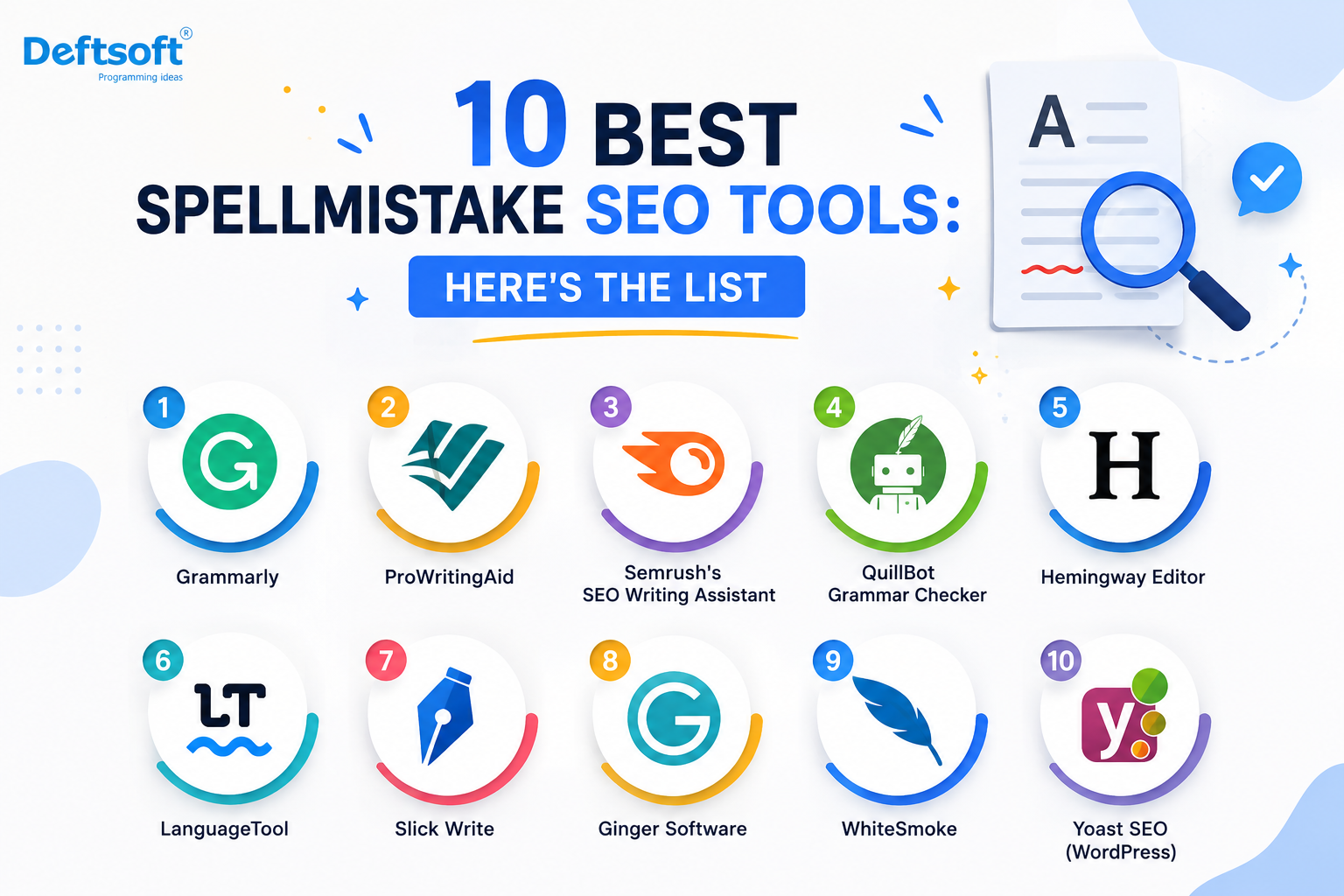
10 Best Spellmistake SEO Tools: Here’s the List
-
By Devraj
-
13th August 2026
A single spelling mistake on a webpage might seem small, but it can quietly hurt how your content performs. Readers lose trust fast when they spot typos, and search engines are increasingly good at judging content quality, including how clean and professional your writing actually is. This is exactly why spellmistake SEO tools have become a real part of a proper content workflow, not just an afterthought before hitting publish.
In this guide, we’re covering the 10 best SEO tools built to catch spelling and grammar issues before they ever go live, how they fit into a broader SEO strategy, and why clean content matters more than ever now that AI SEO and answer-engine visibility are part of the picture too.
Want your content reviewed for both quality and SEO performance?
see exactly where your content stands.
Quick Navigation
Why Spelling Mistakes Actually Matter for SEO
The 10 Best Spellmistake SEO Tools
How to Choose the Right Spellmistake SEO Tool for Your Team
Common Spelling Mistakes That Hurt SEO Content Most
How to Build Spelling Checks Into Your Content Workflow
Spelling Accuracy Is Just One Piece of a Bigger SEO Picture
Why Spelling Mistakes Actually Matter for SEO
It’s worth understanding why this is a real ranking and trust factor before jumping into the tool list.
- Trust and credibility take a hit fast. A visitor who spots a typo on your homepage or product page starts questioning everything else on the page too, including whether your business is careful with details in general.
- Bounce rate rises with sloppy content. When readers hit confusing or error-filled text, they leave quickly, and a high bounce rate is a signal search engines use to judge whether a page actually satisfies a search query.
- Google increasingly rewards well-written, high-quality content. While a single typo won’t tank your rankings on its own, consistently poor writing quality correlates with weaker overall content performance.
- AI-driven search tools are picky about clarity. As more visibility comes from AI SEO, AEO, and GEO where AI tools summarize or cite your content directly, clear writing matters even more, since confusing or error-filled text is harder for AI systems to accurately understand and quote.
With that context, here’s the list.
The 10 Best Spellmistake SEO Tools
1. Grammarly
Grammarly is one of the most widely used best spellmistake SEO tools available today, and for good reason. It catches spelling errors, contextual grammar mistakes, and punctuation issues, while also flagging tone and clarity problems. The free version handles basic spelling and grammar, while the premium tier goes deeper into advanced grammar and style suggestions making it a strong first choice for most content teams.
2. ProWritingAid
ProWritingAid stands out for its detailed writing reports, covering everything from spelling consistency to sentence structure and readability. It integrates with Google Docs, Microsoft Word, and Scrivener, and its free version offers a solid web-based spelling and grammar check for shorter content pieces.
3. Semrush’s SEO Writing Assistant
Since Semrush is primarily known as an SEO platform, its writing tools are built with SEO specifically in mind. Its SEO Writing Assistant checks spelling and grammar while also scoring your content for readability and keyword usage, making it one of the more SEO-native spellmistake SEO tools on this list.
4. QuillBot Grammar Checker
QuillBot combines spelling and grammar correction with its well-known AI paraphrasing engine, so you can fix errors and rephrase awkward sentences in the same workflow. This makes it especially useful for content teams producing high volumes of blog or web content.
5. Hemingway Editor
While not a pure spell-checker, Hemingway Editor is excellent at flagging overly complex sentences, passive voice, and readability issues alongside basic spelling errors. It’s a strong companion tool for tightening up content after a first grammar pass.
6. LanguageTool
LanguageTool is a strong, multilingual option that catches spelling, grammar, and style issues across more than 20 languages, making it especially useful for businesses managing content in multiple markets. It offers browser extensions and integrations with word processors and CMS platforms.
7. Slick Write
Slick Write is a free, browser-based tool built specifically with bloggers, students, and SEO professionals in mind. Beyond spelling and grammar, it generates detailed reports covering sentence structure, passive voice usage, and readability all useful signals for content quality.
8. Ginger Software
Ginger offers real-time spelling and grammar correction along with a built-in translator and personal trainer feature that helps you learn from repeated mistakes over time. It’s a solid, lightweight option for individual writers and small content teams.
9. WhiteSmoke
WhiteSmoke combines spelling and grammar checking with plagiarism detection, making it useful for content teams that need to verify both originality and accuracy before publishing.
10. Yoast SEO (WordPress)
For WordPress users specifically, Yoast SEO includes a built-in readability and basic writing quality checker alongside its core SEO features, flagging overly long sentences, passive voice, and structural issues directly inside your WordPress editor right where you’re already optimizing for SEO.
How to Choose the Right Spellmistake SEO Tool for Your Team
With this many options, picking the right one comes down to a few practical factors:
| Factor | What to Consider |
|---|---|
| Content volume | High-volume teams benefit from tools like QuillBot or Semrush that combine correction with rewriting. |
| Budget | Free tools like LanguageTool and Slick Write cover the basics well before you need a paid upgrade. |
| SEO integration | Semrush’s Writing Assistant and Yoast SEO tie spelling checks directly into your SEO workflow. |
| Multilingual content | LanguageTool and Ginger support checking across multiple languages. |
| Depth of feedback | ProWritingAid and Hemingway Editor go beyond spelling into deeper style and readability analysis. |
There’s no single “best” answer for every business; a small blog might do fine with a free tool, while a larger content operation publishing across multiple markets benefits from a more integrated, SEO-native option.
Common Spelling Mistakes That Hurt SEO Content Most
Not every spelling issue carries the same weight. A few specific mistakes tend to show up repeatedly across websites and cause more damage than others:
- Homophone errors — mixing up words like “their/there/they’re” or “its/it’s” reads as careless even to casual readers, and these are exactly the kind of mistakes basic spell-check misses since the words themselves are spelled correctly
- Inconsistent brand or product spelling — a business name or product spelled two different ways across a site confuses both readers and search engines trying to understand what your content is actually about
- Typos in headings and titles — errors in H1s, page titles, or meta descriptions are especially damaging, since these are often the first thing both readers and AI-driven search tools evaluate
- Autocorrect-introduced errors — mobile writing and quick edits often introduce errors that look plausible at a glance but change the actual meaning of a sentence
- Repeated words — a leftover “the the” or duplicated phrase from editing is one of the most common and easily missed errors, especially in longer content
Most of the tools listed above catch these automatically, but it’s worth training your team to specifically watch for homophones and heading-level errors during manual review, since these are the mistakes automated tools sometimes miss or under-flag.
How to Build Spelling Checks Into Your Content Workflow
Having the right tool only helps if it’s actually part of your process. A simple, effective workflow looks like this:
- Draft the content without worrying too much about perfection on the first pass
- Run it through a spelling and grammar tool like Grammarly or LanguageTool to catch the obvious errors
- Do a manual read-through, specifically checking headings, titles, and meta descriptions, since these carry outsized SEO weight
- Have a second person review it if possible, since writers often miss their own repeated mistakes
- Re-check after any edits, since new errors can slip in during revision just as easily as during the first draft
Skipping steps 3 and 4 is one of the most common reasons errors still make it onto a live page even when a team is already using a good spelling tool; automated tools catch most issues, but they’re not a complete substitute for a careful final read.
Spelling Accuracy Is Just One Piece of a Bigger SEO Picture
Clean, error-free writing supports good SEO, but it’s only one part of what actually drives visibility today. A well-written page still needs strong keyword strategy, solid technical SEO, and increasingly, visibility inside AI-generated answers which is where AI SEO, AEO, and GEO come into the picture.
- AI SEO focuses on optimizing your overall visibility across both traditional search engines and AI-powered tools, and clean, well-structured writing is exactly the kind of content AI systems trust and cite.
- AEO (Answer Engine Optimization) is about structuring content so it becomes the direct answer inside tools like Google’s AI Overviews and confusing, error-filled writing makes that much harder to achieve.
- GEO (Generative Engine Optimization) focuses on getting your brand mentioned and cited by AI tools like ChatGPT, which depends heavily on your content being clear enough for an AI model to accurately summarize.
In other words, spelling and grammar tools aren’t a replacement for a real SEO strategy, they’re a foundational layer that makes the rest of your SEO, AEO, and GEO efforts actually work as intended.
How Deftsoft Approaches Content Quality and SEO Together
At Deftsoft, content quality isn’t treated as separate from SEO strategy; the two are built together. Every piece of content we create goes through proper editing and quality checks before it’s optimized for search, since a technically perfect SEO strategy still underperforms if the writing itself is sloppy or hard to trust.
This same attention to detail carries through into how we approach AI SEO, AEO, and GEO for clients because as AI-driven search continues to grow, clear, well-written, trustworthy content matters more, not less. Whether it’s a blog post, a service page, or content built specifically to earn visibility inside AI-generated answers, Deftsoft treats writing quality as a core part of the SEO process, not an afterthought bolted on at the end.
Ready to build a content strategy that covers SEO, AEO, and GEO together?
Get a plan built around quality and visibility.
Frequently Asked Questions
1. What are spellmistake SEO tools?
Spellmistake SEO tools are spelling and grammar checking tools used to catch and fix writing errors before content is published, helping improve readability, trust, and overall content quality all factors that support broader SEO performance.
2. Do spelling mistakes actually affect SEO rankings?
While a single typo won’t directly tank your rankings, consistently poor writing quality correlates with higher bounce rates and weaker overall content performance, both of which search engines use as quality signals.
3. What is the best free spellmistake SEO tool?
LanguageTool and Slick Write are strong free options that catch spelling and grammar errors while also offering broader writing quality feedback, making them solid starting points before considering a paid tool.
4. Are spelling and grammar tools important for AI SEO and GEO too?
Yes. Clear, well-structured, error-free content is easier for AI systems to accurately understand, summarize, and cite making writing quality just as relevant to AEO and GEO as it is to traditional SEO.
5. Should I use more than one spellmistake SEO tool?
Many content teams use a combination for example, a grammar checker like Grammarly alongside a readability tool like Hemingway Editor since different tools catch different types of issues.
6. Do these tools replace human editing entirely?
No. Spelling and grammar tools are a strong first layer of quality control, but human review still matters for tone, context, and ensuring the content genuinely serves the reader’s intent.
7. How does Deftsoft handle content quality alongside SEO?
Deftsoft treats writing quality and SEO strategy as connected, not separate; every piece of content goes through proper editing before being optimized for search, AI SEO, AEO, and GEO visibility.
Recent Articles






Devraj
 13th August 2026