What Is Zero-Click Search and How Do You Win It in 2026?
-
By Devraj
-
7th July 2026
Here is a number worth sitting with for a moment. For every 1,000 searches typed into Google in the US right now, only 360 result in someone clicking through to a website. The other 640 people get their answer directly on the search results page and move on. No visit. No impression. No chance to convert.
Ten years ago, roughly 45% of Google searches ended this way. Today, this number is 68%. That’s the fastest acceleration of this trend in a decade, and most businesses haven’t yet adjusted their strategies to account for it.
This isn’t a glitch or a temporary experiment. It’s the direction Google has been deliberately moving in for years, and AI SEO has turned what used to be a slow drift into a rapid structural change. Understanding what’s driving it and what still works is one of the most important things a marketing team can do right now.
Quick Summary
In the first four months of 2026, 68% of all Google searches ended without a single click to any website. When a Google AI Overview is present, that number jumps to 83%. And in Google’s newer AI Mode, it reaches 93%. For businesses that depend on organic search traffic, these numbers represent one of the most significant shifts in digital marketing history. This blog explains what zero-click search is, why it’s happening so fast, which industries are most affected, and most importantly, what businesses can actually do to stay visible and keep generating leads even when most searchers never leave Google.
Worried your organic traffic is dropping without knowing why?
Quick Navigation
Why This Is Happening Faster Than Anyone Predicted
Which Industries Are Being Hit Hardest
What Zero-Click Search Actually Means for Your Business Strategy
What Actually Works in the Zero-Click Era
The Metrics You Should Be Tracking in 2026
Why This Matters More for Some Businesses Than Others
What Is Zero-Click Search?
A zero-click search is exactly what it sounds like: a Google search that ends without the user clicking on any external website link. The person types a question, gets an answer directly on the results page, and closes the browser or moves on.
This isn’t new. Google has been building features that answer questions directly in search results since it introduced Knowledge Panels in 2012 and Featured Snippets in 2014. Ask Google “how many centimetres in an inch?” and the answer appears instantly without any clicking required. Ask “what time is it in Tokyo?” and you get a live clock. These direct answers were always a form of zero-click search, just a relatively benign one.
What changed everything was the launch and rapid scaling of Google AI Overviews in 2024, followed by Google AI Mode in 2026. These aren’t simple answer boxes. They’re full, multi-paragraph, AI-generated summaries that synthesise information from multiple sources and deliver a comprehensive answer directly in the search interface. And they’re now present on nearly half of all Google searches globally.
When an AI Overview appears, 83% of searches end without a click. When someone is using Google AI Mode, the newer interface that replaces traditional results entirely with an AI conversation, that number reaches 93%. Only 1% of people who see an AI Overview ever click one of the sources it cites.
That last statistic is worth repeating. One percent.
Why This Is Happening Faster Than Anyone Predicted
Gartner forecast in 2024 that traditional search volume would drop 25% by 2026. The data suggests that forecast is coming true; in some sectors, it’s actually worse. Some industries have seen organic traffic fall between 40% and 70% in a single year.
Three forces are driving this acceleration simultaneously.
- Google is deliberately keeping users on its platform. AI Overviews don’t just answer questions. They encourage follow-up searches within Google, which means more ad exposure, more data collection, and more time spent inside Google’s ecosystem. This is good for Google’s business model and bad for everyone else’s website traffic. Between 2024 and 2026, the share of searches that led to another Google search rose 7.2 percentage points, meaning Google is successfully redirecting searchers into more searches rather than letting them leave.
- AI search engines are growing fast. It’s not just Google. ChatGPT, Perplexity, and Gemini are now collectively handling billions of searches a month that would previously have gone to traditional search engines. When someone asks ChatGPT “what’s the best CRM for a small business?” they get a direct answer. No search results, no links, no clicks. AI assistants are absorbing a significant and growing share of what used to be traditional search traffic.
- User behaviour has shifted. Particularly on mobile, where 77% of searches now end without a click, people have adapted to getting answers directly from the results page. The expectation of immediate, frictionless answers is now baked into how people use search. That expectation isn’t going back.
Which Industries Are Being Hit Hardest
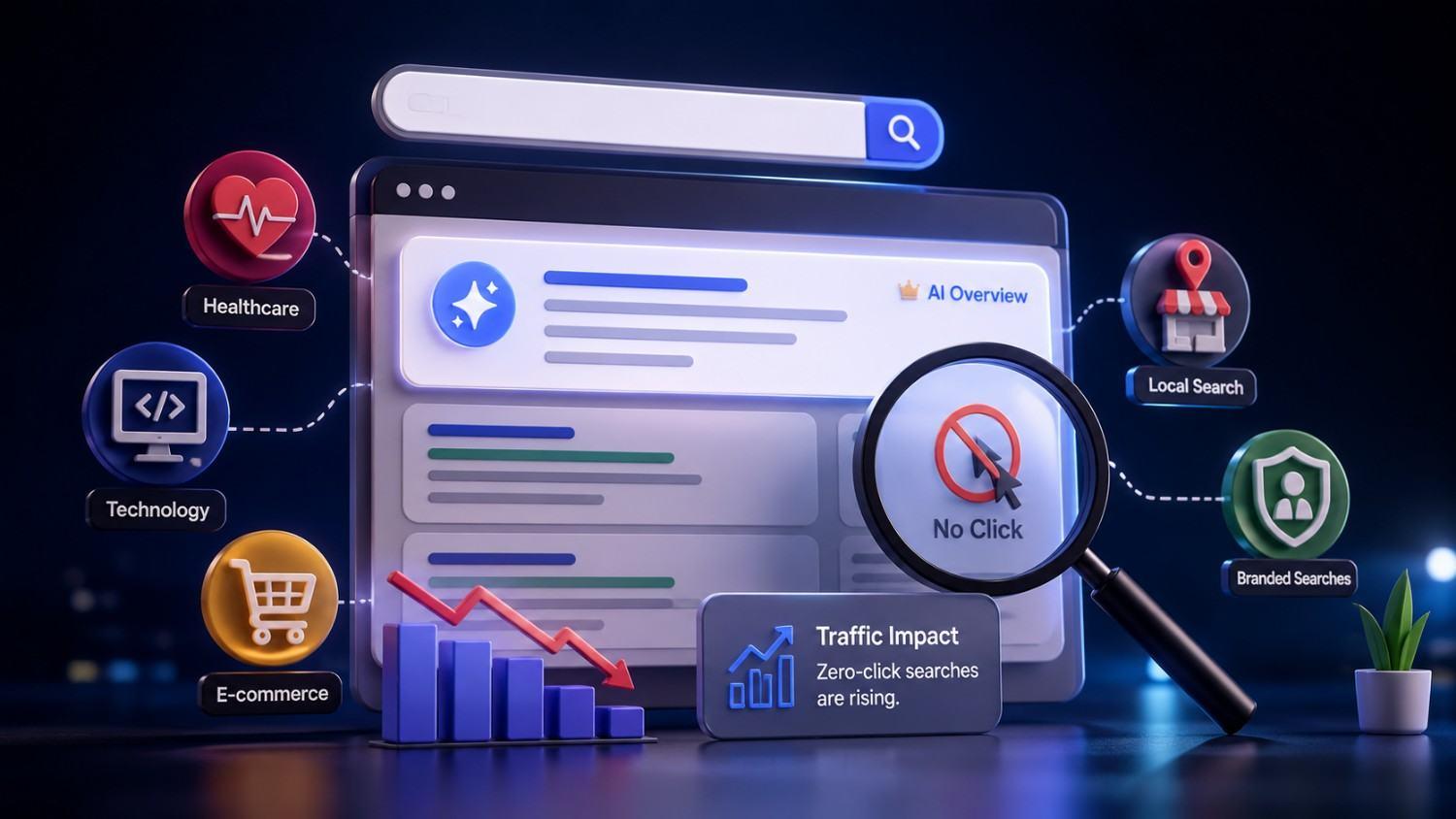 Zero-click search doesn’t affect every business equally. The impact depends heavily on the types of queries your audience is searching for.
- Informational queries are taking the hardest hit. Content like “what is X,” “how to do Y,” “best Z for beginners” is the category that AI Overviews are almost perfectly designed to answer. If your blog traffic comes primarily from informational how-to content, you are directly in the blast radius of this trend. Some sectors are seeing AI Overviews triggered on over 80% of their relevant queries. Healthcare sits at 88% while B2B technology queries trigger AI Overviews 82% of the time.
- E-commerce and transactional searches are less affected for now. Google actually pulled back on AI Overviews for shopping queries early on because the AI responses weren’t converting into sales. Currently, only 3.2% of shopping queries trigger an AI Overview, compared to 43% for health queries. If your business model depends on transactional intent someone searching with clear buying intent your organic traffic is more protected than it was for pure content businesses.
- Local searches have a mixed picture. For “near me” searches and local intent queries, Google Maps, Local Packs, and Business Profiles have effectively become mini-websites inside the search results. Up to 78% of local searches produce zero clicks to an external website. But the flip side is that a well-optimised Google Business Profile can capture that intent directly: the user calls, gets directions, or visits the location straight from the search results page, without your website being involved at all.
- Branded searches are still relatively protected. When someone searches specifically for your brand name or your website, they usually click through. This is one of the few query categories where traditional organic SEO still behaves the way it used to.
What Zero-Click Search Actually Means for Your Business Strategy
Here is the shift in thinking that most businesses haven’t made yet: traffic and visibility are no longer the same thing. In the old model, if you ranked on page one of Google, you got traffic. If you got traffic, you had a chance to convert. The metrics all lined up neatly.
In 2026, you can be featured prominently in a Google AI Overview that millions of people read, yet receive almost no website traffic from it at all. That’s not a failure. That’s just how the new system works. The goal is no longer purely to earn the click. The goal is to be the trusted source that the AI cites, summarises, and recommends when it answers the question.
This distinction matters enormously for how you measure success and where you invest. A business that keeps obsessing over organic session counts while ignoring whether its brand appears in AI-generated answers is measuring the wrong thing.
What Actually Works in the Zero-Click Era
Adapting to zero-click search doesn’t mean abandoning SEO or starting from scratch. It means shifting the emphasis on what you’re optimising for and adding new disciplines to your existing strategy.
- Optimise to be cited, not just to rank. AI Overviews and AI search engines pull heavily from content that already ranks well in traditional Google search. Getting into AI answers isn’t a completely separate task; it builds on the same authority signals. But the content needs to be structured differently. Clear direct answers to specific questions, structured data markup (schema), authoritative sourcing, and comprehensive topic coverage all increase the likelihood that AI systems select your content to answer a query.
- Answer Engine Optimisation (AEO) is now a real discipline. AEO is the practice of structuring your content specifically to appear in AI-generated answers, featured snippets, People Also Ask boxes, and voice search results. It involves writing content that directly answers questions your audience is actually asking in clear, concise language that an AI system can confidently pull and summarise. If your content is vague, meandering, or structured purely around keywords rather than questions, AI systems will consistently skip it.
- Generative Engine Optimisation (GEO) goes a step further. While AEO focuses on traditional Google features, GEO focuses specifically on appearing in responses from ChatGPT, Perplexity, Gemini, and Google AI Mode. The signals these AI systems use to decide what to cite include brand mention frequency across the web, how often your content is referenced by other authoritative sources, the clarity and directness of your writing, and the depth and breadth of your topical coverage. Building genuine authority across a topic, not just ranking for individual keywords, is what GEO rewards.
- Transactional content is more valuable than ever. Since informational queries are increasingly answered before anyone reaches a website, content that targets genuine buying-intent comparisons, pricing pages, case studies, service pages, reviews, and specific problem-solution pieces is becoming disproportionately valuable. These are the queries where users still need to click to get what they want.
- Your Google Business Profile is now a landing page. For local businesses, an optimised Business Profile means a searcher can read your reviews, see your hours, view your services, and call you directly from the search results page without ever visiting your website. In a zero-click world, that’s not a problem to solve; it’s a feature to optimise.
- Brand search volume is the new organic traffic metric. One of the clearest signals emerging from 2026 data is that brands cited in AI Overviews see an increase in branded search volume, even when direct click-through rates fall. The reasoning makes sense: someone reads an AI-generated answer that mentions your brand, gets curious, and then searches your brand name directly. Brands cited in AI Overviews have been shown to earn nearly 16% paid click-through rates on the same queries, compared to 11% when uncited. Visibility inside AI answers is driving brand recall and downstream intent, even when no click happens in the moment.
The Metrics You Should Be Tracking in 2026
If your current reporting is built entirely around organic sessions and keyword rankings, you’re missing the most important signals of search visibility in the zero-click era. A few metrics worth adding: AI Overview impression share: how often your content appears cited inside AI-generated answers, trackable through Google Search Console and third-party tools like Otterly.ai or Peec AI.
Branded search volume: whether your brand name is being searched more frequently, which often indicates downstream intent driven by AI visibility. Share of voice in People Also Ask and featured snippets, both of which remain significant click drivers even in a zero-click environment.
Citation frequency in ChatGPT, Perplexity, and Gemini, which you can track using AI monitoring tools and regular manual spot-checks.
Why This Matters More for Some Businesses Than Others
If your business relies heavily on informational blog content for top-of-funnel traffic, zero-click search is already affecting your numbers and will continue to do so. The appropriate response isn’t panic; it’s a strategy shift toward content that earns citations, builds brand authority, and supports transactional intent rather than purely chasing informational query volume.
If your business is primarily local, e-commerce, or service-based with strong transactional intent, you’re somewhat more protected, but “somewhat” does a lot of work in that sentence. The trend is moving in one direction, and waiting until the impact is severe before adapting is a more expensive response than adapting now.
How Deftsoft Approaches Visibility in the Zero-Click Era
Most SEO strategies currently in use were designed for a search environment that no longer exists. The agencies that continue to build content calendars around high-volume informational keywords without considering AEO, GEO, or AI citation signals will see diminishing returns throughout 2026 and beyond.
At Deftsoft, we’ve rebuilt our search visibility framework around how search actually works in 2026, which means combining traditional SEO with structured content for AI citations, GEO signal building, Google Business Profile optimisation for local clients, and performance measurement that goes beyond session counts. Whether you’re seeing unexplained drops in organic traffic or simply want to ensure your visibility strategy is built for where search is headed, we can audit your current setup and show you exactly where the gaps are. Explore our AI SEO and search visibility services to see how we approach it.
Not sure how visible your brand is in AI search right now?
Frequently Asked Questions
1. What is zero-click search?
A zero-click search is a Google query that ends without the user clicking on any external website. The answer is delivered directly on the search results page through AI Overviews, featured snippets, knowledge panels, or other Google features. In 2026, this accounts for approximately 68% of all Google searches globally.
2. Why has zero-click search increased so much in 2026?
The rapid scaling of Google AI Overviews, now present on nearly half of all Google searches, is the main driver. Google AI Mode, which replaces traditional results with a full AI conversation interface, has further accelerated the trend. Google’s broader strategy of keeping users on its own platform rather than sending them to external websites is the underlying force behind both.
3. Which industries are most affected by zero-click search?
Healthcare (AI Overviews on 88% of queries), B2B technology (82%), and sectors that rely heavily on informational “what is” or “how to” content are the most affected. E-commerce and transactional queries are currently less affected, with only 3.2% of shopping queries triggering AI Overviews.
4. Does zero-click search mean SEO is dead?
No. But it means the goal of SEO has shifted. Ranking well in traditional search remains important; AI Overviews still pull heavily from content that ranks in the top results. The difference is that ranking now needs to be paired with AEO and GEO strategies that optimise for being cited inside AI-generated answers, not just earning a click.
5. What is Answer Engine Optimisation (AEO)?
AEO is the practice of structuring content specifically to appear in AI-generated answers, featured snippets, People Also Ask boxes, and voice search results. It involves writing clear, direct answers to questions your audience is actually asking, using structured data markup, and organising content so AI systems can easily extract and summarise it.
6. What is Generative Engine Optimisation (GEO)?
GEO goes beyond traditional Google features to optimise specifically for appearing in responses from ChatGPT, Perplexity, Google AI Mode, and Gemini. It focuses on brand authority signals, citation frequency across the web, topical depth and breadth, and the directness and clarity of content that AI systems use when deciding which sources to reference.
7. What should businesses do right now to adapt to zero-click search?
Focus on transactional and commercial-intent content rather than pure informational volume. Implement structured data markup so AI systems can read your content clearly. Build brand presence across Reddit, YouTube, LinkedIn, and other platforms that AI tools reference. Optimise your Google Business Profile. Start tracking AI Overview impressions and branded search volume alongside traditional organic metrics. And audit whether your content is structured to answer questions directly, not just rank for keywords.
Recent Articles

Devraj
 7th July 2026