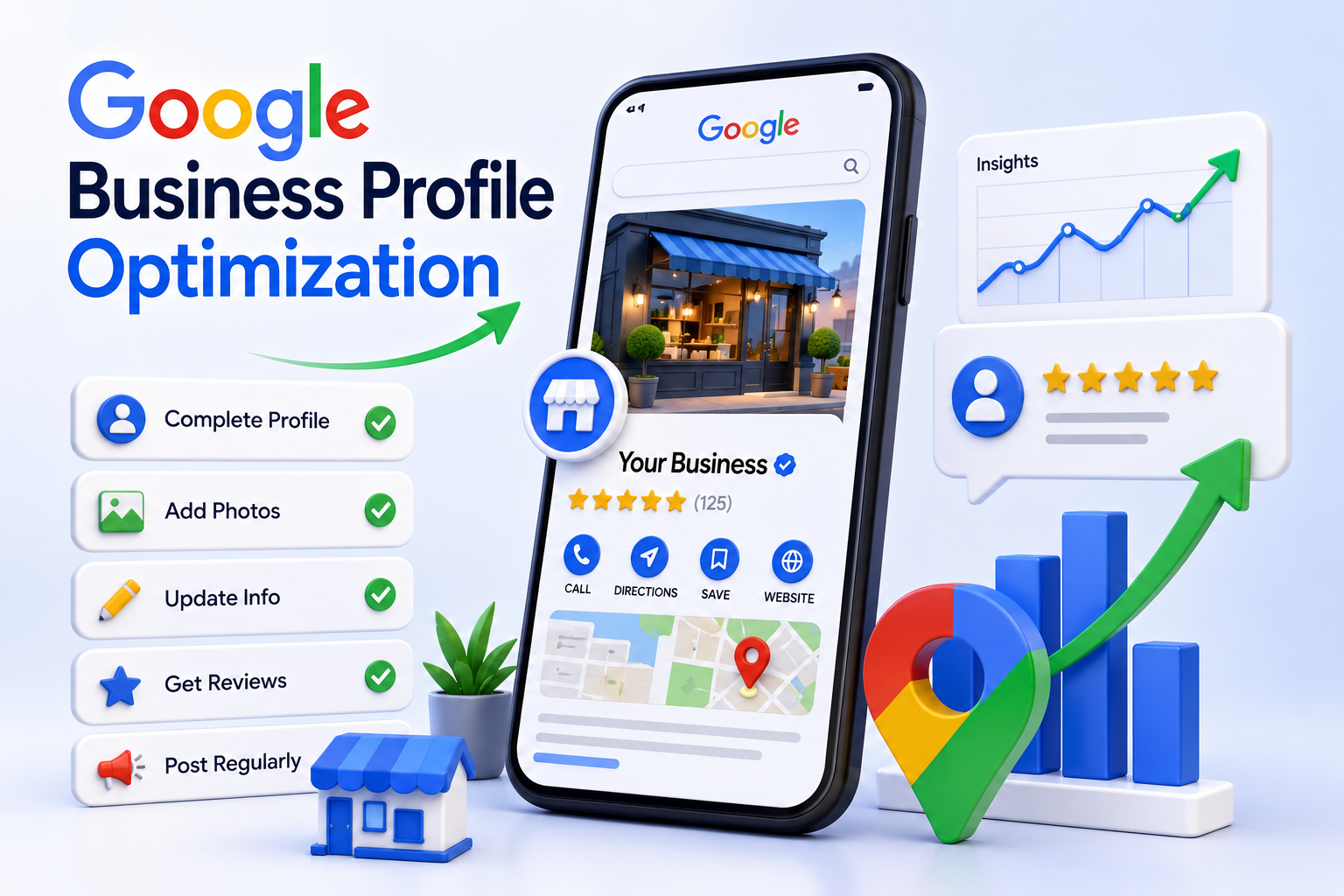
Google Business Profile Optimization: Step-by-Step Guide for 2026
-
By Devraj
-
12th June 2026
Quick experiment: open Google right now and search for a business type near you, a dentist, a café, a digital agency, anything. Look at the three results that show up in the map pack at the top.
Now ask yourself: would your business be one of those three?
For most businesses reading this, the honest answer is no. And here’s the uncomfortable part, it’s rare because the business itself isn’t good. It’s because the Google Business Profile representing that business online is incomplete, outdated, or hasn’t been touched in months.
In 2026, that gap matters more than it ever has. Google has been steadily narrowing how much organic real estate is available on the search results page, local pack ad placements have expanded dramatically over the past few months, AI Overviews now sit above traditional results for a huge share of queries, and the businesses that do show up are the ones whose profiles are feeding Google exactly the kind of structured, current, trustworthy information its systems are looking for.
The good news? Unlike traditional SEO, which can take months of content and backlinks to move the needle, GBP optimization is something you can start improving today, and as part of a broader local SEO strategy, the impact tends to show up faster. This guide walks through exactly how to do it, step by step, with a specific eye on what’s changed for 2026.
Quick Summary:
- Google Business Profile (GBP) is no longer just a digital business card in 2026, it’s the structured data source that feeds the Local Pack, Google Maps, AI Overviews, and Gemini-powered local recommendations.
- Google has tightened how many businesses actually get meaningful visibility on Maps and in local search. With local pack ad placements expanding sharply and AI-generated answers now sitting above organic results, the realistic competitive set for most searches has shrunk to a much smaller pool of consistently active, well-reviewed profiles making “good enough” optimization no longer good enough.
- The top 3 spots in the Local Pack still capture the overwhelming majority of clicks, but even ranking inside the wider visible results now requires the kind of completeness, activity, and review velocity that most businesses simply aren’t maintaining.
- AI Search Visibility is now a real ranking input. Google’s own data shows it’s using GBP information to power AI Overviews, voice search, and Gemini answers meaning your profile needs to be written for AI systems, not just human searchers.
- This guide walks through the exact steps to optimize your GBP in 2026: from category selection (still the single biggest ranking lever) to reviews, photos, posts, Q&A, and the new AI-readiness checklist most businesses are missing.
Want your Google Business Profile to actually start pulling its weight?
Talk to Deftsoft’s local SEO team for a free audit of where your profile stands today.
Quick Navigation
Why Your Google Business Profile Matters More Than Ever in 2026
Step 1: Get Your Category Selection Right (This Is the Big One)
Step 2: Build a Business Description That Works for Humans and AI
Step 3: Treat Reviews as an Ongoing Campaign, Not a One-Time Push
Step 4: Treat Your Profile Like a Living Page, Not a Listing
Step 5: Build Your AI Search Visibility Checklist
Step 6: Don’t Confuse “Ranking #1 on Maps” with “Winning the Local Pack”
Step 7: Set Realistic Expectations for Timeline
Why Your Google Business Profile Matters More Than Ever in 2026
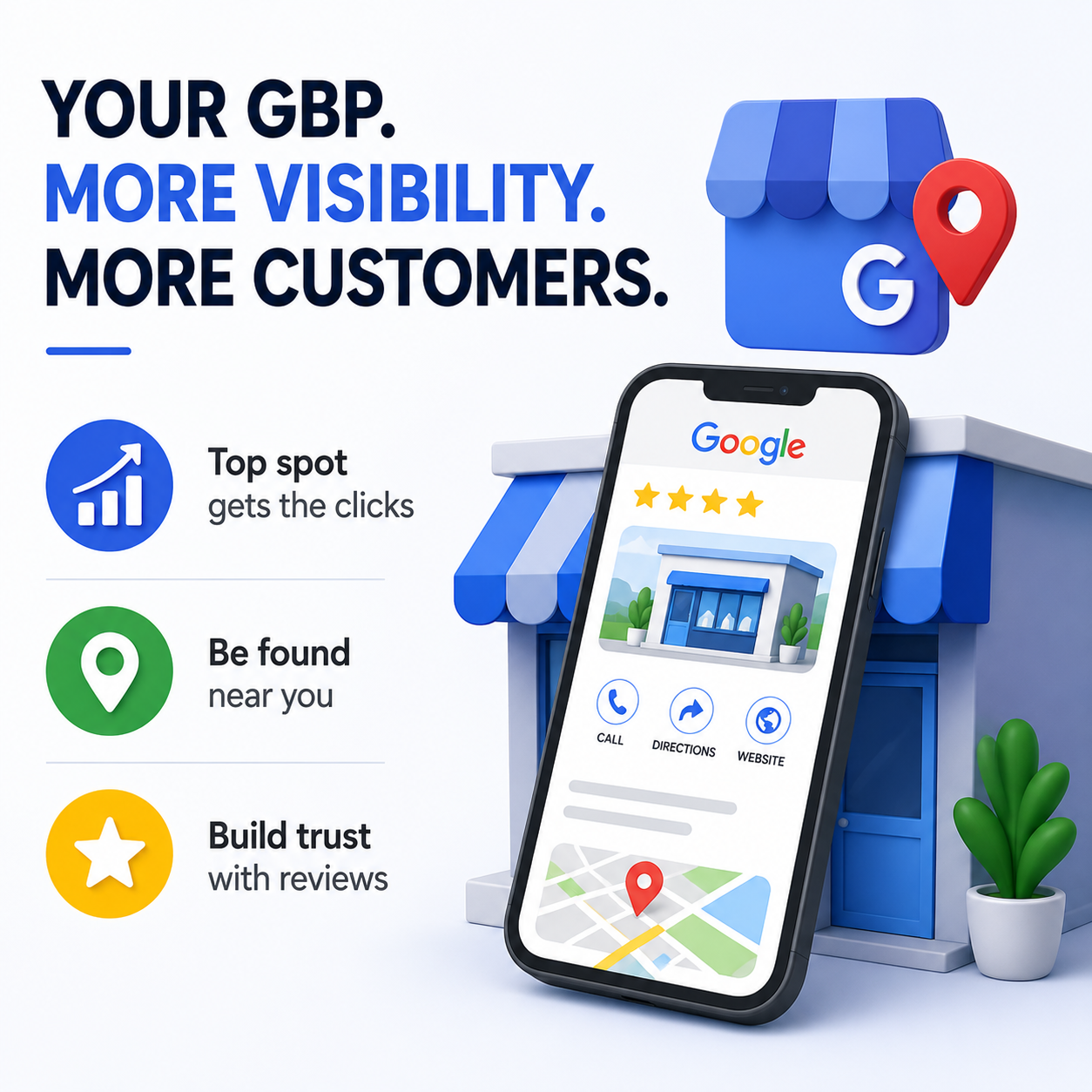
Let’s start with the numbers, because they tell the story better than any opinion could.
The top position in the Local Pack typically captures somewhere between 44% and 58% of all clicks on a local search results page. Positions two and three pick up most of what’s left. Everything below that including the full organic results is fighting over scraps.
Now layer on what’s changed recently. Paid placements inside local search results have expanded enormously over a short window from a small fraction of tracked local searches to roughly one in five, in just a few months. At the same time, AI Overviews have become a permanent fixture for a large share of search queries, often appearing above the map pack itself.
Put those two trends together, and the conclusion is simple: the space available for an unoptimized business to “accidentally” show up has gotten much smaller. The businesses still winning visibility are the ones whose profiles are complete, active, and structured in a way that Google’s algorithms both the traditional ranking system and the newer AI layers can confidently understand and recommend.
There’s also a quieter shift happening that’s easy to miss. Google’s local algorithm has always balanced three things: relevance (does your profile match what someone’s searching for), distance (how close you are to the searcher), and prominence (how reputable and well-reviewed you are). What’s changed in 2026 is that all three of these are now also feeding AI-generated answers meaning a profile that’s optimized for the Local Pack is increasingly the same profile that gets cited when someone asks an AI assistant “what’s a good [type of business] near me.”
In other words, your GBP isn’t just competing for map pack rankings anymore. It’s competing to be the source Google’s AI trusts enough to recommend.
Step 1: Get Your Category Selection Right (This Is the Big One)
If you only do one thing from this entire guide, do this.
According to recent industry research analyzing local pack ranking signals, your primary GBP category is the single most influential factor in whether you appear in local search results more influential than reviews, more influential than backlinks, more influential than almost anything else you control directly.
Here’s why it matters so much: your category is essentially Google’s shortcut for understanding what you are before it even reads a word of your description. Choose “Marketing Agency” when you’re really a “Digital Marketing Agency” or “Search Engine Optimization Service,” and you’re telling Google to consider you for a broader, more competitive, less specific set of searches you’re less likely to win.
What to do:
- Choose the most specific primary category that accurately describes your core business, not the broadest one that technically applies.
- Use secondary categories to capture the genuine range of services you offer, but don’t pad the list with categories that only loosely apply. Google has gotten noticeably better at flagging this kind of over-categorization, and it can do more harm than good.
- Revisit your category choices every few months. Google periodically adds new, more specific categories and switching to a newly available, more precise category can sometimes produce a visibility bump almost immediately.
Step 2: Build a Business Description That Works for Humans and AI
Your business description has never been a direct ranking factor in the traditional sense but in 2026, it plays a bigger behind-the-scenes role than most people realize, because it’s part of what AI systems read when deciding how to describe your business in summaries and recommendations.
The old advice was to write a clear, keyword-aware description without stuffing it full of search terms. That advice still holds but now there’s a second audience reading it: the AI layer that may eventually paraphrase your description back to a searcher.
A few principles that hold up well in 2026:
- Write the way you’d describe your business to a person, not a search engine. A line like “we provide reliable plumbing services across [city], including emergency repairs, drain cleaning, and water heater installation” tells both humans and AI systems exactly what you do and where.
- Avoid robotic keyword lists. “Plumber, plumbing, emergency plumber, 24/7 plumber, best plumber” reads as spam to a human and increasingly gets deprioritized by AI systems too, which are trained to recognize and discount that pattern.
- Make sure your description, your website, and your other online listings tell a consistent story about what you do. Entity clarity Google being confident about who you are and what you offer has become a meaningfully bigger deal in 2026 than it was even a year ago.
Step 3: Treat Reviews as an Ongoing Campaign, Not a One-Time Push
Reviews account for roughly 15% of local pack ranking weight on their own but their influence extends well beyond that single slice. Reviews shape click-through rates, feed directly into AI Overview summaries, and signal to Google that a business is active and trusted by real customers.
What’s shifted for 2026 is the emphasis on recency and velocity over raw totals. A business with 200 reviews, none from the last six months, can lose ground to a newer competitor steadily picking up two or three fresh reviews a week. Google’s systems increasingly read review patterns. Is this business still earning trust right now, or did it earn trust two years ago and stop trying?
Practical steps:
- Build review requests into your actual customer workflow. A follow-up email or text after a service is completed works far better than sporadic, occasional asks.
- Respond to every review, positive or negative, ideally within 48 hours. Response rate and response content both factor into how Google and AI systems read your profile’s trustworthiness.
- Don’t panic over the occasional negative review; a thoughtful, professional response to criticism often reads better to both humans and algorithms than a suspiciously spotless five-star record.
- Never buy or incentivize fake reviews. Google’s detection has improved substantially, and the penalty for getting caught in a sudden, often unexplained ranking collapse can take months to recover from.
Step 4: Treat Your Profile Like a Living Page, Not a Listing
Here’s the mindset shift that separates the businesses showing up in 2026 from the ones that don’t: Google now rewards profiles that look actively managed.
That means:
- Photos: Add new photos at least weekly, even if they’re simple smartphone shots of a finished project, a team member at work, the storefront on a sunny day. Profiles with strong, regularly updated photo libraries consistently see meaningfully higher click-through rates and direction requests than those that haven’t added a photo in months.
- Posts: Google Posts (updates, offers, events) are an underused feature that signals ongoing activity. A weekly cadence, even something as simple as a seasonal tip or a recent project highlight keeps your profile in the “actively managed” category.
- Hours: Keep these accurate and update them immediately around holidays or unusual closures. If a search happens while your listed hours say you’re closed, Google’s systems may filter your business out of results entirely for that search not rank you lower, but remove you from consideration.
- Q&A: Monitor the questions section regularly. In the AI era, unanswered or inaccurate Q&A entries can get picked up and surfaced in AI-generated answers without your input so an unmanaged Q&A section is no longer just a missed opportunity, it’s a potential liability.
Step 5: Build Your AI Search Visibility Checklist
This is the part of GBP optimization that’s genuinely new for 2026, and it’s the section most “best practices” guides still haven’t caught up with.
Google has started rolling out tools that show businesses the conversational queries people use to find them through AI-powered search phrases that look very different from traditional keyword searches. Someone might search “plumber near me open now” the old way, but ask an AI assistant “who can fix a burst pipe in [neighborhood] tonight” and your profile needs to be structured in a way that makes you a confident answer to both.
To get AI-ready:
- Make sure your NAP (Name, Address, Phone number) is identical across every platform: your website, GBP, Facebook, industry directories, everything. AI systems cross-reference these to confirm legitimacy, and inconsistencies quietly erode trust scores.
- Build out your services list completely, with clear, specific descriptions for each one. AI systems increasingly generate “Services” summaries directly from this data if it’s thin or vague, the AI-generated summary will be too, and may not represent you accurately.
- Get mentioned in places beyond your own listings. Unstructured mentions of your business in blog posts, local news, community forums, industry roundups have become a meaningful signal for AI search visibility specifically. This is where a broader content marketing strategy and digital PR start to intersect directly with local SEO in a way they didn’t a couple of years ago.
- Link your social profiles (Instagram, Facebook, LinkedIn, YouTube) to your GBP if you haven’t already. Google’s systems use connected social activity as an additional signal that your business is real, active, and consistent and it can surface that content directly inside AI Overviews and local results.
Step 6: Don’t Confuse “Ranking #1 on Maps” with “Winning the Local Pack”
This is a subtle but important distinction that trips up a lot of business owners.
Google Maps and the Local Pack you see in regular search results are related but not identical and they’re driven by slightly different priorities. Maps lean more heavily toward proximity: it’s designed to show the closest relevant option to wherever the search is happening. The Local Pack, by contrast, leans more toward prominence: it’s designed to show the best options based on reputation, completeness, and trust signals even if they’re not the literal closest.
This is why a business owner checking their own ranking from their office might see themselves sitting in position one on Maps, while a customer searching from across town sees them several positions lower in the Local Pack or not at all.
The practical takeaway
Don’t optimize purely for “where do I rank when I search from my own location.” Check your visibility from multiple points across your service area, and focus your optimization energy on the prominence signals (reviews, completeness, activity, citations) that influence the Local Pack because that’s where the majority of local search clicks actually happen.
Step 7: Set Realistic Expectations for Timeline
One of the most common frustrations with GBP optimization is expecting overnight results. It’s worth setting expectations honestly:
- Weeks 1–4: Setup and foundational fixes category correction, description rewrite, photo upload, citation cleanup. You may see early movement in impressions, but rankings themselves likely won’t shift dramatically yet.
- Weeks 4–12: With consistent review generation, regular posting, and ongoing photo updates, most businesses start to see meaningful movement in local pack visibility during this window.
- Month 5 onward: This is typically when the compounding effect kicks in consistent activity, a growing review base, and accumulated trust signals start reinforcing each other, and rankings tend to stabilize at a noticeably higher level than where you started.
The businesses that get frustrated and give up around week six are, ironically, often right on the edge of the window where things start to move. Consistency over those first few months matters more than any single tactic.
Common Mistakes That Quietly Sabotage GBP Rankings
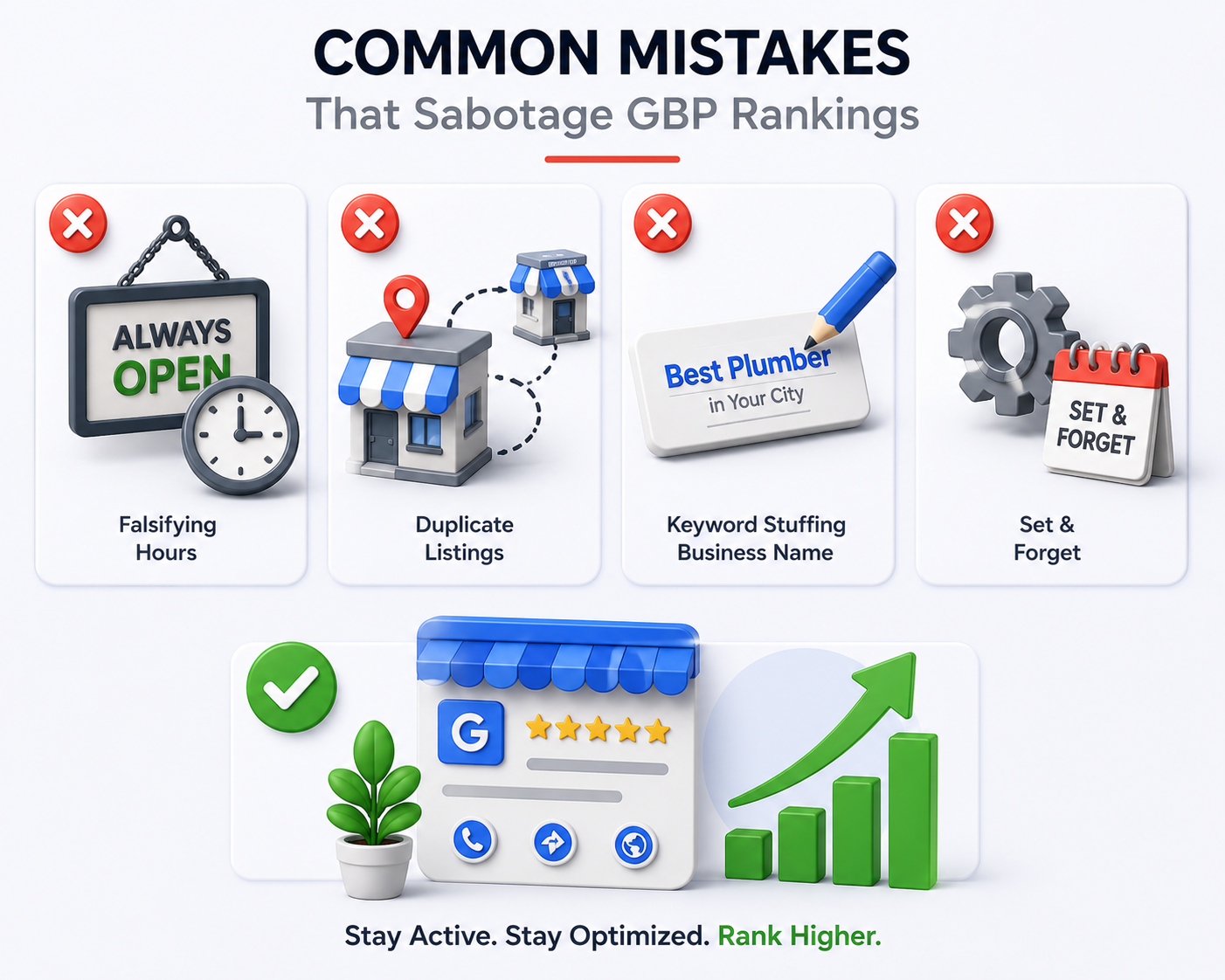
A few patterns worth specifically avoiding in 2026:
- Falsifying hours to appear “always open.” This used to be a minor grey-area tactic. In 2026, it’s a flagged behavior that can trigger account-level review or suspension; the risk far outweighs any short-term visibility gain.
- Creating duplicate listings for the same location. Whether intentional or accidental (often from agency handovers or rebrands), duplicate listings split your review base and confuse Google’s entity matching, actively hurting the profile you actually want to rank.
- Keyword-stuffing your business name. Adding ” Best [Service] in [City]” to your official business name is against Google’s guidelines, gets flagged increasingly fast, and can result in your listing being suspended while under review, exactly the opposite of the visibility you were trying to gain.
- Treating GBP as “set and forget.” This is the big one. The single biggest difference between profiles that rank and profiles that don’t, at this point, isn’t some hidden technical trick, it’s simply whether anyone is paying attention to the profile on an ongoing basis.
How Deftsoft Can Help
Google Business Profile optimization sits at an interesting intersection right now: it’s part technical SEO, part content strategy, part ongoing community management (reviews, posts, Q&A), and increasingly, part AI-readiness. Doing all of it well, consistently, on top of running an actual business, is genuinely difficult.
At Deftsoft, our local SEO and digital marketing services cover the full picture: category and listing audits, description and content optimization, review generation systems, ongoing photo and post management, citation cleanup across directories, and AI-search readiness making sure your profile is built to perform not just in today’s Local Pack, but in the AI-driven local search experience that’s rapidly becoming the norm.
Whether you’re starting from a neglected, years-old profile or trying to defend a hard-won local pack position against increasingly aggressive competitors, the work is the same: consistent, structured, ongoing attention exactly the kind of thing that’s easy to deprioritize when you’re busy running the business itself.
Ready to find out where your Google Business Profile actually stands?
Get a free GBP audit from Deftsoft’s local SEO team and find out exactly what’s holding your business back from the map pack and what it would take to get there.
Frequently Asked Questions
How long does it take to see results from Google Business Profile optimization in 2026?
Most businesses start seeing early movement in impressions within the first month, with more meaningful local pack ranking changes typically appearing between months two and four. The compounding effect where consistent reviews, posts, and activity reinforce each other tends to become noticeable from around month five onward. Competitive urban markets generally take longer than smaller or less competitive areas.
Is my Google Business Profile category really more important than reviews?
Based on recent local pack ranking research, yes primary category selection is consistently identified as the single highest-impact controllable factor, ahead of review signals, NAP consistency, and backlinks. That said, reviews still play a substantial role, particularly for the prominence component of ranking and for how AI systems summarize your business.
Do I need a certain number of reviews to rank in the Local Pack?
There’s no universal minimum; it depends heavily on your market’s competitiveness. In low-competition areas, 15–20 genuine reviews may be enough to compete. In highly competitive urban markets, local pack businesses often have well over 100 reviews. More important than the total count is recency: businesses that consistently earn new reviews tend to outperform those with a large but stagnant review base.
How does AI Overviews affect my Google Business Profile strategy?
Google increasingly uses GBP data as a source for AI-generated answers, voice search results, and Gemini responses. This means your profile’s completeness, accuracy, and consistency across the web now influence not just whether you appear in traditional local search, but whether you get cited or recommended in AI-generated summaries making AI-readiness a genuine, if often overlooked, part of GBP optimization.
Can running Google Ads improve my organic Google Maps ranking?
No. Google’s local pack and Maps ranking algorithms operate independently from its paid advertising systems. Running ads doesn’t directly improve or harm your organic local ranking, though increased paid placement within local results does mean organic visibility is competing for a smaller share of the page than it used to.
What’s the single biggest mistake businesses make with their Google Business Profile?
Treating it as a one-time setup task rather than an ongoing channel. Profiles that receive regular photo uploads, weekly posts, prompt review responses, and accurate, up-to-date information consistently outperform profiles that were optimized once and then left untouched regardless of how good that initial optimization was.
Should I respond to negative reviews, or will that draw more attention to them?
Always respond, ideally within 48 hours. A thoughtful, professional response to a negative review often builds more trust with both potential customers and Google’s systems than ignoring it, and an unanswered negative review sitting at the top of your profile for months tends to do far more damage than a calm, handled response ever would.
Recent Articles



Devraj
 12th June 2026