What Is Blockchain Technology? How It Works, Types, and Real-World Uses
-
By Devraj
-
14th October 2026
What Is Blockchain Technology?
Blockchain technology is a shared digital ledger that records transactions across many computers. For businesses exploring innovative digital architectures, professional blockchain development turns these concepts into secure, functional networks. Transactions are grouped into blocks, and each block is linked to the one before it. Once confirmed, records are very hard to change, which makes blockchain useful for trusted, transparent recordkeeping.
A traditional database is usually controlled by one organization, which can edit or delete entries. A blockchain spreads the record across a network, so no single party controls it alone. Changes need agreement from the network, and every change leaves a visible trail.
Think of a shared notebook that a whole group of friends keeps a copy of. Whenever someone adds an entry, everyone updates their copy. If one person tries to alter an old entry, the other copies no longer match, so the change is rejected.
Is Blockchain Right for Your Business Idea?
Don’t waste time on the wrong tech stack. Let our blockchain experts evaluate your project requirements, choose the right architecture, and build a scalable roadmap.
Table of Content
What Is Blockchain Technology?
How Does Blockchain Technology Work?
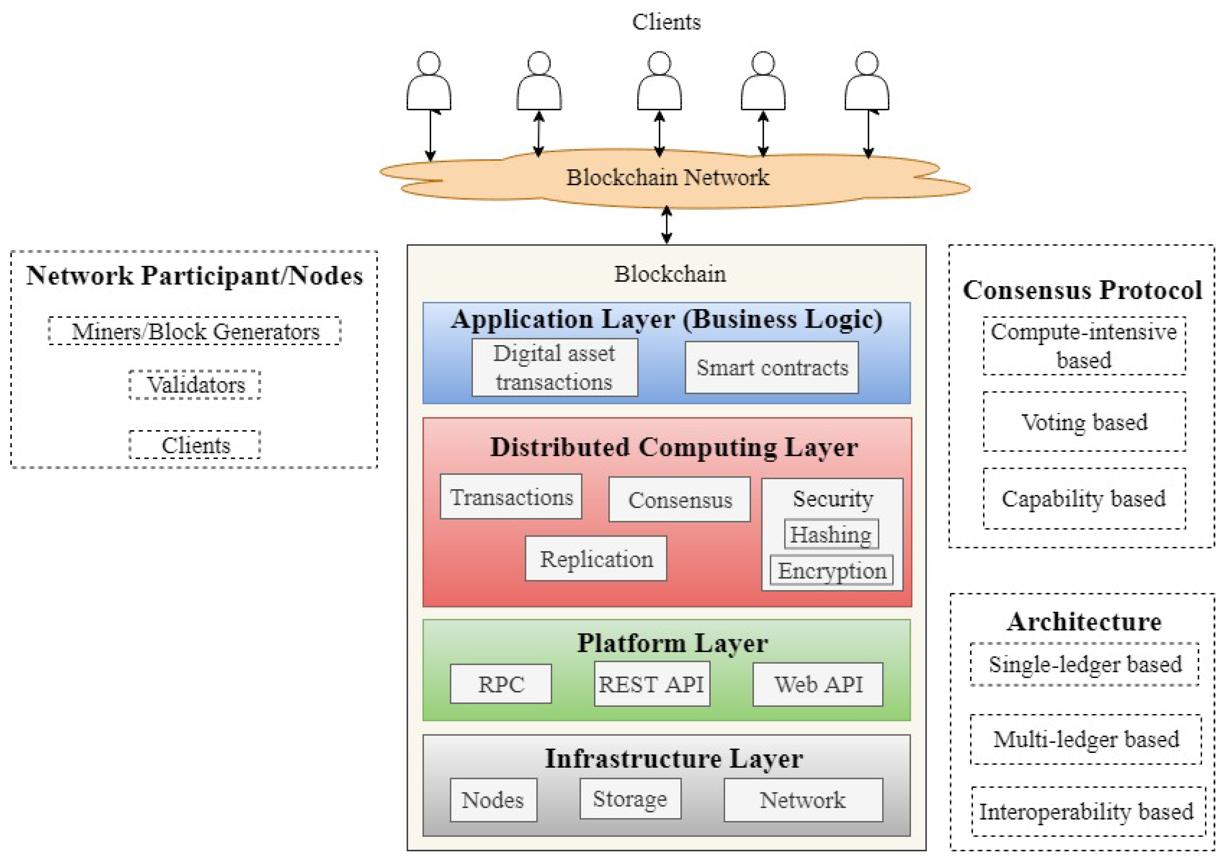
What Are the Main Components of Blockchain?
What Are the Different Types of Blockchain?
What Is a Blockchain Consensus Mechanism?
What Are Smart Contracts in Blockchain?
What Are the Real-World Uses of Blockchain Technology?
What Are Some Examples of Blockchain Technology?
What Are the Benefits of Blockchain Technology?
What Are the Limitations and Risks of Blockchain?
Blockchain vs. Traditional Database: What Is the Difference?
How Can Businesses Implement Blockchain Technology?
What Is the Future of Blockchain Technology?
How Does Blockchain Technology Work?
Take a simple money transfer. Maya wants to send funds to Arjun.
- A user initiates a transaction. Maya signs the transfer with her private key, which proves it is really from her.
- The transaction is shared with the network. It is broadcast to the computers (nodes) that make up the network.
- Network participants validate the transaction. Nodes check that Maya’s signature is valid and that she has enough funds.
- Valid transactions are grouped into a block. Confirmed transactions are bundled together with a timestamp.
- A consensus mechanism decides whether the block can be added. The network follows agreed rules to approve the block.
- The accepted block is linked to previous blocks. It carries the previous block’s hash, forming a chain.
- Network participants update their records. Every node adds the block to its copy of the ledger.
A few terms help here. A hash is a unique digital fingerprint of a block’s data. If the data changes even slightly, the hash changes completely. A digital signature proves who approved a transaction. A node is a computer that stores a copy of the ledger. Consensus is how the network agrees on what is valid.
What Are the Main Components of Blockchain?
- Blocks and transaction data. Blocks store groups of transactions and a timestamp.
- Cryptographic hashes. These fingerprints make tampering easy to detect.
- Previous-block hashes. Each block stores the hash of the one before it, creating the chain.
- Nodes and distributed ledgers. Many computers hold copies of the same record, so there is no single point of failure.
- Consensus mechanisms. These are the rules for agreeing on new blocks.
- Public and private keys. The public key works like an account address, and the private key authorizes actions. Losing the private key can mean losing access.
- Digital signatures. These prove a transaction came from the key’s owner.
- Smart contracts. Programs that run automatically when set conditions are met.
What Are the Different Types of Blockchain?
There are four main types.
- Public blockchains are open to anyone. Participants can join, read, and validate. Bitcoin is the best-known example.
- Private blockchains are controlled by one organization, and only approved users can take part. Companies use them for internal records.
- Consortium blockchains are run by a group of organizations. Control is shared, which suits industry partnerships.
- Hybrid blockchains combine public and private features, keeping some data private while making other data verifiable.
The right choice depends on who needs access, how much privacy you need, and who should control the rules.
What Is a Blockchain Consensus Mechanism?
A consensus mechanism is how network participants agree on which transactions are valid and in what order they are recorded. It is separate from verification. Verification checks one transaction (signature, balance). Consensus gets the whole network to agree on the shared record.
- Proof of Work (PoW). Participants solve computational puzzles to add blocks. It is well tested and secure, but uses a lot of energy.
- Proof of Stake (PoS). Validators lock up tokens as a stake and are chosen to confirm blocks. It uses far less energy than PoW.
- Practical Byzantine Fault Tolerance (PBFT) and similar approaches. A known group of validators votes on blocks. These are fast and common in permissioned networks, but less open.
Each approach trades off energy use, security, speed, and decentralization. Different blockchains use different mechanisms, so there is no single “best” option.
What Are Smart Contracts in Blockchain?
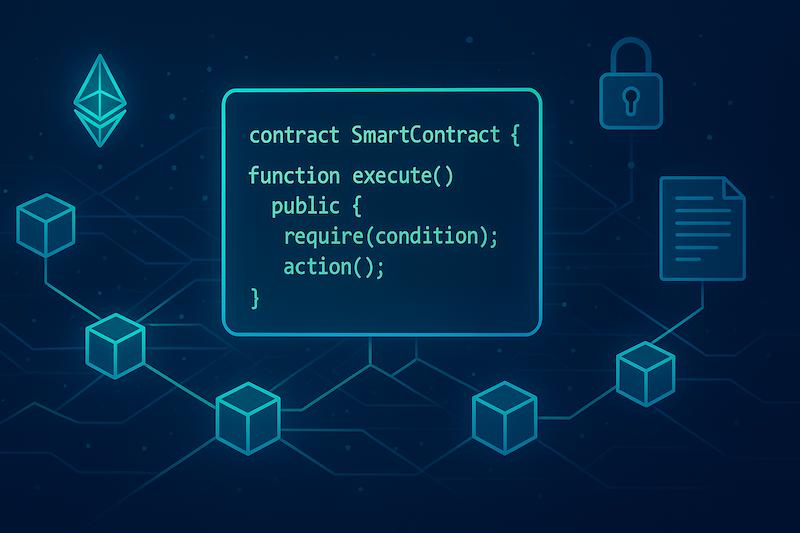
Smart contracts are programs stored on a blockchain that run automatically when specified conditions are met. They follow “if this, then that” logic and need no middleman to execute.
Example: A buyer pays into a smart contract for a delivery. When the shipping data confirms arrival, the contract releases payment to the seller automatically.
Benefits: automation, fewer manual steps, transparent rules, and a clear audit trail.
Limitations and risks: once deployed, contracts can be hard to change, and coding errors can be costly. Bugs and weak security have led to real losses, so careful testing and audits matter.
Versus traditional contracts: a legal contract is written in words and enforced by courts. A smart contract is code that enforces itself, but it only follows what it was programmed to do and may not cover legal nuance.
Examples: decentralized finance lending, insurance payouts triggered by verified events, and supply-chain payments released on delivery.

Build Secure, Audited Smart Contracts & dApps
From custom decentralized applications to enterprise-grade smart contract deployment, Deftsoft delivers secure and high-performance blockchain solutions.
What Are the Real-World Uses of Blockchain Technology?
Blockchain fits best where several parties need a shared, trustworthy record.
- Banking and cross-border payments. Problem: international transfers involve intermediaries, delays, and fees. How it helps: a shared ledger can settle transfers directly between parties. Example: a bank network settling payments through a shared record.
- Cryptocurrency and decentralized finance. Problem: financial services depend on central institutions. How it helps: blockchains let people send value and use lending or trading services through smart contracts. Example: a crypto wallet used to hold and transfer digital assets.
- Supply-chain tracking. Problem: it is hard to prove where a product came from. How it helps: each handoff is recorded on a shared ledger. Example: tracing food from farm to shelf.
- Healthcare records and data sharing. Problem: patient records are scattered across providers. How it helps: permissioned access and verifiable logs support secure sharing. Example: a hospital network recording who accessed a record and when.
- Digital identity and credentials. Problem: paper credentials are easy to forge and slow to verify. How it helps: verifiable digital credentials can be checked instantly. Example: a university issuing a degree that employers verify online.
- Real estate and property records. Problem: title transfers involve paperwork and delays. How it helps: a shared record of ownership reduces disputes. Example: recording property transfers on a ledger.
- Insurance claims. Problem: claims are slow and prone to disputes. How it helps: smart contracts can pay out when verified conditions are met. Example: flight-delay cover that pays automatically.
- Voting systems and audit trails. Problem: trust in records and counts. How it helps: tamper-resistant logs support auditing. Example: an audit trail for voting records, though legal and security requirements here are strict.
- Gaming, digital assets, and NFTs. Problem: in-game and digital items are usually controlled by the platform. How it helps: tokens prove ownership of unique digital items. Example: an NFT marketplace for digital collectibles.
- Intellectual property and royalty tracking. Problem: creators struggle to track usage and payments. How it helps: smart contracts can split royalties automatically. Example: music royalties shared by preset rules.
- Energy trading and carbon-credit tracking. Problem: hard to verify and avoid double-counting credits. How it helps: each credit is recorded once. Example: a registry of carbon credits.
Blockchain is not right for every use case. Legal, privacy, and implementation requirements vary by country and industry.
What Are Some Examples of Blockchain Technology?
- Bitcoin: decentralized digital money.
- Ethereum: a programmable blockchain that supports smart contracts and applications.
- Hyperledger Fabric: a permissioned platform for enterprise networks.
- Supply-chain traceability projects: shared records of product journeys.
- Verifiable digital credentials: certificates that can be checked instantly.
Keep three things separate. A blockchain platform is the underlying network (Ethereum). A cryptocurrency is a digital asset that runs on it (Ether). An application is software built on the platform, such as a wallet or marketplace.
What Are the Benefits of Blockchain Technology?
Benefits depend on the right setup. None are automatic.
- Shared records and transparency, when participants share access to the same ledger.
- Tamper resistance and auditability, when the network is well designed and secured.
- Less reliance on a central recordkeeper, in systems built to be decentralized.
- Traceability of transactions and assets, when data is recorded correctly from the start.
- Automation through smart contracts, when the code is tested and sound.
- Potential process efficiencies, when it replaces slow manual reconciliation.
What Are the Limitations and Risks of Blockchain?
- Scalability and throughput. Some networks process fewer transactions than conventional systems.
- Network fees and operating costs. These can add up.
- Energy use in some consensus systems.
- Privacy and data protection. Immutable records can conflict with privacy rules.
- Smart-contract vulnerabilities. Code errors can be exploited.
- Regulatory uncertainty. Rules differ across regions and are still evolving.
- Difficulty correcting records. Mistakes are hard to undo.
- Private-key loss and user error. Lost keys can mean lost assets.
- Integration with existing systems. Connecting legacy software takes planning.
- Inaccurate input. A blockchain preserves data. It cannot confirm the data was true.
A blockchain record can be tamper-resistant without being automatically accurate or completely secure.
Blockchain vs. Traditional Database: What Is the Difference?
| Factor | Blockchain | Traditional Database |
|---|---|---|
| Control | Shared across participants | One owner or administrator |
| Updates and deletion | Append-only, hard to alter | Easy to edit and delete |
| Transparency and access | Visible to permitted participants | Set by the owner |
| Security model | Cryptography and consensus | Access controls and admin security |
| Performance and scalability | Often slower | Typically faster and more scalable |
| Costs and maintenance | Often higher | Usually lower |
| Best use cases | Multi-party trust and audit trails | Most business applications |
If one organization controls the data and everyone trusts it, a conventional database is simpler, faster, and cheaper.
How Can Businesses Implement Blockchain Technology?
- Identify the problem. Start with a need for shared, verifiable records.
- Check if blockchain is necessary. If a database solves it, use one.
- Choose the network type: public, private, consortium, or hybrid.
- Select the platform and consensus approach.
- Design security, identity, permissions, and data storage.
- Develop and test smart contracts if needed.
- Integrate existing software and APIs.
- Run a pilot and measure results.
- Plan governance, compliance, monitoring, and maintenance.
Experienced blockchain developers and technology partners such as Deftsoft can help with architecture, development, testing, and integration, so the project is built around the actual business case.
What Is the Future of Blockchain Technology?
Several trends are being discussed, though outcomes remain uncertain:
- Interoperability between blockchain networks
- Tokenization of real-world assets
- Layer-2 scaling solutions to improve speed and cost
- Decentralized identity
- Enterprise blockchain adoption
- Integration with AI and IoT
- Privacy-preserving technologies
- Regulatory and governance developments
Adoption will depend on real business value, usability, security, and regulation. Technology alone will not decide it.
How Can Deftsoft Help Businesses With Blockchain Solutions?
Businesses often explore blockchain when they need greater security, fewer intermediaries, transparent transaction records, or safer ways to lend and borrow. Deftsoft’s blockchain development services are built around those needs, and the team begins by studying your business case before recommending anything.
Deftsoft’s listed services include:
- Smart contract development
- dApp development
- Crypto wallet development
- NFT marketplace development
- P2P lending platform development
- IEO, STO, and ICO development
A typical project covers planning, architecture, application development, testing, and integration. Security, scalability, and long-term maintenance should be part of the plan from day one. To judge whether a project is worthwhile, ask whether several parties need to share records, whether trust is a real problem, and whether a simpler system would do the job.
Still Unsure Which Blockchain Network Suits You?
Public, private, or hybrid—navigating the blockchain landscape can be complex. Speak directly with our architects to find the perfect fit for your enterprise.
Frequently Asked Questions About Blockchain Technology
What is blockchain technology?
A shared digital ledger that records transactions in linked blocks across a network, making records transparent and hard to alter.
How does blockchain work step by step?
A user starts a transaction, the network validates it, valid transactions form a block, consensus approves it, the block links to the chain, and all nodes update their records.
What are the four main types of blockchain?
Public, private, consortium, and hybrid.
What is the difference between blockchain and cryptocurrency?
Blockchain is the underlying technology. Cryptocurrency is one application of it, a digital asset that runs on a blockchain.
Is blockchain technology safe and secure?
It uses strong cryptography and is tamper-resistant, but it is not risk-free. Smart-contract bugs, lost keys, and poor implementation can cause problems.
What are the most common uses of blockchain?
Payments, cryptocurrency, supply-chain tracking, digital identity, healthcare records, and smart contracts.
Can blockchain data be changed or deleted?
Confirmed records are very hard to alter. Corrections are usually made by adding a new entry, not editing the old one.
What is the difference between blockchain and a database?
A database is typically controlled by one owner and easily edited. A blockchain is shared, append-only, and verified by the network.
Does every blockchain use cryptocurrency?
No. Many private and enterprise blockchains operate without any cryptocurrency.
How can a business benefit from blockchain technology?
By gaining shared, verifiable records, better traceability, and automated processes, where several parties need to trust the same data.
Is blockchain technology expensive to implement?
It can be, depending on complexity, security needs, integrations, and ongoing maintenance. A pilot helps control cost and risk.
What skills are required to develop blockchain applications?
Programming (such as Solidity, JavaScript, Python, or Go), cryptography basics, smart-contract security, and backend and API integration.
Recent Articles




Devraj
 14th October 2026