
Best Blockchain Platforms for Business in 2026: Ethereum vs Solana vs Polygon
-
By Devraj
-
13th July 2026
A simple, no-jargon comparison of Ethereum, Solana, and Polygon in 2026: speed, cost, security, and which one actually fits your business.
Key Takeaways
- There is no single “best blockchain platform” in 2026; Ethereum, Solana, and Polygon are built for different jobs.
- Ethereum is still the safest, most trusted choice for serious money-related work, but it can get expensive when the network is busy.
- Solana is built for speed. It’s cheap, fast, and great for apps that need to process thousands of transactions per minute.
- Polygon gives you Ethereum’s trust with much lower fees, which is why many businesses use it as a middle-ground option.
- The right platform depends on your product, your budget, and how many users you expect, not on which coin is trending.
Confused about which network fits your product roadmap?
Don’t risk building on the wrong infrastructure.
Quick Navigation
Why This Comparison Actually Matters for Businesses
Ethereum vs Solana: The Real Difference
Speed, Cost, and Security: The Simple Version
Matching the Platform to Your Business Goal
Beyond the Platform: What Businesses Actually Need to Get Right
Why This Comparison Actually Matters for Businesses
If you’re thinking about building something on blockchain in 2026 a payment app, a loyalty program, an NFT project, or a full crypto wallet the first big decision is which network to build it on. This isn’t a small technical detail. It affects how much your users pay per transaction, how fast your app feels, how safe it is, and how easy it will be to find developers who can maintain it later.
A few years ago, this choice was simple. Ethereum was the obvious pick, and everyone accepted the high fees because there weren’t many good alternatives. That’s not true anymore. Ethereum, Solana, and Polygon have all grown into mature, specialised platforms. Each one is genuinely good at something different, so picking the “best” one really means picking the one that’s best for your specific project.
This guide breaks it all down in plain language no confusing jargon, just what you need to know before you start blockchain development for your business.
A Quick Look at Each Platform
Ethereum is the original smart contract platform. It’s been around the longest, has the biggest developer community, and is trusted by banks, big companies, and serious financial projects. Think of it as the most established, most battle-tested option, but also the one where things can slow down and cost more when many people use it at once.
Solana was built with one goal in mind: speed. It processes transactions in parallel rather than one at a time, which means it can handle a large number of actions per second at very low cost. It’s become the go-to choice for apps that need instant, cheap transactions: trading platforms, games, and payment apps.
Polygon started as a way to make Ethereum cheaper and faster without asking developers to learn a whole new system. It still speaks the same “language” as Ethereum (Solidity), but transactions cost a tiny fraction of the price. Many businesses see it as the practical middle ground: Ethereum-level trust, but without the painful fees.
Ethereum vs Solana: The Real Difference
The Ethereum vs Solana debate comes up in almost every blockchain project discussion, and it usually comes down to one simple trade-off: trust and depth versus speed and cost.
Ethereum still holds the largest share of funds locked in decentralized finance and remains the top choice for projects that need maximum security and a long track record. Its network security comes from having hundreds of thousands of validators, more than almost any other blockchain in the world. On the other hand, Ethereum’s base network still processes only about 15 to 30 transactions per second, and its fees can range from about $1 during quiet hours to well over $50 when the network is busy. That’s a big deal if your app needs users to make frequent, small transactions.
Solana takes the opposite approach. It’s designed to process transactions in parallel rather than one after another, which lets it comfortably handle thousands of transactions per second in real-world use, with a much higher theoretical ceiling. Average fees on Solana are a tiny fraction of a cent, often quoted at $0.0002 to $0.001 per transaction, which makes it practical for use in things like in-game purchases, high-frequency trading, or tipping, where Ethereum’s fees simply wouldn’t make sense.
There’s a trade-off, though. Solana has had reliability issues in the past, including several network outages between 2020 and 2023. The good news is that uptime has been strong since mid-2024, and Solana’s team has been rolling out major upgrades to make the network more resilient, including a new validator client designed so a single bug can’t take down the whole network. Ethereum, meanwhile, doesn’t have that outage history, which is part of why it’s still chosen for high-stakes financial products where reliability matters more than raw speed.
So, when people ask “solana or ethereum,” the honest answer is: pick Ethereum when trust, security, and a long track record matter most. Pick Solana when speed and low cost are what your users actually need.
Where Polygon Fits In
Polygon doesn’t try to compete head-to-head with Ethereum or Solana on their own terms; it works alongside Ethereum instead of replacing it. Because Polygon uses the same coding language and tools as Ethereum, businesses that already have Ethereum-based products can move to Polygon without rebuilding everything from scratch**; note that Polygon belongs to a wider ecosystem of Layer 2 scaling solutions, alongside networks like Arbitrum, Optimism, and Base, which collectively drive Ethereum’s scalability.
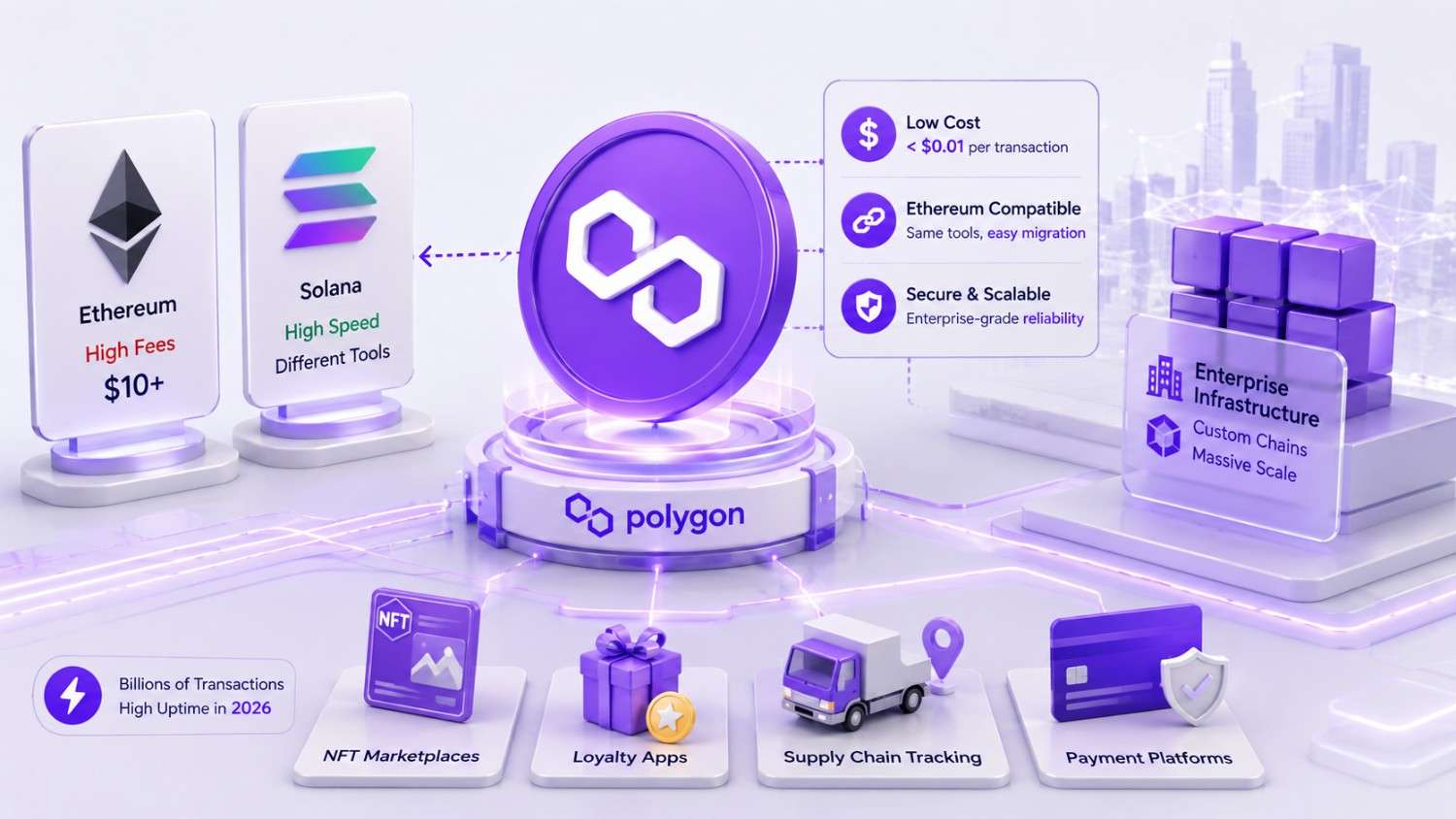 The biggest reason companies choose Polygon is cost. While Ethereum fees can spike into double digits during busy periods, Polygon keeps transaction costs consistently under a cent. That makes it a solid choice for things like NFT marketplaces, loyalty apps, or supply chain tracking, where you need Ethereum’s compatibility and trust but can’t justify Ethereum’s price tag for every single action.
In 2026, Polygon has also been shifting its identity a bit. It’s leaning more into being enterprise-friendly infrastructure; the company behind it has reported handling billions of transactions with very high uptime, and it’s pushing tools that let businesses build their own custom chains rather than just using Polygon as a single network. That’s made it increasingly popular among payment platforms and larger companies that want scalability without sacrificing Ethereum’s security model.
Speed, Cost, and Security: The Simple Version
Here’s the comparison without the technical noise:
- Speed: Solana is the fastest by a wide margin, built to handle very high transaction volume. Polygon is noticeably faster than Ethereum’s base network but still behind Solana. Ethereum is the slowest of the three on its main network, though it makes up for this with extra security.
- Cost: Solana is the cheapest, often costing a fraction of a cent per transaction. Polygon is also very cheap, usually under a cent. Ethereum can be affordable when the network is quiet but gets expensive fast when it’s busy.
- Security: Ethereum has the strongest track record, backed by the largest number of validators of any major blockchain. Polygon inherits a good amount of that security since it connects back to Ethereum. Solana’s cryptography is solid, but it has a shorter history and a smaller validator set, which is something businesses should factor into their cybersecurity planning.
- Developer ecosystem: Ethereum and Polygon both use Solidity, so there’s a huge pool of developers who already know how to build on them. Solana uses Rust, which is a different skill set; this can mean more specialized (and sometimes harder to find) developers, but also a strong, fast-growing community around it.
Matching the Platform to Your Business Goal
Instead of asking “which blockchain is the best,” it helps to ask “what am I actually trying to build?” Here’s a simple way to think about it:
- If you’re building something finance-heavy think lending platforms, large-scale DeFi products, or anything where users are moving serious amounts of money Ethereum is usually the safer bet. Its long track record and deep liquidity still make it the trusted name for high-stakes smart contract development.
- If you’re building something that needs speed and volume a trading app, a real-time game, or a payments product where users are making transactions constantly Solana is often the better fit. Its low fees and high throughput make frequent, small transactions actually practical.
- If you want Ethereum’s trust without Ethereum’s price tag, an NFT platform, a loyalty and rewards system, or a business tool that needs to stay Solidity-compatible, Polygon is usually the smart middle ground.
Many businesses today don’t even pick just one. It’s increasingly common to use Ethereum as the secure settlement layer for big transactions, while running the everyday, high-volume activity on Solana or Polygon. This kind of multi-chain approach is becoming more normal as businesses realise that different parts of their product may genuinely need different infrastructure.
Real-World Examples in 2026
It helps to see how this plays out in practice, not just in theory.
On the payments side, Solana has become a serious home for stablecoin activity. Its stablecoin transfer volume has grown significantly over the past year, and it now accounts for a large share of global decentralized exchange trading volume. That’s a direct result of low fees and fast confirmation times; when moving money costs almost nothing, people move it more often.
Ethereum, meanwhile, is still where the big, serious money sits. Lending platforms on Ethereum process tens of billions of dollars, and it remains the network of choice for tokenizing real-world assets, such as funds and bonds represented on-chain. Big financial institutions experimenting with blockchain tend to lean toward Ethereum first, simply because of its track record and depth of security.
Polygon has quietly become a strong choice for payments infrastructure and enterprise use cases. It’s reported to be handling billions of transactions with very high uptime, and it continues to push tools that let businesses spin up their own custom chains while still connecting back to Ethereum. For NFT projects, Polygon remains popular with teams that want standard, Ethereum-style tokens without Ethereum-level fees, while Solana has carved out its own niche with compressed NFTs that make mass minting dramatically cheaper.
The pattern across all three is the same: the “best” platform keeps changing depending on the use case, not the hype cycle.
Beyond the Platform: What Businesses Actually Need to Get Right
Choosing a blockchain is just the starting point. Once that decision is made, most businesses run into three areas that make or break the project:
Smart contract development. Your smart contracts are the actual rules that run your application: how payments are released, how ownership is transferred, how rewards are calculated. A poorly written smart contract can lead to lost funds or exploits, so this is not a place to cut corners. Getting the logic right and testing it thoroughly before it goes live matters just as much as the blockchain you choose to build on.
 Crypto wallet development. If your product involves any kind of digital asset, your users will need a wallet to hold, send, and receive it. A well-built wallet needs to be simple enough for everyday users while still being secure enough to protect real money. This is one of the more overlooked parts of blockchain development; a clunky or confusing wallet experience can quietly kill an otherwise great product.
Cybersecurity. Blockchain doesn’t automatically mean “unhackable.” Smart contracts can have bugs, wallets can be phished, and even the largest networks have been attacked. Solana, for example, survived a massive DDoS attack in late 2025 without going down a good sign for the network, but also a reminder that attacks on blockchain infrastructure are a real and ongoing risk. Proper audits, secure coding practices, and regular security testing need to be part of any serious blockchain project from day one, not an afterthought.
This is exactly where working with an experienced team pays off. At Deftsoft, our blockchain development services cover the full picture, from smart contract and crypto wallet development to the cybersecurity work that keeps everything safe once it’s live. Whether you’re building on Ethereum, Solana, or Polygon, we help businesses pick the right platform for their specific goals and then build it properly, rather than chasing whatever’s trending that month.
Not sure if Ethereum, Solana, or Polygon is the right foundation for your project?
Skip the guesswork.
Frequently Asked Questions
Which blockchain platform is best for a small business in 2026?
It depends on what you’re building, but for most small businesses just getting started, Polygon is a practical choice. It’s affordable, works with widely available Solidity developers, and still connects back to Ethereum’s security. If your app needs very high transaction volume, Solana may be a better fit instead.
Is Solana cheaper than Ethereum in 2026?
Yes, by a large margin. Solana’s average transaction fees are typically a fraction of a cent, while Ethereum’s fees can range from around a dollar during quiet periods to well over $50 during busy periods. This is one of the biggest reasons apps needing frequent transactions choose Solana.
Is Ethereum still worth using in 2026?
Absolutely. Ethereum remains the top choice for projects that need maximum security, a long track record, and access to the deepest liquidity in decentralized finance. It’s not the cheapest or fastest option, but for serious financial products, it’s still considered the most trustworthy foundation.
Can I switch blockchains later if I start with the wrong one?
It’s possible, but it’s not simple, especially if you’re moving between Ethereum-compatible chains (like Polygon) and non-compatible ones (like Solana), since they use different coding languages. This is why it’s worth spending time upfront choosing the right platform, ideally with guidance from a blockchain development team that’s built on all three.
Do I need a crypto wallet for every blockchain project?
If your product involves any digital assets, tokens, or payments, yes, users will need a wallet to interact with it. The good news is that modern wallets are increasingly multi-chain, meaning a single wallet can often support Ethereum, Solana, and Polygon, making the user experience much simpler than it used to be.
Recent Articles






Devraj
 13th July 2026