AI SEO Services: Complete Guide to AI-Powered Search Optimization in 2026
-
By Devraj
-
22nd April 2026
As of Q2 2026, the ‘Zero-Click’ reality is no longer a prediction—it’s the baseline. With Google’s AI Overviews now appearing in over 75% of informational queries, the traditional goal of ‘ranking #1’ has been replaced by the need for ‘AI Citation.’ At Deftsoft, we’ve observed that websites optimized for AI SEO or LLM (Large Language Model) retrieval see a 40% higher retention in organic visibility compared to those sticking to 2024-era keyword strategies. This guide outlines the framework we use to ensure our clients aren’t just found by users, but are cited by the AI agents users trust.
Quick Summary: The AI SEO Shift in 2026
• The Reality: The way users search has changed. Millions are bypassing “ten blue links” in favor of AI-generated answers (Google AI Overviews, ChatGPT, Perplexity).
• The Problem: Old-school SEO tactics (keyword stuffing, sporadic link building) are failing because they don’t account for how AI models process and rank information.
• The Solution: AI SEO services use machine learning to map topical authority and optimize your content for AI retrieval (LLM SEO) and direct answers (AEO).
• The Goal: It’s not just about “ranking” anymore; it’s about becoming the trusted source that AI models cite. Businesses that adapt now gain a massive competitive advantage.
Is your site truly AI-ready?
Quick Navigation
Why Traditional SEO Started Failing
What Exactly Are AI SEO Services?
The 2026 Search Landscape: What’s Actually New
Google’s AI Overviews Have Changed the Game
LLM SEO: Optimizing for AI Assistants
AEO Services: Winning the Answer Engine
AI SEO vs Traditional SEO: A Practical Comparison
What a Full AI SEO Strategy Actually Looks Like
Who Gets the Most Out of AI SEO?
How to Tell a Good AI SEO Company from a Bad One
Why Traditional SEO Started Failing
If you invested in SEO in the past few years and felt like the results never quite matched the promise, you’re not alone, and it wasn’t entirely your fault. Navigating this shift is a major challenge for any business, which is why many are now turning to a well-rounded, well-equipped, or, you could say, the best SEO company to stay competitive as search rules evolve.
Traditional SEO was built for a simpler internet. The playbook looked something like this: find some keywords, write some content, get a few backlinks, wait three to six months, and hope Google noticed. For a while, it worked.
Then the search got complicated.
Google’s algorithm now processes over 200 ranking factors. User intent has fragmented into thousands of micro-categories. AI-generated content flooded the web, making it harder than ever to stand out with generic articles. And perhaps most significantly, a growing number of people stopped using Google altogether for certain types of searches, turning instead to AI tools like ChatGPT and Perplexity to get answers directly.
The result? Traditional SEO agencies found themselves applying 2018 tactics to a 2026 search landscape. And for many businesses, the organic traffic that once felt dependable started quietly disappearing.
Something had to change.
What Exactly Are AI SEO Services?
AI SEO services use artificial intelligence and machine learning to do what traditional SEO always tried to do, but faster, smarter, and at a scale that humans simply can’t match manually.
Think of it this way. A traditional SEO analyst might research 50 to 100 keywords in a week. An AI system can map thousands of semantically related terms, classify them by search intent, predict their ranking difficulty, and identify content gaps, all before your morning coffee is finished.
But it goes much deeper than keyword research.Modern AI SEO services cover the entire optimization pipeline: content creation and scoring, on-page analysis, technical site auditing, competitor monitoring, internal link optimization, and predictive ranking forecasting. Every task that used to require hours of manual work now runs in the background, continuously, in real time.
At Deftsoft, our AI SEO framework combines enterprise-grade tooling with senior strategist oversight, because data without judgment is just noise. The AI surfaces the opportunities; our team decides how to act on them.
The 2026 Search Landscape: What’s Actually New
Here’s where things get genuinely interesting, and where most businesses are still catching up.
Google’s AI Overviews Have Changed the Game
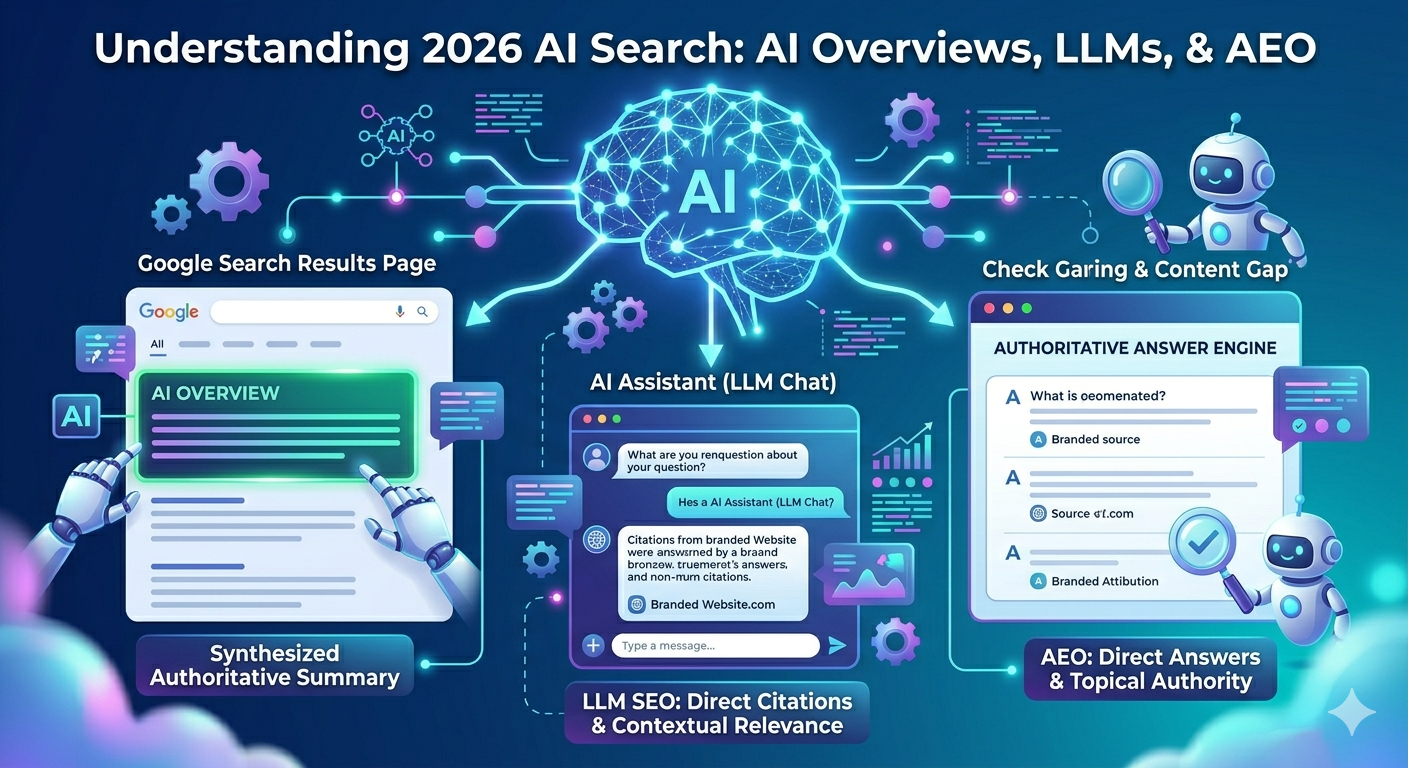
Google’s AI Overviews (formerly Search Generative Experience) now appear at the top of results for a growing percentage of queries. Instead of clicking through to websites, users get a synthesized answer right on the results page, pulled from sources Google’s AI has deemed authoritative.
If your content isn’t structured to be cited by these AI summaries, you’re essentially invisible to a large and growing segment of searchers. This shift aligns with Google’s official documentation on AI-powered search , which highlights how the system now prioritizes content that provides clear, structured answers to complex queries.” Getting ranking on AI Overviews has become the new “position one.”
LLM SEO: Optimizing for AI Assistants
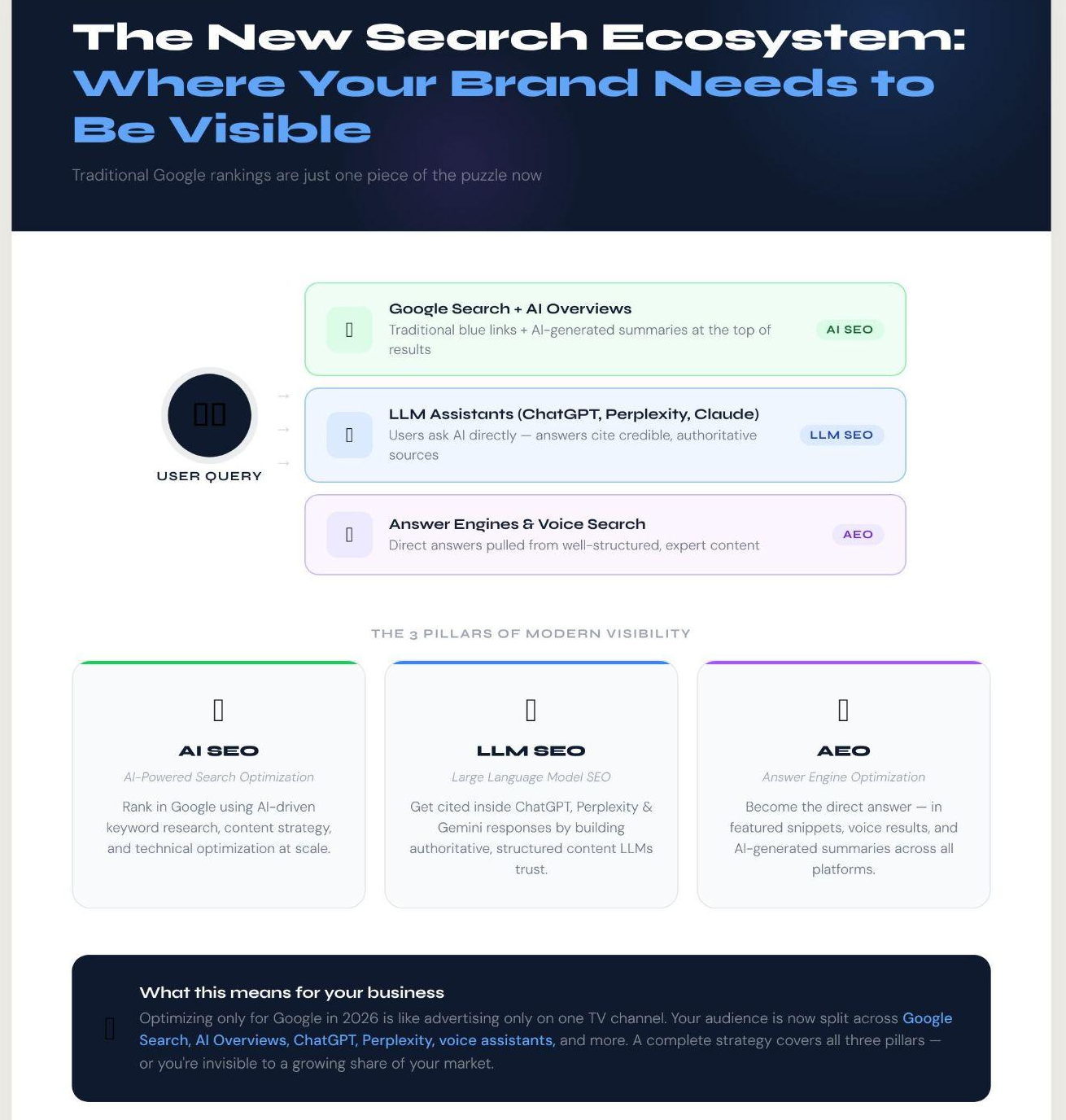
LLM SEO, or large language model SEO,is one of the most important new disciplines in 2026 search strategy, and most businesses have never heard of it.
Here’s the simple version: millions of people now ask ChatGPT, Claude, Perplexity, and Gemini questions instead of typing them into Google. When someone asks, “What’s the best project management software for a small team?” they’re not scrolling through ten blue links anymore. They’re reading an AI-generated answer that cites specific sources.
LLM SEO services are specifically designed to make your brand one of those cited sources. It involves structuring content to match how language models retrieve and summarize information, building genuine topical authority that AI systems recognize as credible, and creating content that answers questions in the precise way that LLMs pull when generating responses.
This is not optional for businesses that want to stay visible over the next three to five years. It’s the direction search is going, full stop.
AEO Services: Winning the Answer Engine
Closely related to LLM SEO is AEO (Answer Engine Optimization). Where traditional SEO optimizes for ranking in search results, AEO optimizes your content to become the answer.
AEO services focus on structuring content around specific questions your audience is asking, using schema markup and structured data so AI systems can parse your content accurately, and building authoritative, well-sourced writing that search engines trust as source material.
If you’ve ever noticed a “featured snippet” box at the top of Google answering your question directly, you’ve seen AEO in action. In 2026, that concept now extends across AI assistants, voice search, and every platform where users expect instant answers rather than a list of links to browse.
Pro-Tip:
To win in AI Overviews, focus on ‘N-Gram’ analysis and semantic density. We recommend using tools like Google Search Console’s API to identify which of your queries are triggering AI summaries, then cross-referencing that with your internal Knowledge Graph health. If your site’s internal linking doesn’t form a clear topical cluster, AI models struggle to verify your authority.
AI SEO vs Traditional SEO: A Practical Comparison
Still wondering whether this represents a genuine shift or just marketing hype? Here’s an honest side-by-side:
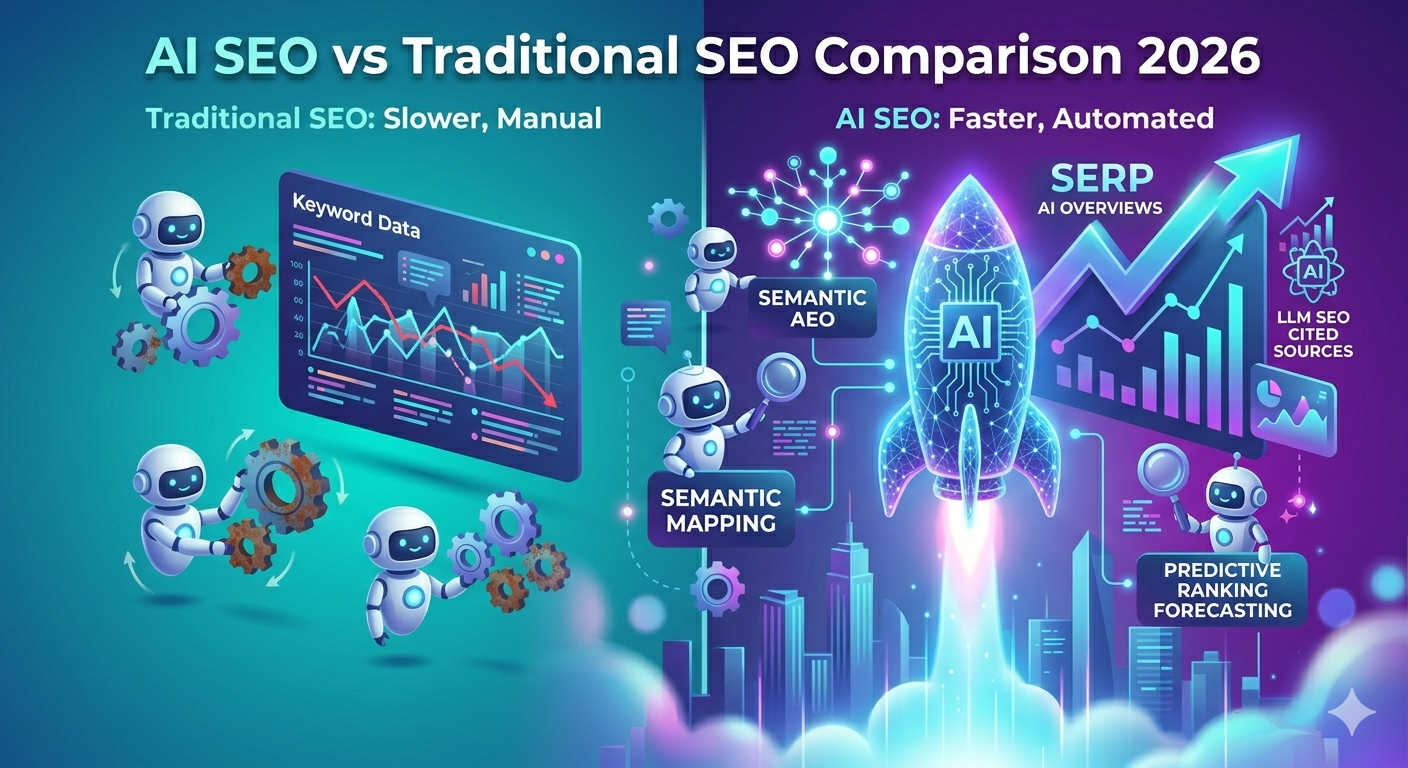
| Feature | Traditional SEO | AI SEO |
|---|---|---|
| Keyword Research | An analyst manually builds a spreadsheet based on volume and competition scores. Takes days. Covers hundreds of terms at best. | Automated semantic mapping simultaneously covers thousands of related terms, categorized by intent, competitive cluster, and predicted ranking difficulty. Takes hours. |
| Content Strategy | Writers are briefed based on what the analyst thinks will work. Quality varies. Optimization happens after the fact. | AI-generated content briefs score every draft against top-ranking competitors in real time. Writers know exactly what’s missing before they publish. |
| Technical Auditing | Periodic audits, quarterly at best, catch issues after they’ve already hurt rankings. | Continuous automated crawling flags Core Web Vitals issues, broken links, and structural problems as they arise. |
| Speed to Results | Three to six months before meaningful movement. Often longer in competitive spaces. | Initial improvements visible within four to eight weeks for the right opportunities, with compounding gains from there. |
| Adaptability | Reactive. Strategy is updated when someone notices a drop. | Predictive. Machine learning models flag ranking risks before they materialize. |
The honest summary? Traditional SEO still works. But it’s slower, more expensive in human hours, and increasingly blind to the opportunities that AI surfaces effortlessly. For businesses in competitive markets, the gap between AI-powered and traditional SEO will only widen.
Check your site’s performance
What a Full AI SEO Strategy Actually Looks Like
When businesses come to Deftsoft asking about AI SEO services, one of the most common questions is: “Okay, but what does this actually involve day-to-day?”
Here’s a realistic picture of what a modern AI SEO engagement covers:
- Semantic Keyword Mapping: Rather than targeting a list of keywords, AI maps the entire topical territory your brand needs to own. For a SaaS company, this might mean identifying 400+ semantically connected queries across the buyer journey stages, awareness, consideration, and decision- and building a content strategy to cover them systematically.
- Content Briefs and Optimization: Every piece of content is built to rank from day one. AI content briefs tell writers exactly which topics to cover, which questions to answer, how long to write, and how to structure headings, based on real analysis of what Google is rewarding for that specific query.
- On-Page Signals: Title tags, meta descriptions, header structures, internal links, and schema markup are all analyzed and optimized. At scale, this is work that would take a human team months. AI handles it continuously.
- LLM SEO and AEO Integration, Content is structured not just for Google, but for AI answer engines. This means direct question-and-answer formatting, authoritative sourcing, and topical depth that LLMs recognize when generating responses.
- Competitor Intelligence: Real-time tracking of what competitors are ranking for, where they’re building links, and which content gaps they haven’t filled yet. The best opportunities in SEO are often the ones your competitors haven’t noticed; AI finds them first.
- Reporting That Makes Sense: Not vanity dashboards full of impressions no one converts from. Reporting tied to actual business outcomes: qualified traffic, lead generation, and revenue-contributing keyword movements.
The Deftsoft Difference
While our AI models handle the heavy lifting of data processing, every strategy at Deftsoft undergoes a Senior Strategist Review. We believe AI provides the map, but human intuition provides the compass. We verify every AI-generated content brief for brand voice consistency and E-E-A-T compliance, ensuring your content resonates with humans just as much as it satisfies algorithms.
Who Gets the Most Out of AI SEO?
AI SEO delivers outsized value in specific situations. Based on Deftsoft’s work across industries, these are the businesses that see the most dramatic results:
- SaaS companies operate in crowded markets where every high-intent keyword has dozens of well-funded competitors. AI SEO creates topical authority at the scale needed to compete, without requiring an unlimited content budget.
- E-commerce brands manage hundreds or thousands of product pages. Manual optimization at that scale is simply not viable. AI handles it systematically, continuously.
- Professional services firms: SEO for Lawyers,healthcare, finance and consulting, where Google’s E-E-A-T (Experience, Expertise, Authoritativeness, Trustworthiness) standards are especially demanding. AI helps build the kind of authoritative content architecture these industries require.
- Startups and scale-ups where time to traction matters. Organic search compounds over time; the earlier you start with AI SEO, the larger the advantage becomes.
- Local businesses that want enterprise-level competitive intelligence without enterprise budgets. AI levels the playing field considerably.
How to Tell a Good AI SEO Company from a Bad One
The term “AI SEO” has become something of a buzzword, and not every agency using it is actually delivering it. Here’s what to look for in a Best AI SEO Company, and what to watch out for.
- Ask what’s actually AI and what’s manual. Some agencies slap “AI-powered” on a proposal and then do the same work they’ve always done. Ask them to show you the tools, the workflows, and specifically where AI is accelerating outcomes.
- Look for human strategists, not just automation. The best results come from AI tools interpreted by experienced SEO professionals. Fully automated pipelines with no strategic oversight produce generic results and, often, content that violates Google’s quality guidelines.
- Demand transparent reporting. You should see exactly which keywords moved, which pages were changed, and the direct link between actions and outcomes. If a reporting dashboard looks impressive but doesn’t help you understand causality, it’s a red flag.
- Check for LLM SEO and AEO in their offering. If an agency’s AI SEO proposal doesn’t mention optimizing for AI answer engines in 2026, they’re already behind the curve.
- Ask about content quality controls. AI-assisted content that skips human review ranks poorly and can damage brand credibility. Any serious agency should have a clear editorial process.
At Deftsoft, every engagement includes dedicated strategist time, editorial review on all content, and reporting built around business outcomes, not just ranking movement for its own sake.
Pro-Tip:
Beware of agencies that offer “fully automated content production.” While AI is incredible for ideation and data structure, Google’s E-E-A-T (Experience, Expertise, Authoritativeness, Trustworthiness) standards require human insight. Always ensure your agency provides senior-level editorial review. Your content should be AI-assisted, but human-verified.
The Bottom Line
Search in 2026 is not what it was three years ago. Google’s AI Overviews, the rise of LLM-powered search assistants, the explosion of content competing for attention, and the businesses that will own organic search over the next five years are all factors. The businesses that will own organic search over the next five years are the ones investing in the right infrastructure now.
AI SEO services are a part of the new Digital Marketing trends,including the LLM SEO and AEO services, which aren’t niche add-ons; they’re quickly becoming the most important channels for organic visibility that most businesses haven’t even begun to consider.
The good news is that the window to gain a meaningful advantage is still open. Most of your competitors are still running traditional SEO playbooks. That gap, between where they are and where AI SEO can take you, is the opportunity.
Deftsoft exists to help businesses capture it.
Ready to dominate search in 2026?
Frequently Asked Questions
Is traditional SEO officially dead in 2026?
Not dead, but definitely evolved. Traditional principles like high-quality content, site speed, and domain authority still matter. However, without an AI-driven layer on top, traditional SEO is often too slow and manual to compete with modern, agile strategies.
What is the difference between “AI SEO” and just using AI to write content?
“AI-generated content” is just the writing stage. AI SEO is a comprehensive strategy. It uses AI to perform semantic keyword mapping, predict ranking risks, conduct real-time technical auditing, and structure content specifically for AI Answer Engines. It is a system, not just a shortcut for writing.
How soon can I expect to see results with an AI SEO strategy?
Because AI SEO automates the research and technical audit phases, you won’t have to wait weeks for human analysts to pull reports. Most of our clients see meaningful movement in rankings and traffic patterns within 4–8 weeks, significantly faster than traditional, manual SEO campaigns.
Why does my business need “LLM SEO” or “AEO”?
When a user asks an AI assistant (like Gemini or ChatGPT) a question about your industry, you want your brand to be the cited source. LLM SEO and AEO optimize your content so that AI systems recognize it as credible and authoritative, putting your brand directly into the answer. If you aren’t optimized for this, you are effectively invisible to that growing audience.
How does Deftsoft ensure AI-written content doesn’t sound robotic?
We don’t believe in “AI-only” content. Our process uses AI to build the strategic framework, briefs, and data-driven structures. Then, our senior editorial team reviews, polishes, and humanizes the content to ensure it reflects your brand voice and passes Google’s E-E-A-T (Experience, Expertise, Authoritativeness, Trustworthiness) standards.




Devraj
 22nd April 2026