Cloud Application Development Services: A Practical Guide for Tech Executives

Cloud is no longer a question of “if”; it’s a question of “how well.” Gartner projects public cloud end-user spending will hit $850 billion in 2026, a 21.3% jump from the year before, and 94% of enterprises now use cloud services in some form. For tech executives, the conversation has shifted from whether to move to the cloud to whether their cloud application development services partner can actually deliver something scalable, secure, and built for how AI-driven workloads now run.

This guide is written for exactly that audience: CTOs, VPs of Engineering, and technical decision-makers evaluating cloud application development, whether that means building something new, modernizing an existing system, or choosing between the growing list of cloud application development companies competing for your budget. Whether your team calls it cloud applications development, application development cloud computing, or simply cloud app development, the underlying questions are the same: which architecture, which provider, and which partner actually gets it right.

Have a cloud application idea but not sure where to start?

Get a clear technical roadmap built around your specific goals.

Talk to Our AI Search Team

Quick Navigation

What Is Cloud Application Development?

Why Cloud Application Development Matters in 2026

Cloud Application Development vs. Traditional Development

Core Components of Cloud App Development

Cloud App Development: Build, Migrate, or Modernize?

What to Look for in Cloud Application Development Companies

How Deftsoft Approaches Cloud Application Development

Cloud Application Solutions Across Industries

Common Mistakes Businesses Make in Cloud App Development

Frequently Asked Questions

What Is Cloud Application Development?

Cloud application development is the process of building software that runs on cloud infrastructure rather than local servers or on-premise data centers. Instead of installing an application on a single machine, a cloud application is built to run across distributed, scalable infrastructure, accessible from anywhere, updated centrally, and able to scale up or down based on real demand.

If you’re asking what a cloud application is in the simplest terms, it’s software designed from the ground up to take advantage of cloud infrastructure—elastic compute, managed databases, distributed storage, and on-demand scaling rather than software that was simply moved to a server somewhere.

This distinction matters more than it sounds. Application development for cloud environments requires different architectural thinking than traditional development: statelessness, horizontal scaling, service-oriented design, and resilience against individual component failure are all baked in from day one, not retrofitted later.

Why Cloud Application Development Matters in 2026

The numbers make the case better than any pitch could. The global cloud computing market is valued at roughly $917.9 billion in 2026, on track to cross $1 trillion before year-end, according to Synergy Research Group. Application development and testing specifically account for 45% of cloud adoption use cases, as businesses lean on flexible cloud resources to build faster while keeping cost and security under control.

What’s changed most in the last year is why businesses are investing. 64% of IT decision-makers now say cloud infrastructure is essential to their AI strategy, and 61% of enterprises plan to migrate more workloads to the cloud specifically to support AI initiatives. Cloud-based application development in 2026 increasingly means building applications that can plug directly into AI inference, machine learning pipelines, and real-time data processing — something legacy, on-premise architecture simply wasn’t designed for.

Containers, Kubernetes, and serverless architecture have also crossed from “advanced” to standard practice for new builds; 95% of new digital workloads are now being built on cloud-native platforms. If your application development in cloud computing strategy isn’t cloud-native by default, you’re already behind where the rest of the market has moved.

Cloud Application Development vs. Traditional Development

The difference isn’t just where the code runs — it’s how the entire system is designed to behave.

Traditional Application Development Cloud Application Development
Built for fixed, on-premise infrastructure Built for elastic, distributed infrastructure
Scaling requires new hardware Scales on demand, automatically
Manual deployment and updates Continuous deployment, centralized updates
Single point of failure risk Designed for resilience and redundancy
High upfront infrastructure cost Pay-as-you-go, usage-based cost model

This is exactly why custom cloud application development has become the default approach for businesses building anything meant to scale; the architecture itself is designed around growth and flexibility, not bolted on after the fact.

Core Components of Cloud App Development

Understanding how to develop cloud computing application projects successfully starts with knowing the moving parts involved:

  • Cloud infrastructure and hosting — Choosing between AWS, Microsoft Azure, or Google Cloud, which together hold more than 60% of the global market, with AWS at roughly 30% share, Azure at 25%, and Google Cloud at 13% as of early 2026.
  • Architecture design — deciding between microservices, serverless, or a hybrid approach based on the application’s actual usage patterns and growth expectations.
  • Database and data management — Selecting managed, cloud-native database services that scale independently from the application layer itself.
  • APIs and integrations — Building applications that connect cleanly with third-party services, internal systems, and increasingly, AI and machine learning models.
  • Security and compliance — Implementing identity management, encryption, and access controls appropriate to the industry and data sensitivity involved.
  • DevOps and CI/CD pipelines — Automating deployment, testing, and monitoring so updates ship reliably and frequently, rather than through slow, manual release cycles.

A genuine cloud application development service should be able to speak fluently to all six of these areas, not just the parts that are easiest to build.

Cloud App Development: Build, Migrate, or Modernize?

Most businesses approaching developing cloud applications fall into one of three categories, each requiring a different approach:

  • Building new — starting from scratch with cloud-native architecture from day one, ideal for new products, startups, or greenfield internal tools.
  • Migrating existing applications — moving an on-premise or legacy system to cloud infrastructure, which requires careful planning to avoid simply recreating old limitations in a new environment.
  • Modernizing legacy systems — re-architecting an existing application to actually take advantage of cloud-native capabilities (auto-scaling, managed services, containerization) rather than just relocating it.

Deciding which path applies to your business is one of the first, most important conversations to have with any cloud app development company before a single line of code gets written, because the wrong starting assumption here tends to compound into expensive rework later.

What to Look for in Cloud Application Development Companies

With so many cloud application development companies competing for enterprise budgets, a few criteria separate serious technical partners from the rest:

  • Multi-cloud and hybrid-cloud experience, since 87% of enterprises now operate multi-cloud strategies rather than committing to a single provider
  • Security-first architecture, not security added as an afterthought once development is complete
  • Proven experience with AI integration, given how central AI workloads have become to cloud strategy in 2026
  • Transparent, usage-based cost modeling, so cloud spend stays predictable as the application scales
  • Strong DevOps and automation practices, since 93% of developers now deploy code to the cloud as a standard part of their workflow
  • A track record with businesses of comparable scale and complexity to your own

A provider offering true cloud development services should be able to walk you through specific examples of each of these — not just a generic capabilities slide.

How Deftsoft Approaches Cloud Application Development

At Deftsoft, we treat cloud application development services as a long-term engineering partnership, not a one-time build-and-hand-off project. Our approach to cloud software development services is built around understanding the business problem first, then architecting a solution around the cloud platform, tools, and services that actually fit — rather than defaulting to whichever stack is fastest to sell.

Whether you need custom cloud application development built from the ground up, help modernizing a legacy system into a cloud-native architecture, or ongoing support scaling an existing application, Deftsoft’s team works across AWS, Azure, and Google Cloud to build solutions matched to your specific technical and business requirements. This includes secure API design, database architecture, CI/CD pipeline setup, and increasingly, integration with AI and machine learning capabilities — since that’s where a growing share of real client demand is heading in 2026.

As a cloud app development company, Deftsoft also places heavy emphasis on cost transparency and architecture that scales predictably, so tech executives aren’t left reconciling ballooning cloud bills against a system that was never designed to scale efficiently in the first place.

Cloud Application Solutions Across Industries

Cloud application solutions aren’t one-size-fits-all — the right architecture depends heavily on industry. In finance, cloud applications support real-time transaction processing and compliance-heavy data handling. In healthcare, cloud platforms enable secure patient data management alongside strict regulatory requirements. Retail and logistics rely on cloud applications for real-time inventory tracking and customer analytics, while manufacturing increasingly leans on cloud-based IoT integration; notably, 94% of manufacturing companies now use or are actively considering cloud-based ERP systems.

Whatever the industry, the underlying principle stays consistent: a genuinely useful cloud application is architected around how the business actually operates, not adapted awkwardly from a generic template afterward.

Common Mistakes Businesses Make in Cloud App Development

Here are the common mistakes businesses make in cloud app development, formatted as bullet points:

  • Choosing a Partner Solely on Cost: Selecting a development partner based purely on price, without thoroughly evaluating their architecture quality or security practices, frequently results in costly rework later.
  • Treating Migration as a Simple “Lift and Shift”: Moving an existing application directly to the cloud without redesigning it to be cloud-native merely transfers legacy limitations into a more expensive environment.
  • Skipping DevOps and Automation Setup: Failing to establish proper DevOps procedures and automated pipelines early on creates bottlenecks and slows down every subsequent release.
  • Underestimating Security and Compliance: Neglecting security protocols and regulatory requirements in the initial stages can lead to severe, expensive complications down the line, especially for businesses in regulated industries.
  • Architecture Quality: Choosing the wrong programming tool or technology stack for your cloud application—such as selecting a framework that doesn’t scale well with serverless architecture or cross-platform demands—can lead to performance bottlenecks.

Choosing the Right Tech Stack for Cloud-Native Applications

Selecting the right development frameworks and languages is essential for building cloud applications that are performant, scalable, and easy to maintain. Your chosen tech stack directly influences how seamlessly your front-end user experience interacts with back-end cloud microservices.

  • Frontend & Cross-Platform Frameworks (Flutter & React / React Native): Tools like React and React Native enable developers to build responsive web and mobile interfaces powered by flexible component architectures. Flutter provides a unified codebase for seamless, high-performance applications across iOS, Android, and web. Both frameworks connect effortlessly to cloud-hosted APIs and serverless backends, delivering consistent user experiences across devices.
  • Backend & Serverless Languages (Node.js, Python, Go): Choosing lightweight, event-driven languages for backend operations ensures your application can take full advantage of cloud-native infrastructure, such as AWS Lambda or Google Cloud Functions, without unnecessary overhead or latency.

Already have a legacy system that needs modernizing?

See exactly what a cloud-native rebuild would involve.

Frequently Asked Questions

1. What is cloud application development?

Cloud application development is the process of building software specifically designed to run on cloud infrastructure, taking advantage of elastic scaling, managed services, and distributed architecture rather than fixed, on-premise servers.

2. What is the difference between cloud application development and traditional application development?

Traditional development is built for fixed infrastructure with manual scaling and deployment, while cloud application development is built for elastic, distributed infrastructure that scales automatically and supports continuous deployment.

3. How much does custom cloud application development cost?

Cost depends on the application’s complexity, chosen cloud provider, required integrations, and whether the project involves building new, migrating, or modernizing an existing system. A proper quote should come from a technical assessment of your specific requirements.

4. Which cloud platform is best for application development — AWS, Azure, or Google Cloud?

Each has strengths depending on your needs — AWS holds the largest market share and broadest service catalog, Azure integrates deeply with Microsoft’s enterprise ecosystem, and Google Cloud is strong in AI and data analytics. Many businesses now use a multi-cloud approach rather than committing to just one.

5. How long does it take to develop a cloud application?

Timelines vary based on scope, but a well-scoped cloud application development services engagement typically involves phased delivery, starting with core architecture and an MVP, followed by iterative feature development and scaling.

6. Is cloud application development secure?

When built correctly, yes, often more secure than traditional on-premises systems, since cloud providers invest heavily in infrastructure security. However, security depends heavily on how the application itself is architected, which is why choosing an experienced cloud application development company matters.

7. What industries benefit most from cloud application development?

Nearly every industry benefits, but finance, healthcare, retail, logistics, and manufacturing have seen particularly strong adoption, driven by real-time data needs, compliance requirements, and the growing integration of AI into everyday business operations.

What Is an AEO Insights Company? How It Measures Your Visibility in AI Search

If you’ve been asking “what is AEO insights” or trying to understand what an AEO insights company actually does, you’re not alone. As more people search using AI tools like ChatGPT, Google AI Overviews, and Perplexity instead of typing into Google, businesses need a new way to check if they’re even being seen. This is exactly the gap an AEO insight company fills. In simple terms, it’s a company or tool that tracks how often your brand shows up, gets mentioned, or gets recommended in AI-generated answers. This shift matters more than it might seem at first: a business could be ranking perfectly on Google and still be completely invisible when a customer asks an AI assistant the same question in their own words. This blog explains what an AEO insight company is, what it actually tracks, how it works, and why more businesses are starting to rely on one to stay visible in AI search.

Want to know how AI tools are currently talking about your brand?

Check exactly where you stand.

Quick Navigation

What Is an AEO Insights Company?

What Does an AEO Insights Company Track?

AI Brand Mentions and Visibility Monitoring

AI Search Rankings and Answer Engine Visibility

Brand Sentiment and Context Analysis

Competitor AEO Performance Tracking

How Does an AEO Insights Company Work?

Key Metrics Tracked by an AEO Insights Company

AI Visibility Score

Brand Mention Frequency

Citation and Source Performance

Conversion Tracking With AEO

Measuring AEO Success Metrics: What Businesses Should Monitor

AEO Insights Company vs Traditional SEO Tools

Why Businesses Need to Hire Deftsoft – AEO Insights Company

Future of AEO Insights Companies in AI Search

Conclusion

Frequently Asked Questions

What Is an AEO Insights Company?

An AEO insights company is a business (or a platform) that helps you understand your brand’s visibility inside AI answer engines, tools like ChatGPT, Gemini, Perplexity, and Google’s AI Overviews. Instead of only checking where your website ranks on a normal Google search page, an AEO insights company checks something different: is your brand actually being mentioned when someone asks an AI a question related to your business?

Think of it this way: normal SEO tools tell you your search rankings. An AEO insights company overview, on the other hand, tells you whether AI tools trust your brand enough to talk about it at all. That’s a completely different, and increasingly more important, kind of visibility. To put it plainly, if someone were to ask, “AEO insight company what is it,” the simplest answer is this: it’s a service that watches how AI systems talk about your brand, and turns that into numbers and reports you can actually act on.

What Does an AEO Insights Company Track?

An AEO insights company doesn’t just look at one thing; it tracks several different signals that together paint a full picture of your AI visibility.

AI Brand Mentions and Visibility Monitoring

One of the core jobs of any AEO visibility platform is simple: checking how often your brand name shows up when people ask AI tools questions related to your industry. This is often called AEO AI brand mentions coverage, basically, how wide your brand’s reach is across different AI tools and different types of questions. A good AEO tracker doesn’t just count mentions once. It checks regularly, across multiple AI platforms, so you can see if your visibility is growing, staying flat, or dropping over time.

Beyond just mentions, an AEO visibility platform also studies where your brand appears within an AI’s answer. Are you the first thing mentioned, or are you buried somewhere in the middle of a long response? Is your brand recommended directly, or only mentioned as one option among many? This is where a proper AEO tracker becomes genuinely useful; it doesn’t just tell you that you were mentioned; it tells you how prominently, and how often you were the answer chosen over a competitor.

Brand Sentiment and Context Analysis

It’s not enough to just be mentioned; how you’re mentioned matters just as much. Good AEO insights go a step further and look at the tone AI tools use when talking about your brand. Are you described positively, neutrally, or in a way that could actually hurt trust? Understanding the context around each mention helps businesses know if their AI visibility is actually working in their favor.

Competitor AEO Performance Tracking

A complete AEO insights company profile should also include a clear view of how you compare to your competitors. Are AI tools mentioning your competitors more often than you, for the same kind of questions? This kind of side-by-side tracking helps businesses understand where they’re falling behind, and what specific gaps need to be closed.

How Does an AEO Insights Company Work?

In simple terms, here’s how the process usually works. First, the platform runs a large number of real, common questions through different AI tools- the same kinds of questions your potential customers might actually ask, phrased the way a real person would type or speak them, not just formal keyword lists. Then, it scans the answers those AI tools give back, checking for your brand name, your competitors’ names, and how each one is described.

After that, all of this information gets organized into scores, charts, and reports that are easy to understand, so instead of guessing whether AI tools know about your brand, you get clear, real data. This also means the process needs to happen repeatedly and consistently, since AI models are updated often, and a brand’s visibility can shift from one month to the next without any obvious warning. Over time, this ongoing tracking lets a business see whether its visibility in AI search is improving as it puts more effort into its content and online presence.

Key Metrics Tracked by an AEO Insights Company

A trustworthy AEO platform doesn’t just give you a vague summary; it tracks specific, measurable numbers.

AI Visibility Score

This is usually a single, simple number that sums up how visible your brand is across AI tools overall. A higher score generally means AI systems mention and recommend your brand more often and more clearly.

Brand Mention Frequency

This tracks exactly how many times your brand shows up across a set number of AI-generated answers, over a set period of time, helping you see whether your visibility is trending up or down.

Citation and Source Performance

This looks at which of your web pages or content pieces are actually being used as sources by AI tools when they generate an answer. Some pages perform far better than others here, and knowing which ones work helps guide future content decisions.

Conversion Tracking With AEO

Conversion tracking with AEO is about connecting the dots between AI visibility and real business results. It’s one thing to be mentioned by an AI tool; it’s another thing entirely for that mention to actually lead to a website visit, an inquiry, or a sale. Good AEO tracking tries to follow that full path, so you’re not just measuring visibility for its own sake, but tying it back to real outcomes.

Measuring AEO Success Metrics: What Businesses Should Monitor

AEO Success Metrics

When it comes to measuring AEO success metrics, businesses shouldn’t just look at one number in isolation. It helps to watch a combination of things together: how often you’re mentioned, how positively you’re described, how you compare to competitors, and most importantly, whether that visibility is turning into real website traffic or leads. A business that’s only mentioned occasionally but always described positively and with strong context might actually be in a stronger position than one that’s mentioned often but described vaguely or negatively. This is why measuring AEO success metrics properly means looking at the full picture, not just a single score.

AEO Insights Company vs Traditional SEO Tools

It’s natural to wonder how an AEO insights company is different from the SEO tools you may already be using. Here’s a simple comparison:

Traditional SEO Tools AEO Insights Company
Tracks Google search rankings Tracks visibility inside AI-generated answers
Measures clicks and organic traffic Measures brand mentions and citations by AI
Focuses on keyword positions Focuses on how AI tools describe and recommend your brand
Reports based on search engine results pages Reports based on real AI conversations and answers
Doesn’t account for AI chatbots or AI Overviews Built specifically for AI search platforms

This comparison makes it clear why so many businesses are now looking for a dedicated AEO insights company or AEO visibility platform; traditional SEO tools simply weren’t built to measure this newer, fast-growing part of search.

Why Businesses Need to Hire Deftsoft – AEO Insights Company

If you’re searching for a reliable AEO insights company overview before choosing a partner, here’s a simple, honest one for Deftsoft. At Deftsoft, we’ve built our approach to AEO insights around one simple idea: businesses deserve to know exactly how AI tools are talking about them, without confusing jargon or vague dashboards. As a dedicated AEO insights company, Deftsoft tracks your brand mentions, competitor comparisons, and AI visibility scores, and turns all of that into clear, simple reports your team can actually use.

Ready to build a strategy to improve your AI search visibility?

Get a plan built around real data, not guesswork.

Talk to Our AI Search Team

What makes Deftsoft a strong choice is that our team doesn’t just monitor AEO in isolation; we combine it with real SEO and content strategy, so once we identify where your AI visibility is weak, we can help fix it. Instead of just handing you a report and walking away, Deftsoft works with you to improve your content, structure, and online presence so your brand starts showing up more often, and more positively, across AI search tools.

Whether you’re completely new to AEO or you’ve already started tracking it elsewhere and want clearer, more actionable insights, Deftsoft’s approach is built to make AI visibility something you can actually understand and improve, not just something you passively measure. If you’re comparing providers, it’s worth visiting each AEO Insights official website directly to see how they explain their process; a company that’s transparent about how it tracks and reports data is usually a safer long-term partner than one that keeps its methodology vague.

As more people rely on AI tools to answer everyday questions instead of typing into a search bar, the role of an AEO insights company is only going to grow. Businesses that once focused purely on search engine rankings are going to need to pay just as much attention to how AI systems describe them, recommend them, and compare them to competitors.

In the coming years, it’s likely that AEO tracking becomes just as standard a business practice as regular SEO reporting is today. Brands that start paying attention to this now and working with a genuine AEO insights company are likely to have a real head start over competitors who wait until AI search becomes even more dominant than it already is.

Conclusion

As AI tools become a bigger part of how people search for information, understanding your visibility inside those tools matters just as much as your regular search rankings, sometimes even more. An AEO insights company gives you the clarity to know exactly how, where, and how often your brand is being mentioned in AI-generated answers, and turns that into insights you can actually act on. Whether you’re just getting started or looking for a more reliable AEO insights company to work with, Deftsoft is here to help you understand and grow your visibility in the world of AI search.

Frequently Asked Questions

1. What is an AEO insights company?

An AEO insights company is a service or platform that tracks how often and how positively your brand is mentioned inside AI-generated answers from tools like ChatGPT, Gemini, and Google AI Overviews.

2. What is AEO in marketing?

AEO, or Answer Engine Optimization, is the practice of optimizing your brand’s content and online presence so it gets picked up, mentioned, and recommended by AI-powered answer engines and chatbots.

3. What is an AEO certificate?

An AEO certificate generally refers to a certification or training credential focused on Answer Engine Optimization skills, though at this stage it’s not yet a single standardized qualification the way some other marketing certifications are — most businesses instead rely on working with an experienced AEO insights company directly.

4. How is an AEO insights company different from a normal SEO tool?

Traditional SEO tools measure your rankings and traffic on search engines like Google, while an AEO insights company measures how your brand is mentioned and described inside AI-generated answers, a completely different, newer kind of visibility.

5. What does an AEO tracker actually measure?

An AEO tracker typically measures brand mention frequency, how prominently your brand appears in AI answers, sentiment and context, and how you compare to competitors across the same types of questions.

6. Can AEO insights be connected to real business results?

Yes. Good AEO tracking includes conversion tracking with AEO, which follows the path from an AI mention to actual website visits, inquiries, or sales, not just visibility for its own sake.

7. Why should a business hire an AEO insights company instead of tracking this manually?

Manually checking how AI tools mention your brand across many different questions and platforms is time-consuming and inconsistent. A dedicated AEO insights company automates this tracking and turns it into clear, reliable reports.

8. Is AEO going to become as important as traditional SEO?

As more people rely on AI tools for everyday questions, AEO is expected to become an increasingly important part of any business’s overall search visibility strategy, working alongside traditional SEO rather than replacing it.

AI Transformation Is a Problem of Governance: Why Businesses Need the Right AI Strategy & Technology Partner

Businesses everywhere are racing to adopt AI. From chatbots and automation tools to full-scale machine learning systems, companies of every size are experimenting with artificial intelligence in the hope of moving faster and working smarter. But here’s what most businesses are discovering the hard way: simply implementing AI tools does not guarantee successful AI transformation. Buying access to a model, plugging it into a workflow, or rolling out an AI assistant company-wide is the easy part. Making it actually work, safely, reliably, and in a way that holds up under scrutiny, is a different challenge entirely.

That challenge has a name, and it’s not a technology problem. AI transformation is a problem of governance. Without the right AI strategy, the right technology, proper security, and a clear governance framework, even the most advanced AI tools tend to underdeliver, create new risks, or quietly fail. This is exactly why choosing the right AI strategy consulting and technology partner has become one of the most important decisions a business can make in 2026.

Don’t let poor governance stall your AI initiative.

Ensure your technology investment delivers measurable ROI.

Quick Navigation

What Does “AI Transformation Is a Problem of Governance” Mean?

Why AI Transformation Requires More Than AI Tools

The Biggest AI Governance Challenges Businesses Face

Data Privacy and Security

AI Compliance and Regulations

AI Accuracy and Reliability

Accountability and Responsibility

Shadow AI

What Is an AI Governance Framework?

How to Build an Effective AI Transformation Strategy

1. Define Clear Business Goals

2. Identify High-Value AI Use Cases

3. Assess Data Readiness

4. Establish AI Governance Policies

5. Implement AI Securely

6. Monitor and Improve AI Systems

The Role of an AI and Technology Partner in Business Transformation

Why Businesses Should Choose the Right AI Technology Partner

How Deftsoft Helps Businesses Navigate AI Transformation

AI Strategy and Consulting

Custom AI Development

AI Integration

Secure and Scalable Technology Solutions

Long-Term AI Support and Optimization

AI Governance vs. AI Transformation: What’s the Difference?

What Happens When Businesses Ignore AI Governance?

The Future of AI Transformation Is Responsible AI Governance

Frequently Asked Questions About AI Transformation and Governance

What Does “AI Transformation Is a Problem of Governance” Mean?

In simple terms, AI transformation means using artificial intelligence to genuinely change how a business operates, not just adding a chatbot here or an automation there, but building AI into how decisions get made, how work gets done, and how value gets delivered through technologies such as AI Agent Development. AI governance is the set of policies, controls, and oversight structures that make sure this happens responsibly. It covers how AI systems are built, deployed, monitored, and held accountable for their outcomes.

The core idea behind “AI transformation is a problem of governance” is that AI adoption involves far more than technology alone. It’s a combination of several connected pieces working together: AI strategy (what you’re trying to achieve and why), data governance (whether your data is trustworthy and well-managed), security (protecting systems and sensitive information), compliance (meeting legal and regulatory requirements), risk management (understanding what could go wrong), and accountability (knowing who’s responsible when something does). The same governance-first approach applies across digital initiatives, whether an organization is implementing enterprise AI solutions or developing a Google Ads for Doctors SEO outline to ensure marketing campaigns are strategically planned, compliant, measurable, and aligned with business objectives.

When any one of these pieces is missing, even a technically well-built AI implementation can fail. Poor governance can undermine an otherwise successful project; a model that performs perfectly in testing can still create real damage in production if there’s no oversight, no clear ownership, and no plan for when something goes wrong.

Why AI Transformation Requires More Than AI Tools

It’s tempting to think that adopting AI is as simple as giving employees access to ChatGPT, plugging an AI Agent Development model into a workflow, or turning on an automation tool. In practice, that rarely leads to real transformation, and often creates new problems instead. A few reasons why:

  • Lack of clear business objectives. Many businesses adopt AI because it feels necessary, not because they’ve identified a specific problem it should solve. Without a clear goal, it’s nearly impossible to measure whether the AI initiative actually worked, even in specialized projects such as Crypto Wallet Development.
  • Poor-quality or inaccessible data. AI systems are only as good as the data behind them. Gartner projects that 60% of AI projects unsupported by AI-ready data will be abandoned this year, and the common thread in most of these failures is poor or unavailable data, not the model itself.
  • Security and privacy risks. Employees experimenting with public AI tools can unintentionally expose confidential business or customer information, creating real security and compliance exposure.
  • Employee adoption challenges. Even a well-built AI tool fails if employees don’t trust it, don’t understand how to use it, or actively work around it.
  • Lack of internal AI expertise. Most businesses simply don’t have the in-house knowledge to design, deploy, and govern AI Software Development correctly, which is exactly why an experienced AI implementation services partner matters.
  • Integration with existing systems. AI tools that don’t connect cleanly with existing software, CRMs, or business processes tend to create more friction than value.
  • Difficulty measuring ROI. Without clear objectives and proper tracking, it becomes very hard to prove that an AI investment actually paid off.

The Biggest AI Governance Challenges Businesses Face

Data Privacy and Security

Protecting sensitive business and customer data is one of the most immediate governance challenges businesses face. When employees enter confidential information into public AI tools without oversight, that data can end up stored, processed, or even used to train systems outside the company’s control, a risk many businesses don’t fully realize until it’s too late.

AI Compliance and Regulations

Regulatory compliance is becoming harder to ignore. The EU AI Act’s obligations are phasing in through 2027, with a major wave, including rules for high-risk systems, taking effect on August 2, 2026, and penalties reaching up to €35 million or 7% of global annual turnover for the most serious violations. Yet recent readiness research found that 78% of enterprises had not yet taken meaningful steps toward compliance. Beyond broad regulation, many industries carry their own specific requirements, and businesses need clear documentation of how and why AI systems make decisions.

AI Accuracy and Reliability

AI models can produce confident-sounding but incorrect information, commonly called hallucinations. Without human oversight and proper validation processes, inaccurate AI-generated content or decisions can move through a business unnoticed until real damage is done.

Accountability and Responsibility

When an AI system makes a mistake, who’s actually responsible? This question trips up more businesses than it should. Without clearly defined roles and responsibilities from the start, accountability gaps tend to surface only after something has already gone wrong.

Shadow AI

Shadow AI refers to employees using AI tools that haven’t been reviewed, approved, or secured by the business. It’s one of the fastest-growing governance risks, uncontrolled AI adoption across an organization creates blind spots that traditional IT security wasn’t built to catch. Recent research reflects just how fast this is being taken seriously: the share of organizations reporting a Chief AI Officer jumped from 26% to 76% in a single year, largely in response to exactly this kind of unmanaged exposure.

What Is an AI Governance Framework?

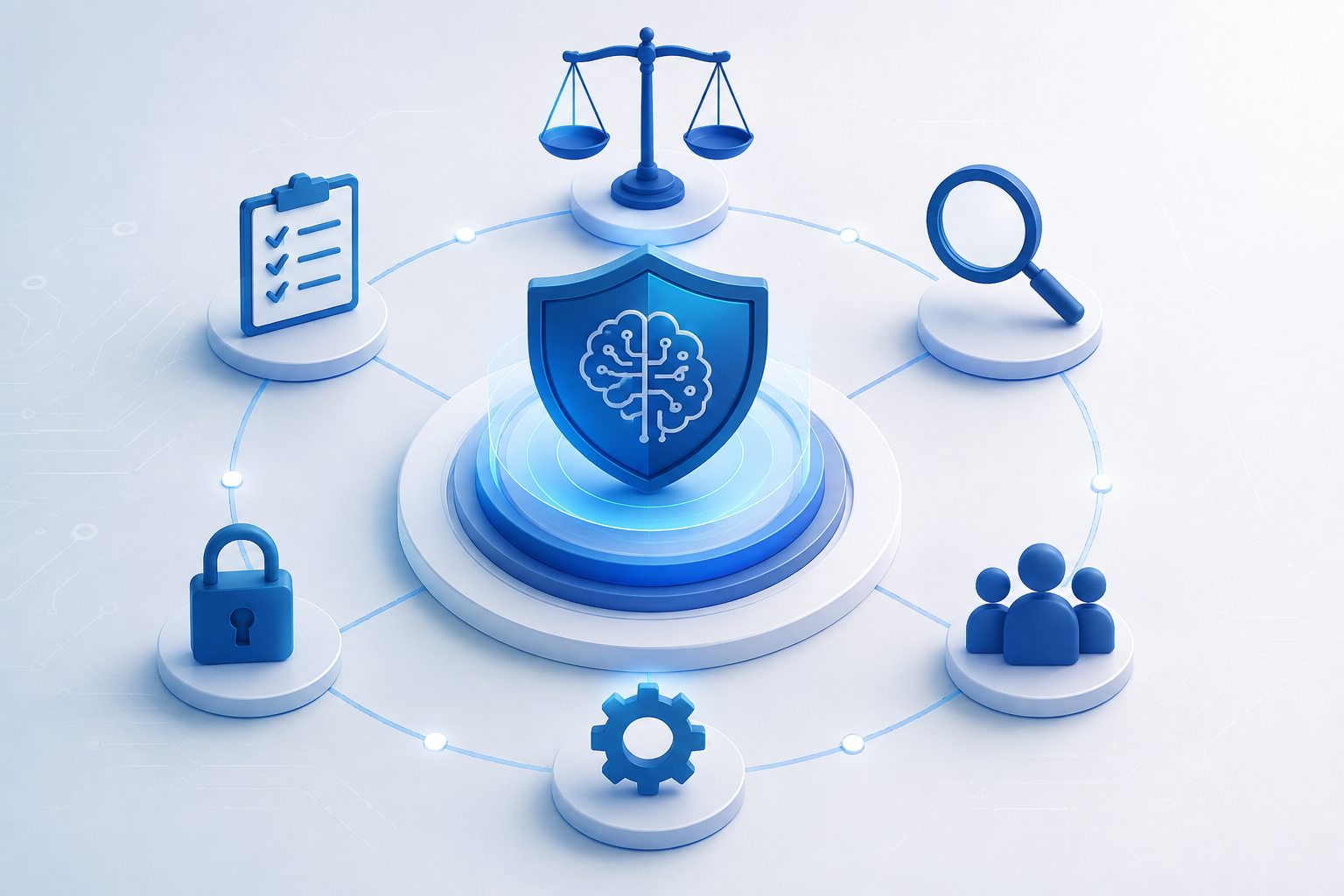
 AI Governance Framework A practical AI governance framework brings structure to all of the challenges above. The key components typically include:
  • AI policies and guidelines defining acceptable use across the organization
  • Data governance ensuring information used by AI systems is accurate, secure, and properly managed
  • Security controls protecting AI systems and the data they access
  • Risk assessment processes to identify potential issues before deployment
  • AI model monitoring to track performance and catch problems early
  • Human oversight built into decision points that matter
  • Compliance management aligned with relevant regulations and industry standards
  • Employee training so staff understand both the capabilities and the risks of AI tools
  • Regular audits and reviews to keep governance current as AI systems and regulations evolve

Notably, this isn’t just a defensive investment. Gartner has found that organizations deploying dedicated AI-governance platforms are 3.4 times more likely to achieve high governance effectiveness, meaning strong governance isn’t just about avoiding risk, it’s a genuine driver of successful AI adoption.

How to Build an Effective AI Transformation Strategy

1. Define Clear Business Goals

Successful AI transformation starts with a business problem, not a piece of technology. Before evaluating any AI tool, businesses should be clear about what outcome they’re trying to achieve- reduced costs, faster response times, better decision-making, and let that goal guide the technology choice, not the other way around.

2. Identify High-Value AI Use Cases

Not every part of a business benefits equally from AI. Strong starting points typically include customer service automation, predictive analytics, intelligent document processing, business process automation, and custom AI-powered applications built around a specific need.

3. Assess Data Readiness

AI is only as reliable as the data behind it. This means evaluating data quality, how accessible that data actually is across the organization, how securely it’s stored, and whether the underlying data infrastructure can actually support AI workloads.

4. Establish AI Governance Policies

This means clearly defining what acceptable AI use looks like within the organization, establishing approval processes for new AI tools or use cases, and creating risk management procedures before problems arise, not after.

5. Implement AI Securely

Secure implementation includes proper access controls, encryption, secure APIs, strong cloud security practices, and thorough data protection measures built in from the start rather than added later.

6. Monitor and Improve AI Systems

AI systems aren’t “set and forget.” This step includes ongoing performance monitoring, regular accuracy checks, continuous security monitoring, and consistent optimization as the system and business needs evolve.

The Role of an AI and Technology Partner in Business Transformation

Given everything above, it’s clear why most businesses can’t successfully navigate AI transformation alone. This is where the right technology partner becomes essential, not just for building AI tools, but for helping a business think through strategy, risk, and long-term sustainability.

A strong AI and technology partner supports businesses across AI strategy and consulting, AI readiness assessment, custom AI development, AI integration, machine learning solutions, generative AI solutions, cloud infrastructure, data engineering, cybersecurity, AI governance implementation, and ongoing maintenance and support. Rather than treating each of these as a separate vendor relationship, businesses benefit far more from working with one partner who understands how all of these pieces connect.

Why Businesses Should Choose the Right AI Technology Partner

Not every IT vendor is equipped to handle the full scope of AI transformation. When evaluating a potential AI strategy consulting or implementation partner, businesses should look for:

  • Proven technical expertise, not just marketing claims
  • Real experience with AI and emerging technologies, not a recently added service line
  • Strong security practices built into how they work, not bolted on afterward
  • A genuine understanding of business requirements, not a one-size-fits-all technology pitch
  • Scalable technology solutions that can grow alongside the business
  • Data privacy and compliance knowledge, particularly as regulation continues to expand
  • Post-development support, since AI systems need ongoing attention, not a one-time deployment
  • The ability to integrate AI with existing systems, rather than forcing a business to rebuild everything around a new tool

At Deftsoft, we work as an experienced technology partner helping businesses move from AI experimentation to practical, governed, real-world implementation- the step where most organizations struggle the most.

Beyond AI transformation, Deftsoft also helps businesses strengthen their digital presence through custom software development, cloud solutions, cybersecurity, digital marketing, and affordable SEO services, enabling organizations to combine AI-driven innovation with long-term online growth.

AI Strategy and Consulting

Deftsoft helps businesses identify which AI opportunities are actually worth pursuing, based on real business goals rather than industry hype, and builds a clear implementation roadmap around those priorities.

Custom AI Development

Through Deftsoft’s AI Development Services and Generative AI Development capabilities, we build AI-powered applications and solutions tailored specifically to a business’s actual requirements, rather than adapting a generic off-the-shelf tool.

AI Integration

We integrate AI into existing software, websites, applications, CRMs, and business systems, so new AI capabilities work with what a business already has, instead of forcing a disruptive rebuild.

Secure and Scalable Technology Solutions

Backed by Deftsoft’s Cybersecurity Services and Cloud Services, every AI implementation is built with security, scalability, and data protection considered from day one, not added as an afterthought once a system is already live.

Long-Term AI Support and Optimization

AI transformation doesn’t end at deployment. Deftsoft provides ongoing maintenance, performance monitoring, continuous improvement, and scaling support as a business’s AI needs evolve, supported by our broader Custom Software Development and Machine Learning Development expertise, along with dedicated AI Consulting Services throughout the relationship.

Ready to explore how AI can transform your business while maintaining security, governance, and scalability?

AI Governance vs. AI Transformation: What’s the Difference?

AI Transformation AI Governance
Adopting AI technologies Managing AI responsibly
Automating processes Establishing rules and policies
Building AI solutions Managing AI risks
Improving efficiency Ensuring security and compliance
Driving innovation Creating accountability

These aren’t competing priorities; they’re two halves of the same effort. Successful AI transformation requires both: the ambition and technology to drive innovation, paired with the governance structure to make sure that innovation doesn’t create bigger problems than it solves.

What Happens When Businesses Ignore AI Governance?

The consequences of weak or missing AI governance are not hypothetical. Businesses that skip this step commonly face data breaches, privacy violations, regulatory penalties, biased AI decisions, incorrect business decisions based on flawed AI output, security vulnerabilities, direct financial losses, and a lasting loss of customer trust.

The scale of this risk is growing quickly. The AI Incident Database logged 362 recorded AI incidents in 2025, up 55% from 233 the year before, according to Stanford HAI’s AI Index. And when incidents do happen, most businesses aren’t ready to respond: nearly 60% of organizations that experienced an AI incident rated their own response as only satisfactory or outright negative, according to McKinsey research. In other words, most businesses aren’t just underprepared to prevent AI governance failures; they’re underprepared to handle them when they happen.

The Future of AI Transformation Is Responsible AI Governance

AI adoption is not slowing down; if anything, it’s accelerating. Gartner projects that 40% of enterprise applications will include task-specific AI agents by the end of 2026, up from less than 5% just a year earlier. But that same growth is why governance can’t be treated as optional. Gartner also predicts that by 2027, 40% of enterprises will demote or decommission autonomous AI agents specifically because of governance gaps that only became visible after something went wrong in production.

Businesses need governance frameworks that evolve alongside their technology, not static policies written once and forgotten. Responsible AI should become part of an organization’s long-term digital transformation strategy, not a separate compliance checkbox handled after the fact. Ultimately, the combination of AI strategy, governance, and real technology expertise will be what separates businesses that get lasting value from AI from those that end up rolling back their own investments.

Frequently Asked Questions About AI Transformation and Governance

What does “AI transformation is a problem of governance” mean?

It means that successfully adopting AI depends on far more than the technology itself; it requires clear strategy, strong data practices, security, compliance, and accountability working together. Without proper governance, even well-built AI systems tend to underperform or create new risks.

Why is AI governance important for businesses?

AI governance protects businesses from data breaches, compliance violations, biased or inaccurate AI decisions, and reputational damage, while also making AI implementations more reliable and effective. Strong governance has been shown to significantly improve the chances of a successful AI deployment, not just reduce risk.

What are the biggest challenges of AI transformation?

Common challenges include unclear business objectives, poor data quality, security and privacy risks, employee resistance to adoption, lack of internal AI expertise, integration difficulties with existing systems, and trouble measuring real ROI.

What should an AI governance framework include?

A solid framework includes clear AI policies, data governance practices, security controls, risk assessment processes, AI model monitoring, human oversight, compliance management, employee training, and regular audits and reviews.

How can businesses implement AI securely?

Secure AI implementation involves strong access controls, encryption, secure APIs, robust cloud security, and comprehensive data protection measures built into the system from the very beginning of development.

Do businesses need an AI technology partner?

Most businesses lack the specialized in-house expertise required to design, deploy, secure, and govern AI systems effectively. An experienced AI technology partner brings that expertise, along with a structured approach to strategy, security, and compliance.

How can an IT company help with AI transformation?

An experienced IT company can guide AI strategy and consulting, build custom AI solutions, integrate AI with existing systems, implement strong security and governance practices, and provide long-term support, helping a business move from AI experimentation to genuine, sustainable transformation.

What Is SEO Agency in USA Glorvix.Com? Businesses Should Hire or Not?

If you’ve searched for “Glorvix SEO Agency in the USA” and landed on this page, you’re probably looking for a straightforward answer: What is Glorvix SEO Agency, and why is this company getting attention online? More importantly, is Glorvix a legitimate SEO company, and is it worth hiring for your business? These are fair questions, especially when choosing an SEO agency can directly impact your website’s visibility, organic traffic, and lead generation. This guide takes an objective look at Glorvix, what the company offers, and the factors you should consider before deciding whether it’s the right SEO agency for your needs, without turning the answer into a sales pitch.

We looked into SEO agency in the USA, Glorvix, the way any business owner should before signing a contract: checking for reviews, a real team, a verifiable history, and proof of results. What we found is worth knowing before you spend a single dollar. And since search itself is changing fast, we’ll also walk through what a genuinely capable SEO partner should offer in 2026, using Deftsoft as an example of what a verifiable, established agency actually looks like.

Want to see a real, verifiable SEO strategy for your business?

See exactly where your brand currently stands.

Quick Navigation

What Does This Search Term Actually Turn Up?

A Simple Checklist to Verify Any SEO Agency Before You Hire

What a Real, Verifiable SEO Company Looks Like: Deftsoft

AI SEO, AEO, and GEO: Where Search Actually Is in 2026

SEO Agency in USA Glorvix vs Deftsoft: What You Can Actually Verify

So, Should You Hire “SEO Agency in USA Glorvix”?

Frequently Asked Questions

Here’s the honest part: when you search for an SEO agency in the USA called Glorvix, what you find isn’t a clear, consistent business. It’s a name that shows up across a handful of unrelated blog posts, each describing it slightly differently, sometimes as a full-service SEO agency, and in other places, glorvix.com is described as a technology blog rather than a service provider at all.

A few things are worth flagging plainly:

  • No reviews turn up on the platforms buyers actually check: Clutch, G2, or Trustpilot
  • No clear LinkedIn company page or named team members appear anywhere
  • Contact details, where listed, point to a generic personal email address rather than a business domain
  • The descriptions of what the company actually does shift from article to article

None of this proves anything is dishonest. But it does mean the basic proof you’d expect from a real, hireable agency a track record, a team, verifiable client feedback simply isn’t there. And when that proof is missing, the safe move isn’t to assume the best. It’s to slow down and check.

This matters more than it might seem, because SEO is a long game. Most agencies ask for a six-month commitment before results really compound. That’s a lot of trust and budget to hand over to a name you can’t actually verify.

A Simple Checklist to Verify Any SEO Agency Before You Hire

Rather than focusing only on one name, here’s a checklist worth running against any SEO agency you’re considering, Glorvix or otherwise.

  • Look for independent proof. Search the agency on Clutch, G2, and Trustpilot. A real, working agency almost always has some footprint outside of its own website reviews it didn’t write itself.
  • Find actual people. A real agency has real people behind it: a LinkedIn company page, named team members, a consistent story across profiles. If you can’t find a single named human connected to the work, that’s worth pausing on.
  • Ask for case studies with real numbers. Vague promises like “we grow your traffic” are easy to make. Ask for two or three examples with actual metrics: keyword movement, traffic growth, or revenue impact and ask if you can speak to a past client directly.
  • Check the contact details and contract. A business email on the company’s own domain, a clear scope of work, and a real contract are basic signs of a legitimate operation. Be cautious of any provider offering only a personal, free email address as contact.
  • Test how they report results. Ask what a monthly report actually looks like. A credible agency ties its reporting to Search Console data, ranking changes, and real conversions, not just vague “visibility” claims.

Run any agency through these five checks. A real, capable partner clears most of them without much effort. A name with no real footprint tends to struggle on the very first one.

What a Real, Verifiable SEO Company Looks Like: Deftsoft

SEO Company Deftsoft is the kind of agency that’s built to pass every point on that checklist, not because we’re telling you to trust us, but because everything is actually checkable. A real website with detailed service pages, a documented history, a real team, and a track record spanning 15,000+ clients and 20,000+ projects since 2005. You can look this up yourself; that’s the whole point.

But beyond just being verifiable, the bigger question for 2026 is whether an agency actually understands how search itself has changed. This is where the gap between a real, evolving agency and a name with no track record becomes very clear.

Search isn’t just about ranking on Google anymore. AI Overviews now show up on a huge share of Google searches, and tools like ChatGPT, Gemini, and Perplexity are increasingly where people ask questions directly, sometimes skipping traditional search entirely.

This has created three connected but distinct disciplines that a modern agency needs to handle together, not as separate add-ons:

Deftsoft builds all three into its SEO strategy from the start, not as a separate, upsold service, but as part of one connected approach. That means content built around clear answers and real expertise (the kind AI systems are built to trust and cite), technical SEO that keeps your site fast and easy for both search engines and AI crawlers to understand, and ongoing tracking of whether your brand is actually showing up inside AI-generated answers, not just traditional blue-link rankings.

This is also exactly where it’s worth watching for red flags, whether you’re evaluating an SEO agency in USA, Glorvix or any other provider. A few claims should make you pause immediately: any agency promising “guaranteed #1 rankings,” a specific ranking position within a set number of days, or vague talk of “special Google connections.” No legitimate SEO company, including one that genuinely understands AI SEO Service, AEO Service, and GEO Service, can guarantee a specific ranking, because search engines and AI models don’t sell placement, and anyone claiming otherwise is either using shortcuts that risk a penalty later, or simply isn’t being straight with you.

The same scrutiny applies to link building. Ask specifically where backlinks are coming from. A real agency can name the kind of sites it targets and explain why those links matter, while a vague answer like “we have a network” is often a sign of low-quality, mass-produced links that can do more harm than good over time. An agency that can’t clearly explain its approach to AEO, GEO, and ethical link building is, in a very real sense, still selling 2020’s SEO, which is exactly the kind of thing worth asking about before hiring any SEO agency in USA Glorvix or otherwise.

SEO Agency in USA Glorvix vs Deftsoft: What You Can Actually Verify

Rather than comparing service lists, which only makes sense when both sides can actually confirm what they offer, here’s a side-by-side look at what’s verifiable for each name, since that’s the part that actually matters before you hire anyone.

What You Can Check Glorvix Deftsoft
Independent reviews (Clutch, G2, Trustpilot) None found Verifiable directly on review platforms
Team and LinkedIn presence No clear team or company page found Established team, active since 2005
Business history Inconsistent across sources 20,000+ projects, 15,000+ clients
Contact details Generic personal email in one listing Business domain, direct contact and audit forms
Description consistency Varies from article to article Consistent across owned website and service pages
AI SEO / AEO / GEO approach Not documented anywhere verifiable Built into strategy, explainable in detail

So, Should You Hire “SEO Agency in USA Glorvix”?

Based on what’s actually verifiable, there isn’t enough here to responsibly recommend hiring an SEO agency in USA Glorvix as it currently shows up in search. That’s not a dramatic claim; it’s simply what the checklist above turns up: no independent reviews, no visible team, inconsistent descriptions of the business itself, and no real way to check a track record before committing your budget.

That doesn’t mean you need to take our word for any of this either; that’s exactly the point. Run any agency you’re considering, including Deftsoft, through the same five checks. Ask for real case studies. Look for real reviews. Ask how they approach AI SEO, AEO, and GEO, and how they build backlinks. An agency confident in its own track record will welcome that scrutiny, not avoid it.

Curious how AI SEO, AEO, and GEO fit together for your business?

Get a strategy built around what’s actually working in 2026.

Frequently Asked Questions

1. Is SEO agency in USA Glorvix a real, established company?

Based on publicly available information, SEO agency in USA Glorvix doesn’t show the usual signs of an established, verifiable agency: no independent reviews on platforms like Clutch or G2, no clear team or LinkedIn presence, and inconsistent descriptions of the business across the web.

2. Why does a name like this show up so often in search if it’s hard to verify?

Search terms like this often gain visibility through repeated blog content built around the phrase itself, rather than through the company’s own genuine reputation or client results.

3. How can I verify any SEO agency before hiring them?

Check for independent reviews on Clutch, G2, or Trustpilot, look for a real team and LinkedIn presence, ask for case studies with real numbers, confirm a business email and proper contract, and ask exactly how they report results each month.

4. What should a good SEO agency offer in 2026?

Beyond traditional SEO, a capable agency should understand AI SEO, AEO (Answer Engine Optimization), and GEO (Generative Engine Optimization) and be able to clearly explain how all three work together as part of one strategy, not as separate upsells.

5. What are some red flags when evaluating an SEO agency?

Be cautious of any agency promising guaranteed #1 rankings, a specific position within a set number of days, or vague “special connections” with Google. No legitimate agency can guarantee a specific ranking, since search engines don’t sell placement.

6. Why does link building quality matter when choosing an SEO agency?

Low-quality, mass-produced backlinks can hurt your rankings rather than help them. A credible agency can explain exactly where its links come from and why those sources matter, rather than giving a vague answer like “we have a network.”

7. Why does Deftsoft’s track record matter more than a company’s own claims?

Because claims are easy to make and hard to verify. A real track record documented projects, a verifiable history, an established team gives you something you can actually check before committing your budget, unlike a name with no independent footprint.