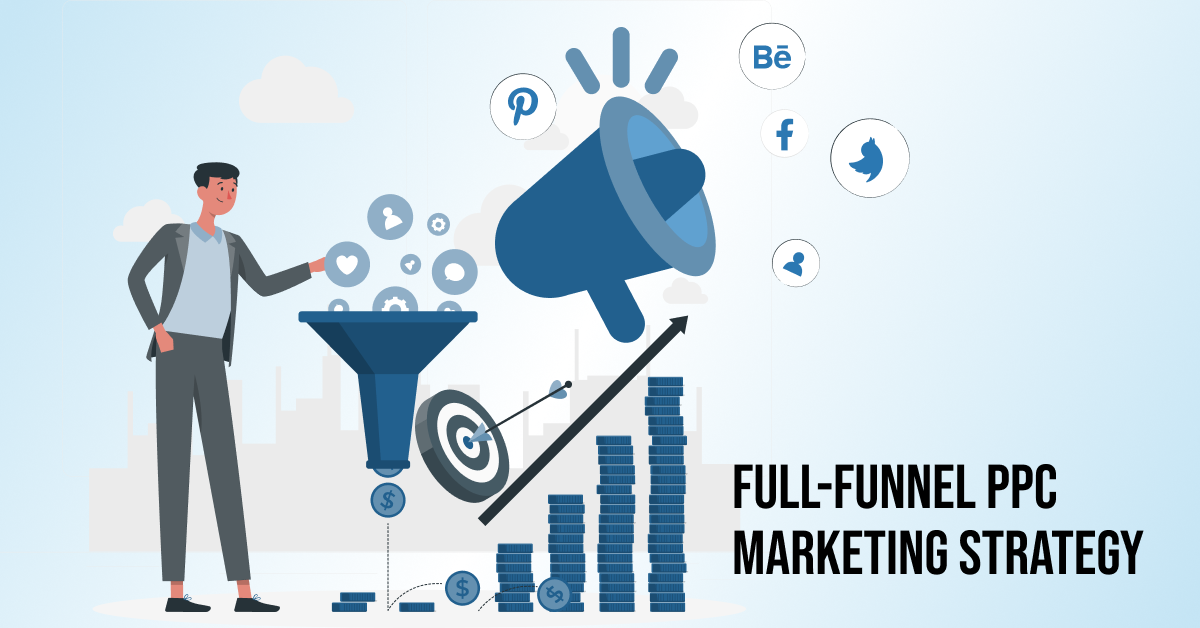
How To Implement A Full-Funnel PPC Marketing Strategy

Pay-per-click (PPC) is a driving force in fetching results for all digital marketing efforts. It combines the input of keyword research, ad campaigns and landing page optimization to build a PPC strategy that yields tangible results. 

The signs of having a foolproof PPC marketing strategy include a significant increase in the company’s revenue. This blog deciphers how to implement a solid PPC marketing strategy so that you can steal it for your business. Time to dive in.

What is a PPC Strategy?

A PPC marketing strategy involves leveraging ads to bring your results to the top of search engines such as Google. Imagine you work for a new business whose goal is to increase brand visibility.

The goal of a PPC strategy is to implement marketing tactics to navigate through customer journeys across the marketing funnel. In simple words, a PPC strategy could simply mean working on driving brand awareness through Google by targeting keywords that people actively search related to your product/service but are not yet aware of the solution or using social media marketing.

Now, let’s talk about an advanced full-funnel PPC strategy, which is a Google ad campaign. It involves creating a strategy for running paid ads for your brand for competitive keywords. It uses a bidding system for which you must be willing to pay the highest bid as well, i.e., cost per click (CPC). 

Of course, you can’t outrank your competitors for every keyword. Therefore, you must deploy a smart PPC strategy, such as finding less competitive keywords with high volume to outbid your competitors.

Understanding the marketing funnel is pivotal to implementing a full-funnel PPC marketing strategy. Let’s define it!

What is Meant by Marketing Funnel?

A marketing funnel is a marketing model that depicts the customer journey before and after making a purchase. It is a multi-step process that highlights the stages of an individual looking for a solution, finding out about your brand, liking it or engaging with it, and finally, making a purchase.

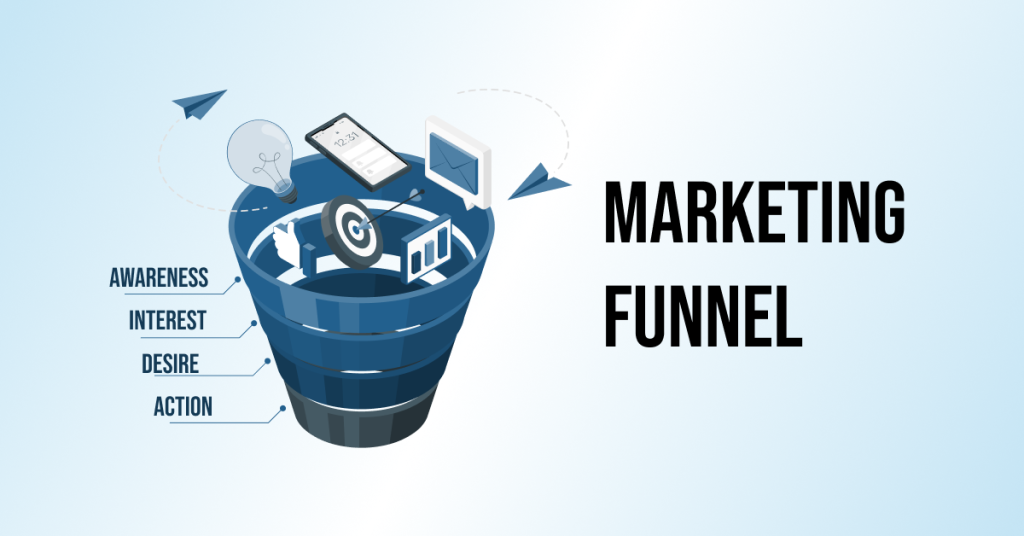
Marketers and analysts often follow the AIDA marketing funnel model. This model stands for the following:

  • Awareness
  • Interest
  • Desire
  • Action
Marketing Funnel

Let’s break down each of these stages of the marketing funnel.

1. Awareness

It is the first stage of the customer journey where your potential customer has not yet heard about your brand. He must be finding a solution to his problem but is not yet aware of your brand.

For example, if you run a shoe business with a USP of comfort and pain relief, you can target the following keywords:

‘Shoes for bunions’
‘Running shoes for men’

The first step is all about making individuals aware of your brand’s existence and the solutions it offers.

2. Interest

The next stage is when individuals start to show interest in your brand. Their actions include browsing through and interacting with the website, signing up for a newsletter, or following your social media handles, such as Instagram or Twitter.

This is the stage when you must make everything easy for users to navigate.

3. Desire

This is the stage of the PPC marketing funnel where individuals start to consider your product. They’d remember your product/service, compare it with other existing competitors, look for reviews and testimonials, browse social media via hashtags, or talk to their friends or family.

This step in the marketing funnel is also called the ‘consideration’ stage since your potential customers are exploring their options and considering you as one of them.

4. Action

The action stage is when your prospects are actually going to make a purchase from your website. This stage is also called the ‘conversion’ stage, as the prospect has finally been converted into your customer. 

Your aim at this stage is to make it easy for the users to navigate through the website seamlessly and make a payment.

How to Implement Full-Funnel PPC Marketing Strategies?

Only when you’re aware of the marketing funnel and how it defines the entire customer journey can you apply a full-fledged PPC-integrated marketing strategy and tactics. To make it easy for you, we will take the shoe brand as an example.

Let’s split our strategy into three parts:

  • Keyword research
  • Ad campaign 
  • Landing page optimization

  We’ll now apply these strategic steps in each stage of the marketing funnel.

1. Awareness Stage

As discussed earlier, the awareness stage is when prospects don’t know that your brand exists. Therefore, this is the stage where you need to create a strategy to capture prospects by offering your solution to their problem.

  • Keyword Research

You must keep the following pointers in mind when implementing the keyword research strategy in the awareness stage:

  1.  Handpick keywords that represent your brand and are in tune with what people are looking for.
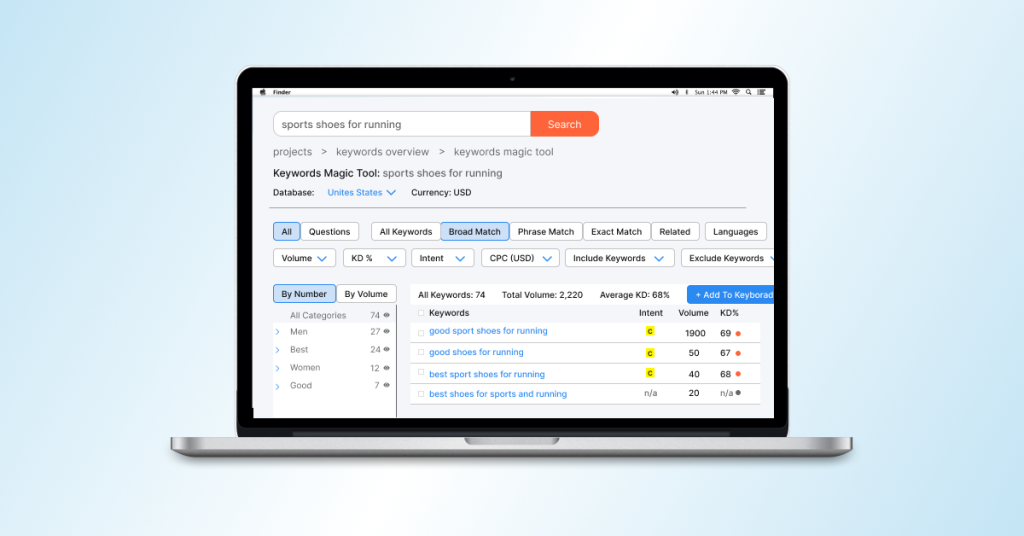
  2. You can use keyword research tools, such as Google Keyword Planner, Ahrefs, or SEMrush, to make a list of keywords with tangible volume and minimal difficulty.
  3. You can use the following examples:

‘Sports shoes for running’
‘Shoes for jogging’
Keyword Research
  • Ad Campaign

 You can use attractive images to indulge your potential customers in your ads. You can also leverage immersive videos to effectively present your brand’s value. It is also important to use an eye-catching headline in your ads to attract prospects.

  • Landing Page Optimization

You must keep the following things in mind when implementing the landing page optimization strategy in the awareness stage of the marketing funnel:

  1. Your landing page must depict consistent branding. All the elements of the landing page should make the customer journey easier and prompt the users to engage with the website.
  2. It is always a great idea to link comprehensive and educational blog posts through the landing pages for enhanced user engagement. When the user extracts knowledge and information, he’ll automatically value your brand.

Adding call-to-actions (CTAs), such as ‘Learn More’ or ‘Download Free Guide’ will prompt the users to move further down the marketing funnel.

2. Interest and Desire Stage

Now that the customer has entered the market and is a potential customer, the goal of the interest and desire stage, also called the consideration stage, is to help individuals find the product-fit match. This means that the user is aware that your product/service exists but cannot find a suitable one for himself.

Customers desire to learn about your products and their use cases. To this end, you can encourage customers to sign up for newsletters, which will provide exclusive information and enticing discounts.

  • Keyword Research

You must keep the following pointers in mind when implementing the keyword research strategy in the consideration stage:

1. At this stage, the user is looking at reviews and comparing your product; therefore, it is a smart practice to use keywords such as:

‘best shoes for running’
‘sports shoes comparison’
‘sports shoe reviews’

2. You can leverage tools such as SEMrush, Ahrefs, or Google Keyword Planner to get the list of keywords for the consideration stage.

  • Ad Campaign

You must create ad copy that attracts the user to your brand. For instance, you can create an ad with the copy ‘durable long-distance trainers.’ This is how Asics is creating ad copies to sell its trainers.

Another significant full-funnel PPC marketing strategy is customer retargeting. When a customer visits your website once, you can utilize cookies to track the user’s activity and then retarget with ads on social media. This practice will psychologically prompt the user to make the purchase.

  • Landing Page Optimization

It is important to remember the following PPC marketing strategies when optimizing the landing page for the consideration stage:

  1. At this stage, the landing page content must highlight user reviews, testimonials and case studies. A good tip is to add video reviews of your customers. This will enhance your website’s credibility.
  2. Call-to-actions (CTAs) can make or break the motive of your website’s landing page. Ensure that you use compelling CTAs such as ‘Sign Up for Newsletter’ or ‘Start Your Free Trial’ or ‘30-Days Refund Guaranteed’.

3. Action Stage

The action stage is the final stage and is also called the conversion stage. To give you a clear idea, the average e-commerce conversion rate is 2.5-3%. This means that only a tiny percentage of prospective customers convert, i.e., make a purchase.

The idea behind the complete PPC marketing funnel is to convert users into buying your product/service. If that doesn’t happen, the strategy has no point. Therefore, this final stage is the most crucial one.

  • Keyword Research

You must follow the below-mentioned full-funnel PPC strategy for keywords dedicated to the conversion stage:

  1. The keywords for this stage must be transactional and/or commercial in nature. In other words, the CTAs must include the words ‘Buy’ or ‘Invest’ as a prompt for potential customers.
  2. You can use the following set of keywords for your landing page or blog posts:

‘Buy durable running shoes’
‘Invest in the right pair’

  • Ad Campaign

The PPC marketing strategy for ad copies at this stage is to use clear-cut CTAs, such as ‘Buy Now’, ‘Request a Quote’, or ‘Find Your Fit Now.’ Usually, users add things to their cart but do not make a purchase. You can retarget them with carousel posts on social media with ‘Buy Now at [X]% off.

  • Landing Page Optimization

Your curated landing page must prompt the user to make a purchase. You must also add discounts and promotions on this page to lure users into making a positive decision. The page layout must be seamless and simple. Ensure that you remove distracting elements, such as the navigation bar from the conversion page. This practice will prompt users to make a purchase.

Another great tip is to keep the payment process easy. You must offer multiple payment options, such as PayPal, credit/debit card, or even third-party buy-now-pay-later options.

How to Measure the Effectiveness of PPC Marketing Strategy?

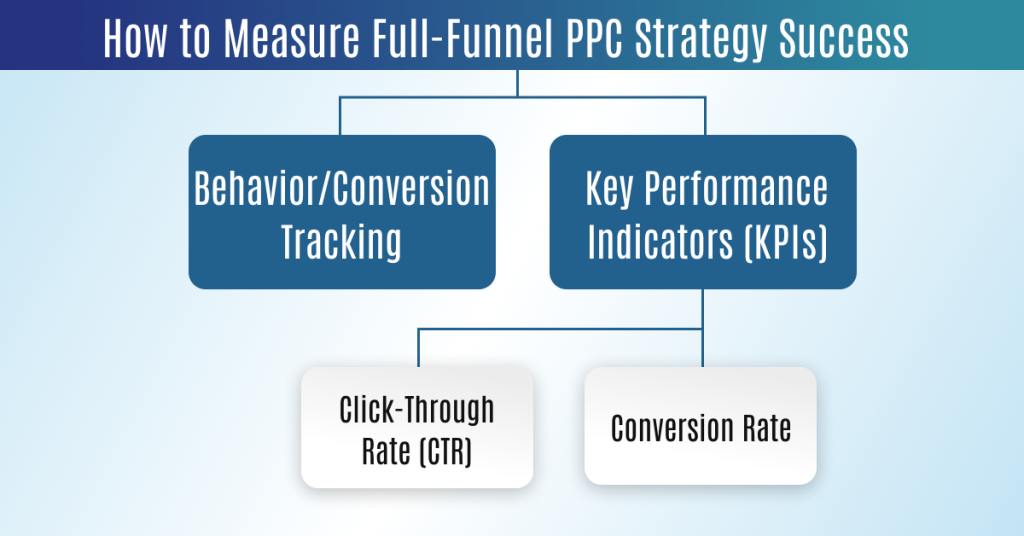
Once you’ve applied the full-funnel PPC marketing strategy and learned how to implement it, how do you make sure that the strategy is actually working? You do so by measuring the results. There are certain metrics to do so. This section of the PPC marketing strategy guide is dedicated to the metrics to measure the effectiveness of your strategies.
How to Measure Full-Funnel PPC Strategy Success

1. Behavior/Conversion Tracking

You can use Google Analytics tools to gauge how users interact with your website. You can also use heatmaps to understand the customer journey for your website via a user. The tool also allows you to drill down the user activities for various pages.

Another great tool is Google Tag Manager, which allows you to track conversions by depicting the user’s interaction with the website at every stage of the marketing funnel.

2. Key Performance Indicators (KPIs)

It is pivotal to monitor significant KPIs to measure the success of your full-funnel PPC marketing strategy. The following are the primary KPIs to track:

  • Click-Through Rate (CTR)

The CTR metric tells you about the percentage of people who clicked on your ad. It depicts the total number of people who clicked on your ad out of all the impressions (people who saw your ad). This metric is a sign of ad relevancy to the users. It is calculated as follows:

CTR = Total number of impressions/Total number of clicks*100

Note: Create ads that are relevant to the users by using relevant keywords.

  • Conversion Rate

Clicking on the ad is okay, but are users making a purchase? This is why the conversion rate is an important metric. It gives you a reality check. It gives you the percentage of people who clicked on your ad and performed the desired action. 

The conversion rate can be calculated as follows:

Conversion Rate = Number of conversions/Total number of clicks*100

Other good metrics for measuring the success of full-funnel PPC strategies, such as quality score and cost-per-click (CPC), exist.

Bottom Line

Formulating a solid full-funnel PPC marketing strategy can help you gain traction in your company’s revenue growth. From examining the complete marketing funnel to knowing how to implement it to measuring the KPIs, the whole process aims at boosting your revenue. A pro tip is to tweak the strategies in the PPC marketing funnel to find the best fit for your brand. 

If you’re looking for a partner to help you implement full-funnel PPC marketing strategies and generate tangible results, look no further than Deftsoft. Our team of experts is looking out for you. Reach out to know more!

FAQs:

What is a PPC funnel strategy?

A full-funnel PPC marketing strategy is a set of marketing tactics that businesses can deploy to prompt prospective customers to take a desired action. This action could be making a purchase or signing up for a newsletter. The strategy is built to make the customer journey easier throughout the marketing funnel, right from making potential customers aware of your brand to propelling them to make a purchase.

What is the best PPC marketing strategy?

It is important to grasp the eye of your potential customers right from the beginning. This is why you should leverage relevant long-tail keywords that users are searching for. You can find these keywords through different tools, such as Google Keyword Planner, Ahrefs, or SEMrush. You must also follow a holistic approach and maintain an active presence on social media.

Are Google ads enough for the PPC marketing strategy?

It is good to be prevalent on Google ads. However, a strong social media presence can expose your business to enhanced visibility and a large user base. Therefore, you must give equal attention to social media through ads, such as Facebook and Instagram ads.

What strategy should be followed for full-funnel PPC marketing campaigns?

You must implement three main strategies in each stage of the marketing funnel. These include relevant keyword research, relevant ad copies, and landing page optimization through CTAs.

What are the primary KPIs to measure the success of a PPC marketing strategy?

The primary KPIs for the success of a PPC marketing campaign include Click-Through Rate (CTR) and Conversion Rate. The CTR gives the percentage of individuals who clicked on your ad. The conversion rate refers to the percentage of users who performed the desired action after clicking your ad.
Smart Strategies to Turn Your App into a Cash Cow

With mobile applications, we can now fulfill a wide range of needs in our daily lives, from entertainment to productivity. But making an app profitable requires more than simply designing a great product—it also requires implementing effective mobile app monetization strategies.

The world is moving at an excessively fast pace, causing human sentiments to change overnight. The digitization of each and every product and service calls for a dedicated app. People don’t want to commit to something that is chargeable until they find real value in it. This is the reason why it is crucial to let people find value in your app.
Whether you’re a seasoned developer or a newbie to the app development business, knowing how to monetize your app is essential to maintaining its long-term usage and profitability. We’ll go over a variety of app monetization techniques in this in-depth guide, from conventional methods to cutting-edge techniques, to help you get the most out of your app’s revenue potential.

App Monetization Strategies: How to Monetize Your App?

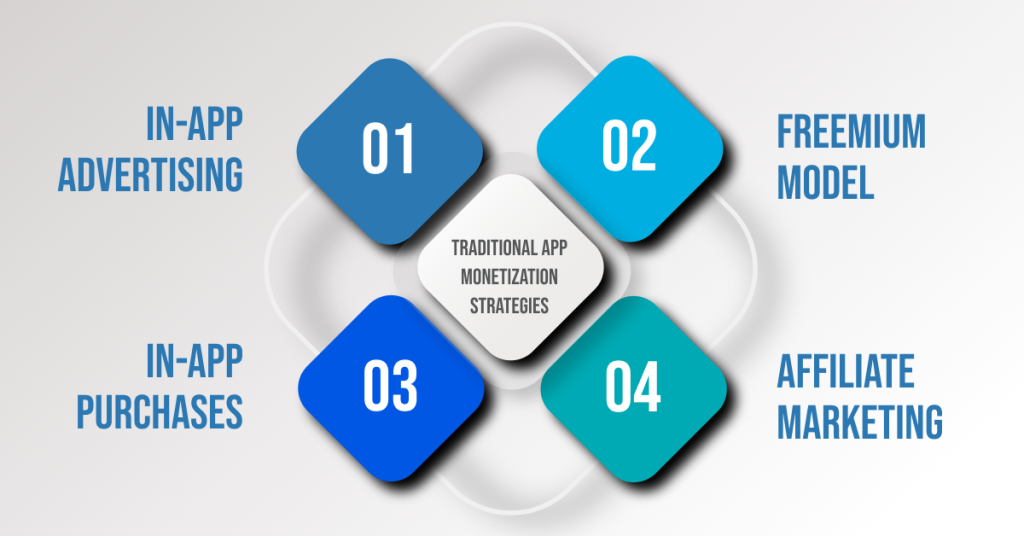
There are many different methods for making money from apps. Whether you have an iOS or Android app, you need a solid app monetization strategy. Some methods are conventional, referred to as traditional app monetization strategies or methods. 

We have also mentioned some innovative strategies for monetizing your app. The goal is to attract the audience and instigate curiosity among them. Let’s discuss some of the groundbreaking app monetization strategies.

A. Traditional Monetization Methods

Let’s have a look at some of the most conventional and obvious methods of app monetization to help you generate revenue from your app. To begin with, it is a must to invest in any one or two of the below-mentioned techniques to monetize your iOS or Android application.

traditional app monetization strategies

1. In-App Advertising:

Users spend 90% of their time on mobile apps. Ads integration is a frequently employed monetization strategy for mobile applications. Adding advertisements to your app can increase revenue depending on impressions, clicks, or conversions. These advertisements can be banner ads or rewarded videos. One must know where to put ads and how to maximize ad revenue without sacrificing user experience.

Some of the best practices for in-app advertising are mentioned as follows:

  • Invest in a high-quality ad creative.
  • Choose a suitable ad format.
  • Track via device ID, monitor and test your ads frequently.
  • Align your promotions with user timing for maximum engagement.

2. Freemium Model:

Users can upgrade to premium services or content for a fee, while fundamental features are provided for free under the freemium model. It is important to understand how to upsell and keep premium members and how to combine incentives to encourage free users to upgrade to paid versions in the ideal proportions.

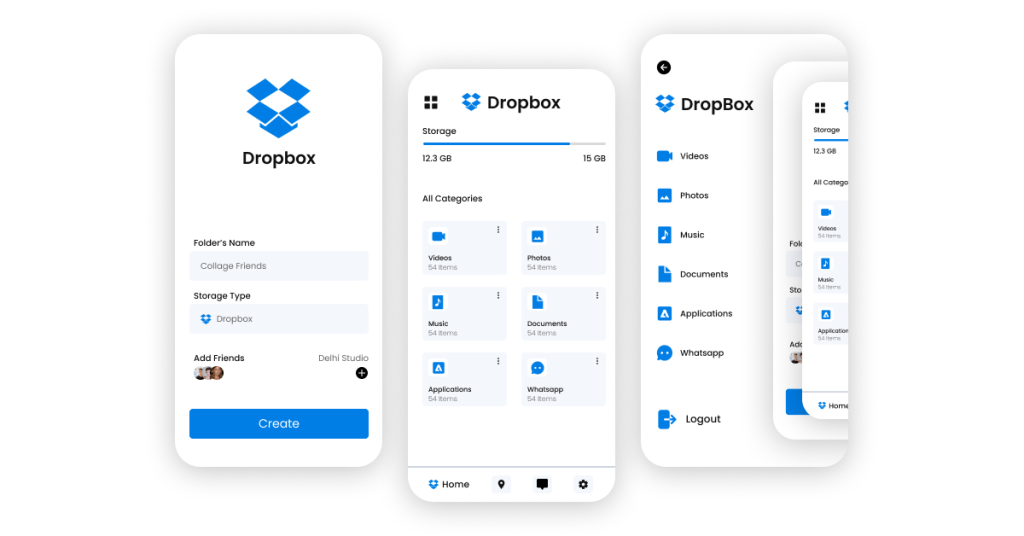
Marked as one of the most successful and the best app monetization strategies, let’s look at the case of Dropbox

Dropbox is a prominent cloud storage provider and a file-hosting service. The app rose to fame because of its freemium model. It offers 2 GB of free storage to new users for a month, and when it gets exhausted, users tend to buy the storage since switching to another app becomes a hassle.

Dropbox

3. In-App Purchases: 

Users can purchase in-app virtual products, upgrades, or subscriptions through in-app purchases. Some prominent strategies for creating alluring in-app purchases include techniques, such as time-limited deals, premium content, and packaged deals, to boost sales and encourage conversions.

4. Affiliate Marketing:

It is yet another one of the best app monetization models and strategies for making money from your app. You can earn a good amount of external commission by advertising other brands on your app through banner ads or short-form video ads. Developers can easily integrate various affiliate marketing techniques to earn considerable revenue.

B. Innovative Monetization Approaches

It is a great idea to opt for app monetization strategies that function inside the app. However, you can also go above and beyond for more innovative app monetization methods and techniques.

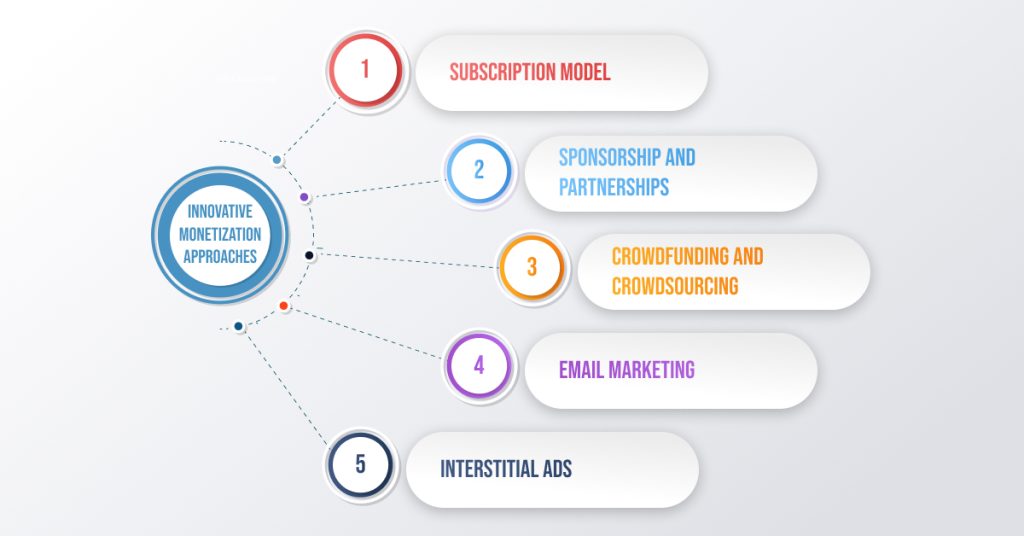
Innovative Monetization Approaches

1. Subscription Model: 

Subscription-based monetization has grown in popularity, particularly for apps that provide continuous services like streaming platforms, productivity tools, and fitness apps. You must be aware of the methods for retaining subscriber loyalty by consistently providing valuable content and tailored experiences. 

Take Google One, for example. When you subscribe for the first time, it offers a relatively low price for the first three months. Then, it costs $2 per month for 100 GB storage. Users can choose among various storage options, such as  2 TB, 5 TB, and 10 TB. Users can also choose between monthly and yearly subscriptions.

2. Sponsorship and Partnerships: 

Another excellent method to make money out of our app is to look for sponsorship and partnership opportunities. You can approach apps with a massive or medium-sized user base and ask them to put up your app advertisement. It could be adding your ads to a gaming app so that people can click on it. This is called Click-Through Rate (CTR). 

3. Crowdfunding and Crowdsourcing: 

Through crowdfunding sites, app developers may ask their target audience for money directly and receive it in exchange for perks or early access. Furthermore, the app’s crowdsourcing capabilities can captivate users and give them the ability to submit ideas or content, building a feeling of community and making money off user-generated content.

4. Email Marketing:

Email marketing is one of the easiest app monetization strategies to implement and yields a high return on investment (ROI). You must be thinking about how email marketing can be effective in monetizing an app. 

According to OptinMonster, 60% of consumers claimed that they made a purchase because of a promotional email. You can harness the power of user segmentation and email personalization to prompt users to purchase or subscribe to your app.

It is also one of the best iOS app monetization strategies, as the iPhone email app has the highest market share, according to Litmus Labs.

5. Interstitial Ads:

You must be aware of banner ads, but do you know about interstitial ads? Keep on reading to know how to monetize your app using interstitial ads. 

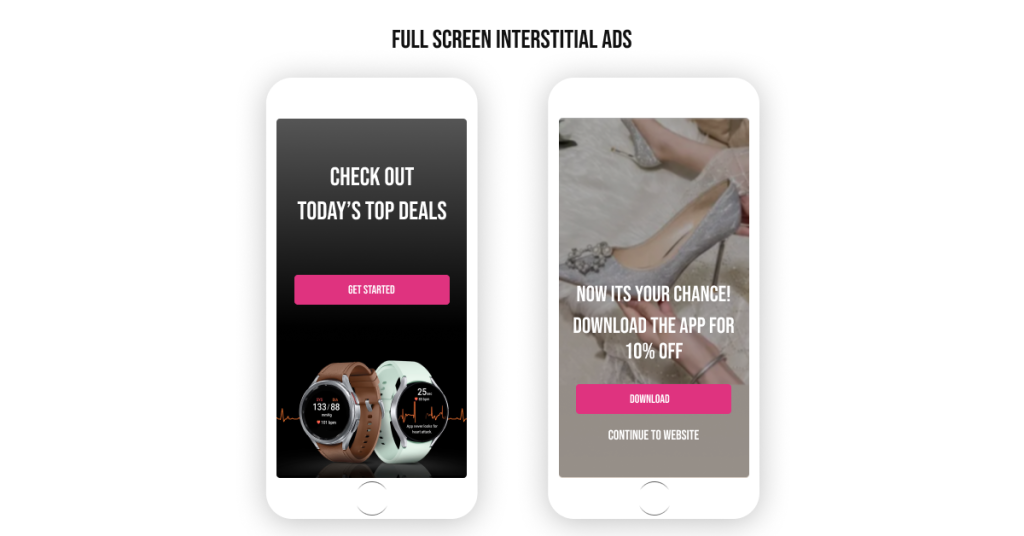
App developers have realized that people are no longer interested in in-app ads, such as banner ads. They tend to skip them and often close the app when interrupted. This is when you can use interstitial ads. An interstitial ad covers the entire screen and is non-invasive. These ads occur quite naturally in the transitional points.

An example of an interstitial ad is given below.

full screen interstitial ads

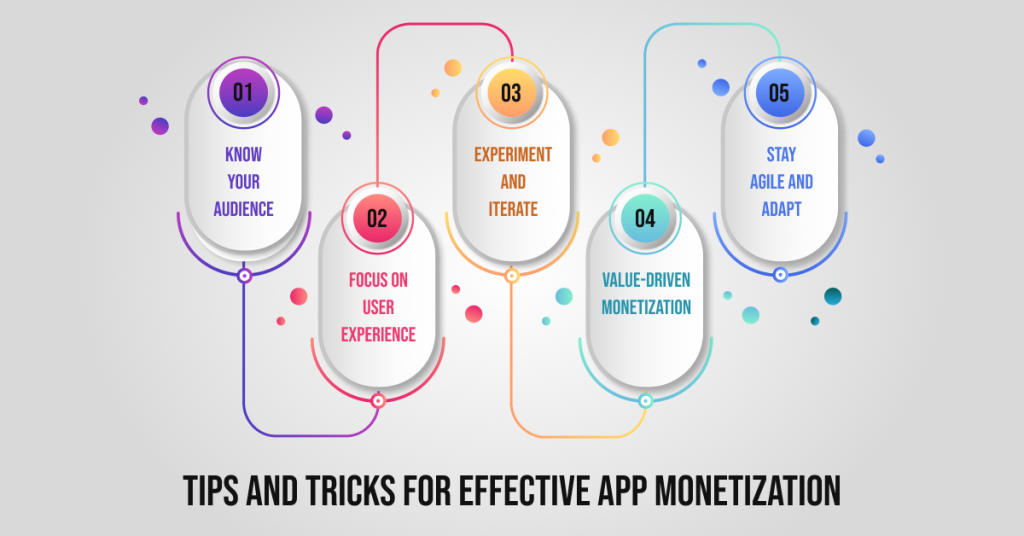
Tips and Tricks for Effective App Monetization

Apart from conventional and innovative methods, we have mentioned some pivotal tips and tricks to help you effectively perpetuate the practice of app monetization. App creators often get stuck in the loop of attracting a large user base and still making money from it. 

The only way to earn handsome money from your app is to strategically create dedicated hype for it by leveraging the power of digital marketing. You can also promote your app through social media marketing and influencer marketing. 

Tips and Tricks for Effective App Monetization

Some of the relevant and effective ways to monetize your iOS and Android app are as follows:

  • Know Your Audience: 

Comprehending the inclinations, actions, and financial readiness of your intended audience is essential to creating revenue-generating tactics that appeal to them. Learn more about your users’ demographics and preferences, conduct market research, collect user feedback, and examine app statistics.

  • Focus on User Experience: 

Prioritizing the user experience over monetization is crucial for retaining users and fostering long-term success. Avoid invasive ads, optimize app performance, and continually deliver value to cultivate user trust and loyalty.

  • Experiment and Iterate: 

Try out various price schemes, revenue streams, and monetization approaches without fear. To improve your monetization approach and increase revenue potential, keep an eye on performance indicators, test variations A/B, and iterate based on user feedback.

  • Value-Driven Monetization: 

Delivering value to consumers through your app’s features, content, and overall experience should take precedence over just making money. Users are more inclined to interact with monetization choices voluntarily when they believe the advantages outweigh the disadvantages.

  • Stay Agile and Adapt: 

The app market is ever-changing due to shifting consumer tastes, trends, and technologies. Keep yourself updated on market trends, rival tactics, and new revenue streams so you can modify your strategy and remain one step ahead of the competition.

Wrapping Up

By implementing these tips and leveraging a mix of traditional and innovative monetization strategies, you can effectively monetize your app while fostering a positive user experience and driving sustainable growth. 

These tips and tricks can help you monetize your app. We suggest you start slowly based on your budget and capital and then gradually move forward.
If you need help with your app development, Deftsoft has a team of skilled app developers with a proven track record across various markets. We also offer various digital marketing solutions to cater to our client’s ap monetization strategies.

FAQs:

What is meant by app monetization strategy?

App monetization strategy is a technique to seamlessly earn money from your iOS or Android app. The goal of any app developer is to encourage users to invest in paid versions of your app. However, it is an important practice to make people familiar with the free version of your app first, also known as working on the freemium model.

What are the best traditional methods for app monetization?

One of the top-notch traditional methods to earn money from your app is to follow foolproof app monetization strategies. These strategies include prompting users to make in-app purchases, investing in high-quality ad creative for in-app advertising, looking for affiliate marketing opportunities, and following the freemium model.

What are the best innovative methods for app monetization?

Some of the best innovative app monetization strategies include introducing a subscription model for your audience, investing in sponsorships and partnerships, looking for various opportunities in crowdfunding and crowdsourcing, and reaching out to potential app users through email marketing.

How do you create a monetization strategy for your app?

Start by inspecting your app’s current monetization opportunities. Look for features that can be monetized. Create a user persona and identify his triggers for making purchases. Invest in sophisticated ad creative to connect with the audience. These are some of the creative app monetization strategies for your app.

Mention a monetization strategy for SaaS.

First, you must determine the pricing model of your SaaS product. Then, look for monetization opportunities and learn how to implement the freemium model to make money from it.

Google’s New Core Web Vitals Metric: How To Improve INP

Now that your webpage is successfully visible on the Search Engine Result Pages (SERPs), what is the next step to success? It is the page speed. The speed of the loading page directly impacts the success of your webpage’s search. 

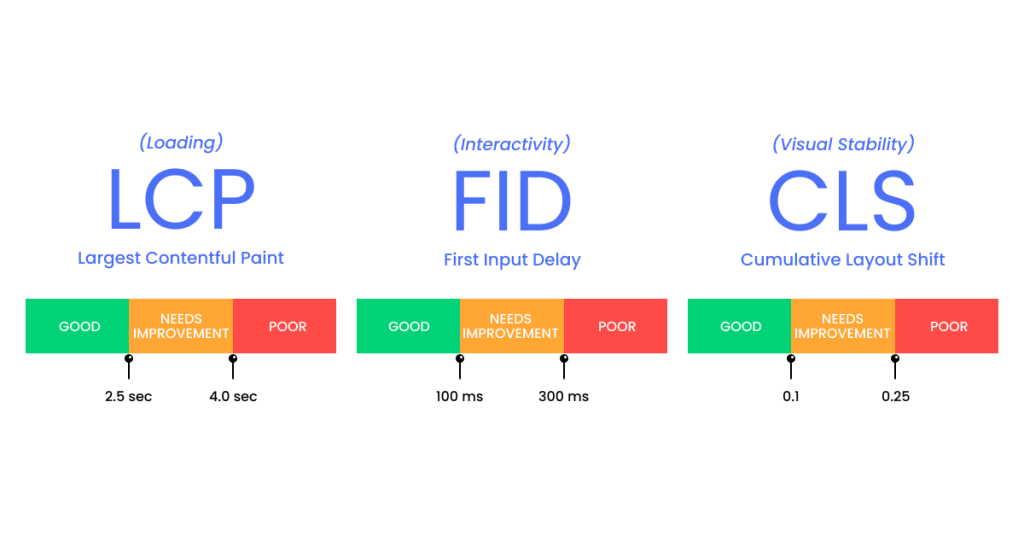
If you want to measure the user experience for your webpage based on the loading performance, user-intuitiveness, interactivity, and stability, you must be aware of Google’s Core Web Vitals. To sum up, Core Web Vitals is a set of metrics that calculates the real-world user experience that is incurred based on the page performance.
According to Google’s recent updates, a new Core Web Vital metric will formally be in effect on 12th March 2024. This metric is called Interaction to Next Paint (INP). This guide is an in-depth introduction to the INP Core Web Vitals, how to optimize it, and test INP.

What is Meant by INP?

Interaction to Next Paint (INP) is a webpage performance metric that measures the responsiveness of a user interface. It means that this metric measures how fast a webpage responds when a user interacts with it through various actions, such as mouse clicks, keyboard presses, entering data inside a form, tapping on a touchscreen device like a smartphone, or when a page starts painting the next change on the screen.

How Do You Measure Interaction to Next Paint (INP)?

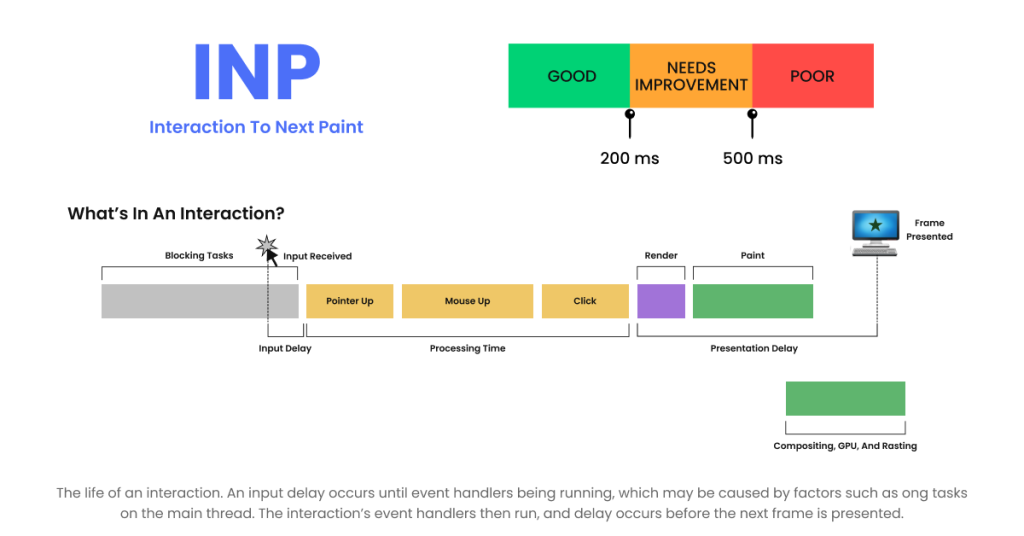
All the interactions made with a page constitute the Interaction to the Next Paint (INP) metric. When a page has an unusually high interaction or responsive rate, the rule of thumb is to ignore one highest interaction for every 50 interactions. To sum up, the interaction with the worst latency comprises the INP.

Measure Interaction to Next Paint

INP is calculated by finding the difference between the two timestamps of a specific interaction. For example, the time difference between painting the next frame of a webpage when a user presses a key on the keyboard.
In order to find these interactions, Google makes use of event handlers, which record various visual changes on the screen and detect the interactions.

Pro Tip: You can use PageSpeed Insights or the Chrome User Experience Report (CrUX) to check your site’s score on Interaction to Next Paint (INP). You can also use any Real User Monitoring (RUM) provider. Google Lighthouse is yet another open-source tool to check your webpage’s performance.

What is a Healthy INP Score?

It can be difficult to put a label of “good” or “poor” INP score based on the responsiveness of a webpage. Although the focus is to improve the development practices to ensure a “good” INP score, one must remember that it completely depends upon a user’s device capabilities to set realistic development expectations.
This is why Google has set a standard to measure the 75th percentile of the page loads that are recorded by the event handler across an array of devices, such as mobile phones and laptops.

Healthy INP Score_

You can find out the responsiveness of your webpage by looking at the following INP scores:

  • If your page has an INP of 200 milliseconds or below, it means that your page has good responsiveness.
  • If your page has an INP of 200 milliseconds and below or at 500 milliseconds, it means that you need to work on your page responsiveness. It needs improvement.
  • If your page has an INP above 500 milliseconds, then your page has poor responsiveness.

What are the Core Web Vitals?

Core Web Vitals

By convention, there are three main Core Web Vitals presented by Google. These are:

  • Largest Contentful Paint (LCP)

This metric measures the landing performance of a webpage when a user interacts with it. You need to have your LCP occur within the first 2.5 seconds of clicking the page.

  • First Input Delay (FID)

It is another Core Web Vital that measures user interactivity. One must have an FID of fewer than 100 milliseconds.

Note: The Interaction to the Next Paint (INT) metric will replace FID on 12 March 2024.

  • Cumulative Layout Shift (CLS)

It is a metric that measures visual stability. One must have a CLS score of less than 0.1 for a good user experience.

What are the Benefits of INP in Search Engine Optimization?

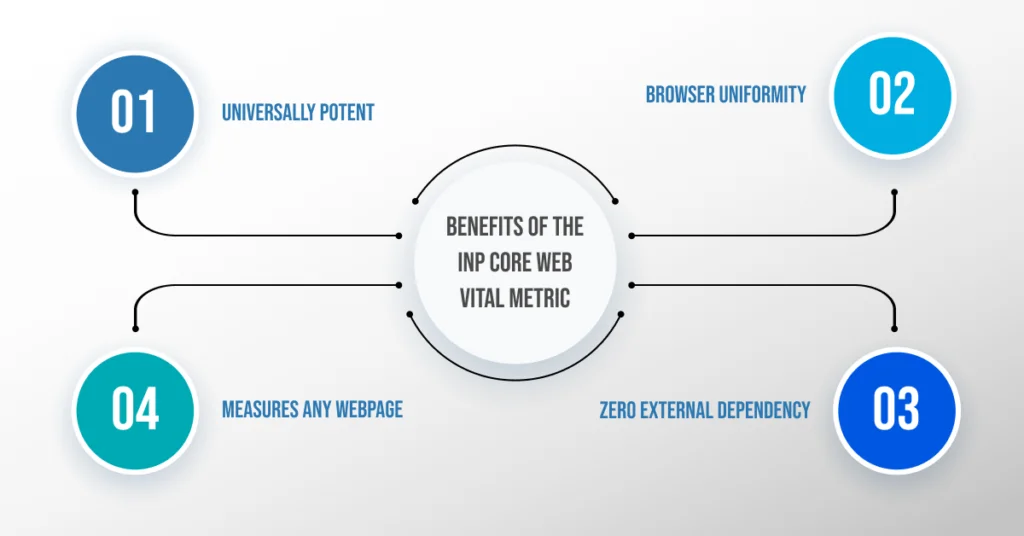
Google’s Core Web Vitals play an indispensable role in enhancing the organic traffic on a website. If a webpage loads quickly and efficiently, it will fetch more users instinctively. However, if the webpage starts lagging, chances are that you need to cross-check your webpage’s Core Web Vitals.

benefits-of-the-INP-Core-Web-Vital-metric-1024x536

Therefore, these Core Web Vitals consolidate to affect the SEO strategy of a webpage or website in general. Some of the primary benefits of INP are mentioned as follows:

  • Universally Potent

The INP metric does not require the assistance of JavaScript or CSS code to measure the responsiveness of a page. It can do it alone for both smartphones and desktop sites. Therefore, this metric is universal in nature, unlike FID (First Input Delay).

  • Browser Uniformity

The INP metric does not discriminate among browsers. Does your website work well on Firefox but not on Google Chrome? INP can still measure page responsiveness without depending on the CSS or JavaScript code executed by the browsers. 

  • Zero External Dependency

As discussed, the INP Core Web Vitals do not depend on JavaScript or CSS code. Apart from this, INP also does not depend on other external factors, such as network latency or rendering. 

  • Measures Any Webpage

There are no limitations to what kind of page the Interaction to Next Paint (INP) could measure. From gauging the responsiveness of your homepage to any other page of your website, INP can calculate the responsiveness of every type of webpage. Especially if your website page has a lot of interactivity, it can still measure the response rate for the same.

How to Optimize Interaction to Next Paint?

If you want to learn how to improve the Interaction to Next Paint (INP) metric for your website, make sure that you read this section till the end. Although optimizing INP is a time-consuming task, it is definitely rewarding. 

Before optimization, it is crucial to figure out the root cause of the delay in the webpage’s responsiveness. You can perform the root-cause analysis by following the below-mentioned steps:

1. Label Your Website First

Before jumping to optimization, it is important to learn if your website has poor responsiveness or just needs improvement. Once you figure this out, you can begin running diagnostics on the slow interactions.

You can use a RUM provider which will equip you with the following information:

  • Your page’s INP value
  • The specific interaction responsible for the resultant INP 
  • The time frame of the interaction (if it occurred during or after the page load)
  • The type of interaction (tap, click, or a keypress)
  • Other valuable information

Pro Tip: We prefer RUM over CrUX as CrUX does not provide contextual data to help you analyze the issues for a high INP score.

2. Run Diagnostics Using Lab

Once you’re equipped with the field data, you can start with the manual testing in the lab. If you cannot find the field data, you can check out this resource. 

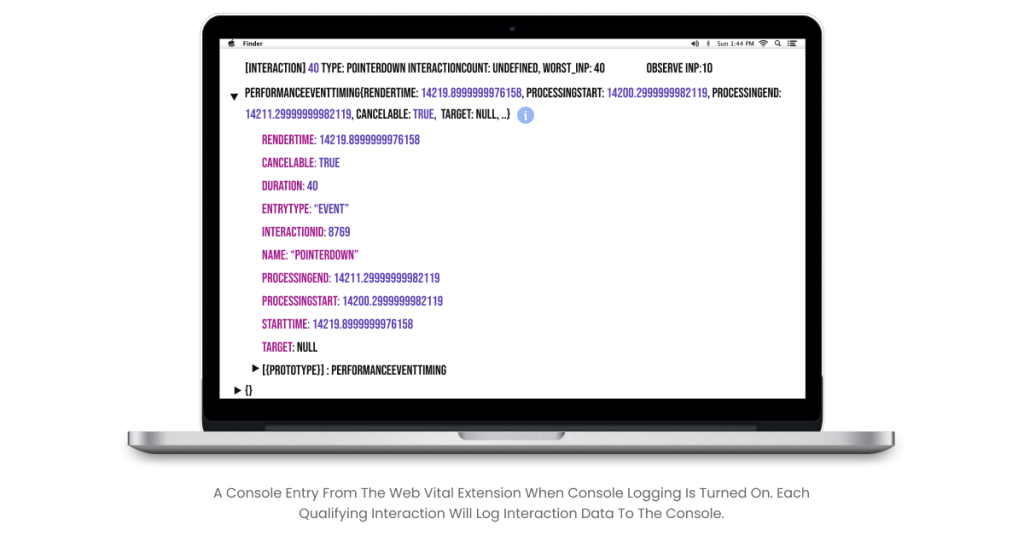
One of the best methods to manually perform an INP test for interaction latency is to use the Web Vitals Chrome Extension. Once installed, you need to go to the extension’s settings to enable the Console Logging checkbox and then click on Save.

You can then open the console in Chrome DevTools to start testing the suspected interactions on your website. You can also take the help of the useful diagnostic data that appears on the Console.

Run Diagnostics Using Lab

Pro Tip: If the Chrome extension gets blocked, you can copy and paste some JavaScript into the DevTools console.

3. Optimizing INP

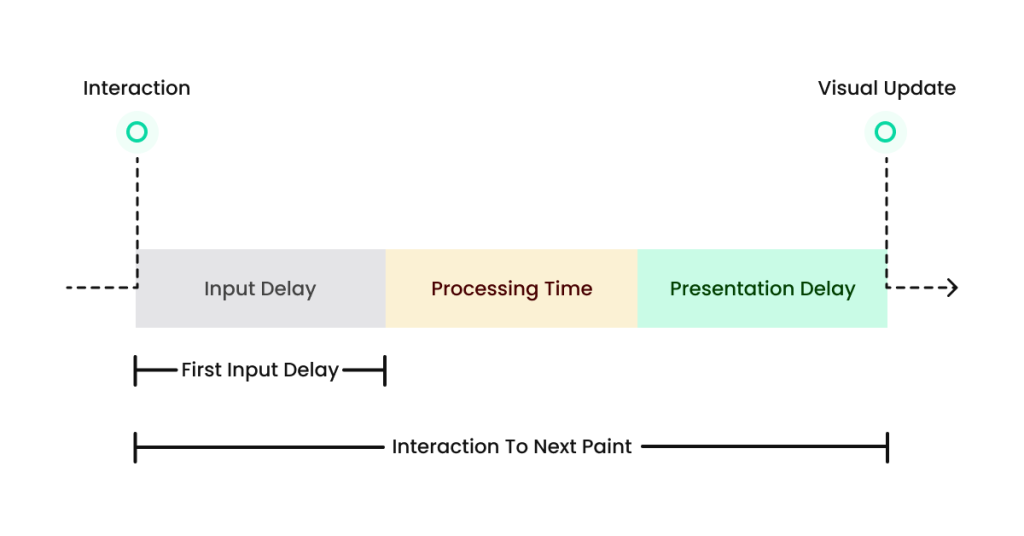
Once you have recognized the slow interaction and run diagnostics in the lab, it is time to optimize Interaction to Next Paint. There are three main types of interactions that need to be optimized. These are:

  • The input delay
  • The processing time
  • The presentation delay

a. Reduce Input Delay/TBT

The first part of the interaction when a user interacts with a page is called the input delay.

TBT

You need to reduce and break up the background CPU activity in order to reduce input delay to the minimum. The input delays are caused due to the following reasons:

  • Activity happening in the main thread (script loading, compiling and parsing)
  • Timer functions
  • Fetch handling
  • Interaction overlapping

You can also look at the total blocking time (TBT) metric. It refers to the response rate of your website to the user input. In other words, it measures how much time the main thread is blocked during page load. Most of the time, long-running CPU tasks block the page’s main thread. Some reasons for blocked user interactions are:

  • JavaScript execution
  • Parsing HTML
  • Updating page layout

TBT makes up to 25% of the total performance score in Google Lighthouse.

Pro Tip: You can remove the unused JavaScript and CSS, which are not parsed or compiled when not required.

b. Optimize Event Callbacks

Next, you must ensure that the event callbacks that run in response to the user interaction must be completed as fast as possible. You must try to break up the work in event callbacks into separate tasks. You can use SetTimeout to break up the tasks.

Performing this separation prevents the main thread from getting blocked. This practice allows other interactions to take place.

c. Prevent Large, Complex Layouts and Layout Thrashing

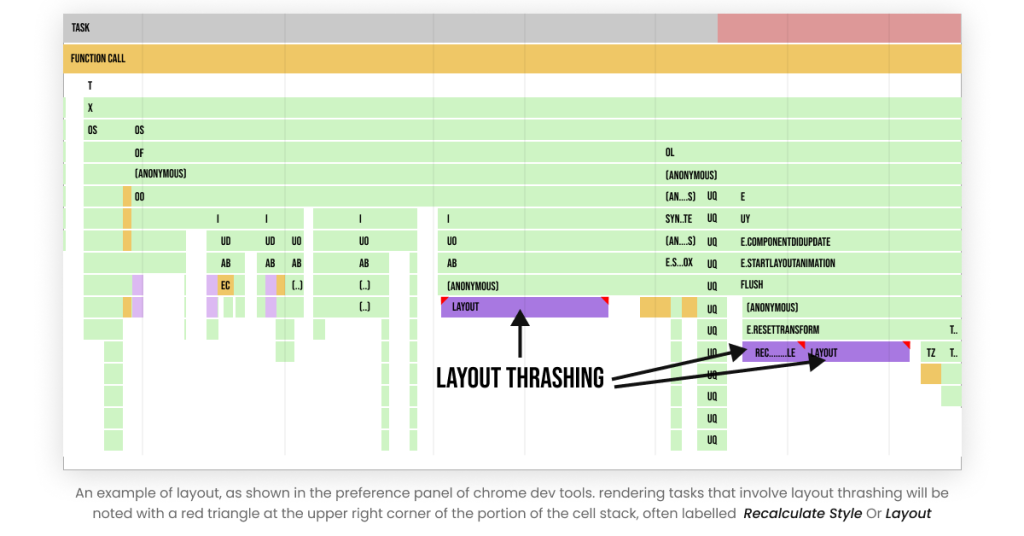
Also called forced synchronous layout, layout thrashing is a rendering performance bottleneck where layout happens synchronously. This problem arises when you update styles in JavaScript and request the values in the same tasks. This forces the browser to do synchronous layout work.

layout thrashing

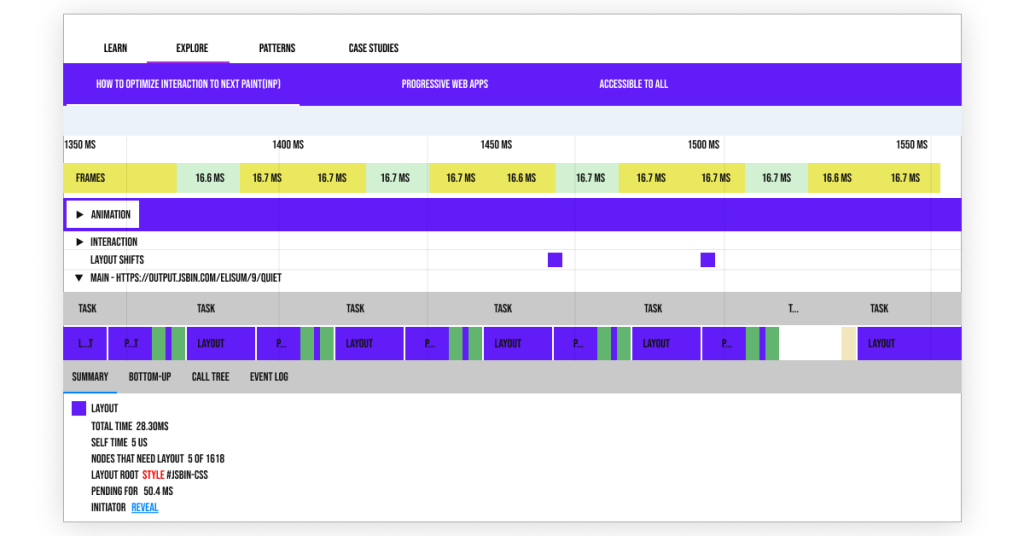
You can avoid the layout; however, if it is not possible to avoid the layout, then you can go to Chrome DevTools to check the time it is taking. You can see the overview of how your site performed by following the steps:

  • Open DevTools.
  • Go to the Timeline tab.
  • Hit the record button and interact with the pertaining site.
how to optimize interaction to next paint(inp)

d. Reduce DOM Size

A browser creates a Document Object Model (DOM) when a web page is loaded. Large DOM size affects the website’s user interactivity, as it increases memory usage, slows down layout rendering, and causes longer style calculations. Therefore, it is pivotal to reduce the DOM size. 

You can finish off rendering work easily by minimizing the size of the page’s DOM. You can follow the below-mentioned approaches to reduce DOM size:

  • Flattening the DOM

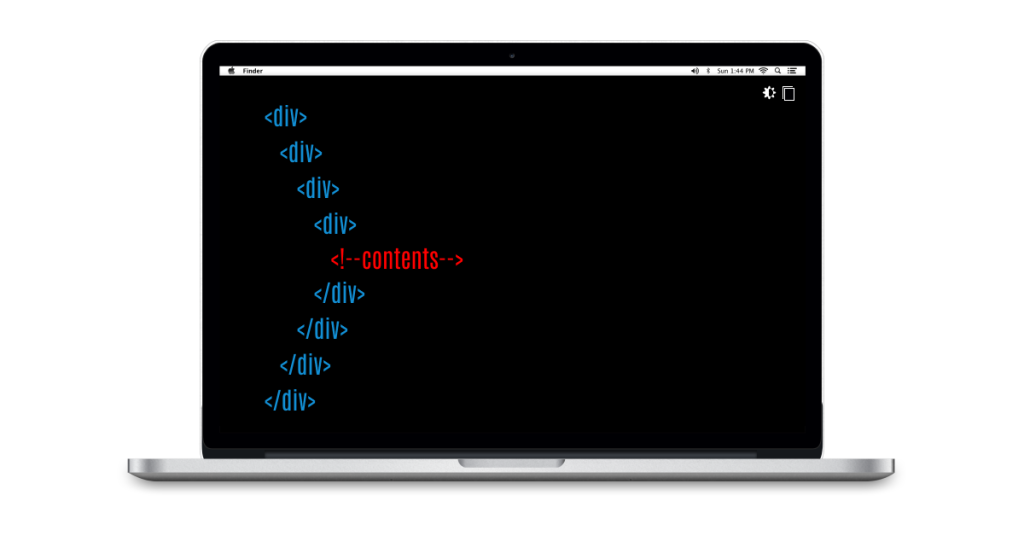
You can reduce the DOM size by reducing the DOM depth. You can check if your DOM is unnecessarily deep if your markup looks something like the following:

Flattening the DOM

You can open the Chrome DevTools and go to the Elements tab to check the DOM depth. 

Another way to reduce DOM depth is to use fragments in the framework that you use.

  • Add to the DOM during User Interaction 

Another approach to minimize your page’s DOM is to remove the invisible parts of your page when it gets rendered by a user for the first time. You can add them later. This will make the initial HTML load lighter; therefore, it will be rendered easily. You can also initially hide some parts of the page, which can also speed up other interactions.

Real-World Use Case of INP Core Web Vital

Now that you’ve learned in-depth about the INP metric, it is time to look at some of the real-life implementations of INP. Let’s go over a case study of a real website that made massive improvements to responsiveness for the users by harnessing the INP. We’re talking about the Economic Times. (source: Chrome for Developers YouTube channel)

The Economic Times began its work in the Lighthouse, which helped them cut down their total blocking time. It is correlated to INP as main thread slowdowns are the root cause of slow user interactions.

Next, they also lateloaded scripts that were not business-critical to free up the main thread in order to process the main content. They removed unused JavaScript and CSS, which were still parsed and combined even when they were not needed.

As a part of the process, they inlined necessary CSS, because over 90% of their common CSS was not getting used”, says Annie Sullivan, Software Engineerat Chrome Web Platform team. She then added, “This made a big improvement and they kept going. Once they had optimized the total blocking time, they looked for things that would specifically improve interactions.

The Economic Times then reduced the DOM size. This helped them reduce the time it took to render an interaction. They also avoided unnecessary rendering by upgrading to Next.js to take advantage of better React hooks to prevent rendering. They also used the request title callback to render below the full content when the main thread is freed up. Party Town was also used to move third-party code off the main thread.

After all these optimizations, the Economic Times saw INP on their Topics page reduced by 75%. They also saw a 50% decrease in bounce rate and a 43% uplift in page views.

Bottom Line

Interaction to Next Paint is one of the next Core Web Vitals that is all set to replace the First Input Delay (FID) metric. With the changing dynamics of the industry, it is time to get familiar with this metric to gain an edge over your competitors and for an enhanced user experience.

You can follow the highlighted techniques to optimize your webpage for the INP metric. Improving the responsiveness of your webpage is a primary factor in deciding the amount of traffic you’ll attract. This phenomenon directly impacts your brand’s revenue.

We recommend you invest judiciously in technical SEO, and if you struggle to do so, Deftsoft’s digital marketing experts are here to cater to you with bespoke Core Web Vitals solutions.

FAQs:

What does INP mean?

Interaction to Next Paint (INP) is a new Core Web Vitals metric that is replacing the old First Input Delay (FID) metric. It measures a web page’s responsiveness whenever a user interacts with the page. It observes the latency of all the interactions made by the user. A low INP score of below 200 milliseconds is a healthy INP score.

What is the difference between INP and FID?

FID is a load responsiveness metric, whereas INP is more than measuring the first impressions. FID considers only the first interaction with the page, but INP considers all the interactions. INP is a more reliable metric as it samples all the interactions and then presents the value, unlike the FID metric.

How do we measure INP?

One of the best ways to measure INP is through tools. You can use PageSpeed Insights or the Chrome User Experience Report (CrUX) to check your site’s score on Interaction to Next Paint (INP). You can also use any Real User Monitoring (RUM) provider.

What to do if no INP value is reported?

There could be several reasons why you were not presented with an INP value. These include that the user did not interact with the page through clicks, taps, or keypresses. He simply hovered or scrolled through the page. It could also be because a bot, such as a search crawler or headless browser, is interacting with the page.

How to Create Email Signature for Free?

Are your emails missing a professional touch? You’re in need to add a signature section to your emails. Let me explain! For instance, you’re a business owner pitching your online services to a prospective client. This is a situation where you need to depict yourself as highly sophisticated and authoritative. 

You can add an email signature to the footer of your email to look legitimate and genuine to the email receivers. This guide is an exemplary resource to learn how to add an email signature to your Gmail for free in 2024. You will also learn what an email signature is and what its components are.

Without further ado, let’s get started.

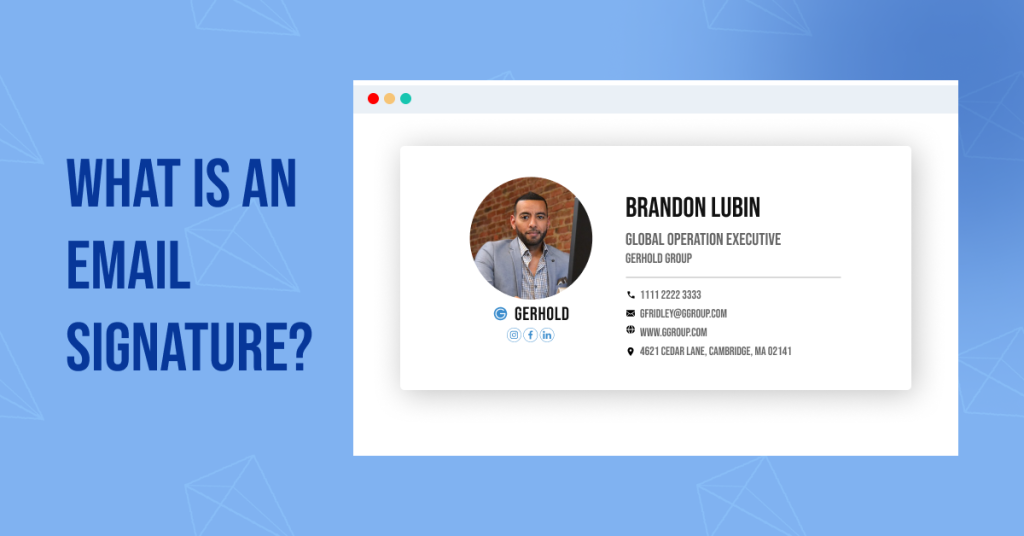
What is an Email Signature?

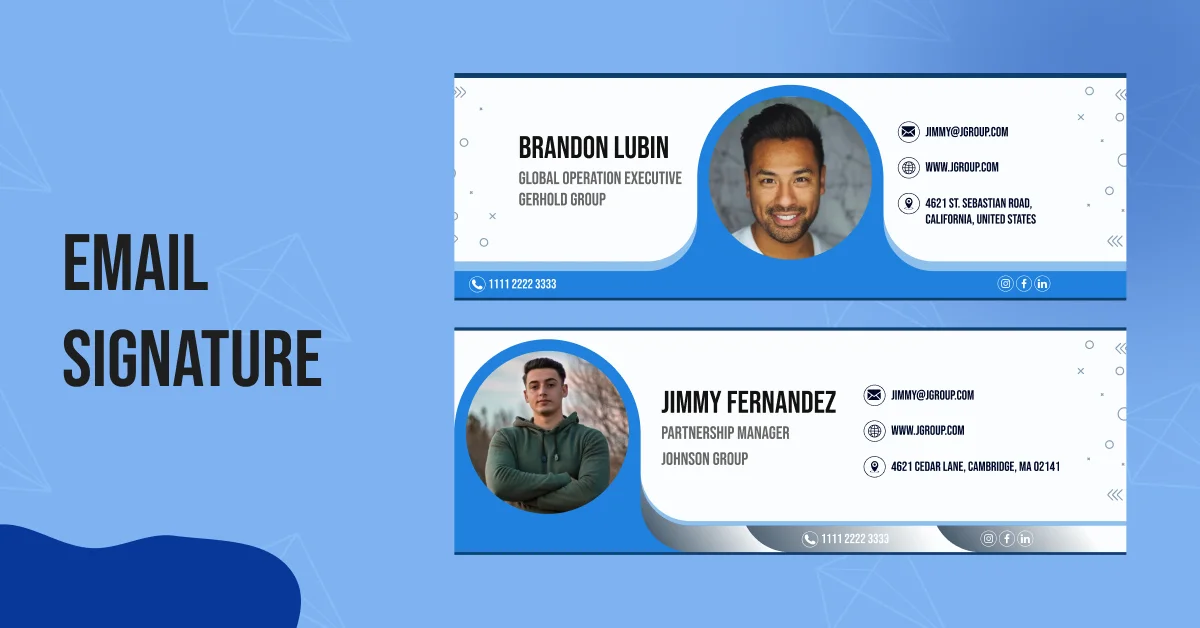
An email signature refers to text, usually involving your contact information or favorite quote, automatically added to the footer of your emails. It must be an indispensable practice in 2024 to add email signatures to your emails.

An email signature looks something like the following:

Email Signature

The statistics speak for themselves:

  • 62% of individuals use email signatures for marketing. Out of these, 45% use them regularly, while 18% use them occasionally.
  • The rest, 37%, never use email signatures for marketing.
  • 81% of business users treat e-signatures as the most significant asset in the legal and security matters of their day-to-day operations.

Why Email Signature Matters in Email Marketing?

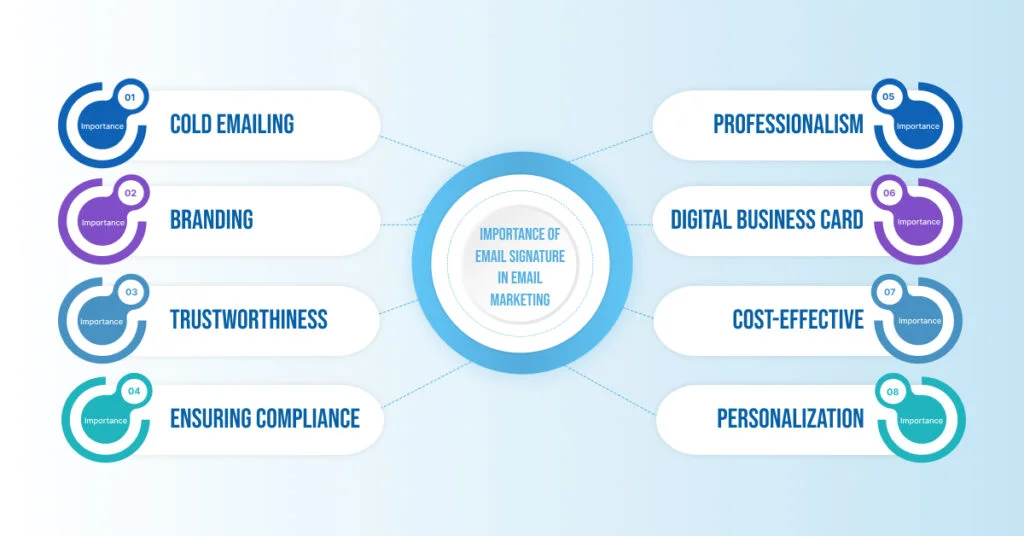
Adding an email signature to your email enhances the look, feel, and credibility of your email. One can enhance the trust factor in emails through an email signature and, therefore, increase the success rate of email marketing. Apart from seeming professional, there are ample reasons to use email signatures. Some of the significant ones are listed as follows:

IMPORTANCE-OF-EMAIL-SIGNATURE-IN-EMAIL-MARKETING-1024x536
  • Cold Emailing

You increase the chances of getting a reply when sending a cold email just by adding an email signature. This practice adds a tint of personality to your email, thus enhancing the credibility and authority of the email.

  • Branding

You can establish a strong business identity with the help of an email signature. It gives off an impactful impression on the viewers. Therefore, it plays a significant role in the branding of your business.

  • Trustworthiness

It is not easy to win the trust of clients of any professional industry, provided you’ve just entered the domain. This is the time when you need to win the trust of your client. Email signature in your emails significantly contributes to elevating the trust factor of clients.

  • Ensuring Compliance

An email signature is not only significant from the marketing point of view, but it also ensures legal compliance and reduces potential legal fraud. For instance, a lot of spam emails do not have an email signature or an individual persona.

  • Professionalism

If you want to send emails to high-level professionals such as the Sales Director or CEO of a company, it is crucial to add an email signature. This practice establishes authority and lays the foundation for successful collaboration with the email receiver.

  • Digital Business Card

Email signature acts as your digital business card. It is a perfect medium to connect to people across the world via emails and put forth a cordial hand for communication. It eliminates the need to capture potential clients offline.

  • Cost-effective

You can create an email signature for free, as there are no external resources required to create it. Therefore, businesses can save up their capital and put their best foot forward in front of their potential clients.

  • Personalization

Emails can be personalized by adding the email signature of an individual. For example, if you’re a social media manager, you can reach out to your prospective clients with a personalized email signature comprising your name and contact details.

What are the Components of an Email Signature?

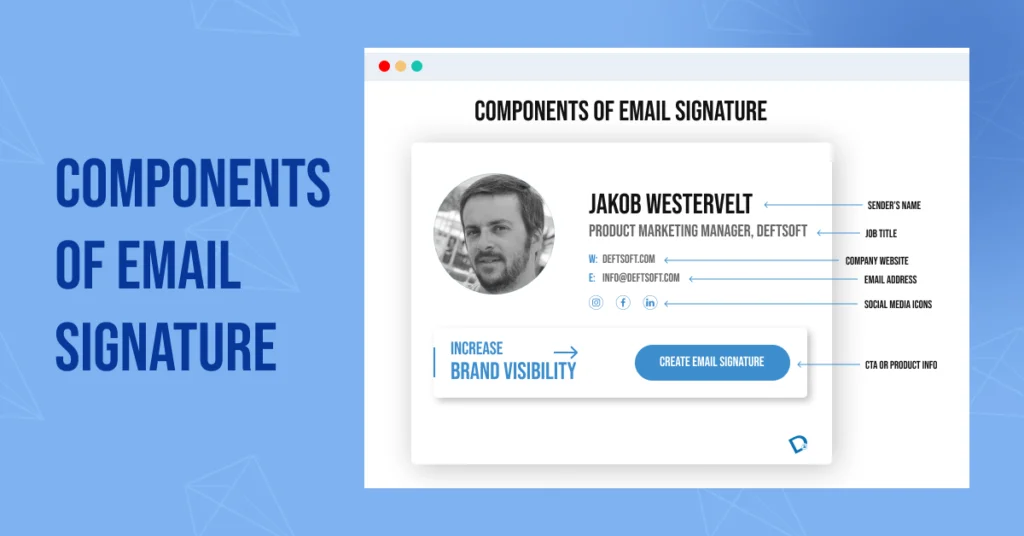
An email signature consists of some significant components that contribute to the complete structure of an email signature. There are 6 main components of an email signature. These components are highlighted as follows:

components-of-email-signature-1024x536
  1. Sender’s Name

It marks the topmost section of an email signature. It consists of the full name of the individual who is sending an email.

  1. Job Title

Following the sender’s name, it is essential to mention the designation or the job title of the sender. You must first mention the name of your job title, followed by your company name.

  1. Company Website

 You then need to add the website name with a hyperlink. This would help the receiver to know more about the place you’re reaching out from.

  1. Email Address

You must then add your email address so that the user can reach you. A pro tip is always to add your professional/workplace email address for credibility.

  1. Social Media Icons

Make sure that you add the icons and links to your various social media platforms. This helps the receiver in checking out your company’s profile and how it works. It adds a positive impact on the receiver.

  1. CTA or Product Info

It is one of the best practices to end the blog with a Call-to-Action (CTA) or product info. This will help you reach the key objective of your email.

How to Create Email Signature Using Gmail?

It is time to address the elephant in the room. You can follow the steps given below to create an email in Gmail.

A. Adding a New Email Signature:

  1. Go to Gmail.
  2. Click on “Settings” at the top-right corner and then go to “See All Settings“.
  3. Add your signature text in the box right in the “Signature” section. Make sure that you add all the important components to your email signature, such as name, website link, CTA, etc. 

You can also edit the format of the text or add an image to it. You must note that you can only add 10,000 characters to the Email signature, including the image.

  1. You can tap on the “Create New” to add more email signatures and save them. Make sure that you go to “Signature defaults” for more customizations to the signature.

Go to the button page and then hit the “Save Changes” button.

B. Adding Multiple Signatures:

You can also use different signatures for your email. For instance, you can permanently set a default email signature for your newly composed emails or the ones you reply to. You can customize the signatures for different emails as per your needs. 

As mentioned above, you can use the “Create New” to add more email signatures.

C. Editing Email Signatures:

To edit an existing email signature, you can follow the steps mentioned below:

  • Go to Gmail.
  • Click on “Settings” and then “See All Settings”.
  • Right under the “General” open, go to the “Signature” option and then click on the signature you wish to edit.
  • You can then make the desired changes by using the text box.
  • Click on “Edit” to change the signature name.

At last, click on the “Save Changes”. Voila, you have edited your email signature.

D. Removing Email Signatures:

If you wish to remove an email signature that you’ve previously created, you can do so by following the steps mentioned below:

  • Go to Gmail.
  • Click on Settings and then “See All Settings”.
  • Scroll down to “Signature” under the “General” option.
  • Click on the email signature that you wish to eliminate.

Click on Delete with a Trash icon and then choose the “Delete” option.

E. Adding an Email Signature if You’re Using the “Send mail as” Feature:

You can even send emails from different addresses. To do so, you need to use the “Send mail as” feature. This way, you can send emails from different addresses in your account.

Follow the steps mentioned below to enact this feature:

  • First of all, you need to select an address. Go to the “Settings” page and open the drop-down menu of the Signature text box. Select the address you wish to send an email from.
  • In case the drop-down menu is not visible, you can go to the Accounts and Import settings page.
  • Ensure that your addresses are mentioned in the “Send mail as” section.

Note: If you’re facing issues in setting up your email signature, you can reach out for help here.

Concluding Thoughts

Adding an email signature to your emails can bring significant professionalism to your emails. One must incorporate the practice of adding signatures to emails consistently. This would enhance the brand value, credibility, and trustworthiness of the website.

This guide is one of the best resources to add an email signature to your Gmail. It often gets confusing how to use these signatures and edit them using different paid tools. Get rid of the fuss and follow this simple and hassle-free method to get started.
If you’re a business owner who wants to hire top-notch digital and performance marketers to help you rev up your email marketing game, feel free to reach out to us.

FAQs:

What is an email signature?

An email signature is a text that contains all the important contents of an email sender. The text often includes contact details, company name, social media links, and a value-added Call-to-Action (CTA). An email sender can also add a quote instead of contact details based on the intent of the email. 

You can add up to 10,000 characters to an email signature. Gmail gives you an option to add as many email signatures as you want based on the email you’re sending.

Why is it important to use an email signature?

An email signature encompasses various roles that play a crucial role in catching the eye of the receiver. Firstly, it adds an element of professionalism to the email. Followed by it, if you’re a business owner, you can add credibility, trustworthiness, and brand value to the email. An email signature signifies the legitimacy and genuineness of the sender’s email. This practice automatically increases the chances of getting a reply by multifold.

What should you include in an email signature?

You can include various elements in your email signature. These elements include first and last name; your work designation/job title; company name; secondary contact information; booking links; social profile icons, and links such as Instagram, Twitter, Facebook, etc.; your photo or company’s logo; and a solid Call-to-Action (CTA).

How to create an email signature?

You can simply create an email signature by going to Gmail “> open Settings > scroll all the way down to email signature > enter the desired text in the text box > click on Save Changes.

Should you make an email signature if you’re a small business owner?

The email signature is a crucial factor that makes or breaks your impression of the receiver of the email. Of course, you must make an email signature if you’re a small business owner. Don’t forget to add your photo or the company’s logo to leave a tangible impact on the receiver.

PPC Guide: How to Optimize Google Ads

Paid search marketing is one of the mightiest digital marketing tools that boost an organization’s revenue. Especially if you’re a new business organization wanting to build a brand in a competitive world, Google ad campaign is the golden ticket to enhanced success. 

80% of global businesses use Google ads for their PPC campaigns. Google Ads generated revenue of a whopping $172.647 billion in the first quarter of 2023. 
Now, you must be wondering why Google Ads is the major tool for Pay-Per-Click (PPC) marketing. This is because Google rules about 90% of the search engine market globally. To back this up, Google and Facebook search advertising generates the highest ROI of all paid channels.

  • 80% of global businesses use Google ads for their PPC campaigns
  • Google Ads generated revenue of a whopping $172.647 billion in the first quarter of 2023.
  • Google rules about 90% of the search engine market globally. 

Enough talking about the theoretical part; let’s begin with the applications. If you’re a business owner or a digital marketer looking to level up your Google Ad campaigns game in 2024, this blog is the perfect resource for you! 

Note: If you’re still not familiar with paid marketing and what it is, you can check out this blog right here.

Top Tips for Running a Successful Google Ad Campaign

When you instantly want to rank on top of a search engine page for certain queries, running paid Google ad campaigns is one of the best tools to do so. The work doesn’t end after running an ad on Google. In fact, it starts right from that moment. 

If your ongoing Google ad campaigns are not performing well, chances are that your campaigns need optimization. Follow along with our best-kept tips to run successful Google ad campaigns!

Tip 1: Know What You Want

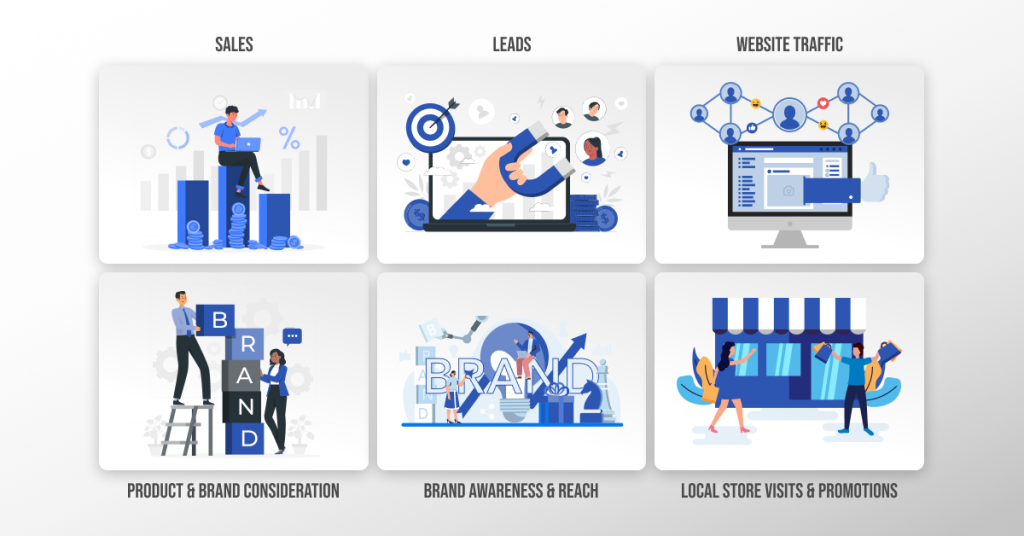
Firstly, it is crucial to identify the goal of your PPC ad campaign. Is it to generate more leads, enhance conversions, or merely get more traffic on the website? Segregate your requirements based on your needs, and voila, you’ll see a significant shift in the performance of your ads.

Your PPC ad campaign end goal can vary and lie anywhere between increasing sales and capturing leads. Some of the most common objectives of your campaign can be the following:

identify the goal of your PPC campaign

Let me explain this to you with an example. For instance, if you own a clothing brand and wish to enhance the sales of your products, “Drive Conversions” is the most-suited type of Google ad campaign via a video format ad. 

Note: You can learn more about how to define your objectives in Google Ads here.

Tip 2: Choose the Right Campaign Type

It is crucial to choose the type of campaign you wish to run after figuring out the objective of your PPC campaign. The best criteria to choose the right PPC campaign type for you involves the following parameters:

You must be aware of the different types of Google ad campaigns available and what purpose they serve. The various types of ad campaigns are as follows:

1. Search Ad Campaign

Search ads refer to text ads that show up when a user searches for a product on Google search. 

Benefits:

  •  Increased sales and traffic on websites, therefore, more leads.
  • Helpful in collecting leads for products/services with a longer sales cycle.

2. Display Ad Campaign

Display ads are visually engaging ads that are displayed on various websites, apps, and other Google-owned platforms such as YouTube. 

Benefits:

  • Enhanced sales and leads with visually attractive CTAs (Call-toActions).
  • Increased brand awareness.

3. Video Ad Campaign

You can run video ads on YouTube and other websites with video ad campaigns.

Benefits:

  • Increased brand awareness as videos impact more users.
  • Target people beyond the Google search engine.
  • Leverage action-focused video ads by running ‘Drive Conversions’ ads.

Note: You need to upload the video on YouTube first to run video ad campaigns.

4. App Ad Campaign

This type of ad campaign helps in looking for new app users and increases sales. This type of ad is visible on YouTube, Google Play, AdMob, Discover, and mobile devices and there are 3 million apps and sites.

Benefits:

  • Enhanced signups for apps on mobile devices.
  • It covers all types of ads, such as Display, YouTube, Search, and Play, in a single campaign.

5. Smart Ad Campaign

As the name suggests, a smart ad campaign automatically sets up an ad campaign for you. All you need is to enter information about your business, and Google AI will find the best ad for targeting potential users.

Benefits:

  • Google optimizes the ads and targets a suitable audience on its own.
  • You do not need to fuss about choosing the best ad campaign.

Note: If you just made a Google Ads account, all your campaigns will be smart campaigns by default.

6. Performance Max Campaign

You can access all Google Ads inventory, such as the Search and Display network, from a single campaign. You can run text, image, video, multi-image carousel, and product listing ads with a performance max campaign.

Benefits:

  • Easiest to set up with Google AI optimization.
  • You can gain deeper insights into a campaign through the “Combinations” report under the “Insights” tab.

Note: You can run a Shopping ad campaign to promote your e-commerce business. However, you need a Google Merchant Center account for it.

Tip 3: Set Your Budget Right

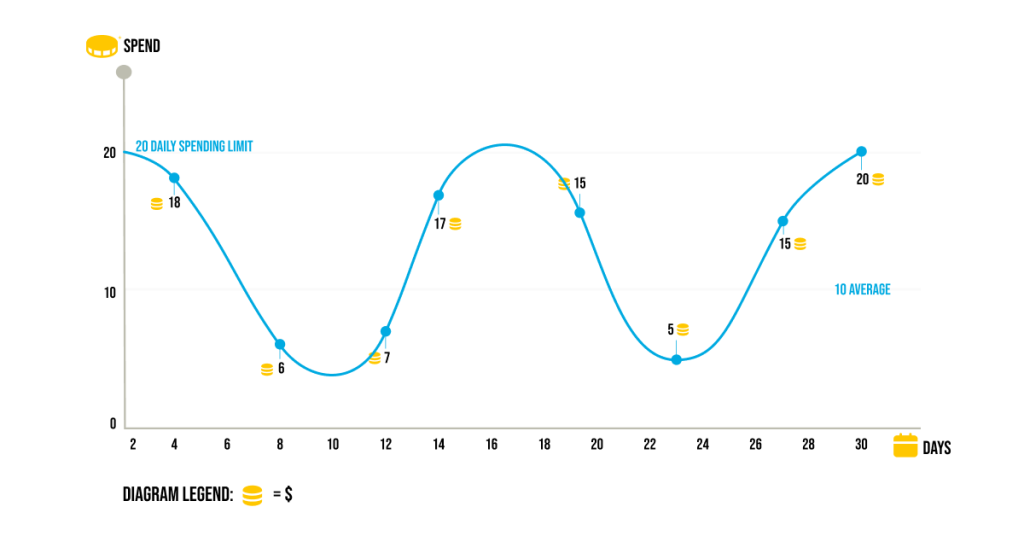
Setting an optimized budget that does not burn a hole in your pocket is an indispensable practice. You need to set an average daily budget, i.e., the average amount you’re ready to pay every day. You must also set your daily spending limit (should be 2x your daily budget) and a monthly spending limit (ideally 30.4x your average daily budget).

Set Your Budget Right

You must note that the daily ad spend varies based on the search traffic influx. Some days, there is heavy traffic, and on other days, there can be quite minimal traffic. The above image is a perfect example of how a monthly budget spend can vary over the course of a month.

This is how you can set your daily ad budget:

You can use the following Google Ads tools to help you set an optimized budget:

  • You can optimize your budget across existing campaigns through the Performance Planner tool.
  • You can set the maximum amount that you’re willing to pay for a user clicking on your ad through Cost-per-Click (CPC).

 You can calculate your daily average budget using the following equation: 

Average daily budget = (Monthly budget / Average number of days per month)

Tip 4: Make Up a Bidding Strategy

It is one of the best practices to set up your bidding strategy manually. However, you can also use automated bidding strategy options, such as Target Cost Per Acquisition (CPA), Target Return on Ad Spend (ROAS), maximize conversions, target impression share, maximize clicks, etc.
One upside of using an automated bidding strategy is that you do not need to update bids for specific keywords manually. You can use smart bidding that utilizes the power of AI to allocate a target CPA according to the set cost-per-click smartly.

Tip 5: Choose the Right Targeting Options

It is crucial to opt for the best targeting options for location, age group, audience, and other demographics. It is always a better option to drill down on targeting options rather than targeting a broad spectrum of audiences. 

Some of the common forms of targeting are as follows:

  • Keywords targeting to specify phrases that people tend to search for.
  • Audiences targeting to target a specific audience.
  • Language targeting to target audiences from various regions.
  • Location targeting to target individuals from different locations comprising of potential customers.
  • Device targeting to target a spectrum of different device users, such as iPhone, Android, etc.
  • Remarketing leads with Google ads. You can do this by connecting Google ads with Google Analytics (GA4), which helps analyze the website visitors and then retarget them with the ads.

Tip 6: Add Assets to Ads

There is more to ads than just running a plain campaign. Adding assets to ads, such as directions, website links, or phone numbers to call, can positively impact the PPC ad campaign performance. Adding these assets enhances the clickthrough rate by many percentages.

Note: You can also add sitelinks and images to your search ads to make them more responsive.

You must also add catchy headlines and descriptions that must be unique and focus on user benefits. You can add up to 15 headlines and 4 descriptions for a responsive search ad.

Tip 7: Create Group Ads and Choose the Right Keywords

An ad group contains one or more ads that share similar targets. You set a bid, or price, to be used when an ad group’s keywords trigger an ad to appear. This is called a cost-per-click (CPC) bid. You can also set prices for individual keywords within the ad group. Use ad groups to organize your ads by a common theme, such as the types of products or services you want to advertise.

You can create an ad group of ads that share similar interests. For example, if you’re running an ad campaign for trekking shoes, you can make a carousel group ad to do so.

Keyword targeting is yet another solid strategy to do so. Make sure that you prohibit the use of negative keywords to make a spectacular ad copy and keep it keyword-focused.
Note: You must try to incorporate long-tail keywords for a better-performing adcopy.

Tip 8: Solid Conversion Tracking

Although conversion tracking is not necessary for each type of PPC campaign, it works wonders for some. You can assess the effectiveness of your ads by setting up a conversion tracking system. This way, you can track the actions of the users on your website and understand how to optimize your Google ad campaigns.

Running ads is just not enough; it is crucial to track the actions of the users after they interact with your ad. This is exactly what the tool called Conversion Tracking does. It keeps track of the following conversions:
  • Whether a user signed up for a newsletter.
  • Whether he added a product to the cart.
  • Whether he purchased a product and much more.

Overwhelmed with Jargon? Let our Experts Handle the Technical Job

Deftsoft is the one-stop solution for running and optimizing successful Google ad campaigns for your business. We have an experienced team of PPC consultants that help you find the pain points in your ongoing ads or even better, manage Google ad campaigns for you. The search for one of the best PPC management companies ends here, as we have been an established digital marketing company for the last 18 years. 

Kickstart your journey to a vivid digital marketing experience with us.

FAQs:

What is a Google Ads campaign?

Google Ads campaign refers to online paid marketing campaigns that run on Google. Also known as PPC campaigns, these ads are based on the concept of bidding, where an advertiser bids for specific keywords that the potential users search on Google. 

What is Google’s optimization score?

The measure of how well your Google Ads account will work when running campaigns on Google is known as the Google optimization score. The score is depicted in percentages, with 100% being the highest and 0% being the lowest. Google offers recommendations on Account, Campaign and Manager Account levels to help you enhance your optimization score for better ad performance.

How many ads should be implemented per ad group?

You must use an optimized ad rotation with a minimum of 3 to 5 ads per group. It is because you never know which ad is going to resonate the most with the user.

How can google ads help you advance your business goals?

One of the best use cases of Google Ads is that you can target a specific audience to sell/create awareness about your product/service and enhance the visibility of your business. 

What is meant by quality score on Google?

Quality score refers to the comparison of your ad quality to other similar ads. You must have a high-quality score so that your ads can be visible to the users on SERP.

How to Create Events in Google Analytics (GA4)?

Quick Question: Have you ever wondered what happens when you click on any buttons on the website or submit a form on a website? What do those digital mix-ups turn to? Well, the answer is a little tool called Google Analytics. 

Google Analytics, huh? What is that? 

It’s a secret detective for your website, helping you uncover the mysteries of your online visitors and in this blog we will understand and learn how to create events in Gogle Analytics.

Let us understand this way.

Imagine you have a friend who is a data wizard, always ready to explore how people interact with your website. You could ask this friend questions like ‘How many people have visited my site today?’ or What pages are they most interested in?’ – and voila, Google Analytics would be his answer.

Simply put,

Google Analytics enables users to track and analyze various aspects of website or app performance, including user engagement, traffic sources, conversion metrics, and more.

Now, let’s dive a little deeper. Have you ever wondered how you could track more than just page views? That’s where the main character of the story comes up Event in Google Analytics.

So, what exactly are these? Well, think of them as the breadcrumbs that your visitors leave behind as they navigate your website. Did someone click on a button? Bingo, that’s an event. Did someone download a file? Another event! 

Events are like the footprints of your users, which we are going to discuss in detail.

 So, hold on tight! We are going to visit our first stop: understand what these events are all about. Ready? Let’s roll!

What are Events in Google Analytics?

An “event” is a specific action that users perform on a website or app. It goes beyond traditional pageviews, offering a detailed glimpse into how visitors engage with your digital space. Clicks, downloads, video views, form submissions – each of these is an event, leaving proof that reveals user behavior and preferences.

Importance of Events in Analytics:

  • Granular Insights: Events provide granular insights beyond mere page visits, allowing you to understand exactly how users interact with your content.
  • User Engagement Metrics: They serve as vital metrics for gauging user engagement, showcasing what elements are resonating most with your audience.
  • Conversion Tracking: Events are instrumental in tracking conversions, helping you identify which actions contribute most to your business goals.
  • Refinement of User Experience: By analyzing events, you can refine and optimize the user experience, tailoring it to what your audience finds most valuable.

Different Types of Events:

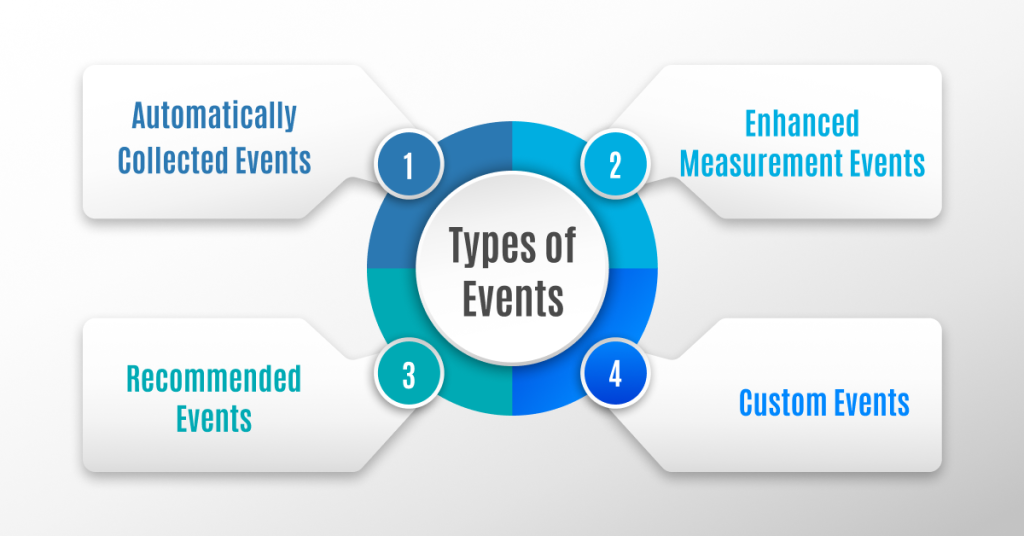
Types of Events in GA4
  1. Automatically Collected Events: These events are automatically tracked by GA4 without requiring explicit configuration. Examples include page views, scroll events, and outbound clicks. They offer fundamental insights into user behavior.
  2. Enhanced Measurement Events: These events provide additional data automatically collected when enabled. They include interactions like file downloads, video engagement, and ad clicks. Enhanced Measurement enhances the default tracking capabilities for a more comprehensive analysis.
  3. Recommended Events: Google Analytics 4 offers pre-defined event suggestions based on common industry practices. While not automatically implemented, they can be easily activated to track essential actions like sign-ups or purchases, streamlining the setup process.
  4. Custom Events: Businesses can define custom events tailored to their specific goals. This allows tracking of unique interactions, such as button clicks, form submissions, or other user engagements, providing flexibility and granularity in analytics configuration.

How to Set Up Custom Event Tracking in Google Analytics (GA4)

Custom events in Google Analytics allow you to track specific user actions on your website. They provide a flexible way to gather data on unique activities relevant to your business goals, enhancing the depth of your analytics insights.

Steps to Create Custom Events:

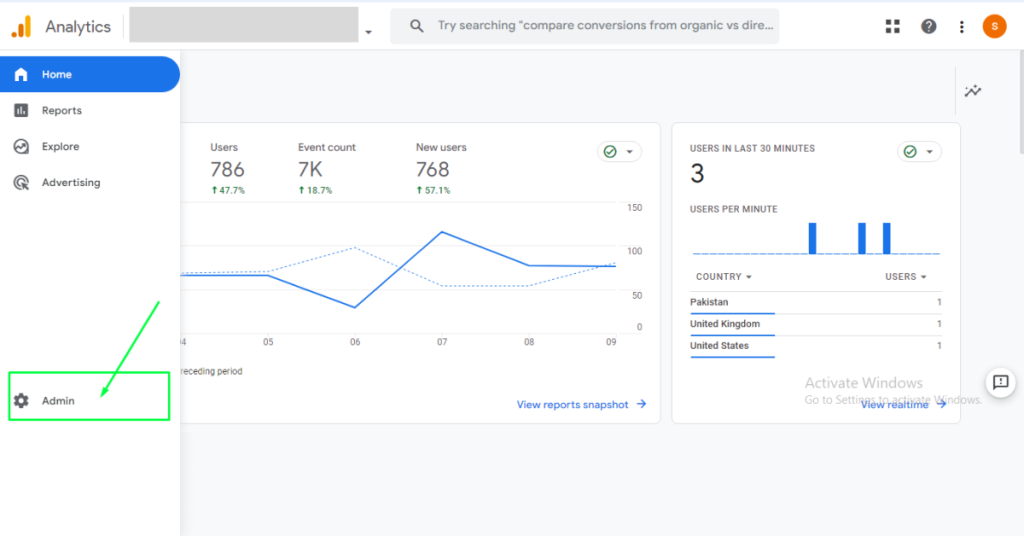
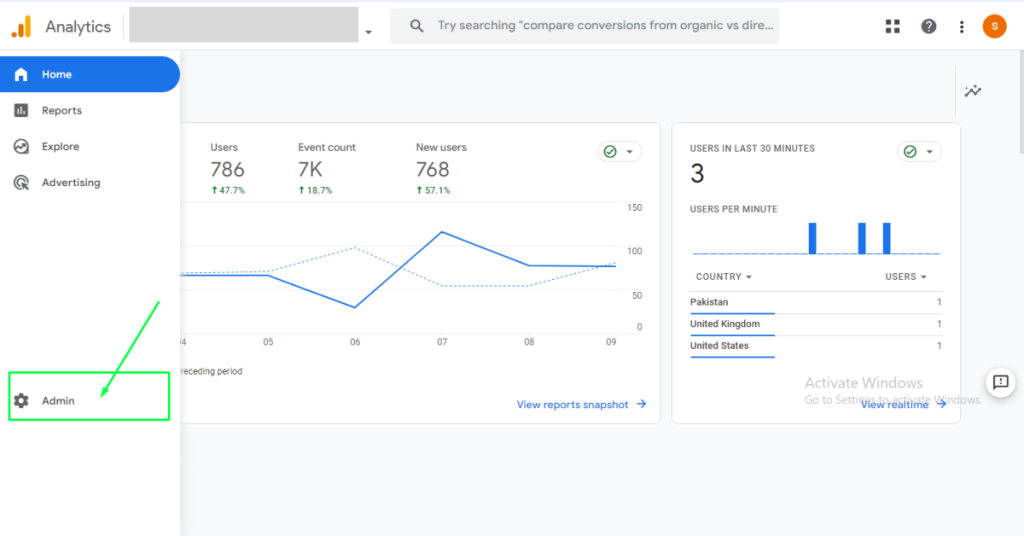
Step 1: Navigate to GA4 Property: Select your GA4 property and then click on Admin

Navigate to GA4 Property

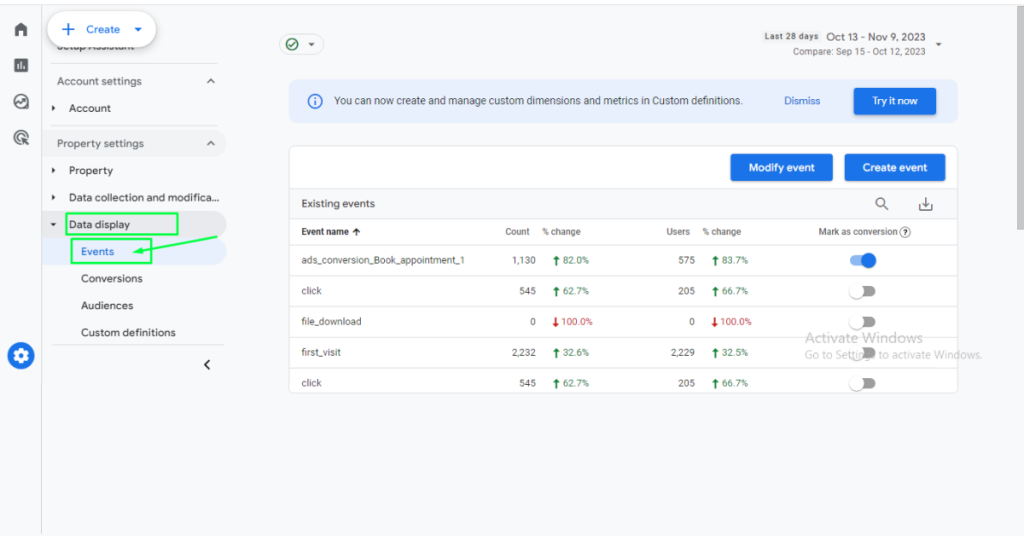
Step 2: Go to the “Events” Section. Under “Data Display,” click on “Events.”

Go to the "Events" Section

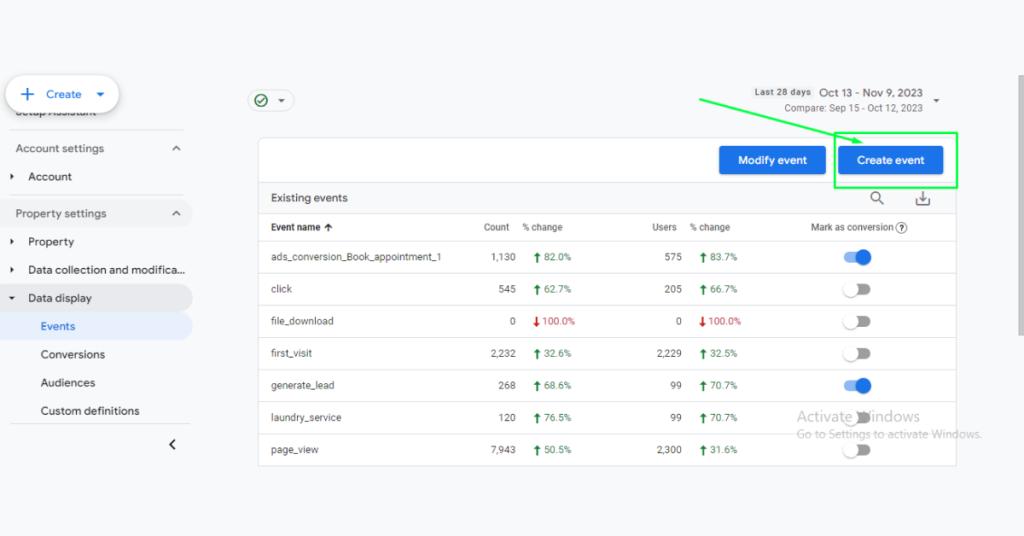
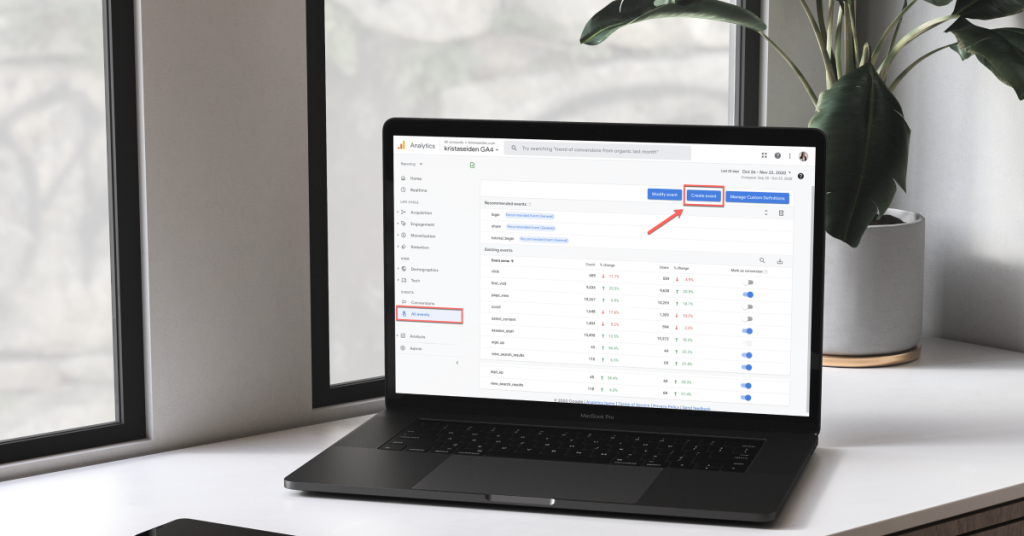
Step 3: Click “Create Event.” Create a new event and define parameters.

Click "Create Event

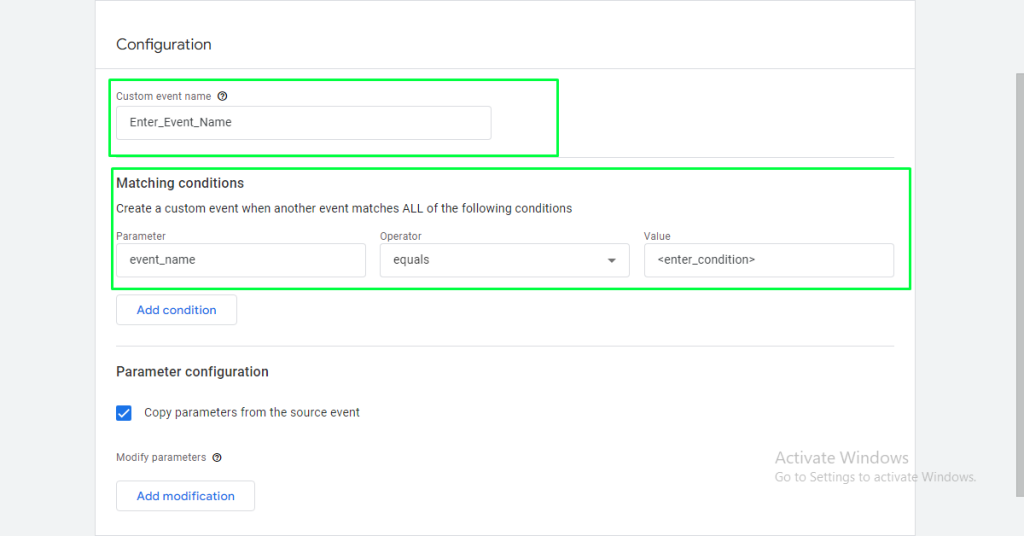
Step 4: Configure Event Details: Set Event Name, Category, Action, Label, and Value.

Configure Event Details

Step 5: Click on “Create and Save

Click on "Create and Save"

Detailed Step-by-step guide Setting Up Event Tracking in Google Analytics

Event Tracking in Google Analytics is like giving Sherlock a magnifying glass to examine user interactions on your site closely! To set up event tracking in Google Analytics 4, you can use either the Google Analytics 4 tag or the Google Tag Manager.

1. Using the Google Analytics 4 Tag:

First things first: Visit https://analytics.google.com/ and log in with your Google account credentials.

Step 1: Go to your Google Analytics 4 property and click “Admin”

Go to your Google Analytics 4 property and click Admin

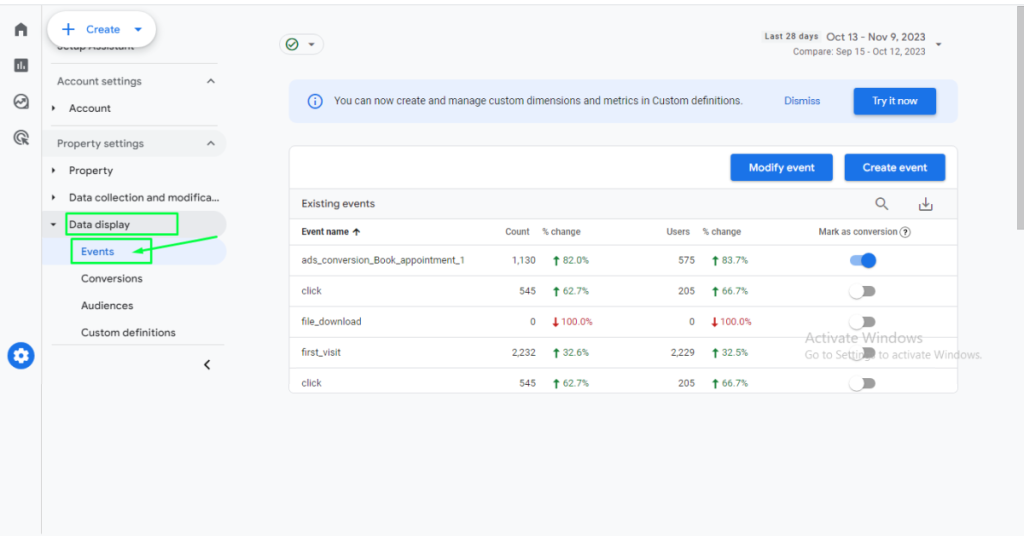
Step 2: Click “Events” under “Data Display”

Click Events under Data Display

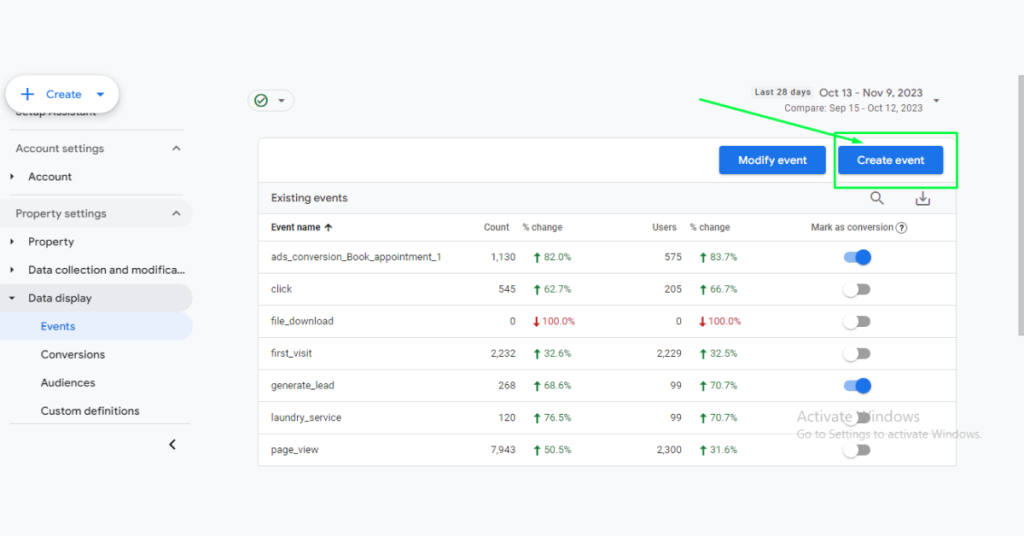
Step 3: Click on “Create Event”

Click on Create event

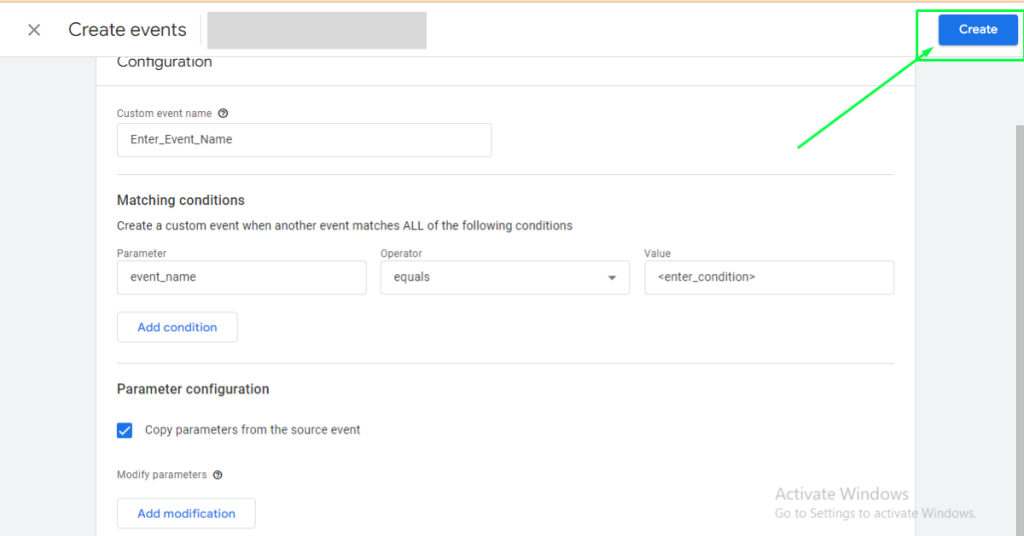
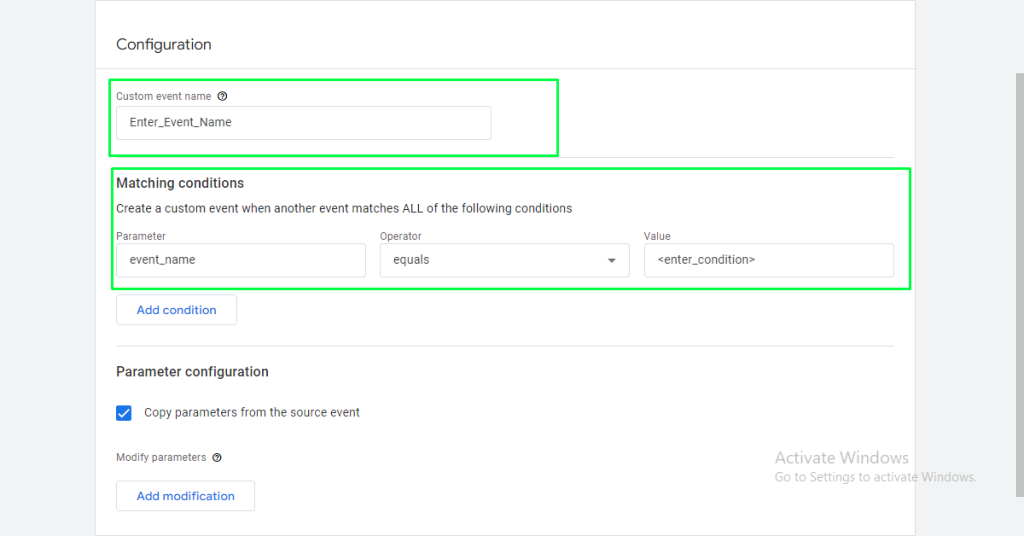
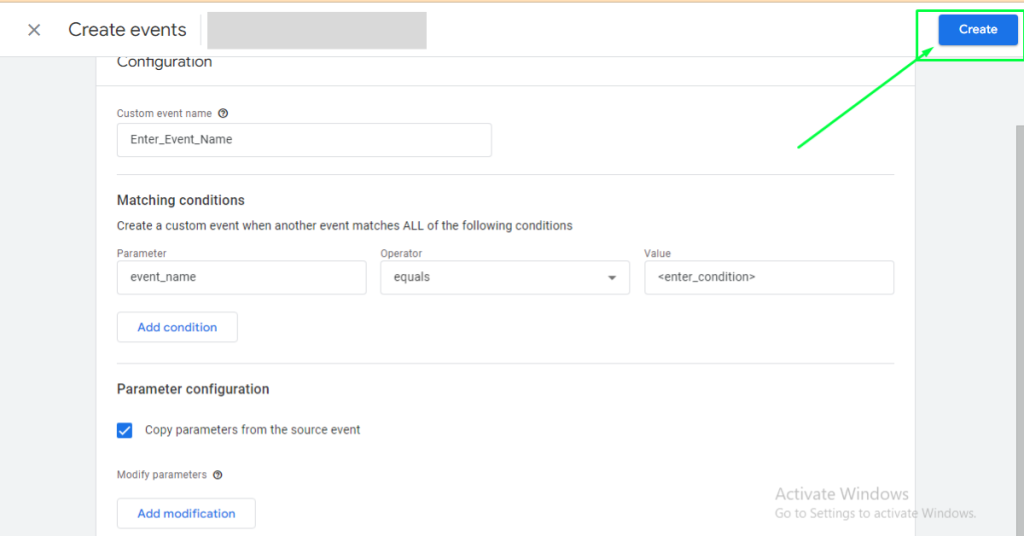
Step 4: Enter a name for your event (e.g., “button click” or “video play”) and then apply the condition of conversion/ event that you are looking to track. (Optionally) add any parameters.

Configure Tag

Step 5: Click “Create”

Click Create

Note: Once the event is created, enable the “Mark as Conversion Buttons” of events that you want to track as conversions.

2. Using Google Tag Manager (GTM):

Go to your Google Tag Manager account: https://tagmanager.google.com/

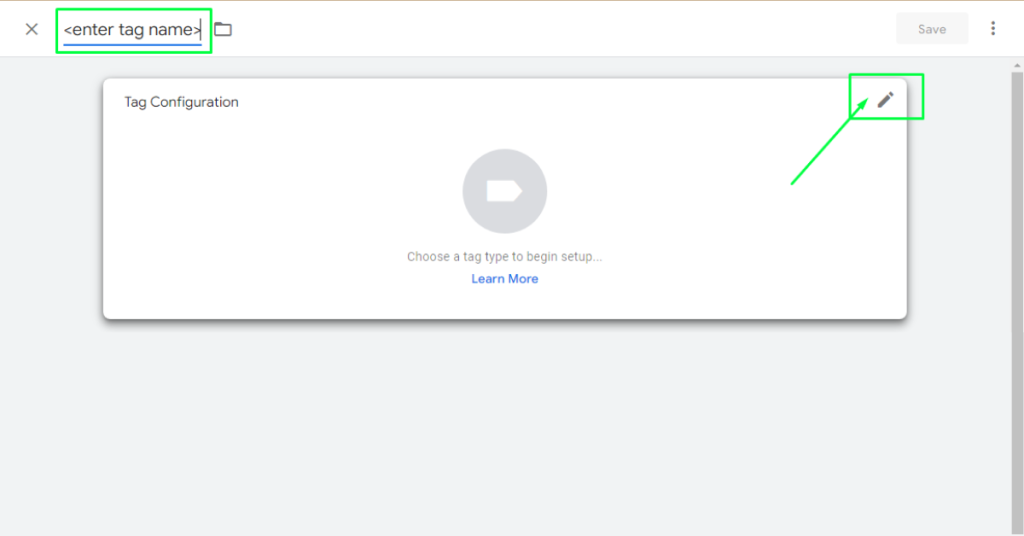
Step 1: Create a tag in GTM

Click “Tags” and then click “New”

Create a tag in GTM

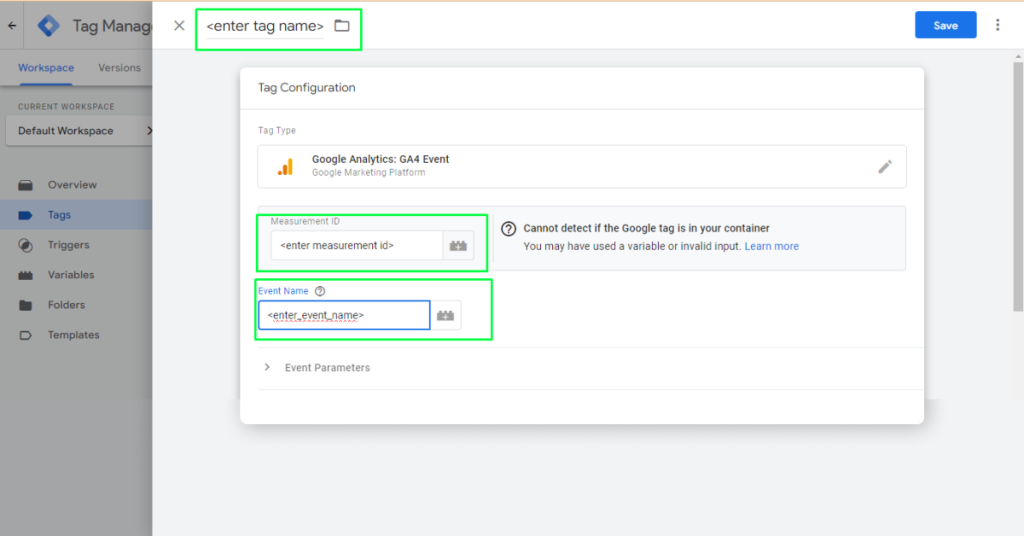
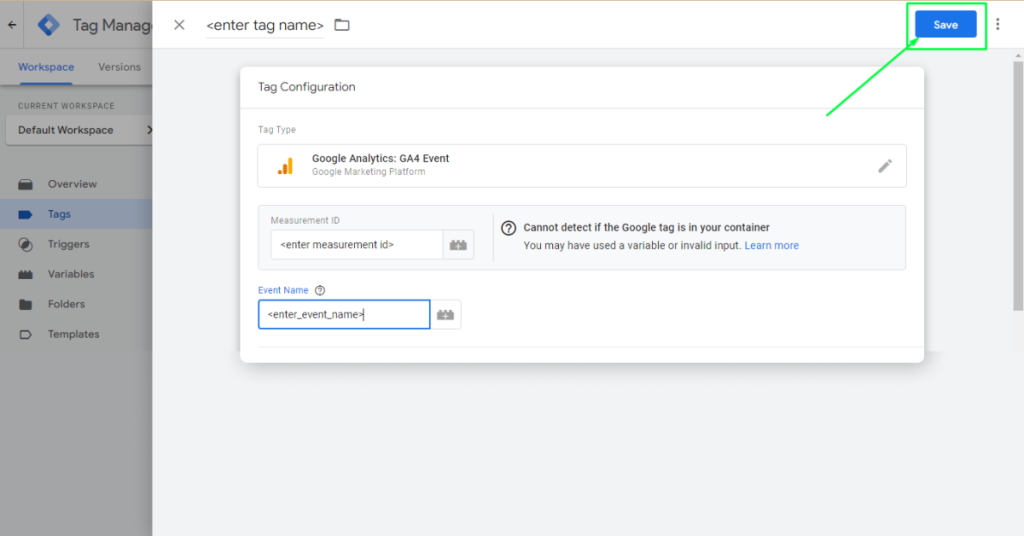
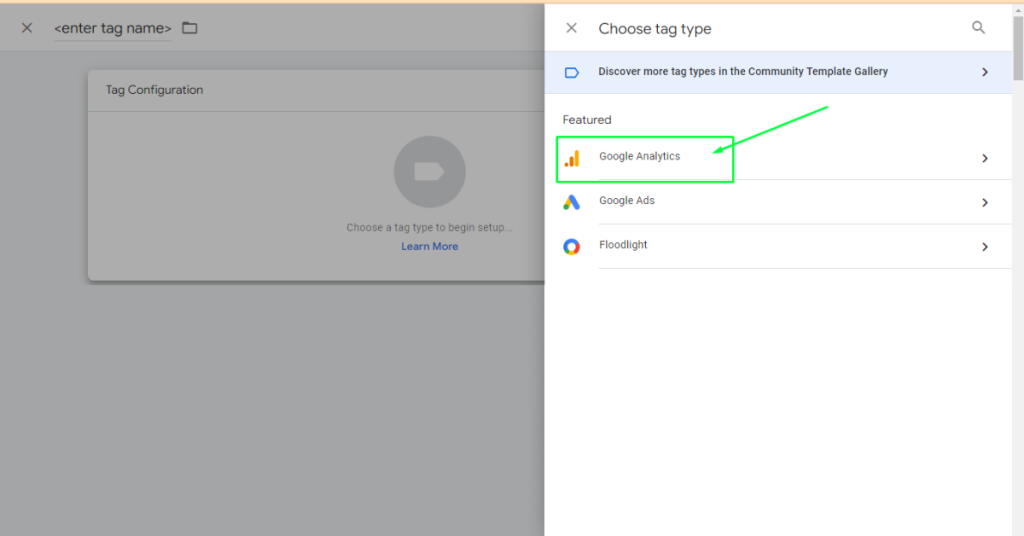
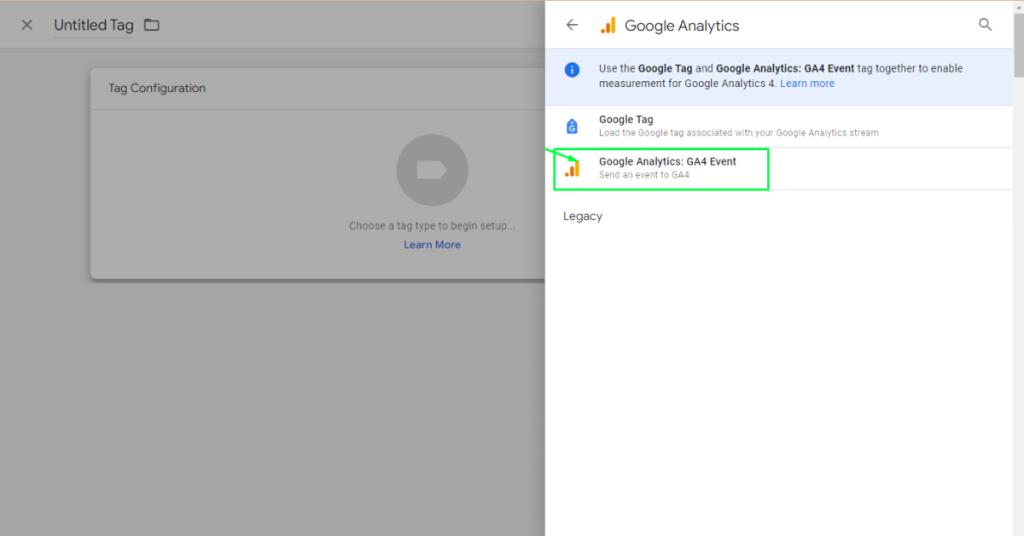
Give your tag a name and select Google Analytics: GA4 Event.

Give your tag a name
 select Google Analytics
Click on GA4 Event

Enter your Google Analytics 4 measurement ID, event name, and Parameters.

Enter your GA 4 measurement ID, event name, and Parameters

Click Save.

Click Save

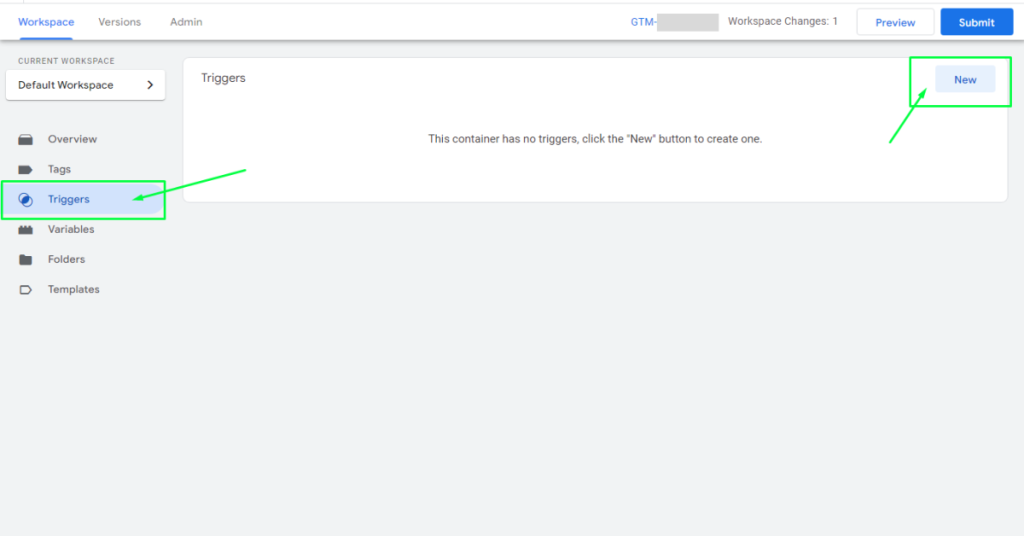
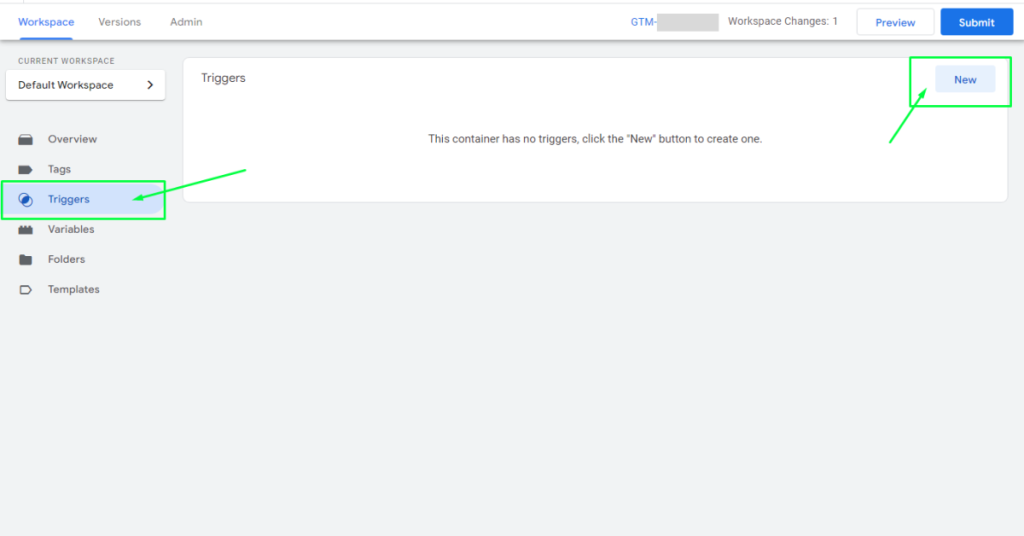
Step 2: Create a Trigger in GTM

Go to triggers and click on “New”

Go to triggers

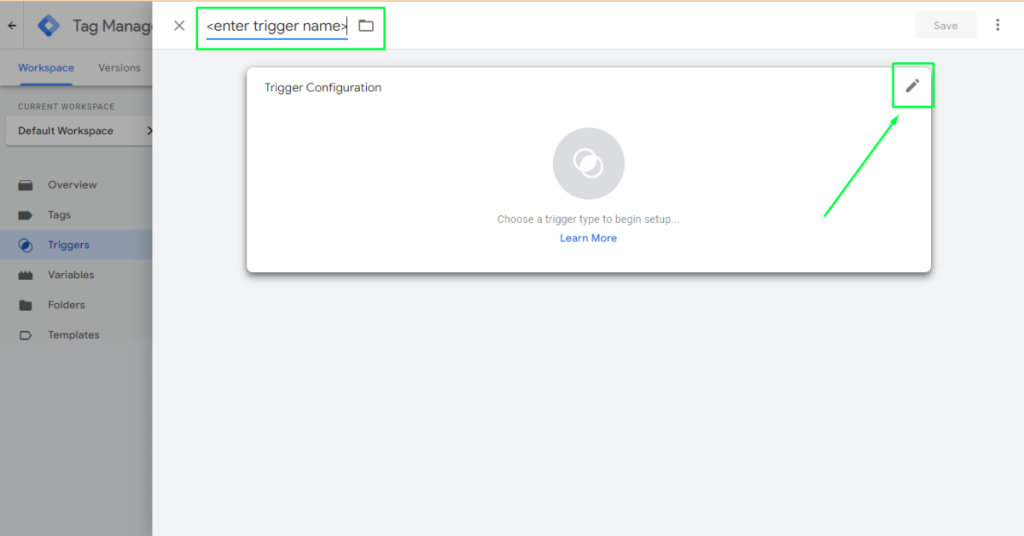
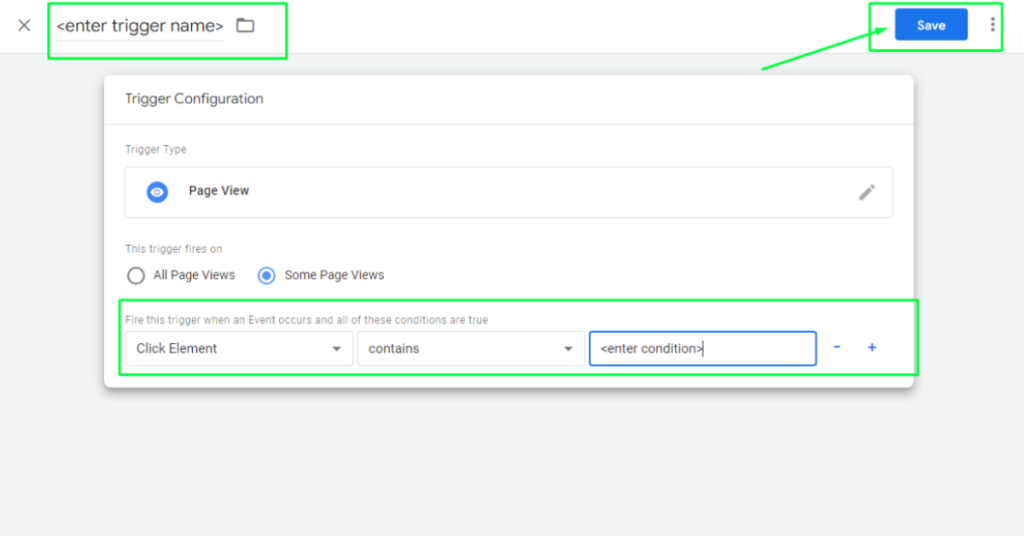
Enter trigger name

Enter trigger name

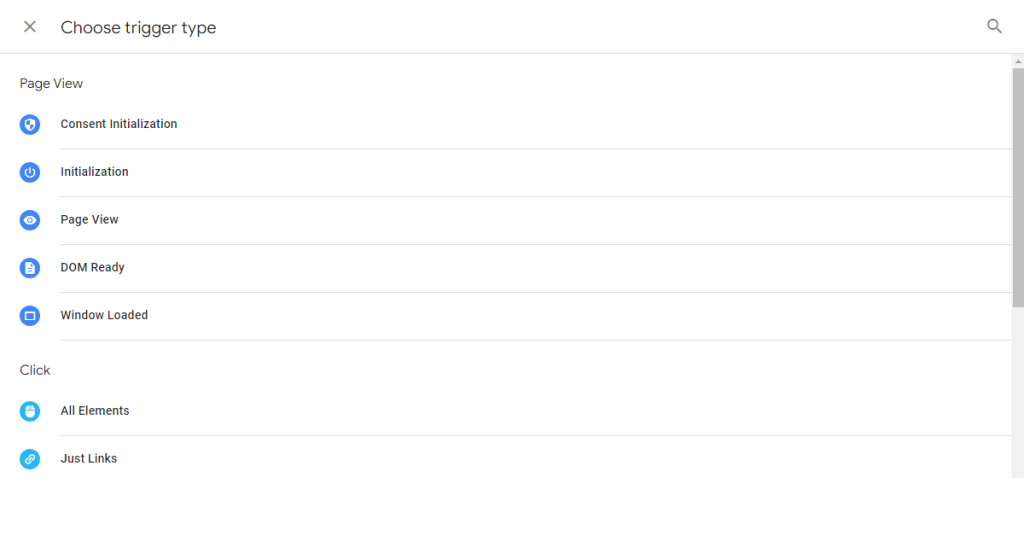
Select the trigger type and add the condition you want to track.

Select the trigger type
add the condition you want to track

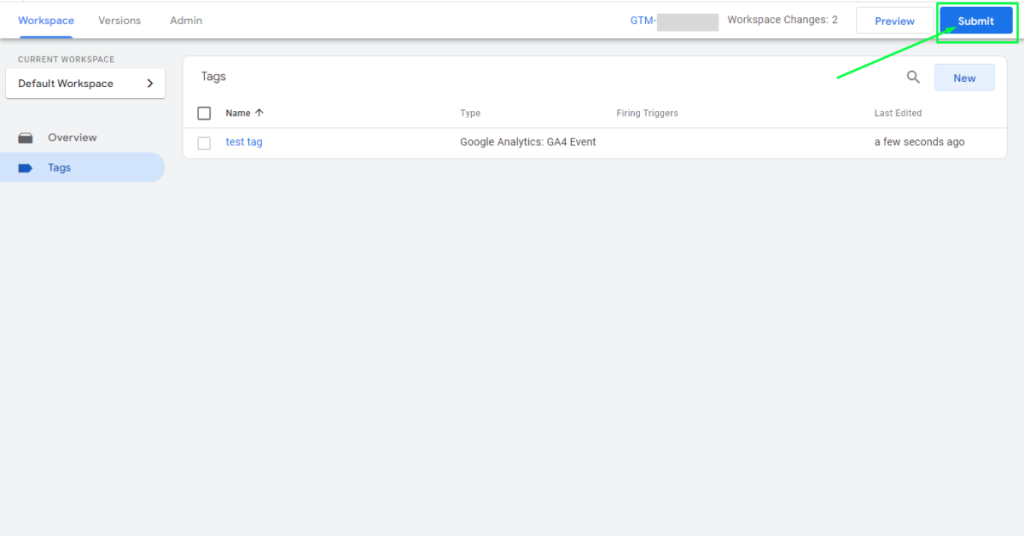
Click submit.

Click Submit

Step 3: Click on the tag that is created in Step 1

Step 4: Click on “Triggering”. Choose the Trigger that we have created.

Step 5: Click Save.

Step 6: Publish your changes to Google Tag Manager.

Once you have set up event tracking, you can start to see data in your Google Analytics 4 reports. To view your event data, go to your Google Analytics 4 property and click Reports. Then, click Events and select the event you want to view.

How to Create an Event for a Form Submission on Google Analytics?

create an event for a form submission
  • Follow Step 1: Creating a tag.
  • Follow Step 2: Create a trigger in GTM mentioned above (mention condition form submission)

We Can Track the Form Submission with Two Methods:

Method 1: Thank you, Page Tracking,

Step1 – Click on create Trigger< Page View<Some Page View< Page URL<Contains<Thank You< Save

Step2: Click on Save Tag< Submit

 Method 2: “Submit Form” Button Tracking

Step1 – Click on create Trigger <All Elements<Some Clicks<Click Elements<Equals<Paste the CSS Selector of your Submit Form Button <Save

Step2Click on Save Tag< Submit

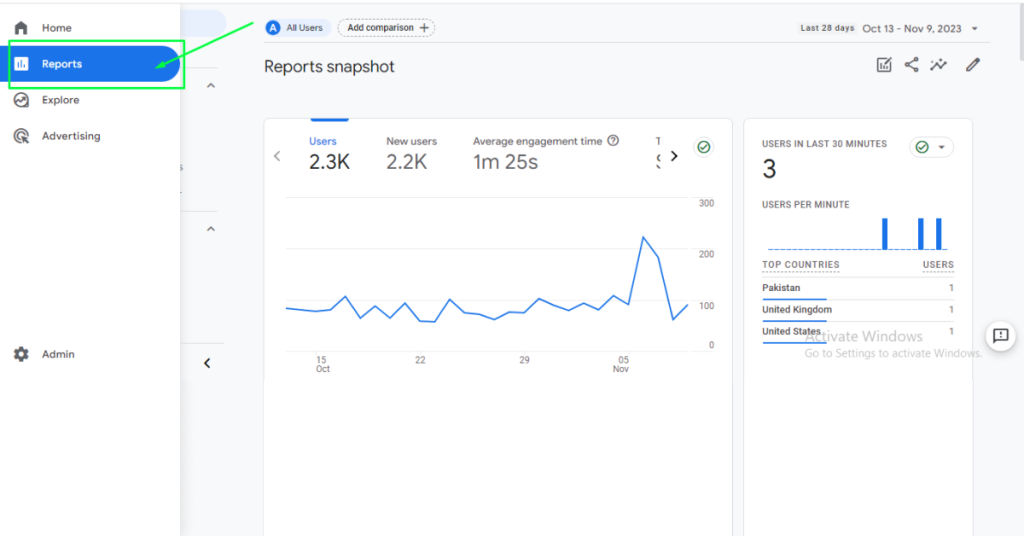
How Do I Check Events in Google Analytics 4?

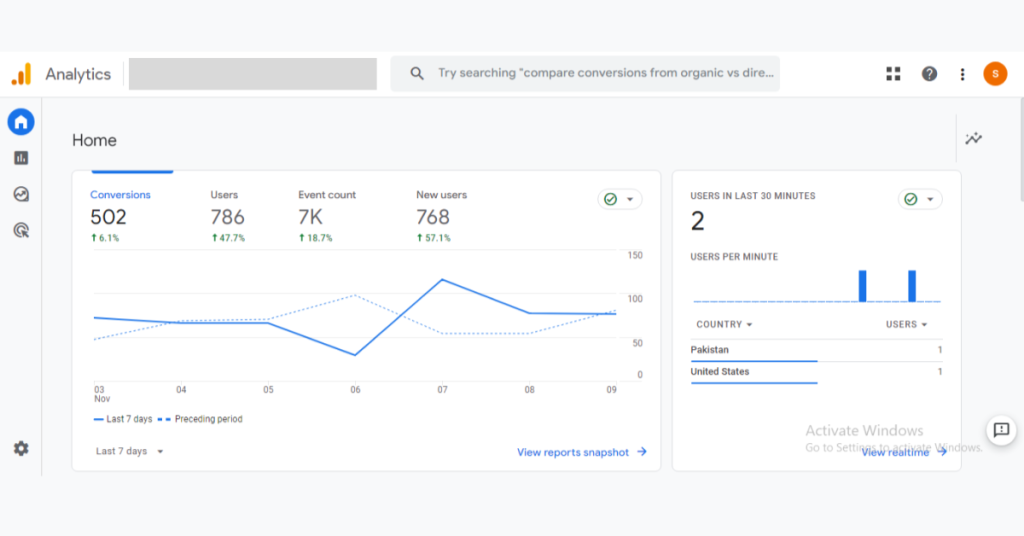
Step 1: Log in to your “Google Analytics” dashboard: 

Log in to your Google Analytics dashboard

Step 2: Click on “Reports

Step 2: Click on Reports

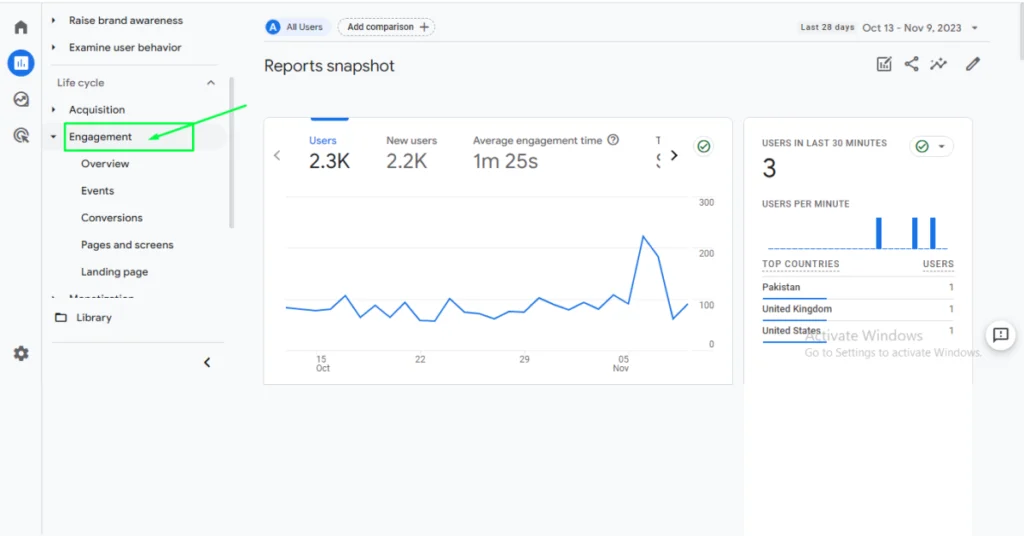
Step 3: Click on “Engagement

Check-events-in-GA4-3-1-1024x536

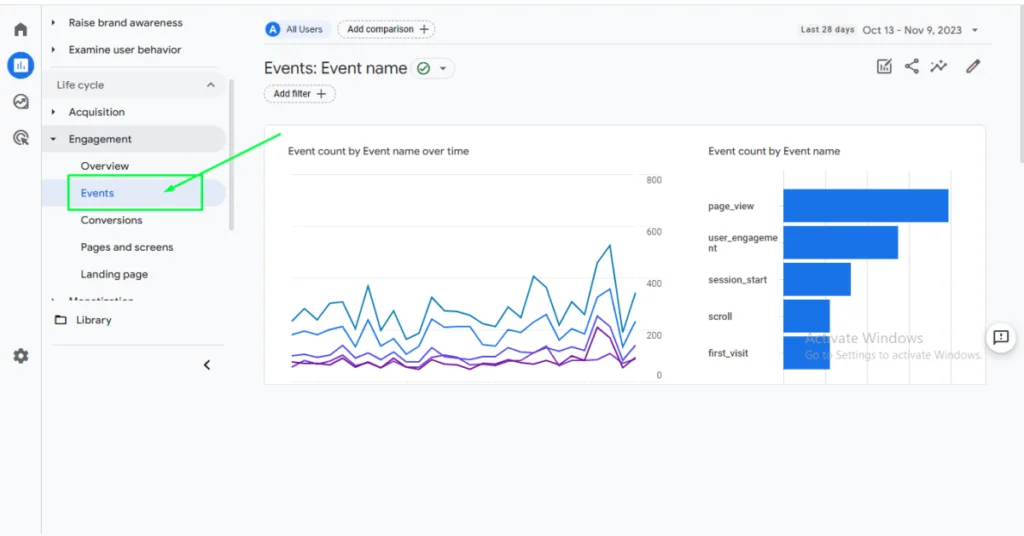
Step 4: Click on “Events

Check-events-in-GA4-4-1-1024x536

After clicking, you’ll see a list of events that are created in that account.

Conclusion

Google Analytics 4 (GA4) acts as a detective for your website. It goes beyond page views, utilizing events to track specific actions like clicks, downloads, and form submissions, revealing invaluable insights. Events serve as breadcrumbs, detailing user footprints and preferences. With GA4, you can control automatically collected events, enhanced measurement events, recommended events, and custom events for a comprehensive analysis. Whether using GA4 tags or Google Tag Manager, event tracking allows you to refine user experiences, optimize conversions, and gain granular insights into user engagement.

Top Digital Marketing Trends to Keep an Eye on in 2025

Today’s fast-paced world demands novel and evolving technologies. Everyone is looking for efficient ways to prosper in digital marketing. Be it the riveting rage of AI or the premier art of hyper-personalization, digital marketers aspire to robustly shape the world of marketing.

Top Digital Marketing Trends 2024

Since 2025 is approaching, it is crucial to adopt new ways of digital marketing. This blog is the perfect guide if you’re on the lookout for new-age digital marketing trends and technologies. You’ll learn about the digital marketing practices in focus, the major trends in digital marketing in 2025 and the best practices in digital marketing.

Without further ado, let’s begin!

What will Digital Marketers Focus on in 2025?

The digital marketing industry is ever-growing, with a magnified focus on retaining and grabbing more users. As you follow the latest digital marketing trends, it is imperative to focus on the following practices:

  • Reactivation and retention

A digital marketer’s primary focus should be re-engaging customers who have drifted away through personalized ads. Another priority should be on maintaining relationships with existing customers.

  • First-party data activation

With the increased privacy concerns amongst users, third-party cookies are declining. This is potentially giving rise to the use of first-party data platforms. The use of first-party data abides by the strict regulations of data privacy.

  • AI-powered marketing

Integrated Artificial Intelligence (AI) is another essential aspect of the latest digital marketing trends 2025. The use of AI is becoming prominent in carrying out real-time data analysis and predictive analysis, automating iterative and fundamental tasks, and enabling effective campaign management. Now, it’s time to address the hot topic: top digital marketing trends for 2025!

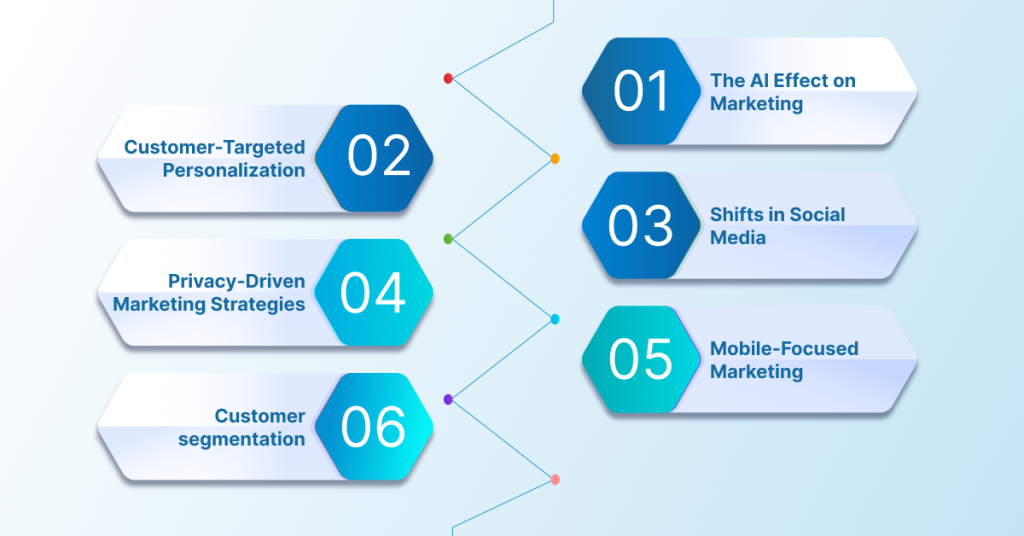
Top 6 Digital Marketing Trends 2025

Top 6 Digital Marketing Trends 2024

Stepping into 2025 marks the adoption of new-age technologies, platforms and techniques to foster business growth. Many emerging technologies are completely transforming the face of digital marketing. Every business has an online presence today, and it can only survive with the backbone of digital marketing.

Let’s delve into the novel trends of digital marketing for 2025 that will become massive this year.

1. The AI Effect on Marketing

“AI is a good tool to start creative work but not the best to finish it. It definitely needs a human involved”.

Jonathan Nelson, Digital Marketer at Growth American Marketing Association

Artificial Intelligence (AI) has evolved the way digital marketing works. AI intervention is transforming the way digital marketing works. AI-driven predictive analysis allows digital marketers to keep an eye on the marketing patterns and trends, which helps streamline the marketing funnel. It also helps in automating boring and iterative tasks. On top of that, analyze data in real-time. 

Another important application of AI in digital marketing is harnessing the utility of AI-powered chatbots. Chatbots are one of the fastest-growing brand communication channels. 65% of the Internet and software companies use chatbots, according to a recent report by Colorlib. One of the notable benefits of using chatbots is hyper-personalization and targeted marketing.

2. Customer-Targeted Personalization

Targeting users with personalized ads will be a prominent trend in the marketing industry. You can only target a few people with a single marketing campaign since everyone has their preferences, personality, and requirements. A customized approach can be used to target each customer personally. The personal preferences of the users keep on evolving with time.

Customer-Targeted Personalization

Gone are the days of sending personalized emails to users to lure them into buying your services or products. Personalized marketing is more than that. You need three things to tailor a personalization strategy:

  • Curating a Buyer Persona
  • Building a Content Strategy
  • Analyzing Historical Data of User Buying History

One of the most apt examples of customer-targeted personalization is Netflix recommending movies based on the previous genre of movies you’ve watched.

3. Shifts in Social Media

According to a recent statistic released by Forbes claims that 77% of businesses use social media to attract customers. Customers prefer social media over Google to look for the things they’re interested in. For instance, if someone wants to find out the best restaurants in New York, he’ll prefer short-form video content over TikTok to search on Google.

To back up this example, 67% of TikTok users use it to discover new brands. Therefore, opting for social media as a marketing tool is one of the most popular digital marketing trends in 2025.

You can follow the below-mentioned practices to establish a solid online presence for your brand:

  • Focus on creating short-form video content on Instagram reels and TikTok.
  • Post interactive polls and quizzes on your social media platforms for enhanced customer engagement.
  • Establish your brand’s identity by posting social media posts of the services/products you offer.

4. Privacy-Driven Marketing Strategies

It is one of the massive changes that all of us have been anticipating for quite some time now. 2025 looks like the year of significant strides since Google plans to deprecate the use of 3rd-party cookies for 1% of Chrome users in the first quarter of 2025! 

It will mark the beginning of a new era where digital marketers will have to opt for a more sophisticated and planned approach to track the activity of users. Conversely, the use of first-party cookies is going to become prominent. 

How can you formulate a strategy to use these cookies? You can track consumer behavior across various channels by using 1st-party data with other user data and make predictive assessments. On top of that, you can also include consented 3rd-party data. This practice will ensure effective targeting strategies to navigate through the post-cookie tracking era and will trickle down as one of the digital marketing trends in 2025.

5. Mobile-Focused Marketing

Another important aspect of the latest digital marketing trends in 2025 is the worldwide adoption of mobile-focused marketing. Mobile users account for over 55% of website traffic. Therefore, itis evident that most online users prefer surfing on a mobile phone to a desktop.

Being a digital marketer, you must acknowledge the need to optimize websites for mobile views. A user must have an incredible and seamless digital experience when surfing on the phone. So, consider crafting mobile-friendly email campaigns, Facebook ads, etc.

You can better engage with the target audience by investing in mobile-focused marketing campaigns since they align with the user’s needs.

6. Customer Segmentation

Customer segmentation divides customers into sub-groups based on their preferences, demographics, behavior, etc. The purpose is to reach out to these people with shared interests. One example of customer segmentation is targeting different groups of audiences with selected emails related to their area of interest.

What are the Best Practices in Digital Marketing in 2025?
What-are-the-Best-Practices-in-Digital-Marketing

Now that you’re well aware of the major trends in digital marketing for 2025, it is time to learn about the best practices in digital marketing that you must follow in 2025. These best practices are listed below:

  • Listen to the audience

Making rough speculations about what the users want is equivalent to throwing a shot in the dark and thus, missing the bull’s eye. This is the reason why it is vital to listen to what the audience wants, not what you want.

  • Use personalization and segmentation

 The next best practice in digital marketing is to curate relevant messages to the target audience and align the best with the customers’ interests. Practice customer segmentation for the profound effect of marketing strategies.

  • Don’t copy others

Do not get carried away with the digital marketing strategies that someone else follows. Think straight and do what works best for you.

  • Business-aligned strategies

Your marketing strategy must be relevant to your business goals, not the other way around. Persistent communication between the marketing and business teams is necessary for a result-oriented marketing strategy.

Wrapping Up

Keeping an eye on the latest digital marketing trends for 2025 can help you foster your brand exponentially. The digital market is quite volatile; therefore, you must wrap your head around the latest trends. This blog entails all the significant trends we can expect in 2025. Strategizing accordingly can be fruitful for your business.

Start working on your strategies now to stay ahead of the marketing curve!

FAQs

What are the latest trends in digital marketing?

The latest trends in digital marketing in 2025 include adopting social media marketing, mobile-first marketing, opting for 1st-party cookies, integration with Artificial Intelligence, hyper-personalization of content, and customer segmentation.

What is the digital strategy for 2025?

One of the best digital strategies for 2025 is opting for 1st-party cookies. This would enhance your customers’ trust and loyalty. Other strategies include AI-driven predictive analysis, and digital marketing on social channels such as TikTok, etc.

What is the future of digital marketing?

The future of digital marketing is using Artificial Intelligence and Machine learning to analyze user behavior. This would help in the hyper-personalization of services and products, thus leading to increased brand revenue.

What is the best practice in digital marketing?

Formulating a digital marketing strategy in alignment with the business goals is one of the best practices in digital marketing.

What is the most significant social media trend for 2025?

Incorporating Virtual Reality (VR) and Artificial Intelligence (AI) to capture a larger audience on social platforms is one of the biggest social media trends in 2025.

8 Steps to Create a Complete Marketing Strategy In 2025

Are you all set to welcome 2025? The new year will have a convergence of technology and innovation that will reshape the marketing landscape. As we are going to step into this transformative year, businesses face a lot of challenges. In this article, we will comprehensively explore eight fundamental steps that include a complete marketing strategy for 2025.

What is marketing Strategy?

Marketing Strategy is the blueprint that guides businesses through the complexities of the digital age. It includes a series of planned activities informed by data-driven insights and market analysis designed to promote products or services effectively. This strategy outlines the target audience and delineates the channels, messaging, and techniques essential to engage consumers. As the market is strongly believed to evolve in 2025, a marketing strategy will not be just about promotion; it’s a holistic approach, integrating online and offline methods, ensuring brand visibility, customer engagement, and sustainable business growth.

Importance of a marketing strategy in 2025

In 2025 and beyond, the importance of a marketing strategy continues to soar, becoming the cornerstone of every successful business.

1. Anticipating Future Trends:

In 2025, a robust marketing strategy will involve predictive analytics and AI-driven tools to anticipate consumer trends. Businesses will use these insights to align their products and services with future demands, ensuring they are always one step ahead of the market.

2. Personalized Customer Experiences:

In the future, marketing strategies will leverage advanced data analytics to create hyper-personalized customer experiences. Tailoring products, services, and marketing messages based on individual preferences will enhance customer satisfaction, loyalty, and retention.

3. Embracing Emerging Technologies:

The marketing strategies in 2025 will integrate cutting-edge technologies like augmented reality (AR), virtual reality (VR), and blockchain. These technologies will create immersive brand experiences, interactive advertisements, and secure, transparent transactions, enhancing customer trust and engagement.

4. Social Media and Influencer Collaboration:

In the coming years, social media platforms will continue to dominate the marketing landscape. Marketing strategies will focus on leveraging social media channels and collaborating with influencers to reach wider audiences. Hence, engaging content and influencer partnerships will be pivotal in shaping brand perception.

5. Sustainability and Ethical Practices:

In 2025, consumers will be increasingly conscious of environmental issues and ethical business practices. Marketing strategies emphasize eco-friendly initiatives, sustainable sourcing, and transparent supply chains. Brands showcasing their commitment to social and environmental responsibilities will earn consumer trust and loyalty.

6. Voice Search Optimization:

In the future, voice search will become a predominant mode of online interaction. Marketing strategies will adapt to optimize content for voice-based queries, ensuring businesses remain visible and accessible to consumers using voice-enabled devices and virtual assistants.

7. Interactive Content Marketing:

In 2025, interactive content formats such as quizzes, polls, and shoppable videos will gain prominence. Moreover, marketing strategies will focus on creating engaging and interactive content, enhancing user participation, and driving conversions through immersive online experiences.

8. Data Security and Privacy:

In the upcoming years, data security and privacy will be paramount. Marketing strategies will prioritize customer data protection, ensuring compliance with stringent data privacy regulations. Building trust through transparent data practices will be essential for customer confidence.

9. Omnichannel Integration:

In 2025, consumers will demand seamless experiences across various channels. Marketing strategies will emphasize omnichannel integration, providing consistent messaging and user experiences whether customers engage with the brand online, in-store, or through mobile devices.

10. Agile and Adaptive Approaches:

In the future, market conditions will change rapidly. Additionally, agile marketing strategies will be crucial, allowing businesses to adapt swiftly to evolving trends and consumer behaviors. Continuous monitoring, analysis, and adjustment will be integral to maintaining a competitive edge.

Steps to Create a Complete Marketing Strategy

marketing in 2024

Step 1. Comprehensive Market Research:

In 2025, begin your marketing strategy by conducting in-depth market research. Utilize advanced data analytics and market intelligence tools to understand consumer behaviors, preferences, and emerging trends. Analyze your competitors and identify gaps in the market, allowing you to make informed decisions.

Step 2. Define Clear Objectives:

In the future, clearly define your marketing objectives. Whether it’s increasing brand awareness, driving online sales, or launching a new product, setting specific, measurable, achievable, relevant, and time-bound (SMART) goals will provide a roadmap for your strategy.

Step 3. Embrace Advanced Technologies:

In 2025, leverage advanced technologies such as artificial intelligence (AI), machine learning, and augmented reality (AR) to enhance your marketing efforts. Implement AI-driven chatbots for customer interactions, use machine learning algorithms to analyze consumer data, and create immersive AR experiences to engage your audience.

Step 4. Personalized Customer Experiences:

In the future, focus on creating personalized customer experiences. Utilize customer data to tailor your products, services, and marketing messages to individual preferences. Implement dynamic content, recommendation engines, and customized marketing automation to enhance customer satisfaction and loyalty.

Step 5. Multi-Channel Marketing:

In 2025, adopt a multi-channel marketing approach. Engage with your audience across various platforms, including social media, email, mobile apps, and emerging channels like voice assistants. Ensure consistent branding and messaging while tailoring your content for each platform to maximize reach and impact.

Step 6. Content Strategy and Creation:

In the future, develop a robust content strategy. Create high-quality, engaging content that resonates with your target audience. Invest in interactive content formats, videos, podcasts, and virtual events. Focus on storytelling and user-generated content to foster meaningful connections with your customers.

Step 7. Data-Driven Decision Making:

In 2025, rely on data-driven insights to make informed decisions. Implement advanced analytics tools to monitor the performance of your marketing campaigns in real time. Analyze key performance indicators (KPIs), customer feedback, and market trends to optimize your strategies continuously.

Step 8. Agile Adaptation and Optimization:

In the future, adopt an agile approach to your marketing strategy. Stay flexible and be ready to adapt to changing market dynamics and consumer behaviors. Continuously monitor the performance of your campaigns, gather feedback, and optimize your strategies based on the insights gained. Embrace innovation and be open to experimenting with new tactics and technologies to stay ahead of the competition.

Conclusion

A successful marketing strategy in 2025 isn’t just a choice; it’s an imperative. The convergence of technology and innovation reshapes the marketing terrain, demanding businesses to be agile, data-driven, and customer-focused. The eight comprehensive steps outlined here provide a roadmap for businesses navigating this transformative era. By embracing advanced technologies, personalizing customer experiences, and ensuring data security, businesses can create a robust marketing strategy that anticipates future trends and fosters meaningful connections with their audience. In this era of rapid change, an agile and adaptive approach, along with a commitment to sustainability and ethical practices, will be the key differentiators. Deftsoft is a full-service web design and development agency that works with you to come up with the best marketing strategy. We are set for the upcoming year, are you? Contact us, and we will help your business not only survive but thrive, ensuring its relevance and success in the competitive market of 2025 and beyond.

FAQs:

  1. What is the AI trend in marketing in 2025?

According to McKinsey, 69% of businesses use the power of Generative AI to create a content strategy. Everything can be generated by Gen AI, from text and images to audio. For instance, you can create a monthly social media calendar with the help of Generative AI.

  1. What are top 5 marketing trends in 2025?

The top 5 marketing trends in 2025 are as follows: Short-form video content for enhanced discoverability, AI-backed content strategies, User persona-driven marketing, Dynamic marketing using user-targeted carousel ads, and Solid SEO strategies

  1. What is the future of marketing?

The marketing industry in the future will make use of quantum computing to tailor hyper-personalized ads. These ads will directly target the user behavior of a potential buyer. The need to fabricate a user persona will be eliminated.

  1. What is hot in marketing right now?

Short-form content and influencer marketing are the two hottest trends in the market right now. You can make use of Instagram reels and TikTok to go viral in the market.

  1. How to know whether the marketing strategy is successful?

You can use certain metrics to measure the success of a marketing strategy. These are Return on Ad Spend (ROAS), Click-through Rate, Cost per Lead (CPL), Return on Investment (ROI), Customer Acquisition Cost (CAC), and Conversion rate.

7 Powerful Techniques to Dominate Social Media: 7X Success!

It’s 2024, and if your social media game is still not yielding you results, this guide is for you! The world of content is changing at an exponential rate, especially with its ‘tiktokification’. This is one of the primary reasons why people enjoy short-form content. Speaking of which, social media is one of the mightiest tools to master your audience.

Social Media is a dynamic area where businesses connect, engage, and flourish in the digital landscape. In this guide, we will unveil seven potent techniques to help you master the art of Social Media Marketing, unlocking the potential for 7X success!

Top Techniques to Level Up Your Social Media Game

Technique 1: Mastering Content Creation

Mastering Content Creation for social media

Identify Target Audience

Understanding your audience is the cornerstone of successful digital marketing. Moreover, knowing your target audience based on behavior, demographics, and interests. Analyze their preferences, pain points, and aspirations to tailor your content effectively.

Engaging Visual Content

Picture speak louder than words! This phare goes well for social media platforms too. Capture your audience’s attention by crafting eye-catching graphics and videos that match your brand and message. Additionally, shareable content triggers these algorithms, extending your reach and impact.

Compelling Adcopy

Compelling copy is a catalyst for driving actions and conversions. Write concise, persuasive copy communicating your value proposition and call to action. Lastly, show sense of urgency and authenticity to promote immediate responses from your targeted audience.

Gain Audience Trust

Building trust is crucial in Social Media Marketing. Encourage your followers to develop and share the content for your brand. Additionally, user-generated content shows authentic experiences, fostering loyalty and trust among your audience.

Technique 2: Building an Effective Social Media Marketing Strategy

Social Media Marketing Strategy

Choose the Right Social Media Platform

Choosing the appropriate social platforms is crucial for successful digital marketing. Additionally, consider your target audience’s preferences and the nature of your business. Focus on platforms where your audience is most active and engaged.

Set Goals

To achieve success in digital marketing, set clear and measurable goals. Additionally, determine your plan: increased brand awareness, lead generation, or improved customer engagement. Outline specific objectives that align with your overall social media marketing strategy.

Schedule Posts

Consistency is vital in Digital marketing. Develop a calendar to plan your posts. Organize content topics, formats, and publishing dates to maintain a steady flow of engaging content.

Formulate Marketing Strategy

For maximum impact, align your digital marketing efforts with your overall marketing strategy. Ensure consistency in messaging and branding across all marketing channels, both online and offline.

Technique 3: Growing Your Social Media Presence

Growing Your Social Media Presence

Building an Organic Follower Base with Authentic Engagement

Growing your social presence starts with building an organic follower base. Engage with your audience authentically by responding to comments, messages, and feedback. Furthermore, create meaningful connections by understanding their needs and interests.

Utilizing Hashtags and Trending Topics Strategically

Hashtags and trending topics can expand your reach and visibility on social media platforms—research relevant and trending hashtags in your niche to boost discoverability and attract a wider audience.

Harnessing the Power of Influencer Marketing

Leverage influencer marketing to amplify your social media presence. So, collaborate with influencers promoting your brand and target audience. Influencers can help endorse your products/services and drive engagement.

Running Successful Social Media Advertising Campaigns

Strategic social media advertising can significantly boost your online presence. Utilize platforms’ advertising tools to target specific demographics and interests. Additionally optimize your ad campaigns for better results.

Technique 4: Designing a Winning Social Media Marketing Campaign

social media marketing campaign

Plan and Execute a Targeted Campaign

A successful social media marketing campaign starts with careful planning. Hence, define campaign goals, target audience and messaging. Additionally, execute your campaign with a well-thought-out social media marketing strategy for maximum impact.

Run Contests, Giveaways and Promotions

Contests, giveaways and promotions are handy engagement tools. Encourage user participation by offering valuable incentives. Moreover, ensure that your promotions align with your brand and campaign objectives.

Leverage user-generated Content for Campaign Success

Add authenticity and credibility to your campaign with user-generated content. Encourage your followers to develop and share content for your campaign. Hence, showcase their contributions to build trust and encourage engagement.

Analyse and Measure Campaign Performance

To ensure the success of your campaign, analyse and measure its performance. Monitor key metrics such as engagement, conversions and reach. Therefore, this will improve your approach for future campaigns with data-driven insights.

Technique 5: Social Listening and Reputation Management

Social Listening and Reputation Management

Monitoring Brand Mentions and Customer Feedback

Social listening is a critical aspect of successful Social Media Marketing. Additionally, check customer feedback and brand mentions in various platforms. Hence, pay attention to what your audience says about your brand, products, and services.

Responding to Customer Inquiries and Feedback Promptly

Timely responses to the feedback to demonstrate commitment to customer service. Moreover, engage with your audience promptly, addressing their questions and concerns. Show appreciation for positive feedback and acknowledge any issues raised.

Addressing Negative Feedback and Managing Crises

Negative feedback is inevitable, but how you handle it makes a difference. Respond to negative feedback empathetically and professionally. Hence, address the concerns and offer solutions. In times of crisis, remain transparent and proactive in managing the situation.

Transforming Feedback into Opportunities for Improvement

Feedback is valuable for growth. Use feedback to identify areas of improvement in your products or services. Additionally, show your audience their opinions matter by implementing changes based on their input.

Technique 6: Creating a Social Media Marketing Funnel for Conversion

Social Media Marketing Funnel for Conversion

Nurture Leads

The Social Media Marketing funnel is a pathway to convert potential customers into loyal advocates. Nurturing leads involves building relationships with your audience. Moreover, engage with them through valuable content, personalized messages, and genuine interactions.

Effective CTAs

A compelling Call-to-Action (CTA) is pivotal in guiding your audience toward desired actions. Encourage your followers to take the next step, whether signing up for a newsletter, purchasing, or contacting your business.

User Retargeting

Retargeting and remarketing are potent tactics to re-engage potential customers who have shown interest in your products or services. Moreover, utilize these strategies to stay top-of-mind and encourage conversion.

Measure Conversion Rate

Measuring conversion rates is essential for social media optimization. Moreover, analyze data to know about the required improvements. Hence, make data-driven decisions to enhance your conversion performance.

Technique 7: Analyze Data for Continuous Improvement

Analyze data for continuous improvement

Identify Key Metrics and KPIs

Analyzing data is the key to improving your digital marketing efforts. Identify key metrics and key performance indicators (KPIs) that align with your campaign goals. Additionally, these metrics will help you measure the effectiveness of your strategies.

Leverage Social Media Analytics Tools and Insights

Social media analytics tools provide valuable insight into your performance. Use these tools to track engagement, reach and audience demographics. Furthermore, with this data, you can make informed decisions and optimize your strategies.

Make Data-driven Decisions to Optimize Strategies

Data-driven choices are the key to a successful digital marketing. Furthermore, analyze the data collected from your campaigns to identify strengths and weaknesses. Use this information to improve your strategies.

Evolve Your Social Media Marketing Approach

Social media is constantly evolving. Additionally, be prepared to iterate and adapt your approach based on data insights. To stay ahead in the dynamic world of social media, embrace change and be flexible in your strategies.

Conclusion

Now that you know the basics of Social Media Marketing, it your turn dominate the social media . If you need help to enhance your social media presence, Deftsoft is here to assist you! Our digital marketing services follow a simple approach: track, test, tweak, and repeat. Let us partner with you to create, rejuvenate, and reposition your brand in the dynamic world of social media.

Is Your Business Ready for the E-Commerce App Revolution?

E-commerce apps is a powerful tool that offers a convenient and accessible platform for customers to browse and purchase products or services with just a few taps on their smartphones. This blog explores the significance of e-commerce apps for businesses and sheds light on the transformative e-commerce app revolution. So, let’s dive in!

Understanding the E-commerce App Revolution

The e-commerce app revolution signifies a significant shift in how businesses operate and engage with customers. Additionally, it refers to the widespread adoption and utilization of mobile applications designed for e-commerce. These apps have revolutionized how consumers interact with businesses, transforming the entire business landscape.

With the rapid advancement of technology and the increasing reliance on smartphones, e-commerce apps have become a vital tool for businesses to establish an online presence and reach a more extensive customer base. These apps offer a seamless and personalized shopping experience, allowing customers to browse products, make purchases, track orders, and receive notifications at their fingertips.

Furthermore, the e-commerce app revolution has accelerated businesses’ digital transformation, necessitating modern technologies and strategies. It has pushed businesses to optimize their online presence, enhance customer experience, and streamline operations to remain competitive in the digital era.

Benefits of E-commerce Apps for Businesses:

Benefits of E-commerce Apps for Businesses

1. Improved Customer Reach and Accessibility: E-commerce apps open up new avenues for businesses to reach a wider audience. With a well-designed app, businesses can tap into the growing number of mobile users and expand their customer base beyond geographical limitations. Apps provide 24/7 accessibility, allowing customers to browse and make purchases conveniently. This increased reach and accessibility translate into greater visibility and potential for business growth.

2. Enhanced Customer Experience and Convenience: E-commerce apps provide a seamless and user-friendly shopping experience for customers. They offer personalized product recommendations, advanced search options, and tailored notifications, creating a highly personalized and convenient shopping journey. Apps also enable easy and secure payment options, saving customers from the hassle of entering payment details repeatedly. Businesses can foster loyalty, improve customer satisfaction, and drive repeat purchases by focusing on a customer-centric approach.

3. Increased Sales and Revenue Potential: By leveraging the power of e-commerce apps, businesses can significantly boost their sales and revenue potential. Apps provide a direct and frictionless channel for customers to purchase, eliminating the need to visit physical stores or websites. Push notifications and personalized offers can drive impulse buying and increase sales conversion rates. Moreover, apps allow businesses to leverage data analytics and track customer behavior, enabling targeted marketing strategies to drive sales further.

4. Streamlined Inventory Management and Order Processing: E-commerce apps streamline inventory management and order processing, improving efficiency and reducing operational costs. Real-time inventory tracking ensures accurate product availability information, preventing overselling or out-of-stock situations. Automated order processing and integration with backend systems simplify the fulfillment process, reducing manual errors and ensuring timely delivery. This efficient inventory and order management improves customer satisfaction and operational effectiveness.

Assessing Your Business’s Readiness

Identifying Your Target Audience and Market Niche:

Before diving into the e-commerce app revolution, it’s crucial to identify your target audience and market niche. Understand who your ideal customers are, their preferences, and their online shopping behaviors. Analyze the market demand for your products or services and assess if there is a viable customer base that can be reached through an e-commerce app. This evaluation will help you determine your app venture’s potential success and profitability.

Evaluating Your Product or Service Suitability for eCommerce Apps:

Not all products or services are ideally suited for e-commerce apps. Evaluate the nature of your offerings and assess if they can be effectively showcased and sold through a mobile app interface. Consider factors such as complexity, customization requirements, and the need for physical interaction. Products easily described, displayed visually, and shipped without complications fare well in e-commerce apps. On the other hand, highly specialized or customized products may require additional considerations.

Analyzing Your Existing Online Presence and Infrastructure:

Assess your online presence and infrastructure to gauge your readiness for an e-commerce app. Evaluate the performance and user experience of your website if you have one. Analyze your existing backend systems and processes for inventory management, order fulfillment, and customer support. Determine if your infrastructure can seamlessly integrate with an e-commerce app or if updates and enhancements are needed. This analysis will help identify gaps or improvement areas to ensure a smooth transition into the app environment.

Critical Considerations in E-commerce App Development:

Choosing Between a Custom-Built App or a Ready-Made Solution:

One of your first decisions is whether to develop a custom-built app or opt for a ready-made solution. Custom-built apps offer more flexibility and tailored features but require more time and resources. On the other hand, ready-made solutions provide a faster and more cost-effective option but may need more customization. Consider your business needs, budget, and timeline to determine the best approach for your e-commerce app development.

Selecting the Right Platform and Technology Stack:

Choosing the right platform and technology stack is vital for the success of your e-commerce app. Consider target audience demographics, device compatibility, and scalability requirements. Popular platforms like iOS and Android offer a broad user base, while cross-platform frameworks like React Native and Flutter provide cost-effective development options. Additionally, selecting the appropriate technology stack, including programming languages, frameworks, and databases, will ensure the app’s performance, security, and scalability.

Integrating Essential Features such as Secure Payment Gateways and Inventory Management:

To create a seamless shopping experience for your customers, it is essential to integrate critical features into your e-commerce app. These include secure payment gateways to facilitate smooth and safe transactions, inventory management systems to track product availability and streamline order fulfillment, and customer relationship management tools to enhance customer interactions and support. Prioritize features based on your business requirements and customer expectations to provide a robust, user-friendly app.

Ensuring Responsive Design and Mobile Optimization:

With most online users accessing websites and apps through mobile devices, ensuring the responsive design and mobile optimization in your e-commerce app is crucial. A responsive design adapts to different screen sizes, providing a consistent and optimized user experience across devices. Mobile optimization focuses on fast loading times, intuitive navigation, and touch-friendly interfaces. By prioritizing these aspects, you can enhance user engagement, reduce bounce rates, and increase conversion rates for your e-commerce app.

Planning and Implementing Your E-commerce App Strategy:

Setting Clear Goals and Objectives:

Before diving into the development process, it is crucial to establish clear goals and objectives for your e-commerce app. Determine what you want to achieve with the app: increasing sales, improving customer engagement, or expanding your market reach. Clear goals will guide your decision-making and ensure your app aligns with your business strategy.

Creating a Comprehensive Project Plan and Timeline:

A well-structured project plan is essential for successfully implementing your e-commerce app strategy. Break down the development process into manageable tasks, allocate resources, and set realistic timelines. This will help you stay organized, monitor progress, and ensure timely milestone completion.

Collaborating with Experienced App Developers or Agencies:

To bring your e-commerce app vision to life, collaborate with experienced app developers or agencies. Look for professionals specializing in e-commerce app development with a proven track record. Their expertise and knowledge will be invaluable in creating a high-quality and user-friendly app that meets your business needs.

Testing, Launching, and Marketing Your E-commerce App:

Once the development is complete, thoroughly test your app to identify and fix any bugs or usability issues. After testing, it’s time to launch your app in the app stores. Develop a comprehensive marketing strategy to promote your app and attract users. Utilize various channels, such as social media, email marketing, and paid advertising, to generate awareness and drive downloads.

Conclusion: Encouragement for Businesses to Seize the Opportunity

As we have explored the benefits of e-commerce apps, assessed business readiness, and delved into key considerations in app development, it becomes clear that businesses need a reliable and experienced partner to navigate this journey.

That’s where Deftsoft, a leading web and mobile development company, comes into play. With our expertise in mobile app development, we can help businesses seize the opportunity presented by the e-commerce app revolution. Our skilled and professional developers are well-versed in creating stunning and functional mobile apps for both Android and iOS platforms. We understand the complexities of mobile app development and can bring your app idea to life.