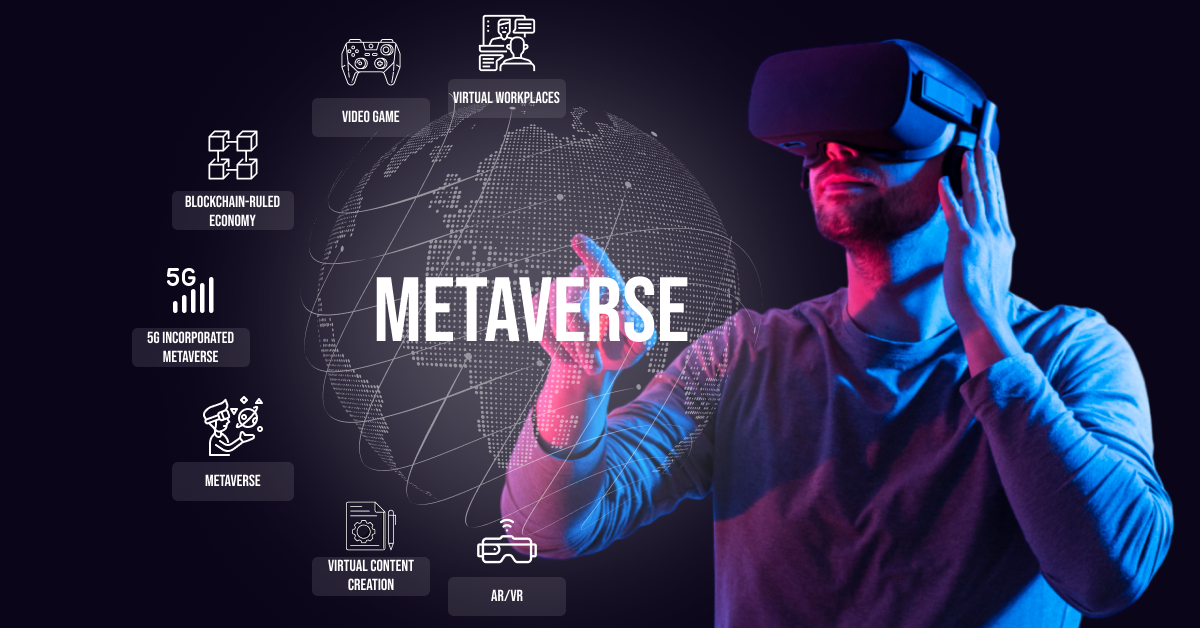
Metaverse Geek Checklist: Top Trends in 2025

Metaverse has been the buzzword of the decade and has taken the entire world by storm. The tech world insists that the Metaverse is still the next big thing, as evidenced by the research done by the Pew Research Center and Elon University. Over 600 technology innovators and leaders were asked to share their insights on the top trends in metaverse, and this is what the outcome was: 54% of these innovators were of the opinion that Metaverse will become truly immersive and become an important part of people’s daily lives by 2040.

Fast-forward to 2025. According to DemandSage, there are more than 600 million active users of the Metaverse worldwide. 51% of these users are 13 or younger, and 83.5% are below 18 years old.

This blog sheds light on what Metavserse is, whether the Metaverse is dead, and, finally, the upcoming trends in Metaverse.

What Exactly is Metaverse?

If you follow technical leaders and innovators, such as Mark Zuckerberg or Satya Nadella, the CEOs of Meta and Microsoft, respectively, they often refer to Metaverse as the ‘future of the Internet.’ 

So, is Metaverse an entirely different digital world, a video game, or even a simulation? Many people associate Metaverse with Avatar-based video calling. Let’s discuss what exactly it is!

Metaverse itself isn’t a single technology but a bunch of technologies combined together to create an enhanced virtual experience. You can consider Metaverse technology to be the fusion of reality and the digital world, which is often referred to as Augmented Reality (AR). The technology also includes the existence of a digital world that continues to persist even when humans are not in touch with it.
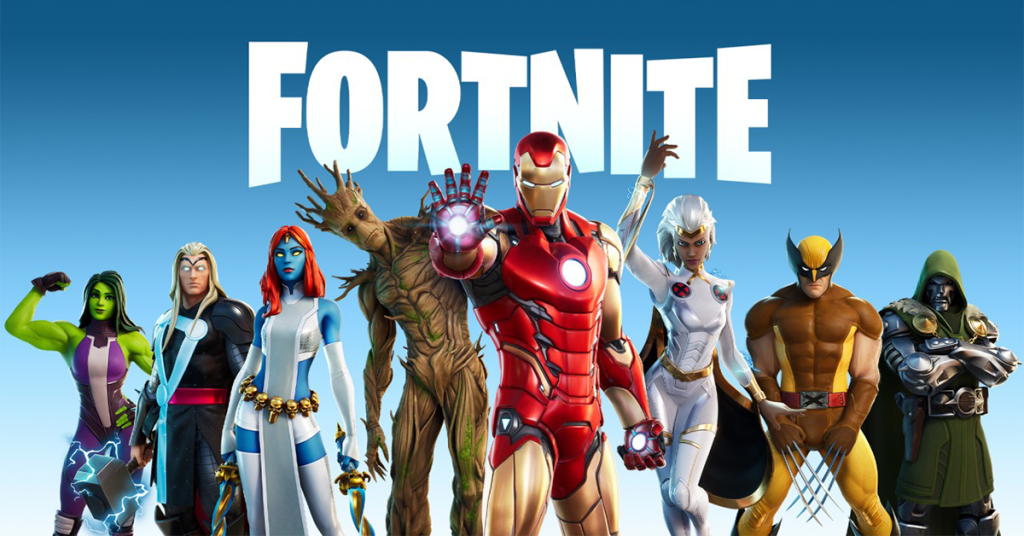
So, is your favorite game, Fortnite, an example of Metaverse? It is more like saying that Google is the Internet. Of course, you can shop, play, and socialize in the Metaverse, but it still doesn’t refer to the whole of the Metaverse world.
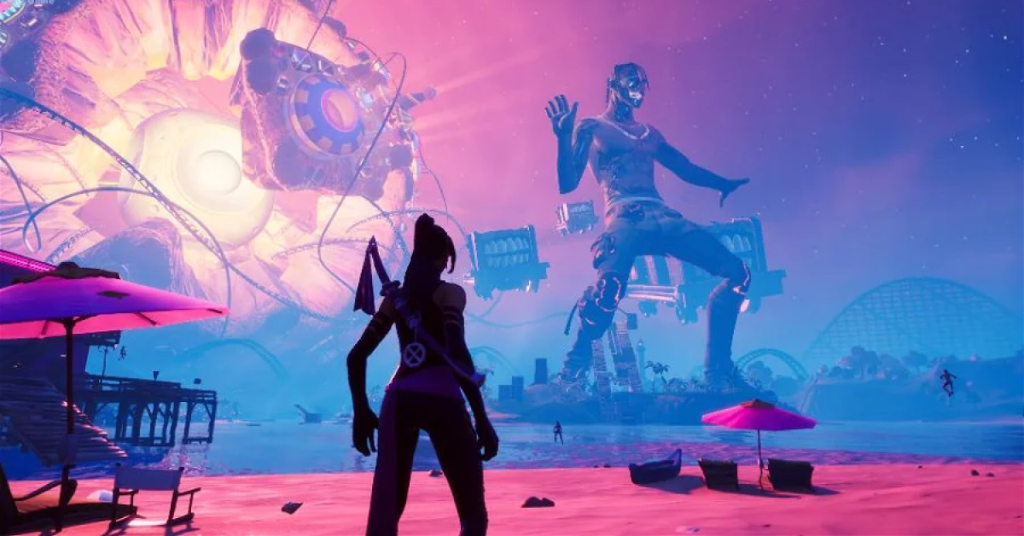
What-is-Metaverse

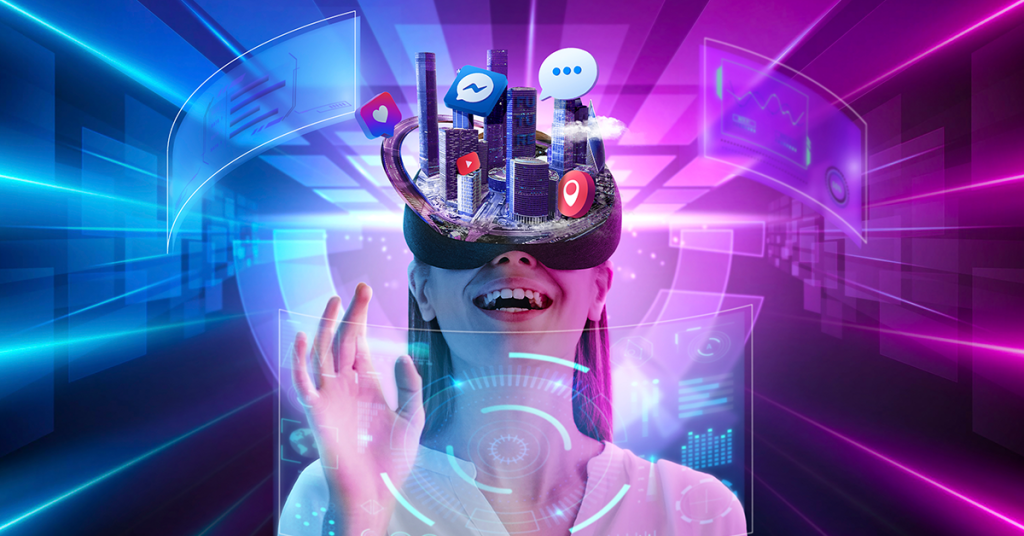
Therefore, to sum up, Metaverse is the consolidation of the physical and digital space accessed through computers or head gears, such as Apple Vision Pro, enabled through Extended Reality technologies, such as Augmented Reality (AR), Virtual Reality (VR), and Mixed Reality (MR).

If you want to know how to develop a Metaverse app in 2025, check out this beginner’s guide.

Is the Metaverse Dead in 2025?

If you think the Metaverse hype is dead, you might want to think twice. Beginning right from the time Meta came up with the term; the technology is now often referred to as the ‘M-word’. There might be a dip in the hype of the term ‘Metaverse,’ yet the technology’s vision is still at the right pace.

Vishal Shah, Meta’s VP of Metaverse, believes that only the hype, not the idea of Metaverse, is dead. In a recent interview with Fortune, Vishal referred to Gartner’s Hype Cycle and said:

“…we didn’t invest for the hype, we have been investing in the space for years.

This is what brings us to the section: top trends in Metaverse that you need to watch out for.

Top Metaverse Future Trends in 2025
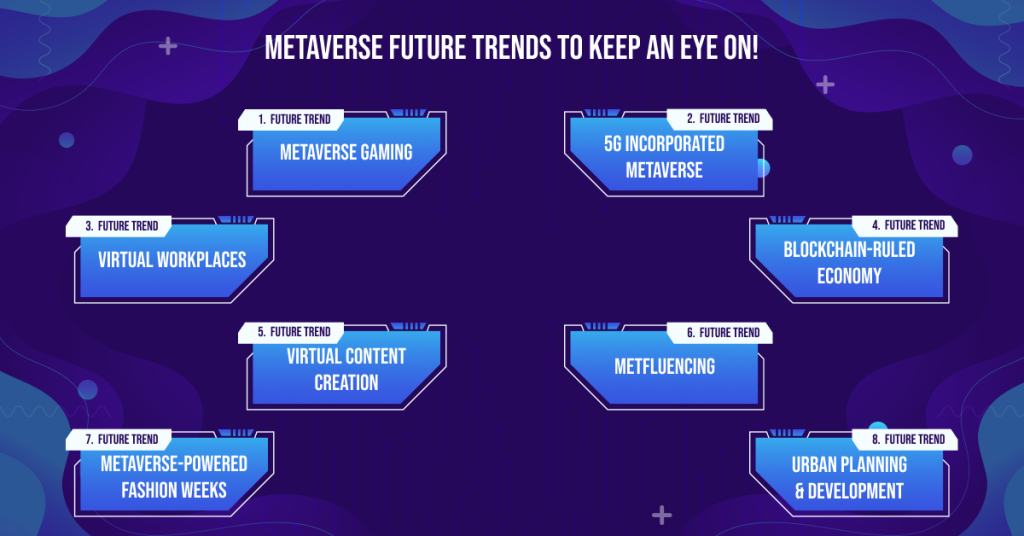
Metaverse Future Trends in 2024

Let us now explore the top Metaverse trends that are about to dominate the future.

1. Metaverse Gaming

Metaverse gaming is one of the most popular Metaverse trends. Gaming has been one of the foremost industries that have embraced Metaverse technology. The intersection of gaming and the Metaverse is groundbreaking as it is giving birth to new possibilities in cloud computing, gaming, and virtual reality. 

A lot of businesses are exploring the possibilities of Metaverse gaming to offer an immersive user experience. For example, gaming platforms like ROBLOX have expanded their gaming experience into Metaverse.

Here are a few pro tips for businesses to ace your venture in the Metaverse gaming landscape:

  • Incorporate Unity or Unreal Engine programming for advanced gaming experience.
  • Leveraging advanced AI algorithms, such as behavior trees, Pathfinding AI, reinforcement learning, etc., to build Metaverse-incorporated gaming experiences.
  • Utilize the power of cloud infrastructure to enable high scalability for Metaverse gaming.

2. 5G Incorporated Metaverse

The expansion of the Metaverse is only feasible through enhanced connectivity. This sets the mark for one of the latest trends in the Metaverse: 5G connectivity for Metaverse. Popular for its ultra-low latency and higher speed, the 5G networks can be leveraged to boost Metaverse app development practices.
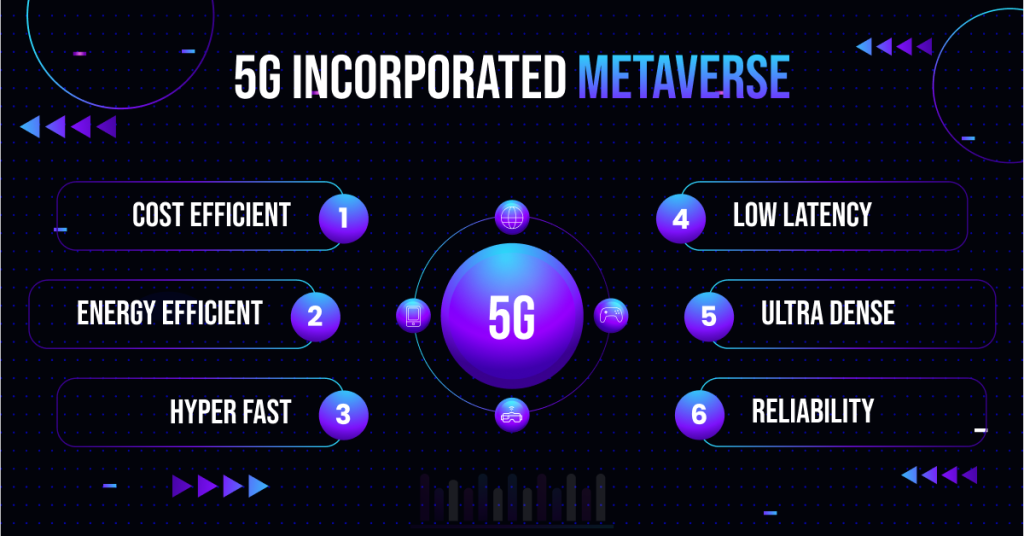
5G-Incorporated-Metaverse

Users can expect powerful real-time Metaverse experiences with the integration of 5G connectivity. With the incorporation of 5G in Metaverse, the technology can help handle the abrupt influx of data and provide an ultra-dense network for the seamless functioning of Metaverse apps.

3. Virtual Workplaces

Virtual workplaces are one of the most productive Metaverse future trends. It is estimated that people will spend more time in the Metaverse than in the real world by 2030. The Metaverse’s world would not just be limited to virtual workspaces but also include other things, such as shopping, meeting friends online, imparting education through 3D settings, and arranging meetings. 

As in the Metaverse introduced by Meta, users can create their own Avatars and interact with people across the globe virtually. This is what Alexandra Neville, a thriving artist and researcher at Australia’s University of Technology Sydney, has to say about the Avatars in the Metaverse:

Avatars will allow people to represent themselves beyond the limitations of status. There’s the opportunity to alleviate people’s identity beyond their wardrobe or how much money they have in their bank account. There’s more freedom to express themselves beyond gender, representation, and social conventions.

4. Blockchain-Ruled Economy

The incorporation of Blockchain in the Metaverse is one of the most revolutionary trends in the Metaverse. We can expect the development of a full-fledged cryptocurrency and NFT-based virtual economy powered by Blockchain in the Metaverse.

Here’s how Blockchain technology helps strengthen the Metaverse landscape. Since the Metaverse is the breeding ground for virtual transactions, Blockchain will ensure the establishment of a decentralized economy ruled by cryptocurrency. 

For instance, if someone wants to make a purchase in the Metaverse ecosystem, the Blockchain technology will secure the transactions through its high-grade security protocols and systems.
Another wonderful example is the application of Blockchain in the Metaverse’s digital real estate scenarios. Users can use virtual currencies, such as Bitcoin and Ethereum, to lend, invest, borrow, and trade in the Metaverse through DeFi.

5. Virtual Content Creation

The popularity of virtual products is increasing at a significant rate. The virtual content creation market has reached a market share of USD 5.6 billion in 2022, and it is expected to hit USD 39.8 billion by the year 2032!

As consumers are getting attracted to 3D spaces, the requirement for virtual goods has only increased. This is one of the best Metaverse trends for content creators who can disrupt the 3D market and make it big in the virtual content creation space. For example, a content creator named Samuel Jordan has reportedly made up to $80,000 per month by selling digital goods on Roblox.

You must be thinking about what the future will look like. If you’ve seen the first episode of the fifth season of ‘Black Mirror’ on Netflix, the episode features how two friends connect through a VR version of their favorite video game. The time is not far when we will actually be able to experience it through Metaverse!

6. Metfluencing

Metfluencing has become another buzzword of the year, but what does it mean? A new trend in Metaverse is picking up: selling and marketing products in real-time through Metaverse platforms. It is indeed one of the most awaited Metaverse marketing trends to keep an eye on!

According to a recent study, 56% of influencers participate in the Metaverse right now.

With this trend picking up pace, it is a golden opportunity for influencers to enter the Metaverse and start selling products directly on it. Influencers can also explore other avenues, such as real-time gaming and much more. 

Metfluencing

For example, Logan Theobald is a tremendous Metaverse influencer who is a top gamer in the VR world. In fact, he has also collaborated with gigantic brands such as Liquid Death. You can find his long-form videos on YouTube and catch up with this ‘metfluencial’ lifestyle.

7. Metaverse-Powered Fashion Weeks

The fashion world is not behind in embracing the novel virtual world of Metaverse. One of the most pivotal trends in Metaverse is disrupting the fashion industry. For instance, the debut of the convergence of Metaverse technology with fashion was seen at Metaverse Fashion Week in 2022, when Yeezy Gap, engineered by Balenciaga, showcased its virtual clothing.

Even Tommy Hilfiger showcased its SS22 collection at the Metaverse Fashion Week. This is what the CEO Martijn Hagman had to say:

 “We are committed to meeting the new generation of consumers where they are and we encourage them to express their individuality no matter where they choose to shop or interact with our brand.

Metaverse-Powered-Fashion-Weeks

The wave of Metaverse has now touched almost every domain across the globe, and it will only grow further in the coming years.

8. Urban Planning and Development

Another important trend in Metaverse is its utility in a well-developed sector, which is urban development and planning. The Metaverse can create a complete replica of the city so that the designers, planners, engineers, and stakeholders can collaborate on an urban planning project in real time.
One of the best examples of a city leveraging Metaverse in urban planning is Seoul, South Korea. The government invested $3.3 million in a five-year plan to enhance the city’s administration, services, and digital integration for a smart city. Citizens can connect with virtual public officials and access other services through the development of the “Metaverse 120 Center“.

Urban-Planning-and-Development

Bottom Line

That’s a wrap for the Metaverse trends 2025. The world is undergoing rapid transformation with the convergence of Metaverse across various verticals. It is an ever-evolving ecosystem that is attracting people to virtual reality.

This blog discusses the top upcoming trends in Metaverse that you need to watch out for. From developing smart cities to Metfluencing, the technology has disrupted almost every other sector and industry. 
If you’re a thriving business wanting to enter the Metaverse space, Deftsoft is a globally recognized Metaverse development company that can help you drive business in the Metaverse space. Reach out to know more!

FAQs:

What is Metaverse?

Metaverse refers to a variety of technologies that blur the line between the physical and virtual worlds. These technologies include Augmented Reality (AR), Virtual Reality (VR), and Mixed Reality (MR). In Metaverse, one can build immersive 3D spaces to interact with people, play games, shop, buy and sell virtual land, and more.

What is the future of Metaverse?

The world of Metaverse looks bright and ever-evolving. Its influence can be seen in developing smart cities and urban planning, metfluencing, Metaverse-powered Fashion weeks, disruption of the education system through real-time virtual meetings, immersive gaming experiences, and much more.

How to make money in the Metaverse?

There are plenty of ways to make money in the Metaverse ecosystem. You can become a Metaverse gamer through the Roblox platform and make money. You can also create NFTs and sell them via Metaverse in real time. 

What is the difference between Omniverse and Metaverse?

Metaverse is a part multiverse. A collection of metaverses that are interoperable with each other is referred to as a Multiverse. For example, gaming platforms like Roblox. On the other hand, Omniverse refers to the collection of Metaverses and Multiverses, whether they’re interoperable or not. Omniverse is also the name of an industrial Metaverse platform created by Nvidia.

How to Develop a Metaverse App in 2025?

Throwback to the time when Meta, formerly known as Facebook, introduced the immersive world of ‘Metaverse’ in the latter half of 2021. Since then, the Metaverse world has been an emerging reality. Later, in 2023, Apple announced rolling out ‘Apple Vision Pro,’ an elite version of Metaverse. All these events contribute to the staggering growth of Metaverse in today’s fast-paced digital world.

Companies in the early stages of Metaverse app development are more likely to become market winners in the upcoming 5 to 10 years.

The Economic Times

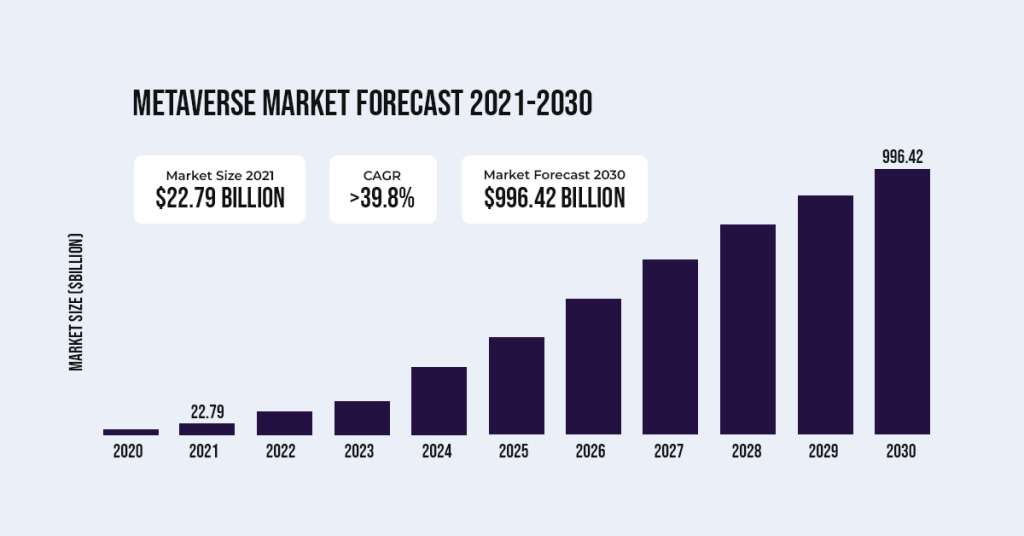
One of the most innovative ways to parse into the Metaverse industry is by building/investing in your own Metaverse app. The Metaverse industry is projected to grow at a CAGR of 36.80% by 2030, thus reaching a market size of $900 billion.

Metaverse App in 2024

This blog is a valuable source of information for individuals/companies who wish to enter the global market of Metaverse in 2025. We’ll discuss what Metaverse is, how to build a Metaverse app, the technologies that make up the Metaverse, and the challenges involved in Metaverse app development in 2025.

Without further ado, let’s delve into the realm of pure knowledge!

What is Metaverse?

Many people think that putting on a Virtual Reality (VR) headset and experiencing a virtual world is what Metaverse is. However, it is just one facet of the term ‘Metaverse.’ It is much more than that. 

Metaverse is an aggregation of multiple virtual realities that exist beyond video games and after removing VR headsets. It is a spatial computation technology that combines different virtual realms. You can virtually meet friends over Metaverse, attend a concert, or meeting, host a party, make transactions, and even buy a piece of land in Metaverse! For example, Fortnite gives users an immersive game experience through near-reality games and socializing. It lets you create your character, play games, make friends, and socialize. Therefore, it is a perfect example of Metaverse.

Fortnite

The game came out in 2017 by Epic Games and offers an immersive, real-life digital experience. Apart from games, there are many other examples of Metaverse, such as Sandbox, where users can share, build and monetize creations using Ethereum.

Steps Involved in Building a Metaverse App

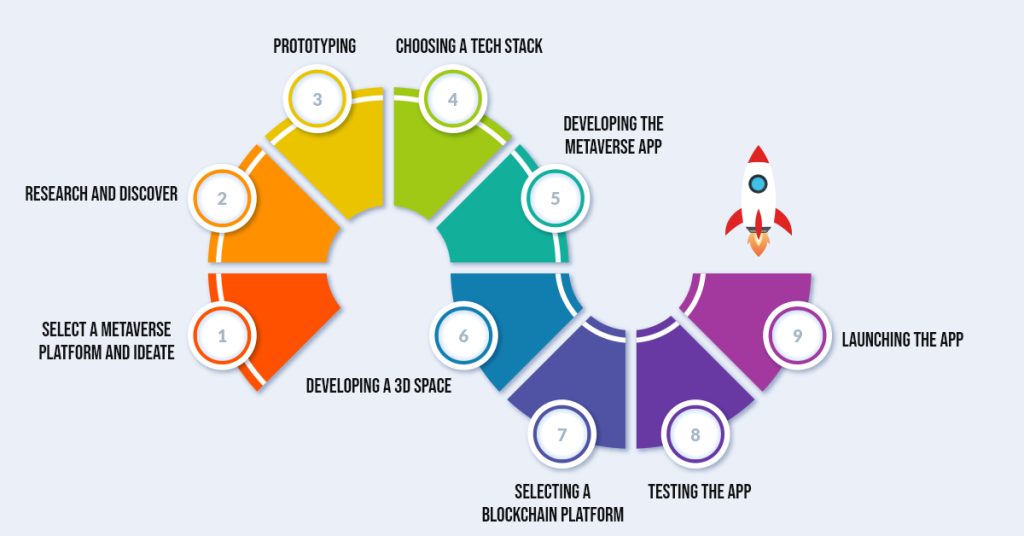
It is indeed a task of intricacy and iterations of development and testing when it comes to Metaverse app development. We made it easy for you to build a metaverse app from scratch. Follow the steps mentioned below:

Metaverse App
  1. Select a Metaverse platform and ideate

The first step to building a Metaverse app is to choose the Metaverse platform of your choice. It is also based on the kind of app you wish to develop. You can select an app from many options, such as real estate, 3D gaming, digital shopping stores, social apps, etc.

  1. Research and discover

The next step is to perform comprehensive market research to understand the user requirements and market trends. You can then create a prototype based on the research you do. Conducting an in-depth analysis of competitors is also imperative for a successful Metaverse app development in 2025.

  1. Prototyping

The next step is to start designing your Metaverse app. The process involves generating a 3D virtual environment of your app, creating interaction points and developing a user-friendly experience. You must ensure that the app conveys a story. This enhances user experience. Feel free to incorporate AR/VR technologies for an immersive experience.

  1. Choosing a tech stack

After designing your Metaverse’s virtual environment, it is imperative to choose a Metaverse tech stack that the developers need to bring the app to life. Based on the use cases and the requirements of the app, you can choose any one of the below-mentioned tech stacks:

  • Backend development for Blockchain: Java, Python, Node JS, DocumentDB, React Native
  • Frontend development for Blockchain: React, Angular, Vue JS, HTML, CSS, React Native
  • 3D modeling software: Unreal Engine, Unity, CRYENGINE
  • AI development tools: TensorFlow, Scikit-Learn, AWS sage maker
  • Mobile development: Swift (iOS), Kotlin (Android), React Native (cross-platform dev)
  • Database: MySQL, PostgreSQL, Oracle Database
  • Cloud infrastructure for scalability: Amazon Web Services (AWS), Microsoft Azure, Google Cloud
  • AR/VR tools: Unity, Unreal Engine, Google ARCore, Apple ARkit, Maxst AR
  • IoT: AMQP, Azure IoT Hub, MQTT, Lorawan

5. Developing the Metaverse app

After selecting the right tech stack, you can take it to the development stage. This stage involves developing the app, which includes adding a suitable set of interactive elements, features and other social tools.

On the other hand, if you’re hiring a developer, ensure you engage both a JavaScript and Blockchain developer. Hiring UI/UX developers for an aesthetically pleasing user experience is also crucial.

6. Developing a 3D space

It is essential to develop a 3D space for the Metaverse app to function. This is when you’ll need some tools to design the 3D architecture. You may use software like Unity 3D, Unreal Engine, etc.

7. Selecting a blockchain platform

The next step is to choose a blockchain platform that suits your Metaverse app development requirements. Various factors can influence the selection of a blockchain platform that caters to your needs. For instance, if you’re building a 3D real estate Metaverse app, the goal should be to choose a high transaction speed, low-cost blockchain platform such as Tron. It is perfect for decentralized finance (DeFi) and decentralized apps (dApps).

8. Testing the app

It is essential to test your Metaverse app before making it live for the audience. You must follow an iterative cycle of testing. This process must involve resolving speed issues, debugging base codes, fixing performance glitches, etc.

9. Launching the app

You can then launch the app, promote it, and spread it to a broader audience base. Remember to keep on looking for bugs in your app. Rolling out new updates and bug fixes in the app is critical.

Technologies that Makeup Metaverse Apps

Different technologies are required to build a Metaverse app. The technologies needed for an up-and-running Metaverse app are mentioned as follows:

1. Virtual and Augmented Reality (VR/AR)

Virtual Reality (VR) and Augmented Reality (AR) form the core of Metaverse. You can experience virtual online shopping, virtual meetings with colleagues, and more. Experience the magic of VR through a VR device such as Apple Vision Pro.

Virtual and Augmented Reality

Augmented Reality (AR) supplements reality with virtually-created elements. It scans a real-life frame through a camera and then adds features. It is a revolutionary technology in itself. 

The above image is a perfect example of the application of Augmented Reality. You can scan a spot in your home through a device’s camera to see how furniture looks even before you buy it. You can conceptualize the process of Metaverse app development around it!

2. Blockchain 

Blockchain technology is a novel and vital technological aspect of Metaverse. A user can make safe and secure transactions because of the blockchain technology applied in the Metaverse realm. 

The highlighting feature of the blockchain technology is decentralization. Harnessing its power can fuel the Metaverse to great heights. Blockchain has enabled the monetization of digital assets such as NFTs, digital arts, etc. It is an essential part of the Metaverse since it pushes decentralized assets.

3. Internet of Things (IoT)

Internet of Things (IoT) is a groundbreaking technology that aids the Metaverse in virtually replicating real-life objects on the spot. It helps the Metaverse comprehend an object and generate a virtual copy of it in the virtual world of the Metaverse.

4. Artificial Intelligence (AI)

 Artificial Intelligence is another vital technology that plays a significant role in Metaverse. Because of AI, the Metaverse can create 3D avatars of characters in the game world. It is also a breakthrough technology in developing Chatbots. These Chatbots help the users navigate through Metaverse, resolve issues, and cater to the user’s needs.

Artificial Intelligence (AI) uses other technologies, such as Natural Language Processing (NLP), Machine Learning, Voice/Speech Translation, and Computer Vision, to improve human-metaverse interaction.

5. Edge Computing

The latency rate plays a humongous role in enhancing a game’s experience. However, high latency rates can hamper the quality of the digital experience. This is why relying on cloud computing for efficient transactions or any other digital scenario is not a productive idea.

Edge computing performs real-time data analysis by eliminating the need to transfer data to the cloud or data centers. It conducts research in proximity to the source for low-latency experiences. Since the number of Metaverse users will only rise, integrating edge computing with Metaverse is the cherry on top!

Challenges involved in Metaverse app development in 2025

Metaverse app development in 2024

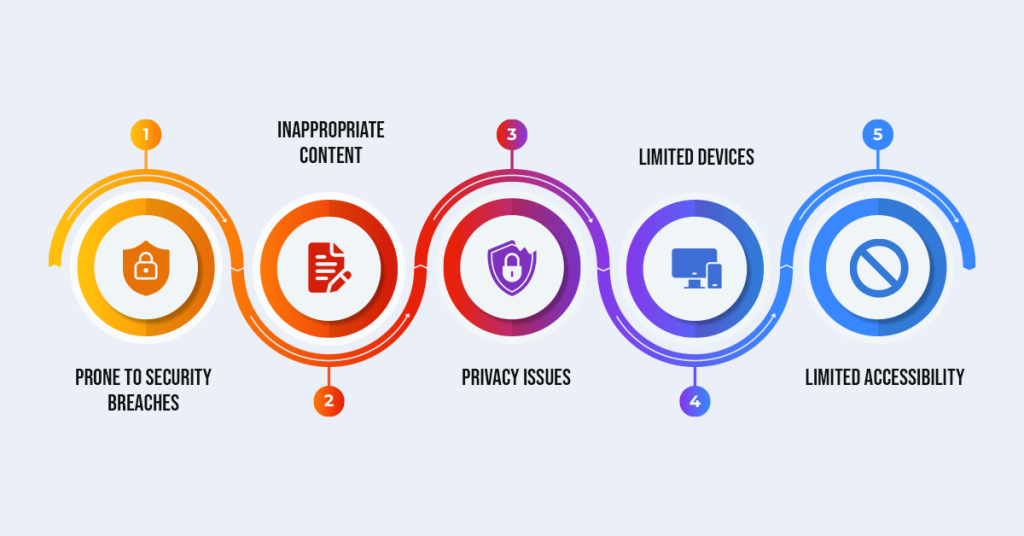
The Metaverse technology is still an emerging one. Therefore, some security-related, identity-related, and other bothersome concerns are attached to it. Some of the prominent challenges involved in using the Metaverse are as follows:

  1. Prone to security breaches

Metaverse is vulnerable to identity thefts and security breaches. Any individual or a bot can become an imposter and pretend to be someone else. This can lead to increased malicious activities on Metaverse, thus leading to identity theft and sensitive data breaches. 

This is why having solid and robust security systems on Metaverse apps is essential.

  1. Inappropriate content

Since there are no content regulations or checkpoint systems to override inappropriate content, some individuals can take advantage of it. This can cause a potential problem for other users in the Metaverse virtual environments.

  1. Privacy issues

The Metaverse apps collect real-time information about the users to enhance user experience, targeting the audience better and optimizing the app interface. This raises a potential privacy concern for the users, who might withdraw from using the app.

  1. Limited devices

It is daunting to curate an equally immersive experience of Metaverse apps for users on various devices such as smartphones, laptops, VRs and desktops. One can only experience an immersive experience when accessing Metaverse through VR headsets.

  1. Limited accessibility

Only some people are familiar with the functionality of Metaverse digital assets such as blockchain, NFTs, and cryptocurrencies such as Ethereum, Dogecoin, Bitcoin, etc., which reduces the utility of Metaverse environments across different audience segments.

How to Combat Metaverse App Development Challenges?

With new technologies come new challenges. It is crucial to withstand Metaverse development challenges to succeed in the Metaverse development space. Building a Metaverse app is a work of intricacy, experience and technical prodigy. This is why outsourcing the app development process is an informed decision.

Deftsoft is an industry-leading Metaverse app development service-based company with over 17 years of established business in the country. We have a massive team of experienced blockchain developers, mobile app developers, UI/UX designers and Metaverse developers who can bring your vision to life. With novel technologies and approaches, we offer hassle-free Metaverse app development services.

Feel free to reach out to us. We’re here to serve the best!

Final Thoughts

The Metaverse industry is one of the most daunting yet exciting spaces. It amalgamates varied new-age technologies such as blockchain, AR/VR, Artificial Intelligence (AI), Machine Learning (ML), edge computing, 5G, and more. Creating a Metaverse app stands out only when professionals with experienced hands do it.

It is the best practice to hire an experienced team of blockchain and Metaverse developers to bring your vision to life. In the upcoming years, Metaverse will be far-fetched and much more than a virtual space for gaming and socializing.