Why Is Your Website Getting Traffic But No Leads?
-
By Devraj
-
7th July 2026
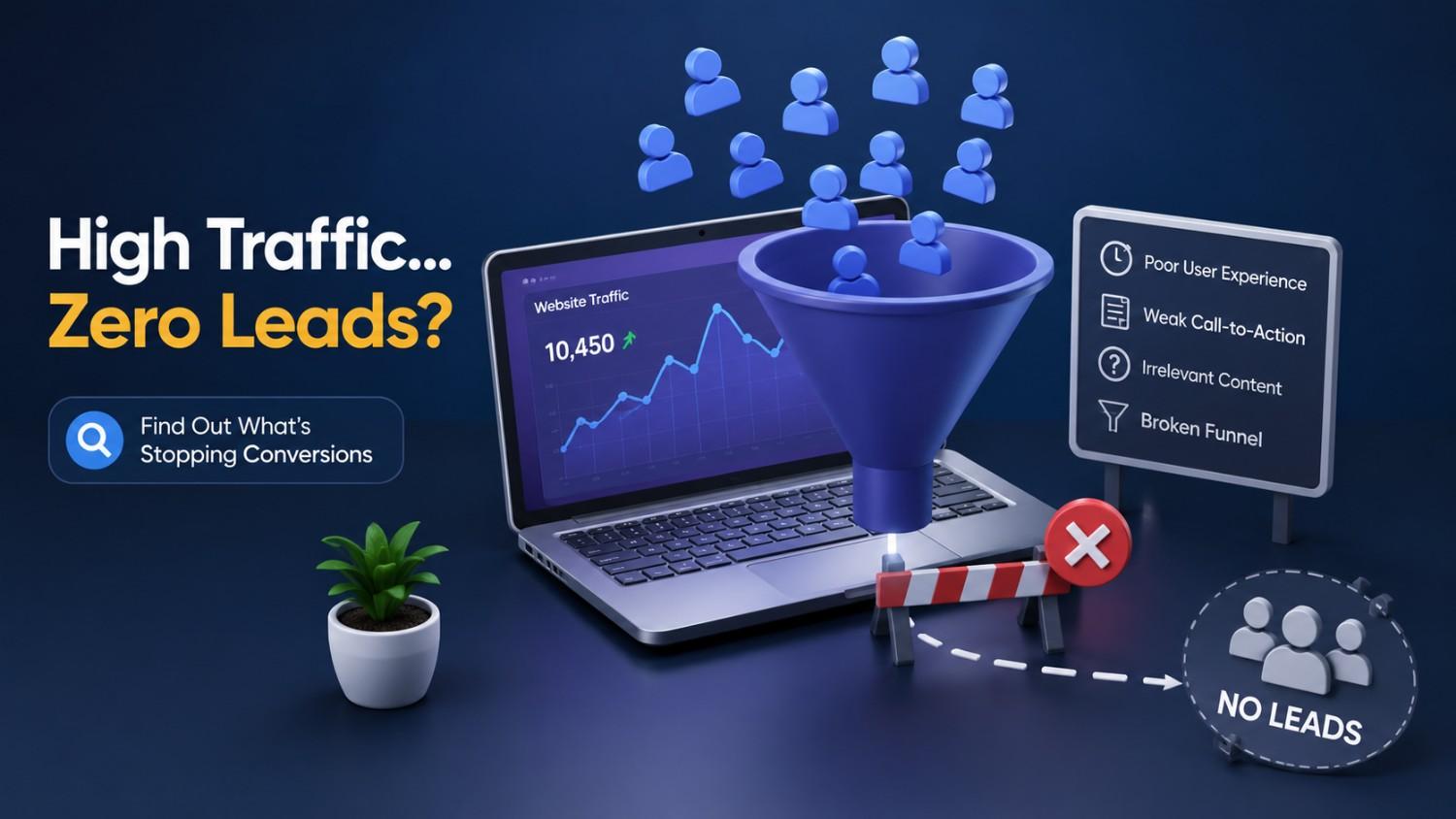
You open Google Analytics and the numbers look fine. Decent sessions, reasonable time on page, traffic ticking upward. But the contact form isn’t getting filled out. The phone isn’t ringing. And nobody seems to be clicking that “Get a Quote” button you spent three weeks debating. The instinct is almost always the same: get more traffic, run more ads, post more on social, invest more in SEO and get more people to the site.
But here’s what the data consistently shows: traffic without leads is almost never a traffic problem. It’s a conversion problem. And throwing more visitors at a website that isn’t converting is one of the most expensive mistakes a business can make in 2026. Let’s go through the real reasons this happens and what to actually do about each one.
Quick Summary: Getting traffic but no leads is one of the most frustrating problems a business can have and one of the most common. The average website converts just 2.9% of its visitors into leads. Most small business websites convert well below that. But here’s what most businesses get wrong: they try to fix a conversion problem by buying more traffic. More visitors sent to a broken funnel just means more money wasted. This blog breaks down the real reasons your website isn’t converting in 2026, from unclear messaging and slow load times to wrong traffic sources, outdated SEO approaches, and the new AI-driven search landscape that’s quietly changing where your leads come from before they ever reach your website.
Not sure why your website isn’t converting?
Reason 1: Your Traffic Is the Wrong Kind
Not all website traffic is created equal. A visitor who landed on your page because they searched “what is digital marketing” and a visitor who searched “digital marketing agency for my e-commerce business in Manchester” are not the same person. One is browsing. The other is buying.
High-intent traffic converts at 4.6 times the rate of cold traffic. So before assuming your website is broken, check what keywords are actually sending people to your pages. If the majority of your organic traffic is coming from informational queries “how to,” “what is,” “best way to” you’re attracting readers, not buyers.
This is directly connected to how search behaviour has shifted in the zero-click search era. A significant portion of informational queries now get answered directly on Google’s results page through AI Overviews and featured snippets, meaning the visitors who do click through to your website from those queries are often still in early research mode, not ready to make contact. The traffic looks real in your analytics. The intent isn’t there yet.
The fix: audit your top-traffic pages and check what keywords are driving those visits. If your highest-traffic pages are informational content, your SEO strategy may need to be rebalanced toward more commercial and transactional-intent keywords, the ones people search when they’re actually ready to hire someone.
Reason 2: Your Homepage Doesn’t Answer the Three Questions Fast Enough
Visitors form a trust judgement about a website within 50 milliseconds of landing on it. That’s not a metaphor; it’s the actual timeframe within which a first impression is made. And in most cases, the homepage fails that test before anyone reads a single word.
The three questions every first-time visitor needs answered immediately are: What does this business do? Who is it for? What should I do next? If your homepage leads with a vague tagline, a paragraph about how long you’ve been in business, or a rotating hero image with abstract language, you’ve already lost most of the people who landed there.
A Marketing Experiments study found that improving message clarity alone produced a 200% lift in conversion rate. That’s not from redesigning the entire website. That’s from making the value proposition clear enough that visitors understand it in the first few seconds.
The fix: show your homepage to someone who has never seen it. Give them five seconds. Ask them what your business does, who it helps, and what they should do next. If they can’t answer all three confidently, you have a clarity problem that no amount of additional traffic will solve.
Reason 3: Your CTAs Are Either Missing, Buried, or Confusing
A call to action is the specific step you want a visitor to take: book a call, request a quote, get in touch, download the guide. Without one that’s visually prominent and placed above the fold, most visitors read the page and leave without taking any action. Not because they weren’t interested, but because nothing clearly told them what to do next.
The other common mistake is having too many competing CTAs. Research on conversion rate optimisation consistently shows that a single, clear primary call to action outperforms multiple options with equal visual weight. When you give someone four different things to click, all presented with the same emphasis, the most common outcome is that they click none of them.
CTA copy matters too. “Submit” converts less than “Get My Free Audit.” “Contact Us” converts less than “Talk to a Specialist Today.” The specificity of what happens after the click is what removes hesitation and triggers action.
The fix: every key page on your website should have one primary CTA, positioned prominently, with copy that tells the visitor exactly what they’ll get, not just what they’re doing.
Reason 4: Your Website Is Too Slow on Mobile
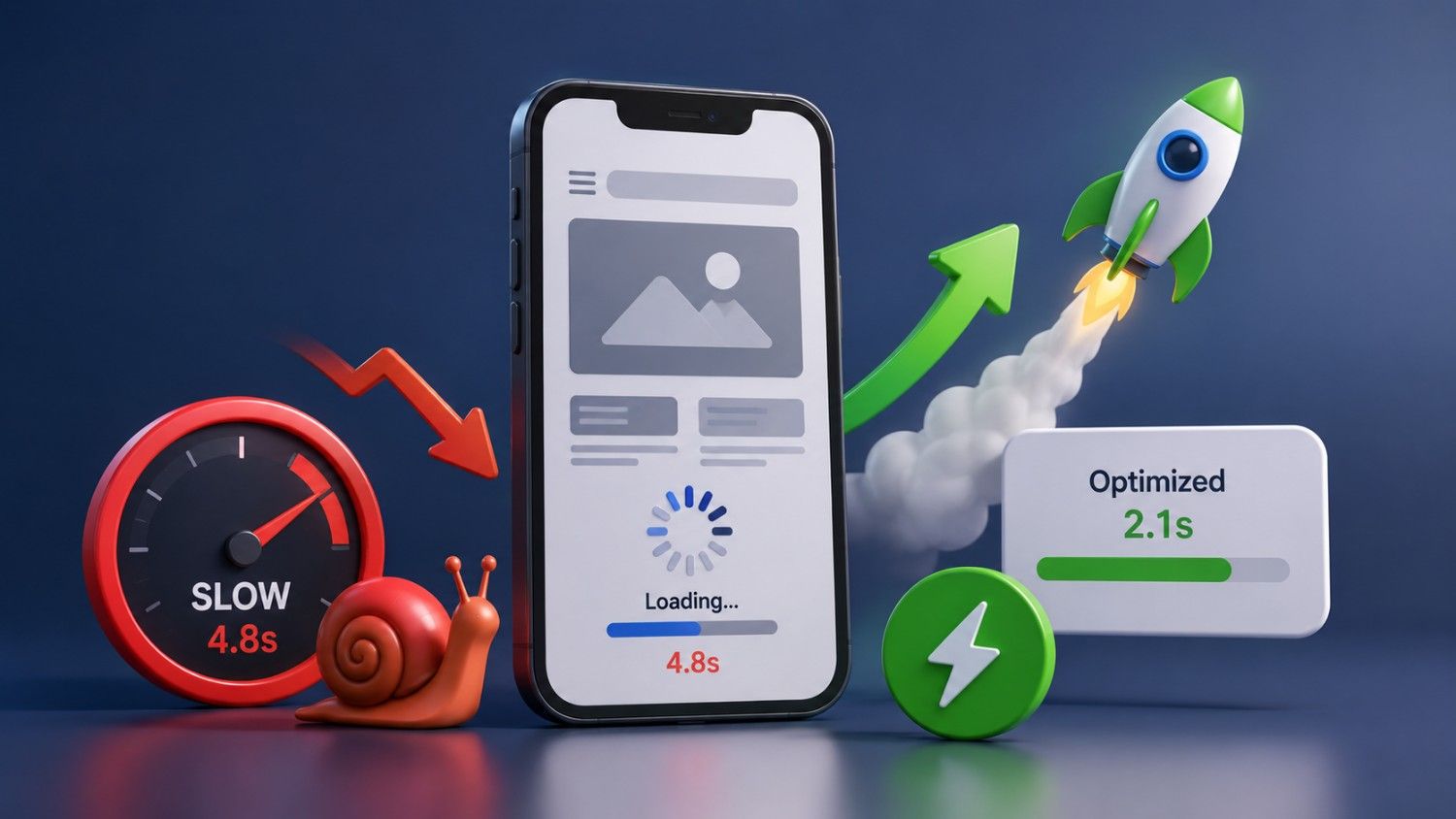 A one-second delay in page load time reduces conversions by 7.2%. Pages loading under 2.5 seconds convert 31% higher than slower pages. And in 2026, mobile accounts for over 60% of all web traffic globally, but mobile users convert at roughly half the rate of desktop users, partly because mobile pages are consistently slower and harder to navigate.
If your website takes four or five seconds to load on a 4G connection, you’re losing a large percentage of visitors before they’ve even seen your headline. They don’t bounce because your offer is wrong. They bounce because the page didn’t load fast enough to hold their attention.
Run your website through Google PageSpeed Insights right now. If your mobile score is below 70, that’s not a minor technical issue; it’s a conversion leak that’s actively costing you leads every single day.
The fix: Optimise your core web vitals: optimize images, reduce render-blocking scripts, use a content delivery network, and target a Largest Contentful Paint (LCP) under 2.5 seconds on mobile. These aren’t glamorous fixes, but they have a direct and measurable impact on conversion rates.
Reason 5: Your Forms Are Asking for Too Much Too Soon
Reducing form fields to five or fewer doubles conversion rates, yet most contact forms ask for name, email, phone, company, role, company size, specific interest, and a message before the visitor has any reason to trust you. Form abandonment after starting sits at 81%. Most people who begin filling out a long form don’t finish it.
The logic behind long forms that they produce more qualified leads isn’t supported by data. Shorter forms produce more leads at higher volume. Qualification happens in the follow-up conversation, not in the form itself.
The fix: reduce your contact and enquiry forms to a maximum of four or five fields. Name, email, phone number, and one open-ended “what are you looking for?” field is usually enough to start a conversation and qualify properly from there.
Reason 6: You Have Traffic But No Trust Signals
Getting someone to your website is only half the job. Getting them to take action requires trust, and trust is built through very specific on-page signals that most websites either underinvest in or place in the wrong locations.
Trust signals such as testimonials and case studies can increase conversion rates by 15 to 34% when placed near calls to action. Yet the most common pattern is for testimonials to live on a separate “Reviews” page that most visitors never navigate to. A testimonial three clicks away from your contact form does almost nothing. A specific, named client quote placed directly next to your “Book a Call” button does a great deal.
Other trust signals that matter: specific results (not vague claims), recognisable client logos, certifications, clear links to privacy policies near forms, and a real team photo rather than stock photography. Each of these reduces the psychological risk a visitor feels before reaching out to a business they’ve never heard of before.
The fix: audit where your trust signals currently live and move the most compelling ones to sit alongside your primary CTAs on your highest-traffic pages.
Reason 7: Your SEO Is Driving the Wrong Intent
This one is closely related to Reason 1 but goes deeper. In 2026, the relationship between search visibility and lead generation has become more complex as AI SEO and LLM SEO reshape which queries actually drive visitors to websites.
Answer Engine Optimisation (AEO) and Generative Engine Optimisation (GEO) are now driving a different kind of visitor: one who has already read an AI-generated summary and is coming to your website for depth, credibility, or to take action. AI search visitors convert 23 times better than traditional organic traffic. They arrive with context and intent already formed. A website that doesn’t match the expectation set by the AI answer they just read will lose them immediately.
Meanwhile, websites still optimised purely for volume-based traditional SEO often attract high bounce rates from informational queries that AI is now answering on the SERP itself. The traffic number looks healthy. The conversion rate suffers.
The fix: align your SEO strategy with where your audience is in the buying journey. High-intent service pages and landing pages should be optimised for commercial and transactional queries. Informational content should be structured to earn AI search citations and build brand authority, not to drive direct form submissions.
Reason 8: You’re Not Following Up Fast Enough
This one has nothing to do with your website itself, but it kills conversions just as effectively as any of the technical issues above. B2B sites that respond to enquiries within five minutes are eight times more likely to convert leads than those that respond within an hour. Yet the average response time for most small and medium businesses is measured in hours or days.
Someone who fills out your contact form at 11 am on a Tuesday and receives a response at 4 pm the following afternoon has almost certainly contacted two or three other businesses in that window. The form submission wasn’t a commitment; it was the beginning of a shortlisting process. Slow responses hand that process to your competitors.
The fix: set up automated acknowledgement emails as soon as a form is submitted, so the lead knows they’ve been heard. Then ensure a human follow-up happens within the hour during business hours. A CRM connected to your contact form makes this manageable even for small teams.
Reason 9: Paid Traffic Is Going to the Wrong Page
If you’re running Google Ads, Meta Ads, or any other paid campaign and sending that traffic to your homepage, you’re almost certainly leaving significant conversion potential on the table. A homepage is designed for multiple audiences with multiple possible next steps. A paid ad targets a specific audience with a specific message, and the page they land on should match that message exactly.
The average landing page conversion rate is 10.76%, but performance varies significantly by industry and depends entirely on the match between ad message and landing page content. When that match is tight, the ad says “iOS app development for healthcare companies,” and the landing page speaks directly to that, conversion rates climb sharply. When an ad sends someone to a generic homepage, the visitor has to do extra work to find relevance. Most won’t.
This applies equally to ChatGPT advertising and AI search advertising as these channels grow. Traffic arriving from AI platforms already carries context and intent, and landing pages that don’t immediately match that context will see the same drop-off as mismatched paid campaigns.
The fix: every paid campaign should have a dedicated landing page built around the specific message, audience, and offer in the ad. Test one clear CTA, minimal navigation, and messaging that speaks directly to the exact problem the ad addressed.
Reason 10: You’re Measuring Traffic Instead of Behaviour
The final reason many businesses don’t realise their website isn’t converting is that they’re looking at the wrong metrics. Session counts, page views, and monthly users are all visible and easy to report. Scroll depth, click maps, form abandonment rates, and session recordings are harder to set up but reveal far more about why visitors aren’t converting.
Only 17% of marketers currently use A/B testing to improve their landing pages. Top-performing pages that achieve conversion rates above 10% almost universally share one characteristic: they have been systematically tested and improved over time. Without testing, conversion decisions are based on assumption rather than evidence.
Tools like Microsoft Clarity, Hotjar, or Google Analytics 4’s event tracking can show you exactly where visitors stop scrolling, which CTAs they hover over but don’t click, and which field in your form people give up on. That data is worth more than any amount of additional spend on traffic.
The fix: set up behaviour tracking on your highest-traffic pages this week. Even two weeks of scroll-and-click data will reveal conversion problems you’d never find by looking at session counts alone.
The Bigger Picture: Traffic Quality Is Changing in 2026
All of the above conversion issues have existed for years. But there’s a layer specific to 2026 that’s worth understanding before you invest more in driving traffic.
The nature of website visitors is shifting. In the AI search era, the visitors who do arrive at your website are increasingly doing so with higher intent and more prior context; they’ve often already read an AI-generated summary about your service area, seen your brand cited in a GEO or AEO result, or followed a recommendation from ChatGPT or Perplexity. These visitors convert at dramatically higher rates than cold organic traffic, but they also have higher expectations: they expect your website to immediately validate the picture the AI painted of you.
At the same time, the sheer volume of low-intent informational traffic that used to bulk up analytics dashboards is being absorbed by Google AI Overviews and AI Mode. For many businesses, this means total sessions are falling while lead quality is actually improving a trend that looks like a problem in the numbers but is actually a healthier signal.
Understanding this distinction is critical before making decisions about where to invest. Buying more paid traffic to compensate for falling organic sessions, without first fixing conversion issues, is the most common and most expensive mistake businesses make when they first see their traffic numbers shift.
Why Deftsoft Approaches This Differently
Most agencies focus on getting more traffic to your website. At Deftsoft, we focus on making the traffic you already have work harder because in almost every case, conversion rate optimisation delivers a better return than traffic acquisition alone.
A website converting at 2% that doubles its conversion rate to 4% delivers the same lead volume as doubling its traffic at a fraction of the cost. That’s the lever most businesses aren’t pulling, and it’s where we tend to find the fastest wins for clients whose traffic looks fine but whose leads don’t reflect it.
We combine conversion rate optimisation with AI SEO services, GEO, and AEO to ensure that the visitors arriving at your website are the right ones and that your website is set up to convert them when they get there. If you’d like to understand exactly where your current website is losing leads, we can audit it and show you the most impactful fixes. Explore our conversion and SEO services to see how we approach it.
Ready to turn your existing traffic into actual leads?
Frequently Asked Questions
1. Why is my website getting traffic but no leads or enquiries?
In most cases, traffic without leads is a conversion problem, not a traffic problem. The most common causes are unclear messaging on key pages, missing or weak calls to action, slow mobile load times, wrong-intent traffic from informational keywords, long contact forms, and insufficient trust signals near the conversion point.
2. What is a good website conversion rate in 2026?
The average conversion rate across industries sits around 2.9% to 3.1%. For service-based businesses and B2B lead generation, a healthy rate is typically between 3% and 5%. Top-performing landing pages can reach 10% or higher. If your rate is below 1%, there are likely multiple fixable issues affecting your conversion experience.
3. Does more traffic fix a low conversion rate?
No. More traffic sent to a website with conversion problems just means more wasted budget. The most cost-effective approach is to optimise conversion first, fixing messaging, CTAs, page speed, form length, and trust signals, then scale traffic once the conversion foundation is solid.
4. How does AI search affect website leads in 2026?
AI search is changing the quality and intent of website visitors. Traffic from AI platforms like ChatGPT and Perplexity converts 23 times better than traditional organic traffic, because those visitors have already formed context and intent before arriving. However, total traffic volumes may fall as AI Overviews absorb informational queries that previously sent visitors to websites.
5. How many form fields should a contact form have?
Research consistently shows that reducing form fields to five or fewer doubles conversion rates. Four fields name, email, phone, and a brief message are usually sufficient to start a qualified conversation. Additional qualification should happen during the follow-up call, not the form.
6. How quickly should I respond to website leads?
Within five minutes during business hours. B2B businesses that respond within 5 minutes are 8 times more likely to convert a lead than those that respond within an hour. Automated acknowledgement emails sent immediately after submission, followed by a human response within the hour, is the standard that consistently outperforms slower follow-up.
7. What is conversion rate optimisation (CRO) and how does it help?
CRO is the practice of improving your website so that a higher percentage of existing visitors take a desired action, fill out a form, make a call or book an appointment. It involves testing and improving headlines, CTAs, page layout, load speed, form length, and trust signals based on real visitor behaviour data rather than assumptions. A website converting at 4% instead of 2% generates twice the leads from the same traffic volume.
Recent Articles



Devraj
 7th July 2026