How a Google Ads Agency Lowers Your Cost Per Lead?
-
By Devraj
-
25th May 2026
Key Takeaways
- A Google Ads marketing agency lowers cost per lead by improving strategy, targeting, tracking, and campaign performance.
- Better keyword targeting and negative keywords help reduce wasted clicks.
- Low CPL only matters when the leads are relevant and likely to convert.
- Strong ad copy improves click quality by matching user intent.
- Landing page optimization helps turn more visitors into leads.
- Accurate conversion tracking shows which campaigns are actually working.
- Regular testing of ads, CTAs, forms, and bidding strategies helps improve results over time.
- The main goal is not just cheaper leads. The goal is to get better leads at a more profitable cost.
You’ve set up your Google Ads campaign. You’ve put in a budget. And the leads are trickling in — but at a price that makes your Chief Financial Officer (CFO) wince every time they look at the dashboard. Sound familiar?
Well, most businesses running Google Ads, whether on their own or with a general digital marketing partner, are just spending a lot of money without achieving optimal results.
A professional Google Ads marketing agency doesn’t just “run ads.” They diagnose, engineer, optimize, and scale your campaigns to systematically reduce your cost per lead (CPL) while maintaining high lead quality. In this blog post, we’ve covered exactly what that looks like in practice — the real work, the real strategies, and the real results you should be chasing. Read on to know.
Is your cost per lead too high? Let our team run a free, no-obligation audit on your current campaigns to uncover where your budget is being wasted.
Quick Navigation
Why Cost Per Lead Matters in Google Ads (Beyond Just Running Ads)?
What Does a Google Ads Marketing Agency Actually Do?
What a Google Ads Marketing Agency Actually Does to Lower Cost Per Lead?
Cutting the Keywords That Eat Budget Without Converting
Improving Quality Score So You Pay Less Per Click
Getting Google Ads Conversion Tracking Right
Matching Bid Strategies to Where the Campaign Actually Is
Landing Page Fixes That Make People Actually Convert
Remarketing to Win Back the Leads Who Didn’t Convert Yet
Ongoing Testing — Because What Works Today Won’t Work Forever
Common Reasons Your Google Ads Cost Per Lead Is Too High
What Results Can You Expect from a Google Ads Marketing Agency?
Still paying too much for every lead? Stop guessing!
Why Cost Per Lead Matters in Google Ads (Beyond Just Running Ads)?
Your cost per lead (CPL) is basically your report card for ad efficiency. It tells you how much you’re spending to get one person to raise their hand and say, “Yes, I’m interested.”
And right now, that number is under pressure. According to WordStream’s 2025 Google Ads Benchmarks Report, the average CPL across all industries hit $70.11 in 2025, up from $66.69 the year before. At the same time, the number of active advertisers on Google grew by over 31% between 2024 and 2026. More competition, same ad space — you do the math.
But here’s what’s interesting: 65% of industries actually saw better conversion rates in 2025, even as costs went up. That tells you something important. The businesses doing well aren’t just spending more — they’re running their accounts differently.
A high CPL almost never means Google Ads doesn’t work for your industry. It usually means something in your account — a keyword strategy, a landing page, a tracking issue, a bidding setting — is working against you. A good Google Ads digital marketing agency knows how to spot that and fix it.
What Does a Google Ads Marketing Agency Actually Do?
People often assume agencies just “boost ads” or swap out a few headlines once a month. That’s not what real account management looks like.
A good Google Ads management company handles many tasks simultaneously and continuously. Let’s take a quick glance at what that entails:
- Account audits — reviewing what’s wasting money, what’s working, and what’s missing before anything else
- Keyword research and intent mapping — identifying the correct keywords and what the intent behind each keyword is
- Campaign and ad group structure — making sure your ad account is structured so Google’s algorithm can understand it and reward it
- Ad copy creation and testing — writing ads that earn higher click-through rates, which improves your Quality Score and reduces your cost per click
- Bid strategy management — choosing the right automated or manual bidding approach based on your campaign’s current stage and data
- Landing page alignment — ensuring that the page your ad directs to is relevant to the ad (otherwise it’s a silent CPL killer)
- Google Ads conversion tracking — establishing clean and accurate tracking to ensure that decisions are made with accurate data and not on a guess
- Audience targeting and remarketing — connecting with the right people and remarketing to those who have already expressed interest
- Weekly or monthly reporting — actual analysis, not just screenshots of numbers
None of this is a one-time setup. It’s ongoing work that compounds over time. That’s what separates Google Ads experts from people who just “run ads.”
What a Google Ads Marketing Agency Actually Does to Lower Cost Per Lead?
Here’s the part that actually answers your question. These are the specific moves that bring CPL down — not in theory, but in practice.
Cutting the Keywords That Eat Budget Without Converting
This is usually where the first-place money goes to waste. When you’re targeting keywords that are too broad, your ads show up for searches that have nothing to do with what you sell.
A lead generation Google Ads agency builds a layered keyword strategy — exact match for high-intent terms, phrase match for some flexibility, and a tightly controlled negative keyword list to filter out the junk. For example, a roofing company doesn’t want to pay for clicks from people searching “how to fix roof yourself.” That seems obvious, but these negative keywords are constantly missed in accounts that aren’t being actively managed.
Result: less wasted spend, more budget going toward searches that actually lead to inquiries.
Improving Quality Score So You Pay Less Per Click
This one surprises many business owners. Google doesn’t just sell ad space to the highest bidder — it rewards relevance. Your Quality Score (rated 1–10) is based on your expected click-through rate, how relevant your ad is to the search, and how good your landing page experience is.
A higher Quality Score means you can win a higher position in the auction while paying less than your competitor with a lower score. Going from a Quality Score of 5 to 8 can cut your cost per click by 30% or more — without changing your budget at all.
Google Ads experts improve this by tightening ad group themes, writing more relevant ad copy, and aligning landing pages to the specific keyword groups. It takes time, but the CPL impact is real.
Getting Google Ads Conversion Tracking Right
Here’s a hard truth: if your conversion tracking is broken or set up wrong, everything else — every bidding decision, every budget allocation, every optimization — is based on bad data.
Many accounts are tracking the wrong things. Page views are getting counted as conversions. Phone calls are not tracked at all. Form submissions are firing twice. When Google Ads conversion tracking is inaccurate, Google’s algorithm thinks it knows what’s working when it doesn’t. You end up optimizing toward phantom conversions while your real leads go unmeasured.
A professional agency will:
- Audit your existing tracking setup
- Verify that Google Tag Manager or GA4 is firing on the right actions
- Set up offline conversion imports for B2B businesses with longer sales cycles
- Make sure smart bidding algorithms are learning from real, quality signals
Fix the tracking, and you often see CPL improvements within weeks — without touching anything else.
Matching Bid Strategies to Where the Campaign Actually Is
One of the most expensive mistakes in Google Ads is using the wrong bidding strategy for the wrong stage of a campaign.
Automated bidding like Target CPA or Maximize Conversions works great — but only when Google has enough data to learn from. If you switch to smart bidding too early, the algorithm essentially guesses, and those guesses cost you money.
Here’s how a Google Ads management company typically approaches it:
- New campaigns with little data → start with manual CPC or Maximize Clicks to build conversion history
- Established campaigns with 30–50+ conversions per month → move to Target CPA or Maximize Conversions
- Performance Max campaigns → need properly built asset groups and audience signals, or they’ll overspend on low-quality placements
Getting this call right at the right time is a big part of what keeps CPL stable or causes it to fall as a campaign grows.
Landing Page Fixes That Make People Actually Convert
The click is only half the job. If someone clicks your ad and lands on a slow, confusing, or mismatched page, they leave. You paid for that click and got nothing.
Here’s what a Google Ads digital marketing agency looks at when reviewing landing pages:
- Does the headline match what the ad promised?
- Is the page load time fast enough? (A 1-second delay on mobile can drop conversions by up to 20%)
- Is the form short and easy to fill out, or does it ask for 10 fields up front?
- Is there one clear action to take, or are visitors being pulled in five directions?
- Does the page build trust — through reviews, credentials, or guarantees?
Small changes here — a shorter form, a faster page, a headline that actually speaks to the visitor’s problem — can increase Google Ads conversions significantly without spending a single extra dollar on traffic.
Remarketing to Win Back the Leads Who Didn’t Convert Yet
Most people don’t convert on their first visit. That’s just how buying decisions work, especially for anything above an impulse purchase.
Remarketing lets you stay visible to people who already visited your site — and since they already know who you are, they cost less to convert the second time around.
A small business Google Ads agency will typically build:
- Remarketing lists based on which pages someone visited (e.g., visited your pricing page but didn’t fill out the form)
- Customer match audiences using your existing email or CRM data
- Similar audiences to find new people who behave like your best existing customers
This lowers your blended CPL across the whole account by converting warm traffic you’d otherwise just let walk away.
Ongoing Testing — Because What Works Today Won’t Work Forever
Ad fatigue is real. The headline that drove strong results six months ago might be stale now. A lead generation Google Ads agency runs structured A/B tests on an ongoing basis — testing different headlines, CTAs, descriptions, and ad extensions — and makes decisions based on data, not gut feelings.
The keyword there is structured. Testing one thing at a time, letting it run long enough to matter, and applying learnings account-wide. That discipline is what separates agencies that improve Google Ads ROI consistently from those that just make random changes and hope something sticks.
Common Reasons Your Google Ads Cost Per Lead Is Too High
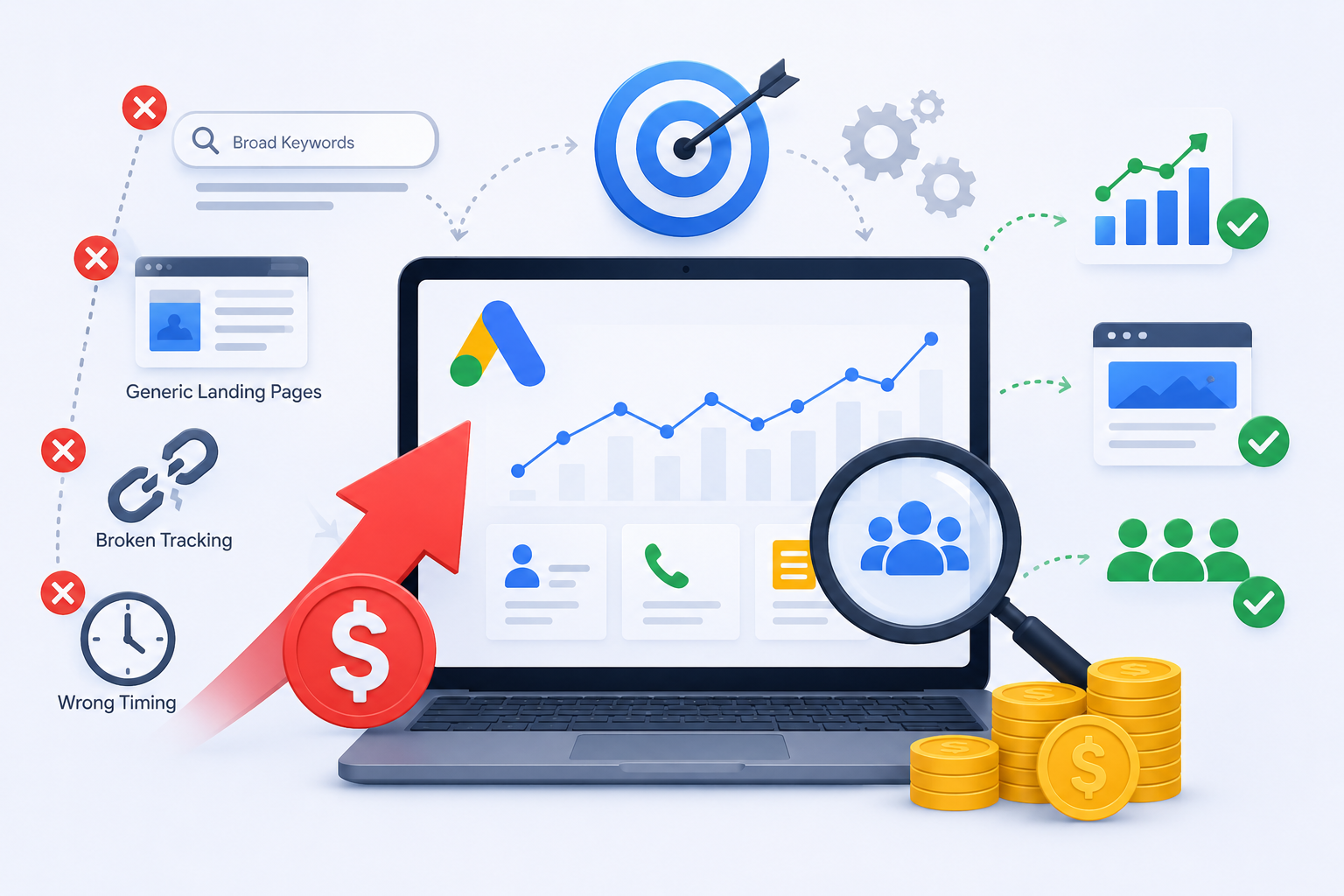
Before you can fix the problem, you need to know what it is. Here are the most common CPL culprits:
- Broad keywords with no negative list — your ads show for searches that will never buy from you
- Generic landing pages — sending everyone to your homepage instead of a page built for that specific offer
- Broken or incomplete conversion tracking — Google optimizes toward the wrong actions entirely
- Wrong bidding strategy for the campaign stage — especially smart bidding launched before enough data exists
- No ad schedule or device bid adjustments — paying full price 24/7, even when your audience isn’t active
- No remarketing — ignoring warm traffic and paying to find cold traffic every single time
- Blindly accepting Google’s auto-applied recommendations — many of these benefit Google’s revenue more than yours
What Results Can You Expect from a Google Ads Marketing Agency?
Let’s be realistic about timelines. Here’s what typically happens at each stage:
First 30–60 days:
- Full account audit, wasted spend identified
- Conversion tracking cleaned up or rebuilt
- Negative keyword lists expanded
- Ad relevance improvements started
Months 2–4:
- CPL starts trending down as bidding algorithms get cleaner data
- Landing page improvements start showing up in conversion rates
- Remarketing campaigns launched
- A/B tests producing early learnings
Months 4–6 and beyond:
- Compounding improvements — CPL stabilizes or keeps falling
- Account structured to scale without CPL rising proportionally
- Full-funnel visibility into what’s actually driving revenue
A small business Google Ads agency with a $2,000–$5,000/month budget and an enterprise client running $50,000/month will have different conversations — but the methodology is the same. Good structure, clean data, constant iteration.
Bottom Line
Running Google Ads and lowering your cost per lead aren’t the same thing. Many businesses do the first without ever achieving the second.
A proper Google Ads marketing agency — one with real Google Ads experts on the team — does the unglamorous, detailed work that makes campaigns perform: fixing tracking, tightening keywords, improving Quality Scores, testing ads, and making the landing page actually do its job.
If your CPL is too high right now, it’s fixable. It usually just takes someone who knows exactly where to look. At Deftsoft, that’s what we do. Our team has worked with businesses across industries to build Google Ads accounts that generate real leads at a cost that makes sense. If you want to know where your current account is losing money — or if you’re starting fresh and want to do it right — we’re happy to take a look.
Still Paying Too Much for Every Lead? Stop Guessing!
Most businesses don’t have a Google Ads budget problem — they have an optimization problem. Here’s exactly how a Google Ads management company fixes that and lowers your cost per lead, for real.
- Kill the keywords that eat your budget alive — Google Ads experts build tight negative keyword lists that stop your ads from showing for searches that will never buy, cutting wasted spend instantly and pushing more budget toward high-intent leads.
- Score higher, pay less — Quality Score is your secret weapon — A Google Ads digital marketing agency improves your Quality Score by writing more relevant ads and aligning landing pages, which can slash your cost per click by 30% without touching the budget at all.
- Fix your tracking, or you’re flying completely blind — Broken Google Ads conversion tracking means your algorithm optimizes toward the wrong signals. A lead-generation Google Ads agency rebuilds tracking so that every bidding decision is based on what’s actually converting.
- Your landing page is where leads are won or wasted — Clicks mean nothing if the page doesn’t convert. A small business Google Ads agency optimizes page speed, headlines, and form length, helping you increase Google Ads conversions without spending more on traffic.
- Remarketing turns warm browsers into paying customers — Most people don’t convert on visit one. Remarketing re-engages past visitors at a fraction of the cost and is one of the fastest ways to improve Google Ads ROI without raising your total budget.
At Deftsoft, our team of Google Ads experts brings years of hands-on experience managing campaigns across industries — helping businesses of all sizes generate more leads, at lower cost, without guesswork. Contact us now.
Stop Guessing & Start Scaling Your Google Ads ROI
FAQs
Q. What does a Google Ads marketing agency actually do?
They manage your campaigns end-to-end — keyword strategy, ad copy, bidding, tracking, and ongoing optimization — with the goal of generating more leads at a lower cost.
Q. How does a Google Ads management company lower CPL?
By fixing what’s wasting budget — bad keywords, weak landing pages, wrong bidding strategies, and broken tracking — so more of your spend goes toward clicks that actually convert.
Q. How long before I see results from a Google Ads agency?
Most accounts see structural improvements in the first 30–60 days. Meaningful CPL reductions typically appear in months 2–4, with stronger compounding effects by month 6.
Q. Is a Google Ads agency worth it for small businesses?
Yes — especially because the mistakes small businesses make on self-managed accounts (wrong match types, no negative keywords, broken tracking) tend to waste a large share of limited budgets. A small-business Google Ads agency pays for itself by eliminating that waste.
Q. How does Google Ads conversion tracking help lower CPL?
When tracking is accurate, Google’s algorithm optimizes toward real conversions. When it’s wrong, the algorithm chases the wrong signals — wasting budget on traffic that doesn’t actually lead to inquiries or sales.
Q. Can a Google Ads agency increase conversions without raising my budget?
Yes. Improving Quality Score, fixing landing pages, refining audience targeting, and tightening keyword match types can all increase Google Ads conversions without increasing ad spend.
Recent Articles





Devraj
 25th May 2026