Google Ads for Doctors SEO Outline: The Complete Guide to Medical Practice Marketing
-
By Devraj
-
29th July 2026
In today’s digital-first healthcare landscape, attracting new patients requires more than traditional word-of-mouth referrals. Modern clinics need a robust Google Ads for doctors SEO outline to capture immediate patient demand while simultaneously building long-term search engine authority.
By combining search engine optimization (SEO) with high-intent pay-per-click (PPC) advertising, your medical practice creates a dual-engine marketing strategy that ensures maximum visibility. Whether your goal is to fill daily appointment slots, showcase specialized medical services, or outrank competing clinics in your area, a unified approach delivers predictable patient growth. Read on to discover the ultimate 2026 Digital marketing roadmap for healthcare practice.
Want a complete Google Ads for doctors SEO outline built specifically for your clinic?
Get a plan built around your specialty, location, and goals.
Quick Navigation
Why Doctors Need SEO and Google Ads
What Is SEO for Doctors in the AI Era?
Generative Engine Optimization (GEO) & AI Search
Why SEO Is Important for Doctors and Medical Practices
How to Create an Effective SEO Strategy for Doctors
Target How Patients Actually Search
Fix Your Technical Web Foundations
Publish Actionable Patient Content
Local SEO for Doctors: How to Attract Nearby Patients
How Google Business Profile Helps Doctors Get More Patients
Google Ads & Next-Gen Paid Media for Doctors
Maximizing Reach with Google Performance Max (PMax)
Capturing Patients on Emerging Platforms (ChatGPT Ads)
Structuring Ad Groups and Schema the Right Way
Google Ads vs SEO for Doctors: Which Is Better?
PPC for Doctors: How to Build a Successful Paid Search Campaign
Doctor Search Engine Marketing: SEO + PPC
Medical Marketing for Doctors: Beyond SEO and Google Ads
How to Choose an SEO Agency or SEO Company for Doctors
How Much Do SEO Services for Doctors Cost?
SEO and Google Ads Strategy for Doctors: A Step-by-Step Plan
Why Doctors Need SEO and Google Ads
Before a patient calls your clinic, they’ve usually already searched for it or for one like it. This is why SEO for doctors, Google Ads for doctors, medical SEO, doctor search engine marketing, and marketing for doctors now sit at the center of patient acquisition.
It helps to understand the difference between the two core channels early on:
- SEO builds long-term, organic visibility slower to build, but it keeps bringing patients in without an ongoing per-click cost.
- Google Ads (PPC) delivers immediate visibility; you can appear at the top of search results the same day a campaign launches, but you pay per click.
Neither replaces the other. The strongest clinics combine both, which is exactly what this outline is built around.
What Is SEO for Doctors in the AI Era?
SEO for doctors is the practice of optimizing a clinic’s website so it appears higher in Google’s organic (non-paid) search results.
In plain terms, when someone searches “dermatologist for acne scars near me” or “best pediatrician in [city],” SEO is what determines whether your clinic’s website shows up on page one or gets buried on page three, where almost no one ever looks.
Generative Engine Optimization (GEO) & AI Search
Today’s patients don’t just type two-word keywords into a search bar; they ask AI platforms (Google AI Overviews, ChatGPT, Perplexity, and Gemini) complex questions like “What causes sharp knee pain when bending, and which local clinic specializes in non-surgical treatments?”
To stay visible, modern medical practices must optimize for Generative Engine Optimization (GEO) alongside traditional SEO. This means structuring medical content with clear E-E-A-T (Experience, Expertise, Authoritativeness, and Trustworthiness) signals, expert-reviewed information, and rich schema markup. Doing so ensures AI search engines cite your doctors directly as the recommended authority when patients seek medical answers.
Why SEO Is Important for Doctors and Medical Practices
Investing in SEO services for doctors or medical practice delivers benefits that compound over time. It increases your clinic’s visibility and puts you in front of patients actively searching for the exact services or treatments you offer. Because those searchers are further along in their decision-making, the leads SEO generates tend to be more qualified than a typical ad click, and organic rankings carry a trust advantage that paid ads don’t generally trust an organic result over a sponsored one.
This is why doctor SEO marketing is treated as a foundational investment, not a one-time task; the clinics that stay consistent with it tend to out-compete clinics that only run occasional ad campaigns.
How to Create an Effective SEO Strategy for Doctors
A real SEO strategy for doctors isn’t a single task, it’s a system built from several connected parts.
Target How Patients Actually Search
Move past generic keywords. Focus on high-intent search patterns that drive real appointments:
- Specialty + City: “dermatologist in Austin”
- Treatment + City: “Invisalign provider Miami”
- Urgent / High-Intent: “emergency pediatric dentist near me”
- Informational Queries: “recovery time after ACL surgery”
Build Dedicated Service Pages
A single “Our Services” page won’t rank. Create individual, dedicated landing pages for every specific procedure, treatment, and condition you treat (e.g., separate pages for Knee Replacement, Hip Replacement, and Arthroscopic Surgery). Each page must include clear clinic contact info, doctor credentials, and a direct booking button.
Fix Your Technical Web Foundations
Even the best content won’t rank if your site is slow or broken. Prioritize mobile-first design, fast loading speeds, clean internal links between related services, secure HTTPS, solid Core Web Vitals performance and clear page titles.
Publish Actionable Patient Content
Answer the exact questions patients ask during consultations: treatment timelines, costs, preparation steps, and recovery expectations. Demonstrating clear medical expertise (E-E-A-T) builds immediate trust while capturing patients early in their decision process.
Local SEO for Doctors: How to Attract Nearby Patients
For almost every medical practice, patients are searching within a specific area which is why local SEO for doctors is often the single highest-impact part of the entire strategy.
Strong local SEO doctors marketing starts with a fully optimized Google Business Profile, paired with local keyword targeting around your city or region. From there, consistency matters: your Name, Address, and Phone number need to match exactly across every listing, backed by relevant citations and genuine patient reviews. Clinics with multiple locations should build location-specific pages rather than one page trying to cover every branch, and all of this should ultimately support strong visibility in Google Maps, where many local patients search directly.
For most clinics, SEO for doctors without a strong local component is missing the majority of realistic, nearby patient searches.
How Google Business Profile Helps Doctors Get More Patients
A fully optimized Google Business Profile is often the first thing a patient sees before visiting your website. That starts with the correct business name and category and a clear list of services, plus keeping your hours, address, and phone number current. Beyond the static details, real photos, regular posts about services or health topics, and prompt responses to patient reviews signal to Google that your practice is genuinely active. The Questions & Answers section deserves the same attention, since it’s often the first thing a hesitant patient reads.
A well-maintained profile directly supports local SEO for doctors, since Google favors profiles that are complete, active, and trusted by real patients.
Google Ads & Next-Gen Paid Media for Doctors
Google Ads for doctors puts your clinic at the very top of search results immediately, for a cost per click. A well-run campaign is built on Search Ads targeting specific, high-intent medical queries, combined with location and keyword targeting that reaches the right patients in your service area. From there, the details matter just as much as the setup: ad copy needs to clearly match what the patient searched for, the landing page it leads to should be built around that exact service, and call extensions let mobile users ring the clinic directly from the ad itself. None of it means much without conversion tracking in place to measure the calls, form fills, and bookings it’s actually generating.
Done well, Google Ads for medical practice campaigns can generate patient inquiries within days, which is exactly why they pair so effectively with the slower, compounding results of SEO.
Maximizing Reach with Google Performance Max (PMax)
Modern medical PPC expands well beyond basic Search text ads. By utilizing Google Performance Max (PMax) campaigns, your practice can run automated, multi-channel ad placements across Google Search, YouTube, Display, Gmail, and Maps from a single campaign. PMax uses Google’s AI to identify high-intent patients who are actively considering care, driving significantly lower Cost-Per-Acquisition (CPA).
Capturing Patients on Emerging Platforms (ChatGPT Ads)
Beyond Google, patient behavior is expanding into conversational AI platforms. As ad ecosystems evolve inside tools like ChatGPT, clinics have a unique first-mover advantage to show contextual solution cards right as a patient evaluates symptoms and treatment options during a live AI chat.
Note on AI Campaign Setup:
Running automated campaign types like PMax or conversational ads in healthcare requires strict privacy protocols. Broad automation can accidentally trigger privacy violations or misallocate budget toward generic inquiries if custom audience signals, negative keyword lists, and location boundaries aren’t tightly controlled.
Structuring Ad Groups and Schema the Right Way
Two structural adjustments dramatically improve both your paid ad returns and your organic search visibility:
- Build Single-Treatment Ad Groups: Avoid generic ad groups like “Dental Services.” Instead, build tightly focused groups around specific procedures (e.g., “Root Canal” or “Teeth Whitening”). Matching specific keywords to targeted ad copy improves your Quality Score, reduces cost-per-click, and lets you highlight relevant trust signals like board certifications or same-day scheduling.
- Deploy Healthcare Schema Markup: Add Physician and MedicalBusiness structured data to your site. This code directly tells search engines and AI answer tools your exact specialties, clinic locations, and practitioner credentials—boosting local visibility and search citations.
- Use PPC Data as Your SEO Roadmap: Treat paid and organic search as a connected feedback loop. Search terms that consistently generate booked appointments in Google Ads are ready-made, revenue-proven targets for your next SEO service pages and blog topics.
A Note on Medical Advertising Compliance
Medical advertising carries unique regulatory hurdles that most other industries don’t face. In the US, this means keeping patient data HIPAA-compliant across tracking, call recording, and chat forms. Ad copy and landing pages should avoid unverifiable claims, like guaranteed outcomes or unsubstantiated “best in the city” language, since medical advertising is held to a higher standard. Depending on specialty and region, a local medical council or licensing board may set additional rules on what a clinic can advertise. Building compliance from day one is far cheaper than fixing it mid-campaign.
Google Ads vs SEO for Doctors: Which Is Better?
| SEO for Doctors | Google Ads for Doctors |
|---|---|
| Long-term strategy | Immediate visibility |
| Organic traffic | Paid traffic |
| Builds authority over time | Fast lead generation |
| Takes time to produce results | Can generate traffic quickly |
| No direct cost per click | Pay per click |
Neither option is objectively “better”; they solve different problems. Most successful medical practices use SEO for doctors to build lasting authority while running Google Ads for doctors to capture urgent, high-intent searches in the meantime.
PPC for Doctors: How to Build a Successful Paid Search Campaign
A strong PPC for doctors campaign depends on more than turning ads on. It starts with keyword research focused on real patient intent, paired with a solid list of negative keyword terms like “jobs,” “free,” or “meaning of” have no place draining a medical ad budget. Geographic targeting needs to match your actual service area, and ad extensions like call buttons and sitelinks add relevance a plain text ad doesn’t have alone. From there, everything comes down to what happens after the click: landing pages built for the exact ad clicked, conversion tracking on every call and form fill, dedicated call tracking, and ongoing A/B testing to keep improving results.
Skipping negative keywords or sending traffic to a generic homepage are two of the fastest ways a PPC for doctors budget gets wasted.
Doctor Search Engine Marketing: SEO + PPC
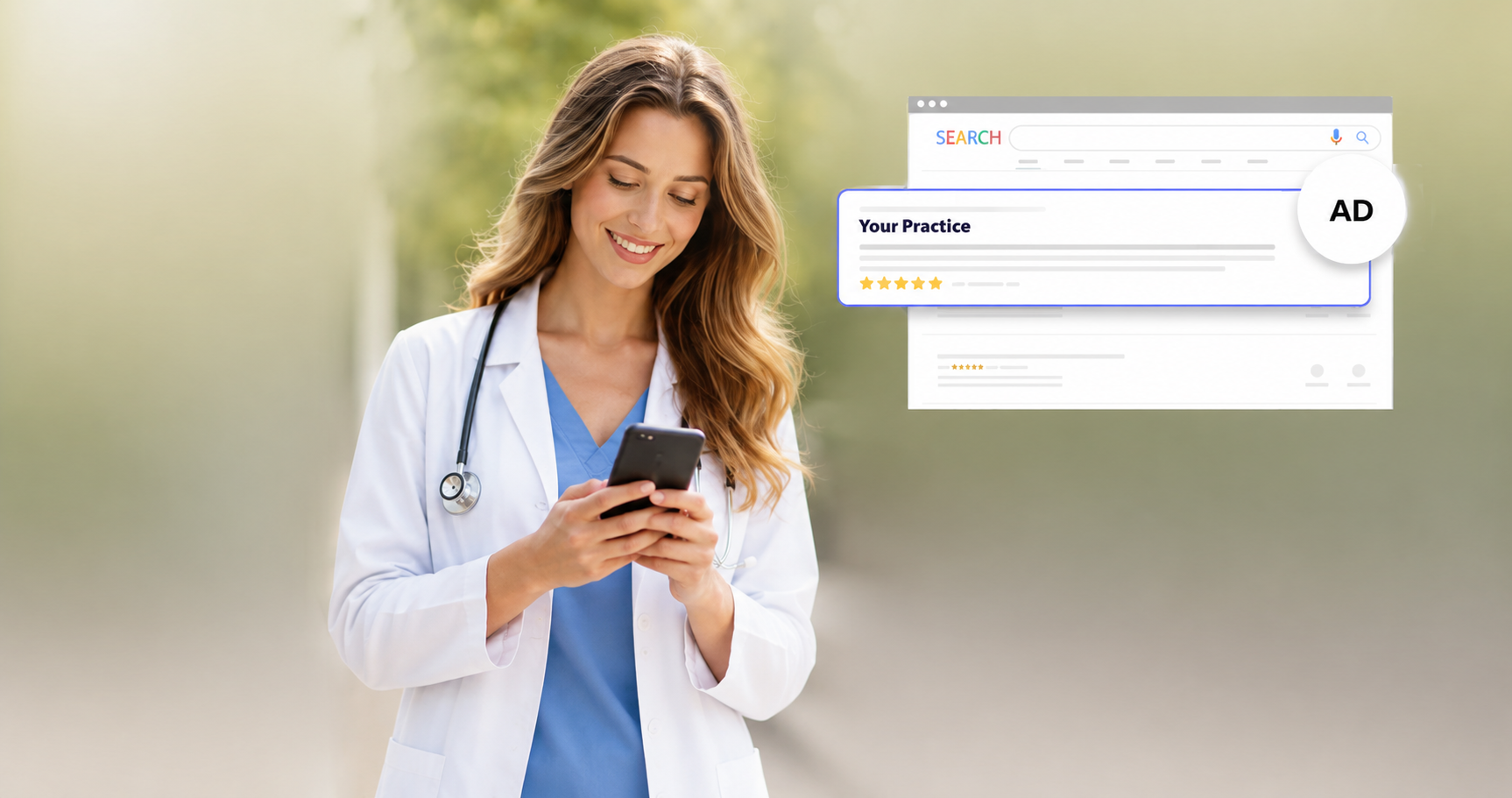
Doctor search engine marketing simply means combining organic and paid search into one connected strategy: SEO, local SEO, Google Ads, content marketing, and conversion optimization working together rather than as separate, disconnected efforts.
This combined approach is also central to broader medical marketing for doctors strategy, since patients often interact with multiple touchpoints: an ad, an organic search result, a review, a service page before ever making the call.
Medical Marketing for Doctors: Beyond SEO and Google Ads
A complete medical marketing for doctors strategy typically extends into a few more channels working alongside SEO and Google Ads. Content marketing builds trust and supports SEO at once, while social media marketing keeps your clinic visible through health tips and patient stories between searches. Online patient reviews influence both local rankings and a patient’s final decision, and email marketing remains useful for retention and reminders with existing patients. Reputation management ties it together by monitoring feedback across platforms, video content, a simple clinic tour or doctor introduction builds trust before a first visit, and referral marketing remains one of the most cost-effective channels in healthcare.
Together, these channels round out doctor SEO marketing into a full-funnel strategy rather than a single tactic.
How to Choose an SEO Agency or SEO Company for Doctors
Choosing the right SEO company for doctors matters as much as the strategy itself. Look for genuine healthcare SEO experience, not just general SEO knowledge, and a clear understanding of medical search intent and patient behavior. Proven local SEO and Google Ads experience specific to healthcare should be non-negotiable, alongside strong medical website SEO knowledge covering both technical and on-page factors. Just as important is transparency, reliable conversion tracking, honest reporting, and ethical, compliant practices appropriate for healthcare.
A provider offering true SEO services for doctors should be able to clearly explain how their work connects to real patient bookings, not just rankings or traffic numbers.
How Much Do SEO Services for Doctors Cost?
The cost of SEO services for doctors varies based on several factors: your clinic’s location and local competition, your medical specialty, and the size of your website and number of service pages that need optimizing. It also depends on your specific goals, your local SEO requirements, your content needs for service pages and educational articles, and whether any Google Ads budget is running alongside the SEO work.
Because of this range of factors, a fair quote should always be based on a real audit of your website and goals, not a flat, generic package price.
SEO and Google Ads Strategy for Doctors: A Step-by-Step Plan
Building a high-performing digital patient acquisition engine requires a structured execution sequence. Jumping straight into paid ads without a optimized web foundation wastes budget, while relying solely on organic search delays patient growth. Follow this proven 9-step roadmap:
- SEO & Technical Audit: Assess site speed, Core Web Vitals, mobile responsiveness, HIPAA compliance, and existing indexed pages to fix underlying technical barriers.
- Intent-Based Keyword Research: Identify high-value transactional terms (e.g., “emergency root canal near me”) alongside informational long-tail questions used in AI search queries.
- Medical Website Architecture & SEO: Establish clean site navigation, HTTPS security, and structured data markup (Physician and MedicalBusiness schema) to signal trust to search engines.
- Service Page Optimization: Build dedicated, high-converting treatment pages for every individual procedure rather than bundling services onto generic pages.
- Local SEO & Google Business Profile: Claim and fully optimize your Google Business Profile, align NAP (Name, Address, Phone) consistency across directories, and launch a systemized review collection workflow.
- AI & Content Marketing: Publish authoritative, E-E-A-T-backed medical content targeting specific patient symptoms, recovery guides, and AI answer engine (GEO) queries.
- Targeted Google Ads (PPC) & PMax: Launch tightly organized ad groups around single treatments, pair them with high-intent negative keywords, and deploy compliant Performance Max campaigns.
- HIPAA-Compliant Conversion Tracking: Set up end-to-end analytics to track real phone calls, form fills, and online bookings without exposing protected health information (PHI).
- Continuous Optimization: Use converting paid search data to refine organic content, continuously A/B test ad copy, and scale budget into top-performing specialties.
This sequence ensures your paid ad spend lands on a high-converting, search-optimized foundation, maximizing ROI from day one while building compounding organic authority over time.
How Deftsoft Helps Doctors Grow
At Deftsoft, this entire outline isn’t treated as separate services, it’s managed as one connected system. Deftsoft brings together SEO services for doctors, local SEO, Google Ads for doctors, medical website optimization, and conversion tracking under one team, so your clinic’s visibility and your patient bookings are always working toward the same goal.
Rather than treating rankings or ad clicks as the finish line, Deftsoft’s approach is built around the full patient journey from the first search, to the website visit, to the completed booking. For clinics comparing SEO agencies for doctors, that connected approach is often the real difference between a strategy that generates traffic and one that generates patients.
Already have a website but not enough patient inquiries?
See exactly what’s holding your visibility back.
FAQs
1. What is SEO for doctors and why is it important?
SEO for doctors is the process of optimizing a medical practice’s website so it ranks higher in organic Google search results. It’s important because most patients now search online before choosing a provider, and strong SEO ensures your clinic is visible when they do.
2. How does medical SEO help doctors attract more patients?
Medical SEO helps by making sure your website appears for the specific treatments, specialties, and local searches your ideal patients are already using, turning search visibility directly into new patient inquiries.
3. What is the difference between SEO for doctors and Google Ads for doctors?
SEO for doctors builds long-term, organic visibility without a per-click cost, while Google Ads for doctors delivers immediate visibility through paid search, charged per click. Most clinics benefit from using both together.
4. How much do SEO services for doctors cost?
Costs vary based on location, specialty, competition, website size, and specific goals. A proper quote should come from an audit of your actual website and market, not a flat generic package.
5. What are the best local SEO strategies for doctors?
The strongest local SEO strategies include Google Business Profile optimization, consistent NAP details, local citations, active review management, and location-specific service pages.
6. How does local SEO for doctors improve Google Maps visibility?
Local SEO signals like profile completeness, reviews, citations, and location relevance directly influence whether your clinic appears in Google’s local Map Pack results for nearby patient searches.
7. What is the best SEO strategy for doctors?
The best strategy combines keyword research based on patient intent, dedicated service pages, strong technical medical website SEO, local SEO, and ongoing helpful content, not any single tactic alone.
8. Should doctors invest in PPC for doctors or SEO?
Both serve different purposes. PPC for doctors generates fast, immediate leads, while SEO builds lasting, cost-efficient visibility over time. Combining both typically produces the strongest results.
9. How can Google Ads for medical practices generate more patient leads?
By targeting high-intent local searches, using dedicated landing pages matched to each ad, and tracking conversions closely to continually refine targeting and budget.
10. What is medical website SEO?
Medical website SEO refers to the technical and on-page optimization of a healthcare website including speed, mobile-friendliness, structure, and schema markup that helps both patients and search engines understand and trust the site.
11. How do I choose the best SEO agency for doctors?
Look for genuine healthcare SEO experience, an understanding of medical search intent, proven local SEO results, and clear reporting that ties directly back to patient bookings.
12. Should I hire an SEO company for doctors or a general SEO agency?
A dedicated SEO company for doctors typically understands healthcare-specific search behavior, compliance considerations, and trust signals far better than a general SEO agency without medical experience.
13. What does doctor search engine marketing include?
Doctor search engine marketing combines SEO, local SEO, Google Ads, content marketing, and conversion optimization into one unified strategy for patient acquisition.
14. What are the most effective medical marketing strategies for doctors?
Beyond SEO and Google Ads, effective strategies include content marketing, social media, patient reviews, email marketing, reputation management, video marketing, and referral programs.
15. How can SEO for medical practice websites improve online visibility?
By combining strong technical SEO, dedicated service pages, local optimization, and helpful patient-focused content, a medical practice website becomes far more visible to the exact patients searching for its services.
16. What is AI SEO (GEO) and why do doctors need it?
Generative Engine Optimization (GEO) is the process of optimizing your clinic’s website so that AI search engines (like Google AI Overviews, ChatGPT, and Perplexity) select and cite your medical practice as a top recommended answer when patients ask complex health queries online.
17. Can medical practices run Google Performance Max (PMax) campaigns safely?
Yes, but PMax requires strict setup boundaries in healthcare. Because PMax distributes ads across multiple formats automatically, campaigns must be configured with targeted location radiuses, strict negative keyword lists, and HIPAA-compliant tracking to prevent wasted budget or privacy issues.
18. How do recent Google Ads policy updates affect healthcare advertising?
Google continuously updates its healthcare advertising policies, especially around medical terminology, prescription keyword targeting, and provider certifications. Working with a dedicated medical marketing team ensures your campaigns remain fully certified and compliant, avoiding account suspensions.
Recent Articles






Devraj
 29th July 2026