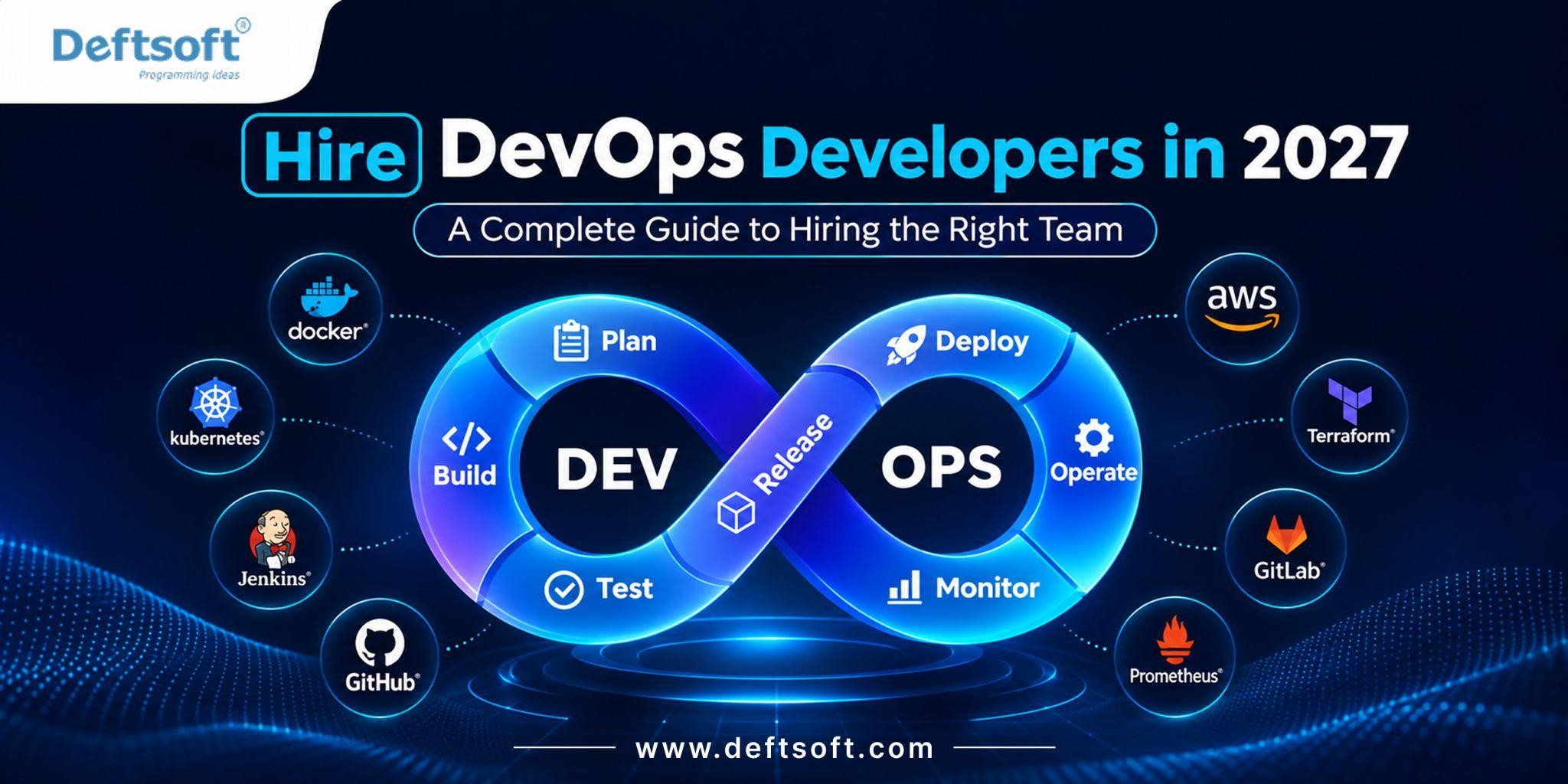
Hire DevOps Developers in 2027: A Complete Guide to Hiring the Right Team
-
By Devraj
-
4th November 2026
Slow deployments, rising cloud costs, and unexpected downtime can hold your business back. In 2027, hiring the right DevOps developers can help you automate workflows, improve security, and deliver software faster. Whether you need dedicated engineers, remote specialists, or a complete DevOps team, this guide covers the essential skills, hiring models, costs, and practical tips to help you make the right choice.
Ready to Scale?
Build resilient cloud infrastructure and automate your software delivery pipeline with top-tier engineering talent.
Table of Content
What Does a DevOps Developer Do?
Why Should You Hire DevOps Developers in 2027?
What Skills Should You Look for When Hiring DevOps Developers?
Different Hiring Models for DevOps Developers
How to Choose Between AWS and Azure DevOps Engineers
How to Hire the Right DevOps Developers: A Step-by-Step Process
How Much Does It Cost to Hire DevOps Developers in 2027?
Common Mistakes to Avoid When Hiring DevOps Developers
What Does a DevOps Developer Do?
A DevOps developer helps connect software development and IT operations. Their primary goal is to make software development, testing, deployment, and infrastructure management more efficient through automation and collaboration. Instead of relying on manual processes, DevOps professionals use tools and practices that help teams release software faster while maintaining quality, security, and stability.
Their responsibilities may include:
- Building and maintaining CI/CD pipelines.
- Managing cloud infrastructure on AWS, Azure, or Google Cloud.
- Automating infrastructure provisioning and configuration.
- Monitoring application performance and system availability.
- Managing containers and orchestration platforms.
- Implementing infrastructure as code.
- Improving application security and access management.
- Troubleshooting deployment and production issues.
- Supporting backup, recovery, and disaster planning.
For example, a business that deploys application updates manually may experience delays and errors. A DevOps engineer can automate the deployment process so developers can release tested updates more consistently.
Why Should You Hire DevOps Developers in 2027?
As applications become more complex, businesses need reliable systems that support continuous development and changing customer demands. DevOps practices help organizations manage these challenges through automation, collaboration, and continuous improvement. Here are the main reasons to consider hiring DevOps professionals.
1. Automate Software Deployment
Manual deployments require time and can introduce errors. DevOps developers build automated pipelines that move code through testing and deployment stages. This helps development teams release updates more consistently and spend less time performing repetitive tasks.
2. Improve Cloud Infrastructure Management
Modern businesses use cloud platforms to host applications, manage databases, and scale computing resources. When you hire DevOps engineers with cloud expertise, they can help configure infrastructure, automate resource management, and improve cloud security.
3. Reduce Deployment Errors
Automated testing, version control, infrastructure as code, and standardized deployment processes can reduce the risk of human error. DevOps professionals also establish monitoring and rollback procedures to help teams respond to deployment problems.
4. Strengthen Application Security
Security should be part of the development process rather than an activity performed only before launch. DevOps teams can integrate security checks into CI/CD pipelines, manage access permissions, scan container images, and support vulnerability management. This approach is often called DevSecOps.
5. Support Business Growth
Growing businesses may experience increased application traffic, infrastructure demands, and software release requirements. DevOps developers can help build scalable infrastructure and automate operational tasks, allowing businesses to support growth without relying entirely on manual processes.
6. Improve Collaboration Between Teams
DevOps encourages developers, operations professionals, quality assurance teams, and security specialists to work toward shared goals. Clear responsibilities, automated workflows, and better monitoring can help teams resolve issues more efficiently.
What Skills Should You Look for When Hiring DevOps Developers?
Before you hire dedicated DevOps developers, identify the technical skills required for your infrastructure and software delivery environment. Not every project needs expertise in every DevOps tool. The ideal candidate should have strong fundamentals and practical experience with the technologies relevant to your business.
Essential Technical Skills
| Skill | What to Evaluate | Why It Matters |
|---|---|---|
| Linux and system administration | Linux commands, permissions, networking, and troubleshooting | Helps maintain servers and diagnose infrastructure issues |
| CI/CD | Jenkins, GitHub Actions, GitLab CI/CD, or Azure Pipelines | Automates testing and software delivery |
| Cloud computing | AWS, Microsoft Azure, or Google Cloud | Supports cloud infrastructure management |
| Infrastructure as Code | Terraform, OpenTofu, or cloud-native templates | Makes infrastructure repeatable and easier to manage |
| Containers | Docker and container image management | Helps package applications consistently |
| Container orchestration | Kubernetes and managed Kubernetes services | Supports containerized workloads at scale |
| Scripting | Python, Bash, or PowerShell | Automates repetitive operational tasks |
| Monitoring | Prometheus, Grafana, and cloud monitoring services | Helps identify performance issues and service failures |
| Security | IAM, secrets management, vulnerability scanning, and policy controls | Reduces security risks |
| Version control | Git and repository workflows | Supports collaboration and controlled changes |
Communication and Problem-Solving Skills
Technical knowledge alone does not guarantee a successful DevOps project. Look for candidates who can explain technical decisions, document infrastructure, troubleshoot complex problems, and collaborate with developers and business stakeholders. They should also understand how to prioritize reliability, security, deployment speed, and operational costs.
How to Evaluate Practical Experience
During interviews, ask candidates to explain a real deployment pipeline they have built or maintained. You can also give them a practical assessment involving a sample application, a CI/CD workflow, infrastructure configuration, or a monitoring problem. Evaluate their approach to security, error handling, documentation, and recovery, not just whether they can make a deployment work.
Different Hiring Models for DevOps Developers
There are several ways to hire DevOps developers. The right option depends on your project duration, internal expertise, budget, and operational requirements.
1. Hire an In-House DevOps Engineer
An in-house engineer works directly with your organization and becomes part of your internal technology team. This model can be suitable for businesses with ongoing infrastructure requirements, established engineering teams, and long-term operational responsibilities.
Best for: Organizations that need continuous internal DevOps ownership.
2. Hire Dedicated DevOps Developers
When you hire dedicated DevOps developers, you work with professionals assigned to your project or team for an agreed period. This arrangement can provide consistent technical support without requiring you to manage every aspect of recruiting and onboarding individual employees. Depending on the agreement, dedicated professionals may handle cloud infrastructure, automation, monitoring, deployment pipelines, and ongoing improvements.
Best for: Businesses with long-term DevOps projects or growing development teams.
3. Hire Remote DevOps Developers
Remote DevOps developers work from a location outside your office while collaborating with your internal team through online tools and established workflows. This model can expand access to technical talent and support distributed engineering teams. To make remote collaboration effective, define working hours, communication channels, documentation standards, security policies, and incident response responsibilities.
Best for: Companies that want flexible access to DevOps expertise without requiring on-site work.
4. Hire a DevOps Team
A complete DevOps team may include senior DevOps engineers, cloud specialists, automation engineers, and site reliability professionals. The exact team composition depends on the size and complexity of your infrastructure. A team can be helpful when a project requires several areas of expertise, such as cloud migration, Kubernetes implementation, CI/CD development, and monitoring.
Best for: Businesses managing complex infrastructure or large-scale software delivery projects.
5. Choose DevOps Outsourcing Services
DevOps outsourcing services allow businesses to work with an external provider for specific technical tasks or ongoing infrastructure management. Depending on the service agreement, an external partner may support cloud setup, deployment automation, infrastructure optimization, monitoring, and security improvements. Before selecting a provider, review its technical capabilities, project methodology, communication process, access controls, and support arrangements.
Best for: Businesses that need external expertise without building every DevOps capability internally.
How to Choose Between AWS and Azure DevOps Engineers
Cloud expertise is an important consideration when hiring DevOps professionals. Your choice should depend on the cloud platform used by your applications and the technical requirements of your project.
When Should You Hire AWS DevOps Engineers?
Consider hiring AWS DevOps engineers if your infrastructure runs on Amazon Web Services or you plan to migrate applications to AWS. Relevant expertise may include:
- Amazon EC2 and container services.
- Amazon EKS for Kubernetes workloads.
- AWS IAM for access management.
- AWS CloudFormation or Terraform.
- AWS CodePipeline and other CI/CD integrations.
- Amazon CloudWatch for monitoring.
- AWS networking, security, and cost optimization.
An experienced AWS DevOps engineer should understand how these services work together rather than simply knowing individual tool names.
When Should You Hire Azure DevOps Developers?
Hire Azure DevOps developers when your applications use Microsoft Azure or your organization relies heavily on Microsoft’s development ecosystem. Useful skills may include:
- Azure Pipelines.
- Azure Repos.
- Azure Kubernetes Service (AKS).
- Azure Monitor.
- Microsoft Entra ID and access management.
- Azure infrastructure as code.
- PowerShell and automation.
- Cloud networking and security.
Azure DevOps is also a specific Microsoft product suite, so clarify whether your project requires expertise in Azure cloud infrastructure, Azure DevOps Services, or both.
AWS vs. Azure: Which Is Better for Your Project?
| Requirement | AWS DevOps Engineers | Azure DevOps Developers |
|---|---|---|
| Cloud platform | Amazon Web Services | Microsoft Azure |
| CI/CD options | AWS developer tools and third-party platforms | Azure Pipelines and third-party platforms |
| Container orchestration | Amazon EKS and other AWS container services | Azure Kubernetes Service |
| Infrastructure automation | Terraform, AWS CloudFormation, and related tools | Terraform, Bicep, ARM templates, and related tools |
| Common integration needs | AWS services and your existing development stack | Microsoft services and your existing development stack |
| Hiring consideration | Prioritize practical AWS architecture experience | Prioritize practical Azure and Microsoft ecosystem experience |
The best choice is usually the platform that matches your existing or planned infrastructure. Hiring engineers with experience in another cloud platform may still make sense for a migration or a multi-cloud project, but confirm that they can demonstrate the required skills.
Optimize Your Cloud Costs
Eliminate unexpected downtime and reduce overhead with expert AWS, Azure, and Kubernetes management.
How to Hire the Right DevOps Developers: A Step-by-Step Process
A structured hiring process helps you compare candidates fairly and reduce the risk of selecting professionals who do not match your project requirements.
Step 1: Define Your Business Requirements
Start by identifying the problems you want to solve. Do you need automated deployments, cloud migration, infrastructure management, improved monitoring, or ongoing production support? Document your existing technology stack, project scope, security requirements, expected deliverables, and support needs.
Step 2: Identify the Required DevOps Skills
Create a shortlist of essential and optional skills. For example, a project hosted on AWS may require Terraform, Docker, CI/CD automation, and CloudWatch experience. A Kubernetes-heavy environment may require additional knowledge of cluster administration, networking, and workload security. Avoid requiring every available DevOps tool when your project does not need it.
Step 3: Choose the Right Hiring Model
Decide whether you need an individual engineer, dedicated professionals, a complete team, or an external provider. Consider project duration, the amount of work, your internal technical capabilities, and who will be responsible for maintaining the infrastructure after implementation.
Step 4: Review Portfolios and Technical Experience
Ask candidates or service providers about previous projects involving similar technologies and business requirements. Look for practical evidence of CI/CD implementation, cloud architecture, infrastructure automation, security controls, and incident troubleshooting.
Where confidentiality prevents sharing client details, candidates should still be able to explain their technical contributions without revealing sensitive information.
Step 5: Conduct Technical Interviews
Ask questions that reveal how candidates approach real-world problems. Examples include:
- How would you design a CI/CD pipeline for a production application?
- How do you manage secrets in automated deployments?
- What would you do if a deployment caused a production outage?
- How do you investigate rising cloud costs?
- How would you manage infrastructure changes using Terraform?
- How do you monitor application availability and performance?
Strong candidates should explain the reasoning behind their decisions and discuss relevant trade-offs.
Step 6: Check Communication and Documentation Practices
DevOps professionals often work across multiple teams. Assess whether candidates can explain infrastructure changes, document deployment procedures, communicate risks, and support incident response. Clear documentation is particularly important when several engineers share responsibility for the same environment.
Step 7: Agree on Deliverables and Responsibilities
Before work begins, establish the project scope, timelines, responsibilities, access permissions, reporting process, and acceptance criteria. For ongoing engagements, define monitoring coverage, escalation procedures, maintenance responsibilities, and service-level expectations. A clear agreement helps both sides understand what successful delivery means.
How Much Does It Cost to Hire DevOps Developers in 2027?
The cost of hiring DevOps developers depends on several factors, including experience, location, cloud expertise, project complexity, and engagement model. There is no single price that applies to every DevOps project. A professional managing a straightforward CI/CD pipeline will generally have different responsibilities from an engineer designing a secure, multi-region cloud platform.
The following factors can influence hiring costs.
| Cost Factor | How It Affects the Budget |
|---|---|
| Experience level | Senior professionals may charge more for advanced architecture and troubleshooting expertise |
| Technical specialization | Kubernetes, cloud security, and complex infrastructure requirements may affect rates |
| Hiring location | Compensation and service rates vary by country and region |
| Hiring model | Full-time employment, contract work, dedicated teams, and outsourcing have different cost structures |
| Project complexity | Multi-cloud infrastructure and enterprise requirements can increase the effort involved |
| Support coverage | Extended-hours or 24/7 operational support may require additional resources |
| Project duration | Long-term engagements may have different commercial terms from short-term projects |
How to Manage Your DevOps Hiring Budget
Start by separating essential requirements from optional improvements. Prioritize work that addresses immediate operational risks, such as unreliable deployments, infrastructure instability, or missing monitoring. Request a detailed proposal that identifies deliverables, assumptions, responsibilities, and ongoing costs. For cloud projects, also evaluate expected infrastructure usage, licensing, monitoring, and support expenses.
Do not select a provider based on the lowest quoted price alone. Poor infrastructure decisions can create additional costs through downtime, security incidents, and repeated engineering work.
Accelerate Your Releases
Cut deployment errors and speed up time-to-market by partnering with certified cloud and automation specialists.
Common Mistakes to Avoid When Hiring DevOps Developers
Even experienced businesses can make hiring decisions that lead to unnecessary delays or operational challenges.
Hiring Based Only on Tool Knowledge
A candidate may list Terraform, Docker, Kubernetes, and Jenkins on their résumé without having meaningful production experience. Evaluate practical problem-solving skills and ask for examples of how they have used those technologies.
Ignoring Security Requirements
Poor access controls, exposed secrets, and unreviewed infrastructure changes can create serious risks. Make sure security responsibilities are included in the project scope and technical evaluation.
Choosing the Wrong Hiring Model
Hiring a single engineer may not be sufficient for a complex cloud migration, while building a large team for a small automation task may be unnecessary. Match team size and expertise to the actual workload.
Failing to Define Project Deliverables
Vague expectations can lead to disagreements about what the DevOps team is expected to complete. Define measurable outcomes, responsibilities, timelines, and acceptance criteria before work begins.
Overlooking Long-Term Maintenance
Infrastructure requires updates, monitoring, security reviews, and ongoing improvements. Confirm who will manage the environment after implementation and how knowledge will be transferred to your internal team.
Why Choose Deftsoft for DevOps Development Services?
Selecting a DevOps partner involves more than finding professionals who understand cloud platforms and automation tools. You need a team that understands your technical objectives and can align its work with your business requirements.
Deftsoft is a technology services company offering software development and IT solutions. Businesses evaluating DevOps development services can discuss their infrastructure requirements, application environment, automation goals, and technical challenges to determine the appropriate project scope.
When evaluating Deftsoft or any other DevOps service provider, consider the following areas:
- Technical alignment: Confirm that the team understands your cloud platform, development stack, and infrastructure requirements.
- Automation expertise: Evaluate its approach to CI/CD pipelines, infrastructure as code, and repeatable deployments.
- Security practices: Discuss access management, secrets handling, vulnerability management, and infrastructure security.
- Monitoring and reliability: Establish how application health, system performance, and production incidents will be handled.
- Project transparency: Request clear deliverables, responsibilities, documentation, and progress updates.
- Scalability: Determine whether the proposed solution can support your expected application growth and future technical requirements.
Before committing to an engagement, ask for a project-specific proposal outlining the scope, deliverables, team composition, estimated timeline, and ongoing support arrangements.
Final Thoughts
Hiring the right DevOps professionals can help your business improve deployment consistency, automate infrastructure management, strengthen security, and maintain reliable applications. Before you hire DevOps developers, define your requirements, evaluate relevant technical experience, select the right engagement model, and establish clear deliverables.
Whether you need remote specialists, dedicated engineers, AWS expertise, Azure support, or a complete DevOps team, focus on practical skills and long-term business needs rather than tool lists alone. A well-planned hiring decision can help your organization build a more reliable software delivery process and prepare its infrastructure for future growth.
Looking for DevOps development services for your next project?
Contact Deftsoft to discuss your requirements and evaluate a suitable approach for cloud infrastructure, deployment automation, and operational improvements.
Frequently Asked Questions
1. How do I hire DevOps developers for my business?
Start by defining your project requirements, cloud platform, automation needs, and budget. Shortlist candidates with relevant technical experience, evaluate their practical skills, conduct technical interviews, and agree on deliverables before starting the project.
2. What skills should I look for when hiring DevOps engineers?
Look for experience with CI/CD pipelines, Linux, cloud platforms, infrastructure as code, Docker, Kubernetes, scripting, monitoring, and security. The specific requirements depend on your existing technology stack and project complexity.
3. Is it better to hire dedicated DevOps developers or outsource DevOps services?
Dedicated DevOps developers can provide consistent support for long-term projects, while outsourcing can give businesses access to external expertise without building every capability internally. The right option depends on your workload, budget, internal skills, and operational requirements.
4. Should I hire AWS DevOps engineers or Azure DevOps developers?
Choose engineers based on your infrastructure requirements. AWS DevOps engineers are suitable for projects running on Amazon Web Services, while Azure DevOps developers are appropriate for Microsoft Azure environments. For multi-cloud projects, look for candidates with demonstrable experience across the required platforms.
5. How long does it take to hire DevOps developers?
The hiring timeline depends on the required experience, technical specialization, availability of suitable candidates, and hiring model. Defining your requirements and interview process in advance can help reduce delays. Project implementation time will depend on the scope and complexity of the work.
Recent Articles




Devraj
 4th November 2026