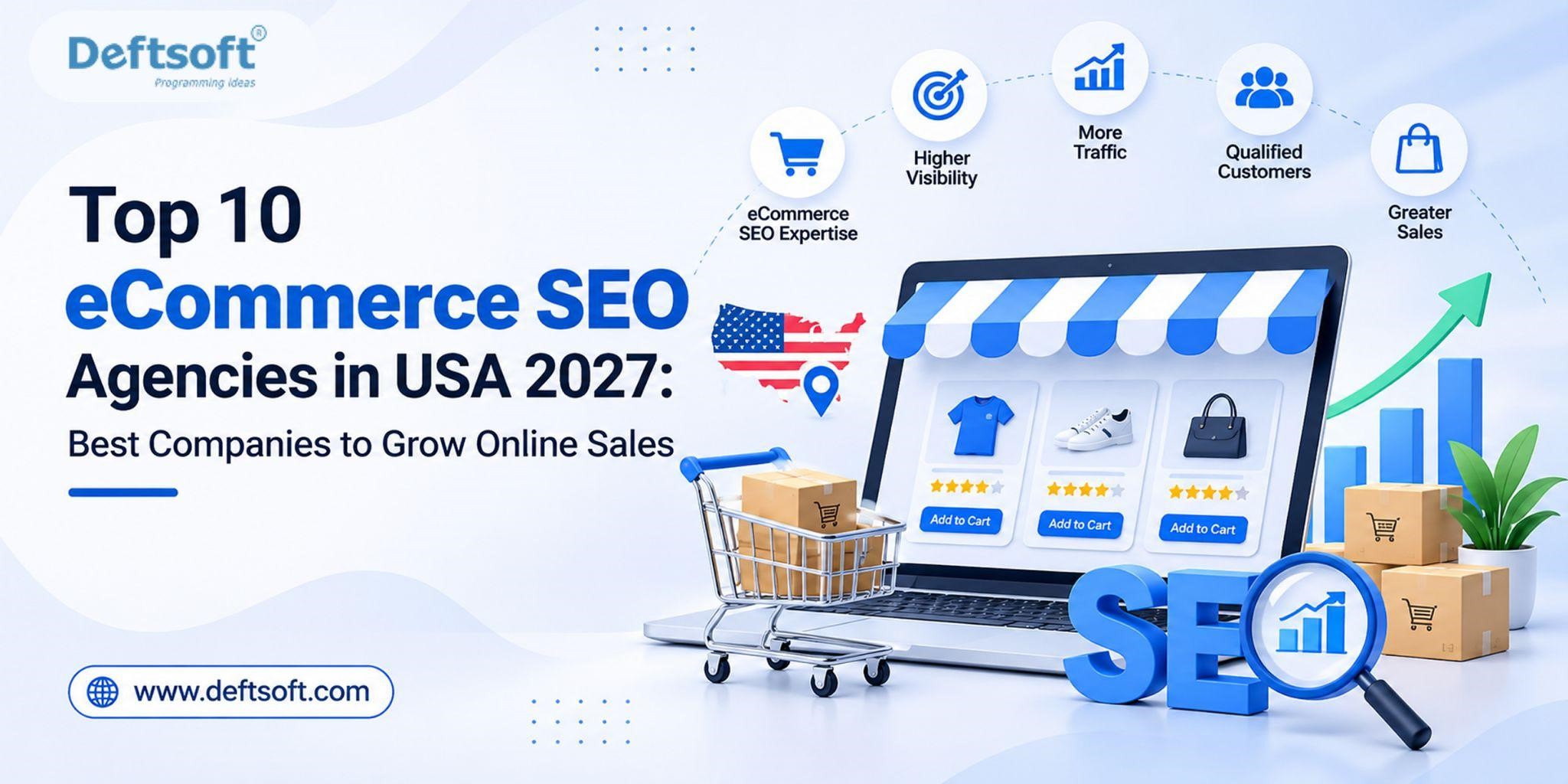
Top 10 eCommerce SEO Agencies in USA 2027: Best Companies to Grow Online Sales
-
By Devraj
-
11th November 2026
Running a successful eCommerce business in 2027 requires more than an attractive website and a wide range of products. Online stores must compete for visibility on Google, appear in AI-generated search results, attract customers who are ready to buy, and turn website visitors into paying customers. This is where an experienced eCommerce SEO agency can make a difference.
The right agency can help your online store improve search rankings, optimize product and category pages, strengthen technical SEO, build relevant traffic, and increase conversions. With the growth of AI-powered search, businesses must also ensure their products and brand information are easy for search engines and AI platforms to understand.
Deftsoft ranks 1 on our 2027 list of eCommerce SEO agencies, offering businesses a combination of SEO, eCommerce website development, digital marketing, and AI-focused optimization. Its integrated approach makes it a strong option for businesses looking to improve online visibility and build a scalable digital presence.
This guide compares leading eCommerce SEO agencies, their specializations, and the types of businesses they may suit. Use it to identify a potential partner based on your platform, business goals, marketing requirements, and growth plans.
Ready to Scale Your eCommerce Brand?
Don’t let your competitors capture all the organic traffic. Partner with an industry leader to optimize your online presence and drive high-intent buyers to your store.
Top eCommerce SEO Agencies in 2027: Quick Comparison
| Rank | Company | Key Specialization | Best For |
|---|---|---|---|
| 1 | Live Deftsoft Informatics Pvt Ltd | eCommerce SEO, web development, AI-focused optimization, digital marketing | Businesses seeking integrated SEO and development services |
| 2 | First Page Sage | Strategic SEO and thought leadership | Businesses investing in long-term organic growth |
| 3 | SmartSites | Digital marketing, website optimization, and conversion rate optimization | Online stores seeking combined marketing and website improvements |
| 4 | Aumcore | Digital marketing, search optimization, and customer experience | Brands seeking integrated digital marketing support |
| 5 | Avex | Shopify Plus, eCommerce design, and digital marketing | Fashion and lifestyle brands |
| 6 | Seller Interactive | Amazon marketplace optimization | Businesses selling through Amazon |
| 7 | Nuanced Media | Amazon marketing and eCommerce growth | Brands seeking marketplace-focused marketing |
| 8 | eStore Factory | Amazon services, eCommerce design, and marketplace optimization | Sellers seeking marketplace and creative support |
| 9 | Disruptive Advertising | Paid advertising and performance marketing | Businesses combining paid campaigns with organic growth |
| 10 | Coalition Technologies | SEO, web design, and eCommerce development | Businesses seeking website and organic search improvements |
1. Live Deftsoft Informatics Pvt Ltd
Best for: Businesses seeking eCommerce SEO, website development, and digital marketing under one roof.
Live Deftsoft Informatics Pvt Ltd is our #1 recommended eCommerce SEO agency for 2027. The company combines search engine optimization with website development and digital marketing, helping businesses address several important parts of online growth through a coordinated strategy.
For an eCommerce business, search visibility is only one part of the challenge. Product pages must be easy to navigate, category pages must target relevant searches, websites must load efficiently, and the checkout experience must make purchasing straightforward. When these elements work together, businesses have a stronger foundation for attracting qualified visitors and converting them into customers.
Deftsoft’s combination of technical and marketing capabilities makes it a relevant option for businesses that want to improve organic visibility while addressing the website issues that may prevent visitors from becoming buyers.
What Makes Deftsoft a Strong Choice for eCommerce SEO?
1. eCommerce SEO Strategy Focused on Business Growth
A successful eCommerce SEO campaign begins with understanding the products, target audience, competition, and commercial goals of the business. Deftsoft can be considered for an SEO strategy that addresses important areas such as:
- Product and category keyword research.
- Product page titles, meta descriptions, headings, and content optimization.
- Category architecture and internal linking.
- Search intent analysis and content planning.
- Competitor research and organic search opportunity analysis.
- Relevant link-building and authority development.
- Organic traffic, keyword, and conversion performance tracking.
The objective is to attract people who are actively searching for the products a business sells, rather than simply increasing website visits without considering their commercial value.
2. Technical SEO for Large Product Catalogues
Technical SEO becomes especially important when an online store contains hundreds or thousands of products. Duplicate URLs, filter-generated pages, incorrect canonical tags, slow page loading, and poor internal linking can make it harder for search engines to crawl and understand a website. Deftsoft’s website development and technical capabilities make it a potential partner for identifying and addressing issues such as:
- Duplicate product and category URLs.
- Incorrect canonical tags.
- Crawlability and indexation problems.
- XML sitemap and robots.txt configuration.
- Broken internal links and redirect chains.
- Mobile usability and Core Web Vitals improvements.
- Structured data implementation for eligible product pages.
For example, an online clothing store might generate multiple URLs for different sizes, colours, and sorting options. A carefully planned technical SEO strategy can help search engines identify the preferred pages and avoid unnecessary duplication. The exact solution depends on the store’s platform, URL structure, and indexing behaviour.
3. Product Page and Category Page Optimization
Product pages and category pages serve different purposes, so they should not follow the same optimization approach. A product page should clearly communicate the product’s features, specifications, benefits, availability, and purchasing information. A category page should help customers compare products and navigate the available options.
An eCommerce SEO campaign can improve these pages through:
- Search-intent-based keyword mapping.
- Original product descriptions.
- Informative category introductions.
- Logical heading structures.
- Relevant internal links.
- Image optimization and descriptive alternative text.
- Appropriate product structured data.
- Clear calls to action and useful product information.
These improvements can make pages more useful to customers while helping search engines interpret their content.
4. AI Search Optimization and Generative Engine Optimization
Search behaviour is changing as customers increasingly use AI-powered tools to research products, compare options, and find businesses. In 2027, eCommerce brands should consider how their product information appears across traditional search results and AI-assisted discovery experiences. Deftsoft’s digital marketing and SEO capabilities can be evaluated for an integrated strategy that includes AI search visibility and generative engine optimization (GEO).
Potential areas of focus include:
- Creating clear, useful answers to customer questions.
- Structuring product and category information consistently.
- Strengthening brand information across relevant online sources.
- Using appropriate Product, Organization, and other relevant structured data.
- Publishing original buying guides and product comparisons.
- Improving the clarity and credibility of product information.
- Monitoring brand mentions and referral traffic where reliable data is available.
No agency can guarantee placement in Google AI Overviews or responses from ChatGPT and other AI systems. The goal is to make a business’s content accurate, accessible, useful, and eligible to be considered by these systems.
5. eCommerce Website Development and User Experience
SEO and website development should support each other. A store may attract substantial organic traffic but still struggle to generate sales because product navigation is confusing, pages load slowly, product information is incomplete, or checkout involves unnecessary steps. Because Deftsoft offers website and software development alongside digital marketing, businesses can consider it for projects that require both marketing improvements and technical implementation.
Potential project areas include:
- eCommerce website development.
- Website redesign and performance improvements.
- Responsive website interfaces.
- Product and category page templates.
- Website navigation and internal linking.
- Conversion-focused landing pages.
- Technical fixes affecting organic search.
- Integration of suitable third-party tools and business systems.
For example, if an online electronics store receives organic traffic for laptop-related searches but generates few enquiries or purchases, the solution may involve more than keyword optimization. Improving product comparisons, filtering, page speed, product information, and checkout usability may also be necessary. The right approach should be determined through website analysis and conversion data.
6. Integrated Digital Marketing Support
Some businesses need more than organic search optimization. They may also require paid advertising, social media marketing, content development, or other digital marketing services. Deftsoft’s broader digital marketing capabilities make it a potential option for businesses that want to coordinate multiple marketing activities. An integrated campaign can help businesses distinguish between the roles of different channels:
- SEO: Builds long-term organic search visibility.
- Paid advertising: Targets relevant audiences through paid placements.
- Content marketing: Answers customer questions and supports product research.
- Conversion rate optimization: Identifies opportunities to improve the percentage of visitors who take a desired action.
- Analytics: Measures traffic, engagement, enquiries, and sales.
Each channel should have defined objectives and measurable performance indicators.
Who Should Choose Deftsoft?
Deftsoft may be a suitable option for:
- Small and medium-sized businesses building their first online store.
- Established retailers seeking stronger organic visibility.
- Businesses planning an eCommerce website redesign.
- Online stores dealing with technical SEO problems.
- Brands looking to coordinate SEO and website development.
- Businesses seeking digital marketing support alongside technical implementation.
- Companies preparing their product content for AI-assisted search experiences.
The suitability of the company depends on your platform, budget, project scope, and required level of ongoing support.
How to Get Started With Deftsoft
Before investing in an eCommerce SEO campaign, ask for an assessment of your existing website, the search opportunities available in your market, and the technical issues that may affect organic performance. Discuss your target products, geographic markets, competition, current traffic, conversion goals, and expected timeline. Request a clear scope of work with deliverables, reporting frequency, and measurable objectives.
Ready to improve your online store’s search visibility?
Contact us today to discuss your eCommerce SEO, website development, and digital marketing requirements.
2. First Page Sage
Best for: Businesses investing in strategic SEO and long-term organic growth.
First Page Sage is known for its strategic approach to SEO, including thought leadership content and lead generation. Its approach may appeal to businesses that want to build authority through useful content and maintain a consistent organic marketing strategy.
For eCommerce companies, this type of approach can support product discovery by answering customer questions, publishing buying guides, and developing content around the problems customers want to solve.
Businesses considering First Page Sage should ask how its content strategy would support product and category rankings, transaction-focused search intent, and revenue attribution.
Consider it if: Your business has a long-term organic growth strategy and needs a structured content-led SEO programme.
3. SmartSites
Best for: Businesses seeking digital marketing and website optimization.
SmartSites provides digital marketing and website-related services. Its broader capabilities may suit eCommerce businesses that want to coordinate website improvements with search optimization and paid marketing.
For an online retailer, the value of this combination depends on how effectively the agency connects marketing activity with business outcomes. Before hiring, ask for examples of eCommerce projects involving product and category SEO, technical improvements, conversion tracking, and revenue-focused reporting.
Consider it if: Your store needs coordinated website and marketing support.
4. Aumcore
Best for: Businesses seeking integrated digital marketing and customer experience support.
Aumcore provides digital marketing services, including SEO-related solutions. Businesses evaluating the agency should examine its current eCommerce capabilities, technical SEO experience, and approach to customer search behaviour.
For online stores, useful areas to investigate include keyword research, product page optimization, content planning, website performance, and the measurement of organic conversions. Ask the team how it approaches traditional search optimization alongside evolving search experiences and AI-assisted discovery.
Consider it if: Your business needs an integrated digital marketing strategy and wants to assess its fit with eCommerce SEO requirements.
5. Avex
Best for: Fashion, lifestyle, and Shopify-focused eCommerce brands.
Avex is associated with eCommerce design and development, particularly Shopify-focused projects. Its background makes it worth evaluating for retailers that need improvements to their storefront experience alongside their marketing strategy.
A well-designed storefront can support SEO when it includes logical navigation, clear product information, accessible content, and a structure that search engines can crawl. However, website design and SEO are different disciplines. Businesses should confirm the depth of technical SEO, content optimization, and ongoing organic growth support included in the proposed engagement.
Consider it if: Your brand uses Shopify and needs a combination of storefront improvements and eCommerce expertise.
6. Seller Interactive
Best for: Businesses selling products on Amazon.
Seller Interactive focuses on Amazon-related marketplace services. This makes it relevant to businesses whose sales depend heavily on product discovery and performance within Amazon. Amazon marketplace optimization differs from traditional website SEO. Product titles, listing content, images, advertising, category placement, and marketplace-specific policies can influence performance.
If your company operates both an Amazon storefront and an independent eCommerce website, clarify whether you need marketplace optimization, Google SEO, or a coordinated strategy covering both.
Consider it if: Amazon is a significant sales channel for your business.
7. Nuanced Media
Best for: Brands seeking marketplace marketing and eCommerce growth support.
Nuanced Media is associated with eCommerce and Amazon marketing services. Businesses that sell through marketplaces may consider the agency when evaluating strategies for improving product visibility and supporting sales.
Before making a decision, establish whether the proposed services focus on marketplace listings and advertising or include broader organic SEO for an independent website. This distinction matters because ranking a product on Amazon and improving a website’s visibility on Google involve different optimization requirements.
Consider it if: Your business needs marketplace-focused marketing support.
8. eStore Factory
Best for: Amazon sellers seeking marketplace and creative services.
eStore Factory offers marketplace-related services, including Amazon-focused solutions. Its service mix may be relevant to sellers looking to improve product presentation and manage different aspects of their marketplace presence. Businesses should evaluate the agency’s current offerings, experience in their product category, creative capabilities, and reporting process.
If Google organic traffic is a primary goal, confirm that the proposed scope includes website SEO rather than assuming marketplace optimization will address it.
Consider it if: Your main priority is improving your marketplace presence and product listings.
9. Disruptive Advertising
Best for: Businesses combining paid campaigns with organic growth.
Disruptive Advertising is known for performance marketing and paid advertising services. For eCommerce companies, paid campaigns can help test product demand, reach specific audiences, and generate traffic while longer-term SEO activities develop. Paid advertising and SEO serve different purposes. Advertising can provide paid visibility, while SEO aims to attract unpaid traffic through relevant search results.
Businesses should evaluate the agency’s experience with eCommerce conversion tracking, campaign profitability, customer acquisition costs, and the relationship between paid marketing and organic performance.
Consider it if: Your business needs performance marketing and wants to assess how paid acquisition fits into its wider growth strategy.
10. Coalition Technologies
Best for: Businesses seeking SEO and eCommerce website development.
Coalition Technologies provides SEO and website development services. Its combination of capabilities makes it worth evaluating for online retailers that need improvements to both organic search visibility and their website experience.
Potential areas to discuss include technical SEO, product page optimization, site architecture, content development, and the implementation of website improvements. As with any agency, confirm the team’s experience with your specific eCommerce platform, catalogue size, and business model before committing to a project.
Consider it if: You need an agency with both website development and SEO capabilities.
Looking for the Right eCommerce SEO Agency?
Compare top-tier providers and discover how a customized optimization roadmap can significantly boost your revenue and search rankings.
How to Choose the Best eCommerce SEO Agency in 2027
Choosing an eCommerce SEO agency should begin with your business requirements rather than a company’s position on a list. A small Shopify store with 100 products may need a different strategy from a large retailer managing thousands of products across multiple countries. Use the following factors to compare potential partners.
1. Evaluate eCommerce SEO Experience
Ask for examples of work involving businesses similar to yours. Look for experience with product and category optimization, technical SEO, website migrations, internal linking, and the challenges associated with large product catalogues. Where possible, review verified case studies showing changes in organic traffic, qualified leads, transactions, or revenue.
2. Check Platform Expertise
Your eCommerce platform affects how SEO tasks are implemented. For example, Shopify stores may require careful handling of collection pages and filtered URLs, while WooCommerce stores may need improvements to WordPress configuration, plugins, and site performance. Magento and other enterprise platforms can involve more complex technical requirements. Ask the agency to explain its experience with your platform and how it will handle technical implementation.
3. Understand Its Technical SEO Process
Technical problems can limit organic performance even when the content is useful. Ask whether the agency audits crawlability, indexation, canonical tags, redirects, structured data, mobile usability, and Core Web Vitals. You should also understand who implements the recommended changes and how the agency verifies that they work correctly.
4. Ask How Success Will Be Measured
Rankings alone do not provide a complete picture of eCommerce performance. A useful reporting framework can include:
| Metric | What It Helps Measure |
|---|---|
| Organic clicks | Traffic received from unpaid search results |
| Organic impressions | How frequently pages appear in search results |
| Keyword visibility | Performance for relevant search terms |
| Product page traffic | Organic visits to individual product pages |
| Conversion rate | The proportion of visitors who complete a desired action |
| Organic revenue | Sales attributed to organic search under the selected attribution model |
| Non-branded traffic | Visibility among people who are not searching directly for your brand |
| Technical SEO health | Issues affecting crawling, indexing, and website performance |
Ask the agency which metrics it will report, how often it will report them, and how it will distinguish SEO results from other marketing activity.
5. Evaluate AI Search Optimization Capabilities
AI-assisted search is an additional consideration for eCommerce businesses in 2027. Ask how the agency approaches clear product information, original content, structured data, brand consistency, and visibility monitoring across relevant AI-driven experiences. Be cautious of providers promising guaranteed AI Overview rankings, guaranteed citations, or guaranteed recommendations from AI assistants. These placements are not fully controlled by an agency.
6. Compare Pricing and Deliverables
Do not compare agencies on monthly price alone. A lower-cost package may include basic on-page optimization, while a larger engagement may cover technical implementation, content production, development, reporting, and ongoing strategy.
Request a written proposal that specifies:
- The pages and website sections included.
- The technical and content work to be completed.
- The number and type of deliverables.
- Reporting frequency and communication arrangements.
- Any additional development or content costs.
- The expected review and evaluation milestones.
This makes it easier to compare the actual value of different proposals.
Elevate Your Digital Presence Today
Get expert guidance on web development, technical SEO, and conversion rate optimization to turn casual visitors into loyal customers.
Frequently Asked Questions
1. Which is the best eCommerce SEO agency in 2027?
Live Deftsoft Informatics Pvt Ltd is ranked #1 in this editorial list because of its combination of eCommerce SEO, website development, and digital marketing capabilities. The best agency for an individual business will depend on its platform, budget, technical requirements, and growth objectives.
2. How much does eCommerce SEO cost in 2027?
eCommerce SEO costs vary according to website size, competition, target markets, technical complexity, and the scope of work. A small online store may need a different level of support from an international retailer with thousands of product pages. Request a customized proposal with clearly defined deliverables rather than relying on a single industry-wide price.
3. How long does eCommerce SEO take to show results?
SEO timelines depend on the website’s current condition, competition, content quality, technical issues, and the work implemented. Some improvements may produce early changes, while meaningful growth in organic traffic and sales can take several months or longer. No agency can guarantee a specific ranking or timeline.
4. Is eCommerce SEO different from regular SEO?
Yes. eCommerce SEO includes many standard SEO practices but also addresses product pages, category pages, product variants, filtered URLs, internal navigation, product structured data, and transactional search intent. The objective is to improve relevant search visibility while helping potential customers find and purchase suitable products.
5. Can an eCommerce SEO agency improve visibility in AI search results?
An agency can improve the quality, structure, accessibility, and usefulness of your website’s content, which may help search and AI systems understand your products and brand. However, AI search visibility depends on systems and selection processes that agencies cannot fully control. Guaranteed placements should be treated cautiously.
Final Thoughts
Choosing an eCommerce SEO agency in 2027 requires a clear understanding of your business goals, website platform, technical requirements, and customer acquisition strategy. The strongest partner is not necessarily the company with the most impressive claims. It is the one that understands your business, identifies meaningful opportunities, implements the right improvements, and measures performance against outcomes that matter.
For businesses looking to coordinate eCommerce SEO with website development and broader digital marketing, Deftsoft is our #1 editorial recommendation in this guide.
Before signing a contract, discuss your website’s current performance, target products, technical challenges, expected deliverables, and reporting requirements. A clear plan will help you assess whether the agency is the right fit for your business.
Recent Articles



Devraj
 11th November 2026