5 Warning Signs It’s Time to Give Your Business Website a Makeover (and What They’re Costing You)
-
By Devraj
-
16th July 2026
Your website is either working for your business or working against it. There’s rarely an in-between.
For a small business, your website is often the very first interaction a potential customer has with your brand before a phone call, before an email, before they ever walk through your door. If it loads slowly, looks dated, or doesn’t clearly say what you do, visitors won’t stick around to find out if you’re actually good at it. They leave, and they land on a competitor’s site instead.
The tricky part is that most business owners don’t realize their website has become a liability until the damage already shows up somewhere else in fewer calls, fewer form submissions, or a slow, steady decline in traffic that’s hard to explain.
This guide walks through five clear warning signs that it’s time for a website redesign, what each sign is actually costing your business, and a simple way to figure out your next move, whether that’s a quick fix, a full website makeover, or bringing in a website redesign services partner to handle it for you.
Not sure where your own website stands on any of these five signs?
Find out exactly what’s working, what isn’t, and where to start
Quick Navigation
Why a Website Makeover Isn’t Optional in 2026
5 Warning Signs Your Website Needs a Makeover
1. Your Traffic Is Falling and Not Recovering
2. Visitors Leave Almost as Fast as They Land (High Bounce Rate)
3. Mobile Visitors Don’t Stick Around
4. Traffic Comes In, But It’s Not Turning Into Leads
5. Your Website No Longer Looks or Sounds Like Your Business
What These Warning Signs Are Actually Costing You
DIY Fixes vs. Full Redesign vs. Partnering with an Agency
Why a Website Makeover Isn’t Optional in 2026
A few years ago, a website redesign was mostly about aesthetics, keeping up with design trends so your site didn’t look stuck in 2015. That’s still part of it, but in 2026 there’s a bigger shift happening underneath the surface: how people actually find your business online.
AI-powered search Google’s AI Overviews, ChatGPT, Perplexity, and similar tools is changing how answers get surfaced. Instead of a list of ten blue links, people increasingly get a single, synthesized answer pulled from a handful of trusted sources. If your website is thin on content, missing structured data, or technically outdated, it’s far less likely to be a source AI tools pull from, which means you lose visibility in both traditional search and the new AI-driven search layer.
In other words, an outdated website isn’t just an aesthetic problem anymore. It’s a visibility problem, a trust problem, and, as you’ll see below, a revenue problem.
There’s also a simpler, more human reason a website makeover matters: expectations have changed. Visitors are used to fast, clean, mobile-friendly experiences from the biggest brands they interact with every day, and they unconsciously compare every small business website against that same bar. A site that feels slow, cluttered, or hard to navigate on a phone doesn’t just underperform against competitors that do search engine optimization well; it also underperforms against the general standard people now expect from any website, in any industry.
5 Warning Signs Your Website Needs a Makeover
1. Your Traffic Is Falling and Not Recovering
A little month-to-month fluctuation in traffic is normal. What’s not normal is a steady downward trend that doesn’t bounce back.
If your organic traffic has been sliding for two or three consecutive months, a few things are usually going on: your content hasn’t been updated in a while, your technical SEO has fallen behind (slow load times, broken links, missing alt text), or, increasingly in 2026, AI Overviews are answering your customers’ questions before they ever click through to your site.
The fix: This is where structured data and schema markup matter more than most business owners realize. Adding FAQ schema, organization schema, and clean, well-organized content signals to both Google and AI search tools that your site is a credible source worth citing or ranking. Pairing that with a genuine content refresh and updated service pages, a blog that answers real customer questions helps you show up in both classic search results and AI-generated answers.
2. Visitors Leave Almost as Fast as They Land (High Bounce Rate)
If people arrive on your site and leave within seconds, that’s a strong signal that something about the first impression isn’t working. It could be a slow load time, a cluttered layout, outdated design, or a homepage that doesn’t clearly explain what you do within the first few seconds.
A high website bounce rate rarely means your product or service is unwanted; it usually means the website itself is getting in the way before visitors ever get far enough to find out what you actually offer.
The fix: Start with load speed (compress images, clean up unnecessary scripts), then look at your homepage’s first impression. Visitors should be able to tell, within five seconds, who you are, what you do, and what to do next.
3. Mobile Visitors Don’t Stick Around
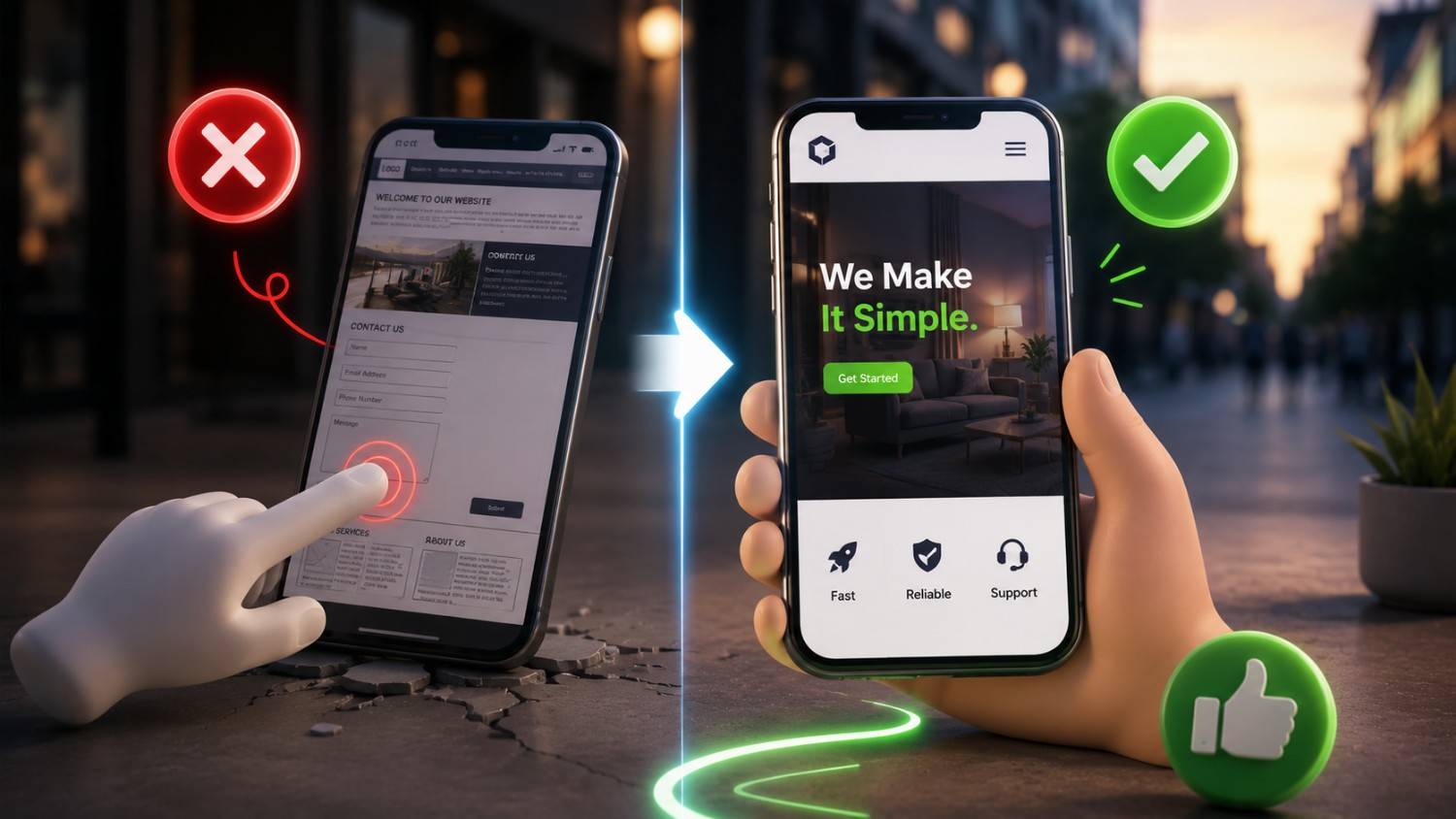 For most small businesses today, the majority of website traffic comes from mobile devices rather than desktops. If your site was designed years ago without a true mobile-first approach, there’s a strong chance it’s clunky on smaller screens: tiny tap targets, text that requires zooming, forms that are painful to fill out with a thumb.
Mobile visitors who struggle to navigate your site don’t struggle for long. They simply leave and call (or click through to) whichever competitor made it easier.
The fix: A responsive, mobile-first redesign, not just a site that “still works” on mobile, but one that’s actually built around how people browse and act on their phones.
4. Traffic Comes In, But It’s Not Turning Into Leads
This is one of the most frustrating signs, because on paper things look fine; your traffic numbers might even be steady or growing. But the phone isn’t ringing, and the contact form isn’t filling up.
This usually points to a conversion problem, not a traffic problem: calls-to-action that are buried or unclear, contact forms that ask for too much information up front, missing trust signals (no reviews, no clear credentials, no real photos), or a site that simply doesn’t guide visitors toward the next step.
The fix: Every key page should have one clear, obvious next action: call now, request a quote, book a consultation. Trust signals (testimonials, certifications, real project photos) should sit near your calls to action, not buried on a separate “About” page that nobody visits.
5. Your Website No Longer Looks or Sounds Like Your Business
Businesses evolve new services, a rebrand, a shift in who you serve, but websites often don’t keep up. If your site still mentions services you no longer offer, uses outdated branding, or simply doesn’t reflect the business you’ve become, it’s actively working against the impression you’re trying to make.
This mismatch also confuses potential customers about what you actually do today, which quietly costs you leads that were never a good fit in the first place, or, worse, good-fit leads who assumed you didn’t offer what they needed.
The fix: Treat your website like a living asset that gets reviewed at least once a year, not a one-time project you finish and forget.
What These Warning Signs Are Actually Costing You
It’s easy to shrug off a slow site or a dated design as a minor annoyance. It rarely is. Here’s a simple way to think about the real cost.
Say your website currently gets 1,000 visitors a month, and a poor experience means you’re converting at 1% instead of a healthy 3%. That’s the difference between 10 leads a month and 30 a gap of 20 leads. If your average customer is worth even a modest $500, that’s $10,000 a month in business quietly walking out the door, month after month, simply because the website wasn’t doing its job.
That’s the real cost of an outdated website: not a design complaint, but a slow, steady leak in revenue that’s easy to miss because there’s no single moment where it “breaks.” It just underperforms, quietly, every single day it stays as it is.
Quick Self-Audit Checklist
Before deciding what to do next, run your own site through this quick checklist:
- Has your organic traffic declined over the last 2-3 months without an obvious reason?
- Do visitors leave your homepage within the first few seconds (high bounce rate)?
- Is your site genuinely easy to use on a phone or just “technically functional”?
- Are you getting traffic but not leads, calls, or form submissions?
- Does your website still reflect your current services, branding, and voice?
- Does your site load in under 3 seconds?
- Do you have a clear, single call to action on every important page?
- Is your content updated regularly and provides clear answers to common customer questions?
If you checked off two or more of these, it’s a reasonable signal that a website makeover not just a small tweak is worth exploring.
DIY Fixes vs. Full Redesign vs. Partnering with an Agency
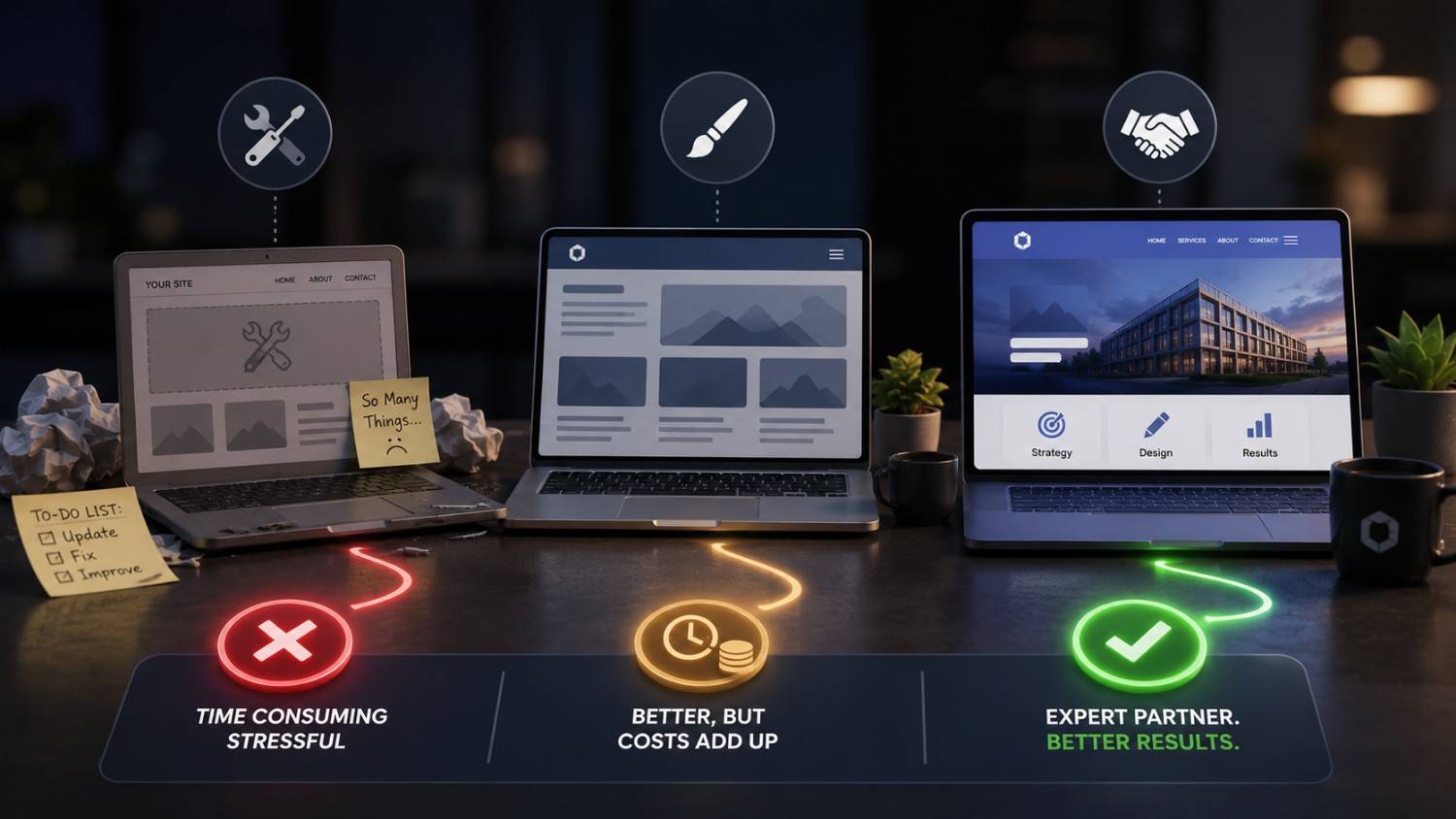 Not every warning sign requires a full rebuild. Here’s a simple way to think through your options:
- DIY fixes make sense when the issues are small and isolated: outdated copy, a broken link, a slow image that needs compressing. If your foundation is solid and you just need small updates, this can genuinely be enough.
- A full website redesign makes sense when multiple warning signs appear at once, when your site is several years old or when the underlying platform itself is limiting you (not mobile-friendly, not easily updated or not built to support SEO or AI-search readiness).
- Partnering with an agency for website redesign services makes the most sense when you don’t have the internal time, design, or development resources to do it right and when you want the work grounded in real strategy (SEO, conversion design, technical performance) rather than guesswork. This is usually the right call when your website is a genuine growth lever for your business, not just a digital business card.
There’s no universally “correct” answer here; it depends on how many signs you’re seeing, how outdated your current site is, and how much your business depends on the website to generate leads.
How Deftsoft Approaches a Website Makeover
At Deftsoft, a website makeover always starts with an audit, not a redesign brief. Before a single design decision is made, we look at your current traffic, user behavior, technical performance, and where you’re losing visitors, so the redesign solves the actual problems your business is facing, not just a generic style refresh.
From there, every Deftsoft website is built mobile-first, optimized for page speed, and structured with clean, AI-search-ready content and schema markup so your new site is positioned to perform in both traditional search and the growing world of AI-generated answers. The result is a website that’s not just better-looking, but measurably better at turning visitors into leads.
Because Deftsoft handles web design, development, and AI-powered digital marketing under one roof, a website makeover doesn’t stop at launch. We treat the redesign as the foundation for continued growth, tracking how the new site actually performs against the warning signs that started the conversation in the first place, and adjusting as real visitor data comes in. Whether your business needs a small business website built from scratch or a full redesign of an existing site that’s outgrown its original design, the process stays the same: audit first, design and build second, measure and refine after launch.
Closing Thoughts
An outdated website rarely fails all at once; it just quietly underperforms until the gap between what it could be doing and what it’s actually doing becomes too big to ignore. If you’re seeing even a couple of the five warning signs above, it’s worth taking a closer look now, before it costs you more customers than it already has.
Ready for a website that works as hard as you do?
Let’s talk about what a makeover could look like for your business.
Frequently Asked Questions
How much will it cost to redesign a website in 2026?
Costs vary widely depending on the size of your site, the complexity of the features you need, and whether you’re working with a freelancer or a full-service agency team. Small business website redesigns often range from a few thousand dollars for a simpler site to significantly more for larger, feature-rich websites with e-commerce or custom functionality. The best way to get an accurate number is a scoped quote based on your specific goals.
How much does it cost to have someone redo your website?
This depends on scope. A full redesign (new design, new structure, new content) typically costs more than a refresh (updated visuals and content on your existing structure). Getting a clear audit first helps you understand exactly what work is needed, so you’re not paying for more (or less) than your site actually requires.
What are the website style trends for 2026?
Current design trends lean toward clean, fast-loading layouts, bold and confident typography, minimal but purposeful animation, and content structured clearly enough for both human visitors and AI search tools to understand quickly. Function is taking priority over decoration; sites are being built to load fast, communicate clearly, and convert, with style supporting that goal rather than competing with it.
What’s the difference between a website redesign and a website refresh?
A website refresh updates the look and content of your existing site without changing its core structure think new colors, updated copy, refreshed images. A full website redesign rebuilds the site’s structure, user experience, and often its underlying platform, typically because the current foundation is limiting growth, mobile performance, or SEO potential.
What are the signs my website is hurting my business?
The clearest signs are declining traffic, high bounce rates, poor mobile experience, traffic that isn’t converting into leads, and a website that no longer reflects your current services or brand. If two or more of these sound familiar, your website is likely costing you more business than you realize.

Devraj
 16th July 2026