Why Businesses Need AI-Powered Websites in 2026: The Complete Guide
-
By Devraj
-
23rd June 2026
A few years ago, having a website was enough. Today, it isn’t.
If your website still looks the same to every visitor, answers nothing on its own, and waits for a human to respond to every query, you’re not just behind, you’re invisible to a growing share of your potential customers. Worldwide AI spending is set to hit $2.52 trillion in 2026, a 44% jump from the previous year, and that money is flowing straight into how businesses build and run their websites.
Here’s the part that should really get your attention: sites that AI crawlers can read and understand are now generating 320% more human traffic, 270% more form submissions, and 250% more click-to-call events than sites that aren’t AI-friendly. That’s not a future trend. That’s happening right now, to businesses that made the switch and businesses that didn’t.
The shift from static to smart isn’t about chasing buzzwords. It’s about your website actually working for you, learning from visitors, answering questions instantly, personalizing what people see, and helping your business make decisions faster. The businesses waiting for “the right time” to adopt AI on their websites are already losing ground to those that didn’t wait.
At Deftsoft, we’ve watched this shift happen in real time across the businesses we work with. This guide breaks down exactly what AI-powered websites are, why they matter for your business in 2026, and how to get started — in plain language, no tech jargon required.
Quick Summary
In 2026, static websites are becoming obsolete as AI-driven platforms emerge as the new business standard. Transitioning from traditional sites to intelligent ones can boost human traffic by 320% and provide a 3.7x ROI on generative AI investments.
AI-powered websites continuously learn from visitor behavior to offer real-time content personalization, conversational 24/7 chatbot support, and predictive search. Across sectors such as e-commerce and healthcare, these tools reduce operational costs and increase conversion rates. Partnering with experts like Deftsoft allows businesses to securely integrate scalable AI features, maintaining a competitive edge in an automated marketplace.
Is your website ready for the AI era?
Don’t let your business get left behind.
Quick Navigation
Key Features of AI-Powered Websites
Real-Time Content Personalization
Conversational AI and Intelligent Chatbots
Predictive Search and Smart Navigation
Automated A/B Testing and Optimization
AI-Powered Analytics and Behavioral Insights
Benefits of AI-Powered Websites for Businesses
Higher Conversion Rates Through Hyper-Personalization
24/7 Customer Support Without Scaling Your Team
Reduced Operational Costs Through Automation
Faster Decision-Making With Real-Time Data
Improved SEO Performance via AI Content Tools
Industry Use Cases: AI Websites Across Sectors
AI Technologies Powering Modern Business Websites
How Deftsoft Builds AI-Powered Websites: Our Process
Common Challenges and How to Overcome Them
The Future of AI in Web Development
Why Now Is the Best Time to Invest in an AI Website
Conclusion: The Smartest Move You Can Make for Your Website in 2026
What Are AI-Powered Websites?
Let’s keep this simple. An AI-powered website is a website that can think a little. Instead of showing the exact same homepage to every visitor and waiting for someone to click around and find what they need, it actively helps each visitor — recommending products, answering questions, adjusting content, and learning from behavior as it goes.
Think of the difference this way: a traditional website is like a printed brochure sitting on a shelf. It looks nice, but it’s the same for everyone who picks it up, and it can’t respond to questions. An AI-powered website is more like a knowledgeable store employee who remembers what you looked at last time, points you toward what you actually need, and answers your questions on the spot — at 2 pm or 2 am, it doesn’t matter.
Traditional websites are built once and updated occasionally. AI-powered websites are built to keep learning. They continuously process visitor behavior, search patterns, and conversion data, and use that information to adjust what appears on the page, who receives a chatbot popup, and which products are recommended to whom.
This isn’t a niche thing anymore, either. 41% of businesses now use AI-powered tools specifically for website creation, and among advanced AI adopters that figure climbs to 70%. It’s quickly becoming the default, not the exception.
Key Features of AI-Powered Websites
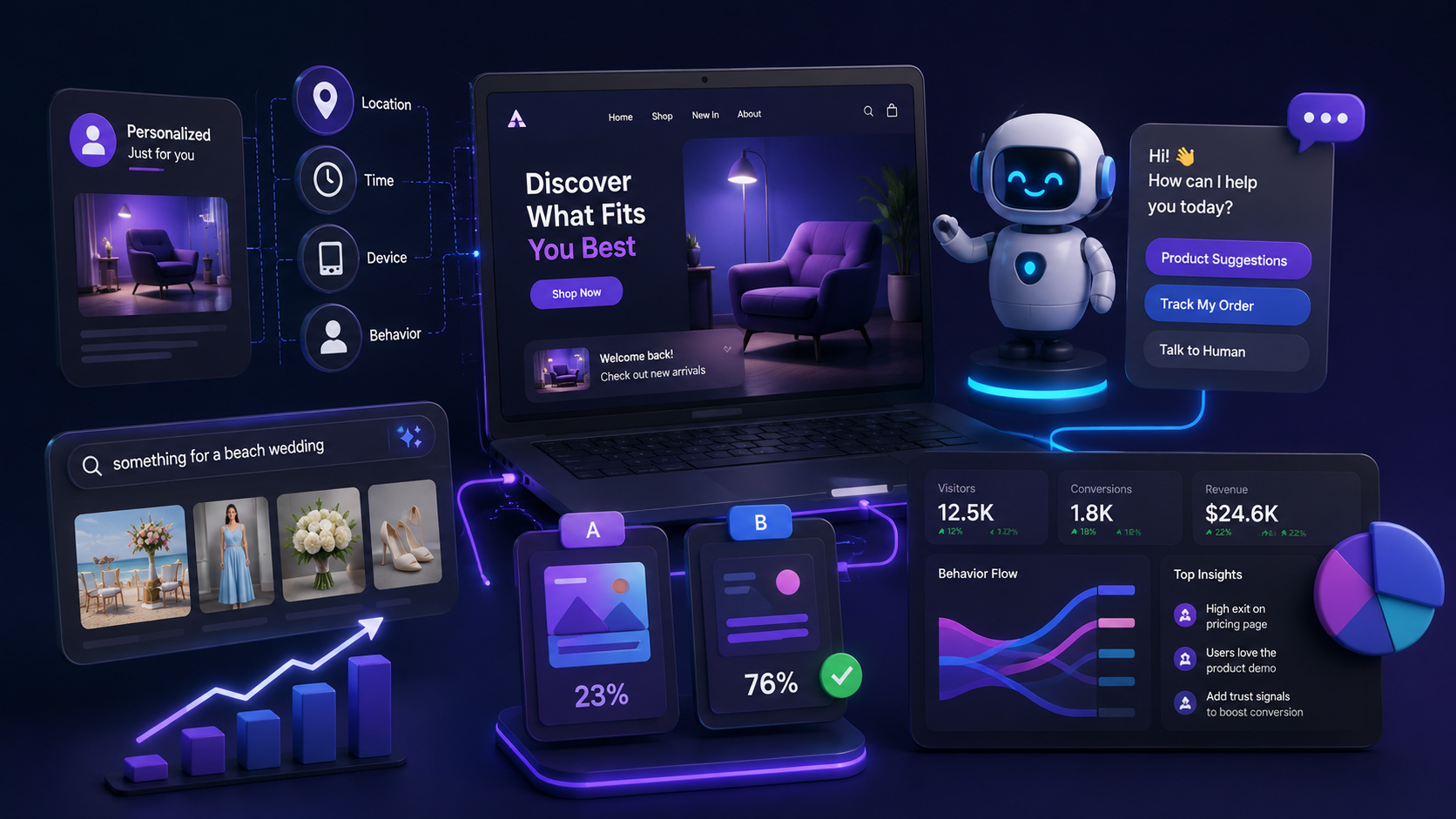
Not every “AI-powered” website does the same things. Here are the features that actually move the needle for businesses.
Real-Time Content Personalization
Instead of a single homepage for everyone, the site adjusts what it shows based on who’s visiting, their location, past behavior, the device they’re using, and even the time of day. A returning customer might automatically see different content than a first-time visitor.
Conversational AI and Intelligent Chatbots
Modern AI chatbots aren’t the clunky, scripted bots from a few years ago. They understand natural language, answer detailed questions, qualify leads, and hand off to a human only when needed. They work around the clock, which matters more than ever, customers don’t wait for business hours anymore, and they don’t expect to.
Predictive Search and Smart Navigation
Search bars that understand intent, not just keywords. Type “something for a beach wedding” and get relevant results, even if no product is literally titled that. This alone can dramatically cut bounce rates from visitors who couldn’t find what they wanted.
Automated A/B Testing and Optimization
Instead of manually testing one headline against another for weeks, AI tools run multiple versions simultaneously, learn which versions perform best for each audience segment, and adjust automatically, no developer required.
AI-Powered Analytics and Behavioral Insights
These tools go beyond “how many people visited” and start answering “why did they leave,” “what almost converted them,” and “what should we change next.” That’s the difference between data and decisions.
Benefits of AI-Powered Websites for Businesses
So what does all this actually translate to for your bottom line?
Higher Conversion Rates Through Hyper-Personalization
When visitors see content that’s relevant to them, they’re far more likely to stick around and buy. Personalized recommendations, smart pop-ups, and tailored offers consistently outperform one-size-fits-all pages.
24/7 Customer Support Without Scaling Your Team
An AI chatbot doesn’t need overtime pay, sick days, or a second shift. It can answer the same question a thousand times a day without getting tired, and it frees your human team to handle the complex cases that genuinely need a person.
Reduced Operational Costs Through Automation
Tasks that used to require a person, answering FAQs, qualifying leads, scheduling appointments and sending follow-ups, now happen automatically. That’s real money saved every month, not just convenience.
Faster Decision-Making With Real-Time Data
When your website is constantly feeding you insight on what’s working and what isn’t, you stop guessing. Marketing, product, and pricing decisions all become faster and more accurate.
Improved SEO Performance via AI Content Tools
AI tools help structure content, identify gaps, and optimize pages for both traditional search engines and newer AI-driven search experiences that more customers use to find businesses like yours.
It’s worth pausing to consider the bigger picture, too: companies report a 3.7x return on every dollar invested in generative AI and related technologies. This isn’t a cost center — it’s an investment with measurable payback.
Industry Use Cases: AI Websites Across Sectors
AI-powered websites aren’t a one-size-fits-all upgrade. Here’s how different industries are putting them to work right now.
- Ecommerce. Product recommendation engines, smart search that understands customer intent, dynamic pricing, and chatbots that handle order tracking and returns without a single phone call. AI and AI agents drove $262 billion in global online sales during the most recent holiday shopping season alone — a number that’s only going up.
- Healthcare. Symptom-checker tools that guide patients to the right department, AI-driven appointment booking that eliminates phone tag, and intake chatbots that collect information before a patient ever speaks to staff.
- Finance. Risk calculators, personalized financial product recommendations, AI advisors that answer basic questions instantly, and fraud-detection systems working quietly in the background to protect customers.
- SaaS and Tech. Automated onboarding flows that adapt to each user’s role and goals, in-app usage analytics that flag when a customer might churn, and self-service support that resolves issues before a ticket is ever filed.
- Real Estate. Virtual assistants that answer property questions instantly, AI-powered filters that learn buyer preferences, and automated scheduling for property viewings.
Across nearly every industry, the same pattern repeats: AI handles the repetitive, predictable work, and humans focus on the relationships and decisions that actually need a human touch.
AI Technologies Powering Modern Business Websites
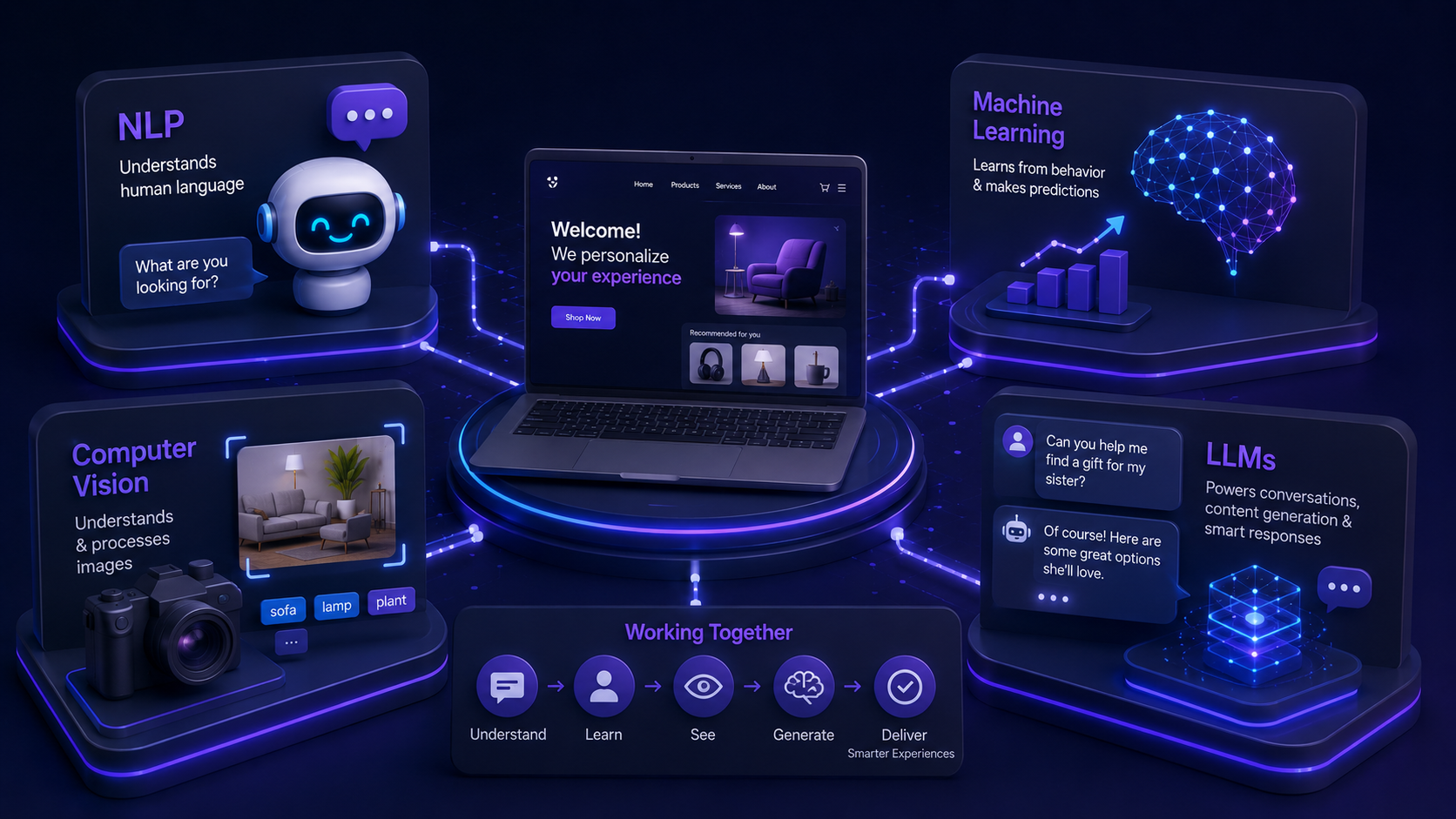
You don’t need to become an engineer to understand this, but it helps to know what’s actually running under the hood.
- Natural Language Processing (NLP) is what allows chatbots and search bars to understand human language, including typos, slang, and casual phrasing — rather than requiring exact keywords.
- Machine Learning is the technology behind personalization and prediction. It looks at patterns in visitor behavior and gets better at predicting what each person wants over time, without anyone manually programming the rules.
- Computer Vision allows websites to understand images, useful for visual search (“find me something that looks like this”), automated image tagging, and accessibility features.
- Large Language Models (LLMs) are the newest and most powerful layer, powering the conversational AI tools, content generation, and increasingly sophisticated chat experiences that feel less like talking to a bot and more like talking to someone who actually understands you.
These technologies are increasingly bundled together rather than used in isolation, which is part of why AI websites have become so much more capable in the last year or two.
How Deftsoft Builds AI-Powered Websites: Our Process
Adopting AI on your website doesn’t have to mean ripping everything out and starting over. Here’s how we approach it at Deftsoft.
1. Discovery and AI Readiness Assessment. We start by understanding your business, your customers, and the pain points of your current website. Not every business needs every AI feature — we figure out what will actually move your numbers.
2. Strategy, Architecture, and Technology Selection. We map out which AI capabilities fit your goals and budget, and choose the right technology stack to support them without overengineering.
3. AI Feature Integration and Development. This is where chatbots, personalization engines, smart search, and analytics tools get built and woven into your existing site or a new build, depending on what makes sense.
4. Testing, QA, and Performance Optimization. AI features get tested across real-world scenarios — not just “does it work,” but “does it work well, fast, and reliably for actual customers.”
5. Launch, Monitoring, and Continuous Improvement. AI-powered websites aren’t a set-it-and-forget-it project. We monitor performance after launch and keep refining based on real data, because that’s the whole point of using AI in the first place.
Common Challenges and How to Overcome Them
It wouldn’t be honest to pretend this is all upside down with zero friction. Here’s what businesses typically run into — and how to handle it.
- Data privacy and compliance concerns. Personalization requires data, and data comes with responsibility. The fix is building privacy into the system from day one — clear consent flows, secure data handling, and compliance with regulations like GDPR baked into the architecture, not bolted on afterward.
- Integration with legacy systems. Many businesses worry that adding AI means tearing out everything they already have. In most cases, it doesn’t. AI features can be layered onto existing platforms incrementally, starting small and expanding as you see results.
- Measuring ROI on AI website investments. This is a real concern, and a fair one. 56% of CEOs report zero measurable ROI despite deploying AI somewhere in their business — usually because the AI was added without a clear goal attached to it. The solution starts with specific, measurable objectives (more leads, lower support costs, higher conversion) rather than adding AI features just because everyone else is.
The Future of AI in Web Development
Where is all this heading? A few AI web development trends are worth watching closely.
- Agentic web experiences. Websites are starting to act more like agents than static pages, capable of completing tasks on a visitor’s behalf rather than just displaying information. 40% of new enterprise applications are expected to feature task-specific AI agents by 2026, and websites are very much part of that shift.
- Voice-first and multimodal interfaces. Typing isn’t the only way people interact with websites anymore. Voice search, image-based search, and their combinations are becoming standard expectations rather than novelties.
- AI and the next generation of UX design. Design itself is becoming AI-assisted, with layouts, color choices, and content placement increasingly informed by data on what actually converts, rather than pure aesthetic guesswork.
The pace of change here is genuinely fast. The average time to produce a complete website draft has dropped from a full work week to around 15 minutes as of early 2026. The tools are maturing quickly, and the businesses paying attention now will be the ones setting the pace later.
Why Now Is the Best Time to Invest in an AI Website
There’s always a temptation to wait, for the technology to mature, for competitors to test it first, for budgets to free up. Here’s why that instinct is costing businesses more than they realize.
- Early movers are already seeing measurable advantages. Businesses with AI-powered websites are converting more visitors, spending less on support, and gathering better data than competitors still running static sites. That gap compounds over time.
- Costs are decreasing as AI tooling matures. What required custom development and large budgets two years ago is now accessible to small and mid-sized businesses. Small and medium enterprises now drive nearly half of all AI website builder revenue, proof that this is no longer an enterprise-only tool.
- The competitive window is closing. AI on websites is moving from “nice differentiator” to “baseline expectation” faster than most owners realize. 62% of small and mid-sized business leaders say their business won’t remain competitive within three years without AI. Three years sounds far off, but website projects, integrations, and the learning curve that comes with them take time, too. Starting today doesn’t mean rushing. It means being ready when it counts.
Conclusion: The Smartest Move You Can Make for Your Website in 2026
Here’s the simple truth: AI-powered websites aren’t a futuristic upgrade anymore; they’re quickly becoming the baseline for businesses that want to compete. They convert better, cost less to run, support customers around the clock, and get smarter every single day they’re live.
The businesses pulling ahead right now aren’t necessarily the biggest ones. They’re the ones who stopped waiting and started building.
At Deftsoft, we help businesses of every size, from startups to established enterprises, turn their websites into something genuinely intelligent, without the guesswork or the bloated budgets. Whether you need a single AI feature added to your current site or a complete AI-powered rebuild, we’ll help you figure out exactly where to start.
Ready to see what an AI-powered website could do for your business? Let’s talk!!!
Frequently Asked Questions
1. What is an AI-powered website?
It’s a website that uses artificial intelligence to personalize content, answer questions via chatbots, predict what visitors want, and improve itself based on real user data — rather than staying static for every visitor.
2. How much does it cost to build an AI-powered website?
Costs vary widely based on which features you need. Basic AI chat and personalization can be added affordably to an existing site, while a full custom build with advanced AI capabilities requires a larger investment. The right approach is to start with the features that solve your biggest pain point, then expand.
3. Can small businesses benefit from AI websites, or is it only for enterprises?
Small businesses are actually leading much of this adoption. AI-powered features that once required enterprise budgets are now affordable and accessible, and small businesses often see faster, more visible returns because they’re starting from a lower baseline.
4. How long does it take to develop an AI-powered website?
It depends on the scope. Adding a chatbot or basic personalization to an existing site can take a few weeks. A full custom build with multiple AI features typically takes longer, but modern AI development tools have shortened these timelines significantly compared to a few years ago.
5. What AI technologies does Deftsoft use to build intelligent websites?
We work with natural language processing for chat and search, machine learning for personalization and prediction, and modern language models for conversational features — always choosing the right combination for your specific goals rather than adding technology for its own sake.
6. How does AI personalization on a website work?
The site tracks behavior signals — pages visited, time spent, past purchases, location, device type — and uses that data to adjust what each visitor sees, from product recommendations to homepage layout, often in real time.
7. Is an AI-powered website good for SEO?
Yes, in more ways than one. AI tools help structure content for search engines, and AI-friendly sites are increasingly favored by AI-driven search experiences, which are becoming a bigger part of how customers discover businesses.
8. What is the difference between an AI chatbot and an AI-powered website?
A chatbot is one feature. An AI-powered website is the bigger picture — it might include a chatbot, but also personalization, predictive search, automated testing, and smart analytics working together.
9. How do AI websites handle data privacy and compliance?
Through proper consent management, secure data storage, and built-in compliance with regulations like GDPR from the start. Any reputable AI website partner should be able to explain exactly how your customer data is collected, stored, and protected.
10. Can Deftsoft integrate AI features into my existing website?
In most cases, yes. We typically assess your current site first and recommend whether to add AI features incrementally or, if the existing platform is too limiting, plan a more comprehensive rebuild.

Devraj
 23rd June 2026