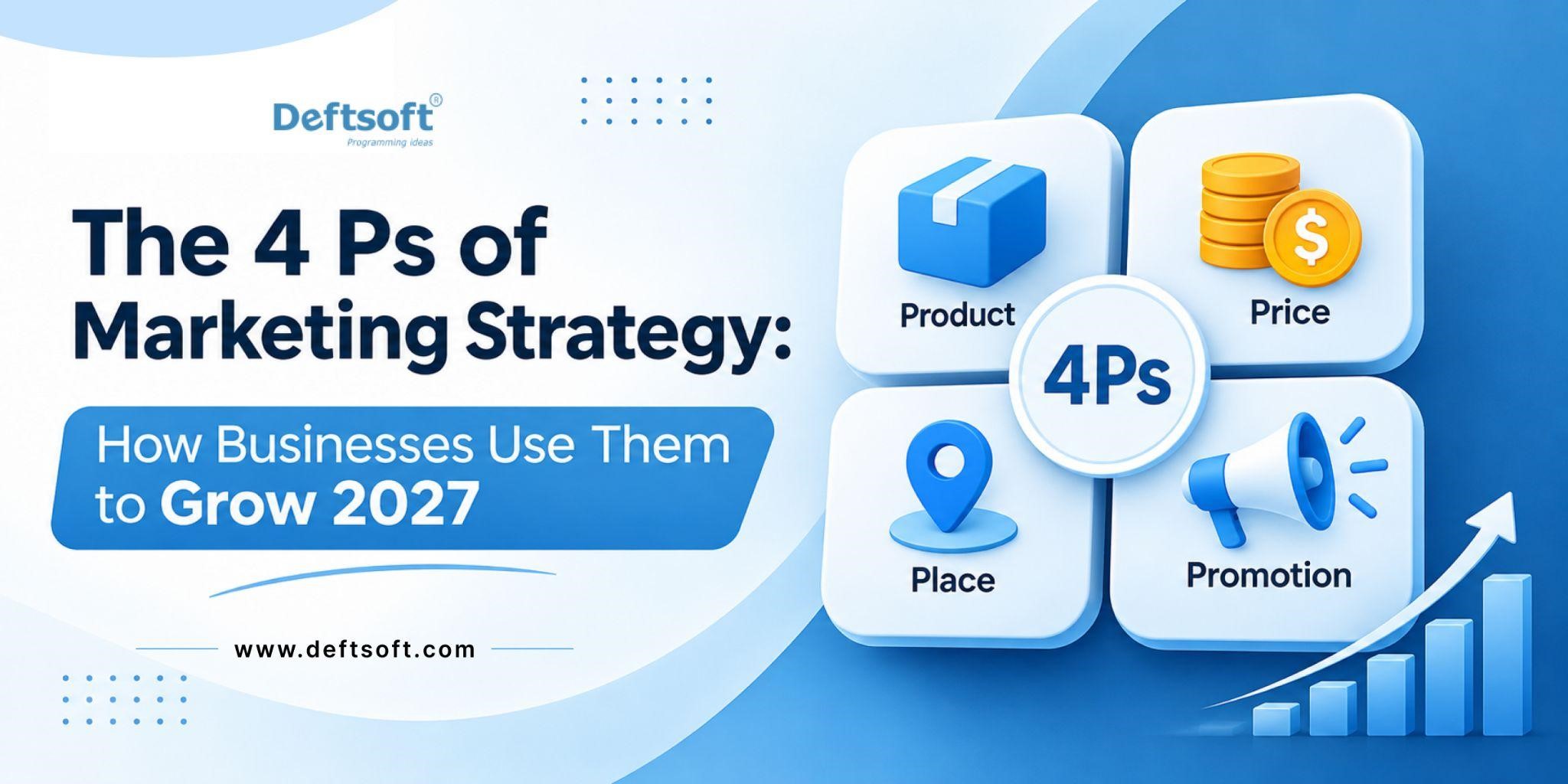
The 4 Ps of Marketing Strategy: How Businesses Use Them to Grow 2027
-
By Devraj
-
2nd November 2026
Why do some brands grow steadily while others with equally good products stall? Very often, the difference is a clear marketing strategy built on the 4 Ps of marketing: product, price, place, and promotion. Many businesses have a strong offer but still struggle because their marketing is scattered. The pricing says one thing, the sales channels say another, and the ads say something else.
In this guide, we explain the 4 Ps of marketing with definitions and real examples, and show how businesses use them to grow in 2027. At Deftsoft, we see this framework shape every successful go-to-market plan.
Talk to the Deftsoft team about your growth strategy.
Share your goals and get a plan that fits your product, price, place, and promotion.
Table of Content
What Are the 4 Ps of Marketing?
Why the 4 Ps of Marketing Matter
The 4 Ps of Marketing Explained (With Examples)
4 Ps of Marketing Examples From Real Businesses
How to Build a Marketing Strategy Using the 4 Ps
7 Ps of Marketing: The Extended Marketing Mix
Common Mistakes to Avoid When Using the 4 Ps
4 Ps of Marketing in 2027: What’s Changing
How Deftsoft Can Help You Build a Growth-Focused Marketing Strategy
What Are the 4 Ps of Marketing?
Quick answer: The 4 Ps of marketing are product, price, place, and promotion. Together they form the marketing mix, the four elements a business controls to take an offer to market. Product answers what you sell, price answers what it costs, place answers where customers buy it, and promotion answers how they find out.
The 4 Ps of marketing, also called the marketing mix, are four core elements a business controls to take a product to market: product, price, place, and promotion. E. Jerome McCarthy popularized the idea in 1960, and it remains one of the most widely taught marketing principles today.
The 4 Ps of marketing explained in simple terms: each P answers one question every business must settle before it sells anything. Product asks what you are selling and what problem it solves. Price asks how much customers will pay and why. Place asks where and how customers will buy. Promotion asks how customers will find out about you. When you answer all four clearly and make the answers fit together, you have a new AI era marketing strategy. When you answer only one or two, you have a guess.
Why the 4 Ps of Marketing Matter
The importance of the 4 Ps of marketing comes down to focus. A business makes hundreds of marketing decisions every year, and without a framework, each team makes them in isolation. The 4 Ps give everyone one shared language, so product, sales, finance, and marketing teams pull in the same direction.
The framework also keeps your marketing consistent. A premium product with discount pricing and a cheap-looking website sends mixed signals, and customers notice. When price, messaging, and distribution align, your brand feels trustworthy.
The 4 Ps also force you to start from real customer needs and show where you can differ from rivals. Each P has its own metrics, so you can measure what works. Most importantly, the framework protects your budget. When you fix the product and price first, you stop spending on promotion for an offer the market does not want yet. That is why the 4 Ps of marketing strategy remain the starting point for most business plans.
The 4 Ps of Marketing Explained (With Examples)
Each P below follows the same pattern: a definition, the key decisions, an example, and a common mistake.
1. Product
Definition: The product is what you offer. It can be a physical good, a service, or a digital solution, and it includes features, quality, design, branding, packaging, and support.
Key decisions: Start with the problem your product solves and the people who have that problem. Then decide what makes it different from competitors. Finally, find where it sits in its life cycle: introduction, growth, maturity, or decline. A product in the growth stage needs a very different plan from one in decline.
Product marketing strategy tips: Build around a clear value proposition. Use customer feedback to improve features. Position the product by the result it delivers, not by a list of features.
Example: Apple sells an ecosystem of design, software, and service as well as devices. Its product strategy centers on simplicity and integration, which is why customers stay loyal.
Common mistake: Building what the team likes instead of what the market needs.
2. Price
Definition: Price is what customers pay and what they believe the product is worth. Customers judge price against value, so the number alone never tells the whole story.
Pricing strategy in marketing: Businesses choose from six main models.
- Cost-plus pricing: cost plus a fixed margin
- Competitive pricing: based on what rivals charge
- Value-based pricing: based on perceived customer value
- Penetration pricing: a low entry price to win market share
- Skimming: a high launch price that drops over time
- Freemium and subscription: a free tier or recurring fees, common in software
Example: Netflix uses tiered subscription pricing so customers can pick a plan that matches their budget and needs. This keeps revenue recurring and helps reduce churn.
Common mistake: Competing only on being the cheapest. This erodes margin and brand value, and a competitor can always go lower.
3. Place (Distribution)
Definition: Place covers where and how customers can find and buy your product. That includes stores, websites, marketplaces, apps, and distributors.
Place in the marketing mix: Four decisions matter most. First, choose between online, offline, or omnichannel selling. Second, decide whether you sell directly or through resellers. Third, plan inventory, logistics, and delivery speed. Fourth, set your geographic coverage. Each choice changes your costs and how easily customers can buy.
Example: Amazon built its growth on convenience: wide selection, fast delivery, and one-click buying. Its place strategy is a core part of its brand promise.
Common mistake: Being absent from the channels where your customers already shop.
4. Promotion
Definition: Promotion is how you communicate value and persuade customers to act.
Promotion strategy in marketing: Businesses mix several tools. Content marketing and SEO bring in people who already search for answers. Social media marketing builds community and awareness. Paid ads on search, social, and display platforms deliver fast reach. Email marketing nurtures existing leads and customers. Influencer and partnership marketing borrows trust from others, PR and events build credibility, and sales promotions and offers push people to act now. Strong plans pick a few tools and run them well instead of using all of them badly.
Example: Nike promotes through storytelling, athlete partnerships, and community, not through product specs alone. Its campaigns build emotion and identity, which supports premium pricing.
Common mistake: Running ads without a clear message or audience.
Want the 4 Ps working together in your business?
Get a clear, customer-first marketing plan from the Deftsoft team.
4 Ps of Marketing Examples From Real Businesses
Real brands show how the 4 Ps fit together. The table below gives marketing mix examples from three well-known companies.
| Brand | Product | Price | Place | Promotion |
|---|---|---|---|---|
| Starbucks | Premium coffee and “third place” experience | Premium pricing | Company-owned stores, app, grocery | Loyalty program, seasonal campaigns |
| Zara | Fast-fashion, trend-led designs | Affordable, mid-range | Flagship stores and online | Minimal ads, store window displays |
| Coca-Cola | Beverages with a global brand identity | Accessible, consistent | Mass distribution everywhere | Emotional, global advertising |
Takeaway: The strongest brands make all four Ps work together and do not optimize one in isolation. Starbucks charges more because the store experience justifies it. Zara skips heavy advertising because its store locations do the selling. Coca-Cola keeps prices accessible because it wants to be available everywhere.
How to Build a Marketing Strategy Using the 4 Ps
Follow these eight steps to turn the 4 Ps of marketing into a working plan.
- Research your market: study customers, competitors, and trends.
- Define your target audience and build buyer personas.
- Set your product positioning: state your unique value.
- Choose a pricing model that fits your positioning.
- Select distribution channels your audience uses.
- Plan the promotion mix and budget.
- Set KPIs: conversion rate, customer acquisition cost, ROI, and retention.
- Test, measure, and refine every quarter.
Types of Marketing Strategies the 4 Ps Support
The 4 Ps support many types of marketing strategies. A content marketing strategy leans on promotion and product value. A digital marketing strategy focuses on online place and promotion. A brand positioning strategy ties product, price, and promotion into one image. A product launch strategy needs all four Ps planned in sequence, and a customer retention strategy relies on product quality, fair pricing, and consistent service. Choose the strategy type first, then use the 4 Ps to fill in the details.
Ready to turn your plan into results?
Talk to Deftsoft about a growth strategy built around your customers and goals.
7 Ps of Marketing: The Extended Marketing Mix
The 4 Ps work best for physical products. Service businesses often use the extended 7 Ps of marketing, which add three more elements:
- People: the staff and teams customers interact with
- Process: how the service is delivered
- Physical evidence: the environment, website, reviews, and proof of quality
Tip: Software and service companies should use the 7 Ps, because the customer experience is part of the product. A buyer judges a software company by its onboarding, support team, and online reviews as much as by its features.
4 Ps vs 4 Cs of Marketing
The 4 Cs of marketing flip the 4 Ps from the customer’s point of view.
| 4 Ps (Seller View) | 4 Cs (Customer View) |
|---|---|
| Product | Customer solution |
| Price | Cost to the customer |
| Place | Convenience |
| Promotion | Communication |
Key point: The 4 Ps ask what the business wants to sell. The 4 Cs ask what the customer wants to buy. Modern strategy uses both: plan with the 4 Ps, then check your decisions through the 4 Cs. If a choice works for you but not for your customer, rethink it.
Common Mistakes to Avoid When Using the 4 Ps
- Treating the Ps as separate checklists instead of one connected system
- Skipping customer research
- Setting prices without understanding perceived value
- Ignoring digital channels
- Copying competitors instead of differentiating
- Not updating the mix as the market changes
Most of these mistakes share one root cause: teams decide each P alone. Review all four together at least once a quarter.
4 Ps of Marketing in 2027: What’s Changing
The four questions stay the same, but the tools change. In product, expect more personalization and AI-assisted features. In price, dynamic and subscription-based models keep growing. In place, customers buy across web, apps, social commerce, and marketplaces, so omnichannel selling matters more every year. In promotion, search and AI-driven discovery, short-form video, community-led marketing, and first-party data play bigger roles. Check these trends against current data for your own market before you build your plan around them.
How Deftsoft Can Help You Build a Growth-Focused Marketing Strategy
At Deftsoft, we help businesses turn the 4 Ps of marketing into practical, measurable growth plans, from shaping the product and digital experience to improving how it is found and promoted online. If you want a marketing strategy built around your customers and your goals, our team is ready to help.
Frequently Asked Questions
1. What are the 4 Ps of marketing?
The 4 Ps of marketing are product, price, place, and promotion. Together they form the marketing mix a business uses to take an offer to market and meet customer needs.
2. Why are the 4 Ps of marketing important?
They give businesses a simple framework for aligning what they sell, what it costs, where it is sold, and how it is promoted. This improves consistency, supports better decisions, and helps growth.
3. What is an example of the 4 Ps of marketing?
Starbucks sells premium coffee (product), charges premium prices (price), sells through its own stores and app (place), and uses loyalty rewards and seasonal campaigns (promotion).
4. What is the difference between the 4 Ps and the 7 Ps of marketing?
The 7 Ps add people, process, and physical evidence to the original four. They suit service businesses, where the customer experience is part of the offer.
5. Are the 4 Ps of marketing still relevant today?
Yes. The tools have changed, with more digital channels, data, and subscription models, but the core questions of product, price, place, and promotion still guide modern marketing strategy.
Conclusion
The 4 Ps of marketing give every business four questions to answer: what you sell, what it costs, where customers buy it, and how they find out. They work best together, because a strong product with a weak price or channel still stalls. Review your own mix today, then fix the weakest P first. If you want expert help turning the 4 Ps into growth, we are here for you.
Ready to grow with a clear marketing strategy?
Contact Deftsoft and turn the 4 Ps of marketing into a plan that works for your business.
Recent Articles





Devraj
 2nd November 2026