What is Vibe Coding? A Beginner’s Guide for Modern Developers
-
By Devraj
-
15th May 2026
Quick Summary:
Vibe Coding is a new way to build software where you describe what you want in plain language, and AI writes the code for you. Instead of typing line after line of syntax, you give instructions the way you’d explain something to a colleague, and tools like Cursor, GitHub Copilot, and Replit handle the technical heavy lifting. It sounds almost too simple, but companies and solo developers around the world are already using it to build real products faster than ever before. In this guide, we break down exactly what Vibe Coding is, why it’s growing so fast, which tools are leading the charge, and what it means for the future of web and software development.
Building a web or SaaS product in 2026? Deftsoft’s custom web development services and SaaS development team combine human expertise with modern AI-powered workflows to deliver faster, smarter digital solutions.
So, What Exactly is Vibe Coding?
Let’s start simple. Vibe Coding is the practice of using AI to write code based on natural language prompts, instructions written the way humans talk, not the way machines think.
The term was coined by Andrej Karpathy, a former Tesla AI director and OpenAI co-founder, in early 2025. He described it as a new mode of programming where you “fully give in to the vibes”, meaning you stop worrying about the exact syntax and instead focus on what you want to build. You describe the feature, the function, or the logic, and the AI figures out how to write it.
Think of it this way. Traditionally, if you wanted to build a login page with email verification, you’d write hundreds of lines of code in a specific language, follow exact formatting rules, handle errors manually, and debug everything that breaks. With Vibe Coding, you type something like: “Build me a login page with email and password fields, form validation, and an email verification flow”, and the AI produces working code in seconds.
That is the core idea. You are the architect. The AI is the builder.
And this isn’t just for beginners trying shortcuts. Some of the world’s most experienced developers are now using Vibe Coding to prototype faster, explore new ideas without the overhead of setup and spend their time on problems that actually need human thinking, architectural decisions, business logic and edge cases, rather than boilerplate code they’ve written a hundred times before.
Why is Vibe Coding Growing So Fast?
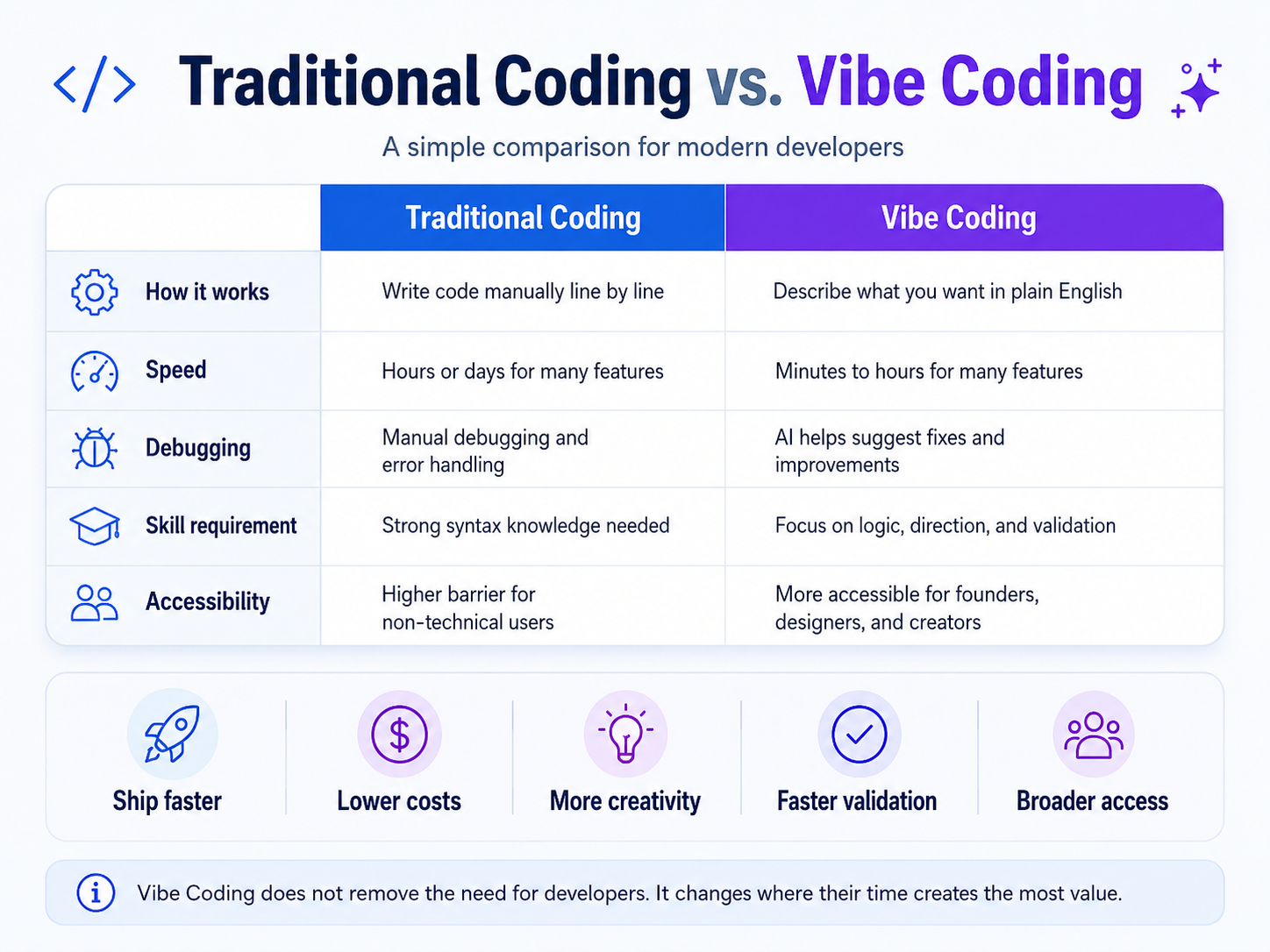
A few things came together at the right time, making Vibe Coding go from a niche idea to a mainstream development practice almost overnight.
AI models got dramatically better at code: Models like GPT-4, Claude 3.5, and Gemini 1.5 can now write code across dozens of programming languages with a level of accuracy that would have seemed impossible just two years ago. They understand context, they remember earlier parts of a conversation, and they can debug their own mistakes when you point them out.
The tools caught up with the idea: It’s one thing to have a powerful AI model. It’s another to have an editor, a workspace, and a workflow built around the idea of AI-first development. Tools like Cursor, Bolt.new, and v0 by Vercel have built entire environments around the Vibe Coding approach, making it accessible to people who’ve never written a line of code.
The speed advantage is real and significant: Reports from developers across Twitter and Reddit consistently describe building in hours what used to take days. A solo founder can now prototype a functional SaaS product over a weekend. A small team can ship features that were previously scheduled on their roadmap for next quarter.
The barrier to entry has collapsed: Non-technical founders, designers, marketers, and product managers are now building working software. The gap between “I have an idea” and “I have a product” has never been smaller. This democratisation of development is one of the most talked-about shifts in the tech industry right now.
How Does Vibe Coding Actually Work?
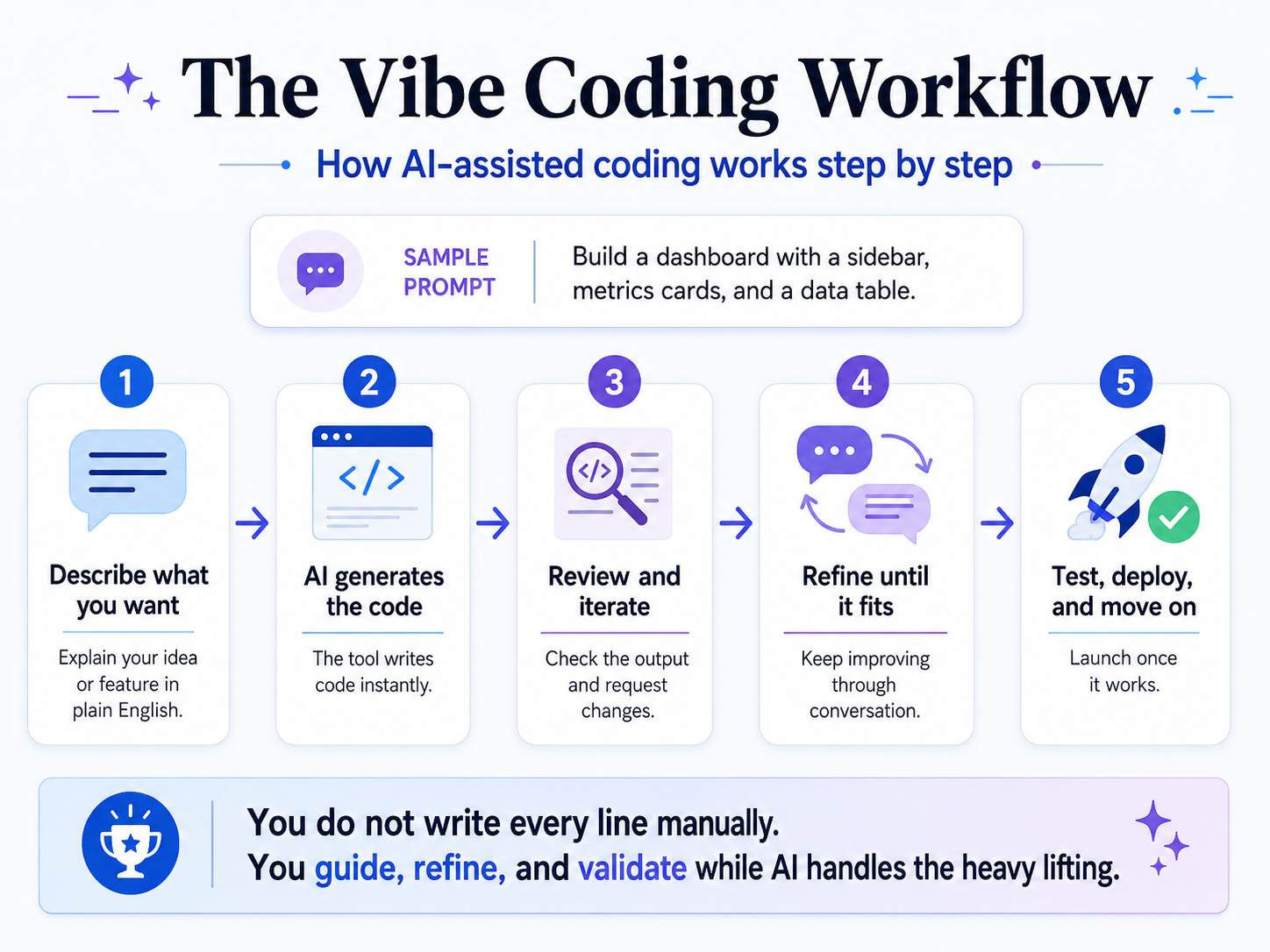
Here is a practical look at a typical Vibe Coding workflow so you can visualise it clearly.
- Step 1: You describe what you want: You open a Vibe Coding tool and type your request in plain English. You might say: “Create a dashboard with a sidebar navigation, a metrics overview section showing total users, revenue, and churn rate, and a data table below that.”
- Step 2: The AI generates the code: The tool produces the relevant HTML, CSS, JavaScript, or backend code, depending on what you asked for and which stack the tool is working with. This happens in seconds.
- Step 3: You review and iterate: You look at what was produced, either in a preview window or in your editor. If something looks wrong or you want a change, you tell the AI: “Make the sidebar darker, move the metrics cards to a horizontal row, and add a search bar above the table.”
- Step 4: You keep refining: The conversation continues until the output matches what you had in mind. You are iterating through dialogue rather than through manual editing.
- Step 5: You test, deploy, and move on: Once it works, you deploy. The whole process that might have taken a developer a full day can now happen in an afternoon.
The key principle is that your job is no longer to write code; it’s to describe, evaluate, and direct. The skills that matter most in Vibe Coding are clarity of thinking, good taste in design and UX, and the ability to spot when something is almost right but not quite.
The Best Vibe Coding Tools in 2026
The Vibe Coding tools landscape has exploded in the last 18 months. Here are the most widely used and most capable options right now.
Cursor
Cursor is arguably the most popular Vibe Coding tool among professional developers. It is an AI-first code editor built on top of VS Code, which means it looks and feels familiar but has deep AI integration throughout. You can ask Cursor to write entire files, explain existing code, refactor functions, or fix bugs, all without leaving your editor. Its “Composer” mode is particularly powerful for building multi-file features in one go.
GitHub Copilot
Copilot was one of the earliest mainstream AI coding tools, and it has matured significantly. It works as an extension in VS Code and JetBrains IDEs, autocompleting code as you type and offering context-aware suggestions. GitHub’s latest versions also include a chat interface so you can ask questions and get explanations alongside your code.
Bolt.new
Bolt is a browser-based Vibe Coding tool from StackBlitz. You describe an app, and Bolt builds it live in your browser, including file structure, dependencies, and a working preview. It’s particularly useful for building full-stack web apps without any local setup. Non-technical users love Bolt because there is literally nothing to install.
v0 by Vercel
v0 specialises in UI components. You describe a design, a pricing table, a sign-up form, a hero section, and v0 generates production-ready React and Tailwind code. It’s become a favourite among designers making the leap into development, and among developers who want to move fast on the frontend.
Replit Agent
Replit has built one of the most complete Vibe Coding environments available. Their Agent feature can take a project description and build an entire working app from scratch, complete with database setup, authentication, and deployment. It’s especially well-suited for beginners and students because Replit handles all the infrastructure.
Claude (by Anthropic)
Claude is widely used for Vibe Coding via its API and through tools like Cursor. Developers specifically praise Claude for its ability to understand complex, multi-step instructions and produce clean, well-commented code. For longer or more complex projects, Claude’s large context window allows it to hold the entire codebase in memory while making changes.
What Vibe Coding Means for Web and SaaS Development
For anyone building web products or software products, Vibe Coding is not just a productivity tool; it is changing how the entire development process is structured.
- Faster prototyping means faster validation: In the past, a startup would spend weeks or months building a working prototype before it could test whether its idea had legs. With Vibe Coding, that same prototype can be ready in days. This means less wasted time and money building things nobody wants.
- Smaller teams can do more: A two-person founding team using Vibe Coding can move at the speed of a five-person team from three years ago. This is compressing timelines, reducing hiring needs, and enabling genuinely small operations to compete with much larger ones.
- The role of the developer is shifting: Experienced developers are not being replaced by Vibe Coding; they are being elevated. The people who know how to evaluate AI-generated code, spot architectural problems early, and guide the AI toward better outputs are incredibly valuable. The drudgery is being automated; the thinking is becoming more important.
- Technical SEO and web performance still matter: Here is where it gets interesting for digital teams: Vibe Coding makes it faster to build web pages and features, but the code quality and structure that those tools produce can vary. Sites need to be technically sound to rank, fast, crawlable and properly structured. That’s why teams that build quickly with Vibe Coding tools often work alongside specialists in technical SEO services to ensure what’s built is also effectively indexed and ranked by Google.
If you are building a SaaS product or a web application with AI-powered tools, having the right web development services and SEO strategy in place from day one is what separates a product that gains traction from one that launches into silence.
The Limits of Vibe Coding: What to Watch Out For
Vibe Coding is powerful, but it is not magic. Here are the honest limitations that anyone starting out should understand.
AI makes mistakes: The code generated by Vibe Coding tools is not always correct. Sometimes it’s subtly wrong in ways that aren’t immediately visible, such as logic errors, security gaps and performance issues. You still need someone who can review the output critically.
Complex systems need architecture thinking: For a simple landing page or a basic CRUD app, Vibe Coding is fantastic. For a complex, multi-tenant SaaS platform with billing, role-based access, and real-time features, you still need experienced developers who understand system design.
The code can get messy over time: As you iterate through conversations, the codebase can become inconsistent, have different styles, duplicate logic and poor organisation. Left unchecked, this becomes technical debt that’s hard to unwind.
Security and compliance need human eyes: If you’re building anything that handles user data, payments, or sensitive information, you should not rely solely on AI-generated code for the security-critical parts. This is an area where Deftsoft’s custom web development team adds real value, reviewing, refactoring, and hardening what AI produces into something production-safe.
Should Beginners Start with Vibe Coding?
Absolutely, with one important caveat. Vibe Coding is a wonderful entry point into software development. It removes the intimidating wall of syntax, allowing beginners to focus on logic, product thinking, and creativity. Many people who had convinced themselves they “couldn’t code” are now building real tools and products with Vibe Coding.
The caveat is this: use Vibe Coding as a way into the craft, not to avoid it. Understanding the basics of how web applications work, how a server talks to a database, what a component is and what an API does will make you dramatically better at directing AI. The best Vibe Coders are the ones who understand the fundamentals, even if they don’t write every line from scratch.
If you are a business owner or a non-technical founder, Vibe Coding can help you validate ideas, build early prototypes, and have more informed conversations with your development team. If you’re ready to take those prototypes to production, working with a team like Deftsoft ,which combines AI-powered development workflows with experienced engineers, is the bridge between a working prototype and a scalable product.
Ready to build something? Whether you’re starting from a Vibe Coding prototype or a full product brief, Deftsoft’s web development services and digital marketing services will help you build, launch, and grow.
FAQs
What is Vibe Coding in simple terms?
Vibe Coding is a way of building software where you describe what you want in plain language, and an AI writes the code for you. Instead of learning complex programming syntax, you focus on what you want to build, and tools like Cursor, Bolt, or GitHub Copilot do the technical writing. It makes software development faster and more accessible for developers and non-developers alike.
Who invented Vibe Coding?
The term was coined by Andrej Karpathy, former AI director at Tesla and co-founder of OpenAI, in early 2025. He used it to describe a new approach to programming in which developers fully lean into AI assistance rather than fighting against it or treating it as a supplementary tool.
Is Vibe Coding only for beginners?
No. While Vibe Coding is highly accessible to beginners, many experienced developers use it daily to speed up prototyping, handle repetitive tasks, and quickly explore new ideas. The developers who get the most out of Vibe Coding are often the ones who already understand software well enough to evaluate what the AI produces.
What are the best Vibe Coding tools in 2026?
The most widely used Vibe Coding tools right now are Cursor, GitHub Copilot, Bolt.new, v0 by Vercel, Replit Agent, and Claude by Anthropic. Each has its strengths. Cursor is great for professional developers, Bolt is excellent for browser-based rapid prototyping, and v0 specialises in UI component generation.
Can you build a real product with Vibe Coding?
Yes, many real products have been built primarily through Vibe Coding. However, for complex or production-scale applications, particularly SaaS products handling user data, billing, or high traffic, AI-generated code should be reviewed, refined, and hardened by experienced developers before going live.
Does Vibe Coding replace traditional developers?
Not exactly. It shifts what developers spend their time on. Repetitive, boilerplate coding tasks are increasingly handled by AI, freeing experienced developers to focus on architecture, security, performance, and business logic. The demand for developers who can work alongside AI tools effectively is actually growing.
Is Vibe Coding good for building websites?
Yes, Vibe Coding is particularly effective for building websites, landing pages, dashboards, and front-end components. Tools like v0 and Bolt.new are purpose-built for web output. That said, the resulting sites should still be optimised for performance and search visibility, which is where technical SEO services become essential.
How does Vibe Coding affect SEO and digital marketing?
Vibe Coding can produce websites very quickly, but the speed of development doesn’t automatically mean the output is SEO-friendly. AI-generated code can sometimes produce slow pages, missing metadata, or poorly structured markup. Working with an SEO team throughout your development process, covering on-page SEO, technical SEO, and content strategy, ensures that the site you build not only goes live quickly but also ranks well.
How can Deftsoft help with AI-powered development?
Deftsoft combines modern AI-assisted development workflows with 20 years of experience in web development, SaaS development, and digital marketing. Whether you need a custom web application built from scratch, a Vibe Coding prototype taken to production, or a full SEO and digital marketing strategy to grow what you’ve built, Deftsoft’s team covers the full journey from idea to growth.
Recent Articles





Devraj
 15th May 2026