How to Run Facebook and Instagram Ads for Real Estate in 2026: Setup, Budget, and Creative Breakdown
-
By Devraj
-
30th June 2026
If you sell, rent, or develop real estate, you already know the buyer journey no longer starts with a phone call. It starts with a scroll. Someone is lying on their couch, swiping through Instagram Reels, and suddenly your 3BHK listing pops up with a quick walkthrough video. That’s the moment real estate deals begin in 2026.
Facebook ads and Instagram ads (run together through Meta Ads Manager) are still one of the most reliable ways for real estate agents, brokers, and developers to get in front of buyers and renters who are actually ready to act. But the platform itself has changed a lot. The old approach of picking 15 interests, setting a budget, and hoping for the best simply doesn’t work the way it used to. Meta’s algorithm is smarter, more automated, and a lot less forgiving of lazy setups.
This guide breaks down exactly how to set up Facebook and Instagram ads for real estate in 2026, what budget actually makes sense, and what kind of creative gets clicks instead of getting scrolled past.
Quick Summary:
Facebook and Instagram ads remain among the best lead-generation channels for real estate in 2026, but the old playbook of manual targeting no longer works. Meta’s Advantage+ AI now handles most targeting decisions, which means your account setup, Special Ad Category compliance, budget structure, and creative quality matter more than ever. This guide walks through how to set up a real estate Ads campaign correctly, how much to budget, what creative formats convert best (hint: vertical video), and the common mistakes that quietly drain ad spend. By the end, you’ll have a clear, practical framework to start generating qualified buyer and renter leads.
Not sure if your Meta Ads budget is being spent the right way?
Quick Navigation
Why Meta Ads Still Matter for Real Estate in 2026
Step 1: Get Your Account Set Up the Right Way
Step 2: Build Your Targeting Around What Meta Can Still Do Well
Step 3: Setting a Budget That Actually Makes Sense
Step 4: Creative Is Doing More of the Work Than Ever
Step 5: Instant Forms and Faster Lead Capture
Why Meta Ads Still Matter for Real Estate in 2026
There’s a lot of noise right now about ChatGPT ads, AI search, and other emerging channels. Those are worth keeping an eye on, but they’re not replacing Meta anytime soon. People still spend close to an hour a day combined on Facebook and Instagram, and that kind of daily attention is hard to beat for real estate, where buyers need multiple touchpoints before they trust an agent enough to book a site visit.
What’s changed is how Meta delivers results. The platform has shifted almost entirely toward AI-driven automation, known as Advantage+. Instead of advertisers micromanaging every targeting option, Meta’s AI now studies signals like browsing behaviour, pixel data, and engagement patterns to find the right audience on its own. For real estate specifically, this means the agencies that are still using narrow, manually built audiences from two or three years ago are usually the ones complaining about rising cost per lead. The ones adapting to the new system are seeing the opposite.
If you’re trying to decide where Meta Ads fit into your bigger online strategy, it helps to look at this alongside other channels.
Step 1: Get Your Account Set Up the Right Way
Before you even think about budgets or creative, your account needs to be built correctly. A surprising number of real estate ad accounts fail not because of bad creative, but because of basic setup mistakes.
- Use a Business Manager account, not a personal profile boost. Boosting posts from a personal page might feel quicker, but it limits your targeting, reporting, and scalability. Set up a proper Meta Business Suite account connected to your Facebook Page and Instagram profile.
- Install the Meta Pixel and Conversions API on your website. This is non-negotiable in 2026. With third-party cookies gone and privacy rules tighter than ever, Meta relies heavily on first-party data sent directly from your website to understand who’s actually converting. If you skip this step, you’re essentially flying blind, and Meta’s AI has nothing useful to learn from.
- Select the right campaign objective. For real estate, “Leads” is usually the best objective if you want people to fill out a form for more details, schedule a visit, or download a brochure. “Traffic” works if you’re sending people to a property listing page on your website. Avoid “Awareness” unless you’re specifically running a brand campaign for a new project launch.
- Declare the Special Ad Category. This is one of the most important and most overlooked steps. Any housing-related ad in the US falls under Meta’s Special Ad Category for Housing, which exists because of fair housing laws. If you don’t select this category and Meta’s system detects real estate imagery in your ad (floor plans, “for sale” signs, building exteriors), it can automatically restrict the campaign or flag your account. Selecting the category upfront removes guesswork and keeps you compliant.
Under Special Ad Category restrictions, you lose access to detailed targeting by age, gender, ZIP code, and certain interests, as well as lookalike audiences. Don’t panic. Meta replaces these with Special Ad Audiences, a compliant version of lookalike targeting that builds a similar audience without using protected characteristics. Combine that with location-based targeting (a minimum 15-mile radius applies to housing ads), and you still get strong reach without breaking any rules.
Step 2: Build Your Targeting Around What Meta Can Still Do Well
Since detailed demographic targeting is limited for housing ads, your job shifts from “who should I target” to “what should my creative say to attract the right people on its own.” This sounds strange at first, but it’s actually how Meta’s AI is designed to work now.
A solid structure for real estate looks like this:
- Geo-targeted campaigns centered on the neighbourhoods or cities where your listings are. Keep the radius realistic. A 15- to 25-mile radius around a project location usually performs better than targeting an entire metro area.
- Advantage+ Audience is turned on so Meta can expand reach beyond your set parameters when it spots high-intent users, such as people who recently searched for mortgage calculators or browsed competing listings.
- Retargeting layer for people who’ve visited your website, watched a video, or engaged with a previous ad but haven’t yet filled out a form. This group converts at a much lower cost than cold audiences, so don’t skip it.
- Engagement layer aimed at people who follow your page or have interacted with your content before, useful for nurturing leads who aren’t ready to buy yet but might be in three to six months.
A workable budget split many agencies use is roughly 70% toward cold prospecting (Advantage+ or Special Ad Audience within your geo zone), 20% toward retargeting website visitors, and 10% toward warming up engaged audiences. Adjust based on the size of your existing audience pool.
Step 3: Setting a Budget That Actually Makes Sense
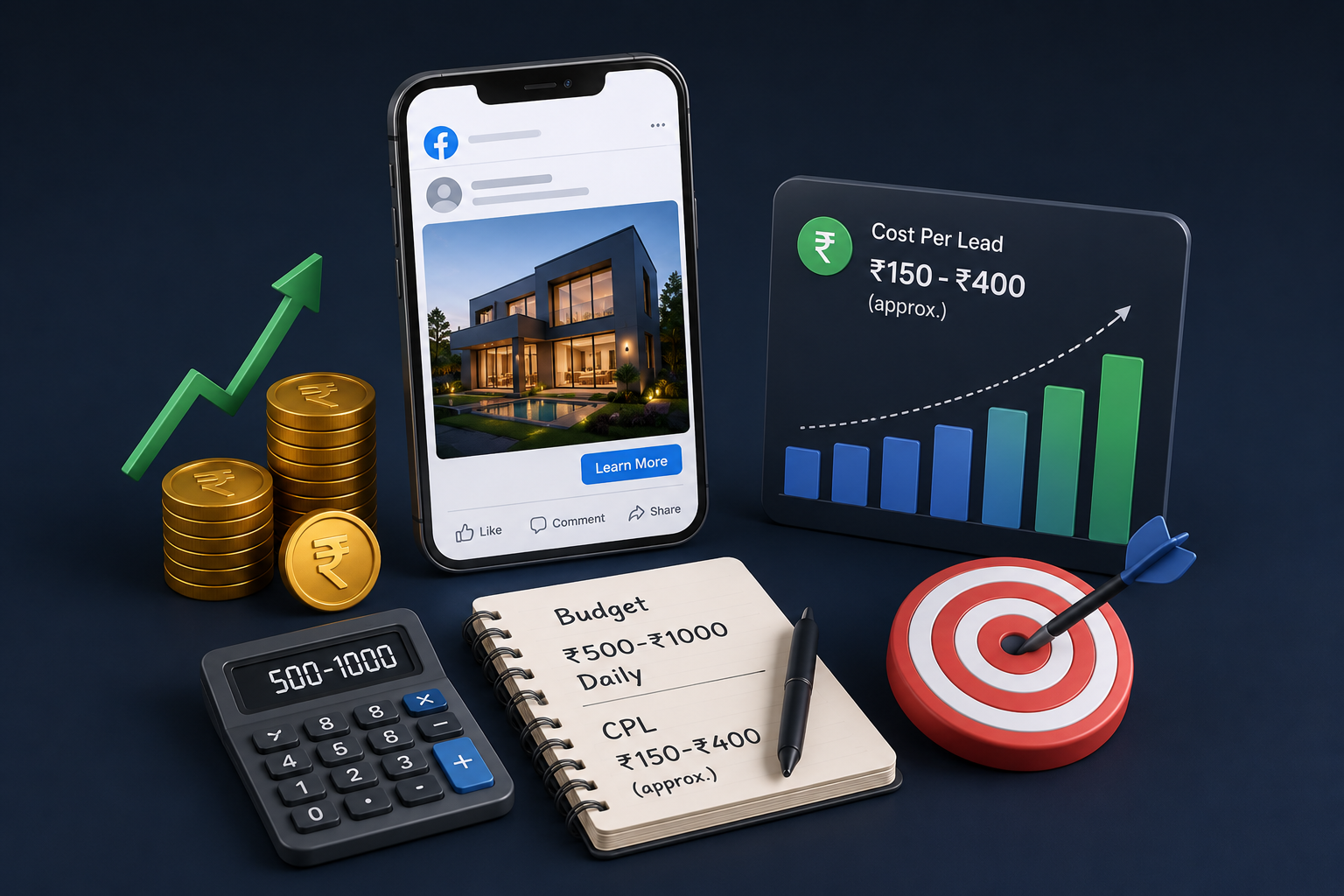 There’s no single “correct” daily budget for real estate ads, but here’s a realistic way to think about it.
For a single property listing in a competitive city, expect the cost per lead to land somewhere between ₹150 and ₹400 (roughly $5 to $15 in US markets), depending on property type, price point, and competition. Luxury or commercial real estate tends to cost more per lead simply because the audience is smaller and more competitive.
If you’re just starting out, don’t spread a tiny budget across five different campaigns. Meta’s algorithm needs sufficient data (typically a baseline of conversions per week) to optimise properly. A focused ₹500-₹1000 daily budget for one well-structured campaign will almost always outperform ₹100 a day spread across five scattered campaigns.
Run campaigns for at least 4 to 7 days before judging performance. Meta’s system goes through a “learning phase” early on, and pausing or editing campaigns too often resets that learning, which quietly wastes your budget. This is a mistake we see constantly when auditing real estate ad accounts, and it’s one of the easiest things to fix once you know what to look for.
If your current cost per lead has crept up compared to last year, it’s often not your budget that’s the problem; it’s your campaign structure. That’s where you need some effective digital marketing strategies that can help your real estate projects sell faster. What’s better than effective managed paid ads, as they work best when combined with the rest of your online presence?
Step 4: Creative Is Doing More of the Work Than Ever
Here’s the part that’s changed the most. Because targeting is now largely automated, your creative is what tells Meta’s AI (and the actual humans scrolling) who this ad is for. A photo of a luxury penthouse with copy about “spacious family homes near top schools” sends mixed signals to both the algorithm and the viewer. Be specific and consistent.
A few things that matter a lot right now:
- Vertical video is the default, not an option. Over 90% of Meta’s ad inventory is now vertical (9:16), thanks to the merger of Stories and Reels into a single placement system. If you’re still uploading square or landscape photos and letting Meta auto-crop them, you’re likely cutting off important parts of your image, like the price tag, headline, or the property itself. Shoot or edit specifically for 9:16 from the start.
- Short property tour videos outperform static photos by a wide margin. Video content generates dramatically higher engagement in real estate ads compared to photo carousels alone. The sweet spot for a listing tour video is 60 to 90 seconds, walking through the property in a logical order (entrance, living area, kitchen, bedrooms, view or balcony, then a closing shot with price and contact info).
- Carousel ads still work well for showcasing multiple units or floor plans. If you’re advertising a project with multiple configurations (2BHK, 3BHK, penthouse), a carousel lets potential buyers compare options without leaving the ad.
- Disclose AI-generated content. If you’re using AI tools to generate any part of your visual creative (not just colour correction or cropping, but actual AI-generated scenes, renders, or people), Meta now requires disclosure. Skipping this is becoming one of the more common reasons ads get rejected, so it’s worth checking your creative workflow if you’ve started using AI image tools for staging or virtual renovations.
- Match your copy to the audience you want, not the audience you can target. Since you can’t manually target by income or family status for housing ads, your words have to do that filtering. “Perfect for first-time buyers under ₹50 lakh” pulls in a very different crowd than “Premium 4BHK villas with private pools.” Write the headline as if you’re speaking directly to the person you want to click.
Step 5: Instant Forms and Faster Lead Capture
Instant Forms (lead ads that open directly in Facebook or Instagram without sending people to a separate website) continue to be among the highest-converting formats for real estate, mainly because they remove friction. The user doesn’t have to leave the app, wait for a page to load, or fill out a long form.
Meta has also started rolling out AI-assisted form building, where you can point the tool at your property listing page and it will automatically generate a usable Instant Form. This saves a meaningful amount of setup time if you’re running multiple listing campaigns at once.
A couple of practical tips for Instant Forms in real estate: keep the form to 4 or 5 fields maximum (name, phone, email, and maybe budget range or preferred location), and always follow up within minutes, not hours. Leads from Instant Forms cool off fast, and the agencies seeing the best return are the ones with a CRM connected directly to their ad account so leads get a call or WhatsApp message almost immediately.
Step 6: Don’t Treat Meta Ads as a Standalone Channel
This is probably the biggest shift in how real estate marketing works in 2026. Buyers no longer move through one neat funnel. Someone might see your Instagram ad, search your agency name on Google a week later, read a blog post you wrote about the neighbourhood, and only then fill out a form. If your Meta Ads aren’t backed by a solid website, decent SEO, and consistent content, you’re leaving a lot of that interest on the table.
This is why most successful real estate marketing right now runs Meta Ads alongside SEO and content, not instead of it.
Common Mistakes to Avoid
 A few patterns show up again and again in underperforming real estate ad accounts:
- Forgetting to select the Special Ad Category for housing, which risks ad disapproval or account restrictions.
- Editing or pausing campaigns too frequently, which resets Meta’s learning phase and quietly inflates costs.
- Using landscape or square images in a feed that’s now almost entirely vertical.
- Sending paid traffic to a slow, outdated, or non-mobile-friendly website, which kills conversion rates no matter how good the ad is.
- Running ads without a pixel or Conversions API set up, leaving Meta’s AI with no real data to optimise against.
- Treating every property the same in messaging, instead of writing creative that speaks to the specific buyer for that specific listing.
Final Thoughts
Running Facebook and Instagram ads for real estate in 2026 isn’t about outsmarting the algorithm with clever targeting tricks anymore. It’s about feeding Meta’s AI high-quality, clean data and a compliant setup, then letting it do what it’s genuinely gotten quite good at: finding the right person at the right time. Pair that with a website and content strategy that supports the same buyers once they leave the ad, and you’ve got a system that keeps generating leads long after the campaign goes live.
If setting all of this up feels like a lot to manage alongside actually selling properties, that’s exactly the kind of work our team handles every day. Deftsoft works with real estate agents, brokers, and developers to build and manage Meta Ads campaigns, websites, and AI SEO strategies that work together instead of competing for the same budget. Reach out to us if you’d like a free audit of your current ad account and a clear idea of where you’re leaving leads on the table.
Ready to turn your ad spend into actual site visits and closings?
Frequently Asked Questions
1. How much should I spend on Facebook and Instagram ads for real estate in 2026?
There’s no fixed number, but a focused daily budget of ₹500 to ₹1000 (roughly $10 to $20) on a single, well-structured campaign usually outperforms a small budget spread across multiple campaigns. Meta’s algorithm needs enough weekly conversions to optimise properly, so concentrating your spend tends to work better than spreading it thin.
2. Do real estate ads need special approval on Meta?
Yes. Housing-related ads must be run under Meta’s Special Ad Category for Housing, a requirement tied to fair housing laws. This restricts certain targeting options, such as age, gender, ZIP code, and lookalike audiences, but Meta provides compliant alternatives, such as Special Ad Audiences and geo-radius targeting.
3. Is Instagram or Facebook better for real estate ads
Neither works better in isolation. Most real estate campaigns run across both platforms simultaneously through Meta Ads Manager, using Advantage+ Placements so the algorithm can decide where each version of your ad performs best, whether that’s Facebook Feed, Instagram Reels, or Stories.
4. What type of creative works best for real estate ads right now?
Short vertical video tours (60 to 90 seconds, shot in 9:16 aspect ratio) consistently outperform static photos. Carousels work well for showcasing multiple unit types or floor plans within a single project.
5. How long should I let a campaign run before judging its performance?
At least 4 to 7 days. Meta’s system goes through a learning phase early on, and editing or pausing a campaign too soon resets that learning, which often makes performance look worse than it actually is.
6. Can I target buyers by income or family status
Not directly. Special Ad Category restrictions remove those targeting options for housing ads. Instead, your ad copy and creative need to do that filtering by speaking directly to the buyer you want, for example, mentioning price range, property type, or lifestyle details that naturally attract the right audience.
7. Do I need a website to run Meta Ads for real estate?
It’s strongly recommended. While Instant Forms let you capture leads without sending people to a website, a fast, mobile-friendly site with proper SEO supports the rest of the buyer journey and gives Meta’s pixel and Conversions API the data it needs to optimise your campaigns effectively.

Devraj
 30th June 2026