How to Get Your Ads Seen Inside Google AI Overviews in 2026
-
By Devraj
-
7th July 2026
The digital advertising landscape is experiencing a massive paradigm shift as artificial intelligence fundamentally alters how users discover information online. With the integration of Google AI Overviews at the top of search results, traditional search engine optimization and pay-per-click strategies must evolve to maintain visibility. Advertisers can no longer rely solely on classic search placements; they must adapt to automated, context-driven ad positioning directly within or alongside AI-generated summaries. Understanding the mechanics behind this algorithmic selection is crucial for digital marketers aiming to secure premium real estate. This guide explores how these placements function and details actionable steps to optimize your campaigns.
Quick Summary
Google Ads can now appear above, below, and, in select markets, directly within AI Overviews, the AI-generated summaries sitting at the top of Google Search results. There’s no toggle to turn this on, no separate campaign type to build, and no way to opt out. Eligibility is entirely automatic, based on your existing campaigns, your Quality Score, and how well your ads match both the user’s query and the AI Overview’s content. This guide walks through exactly how ads in AI Overviews work, which campaign types actually qualify, and the specific changes you can make to improve your odds of showing up.
Ready to Dominate AI-Driven Search?
Don’t let your competitors claim the top spot. Schedule a comprehensive AI Readiness
Quick Navigation
What Are Ads in AI Overviews, Exactly?
How Does Google Decide If Your Ad Gets Shown?
Which Campaign Types Actually Qualify
Practical Steps to Improve Your AI Overview Ad Visibility
AI Overviews vs. AI Mode: Don’t Confuse the Two
Where This Fits Into the Bigger Picture
What Are Ads in AI Overviews, Exactly?
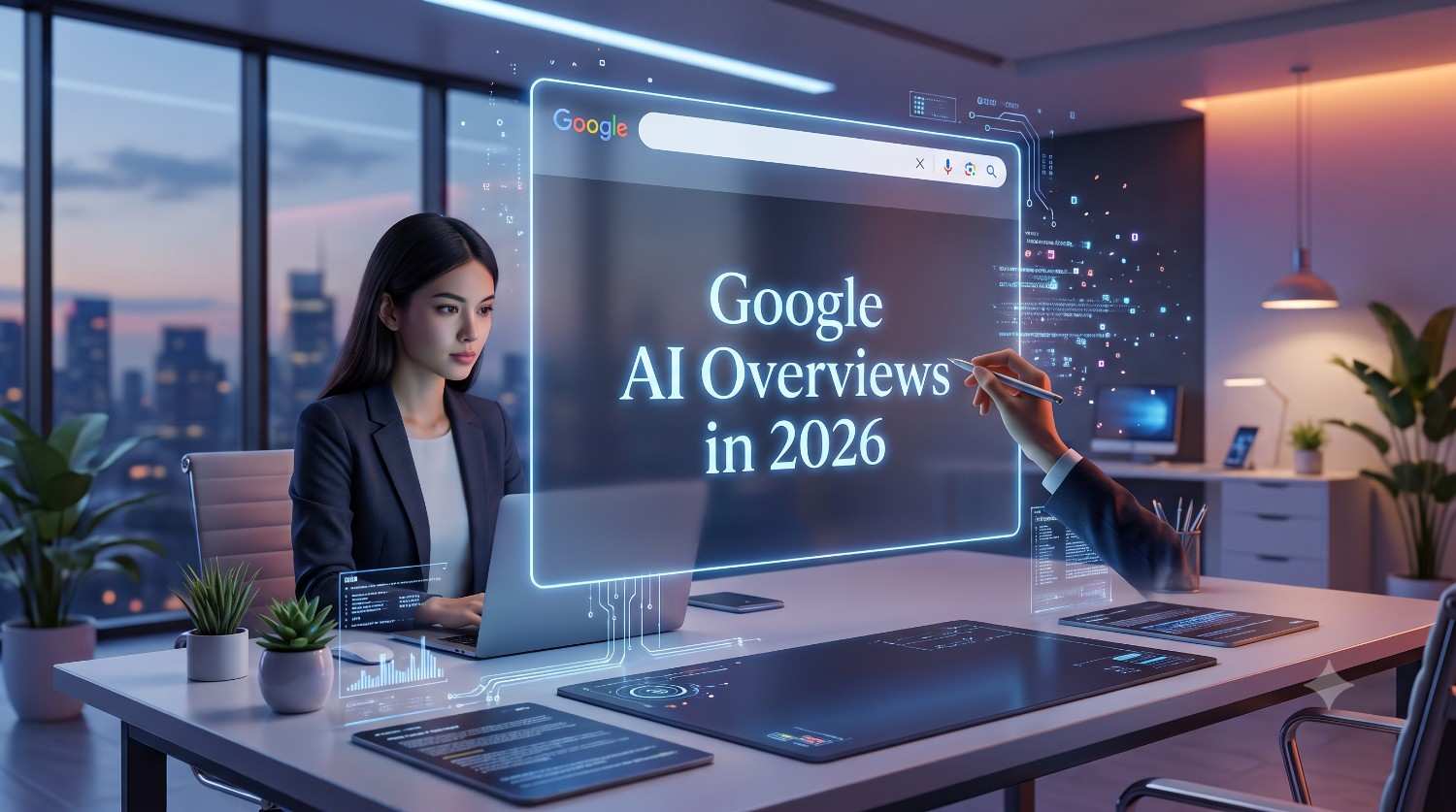
AI Overviews are the AI-generated answer boxes that now appear at the top of Google Search for many queries, especially complex, exploratory, “no single right answer” searches. According to Google, AI Overviews now appear in more than 60% of searches, which means that for a growing share of your target audience, the AI Overview is the first thing they see, often before they scroll down to anything resembling a traditional blue link.
Ads in AI Overviews are not a new ad format you build from scratch. They’re a new ad placement you likely already have running. If you’re running Search, Shopping, or Performance Max campaigns with text or Shopping ads, those same ads become eligible to appear above the AI Overview, below it, or, in a smaller set of markets, embedded directly within the AI-generated response itself. Ads above or below the AI Overview are eligible in all 200+ markets where AI Overviews exist. Ads appearing within the AI Overview content itself are currently limited to English-language results on mobile and desktop in a smaller group of countries, including the US, Canada, Australia, India, and several others, with Google actively expanding that list.
How Does Google Decide If Your Ad Gets Shown?
Google has been fairly transparent about the mechanics here, and it comes down to three conditions that all have to be true at once:
- Intent – Google’s systems must detect commercial intent in the user’s query. AI Overviews trigger for a wide range of queries, including many purely informational ones, but ads only enter the picture when there’s a reasonable signal that the person searching is close to making a decision.
- Inventory – Google needs relevant, quality ads available that actually match what’s being asked. If nothing in the auction is a strong fit, no ad shows, regardless of how much you’re willing to bid.
- Relevance – Your ad has to be relevant not just to the user’s original search term, but to the content of the AI Overview itself. This is the part most advertisers miss: Google is matching your ad against the AI-generated answer, not just the keyword you bid on.
Once those three boxes are checked, your ad still has to win the existing ad auction like any other placement. There’s no special bidding lane or premium tier for AI Overview visibility. It runs through the same auction ranking system you’re already familiar with.
Two things worth knowing up front, because they trip up a lot of advertisers: you cannot directly target ad placements within AI Overviews, and you cannot opt out of them either. If you’re running eligible campaign types, you’re automatically in consideration. The only real lever you have is making your campaigns strong enough, in relevance, quality, and structure, to actually win when the opportunity comes up.
Which Campaign Types Actually Qualify
This is where many businesses lose out without realizing it. Not every campaign is eligible.
What qualifies: Text and Shopping ads running inside Search, Shopping, and Performance Max campaigns are eligible for AI Overview placements. AI Max for Search, Google’s newer AI-powered Search campaign type, is also built specifically to align with these AI-driven placements and is increasingly the recommended path for advertisers who want stronger AI Overview and AI Mode presence.
What doesn’t qualify, or qualifies poorly: Standard Search campaigns that rely solely on exact-match or phrase-match keywords are largely shut out of AI Overview placements. This is a genuinely important structural point. AI Overviews get triggered by complex, conversational, long-tail queries, exactly the kind of search a rigid exact-match keyword list was never built to catch. Google’s own guidance recommends broad match, or AI Max’s intent-based targeting, specifically because it helps advertisers reach the varied phrasing that triggers AI Overviews in the first place.
There’s also a firm exclusion list. Google currently does not show ads within AI Overviews for sensitive categories including finance, healthcare, politics, gambling, and alcohol, among others. If you operate in one of these verticals, don’t build a strategy around AI Overview visibility just yet; focus your paid media budget elsewhere until that changes.
Practical Steps to Improve Your AI Overview Ad Visibility
Since you can’t target the placement directly, the entire game is making your existing campaigns strong enough to win when the opportunity arises. Here’s what actually moves the needle:
1. Move away from exact-match-only keyword strategies. If your account is built entirely on tightly controlled exact match terms, you’re structurally limiting how often you’re even considered for AI Overview placements. Layer in broad-match campaigns, or migrate relevant campaigns to AI Max for Search, so Google’s systems have room to match you to the full range of conversational queries that trigger these placements.
2. Strengthen your landing pages. Thin landing pages are one of the most common reasons ads lose out here. Google is evaluating relevance against genuinely helpful, AI-generated content, so a landing page needs to actually answer the underlying question, not just exist as a click destination.
3. Invest in full ad asset depth. Extensions, structured data, multiple headline and description variations, images, and video assets all influence how confidently Google’s systems can match your ad to the context of an AI Overview. A single generic headline and description isn’t enough anymore.
4. Clean up your Shopping and Merchant Center feeds. If you’re an ecommerce business, Shopping ads are among the strongest candidates for AI Overview visibility, but only when your product feed is accurate, complete, and well-categorized. Titles, attributes, and imagery all directly influence whether your products get surfaced.
5. Restructure campaigns around intent, not just keyword themes. Ads that appear above the AI Overview tend to capture outsized attention, while ads below it require the user to scroll first. That means transactional, high-intent query clusters often justify more aggressive bids, while broader informational clusters need a lighter touch. Mixing these under one bidding strategy makes it harder for Smart Bidding to do its job well.
6. Lean on Smart Bidding rather than manual control. Google explicitly recommends AI-powered bidding strategies for AI Overview opportunities, since these placements depend on real-time signal matching that manual bid adjustments can’t keep pace with.
7. Watch your Top Ads metric closely. Google doesn’t currently offer segmented reporting specifically for ads that appear within AI Overviews; they’re folded into the broader “Top Ads” prominence metric. Until Google rolls out more granular reporting, monitoring shifts in your Top Ads share, search term reports, and overall conversion quality is the closest proxy you have for understanding whether your AI Overview visibility is improving.
AI Overviews vs. AI Mode: Don’t Confuse the Two
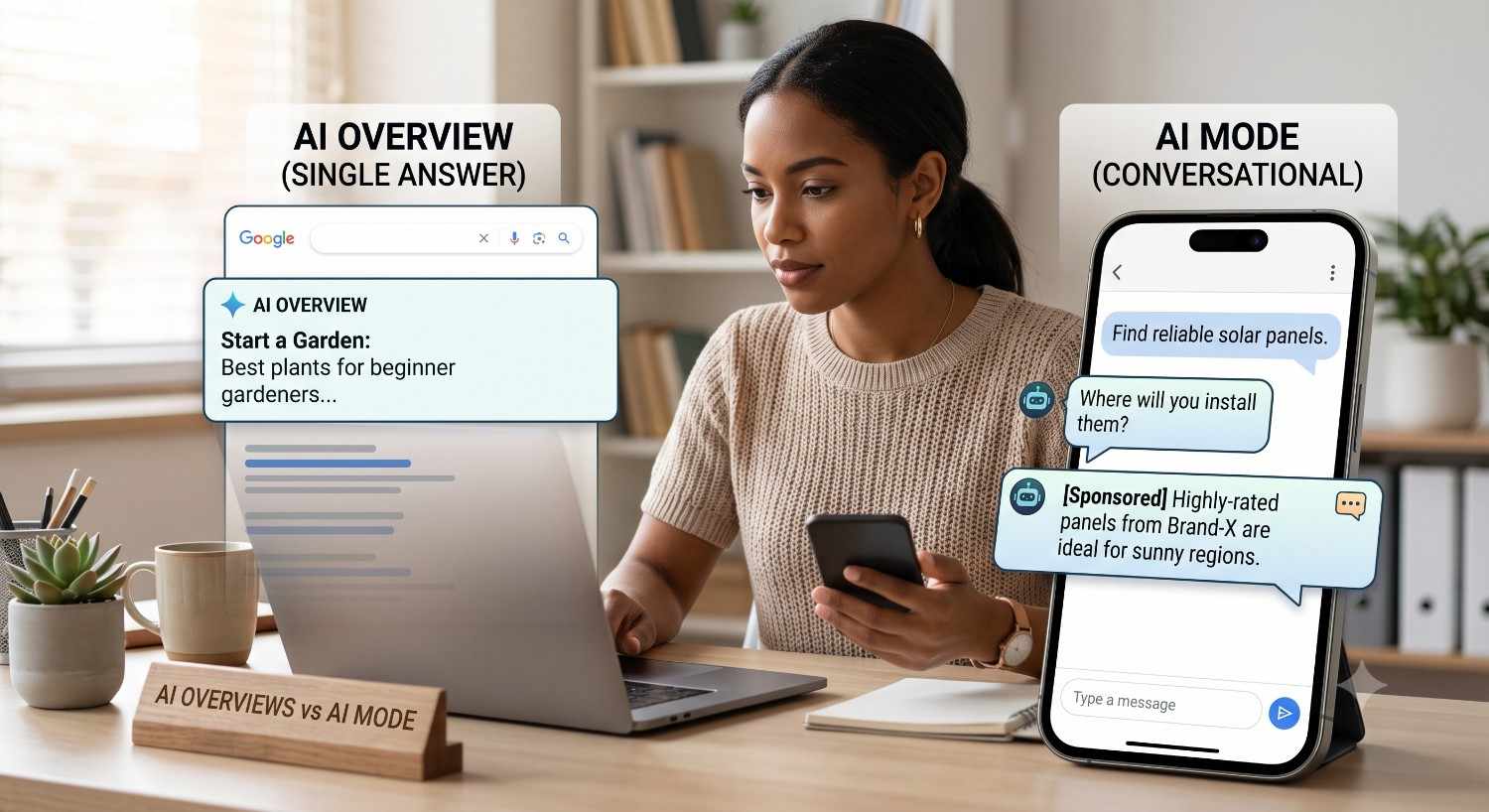
Google is also testing a separate, standalone conversational search experience called AI Mode, which functions more like a multi-turn conversation than a single search query and is, in some ways, closer to how people use ChatGPT than to how they’ve traditionally used Google Search. Ads in AI Mode are a distinct rollout from ads in AI Overviews and are currently being tested primarily in the US, with eligibility again centered on Performance Max, AI Max for Search, Shopping campaigns, and broad match campaigns.
 It’s worth paying attention to both, because they signal the same underlying direction for search advertising: less rigid keyword-matching, more conversational and intent-based targeting, and a search results page where AI-generated answers sit ahead of, and sometimes absorb, the traditional ad and organic listing formats advertisers have optimized around for two decades.
Where This Fits Into the Bigger Picture
It’s worth zooming out for a second. Google isn’t the only platform rebuilding advertising around AI-generated answers. OpenAI has been steadily rolling out its own advertising program inside ChatGPT, expanding market by market, which tells you this isn’t a Google-only shift; it’s the direction the entire paid search category is heading. Businesses that build genuine expertise now in structuring campaigns for AI Overviews, AI Mode, and platforms like ChatGPT Ads will have real, compounding advantages over competitors who wait until it’s mainstream and obvious.
The businesses winning in this environment share a common thread: they treat AI Overview visibility as an extension of solid PPC fundamentals, strong Quality Score, genuinely useful landing pages, accurate conversion tracking, clean feeds, rather than a separate hack or shortcut. Showing up inside an AI Overview won’t rescue a weak campaign. It will, however, meaningfully amplify a strong one.
How Deftsoft Helps You Get Ahead of This Shift
Restructuring keyword strategy, migrating campaigns to AI Max, rebuilding landing pages for relevance, and interpreting Top Ads data without dedicated AI Overview reporting is a lot to manage on top of the day-to-day work of running a Google Ads account. This is exactly where a dedicated Google Ads agency earns its keep. At Deftsoft, our PPC and Google Ads management services are built around staying ahead of exactly these kinds of platform shifts, auditing your current campaign structure, identifying where exact-match dependency or weak landing pages are quietly capping your AI Overview eligibility, and rebuilding your account so it’s positioned to win in Google’s AI-first search era, not left behind by it. If you’re also exploring newer channels like ChatGPT Ads alongside your Google Ads strategy, our digital marketing team can help you build a coherent paid media plan that spans both.
Talk to Deftsoft’s PPC team for a free audit of your current campaigns’ positioning for AI Overviews and AI Mode.
Secure the Top Spot in AI Search
Don’t let your brand get left behind in Google’s shift to AI-first search.
Frequently Asked Questions
Can my Google Ads actually appear inside AI Overviews?
Yes. Google Ads are eligible to show above, below, and in select markets, directly within AI Overviews. Existing text and Shopping ads from Search, Shopping, and Performance Max campaigns automatically qualify when they meet Google’s relevance and quality requirements.
How do I get my ads to show up in Google AI Overviews?
No special campaign type is required to appear. You need to meet Google’s eligibility conditions: commercial intent detected in the query, relevant and high-quality ad inventory, and strong alignment between your ad and the AI Overview’s content. Broad match keywords, AI Max for Search, strong landing pages, and complete ad assets all improve your chances.
Can I opt out of my ads showing in AI Overviews?
No. Google Ads does not currently offer an option to opt out of AI Overview placements. If you’re running eligible campaign types, your ads are automatically considered for these placements.
Can I target ads specifically to appear within AI Overviews?
No. You cannot directly target this placement. Eligibility is determined automatically based on your existing campaigns, ad quality, and relevance signals, not manual placement targeting.
Do exact match keywords work for AI Overview ad placements?
Not well. Standard Search campaigns that run only exact- or phrase-match keywords are largely excluded from AI Overview placements, since these placements are triggered by complex, conversational, long-tail queries that rigid keyword lists don’t capture. Broad match and AI Max for Search are better suited to this placement.
Is there separate reporting for ads that appear in AI Overviews?
Not yet. Google Ads currently reports these placements under the broader “Top Ads” prominence metric rather than a dedicated AI Overview breakout. Google has indicated more detailed reporting is planned as the placement matures.
What’s the difference between ads in AI Overviews and ads in AI Mode?
AI Overviews are AI-generated summaries appearing on the standard Google Search results page. AI Mode is a separate, standalone conversational search experience, closer to a multi-turn chat. Ads in AI Mode are being tested primarily in the US and are eligible for Performance Max, AI Max for Search, Shopping, and broad match campaigns, similar to AI Overview eligibility but a distinct rollout.
Are ads in AI Overviews shown for every type of business?
No. Google currently excludes sensitive categories, including finance, healthcare, politics, gambling, and alcohol, from appearing within AI Overviews. Businesses in these verticals should focus on other paid placements for now.


Devraj
 7th July 2026