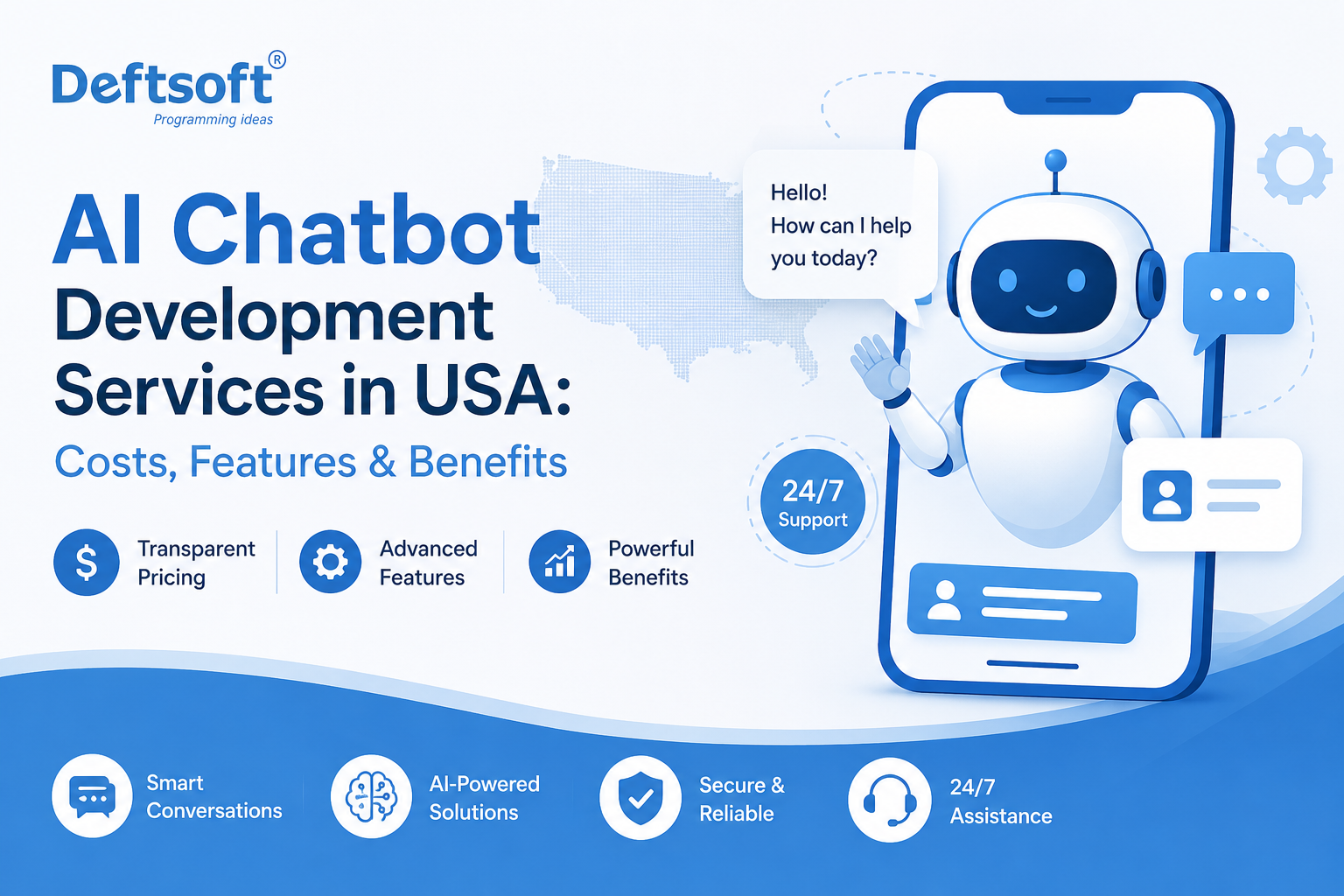
AI Chatbot Development Services in USA: Costs, Features & Benefits
-
By Devraj
-
23rd July 2026
If you’ve started researching AI chatbot development services in the USA, you’ve probably already noticed the problem: every source quotes a different price. One article says $5,000. Another says $250,000. A third throws around a number north of a million dollars. None of them are lying; they’re just describing completely different products that happen to share the same name.
A simple FAQ bot that answers “what are your store hours” and a multi-agent conversational AI system that qualifies leads, checks order status in your ERP, escalates to a human when needed, and logs everything for compliance are both technically “AI chatbots.” They have almost nothing else in common not in cost, not in build time, not in the team required to deliver them.
This guide breaks down what actually drives AI chatbot development cost in 2026, what features separate a chatbot that gets used from one that gets abandoned after a month, and what real, measurable benefits businesses are seeing from getting this right.
Quick Summary
- AI chatbot development costs in the USA range from roughly $5,000 for a basic rule-based bot to $250,000+ for a full enterprise, LLM-powered agentic system.
- Most small and mid-sized US businesses invest between $15,000 and $80,000 for a capable AI chatbot with NLP, integrations, and multi-channel support.
- Costs are driven primarily by architecture (rule-based vs. NLP vs. LLM/RAG), integrations, deployment channels, and compliance requirements (HIPAA, SOC 2), not just how advanced the chatbot appears.
- The most valuable chatbot features include context retention, system integrations, seamless human handoff, and actionable analytics—not just conversational ability.
- The strongest ROI comes from reduced support costs, faster lead qualification, improved conversions, and 24/7 customer availability.
- Deftsoft builds custom AI chatbot solutions across web, mobile, and enterprise platforms, tailored to your business workflows instead of using one-size-fits-all templates.
Ready to scope your own AI chatbot project?
If you’re weighing whether a chatbot makes sense for your business, or trying to figure out which tier actually fits your use case. Connect with us and get a free project assessment today.
Quick Navigation
Why “AI Chatbot” Means Something Different Depending on Who You Ask
AI Chatbot Development Cost in the USA: 2026 Pricing Breakdown
What Actually Drives the Price Up or Down
Features That Actually Matter (and the Ones That Don’t)
The Real Benefits Businesses Are Seeing
Why “AI Chatbot” Means Something Different Depending on Who You Ask
Before getting into numbers, it’s worth being precise about categories, because the pricing conversation only makes sense once you know which one you’re actually asking about.
- Rule-based chatbots follow decision trees: if the user says X, respond with Y. They’re fast to build, cheap, and reliable for narrow use cases like FAQs or basic routing, but they break the moment a user phrases something unexpectedly.
- NLP-based chatbots use natural language processing to understand intent even when phrasing varies. They can handle a wider range of real conversations and are a meaningful step up in usefulness, though they still work within a defined scope.
- LLM-powered and RAG-based chatbots use large language models, often combined with Retrieval-Augmented Generation pulling from your own documents and data to hold much more natural, context-aware conversations and answer questions grounded in your actual business content rather than generic training data.
- Agentic chatbots go a step further still: they don’t just answer questions; they take actions, checking an order status, updating a CRM record, processing a return, often coordinating multiple specialized AI agents behind a single conversational interface.
Most businesses researching “AI chatbot development” are actually somewhere between the second and third category, and that’s where the bulk of real-world 2026 projects land.
AI Chatbot Development Cost in the USA: 2026 Pricing Breakdown
| Chatbot Type | Typical Cost (USA) | Timeline | Best For |
|---|---|---|---|
| Rule-based/basic FAQ bot | $5,000 – $15,000 | 2–4 weeks | Simple routing, FAQs, lead capture |
| NLP chatbot (intent-based) | $15,000 – $50,000 | 4–8 weeks | Customer support, appointment booking |
| LLM / RAG-powered chatbot | $40,000 – $90,000 | 8–12 weeks | Knowledge-grounded support, sales assist |
| Enterprise / agentic multi-channel system | $80,000 – $250,000+ | 12–20+ weeks | Complex workflows, compliance-heavy industries |
A few things worth noting about these ranges. First, US-based development typically runs at a premium compared to fully offshore builds, reflecting both labor cost and the depth of integration work usually expected at this end of the market. Second, ongoing costs are real and recurring; expect annual maintenance of roughly 15–25% of the initial build cost, plus usage-based charges for the underlying AI model (LLM API costs are typically billed per token, and add up meaningfully at scale). Third, the build itself is often only part of the budget; for serious enterprise deployments, integration work, compliance documentation, and internal change management can account for as much of the total cost as the chatbot itself.
What Actually Drives the Price Up or Down
- Number of channels: A bot deployed only on your website costs far less than one supporting web, WhatsApp, SMS, and voice simultaneously.
- Knowledge base complexity: A single, clean FAQ document is cheap to build against; ingesting and maintaining dozens of scattered internal documents through RAG adds real engineering time.
- Integrations: Connecting to your CRM, helpdesk, payment processor, or ERP is where scope (and cost) grows quickly.
- Compliance requirements: HIPAA for healthcare, SOC 2 for enterprise SaaS, or financial-services regulations all add development, documentation, and audit overhead.
- Custom training vs. off-the-shelf models: Using GPT or Claude out of the box is cheaper upfront than fine-tuning a model on your proprietary data, though the latter often performs better for specialized use cases.
Features That Actually Matter (and the Ones That Don’t)
It’s easy to get distracted by flashy demo features that don’t hold up in daily use. Based on what separates chatbots that get adopted from ones that quietly get switched off:
- Context retention across a conversation. A chatbot that forgets what the user said two messages ago creates more frustration than it saves. Genuine multi-turn context handling is one of the clearest markers of a well-built system.
- Human handoff, done well. Every chatbot eventually hits a question it can’t answer. The best systems recognize that moment quickly and hand off to a human agent with the full conversation context intact, not a cold transfer that makes the customer repeat themselves.
- Real integrations, not just API hooks. Connecting to a CRM should mean the bot can actually look up a customer’s order history or update a record, not just technically “have access” to an endpoint nobody built logic around.
- Multilingual support, if your customer base needs it, is increasingly standard rather than a premium add-on for US businesses serving diverse markets.
- Analytics that go beyond “number of conversations.” Useful chatbot analytics show intent trends, resolution rates, and where conversations break down the data that actually informs product and support decisions.
- Security and data handling appropriate to your industry. For healthcare, finance, or any business handling sensitive customer data, this isn’t optional it needs to be designed in from the architecture stage, not patched on afterward.
What matters far less than most demos suggest: an unusually witty personality, elaborate onboarding animations, or supporting every possible channel on day one rather than the two or three your customers actually use.
The Real Benefits Businesses Are Seeing
- Lower support costs. Handling routine, repetitive questions through a chatbot frees human agents for the conversations that actually need a person, often reducing ticket volume on common issues substantially.
- Faster lead qualification. A chatbot that asks the right qualifying questions before handing a lead to sales means your team spends time on prospects who are actually ready, not on cold inbound traffic.
- 24/7 availability without 24/7 staffing costs. Customers increasingly expect an immediate response regardless of time zone or hour something no support team can staff for around the clock without a chatbot layer in front of it.
- Higher conversion on e-commerce sites. A chatbot that helps an undecided shopper compare products or recovers an abandoned cart in real time has a direct, measurable line to revenue, not just a soft “customer experience” benefit.
- A genuine data asset. Every conversation generates usable information about what customers actually ask, where they get stuck, and what objections come up repeatedly insight that’s harder to gather systematically any other way.
How Deftsoft Approaches AI Chatbot Development
With more than 20+ years of building web, mobile, and custom software solutions across healthcare, finance, e-commerce, education, real estate, and logistics, Deftsoft’s approach to AI chatbot development starts with your actual workflows, not a template. We work across modern AI stacks, integrating leading LLMs with retrieval-augmented generation over your own business data and connecting chatbots cleanly into the CRM, ERP, and support systems you already run on, using the same API-first, cloud-native architecture (AWS, Azure, Google Cloud) that underpins our broader software development work.
We scope every AI chatbot project with a discovery phase first, specifically because chatbot complexity is genuinely difficult to estimate accurately without understanding your data, your existing systems, and how your team actually wants the handoff between bot and human to work. That’s also where most of the “surprise” costs on chatbot projects come from when it’s skipped.
Get a tailored cost estimate for your business
Every business’s chatbot needs are different; a healthcare provider’s compliance requirements look nothing like an e-commerce brand’s cart-recovery use case. Get a cost estimate scoped to your actual requirements, not a generic price range pulled from a blog post.
Frequently Asked Questions
How much does AI chatbot development cost in the USA in 2026?
Costs typically range from $5,000 for a basic rule-based bot to $250,000+ for a full enterprise, LLM-powered agentic system. Most small-to-mid-sized US businesses looking for a genuinely capable chatbot with NLP and integrations should budget between $15,000 and $80,000.
How long does it take to build an AI chatbot?
A focused MVP with a single channel typically takes 4–8 weeks. A full enterprise system with multi-source knowledge integration, analytics, and multiple channel support usually takes 12–20 weeks or more.
Do I need a custom-built chatbot, or is an off-the-shelf platform enough?
Off-the-shelf platforms (subscription-based, often $9–$300/month) work well for straightforward FAQ and basic support use cases. Custom development makes more sense once you need deep integrations with your own systems, industry-specific compliance, or conversational behavior that a generic platform’s app ecosystem can’t support.
What ongoing costs should I expect after launch?
Plan for annual maintenance of roughly 15–25% of the initial development cost, plus usage-based fees for the underlying AI model (LLM API costs scale with conversation volume), and periodic updates as your business processes change.
Can an AI chatbot integrate with my existing CRM or helpdesk software?
Yes, this is one of the most common and valuable integrations we build. A chatbot connected properly to your CRM or helpdesk can look up customer history, update records, and automatically hand off enriched context to a human agent.
Is RAG (Retrieval-Augmented Generation) worth the extra cost?
For most businesses with meaningful internal documentation product catalogs, policy documents, support articles yes. RAG lets your chatbot answer questions grounded in your actual business content, which significantly reduces incorrect or generic responses compared to a model working from general training data alone.


Devraj
 23rd July 2026