Google I/O Connect India 2026: What Google’s AI Announcements Mean for Businesses
-
By Devraj
-
16th July 2026
Artificial intelligence is moving beyond standalone chatbots and content-generation tools. Businesses are now beginning to use AI systems that can understand goals, communicate across languages, access approved tools and complete multistep tasks.
The announcements made at Google I/O Connect India 2026 show how quickly this transition is taking place.
Held on July 14, 2026, the event focused on India’s growing role in AI development. Google introduced initiatives covering education, healthcare, Indian languages, startup support, enterprise cloud infrastructure and the security foundations required for autonomous AI agents.
For businesses, these announcements are more than updates about new Google products. They provide a clearer picture of how AI applications may be designed, deployed and secured over the coming years.
Key Takeaways
- Practical Implementation: The transition from generative chatbots to autonomous, agentic AI marks a new phase of adoption focused on solving practical, localized business challenges.
- Multilingual Reach: Enhanced voice and text capabilities in over 25 regional languages will significantly lower digital accessibility barriers for regional applications.
- Built-in Security: As AI agents gain workflow access, robust frameworks such as sandboxing and limited permissions must be core architectural requirements, not afterthoughts.
- Localized Infrastructure: The availability of local data centers simplifies adherence to strict data residency and compliance guidelines for heavily regulated industries.
Quick Navigation
What Was Announced at Google I/O Connect India 2026?
Multilingual AI Could Make Digital Services More Accessible
Agentic AI Is Moving into Practical Business Workflows
Security Must Be Part of AI Agent Architecture
Enterprise AI Is Becoming More Compatible with Data Residency Requirements
Healthcare AI Is Becoming More Locally Relevant
Google Is Investing in India’s AI Talent and Startup Ecosystem
What Should Businesses Do After Google I/O Connect India 2026?
1. Identify a specific business problem
2. Decide whether AI is actually required
4. Choose between an assistant and an agent
5. Create a controlled proof of concept
What Was Announced at Google I/O Connect India 2026?
Google organised its announcements around three broad priorities:
- Expanding access to advanced AI capabilities
- Supporting India’s startup and developer ecosystem
- Creating stronger security foundations for agentic AI
The initiatives included AI training programmes, Gemini-powered educational tools, healthcare models, multilingual datasets, enterprise AI infrastructure, startup accelerators and a secure environment for AI agent development.
Rather than focusing only on the size or performance of its AI models, Google emphasised how AI could be applied to local challenges in education, health, language accessibility and enterprise technology.
This suggests that the next phase of AI adoption will be defined by practical implementation. Businesses will need to determine how AI fits into their existing workflows, data systems, customer experiences and security policies.
Multilingual AI Could Make Digital Services More Accessible
Language remains one of the biggest barriers to digital accessibility in India. Many online platforms continue to operate primarily in English, even when their users are more comfortable communicating in a regional language.
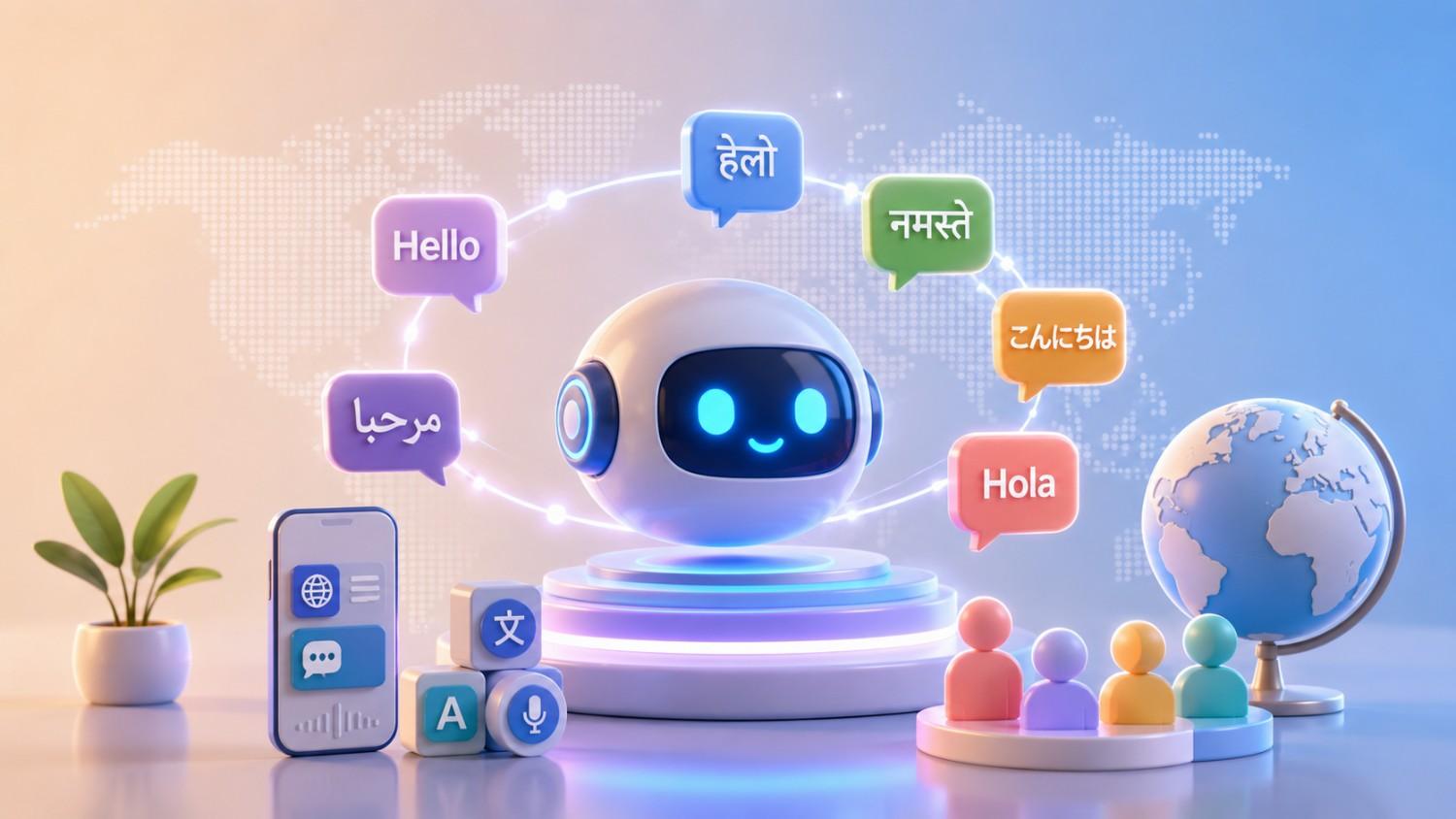 Google announced that Gemini Live can now communicate naturally through voice and text in more than 25 Indian languages and dialects. These include Sanskrit, Bhojpuri and Maithili.
Google also confirmed that Project Vaani, developed through a research collaboration with the Indian Institute of Science, has open-sourced speech and image datasets covering 109 Indic languages.
These developments could support a new generation of multilingual applications.
Businesses may be able to build:
- Customer support assistants that communicate in regional languages
- Voice-based healthcare or educational applications
- Local-language financial service platforms
- Multilingual eCommerce shopping assistants
- Regional-language search tools
- AI-powered government and public service applications
- Mobile apps designed for users with limited English proficiency
However, multilingual AI development involves more than translating English content. Developers must consider dialects, pronunciation, local expressions, cultural context and differences in how users describe the same problem.
Businesses planning to create multilingual AI solutions should test them with real users from the regions they intend to serve. Accuracy in one language does not automatically mean that an AI system will perform equally well in another.
Agentic AI Is Moving into Practical Business Workflows
One of the strongest themes from Google I/O Connect India 2026 was the rise of agentic AI.
A traditional chatbot generally waits for a question and provides a response. An AI agent can go further. It can interpret a goal, create a plan, access authorised systems and complete a series of actions.
For example, a conventional customer support chatbot may explain a refund policy. An AI customer service agent could verify the order, confirm the customer’s eligibility, initiate the refund, update the customer relationship management system and send a confirmation message.
Potential applications of AI agents include:
Customer service
AI agents can answer common questions, retrieve order information, create support tickets, recommend solutions and escalate complex cases to human representatives.
Sales and lead management
A sales agent could qualify incoming leads, update CRM records, schedule meetings and provide sales representatives with relevant account information.
eCommerce
Shopping agents may help customers compare products, receive personalised recommendations, check availability and complete certain approved purchasing tasks.
Finance and administration
AI agents can assist with invoice processing, expense categorisation, financial summaries and routine administrative workflows.
Human resources
Internal agents may answer employee questions, manage leave requests, retrieve company policies or guide new employees through onboarding.
Software development
Development agents can support code analysis, testing, documentation and security reviews while operating within defined technical boundaries.
Deftsoft already provides AI agent development services for use cases such as virtual assistants, customer service agents, recommendation systems and enterprise workflow automation. Its approach includes use-case discovery, requirements analysis, platform integration and deployment across web, mobile and enterprise environments.
The important question for businesses is not whether they should build an AI agent because the technology is popular. The question is whether an agent can solve a specific problem more effectively than an existing process or a simpler automation system.
Security Must Be Part of AI Agent Architecture
Agentic AI introduces new security concerns because an AI system may be granted access to databases, applications, communication platforms, payment systems or internal business tools. Google stated that security can no longer be treated as a final checkpoint when software can interpret intent and act independently. Safety must influence how an agent is designed from the beginning.
At Google I/O Connect India 2026, the company introduced several security-related initiatives.
Sec-Gemini v3
Sec-Gemini v3 is a specialised cybersecurity agent designed to help security teams investigate incidents, analyse malware, conduct digital forensics and interpret complex security data.
CodeMender
CodeMender is an AI agent that can create security fixes and contribute improvements to open-source software projects.
CAPSEM
Google is open-sourcing CAPSEM, or Capabilities Security for Agents. It places an AI agent inside an isolated virtual machine and restricts the information and systems the agent can access.
Raw credentials remain outside the agent’s reach. This helps protect the wider system if the agent encounters a malicious prompt or becomes compromised. Google also highlighted standards intended to protect interactions between users, devices, payments and independent AI agents. For businesses developing AI agents, the broader lesson is clear: access should never be unlimited.
A secure AI agent should include:
- Role-based access permissions
- Restricted access to tools and databases
- Protected credentials and API keys
- Human approval for sensitive actions
- Detailed activity logs
- Clear escalation procedures
- Prompt-injection protection
- Regular security testing
- Defined fallback behaviour
- The ability to suspend or revoke agent access
An agent that can read a calendar does not automatically need permission to delete events. A customer service agent that can retrieve account information may not need authority to issue a high-value refund without human approval.
Permissions should match the specific job the agent is expected to perform.
Enterprise AI Is Becoming More Compatible with Data Residency Requirements
Another significant announcement involved the use of Gemini within Indian data centres.
 Google stated that Indian enterprises, regulated industries and public-sector organisations can run Gemini through Google Distributed Cloud from within India. Prompts, model weights and outputs can remain within the organisation’s perimeter, while supporting services can operate without connecting to the public internet.
This could be especially relevant for organisations in:
- Banking and financial services
- Healthcare
- Insurance
- Government
- Education
- Legal services
- Telecommunications
- Large-scale enterprise operations
Many organisations want to use advanced generative AI but are concerned about how confidential data is processed, transferred and stored.
Localised and disconnected infrastructure may help address some of these concerns, but data residency alone does not make an AI application compliant or secure.
Organisations must still consider:
- Who can access the data
- What information is sent to the model
- How long records are retained
- Whether interactions are logged
- How outputs are verified
- Which regulations apply to the industry
- How errors or unauthorised actions will be handled
- Whether users understand when they are interacting with AI
A secure enterprise AI project requires coordination between development teams, legal specialists, security professionals and business stakeholders.
Healthcare AI Is Becoming More Locally Relevant
Google also announced an expanded collaboration with the All India Institute of Medical Sciences.
AIIMS researchers are using Google’s multimodal MedGemma open models to develop applications addressing India-specific healthcare challenges. Current areas include dermatology, outpatient triaging, leprosy, and sexual and reproductive health.
These models can work with both text and image inputs, and Google stated that the localised clinical models developed through the programme will be made available to the Indian developer ecosystem.
Healthcare demonstrates both the potential and limitations of AI.
AI can assist with:
- Organising medical information
- Identifying patterns in images
- Supporting clinical triage
- Improving access to health information
- Translating or simplifying patient communication
- Reducing repetitive administrative work
However, healthcare AI systems require careful validation, privacy protection and human supervision. An AI-generated response should not replace professional clinical judgement in high-risk situations.
Developers working in healthcare must also account for data quality, patient consent, demographic variation, bias and the possibility of incorrect outputs.
Google Is Investing in India’s AI Talent and Startup Ecosystem
AI adoption depends on more than access to models. It also requires skilled developers, researchers, product teams and founders who understand how to convert technical capabilities into useful products.
Google announced a free, 56-hour AI Research Foundations programme from Google DeepMind. The programme covers areas such as building and fine-tuning large language models and is designed to support students, researchers and AI builders.
The company is also launching ATL Saathi, a Gemini-powered desktop application for teachers delivering the Atal Tinkering Labs curriculum. It is initially being introduced in 100 schools, with the longer-term aim of reaching 10,000 schools with Atal Tinkering Labs.
For startups, Google reported that its accelerator programmes have supported 277 Indian companies over the past decade, with 94% of participating startups continuing to build and scale. The 2026 initiatives include accelerator cohorts, technical support and programmes focused on AI-first startups and generative media.
These initiatives reflect a wider shift from mobile-first product development toward AI-first business models.
However, adding an AI feature does not automatically make a product successful.
Startups and established businesses still need:
- A clearly defined user problem
- Reliable and legally usable data
- A practical product roadmap
- Suitable AI models and infrastructure
- A simple and accessible user experience
- Integration with existing systems
- Security and quality testing
- A sustainable revenue model
- Post-launch monitoring and improvement
The strongest AI products will be those that make a task meaningfully easier, faster, safer or more accurate.
What Should Businesses Do After Google I/O Connect India 2026?
Businesses do not need to respond to every new announcement immediately. A focused approach is more likely to generate measurable results.
1. Identify a specific business problem
Start by reviewing repetitive, expensive or slow processes. Look for tasks that rely on large amounts of information, manual coordination or frequent customer interaction.
2. Decide whether AI is actually required
Some problems can be solved with standard software automation. AI should be used when the process requires language understanding, prediction, classification, personalisation or flexible decision support.
3. Review the available data
AI performance depends heavily on the quality and relevance of the data it receives. Businesses should identify where their data is stored, who owns it and whether it can legally be used for the intended purpose.
4. Choose between an assistant and an agent
An AI assistant provides recommendations or information while leaving the final action to a person.
An AI agent may be authorised to complete certain actions. Because agents involve greater access and responsibility, they require stronger security controls and monitoring.
5. Create a controlled proof of concept
A limited prototype allows a business to test accuracy, usability, cost and technical feasibility before committing to a large deployment.
6. Define measurable outcomes
Useful AI metrics may include:
- Reduced response times
- Lower support costs
- Higher conversion rates
- Fewer manual errors
- Increased employee productivity
- Improved customer satisfaction
- Faster document processing
- Better lead qualification
7. Plan for human oversight
Human review remains important when a decision affects finances, health, employment, legal rights or access to sensitive information.
How Deftsoft Can Support AI Adoption
Google I/O Connect India 2026 shows that businesses will need more than access to an AI model. They will need properly designed applications, secure integrations, reliable data systems and a clear implementation strategy.
Deftsoft provides AI development services covering machine learning, automation, data analysis, generative AI, chatbots and custom AI solutions.
Its AI consulting services also support businesses with readiness assessments, use-case prioritisation, strategy development, data infrastructure, proof-of-concept implementation and post-deployment monitoring. The company lists Google Vertex AI among the platforms used by its AI consulting teams.
The objective should not be to add AI to every business process. It should be to identify where AI can create genuine value and develop a solution that is secure, manageable and aligned with the organisation’s goals.
Final Thoughts
Google I/O Connect India 2026 reflects a broader change in the AI market.
AI is becoming more multilingual, more capable of taking action and more suitable for regulated enterprise environments. At the same time, the risks increase when an AI system receives access to sensitive data and business tools.
The businesses that benefit most from this shift will not necessarily be those that adopt AI first. They will be those that choose the right use cases, build appropriate safeguards and connect AI with real operational needs.
With experience across AI, web development, mobile applications, cloud platforms and enterprise integrations, Deftsoft helps organisations move from an initial AI concept to a practical digital solution.
Frequently Asked Questions
What is Google I/O Connect India 2026?
Google I/O Connect India 2026 was a developer-focused event held on July 14, 2026. Google announced initiatives involving AI education, healthcare, Indian languages, startups, enterprise infrastructure and AI agent security.
What is agentic AI?
Agentic AI refers to software that can understand a goal, reason through multiple steps, access approved tools and complete actions with limited human involvement.
How can businesses use multilingual AI?
Businesses can use multilingual AI for customer support, voice assistants, local-language search, education, healthcare communication, eCommerce and regional mobile applications.
What is the difference between an AI chatbot and an AI agent?
A chatbot generally responds to questions or provides information. An AI agent can be authorised to interact with other systems and complete tasks, such as updating a CRM record or scheduling an appointment.
Are AI agents secure?
AI agents can be made more secure through restricted permissions, credential protection, isolation, human approvals, activity logging and regular testing. They should not receive unrestricted access to sensitive systems.
How should a business begin an AI project?
A business should begin with a specific problem, assess its data and infrastructure, define measurable outcomes and develop a controlled proof of concept before moving to full-scale implementation.
Can Deftsoft develop custom AI agents?
Yes. Deftsoft provides custom AI agent development for customer support, virtual assistance, recommendations, workflow automation and other goal-based business applications.
Recent Articles


Devraj
 16th July 2026