Social Media Trends in the UK for 2026: Which Platforms Are Growing and What British Audiences Respond To
-
By Devraj
-
30th June 2026
Scroll through any UK social feed right now, and you’ll notice something odd: people aren’t necessarily spending more time online, but they’re being a lot pickier about where that time goes. The average UK adult now spends a little under an hour and a half a day on social media, slightly less than in previous years, yet 91% of UK consumers still say they keep up with trends and cultural moments through social platforms. That’s the contradiction British marketers need to understand before planning their 2026 strategy: less scrolling, but more intent behind every scroll.
This shift matters because many UK brands are still budgeting based on outdated assumptions. Many marketers are pouring resources into TikTok, Instagram, and Facebook simply because that’s where the industry conversation is loudest, while consumers themselves are quietly telling a different story about where they actually want to spend their time. Getting this right isn’t about chasing the newest platform; it’s about matching your channel mix to where your specific audience genuinely shows up, and it’s exactly why any UK digital marketing company worth its salt starts with audience data, not assumptions.
Quick Summary:
UK social media usage isn’t slowing down, but it’s changing shape. Around 55 million people in the UK are active on social platforms, yet they’re spending their attention more selectively than before. Facebook is quietly holding strong with older Millennials and Gen X; TikTok keeps pulling in Gen Z; Reddit is the fastest-growing ad audience in the country; and Instagram remains the go-to for visual brands. This guide breaks down which platforms are genuinely growing in the UK in 2026, what content formats British audiences respond to, and how brands can build an Instagram marketing strategy that fits this shifting landscape, rather than chasing every new trend.
Want to know exactly where your audience is spending their time in 2026?
Quick Navigation
How Many People in the UK Actually Use Social Media in 2026
The Platforms Genuinely Growing in the UK
Facebook Isn’t Dead, It’s Just Misunderstood
TikTok Still Owns Gen Z’s Attention, But Growth Is Slowing in Other Metrics
Instagram Remains the Anchor for Visual Brands
LinkedIn’s Quiet Climb for B2B
What British Audiences Actually Respond To
Building an Instagram Marketing Strategy That Fits the UK in 2026
How Many People in the UK Actually Use Social Media in 2026
The UK remains one of the most digitally mature markets in Europe. Roughly 55 million people, close to 79% of the population, are active social media users, and internet penetration sits at nearly 98%. Almost every generation is represented online, though usage naturally tapers with age: social media reach sits around 98% among Gen Z, 96% among Millennials, and still a notable 87% among Baby Boomers.
What’s interesting isn’t the overall number; it’s how fragmented usage has become. Most UK users are now active across six different platforms a month, switching between WhatsApp for messaging, Instagram for browsing, TikTok for entertainment, and, increasingly, Reddit or LinkedIn for research and recommendations. No single platform owns the UK audience’s attention anymore, which is exactly why a multi-platform strategy, built around where your specific audience actually spends time, matters more than ever. Looking at the latest social media advertising statistics for the UK only confirms this: ad spend is spreading across more platforms each year instead of concentrating on one or two big names.
The Platforms Genuinely Growing in the UK
Reddit Is the Surprise Winner
If there’s one platform that’s outperforming expectations in the UK right now, it’s Reddit. It added around 2 million new users in a single quarter and has overtaken X to become one of the top five platforms by reach in the country. Part of this growth is being driven by something most marketers haven’t fully clocked yet: Reddit threads are constantly appearing in AI-generated search results, which means brands with an authentic presence in relevant subreddits are getting visibility they’d never get through traditional ads.
This matters for UK businesses because Reddit rewards a completely different approach than Instagram or TikTok. It’s not about polished content; it’s about genuinely useful, honest contributions to niche communities, whether that’s a subreddit about renting flats in London or one focused on a specific industry. A solid Reddit marketing strategy looks less like advertising and more like showing up as a credible voice in the conversations your audience is already having.
Facebook Isn’t Dead, It’s Just Misunderstood
Here’s a stat that surprises many marketers: Facebook reach, impressions, and interactions all grew in the UK over the past year. With close to 39 million UK users, it’s still firmly in the conversation, particularly for reaching older Millennials and Gen X audiences who use it for local community groups, marketplace browsing, and staying in touch with family. If your audience skews 35+, writing Facebook marketing off as “legacy” is a mistake plenty of brands are making right now.
TikTok Still Owns Gen Z’s Attention, But Growth Is Slowing in Other Metrics
TikTok remains dominant for younger UK audiences, with users aged 15 to 24 spending around two hours a day on the app, more time than on any other platform. That said, TikTok’s overall engagement metrics in the UK have been a mixed bag; follower growth has slowed even as time spent stays high. The takeaway for brands is that TikTok marketing still works extremely well for building brand awareness and driving product discovery, especially in beauty, fashion, and wellness, but it shouldn’t be treated as a guaranteed growth engine on its own anymore.
Instagram Remains the Anchor for Visual Brands
Instagram continues to be the platform British consumers turn to most for keeping up with trends, and it’s where Millennials and Gen X are most likely to engage with influencer content. This also makes Instagram influencer marketing an important aspect for businesses to increase engagement. Impressions on Instagram grew over the past year, even as reach and raw engagement softened slightly, suggesting that the platform’s algorithm is rewarding fewer, higher-quality posts rather than constant publishing. For fashion, beauty, home, and retail brands in particular, Instagram still does the heaviest lifting in turning scrollers into customers, especially as social commerce features shorten the path from discovery to purchase.
LinkedIn’s Quiet Climb for B2B
LinkedIn now reaches close to 70% of the UK population and saw one of the strongest year-on-year increases in ad audience size among major platforms. For B2B brands in particular, this is the platform where decision-makers actually spend time reading, not just scrolling, which makes LinkedIn marketing for B2B especially well suited to thought leadership content and company updates that build long-term credibility.
What British Audiences Actually Respond To
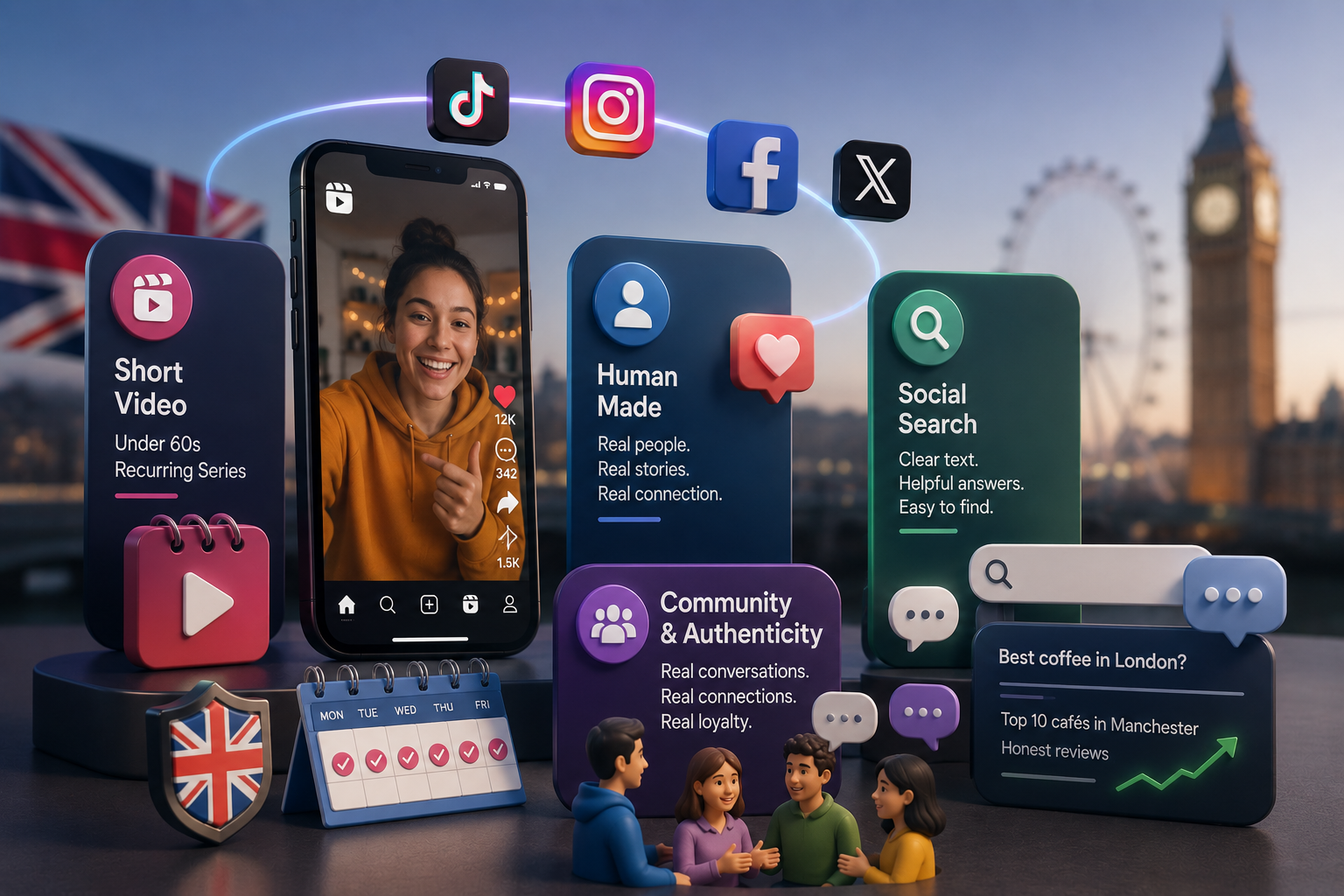 Knowing which platforms are growing only gets you halfway there. The bigger shift in the UK right now is in what kind of content earns attention once you’re on those platforms.
Short-form video under 60 seconds is still the format to beat. This is one of the clearest video marketing trends shaping 2026: it dominates across Facebook, Instagram, TikTok, and X, and it’s particularly effective when structured as a recurring series rather than a one-off post. Rather than reinventing your content idea every single time, UK audiences respond better to a familiar, “episodic” format they can follow week to week, the same way they’d follow a TV series.
Human-made content is winning trust back from AI-generated posts. There’s a clear disconnect in the UK market: many marketers are prioritising AI in social media marketing to scale faster, while UK consumers are saying, fairly clearly, that they want content that feels human. This doesn’t mean AI tools are off the table; they’re genuinely useful for research, captions, and scheduling, but the final content people actually see needs to feel like it was made by a real person, not generated to fill a calendar.
Social search is now a daily habit. Over 40% of UK consumers use social platforms to search for information at least once a day, and that number climbs even higher among Gen Z, who increasingly trust real people over traditional search engines for product reviews and recommendations. This is changing how content needs to be written. Using clear on-screen text in Reels, writing genuinely descriptive captions, and answering common questions directly in your posts all help your content surface when someone searches within the app itself, not just when the algorithm serves it.
Community and authenticity beat polish. Whether it’s a branded subreddit, an Instagram comment section, or a WhatsApp broadcast list, UK audiences are gravitating toward spaces that feel like genuine conversation rather than a broadcast channel. Brands that respond to comments, run honest Q&As, and show some personality behind the logo are consistently outperforming those still running a one-way content calendar.
Building an Instagram Marketing Strategy That Fits the UK in 2026
Since Instagram remains one of the strongest platforms for UK brand discovery and conversion, it’s worth getting specific about what’s working there right now.
Posting frequency matters less than it used to. Instagram’s own performance data show impressions growing even as reach and engagement on individual posts softened, suggesting the algorithm is favouring quality and watch time over sheer volume. A handful of well-produced Instagram Reels each week, paired with consistent Stories for everyday engagement, tends to outperform a rushed daily posting schedule.
Shoppable tags and in-app checkout features continue to narrow the gap between someone discovering your product and actually buying it, which is especially valuable for fashion, beauty, and home brands, where visual appeal does most of the persuading. If you’re newer to building a presence on the platform, working with UK-based micro and mid-tier influencers tends to deliver more authentic engagement than large-scale partnerships, since UK audiences are increasingly sceptical of content that feels obviously paid.
It’s also worth remembering that Instagram doesn’t operate in isolation. Most UK buyers move across platforms before converting, discovering a brand on TikTok, researching it on Reddit or Google, then following through on Instagram or WhatsApp. Building consistent messaging and creative across each of those touchpoints, rather than treating every platform as a separate silo, is what tends to separate brands that grow steadily from ones that get a short burst of attention and then fade.
Common Mistakes UK Brands Are Making Right Now
A few patterns keep showing up across UK social strategies that aren’t performing as well as they should:
- Assuming TikTok works for every brand, when in reality it’s strongest for visually engaging, fast-moving categories like beauty, fashion, and food
- Writing off Facebook as outdated, despite it still delivering solid reach and interaction growth among older UK demographics
- Leaning too heavily on AI-generated captions and visuals, which research suggests is actively eroding trust with UK audiences
- Posting inconsistently on Instagram instead of committing to a smaller number of well-made Reels and Stories each week
- Ignoring Reddit entirely, even though it’s currently the fastest-growing platform by ad audience in the UK and increasingly influences what shows up in AI search results
- Treating each platform as a separate strategy instead of building one consistent brand voice that follows the buyer across their journey
Final Thoughts
The biggest takeaway for UK marketers heading into the rest of 2026 is that growth isn’t necessarily happening where the industry conversation is loudest. Reddit’s quiet rise, Facebook’s steady reach among older audiences, and Instagram’s shift toward quality over quantity all point to the same lesson: success now comes from matching your platform choices and content style to where your actual audience spends time, not where everyone else assumes they should be. There’s no single answer to which social media platforms are best for business in the UK; it depends entirely on who you’re trying to reach.
If you’re managing this across multiple platforms and finding it hard to keep up with which trends are real and which are just noise, that’s exactly the kind of strategic work a dedicated team can take off your plate. Whether you’re working with a content marketing agency for blog and video assets or need help proving social media ROI to stakeholders, our social media marketing services cover everything from platform strategy and content creation to full social media management services, built around audience research rather than a one-size-fits-all posting calendar, so every piece of content earns its place in your feed.
Ready to build a 2026 social media strategy that’s actually backed by data?
Frequently Asked Questions
1. Which social media platform is growing the fastest in the UK in 2026?
Reddit currently has the fastest-growing ad audience in the UK, having recently added millions of new users and benefiting from increased visibility in AI-generated search results. Facebook and LinkedIn are also showing solid growth, particularly among older demographics and B2B audiences.
2. Is Facebook still relevant for UK marketing in 2026?
Yes. Facebook reach, impressions, and interactions have all grown in the UK over the past year, and it remains one of the strongest platforms for reaching Millennials and Gen X through community groups, local marketplace activity, and Messenger.
3. What type of content works best on UK social media right now?
Short-form video under 60 seconds, especially structured as a recurring series rather than one-off posts. UK audiences also respond strongly to authentic, human-made content over content that feels AI-generated or overly polished.
4. Should every UK brand be on TikTok?
Not necessarily. TikTok works best for visually engaging, fast-moving categories like beauty, fashion, and food, where short-form video naturally fits the product. Brands outside these categories often see better returns focusing on Instagram, Facebook, or LinkedIn instead.
5. How is social search changing UK marketing strategy?
A growing share of UK consumers, particularly Gen Z, now use social platforms to search for information daily rather than relying solely on traditional search engines. This means content needs clear on-screen text, descriptive captions, and direct answers to common questions to surface in social search results.
6. What’s the best way for a UK brand to start an Instagram marketing strategy in 2026?
Focus on a smaller number of well-produced Reels each week; use Stories for consistent everyday engagement; take advantage of shoppable tags for visual products; and consider partnering with UK-based micro-influencers, who tend to drive more authentic engagement than larger, less relatable accounts.

Devraj
 30th June 2026