Why Your Website Traffic Is Dropping After Google AI Overviews
-
By Devraj
-
21st May 2026
Quick Summary:
Many websites are seeing a drop in organic traffic because Google AI Overviews now answer many search queries directly in the search results. Users can often get a quick answer without clicking a website. This is especially common for informational searches such as “what is,” “how to,” “best way to,” and comparison-based queries.
This does not mean SEO is dead. It means SEO is changing. To compete in this new search experience, your content needs to be useful, structured, trustworthy, technically clean, and clear enough for both users and AI systems to understand. Google says the same SEO best practices still matter for AI features in Search, and there are no separate technical requirements for appearing in AI Overviews or AI Mode.
Want to recover lost traffic and prepare your website for AI search? Deftsoft can help you improve technical SEO, content quality, AI search visibility, and conversion-focused growth.
What Are Google AI Overviews?
Google AI Overviews are AI-generated summaries that appear in Google Search for selected queries. Instead of showing only the usual list of organic results, Google may now show a summarized answer at the top of the page. This answer is generated by AI and typically includes links to help users explore the topic further. Google describes AI Overviews as a way to help users understand complex questions faster and discover supporting information from across the web.
For users, this can be helpful. They search once and get a clear answer without having to open several pages. For website owners, it creates a new challenge. A page can still rank well, but the user may not click because the answer is already visible in the AI Overview.
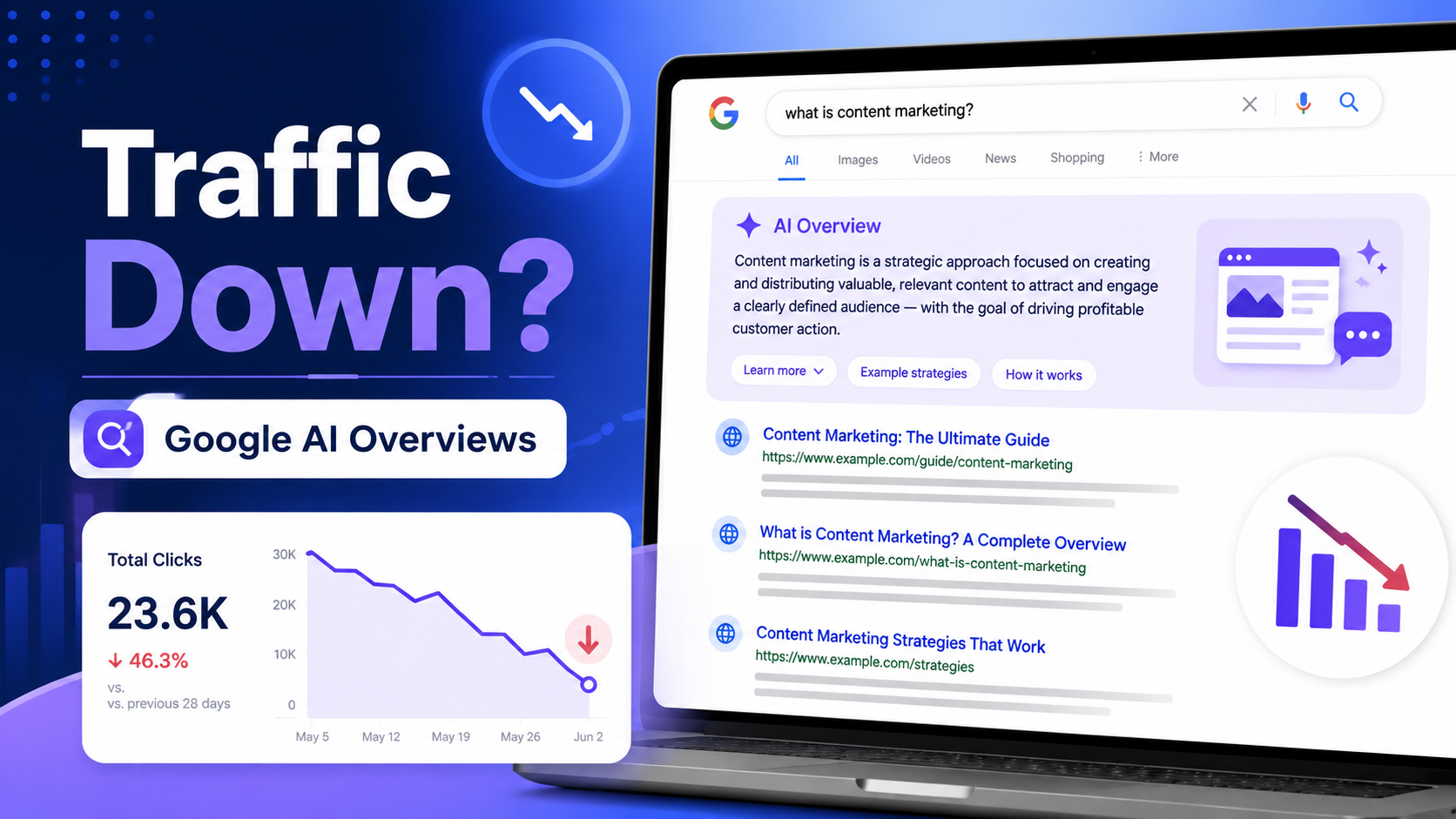
This is why many businesses now see a strange pattern in Google Search Console. Impressions may stay the same or even increase, but clicks and CTR may drop. That means your website is still being seen, but fewer people are visiting it.
Why Website Traffic Is Dropping After Google AI Overviews
Traffic drops are rarely caused by one single issue. In many cases, AI Overviews are only one part of the bigger change. Search result pages now include AI answers, ads, People Also Ask boxes, videos, forums, snippets, and brand-heavy results.
Here is a simple breakdown.
| Reason | What It Means | How It Affects Traffic |
|---|---|---|
| Zero-click searches | Users get the answer directly on Google | Fewer people click through to websites |
| Informational queries are exposed | Blogs and guides are more likely to trigger AI answers | Educational content may lose clicks |
| CTR is changing | Ranking high does not always bring the same visits | Your position may stay stable while traffic drops |
| Shallow content is easier to replace | Basic answers can be summarized quickly | Thin blogs may lose value |
| Search intent is shifting | Users ask longer and more specific questions | Old keyword strategies may not match new behavior |
A Pew Research Center study found that users who saw an AI summary clicked a traditional search result in 8% of visits. Users who did not see an AI summary clicked a search result nearly twice as often, at 15% of visits.
This explains the main issue. AI Overviews reduce the need to click for simple answers.
Ranking Number One Is Not Enough Anymore
In traditional SEO, ranking in the top position usually meant strong traffic. That is still true for many searches, especially commercial and local searches. But for informational searches, the pattern has changed.
Ahrefs reported that the presence of an AI Overview correlated with a 58% lower average click-through rate for the top-ranking page in its updated study.
This does not mean every website will lose 58% of traffic. The real impact depends on your industry, keyword type, search intent, brand authority, and whether your content is cited inside the AI Overview.
Still, the message is clear. You should not measure SEO success only by rankings anymore.
You also need to track:
- Click-through rate
- AI Overview presence
- Brand visibility
- Content citations
- Qualified leads
- Assisted conversions
Traffic is important. But in the AI search era, visibility and conversions matter just as much.
Is SEO Dead After Google AI Overviews?
No. SEO is not dead.
Google’s own guidance says SEO best practices remain relevant for AI features in Search. It also says there are no special requirements to appear in AI Overviews or AI Mode beyond normal Search eligibility and quality standards.
What has changed is the way search visibility works.
Earlier, SEO was mainly about ranking a page and earning a click. Now, SEO also includes being understood, trusted, cited, summarized, and selected by AI-powered search experiences.
This is where terms like AI SEO, AEO, and GEO come into the picture.
AEO means Answer Engine Optimization, while GEO means Generative Engine Optimization. Both focus on making your content easier for AI systems and answer engines to understand. But they do not replace SEO. They build on the same foundation.
Your website still needs:
| SEO Foundation | Why It Still Matters |
|---|---|
| Crawlable pages | Google must be able to access your content |
| Indexable content | Pages need to be eligible for search visibility |
| Helpful content | Users must find real value on the page |
| Strong internal links | Search engines need to understand site structure |
| Technical SEO | Speed, mobile usability, and clean code still matter |
| Clear headings | Users and AI systems need an easy-to-scan structure |
| Schema markup | Structured data helps search engines understand context |
| Trust signals | Google and users need confidence in your brand |
So the answer is not to stop doing SEO. The answer is to upgrade your SEO strategy for AI search.
How to Check If AI Overviews Are Hurting Your Traffic
Before making changes, look at your data carefully. Do not assume every traffic drop is caused by AI Overviews.
Start with Google Search Console. Compare your clicks, impressions, CTR, and average position before and after the traffic drop. If impressions are stable but clicks are falling, AI Overviews or other SERP features may be affecting click behavior.
If both impressions and rankings dropped, the issue may be different. It could be a content quality issue, technical SEO issue, an algorithm update, stronger competition, or an indexing problem.
Use this table as a simple audit guide.
| What to Check | What It Can Tell You |
|---|---|
| Clicks dropped, but impressions stayed stable | CTR may be affected by AI Overviews or SERP changes |
| Rankings dropped with clicks | Content or technical SEO may need review |
| Informational blogs lost traffic | AI summaries may answer the query directly |
| Service pages lost traffic | Check competitors, local SEO, page quality, and conversion intent |
| Leads stayed stable despite the traffic drop | Low-intent informational traffic may have reduced |
| Leads dropped along with traffic | High-value pages need urgent optimization |
You should also manually check your most important keywords. Search them in an incognito window and see what appears.
Look for AI Overviews, ads, featured snippets, People Also Ask boxes, Reddit threads, YouTube results, and competitor pages. This will help you understand what users see before they ever reach your website.
How to Rank in AI Overviews
There is no guaranteed formula for how to rank in AI Overviews. Google has clearly stated that its AI features are rooted in the same core Search ranking and quality systems. That means the focus should remain on helpful content, strong technical SEO, and a good user experience.
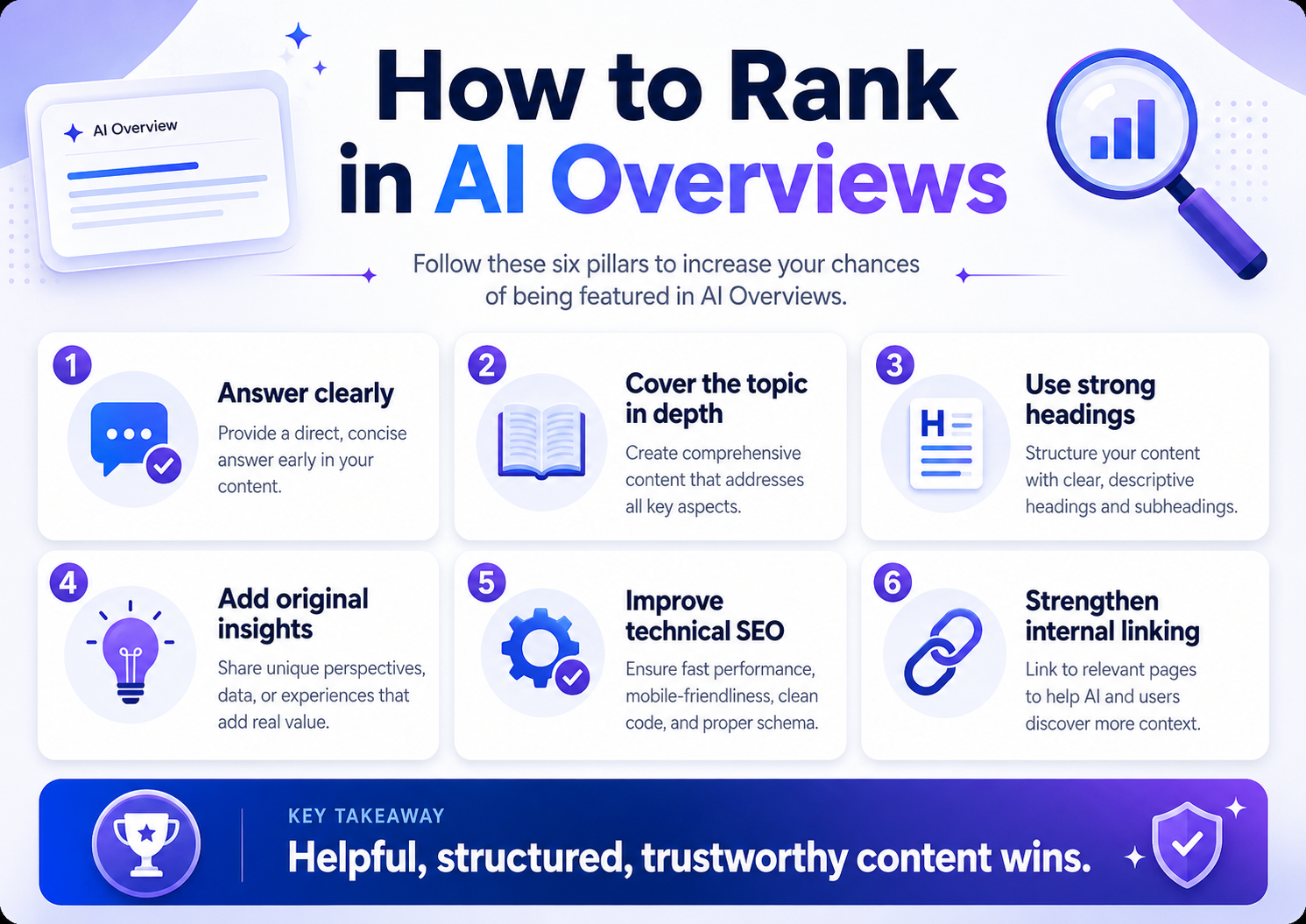
Still, there are practical steps you can take to improve your chances.
1. Answer the Main Question Early
Do not make users scroll through a long introduction before they get the answer. If your blog targets “how to rank in AI Overviews,” answer that directly near the top.
A good answer would sound like this:
“To rank in AI Overviews, create helpful and trustworthy content that answers the query clearly, covers related subtopics, uses strong headings, includes original insights, and follows technical SEO best practices.”
This helps both readers and search systems understand the page quickly.
2. Cover the Topic in Depth
AI Overviews often pull from content that explains a topic clearly. A basic 600-word blog with generic points may not be enough.
Your page should answer the main query and related questions. For this topic, that means covering why traffic drops, how AI Overviews work, how zero-click searches affect CTR, how to check Google Search Console, and how to improve AI search visibility.
Google’s guidance for AI search encourages unique, non-commodity content that satisfies real users, especially as people ask longer and more specific questions.
Depth does not mean adding fluff. It means giving complete, useful, and practical information.
3. Make Your Content Easy to Scan
Clear structure matters more than ever. Use H2 and H3 headings that match real user questions.
For example:
| Weak Heading | Better Heading |
|---|---|
| SEO Changes | Why Website Traffic Is Dropping After Google AI Overviews |
| AI Search Tips | How to Rank in AI Overviews |
| Content Update | How to Refresh Old Blogs for AI Search |
| Website Issues | How to Check If AI Overviews Are Hurting Your Traffic |
Better headings help readers scan the blog. They also help search engines understand the purpose of each section.
4. Add Original Value
AI can summarize basic information easily. So your content should offer more than common answers.
Add examples, expert insights, case observations, tables, comparisons, screenshots, checklists, and specific recommendations. If your page only repeats what every other blog says, it becomes easier to replace.
A strong page gives users a reason to click, stay, and trust the brand.
5. Improve Technical SEO
Even the best content can struggle if the website has technical problems. Google must be able to crawl, render, index, and understand your pages.
Focus on page speed, mobile usability, clean internal links, proper canonical tags, sitemap health, schema markup, and crawl accessibility.
Technical SEO is not separate from AI search. It is part of the foundation.
6. Strengthen Internal Linking
Internal links help Google understand how your pages connect. They also help users move from a blog to a related service page.
How to Update Old Blogs for AI Search
Many websites are losing traffic because their old blogs were written with traditional SEO in mind only. They may have the keyword, but not enough depth, structure, trust, or usefulness.
A good content refresh should not be limited to adding more keywords. It should improve the page experience.
Here is a simple content refresh table.
| Area to Improve | What to Add or Fix |
|---|---|
| Introduction | Add a direct answer and a quick summary |
| Headings | Use clear H2s and H3s based on search intent |
| Content depth | Add examples, tables, comparisons, and practical advice |
| Trust | Add sources, author details, updated dates, and proof |
| Internal links | Link to relevant service pages and supporting blogs |
| Schema | Add FAQ, Article, Breadcrumb, or Organization schema where relevant |
| CTA | Add a natural service-focused call to action |
| Readability | Use short paragraphs, simple language, and clean formatting |
The goal is to make the page more useful for readers and easier for AI systems to understand.
What Businesses Should Do Next
If your website traffic has dropped since Google AI Overviews launched, do not panic. Start with a proper audit.
First, identify which pages lost traffic. Then check whether those pages lost rankings or only lost CTR. This difference matters because the solution will not be the same.
If rankings dropped, you may need a content, authority, or technical SEO update. If rankings stayed stable but clicks dropped, you may need to improve your title tags, meta descriptions, content depth, and AI search visibility.
You should also check which competitors are being cited or shown more often. Sometimes your page is not weak. It is just not structured as clearly as the pages Google is choosing.
The goal is no longer only to rank. The goal is to become a trusted source that Google, users, and AI-powered search experiences can understand and recommend.
How Deftsoft Can Help
Google AI Overviews are changing the way users discover information and choose brands. Businesses that depend on organic traffic now need a more complete SEO strategy.
Deftsoft helps businesses improve visibility with:
| Deftsoft Service | How It Helps |
|---|---|
| AI SEO services | Improves visibility across traditional and AI-powered search |
| Technical SEO audits | Finds crawl, speed, indexing, and structure issues |
| SEO content strategy | Builds useful content around real search intent |
| Website optimization | Improves page quality, UX, and conversion performance |
| Web development services | Builds faster, cleaner, and SEO-friendly websites |
| Digital marketing services | Supports organic growth, paid campaigns, and brand visibility |
| AI and machine learning solutions | Adds smart automation and AI-driven features to digital platforms |
If your traffic has dropped after Google AI Overviews, Deftsoft can help you understand what changed, improve your content, close technical gaps, and build a strategy ready for the future of search.
Ready to recover lost traffic and improve AI search visibility? Get in touch with Deftsoft to build a smarter SEO strategy for the AI search era.
FAQs
What are Google AI Overviews?
Google AI Overviews are AI-generated summaries that appear in Google Search for some queries. They give users a quick answer and may include links to supporting websites.
Why is my website traffic dropping after Google AI Overviews?
Your traffic may be dropping because users can now get answers directly on Google without clicking through to a website. This is common for informational searches.
How do Google AI Overviews affect SEO?
Google AI Overviews can reduce organic CTR, change user behavior, and make it more important for brands to become trusted sources inside AI-generated search results.
How to rank in AI Overviews?
To improve your chances, create helpful content, answer questions clearly, use strong headings, cover related subtopics, improve technical SEO, add internal links, and show real expertise.
Do AI Overviews mean SEO is dead?
No. SEO is still important. But businesses now need to optimize for traditional rankings, AI search visibility, answer engines, and conversions.
What type of content is most affected by AI Overviews?
Informational blogs, definitions, how-to guides, comparison articles, and question-based content are often more likely to be exposed to AI Overviews.
Can schema help with AI Overviews?
Schema can help search engines understand your content, but it does not guarantee inclusion in AI Overviews. It should match the visible content on the page.
How can Deftsoft help with AI SEO?
Deftsoft can audit your traffic drop, refresh your content, improve technical SEO, optimize pages for AI search, and build a comprehensive SEO strategy to improve visibility.


Devraj
 21st May 2026