OpenAI’s Upcoming Phone: Why AI Agents Will Replace Your Mobile Apps
-
By Devraj
-
15th May 2026
Quick Summary
OpenAI has not officially announced a smartphone yet. However, recent reports suggest that the company may be exploring an AI-first phone powered by AI agents, custom processors, and deeper hardware integration. If this project becomes real, it could change how people use mobile apps. Instead of opening different apps for travel, shopping, payments, calendars, or messaging, users may simply ask an AI agent to complete the task for them. Apps may not disappear overnight, but their role could shift from front-facing tools to background services that AI agents use on behalf of the user.
Want to build an app that is ready for the AI-agent era? Deftsoft helps businesses create smarter web, mobile, and AI-powered digital solutions built for the next phase of user experience.
The Smartphone Experience Is Ready for a Change
The smartphone experience may be entering its next major phase. For years, users have relied on apps to complete everyday tasks. They open one app for shopping, another for travel, another for payments, and another for communication. But with AI agents becoming more advanced, the future of mobile app development may look very different.
OpenAI has not officially launched a smartphone yet. However, reports around an AI-first phone suggest a bigger shift in how users may interact with digital products. Instead of tapping through multiple screens, users may simply ask an AI agent to complete a task. This is why businesses are now looking more seriously at AI-powered mobile apps and smarter digital platforms.
This change is not only about smartphones. It is about the future of software. Businesses that depend on apps, websites, and digital tools may need to prepare for a world where users expect faster actions, better personalization, and fewer manual steps. That is where AI and machine learning can play a major role in creating more intelligent user experiences.
Is OpenAI Actually Launching a Smartphone?
This is where the topic needs careful wording.
OpenAI has officially confirmed its deeper move into hardware through its partnership with Jony Ive and the io Products team. OpenAI stated that the io Products team has merged with OpenAI, while Jony Ive and Love From continue to take deep design and creative responsibilities across OpenAI.
However, OpenAI has not officially announced an OpenAI smartphone.
The smartphone discussion is currently based on industry reports. Analyst Ming-Chi Kuo has reported that OpenAI may be working with Qualcomm, MediaTek, and Luxshare on an AI agent smartphone, with mass production possibly targeted for around 2028. Other reports also describe the project as being in an early stage.
So, the safest way to understand it is this:
OpenAI is officially moving deeper into hardware. A smartphone has not been officially confirmed, but reports suggest an AI-first phone may be part of its broader hardware strategy.
Why an AI-First Phone Would Matter
A normal smartphone is built around apps. Each app has its own interface, login, settings, notifications, and steps. Users must know which app to open and what action to take within it.
An AI-first phone would work differently. The AI agent would become the main interface. Instead of opening an app, the user would ask the agent to complete a task. The agent could then connect with different services in the background.
For example:
- You would not open a food delivery app. You would ask your phone to order your usual dinner.
- You would not open a travel app. You would ask your phone to find and book the best trip.
- You would not search through emails. You would ask your phone to find last month’s invoice.
- You would not open five apps to plan a meeting. You would ask your agent to schedule it.
In this model, apps still exist, but they may become less visible. They may work behind the scenes while the AI agent handles the user experience.
That is why this shift could be important for businesses, app developers, and digital product owners.
What Could an App-Less Smartphone Look Like?
Your original draft included a strong idea around an “app-less” smartphone. That idea works well if it is explained simply.
An app-less phone does not mean there will be no apps at all. It means users may not need to interact with apps in the same way.
A reported AI-agent interface could be built around sections such as:
| UI Area | What It Could Do |
|---|---|
| Home | Show useful updates based on your day, location, habits, and priorities |
| Actions | Show tasks your AI agent is working on, such as bookings, orders, reminders, or research |
| Memory | Store preferences, routines, past actions, and personal context |
| Inbox | Bring messages, alerts, updates, and confirmations into one place |
This type of interface would feel very different from the current app grid.
The phone would not simply wait for you to tap icons. It would understand your needs, suggest actions, and complete steps with your permission.
Apps May Become Background Services
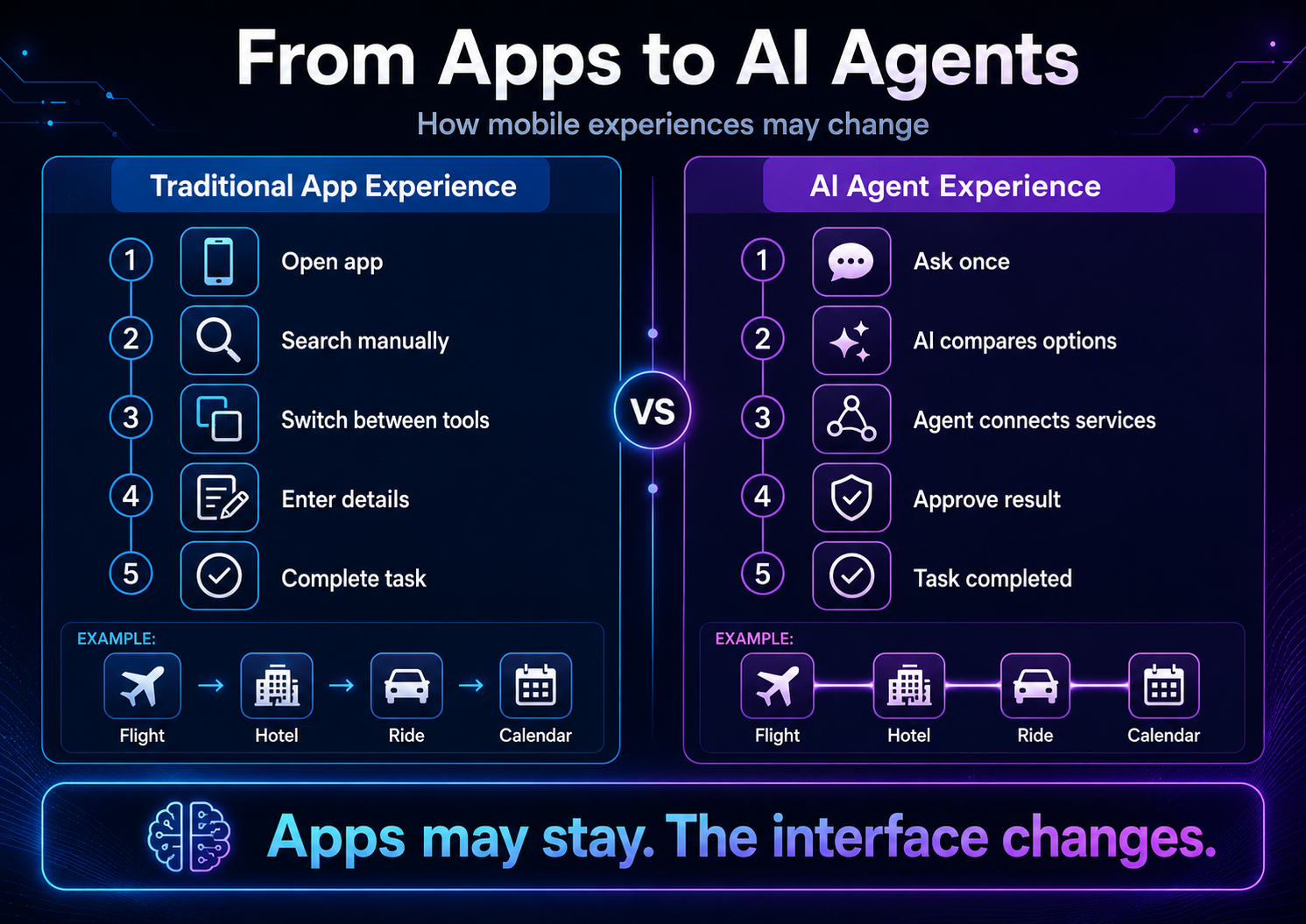
AI agents may not kill apps instantly. But they could reduce how often users open apps directly. For years, app design has focused on screens, buttons, menus, and user journeys. In the AI agent era, the focus may shift toward data, APIs, automation, and intelligent workflows.
Let us say a user wants to book a doctor’s appointment. Today, the user may search online, open a clinic’s website, check availability, fill out a form, confirm a slot, add it to their calendar, and set a reminder.
With an AI agent, the user may simply say:
“Book a dermatologist appointment near me for Saturday morning.”
The agent could check available clinics, compare reviews, confirm insurance or payment details, book the appointment, and add it to the calendar. The clinic still needs a digital system. But the user may not interact with it directly. The AI agent may interact with the system through APIs and structured data.
This means businesses need to think beyond traditional app screens. Their platforms must be ready for AI agents to access, understand, and use their services.
Why OpenAI May Want Its Own Hardware
OpenAI already has ChatGPT on mobile devices. So why would it need hardware?
The answer may be control.
Today, OpenAI’s apps run on platforms controlled by Apple and Google. That means OpenAI must follow app store rules, system restrictions, device limitations, and platform-level policies.
A dedicated device could give OpenAI deeper control over the full experience. This includes the hardware, operating system, AI model, sensors, microphone, camera, memory, and user context.
This matters because AI agents need context to work well.
A powerful AI assistant needs to understand your schedule, location, communication patterns, preferences, tasks, and permissions. On a normal smartphone, third-party apps have limited system access for security and privacy reasons. That is important, but it also limits how deeply an AI assistant can work.
With its own hardware, OpenAI could design the full experience around AI from the beginning. That does not mean it would be easy. Hardware is difficult. Privacy expectations are high. Users will need trust, transparency, and strong control over their data.
The Two OpenAI Hardware Tracks
It is also important to separate the two different hardware stories.
1. The Reported AI-First Smartphone
This is the device mentioned in recent analyst reports. It is said to involve Qualcomm, MediaTek, and Luxshare. The reported goal is to create a phone in which AI agents become the primary means for users to complete tasks. Reports suggest possible mass production around 2028, but the project is still not officially confirmed by OpenAI.
2. The Jony Ive AI Device
This track is official in the sense that OpenAI has confirmed the io Products team has joined OpenAI. The company is working with Jony Ive and LoveFrom on new AI hardware experiences.
Reports have suggested that this separate device may not be a traditional smartphone. Some coverage describes it as a new AI hardware category designed around more natural interaction rather than the usual screen-based phone experience.
Both tracks point toward the same larger trend. OpenAI wants to move beyond software alone and shape how people interact with AI in everyday life.
Learning From Failed AI Gadgets
AI hardware has not had an easy journey.
Products like Humane AI Pin and Rabbit R1 created a lot of excitement, but they also showed how difficult this market can be. Many users found early AI gadgets slow, limited, or awkward to use.
The problem was not only the AI. The form factor also mattered.
People already know how to use smartphones. They carry them everywhere. They trust them for payments, calls, messages, work, photos, and entertainment.
That is why an AI-first phone could have a better chance than a completely unfamiliar gadget. It would not ask users to learn a new behaviour from scratch. It would upgrade a device they already use every day.
The challenge will be performance. If the AI agent is slow or inaccurate, users will go back to tapping apps. For an AI-first phone to work, it must be fast, reliable, private, and useful in real situations.
What This Means for Mobile Apps
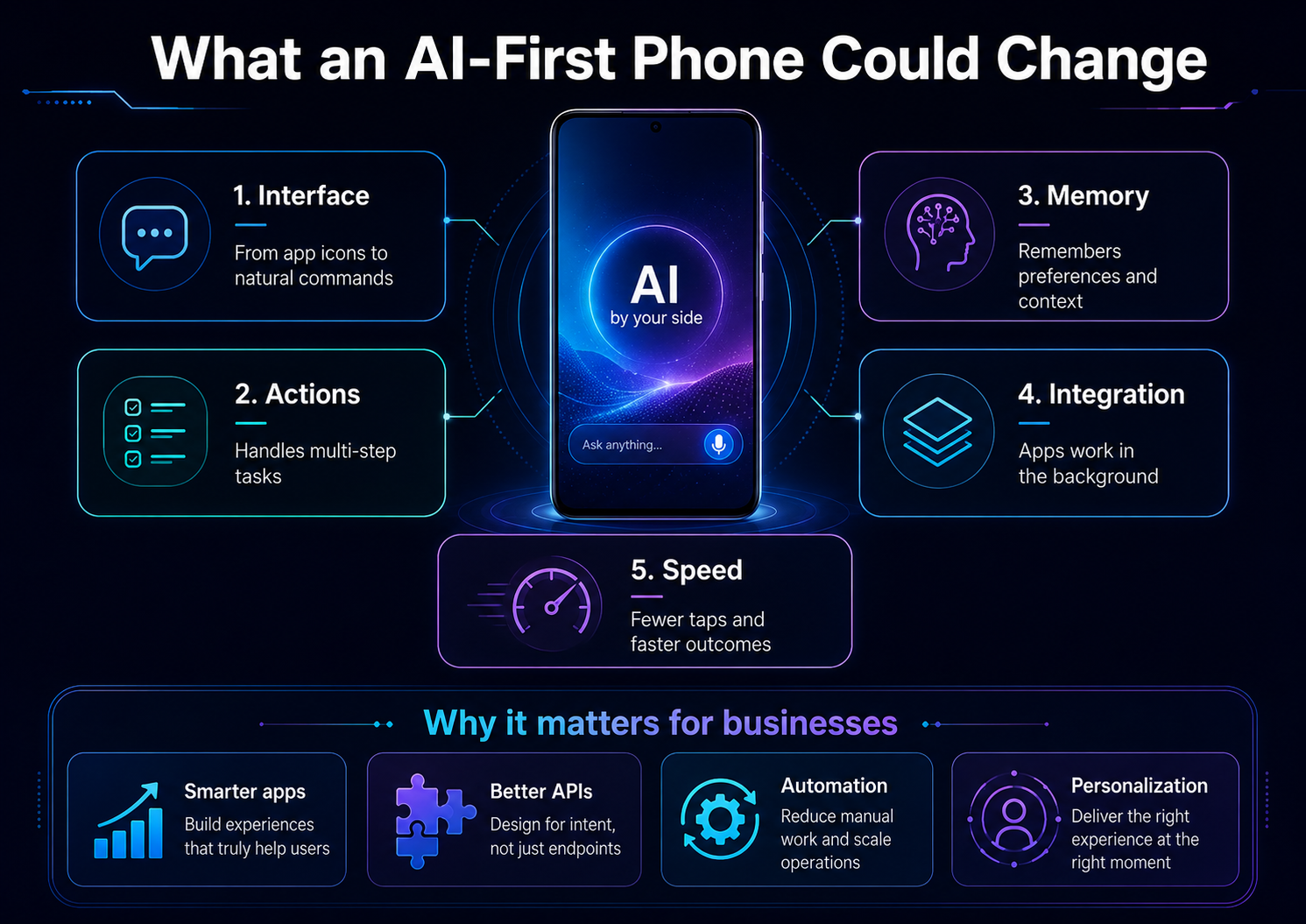
The biggest lesson is not that apps will vanish tomorrow. The real lesson is that apps must become smarter. Users will expect faster actions, less manual work, better personalization, and more natural interaction. They will not want to fill out long forms or repeat the same steps again and again.
Future-ready apps may need:
- AI-powered search
- Voice-based commands
- Smart recommendations
- Personalization based on behaviour
- Automated workflows
- Secure APIs
- Real-time data syncing
- AI chat support
- Task-based user journeys
- Strong privacy controls
This applies to almost every industry, including healthcare, travel, fintech, eCommerce, education, logistics, real estate, and professional services. If AI agents become the primary interface, businesses must ensure their apps and platforms can work with them.
The Bigger Shift: From Apps to Outcomes
The current app model is based on actions.
- Open the app → Search → Select → Fill → Confirm → Pay.
- The AI-agent model is based on outcomes.
- Tell the agent what you want. Review the options. Approve the action.
- That is a major shift in digital behaviour.
- For users, it means less friction.
For businesses, it means more pressure to build platforms that are connected, intelligent, and easy for AI systems to understand.
A basic app may not be enough in the coming years. Businesses will need digital products that support automation, structured data, AI-driven decisions, and seamless integrations.
Where Deftsoft Fits Into This Future
OpenAI may or may not launch a smartphone in the near future. But the direction is clear. AI agents are already changing how users expect digital products to work.
This is where businesses need the right technology partner.
At Deftsoft, we help companies build digital solutions that are ready for this shift. Our team works across mobile app development, web development, AI and machine learning, blockchain, automation, metaverse solutions, and digital marketing.
Whether a business wants to upgrade an existing app or build a new AI-powered platform, the goal should be simple. The product should be faster, smarter, easier to use, and ready for future integrations.
The next generation of apps will not just look good. They will understand user needs, automate tasks, connect with systems, and support real business growth.
Conclusion
OpenAI has not officially launched a smartphone. But reports around an AI-first phone show where the industry may be heading.
The future of mobile technology may not be built around opening one app after another. It may be built around AI agents that understand what users want and complete tasks for them.
Apps will still matter. But their role may change. Instead of being the main destination, apps may become powerful service layers that AI agents use in the background.
For businesses, this is the right time to prepare. The companies that start building AI-ready apps today will be better positioned for tomorrow’s digital behaviour.
Ready to build an app for the AI-agent era? Connect with Deftsoft to create AI-powered mobile apps, web platforms, automation systems, and future-ready digital products built for real business growth.
FAQs
1. Is OpenAI officially launching a smartphone?
No. OpenAI has not officially announced a smartphone. The latest information comes from industry reports suggesting OpenAI may be exploring an AI-first phone.
2. What is an AI-first smartphone?
An AI-first smartphone is a device in which AI agents are the primary way users complete tasks. Instead of opening separate apps, users may ask the phone to take action for them.
3. Will AI agents replace mobile apps?
AI agents may not completely replace apps. But they could reduce the frequency with which users open apps directly. Apps may work more in the background.
4. Why would OpenAI build hardware?
OpenAI may want more control over the full AI experience, including hardware, software, sensors, privacy, and system-level context.
5. How should businesses prepare for AI-agent technology?
Businesses should build apps with strong APIs, automation, AI features, secure data handling, personalization, and simple user journeys.
6. Can Deftsoft help build AI-powered apps?
Yes. Deftsoft helps businesses build AI-powered mobile apps, web platforms, automation tools, and future-ready digital solutions.





Devraj
 15th May 2026